An article entitled “More and more women elected as village committee heads” appeared in the China Daily on 6 March 2007, introducing 20 women who had been elected on to village committees in the recent elections in Heyang 合阳 county, Shaanxi province.Footnote 1 On the same day, Shaanxi's most popular newspaper ran a front page story on the “Heyang phenomenon” (Heyang xianxiang 合阳现象), and following this eight government units and a women's civil organization jointly held a “Forum on women village officials and new rural construction” (Nü cunguan yu xin nongcun jianshe luntan 女村官与新农村建设论坛) in Xi'an. With 100 rural women cadres and government officials present at this meeting, “women village officials” suddenly became a hot topic, following previous years’ publicity about “women's specialized households” and “township and small town women entrepreneurs.”
The village officials in question were women who had become village committee heads and members of village Party committees.Footnote 2 Unlike leading women cadres within the formal structures of the political system, they owed their positions not to nomination by upper levels of Party and government leadership but to participation in fiercely competitive elections. They were no longer assistants (fushou 副手) to male leaders but leading participants (yibashou 一把手) in village and Party committees still overwhelmingly dominated by men. They were China's “smallest” officials, but with responsibility for the development of economic and cultural life in villages with populations of up to several thousand people, were the true leaders of rural community development.
The public appearance of this group of women challenged both the traditional gender division of labour and entrenched ideas about women in rural areas. Shaanxi had been the seat of 13 capitals during China's dynastic history, and with a deeply embedded patriarchal culture, the idea that women might take leading positions in the local community went far beyond ordinary people's imagination. In the fifth village elections in 2003 in Shaanxi province, only 184 women were elected as village heads, a mere 0.6 per cent of the total. By the sixth elections in 2006 the number had almost doubled, and by the seventh elections in 2009 it had increased to 544. Together with the women on village Party committees, there were now 1,193 women village officials throughout the province, 4.5 per cent of the total. Their activities and trajectories had an impact on the gender division of labour and gendered spaces of social activity that far surpassed the numbers alone.
How was it that within the short space of five years, the number of women village officials could increase in this way? The experience of this group of women was quite different from that of their activist predecessors because it was the result of a grass-roots movement for women's political participation rather than the vertical command system of the central government. The promoters of the movement were from a civil organization called the “Shaanxi Research Association for Women and Family” (Shaanxi funü lilun hunyin jiating yanjiuhui 陕西妇女理论婚姻家庭研究会, hereafter abbreviated as the Shaanxi Research Association for Women, or the Research Association).Footnote 3
The Research Association was set up in 1986 as a social organization of women intellectuals committed to confronting the increasingly complex issues facing women as a result of economic reform. It initially defined itself as an organization to conduct and publicize academic research, but in the mid-1990s under the influence of the international feminist movement, its orientation shifted towards “action research,” with the aim of promoting change in gender relations and gender equality at grass-roots level through the spiral process of “research-action-research-action.”Footnote 4 A grass-roots movement began in 2004, becoming the Research Association's main focus of action research. The Association now has more than 130 members, including 23 professionals and more than 100 long-term volunteers.
Background and Methods
The responsibility system that began the process of rural economic reform in the late 1970s resulted in rapid transformation of the rural social economy. It also transformed what in the 1950s had been early signs of the feminization of agriculture into a general phenomenon. Low rural incomes signified a double marginalization of women, and in the western areas of Shaanxi poverty became another name for women, drawing the attention of the developed world. In the early 1990s, new theories about women, gender and development introduced into China through international exchanges and support found a ready audience in the idealistically minded women of the Research Association, and, long committed to rural community development, they transformed the Association's approach to one of “action research.”
The sites the Research Association selected for its community development projects were all in poor districts (pinkun diqu 贫困地区), and premised on the needs of the community, its projects focused on issues such as birth planning, health, education, infrastructure, disaster control and prevention, and community organization. The basic principles were shaped by a commitment to participation, empowerment and gender awareness. Each project started out in response to the practical gender needs of the community, and throughout its implementation emphasized the participation and empowerment of women and poor people, consciousness raising and capacity building. Projects did not make any direct intervention in issues of women's political participation before 2001. It was thought that although women's involvement in policy-making and public affairs was an important target, this had to be supported by certain levels of experience and ability. Asking women without the appropriate abilities to participate in village committees would merely scratch the surface of the complex issues involved. It was therefore decided to prioritize capacity building from below, and devote energy to nurturing activists and organizations.
To this end, extensive basic-level work was undertaken, including diverse training activities in gender issues, women's leadership skills, participatory community planning, community organization and management, all aimed at supporting village women to set up small groups for community activities and stimulate their interest in community affairs. A group of women activists was also trained in the project sites. Two problems emerged. One was that not enough women wanted to participate, and their reluctance or inability to enter into community decision-making processes made it difficult to bring gender issues to communities’ attention. The other was that encouraging women activists to take part in village committee elections revealed that community resistance and women's anxieties were much more complex than we had previously imagined. Far from being a simple effect of inadequate local understanding about the importance of women's representation and of women's deficiencies in experience and capacity, the main problem lay in enabling women to overcome their own misgivings about complex clan relationships, relationships with husbands and local cadres, and family resistance. For example, one woman with a high reputation in her village and whom the villagers had already indicated they wanted to elect as village committee head, was adamant in her refusal to stand for election. Her household income relied solely on the farming land contracted to her and her husband and a small flour processing mill, the management of which she was responsible for since her husband suffered from poor health. With two young children at primary school, she had no time or energy left to look after village affairs as well as her own family.
Women's participation in public affairs is both an aim of and a strategic method for achieving gender equality. Enabling more women to sit on village committees and take part in public policy-making and governance thus became a key issue in the Association's research on gender rights in local communities, and in 2001 became a formal part of a project on rural community development that the Association had been developing since 1998.Footnote 5
In the mid-1980s, China started to implement a system of village self-government involving direct elections to village committees, administrative self-management and self-management in education and services. The national Organic Law on Villagers Committees was formally passed in 1998, following which the percentage of women members of village committees dropped. National figures for 2003 showed that women formed no more than 16 per cent of village committee membership, and of those only 1 per cent were heads and deputy heads. The figures for Shaanxi province were even lower. The 11,061 women who were elected as village officials in the fifth elections in 2003 were 9 per cent of the total, 7 per cent lower than the national average and 1 per cent lower than in previous years. Totalling no more than 183, women village heads constituted only 0.6 per cent of village heads throughout the entire province.
A visit to India by members of the Research Association broadened their vision in two main respects.Footnote 6 One was in seeing the influence of laws and policies. The revisions of point 73 of the 1993 Indian Constitution had significant effects on women's political participation, and the proportion of women in leadership positions at the basic level rose to one third. This led the Research Association to rethink its previous strategy, and to wonder whether, in addition to the community work of basic level mobilization and capacity building, it would be possible to put energy into promoting policy change and to combining top-down with bottom-up methods. It also led to a reconsideration of the relationship between women's capacities and political participation. In the early period following constitutional change in India, not all women elected to office were able to take up their posts. A cartoon poster of the time depicted a man holding up a sign showing a woman chairing a meeting; the message that elected women were still controlled by men was clear. The members of the Shaanxi Research Association met many village women leaders in different parts of the country, all of whom were extremely lively and able, and strongly supported by their local communities. This made the visitors reflect on whether women should first be given a stage on which to practise and develop their skills, or whether they should develop those skills before taking to the stage. India's successful example suggested that both were necessary, but that the first was possibly more important given that ability can only be fostered through practice.
After the India trip the Association decided to adopt the approach of “walking on two legs” to promote women's participation in basic-level governance, on the one hand sticking to its previous approach of empowering rural women through a bottom-up strategy, and on the other beginning to influence policy and mobilize society through encouraging and training more women to move into the key centres of village power and thus bring the issue of gender into the work of the village committees. The methodological and theoretical approach adopted was based on the concept of “action research” developed in feminist theory and elsewhere, because it offered a way of transforming book-based women's studies into a rich and active force of social intervention and change.Footnote 7
There are many complex reasons explaining the low numbers of women village cadres since the introduction of village self-government (zizhi 自治). However, three main reasons stand out. The first concerns the weakness of relevant policies and laws. The Organic Law on Villagers Committees and the Law on the Protection of Women's Rights note only that “there should be an appropriate quota” for women sitting on village committees. Such terminology does not have sufficient impact to influence either local government officials’ or villagers’ attitudes. Secondly, the deep influence of patriarchal structures and practices of marriage and lineage relationships means that women lack adequate social capital to compete in village elections. Various factors seriously disadvantage them in comparison to men. Under China's customary practice of “men bring in wives, women marry out” (nan qu nü jia 男取女嫁) or village exogamy (cunwai hun 村外婚), most women leave their natal villages when they marry, meaning that they lose the social relationships and networks they accumulated before marrying and have to build up new ones in the strange environment of their mothers-in-laws’ houses. The system of patrilineal kinship still exercises considerable authority in the countryside, making it easy for men competing in the elections to obtain votes from their relatives. Moreover, traditional patterns of gender relations make many villagers unwilling to accept women as their leaders and managers. Finally, the traditional gender division of labour according to which “men rule the outside, women rule the inside” (nan zhu wai, nü zhu nei 男主外女主内) limits the extent to which women participate in village public affairs and the opportunities they have to develop and demonstrate their abilities. Many women are also unwilling to take part in village elections because they are anxious about local gossip, whether or not their families will support them, and their capacity to take on the double burden of village and domestic work. As a result, many women with great potential decide not to go forward to take their chances in elections. To change this situation, the Research Association's project had to address policy, capacity building, publicity and social mobilization.
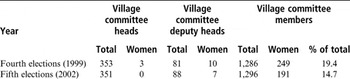
Heyang county was selected as the project site because of its representative qualities. Situated on the northern banks of the Wei 渭 River, it is densely populated, with twelve small towns, four townships and 351 administrative villages. It is largely agricultural, and is classified as a “poor county,” with a rural population of 394,000 constituting 90.9 per cent of its total. Its labouring women number 170,000, 51.4 per cent of the county's total labour force. Weinan 渭南 municipality, in which Heyang county is situated, is the most densely populated of the province's lower-level and mainly agricultural municipalities. All these factors offered possibilities for the future promotion of the project. At the same time, Heyang county already had a good record for work on women's political participation, and the provincial Women's Federation had publicized its experience during the fourth village committee elections in 1999. However, the rate of women's political participation fell in the fifth elections in 2002, and about half of the village committees in the county had no female membership (see Table 1). Hence a second reason for its choice was the hope that the Research Association could influence the level of women's political participation.
Comparison of Women Elected to Village Committees in the Fourth and Fifth Elections

A third reason was that the Women's Federation in Heyang county had previous experience of carrying out relevant projects. Between 2001 and 2002, the Research Association was funded by the Dutch Embassy to carry out a project on “Establishing a socially supportive environment to oppose domestic violence at county and township levels,” part of which consisted of giving gender training to leaders from the county's Women's Federation, government and some small towns and townships.Footnote 8 The participatory methods developed in this training sought to encourage women to reflect on their individual experiences and understandings of gender, with the aim of developing a critical awareness of how gender influences individual and social development, and how the formation of social knowledge, allocation of resources and social structures are rooted in the reproduction of gender discrimination and inequality. Having gone through such training, a number of people were therefore already very aware of gender issues. The Association then found support from the Global Women's Fund to train nine Women's Federation cadres, most of whom had already gone through gender training, and four others who had had independent experience of gender training, as facilitators. The Women's Federation conducted a county-wide survey about women's political participation after the fifth election, and hoped to co-operate with the Shaanxi Research Association in encouraging more women to enter the village committees in the 2005 elections.
Process and Results
There were four stages to the Association's action research project. The first, between 2004 and early 2006, aimed to take advantage of the sixth village elections in 2005 to encourage more women to participate in the elections, and particularly to increase the percentage of women village heads. The main site for this was Heyang (though the project extended to Hanzhong 汉中 and Ankang 安康 municipalities at a later date) so this stage was described as the “creation of the Heyang model.” The second stage began in 2006, and sought to improve women's administrative abilities through bringing gender and good governance into village management and “new rural construction,” concentrating on Heyang and Weinan. The third stage in 2008 saw increased co-operation with the provincial Women's Federation, to promote Heyang's experience across the province and to increase the percentage of women village committee members during the seventh elections. The fourth stage began in 2009, and aimed at expanding the channels for women to participate in basic level governance through a shift in focus from the village committee to the township people's congress, the organization of village economic co-operation and the internet. Corresponding with the general principles of action research, the plans and actions undertaken at each stage were designed on the basis of assessments of the previous stage, and sought to incorporate the resulting findings in addressing new problems as they arose.
Stage 1: Creation of the Heyang Model
In August 2008, the Research Association obtained funds from the Ford Foundation for a 20-month “Pilot project to increase the proportion of women elected as village committee members.” The project was led by the Shaanxi Research Association for Women, in collaboration with the Shaanxi province and Heyang county Women's Federations. Its main aims were to increase by 10 per cent the proportion of women on village committees and to reduce gender inequalities by increasing awareness about women's political participation, undertaking capacity building, and improving the policies and social environment for women's participation in village committee elections. Specifically, its aims were to train 20 local women to take on the responsibilities of gender training; train 150 women activists who understood gender issues, had knowledge of the laws on village elections and had leadership skills; establish a supportive environment and formulate policies advantageous to women's election as village committee members; and strengthen women NGOs’ experience in promoting rural women's participation in elections in order to publicize this on a broader scale. To promote these aims, the Research Association undertook to develop close collaborative ties with the provincial Women's Federation, and on the basis of such collaboration to call for a quota of women to serve on the village committees.
Collaboration with the provincial Women's Federation
Before discussing the Research Association's attempts to establish a quota, this section sets out the processes initially involved in finding a common ground with the Women's Federation. Following the reduction of women on village committees after the Organic Law on Villagers Committees was passed, the National Women's Federation issued a document on the matter. However, the local levels of the Federation did not give it much attention, perhaps because of their inadequate understanding of “village self-government.” The Research Association discussed the issue with the Heyang county's Women's Federation, to which it entrusted the task of carrying out an investigation into the situation of women elected in the fifth village elections. The report that emerged from this investigation provided the basis for the design of the Heyang project. In September 2004, after obtaining approval from the Ford Foundation, the Association approached Liu Lige 刘丽鸽, chair of the provincial Women's Federation, with a view to obtaining provincial level support. She was extremely encouraging, and agreed to include the report as a matter of importance in the 2005 plan of the provincial Women's Federation.
Three factors explain Liu's support of the project. The first was that before she became the chairperson of the provincial Women's Federation in 2002 she had been deputy mayor of Weinan municipality, so had rich experience of basic-level administrative and political work. She was extremely diligent, studious and decisive, and focused on obtaining clear and sustainable results. She was already familiar with such concepts as civil society and non-government organization, and realized that the work of the Research Association could be seen as an aspect of the Women's Federation's work. She also liked the Association's innovative and practical style. All this facilitated closer co-operation with the provincial Women's Federation once she took over as chair. The second factor concerned the long-term budgetary constraints of the provincial Women's Federation. Since the early 1990s, the Federation had become accustomed to applying for funding from international aid organs, and successive chairs tended to support projects that were most likely to obtain funds. Thirdly, the author was deputy director of the Research Office of the provincial Women's Federation and hence in effect a leading cadre even though she had no formal position, so could use her position to promote co-operation.
Despite its support of the project, the provincial Women's Federation was initially unclear about what it should do. The Association therefore organized the various parties involved to go on field visits to Hunan and Tianjin to learn from the experience of some successful projects. These included the Party committee secretary of the Women's Federation with responsibility for the project, the leaders of the policy research office of the provincial committee (the leader of the Civil and Administrative Affairs Office was too busy to attend), and the main leaders of Heyang county.
Calling for a quota system policy
The main function the Research Association wanted the Women's Federation to fulfil at this stage was to persuade the Civil and Administrative Affairs Office (Minzheng ting 民政厅) to produce a document that would benefit women in the forthcoming elections, such as stipulating a proportion of women to be elected. With this in mind, Liu Lige was persuaded to take the initiative in approaching the CAAO, the head of which agreed to issue a communication (tongzhi 通知) on strengthening women's political participation together with the provincial Women's Federation and possibly the Organization Department of the Provincial Committee. Liu asked the Research Association to draw up the draft document, and to discuss it with the Organization Department of the provincial Women's Federation and the CAAO.
The quota system is a common means used internationally to increase women's participation in policy-making. As a civil organization, the Research Association was fully aware of its limitations in influencing policy, and joining forces with the provincial Women's Federation to encourage the provincial CAAO in charge of village elections to approve a clear quota system was by no means a straightforward matter. At first, the leaders of the CAAO disagreed with the idea of a quota system on the grounds that it violated principles of fairness, and that protecting women's rights in this way would impair men's candidature.
After several discussions with the CAAO leadership to introduce them to the basic theory and rationale of the quota principle, finally, four drafts later, the Organization Department of the Provincial Committee, the provincial CAAO and the provincial Women's Federation issued a document on “Suggestions for good practice in promoting women's participation in the work of village Party organizations and village elections throughout the province” (Guanyu zuohao quansheng cunji dang zuzhi he cunweihui huanjie xuanju gongzuozhong funü canxuan canzheng gongzuo de yijian 关于做好全省村级党组织和村委会换届选举工作中妇女参选参政工作的意见, Shaanxi Women's Federation, Document 25). This signified a step forward, despite a few points with which the Research Association was not entirely satisfied. The CAAO still refused to agree to the wording that “each village committee must have at least one woman” and changed it to “each village committee should propose having one women member.” In the end, the Association had no choice but to compromise.
The document set out three targets for women's participation in the forthcoming sixth village elections: each village should have women candidates, and each village committee should propose having one female member; there should be no fewer then three women heads of village committees in each county (district and municipality), and in relatively developed and densely populated counties (districts and municipalities) there should be no fewer than five; and the proportion of women elected as village representatives should be no less than 25 per cent. There were also procedural proposals to protect these targets: the Women's Federation should participate at all levels in the small groups leading the elections; at least one woman should be a member of the village electoral committee; and the Shaanxi Research Association's and the Shaanxi Women's Federation's Heyang county project should be written into the document as the pilot project for promoting women's political participation throughout the province.
Spurred on by Document 25, the Organization Department, the CAAO and the Women's Federation of Heyang county circulated it, but with raised targets: each village electoral committee should have one female participant; each village should put forward female candidates at the elections and at least one female member should be on each village committee; each small town and township should endeavour to have one woman village head; and the percentage of women elected as village representatives should be no less than 30 per cent.
The Association also held training courses on “gender and village self-government” for relevant small town and township leaders and CAAO and Women's Federation cadres. Starting out from the premise that village autonomy required a significant measure of female representation on the village committee, the main aim of this training was to increase cadres’ understanding of the gender issues involved in increasing women's political participation, and to strengthen their capacity to implement the new policies. Basic-level cadres invariably thought that the low number of women on the village committees was a reflection of women's “deficiences in quality and ability” (suzhi cha huozhe nengli di 素质差或者能力低), so in providing gender training it was hoped to change these views through emphasizing the significance of gender as an analytical tool.
The training was structured around three main components. The first addressed the importance of women's participation in village self-government from different perspectives, including the macro aim of sustainable development and building a harmonious society, the promotion of political democracy and human rights, the basic national policy of gender equality, and the current situation of women's participation in village self-government. The second main component examined the main factors influencing women's participation in village self-government and introduced gender theory as a “new analytical perspective.” This included discussion about the gender division of labour and gender biases limiting women's participation in elections, the inadequacy of resources and opportunities to support women's participation, and the policy weaknesses hindering women's participation. It also queried the “quality doctrine” (suzhi shuo 素质说). The third component addressed the issue of how to raise the proportion of women on village committees, focusing on the legal aspects of the electoral system and how to guarantee an “appropriate proportion” of women; the quota system; international experience and tendencies in promoting women's political participation; social mobilization to raise public awareness of the importance of women's political participation; and capacity building to improve women's enthusiasm and capacity for political participation.
Overall responses to the training courses were positive. Feedback indicated that they conveyed a lot of useful information and novel and original ideas and clarified a number of mistaken ideas. The courses’ introduction to international experience was particularly helpful since in opening up new perspectives it contributed to a broader and stronger recognition of the importance of women's participation in the elections. In all, the courses made a valuable input to the Association's efforts to promote women's participation.
Training the electoral potential of women activists
The main rule of the game in democratic elections is the “survival of the fittest.” Being able to draw on a group of women who were enthusiastic about participating was therefore the basic premise for increasing the proportion of elected women. A main point of difference between the Research Association and the CAAO cadres was, as noted above, the CAAO's view that the low proportion of women participating in the elections was mainly because of their lack of ability and “poor quality.” One of the Association's most significant interventionist strategies was therefore to identify women with potential who would welcome training to increase their commitment and self-confidence.
The Research Association invited a number of highly trained specialists to collaborate in organizing sessions to train facilitators for the gender training sessions, and drawing on its previous experience it issued a series of participatory training materials on raising gender awareness and self-confidence, knowledge about village self-government, and electoral skills. It also organized five three-day participatory training sessions for 255 women activists selected by their communities as having electoral potential. A full description of this process would merit another article, so the following is just a brief description of the main aspects.
The courses the Association provided were organized around a series of activities designed to achieve three objectives. The first was to enable the participants to recognize that the reasons for the low number of women standing for village elections had nothing to do with their ability but were the result of traditional ideas about gender. The second was to raise women's self-confidence to participate in competitive elections, and the third was to explain the procedures of democratic elections and strategies for participating in them.
The courses were divided into a number of units. After an introductory warm-up session, the second unit addressed the need for and significance of women's representation at village level, including a gender analysis of the barriers faced by women and global tendencies concerning gender equality in governance practices. The third unit examined ideas about women's capacities and good practice as a village official, as well as relevant laws and policies. The fourth discussed preparations for the elections, including the principles, procedures and challenges of democratic village elections. This unit also addressed the need for women to seek support and solidarity, asking the participants to consider how they might persuade their husbands, mothers-in-law, sons and daughters to support them. The final unit asked each participant to draw up an action plan for participating in elections to discuss with the group as a whole.
The sessions were targeted at women the Women's Federation identified through a rigorous selection process as having the potential to participate in elections for the village headship. They were mainly between 30 and 50 years old with middle school education or above, and most had some experience as head of the village Women's Congress or other village positions. Some were “able women who had become rich” (zhifu de nü nengren 致富的女能人), in other words women who had used their talents and skills to become prosperous; others were village doctors, local school teachers and so on. Their responses were extremely positive and most women left the courses motivated to give the elections a try.
The effectiveness of these training courses depends on various elements, including their clarity of design, content and objectives, all of which require extensive investigation and research. The courses included diverse participatory activities designed to dispel women's sense of inferiority and increase their self-confidence.Footnote 9 For example, a small-group activity asked them to imagine the kind of qualities and capacities they associated with an “able woman” (nü nengren 女能人) and with a good village head, and their ideas about the differences between the two. Discussions were invariably heated, but always came to the same conclusions, namely that the reasons explaining the low numbers of women village heads lay in widespread gender discrimination. Men always felt that women “were short on vision” and women were unable to gain their families’ support; women tended to look down on themselves and had too many responsibilities.
No comprehensive survey has yet been undertaken to find out how many of the women participating in these training sessions were successful in village elections. However a few cases show that success also depends on women's personalities and personal circumstances, and the intricate network of social relationships in their village communities. Being able does not necessarily guarantee success in elections, any more than attending training courses does. Having conducted several such training courses, my view is that their results hinge on being able to find women who have real potential as well as being co-operative and committed. Overall, however, the training proved to be immensely valuable in preparing women for the elections. For years, ever since the introduction of the agricultural responsibility system, rural women have rarely been offered the opportunity to take part in any kind of training. They have, in effect, been denied a public voice. The training the Association offered these women gave them a profound sense of recognition, and revived desires to demonstrate strengths and talents that had long been inhibited. Though these women had never before even imagined that they might become members of the village committee, they now showed a keen interest in competing in the village elections. Providing gender training proved to be an excellent way of preparing the human resources to increase the proportion of women elected in Heyang's sixth village elections.
Social mobilization and public education
One of the main reasons explaining women's lack of interest in political participation is that being an official has long been seen as a male occupation. As noted above, women were often worried that they would not be supported by their families and communities in competing in the elections. Indeed, they were often afraid that they would be ridiculed. Hence the Research Association's third strategy of intervention was to build up a social environment conducive to women's participation in the elections.
The Communist Party and the Women's Federation have long and rich experience of mass work and social mobilization, and the Heyang Women's Federation could build on this to create a social environment to support women's political participation. It used the popular local dramatic and operatic forms to compose a 90-minute long local opera on “Women participating in politics” which performed in 16 towns and townships to more than 20,000 people. It produced 3,000 posters featuring the theme of women's political participation, which were publicly displayed in every village of the county. It used radio, television, newspapers and blackboards in a dynamic and extensive series of publicity activities, including a special television feature, and banners and slogans about women's political participation that were broadcast on television for 18 consecutive days.Footnote 10 Overnight, women's competition for the post of village head became the talk of the town, and had a considerable effect in reducing local resistance and changing villagers’ traditional views and prejudices. A number of husbands, mothers-in-law and village cadres who had not previously supported women's participation changed their attitudes, and many women were encouraged to stand for election, in one case as a direct result of these mobilization efforts.Footnote 11
Family resistance to women becoming involved in political activities had not basically changed since the situation in the 1950s. Many husbands and mothers-in-law did not like women to appear to be stronger than men, were worried about gossip, and were afraid that women's involvement in public responsibilities would leave the household with no one to do the necessary domestic tasks. In using the forms of social mobilization described above, the Association did not seek to change these attitudes entirely. Rather, it hoped to create a social atmosphere to encourage women to participate in village elections and through this diminish family resistance.
Direct results
An unprecedented 20 women in Heyang county were elected as village officials in the sixth village elections of January 2006. In addition, 324 women were elected as village committee members, constituting 25.2 per cent of the total, 10.5 per cent more than during the previous election (Table 2). Nearly all villages (92 per cent) had women village committee members, an all-time high and 36 per cent higher than after the fifth elections. This experience also inspired more women to participate in the village Party branch elections, and in 2006, 16 women were elected as Party secretary of village Party branches in Heyang county, 4.6 per cent of the total. Three of these women were also elected as village heads.Footnote 12
Comparison of Women Elected to Village Committees in the Fifth and Sixth Elections

Heyang county's example also had a broader influence throughout the province where the proportion of women participating in the elections showed a significant rise. In all, 291 women were elected as village heads, 1.1 per cent of the total and nearly double the previous number, and 12,549 were elected as village committee members, 16.1 per cent of the total and a 7.1 per cent increase on the previous figure.
Stage 2: 2006–2008
The news that 20 women had been elected as village heads in Heyang county spread from the county to the province and country, and caught widespread attention from villagers, government and the media. This put considerable pressure on the Research Association and the Heyang Women's Federation, because they clearly realized that the behaviour of the women elected as village officials had implications beyond assessment of them as individual leaders and whether or not they would be re-elected in subsequent elections. Of even greater importance were the implications for society's overall evaluation of rural women's political role: if they underperformed it would make it much more difficult to promote women's political participation in the future. The Research Association thus immediately launched the second stage of its project to help these women on their way as village heads.
However, the village committees found it very difficult to know what to do. Villagers were generally apathetic in their attitude towards community affairs following the dismantling of the collective system, and the rural sector had suffered from long-term under-investment by the government. More than half of the women elected as village heads had no previous experience as cadres, and had little understanding of the procedures and substance of village committee work. They were extremely keen to fulfil the promises they had made to the villagers during the elections, but as officials in villages of a “poor county” they were constrained by the lack of public accumulation at village level. Most of the villages where these women were elected had debts. Moreover, most of these women shared a mission to bring gender into the agenda of village affairs. So for them, the issue was not just one of insufficient experience, it was also one of learning and innovation, particularly in practices concerning gender and good governance.
The central government's measures to build the “new socialist countryside,” launched in October 2005,Footnote 13 gave women officials and the Research Association a new opportunity to promote women's achievements and talents. This defined another stage of the Association's strategy, namely to use example and strength to influence the government and inspire women to participate in the following village elections. Beginning in June 2006, this second stage of the project sought to use a series of capacity building measures to build up women's gender awareness and governance abilities, and to realize the dual objective of consolidating women's political participation and promoting village democracy.Footnote 14
As already pointed out, villagers’ apathy and the lack of appropriate channels for political participation were a serious problem. Recognizing the importance of villagers' participation and forming mechanisms to encourage them to participate in policy decisions about village affairs thus confronted village cadres with key tasks in implementing basic-level governance. The second stage of the project specifically designed a diverse range of capacity building activities, including participatory training dealing with issues such as gender analysis, management of village affairs, women's leadership skills, participatory community development planning and external investigations. The Research Association's experience had shown that training was an indispensable link in capacity building but had limited effects on improving abilities. With the idea of adopting a “learning by doing” (zuo zhong xue 做中学) approach,Footnote 15 and drawing on the methods of projects on rural community development, the Association set up a small fund for community development to teach women how to use participatory methods in assessing community needs and make funding applications for small projects. The guidelines for the funding applications emphasized gender and governance, and gave priority to projects that included villagers’ and women's participation. There were many different kinds of small projects, touching on nearly all the five main components of new rural construction set out in the 15 October Planning Recommendations.Footnote 16 These included constructing rubbish collecting stations and silos for dairy cattle farms, organizing women's art groups, and setting up computers with internet access for local news. Three women officials from adjacent villages got together to repair a long-neglected road. All these kinds of projects came about through discussion with the villagers concerned, and the emphasis they gave to participatory methods gave women further training in listening to and discussing villagers’ opinions as part of village policy-making.
The method of “participatory assessment of villagers’ needs” on which these projects were based adopts a series of tools and procedures that can enable people outside the community to understand the needs of its different interest groups, and thus contribute to a shared understanding of community development plans. The women officials were themselves local people. The funds they had for their projects were limited (on average 10,000 yuan), so they were unable to implement the principle of participatory assessment fully even though all were inspired by the spirit of participation. They generally held meetings to listen to local opinion, and women were particularly active in, for example, repairing the road and constructing the rubbish collection stations. Villagers also contributed their labour to such projects and put money into purchasing the equipment for the cultural groups.
Women are by no means “naturally” endowed with the spirit of democratic management, and the notion of “governance” is too abstract for most women village officials. The Research Association's aim in supporting these projects was to give them concrete training in participatory community planning and small project management as a means of learning through practice the advantages of villagers’ participation in decision-making. With this experience they would be able to introduce basic elements of governance into village self-government through integrating community discussion into their work on the village committees. This approach signified an enormous challenge to the accepted standards of China's political culture, so it was impossible to expect women to adopt it overnight. Nevertheless, the training programme led to noticeable changes, with a number of women realizing the benefits of participatory methods as a way of resolving village issues.
Changes in this direction may be very slow and uneven, but they are worth promoting. Through the processes involved in competitive bidding, implementation and assessment of these small projects, women learned about the significance and methods of participatory approaches to decision-making, management and supervision. Their experience also enabled them to publicize and influence the government's activities in “new rural construction” and thus promote democratic village management.
Through three years of practice and testing, women officials came into their own as village leaders. Most of them fulfilled the promises they had made when they were elected, and they led their communities in making significant changes in village life. One of them became a delegate to the National People's Congress and five became delegates to the County People's Congress. Another was a representative at the tenth Congress of Women in China, and head of the Association of Women Officials of Shaanxi province. They had moved from participating in governance at county and provincial levels to the big national stage.
The Heyang County Women Village Officials’ Association was set up in March 2007 to give this group of women their own network. In August of the following year, on the eve of the seventh village elections, the Research Association organized a series of visits for nearly 200 cadres including women village heads, leaders from relevant government departments and women's studies experts to villages where women already held office, so they could see for themselves the changes in village life and organization that these women had been able to effect.Footnote 17 They gave highly positive assessments of the women village heads’ contribution to new rural construction, reaffirming the significance of women's political participation and encouraging women across the province to participate in the new elections.
Stage 3 (2008–2009): Spreading Heyang's Experience, Creating the Shaanxi Model
The Research Association's target during the third stage of the project was to extend its social experiment across a broader area, using its experience of action research and social intervention to set up models to persuade the government to promote its aims.
By the time of the seventh elections in 2008 many things had changed. The achievements of Heyang women village heads in promoting new rural construction received widespread recognition, and the various platforms the Research Association gave them greatly expanded their influence. Their example helped change the views of both people in their own communities and government officials, so that the Provincial Women's Federation and CAAO became quite optimistic about the prospects of raising the proportion of women on village committees. All this established a sound basis for promoting the Heyang model during the eighth village elections.
The situation in Shaanxi in 2008 was also noticeably different. Since 2005, every level of the Women's Federation had been seeking ways to emphasize the importance of women's participation, through ensuring the presence of women representatives in their various meetings and organizing more and more training courses. Following the 2007 establishment of the Heyang Women Village Heads Association, a similar association was set up at provincial level, and just before 8 March, International Women's Day, under the planning of the Research Association, eight different units from the provincial Women's Federation, the CAAO and the Agricultural Affairs Office together held a “Forum on women village officials and new rural construction.” As mentioned at the beginning of this article, 100 women from across the county gathered at this forum, as well as provincial officials concerned with agricultural affairs. The women took a prominent part, raising questions and seeking advice about recent rural policy changes. They also used the opportunity to build up support for the projects they had launched in their respective villages. The male leaders attending the forum were so impressed that they decided to allocate funds from their own resources to support these women heads’ projects. The Research Association and the Provincial Women's Federation organized further “on location” meetings in Heyang in August 2008, to take provincial and municipal leaders to visit the villages where the women heads held office. Many of these village heads had led local development projects such as road construction and repair, water supply and setting of schools.
The male cadres on these visits found the example of these women heads impressive. They had led the way in improving local public services, involving the participation of their village communities and enriching local cultural activities, as well as being enthusiastic and flexible, skilful mediators, and willing to work hard and put up with difficulties. The visitors were now willing to promote even more women as heads in the 2008 elections. The most spectacular change was to the Deputy Head of the CAAO in charge of running the elections, who had originally thought that protecting women's rights and interests might harm men's rights. Now, in 2008, he decided to support the 5 per cent proportion of women to be elected as village heads in each county, and said that he would emphasize the importance of women's political participation in all his visits to rural communities. Numerous print media, television and other reports about women's political participation accompanied these activities, further acknowledging the significance of this group of women.
The Shaanxi Women's Federation was in a good position to undertake the work of extending the Heyang model for the eighth village election. Its chair at the time was Liu Lige, an exceptionally far-sighted and authoritative leader who, as mentioned above, had previously collaborated with the Association. As the seventh elections in 2008 approached, the Provincial Women's Federation gave new emphasis to the Heyang project, and in its work plans at the beginning of the year set out arrangements for every county Women's Federation to learn from the Heyang model in a serious attempt to raise the proportion of women in village Party branches and village committees.
This presented the Women's Federation with a series of new challenges. First, with the introduction of self-government, village committee members were appointed through direct election, so policy intervention in the appointment of women cadres was much less than at township levels and above.Footnote 18 Second, although the Women's Federation's position within the formal structures of the political system gives it more influence over policy than a civil organization, it still occupies a very marginal position in China's power structure. Those who can influence elections are mainly the Party leaders at county and township levels, and Women's Federation chairs at the same level have little leverage over them. Third, training and publicity require funds, and the most of the Women's Federations below county level have no resources for such activities (they only guarantee the wages of their personnel). Fourth, elections involve a complex process of manoeuvres in which there is no guarantee of success. The Women's Federation's function as a mass organization has invariably been to co-operate with and assist the central work of Party and government committees, and it has rarely made the kind of practical demands its work with the Heyang project involved, concerning activities such as publicity, education and evaluations. Indeed, the Women's Federations in many localities noted their reservations about the possibilities of success in making such demands.
The provincial Women's Federation obtained two million yuan for training in 2008 in its first ever success in obtaining funds from provincial sources. Its leadership decided to use part of this to support training and publicity in the Women's Federations of ten cities, and to this end it held a work conference of municipal, district and county Women Federation chairs in June that year. Experts from the Research Association were invited to give training to the participants, mainly Women's Federation “activists” involved in village elections. The chair of the Heyang Women's Federation gave an introduction to the Federation's work, and invited women to set out their action plans for their different localities. The meeting was a great success, with participants showing enormous enthusiasm and initiative, just like the “eight immortals crossing the sea.”Footnote 19 They put forward a number of realistic work plans, such as for the training and allocation of responsibilities to women cadres.Footnote 20 In order to facilitate its implementation, they also summarized the Heyang experience in terms that corresponded with dominant discourse, as one that combined the “Party's serious attention, correct selection of candidates, inspiration and stimulation, and close monitoring.”Footnote 21 The Women's Federation “activist project” required chairs at every level to take control, every municipal level chair to go to the counties within their jurisdiction to find activists to report and mobilize support, and every county level chair to go to their towns and townships to find activists to supervise investigations.
The different levels of the Women's Federation also made serious attempts after the meeting to obtain Party committee support and, referring to the Heyang experience, issued a policy document to benefit women in elections. This proposed the selection of women with electoral potential for training, and the use of posters, slogans and banners and special television programmes as publicity to create a social and cultural environment conducive to women's participation in elections. This basically reproduced the 2005 Heyang model, but it had a few new features.
One was the main role played by the Women's Federation. The provincial Women's Federation directed the process, in reality and in name, drawing the different levels of the Federation into the work of the project. The elections suddenly became its most important task, and the Federation's initiatives and efforts to mobilize people were on a scale that had rarely been seen in its work in recent years. A second new feature was the active collaboration of the civil and administrative affairs departments. As the 2008 elections started, the provincial CAAO took the initiative in proposing to continue to “issue documents” (fa wen 发文) together with the provincial Women's Federation and the Organization Department of the Provincial Committee.Footnote 22 It also raised the target for women's elections from “each village committee should have one woman member” to “both village committees should have a woman member,”Footnote 23 and the proportion of women heads on each village committee was raised from between 3 and 5 per cent to 5 per cent. Such measures lent added weight to the Research Association's work in promoting the policy in the form of the Shaanxi Women's Federation Document 25.
A third new feature was that the Association provided technical support to meet the increased training requirements that resulted from the provincial Women's Federation's involvement in the project. After the work meeting of municipal and county level Federation chairs, the provincial Women's Federation chair asked the Research Association to take on the task of training in the respective localities, for which the provincial Women's Federation would foot the bill for work, travel and other expenses. She also asked the Association to produce and design the necessary materials and publicity. Between July and October 2008, the Research Association organized a group of seven women to run 26 training courses across the province, involving 2,400 women activists and 1,000 Party and government cadres with responsibility for the elections. The fourth new feature was the localization of expenses for the Association's activities. Nearly all expenses in 2008, including training and the printing of publicity and teaching materials, were directly shouldered by the provincial Women's Federation, with additional funds raised by local branches. The provincial Women's Federation invested nearly one million yuan, more than the investment of the Research Association in its 2005 project. Such investment from the formal political system (tizhi nei 体制内) also dispelled many experts’ former doubts about the possibility of reproducing the Heyang model because it depended on the support of project funds.
The back-stage part the Research Association took in 2008 by no means signified that it relinquished its mission and promotional role. It was involved in three highly influential events in 2008. The first was in early April, when Gu Xiulian 顾秀莲, vice-chair of the National People's Congress and chair of the National Women's Federation, went to Xi'an to meet 30 women village heads from Heyang county, when the speeches given by leaders of the Provincial Committee's Organization Department and the provincial CAAO launched the first steps in mobilizing for the seventh village elections. Second, the provincial Women's Federation held a work meeting in June for the local Women's Federation chairs to make concrete arrangements for promoting the Heyang experience. Third, the “on-location” visits held in August for women village officials had widespread effects in mobilizing women as the elections began. The first and third of these events were planned by the Research Association, and it acted as consultant for the second.
The excitement and drama of these events fully demonstrated women's ingenuity in expanding the spaces to develop their organizational interests. It also showed that even in the dominant value system of today's market economy, women's organizations working for women's rights can generate a dynamism and an appeal which gain considerable social recognition. Space does not permit much detail, but a description of Gu Xiulian's visit to Xi'an is a good example of the kind of behind-the-scenes work the Research Association engaged in to promote its project.
China's current political culture remains heavily influenced by personal authority (ren zhi 人治), and drawing on the influence of high-level political leaders is a common means of getting things done. On 5 April 2008, Gu Xiulian went to Xi'an to participate in the ritual activities at the imperial tombs over the Qingming festival. After the activities, she had half a day of free time, and asked the Shaanxi Women's Federation to organize a visit somewhere nearby. As a participant of the provincial Women's Federation meeting held with middle and higher level cadres to discuss the event, I immediately thought of using Gu Xiulian's influence to promote the Research Association's project for Shaanxi's seventh village level elections and suggested that she meet women village heads in Heyang county. The Women's Federation basically supported the idea, but eventually turned it down on the grounds that it would take too much time for Gu to reach Heyang from the imperial tombs. Gao Danzhu 高丹竹, a colleague and project officer from the Research Association, also realized that this was an excellent publicity and mobilization opportunity, so we suggested moving the meeting from Heyang to Xi'an, and hiring a bus to transport the women village cadres from Heyang.
On the afternoon of 5 April, 30 women village cadres from Heyang county arrived in Xi'an where they waited for Gu Xiulian in the Paradise Resort (Qujiang binguan 曲江宾馆). At 4 o'clock sharp she arrived, accompanied by the deputy chair of Shaanxi province People's Congress, and after a group photograph listened to reports from relevant provincial, Women's Federation and Heyang cadres about recent work to promote women's participation in basic-level village elections.Footnote 24 She then made an important speech in which she gave her support to this work and suggested various requirements for the coming election. The vice-chair of the Shaanxi People's Congress and the deputy head of the Organization Department of Shaanxi province also made their positions known, and similarly put forward certain requirements for increasing the proportion of women to be elected. The results were excellent in encouraging the women village heads from Heyang county to strengthen their resolve. Some of the Heyang county activists also spoke at the meeting and some of Heyang's key leaders were persuaded to go to the front, all of which benefited the expansion of the Association's work on the Heyang project.
In sum, the interventionist methods the Women's Federation used during the 2008 elections basically reproduced and extended the Heyang experience, but they differed in their mechanisms of operation. The shift from civil organization leadership to that of a formal political institution brought with it two main new features which we summed up as the “Shaanxi model.” One was that with local, provincial resources, it was no longer necessary to rely on external funding and support. The second was that the project's main exponents were the Women's Federation, not the Research Association.
The 2008 elections far surpassed the experience of the previous ones in terms of policy dynamics, the numbers of people who received training, the scale of social mobilization, and the human resources and funds invested. The numbers of women elected as village heads and members were much higher than previous levels (Table 3). However only 14 of the 108 districts and counties achieved their target, fewer than the anticipated 5 per cent. Nevertheless, 2008 left a significant legacy. Alongside policy improvements and changes in attitude towards women's political participation by Party and government cadres, nearly 3,000 rural women received training and used this to develop a subjective consciousness and self-affirmation as a precious resource for future rural community development. The spirit embodied by the Women's Federation in their extensive efforts to promote women as village heads moved and educated many cadres, and gave them a new understanding of the organizational dynamism of the Women's Federation. A municipal Women's Federation chair remarked that “if the Women's Federation showed the same drive in all their work that they have shown in promoting women village heads, there would be nothing they could not achieve.” This is an important legacy for them, whether or not it can be protected against the forces of the consumer market economy.
Comparison of Women Elected to Village Committees in the Fifth, Sixth and Seventh Elections in Shaanxi Province

Stage 4: 2009–2012
The 2008 elections in Shaanxi produced the highest number ever of women village committee heads and members of village Party branches. This signified a challenge both to the traditional model of the gender division of labour and to general social attitudes, but it did not fundamentally alter the patriarchal cultural system. Assessment of the Research Association's work during this period identified a number of new problems.
First, the rate of re-election of women village heads was low, only 50 per cent in the 2008 elections in Heyang county. There were a number of complex reasons explaining this. The government's tax reforms made village work easier than before, and the government's annual increase in rural investment gave village cadres much greater authority to control their resources. When new policies enabled village Party secretaries and village committee heads to register as state personnel and be eligible for state pensions, local interest in participating in the elections for village head rose to an all-time high, leading to intensified competition between village officials. In addition, the combination of China's gender culture and current structures of power in the countryside inhibits women from entering the key centres of authority. The Party branch occupies the leading position in the current system of power in the countryside, and most of the Party secretaries in the villages where women are village heads are men. The exemplary qualities many women show as village heads, such as their enthusiasm and initiative in work, their capacities as household and financial managers, their lack of interest in lavish pleasures such as eating and drinking and their relative honesty, all represent a potential threat to male cadres, and driven on by these and other factors, some male cadres formed alliances to prevent women from succeeding in the elections. Some town and township cadres demanded total perfection of the women officials, exaggerating every tiny defect and making it virtually impossible for women to join the main circles of power in the village committee.
A further reason for the low re-election rate of women concerned the pressures created by the “black hole” (hei dong 黑洞) of township management of village finances.Footnote 25 Women heads were extremely enthusiastic and keen to fulfil their electoral promises, and to this end attempted to set up many new projects. Under the present system of financial management, the expenses for such projects are managed by the town and township. Many years of shortages in town and township finances reduced the funds available, and many women heads had little experience in taking out loans or raising funds, creating more and more gaps and debts for their projects, all of which made a number of them disappointed and scared. Finally, the double burden of managing work and the household that all working women experience is particularly heavy for women village heads, many of whom devoted their entire energy to dealing with the complexity and severe material constraints of village public affairs. However, the government barely subsidizes village officials, and many women heads were not paid a penny after a year's work. With no time to spare for agricultural or domestic work they found that they were no longer supported by their family members.
The second main problem identified by the Research Association concerned the barriers to integrating gender issues into village management. Keen to carry out their promises to the villagers in such matters as bringing water into the village and building roads and schools, women heads spent all their time and effort going round to find resources to carry out their projects. Most of them had few opportunities for training after they took up their posts, and given that gender consciousness does not appear naturally, lacked an adequate understanding and sensitivity about issues such as equal remuneration. Despite the Association's efforts to promote women village officials, they still occupy a minor position in village policy-making mechanisms, and Party branches and village committees are still largely dominated by men. A woman village head has little authority or power to confront the weight of the patriarchal system, and she has limited capacity to influence village affairs in matters concerning gender equality. Such circumstances make it extremely difficult for women to become dynamic about political participation.
Finally, there are too few avenues available to women to influence public affairs. From the perspective of governance and empowerment, women's participation in management of local Party branches and village committees is no more than a form of basic-level governance, and the number of women participating is very small. How might more women be persuaded to participate in more diverse ways in local community affairs?
All this demonstrates that women's participation in basic levels of governance can challenge the traditional system of patriarchal authority, but thorough change is a long process which has to be sustained with courage and tenacity. This gave a new theme and direction to the Association's action research.
Since 2005, the Research Association has trained a large number of rural women activists. Many of them developed their interest in participating in community affairs as a result of this training. In particular, those women who succeeded in the 2005 elections but failed in 2008 have considerable abilities and experience in basic-level governance. These women have already demonstrated their dynamism in political participation, and they should not once again be overwhelmed by the weight of the structures and practices of rural patriarchal culture. In June 2009, the Association made an application to the Ford Foundation for a third project, to expand its focus from village-level elections to the people's congresses, the organization of economic co-operatives and internet-based projects. In continuing to explore these kinds of possibilities, it hopes to expand the avenues available to women to participate in basic-level governance and community affairs.
Conclusions
Action research involves a spiral process of moving towards its ultimate goals through a series of aims and targets. As a feminist organization, the Research Association defines its ultimate objectives as “together with women, to unite with all society's strengths to construct a society free of gender discrimination in which all enjoy its resources and have access to equal opportunities” (yu funü yiqi, lianhe suoyou shehui liliang, zhili dizao yige ziyuan gongxiang, jihui pingdeng, meiyou xingbie qishi de shehui 与妇女一起,, 联合所有社会力量,, 致力缔造一个资源共享、机会平等、没有性别歧视的社会). “Paying serious attention to the difficulties and constraints rural women face in basic-level work in order to strengthen their influence in community affairs” is a strategic objective of the Research Association for 2006–10. It has formulated a series of active interventions, all informed by clear theoretical positions, to promote women's participation in basic-level governance in accordance with this strategy. These constitute a staged approach to reach the ultimate goal. The case study described above demonstrates some aspects of the research on gender and the movement towards gender equality currently taking place in contemporary China.
In its design and underlying theoretical analysis, this grass-roots movement to increase the number of women becoming village committee members is clearly influenced by global feminist thought. However, its specific methods of implementation are profoundly coloured by local practices of top-down approaches to social mobilization inherited from China's socialist period. Its ingenious combination of global feminist theory and China's socialist legacy derives from its two main exponents, a civil organization in the form of the Shaanxi Women's Research Association for Women and Family, and the more official organization of the Women's Federation.
The Research Association played the leading role throughout this movement. It was responsible for the design, implementation and promotion of the Heyang model, the planning and funding of big activities such as the women village officials’ forum, the training of women activists and trainers, and the production of posters and pamphlets. Set up in the 1980s, the Association benefited greatly from the opportunities offered by the 1995 World Women's Forum held in Beijing which brought it into contact with many international feminist scholars and groups. Many new projects in rural community development were launched with international aid in the mid-1990s, and these were also crucial in increasing the Association's understanding and practice of theories of women's development. With this knowledge, the Association fostered a new group of feminist scholars with a truly global vision, sensitive to gender issues and accustomed to participatory approaches to rural community work. These women are idealist practitioners committed to the methods of feminist action research and to moving closer to gender equality through expanding the spaces for the discovery of new problems. They are intimately tied to their communities, understand women's needs and requirements and have rich experience in gender analysis and responding to community problems. It is precisely because of the sense of mission, feminist vision and specialized abilities shared by this group of women that each stage of the Association's action research has been based on a gender analysis of problems as they arise. These women have brought clarity to the movement's orientation, and strength to its implementation and management.
The Women's Federation is the most effective promoter of a project such as this. It is the largest women's organization in the world, and has a vertical structure of networks that extend to all parts of the country. The continuity of this network is a vital element in the continuous development of China's state socialist feminism. The rapid transformation of Chinese society after the 1980s strengthened the mass character of the Women's Federation in a series of political reforms. In particular, after the 1995 Beijing Women's Forum, it developed a much greater understanding and knowledge of the themes and theories of global feminism, and its consciousness of the need to represent and protect women's rights increased accordingly. Its semi-official status, its widespread organizational network in urban and rural areas, and the rich experience of social mobilization it acquired during the socialist era give it a superiority in influencing state policy and social mobilization unmatched by other women's organizations. This explains why, when the Research Association proposed its pilot project in Heyang county to increase the proportion of female membership of village committees, it was able to obtain the support of the provincial Women's Federation as well as the co-operation of Heyang county Women's Federation. It is also crucial to the formulation of Documents 25 and 48, both of which supported the Women's Federation networks in extending the Heyang model to the province as a whole in 2008, thus setting up the “Shaanxi model.”
These two organizations belong to two different categories in China's political system. One is a purely civil organization outside the formal structures of political power, and the other is an official organization inside the system. The roots of their co-operation lie in their shared sense of mission and their sharing of resources. The organizational co-operation between the Research Association and the Women's Federation used the latter's vertically structured networks and horizontal connections with different government departments to promote policy formulations and the publicization of the Heyang model. It also resulted in “rural women's participation in village governance” becoming a topic of public attention. This was an important factor in the 2008 increase in the numbers of women who succeeded in the village elections. Co-operation between the two organizations also compensated for some of the Women's Federation's internal deficiencies in theoretical and technical resources. Without the Research Association's project and resource investment in 2005, the issue of rural women's political participation would not have acquired any significant influence across the province. The technical support provided by the Research Association enabled the Women's Federation to combine global feminist theories about gender analysis, gender mainstreaming and quota systems with the dominant discourse of the formal political system in ways that could influence the government system. Co-operation with the Research Association in developing activities such as the village women officials’ forum, the “on-location” visits for women officials to exchange experiences about new rural construction and the seminar on women's participation in basic level governance enabled the provincial Women's Federation to expand its influence on the government, media and village women officials. This was an experience of co-operation which resulted in multiple victories.
To summarize, the agency of a feminist civil organization in China's post-socialist era in making an intervention to collaborate with a state feminist organization in the form of the Women's Federation has inscribed ideas from global feminism like mainstreaming gender, women's empowerment and topics concerning women's political participation into China's socialist ideological legacy of gender equality and women holding up half the sky. This collaboration has mustered significant resources from both inside and outside the system to create new spaces for the articulation and protection of women's rights. Herein lies the success of this collaboration as an instance of China's contemporary movement towards gender equality.