Implications
This research further supports the use of analgesia during mulesing of lambs. Differences in pain-related behaviours supported the use of meloxicam when used in combination with Tri-Solfen® (Bayer, Australia). This may encourage producers to also administer a non-steroidal analgesic when mulesing lambs and where previously they may only have used Tri-Solfen®.
Introduction
Flystrike is known to cause substantial physiological and behavioural stress to affected animals (Lee and Fisher, Reference Lee and Fisher2007). Associated loss of production, treatment and animal death is estimated to cost the Australian sheep industry $173 to 280 M per annum (Sackett, Reference Sackett, Holmes, Abbott, Jephcott and Barber2006; Lane et al., Reference Lane, Jubb, Shephard, Webb-Ware and Fordyce2015). The incidence of flystrike can be reduced by mulesing (Phillips, Reference Phillips2009). Mulesing is a surgical procedure that removes four strips of perineal skin resulting in skin tightening and fibreless scar tissue. In Australia, 70% to 80% of Merino lambs are mulesed (reviewed by Phillips, Reference Phillips2009; Lane et al., Reference Lane, Jubb, Shephard, Webb-Ware and Fordyce2015). Mulesing results in an immediate increase in plasma cortisol concentration that lasts for up to 24 to 48 h (Shutt et al., Reference Shutt, Fell, Connell, Bell, Wallace and Smith1987; Fell and Shutt, Reference Fell and Shutt1989; Chapman et al., Reference Chapman, Fell and Shutt1994; Paull et al., Reference Paull, Lee, Atkinson and Fisher2008). Behavioural responses to mulesing such as hunched standing, stiff walking and reduced lying can persist for up to 3 days (Fell and Shutt, Reference Fell and Shutt1989; Paull et al., Reference Paull, Lee, Atkinson and Fisher2008). These postural indicators have been successful in defining the response in lambs following husbandry painful procedures (Mellor and Murray, Reference Mellor and Murray1989; Molony and Kent, Reference Molony and Kent1997; Thornton and Waterman-Pearson, Reference Thornton and Waterman-Pearson1999; Molony et al., Reference Molony, Kent and McKendrick2002; Grant, Reference Grant2004). During the last decade there has been significant adoption of post-operative analgesics to reduce the pain caused by mulesing.
Tri-Solfen® is a postoperative analgesic that contains lignocaine (a short-acting local anaesthetic), bupivacaine (a long-acting local anaesthetic), centrimide as an antiseptic to cleanse the wound and adrenaline to reduce blood loss while enhancing the anaesthetic effects. Paull et al. (Reference Paull, Lee, Colditz, Atkinson and Fisher2007) and Lomax et al. (Reference Lomax, Sheil and Windsor2008) reported that Tri-Solfen® reduced pain-related behaviours in the first 4 to 8 h after mulesing. Lomax et al. (Reference Lomax, Sheil and Windsor2013) concluded that Tri-Solfen® reduced pain-related behaviours for up to 24 h; however, this study involved very low numbers of animals. Other than this single study, there is limited evidence to support the premise that Tri-Solfen® offers pain relief beyond 4 to 8 h post-mulesing and its duration of action may be much less.
Non-steroidal anti-inflammatory drugs (NSAIDs) provide another option for mulesing analgesia. They provide long acting pain relief through inhibition of the COX-1 and COX-2 pathways in prostanoid production in soft tissues. This results in relief from pain and inflammation (Mathews, Reference Mathews2002; Ricciotti and FitzGerald, Reference Ricciotti and FitzGerald2011). Non-steroidal anti-inflammatory drugs may therefore provide a longer period of pain relief following mulesing than Tri-Solfen®. Non-steroidal anti-inflammatory drugs have been shown to be effective at mitigating pain in a range of species following docking, dehorning and castration (Zöls et al., Reference Zöls, Ritzmann and Heinritzi2005; Coetzee and Smith, Reference Coetzee and Smith2010; Keita et al., Reference Keita, Pagot, Prunier and Guidarini2010; Small et al., Reference Small, Belson, Holm and Colditz2014), however, there has been less work on their effectiveness to reduce pain associated with mulesing. Paull et al. (Reference Paull, Lee, Atkinson and Fisher2008) found no differences in peak cortisol concentrations or pain-related behaviours between lambs that received meloxicam at the time of mulesing or no pain relief. In this study dose rates and time of administration may have limited the effectiveness of meloxicam in mitigating pain in response to mulesing. Furthermore, no attempt was made to determine if meloxicam could enhance or extend relief from pain provided by Tri-Solfen® following mulesing.
The use of multimodal analgesia was considered previously by Paull et al. (Reference Paull, Lee, Colditz, Atkinson and Fisher2007) who found that treatment with a topical analgesic in combination with the NSAIDs, carprofen or flunixin, reduced peak cortisol concentrations following mulesing and reduced pain-related behaviours compared to lambs treated with only a topical analgesic. They postulated that the enhanced effectiveness of combining local anaesthetic and NSAIDs might be due to their complementary durations and mechanisms of action. However, there were no significant differences in plasma cortisol concentrations between these treatments 24 h after mulesing and there was no attempt to measure impacts on lamb behaviours beyond 12 h post-mulesing.
The current study tested the hypotheses that (i) pain-related behaviours in Merino lambs could be used to assess the efficacy of pain mitigation treatments following mulesing; (ii) a combination of meloxicam and Tri-Solfen® would be the most effective treatment in mitigating pain in response to mulesing in Merino lambs, and (iii) administration of meloxicam 15 min before mulesing would be more effective in mitigating pain in response to mulesing than administration of meloxicam at the time of mulesing.
Material and methods
Animals
The research was performed at Murdoch University’s farm at Whitby Falls in Western Australia (32°17’35”S, 116°00’55”E) between May and July 2017. A total of 178 pregnant Merino ewes (122 single bearing and 57 twin bearing) lambed between May and June 2017. Seven days before mulesing, all lambs aged 6 to 10 weeks were weighed, ear tagged, paint-branded on both sides with a unique number and their dam was recorded. Two days before mulesing, lambs were weighed again with an average weight of 12 kg. One hundred and forty Merino lambs were allocated to one of seven treatments (n=20 lambs per treatment) based on live weight, sex and rear type (number of lambs reared per ewe). Lambs were then allocated into four plots (n=5 lambs/treatment per plot). Twin siblings were allocated to the same treatment and plot. The four plots (50×50 m) were adjacent to the yards where the lambs were treated. Ewes were supplemented with 1 kg of oaten hay (9.0 MJ Metabolisable Energy per kg Dry Matter; 6.0% Crude Protein) and 600 g of lupins (13.1 MJ Metabolisable Energy per kg Dry Matter; 31.3% Crude Protein) per day per ewe for the experimental period, which ceased 10 days post-mulesing. Lambs were weighed 10 days post-mulesing. The average weight of the lambs that were not mulesed were 15.6 kg and those that were mulesed, regardless of pain relief administered, were 13.5 kg.
Experimental design
The treatments were implemented at mulesing (day 0) which consisted of lambs that were not mulesed (Control), lambs that were mulesed and administered a saline injection as opposed to pain relief (Placebo), lambs mulesed and administered meloxicam (Metacam® 20, Boehringer Ingelheim, Sydney, Australia) 15 min before mulesing (MC-15), lambs mulesed and administerd Tri-Solfen® only (TS), lambs mulesed and administered a combination of meloxicam 15 min before mulesing and Tri-Solfen® (MC-15+TS) and lambs mulesed and administered meloxicam in the cradle (MC0).
At marking, all lambs were placed in dorsal recumbency into a cradle that restrains the animal around the hocks of all four limbs. All lambs, except for the Control (un-mulesed and untreated) were ear marked, vaccinated with ScabiGard® (Zoetis, Sydney, Australia) via a scratch to the skin on the inner thigh and Glanvac® (Zoetis, Sydney, Australia) via a subcutaneous injection, both per manufacturer’s instructions. Tails were docked using a gas heated knife and mulesed. Females were also vaccinated with Gudair® (Zoetis, Sydney, Australia) via subcutaneous injection high on the neck skin and in accordance with manufacturer’s instructions. Males were castrated using rubber rings. Mulesing was performed by a professional contractor accredited by the Livestock Contractors Association of Australia. Mulesing involved the removal of two strips of skin from the breech area outside the non-wooled perineal area and one strip of skin along each lateral side of the tail. Lambs allocated to the Control treatment were placed in the cradle for 60 s (average time of marking) before being released to their allocated plots.
The live weight of each lamb measured two days prior to mulesing was rounded to the nearest 5 kg and meloxicam was administered subcutaneously based on the manufacturers recommended dose of 1 ml/20 kg live weight – 1 mg/kg (0.5 to 1 ml per lamb). The dose of saline administered to lambs in the Placebo treatment was also based on the recommended doses for Metacam® 20. Tri-Solfen® was administered immediately after mulesing at 8 ml for lambs between 11 and 15 kg and 10 ml for lambs between 16 and 20 kg.
Assessment of lamb behaviour
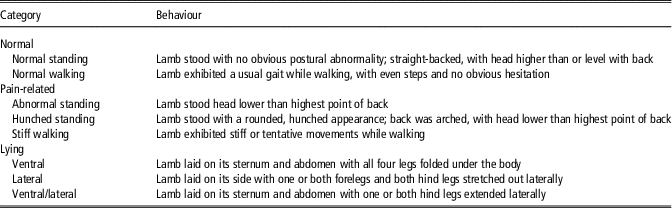
On day 0, four observers were allocated five or 10 lambs per plot to record the behaviours categorised in Table 1 and were blinded to the treatments. All observers were experienced in assessing sheep behaviour having been trained before the commencement of the experiment to standardise their observations for comparability. Live observations were made 5 min after the lamb was released from the marking cradle and then every 15 min for the following 6 h. Behaviours recorded were standing, walking and lying; standing and walking were then further categorised into normal and abnormal behaviours as described by Small et al. (Reference Small, Belson, Holm and Colditz2014) (Table 1). Comparisons of lamb behaviour were made between three composite traits; total pain (hunched and abnormal standing and stiff walking), total normal (normal standing and walking) and lying (ventral, lateral and ventral/lateral lying). The lambs were observed for a total of 15 s at each time point and the most dominant behaviour expressed was recorded for each 5-s interval. The data were then scored as 0 (not observed during 15 s), 1 (dominant behaviour in one 5-s interval), 2 (dominant behaviour in two 5-s intervals) or 3 (dominant behaviour in all three 5-s intervals) at each measurement period. One observer from each plot on day 0 was used for the observations on days 1 to 4 and each observer assessed the same lambs each day. On day 1, behaviours were recorded every 15 min for 2 h and on days 2 to 4 behaviours were recorded every 15 min for 1.25 h. On days 1 to 4, observations of lamb behaviour on the first plot commenced at 9 am and once completed the observers moved through the plots in numerical order.
Categories used to classify behaviour of Merino lambs post-mulesing

Statistical analyses
All statistical analyses were performed using GENSTAT (18th edition; VSN International, 2017, Hemel Hempstead, UK). All data was analysed using the method of restricted maximum likelihood. Comparisons of lamb behaviour were made between the three composite traits; total pain, total normal and lying. Data were analysed over time for each hour and each day, and for day 0 and day 1 combined, and the values reported are from a total score of 3. A number of correlated structures were examined, with a split plot in time structure considered appropriate for all analyses. The fixed effects were treatment, time of measurement, rear type, sex and interactions thereof. Random effects included plot, lamb (nested within plot) and measurement period (nested within lamb within plot) along with observer and ewe source. For live weight change of the lambs between days −7 and 10, treatment, sex, rear type and interactions thereof were fitted as fixed effects while plot and lamb (nested within plot) along with ewe source were fitted as random effects. For all analyses there were no significant interactions and so the final models only included main effects of the fixed terms. Main effects and interactions have been considered significant at the 5% level. Difference between means were assessed using LSD (P=0.05). There were generally no significant differences in behavioural measures between Tri-Solfen® and Tri-Solfen® and placebo injection hence only data for the Tri-Solfen® treatment are reported.
Results
Effect of mulesing on lamb behaviour
On average, lambs that were mulesed and not administered pain relief exhibited significantly more pain-related behaviours during the first 6 h post-mulesing than lambs that were not mulesed (1.22 v. 0.22; P<0.05; Table 2). The proportion of pain-related behaviours for mulesed lambs without pain relief was relatively constant over the first 6 h (P>0.05; Table 3). Furthermore, over the first 6 h lambs that were mulesed and not administered pain relief exhibited significantly fewer normal behaviours and lying than lambs that were not mulesed (P<0.05; Table 2).
Effects of pain relief on average daily behaviour 5 days post-mulesing in Merino lambs

Values are respresented as observations scored out of three.
Control=lambs were not mulesed; Placebo=lambs were mulesed and administered no pain relief; MC-15=lambs were mulesed and administered Metacam® 20 15 min before mulesing; TS=lambs were mulesed and administered Tri-Solfen®; MC-15+TS=lambs were mulesed and administered a combination of Metacam® 20 15 min before mulesing and Tri-Solfen®; MC0=lambs were mulesed and administered Metacam® 20 in the cradle.
AMeans within a row are significantly different to the Control treatment (P<0.05).
BMeans within a row are significantly different to the Placebo treatment (P<0.05).
1 Total pain=hunched and abnormal standing and stiff walking.
2 Total normal=normal standing and walking.
3 Total lying=ventral, lateral and ventral/lateral lying.
*LSD (P=0.05).
Effects of pain relief on average hourly behaviour 6 h post-mulesing in Merino lambs

Values are respresented as observations scored out of three.
Control=lambs were not mulesed; Placebo=lambs were mulesed and administered no pain relief; MC-15=lambs were mulesed and administered Metacam® 20 15 min before mulesing; TS=lambs were mulesed and administered Tri-Solfen®; MC-15+TS=lambs were mulesed and administered a combination of Metacam® 20 15 min before mulesing and Tri-Solfen®; MC0=lambs were mulesed and administered Metacam® 20 in the cradle.
AMeans within a row are significantly different to the Control treatment (P<0.05).
BMeans within a row are significantly different to the Placebo treatment (P<0.05).
1 Total pain=hunched and abnormal standing and stiff walking.
2 Total normal=normal standing and walking.
3 Total lying=ventral, lateral and ventral/lateral lying.
*LSD (P=0.05).
There were also significant differences in pain-related behaviours (0.50 v. 1.11; P<0.05; Table 2) and normal behaviours (1.94 v. 1.31; P<0.05; Table 2) on day 1 between lambs that were mulesed without pain relief and those that were not mulesed; however, these differences were not evident on days 2 to 4. There were no significant differences in the frequency of lying between mulesed and non-mulesed lambs from days 1 to 4. There were no sex or rear type effects between lambs in each treatment throughout the experiment.
There was a significant difference between treatments in live weight change of the lambs between days −7 and 10. On average, lambs that were not mulesed gained 3.9 kg compared to 1.9 kg for lambs mulesed without pain relief (P<0.001).
Effect of pain relief on lamb behaviour
On average, lambs that were administered a combination of Tri-Solfen® and meloxicam 15 min before mulesing exhibited significantly fewer pain-related behaviours throughout day 0 than those mulesed with no pain relief (0.85 v. 1.22; P<0.05; Table 2). Furthermore, lambs that were administered the combination of pain relief displayed significantly fewer pain-related behaviours than lambs administered Tri-Solfen® only on day 0 (0.85 v. 1.16; P<0.001; Table 2). The magnitude of pain-related behaviours exhibited by lambs from all other pain relief treatments did not differ post-mulesing.
Overall meloxicam administered 15 min before mulesing did not significantly affect pain-related behaviour on day 0. However, at 4 and 5 h post-mulesing, the lambs exhibited significantly fewer pain-related behaviours in comparison to lambs mulesed with no pain relief (P<0.05). This was consistent with the response at 4 and 5 h for lambs treated with the combination of meloxicam and Tri-Solfen® (Table 3).
There were no significant differences in pain-related behaviour between mulesed lambs that received pain relief and those that did not on days 2, 3 or 4. In addition, there was no significant difference between lambs that were mulesed and administered pain relief and those that were not when pain-related behavioural scores were averaged across days 0 and 1 (1.17 v. 1.11; P=0.12). There were no sex or rear type effects on pain-related behaviour between lambs that were provided pain relief and those that were not. Furthermore, live weight had no significant impact on pain-related behaviour between lambs that received pain relief and those that did not (P=0.264).
Normal behaviours exhibited by lambs on day 0, on average, were not significantly different between treatments regardless of whether pain relief was administered or not. The number of observations of normal behaviour increased significantly in the 6 h following mulesing (P<0.05; Table 3). Female lambs also displayed more normal behaviour than males (1.38 v. 1.16; P=0.01). From days 1 to 4, there were no significant differences in normal behaviour between pain relief treatments, sex or rear type of the lambs.
Lambs that were administered the combination of Tri-Solfen® and meloxicam 15 min before mulesing spent more time lying than lambs administered no pain relief on day 0 (P<0.05; Table 2). This again reflected treatment differences 4 h post-mulesing (Table 3). There were no significant differences in lying behaviour between sexes or rear types from days 0 to 4. There was also no significant difference in live weight change from days −7 to 10 between lambs administered pain relief and those that were not (P>0.05).
Discussion
Mulesing significantly increased the pain-related behaviours as evidenced by hunched standing and stiff walking in comparison to lambs that were not mulesed. The 20% difference in pain-related behaviours across days 0 and 1 was similar in magnitude to that reported by Paull et al. (Reference Paull, Lee, Colditz, Atkinson and Fisher2007 and Reference Paull, Lee, Atkinson and Fisher2008). Lambs that were not mulesed displayed significantly fewer pain-related behaviours in the 30 h following marking compared to lambs that were mulesed. This result, and the results referred to from previous research, provides evidence in support of the initial hypothesis that behavioural observations can be used to assess the effect of pain relief in mulesed lambs.
The combination of meloxicam and Tri-Solfen® significantly reduced pain-related behaviours in the 6 h post-mulesing compared to lambs mulesed and administered no pain relief, supporting our second hypothesis. Independently, Tri-Solfen®, meloxicam administered 15 min before mulesing and meloxicam administered in the cradle did not affect the average incidence of pain-related behaviour during the day after mulesing compared to lambs mulesed and given no pain relief. As there were no differences in pain-related behaviours between the administration times of meloxicam our third hypothesis was rejected. Overall, our findings suggest that under the conditions of this study a combination of a topical analgesia and meloxicam was most effective at decreasing pain-related behaviours associated with mulesing in Merino lambs. The effectiveness of combining meloxicam and Tri-Solfen® to decrease pain-related behaviours is consistent with Paull et al. (Reference Paull, Lee, Colditz, Atkinson and Fisher2007). They found the combination of carprofen and a topical anaesthetic reduced the acute rise in cortisol for 24 h and peak plasma cortisol concentrations were not significantly different to non-mulesed animals. Twelve hours of behavioural observations also indicated that animals administered the combination of analgesics spent less time standing and in a hunched posture and were not different from non-mulesed animals. Pain alleviation is likely due to two mechanisms; the anaesthetic properties of the topical analgesia working directly on nerve fibres to block pain signals (Sheil, Reference Sheil2015), and the NSAID inhibiting inflammation and associated pain by reducing pressure on nerve endings (Davies et al., Reference Davies, Bailey, Goldenberg and Ford-Hutchinson1984). The contribution of these mechanisms to the expression of the pain related behaviours observed in response to mulesing in the current study are unknown.
Lambs that were only treated with Tri-Solfen® had significantly more pain-related behaviours on day 0 in comparison to lambs treated with the combination of meloxicam and Tri-Solfen®, and there was no difference in pain related behaviours when compared to lambs mulesed and administered no pain relief. The absence of an effect of Tri-Solfen® alone on lamb behaviour in response to mulesing, is contrary to previous studies (Paull et al., Reference Paull, Lee, Colditz, Atkinson and Fisher2007; Lomax et al., Reference Lomax, Sheil and Windsor2008 and Reference Lomax, Sheil and Windsor2013). Paull et al. (Reference Paull, Lee, Colditz, Atkinson and Fisher2007) found Tri-Solfen® to have moderate analgesic effects 4 h post-mulesing as evidenced by less hunched standing compared to lambs mulesed without pain relief. However, Lomax et al. (Reference Lomax, Sheil and Windsor2013) found wound sensitivity and pain-related behaviours were reduced for 24 h. The shorter term of pain relief observed by Paull et al. (Reference Paull, Lee, Colditz, Atkinson and Fisher2007) was suggested to be caused by the collection of blood samples to measure cortisol concentrations, which likely exacerbated pain responses. The present study suggests this was not the case as the experimental design mimicked an on-farm scenario with no physical disturbances and the effectiveness of Tri-Solfen® was not reflected in behaviour. The previous studies discussed had relatively low animal numbers in comparison to this study, and the animals used were either housed indoors or on pasture-covered pens less than one-tenth the size of what was used in this experiment. This may account for the differences observed between experiments in the effectiveness of Tri-Solfen® in reducing pain-related behaviours.
The average incidence of pain related behaviours on day 0 was similar for lambs administered the combination of meloxicam and Tri-Solfen® and individual administration of meloxicam 15 min before mulesing. Furthermore, administration of meloxicam 15 min before mulesing significantly decreased pain-related behaviours at 4 and 5 h post-mulesing when compared to lambs that received no pain relief. Therefore, the present study suggests the main analgesia responsible for the effectiveness of the combination treatment was meloxicam. This is consistent with Small et al. (Reference Small, Belson, Holm and Colditz2014) who reported that buccal meloxicam decreased the combined abnormal behaviours (hunched standing, standing with stretched posture and walking stiffly) for 8 h following knife castration and tail docking compared to lambs offered no pain relief.
The relative effectiveness of meloxicam in reducing pain-related behaviours may be related to dose and time of administration. Paull et al. (Reference Paull, Lee, Atkinson and Fisher2008) found meloxicam administered at time of mulesing at 0.5 mg/kg had no effect on behaviour. Colditz et al. (Reference Colditz, Paull, Hervault, Aubriot and Lee2011) administered meloxicam at 1 mg/kg, which relieved sheep from lameness at 6 to 8 h over a 24-h period. Mulesing causes soft tissue damage that results in rapid inflammation. Given NSAIDs preferentially accumulate in inflamed tissue, administration of a NSAID at the time of mulesing will allow for quick absorption (Paull et al., Reference Paull, Lee, Atkinson and Fisher2008; Schweitzer et al., Reference Schweitzer, Hasler-Nguyen and Zijlstra2009). However, the analgesic effect will depend largely on the dose administered. Pharmacokinetics of NSAIDs cannot be transferred from one species to another (Welsh et al., Reference Welsh, McKellar and Nolan1993), and to the authors’ knowledge only two studies have investigated the pharmacokinetics of meloxicam in sheep and showed that plasma concentrations of meloxicam were detectable for 24 to 72 h (Shukla et al., Reference Shukla, Singh, Sindhura, Telang, Rao and Malik2007; Stock et al., Reference Stock, Coetzee, KuKanich and Smith2013). Dose rates and expected duration of action for meloxicam (and other NSAIDs) in previous sheep research has been extrapolated from data from other species (Paull et al., Reference Paull, Lee, Atkinson and Fisher2008). This includes osteoarthritis in cats and dogs and castration of cattle and pigs (Lees et al., Reference Lees, McKellar, Foot and Gettinby1998; Mathews, Reference Mathews2002; Zöls et al., Reference Zöls, Ritzmann and Heinritzi2005). Coetzee et al. (Reference Coetzee, Mosher and Allen2009) documented a half-life of 27.5 h in calves, supporting the notion that meloxicam is a good choice for long-lasting analgesia in ruminants. With the amount of soft tissue damage caused by mulesing and minimal analgesia observed in this current experiment, increased dose rates of meloxicam administered in the cradle could be investigated in combination with Tri-Solfen®. To enhance adoption of injectable meloxicam by commercial sheep producers ease of application is crucial, such as the ability to administer pain relief in the marking cradle.
We conclude that using a combination of meloxicam and Tri-Solfen® can reduce pain-related behaviours in the first 6 h post-mulesing. However, this study did not observe analgesic effects through behavioural measures 24 h post-mulesing regardless of the type of pain relief administered. This paper adds support to the premise that mulesing sheep is painful, this pain is measurable using pain-related behaviour and that a combination of analgesics is most effective in mitigating the pain.
Acknowledgements
The authors thank Boehringer Ingleheim (Sydney, Australia) for funding. L.I. was the recipient of an Australian Wool Education Trust and Universities Federation for Animal Welfare (UK) scholarship and their support is sincerely thanked.
S. Hancock, 0000-0002-4115-4642 M. Laurence, 0000-0003-1215-2848
Declaration of Interest
None.
Ethics Statement
All procedures described were performed in accordance with the Australian Code of Practice for the Use of Animals for Scientific Purposes 2013 and were approved by the Murdoch University Animal Ethics Committee (R2903/17).
Software and data repository resources
There are no software and/or data repository resources.