

Introduction
Crucifers, particularly cabbage (Brassica oleracea var. capitata L.), kale (B. oleracea var. acephala L.), cauliflower (B. oleracea L. var botrytis), Ethiopian mustard (B. carinata L.), Chinese cabbage (B. campestris L. var. pekinensis/chinensis) and broccoli (B. oleracea L. var. italica) are among the major vegetables cultivated by smallholders under a wide range of agroecological conditions in Kenya (Macharia et al., Reference Macharia, Löhr and De Groote2005). The bulk of the produce is sold in urban centres where there is a demand. Approximately 90% of the crops are produced on small farms of up to one acre in size (Macharia et al., Reference Macharia, Löhr and De Groote2005). The crops provide valuable sources of vitamins, minerals and other dietary nutrients that complement a maize-based diet. However, various insect pests, and inappropriate management strategies (such as late or poor weeding, under or overdose use of pesticides, pesticide mixing and increased frequencies of pesticide application) limit crucifer production.
The diamondback moth (DBM) Plutella xylostella (L.), (Lepidoptera: Plutellidae), is the most important pest of Brassicaceae worldwide (Furlong et al., Reference Furlong, Wright and Dosdall2013) and in Kenya (Kahuthia-Gathu, Reference Kahuthia-Gathu2013). It is the most universally distributed of all Lepidoptera, and it can migrate over long distances (Talekar and Shelton, Reference Talekar and Shelton1993). Under unmanaged conditions, the pest can cause significant yield losses of up to 100%. Its high pest status is attributed to year round availability of cultivated and wild host plants (Kahuthia-Gathu et al., Reference Kahuthia-Gathu, Löhr, Poehling and Mbugua2009; Furlong et al., Reference Furlong, Wright and Dosdall2013). Farmers in East Africa depended exclusively on the use of broad-spectrum insecticides for the control of DBM (Seif and Löhr, Reference Seif and Löhr1998), which often led to disruption of its natural control by natural enemies (Desneux et al., Reference Desneux, Decourtye and Delpuech2007; Biondi et al., Reference Biondi, Desneux, Siscaro and Zappalà2012) and facilitated rapid development of resistance to the insecticides ( Kahuthia-Gathu et al., Reference Kahuthia-Gathu, Löhr, Poehling and Mbugua2009). Development of resistance to a wide range of synthetic insecticides (Kibata, Reference Kibata, Sivapragasam, Kole, Hassan and Lim1996; Mohan and Gujar, Reference Mohan and Gujar2003; Vickers et al., Reference Vickers, Furlong, White and Pell2004, Sayyed et al., Reference Sayyed, Omar and Wright2004) and biological insecticides (Liu et al., Reference Liu, Tabashnik and Johnson1995; Ferre and Van Rie, Reference Ferré and Van Rie2002; Sarfraz, Reference Sarfraz2004) prompted the search for alternate management tools such as better use of natural biocontrol and habitat management, to conserve the natural enemies of DBM in crucifers (Sarfraz et al., Reference Sarfraz, Keddie and Dosdall2005). In the East African region, biocontrol-based integrated pest management (IPM) strategies were introduced in 2001 specifically targeting DBM (Nyambo and Löhr, Reference Nyambo, Löhr and Hooddle2005). After the successful introduction of Diadegma semiclausum (Hellén) (Hymenoptera: Ichneumonidae) into smallholder crucifer production systems in the highlands of Kenya, Tanzania and Uganda (Löhr et al., Reference Löhr, Gathu, Kariuki, Obiero and Gichini2007), there was a need to introduce a parasitoid that would be efficient under the semi-arid areas of eastern Africa where crucifers are grown in valley bottoms using residual soil moisture or irrigation (Kahuthia-Gathu et al., Reference Kahuthia-Gathu, Löhr, Poehling and Mbugua2009).
Cotesia vestalis (Haliday) (Hymenoptera: Braconidae), a solitary koinobiont larval parasitoid of DBM, has been used successfully as a biocontrol agent in other parts of the world (Lim, Reference Lim and Talekar1992; Talekar, Reference Talekar, Kirk and Bordat2004) and was considered for introduction into East Africa. The species is known to be effective even in areas of heavy insecticide use (Ooi, Reference Ooi and Talekar1992), which is a valuable attribute, since farmers tend to spray against an array of crucifer pests and diseases, especially against aphids and DBM. The South African strain of C. vestalis is reported to be the most efficient parasitoid with up to 80% parasitism even in areas with hyperparasitism and it co-exists with a range of other parasitoids (Nofemela, Reference Nofemela2013). Furthermore, South Africa is predominantly warm and dry, which makes it climatically closer to the target areas of East Africa in terms of climate matching for the target strain of the species (Nofemela and Kfir, Reference Nofemela and Kfir2005). Consequently, the South African strain was imported into Kenya in March 2003 for redistribution in the semi-arid areas of eastern Africa. The parasitoid prefers to oviposit in L2 and L3 larval instars (Shi et al., Reference Shi, Liu and Li2002; Alizadeh et al., Reference Alizadeh, Rassoulian, Karimzadeh, Hosseini-Naveh and Farazmand2011) and can lay up to 130 eggs (Kahuthia-Gathu, Reference Kahuthia-Gathu2007; Kermani et al., Reference Kermani, Abu Hassan, Suhaimi, Abuzid, Ismail, Attia and Ghani2014). The eggs hatch after a day or two within the host's body and feed on the host haemolymph and fat body, and the mature larvae emerge through the side of the host to pupate externally (Talekar and Shelton, Reference Talekar and Shelton1993; Alizadeh et al., Reference Alizadeh, Rassoulian, Karimzadeh, Hosseini-Naveh and Farazmand2011). The larvae spin creamy-white silken cocoons next to the host body. The life cycle takes about 15 days at 25 °C (Talekar and Shelton, Reference Talekar and Shelton1993).
Prerelease surveys conducted in 2002 in the major crucifer growing areas recorded a mean of 5.4 and 5.8 DBM per plant. Studies conducted from kale grown on farmers fields in Athi River recorded a mean of 2.5 DBM per plant and an average damage score of 1.8, while in Yatta, a mean of 2.2 DBM per plant and a damage score of 1.7 was recorded. However, in Loitokitok, a higher mean of 3.0 DBM and damage score of 2.2 was recorded. Parasitism rates were relatively low with Yatta recording 10.1%, Athi River 10% and Loitokitok 19.5% (Kahuthia-Gathu, Reference Kahuthia-Gathu2007).
In March 2004, 1000 laboratory-reared C. vestalis were released in the mid-altitude semi-arid areas of Yatta and Athi River in Machakos County, Kenya. During the first postrelease survey in April 2005, the parasitoids D. semiclausum, D. mollipla, O. sokolowskii, Apanteles sp. and Brachymeria sp. were recovered from DBM larvae and pupae sampled from kale in Athi River. However, the total parasitism rate was relatively low, at less than 15% (Kahuthia-Gathu et al., Reference Kahuthia-Gathu, Löhr, Poehling and Mbugua2009). In 2006, C. vestalis was recovered from DBM in Athi River and Yatta between March and May with mean parasitism rates of 27 and 0.5%, respectively. To improve parasitoid establishment and spread, additional field releases were made between 2005 and 2006 in Kibwezi, Makindu, Mtito-Andei, Kitui and Loitokitok districts and in areas of Thika District that had not been considered during the original release. Field observations in parts of Thika in Kiambu County, Yatta in Machakos County and Kitui, in Kitui County between 2009 and 2011 indicated that C. vestalis was established and had spread beyond the release sites (Nyambo pers. observ.). However, its spread and impact on DBM populations in smallholder kale production systems and associated socioeconomic aspects remained undocumented. The establishment of a parasitoid in a new habitat is influenced by many factors that determine its rate and range of dispersal (Cronin and Reeve, Reference Cronin and Reeve2005). Parasitoid traits, e.g., host specifity, host density dependence, competitiveness and reproductive potential, affect their potential establishment and dispersal (Neuenschwander, Reference Neuenschwander1996; Lane et al., Reference Lane, Mills and Getz1999). In this study, we document the establishment, spread and impact of introduction of C. vestalis on population densities of DBM, its current geographical distribution, as well as parasitoid species diversity and evenness in smallholder kale production systems in three semi-arid areas of eastern and southeastern Kenya (in the former Eastern and Rift Valley provinces).
Material and methods
Study sites
Study sites were set up at Kitui (Kitui County), Mwingi and Yatta (Machakos County) and Loitokitok (Kajiado County) between September 2011 and April 2012. The aim of the study was to evaluate the impact of the introduced parasitoid C. vestalis and record its spread in the region. During this period, mean temperatures between sites ranged between 26 and 35 °C and rainfall was between 500 and 900 mm per annum. The altitude between sites ranged from 890 to 1900 masl. Kale is grown throughout the year by many homesteads along river valleys or near water sources with supplementary irrigation.
Evaluation of diamondback moth population and its damage on kale
DBM damage on kale was physically assessed once a month by checking the symptoms on leaves. Twenty plants were randomly assessed using a visual damage score of 1 to 5 (1 = no damage, 2 = up to 25% damage, 3 = 25–50% damage, 4 = 50–75% damage and 5 = greater than 75% damage) following the procedure described in Momanyi et al. (Reference Momanyi, Löhr and Gitonga2006). Sampling was done from 25 to 35 farmer-managed fields in each location, depending on the availability of kale in the fields. As the study site was in the semi-arid areas, most of the fields were relatively small with some fields measuring less than an eighth of an acre. The location of the sampled farms was georeferenced for mapping the distribution and spread of the parasitoid. Twenty kale plants with over five big leaves in each farmer's field were randomly selected as recommended by Smith and Shepard (Reference Smith and Shepard2004) and physically checked for the presence of various stages of DBM larvae and pupae. The number of DBM larvae and pupae found infesting each kale plant was recorded.
DBM infestation, and damage and parasitism rates of DBM larvae and pupae were assessed in each kale farm at monthly intervals. To determine the parasitoid guild and their parasitism rates, samples of DBM larvae, pupae and parasitoid cocoons were counted, collected, placed in labelled plastic containers and taken to the laboratory for processing. The containers were lined with tissue paper to absorb excess moisture and closed with caps containing a fine muslin cloth to facilitate ventilation. First instar larvae were ignored because all known P. xylostella larval and egg-larval parasitoids complete their larval development in fourth instar hosts irrespective of the host stage parasitized (Nofemela and Kfir, Reference Nofemela and Kfir2005); thus, parasitism was accumulated from the DBM instars collected from the field. (Egg parasitoids have not been recorded in Kenya due to their insignificance and difficulty in observing them.) The DBM larvae were kept at 23 ± 2 °C, 50−70% RH and photoperiod of 12:12 hours (light: dark) cycle. The larvae were provided with fresh kale leaves and kept individually in plastic containers. The leaves were replaced after every two days until the larvae pupated or parasitoid cocoons formed. Samples of parasitoid cocoons and P. xylostella pupae were confined individually in well-ventilated glass vials (2.5 × 10 cm) and observed daily for emergence of DBM, primary parasitoids or hyperparasitoids. The primary parasitoid and hyperparasitoid species were identified and their incidence recorded. Parasitoid identification was based on wing morphology, using taxonomic keys as described by Scholtz and Holm (Reference Scholtz and Holm1985) and Azidah et al. (Reference Azidah, Fitton and Quicke2000).
All parasitoids and hyperparasitoids were preserved in ethanol (70%) for identification and confirmation. Voucher specimens of the parasitoids were deposited at the International Centre of Insect Physiology and Ecology (icipe), Nairobi, Kenya, and at the Agricultural Research Council-Plant Protection Research Institute (ARC-PPRI), Pretoria, South Africa.
The incidence of each primary parasitoid and hyperparasitoid species recovered from DBM was used to compile monthly lists of the parasitoid guild, species diversity and evenness. The Shannon Diversity Index (H′) was used to calculate the diversity index for each month.
Data analysis
One-way ANOVA using general linear model (GLM) (SAS, 2002, SAS institute Inc.) was used to analyse the data on DBM infestation, damage scores, total primary parasitism, total hyperparasitism rates and incidence per parasitoid species. The means were separated using the Student–Newman–Keuls test (SNK) at P < 0.05 (Sokal and Rohlf, Reference Sokal and Rohlf1995). The data of hyperparasitoid counts were normalized using square root transformation (SQRT+1) analysis using GLM, due to their low numbers. Means were seperated using the Tukey test. Means comparision between months and the sites for DBM infestation and damage scores were analysed using SNK. Parasitism rates for solitary parasitoids were calculated as the sum of parasitoids divided by total number of adults (dead pupae + DBM + parasitoids) ×100, while that of gregarious parasitoids (represesented by number of cocoons) as sum of parasitized hosts/(DBM + parasitized hosts) ×100. The % species incidence was obtained by dividing the number of individual parasitoids recorded each month (a) by the total number of all parasitoids recorded in a month (N) [a/N × 100]. The data on damage and DBM numbers were subjected to Pearson's Correlation Coefficients, to determine the relationship between the damage inflicted and DBM infestation levels.
The number of parasitoids recovered from the DBM larvae and pupae collected from the farmers’ fields was used to evaluate the parasitoid diversity and species eveness. The diversity and evenness of parasitoid species were estimated using the Shannon Diversity Index (H′). It is the proportion of species (pi) relative to the total number of species (S) multiplied by natural logarithm of this proportion (ln pi) (Magurran, Reference Magurran1988). The product is summed across species and multiplied by (−1) (Rosenzweig, Reference Rosenzweig1995). H' = −p i ln p i, where p i, = ni/N. Evenness was calculated by dividing H' by ln S. Variance in diversity was estimated using the formula:
 $$\begin{eqnarray*}
{\rm{Var}}\,H' = \left( {{p_{i - {\rm{ }}(}}{\rm{ln}}{p_{i)^{2} - {\rm{ }}(}}{p_i}{\rm{ln}}{p_{i)^{2}}}} \right){/_{N - }}\left( {_{S - 1/2N^{2}}} \right)\end{eqnarray*}$$
A t-test was performed to test for differences in diversity indices between months of data using the formula t = H'1−H'2/(Var H'1 + Var H'2)^½ (Batten, Reference Batten1976; Magurran, Reference Magurran1988).
Results
The spread of C. vestalis
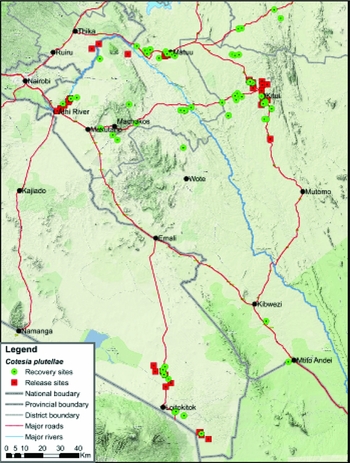
After mapping the coordinates where specimens were collected and compared with the coordinates where C. vestalis had been released, it was apparent that the parasitoids had spread over a large area from the release sites in Mwingi/Yatta, Kitui and Machakos areas. The recovery of C. vestalis in Loitokitok was restricted to the release sites (Fig. 1).
The release and recovery sites of Cotesia vestalis in the semi-arid areas of Kenya.

Evaluation of diamondback moth population and its damage on kale
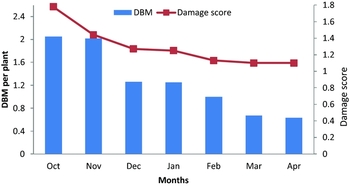
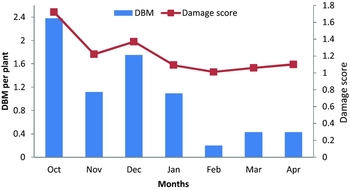
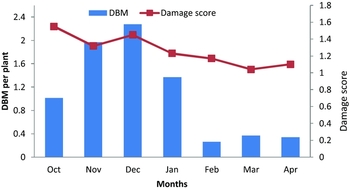
The damage inflicted by DBM on kale plants differed significantly between months of observation from October 2011 to April 2012 in Loitokitok (F = 8.18; df = 6, 168; P < 0.0001), Kitui (F = 13.39; df = 6, 181; P < 0.0001) and Mwingi/Yatta (F = 6.78; df = 6, 181; P < 0.0001). Relatively lower damage scores were observed in all the regions between the months of February and April 2012. The mean damage score in Loitokitok varied from 1.8 in October 2011 to 1.1 in April 2012 (Fig. 2). In Kitui, the damage score varied between 1.7 in October 2011 and 1.06 in March 2012 (Fig. 3). A similar trend was observed in the Mwingi/Yatta region with the damage score ranging from 1.6 in October 2011 to 1.0 in March 2012 (Fig. 4). The mean damage score differed significantly between months and the different sites (F = 8.18, df = 8, 542, P < 0.0001) throughout the study period.
Mean number of diamondback moth per plant damage on kales in Loitokitok.

Mean number of diamondback moth per plant damage on kales in Kitui.

Mean number of diamondback moth and damage on kales in Mwingi/Yatta.

The mean number of DBM recorded from kale ranged from 0.28 per plant to 2.5 in the study sites with the lowest DBM population between February and April. The mean total DBM numbers in Loitokitok were significantly different over the months (F = 3.97; df = 6, 168; P < 0.005). Similar significant differences of DBM per plant were observed in Mwingi/Yatta over the months (F = 8.62; df = 6, 181; P < 0.0001). In Kitui, similar observations were noted with significant differences noted over months on the mean total DBM population (F =13.97; df = 6, 181; P < 0.0001) (Figs. 2–4). In Loitikitok, the mean DBM per plant ranged between 2.05 and 0.63 in October 2011 and April 2012, respectively (Fig. 2). Infestation of DBM in Kitui ranged from 2.38 in October to 0.2 in February. The DBM per plant in November 2011 dropped and increased to 1.75 in December 2011 before dropping to 0.2 in February upto April 2012 (Fig. 3) However, in Mwingi/Yatta, higher DBM population was recorded during December 2011 and a mean low of 0.26 DBM per plant in February 2012, which continued to increase up to 0.34 in April 2012 (Fig. 4).
Evaluation of the parasitoid guild
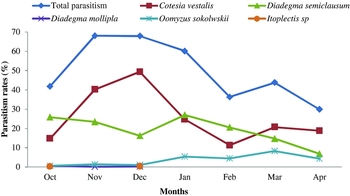
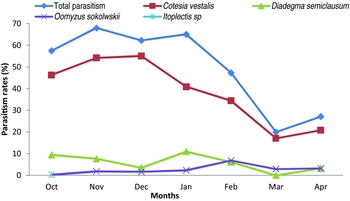
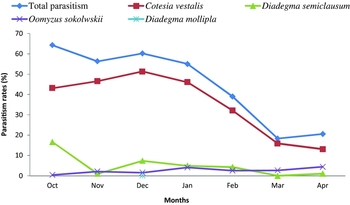
Eight primary parasitoid species consisting of one egg–larval, three larval and four larval–pupal parasitoids were recorded from DBM larvae and pupae during October 2011 to April 2012. They included an egg–larval parasitoid Chelonus sp. (Ichneumonidae), solitary larval endoparasitoids C. vestalis (exotic parasitoid), Apanteles sp. and a Cotesia sp. The indigenous larval–pupal parasitoids Diadegma mollipla (Holmgren) (Ichneumonidae), Oomyzus sokolowskii (Kurdjumov) (Eulophidae) (gregarious parasitoid) and Itoplectis sp. (Ichneumonidae) were observed in addition to D. semiclausum. The three larval, and three larval–pupal parasitoids were recovered from the three study areas, while Itoplectis species was only recovered from Loitokitok and Kitui. Cotesia vestalis and D. semiclausum contributed over 90% of the total primary parasitism levels (Figs. 5, 6 and 7).
Parasitism (%) of diamondback moth in Loitokitok between October 2011 and April 2012.

Parasitism (%) of diamondback moth in Kitui between October 2011 and April 2012.

Parasitism (%) of diamondback moth in Mwingi/Yatta between October 2011 and April 2012.

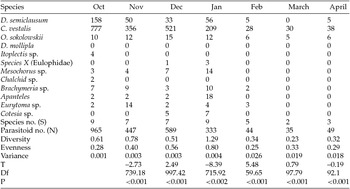
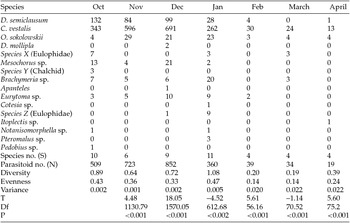
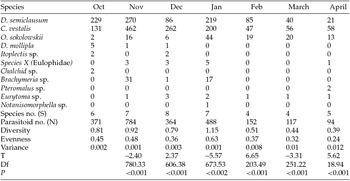
Ten obligate, solitary hyperparasitoid species emerged from D. semiclausum and C. vestalis cocoons recovered from the fields. These included Brachymeria sp. (Chalcidae), Eurytoma sp. and Eurytoma rosae Nees (Eurytomidae), Mesochorus sp. (Ichneumonidae), Pteromalus sp. and Notanisomorphella sp. (Pteromalidae), Pedobius sp. (Eulophidae), two unidentified Ichenumonidae and one Eulophidae. The Brachymeria sp. emerging from D. semiclausum cocoons were visually observed to be generally larger than those from C. vestalis. Over 70% of the hyperparasitoids were recovered from field-collected C. vestalis cocoons as well as from cocoons that formed in the lab from field-collected P. xylostella larvae. They included Brachymeria sp., Eurytoma sp. and Eurytoma rosae, Mesochorus sp., and Pteromalus sp. and Notanisomorphella sp. and Pedobius sp. There were five, six and nine hyperparasitoid species recovered from Kitui, Loitokitok and Mwingi/Yatta, respectively. In addition to being a primary parasitoid, O. sokolowskii was recorded as a hyperparasitoid from seven cocoons of C. vestalis. Only a single specimen of Notanisomorphella sp. was collected in Loitokitok and Yatta in January 2012. However, overall parasitism rate of the hyperparasitoids was less than 4%, with the highest rates of 3.5 and 3.7% recorded from Eurytoma species from Kitui in January and February 2012, respectively (Table 1). More hyperparasitoids were recovered during the dry season than rainy season in the semi-arid areas of Kitui and Mwingi/Yatta regions. Eurytoma and Brachymeria species were the abundant species in all the regions, while Mesochorus sp. was only recovered from the semi-arid regions of Kitui and Mwingi/Yatta (Tables 1 and 2). Only two and three individuals of Pteromalus sp. were recovered from Loitokitok and Mwingi/Yatta, respectively.
Shannon index for species diversity and evenness of the diamondback moth parasitoid and hyperparasitoid guild in Kitui region, Kenya

t-test was conducted to compare differences with the previous months.
Shannon index for species diversity and evenness of the DBM parasitoids and hyperparasitoids guild in Mwingi/Yatta area, Kenya

t-test was conducted to compare differences with the previous months.
Both exotic primary parasitoids, C. vestalis and D. semiclausum, were recorded throughout the study period in all the areas and coexisted in 39% of the total sampled fields. In some areas, both parasitoids accounted up to 68% parasitism rates. Cotesia vestalis and D. semiclausum contributed 68.5% and 46.3% to total primary parasitism rates, respectively (Figs. 5, 6 and 7). Cotesia vestalis was the most predominant parasitoid contributing an average of 50% to parasitism in Loitokitok, 76% in Kitui and 74% in Mwingi/Yatta, while D. semiclausum contributed 39% in Loitokitok, 10% in Kitui and 7% in Mwingi/Yatta areas. The proportion contributed by O. sokolowskii as a primary parasitoid varied from 7.1 to 7.7% across the sites.
In Loitokitok, five parasitoids, namely D. semiclausum, C. vestalis, D. mollipla, O. sokolowskii and Itoplectis sp. were recovered during the study period. Diadegma semiclausum and C. vestalis were the dominant species in the region. Highest and lowest overall parasitism rate of 68.1% and 29.9% was observed in November 2011 and April 2012, respectively. Parasitism rates of DBM by C. vestalis were higher than that of D. semiclausum in October 2011, January and February 2012. The greatest difference in parasitism rates between D. semiclausum and C. vestalis was observed in December 2011, which was 49.4% and 16.2%, respectively. Oomyzus sokolowskii was recovered throughout the sampling period though the parasitism rates were generally low ranging from 0% to 7.7% between October 2011 and March 2012. Diadegma mollipla and Itoplectis sp. were recorded between October and December 2011 with parasitism rates ranging from 0.1% and 0.4%. Differences between monthly parasitism rates were significant for D. semiclausum (F = 2.30, df = 6, 168; P < 0.05), C. vestalis (F = 7.17; df = 6, 168; P < 0.0001) and O. sokolowskii (F = 6.25; df = 6, 168; P < 0.0001) but not for D. mollipla and Itoplectis species where parasitism was not significantly different and occurred at certain times and not others (Fig. 5).
Four primary parasitoids, namely D. semiclausum, C. vestalis, O. sokolowskii and Itoplectis species were registered during the study period in Kitui. The highest overall parasitism rates of 67.9% and lowest of 19.3% were observed in November 2011 and March 2012, respectively. Cotesia vestalis was the dominant species throughout the sampling period with the highest parasitism rate observed in December 2011 (55%) and a low 17% in March 2012. Diadegma semiclausum was collected throughout the study with highest parasitism rate of 10.8% observed in December 2011 and the lowest 0% in March 2012, whereas O. sokolowskii was present throughout with low parasitism rates. Itoplectis sp. was only collected in October 2011 (0.3%). Significant differences in parasitism rates were observed between months for D. semiclausum (F = 2.99; df = 6, 182; P < 0.0001) and C. vestalis (F = 17.38; df = 6, 182; P < 0.0001) (Fig. 6).
Diadegma semiclausum, C. vestalis, O. sokolowskii and D. mollipla were recovered from fields in Mwingi/Yatta area. The first three parasitoids were present throughout the sampling period. Total parasitism rate ranged between 64.3 and 18.4% in October 2011 and March 2012, respectively. Cotesia vestalis was the most prevalent with parasitism rates of 51.3% and 13% in December 2011 and April 2012, respectively, followed by D. semiclausum (16.6% in October 2011 and 0% in March 2012) and O. sokolowskii. Parasitism rates for D. semiclausum and C. vestalis differed significantly between months (F = 10.53; df = 6, 178; P < 0.0001) and (F = 9.76; df = 6, 178; P < 0.0001), respectively (Fig. 7).
Species diversity
A significant difference in species richness and evenness was observed between the three study sites and between months (Tables 1–3). The highest diversity index of 1.15, 1.29 and 1.08 were recorded in January in Loitokitok, Kitui and Mwingi/Yatta, respectively. Kitui recorded the highest diversity in January, while the lowest diversity index of 0.19 was recorded in March in Mwingi/Yatta during the hot, dry season. Species evenness ranged between 0.24 and 0.63, 0.25 and 0.80 and 0.14 and 0.47 in Loitokitok, Kitui and Mwingi/Yatta, respectively. The highest species diversity and evenness of (1.15, 0.63), (1.29, 0.80) and (1.08, 0.47) was recorded in January in Loitokitok, Kitui and Mwingi/Yatta, respectively. Higher numbers of C. vestalis than D. semiclausum were recovered from Kitui and Mwingi/Yatta throughout the sampling period compared to Loitokitok, where higher numbers of D. semiclausum were recovered in October, February and January.
Shannon index for species diversity and evenness of the diamondback moth parasitoid and hyperparasitoid guild in Loitokitok, Kenya
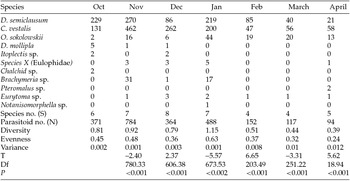
t-test was conducted to compare differences with the previous months.
Discussion
The objective of any pest control strategy is to reduce pest populations to non-economic levels (Francis et al., Reference Francis, Smith and Shepard2005). In Australia and the United States, farmers use a threshold level of 1 DBM larva per plant (Furlong et al., Reference Furlong, Shi, Liu, Guo, Lu, Liu and Zalucki2004; Khan et al., Reference Khan, Griffin, Carner and Gorsuch2004; Smith and Shepard, Reference Smith and Shepard2004). Even though no threshold levels for crucifer pests have been established in Kenya, this threshold is achievable with only biological control of DBM in some countries (Nofemela, Reference Nofemela2013). The DBM counts were close to or below one larva per plant during February to April in all farms. Before the releases of C. vestalis, Kahuthia-Gathu (Reference Kahuthia-Gathu2007) recorded between 0.6 to 5.2 DBM per plant in Athi River, and 0.6 to 2.9 DBM per plant in Yatta. The mean DBM per plant was three and five times higher than observed in the current study. From this we may conclude that the introduction of C. vestalis had a considerable impact on the DBM population density, keeping it below or close to a level requiring additional pest control measures. There was positive correlation between the number of DBM per plant and the level of damage, with damage scores of below 1 being associated with less than 1 DBM per plant. Similar results were observed by Kahuthia-Gathu et al. (Reference Kahuthia-Gathu, Löhr, Poehling and Mbugua2009) in the cabbage growing areas of Kenya. This is contrary to a survey conducted in 2002 before the release of the parasitoid C. vestalis in Yatta and Athi river in the semi-arid areas of eastern province, which indicated higher DBM population densities (5.2 DBM per plant in Athi river) and damage scores greater than 2.2.
The introduced exotic parasitoids, C. vestalis and D. semiclausum were the most dominant species accounting for more than 90% of the primary parasitism levels. This is contrary to the previous observations where the indigenous parasitoid D. mollipla was dominant in the regions (Löhr and Kfir, Reference Löhr, Kfir, Kirk and Bordat2004) of the East African countries. The study showed that C. vestalis was active throughout the sampling period and dominated the parasitoid complex on kale, followed by D. semiclausum. Cotesia vestalis contributed significantly on parasitism of the DBM. Their contribution ranged from 35 to 72%, 62 to 88% and 67 to 85% in Loitokitok, Kitui and Mwingi/Yatta study sites. This shows its establishment in the regions. This could also have been due to the farmers reducing pesticide use, mixture, frequencies and dosages, and using pesticides with no negative effects on the non-target organisms. Nofemela and Kfir (Reference Nofemela and Kfir2005) and Manyangarirwa et al. (Reference Manyangarirwa, Zehnder, McCutcheon, Smith, Adler, Mphuru, Tenywa, Joubert, Marais, Rubaihayo and Nampala2009) reported a similar dominance of C. vestalis in South Africa and Zimbabwe. Generally, parasitism by the indigenous parasitoid species was low and this could have been attributed to competition from the two exotic parasitoids (Wang and Keller, Reference Wang and Keller2002). Findings by Kahuthia-Gathu et al. (Reference Kahuthia-Gathu, Löhr, Poehling and Mbugua2009) and Löhr et al. (Reference Löhr, Gathu, Kariuki, Obiero and Gichini2007) showed that D. semiclausum is competitive and displaced the indigenous parasitoids from cabbage fields in the highlands of Kenya. Oomyzus sokolowskii was the only gregarious parasitoid recorded during the study although the parasitism rates were low (Figs. 4 and 6). Similar observations were made by Nofemela and Kfir (Reference Nofemela and Kfir2005) in South Africa in areas where C. vestalis was the dominant parasitoid. This is contrary to earlier studies that showed parasitism rates of up to 21.2% in Yatta in 2005 (Kahuthia-Gathu, Reference Kahuthia-Gathu2007). Liu et al. (Reference Liu, Wang, Guo, He and Shi2000) reported a negative relationship in parasitism level between O. sokolowskii and C. vestalis. The low parasitism rates by indigenous parasitoids, especially D. mollipla and O. sokolowskii, could be attributed to competition with C. vestalis and D. semiclausum. Oomyzus species may not have played a significant role as a hyperparasitoid due to its gregarious nature, as few specimens were recovered from the samples. Few specimens of Apanteles species were recovered contrary to earlier studies where their parasitism rates ranged between 0.4 and 6.8% in Yatta (Kahuthia-Gathu, Reference Kahuthia-Gathu2013).
The extremely high temperatures between February and April inhibited the growing of healthy kale crops, thus affecting the activities of both the DBM, and the parasitoids, leading to low densities. Contrary to Nofemela (Reference Nofemela2010) who reported that C. vestalis was efficient in suppressing DBM under high-temperature conditions, we observed that a number of hyperparasitoids were shared between C. vestalis and D. semiclausum in this study. Similar observations were made in South Africa (Ullyett, Reference Ullyett1947; Kfir, Reference Kfir1997) and in Indonesia (Poelking, Reference Poelking and Talekar1992). This is contrary to the earlier observations by Löhr et al. (unpublished data) where unidentified hyperparasitoids in the families Pteromalidae and Eulophidae of Apanteles sp. attacked cocoons of C. vestalis in the lowlands but none attacked D. semiclausum. The diverse parasitoid fauna attacking P. xylostella has been studied and varies between different geographic locations (Mustata, Reference Mustata and Talekar1992; Kfir, Reference Kfir1997; Liu et al., Reference Liu, Wang, Guo, He and Shi2000). In many regions, parasitoid fauna is dominated by exotic primary parasitoid species as part of classical biological control programmes (Ooi, Reference Ooi and Talekar1992; Talekar, Reference Talekar1996; Waladde et al., Reference Waladde, Leutle and Villet2001). Biological control success has been recorded in a number of countries through introduction of C. vestalis and D. semiclausum (Talekar and Shelton, Reference Talekar and Shelton1993).
Conclusion
Cotesia vestalis has spread and become established in the semi-arid areas of the former Eastern and Rift Valley provinces. There is need for further research in other semi-arid regions not covered in the current study. Our studies confirm the establishment of C. vestalis at all release sites and spread into areas beyond, eight years after its release. The parasitoid was collected 53 km north, 72 km west and between 100 km to 120 km south of the nearest release site in Kitui district in the mid-altitude, semi-arid areas. Spread from the release in Loitokitok was only a few kilometres but this could be due to lack of surveyable kale fields. In the semi-arid areas of Kitui, Mwingi/Yatta, Machakos and Matuu districts, establishment of C. vestalis was widespread. This could be attributed to the low prevalence of D. semiclausum, as it is sensitive to heat, thus leaving C. vestalis to be the dominant parasitoid.
Acknowledgements
The authors thank the German Government through DAAD for the Grant through the Postdoctoral staff development programme and former icipe Director General Prof. Christian Borgemister for allowing the use of research facilities. We are indebted to Dr G. L. Prinsloo of ARC-Plant Protection Research Institute, South Africa for the assistance in identifying and confirming the natural enemies. Our sincere thanks go to icipe staff, especially Charles Kanyi and Janet Ambane for their support in data collection during the study and the farmers for allowing the use of their farms for data collection.