




No CrossRef data available.
Article contents
At the crossroads: Making the transition to hospice
Published online by Cambridge University Press: 19 July 2005
Abstract
Objective: Previous studies reveal that many terminally ill patients never receive hospice care. Among those who do receive hospice, many enroll very close to the time of death. Nationally, between 1992 and 1998, the median length of stay at hospice declined 27%, from 26 to 19 days. In our prior study of 206 patients diagnosed with terminal cancer and using hospice, we found that one-third enrolled with hospice within 1 week prior to death. Late hospice enrollment can have deleterious effects on patients and their family members. The aim of the present study was to characterize common experiences of patients and primary family caregivers as they transition to hospice, focusing on caregiver perceptions of factors that might contribute to delays in hospice enrollment.
Methods: We conducted in-depth interviews with a purposive sample of 12 caregivers selected from a population of primary family caregivers of patients with terminal cancer who enrolled with hospice in Connecticut between September 2000 and September 2001. Respondents represented different ages, genders, and kinship relationships with patients. Respondents were asked about the patient's care trajectory, how they first learned about hospice, and their experiences as they transitioned to hospice. NUD*IST software was used for qualitative data coding and analysis.
Results: Constant comparative analysis identified three themes common to the experience of transitioning to hospice: (1) caregivers' acceptance of the impending death, (2) challenges in negotiating the health care system across the continuum of care, and (3) changing patient–family dynamics.
Significance of results: Identification of these themes from the caregivers' perspective generates hypotheses about potential delays in hospice and may ultimately be useful in the design of interventions that are consistent with caregivers' needs.
Information
- Type
- Research Article
- Information
- Copyright
- © 2004 Cambridge University Press
INTRODUCTION
Previous studies reveal that many terminally ill patients never receive hospice care (Institute of Medicine, 1997; Bradley et al., 2000; Friedman et al., 2002), and among those who do receive hospice, many enroll very close to the time of death (Christakis, 1994; Christakis & Escarce, 1996; Farmon & Hofmann, 1997; Frantz et al., 1999; Bradley et al., 2002). Nationally, between 1992 and 1998, the median length of stay at hospice declined 27%, from 26 to 19 days (Christakis & Escarce, 1996; General Accounting Office, 2000). In our prior study of 206 patients using hospice, we found that one-third enrolled in hospice only 1 week before their death, and nearly 17% enrolled less than 4 days before their death (Bradley et al., 2002).
Late enrollment with hospice is an important phenomenon because of its potential impact on the quality and comprehensiveness of hospice care provided to the patient and family (Naik & DeHaven, 2001). Very brief lengths of stay may reduce the ability of hospice staff to assess patient and family needs and to prepare adequately for the impending death, thus limiting the full benefits of hospice care. Recent studies have demonstrated important differences in the type and intensity of care received by those with very short hospice enrollments compared to those with longer enrollments. In one study, 60% of physicians believed their terminally ill patients would have benefited from earlier hospice enrollment (von Gunten et al., 1995). Further, although there are few studies of delays in hospice enrollment on family well-being, our earlier work indicates that caregivers of patients with very short hospice enrollments are three times more likely than those with longer stays to suffer major depression in the 6 months following the death (Bradley et al., 2002).
Despite the prevalence of late hospice enrollment and the potentially negative impact on patients and family caregivers, we know relatively little about the experiences of patients and family caregivers as they transition to hospice. Several studies have documented the lack of meaningful communication about prognosis and hospice among physicians, patients, and caregivers at the end of life (Gochman & Bonham, 1988; Miyaji, 2002; von Gunten et al., 1995; Hanson et al., 1997; Bradley et al., 2000), the inherent difficulty of accurate prognostication, and the limitations in current methods of advance care planning (Emanuel, 1995; Lynn et al., 1995; SUPPORT Investigators, 1995; Lynn & Goldstein, 2003) that characterize end-of-life care in the United States. What is less understood, however, is the nature of transitioning to hospice, including the experiences and challenges faced by patients and caregivers who are “at the crossroads” between curative and palliative care.
The aim of the present study was to identify common experiences of primary family caregivers as they transition to hospice to understand factors that might contribute to delays in hospice enrollment. Identification of reasons for delayed enrollment from the caregivers' perspective adds depth to the understanding of delayed use of hospice, and is useful in the design of interventions that are consistent with caregivers' needs.
METHODS
Study Design and Sample
We conducted a qualitative study with 12 family caregivers who were the primary caregivers for patients with terminal cancer who were enrolled with the largest hospice in Connecticut between September 2000 and September 2001. As is common in qualitative studies (Glaser & Strauss, 1967; Patton, 2002), our sample was purposive. The sample was a subsample of respondents from a cross-sectional study of 206 patient-identified primary family caregivers of terminally ill adult patients in Connecticut. A total of 16 caregivers were invited to participate in the study. Of those invited to participate, 12 agreed to do so (4 reported being too busy with caregiving responsibilities or being too emotionally drained), resulting in a response rate of 75%. Respondents represented different ages, genders, and kinship relationships with the patients. Two respondents were interviewed before their relative had died, and 10 were interviewed following the patient's death. This study was approved by the Institutional Review Boards at the Yale School of Medicine and the participating hospice.
Data Collection
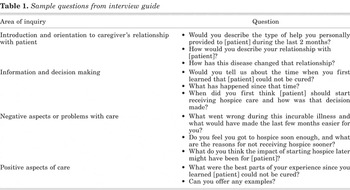
In-depth interviews were conducted with each participant by one of two interviewers (E.H.B., D.S.G.). Using an open-ended interview guide, caregivers were asked about the patient's care and illness trajectory within the month preceding enrollment with hospice, how they first learned about hospice, and their experiences as they transitioned to hospice. Sample questions from the interview protocol appear in Table 1. Depth interviews are a useful technique for generating narratives that center on fairly specific research questions (Crabtree & Miller, 1999). Interviews lasted approximately 1 h and were audiotaped with respondents' permission. Tapes were transcribed by an independent, professional transcriptionist. All interviews were completed between November 2000 and June 2002. The period of data collection was affected by caregivers' ability to take time to participate, as well as by necessary rescheduling related to the patient's condition. One caregiver was interviewed 80 weeks after the patient's death; we excluded these data from the analysis. This omission brought the mean number of weeks post-death that patients were interviewed to 18.5 (range 3.5–36 weeks).
Sample questions from interview guide

Data Analysis
We used the constant comparative method for qualitative data analysis (Glaser & Strauss, 1967; Hewitt-Taylor, 2001). Line-by-line review and coding of the transcripts was performed independently by three investigators (E.H.B., D.S.G., E.C.) in a series of steps. After two or three interviews were coded independently, the team came together in joint sessions to discuss and review the coding of each transcript. The code structure was developed initially through the first joint session and was augmented with successive sessions as greater breadth and depth of the concepts were explored in the interviews and reported. At each stage, discrepancies were resolved through discussion and negotiation until consensus was reached. At the completion of all interviews, the final code structure was reapplied to each transcript, first independently by two researchers (E.C., D.G.S.) and then in a joint session with all investigators to negotiate differences and articulate common themes apparent across the codes. We used QSR NUD*IST 4.0 (Sage Publications Software, Thousand Oaks, CA) to assist with coding and analysis of the data.
RESULTS
Characteristics of the Sample
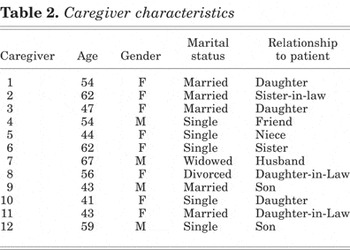
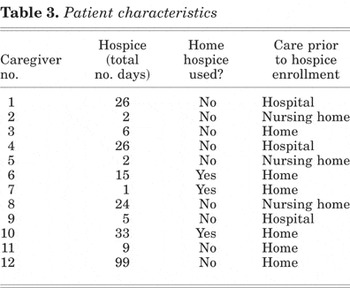
Respondents' mean age was 53 years old (range 41–67 years). Eight were female and 4 were male. Five were married, 5 were single, 1 respondent was divorced, and 1 was widowed. Kinship relation to the patient varied, with 5 being a child of the patient (2 sons, 3 daughters), 1 husband, 1 sister, 1 niece, 1 sister-in-law, 2 daughters-in-law, and 1 friend. All respondents were White and were residents of Connecticut. Table 2 summarizes respondents' demographic information. The average time that the patients were enrolled with hospice was 21 days (median = 26 days). Three patients received both home and inpatient hospice; 9 received inpatient hospice only. Six patients transferred to hospice from home, 3 transferred to hospice from an acute care hospital, and 3 transferred to hospice from a nursing home. Table 3 reports patient characteristics.
Caregiver characteristics

Patient characteristics

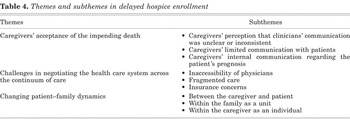
We identified three themes common to the experience of transitioning to hospice: (1) caregivers' acceptance of the impending death, (2) challenges in negotiating the health care system across the continuum of care, and (3) changing patient–family dynamics. Themes and their subthemes are summarized in Table 4.
Themes and subthemes in delayed hospice enrollment

Caregivers' Acceptance of the Impending Death
A common theme that emerged as participants described the months, weeks, and days that preceded the transition to hospice was their changing awareness and acceptance of the patient's impending death. In some cases, caregivers described their original denial of the patients' terminal prognosis gradually turning into acceptance:
I thought she was going to get better. I thought, “She'll be fine,” you know? Until the end, that is. I mean, then you could see she was really not going to…. But for a long time I kept being optimistic about it. (Caregiver #2)
Despite the fact that all patients had been diagnosed with terminal cancer, which has a more predictable trajectory to death than other terminal illnesses, several caregivers reported the patients' death to be a “shock.” Caregivers only slowly came to realize that the patient's death would occur very soon despite objective facts that the patient was terminally ill. The process by which caregivers arrived at the realization that their loved one was near death was characterized by three primary factors: (1) caregivers' perception that clinicians' communication about prognosis was unclear or that the depth of information given was inconsistent over the course of illness, (2) caregivers' limited communication with patients, and (3) caregivers' internal communication regarding the patient's prognosis.
Caregivers' Perception that Clinicians' Communication Was Unclear or Inconsistent
Some caregivers reported that there was no direct communication regarding incipient death during discussions with clinicians or, if there were, that direct communication did not occur until death was very near. For example, one caregiver, describing the way a clinician related her mother's prognosis, said: “I don't feel the doctor really communicated that this was indeed terminal.” (Caregiver #3)
Communication was described as subtle in nature, with euphemisms that may have been misleading to the patient and family. After being told that her cancer had spread, the patient asked her physician,
“So, what are we going to do?” and he said, “Well, we can do chemo. We can try some different drugs than we used before. We're not at the bottom of the barrel yet … I haven't given up on you yet.”
The caregiver commented, “To me, that's not saying someone's terminal.” (Caregiver #3)
Caregivers indicated the importance of direct, candid prognostic information to their acceptance of the patient's status. The caregiver continued,
[The doctor] said to me, “Chemo's not going to work. If it works, it's temporary.” So that was like hitting me with a ton of cold water. I didn't realize that. But yet, once I had that information, then, okay, now what do we do? (Caregiver #3)
Caregivers' Limited Communication with Patients
Caregivers' also described their communication with patients about the end of life as being subtle or indirect. Often there was no tacit acknowledgment of the patient's prognosis. Several reasons for limited communication were described. One caregiver explained that her mother was too afraid to talk about her prognosis:
I think she knew but she couldn't talk about it. This just came to me last week. She was too afraid to talk about it. She wasn't—my mother was a very practical person. Whatever you had to do, you did … and that was my mother's attitude. So I think if she could have talked about it, like, “I'm going to die,” but I don't think she could talk about it. (Caregiver #3)
Another caregiver spoke about how her mother quietly relayed her wishes, saying, “She kind of wrote a note on wanting to be cremated.” (Caregiver #8)
Some caregivers attributed the lack of communication to the patient's desire not to burden the family. A daughter described her mother's reasons for noncommunication:
She was cool and she kept a lot from us. She didn't want to worry us, her children, her sons and her daughters. She kept a lot from us. But then it got to a point where she just needed some care and she didn't want us to go through taking care of her. (Caregiver #12)
Some caregivers spoke with their loved one about death in a veiled way, or only touched upon the subject in the most cursory manner. The following caregiver described her brief end-of-life conversation with her mother and how her mother preferred to cope with her prognosis in a way other than through communication:
Once, a few months ago, when I was here, we were lying in bed together at home and I asked her if … I said, “You don't talk about it.” Her main way of coping was catalogue shopping and T.J. Maxx, when she could get out, and I wanted her to be philosophical or reflective or spiritual or something. That was my need, I realize. She very clearly let me know. She said, “I know what's going on, but I don't want to go there. I'd rather focus on getting as much as I can,” which mainly meant shopping. (Caregiver #6)
In one family, the patient was comfortable talking to people other than her family members about the end of her life. The caregiver explained,
She talked to a friend of mine when she was in Hospice … and the priest also. I think the priest helped the most out of anyone, and my girlfriend, who was pretty close to her. Just talking to her, so she wasn't so afraid. But she couldn't do that with us. [She was] afraid of dying, you know, talking about dying. Just the unknown, or what to expect. You know, to try to get things more orderly. I remember that day, I said, “You want me to give away anything?” “No, everything's for you. You do what you want with it.” She didn't want to have to deal with any of that. Yeah, I never really knew, did she really want a wig? (Caregiver #8)
The caregiver then relayed how her husband did not wish to talk about his mother's end-of-life care.
And also, I think she talked to my husband briefly, who really didn't even want to talk too much about it other than, “My mom wants to be cremated,” is what he said, but I wish things were open [and that there was] more communication about everything, even with the kids, because my kids were very close to her.
In this family, communication was limited because the patient and the son were uncomfortable talking about the end of life. The caregiver summarized,
It was taboo. You didn't talk that you were going to die. She knew the chemo wasn't working. She just kept saying, “I don't want to know, I don't want to know anything.” So you can't say, “Hey, ma, you're dying.” It's just not what she wanted to hear.
Caregivers' Internal Communication Regarding the Patient's Prognosis
Caregivers' internal communication, or internal dialogue, was characterized by gradual acknowledgement of the patient's status. Internal resistance inhibited full recognition of the patient's physical and mental decline and impending death. For example, one respondent spoke about her expectation that her mother would always rebound:
All the doctors called her the Comeback Kid because she would always. She had the mastectomy and then she would go into [remission] and they'd say, “Clean bill of health,” 6 months, a year, a year and a half, two years, “Clean bill of health…” So [her death] was shocking for all of us because if they've done it 12 times, you think they're going to do it the 13th time. You get used to that. (Caregiver #10)
Another caregiver described how he was in denial that his mother would die although she was in hospice:
It was kind of like a shock. You know, you just expected … or I expected just to keep on going to hospice day and night…. [Her death] appeared sudden to us, and probably wasn't if you stepped back and took a realistic look. We saw enough people come in and spend a day or two and pass away. A couple of hours in some cases, people were gone. So it was just like, “Gee, we're in this place where mom is and we're watching all these people die.” It never occurred to us that she was. (Caregiver #12)
In a similar case, the caregiver had grown accustomed to the effects of illness on his wife and was deceived by what he perceived to be a well-functioning patient, as this exchange illustrates:
Participant: … She walked to the car. Got in the car herself. And that's the part that's hard to accept.
Interviewer: Her walking to the car.
Participant: She wasn't that disabled. She wasn't that…. I don't know how to put it into words. She looked fine to me. I mean, I suppose you can just get used to her illness… (Caregiver #7)
Still another aspect of denial involved the caregiver growing accustomed to the caregiver role and believing they would continue in that role indefinitely. The caregiver related,
I never thought it was going to end up that she would be in hospice. I was just relying on myself—the fact that I was going to take care of her. It's hard for me… I never realized how bad it was. You just don't think of it that way. I just continued to take care of her.
Challenges in Negotiating the Health Care System across the Continuum of Care
Respondents identified several issues related to the health care system that made the transition to hospice more complex. These issues included inaccessibility of physicians, fragmented care, and insurance concerns.
Inaccessibility of Physicians
Several caregivers perceived the patients' physicians as inaccessible during the terminal phases of their loved ones' illnesses. One respondent complained,
His [the physician's] office is like insanity, and he doesn't talk to you. He doesn't return your phone calls. He doesn't give you an appointment. It's like this is not your doctor.” (Caregiver #10)
Caregivers also described having difficulty interacting with clinicians when several providers were involved:
It's hard to even get a hold of the doctors. Like one doctor was in charge of chemo, another was in charge of radiation. You didn't know who to call… it was hard to get in contact with them, because basically we didn't know them … and they were in a hurry when they did call you back…” (Caregiver #2)
Inaccessibility of physicians was frustrating to caregivers because they felt they did not have the information they needed about the patient:
Well, I wish we had been able to talk to the doctor more. You know, to really get more feedback. Because we were really in the dark, and I think that is not a good situation.” (Caregiver #2)
Fragmented Care
Respondents noted that the patient was transferred multiple times to different care settings prior to getting to hospice. Patients were referred to non-hospice providers such as nursing homes, rehabilitation facilities, or home care when hospice-level services probably would have been a more appropriate care setting. The case of Mrs. P. illustrates this experience:
Mrs. P. had been living with breast cancer for about 27 years. Over time, the cancer metastasized to her jaw and lung. Recently, she became more ill than she ever had been before, and was admitted to the hospital. She was then discharged to a rehabilitation facility because she only had 30 days' worth of insurance. At rehab, Mrs. P. was unable to do the required exercises, so she was discharged home with 24-hour care after 5 days. The family felt her home attendant was not providing proper care and asked her to leave. Caring for Mrs. P. became overwhelming to her daughter, who felt that Mrs. P. was too ill to be cared for at home. “Every 5 minutes she was in pain and uncomfortable and sick, and I couldn't make it better.” She called the Hospice Liaison, who sent a representative to the house. “Why is your mother here? Why is she not at hospice?” “Because the doctor said that she is not ready.” “Not ready? I hope your mother makes it to hospice. This is so close.” Mrs. P. died at hospice about a month later. Although it was only a week between the time Mrs. P. was discharged from the hospital to the time she was admitted to hospice, Mrs. P.'s daughter said, “It was a hell of a lot of moving for my mother in that condition—from the ambulance at the hospital to [the rehabilitation facility], then from the [rehabilitation facility] to [home], then from [home] to hospice. I mean, all of that took a toll on her.” Mrs. P.'s daughter wondered why her mother hadn't been directly transferred to hospice: “… it took us that time to scramble, to figure out what are we going to do. So we did take her back home. Again, why didn't she go from [the hospital] to hospice?” (Caregiver #10)
Insurance Concerns
Insurance coverage for the terminal phase of patients' illnesses posed challenges for some caregivers. Some reported having to “game” the system to obtain coverage for hospice care. For instance, one caregiver related her experience with her loved one whom she believed was ready for hospice, but who did not meet Medicare standards for hospice coverage:
The help is not there. You're on Medicare, and you can only get so much. It's frustrating…. Her oxygen level had to go low enough [to be eligible for the Medicare hospice benefit], so the doctor would have her literally running up and down the hall trying to get this oxygen level under the certain magical number that entitled you to extra care. (Caregiver #11)
Changing Patient–Family Dynamics
A third theme was changing patient–family dynamics. This theme was characterized by three discrete yet related dimensions: (1) the caregiver-patient interaction and relationship, (2) the family as a unit, and (3) the caregiver as an individual.
Change in Caregiver–Patient Interaction and Relationship
The months and weeks leading to the transition to hospice were filled with complex changes in the interactions and relationships of the caregivers and the patients. The change was painful for some caregivers. In one case, the caregiver described a change from “being a friend” to being the recipient of her mother's anger and frustration:
[She] got disoriented or somewhat delusional, but she always basically knew who I was and that I was her daughter and that I was her friend. Whereas [other times] she just got totally angry with me. She was angry at everyone, but especially me. That was quite an eye-opener. It was [hard] because you've never experienced it before, and here you've been the caregiver all this time and you thought this is the way things are, and then very quickly one day … things change. (Caregiver #8)
Change in the Family as a Unit
A central aspect of the family dynamics was disagreement about the care plan for the patient. In one case, the children disagreed about their mother's treatment plan:
My sister, [name] … had power of attorney at that time, and [my other siblings and I] were against the morphine, so what happened was [the hospital] had another hearing saying that we weren't complying, that we were against the morphine … the next thing we knew, they contacted [name] and they had her sign my mother into hospice against our wishes. My mother was never a candidate for hospice. (Caregiver #1)
This disagreement strongly affected the family:
I don't think it will ever be the same … there's 7 of us, and … we were angry with [name] because of what happened. She refused to sit with us at the funeral. It tore the whole family apart.
Change in the Caregiver as an Individual
Yet another dynamic that arose during the transition to hospice was when caregivers experienced changes in their self-perception due to the patient's illness and their own role changes within the family unit. One respondent described how caring for her mother made her think differently about herself as a person:
I knew she really needed me and she always depended on me anyway and she trusted me, and it made us closer because it was like I was the only one who could … she couldn't take care of herself in any way…. It made me feel overwhelmed with responsibility, but I knew that it wasn't like she was trying to guilt me into doing something. It was just like I accepted that that was what had to [be done]. I was the one to deal with it, and that's how it was. So I had to do [it]…. It was hard. It was upsetting. I mean, it took me to places I'd never been before in the sense of fear and responsibility, because what if she dies while I am here? … So it was very stressful and it was a negative experience for sure, but it did make me realize how you do rally in a moment, like as an individual, what you need to do. I mean like, just in the sense of carrying my mother to the bathroom and wiping her and stuff. I mean, I never thought I could change her diaper. It's just, when you think about it, it's like I can't go there, but then you're there and there's no other option. So you do things that you just never thought you could do, so that's the gift, in realizing you really can do. You can be quite extraordinary when you need to be. (Caregiver #10)
DISCUSSION
This study found three themes common to patients' and caregivers' experiences of transitioning to hospice: (1) caregivers' acceptance of the impending death, (2) challenges in negotiating the health care system across the continuum of care, and (3) changing patient–family dynamics. These themes illustrate some complex dynamics that may emerge during the transition to hospice. Themes did not differ notably between respondents who were interviewed before or after their relative's death.
One phenomenon that influenced caregivers' awareness of the patient's impending death was difficulties in communication between the clinicians and caregivers. Several caregivers reported that clinicians withheld bad news or couched the bad news in euphemism. As found in other studies (Seale, 1991; Miyaji, 2002; Schulman-Green et al., 2005), this may reflect clinicians' desire to maintain hope, their discomfort discussing prognoses, or their underestimating what the caregiver or patient wished to know about the illness. On the other hand, caregivers noted changes in their own willingness to hear bad news as their own cognitive and emotional states changed, often from denial to gradual acceptance of the impending death.
Although patients and family caregivers must accept the reality of the patient's situation before they are able to transition to hospice, the process of gaining awareness and moving toward acceptance may also delay hospice enrollment. This study suggests that, when arriving at the crossroads where hospice is an option, patients or caregivers may not always make purposeful decisions. The intentionality of getting to hospice may be affected by the caregiver's degree of awareness and acceptance of the patient's condition. Accordingly, the decision to enroll with hospice may not reflect careful, deliberate planning based on objective assessment of the patient's disease progression, but rather a complex process of awareness and acceptance of the patient's condition, needs, and alternatives.
Even with optimal communication and timely acceptance of the terminal illness and need for hospice, insurance and systems constraints persist. Although such impediments are not unique to hospice, they seem to be particularly pronounced as a result of confusion over reimbursement policies, involvement of additional providers, changes in care setting, and inadequate planning for end-of-life care. Additionally, current emphasis on patient rights and privacy of medical information may preclude imparting of patient information that is essential to the caregiver's efforts to develop appropriate care plans.
We also found that the introduction of a terminal illness into a family can have a powerful and changing effect on relationships among family members and that negotiating family dynamics may also delay decisions to enroll in hospice. Previous research has described how cancer affects the patient and his or her family (Northouse, 1984; Lewis, 1986; Rolland, 1999) and how caring for a patient with cancer may adversely affect family caregivers, particularly when caregivers are not prepared or lack the resources to take on this new and difficult role (McCorkle & Pasacreta, 2001). Our results corroborate that the introduction of a terminal illness creates new interactions, conflict, and stress among family members that may not be present under normal circumstances. Our findings also indicate that the pressure of making the hospice decision may influence family interactions. Coming to terms with a terminal diagnosis was described as a stressful task for families. Transition periods may be even more stressful because of the new issues that arise. The very decision to enroll in hospice may provoke difficult familial issues. For example, if family members were previously not good collaborators or communicators, those dynamics may worsen in this crisis situation.
As challenging as the caregiver role was for caregivers, some voiced wanting to continue in this role because it meant the patient was still alive. For these caregivers, it was easier or safer to remain a caregiver indefinitely than to face the idea of the patient's death. Additionally, the death of the patient would force yet another role transition and adjustment within the caregiver as an individual, the first being from noncaregiver to caregiver, and the second from caregiver to bereaved. Ironically, although caregivers in our study indicated that hospice helped with their role adjustment and acceptance of the patient's death, fears regarding these role adjustments may delay hospice enrollment and the help hospice offers.
There are important issues to consider in interpreting our findings. First, the study was conducted in one state and with patients and caregivers enrolled in a single hospice. Second, the data were collected over 19 months, a longer time frame than would have been optimal. During this time frame, changes may have occurred in relevant system and provider level factors that influenced caregiver experiences. We are, however, unaware of any such changes. Finally, all the respondents were white, and some kinship relationships were not represented in our sample. Hence, additional themes might become apparent in a broader sample of caregivers. Nevertheless, this qualitative study reveals new and subtle facets of the transition to hospice that may delay enrollment and lays the groundwork for future research with larger and more diverse samples of caregivers.
The experience of getting to hospice is characterized by complex interplay among patients, family members, clinicians, and the health care system. We hypothesize that these complexities may contribute to delayed hospice enrollment. Future research might test this hypothesis empirically. This study illustrates the complexities of making the transition to hospice and reinforces the need to encourage services that help patients and their caregivers navigate one of life's most challenging crossroads.
ACKNOWLEDGMENTS
The authors thank Robin Moore, R.N., for her assistance with data collection for this study. We are also grateful to the participants who shared their stories with us.
This research was supported by the John D. Thompson Hospice Institute for Education, Training, and Research, the Nathan Cummings Foundation, and the U.S. Army Breast Cancer Research Program, Grant Number DAMD17-00-1-0509. Dr. Bradley is also supported by the Donaghue Medical Research Foundation (Grant Number 02-102) and a grant from the Claude D. Pepper Older Americans Independence Center at Yale (#P30AG21342). This research was performed at Yale University.
References
REFERENCES
Bradley, E.H.,
Fried, T.R.,
Kasl, S.V.,
et al.
(2000).
Referral of terminally ill patients for hospice: Frequency and
correlates.
Journal of Palliative Care,
16,
20–26.Google Scholar
Bradley, E.H.,
Prigerson, H.,
Cherlin, E.,
et al.
(2002).
Delayed hospice enrollment and caregiver well being.
The Gerontologist,
254,
254.Google Scholar
Christakis, N.A.
(1994).
Timing of referral of terminally ill patients to an outpatient
hospice.
Journal of General Internal Medicine,
9,
314–320.Google Scholar
Christakis, N.A. &
Escarce, J.J.
(1996).
Survival of Medicare patients after enrollment in hospice
programs.
The New England Journal of Medicine,
335,
172–178.Google Scholar
Crabtree, B.F. &
Miller, W.L.
(1999).
Doing Qualitative Research
(2nd ed.).
Thousand Oaks, CA:
Sage Publications.
Emanuel, L.L.
(1995).
Advance directives: Do they work?
Journal of the American College of Cardiology,
25,
35–38.Google Scholar
Farmon, C. &
Hofmann, M.
(1997).
Factors contributing to late hospice admission and proposals for
change.
The American Journal of Hospice and Palliative Care,
14,
212–218.Google Scholar
Frantz, T.T.,
Lawrence, J.C.,
Somov, P.G.,
et al.
(1999).
Factors in hospice patients' length of stay.
The American Journal of Hospice and Palliative Care,
16,
449–454.Google Scholar
Friedman, B.T.,
Harwood, K., &
Shields, M.
(2002).
Barriers and enablers to hospice referrals: An expert
overview.
Journal of Palliative Medicine,
5,
73–84.Google Scholar
General Accounting Office
(2000).
More beneficiaries use hospice but for fewer days of care.
Report to Congressional Requesters.
Washington, DC:
United States General Accounting Office.
Glaser, B. &
Strauss, A.
(1967).
The Discovery of Grounded Theory: Strategies for Qualitative
Research.
Chicago:
Aldine.
Gochman, D.S. &
Bonham, G.S.
(1988).
Physicians and the hospice decision: Awareness, discussion, reasons,
and satisfaction.
The Hospice Journal,
4,
25–53.Google Scholar
Hanson, L.C.,
Danis, M., &
Garrett, J.
(1997).
What is wrong with end-of-life care? Opinions of bereaved family
members.
Journal of the American Geriatrics Society,
45,
1339–1344.Google Scholar
Hewitt-Taylor, J.
(2001).
Use of constant comparative analysis in qualitative research.
Nursing Standard,
15,
39–42.Google Scholar
Institute of Medicine
(1997).
Approaching Death: Improving Care at the End of Life.
Washington, DC:
National Academy Press.
Lewis, F.M.
(1986).
The impact of cancer on the family: A critical analysis of the
research literature.
Patient Education and Counseling,
8,
269–289.Google Scholar
Lynn, J. &
Goldstein, N.E.
(2003).
Advance care planning for fatal chronic illness: Avoiding
commonplace errors and unwarranted suffering.
Annals of Internal Medicine,
138,
812–818.Google Scholar
Lynn, J.,
Teno, J.M., &
Harrell, F.E., Jr.
(1995).
Accurate prognostications of death: Opportunities and challenges for
clinicians.
Western Journal of Medicine,
163,
250–257.Google Scholar
McCorkle, R. &
Pasacreta, J.
(2001).
Enhancing caregiver outcomes in palliative care.
Cancer Control,
8,
36–45.Google Scholar
Miyaji, N.T.
(2002).
The power of compassion: Truth-telling among American doctors in the
care of dying patients.
Social Science and Medicine,
36,
249–264.Google Scholar
Naik, A. &
DeHaven, M.J.
(2001).
Short stays in hospice: A review and update.
Caring Magazine,
10–13.Google Scholar
Northouse, L.
(1984).
The impact of cancer on the family: An overview.
International Journal of Psychiatric Medicine,
14,
215–243.Google Scholar
Patton, M.Q.
(2002).
Two decades of developments in qualitative inquiry: A personal,
experiential perspective.
Qualitative Social Work,
1,
261–284.Google Scholar
Rolland, J.S.
(1999).
Chronic illness and the family life cycle. In
The Expanded Family Life Cycle: Individual, Family and Social
Perspectives
(3rd ed.),
Carter, B. and
McGoldrick, M. (eds.), pp.
492–511.
Boston, MA:
Allyn & Bacon.
Schulman-Green, D.,
Bradley, E.H.,
Cherlin, E.,
et al.
(2005).
Nurses' communication of prognosis and implications for hospice
referral.
American Journal of Critical Care,
14,
64–70.Google Scholar
Seale, C.
(1991).
Communication and awareness about death: A study of a random sample
of dying people.
Social Science and Medicine,
32,
943–953.Google Scholar
SUPPORT Investigators.
(1995).
A controlled trial to improve care for seriously ill hospitalized
patients: The study to understand prognoses and preferences for outcomes
and risks of treatment.
Journal of the American Medical Association,
274,
1591–1599.Google Scholar
von Gunten, C.F.,
Von Roenn, J.H.,
Neely, K.J.,
et al.
(1995).
Hospice and palliative care: Attitudes and practices of the
physician faculty of an academic hospital.
The American Journal of Hospice and Palliative Care,
12,
38–42.Google Scholar
Sample questions from interview guide
Caregiver characteristics
Patient characteristics
Themes and subthemes in delayed hospice enrollment
 You have
Access
- 30
- Cited by