Survival after congenital heart surgery has significantly improved over the last decades and more than 90% of the children are alive after 10 years.Reference Marino, Lipkin and Newburger 1 Living with a CHD is not equivalent to being cured and many children are in need of life-long follow-up. 2 The most common sequelae of CHD are neurodevelopmental impairments that occur in up to 50% of the children with complex CHD.Reference Marino, Lipkin and Newburger 1 The neurodevelopmental impairments can occur throughout childhood and manifest themselves in varying degrees from discrete symptoms such as language issues, poor executive functioning, concentration difficulties, and behavioural and emotional problems to physical impairments. 2 The cardiac lesion itself may therefore not be the major issue throughout childhood, whereas the neurodevelopmental deficits can impact the child’s quality of life on a daily basis.Reference Marino, Lipkin and Newburger 1
Assessment of patients-reported quality of life is seen as an important component in the follow-up of the CHD patient as emphasised by the American Heart Association in 2013.Reference Marino, Lipkin and Newburger 1 The patients-reported quality of life reflects the individual’s ability to function in physical, social, emotional, and school domains. The quality of life survey may identify/reveal dysfunction in one or more of the domains and is a critical component in the evaluation of the long-term outcomes of CHD-specific therapies.Reference Marino, Lipkin and Newburger 1 , Reference Marino, Cassedy, Drotar and Wray 3
International studies have explored quality of life in children and adolescents with CHD and observations have been inconsistent.Reference Idorn, Jensen and Juul 4 The current literature reflects different questionnaires, different study designs, different groups of CHD, and different age groups. Some studies have presented higher quality of life scores in children with CHD compared to healthy controls,Reference Bratt, Luyckx, Goossens, Budts and Moons 5 , Reference Apers, Moons and Goossens 6 whereas others have found reduced quality of life in children with CHD.Reference Mellion, Uzark and Cassedy 7 – Reference Marino, Shera and Wernovsky 9 Long-term follow-up after congenital heart surgery has revealed reduced QoL even into adulthood.Reference Bambul Heck, Pabst von Ohain, Kaemmerer, Ewert and Hager 10 , Reference Muller, Berner, Ewert and Hager 11
The majority of studies are cross-sectional studies comparing heterogeneous groups of CHD lesions with the main emphasis on comparison of biventricular and single ventricular CHD with each other and healthy controls.Reference Bratt, Luyckx, Goossens, Budts and Moons 5 , Reference Apers, Moons and Goossens 6 Quality of life in anatomic specified groups of CHDs with biventricular repair remains to be elucidated.
Our aim was to investigate quality of life in three of the most common CHDs: Ventricular Septal Defect, Transposition of the Great Arteries, and Tetralogy of Fallot. The choice of the individual CHD lesion was based on a wish to reflect different subtypes with left- and right-dominant anatomical defects and different degrees of complexity to elucidate whether this resulted in differences in quality of life among children with biventricular repair. Furthermore, our objective was to evaluate children and adolescents 10–16 years after their heart surgery to assess long-term outcome. Quality of life outcome was compared with a group of healthy controls.
Materials and methods
Study population
All children who underwent surgery for simple Ventricular Septal Defect closure, radical Transposition of the Great Arteries repair, and radical Tetralogy of Fallot repair between 1 January, 2001 and 31 December, 2007 in two tertiary paediatric cardiology centres: Rigshospitalet, Copenhagen University Hospital and Aarhus University Hospital, Denmark were screened for eligibility. Identification was performed by means of the National Patient Register. Inclusion criteria were surgically corrected Ventricular Septal Defect, Transposition of the Great Arteries, or Tetralogy of Fallot in Denmark, age 10–16 years at the time the questionnaire was distributed and Danish speaking. Exclusion criteria were cognitive or physical limitations preventing the child from filling out the questionnaire, the presence of a known syndrome, genetic, or significant neurological abnormalities, other CHDs than Ventricular Septal Defect, Transposition of the Great Arteries, and Tetralogy of Fallot, chronic diseases, or absence of informed consent. Patients were either contacted by mail or asked to participate during a routine follow-up visit at the outpatient Paediatric Cardiac Clinic at Rigshospitalet, Copenhagen University Hospital or at Aarhus University Hospital. The children with CHD received a package with Paediatric Quality of Life (PedsQL™) questionnaires (http://www.pedsql.org) (Mapi Research Trust, Lyon, France), which should be returned by mail after completion in a pre-stamped envelope enclosed in the invitation letter. A control group of 33 healthy children and adolescents aged 10–16 years recruited from local schools completed the questionnaires as previously described by Idorn et al.Reference Idorn, Jensen and Juul 4
Paediatric Quality of Life
The Paediatric Quality of Life (PedsQL™) version 4.0 generic core module questionnaires in Danish were applied. The questionnaire is composed of parallel child self-report (8–12 years), adolescent self-report (13–16 years), and parent-proxy report. The questionnaire comprises 23 items that contribute to four subscales: (1) physical, (2) emotional, (3) social and (4) school functioning. A five-point scale from 0 to 4 evaluates the degree to which the participants (child/adolescent or parent) have experienced problems during the last month. The points are reversed and transformed to a 0–100 scale. A raw score of 0 ( = never) is transformed to 100 points, a raw score of 1 ( = rare) is transformed to 75 points, a raw score of 2 ( = sometimes) is transformed to 50 points, a raw score of 3 ( = often) is transformed to 25 points, and a raw score of 4 ( = almost always) is transformed to 0 points. The higher score (maximum of 100 points) reflects a better-perceived quality of life. A mean subscale score is calculated based on all the answered items in each of the four subscales. If more than 50% of the items in a single subscale are missing, a mean score would not be calculated. The total score is subsequently calculated as a mean of the four subscales. The reliability and validity of the Paediatric Quality of Life generic core scale has been demonstrated in a healthy and CHD population.Reference Uzark, Jones, Slusher, Limbers, Burwinkle and Varni 12 , Reference Varni, Seid and Kurtin 13
Statistical analysis
Continuous variables were summarised as mean ± standard deviation or median and interquartile range (25th to 75th percentiles), depending on the normality of distribution. Categorical variables were summarised by absolute number and percentage and binomial data were analysed by chi square. All non-normally distributed variables were sought to approximate a normal distribution by data transformation (logarithm, square root, and cube root). If normal distribution could not be archived by transformation, data were analysed with non-parametric statistics. The difference between multiple groups was analysed using the overall Kruskal–Wallis test, while intergroup differences between two groups were evaluated using Mann–Whitney U-test, only if the overall p-value was significant. In order to avoid mass significance, a p-value <0.01 was considered statistically significant (Bonferroni’s correction). A p-value of 0.05 was considered statistically significant in all secondary outcomes. Analyses were performed using R version studio 1.1.4 and R version 3.4.4 (www.r-project.org).
Results
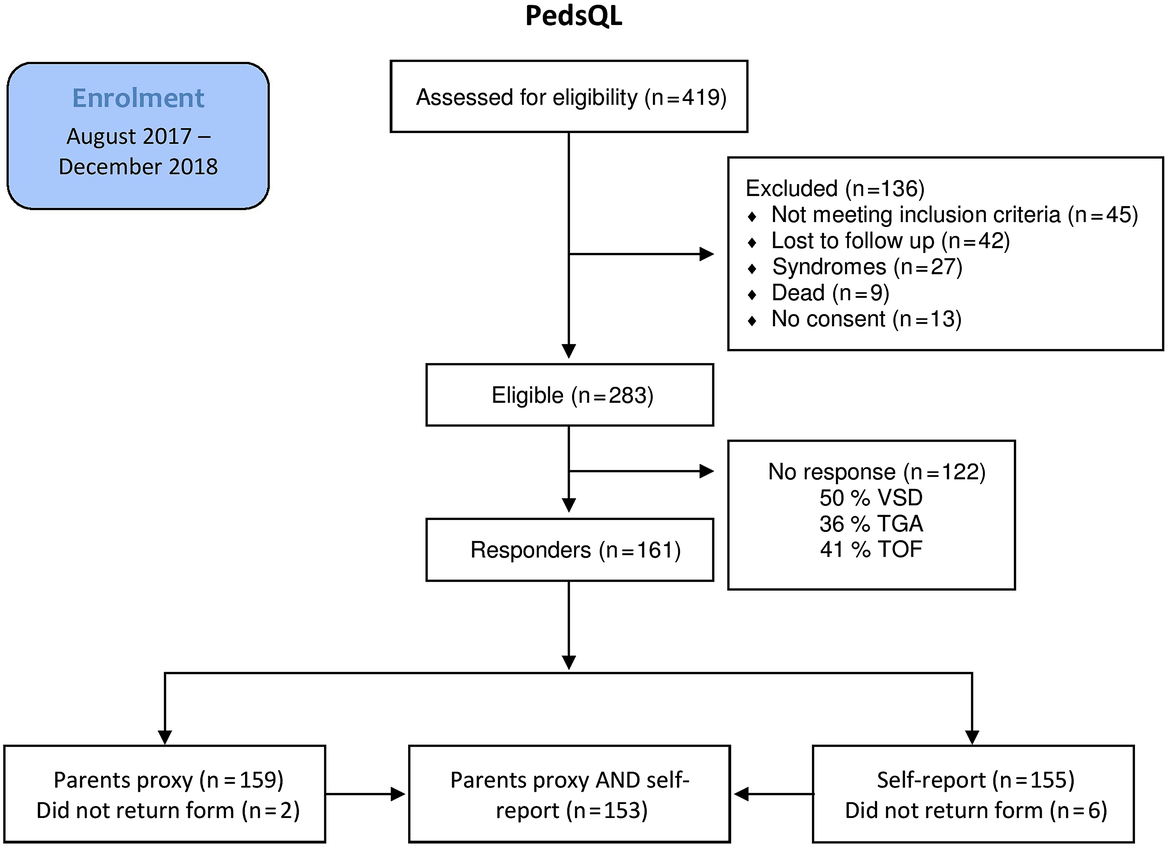
In total, 419 children underwent surgery for Ventricular Septal Defect, Transposition of the Great Arteries or Tetralogy of Fallot in the study period in Denmark and were considered eligible for the study. Of these, 45 did not meet the inclusion criteria, 42 were lost to follow-up, 27 were excluded due to syndromes, 13 did not consent, and 9 children had died. In total, 283 children were eligible for inclusion, of which 54% responded to Paediatric Quality of Life questionnaires (Fig 1).
Consort diagram of the inclusion and exclusion in the study.
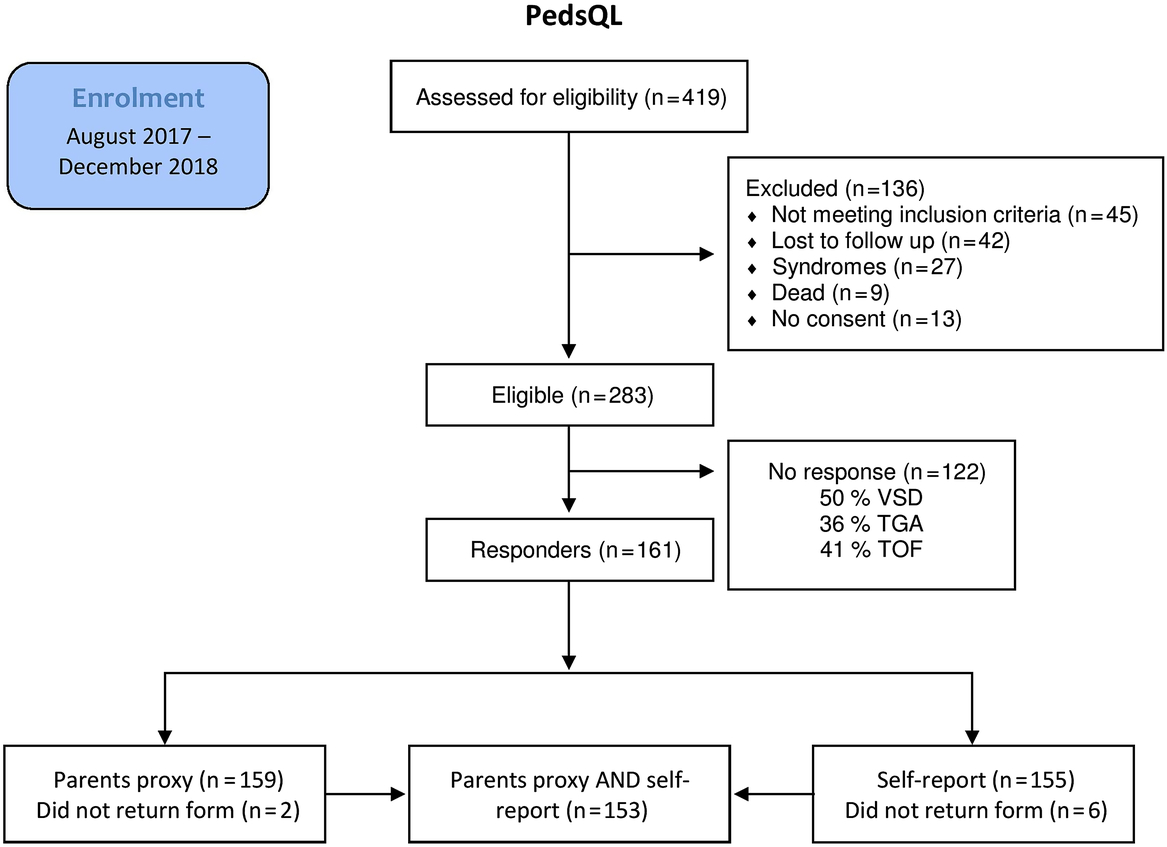
The CHD group comprised the following subgroups: Ventricular Septal Defect (n = 60), Transposition of the Great Arteries (n = 48), and Tetralogy of Fallot (n = 53). Overall, 56% were male with a mean age of 13.2±1.8 years. CHD children and control groups were comparable with respect to age and gender (Table 1).
Characteristics of the children and adolescents in the study. All data are shown as mean ± SD or median (IQR).

TGA = Transposition of Great Arteries; TOF = Tetralogy of Fallot; VSD = Ventricular Septal Defect; SD = standard deviation; IQR = interquartile range; NA = not available.
An overall test comparing the Paediatric Quality of Life scores from the Ventricular Septal Defect, Transposition of the Great Arteries, Tetralogy of Fallot, and control groups showed significant differences between groups in total score (p<0.001), school score (p<0.001), and in the physical score (p = 0.0005) (Table 2).
Self-report result for each of CHDs and control group. Scores are shown for each of the five sub-scores in the questionnaire (physical, emotional, social, school, and total score). All data are shown as median with (IQR).

TGA = Transposition of Great Arteries; TOF = Tetralogy of Fallot; VSD = Ventricular Septal Defect; IQR = interquartile range.
There was no statistically significant difference in scores between the individual CHD groups. However, the contribution from individual subscale scores differed among the CHD groups. Children in the Tetralogy of Fallot group had the lowest total score, which was not only related to a lower school score, but also due to the lowest physical score among all the CHD groups. The lowest score in the Transposition of the Great Arteries group was mainly related to a lower school score, but also a lower social score, whereas the Ventricular Septal Defect group had high social scores, in the presence of lower school scores (Table 2).
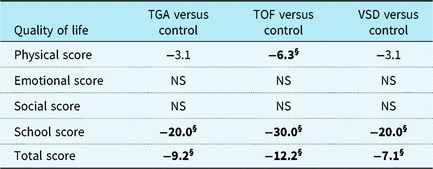
The three CHD groups were individually compared to the control group. All three CHD groups had a significantly lower total (7.7–13.2%, p<0.001) and school scores (21.1–31.6%, p<0.001) than the control group. The Tetralogy of Fallot group was the only group that had significantly lower scores in the physical subscale (p<0.001) compared with the control group, while no significant differences were found in the Transposition of the Great Arteries or in the Ventricular Septal Defect group (Table 3).
Subgroup analysis on control group compared to each of the CHD (TGA, VSD, and TOF). All data are shown as estimated difference in median from control group.

TGA = Transposition of Great Arteries; TOF = Tetralogy of Fallot; VSD = Ventricular Septal Defect; NS = non-significant.
§ p<0.001.
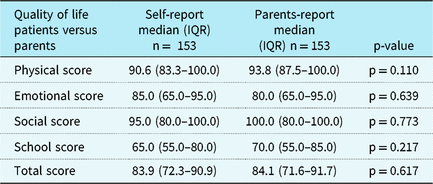
A comparison of CHD self- and parents-proxy scores demonstrated that median scores were comparable in all subscales (Table 4). Further, there was no significant difference between parental scores in children aged 10–12 years versus 13–16 years, nor in the self-reported scores between the two age groups (data not shown).
Self- and parents proxy-report scores. Reports include all three CHD types (TGA, TOF, and VSD).

TGA = Transposition of Great Arteries; TOF = Tetralogy of Fallot; VSD = Ventricular Septal Defect; IQR = interquartile range.
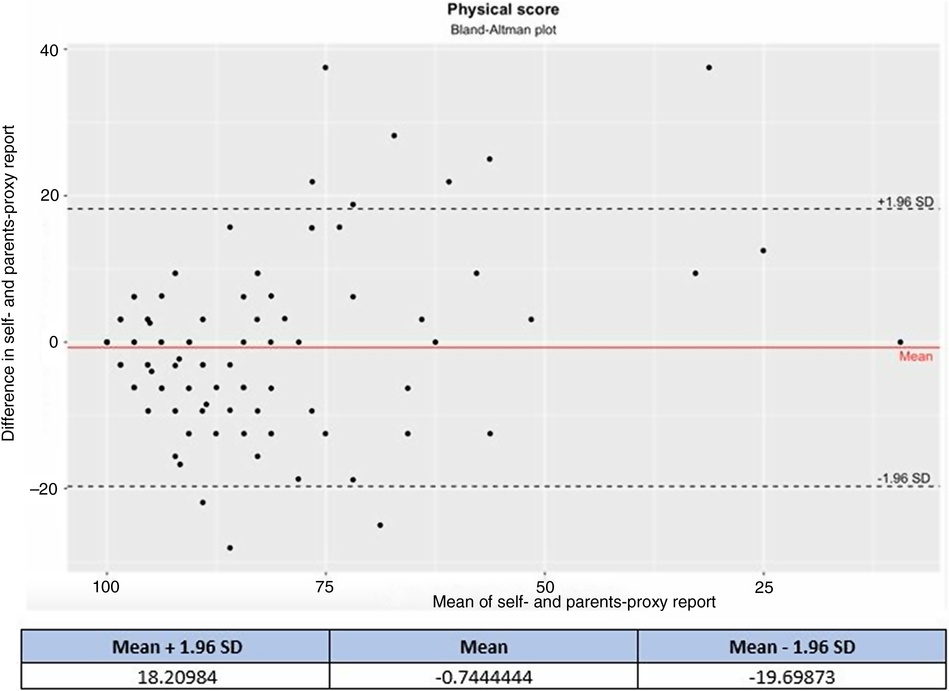
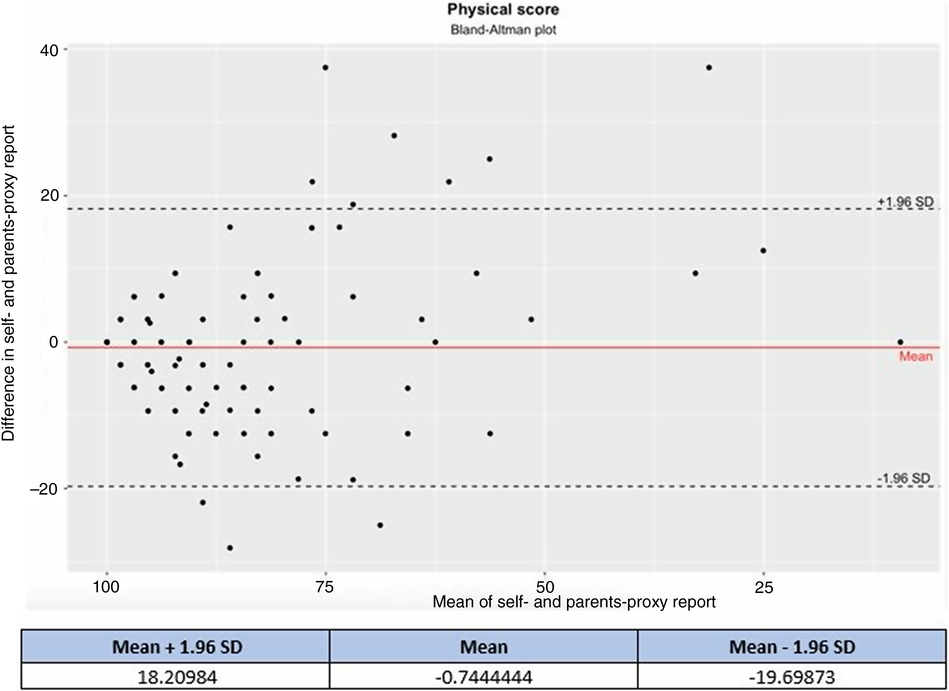
Bland–Altman plots of subscale scores showed consistency in the mean estimate of bias ranging from 2.4 to 1.6 points between the self- and parent-proxy reports in the CHD group. However, in the physical subscale, all scores below a mean of 60 points (5% of the total CHD answers), the children had higher self-scores than parents-proxy scores with a difference in score from 2 to 40 points (Fig 2). The 95% limits of agreement ranged from ±19 to 29 points in all the different subscales, where less than 6% among 153 respondents scored above or below the limits of agreement.
The figure depicts a scatter plot of difference in the mean (95% confidence interval) physical score plotted against the average of physical subscale scores from 153 children (CHD) and parent reports. Each dot represents a patient.
Discussion
The present study expands the current knowledge about quality of life in the three most common types of CHDs. We found that quality of life was significantly lower in children and adolescents with surgically corrected Ventricular Septal Defect, Tetralogy of Fallot, and Transposition of the Great Arteries compared to healthy controls. A significant difference was found in total quality of life score between children with Ventricular Septal Defect, Transposition of the Great Arteries, and Tetralogy of Fallot and their healthy counterparts.
The school score was the only quality of life domain that was significantly decreased in all three CHD groups. The school score reflects neurodevelopmental impairment in the area of intelligence,Reference Bellinger, Jonas and Rappaport 14 attention,Reference Hovels-Gurich, Konrad, Skorzenski, Herpertz-Dahlmann, Messmer and Seghaye 15 , Reference Bellinger, Bernstein, Kirkwood, Rappaport and Newburger 16 and academic achievement.Reference Bellinger, Newburger, Wypij, Kuban, duPlesssis and Rappaport 17 Several studies have related both intraoperative and postoperative factors to more impaired neurodevelopmental outcomes in children with complex CHD.Reference Ballweg, Wernovsky and Gaynor 18 , Reference Mahle 19 In the present study, children represented three physiologically different subtypes of CHD with and without cyanosis. Children with cyanotic cardiac defects (transposition of the great arteries and tetralogy of Fallot) have previously been associated with a higher risk of dysfunction in speech and language,Reference Hovels-Gurich, Bauer and Schnitker 20 and it has been shown that children with preoperative cyanosis have an increased risk of attentional dysfunction in the field of executive controlReference Hovels-Gurich, Konrad and Skorzenski 21 and have impaired school performance.Reference Wright and Nolan 22
Generally speaking, children undergoing simple Ventricular Septal Defect repair do not have any haemodynamic impairmentsReference Mellion, Uzark and Cassedy 7 and the postoperative course is in the majority without complications, and children end up with normal cardiac physiology.Reference Simons, Glidden, Sheslow and Pizarro 23 In this context, it was less clear what contributed to the lower school scores in this specific subgroup of CHDs. However, it has been shown that children with surgically corrected Ventricular Septal Defect have lower intelligence quotients within the normal range, slightly lower visual cognitive abilities, and weaker language skills than healthy controls.Reference Simons, Glidden, Sheslow and Pizarro 23 , Reference Eichler, Kohler-Jonas and Stonawski 24 Interestingly, the median school score was comparable between children with Transposition of the Great Arteries and Ventricular Septal Defect, and the interquartile range was comparable between all three subgroups of CHD children, but significantly lower compared to healthy controls. Theoretically, some of the lower individual school scores could be related to the fact that many children with CHD miss school on a regular basis, which may not only affect their academic performance, but also may give rise to feelings of isolation and social incompetence. Due to the limited number of children, we did not explore if there was any association between a low school score and social and emotional scores. However, we did not observe significantly decreased social and emotional scores in children with CHDs in this cohort.
Another important finding was the significantly lower physical score in the tetralogy of Fallot group compared to the healthy controls. This may reflect the physical limitations not allowing the tetralogy of Fallot patients to have the same level of activity as the peers. Lower maximal heart rate and total duration of exercise have been reported in surgical corrected tetralogy of Fallot patients compared with healthy controlsReference Carvalho, Shinebourne, Busst, Rigby and Redington 25 and could have contributed to the decreased physical scores in the tetralogy of Fallot group. Some of the tetralogy of Fallot patients may still have pulmonary regurgitation or pulmonary valve insufficiency if they yet have not had their right ventricular pulmonary conduit surgery.
In contrast, the Transposition of the Great Arteries and Ventricular Septal Defect groups had comparable physical scores with the healthy peers. Transposition of the Great Arteries patients has an arterial switch operation performed within a few weeks after birth, which is considered as a complete repair here after. The overall long-term outcomes of Transposition of the Great Arteries patients have been described as excellent,Reference Moe and Bardo 26 although lower long-term exercise capacity has been observed in some Transposition of the Great Arteries patients due to the presence of a chronotropic incompetence.Reference Samos, Fuenmayor and Hossri 27
A Ventricular Septal Defect is normally closed in early childhood and children are post-surgically considered healthy and fit. However, it has been described that young adults with surgically corrected Ventricular Septal Defect have reduced cardiopulmonary exercise capacity and significantly lower physical functioning scores compared to healthy controls.Reference Heiberg, Laustsen, Petersen and Hjortdal 28 These findings contrast with ours. The results from Heiberg et al were based on physical exercise tests in combination with a different quality of life questionnaire. Further, the mean age in the Ventricular Septal Defect group in latter study was 21 years and the patients had their Ventricular Septal Defect surgery performed much earlier between 1990 and 1995, which make results difficult to compare. Further, it has been described that children after congenital heart surgery to some extent overrate their physical functioning in questionnaires compared to their actual exercise capacity.Reference Gratz, Hess and Hager 29
It has been shown that a low quality of life score was associated with disease severity and the number of surgical procedures undertaken as well as number of hospital admittances among children with CHD.Reference Marino, Cassedy, Drotar and Wray 3 We included the three most common types of CHDs undergoing biventricular repair. Transposition of the Great Arteries and Ventricular Septal Defect correction normally requires only a single surgical intervention, whereas Tetralogy of Fallot often necessitates several surgical procedures and more hospitalisations. Interestingly, higher risk adjustment for congenital heart surgery categories was significantly associated with worse quality of life scores in paediatric cardiac patients,Reference O’Connor, Wray and Tomlinson 30 which did not seem to be the case in the present study.
Patient self-report and parent proxy-report scores were not significantly different, indicating comparable perceptions of the individual focus areas in the quality of life survey. However, in one area, namely the physical subscale, including all children with CHD, we observed that children reported higher scores than their parents, when the average score was below 60 points. The interpretation of this could either be that the parents scored their children’s physically function lower due to parental overprotection and anxiety of having a child with CHD,Reference Heusch, Kahl, Hensel and Calaminus 8 or it could be related to an unrealistic self-perception of the child like the Dunnen–Kruger effect.Reference Kruger and Dunning 31 Since we did not have any data on the actual physical performance, these considerations remain speculative.
The limitation to a questionnaire survey, in general, also applies to this study. We excluded patients who had cognitive limitations, because they would not be able to complete the self-report-questionnaire, and this group is likely to have worse quality of life scores. The response rate was 54%, which may have introduced selection bias. We sent out letters to the families twice if the questionnaire was not returned, but we do not know whether the non-responders actually had received the questionnaire or did not respond. Information about the parents’ socio-economic status would have improved external validity of results. However, all children included in the control group were recruited from Danish public schools, which do not involve any admission requirements or payment. Consequently, we believe that the control group represents the average child in Denmark quite well. The generalisability of the observations is of course hampered by this uncertainty. The diagnostic validity concerning CHD in the Danish National Patient Register has previously been corroborated and results were consistent in the sensitivity analysis restricted to infants with complete agreement between diagnosis and surgical International Classification of Diseases Code ( ICD).Reference Agergaard, Hebert, Bjerre, Sorensen, Olesen and Ostergaard 32 , Reference Matthiesen, Henriksen and Gaynor 33 Finally, we would have preferred to track if responders in the present survey were representative of the entire subtype of CHD in terms of perioperative course. Unfortunately, the Danish Patient’s Act does not allow us to retrieve information from the child’s medical record without informed consent from the parents, and this information would still only be available in children who responded to the questionnaire.
Conclusion
Quality of life was decreased in children and adolescents with surgically corrected Ventricular Septal Defect, Tetralogy of Fallot, and Transposition of the Great Arteries compared to healthy controls. The school score was significantly decreased in Ventricular Septal Defect, Transposition of the Great Arteries, and Tetralogy of Fallot indicating that future studies should elucidate on factors influencing on school performance. To pursue such an objective, a much more detailed assessment of non-cardiac outcome like quality of life questionnaires should be integrated in clinical long-term follow-up. Paediatricians need to focus on the developmental problems even when surgery is successful. Finally, these results emphasise the importance of counselling parents to recognise the special needs of their child in order to normalise the child’s existence to the greatest possible extent.
Author ORCIDs
Line M. Holst, 0000-0002-5969-7514
Acknowledgments
The authors acknowledge the efforts of Morten Helvind, Rebekka Lytzen, and Jane Lund Møller for their assistance in collecting the data for this study.
Financial Support
This work was funded by grants from The Jascha Foundation, The Ville Heises Grant, The Elsass Foundation, and Candys Foundation.
Conflicts of Interest
None
Ethical Standards
The authors assert that all procedures contributing to this work comply with ethical standards of the relevant Danish national guidelines on human questionnaires and with the Helsinki Declaration of 1975, as revised in 2008, and have been approved by institutional committees at Copenhagen University Hospital Rigshospitalet, Denmark.