


Introduction
All autocratic leaders confront the guardianship dilemma: a military that is strong enough to protect the regime against mass unrest and foreign threats is also strong enough to overthrow it via a coup d’etat (Greitens Reference Greitens2016; Harkness Reference Harkness2018; Paine Reference Paine2022). The coup threat is prevalent: 244 coups were successfully carried out worldwide between 1950 and 2021, and coups are the most common way in which autocratic leaders are deposed (Geddes, Wright, and Frantz Reference Geddes, Wright and Frantz2018). Men with guns pose a dangerous threat to authoritarian leaders.
How do dictators mitigate the guardianship dilemma and avoid removal by their own military officers? Seemingly, this dilemma would be acute in regimes that gained power via the military. In such cases, men with guns dominate the winning coalition (Svolik Reference Svolik2012). Yet surprisingly, rebel regimes, or those that gain power by winning a rebellion, are exceptionally durable and essentially immune from coups. Prominent examples of rebel regimes include the MPLA regime in Angola, which has governed since winning a colonial liberation struggle against Portugal in 1975, and the RPF regime in Rwanda, which has governed since 1994 after winning a civil war.Footnote 1 Our originally coded dataset, which we detail below, includes 21 rebel regimes in Africa since independence. In any particular year, rebel regimes were four times more likely to survive in power than authoritarian regimes founded by other means. In fact, 78% of postindependence rebel regimes in Africa are still in power today.
We propose that rebel regimes solve the guardianship dilemma by sharing power with military elites. In general, sharing power with coercive actors is a double-edged sword. A key decision is whether the leader appoints a distinct military elite as the Minister of Defense, as opposed to eliminating the position, keeping it vacant, or the ruler taking the post himself. On the one hand, this appointment should mitigate motives for high-ranking military officials to stage a coup by distributing spoils and delegating decision-making autonomy. On the other hand, military elites are better-positioned to stage a coup when they are closer to the center of power. They will seize this opportunity when commitments to share power are not credible. Appointed elites may anticipate that the ruler will renege on the power-sharing deal in the future, which would eliminate their access to spoils. This creates incentives for high-ranking military officials to leverage their temporary control over the military and stage a coup today rather than wait and risk losing their privileges tomorrow.
Despite this dilemma, leaders of rebel regimes are better able to commit to sharing power with military elites due to previous wartime experience. Upon establishing their regime, these leaders have already interacted and shared power with their top subordinates—they did so during the struggle to gain power. When facing an intense armed struggle, leaders improve battlefield performance by sharing power—delegating on-the-ground authority to military commanders and incorporating them into central decision-making bodies. Inclusive leadership bodies established during long struggles allow rebel leaders to develop stable power-sharing relationships with their subordinates. After winning, the rebel’s political wing takes control of the government and replaces the existing state military with their own armed wing. Leaders maintain the support of their former cocombatants by appointing them to high-ranking government positions. These power-sharing arrangements are highly credible due to a history of interactions during the war, which stabilizes expectations. By contrast, in non-rebel regimes, power-sharing deals often break down because of mistrust and a persistent internal security dilemma. Civilian and coup leaders are often overthrown by their own military appointees. Overall, these arguments yield our theoretical expectations that rebel regimes are less likely to break down and that they frequently share power with high-ranking military officials.
We provide empirical support for these expectations by analyzing original data from postcolonial Africa between 1960 and 2017. We define rebel regimes as those that came to power by winning a major civil war (at least 1,000 battle deaths). Our sample includes 10 regimes that gained independence by fighting against a colonizer and 11 additional postcolonial rebel regimes. We first establish the aggregate statistical pattern: both types of rebel regimes (colonial liberation regimes and civil war winners) are significantly less likely to break down than non-rebel regimes. These findings are unaltered under numerous robustness checks, including an instrumental variable analysis based on climatic and geographic conditions that influenced where Europeans could settle (which propelled many colonial liberation regimes). Similarly, rebel regimes are significantly less likely to experience successful coups.
We then examine power sharing with military elites. Using original data on cabinet appointments, we show that rebel regimes appointed a Minister of Defense in 83% of years compared with 56% of years in non-rebel regimes. This difference is statistically significant across various specifications. Presidents in non-rebel regimes commonly try to retain personal control over the military by appointing themselves as their own Ministers of Defense. We also show that rebel regimes that do not appoint a Minister of Defense are more susceptible to breakdown, which illustrates the centrality of the power-sharing mechanism.
Finally, we provide systematic evidence for two intervening implications. First, we compiled information on the composition of the state military after rebel takeover. In 19 of 21 cases, rebel regimes either completely transformed and displaced the existing state military, or occupied top positions in an integrated military. Second, we collected biographical information on Ministers of Defense in rebel regimes. They are typically high-ranking rebel commanders from the launching rebellion.
Our article contributes to numerous literatures. In existing research on power sharing and authoritarian stability, scholars focus on power sharing across organizations, such as co-opting opposition groups into a legislature (Gandhi Reference Gandhi2008), offering cabinet positions to members of other ethnic groups (Arriola Reference Arriola2009; Wimmer, Cederman, and Min Reference Wimmer, Cederman and Min2009), or integrating the military with a competing rebel group to settle a civil war (Hoddie and Hartzell Reference Hoddie and Hartzell2003; Toft Reference Toft2009). By contrast, we focus on how leaders share power within the ruling coalition. Drawing on insights from studies of authoritarian stability, we emphasize that a leader’s own ruling coalition poses the greatest threat of overthrow from within (Svolik Reference Svolik2012). We explain how sharing power during and after the launching rebellion mitigates coups by regime elites, a central threat to authoritarian survival.
Studies on authoritarian stability and civil wars rarely address each other directly, and we help to bridge this crucial gap. Our theory illuminates how leaders of rebel regimes can alleviate the dreaded guardianship dilemma by sharing power with their former cocombatants. According to scholarship on authoritarian regimes, leaders gain a security guarantee by sharing power with elites who can credibly threaten to unseat them, thus creating incentives for rulers to share power with military actors (Meng Reference Meng2020; Svolik Reference Svolik2012). However, according to the conflict literature, leaders hesitate to share power with coercive agents because bringing these elites into the inner circle empowers them and elevates their ability to depose the ruler (Paine Reference Paine2021; Roessler Reference Roessler2011). According to these studies, leaders should typically not want to share power with the military. Our study reconciles these two conflicting perspectives by highlighting the conditions under which sharing power with military elites alleviates, rather than exacerbates, the guardianship dilemma.
We also challenge two big ideas about the consequences of social revolutions for regime durability (Huntington Reference Huntington1968; Lachapelle et al. Reference Lachapelle, Levitsky, Way and Casey2020; Levitsky and Way Reference Levitsky and Way2013; Miller Reference Miller2020). First, we locate the stability of rebel regimes in elite power sharing, not in transforming state and society to subjugate the masses. Contrary to Huntington’s (Reference Huntington1968) proclamation that “he who controls the countryside controls the country,” most African rebel regimes struggled to consolidate territorial control beyond the capital because of persistent impediments to broadcasting power (Herbst Reference Herbst2000). Nor did they typically attempt a revolutionary transformation of society, as only six of the 21 rebel regimes in our dataset meet Lachapelle et al.’s (Reference Lachapelle, Levitsky, Way and Casey2020) definition of a revolutionary regime. Our emphasis on elite power sharing rather than mass-level mechanisms also distinguishes our approach from the literature on rebel governance, which focuses mainly on local service provision (Stewart Reference Stewart2021; Weinstein Reference Weinstein2006) or prospects for democratization (Huang Reference Huang2016).
Second, ideological affinity and partisanship alone are not sufficient to ensure stability—rebel regime leaders must still share power with military elites to survive. Lachapelle et al. (Reference Lachapelle, Levitsky, Way and Casey2020) argue that elite actors in revolutionary regimes have fewer motives to stage coups because of a shared ideology and fewer opportunities to do so because of party–military fusion and tight partisan oversight. We instead contend that simply fighting together is not sufficient. The launching rebellion enables members of the rebel military to gain fighting experience and command over troops. These skills make cocombatants a real threat to the leader unless he shares power. Empirically, we find strong evidence for this “carrots” approach to solving the guardianship dilemma. By contrast, when we consider alternative explanations, we do not find evidence for “sticks,” such as rebel regimes exercising greater partisan oversight of the military or building stronger counterbalancing units. We also show rebel regimes that routinely lack Ministry of Defense appointments are less durable, which underscores that ideological and partisan partisan bonds are not sufficient. Leaders of rebel regimes must share power to survive.
Theory
All leaders face a guardianship dilemma: a military that is strong enough to protect the regime is also strong enough to overthrow it. To mitigate the guardianship dilemma, rulers contemplate whether to delegate control to high-ranking military officials, which is an effective means of distributing spoils. However, power-sharing arrangements will not breed stability if the ruler’s promises to maintain the deal in the future are not credible. We explain why rebel regime leaders are better able to make credible commitments to their elite allies, compared with coup or civilian leaders.
Sharing Power to Mitigate the Guardianship Dilemma
In order to rule, a leader must sustain sufficient support from a winning coalition, which varies in its size and composition across regimes. In any authoritarian regime, high-ranking military officials are part of the winning coalition. Securing their acquiescence is necessary to prevent insider coups, which is the essence of the guardianship dilemma. Military elites are also crucial members of the winning coalition because they must be willing to combat threats from outside the regime. Otherwise, the regime is vulnerable to overthrow by popular uprisings or insurgencies (Paine Reference Paine2022). Overall, although authoritarian regime survival hinges on many factors, securing the cooperation of high-ranking military officials is paramount for shielding the regime against threats from above and below (Svolik Reference Svolik2012).
One way for leaders to gain the support of high-ranking military officials is to share power with them. A key power-sharing decision is whether the leader delegates control of the military to the Ministry of Defense. An important, and easily empirically observable, component of this choice is to appoint a distinct military elite as the Minister of Defense, as opposed to eliminating the position, keeping it vacant, or the ruler taking the post himself. Ministerial positions are a common method for rulers to allocate spoils to elites in Africa (Arriola Reference Arriola2009; Francois, Rainer, and Trebbi Reference Francois, Rainer and Trebbi2015). Cabinet ministers are paid lucrative salaries and often receive private luxury cars, houses, first-class travel, and control over government contracts that they can reward to family members.
The Defense portfolio is unique among cabinet positions because it links the executive branch to the military. In the typical military chain of command in Africa, the Defense Minister sits right below the president as commander in chief and oversees the chiefs of staff for each branch of the military. The Minister is involved in the creation and implementation of national security strategy, as well as the appointment, management, and mobilization of all security forces. Thus, when an elite is appointed to the Minister of Defense position, the Ministry of Defense—rather than the president personally—has direct contacts with the highest-ranking officers that exercise operational control over troops. By creating an institutionalized link between the executive branch and the military, the president relinquishes personal control over the military. In Angola, for example, “Because defense and security matters were of extreme urgency, the minister of defense was considered second in importance only to the president. The minister was responsible for the entire defense establishment, including the army, air force, navy, and local militias” (Smaldone Reference Smaldone and Collelo1991, 214, emphasis added).
Double-Edged Sword of Sharing Power
Sharing power with the military by inviting high-ranking officials to join the cabinet is a double-edged sword. Successful coups require that soldiers have ample motive to remove the ruler and the opportunity to do so. On the one hand, naming a Minister of Defense should mitigate motives for military elites to stage a coup for the reasons just discussed. On the other hand, delegating control of the military to high-ranking officers enhances the opportunity to defy the ruler’s wishes and stage a coup.
Rulers clearly perceive the downsides of delegating control to the Ministry of Defense. Among all cabinet positions, the ruler is most likely to personally hold the Defense portfolio (Meng Reference Meng2020, 110). This fear of overthrow by military officers in high-ranking government positions is borne out in the data: empirically, high-level military appointees have the greatest rate of coup success (Singh Reference Singh2014). In our sample of African countries from 1960 to 2017, coup attempts from high-level officers (e.g., generals, cabinet-level officers) succeeded 60% of the time. The success rate is even higher, at 83%, when we restrict the sample to the top three military positions: Minister of Defense, Vice Minister of Defense, and Army Chief of Staff. Juvenal Habyarimana, who ruled Rwanda from 1973 until 1994, seized power from his predecessor while serving as Defense Minister and Army Chief of Staff. Similarly, the Defense Minister of Mauritania seized power from the leader in a coup in 1980, as did the Defense Minister of Burundi in a successful 1996 coup. By contrast, coup attempts by middle-ranking officers (e.g., majors, colonels) succeeded 49% of the time, and those from the bottom (e.g., low-level soldiers) succeeded only 14% of the time.
Why would a high-ranking officer stage a coup even when the ruler delegates control of the military? Why are the lower motives for a coup sometimes overshadowed by the enhanced opportunity to seize the state? A problem of credible commitment remains. Even if the ruler delegates the Defense portfolio today, he might renege on this promise tomorrow—either by shuffling the position or personalizing control over the military. Indeed, shuffling ministers is a common empirical phenomenon to prevent any one person from amassing too much power. Sangoule Lamizana, the second president of Burkina Faso, cycled through five different Defense Ministers in 12 years. Joseph Kabila, the president of the Democratic Republic of Congo from 2001 to 2019, cycled through seven different Ministers of Defense, allowing the average Defense Minister to remain in office just over two years. In such cases, short-lived Defense Ministers are not given ample time to consolidate their own control over the security sector.
Alternatively, leaders can personalize control over the military by not appointing any distinct elite as Minister of Defense. In 38% of the country-years in our sample, the leader left the post vacant, eliminated the position altogether, or named himself his own Defense Minister. For example, Mobutu Sese Seko of Zaire was commander in chief and Minister of Defense for all three decades of his reign. No military officer ever held a cabinet post, and regional military commanders were subordinate to civilian leaders. Within the military, Mobutu routinely shuffled elites in key positions to prevent any officer from developing an independent base of support (Jackson and Rosberg Reference Jackson and Rosberg1982).
Given the threat of removal, Defense Ministers and their allies may perceive their position of power as short-lived. This provides incentives to capture their “moment in the sun” and launch a coup today rather than waiting and risk being removed from the position tomorrow. Mutual distrust between the leader and military elites creates an internal security dilemma. Many rulers in postcolonial Africa “came to fear that their professed allies, especially those with a foothold in the army, police, or security services, might exploit their regime access and coercive capacity to seize power on their own” (Roessler Reference Roessler2011, 307). The internal security dilemma helps to explain the November 1966 coup in Burundi. In the months leading up to the coup, it became apparent that King Ntare V would soon replace Michel Micombero, his then-Minister of Defense. That October, the leader accused Micombero of “incompetence” and “abuse of his authority,” in addition to recruiting mercenary soldiers to replace existing army officers (McGowan Reference McGowan2003). The next month, while the king was out of the country, Micombero seized power in a bloodless coup.
How do rulers navigate the guardianship dilemma? Under what conditions can they delegate control over the military as a means to perpetuate, rather than undermine, their survival? The key is that commitments to share power must be credible. Staging a coup carries risks even for high-ranking military officials. Coup attempts may fail, and participants of failed coups face dire consequences. At best, they are purged from the regime, and at worst, they are jailed or executed (Woldense Reference Woldense2022). Thus, although the prize of capturing the state is large, we anticipate that military elites are content to accept power-sharing relationships when the arrangement is credible—given the sizable risks of a failed coup.
Credible Commitments in Rebel Regimes
Leaders in rebel regimes are better-positioned than typical dictators to neutralize the guardianship dilemma. This is surprising because, seemingly, the guardianship dilemma should be most pressing for rulers who rely on the military to take and retain power (Svolik Reference Svolik2012). However, the launching rebellion provides the foundations for facilitating credible commitments between the leader and military elites after taking power.
Upon seizing power, leaders of rebel regimes have already interacted and shared power with their military cocombatants. Out of military necessity, they did so during the launching rebellion. Leaders cannot win wars alone. During intense armed struggles, leaders must delegate power and authority to subordinates to improve battlefield performance (Greitens Reference Greitens2016). We require the launching rebellion to reach a high death total (1,000 battle deaths total) for the subsequent regime to count as a rebel regime. Every case in our dataset in fact meets an even more stringent standard: at least one period of highly intense fighting (1,000 battle deaths in a single year). As Martin (Reference Martin2021, 15) argues, “intense security threats can spur winning rebels to create inclusive leadership bodies. … To assemble and process military information as efficiently as possible, and feed this information into organizational decisionmaking, central leaders must lean heavily on their ‘specialists in violence’ deployed in the field” [emphasis added]. Successful rebel organizations must adopt decentralized structures in which field commanders wield real authority and decision-making power. For example, in Mozambique, “The executive commanders [who directed operations in each guerrilla region], as well as FRELIMO’s overall military commander (that is, the Minister of Defence), were represented in a national command council chaired by the President of FRELIMO” (Seegers Reference Seegers1986, 140).
Wartime power-sharing relationships are especially likely to facilitate credible commitments when they unfold over long periods. The average war to launch a rebel regime lasted 8.7 years. Lengthy fighting enables leaders to observe performance and learn about the loyalty of their subordinates, thus mitigating the general problem of unknown private motives that can trigger an internal security dilemma (Roessler Reference Roessler2011, 313).
Upon achieving power, rebel movements have a unique opportunity: replacing the existing state military with their own armed wing. However, this opportunity does not solve the guardianship dilemma by itself. This point in particular departs from existing accounts of the durability of revolutionary regimes. Existing theories stress the importance of ideology or partisan ties as the primary mechanism behind regime stability. Levitsky and Way (Reference Levitsky and Way2013, 10) posit that revolutionary armies are “highly partisan and thoroughly committed to the regime” because “the army and other security forces are almost invariably commanded by cadres from the liberation struggle and imbued with a revolutionary ideology.” In this account, sharing power with military elites is not necessary for leadership survival because shared partisan and ideological ties should be sufficient to bind the military to the regime. In fact, Colgan and Weeks (Reference Colgan and Jessica2015) make this precise argument: revolutionary leaders should tend to personalize rather than to share power.
By contrast, we contend that partisanship, ideological bonds, and other sources of inherent affinity are—by themselves—not sufficient. A dictator has no intrinsic friends. Any leader who is highly reliant on his military to gain and maintain power should face internal challengers if he excludes high-ranking elites from power and spoils. Indeed, autocrats are commonly overthrown by coethnics and even their own family members. This problem is even more pressing in rebel regimes. Why would cocombatants with access to guns sit quietly if the ruler shuts them out of power and denies them the spoils of victory? Military elites who held important posts during the war pose the most credible threats because of their positions in the military hierarchy and because they command key operational units. Furthermore, besides some exceptional cases (e.g., the founding of the Soviet Union), even rebel regimes are typically unable to construct strong counterbalancing security forces that enable them to overwhelm and subjugate a conventional military with experience in rebellion.
Thus, the launching rebellion does not, by itself, eliminate threats within the regime. Instead, it creates the foundations for stable power sharing. To survive in power, leaders of rebel regimes have no option but to offer carrots to their cocombatants. Power-sharing arrangements are credible because leading actors gained experience with sharing power during the launching rebellion, which stabilizes their expectations about power-sharing deals after taking power. Put differently, the experience of delegating control during the war and then replacing the state military with the armed wing of the rebel movement provides the latent foundations for credible commitments. However, to truly commit, the ruler must then take the next step to actually delegate control to high-ranking military officials once in power. Otherwise, we expect that inherent affinity alone will be insufficient to save the leader.
Later we provide systematic evidence about the postseizure period in rebel regimes: the frequency of military transformation and of appointing leading combatants to the Minister of Defense position. Here, to make the proposed mechanisms more concrete, we provide motivating examples from Angola (colonial liberation regime) and Ethiopia (civil war winner) of power sharing during and after the launching rebellion.Footnote 2
In Angola, the MPLA adopted collective governance institutions to confront a stronger Portuguese army. The first leader of the rebel organization, which was founded in 1956, “thwarted the principle of collective leadership and used his control over party machinery to amass political power” (Marcum Reference Marcum1978, 28). This personalist approach weakened the MPLA as an effective organization, and in 1961, the Portuguese launched a devastating offensive that unleashed “wild repression by settlers, police and army” of the colonial state (Davidson Reference Davidson and Crowder1984, 771). In 1962, Agostinho Neto replaced the original MPLA leader and restructured the rebel group to instead govern collectively:
Operational authority was vested in the ten-member Steering Committee, six of whom were to constitute the supreme Political-Military Committee (PMC). As the unique retainer of the “natural secrets of the Movement,” this committee of six was given exclusive jurisdiction over military and security matters, including control of the army (EPLA). (Marcum Reference Marcum1978, 30)
After seizing power, the armed wing of the MPLA replaced the previous state military with their own FAPLA troops. As the first president of an independent Angola, Neto appointed key members of the liberation struggle as Ministers of Defense. Neto’s first Minister of Defense was Iko Carreira, who founded and served as the commander-in-chief of FAPLA during the rebellion. The second Defense Minister, Pedro Maria Tonha, who remained in that position from 1981 to 1995, was also an important commander in the MPLA during the war. Similarly, the third Defense Minister, Pedro Sebastião, led the MPLA forces in the Battle of Nto, which was decisive in Portugal’s withdrawal.
Similar patterns of intraelite power sharing occurred in the case of the Ethiopian People’s Revolutionary Democratic Front (EPRDF), which defeated the government in 1991. EPRDF, and its predecessor the Tigray People’s Liberation Front (TPLF), exhibited collective leadership during the rebellion. The three founding members rotated among the top positions (Young Reference Young1998, 38), and military commanders were integrated into the top decision-making bodies (Berhe Reference Seegers2017, 168). “By the time the war ended in 1991, many top leaders had fought together in extremely difficult conditions for 15 years. In part as a result of this historical process, the TPLF was a battle-hardened, highly disciplined organization. … Decision-making within top leadership circles often involved lengthy debates” (Lyons Reference Lyons2021, 1052). After winning, the TPLF disbanded the former national army and replaced state security forces with their own troops. Furthermore, Meles Zenawi, the first leader of the rebel regime, appointed Siye Abraha—a fellow founding member of the TPLF and the commander of the rebel military—as his Defense Minister. Inclusive leadership bodies established during the war set the stage for stable power-sharing arrangements among former cocombatants after the rebel regime took power.
Non-Rebel Cases: Coup and Civilian Regimes
By contrast, leaders in non-rebel regimes typically lack experience with sharing power with military elites prior to taking control of the state. This makes them vulnerable to the guardianship dilemma.
Coup Regimes
Regimes founded by a military coup share one important similarity with rebel regimes: gaining power via force. Yet although coup leaders also depend on men with guns to gain power, they lack similarly favorable preconditions as rebel regimes to facilitate peaceful power sharing. As a result, coup leaders are often brought down by their own coercive agents.
When coup leaders take office, they often have limited experience with their coconspirators, making it difficult to establish credible commitments to share power. Coups are generally carried out by a handful of officers, in contrast to rebellions involving large rebel organizations with many officers commanding local units. Thus, when coup regimes come to power, they lack a large contingent of known coconspirators who can staff the regime. Furthermore, most successful coups are conducted within days or hours. This limits the amount of time and experience coconspirators have with each other before taking power, and they do not have a history of sharing power with each other.
To make matters worse, actions taken during a coup attempt may not reflect true preferences. Most high-ranking military officials care foremost about picking the winning side. They often fear that confronting a coup in progress will split the army and cause a devastating civil war. If officers believe that the coup has been “made a fact,” they might appear to go along simply because they perceive no other viable option (Singh Reference Singh2014). Consequently, coup leaders have limited information about the loyalty of other high-ranking officers. This makes it difficult to assess whether sharing power will solidify the regime or hasten its overthrow.
Finally, coup leaders lack an easy opportunity to replace the officer corps upon taking power, as opposed to the typical process of military transformation in rebel regimes. Although coup leaders often engage in widespread purges of the military that they inherit, these actions generate a high risk of a countercoup, which also occurs when civilian leaders attempt to remake the existing military (Sudduth Reference Sudduth2017).
These considerations underscore that not all regimes born in conflict are the same. Many existing theories overlook this distinction between rebel regimes and coup regimes. For example, Roessler (Reference Roessler2011) highlights dangers posed by any coercive coconspirators—“the armed actors who led, organized, or executed the coup d’état or rebellion that deposed the old regime” (328, our emphasis). Similarly, Colgan and Weeks (Reference Colgan and Jessica2015) distinguish regimes by their revolutionary ideology but do not distinguish the type of coercive origins—“[r]evolutionary leaders are therefore a strict subset of all leaders that come to power as a result of the use of force—such as coups, assassinations, and revolts” (166, our emphasis). By contrast, we argue that rebel regime leaders and coup leaders should diverge in patterns of power sharing and survival in office.
Civilian Regimes
Civilian leaders are particularly wary of the guardianship dilemma. Because they are not military leaders themselves, they are vulnerable to displacement by security officers. Although civilian leaders often have a large contingent of reliable party elites to whom they can delegate important government positions, party elites (who are themselves civilians) lack control and authority over the military. Even if secure against the threat of overthrow from their own party members, civilian leaders face a dire threat of overthrow from the military.
Most postindependence civilian rulers in Africa inherited a military created by the outgoing colonial power rather than setting up their own loyal forces (Harkness Reference Harkness2018). Faced with an existing military that was not necessarily devoted to the regime, civilian rulers are forced to choose between two ill-fated options. On the one hand, they can shut the military out of the government entirely and exclude them from high-ranking government positions, but this creates motives for a coup for reasons discussed earlier. On the other hand, some civilian leaders attempted to alter the composition of the inherited military by replacing existing officers with members of their own in-group (often coethnics). However, this tactic often triggered countercoups in which marginalized groups would leverage “whatever tactics and resources they have to fight against their declining status” (8).
Observable Implications
In sum, our theoretical discussion yields two main observable implications. First, our logic most directly anticipates that leaders in rebel regimes should suffer successful coups (as opposed to other methods of overthrow) less frequently than leaders in other authoritarian regimes. However, beyond preventing coups that remove individual leaders, a loyal military is also paramount for defending the regime against mass unrest, insurgent groups, or foreign threats. The same foundations in rebel regimes that make them largely immune to coup risk should also tend to make them less susceptible to other modes of breakdown. Therefore, rebel regimes should break down less frequently than regimes established by other means. Second, our theory highlights the importance of sharing power with the military and explains why promises between former cocombatants are highly credible. Therefore, rebel regime leaders should share power with military elites more frequently than leaders of non-rebel regimes.
Evidence of Rebel Regime Durability
We establish evidence for the first main implication: rebel regimes are less likely to break down than non-rebel regimes.
Data
Sample
Our sample consists of annual observations for authoritarian regimes in 50 independent African countries between 1960 and 2017, excluding years with warlord or provisional regimes. Countries that gained independence after 1960 enter the dataset upon their first year of independence. We include all African countries with a population of at least 100,000 at independence, including North Africa and several islands. For South Africa, we exclude years before 1994 and, for Zimbabwe, years before 1980 because white-dominated, de facto colonial regimes are not viable counterfactual comparisons for African-ruled regimes.
We exclude all country-years with democratic regimes. We do not expect our mechanism to hold in democracies because the primary determinant of access to political power is winning elections rather than commanding control of the military (Arriola, DeVaro, and Meng Reference Arriola, DeVaro and Meng2021). To code a regime as democratic, we require that elections are free and fair and also that at least one rotation in parties occurred after the first free and fair election (see details in Appendix A.1). In Appendix Table B.2, we show that the results are qualitatively similar when using a less stringent standard for democracy (in which we exclude cases such as South Africa with free and fair elections that never experienced party turnover) or when we instead include all postindependence years (including transitional and warlord regimes).
Dependent Variable
The dependent variable is an indicator for authoritarian regime breakdown, equaling 1 in any year an authoritarian regime loses power and 0 otherwise (see Appendix A.1 for sources). Authoritarian regimes can break down either because the leader was deposed in a coup or was forced to step down after losing an election or because the regime (and leader) were overthrown by a popular uprising, an insurgent group, or foreign intervention. Because our theory focuses primarily on how rebel regime leaders are able to peacefully share power with military elites, we present additional results using a narrower version of the dependent variable, successful coup.
Main Explanatory Variable
In a rebel regime, the launching organization consisted of a rebel group that won a war to gain power. We require the war to generate at least 1,000 battle deaths. We also require that the founders of the rebel group were outside the state military at the time the organization began. Thus, they had to build a private military and win battles to advance on the capital. This is distinct from a coup initiated by individuals within the state military or the ruler’s inner circle, even if the coup creates a high death toll. By “winning,” we mean that the rebel group gained control of the state (of an existing or a new country) either by defeating the incumbent government militarily or by compelling a negotiated settlement in which a member of the rebel group became head of state. Appendix A.2 provides detailed coding notes.
Some specifications additionally distinguish between colonial liberation regimes—those that emerged from a violent struggle to gain independence and/or majority rule—and civil war winners against sovereign domestic governments. We classify the struggles in South Africa, Zimbabwe, and Namibia as “colonial” because these wars established African majority rule, even though none were fought against a European power. We also apply this distinction to Eritrea’s independence war because it became a colonial possession of Ethiopia after its forced annexation in 1962.
Table 1 lists the 21 rebel regimes in our dataset and compares our measure to related variables in the literature on revolutionary or liberation regimes. We do not incorporate considerations such as fundamentally transforming the state or initiating radical social change into our coding scheme. Thus, only 29% of our rebel regime cases meet Lachapelle et al.’s (Reference Lachapelle, Levitsky, Way and Casey2020) definition of a social revolution, 24% meet Colgan’s (Reference Colgan2012) definition of revolutionary regime, and 57% meet Roessler and Verhoeven’s (Reference Roessler and Verhoeven2016) definition of a violent liberation regime.
List of Rebel Regimes

* Lachapelle et al. (Reference Lachapelle, Levitsky, Way and Casey2020) code as revolutionary.
** Colgan (Reference Colgan2012) codes as revolutionary.
† Roessler and Verhoeven (Reference Roessler and Verhoeven2016) code as violent liberation.
Our coding scheme has two main advantages. First, it is more appropriate for testing our theory, which stresses the importance of a violent struggle to gain power but not of other components of social revolutions. Second, our focus on whether the group came into power by fighting is easy to observe and measure, which reduces the subjectiveness of coding decisions. Studies of revolutionary regimes require that the regime attempts to radically transform the state and to initiate radical social change. However, such criteria are inherently more subjective and difficult to code, especially when regimes differ greatly in existing levels of state capacity and on factors that would inhibit consolidating control over the countryside.
Covariates
We control for numerous alternative explanations for authoritarian regime breakdown from the existing literature that encompass the broader economic and social contexts of these regimes. We draw in particular from Boix and Svolik (Reference Boix and Svolik2013), who incorporate widely used controls. Three covariates guard against alternative explanations about economic modernization or temporary economic decline: GDP per capita (logged), GDP growth, and oil production per capita (logged). Others capture demographic and social differences across regimes: population (logged), ethnic fractionalization, and religious fractionalization. We also control for colonizer fixed effects (British, French, Portuguese) because prospects for decolonization wars differed by colonizer. Finally, we control for year fixed effects to account for time-specific sources of heterogeneity (e.g., changes in the international system that affect prospects for regime stability).
Authoritarian Regime Breakdown
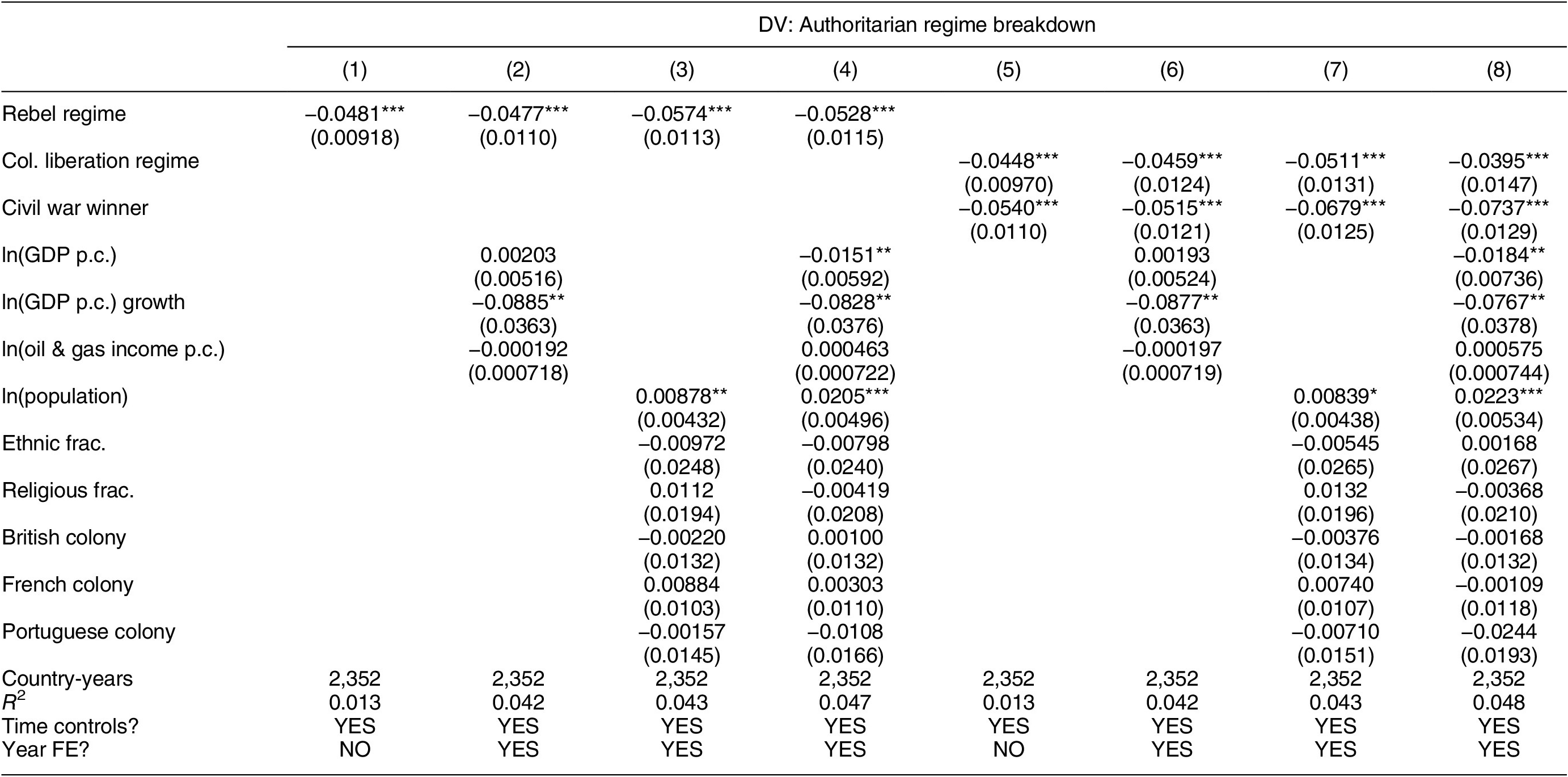
Table 2 assesses our claim that rebel regimes should break down less frequently than non-rebel regimes. It presents estimates from linear regressions of the following form:
 $$ \hskip-5pt {Y}_{it} = \hskip2pt {\beta}_0+{\beta}_R{R}_{it}+{\boldsymbol{X}}_{it}^{\prime }{\beta}_X+{\boldsymbol{T}}_{it}^{\prime }{\beta}_T+{\unicode{x03B5}}_{it}, $$
Authoritarian Regime Breakdown

Note: Table 2 presents linear regression estimates with standard error estimates clustered by country in parentheses. Every column controls for years since the last regime change and cubic splines. *p < 0.10, **p < 0.05, ***p < 0.01.
where
 $ {Y}_{it} $
is authoritarian regime breakdown,
 $ {R}_{it} $
is an indicator for rebel regimes in Columns 1–4 and is disaggregated into colonial liberation regimes and civil war winners in Columns 5–8,
 $ {\beta}_R $
is the main parameter of interest,
 $ {\boldsymbol{X}}_{it} $
is a vector of covariates included in Columns 2–4 and 6–8,
 $ {\boldsymbol{T}}_{it} $
is standard temporal dependence controls (years since last regime change and cubic splines), and
 $ {\unicode{x03B5}}_{it} $
is a random error term. Every model in Table 2 clusters standard errors by country.
The differences in raw frequencies are stark. Non-rebel regimes break down in 6.8% of country-years, which is four times more frequently than rebel regimes: 1.7%. This figure is nearly identical for colonial liberation regimes and civil war winners. Columns 1 and 5 demonstrate that the differences between rebel and non-rebel regimes are statistically significant when accounting for time controls. Columns 2 and 6 add economic covariates, Columns 3 and 7 add the other covariates, and Columns 4 and 8 add every covariate. Comparing the columns shows not only that the covariates do not eliminate the statistically significant relationship between rebel regimes and regime breakdown but also that the magnitude of the coefficient estimates changes minimally. Appendix Table B.1 shows formally that the magnitude of bias from unobserved covariates would need to be large in order to explain away the results.
The appendix shows that the estimates are similar under various robustness checks. We performed a jackknife sample sensitivity analysis in which we iteratively drop all observations from one country at a time, which demonstrates that the results do not hinge on a single outlier.
Nor are our results driven by cases coded as revolutionary in existing datasets. In Appendix Table B.3, we reestimated Columns 1–4 of Table 2 in three different ways: iteratively dropping every case that Lachapelle et al. (Reference Lachapelle, Levitsky, Way and Casey2020), Colgan (Reference Colgan2012) and Colgan and Weeks (Reference Colgan and Jessica2015), or Roessler and Verhoeven (Reference Roessler and Verhoeven2016) code as revolutionary. A significantly lower probability of breakdown for nonrevolutionary rebel regimes also provides evidence that a strong revolutionary ideology is not the primary mechanism driving the results.
Appendix Table B.4 performs additional robustness checks. In Panel A, we reestimate the models with a logit link. In Panel B, we restrict the sample to regimes that gained power via force, and demonstrate that rebel regimes are significantly less likely to break down than coup regimes. This confirms our theoretical expectation that although both types of regimes achieve power by force, coup regimes lack similarly strong foundations for survival.
Instrumenting for Colonial Liberation Regimes
Assessing the causal effect of rebel regimes on regime breakdown poses difficult endogeneity problems. Despite controlling for commonly used covariates in the regimes literature and performing various forms of sensitivity analysis, rebel regimes clearly do not emerge randomly. Selection effects could cut in either direction. On the one hand, the success of rebel groups is predicated on many strategic decisions and succeeding at dimensions such as delegating power, forming alliances, and disseminating information (Christia Reference Christia2012; Lewis Reference Lewis2020), and only successful rebellions enter our dataset as rebel regimes. On the other hand, rebel regimes arise only when the state is so weak that it is vulnerable to rebel overthrow. This should mitigate against subsequent regime durability.
To address this concern, we exploit a source of plausible exogeneity in the emergence of colonial liberation regimes: percentage of a country’s territory that was suitable for colonial European settlement. The 2SLS results are qualitatively similar to the results found above, and thus more convincingly establish a negative causal relationship. We briefly summarize the justification for the instrument here, and present extensive supporting detail in Appendix B.2.
The presence of European settlers correlates strongly with decolonization wars in Africa. After World War II, officials in most imperial metropoles introduced decolonization reforms, but these reforms were blocked in colonies with large European settler populations (including in independent South Africa and quasi-independent Rhodesia). Europeans could create large settlements in which they replicated European agricultural practices only in specific areas of Africa. Thus, following Paine (Reference Paine2019), we can use climatic and geographical factors that influenced prospects for European settlement to instrument for colonial liberation regimes.
Successful Coups
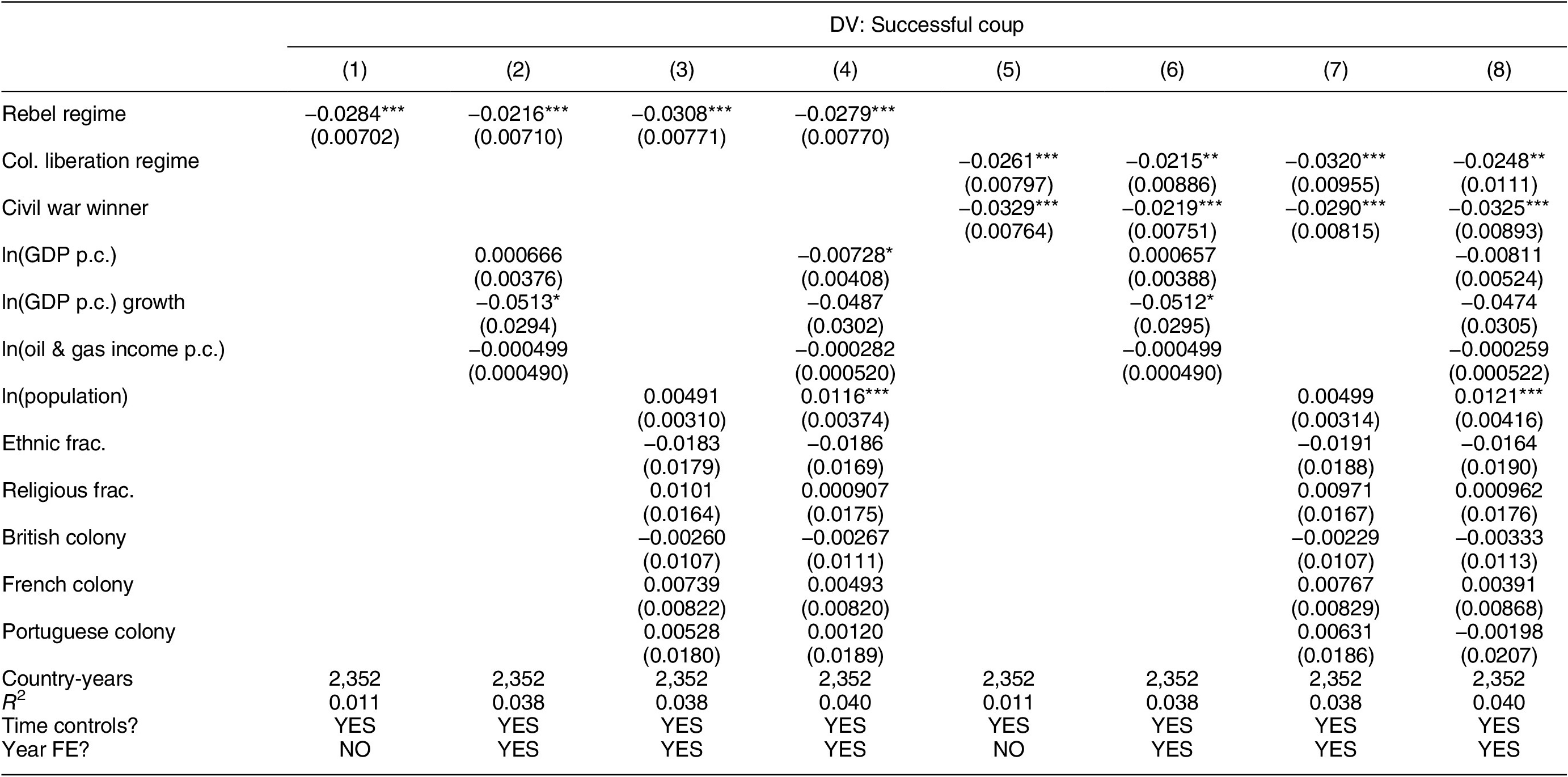
Next, we focus on regime breakdown as a result of a successful coup because the implications of our theory apply most directly to this mode of overthrow. In Table 3, we change the dependent variable in Equation 1 to successful coup, which is a dummy variable that equals 1 if a coup successfully removed the incumbent in that year and 0 otherwise. The sequence of specifications is identical to those in Table 2. We find that rebel regimes are significantly less likely to experience successful coups. The findings are similar when we disaggregate rebel regimes into colonial liberation regimes and civil war winners and when we include the full set of controls. The results are also similar under the same robustness checks as above: logit link, or comparing rebel regimes only with coup regimes (Appendix Table B.7).
Successful Coups

Note: Table 3 presents linear regression estimates with country-clustered standard error estimates in parentheses. Every column controls for years since the last successful coup and cubic splines. *p < 0.10, **p < 0.05, ***p < 0.01.
Evidence of Military Power Sharing
We now establish evidence for the second main implication: rebel regimes more frequently delegate control over the military via a stable appointment of a Minister of Defense. Moreover, within the set of rebel regimes, those that share power more frequently are less likely to break down, and differences in the length of rebellion helps to explain variance in power sharing. We then provide systematic evidence for two related intervening components of the theory: (a) We compiled information on the composition of the state military after rebel takeover. In 19 of 21 cases, rebel regimes either completely transformed and displaced the existing state military, or occupied top positions in an integrated military. (b) We use biographical information to show that Ministers of Defense in rebel regimes were usually high-ranking rebel commanders who played an important role in the launching rebellion.
Minister of Defense Appointments
A key power-sharing decision is whether the leader delegates control of the military to the Ministry of Defense. We operationalize this concept by examining whether the ruler appoints a Minister of Defense and did not shuffle the position within the past year. In African autocracies, the Minister of Defense is the highest position controlling the security sector (chiefs of staff of all military branches report directly to him), and the Defense Minister coordinates key aspects of defense policy. By contrast, when there is no Minister of Defense (either because the ruler eliminates the post, keeps it vacant, or holds it himself), the president can personally make key decisions about the military. This undermines institutional links between the executive branch and the military and reflects an absence of power sharing with high-level military officials.
To code Minister of Defense appointments, we use the Europa World Year Book (1960–2005) and data from the Central Intelligence Agency’s Directory of Chiefs of State and Cabinet Members of Foreign Governments (2006–2017). These sources contain annual records of the names and positions of all ministerial posts for every African country between 1960 and 2017. From these records we coded defense minister appoint, which equals 1 if an individual other than the ruler was appointed as the Minister of Defense and 0 otherwise. This provides the basis for our main variable, defense minister same, which additionally requires that same person held the Defense portfolio in the previous year (this value is set to missing in the first year for each country). This variable equals 0 if defense minister appoint equals 0 or if within the previous year the position had rotated to someone else. Naming a Minister of Defense but frequently appointing new people to the position indicates elite shuffling rather than true power sharing. Therefore, we use defense minister same for our main regressions, but report results using defense minister appoint in the appendix.
Basic summary statistics highlight the stark discrepancy in military power sharing between rebel regimes and others. Rebel regimes appointed a Minister of Defense in 83% of country-years. In fact, over half of all rebel regimes appointed a Defense Minister in every year. By contrast, non-rebel regimes appointed a Minister of Defense in only 56% of country-years. Moreover, Minister of Defense appointments in rebel regimes were more stable, reflecting less frequent shuffling. Rebel regimes appointed the same Minister of Defense as the previous year in 65% of country-years, with a corresponding figure of 34% for non-rebel regimes.
Mozambique, for instance, has had only five different Ministers of Defense since gaining independence in 1975, and the average tenure of a Defense Minister is 8.4 years. Ethiopia’s post-1991 rebel regime has had only seven different Ministers of Defense. In both cases, the president has never personally held the Defense Minister portfolio or left the post vacant. Even Robert Mugabe, who had a reputation as a strongman dictator while ruling Zimbabwe from 1980 until 2017, made stable Minister of Defense appointments: the country had only six different Ministers of Defense during his tenure.
By contrast, leaders of non-rebel regimes often prefer to keep the Defense portfolio for themselves. Dawada Jawara of Gambia, for instance, appointed himself as Defense Minister from 1965 until 1992. When leaders of non-rebel regimes do name a Minister of Defense, they tend to shuffle cabinet appointments frequently to prevent any one elite from gaining too much influence. Burkina Faso has had 19 different Ministers of Defense since the country became independent in 1960, and in many years the incumbent president held the position himself. The average tenure of a Defense Minister was less than three years. In the Central African Republic, a Minister of Defense was appointed in only 36% of years between 1960 and 2017, with an average tenure of less than two years.
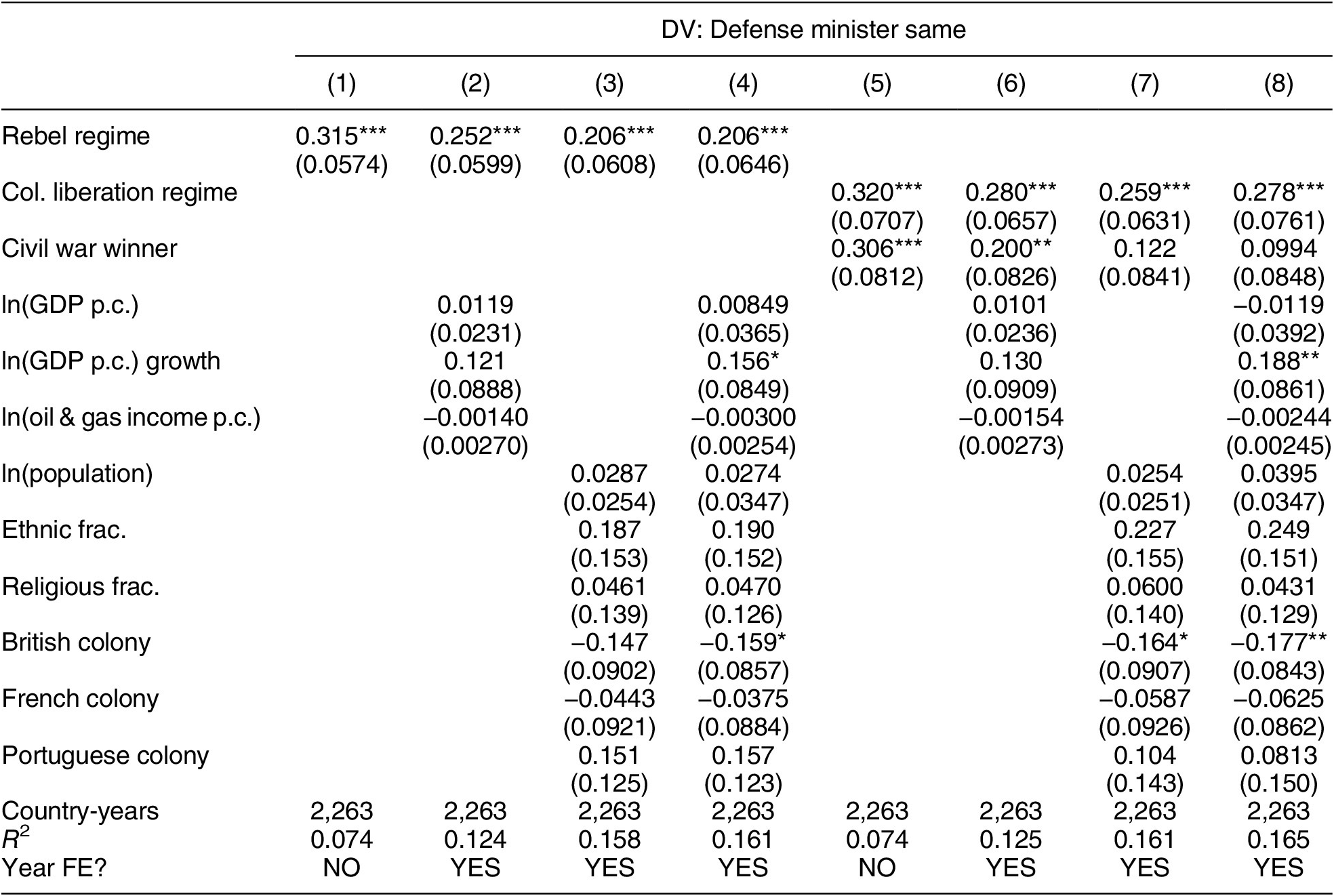
In Table 4, we assess this relationship statistically. We estimate the same linear regression models as in Equation 1 except we change the dependent variable. The sequence of specifications and covariates is identical to those in Table 2. The analysis shows that rebel regimes are significantly more likely to make stable Defense Minister appointments. Although the results are mostly similar across the specifications, the correlation for civil war winners is less robust, which we address below. We present various robustness checks in the appendix: Table B.8 changes the dependent variable to defense minister appoint, and Table B.9 performs the same basic robustness checks as for Table 2 (logit models, or comparing rebel regimes only with coup regimes).
Minister of Defense Appointments

Note: Table 4 presents linear regression estimates with standard error estimates clustered by country in parentheses. *p < 0.10, **p < 0.05, ***p < 0.01.
Comparisons within Rebel Regimes
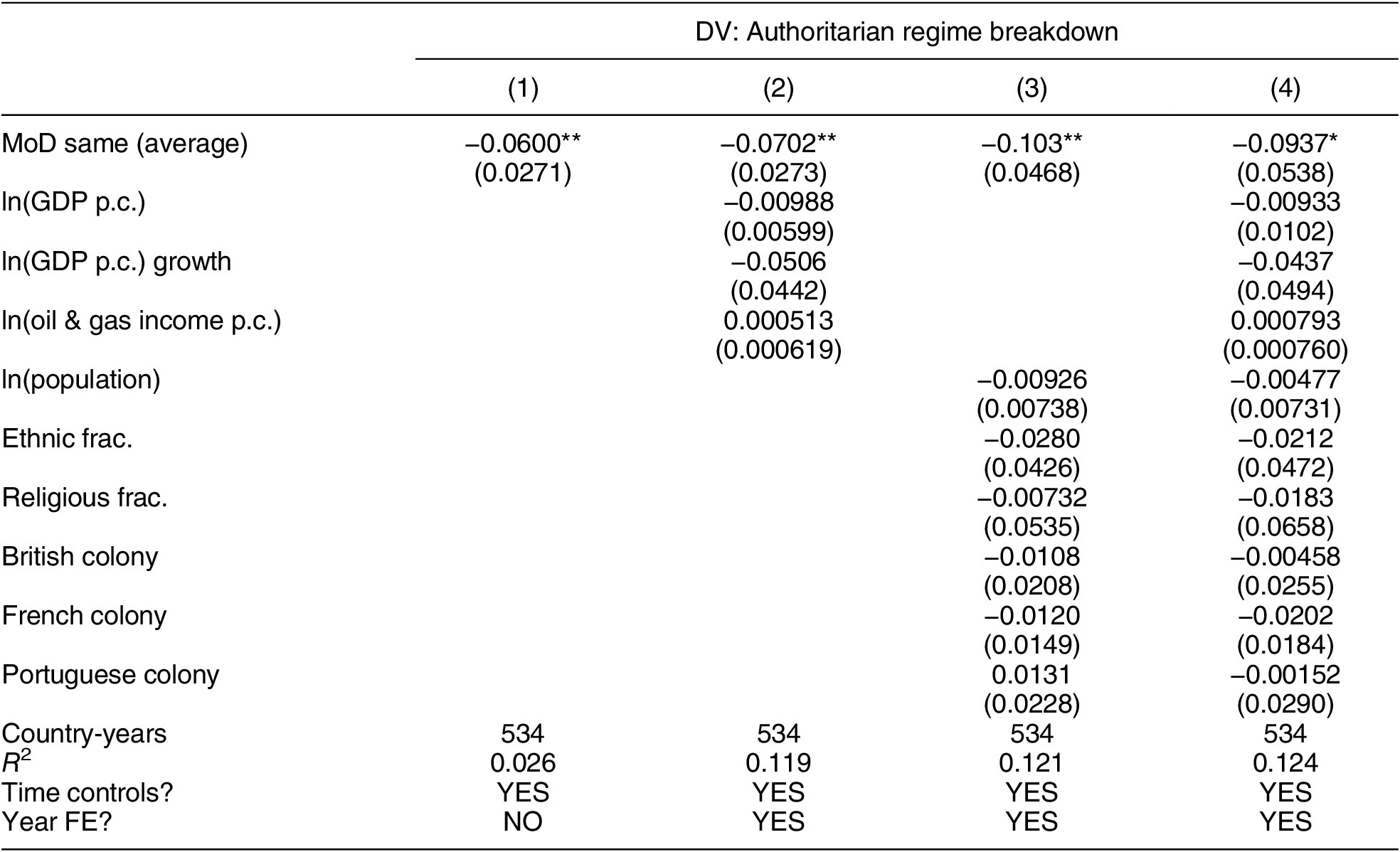
To demonstrate the centrality of power sharing for regime durability, in Table 5 we conduct an analysis among rebel regimes only. The dependent variable is authoritarian regime breakdown, as in Table 2. The main explanatory variable is the fraction of years for which the rebel regime appointed a stable Defense Minister, calculated by dividing the sum of defense minister same by the number of years the rebel regime was in power. We use this rather than the annual measure of Defense Minister appointments because it more accurately represents the overall stability of power-sharing agreements. For regimes that rarely appoint a Defense Minister, we would in fact expect coups to occur in the years in which a Minister of Defense was appointed. In such cases, the ruler has temporarily relinquished direct control over the military, but with low assurances of future power sharing. By contrast, the average rate of Defense Minister appointments picks up the low propensity for such regimes to share power and the consequent low credibility of promises.
Effect of Military Power Sharing within Rebel Regimes

Note: Table 5 presents linear regression estimates with country-clustered standard error estimates in parentheses. Every column controls for years since the last regime change and cubic splines. The sample includes rebel regimes only. *p < 0.10, **p < 0.05, ***p < 0.01.
Table 5 establishes that rebel regimes with stable Defense Minister appointments are less likely to break down than are rebel regimes without stable Defense Minister appointments. We illustrate the statistical findings with an example from Chad’s rebel regime from 1982–90. The leader, Hissène Habré, kept the Defense Minister position vacant most of the time he was in power. The two times he appointed a Defense Minister, they were shuffled almost immediately. Eight years after taking power, Habré was overthrown in a rebellion that was organized by a former army chief of staff, Idriss Déby, whom he had purged the previous year.
This analysis emphasizes the need for rebel regime leaders to share power with military elites in order to avoid overthrow. It highlights the contrast between our power-sharing mechanism and other accounts of revolutionary durability. Whereas existing studies of revolutionary regimes highlight ideology and partisanship ties as a stand-alone mechanism, the within-rebel regimes analysis demonstrates that relying on personal ties alone is not sufficient to promote regime durability. Rebel regimes that do not share power are more susceptible to breakdown.
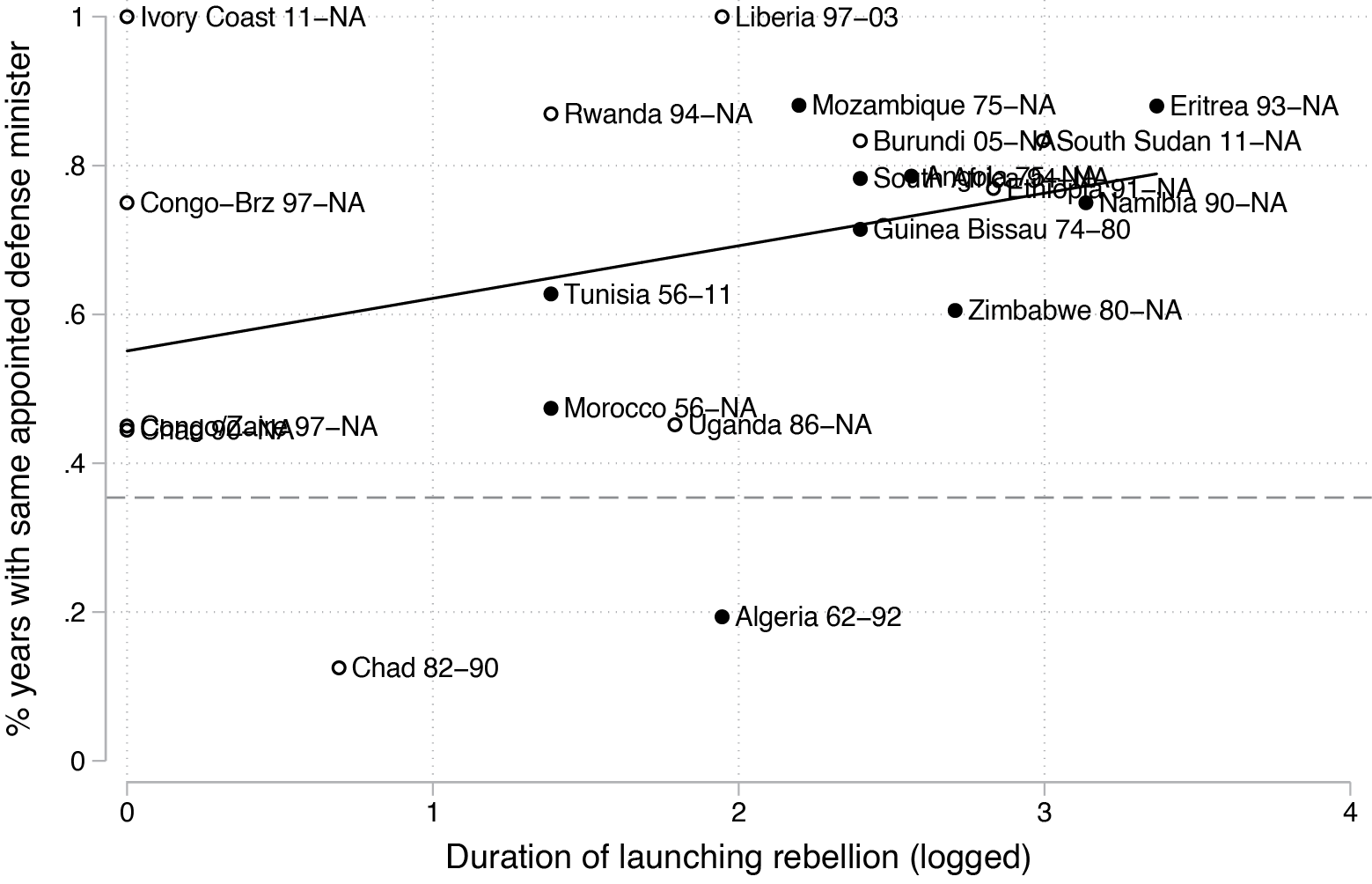
Why do some rebel regime leaders not share power with military elites? Our theory suggests that the duration of the launching rebellion matters. In cases in which the war was short, leaders and military commanders had briefer interactions and limited experience delegating power. Because we posit experience with sharing power during the launching rebellion as the key to facilitating peaceful power sharing after gaining power, we expect rebel regimes that endured longer conflicts to share power more frequently. Empirically, rebel regimes with longer launching rebellions do indeed exhibit higher rates of Defense Minister appointments, as shown in Figure 1. Among the six cases in which the president named the same Minister of Defense in less than half the years of the regime, all experienced struggles of seven years or shorter. This relationship also helps to account for why the correlation between colonial liberation regimes and stable Minister of Defense appointments is stronger than that for civil war winners (see Table 4): the average length of their launching struggles was 12.6 and 6.5 years, respectively.
Duration of Launching Rebellion and Military Power Sharing in Rebel Regimes
Note: The horizontal axis is the logged duration (in years) of the launching rebellion, and the vertical axis is the military power-sharing variable from Table 5. The regression line is in black, and the dashed gray line is the average value of the dependent variable among non-rebel regimes. The solid dots are the colonial liberation cases and the open dots are civil war winners.

Transforming the Military
We expect rebel regimes to facilitate peaceful power sharing with military elites because, upon gaining power, victorious rebel groups enjoy a unique opportunity to transform the state military. This enables the leader to delegate authority to military commanders from their armed wing, with whom they shared power during the launching rebellion. We assess this claim systematically by compiling information on the state military for every rebel regime after taking power. We coded each case into one of three categories: Complete Military Transformation, Military Integration, and No Military Transformation. Table 6 summarizes the cases, and Appendix A.3 provides detailed coding notes and citations.
Military Transformation in Rebel Regimes

In 13 of the 21 rebel regime cases, the rebel military completely transformed the military by displacing the existing state armed forces and replacing them with their own armed wing. Consequently, members of the victorious rebel group dominated the new military. In most cases, the preceding national military disintegrated by the end of the conflict, whether because European colonial soldiers fled the country (leaving African colonial soldiers at the mercy of the rebels) or because of defeat on the battlefield. For example, in Mozambique, the guerrilla forces that fought Portugal in the liberation war became the new national army upon independence. In fact, FRELIMO even refused to integrate into their ranks African soldiers who had previously fought for the Portuguese Army.
In these cases, one rebel faction dominated the new state military even when multiple rebel groups participated in overthrowing the previous government. In Angola, MPLA monopolized control of political positions at independence and their armed wing became the state military while excluding rebel troops from UNITA and FNLA, who then fought against MPLA for decades. In Zimbabwe, Robert Mugabe used troops from the armed wing of ZANU to subjugate rival forces from ZAPU. Despite initial plans for military integration, ZANU’s ascendancy over ZAPU and existing white officers yielded de facto complete military transformation.
In six cases, the main rebel group integrated their armed wing with another force. However, even in military integration cases, the rebel group usually controlled the highest-ranking military positions. In South Africa, Namibia, and Burundi, the civil war settlement called for integrating rebel militaries into the existing state military. After the Cold War ended, international actors intervened to try to end long-running civil wars and supported security-sector reform programs. In South Africa, members of the ANC and other African groups joined officials from the white apartheid regime. Africans from uMkhonto we Sizwe (the military wing of the ANC) and other armed groups came to dominate the highest ranks as well as the rank and file, whereas white officers from the former SADF remained prominent among other officer positions. The arrangement was similar in Namibia. The other military integration cases were more heterogeneous. In Chad 90–NA and the DRC, rebels achieved outright military victory over the previous state military, but their relative weakness upon winning compelled them to share power with other armed opposition groups. In South Sudan, despite creating a new country, the new state military amalgamated various rebel groups that had fought against the Sudanese government.
Rebel forces played a minimal role in the subsequent state military in only two cases, Morocco and Tunisia, during their struggle to gain independence from France. In both cases, guerrilla fighters were less important than peaceful nationalist organizations.
Minister of Defense Biographies
In Table 4, we use the stable appointment of a Minister of Defense to measure whether a ruler delegates control over the military to the Ministry of Defense. Yet our theory offers more specific expectations for rebel regimes. We posit that building a private army from scratch and fighting for power should facilitate peaceful power sharing specifically because the ruler gains experience with sharing power among high-level commanders during the rebellion. Thus, we expect that Ministers of Defense in rebel regimes should tend to be important members of the launching rebellion, as opposed to family members, obscure actors lacking any power base, members of the previous state military, or members of other rebel groups that fought for power.
To assess this expectation, we compiled biographical details about individuals that served as Ministers of Defense in rebel regimes (Appendix Table B.10 provides details). Within the first 20 years of each regime, 70% of Defense Ministers were high-level commanders from the launching rebellion. These actors amassed operational control over troops and gained legitimacy from the founding struggle, which enabled them to credibly threaten the leader if he attempted to personalize power.
In Eritrea, Petros Solomon was appointed as the first Defense Minister following independence. Solomon was a leading figure during the armed struggle. He was one of three members of the party’s military committee, the head of the military intelligence unit, and a member of the political bureau of the party’s Central Committee. Guinea-Bissau’s first Defense Minister, João Bernardo Vieira, a celebrated guerrilla commander, was the military chief in southern Guinea-Bissau during the war. In Mozambique, the first Defense Minister was Alberto Joachim Chipande, who was a leading member of FRELIMO during the liberation war and allegedly fired the first shot against the Portuguese colonial forces. Tobias Joaquim Dai served as Minister of Defense from 2000 to 2008. He commanded the FRELIMO Army during the launching rebellion.
Rebel rulers rarely named Defense Ministers either from the previous regime or from competing rebel factions. Above we noted the lack of military integration in Angola and Zimbabwe despite multiple rebel groups. In both South Africa and Namibia, the Defense Minister has always been a member of the majority-rule rebels even though the rebel army was integrated into the state military. The handful of exceptions come from other cases of military integration. For example, the civil war settlement in Burundi called for a 50-50 distribution of Hutu (rebels) and Tutsi (incumbent regime) in the military. Although a rebel leader became president, the first two Ministers of Defense following the settlement were high-ranking members of the extant state military.
Alternative Explanations
The previous section demonstrated that rebel regimes frequently share power with military elites and that this strategy promotes durable regimes. Here we show evidence against four alternative explanations: (1) revolutionary transformation of state and society, (2) ruling parties and subjugation of the military, (3) sharing power with civilians or across ethnic groups, and (4) alternatives suggested by research on civil war termination.
Controlling the Countryside
Existing accounts link revolutionary regimes to the transformation of society, following Huntington’s (Reference Huntington1968, 292) well-known aphorism, “He who controls the countryside controls the country.” Levitsky and Way (Reference Levitsky and Way2013) and Lachapelle et al. (Reference Lachapelle, Levitsky, Way and Casey2020) argue that gaining power through violence, unleashing a program of social revolution, and defeating counterrevolutionaries eliminates alternative centers of power that supported the previous regime. Even if true on average for the broader global sample of revolutionary regimes, this mechanism does not help to explain the durability of African rebel regimes, as we discuss in Appendix C.1. Throughout history, rulers in Africa have typically failed to exercise effective control over extended territories (Herbst Reference Herbst2000). Even when rebel groups capture the state, they typically fail to implement successful land reform or otherwise uproot bases of societal opposition. Using various quantitative measures of state control over society, in Appendix Table C.1, we demonstrate that rebel regimes in Africa are not distinguished on measures of societal control. This is unsurprising when considering the frequency with which rebel regimes faced counterrevolutionary challenges shortly after gaining power. With five years of establishing the regime, 10 of 21 rebel regimes fought an armed rebellion. Clearly in these instances, the rebel regime did not consolidate full control over the countryside.
We also engage with Lachapelle et al.’s (Reference Lachapelle, Levitsky, Way and Casey2020) argument that counterrevolutions promote elite unity after revolutionary regimes gain power. We show evidence against this alternative within our sample by demonstrating that rebel regimes are durable regardless of whether they face an armed challenger within five years of gaining power.
Ruling Parties and Subjugation of the Military
Many argue that party institutions facilitate authoritarian survival. A common operationalization is that strong parties are ones in which the ruling party predates the regime (Geddes, Wright, and Frantz Reference Geddes, Wright and Frantz2018; Miller Reference Miller2020). Rebel regimes almost always inherit parties (19 of 21 cases in our dataset), as they form an armed wing and a political wing (i.e., party) amid their fight for power. Thus, rebel regimes are highly correlated with inherited parties, but this does not substantiate the strength of the party, in contrast to the more specific mechanisms from our theory. Rather than model a control variable for strong parties for which our rebel regimes variable is nearly a strict subset, we instead subset on regimes that inherited a party upon gaining power in Appendix Table C.2. Within this sample, rebel regimes are still significantly more durable.
We also provide evidence against the possibility that military elites are subjugated or repressed by a strong party in rebel regimes. In Appendix Table C.3, we show that rebel regimes are not significantly more likely to have strong party oversight of the military or have a commissar system (data from Geddes, Wright, and Frantz Reference Geddes, Wright and Frantz2018). The latter finding reflects the rarity of commissar systems among African regimes. The only exceptions are two rebel regimes (Angola, Mozambique) and three non-rebel regimes (Guinea, Tanzania, Zambia). We also show that rebel regimes are not significantly more likely to have counterbalancing military organizations (data from De Bruin Reference De Bruin2020).
Sharing Power with Civilians or across Ethnic Groups
Another possibility is that delegating control over the military is not the only way in which rebel regimes share power and that other forms of power sharing are more important for explaining regime survival. Our theory suggests this is unlikely because the aspects of the rebellion we highlight as facilitating credible power sharing apply to coercive dimensions only. In Appendix C.3, we show that rebel regimes are not more likely to name a vice president or prime minister (the highest-ranking civilian position in the cabinet) and they do not engage in broader ethnic power sharing.
The converse possibility is that rebel regimes are mainly a front for a single ethnic group to dominate others, perhaps because this is easier to achieve by displacing ethnic rivals via a rebellion. By contrast, we demonstrate that the rebellions that launched most rebel regimes were multiethnic and that, like typical African regimes, their postseizure cabinets usually contained multiple ethnic groups.
Civil War Termination Literature
In Appendix C.4, we engage with research on civil war termination and changes since the Cold War ended. We disaggregate rebel regimes by whether they were established by outright rebel victory or a settlement with the previous government, which captures a key distinction from Toft (Reference Toft2009). Only four rebel regimes gained power via negotiated settlements: Burundi, Namibia, South Africa, and Zimbabwe. These cases followed a common post–Cold War pattern of implementing security-sector reform programs. However, all other rebel regimes were founded by outright rebel victory, in which the rebels typically replaced the existing state military with their own and did not undergo security-sector reform initiatives.
Three additional robustness checks address related considerations about civil war termination. First, we disaggregate all regimes by the most recent way in which a civil war ended (outright rebel victory, outright government victory, settlement, no civil war or none ended). Second, we disaggregate rebel regimes by whether they originated during the Cold War. Third, we control for other conflict factors that affect regime stability: ongoing civil war, refugees, foreign-imposed regimes, and a post-Cold War fixed effect.
Conclusion
In this article, we establish an important source of authoritarian durability. Rebel regimes typically survive for long periods because the experience of gaining power via a rebellion enables the ruler to credibly share power with military elites after gaining power. These foundations enable leaders of rebel regimes to solve the guardianship dilemma.
Although our theory is general, our empirical evidence draws solely from Africa. One scope condition for the region is the historically rooted impediments to consolidating control over the countryside (see the discussion in Appendix C.1). Existing hypotheses that revolutionary regimes establish firm control over society are more plausible elsewhere. Consider, for example, three classic cases in which social revolutions preceded long-lasting authoritarian regimes: China, Russia, and Vietnam. Each country experienced a long history of a state governed by members of the dominant ethnic group. Although these factors did not preordain that the revolutionary group would consolidate control over the countryside, they created more favorable conditions than in African states lacking a similar history. Understanding these similarities and differences will help to situate authoritarianism in Africa in a broader global context.
Another remaining question is whether our implication of peaceful power sharing within rebel regimes should last beyond the wartime generation (White Reference White2017). From a theoretical perspective, it is unclear. On the one hand, perhaps the foundations for credible power sharing should not extend beyond the wartime generation because subsequent elites lack experiences with sharing power during the launching rebellion. On the other hand, perhaps peaceful power sharing becomes institutionalized over time: once the wartime generation stabilizes expectations regarding military appointments, these arrangements become the norm. Empirically, we cannot yet answer this question conclusively because most African rebel regimes are still in their wartime generation. Tentatively, the durability of rebel regimes does seem to extend beyond the initial generation. Of the six rebel regimes in our sample that endured at least 30 years, five are still in power today (Angola, Morocco, Mozambique, Uganda, and Zimbabwe). Ultimately, we leave this as a question for future research, along with the broader theoretical considerations we raise about power sharing, the guardianship dilemma, and rebel regimes.
Supplementary Materials
To view supplementary material for this article, please visit http://doi.org/10.1017/S0003055422000296.
DATA AVAILABILITY STATEMENT
Research documents and data that support the findings of this study, including supplementary appendices, are openly available at the American Political Science Review Dataverse: https://doi.org/10.7910/DVN/8LQZW9.
ACKNOWLEDGMENTS
For helpful conversations and insightful feedback, we thank Leonardo Arriola, Kristen Harkness, Alex Lee, Steven Levitsky, Janet Lewis, Elizabeth Nugent, Philip Potter, Naunihal Singh, and Scott Wolford. We are also grateful to audiences at the ACPG Online Workshop, APSA 2021, Boston University, Emory University, GIGA Institute, LSE, Princeton University, SPSA 2020, Syracuse University, Texas A&M, UC Berkeley Africa Working Group, University of Minnesota, and UT Austin, as well as the editors and three anonymous referees. We dedicate this article to our PhD adviser and friend Bob Powell, who sparked our interest in authoritarian power sharing.
CONFLICT OF INTEREST
The authors declare no ethical issues or conflicts of interest in this research.
ETHICAL STANDARDS
The authors affirm this research did not involve human subjects.






Comments
No Comments have been published for this article.