In the early sixteenth century, craftsmen painstakingly smoothed a cliff face in northern Yunnan, leaving an overhang to protect from rain. The cliff rose up across a creek from a road that linked two administrative towns in Wuding Civil and Military Prefecture, or Luɦo Nd’ə, the domain of the Luɦo lineage of native hereditary chieftains. In 1533, artisans carved two lengthy inscriptions side by side on the prepared surface. These craftsmen were commemorated in the first few verses of one of the inscriptions as descendants of one of the five original ancestors of the realm's rulers and subjects:

The text was inscribed in a script known to its users as Luɦo (Chinese, Luowu), which we now know as Nasu script. It is among four distinct so-called Yi scripts still used in parts of Yunnan, Sichuan, Guizhou, and Guangxi, and it records the Tibeto-Burman language now called Nasu (Bradley Reference Bradley2009; Chen Reference Chen2010).
The second inscription, just to the right of the first, might be said to describe the same world, though in a very different idiom, as is evident from the opening lines:

The inscriptions were both quite long: the Nasu text, 558 characters and the Chinese text, 1,428. Since the Nasu text was written left to right and Chinese was written right to left, the order of reading depended upon which language oriented the reading eye. A reader oriented primarily by Nasu script might read the Nasu text first, after which his or her eye would be led immediately to the Chinese inscription. A reader oriented primarily by Chinese would have the opposite experience. Commissioned by the same chieftain, carved at the same time, and arranged symmetrically, even reciprocally, the inscriptions were clearly intended as a pair, despite a few shorter texts carved into the same surface, one before 1533, the others afterward.Footnote 5
The inscriptions at Red-Cliff Gorge (Hongya Xia), known as the Juanziyan inscriptions, have founded every history of the Luɦo chiefs, who ruled a large domain in northern Yunnan from the late tenth century until 1567.Footnote 6 Such stone inscriptions are a rich and underutilized resource for the history of the “tusi system,” in which the Ming granted titles, honors, and autonomy to indigenous hereditary rulers in an attempt to incorporate peripheral peoples into the Ming dominion at a bearable cost; to introduce these peoples to the customs, rituals, and civilizing morality of the Chinese (hua); and to maintain a source of native troops to supplement Ming forces in efforts to annex peripheral polities and pacify the many rebellions and internecine struggles the institution of native chieftains itself generated (Shin Reference Shin2006). While Chinese travelers or visiting officials authored many of the stone inscriptions in native domains, native chieftains or other elite locals commissioned others (Hu, Wu, and Zhang Reference Hu, Wu and Zhang1998; Hua Reference Hua1999; Zhu Reference Zhu1998). In these stones, native rulers carved into the bedrock of their domains visions of the past in support of contemporary claims and aspirations. Unlike nearly every other source on native domains, such inscriptions have the potential to reflect the worlds imagined and practiced by these domains’ inhabitants, even if only the highest strata.
The two inscriptions were a deliberate demonstration of the chiefly lineage's sovereignty. It was a complex demonstration, befitting the complex and ambiguous circumstances of Ming native chieftains. These chieftains enjoyed nearly absolute power over their lands and peoples, yet they served at the pleasure of the Ming court, which might demote them or mount military expeditions against them. The paired inscriptions appear to choreograph a performance of two very different modes of self-description, each defined by the conventions of a particular textual world. The substantive differences can be summed up as contrasts in the form of succession, in the sources of political authority, and in the geopolitical position of the realm. In the Nasu text, chiefly succession is consistently patrilineal—always from father to son. In the Chinese text, succession is episodically uxoric—from husband to wife and mother-in-law to daughter-in-law. In the Nasu text, the sources of political authority are the ancestors’ names, indexed to materializations of ancestors in stone figurines archived in the landscape of the domain. In the Chinese text, the sources of political authority are the titles, honors, and heirlooms granted to the chieftains by the imperial court. In the Nasu text, Luɦo Nd’ə is a sovereign realm embedded in horizontal alliances with other sovereign realms. In the Chinese text, Wuding Civil and Military Prefecture is subordinate to Yunnan Province and fully integrated into the vertical system of imperial governance.
These are the most superficial in a system of differences that can be traced through layers of textual practice and ideology and that unite the two inscriptions in a tense, parallel reciprocity. As scholars of colonialism in Mesoamerica have demonstrated, such layers can be excavated with the help of a series of practical and analytical categories. For instance, William Hanks (Reference Hanks2010) has shown how textual genres can be situated and illuminated through attention to participation frameworks: the authors, principals, witnesses, and addressees the texts project. Analysis of iteration—copying, printing, reinscription, and intertextual quotation—can help elucidate how texts were circulated and received. Attention to indexical fields—the specific places and times from which texts spoke and the social and historical circumstances in which they were produced—can help reveal their relations to specific textual fields. Hanks's approach to these categories in relation to the texts of colonial Yucatan is unified by the sense that colonization created systematic translingual exchange between Spanish and Maya languages, as scholars produced Maya dictionaries and grammars oriented to Christian conceptual hierarchies; as missionaries translated scriptures, sermons, prayers and liturgies into a Maya adapted to alphabetic inscription; and as Maya priests and rebels created heterodox Maya texts that centered on the triune Christian god.
The comprehensively translingual context of colonial Yucatan provides an illuminating contrast with Ming dynasty Yunnan. The massive Ming colonization of the Yunnan-Guizhou plateau altered the lives of people in every community in the region. Yet it was not “translingual” in the deliberate, systematic, and widespread sense of colonial Yucatan. As his reign opened, the Hongwu emperor vowed to “pacify all-under-heaven through military achievements [and] to transform people from afar through rituals and institutions.” When he reappointed most of the native chieftains who submitted to the Ming conquest, civilizing transformation was clearly one of the goals, and literacy was the chief instrument. Early in his reign, the Hongwu emperor mandated that community schools for elementary education be set up in every village and neighborhood in the realm. This mandate was withdrawn five years later, but in the 1400s, the imperial state again promoted community schools in connection with border pacification, with the enthusiastic participation of some provincial and prefectural-level officials (Schneewind Reference Schneewind2006). In 1395, the court decreed that schools for higher-level education should be created in every native domain to teach “proper relations between rulers and subjects, fathers and sons.” The best students in these schools would be sent to the imperial academy as “tribute students” (gong sheng). By 1444, Ming law required native chiefs to receive a Chinese education in order to “gradually receive the influence of public morality and rectify their obstinacy” (Shin Reference Shin2006, 71, 104). These efforts were not very successful, and few schools were actually built in native domains. Yet they indicate the prevailing view of Ming officials that the instrument to teach border peoples and native chieftains civility, morality, and proper “rituals and institutions” was always Chinese language education.
The Ming court was aware that there were many scripts in the southwest. Ming law required that the imperial patents that granted native chieftains their titles and powers be written in both Chinese and the local script, if one existed (Herman Reference Herman2007, 109)—evidence that the court had an inkling of the importance of indigenous scripts for local sovereignty. Yet apart from a few such gestures, mostly ignored in practice, Ming officials displayed remarkably little interest in influencing the uncivilized by learning local languages, compiling dictionaries, translating the classics, or developing ways to write indigenous languages with Chinese characters. While Ming officials continued to repeat the rhetoric of the civilizing mission during the fifteenth and sixteenth centuries, their main effort in practice was to sharply distinguish registered, tax-paying, civilized subjects (min) from uncivilized barbarians (man, yi or man yi) and to confine the latter within native domains (Shin Reference Shin2006, 107).
Broadly speaking, then, as the Ming consolidated its rule over Yunnan and Guizhou, the scripts of the colonizers and the colonized were rarely made to transform each other. This makes the parallel texts carved into the cliff at Red-Cliff Gorge even more interesting. I will argue that these texts did not translate each other; they did not interpret each other; they did not describe one lineage from two perspectives; and they were not intended for two separate audiences. To dispense with these possibilities and to understand what actually might have motivated the texts’ parallel inscription, I will look at both texts with the help of a few of the metalinguistic categories that scholars of Mesoamerica have used to such interesting effect. Hanks does not put it this way, but at the center of all textual production in the Spanish colonial project was the issue of sovereignty: the sovereignty of the king, in whose name so many documents were composed; the sovereignty of the Christian god, which lay behind nearly every text; and even the potential sovereignty of the Maya rebels of the Caste War. A complex, double-stranded demonstration of sovereignty, I will argue, was similarly the motivating cause of the inscriptions at Red-Cliff Gorge.
The chieftain who commissioned the two inscriptions created a powerful argument for her right to rule, in exceptionally fraught circumstances. The tension between the two texts, particularly the central difference between rigorously patrilineal and episodically uxoric succession, paralleled the existential tension that haunted and galvanized the rule of every female chieftain, all, strictly speaking, outsiders to the chiefly lineage. Placing the inscriptions side by side showcased the impossibility of translation, accommodation, or mutual interpretation between these two textually embodied modes of materializing that patrilineage and its sources of ancestral power and political authority. Chiefly sovereignty, the inscriptions seem to show, is neither merely embodied in ancestral authority nor merely endowed by the emperor. Sovereignty—particularly the sovereignty of a female chieftain—was the virtuosic capacity to master both these incompatible self-descriptions and to occupy the gap between them.
Many treatments of the tusi system (which, in truth, was far from systematic) describe native chieftains as collaborators with colonial power, partners in imperial governance, and cultural mediators between local practices and Confucian sensibilities.Footnote 7 Rarely does the scholarship attend to native chieftain's own modes of self-description as they maneuvered, often unsuccessfully, to negotiate their titles and powers with the imperial state while also convincing or forcing their subjects to accept their rule. The chiefly sponsor of the inscriptions at Red-Cliff Gorge appears neither as an agent of the imperial state, whose authority flows from the center, nor as a local irritant in the body of the state, whose power emerges from her autochthonous ancestry. Instead, she appears as an innovator, ready to exploit mastery of two scripts to demonstrate her sovereignty as the unique discrepancy between two modes of apprehension of her lineage and domain.
Reading these inscriptions in parallel can also shed light on the situation of the many other native chieftains in the Ming dynasty colonial southwest. Native chieftains of many ethnicities struggled to impose their rule across languages, across written scripts, across sources of power and legitimacy, and across different materializations of ancestry, lineage, succession, and descent. While we are accustomed to thinking about colonialism through projects of translation and linguistic accommodation, difficulties or impossibilities of translation might have been even more salient in this context. Instead of focusing exclusively on mediation, we might also ask how indigenous actors actively strategized to deploy discrepancies between different linguistic worlds.
Prelude of Rebellion
Before the Ming, chiefly lineages now commonly identified as Nasu ethnicity controlled an enormous stretch of mountainous territory in Guizhou, Sichuan, and Yunnan. John Herman's (Reference Herman2007) groundbreaking history of the Nasu realms of the Shuixi region of Guizhou details their response to the Mongol invasion and Ming colonization. West of Shuixi, and beyond the scope of Herman's study, a chain of Nasu domains ran from the Guizhou border through what was then south Sichuan into north Yunnan, including Mangbu, Dongchuan, and Wumeng. On the western end of this string was Wuding (see figure 1). These domains had begun as allied chiefdoms in the borderlands between the Nanzhao Kingdom and Tang China. In the Ming, they became military and civilian prefectures (junmin fu) ruled by native prefects (tu zhifu). Like most native prefects in the southwest, these rulers were subject to little actual oversight and no tax quotas, though they were required to make tribute missions to the capital, apply to the court to ratify their hereditary appointments, and make their militias available for war against other native chieftains.
Native domains in north-central Yunnan and southern Sichuan during the early and mid Ming (redrawn from Tan Reference Tan1996).

When the two texts were inscribed into the cliff at Red-Cliff Gorge, the native prefect of Wuding, Jueli Songlin, known as Lady Qu (Qu shi), was reconsolidating her power after surviving a devastating rebellion. During late fifteenth and the sixteenth centuries, the Ming actively sought to contain the entrenched power of native prefects by replacing them with regular officials while allowing smaller portions of their domains to be controlled by lower-ranked chieftains. In 1511, Yunnan's pacification commissioner refused to ratify the appointment of Lady Qu's husband, Feng Chaoming (Ahú Yì̠lò), as native prefect. Feng Chaoming sent a delegation to Beijing to appeal, and he was allowed to continue to rule without the title. After fighting alongside Ming forces to put down a rebellion in Guangxi in 1520, Feng Chaoming applied for the post again, but he died before the appointment arrived. His son, Feng Zhao (Yì̠lò Yì̠tʂə́), was too young to succeed, so his wife, Lady Qu, ruled in his place.
Seven years later, the magistrate of neighboring Xundian Prefecture attempted to discipline a Nasu chieftain named An Quan for resisting payment of land tax. An Quan's lineage had ruled Xundian as native prefects from 1384 until 1476, when they were replaced with regular officials (Gong Reference Gong2011, 482; Wang [1550] Reference Wang1963, juan xia p. 48a). Nasu chiefly lineages often exchanged daughters with other chiefly lineages for several generations at a time. An Quan's lineage was allied with the Luɦo lineage in this way, and An Quan’s wife, Lady Feng, was the late Feng Chaoming’s sister. When the magistrate captured Lady Feng, stripped her, and had her flogged, An Quan raised an army, occupied Xundian's capital, and served out a humiliating defeat to the expedition that Yunnan's governor sent to retake the city.
Lady Qu took the precaution of stationing her troops, led by her husband's brother, Feng Chaowen, on her realm's border with Xundian. On hearing of his sister's flogging, however, Feng Chaowen allied with An Quan, intending to revenge his sister and replace his sister-in-law Lady Qu as Wuding's ruler. His army occupied the prefecture's two administrative towns and marched together with An Quan's troops on the provincial capital, a combined army of around 20,000.Footnote 8 The Ming court sent its minister of military affairs to lead imperial troops from Guizhou, Sichuan, and Hunan and native militias from various parts of Yunnan against the rebels. Greatly outnumbered, Feng Chaowen fled toward the neighboring domain of Dongchuan, where he was killed. Lady Qu and her son Feng Zhao, just then reaching maturity, actively assisted the Ming forces. In return, the court allowed them to continue ruling Wuding and confirmed Feng Zhao as native prefect in 1530. Feng Zhao was sent on an expedition against a native domain in Yunnan's Enshan district in 1531, and he died on the road at the age of eighteen or nineteen. His mother was named native prefect in 1533 (He Reference He1986; Zhu Reference Zhu2009).
The paired inscriptions were created two years after Feng Zhao's death. All the powerful agnates of the Luɦo chiefs had been killed during the rebellion, and the prefecture was still struggling with the economic deprivation caused by years of warfare. As native prefect, only Lady Qu commanded the credentials and resources to sponsor this monument to the Luɦo chiefs at the center of her realm.
Authors and Audience
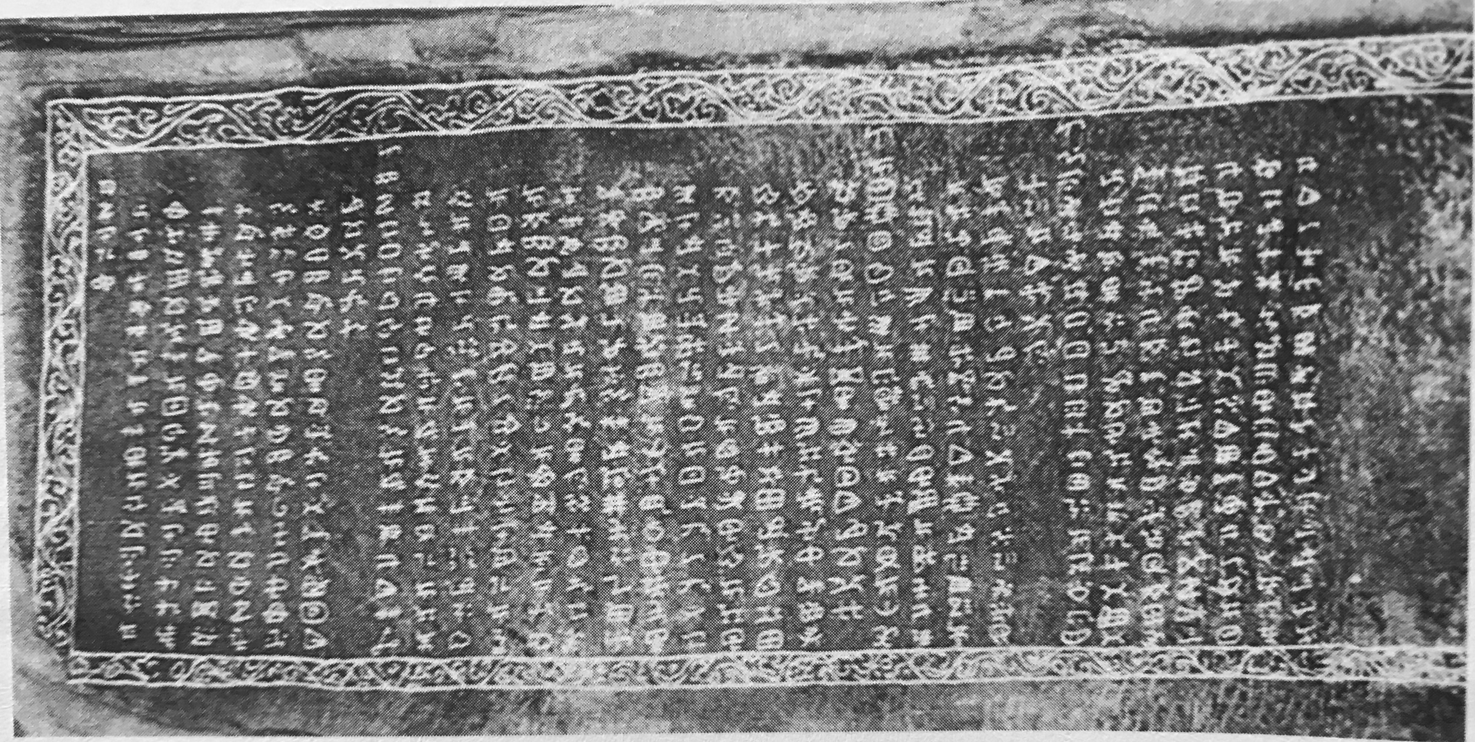
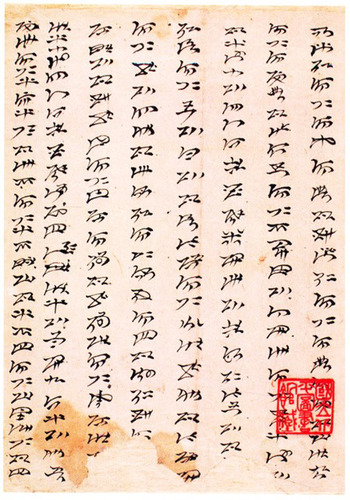
The texts were painted onto the cliff by calligraphers before being carved by skilled craftsmen. At the moment of inscription, they were already embedded in regimes of iteration and authorship that placed each in a sharply defined genre. The Nasu text, titled “Great Generations of the Luɦo” (Luɦo ŋo ts'í̠ ŋé), describes fourteen generations of Luɦo chiefs, beginning with Ávì Áʋo of the early tenth century and ending with Yì̠lò Yì̠tʂə́ (Feng Zhao). It is written in the style that literate ritualists, or pemɔ́, used to write manuscripts, usually bound into books, each book containing several texts for ritual use. The inscription looks like an elongated page from such a manuscript, bordered with decorative curved lines (see figure 2). It is probably a modified copy of a genealogical text recited at an ancestral feast called némv̏, held once every thirteen years (Ma [1949] Reference Ma1987) (see figure 3). Such genealogical texts are an important part of the corpus of Nasu texts purchased in 1942 from the successors to the Luɦo native prefects and stored in the National Library (Meng Reference Meng2015; Yang Reference Yang2010).
The Nasu-script inscription at Hongya Gorge (He Reference He1986).

A page from a Nasu genealogical text. This unique text gives the names of the wives and daughters of the Luɦo chieftains and their natal lineages or the lineages into which they married (Yang Reference Yang2010).

The inscription projects a composite authorship. On the one hand, the authors are the ancestral chieftains themselves, not as living actors but as ancestral bodies (və̏)—little figurines of greenstone, packed into wooden seeds, protected by hollow peach logs, and stored in a high cliff cave. These bodies and their textual iterations were recopied and rearranged at each némv̏, the inscribed text coming into being through these iterations. On the other hand, the pemɔ́ copyists framed the text with emphatic assertions of their own creative agency. The text begins with the mention of the ancestral pemɔ́ Pedʐɨ̀mb’ù. It ends, after a long encomium to Yì̠lò Yì̠tʂə́'s virtues, with the declaration “the pemɔ́ took note and wrote of his glory.” At the same time, the text projects Lady Qu as its principal—the party in whose name it was reiterated on the cliff face. Lady Qu was chief affine to her son Yì̠lò Yì̠tʂə́'s lineage. It was the chief affine's responsibility to recite the genealogy at némv̏, even if in the voice and words of a pemɔ́.
The Chinese inscription, titled “Hereditary Qualifications of the Feng Native Prefects of Wuding Civil and Military Prefecture” (武定軍民府土官知府鳳氏世襲腳色), was originally composed in 1501 as a memorial to the Ming court, attesting to the credentials of Feng Ying (P'ùkà̠ Ahú), native prefect of Wuding from 1488 to 1511, in application for an honorary provincial office (Whittaker Reference Whittaker2008, 75). It describes the careers of ten native prefects over five generations. The text was transcribed onto the cliff in the square, clear, simplified, impersonal style known as “artisanal characters” (jiangti zi), which was developed early in the Ming to facilitate carving into wood blocks (McDermott Reference McDermott2006, 26).Footnote 9 The inscription was obviously a copy of a copy, the original having been sent to Beijing.
Both Zhu Juyuan (Reference Zhu1990) and Jacob Whittaker (Reference Whittaker2008), who have examined the inscriptions with care, argue that each was directed to a different linguistic community: the Nasu-speaking subjects of the Luɦo chieftains, on the one hand, and visiting Han officials, merchants, and craftsmen, on the other. This argument oversimplifies the distribution of literacies in Wuding, assumes that reading while traveling is solitary, and ignores the placement of the inscriptions side by side. Nasu script expressed an arcane, compressed, and formal ritual language. The capacity to read it was restricted to pemɔ́, who had undergone long apprenticeship in copying, reading, and ritually expressing Nasu texts. For the upper strata of society in Wuding, who were Nasu speakers, it was possible to attain literacy in Chinese through tutors or through schooling. The Zhengde-era (1505–21) gazetteer of Yunnan praises Feng Ying for promoting literacy in Wuding, noting that “there are more and more people studying Chinese in family schools in the prefectural capital and the countryside” (Zhou n.d. [Reference Zhou1990], juan 6/199).Footnote 10 It is likely that more of the Luɦo chieftain's subjects could read Chinese than Nasu.
Like traveling, reading in such contexts was rarely a solitary practice. The present location of the cliff face makes it clear that all the inscriptions could be easily read from the road, and we can imagine travelers reading texts or parts of texts out loud to others in their group, out of interest or to break up the monotony of travel. Any group of travelers would have required a literate pemɔ́ in its midst to read the Nasu inscription or someone with substantial Chinese education to puzzle through the lists of titles and honors in the Chinese text.
Finally, the idea that the texts were directed to separate linguistic communities does nothing to explain their inscription side by side, which seems to have been designed to encourage travelers to read them reciprocally and comparatively. While these are speculations, I suggest that as a methodological principle, we might read the texts as though they were both directed toward the Luɦo chieftains’ multilinguistic subjects, attending to the differences that such hypothetical readers might have seen across the cliff face.
Chains of Names
The Nasu-script “Great Generations of the Luɦo” begins with Ávì Áʋo, “heir of P'ùtɕ’ò.” Other Nasu genealogical texts show how the Luɦo lineage emerged with the uxorilocal marriage of Ávì Áʋo’s paternal grandfather to the daughter of P’ùtɕ’ò, resident of Yilu (River Town) in the area that became Wuding (Zhu and Yang Reference Zhu and Yang1990). Ávì Áʋo’s name is in linked patronymic form, a common convention in chiefly lineages in the southwest across many languages (Lo Reference Lo1945). Thus, Ávì Áʋo was Áʋo, son of Ávì, and his successor, Áʋo Yìvɔ, was Yìvɔ, son of Áʋo. The chieftain's “grandsons have prospered for generations,” the text proclaims, “with crowds of retainers and captains, countless armor and spears, men and horses as fierce as cliff leopards.” It then describes thirteen more chiefs, each enchained to his predecessor with a linked patronymic. Other written genealogies use the same convention to name as many as forty-six generations prior to Áʋo (Zhang and Zhang Reference Zhang and Zhang1990). Linked patronymics were useful for converting adopted males into sons, grafting cognate lineages onto the chiefly line, and suturing gaps in the chiefly lineage. We can expect that the texts that materialized Nasu chiefly lineages used such strategies to create their spectacularly long lines of succession.
Chinese sources show Áʋo (Chinese, A'er) emerging during the early tenth century as the Tang imperium fragmented and the Nanzhao kingdom collapsed. Nanzhao had dominated Yunnan during the eighth and ninth centuries, conquered the Burmese kingdom of Pyo, and formed a potent alliance with the Tibetan Empire. After the kingdom's sudden end in 902, A'er forged an extensive alliance of chiefdoms along the Jinsha River. The Yunnan section of the Geographical Chronicles of the Yuan (Yuanshi dili zhi), based in part on court records of the Dali Kingdom, states, “The black barbarian Avi [Ávì Áʋo] annexed more than thirty barbarian dwelling places and divided them amongst his brothers, sons and nephews to rule, all belonging to the Luowu [Luɦo] tribe” (Zhu Reference Zhu2009, 14). A'er extended his influence over a vast territory, through what became Wuding, Wumeng, Dongchuan, and Mangbu. In 937, Duan Siping, a former official of the Nanzhao, created the alliance of local rulers that grew into the Dali Kingdom, structured as eight fu and four jun surrounded by thirty-seven outer bu. The bu were ruled by hereditary chieftains and exempted from the inner state's tax, corvée, and military service. Duan Siping's dynasty recognized A'er as the chiefain (buzhang) of the first bu. A Jingtai-era (1449–57) provincial gazetteer names the Luowu (or Laoyu) bu as the strongest of the thirty-seven bu (Zhu Reference Zhu2009, 27; see also Huang Reference Huang1994).
Without mentioning the Dali Kingdom or the Yuan empire, “Great Generations of the Luɦo” structures its fourteen linked patronymics around two great sacrifices for the ancestors. Three generations after Áʋo, P’ùtə̀ Yìgɯ (Chinese, Yigen) “selected the auspicious year, prepared for the ceremony, drew ancestral water, and sacrificed to the ancestors.” “Ancestral water” (mv̏ʑi) is a clear reference to the némv̏ feast, an opportunity to divide the lineage into branches and to re-found each branch in the new geographic location at which ancestral water was drawn. Five generations later, Ándz’ɯ̀ P’ùʑì (Chinese, Nongji, Luji, or Sanbaonu), “his name resounding with good governance, relying upon the ancestors’ benevolence, drew ancestral water (néʑi) by the great cypress, and sacrificed to the ancestors.”
The century and a half between these two sacrifices was eventful. P’ùtə̀ Yìgɯ's son, Yìgɯ Akɯ́ (Chinese, Yige) surrendered peacefully to Khubilai Khan's forces after they forded the Jinsha River, conquered the Dali Kingdom with little opposition in 1253, and moved on Dali's eastern provincial capital of Shanchan (now Kunming) in 1255 (Anderson Reference Anderson, Anderson and Whitmore2015). The Mongols rewarded Akɯ́ by appointing him the native commander of Yunnan's Northern Circuit, which would become the prefectures of Wuding and Xundian. Akɯ́'s surrender encouraged the other chieftains of Dali's thirty-seven bu to submit to the Mongols (Tan [n.d.] Reference Tan and Ma1998). Akɯ́ Tɕ’itsə́ (Chinese, Junze) and Tɕ’itsə́ Ápɔ̀ (Chinese, Anbang) followed Yìgɯ Akɯ́. One or both were likely among the commanders of Né (or Yi) armies who participated in Mongol campaigns in 1257 against Đại Việt forces and in 1260 against the Southern Song in Guizhou and Guangxi (Anderson Reference Anderson, Anderson and Whitmore2015). In the inscription, Tɕ’itsə́ Ápɔ̀’s direct successor is Ápɔ̀ Ándz’ɯ (Chinese, Anci). Yet, Tɕ’itsə́ Ápɔ̀ was active in the 1260s, and Ápɔ̀ Ándz’ɯ died around 1364, making it likely that two or more chieftains, not named in any source, separated them (Whittaker Reference Whittaker2008, 12b). This is the first clear indication that the inscription's chain of linked patronymics excludes chieftains who could not be brought into this order because they were lineage outsiders—that is to say, women.
Chains of Endowments
The Chinese “Hereditary Qualifications of the Feng” begins its genealogical account with Anci (Ándz’ɯ̀), in the eighth generation commemorated by “Great Generations of the Luɦo.” This text ties every genealogical claim firmly to the evidence of specific documents, insignia, or relics. A gold seal presented to Anci by the Yuan for his military service is the first endowment on this list. After noting Anci's titles—he was native commander (tuguan zongguan) of Wuding Circuit—the text moves straight to his death: “In the Jiachun year [the twenty-fourth year of the Zhizheng reign, or 1364], [Anci] died of illness. He selected his eldest son, my great grandfather Nong[ji], also known as Sanbaonu, to succeed him in his duty.” By 1386, the Yuan imperium had fallen, but the Yuan governor of Yunnan and Guizhou, Prince Basalawarmi, was holding out in Yunnan. Other sources claim that Nongji campaigned on Basalawarmi's behalf, leading armies in his stead (Nuo Reference Zhenxing and Ma1813). Feng Ying mentions only that Nongji became commander of Babai, a region on the Thai border known as Babai Dadian. In 1381, Ming armies invaded Yunnan and slaughtered about 100,000 Yuan loyalists in four days. Feng Ying uses the boilerplate phrase “died of illness at his post” to describe Nongji's passing, but he likely died fighting on the Yuan side in this battle.
Nongji's wife Shangsheng took charge on his death. As one branch of the huge Ming army was poised to invade Yunnan through nearby Wusa, the inscription relates, Shangsheng prepared a letter to the new emperor, embossed it with Anci's gold seal, and presented it to the Ming officer sent to secure Wuding. She built a road for the Ming troops to a place called Jinma Mountain and met the army at the head of a convoy carrying a gift of a thousand shi of grain. The Ming general permitted her to return to Wuding “to care for her people.” Two years later, Shangsheng dispatched a delegation to offer the emperor a tribute of twenty hand-selected horses. When the expedition did not return after seven months, she personally set out with another tribute. As she passed through Luzhou in Sichuan, she met the party returning with a prefectural seal and an ornamental cap and belt, the insignia of office granted to native chieftains as they were incorporated into the Ming imperium. She continued on to the Ming capital, where she was presented with an edict appointing her native prefect of Wuding Civil and Military Prefecture. Feng Ying recorded the serial number of this edict, which was duly copied onto the cliff.
Feng Ying's text narrates that in 1394 Shangsheng fell ill and ordered her eldest son Haiji to replace her. After her death, Haiji traveled with a tribute of horses to the new Ming capital in Beijing to apply for the native prefect title, where he died in 1403 in a huitongguan—a state guesthouse for native chieftains and foreign dignitaries (Belsky Reference Belsky2005, 25–26). His wife Sazhou mounted a tribute mission to the capital, where she was awarded the title of native prefect. On her death in 1413, Sazhou was succeeded by her daughter-in-law Shangzhi—her son Nongjiao had already died. She presented tribute in Beijing in 1420 and sent her ministers on a second tribute mission in 1423, during which she was named native prefect, dying in 1427. Feng Ying records that Shangsheng's second son Aning (Mà̠mè̠) mounted a tribute mission in 1437, during which he “inherited my Aunt Shangzhi's post of native prefect.” No source shows who governed Wuding between 1427 and 1437, but Whittaker (Reference Whittaker2008, 81n14) has noted that the Ming Shi Lu records a tribute mission from Wuding dispatched by “a woman native official, Saben,” to “discuss Saben's inheritance.” Saben was most likely Shangzhi's daughter-in-law by adoption, succeeded by Aning either at her death or after a struggle for power.
Feng Ying records that Aning led his troops against the Tai polity of Luchuan (Muang Mao), against which the Ming launched three massive expeditions. “He fell ill with disease caused by the damp and could not manage affairs. In compliance with an edict of the Ministry of Personnel, number 292, he ordered my father Yiben to take up the post of native prefect.” Yiben (P’ùkà̠) sent his lieutenants on a tribute mission in 1456 and was succeeded three years later by his son Jindian (Tɕind’ə), who died in 1486. “[Feng] Ying is Yiben’s own son, Jingdian’s own younger brother. I was the rightful successor. In compliance with an order of Yunnan's Provincial Treasury … I was ordered to return to the Prefecture and cooperate to manage the seal. … In compliance with an order of Yunnan's Provincial Treasury and the Ministry of Personnel's notification, number 890, I was ordered to take up my brother's post of native prefect and to take possession of the paired cap and belt.” Other sources show that Jindian was succeeded by his wife Shangsheng (not to be confused with the first Shangsheng), who ruled without the native prefect title for two years before being displaced by Feng Ying (P’ùkà̠ Áhú). Feng Ying mentions that he was granted the surname Feng 鳳 in 1490, and he spends the rest of the text documenting the titles and honors granted to himself, his wife, and his mother and noting his service against rebels at Liangwang Mountain in 1500.
It is upon the Ming invasion, then, that the two genealogical accounts begin to diverge. The Nasu text does not mention the three female native prefects of the early Ming. Instead, it uses linked patronymics to connect the final chieftain of the Yuan, P’ùʑì (Nongji), directly to Mà̠mè̠ (Aning): Ándz’ɯ̀ P’ùʑì—P’ùʑì Mà̠mè̠. It connects P’ùʑì Mà̠mè̠'s son Mà̠mè̠ P’ùkà̠ (Yiben) directly to his second son P’ùkà̠ Áhú (Feng Ying), not mentioning the two intervening chieftains and lingering on P’ùkà̠ Áhú's glory: “Of the four quarters of Kùya [the provincial capital], Áhú dominated one.” Áhú “prepared men and horses, passed through Né lands,Footnote 11 and made war on the ninety bandits of Aoʑɯ [a Nasu-dominated district in Guizhou, against which the Ming dispatched Feng Ying in 1502].” The military exploits of Áhú's successor Áhú Yilò (Feng Chaoming) follow, with the text's only reference to imperial power: “On an auspicious day he received orders for an expedition. Crowds of troops departed, descending on the southeast; the foes turned their faces.”
Finally, the text fulsomely praises Áhú Yilò's successor, his son Yilò Yi̠tʂə́ (Feng Zhao). “The sky's strength, Yì̠lò Yì̠tʂə́, a sun rising in the cosmos, a light emanating from the earth, virtue in his heart, cautious in action, attentive to sacrifice; walking with ninety thousand braves, wise as a sage.” The text refers to Yì̠lò Yì̠tʂə́’s pacification of his own populace upon beginning his rule after the rebellion and his expedition in 1530 against native domains in southern Yunnan. “Lord Yì̠tʂə́ grasped power, and the people found peace; in two or three years, troops and horses advanced, descended south to Àt'ì, ninety thousand bright swords, countless in number, his power extending everywhere … Lord Yì̠tʂə́, governed twelve years, his duty then complete.” The text deliberately omits Lady Qu's crucial first seven or eight years of rule and ends without naming her as her son's successor as native prefect in 1531.
Archive and Intertext
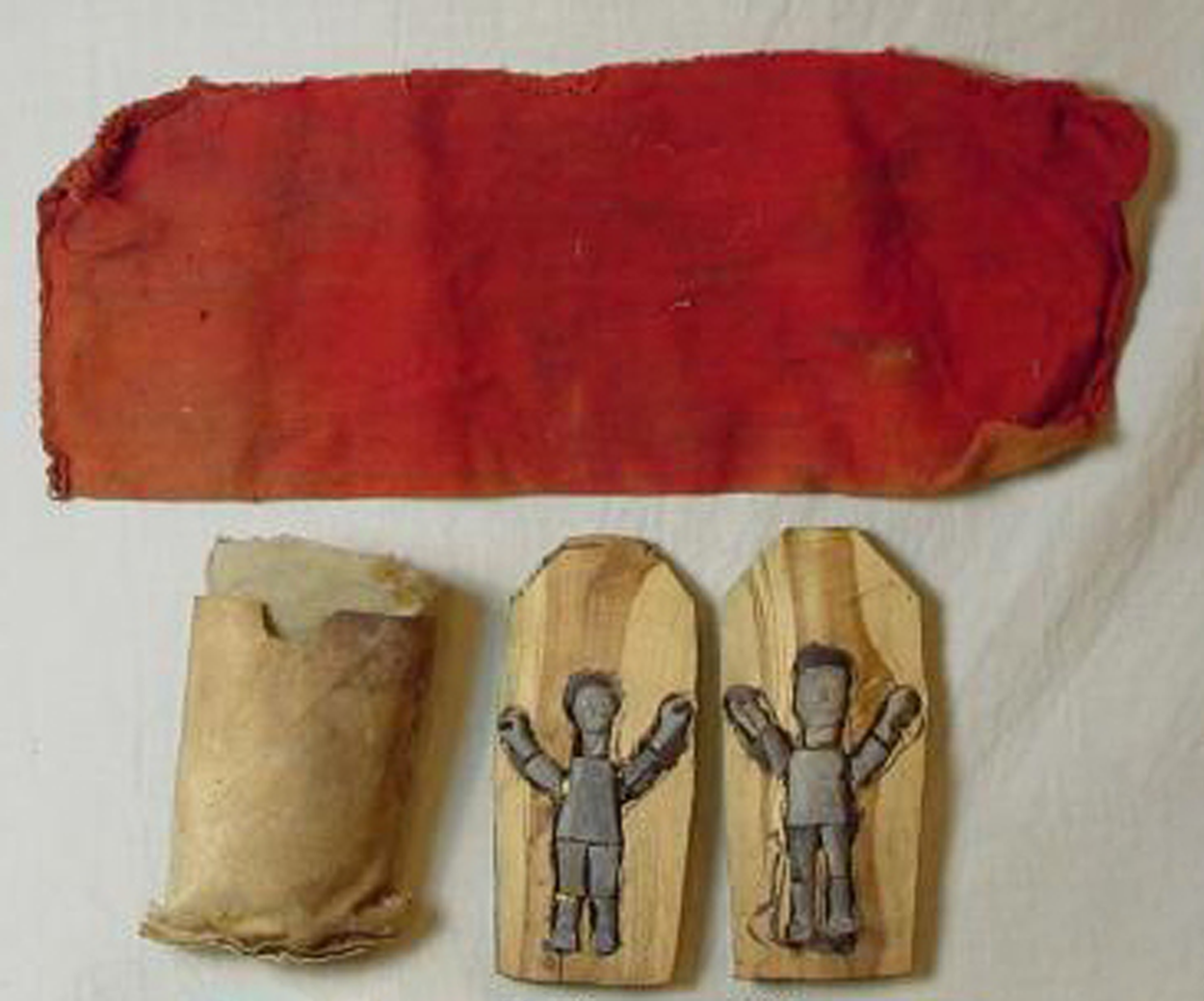
Despite their unique materialization on the cliff face, neither inscription was singular. Each was a node in an intertextual network, subject to the rules of a specific archival and genealogical practice and anchored in a specific notion of chiefly sovereignty. The fundamental genealogical archive for Nasu textual practice was ancestral bodies ordered by generation and stored in a cliff cave. The core of an ancestral body (və̏) was two small, jointed figurines carved of greenstone (see figure 4). A male figurine inlayed with silver and a female figurine inlayed with gold were placed face-to-face inside a wooden shell, the shell inserted into a deerskin bag, the bag bound with red cloth, and this wrapped assemblage placed inside a hollowed peach log with tiny tools crafted of iron or wood and a tapered iron rod with horizontal lines: a miniature copy of the iron pillar that separates heaven and earth, with rungs for the ancestors to climb to the sky. Also placed inside the log was the male ancestor's name written on a strip of silk. All ancestral bodies contained conjugal couples, even while the female member remained alive. A man who died single was married to a suitable dead daughter of another lineage before being given an ancestral body (Ma [Reference Ma1949] 1987).
The internal components of an ancestral body (və̏). Collected by Ma Xueliang in Luquan County (formerly a division of Wuding Prefecture) in 1942–43. Courtesy Academia Sinica.

The Nasu text is punctuated with repeated references to the ancestral feast, némmv̏, when “ancestral water” was drawn. This was the context in which pémɔ́ stitched together the sensationally long textual genealogies on which Nasu chiefly lineages founded their claims to sovereignty. During this nine-day ceremony, ancestral bodies were made for all those who had died since the last ancestral feast, and all the old ancestral bodies were remade anew. A pémɔ́, acting on behalf of the affines, read or recited the dead person's genealogy in front of the altar on which all the ancestral bodies were placed in order of generation. This was an opportunity to recopy the textual version of the genealogy, adding to it and adjusting it to align with the written names inserted into the ancestral bodies. This practice of reiterative textual regeneration helps explain the form of “Great Generations of the Luɦo.” The first Shangsheng, though not named, is present as the female part of the ancestral body named Ándz’ɯ̀ P’ùʑì. Her first son and the female chieftains who succeeded her are all either replaced by or present within the body named P’ùʑì Mà̠mè̠. The texts’ other apparent genealogical omissions might be understood in the same way, as ritualists actively curated the ancestral bodies, crafting a single senior line and revising the manuscript version of that line.
The tribute missions that punctuate the Chinese text evince another archival practice. These missions transmitted titles, honors, edicts, and regalia from the capital to Wuding. Feng Ying's letter is clearly modeled on the genealogical documentation that native chieftains were required to present to the court during such missions. The text anchors each claim of chiefly succession firmly to other existing texts and relics, presumably stored in the prefectural archive, available in the archive of the Ministry of Personnel or cited in other available genealogical documents. The text is an unbroken chain of such endowments, from the cap and belt of office presented to Shangsheng to all the edicts granting titles to her successors, cited by serial number. If the text is unconcerned with showing a line of succession from father to son, this is because its version of succession is a chain of documents and relics rather than a line of ancestral bodies. The chieftains who received no titles or honors are excluded from the account: in particular, Shangzhi's probable daughter-in-law Saben and the second Shangsheng. Finally, the focus of the Chinese text is the living—the entire line of imperial endowments coiled up in the person of the living Feng Ying: his “hereditary qualifications.” In contrast, the focus of the Nasu text is the dead—Lady Qu's dead son Yì̠lò Yì̠tʂə́ and all the other ancestral bodies on the némv̏ ritual ground.
These separate intertextual networks sustained separate visions of the sources of chiefly sovereignty. On the one hand, sovereignty emerged solely from the line of ancestral bodies and their geographical connections to the domain, in the sources of ancestral water. On the other hand, sovereignty originated exclusively in imperial favors. Complicating each of these visions was the institution of uxoric succession.
Lady Qu and the Politics of Uxoric Succession
Patrilineal and uxoric succession make different uses of the lives and deaths of human bodies. Patrilineal succession, often seen as capturing the life-giving potential of wives and concubines to create continuities from fathers to sons, takes form in the Nasu text of acquiring the powers of life and flourishing contained in the conjugal forms of ancestral bodies. Episodic uxoric succession, often seen in patrilineal contexts as subsumed by patriliny (mothers as regents for sons) or patriliny in another form (queens as honorary kings), takes shape in the Chinese text as capturing the aleatory potential of the untimely deaths of husbands and sons. Uxoric succession, not unknown in imperial history, especially among the Han emperors, and common in in many Né (or Yi) lineages (Gong Reference Gong2011), was clearly a powerful and attractive alternative to patrilineal succession during times of social and political uncertainty. In the Luɦo lineage, episodes of uxoric succession began with wives succeeding husbands and continued with daughters-in-law succeeding mothers-in-law. During these episodes, sons and husbands seemed to serve mainly to enable succession from their mothers to their wives with their early deaths. The early Ming succession of three, or possibly four, generations of mothers-in-law and daughters-in-law, which held off the claims of Nongji's second son Aning for fifty-seven years, shows that these women were not passively drawn into chiefly duties by untimely deaths of husbands and sons but instead actively worked to pass on power to other women, perhaps even by arranging the early deaths of their sons and husbands.
Lady Qu's late life might help illuminate the fraught politics of uxoric succession. An episode from the Ming Shi Lu (1987) makes it clear that Lady Qu was a formidable military commander who actively engaged in the struggle for military honors in the game of “using the yi to counter the yi,” in which the Ming deployed native militias against other native domains. In 1551–53, Lady Qu led her army in a sustained expedition against Yuanjiang, a native domain in southern Yunnan. Like all such actions in the mid-Ming period, the expedition must be seen in the context of uneven efforts to impose regular administration on native domains. Yet, as often happened, the immediate cause was a struggle for succession. After a member of the ruling family killed the native prefect and seized power, native and imperial troops were mobilized from several places in Yunnan and Guangxi. The initial attack went badly. The usurper, one Na Jian, promised surrender and agreed to negotiate. But as the expedition's leader approached the city, Na Jian “suddenly loosed his elephants, horses, and yi troops and surged out of the city to attack,” killing the leader and massacring his retinue. The city was surrounded; fortifications were built, and two thousand soldiers were selected to enter the city:
The woman Lady Qu, native prefect of Wuding, as well as Lu Shaoxian who was a member of the Ningzhou native ruling family, and Lu Youren, a chieftain of the Southern Guangxi troops, all hated Na Jian, as he had killed his ruler and taken his ruler's wife, and they swore that even until death they would not retreat.
The Yuanjiang forces retreated into the city, and the attackers laid siege until many residents starved to death, withdrawing only after “miasmic poisons arose.” Eventually, an army of 70,000 occupied the city; Na Jian killed himself with poison, and another member of the ruling family was appointed as native prefect. An imperial edict was issued to “richly reward Lady Qu as well as Lu Shaoxian and Lu Youren” (Ming Shi Lu, juan 86/6684–85).
At this time, Lady Qu was governing as native prefect, assisted by her daughter-in-law Suolin. In 1563, after forty-three years of close involvement in governance, Lady Qu voluntarily retired, placing Suolin in charge and recommending that she be appointed native prefect. Shortly afterward, angered by Suolin's lack of deference, Lady Qu decided to take back power. She adopted one Er Alun, formerly the adopted son of her husband's brother, the rebel Feng Chaowen. Er Alun changed his name to Feng Jizu (“succeeding the ancestors”) and set off on a tribute mission. Before he reached the capital Lady Qu sent a message alleging that Suolin had imprisoned her. Feng Jizu immediately returned and, on the strength of a false claim that the court had named him native prefect, gathered officials and soldiers to enter the city. Suolin fled to the provincial capital. She returned with provincial officials who insisted that Feng Jizu had not been named native prefect and proclaimed that Suolin would continue in the post (Tan [n.d.] Reference Tan and Ma1998)
Unwilling to accept this, and worried that Suolin intended to kill him, Feng Jizu surrounded Wuding town with fighters gathered from the allied native domains of Yao'an, Yimen, and Dongchuan. Suolin fled again with the prefectural seal. This time the governor confiscated the seal, jailed Suolin's chief lieutenant, ordered Lady Qu to take over the Prefecture's affairs, and sent the imperial censor to Wuding with an army. Feng Jizu and his allies defeated the imperial troops and retrenched, recruiting more fighters in Wuding and across the Jinsha River in Huili. The Ming court cashiered the governor to punish him for this defeat. Supported by the new governor, Lu Guangtao, Suolin returned to take up the post of native prefect again. Feng Jizu immediately occupied the city with his large army and executed some seventy prefectural officials. The Ming mustered another large expedition of native militias from around the province. Feng Jizu fled toward Dongchuan, but the native prefect there, understanding that the forces arrayed against his ally were too formidable, attacked Feng Jizu's forces, killing him in battle. In 1567, after four years of warfare, Governor Lu Guangtao appointed a Jiangxi native regular prefect of Wuding. Having escaped the slaughter of her entire household of officials, Suolin was allowed to return to manage her estates, but Lady Qu does not seem to have survived. Their kin would mount more rebellions, destabilizing the region for fifty years, but the line of Luɦo chieftains memorialized in “Great Generations of the Luɦo” had ended (He Reference He1989; Tan [n.d.] Reference Tan and Ma1998; Zhu Reference Zhu2009).
These episodes illustrate two ways that the evolving Ming approach to native domains produced conditions for uxoric succession in chiefly Né lineages. First, the system's sheer violence helped generate the deaths of husbands and sons that uxoric succession required. Shortly after invading Yunnan, the Ming established more than forty military garrisons on the plateau, with a total of some 250,000 soldiers. In a push for rapid colonization in the 1380s and 1390s, all demobilized soldiers in the empire were required to relocate with their families to the southwest, creating the foundations for a yet more massive migration (Herman Reference Herman2007, 87). Some Né chieftains mounted armed rebellions against Han incursions; others encroached upon areas under regular administration, drawing immediate and catastrophic military suppression. Né chiefly lineages frequently fought each other for control of shrinking territories. Shen (Reference Shen2011) lists sixteen major armed conflicts among Né chieftains during the Ming, attributing four to struggles over territory and the rest to succession disputes. The state relied upon native militias in its armed response to all these conflicts, as well as to rebellions and succession struggles among the many non-Né ethnicities in the southwest. Native chieftains and their potential heirs personally led their militias in battle, and they were exposed to all the dangers of field campaigns. This violence did much to produce the deaths of male chieftains and heirs that made uxoric succession possible.
Second, Né chieftains resisted Ming efforts to limit or abolish their powers by transforming the systems of marriage alliances in which chiefly Né lineages exchanged daughters with other Né lineages of comparable status. Long before the Ming conquest, Nasu chieftains had established sequences of marriage alliances based on a pattern of matrilateral cross-cousin marriage. Nasu documents show how the Luɦo exchanged daughters with other chiefly Nasu lineages for as many as six generations at a time in a carefully orchestrated rotation (Zhu and Yang Reference Zhu and Yang1990) (see figure 3). Thus, after the untimely death of her husband, a native chieftain's wife might already have natural allies among the lineage's most influential members, who were often her close relatives. As the Ming increased its efforts to restrain or demote them, Né native chieftains deliberately broadened the scope of their alliances, crossing lines of language and sometimes status (Shen Reference Shen2011). For instance, the Genealogical Chronicles of the Mu chiefs of Lijiang record that Native Prefect Mu Gong's (1494–1553) two wives were the daughters of the native prefect of Wuding—Lady Qu's husband Feng Chaoming (Rock Reference Rock1947, 115–17). In addition, a chiefly wife often had the support of a natal family chosen for its power and influence. Thus, Lady Qu benefited from the marriage of her sister's daughter to An Guoheng, pacification commissioner of Guizhou and heir to the important Mu'ege native domain (Whittaker Reference Whittaker2008, 145). Such alliances were critical to Lady Qu's capacity to assume power after her husband's death, to appoint her daughter-in-law as her successor, and to create enormous destruction when she changed her mind.
In light of the politics of uxoric succession, the inscriptions in Red-Cliff Gorge might be seen as a spectacular demonstration of Lady Qu's own credentials. In 1533, the realm had barely survived Feng Chaowen's ferocious challenge to her rule. Her son had just lost his life in service to the Ming state. Given that Feng Zhao had no children, she may well already have been contemplating passing power to her daughter-in-law Suolin, who was becoming an entrusted co-ruler. Every argument for her rule rested upon the archived, iterated materializations of the Luɦo genealogy in paper, greenstone figurines, and gold-encrusted heirlooms. She had two mutually contradictory archives at her service, and while male chieftains before her had highlighted one or the other depending upon the context, she chose to display both. She needed both to legitimate her own rule, to legitimate her right to choose a successor, and to legitimate the eventual successor she chose.
Lady Qu needed the archive instantiated in “Great Generations of the Luɦo” to demonstrate her legitimate participation in the Luɦo lineage. Though that archive did not include her name, she was already embodied there as a female greenstone figure pressed face-to-face with the male greenstone figure of Ahú Yì̠lò inside the ancestral body (və̀) bearing that name. Her eventual choice of her daughter-in-law as her successor would be the natural and legitimate form of succession, for Suolin, too, was already embedded there as the greenstone iteration of the dead body she would become: the female part of the ancestral body named Yì̠lò Yì̠tʂə́. This succession was already recorded in the genealogy inscribed on the cliff face: Ahú Yì̠lò to Yì̠lò Yì̠tʂə́. Lady Qu also needed the archive indexed by “Hereditary Qualifications of the Feng.” She held the seal, cap and belt of native prefect and a patent granting her this title. The inscription was the pedigree of these regalia, demonstrating their legitimate transfer along the line of native prefects. It was a claim that, like the other native prefects described in the inscription, she would have the right to propose a successor to be ratified by the emperor. In the aftermath of rebellion, it was also a show of power: a reminder that the emperor had invested her with these insignia, and behind the emperor was the shadow of Ming military might.
Conclusion: Powers of Self-Description
Lady Qu's spectacular act of juxtaposing iterations of these two archives on a single cliff face in the center of her realm reveals the contradictions at the heart of every native domain in the southwest. Native chieftains drew their sovereignty from genealogical claims, usually autochthonous, and always embedded in the rock and soil of their realms, yet their sovereignty was also awarded by the distant imperial court. Native chieftains forged political and military power through skillful politics of alliance with others, yet they gained influence and might through military service against other native chieftains. Native domains were sovereign, autonomous polities embedded in horizontal relations with other domains, yet they were fully integrated into the vertical imperial order under the direct supervision of provincial authorities. These were not abstract contradictions: they emerged from contrasting textual worlds, using different scripts, subject to different structures of authorship, sponsorship, and iteration, and conditioned by different orders of archive, reference, and intertextuality.
Native chieftains deployed contrasting linguistic worlds strategically as they negotiated the ambiguous forms of their sovereignty under Ming rule. Lady Qu's innovation was to bring two contrasting textual worlds together to highlight their incommensurable visions of succession, political authority, and geopolitical order. This act seems to reach beyond the specific sources of sovereignty defined by the two inscriptions toward a demonstration of sovereignty as the virtuosic power of self-description. The inscriptions announce that their sponsor commands both, mutually contradictory modes of self-description and the textual worlds in which they were embedded. Yet no effort was made to reconcile them: they do not translate, mediate, or transform each other. Read reciprocally, whether left to right (Nasu to Chinese) or right to left (Chinese to Nasu), the vision of the chiefly lineage that emerges is neither merely an extension of the imperial state nor merely a local irritant in the body of the state. Instead, the cliff face might be read as a performance of the essential mystery of sovereignty by a ruler who, because of her structural position, could never rest secure in either understanding of the sources of sovereign authority. The answer the cliff in Red-Cliff Gorge presents to the question posed to every sovereign—who are you and what gives you the right to rule?—is no identity, only difference. To a reading and listening audience composed not of separate linguistic communities but of the multilingual subjects of the native domain, the message would be: I am both visions and neither. I command both, which no one else can command; I am the space between them, which can be neither recited nor inscribed; I am their difference.
We are accustomed to thinking colonialism through projects of translation. Some of the best recent scholarship on colonialism in the sixteenth-century New World, for instance, works out richly documented histories of translation as a strategy of power. It shows how writing in indigenous languages was refashioned to convey the concepts and operations of scriptures, doctrinal texts, and bureaucratic documents (Hanks Reference Hanks2010); how pictorial scriptive practices were reduced to alphabetic practices (Boone and Mignolo Reference Boone and Mignolo1994); how indigenous mapping practices were transformed into instruments for land expropriation (Mundy Reference Mundy1996). Indigenous languages became, in a thorough and robust way, “translingual” languages, conduits of power-laden projects that transformed persons, relations, and practices.
Lady Qu's inscriptions demonstrate that the Ming colonization of southwest China requires a fundamentally different approach. The (semi)sovereign enclaves that dominated so much of the Yunnan-Guizhou plateau were, above all, linguistic enclaves, defined by differences between Chinese and indigenous languages. Generally speaking, native languages did not become translingual instruments; they were used separately from and in parallel with Chinese, the language of bureaucratic rule, literary status, ritual propriety, and civilizing aspiration. Southwesterners living as gendered “native” (tu, man, or yi) subjects in civilized (hua) China experienced what W. E. B. Du Bois called “double consciousness” (Reference Du Bois1903 [2017]). Understanding Ming colonialism requires tracing the ways southwestern sovereigns and subjects strategically manipulated the differences between Chinese and indigenous languages, deploying double consciousness to their own ends.
Acknowledgments
This article is built on the work of previous researchers on the Luɦo chieftains, particularly that of Zhang Chunde, who introduced me to the Nasu language long ago, and Jacob Whittaker, whose 2008 dissertation is an invaluable guide to sources. Participants in the Humanities Workshop at the Universidad Autonoma Metropolitana in Ciudad de México pointed the way to a readable version with their generous critiques. I thank Sandra Rozental, Carlos Mondragon, and Elizabeth Roberts for that experience. I could not have written this article without Ashley Lebner's unflagging encouragement and enthusiasm. Two anonymous reviewers for JAS generously worked through the text sentence by sentence with exemplary insight, humor, and judgment. The article was revised while I was a recipient of a National Endowment for the Humanities Summer Fellowship.