1. Introduction
Fabrics in igneous rocks may be of magmatic or tectonic origin (Paterson et al. Reference Paterson, Vernon and Tobisch1989, Reference Paterson, Ardill, Vernon and Žák2019). Magmatic fabrics are generated across a range of pressure–temperature conditions above the solidus, while deformation fabrics are generally formed in the solid state below the solidus. While magmatic fabrics may sometimes be ubiquitous within intrusive rocks that have not undergone subsequent pervasive regional deformation, they are not always easy to differentiate from tectonic fabrics (Vernon, Reference Vernon2000; Vigneresse et al. Reference Vigneresse, Weinberg, Sial, Pessoa, Garibaldi, Tikoff, Schaen, Singer, Bergantz, Schleicher, Burgisser, Streck and Vernon2004; Paterson et al. Reference Paterson, Ardill, Vernon and Žák2019). This discrimination becomes particularly relevant for Archaean felsic plutons, as stabilization of the early continental crust has been correlated with a major change in the geodynamic set-up of the planet (e.g. Kamber, Reference Kamber2015; Johnson et al. Reference Johnson, Brown, Gardiner, Kirkland and Smithies2017; Mulder et al. Reference Mulder, Nebel, Gardiner, Cawood, Wainwright and Ivanic2021). Primary structures in Archaean felsic plutons are associated with early continental crust formation, while the secondary tectonic structures represent reworking following or during stabilization. Thus, proper discrimination between features that developed in the magmatic and solid state is an essential prerequisite either for understanding processes like magma chamber dynamics, or for correlation of the solid-state fabrics in the magmatic body with regional tectonics.
Recent studies have shown that a range of processes occur concurrently in felsic magma chambers owing to the rheological complexities of felsic melts (Žák et al. Reference Žák, Verner and Týcová2008; Bea, Reference Bea2010; Gaweda & Szopa, Reference Gaweda and Szopa2011; Annen et al. Reference Annen, Blundy, Leuthold and Sparks2015; Charlier et al. 2015; Lee & Morton, Reference Lee and Morton2015). Pseudo-sedimentary structures such as cross-bedding in plutonic igneous rocks have earlier been attributed to magmatic flow resulting either owing to density currents or convection (e.g. Holness et al. Reference Holness, Neufeld, Gilbert and Macdonald2017a; Vukmanovic et al. Reference Vukmanovic, Holness, Monks and Andersen2018; Alasino et al. Reference Alasino, Ardill, Stanback, Paterson, Galindo and Leopold2019). However, felsic melts are more viscous than their mafic counterparts, and some studies dispute the efficiency with which processes such as convection and slumping of a crystal mush could have operated within felsic magma chambers (Glazner et al. Reference Glazner, Bartley, Coleman, Gray and Taylor2004, Reference Glazner, Bartley and Law2021; Glazner, Reference Glazner2014). It is therefore important to assess the feasibility of processes such as convective flow occurring in felsic magma chambers, their involvement in magmatic fabric formation and to constrain the conditions under which magmatic flow could have operated.
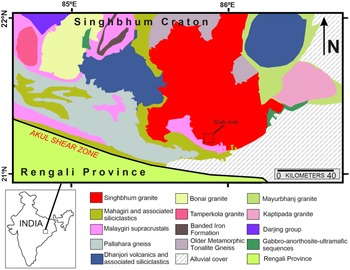
This study focuses on differentiating magmatic and tectonic fabrics in the Mesoarchaean Remal granite-gneiss from the Archaean Singhbhum Craton in eastern India (Fig. 1). The Singhbhum Craton is one of the oldest parts of the Indian shield (Chaudhuri et al. Reference Chaudhuri, Wan, Mazumder, Ma and Liu2018; Ranjan et al. Reference Ranjan, Upadhyay, Pruseth and Nanda2020), and has recently been postulated to represent one of the oldest places where continental crust emerged from the sea (Chowdhury et al. Reference Chowdhury, Mulder, Cawood, Bhattacharjee, Roy, Wainwright, Nebel and Mukherjee2021). The Remal granite-gneiss is located in the southeastern part of the craton, and contains a sub-vertical tectonic fabric superposed onto an earlier magmatic fabric (Dobe & Gupta, Reference Dobe and Gupta2018). The supracrustal Iron Ore Group sequence lying just south of the area is multiply deformed, and therefore, the positive identification of a magmatic fabric within the granite is important. Despite a plethora of studies focused on the geochemical evolution of the Singhbhum Craton from Hadean to Proterozoic times (Saha, Reference Saha1994; Mishra et al. Reference Mishra, Deomurari, Wiedenbeck, Goswami, Ray and Saha1999; Upadhyay et al. Reference Upadhyay, Chattopadhyay, Kooijman, Mezger and Berndt2014; Dey et al. Reference Dey, Topno, Liu and Zong2017; Chaudhuri et al. Reference Chaudhuri, Wan, Mazumder, Ma and Liu2018; Topno et al. Reference Topno, Dey, Liu and Zong2018; Olierook et al. Reference Olierook, Clark, Reddy, Mazumder, Jourdan and Evans2019; Chaudhuri, Reference Chaudhuri2020; Mukhopadhyay & Matin, Reference Mukhopadhyay and Matin2020), magmatic fabrics within the extensive units of the Singhbhum granite, the largest component of the Singhbhum Craton, have not been studied in any detail. In this study, we present field, microstructural and textural evidence for the existence of an earlier magmatic fabric in the Remal granite-gneiss, and demonstrate the feasibility of convective flow having occurred in this body under a range of crystallinities and water contents. We also show that a gneissic segregation banding may form in a granitic body even under greenschist-facies conditions, disputing the presumption that gneissosity formation is necessarily a high-temperature phenomenon.
Simplified map of the southern part of the Singhbhum Craton modified after Saha (Reference Saha1994) and Mukhopadhyay & Matin (Reference Mukhopadhyay and Matin2020). The different litho-units which comprise the Singhbhum Craton are delineated with different colours according to the legend. The location of the Remal granite-gneiss is shown within a box.

2. Geological setting
The Singhbhum Craton is an extensively studied part of the stable Indian shield that is multiply deformed and poly-metamorphosed (Ghosh et al. Reference Ghosh, Bose, Guha, Mukhopadhyay and Aich2010; Mukhopadhyay et al. Reference Mukhopadhyay, Ghosh, Zimmermann, Guha and Mukherjee2012, Reference Mukhopadhyay, Crowley, Ghosh, Ghosh, Chakrabarti, Misra, Heron and Bose2014; Ghosh & Bose, Reference Ghosh and Bose2020; Mukhopadhyay & Matin, Reference Mukhopadhyay and Matin2020; De et al. Reference De, Rosiere and Mukhopadhyay2022). It consists of an Archaean–Proterozoic granitoid core associated with variably deformed and metamorphosed supracrustal sequences (Radhakrishna & Naqvi, Reference Radhakrishna and Naqvi1986; Misra, Reference Misra2006; Olierook et al. Reference Olierook, Clark, Reddy, Mazumder, Jourdan and Evans2019). The northern margin of the granitoids in the Singhbhum Craton is the Singhbhum Shear Zone along which the North Singhbhum Mobile Belt is thrust onto the granitoids further south (Matin et al. Reference Matin, Banerjee, Gupta and Banerjee2012; Olierook et al. Reference Olierook, Clark, Reddy, Mazumder, Jourdan and Evans2019). The eastern segment of the Singhbhum Craton is separated from the North Singhbhum Mobile Belt and the Chhotanagpur Gneissic Complex by the N–NNE-trending sinistral Eastern Indian Tectonic Zone (Chatterjee et al. Reference Chatterjee, Banerjee, Bhattacharya and Maji2010). To the south, the low-grade rocks of the Singhbhum Craton are separated from the high-grade rocks of the Rengali Province by the Barakot-Akul Shear Zone (Crowe et al. Reference Crowe, Nash, Harris, Leeming and Rankin2003; Misra & Gupta, Reference Misra and Gupta2014). This terrane boundary shear zone is dextral strike-slip in nature, and is postulated to have operated in the greenschist facies (Misra & Gupta, Reference Misra and Gupta2014). The Singhbhum granite is the largest component of the Singhbhum Craton by volume and compositionally ranges from tonalite to granite, and is believed to have been emplaced by episodic magma pulses (Saha, Reference Saha1994; Mishra et al. Reference Mishra, Deomurari, Wiedenbeck, Goswami, Ray and Saha1999; Upadhyay et al. Reference Upadhyay, Chattopadhyay, Kooijman, Mezger and Berndt2014; Pandey et al. Reference Pandey, Mezger, Ranjan, Upadhyay, Villa, Nägler and Vollstaedt2019; Mukhopadhyay & Matin, Reference Mukhopadhyay and Matin2020). Available geochronological evidence from the Singhbhum granite points to emplacement and crystallization between 3.5 and 3.2 Ga (see Olierook et al. Reference Olierook, Clark, Reddy, Mazumder, Jourdan and Evans2019 and Mukhopadhyay & Matin, Reference Mukhopadhyay and Matin2020 for reviews). While earlier studies based on lithological variations had proposed three distinct emplacement phases of the Singhbhum granite (Saha, Reference Saha1994; Mukhopadhyay, Reference Mukhopadhyay2001), it has recently been suggested the second and third phases have overlapping compositions ranging from granodiorite to monzogranite and granite (Pandey et al. Reference Pandey, Mezger, Ranjan, Upadhyay, Villa, Nägler and Vollstaedt2019). Owing to the similarities in rare earth element (REE) patterns across the different units of the Singhbhum granite, it was concluded that these granites were derived from sources which were mineralogically and chemically similar (Pandey et al. Reference Pandey, Mezger, Ranjan, Upadhyay, Villa, Nägler and Vollstaedt2019). The highest grade metamorphic event recorded within the Singhbhum granite has been timed at 3.34–3.26 Ga, which is concomitant with emplacement and crystallization ages obtained from the different units of the Singhbhum granite (Upadhyay et al. Reference Upadhyay, Chattopadhyay, Kooijman, Mezger and Berndt2014; Dey et al. Reference Dey, Topno, Liu and Zong2017; Pandey et al. Reference Pandey, Mezger, Ranjan, Upadhyay, Villa, Nägler and Vollstaedt2019; Mukhopadhyay & Matin, Reference Mukhopadhyay and Matin2020). Younger ages from 3.16 to 2.80 Ga have been interpreted to reflect magmatism associated with younger plutons such as the Mayurbhanj granite, and the sparsely recorded youngest ages of 2.50–2.45 Ga are believed to reflect a low-temperature metamorphic overprint (see Mukhopadhyay & Matin, Reference Mukhopadhyay and Matin2020 and Olierook et al. Reference Olierook, Clark, Reddy, Mazumder, Jourdan and Evans2019 for reviews).
The Remal granite-gneiss is a biotite-monzogranite, the largest exposure of which occurs to the south of the spillway of the Remal dam situated at 21° 12′ 1.68″ N, 85° 56′ 4.80″ E (Fig. 1). As mentioned previously, Saha (Reference Saha1994) divided the Singhbhum granite into three phases with the first phase characterized by K-poor trondhjemitic–granodioritic compositions and the two other phases consisting of granodiorite transitioning to monzogranite and granite. Compositionally, the Remal granite-gneiss is a part of the third phase of the Singhbhum granite for which minimum estimated magma temperatures at the time of intrusion have been constrained at 754 ± 13 °C from Zr saturation temperatures (Pandey et al. Reference Pandey, Mezger, Ranjan, Upadhyay, Villa, Nägler and Vollstaedt2019). The most common structural fabric within the Singhbhum granite units is a steeply dipping foliation which Saha (Reference Saha1994) believed to be primary in nature; however, later studies suggested that this fabric is tectonic in origin along with locally developed shear zones (Ghosh & Bose, Reference Ghosh and Bose2020). Although attempts have been made to constrain deformation temperatures in the western and eastern domains of the pluton (Chatterjee et al. Reference Chatterjee, Banerjee, Bhattacharya and Maji2010; Matin et al. Reference Matin, Banerjee, Gupta and Banerjee2012; Topno et al. Reference Topno, Dey, Liu and Zong2018; Ghosh & Bose, Reference Ghosh and Bose2020), there has been no clear distinction made between deformation imprints in the granite at the crystal-mush stage and those that occurred in response to later tectonic stress. While tectonic fabrics within the Singhbhum granite have been studied in some detail (Ghosh et al. Reference Ghosh, Bose, Guha, Mukhopadhyay and Aich2010; Matin et al. Reference Matin, Banerjee, Gupta and Banerjee2012; Ghosh & Bose, Reference Ghosh and Bose2020), magmatic fabrics within the granitoids of the Singhbhum Craton have only been documented in a few studies previously (Sengupta et al. Reference Sengupta, Paul, de Laeter, McNaughton, Bandopadhyay and de Smeth1991; Saha, Reference Saha1994) without any extensive investigations into the origin of such fabrics. The nature and evolution of magmatic fabrics in the Singhbhum granite would provide key insights into the dynamics of Archaean magma chamber processes, and is the subject matter of this study, along with deformation conditions which can superpose a low-temperature segregation layering without significantly disrupting the earlier magmatic fabric.
3. Methods
Detailed fieldwork was conducted to map the different fabric elements of the Remal granite-gneiss. This provides a broad overview of the orientations of the magmatic and tectonic fabrics and the relationship between these features and the multiple generations of dykes observed in the field. Hand specimens were collected from different spatial domains as well as from exposed vertical sections of the Remal granite-gneiss. These samples were cut perpendicular to both the trace of the magmatic and the tectonic fabrics, and were then polished on a polishing plate to a thickness of 30 microns. The prepared thin-sections were then studied under a Leica DM 4500P microscope. The thin-sections were then polished using colloidal silica for 6 hours to remove surficial imperfections and prepare them for electron backscatter diffraction (EBSD) analyses. EBSD analyses of these samples were performed at the Central Research Facility of the Indian Institute of Technology, Kharagpur. The EBSD system consists of a Zeiss-Auriga Compact field emission gun-scanning electron microscope (FEG-SEM) fitted with a Gemini column Schottky type field emission filament along with an Oxford Nordlys detector for EBSD pattern detection (see Dobe et al. Reference Dobe, Das, Mukherjee and Gupta2021). Indexing of electron backscatter patterns was carried out using an AZtec HKL from Oxford Instruments. Acquisition of EBSD data was conducted at 5 × 10⁻⁶ mbar system vacuum and a gun vacuum of 1 × 10⁻¹⁰ mbar. EBSD data acquisition was performed under an accelerating voltage of 30 kV, a beam aperture of 200 microns and at a step size of 20 microns. Orientation maps were constructed across thin-sections by stitching individual scanned areas using the HKL map stitcher utility. The stitched maps were then processed using the MTEX toolbox for Matlab (Bachmann et al. Reference Bachmann, Hielscher and Schaeben2010). EBSD scans were performed to acquire orientation information for K-feldspar, quartz, plagioclase and biotite. Anorthite and orthoclase were chosen to acquire plagioclase and K-feldspar data as these phases returned mean angular deviation (MAD) values of less than 1. Equal-area projections contoured at multiples of random distribution (m.r.d) calculated using MTEX 5.6.1 were plotted for all the above-mentioned phases as well as biotite. Orientation data for orthoclase, anorthite and quartz were used to construct grains using a 10° threshold. The mean orientations of the grains were then used to calculate the orientation distribution function (ODF) for these phases using the de la Vallée Pousin kernel and the optimal half-width calculated by MTEX for each case. Orientation data for biotite were plotted by calculating the ODF using the de la Vallée Pousin kernel and a half-width of 10°. Phenocrysts and smaller grains have been plotted separately for K-feldspar, plagioclase and quartz. Grains with a diameter greater than 500 microns have been designated as phenocrysts, while those with a diameter smaller than 500 microns have been designated as small grains.
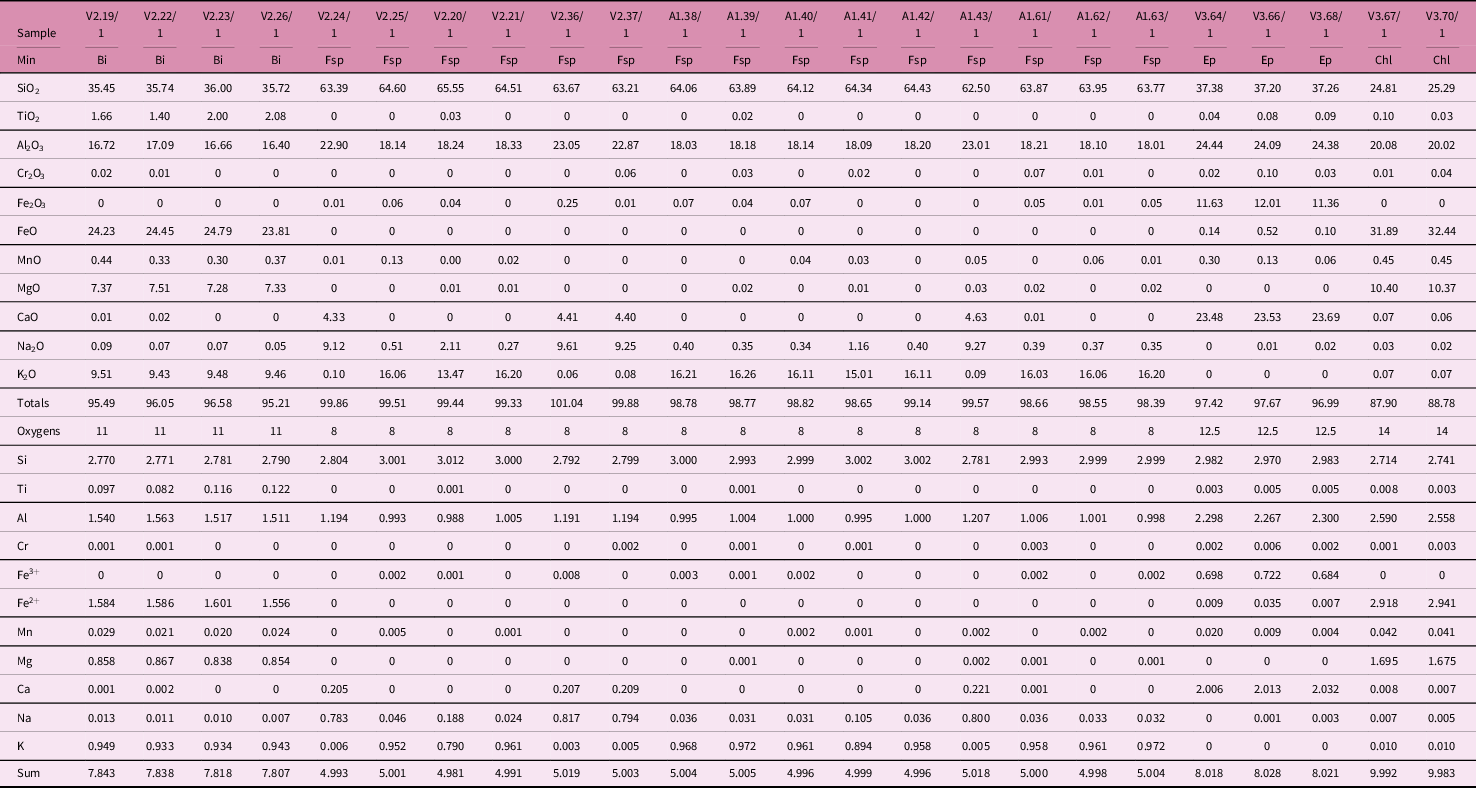
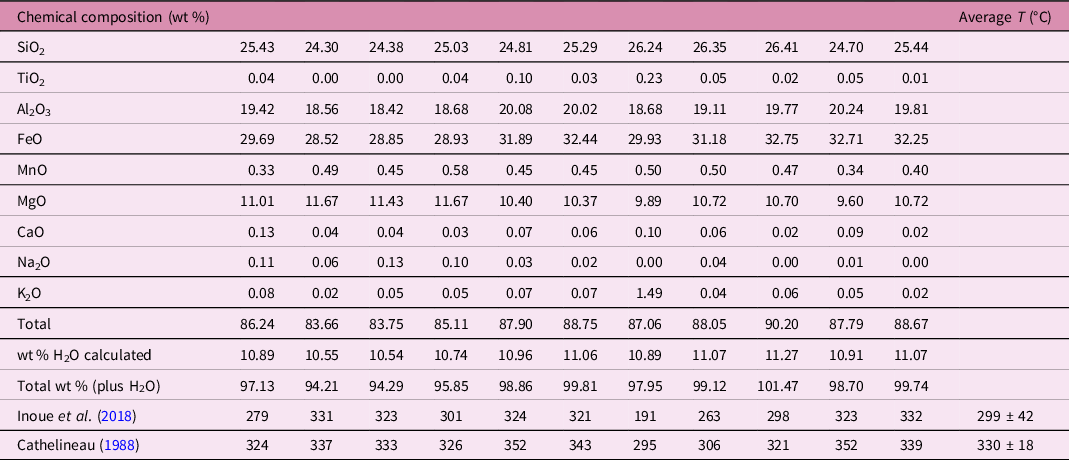
EPMA analyses using wavelength dispersive spectroscopy (WDS) have been conducted on a Cameca SX 100 electron microprobe at the Indian Institute of Technology, Kharagpur, at an accelerating voltage of 15 kV, beam current of 20 nA and beam size of ∼5 µm for feldspars and ∼1 µm for other minerals. Three samples (V3, V2 and A1) were chosen for analyses from three different positions in a vertical section of the Remal granite-gneiss to document any possible compositional variations. V3 was collected from the upper part of the exposure, V2 from the middle part of the exposure and A1 from the base of the exposed section. These samples represent different depths within the original magma chamber. Obtained oxide weight percentages for feldspars have been converted to percentages of albite, anorthite and orthoclase using recalculation spreadsheets downloaded from www.gabbrosoft.org. Representative mineral composition data recalculated using AX for Windows are presented in Table 1. Compositional data from 11 chlorite grains within the mylonitized domains of the Remal granite-gneiss have been used to obtain temperature constraints using the spreadsheet of Verdecchia et al. (Reference Verdecchia, Collo, Zandomeni, Wunderlin and Fehrmann2019). Results from one semi-empirical calibration (Inoue et al. Reference Inoue, Inoué and Utada2018) and one empirical calibration (Cathelineau, Reference Cathelineau1988) of the chlorite thermometer have been presented in Table 3.
Representative mineral compositions recalculated using AX for Windows

Chlorite compositions and results of thermometric estimates using the calibrations of Inoue et al. (Reference Inoue, Inoué and Utada2018) and Cathelineau (Reference Cathelineau1988)

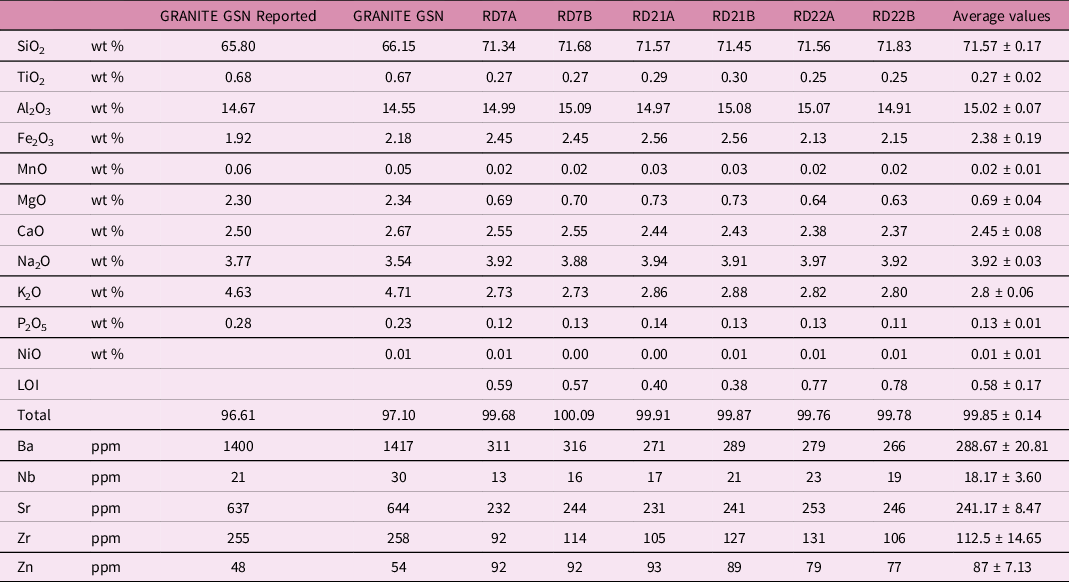
To obtain whole-rock compositional constraints, six samples of the granite-gneiss from different spatial domains were powdered and analysed using the wavelength dispersive X-ray fluorescence spectrometry (WD-XRF) facility at the Indian Institute of Technology Kanpur to determine compositional heterogeneities within the granite-gneiss unit, if any. Details of the analytical protocol are available in Chandra et al. (Reference Chandra, Paul, Viladkar and Sensarma2018). These compositions were then used to model fractional crystallization and melt evolution behaviour using rhyolite-MELTS v1.1.0 via easyMELTS and the MELTS for Microsoft Excel spreadsheet (Gualda et al. Reference Gualda, Ghiorso, Lemons and Carley2012; Ghiorso & Gualda, Reference Ghiorso and Gualda2015) for Windows. Since the whole-rock chemistry of the Remal granite-gneiss shows very little variability, an average composition from the six analysed samples was chosen as the initial bulk composition of the magma as input for the modelling (see Table 2). The chosen composition was then normalized to a total of 100, and rhyolite-MELTS was run at isenthalpic convergence steps at a pressure of 4 kbar, with 1–5 % H2O in the magma, from which feldspar, quartz and biotite were allowed to fractionate. The range of water content was chosen based on previous studies on the minimum and maximum water contents of felsic melts (Scaillet et al. Reference Scaillet, Holtz and Pichavant1998; Holtz et al. Reference Holtz, Johannes, Tamic and Behrens2001). Oxygen fugacity was kept unbuffered. Assuming a depth–pressure relationship of 3.7 km/kbar, a pressure of 4 kbar corresponds to a depth of ∼15 km; this has been chosen to approximate a magma chamber emplaced at intermediate levels in the crust (Edmonds et al. Reference Edmonds, Cashman, Holness and Jackson2019). Rheological and thermodynamic parameters of the magma such as density, viscosity, temperature and heat capacity were obtained from the MELTS for Microsoft Excel spreadsheet. The values of these parameters for corresponding magma crystallinities of 10 %, 30 %, 50 % and 90 % were used to model possible particle velocities and trajectories in a magma chamber simulated as a sill-like body of 5 km length and 1 km height, using COMSOL Multiphysics 4.4. MELTS can compute the viscosity of a magmatic system up to a crystallinity of 50 %, which is the critical threshold beyond which constituent mineral grains form an interlocking network. Therefore, viscosity of the magma at 90 % crystallinity has been set at 1013 Pa·s based on the work of Pinkerton & Stevenson (Reference Pinkerton and Stevenson1992) and Bea (Reference Bea2010). The conductivity of the system has been set at 3.1 W/m·K, which approximates the conductivity of a relatively low permeability granite (Cho et al. Reference Cho, Kwon and Choi2009). Assuming a geothermal gradient of 25 °C km−1, the ambient temperature around the simulated magma chamber has been set at 370 °C. These parameters are available in online Supplementary Material Table S1. The ‘heat transfer’ and ‘laminar flow’ modules in COMSOL Multiphysics have been coupled for the model set-up. The bases of the COMSOL models are assumed to be thermally insulated boundaries in all cases. Gravity was applied to the models as (−g_const × nitf1.rho) N/m3 volume force along the y-axis.
Oxide compositions obtained from WD-XRF analyses of six samples from the Remal granite-gneiss

LOI – loss on ignition.
4. Structural features
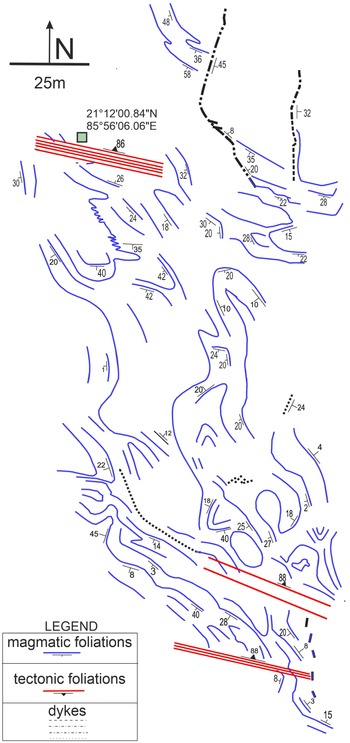
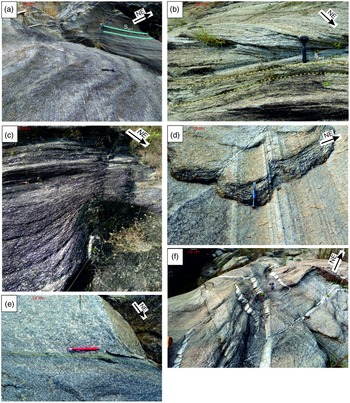
The Remal granite-gneiss contains two visible fabric elements, with contrasting origins, on the mesoscopic scale: a magmatic fabric that is either sub-horizontal to gently dipping or forms trough cross-bedded layers; and a sub-vertical fabric of tectonic origin (see Fig. 2). In the upper reaches (higher elevations) of the outcrop, the magmatic fabric Sign1 consists of relatively thick leucocratic layers dominated by K-feldspar megacrysts that vary from gently dipping to horizontal (Fig. 3a). Below the planar layers, the magmatic fabric is defined by troughs of biotite-rich schlieren representing Sign2 (Fig. 3b) which delineate the base of leucocratic domains containing phenocrysts of K-feldspar with subordinate grains of plagioclase and quartz.
Structural set up of the Remal granite-gneiss with fabric legends shown in the inset.

Visible fabric elements in the Remal granite-gneiss. (a) Crystal rich rhythmic layers traced with solid blue lines which are planar/curviplanar. Leucocratic bands contain K-feldspar megacrysts and the base of each layer is defined by biotite schlieren. (b) Trough cross-bedded layers in the Remal granite-gneiss traced with yellow dotted lines, where individual cross-beds curve and truncate against the layers above and below. (c) Warping of the magmatic fabric by a sub-vertical shear fabric. (d) Plan view of the tectonic fabric defined by segregations of biotite. (e) Plan view of localized mylonite zones in the Remal granite-gneiss with segregations of epidote testifying to the low-temperature conditions of genesis of these zones. (f) A network of pegmatitic dykes within the Remal granite-gneiss.

The biotite schlieren truncate against each other defining trough cross-bedded structures (Fig. 3b). Individual cross-beds show finer laminar terminations against the bases of the overlying boundary layer. The schlieren bounded cross-beds are variably oriented, defining a dome and basin geometry with dips ranging from sub-horizontal to moderate (Dobe & Gupta, Reference Dobe and Gupta2018). A number of magmatic deformation structures are recognizable including vertical magmatic shear fabrics (Fig. 3c) with a normal sense of displacement of the schlieren layers, along with small-scale magmatic folds that locally warp the schlieren. Observable folds within the schlieren layers are commonly vertical, although other orientations are also seen. The leucocratic layers that are bound by the schlieren contain K-feldspar phenocrysts with subordinate amounts of quartz and plagioclase.
The tectonic fabric S1 consists of a consistently oriented WNW–ESE-striking, sub-vertical gneissic banding with segregations of poorly aligned biotite grains defining the cleavage domains, and biotite-poor intermediary leucocratic domains (Fig. 3d). The spacing between the gneissic bands is variable across the outcrop. Towards the margins of the outcrop, the bands are regularly spaced with thinner cleavage domains whereas away from the margins, the cleavage domains are thicker and irregularly spaced. Thicker cleavage domains coincide with greenschist-facies ultramylonite zones along with epidote segregations (Fig. 3e), which are sub-vertical and at very low angles to the biotite cleavage S1, and are associated with prominent dextral shear sense markers.
Different generations of dykes intrude the pluton (Fig. 3f). These dykes span a compositional range from felsic to mafic (dolerite), with the textural range varying from pegmatitic to aplitic. The dykes have intruded in multiple generations, do not show any consistent orientations, cross-cut Sign and show weak imprints of deformation evidenced by their overprinting by S1, indicating that S1 developed under subsolidus conditions. All fabric elements described above are continuous for at least tens of metres across the outcrop.
5. Petrography
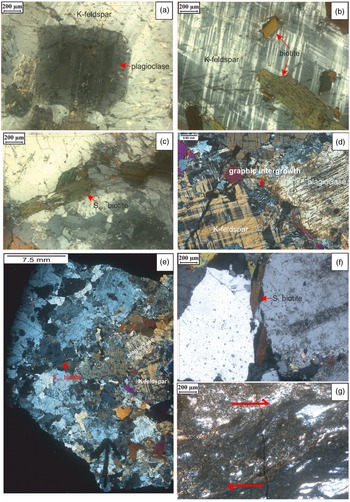
The dominant mineralogy of the Remal granite-gneiss consists of K-feldspar (mostly microcline, 40.8 % by volume), quartz (31.8 % by volume), plagioclase (16.9 % by volume) and biotite (10.3 % by volume). The presence of both Na- and K-rich feldspars constrains the Remal granite-gneiss to the subsolvus field of granite crystallization. Zircon and allanite are common accessory minerals and there is no lithological variation across the outcrop. K-feldspar crystals commonly occur as anhedral to subhedral phenocrysts, with euhedral inclusions of zoned plagioclase grains (Fig. 4a) and euhedral inclusions of biotite (Fig. 4b); in places, the K-feldspars contain flame perthites (Fig. 4a, b). These inclusions within K-feldspar are commonly concentrically arranged, testifying to their igneous nature (Vernon, Reference Vernon1986; Vernon & Paterson, Reference Vernon and Paterson2008). In the domains between the adjacent biotite-rich S1 layers (Fig. 4e), mineral grains are commonly fractured without significant plastic deformation. K-feldspar and plagioclase grains in these domains are anhedral to subhedral and have an average length of 5.3 mm and 2.2 mm, respectively; the average length of the quartz grains is 2 mm. As K-feldspar phenocrysts are dominantly euhedral to subhedral, subsolidus tectonic recrystallization is interpreted to be minimal (Holness et al. Reference Holness, Clemens and Vernon2018). The schlieren layers which define the magmatic fabric Sign2 (Fig. 4c) are composed of aligned flakes of biotite with an average length of 0.5 mm. These layers separate domains of coarser grain size from domains of comparatively smaller subhedral grains of simple twinned orthoclase, quartz and zoning-free plagioclase (Fig. 4e), along with extensive development of graphic intergrowths (see Fig. 4d). The tectonic fabric S1 is also defined by biotite (Fig. 4f), but these biotite grains are poorly aligned and occur as spaced flaky grains. Both the magmatic and the tectonic fabric are defined by biotite grains but their modes of occurrence are different. The Sign biotites are prominently platy with both euhedral and anhedral shapes; these biotites typically have irregular crystal faces perpendicular to their cleavage traces with mostly well-developed crystal faces parallel to the cleavage trace. On the other hand, S1 biotites form shorter and thinner flakes with lenticular shapes. While evidence of tectonically induced recrystallization is minimal and most visible microstructures are characteristic of the magmatic state, the tectonic fabric S1 probably developed by selective dissolution of pre-existing biotite grains and their re-precipitation into a sub-vertical orientation (Wintsch & Yi, Reference Wintsch and Yi2002).
Photomicrographs of thin-sections from the Remal granite-gneiss: (a) Subhedral normally zoned inclusion of plagioclase in a K-feldspar phenocryst. (b) Biotite inclusions within a microcline phenocryst. The biotite grains are euhedral/subhedral and the embayed faces seen in biotite grains that define Sign and S1 are absent in the inclusions. (c) Boundaries of the trough cross-bedded layers defined by biotite segregations. Note the embayed faces of biotite grains perpendicular to cleavage and euhedral faces parallel to cleavage. (d) graphic intergrowth from the Sign domains. (e) Low magnification photomicrograph of Sign layers away from S1. The grain size is significantly larger, and subhedral to anhedral K-feldspar grains dominate with subordinate plagioclase and quartz. (f) Tectonic fabric S1 defined by biotite. (g) Photomicrograph of a mylonite within the Remal granite-gneiss. A distinct dextral drag of the S1 fabric is visible in the central portion of the photomicrograph.
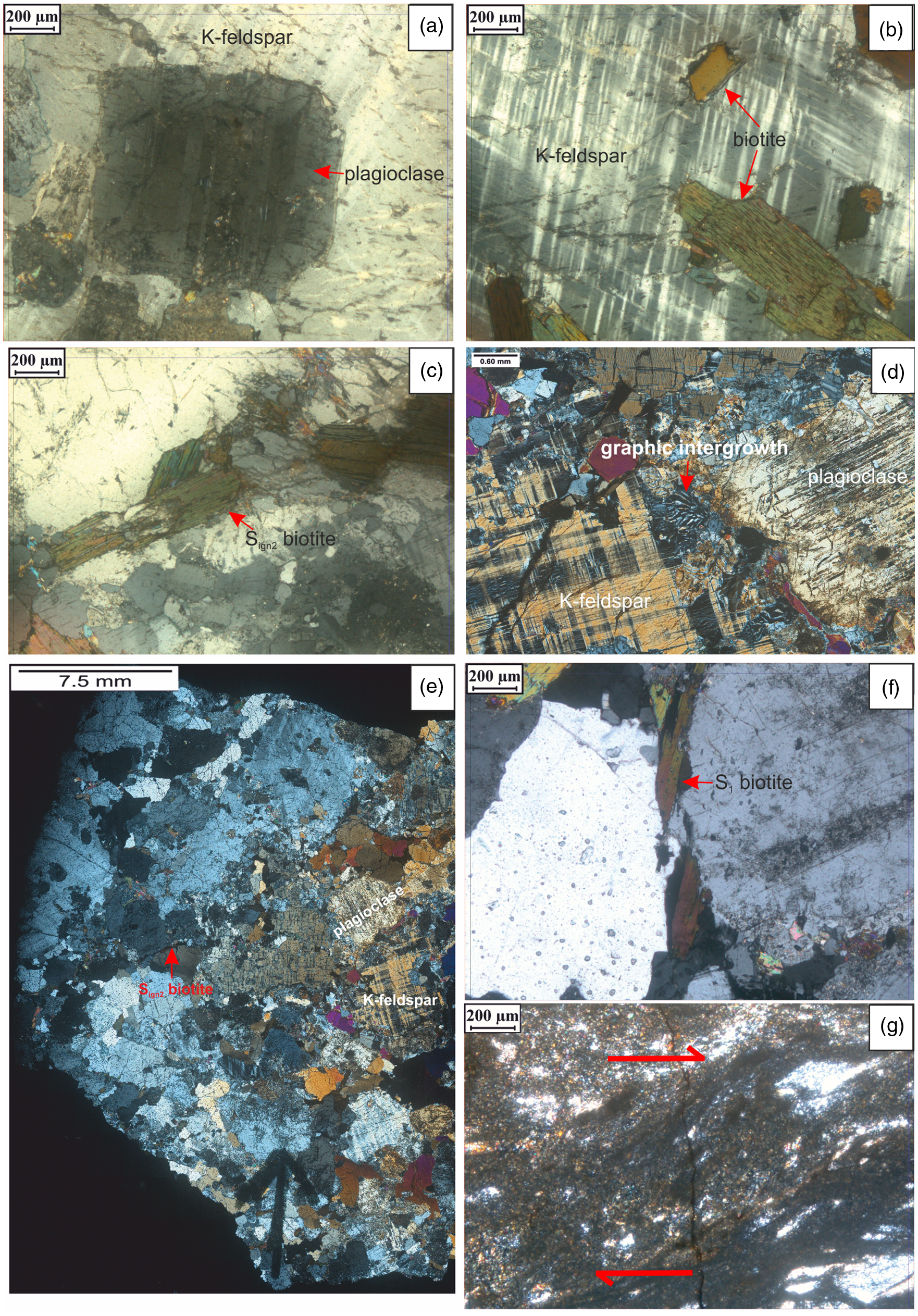
Mylonitized zones within the Remal granite-gneiss (Fig. 4g) are defined by chlorite and epidote-bearing ultramylonite bands within which extensively recrystallized porphyroblasts of quartz exhibit dextral asymmetry in horizontal sections. The dominant recrystallization mechanism of quartz grains in this domain is bulging recrystallization or BLG (Stipp et al. Reference Stipp, Stünitz, Heilbronner and Schmid2002) from which it is inferred that deformation temperatures were low. The significantly localized manner of occurrence of the mylonite zones within the rock suggests their preferential alignment along zones of pre-existing weakness. In the vicinity of the mylonites, feldspars are heavily altered and saussuritized indicating that the deformation occurred under fluid present, greenschist-facies conditions at low temperatures.
6. Textural analyses
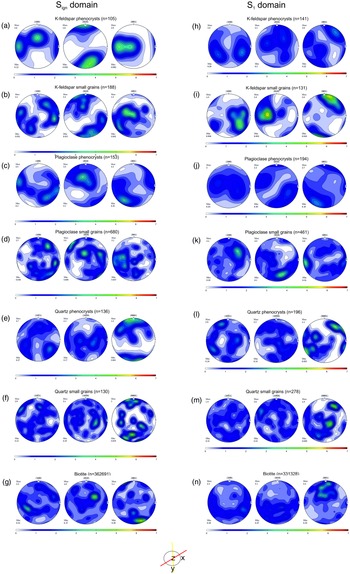
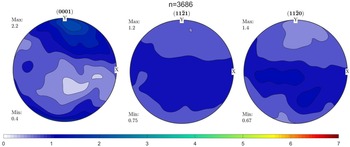
The crystallographic preferred orientations (CPOs) for K-feldspar, plagioclase, quartz and biotite from the magmatic fabric are shown in Figure 5. EBSD studies of magmatic fabrics in felsic plutons are rare (e.g. Žák et al. Reference Žák, Verner and Týcová2008), but textural analyses of constituent minerals provide valuable information about the origin of such fabrics. The CPOs of K-feldspar phenocrysts from Sign domains (Fig. 5a) show a strong alignment of the (010) faces parallel to the magmatic fabric with a girdle of poles to (100) along the magmatic fabric, typical of axial-B fabrics that develop in magmatic feldspars (Satsukawa et al. Reference Satsukawa, Ildefonse, Mainprice, Morales, Michibayashi and Barou2013). Smaller grains of K-feldspar (Fig. 5b) also show an alignment of the (010) faces perpendicular to the magmatic fabric, although there is a larger spread in orientations compared to the phenocrysts. These results are in agreement with previous observations in layered magmatic rocks, where the (010) faces of feldspar grains have been observed to generally align parallel to the magmatic fabric (Benn & Allard, Reference Benn and Allard1989). Large plagioclase grains from the Sign domains (Fig. 5c) show a spread in orientations of the (010) faces. The strongest cluster of orientations is at an angle to the magmatic fabric, but a smaller cluster of orientations parallel to the magmatic fabric is also present. Some of the (001) faces of these plagioclase grains are sub-vertical and at an angle to the magmatic fabric. The CPOs of smaller plagioclase grains (Fig. 5d) show three discrete maxima of orientations of the (010) faces at an angle to the magmatic fabric. Large grains of quartz from the Sign domains (Fig. 5e) have their basal plane (0001) parallel to the magmatic fabric whereas the rhomb planes are aligned into a girdle. A cluster of (0001) planes parallel to the magmatic fabric is also visible in the smaller grains of quartz (Fig. 5f), but like the feldspar CPOs, there is a wider spread in orientations of the smaller grains. The (001) faces of biotite grains from the Sign domains show a strong preferred orientation parallel to the magmatic fabric (Fig. 5g) with weaker clusters at an angle to the magmatic fabric.
Pole figures of K-feldspar, plagioclase, quartz and biotite from the Remal granite-gneiss. The red line in the white ellipsoid at the base of the figure represents the trace of the magmatic fabric, which is inclined at an angle of 26° with respect to the horizontal. The yellow line in the same ellipsoid represents the S1 foliation, which is sub-vertical. The number of grains in the pole figures of K-feldspar, plagioclase and quartz are mentioned in brackets. For biotite pole figures, the number of orientations are mentioned in brackets. (a–f) Plot of orientations of large and small grains of K-feldspar, plagioclase and quartz from microlithon domains between the S1 tectonic fabric. (g) Biotite orientations from the Sign domain. (h–m) Plot of orientations of large and small grains of K-feldspar, plagioclase and quartz near the S1 tectonic fabric. (n) Biotite orientations from the S1 domain. Pole figures are plotted as equal-area projections. K-feldspar, plagioclase and quartz are plotted as mean orientation per grain whereas for biotite, all the indexed pixels have been plotted.

Near the S1 domains the (010) faces of both large and small K-feldspar grains (Fig. 5h, i) are aligned at an angle to the trace of the magmatic fabric. The larger grains have a more random spread in orientations of (010) faces compared to the smaller grains, which have one prominent maxima in orientations of (010) faces. The (001) faces of both large and small K-feldspar grains from this domain show a prominent maximum at an angle to the trace of the magmatic fabric. Similar to the CPOs of the K-feldspar grains, plagioclase grains from S1 domains show no preferred orientation of (010) faces along the trace of the magmatic fabric (Fig. 5j, k). While the larger grains have a more diffuse distribution of orientations of (010) faces, the smaller grains have one prominent maxima of orientations at an angle to the trace of the magmatic fabric. The larger grains of plagioclase also show a weak alignment of (001) faces at an angle to the trace of the magmatic fabric, similar to the large grains of K-feldspar. In the smaller grains of plagioclase, the strongest cluster of (001) faces is vertical, parallel to the trace of the tectonic foliation (S1). Large grains of quartz from the S1 domains show a strong cluster of orientations of basal (0001) planes (Fig. 5l) almost perpendicular to the trace of the magmatic fabric. The smaller grains of quartz do not show any preferred orientation (Fig. 5m). The strongest cluster of (001) orientations of biotite grains from the S1 domains is at an angle to both the magmatic and tectonic fabric while weaker clusters of (001) orientations parallel to the tectonic fabric are also observed (Fig. 5n).
Quartz CPOs from the mylonitized domains of the Remal granite-gneiss are shown in Figure 6. The c-axes distribution in this sample defines a prominent cluster corresponding to deformation dominantly by basal <a> slip, with a dextral offset. The <a> axes are strongly aligned along the foliation and the <a> axes distribution is quite similar to the distribution of poles to the (11–21) faces. The dominant activity of basal <a> slip allows us to qualitatively constrain deformation temperatures below 450 °C, and that strain rates were moderate-high (Schmid & Casey, Reference Schmid and Casey1986; Okudaira et al. Reference Okudaira, Takeshita, Hara and Ando1995; Toy et al. Reference Toy, Prior and Norris2008).
CPOs of quartz grains from the mylonite within the Singhbhum granite. The quartz grains show a strong preferred orientation with prominent dextral asymmetry in the distribution of the <c> axes.

7. Geochemistry
7.a. Mineral chemistry analyses
The Remal granite-gneiss is a part of the Singhbhum granite and is composed dominantly of quartz, K-feldspar, plagioclase and biotite. Localized mylonite zones that are superposed onto the pre-existing magmatic fabric are composed dominantly of chlorite and epidote, with minor amounts of titanite and allanite as accessories. K-feldspars from the Remal granite-gneiss have an average composition of XOr 0.95, XAb 0.05. Perthitic lamellae within some K-feldspar grains show variable compositions ranging from XOr 0.81, XAb 0.19 to XOr 0.89, XAb 0.11. Plagioclase grains within the Remal granite-gneiss have an average composition of XAb 0.80, XAn 0.19 corresponding to oligoclase. Plagioclase grains near the mylonitized domains are saussuritized and show normal compositional zoning with Ca-rich cores and Na-rich rims. Their compositions correspond to almost pure albite (XAb 0.98, XAn 0.2) at the rims to oligoclase at the cores (XAb 0.8, XAn 0.19). Site occupancies in biotites from the Remal granite-gneiss have been recalculated from microprobe data using the spreadsheet of Li et al. (Reference Li, Zhang, Behrens and Holtz2020). The biotites have an average composition of XFe 0.48, XMg 0.31, XAl 0.17, XTi 0.03 with compositions closer to the annite end-member. Biotites from the upper horizons of the intrusive show minor alteration to chlorite, unlike those from deeper parts of the body.
The epidote grains that define the mylonitic fabric within the Remal granite-gneiss have an average pistacite component of 25 and do not show any significant compositional variability. Chlorite grains from the mylonitized domains have an average XMg of 0.41, and away from the mylonitized domains, the chlorite grains have an average XMg of 0.36, based on formula recalculations following Verdecchia et al. (Reference Verdecchia, Collo, Zandomeni, Wunderlin and Fehrmann2019). Plagioclase grains in the vicinity of the mylonite have compositions corresponding to oligoclase (Xab 0.79, XAn 0.19), whereas small plagioclase grains within the mylonite bands are almost purely albitic in composition (Xab 0.97, XAn 0.2). Almost all biotite grains have been partially or completely replaced by chlorite. Partially altered biotite grains have an average composition of XFe 0.48, XMg 0.31, XAl 0.17, XTi 0.03, similar to biotites from the unaltered part of the Remal granite-gneiss. Representative mineral compositions recalculated using AX for Windows are presented in Table 1.
7.b. XRF analyses
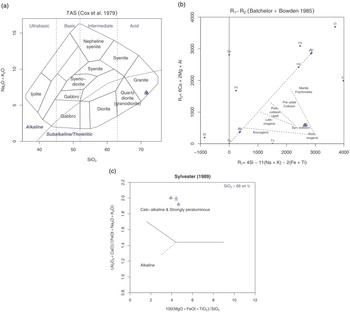
The compositions from the different domains of the six analysed samples of the Remal granite-gneiss show very little variability (see Table 2). The compositions were plotted in classification diagrams using GCDkit for R 3.6.0 (Janoušek et al. Reference Janoušek, Farrow and Erban2006). All samples have SiO2 values >70 % and plot in the granite field of the TAS diagram after Cox et al. (Reference Cox, Bell and Pankhurst1979) (Fig. 7a). In the R1–R2 plot of Batchelor & Bowden (Reference Batchelor and Bowden1985) (Fig. 7b), the analysed compositions fall in the syn-collisional field. In the classification diagram of Sylvester (Reference Sylvester1989) (Fig. 7c), the samples from the Remal granite-gneiss are classified as calc-alkaline and strongly peraluminous. The high SiO2 content of the Remal granite-gneiss can be attributed to crystallization from a highly evolved and differentiated source.
Classification and geotectonic plots of whole-rock compositions from the Remal granite-gneiss. (a) TAS diagram after Cox et al. (Reference Cox, Bell and Pankhurst1979). Analysed compositions fall in the granite field. (b) R1–R2 plot after Batchelor & Bowden (Reference Batchelor and Bowden1985). The samples from the Remal granite-gneiss plot in the syn-collisional field. (c) Classification plot after Sylvester (Reference Sylvester1989) in which the Remal granite-gneiss samples plot in the calc-alkaline and strongly peraluminous field.

8. Chlorite thermometry
The results of thermometric estimates from 11 chlorite grains from the Remal granite-gneiss are presented in Table 3. Temperature estimates have been obtained using an input pressure of 4 kbar, similar to conditions used for the modelling studies. An average temperature of 299 ± 42 °C is obtained using the semi-empirical calibration of Inoue et al. (Reference Inoue, Inoué and Utada2018), while an average temperature of 330 ± 18 °C is obtained using the empirical calibration of Cathelineau (Reference Cathelineau1988). The calibration of Inoue et al. (Reference Inoue, Inoué and Utada2018) yields a wide range of temperatures from 191 °C to 332 °C, while the Cathelineau (Reference Cathelineau1988) formulation yields a comparatively narrower range of temperatures ranging from 295 °C to 352 °C. The average temperature yielded by the calibration of Cathelineau (Reference Cathelineau1988) corresponds to the lower limits of quartz crystal plasticity, and is in agreement with deformation temperature estimates obtained from quartz CPOs.
9. Modelling studies
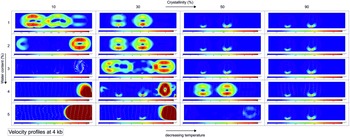
The rheological and thermodynamic parameters obtained from rhyolite-MELTS were used to simulate magma chamber conditions as described in Section 3. While magmatic structures originating due to convection have been recognized in mafic magmas (Holness et al. Reference Holness, Neufeld, Gilbert and Macdonald2017a,Reference Holness, Vukmanovic and Mariani b), we aim to determine if particle trajectories and velocities in felsic magma chambers are consistent with convective material transport on a geologically realistic timescale. Figure 8 shows the states of the magmatic system at crystallinities of 10 %, 30 %, 50 % and 90 % and with a water content ranging from 1 to 5 weight per cent (Fig. 8). When the magma consists of 10 % crystals, vigorous convection occurs irrespective of the water content. For magmas containing 1–3 % water, the magma chamber splits into discrete convection cells with convective velocities of the order of 10−6 m s−1, whereas for more fluid magmas containing 4–5 % water, convective motion is more vigorous with velocities of the order of 10−5 m s−1. As the crystallinity increases to 30 %, magmas containing 1–2 % water display similar particle trajectories and two major convection cells are established within the chamber. For magmas containing 1 % water, convective velocities are of the order of 10−8 m s−1 and it increases with an increase in water content from 10−7 m s−1 for magma with 2 % water to 10−6 m s−1 for magmas with 3–5 % water. Magmas with 3–5 % water show similar particle trajectories and the entire magma chamber splits into a number of discrete convection cells. As the crystallinity approaches the critical threshold of 50 %, convection cells in magmas with 1–2 % water die out and particle velocities are significantly lowered to a magnitude of 10−9 m s−1. For magmas with 3–4 % water, convection continues in discrete cells but the magnitude of convective velocities is reduced to 10−8 and 10−7 m s−1, respectively. For magmas with 5 % water, convection continues without a significant reduction of velocity. At 90 % crystallinity, particle velocities reduce to a magnitude of 10−14 m s−1, which would make any significant convection-driven material transport impossible before solidification (Bea, Reference Bea2010).
Numerical simulations showing the velocity distributions in the simulated magma chamber at 4 kbar pressure. Results of the simulations at different crystallinities and different water contents are shown. Streamlines and arrows indicate the loci of particles within the magma chamber. The Streamline colour and the colour bar below each image represent velocity magnitude (m s−1). See text for details.

10. Results and discussion
10.a. Nature of the magmatic fabric
The presence of two distinct, near orthogonal fabrics in the Remal granite-gneiss is intriguing, particularly because of their penetrative nature, and has been investigated combining field, microstructural and textural evidence. Field observations show that the later sub-vertical fabric is a gneissosity; however, the nature of the earlier, sub-horizontal fabric is difficult to interpret in the context of regional tectonics. The Remal granite-gneiss preserves no evidence of the penetrative deformation of the Iron Ore Group (IOG) rocks (Mukhopadhyay et al. Reference Mukhopadhyay, Ghosh, Zimmermann, Guha and Mukherjee2012) lying to the southwest. Indeed, no sub-horizontal fabric is reported from any of the IOG lithologies or any of the other lithologies (e.g. other parts of the Singhbhum granite) in the southern part of the Singhbhum Craton. There are no earlier folds to which this fabric is axial planar, and no associated shear sense markers or grain-size reduction related to the sub-horizontal foliation; rather, the foliation shows curved surfaces that closely resemble trough cross-beds (Dobe & Gupta, Reference Dobe and Gupta2018). A number of field observations (see Section 4) are consistent with a magmatic origin of the sub-horizontal fabric. The preserved magmatic fabric in the Remal granite-gneiss provides insights into layer-forming processes during felsic pluton construction. Sign1 layers consist of planar, moderately dipping leucocratic layers of variable thickness, dominated by megacrysts of K-feldspar (Fig. 3a). Sign2 layers comprise trough cross-bedded leucocratic layers consisting of phenocrysts of K-feldspar, plagioclase and quartz with segregations of biotite schlieren defining the base of each trough.
Microstructural investigations reveal that deformation imprints on the Remal granite-gneiss are limited, as they preserve euhedral–subhedral shapes with no evidence of sub-magmatic recrystallization of K-feldspar or plagioclase. Magmatic textural imprints such as graphic intergrowths, smooth and wavy curved boundaries without embayments (Fig. 4) and, most importantly, lack of significant textural re-equilibration (e.g. Holness et al. Reference Holness, Clemens and Vernon2018) are well preserved. Textural evidence for the magmatic origin of the cross-bedded Sign2 fabric in the Remal granite-gneiss is also seen in the strong preferred orientation of (010) faces of larger phenocrystic K-feldspar grains. This implies efficient segregation of K-feldspar during magmatic flow resulting in alignment of their (010) faces parallel to the flow direction (Benn & Allard, Reference Benn and Allard1989). Large plagioclase grains from the Sign domains also show clusters of orientations of (010) faces parallel to the magmatic fabric, although the strongest clusters of (010) faces are at an angle. This implies that the plagioclase grains were not as strongly aligned in comparison to K-feldspar during magmatic flow. Larger grains of quartz from the Sign domains, on the other hand, show a strong alignment of their basal (0001) planes parallel to the magmatic fabric implying that these too were efficiently segregated and aligned during magmatic flow. Therefore, the leucocratic domains of the magmatic fabric consist of well-segregated and strongly aligned phenocrysts of K-feldspar and large grains of quartz, and moderately aligned phenocrysts of plagioclase. Segregated and aligned grains of biotite, which define the base of the trough cross-bedded Sign2 layers, show a strong alignment of the (001) faces parallel to the magmatic fabric in Sign domains. This implies that the biotite grains were efficiently segregated and aligned by shear flow sorting (Alasino et al. Reference Alasino, Ardill, Stanback, Paterson, Galindo and Leopold2019; Clemens et al. Reference Clemens, Stevens, Le Roux and Wallis2020) resulting in the formation of the observed schlieren at the base of each layer. Even in the vicinity of the S1 fabric, biotite grains still retain (001) orientation clusters sub-parallel to the trace of the magmatic fabric. This confirms that the effect of tectonism-induced strain in the Remal granite-gneiss was relatively weak.
10.b. Origin of the trough cross-bedded layers
Various mechanisms have been postulated to explain the development of magmatic fabrics in felsic plutonic rocks (e.g. Pupier et al. Reference Pupier, Barbey, Toplis and Bussy2008; Solgadi & Sawyer, Reference Solgadi and Sawyer2008; Lee & Morton, Reference Lee and Morton2015; Alasino et al. Reference Alasino, Ardill, Stanback, Paterson, Galindo and Leopold2019; Bertolett et al. Reference Bertolett, Prior, Gravley, Hampton and Kennedy2019). All mechanisms postulated to explain the development of magmatic fabrics need to account for the rheological state of magma at the time of fabric formation. These are broadly subdivided into magmatic, sub-magmatic and solid-state domains (Paterson et al. Reference Paterson, Vernon and Tobisch1989, Reference Paterson, Ardill, Vernon and Žák2019). The diversity in postulated mechanisms testifies to the multitude of processes that operate from the time of magmatic differentiation until emplacement. It is therefore important to interpret observed meso- and microstructural features in terms of the timing of their origin with respect to the emplacement and cooling history of the pluton (Paterson et al. Reference Paterson, Vernon and Tobisch1989, Reference Paterson, Fowler, Schmidt, Yoshinobu, Yuan and Miller1998, Reference Paterson, Ardill, Vernon and Žák2019; Barbey, Reference Barbey2009; Vukmanovic et al. Reference Vukmanovic, Holness, Stock and Roberts2019).
Trough cross-bedded layers in mafic igneous rocks have been postulated to form owing to deposition of mineral grains by magmatic currents (Wager & Deer, Reference Wager and Deer1939; Vukmanovic et al. Reference Vukmanovic, Holness, Monks and Andersen2018). These crystal-laden currents can originate owing to collapse of the magma chamber wall (Vukmanovic et al. Reference Vukmanovic, Holness, Monks and Andersen2018; Alasino et al. Reference Alasino, Ardill, Stanback, Paterson, Galindo and Leopold2019), or they may originate owing to the establishment of compositional convection within the magma chamber (Holness et al. Reference Holness, Neufeld, Gilbert and Macdonald2017a). Although felsic magmas are expected to be too viscous to sustain convection, the viscosity may vary drastically with varying crystallinity and water content (Bea, Reference Bea2010). Convection models generated in this study using COMSOL Multiphysics (Fig. 8) demonstrate the viability of convection-driven layer formation occurring in a felsic magma at different crystallinities with different water contents. Relatively shallow plutons reportedly cool to their solidus on timescales of the order of 103 years and reach ambient wall rock temperatures on timescales of the order of 104 years (Bea, Reference Bea2010; Holness et al. Reference Holness, Clemens and Vernon2018). Therefore, for convective material transport of the order of 102 m within a magma chamber, the convective velocity within the chamber has to be of an order of 10−8 m s−1 or faster. Our results show that this is possible in magmas with less than 30 % crystals that contain 1–5 % water; convection is viable even in magmas with 50 % crystals with 3–5 % water. As demonstrated by the models, the broad range of crystallinities and water contents at which viable convective material transport is possible leads us to conclude that the trough cross-bedding in the Remal granite-gneiss was generated as a result of deposition of mineral grains from convection currents.
The results of our study show that convection in felsic magma chambers can operate on scales similar to those envisaged for their mafic counterparts. Additionally, viscosity considerations do not hinder convective material transport in felsic magma chambers containing sufficiently hydrous magmas of low-intermediate crystallinities.
10.c. Formation of the tectonic fabric
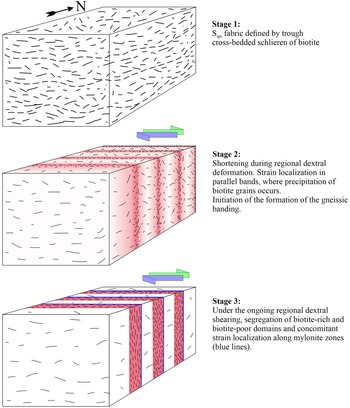
The results of field-based structural studies, microstructures and EBSD-based CPO investigations reveal that the SE–NW-oriented dextral strike-slip event that led to the juxtaposition of the Eastern Ghats Mobile Belt with the Rengali Province (Misra & Gupta, Reference Misra and Gupta2014; Sawant et al. Reference Sawant, Gupta, Clark and Misra2017) left a pervasive imprint on the Singhbhum granite. The tectonic fabric S1 is parallel to the Brahmani Shear Zone along which the eastern segment of the Rengali Province was juxtaposed with the Eastern Ghats Mobile Belt (Sawant et al. Reference Sawant, Gupta, Clark and Misra2017), and sub-parallel to localized greenschist-facies mylonite bands. The Singhbhum granite developed magmatic fabrics during the initial emplacement and cooling phase (see Fig. 9, stage 1). The CPO patterns for quartz, K-feldspar and plagioclase from the S1 domains suggest that the orientations they preserved in the magmatic state were disrupted owing to the development of the S1 fabric, which was formed owing to subsolidus deformation during movement along the Brahmani Shear Zone. Shortening associated with a high degree of simple shear strain on a cold block (Fig. 9, stage 2) would initially lead to brittle fracture formation (Shigematsu et al. Reference Shigematsu, Fujimoto, Tanaka, Furuya, Mori and Wallis2012), which would create zones facilitating hydrous fluid infiltration. Fluid ingress along these weak planes during greenschist-facies metamorphism would lead to the formation of chlorite and epidote, and a switch from dominantly brittle to dominantly ductile deformation. The shortening strain would cause dissolution of biotite grains and their subsequent re-precipitation in orientations with cleavage planes normal to the direction of maximum compressive stress, at small angles to the localized mylonite bands. Concentrations of biotites in the vicinity of these mylonite bands leads to the formation of a segregation layering that resembles a gneissosity (Fig. 9, stage 3), although the entire process operated at low temperatures. Near S1 domains, strong clusters of (001) faces of biotite are aligned at an angle to the magmatic fabric, although weaker clusters parallel to the trace of the magmatic fabric are also observed.
Schematic diagram showing the different stages involved in the superposition of a low-temperature segregation layering onto an earlier magmatic fabric.

The presence of CPOs in dynamically recrystallized quartz grains from the mylonitic domains suggest that quartz deformed plastically during mylonite formation. Quartz grains within the mylonitic bands have undergone deformation by basal <a> slip constraining deformation temperatures to less than 450 °C (Okudaira et al. Reference Okudaira, Takeshita, Hara and Ando1995; Toy et al. Reference Toy, Prior and Norris2008). The results of chlorite thermometry show that synkinematic chlorites within the mylonite zones were formed at an average temperature of 299 °C to 330 °C corresponding to the lower limits for the activation of quartz plasticity (Wallis et al. Reference Wallis, Lloyd, Phillips, Parsons and Walshaw2015). These results are in good agreement with deformation temperatures estimated from quartz CPOs. A probable origin for the mylonite bands involves strain partitioning into centimetre-wide planar zones of weakness, which develop in orientations parallel to the shortening field of the regional strike-slip shearing event. This was followed by hydrous fluid ingress leading to greenschist-facies metamorphism, the genesis of chlorite and epidote and the subsequent localization of ductile deformation into the chlorite–epidote-bearing mylonite bands.
10.d. Regional implications of the tectonic fabric
Previous workers (e.g. Saha, Reference Saha1994) believed that the Archaean Singhbhum Craton shared a boundary with the Neoproterozoic granulite-facies rocks of the arcuate Eastern Ghats Mobile Belt to its south. However, the subsequent recognition of a lithologically distinct late Archaean terrane consisting of upper-amphibolite to granulite-facies gneisses and supracrustals called the Rengali Province (Crowe et al. Reference Crowe, Nash, Harris, Leeming and Rankin2003) sandwiched between the Singhbhum Craton and the Eastern Ghats Mobile Belt necessitated a reassessment of the overall tectonic framework in this region. However, the manner of juxtaposition of the Rengali Province and the Singhbhum Craton is still a matter of debate. While some workers postulate the Rengali Province to be a rotated slice of the Bastar Craton, which was juxtaposed against the Singhbhum Craton by movement along a system of dextral strike-slip shear zones (Misra & Gupta, Reference Misra and Gupta2014; Sawant et al. Reference Sawant, Gupta, Clark and Misra2017; Gupta et al. Reference Gupta, Dobe, Sawant, Misra, Mohanty, Biswal, Ray and Grasemann2020), other workers believe that the Rengali Province represents the exhumed root of the Singhbhum Craton that was thrust back onto the craton along the Sukinda Thrust (Mahapatro et al. Reference Mahapatro, Pant, Bhowmik, Tripathy and Nanda2012; Bose et al. Reference Bose, Ghosh, Kawaguchi, Das, Mondal and Banerjee2021). If the Rengali Province was indeed thrust onto the Singhbhum Craton along the Sukinda Thrust then the footwall across the thrust, i.e. the Singhbhum Craton, would be expected to preserve imprints of strain related to shortening deformation. However, as documented in this study, the dominant deformation imprint within the part of the Singhbhum granite near the interface between the Singhbhum Craton and the Rengali Province consists of a sub-vertical fabric S1 parallel to the Brahmani Shear Zone further south, and there is no evidence for thrust-related deformation preserved in the Remal granite-gneiss.
The time of formation of the S1 fabric can be inferred from correlation with the regional tectonics of the southern part of the Singhbhum Craton. The contact between the Singhbhum Craton and the Rengali Province, the Barakot-Akul Shear Zone, operated in the greenschist facies and is associated with dextral strike-slip movement (Misra & Gupta, Reference Misra and Gupta2014). This shear zone is interpreted as part of a dextral strike-slip step-over zone, the southern boundary of which is the Kerajang-Brahmani Shear Zone (Crowe et al. Reference Crowe, Nash, Harris, Leeming and Rankin2003; Misra & Gupta, Reference Misra and Gupta2014; Sawant et al. Reference Sawant, Gupta, Clark and Misra2017), which is also associated with similar kinematics and deformation conditions. This latter shear zone represents the terrane boundary between the Rengali Province and the Eastern Ghats Mobile Belt (Dobmeier & Raith, Reference Dobmeier and Raith2003). Further south, within the Eastern Ghats Mobile Belt, an intra-province shear zone called the Mahanadi Shear Zone, with similar characteristics, is also inferred to be part of a major strike-slip tectonic event that affected this part of the Indian shield at c. 500 Ma (Bose & Gupta, Reference Bose and Gupta2018). This suggests that the effects of this regional-scale shearing event also affected the southern parts of the Singhbhum Craton, as evidenced by the mylonitic bands within the Remal granite-gneiss. Thus, following its emplacement in Archaean time, the Remal granite-gneiss was only affected by localized strain at low temperatures in Cambrian time (∼500 Ma).
11. Conclusions
This study on the Remal granite-gneiss shows that well-preserved magmatic fabrics are defined by strong crystallographic preferred orientations of K-feldspar, quartz, plagioclase and biotite. The trough cross-bedded layers are characterized by strong alignment of the (010) planes of K-feldspars and the (001) planes of biotite, with the latter defining the schlieren. The results of combined thermodynamic and multiphysics modelling show that significant material transport and mineral alignment by convection currents can occur in felsic magma chambers over a wide range of crystallinities and water contents. It is therefore proposed that the trough cross-bedded layers in the Remal granite-gneiss were formed by convection-driven alignment and sorting of mineral grains, confirming the presence of an early fabric which developed in the magmatic state. During later dextral strike-slip shearing at ∼500 Ma, chlorite–epidote-bearing ultramylonite bands within the Remal granite-gneiss served as zones of strain localization along which biotite grains were precipitated leading to the formation of a gneissic segregation layering. Deformation temperature estimates from quartz CPOs and chlorite thermometry confirm that mylonitization and quartz CPO development occurred under conditions just above the brittle–plastic transition for quartz. This indicates that the gneissic segregation banding formed in the greenschist facies, challenging the generally accepted notion that gneissosity development takes place at high temperatures.
Supplementary material
To view supplementary material for this article, please visit https://doi.org/10.1017/S0016756822000486
Acknowledgements
This manuscript has improved substantially from the encouraging and constructive comments of an anonymous reviewer. Dr Tim Johnson is thanked for his editorial handling and critical comments on an earlier version of the manuscript that greatly improved the quality of this submission. RD thanks the Council of Scientific and Industrial Research (CSIR) for the award of the fellowship and contingency grant (No. 09/081(1242)/2015-EMR-I). Prof. Debajyoti Paul (IIT Kanpur) is thanked for facilitating the XRF analyses. SG and MKP thank the Indian Institute of Technology Kharagpur, for infrastructural facilities that enabled us to conduct this study. NB thanks the Indian Institute of Technology Kharagpur for providing an academic licence for the use of COMSOL Multiphysics 4.4. Help from Mr Niloy Bhowmick and Mr Saptarshi Sinha during EBSD and EPMA analyses respectively, is gratefully acknowledged.
Conflict of interest
The authors declare that there is no conflict of interest.