Located approximately 40 km northeast of present-day Mexico City, Teotihuacan was a large urban center that came to dominate the Basin of Mexico during the Terminal Formative period (AD 1–100), and influenced the geopolitical landscape of Mesoamerica throughout much of the Classic period (AD 100–600/650). This time span witnessed the construction and subsequent expansion of the site's monumental architecture, projects that were accompanied by dedicatory offerings associated with themes of militarism and human sacrifice. This paper contributes to our understanding of these practices by presenting new data on a Sun Pyramid substructure and cache excavated by René Millon and colleagues (Reference Millon, Drewitt and Bennyhoff1965). Previously unpublished contextual data demonstrate that the cache was associated with a substructure contemporaneous with the pyramid's first construction phase. Technological and source provenance analyses of the cache artifacts are also discussed. Finally, we examine similarities among Millon's cache and other Tzacualli—Miccaotli (AD 1–200) dedicatory offerings from the Moon Pyramid.
The Sun Pyramid and Cache Context
With a height of 63 m and a volume of approximately 1,175,000 m3 (Millon et al. Reference Millon, Drewitt and Bennyhoff1965:12), the Sun Pyramid is the most palpable embodiment of state power within Teotihuacan. Multiple excavation projects have produced ceramic and radiocarbon dates consistent with a Tzacualli construction date for the first phase of the pyramid. For a review of these studies see Sload (Reference Sload2015; cf. Sugiyama et al. Reference Sugiyama, Sugiyama and Sarabia G2013). In 1959, Millon and Drewitt (Reference Millon and Drewitt1961) initiated a project to collect ceramic artifacts and draw wall profiles within the pyramid's centerline tunnel. Approximately 55 m from the western entrance, they encountered a vertical layer of stone in the southern wall profile, evidence of which was missing in the north wall (Millon et al. Reference Millon, Drewitt and Bennyhoff1965:52, Fig. 30). Excavation of the adjacent tunnel floor revealed a feature comprised of unshaped stones set in mud mortar measuring 75 cm in width and 1 m in height accompanied by a cache.
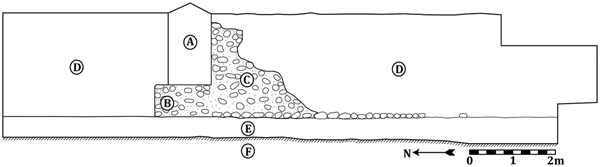
Millon and colleagues (Reference Millon, Drewitt and Bennyhoff1965:23) conclude that the feature sectioned in the south wall profile and below the floor represents the stone façade of an earth-filled platform. Carmen Cook de Leonard and Juan Leonard documented the same construction technique for Tzacualli-phase buildings in the northwestern Oztoyahualco zone of the city, including Plaza 1's Mound B (1B:N5W2) and a structure from grid square N6W1 (Millon et al. Reference Millon, Drewitt and Bennyhoff1965:34). Other scholars have been hesitant to embrace this identification (Sload Reference Sload2015:222; Sugiyama et al. Reference Sugiyama, Sugiyama and Sarabia G2013:412). Millon was unable to expand his excavations beyond the tunnel floor due to time constraints. The following year, Jorge Acosta excavated a 30 m x 1 m north-south exploratory tunnel. Records discovered in the Teotihuacan Mapping Project Archives (University at Buffalo) provide previously unpublished information regarding this operation. These records consist of correspondence between James Bennyhoff and Millon detailing Bennyhoff's visit to Acosta's excavations in 1960, including a scale drawing by Bruce Drewitt of the tunnel's eastern profile (Figure 1). The new data demonstrate that the small stone masonry feature encountered in the tunnel floor was part of a larger structure and that the cache was deposited within or adjacent to one of the structure's northern corners. The profile also indicates a portion of the structure was removed during the original tunneling operation.
Acosta's tunnel, east profile: A) Noguera's tunnel; B) obsidian cache; C) Millon's structure/wall; D) pyramid fill; E) tepetate/earth fill platform – INAH designation of “Teotihuacan I Platform”; F) tepetate (volcanic tuff). Redrawn by Kwoka from the original; Teotihuacan Mapping Project archives, University at Buffalo.

Millon's Cache
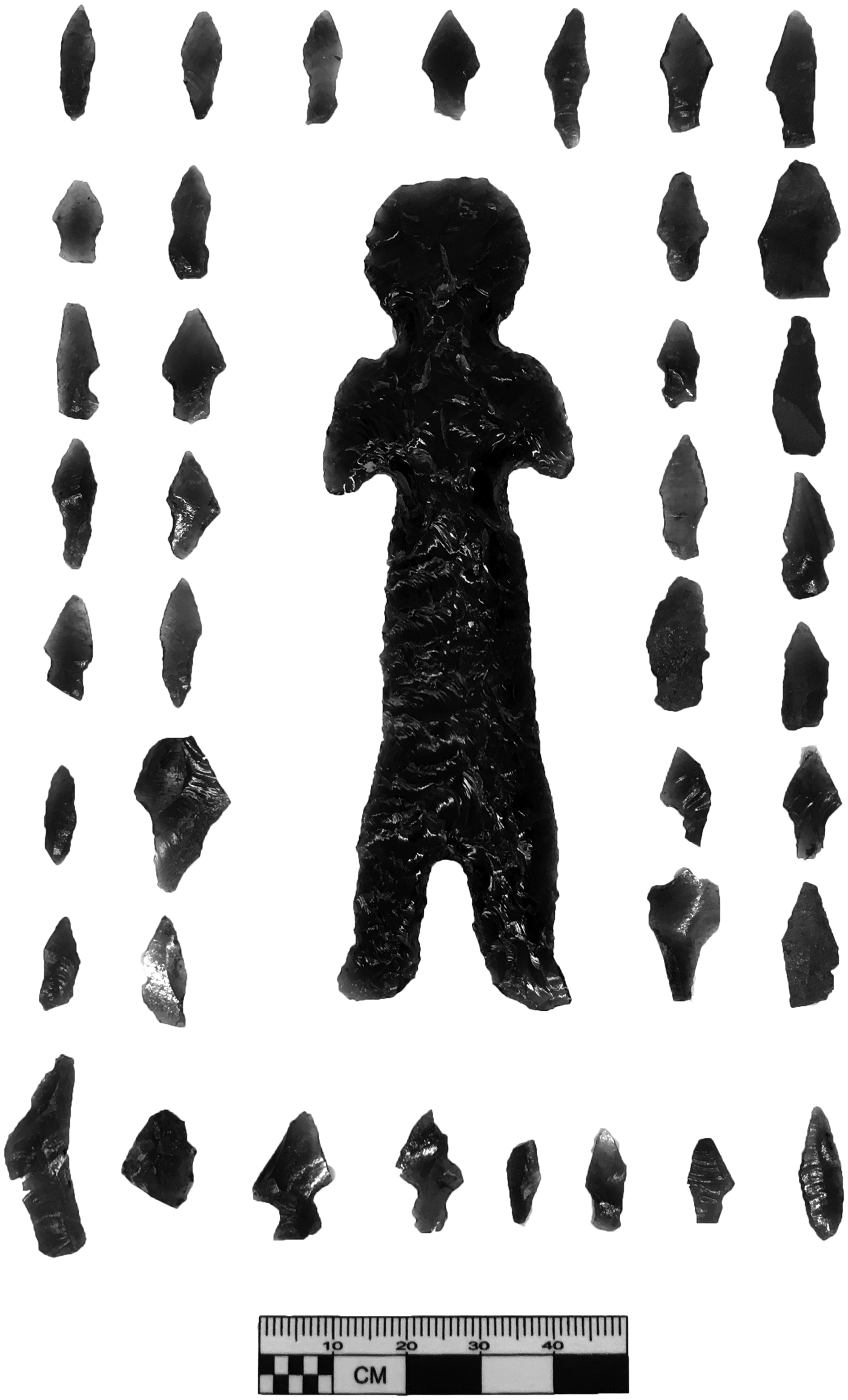
The cache consisted of a tableau centered on an upright obsidian anthropomorphic eccentric surrounded by concentric circles of 40 miniature projectile points, with tips oriented toward the eccentric (Figure 2; see also Millon et al. Reference Millon, Drewitt and Bennyhoff1965:Figures 37–40). Kwoka examined a curated sample of the cache soil matrix and detected the presence of a yellow granular substance that could be yellowboy, a byproduct of pyrite weathering, perhaps indicating a mirror was present. No backing material was recovered, such as the slate or ceramic disks that often accompany Teotihuacan mirrors. The soil sample also contained numerous fibers that demonstrate textiles were included in the offering. Millon and colleagues (Reference Millon, Drewitt and Bennyhoff1965:24) report that the lower portion of an incised slate figurine was recovered, though its current location is unknown.
Anthropomorphic eccentric and miniature projectile points from Millon's cache. Photograph by Joshua J. Kwoka.

Cache Analysis
Morphology and Technological Analysis of Obsidian Artifacts
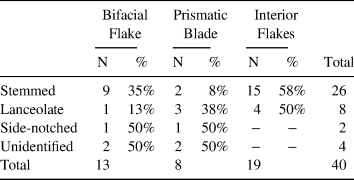
The analysis of the miniature projectile point collection proceeded by assigning point type based on morphology (Table 1). Of the 40 points, 34 are fashioned after Teotihuacan lanceolate (n = 8) and stemmed (n = 26) varieties, and it is possible that the two side-notched points were intended to mimic a stemmed design. Four asymmetrical pieces of obsidian did not resemble known point types. Blanks from which the miniature projectile points were produced were classified using a lithic technology approach that employed types indicative of specific reduction technologies. Bifacial reduction debitage, in the form of bifacial thinning (n = 12) and alternate flakes (n = 1), and late-series prismatic blade fragments (n = 8) accounted for 52.5% of the miniature projectile points, whereas the remainder were produced from interior flakes. Following Hirth and Flenniken (Reference Hirth, Jeffrey Flenniken and Hirth2006:309), interior flakes are produced via percussion and have little (i.e., < 10%) to no dorsal cortex. It is possible that some of these derived from bifacial reduction, though they lack diagnostic attributes. A complicating factor is that, with two exceptions, the miniature projectile points were produced by retouching 50–100% of the blanks’ margins, possibly removing diagnostic features.
Miniature Projectile Point Technological Analysis.

The longitudinal profile of the anthropomorphic eccentric is biconvex, yet slightly curved, indicating it was produced from a large flake or macroblade blank. Pressure flake scars are present along all margins. Remnants of percussion scars are visible on both faces in areas where pressure removals failed to reach the centerline. The legs, underarms, and neck were produced by notching via pressure. None of the flake scars emanating from the notches exceed 1.5 cm in width or length. Transverse-parallel pressure flaking extends from the arm notches to the feet along both lateral margins, with flake scars sweeping to the left. An initial series of long flakes were removed sequentially, though these are partially obscured by a second group of shorter pressure flakes that are not patterned. In addition, extending through this area is a 0.5 cm wide plateau of shallow step fractures offset to the right of the longitudinal centerline on both faces. This offset is attributable to the differential length of pressure removals, which are consistently longer on the left side regardless of which face is viewed. The plateau represents what would have been a compounding problem: the force driving initial pressure removals was not sufficient to remove the center mass, resulting in step terminations. Subsequent attempts to thin the eccentric would have been complicated by the failure to remove this mass and the accumulation of additional step fractures, increasing the likelihood of further step fractures. Based on these factors, the surface topography of the eccentric is complex and appears crude in comparison to other known examples.
Obsidian Source Attribution
The cache artifacts were analyzed using a ThermoScientific Quant'X EDXRF spectrometer, located at the University of California, Berkeley. Information on instrumentation, laboratory protocol, and statistical analyses can be found in Shackley (Reference Shackley2005). Source assignments were made by referencing the Mesoamerican source samples in the laboratory database and published data (Cobean et al. Reference Cobean, Vogt, Glascock and Stocker1991; Glascock Reference Glascock and Shackley2011; Glascock et al. Reference Glascock, Michael Elam and Ayoama1990; Nelson and Tingey Reference Nelson and Tingey1997). The elements Rb, Sr, Zr, and Ba were plotted on three-dimensional and bivariate graphs against the above-cited central Mexican, Guatemalan, and Honduran XRF source standard data (Supplemental Figures 1, 2). Although there are inter-instrument differences, the source that best fits the data is the locally available Otumba (Supplemental Table 1).
Discussion and Conclusions
Recent research has demonstrated the presence of numerous architectural features and ritual deposits located along the Sun Pyramid's centerline. The dating of these deposits and their relation to the construction of the pyramid remains a point of contention (Sload Reference Sload2015; Sugiyama et al. Reference Sugiyama, Sugiyama and Sarabia G2013). In the case of Millon's structure and offering, there are multiple lines of evidence demonstrating its association with the construction of the Sun Pyramid, including a ceramic collection comprised of 99.9% Tzacualli materials (the remainder being pre-Tzacualli; Smith Reference Smith1987:257). Sload (personal communication, 2016) has noted that both the structure and cache are aligned with the top of the Pyramid's first tier, which could also be viewed as the junction between the first and second tier, demonstrating a spatial relationship between the two. Finally, the location of Millon's structure, approximately 1 m above the original Sun Pyramid plaza floor and well within the first tier, precludes it from predating the pyramid. The exact function of this structure remains unknown; one possibility is a construction fill retaining wall. Alternatively, Teotihuacanos could have erected small structures to house ritual deposits during the construction process. The energy investment of such a task seems minimal in comparison to the overall Pyramid construction project.
In terms of composition and arrangement, Millon's cache more closely resembles elements of the slightly later terminal Tzacualli—early Miccaotli Moon Pyramid Burials 2 and 6 (López Luján and Sugiyama Reference López Luján, Sugiyama and Robb2017; Sugiyama and López Luján Reference Sugiyama, Luján, Sugiyama and Luján2006) than the other Sun Pyramid centerline offerings. Although richer and more complex, the Moon Pyramid burials contain similar scenes—two in Burial 2 and one in Burial 6—consisting of pairs of figurines associated with slate-backed appliqué pyrite mirrors, which in turn are surrounded by bifaces and/or eccentrics oriented on their long axis towards the figures. López Luján and Sugiyama (Reference López Luján, Sugiyama and Robb2017:88) suggest that although the figurines were found on their sides, they may have originally stood upright over the mirrors. Each figurine pair consists of one made from obsidian and another from greenstone, similar to the obsidian and slate in Millon's cache. The symbolism of these displays is unclear, though multiple authors have suggested that the profile of anthropomorphic eccentrics mimics bound captives (Carballo Reference Carballo2011:145; López Luján et al. Reference López Luján, Filloy Nadal, Fash, Fash and Hernández2006; Sugiyama Reference Sugiyama2005:139). Following this interpretation, it is possible that these arrangements of figurines surrounded by miniature projectile points/bifaces are representations of tlacacalilitzli, or scaffold sacrifice. Tied to themes of agricultural fertility, renewal, warfare, and royal accession, this method of human sacrifice proceeded by binding a captive to a wooden post or scaffold before repeatedly piercing their body with spears, atlatl darts, or arrows (Taube Reference Taube, Benson and Griffin1988). Further evidence of this practice at Teotihuacan is provided by the large marble sculpture recovered from the Xalla compound (Lopez Lujan et al. Reference López Luján, Filloy Nadal, Fash, Fash and Hernández2006). Grooves on the anthropomorphic statue's arms and legs appear to be ligature marks, and two darts are shown piercing its legs.
In closing, current data indicate significant changes in the production and use of ritual obsidian objects between the Formative and Classic periods. Parry (Reference Parry, Levine and Carballo2014:298–299) has observed that during the Classic period miniature anthropomorphic eccentrics replace larger versions found in Formative ritual deposits. A concurrent shift also occurred in raw material preferences, whereby Pachuca replaced the earlier use of gray and mahogany obsidian.
Blank preferences for miniature projectile points also changed, with the use of debitage from multiple reduction technologies during the Formative being replaced by blades in the Classic (Parry and Kabata Reference Parry and Kabata2004). The source provenance and technological analyses Millon's cache support Parry's observations. Why lithic technology and raw material preferences changed with the onset of the Classic remains to be explained.
Acknowledgements
The authors would like to thank Geoffrey Braswell, Douglas Perrelli, Rebecca Sload, and the anonymous reviewers for their helpful comments on this manuscript. No permits were necessary to conduct this research, though Mexico's Instituto Nacional de Antropología e Historia graciously provided a permit for Millon's original project.
Data Availability Statement
The Sun Pyramid materials are open to the public and can be accessed by contacting UB's Department of Anthropology.
Supplemental Materials
For supplementary material accompanying this paper, visit https://doi.org/10.1017/laq.2018.71
Supplemental Figure 1. Zr, Rb, and Ba three-dimensional plot of the elemental concentrations for all archaeological specimens.
Supplemental Figure 2. Sr versus Rb bivariate plot of the archaeological samples and published source standard data.
Supplemental Table 1. Elemental concentrations and source assignments for the cache artifacts and USGS RGM-1 obsidian standard. All measurements in parts per million (ppm).