Introduction
Studies of data from 1930 to 1978 indicated that laboratory-acquired infections resulted in a minimum of 4079 human infections and 168 deaths (Sulkin and Pike, Reference Sulkin and Pike1951; Pike et al., Reference Pike, Sulkin and Schulze1965; Pike Reference Pike1976, Reference Pike1978, Reference Pike1979; BMBL, 2009). The ten most common causes of laboratory infections included a number of agents in which domestic livestock are reservoir hosts, including: Brucella spp., Coxiella burnetti, Salmonella typhimurium, Mycobacterium spp., and Venezuelan equine encephalitis virus. Of great concern was the fact that in 80% of laboratory acquired human infections, no specific accident or exposure event responsible for causing infection could be identified. A subsequent study in 2000 reported an additional 1267 overt laboratory acquired infections, 663 subclinical infections, and 22 deaths (Harding and Byers, Reference Harding, Byers, Flemming and Hunt2000). Like the previous studies, this report found that only a small number of these human infections could be associated with a known specific incident.
In an effort to prevent laboratory acquired infections and protect public health and the environment, national biosafety guidelines have been established that promote safe microbiological practices and safety standards. These guidelines, as published in the Biosafety in Microbiological and Biomedical Laboratories (BMBL, 2009), provide a standard for safe working procedures and risk assessment procedures for working with pathogenic organisms. In some instances, as in working with organisms classified as Select Agents and Toxins in the United States, these guidelines have become a federal requirement rather than being considered to be recommendations.
Although there are safety concerns because many Risk 3 pathogens classified as requiring BSL-3 or biosafety level 3 agriculture (BSL-3-Ag) containment are zoonotic, there remains a need in the U.S. and worldwide for research studies that lead to development of more effective diagnostics, vaccines, and/or basic knowledge on pathogenesis that will enhance the ability to control or eradicate these pathogens from natural hosts. For the studies to be of greatest value, they need to be conducted in the species of interest using a relevant, virulent strain of the pathogen. Guidelines described in the BMBL primarily address containment equipment, design standards, and recommended personnel work activities and safety practices for laboratories or vivarium facilities. In particular, the BMBL does not address additional biosafety issues that must be considered when working with zoonotic agents in large animals, including fractious animals, under animal biosafety level 3 (ABSL-3) containment. The issues associated with maintaining and working with domestic livestock or wildlife infected with a zoonotic pathogen, in a confined environment, are in stark contrast with those associated with working with them in their natural surroundings. This paper will review the current status of some of these pathogens within the U.S., and will discuss our laboratory's experiences in safely working with large animals infected with zoonotic pathogens within containment facilities.
Standard Biosafety Level 3 practices
Guidelines in the BMBL are primarily directed toward laboratories or vivariums. Currently, recommendations include restriction of access to animal facilities, specific training in facility procedures and animal handling for personnel, and a requirement that all procedures are conducted within biological safety cabinets or other physical containment equipment (BMBL, 2009). Appropriate personal protective equipment (PPE) must be utilized and an occupational health program must be implemented. In addition, personnel should have adequate knowledge of potential hazards, the pathogen, animal manipulation and husbandry procedures, and entry/exit procedures. Ventilation within the facility should have separate supply and exhaust systems, maintain an inward directional flow (negative pressure) monitored by pressure differential monitors, and which discharges exhaust air to the outside without being re-circulated to other rooms. Waste or materials leaving the facility need to be appropriately disinfected. Due to the fact that, unlike small laboratory animals, large animals cannot be placed in secondary containment equipment, facilities designed for large animal studies also need to include HEPA filtration of exhaust air, mechanisms/facilities for decontamination of liquid waste, and appropriate procedures or equipment to decontaminate and dispose of animal carcasses and solid waste such that environmental release of the pathogen does not occur.
Owing to the unique needs for loose-housing of animal species infected with high consequence livestock pathogens, USDA has developed a set of guidelines for design, construction, and operation of these types of facilities for which containment is designated as BSL-3-Ag (BMBL). BSL-3-Ag facilities are built as a ‘box within a box’ design and include enhanced features above ABSL-3 that are ordinarily used in BSL-4 facilities. Some of the enhanced features include: designated facility clothing and shower out requirements upon exiting; directional single-pass and pressure gradient ventilation systems; HEPA filtration of supply and exhaust air and atmospheric vents; airtight duct work; personnel ingress and egress through a series of rooms consisting of a ventilated vestibule with compressible gaskets on the two doors; a clean change room outside containment; a shower room at the non-containment/containment boundary; a dirty change room within containment; and, sealed internal surfaces and penetrations to create an airtight area.
Guidelines outlined in the BMBL and USDA, ARS Departmental Manual 242.1 make ABSL-3 or BSL-3-Ag facilities very expensive to build and operate, and have predominantly been utilized to design laboratories or laboratory animal spaces. Designing facilities that can safely house and handle domestic livestock and wildlife that are infected with Risk group 3 pathogens is a greater challenge than designing laboratory spaces for in vitro work, or vivariums for in vivo work with pathogens in laboratory animal species. In addition, costs to maintain and operate large animal ABSL-3 or BSL-3-Ag facilities are usually higher since housing large ruminants generally requires larger areas as compared with laboratories or vivariums and a greater percentage of space within the structure is devoted to support areas that do not house animals. From our experience, overhead costs for running and maintaining a large animal ABSL-3 or BSL-3-Ag facility on a total square foot basis are often 1.5–2 times greater than costs to maintain comparable ABSL-2 space.
To the author's knowledge, public facilities in North America with some capability to conduct research studies with large animals (small or large domestic livestock and/or wildlife) at ABSL-3 or BSL-3-Ag level are currently available at Colorado State University (CO), Kansas State University (KS), the National Animal Disease Center (IA), Louisiana State University (LA), Plum Island Animal Disease Center (NY), University of Georgia (GA), National Microbiology Laboratory (Winnipeg, Canada), and the Centers for Disease Control and Prevention (GA). Capabilities are markedly different between facilities, with some facilities not having capability to house large domestic livestock, and most with facilities that were not intentionally designed for the capability of containing large wildlife.
Endemic pathogens requiring ABSL-3 or BSL-3-Ag containment within the United States
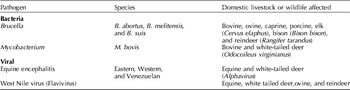
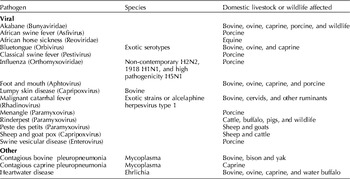
A number of pathogens currently found at various levels of prevalence in domestic livestock or wildlife in North America are recommended for containment with ABSL-3 facilities (Table 1). Additional pathogens for which regulations within the United States require ABSL-3 or BSL-3-Ag containment, almost exclusively agents classified as foreign animal diseases, are listed in Table 2. This manuscript will briefly discuss BSL-3 containment of three pathogens of importance for public health in the United States, why there remains a need for research, and issues we considered in designing our large animal facilities and implementing in vivo experiments with these pathogens.
Pathogens of domestic livestock or wildlife occurring in North America that require BL3 containment in the United States

Some foreign animal diseases of domestic livestock that require ABSL-3 or BSL3-Ag containment in the United States

Brucella and Mycobacterium bovis
Although Brucella canis and marine Brucella are in the United States and capable of being zoonotic, Brucella melitensis, Brucella suis, and Brucella abortus are the most significant zoonotic species of Brucella, and coincidently have domestic livestock and/or wildlife as preferred hosts. Both B. suis and B. abortus are currently maintained within reservoir hosts in the United States. Despite being endemic within small ruminants in Mexico, B. melitensis has not established a reservoir host in the United States. Although brucellosis regulatory programs have benefited public health by essentially eradicating B. abortus and B. suis from domestic livestock over the last 60 years, these two brucellae remain prevalent within wildlife reservoirs (elk and bison, and feral swine and reindeer, respectively). As establishment of wildlife hosts of brucellosis most likely resulted from spillover from infection of domestic livestock, it is ironic that persistence in these wildlife reservoirs has led to transmission back into domestic livestock particularly as eradication programs have neared completion in domestic cattle and swine populations.
Mycobacterium bovis is the primary cause of tuberculosis in animals and is a recognized zoonotic pathogen. Unlike other forms of human tuberculosis that are transmitted through aerosolized droplets passing from infected to susceptible people, the most common route of human M. bovis infection is through consumption of non-pasteurized dairy products; however, transmission from domestic livestock by aerosol or direct contact is also possible (Barrera and De Kantor, 1987). In 1900, tuberculosis was the leading cause of death in the United States. It is estimated that approximately 10% of all human tuberculosis cases were the result of exposure to tuberculosis in cattle or cattle products (Olmstead and Rhode, Reference Olmstead and Rhode2004a). More distressing, 25% of tuberculosis cases in children were caused by M. bovis (Roswurm and Ranney, Reference Roswurm and Ranney1973). Owing to the public health concerns associated with persistence of M. bovis in domestic livestock, regulatory efforts were initiated in 1917 to eliminate tuberculosis from cattle.
Within the U.S., billions of dollars of state and federal funds have been invested in regulatory programs to reduce the prevalence of brucellosis and tuberculosis in domestic livestock to their current low level of prevalence. Although economically beneficial to producers, the greatest benefit from regulatory efforts has been enhancement of public health (Olsen and Stoffregen, Reference Olsen and Stoffregen2005). In regards to brucellosis, multiple studies have demonstrated that addressing the disease in animal reservoirs is the most cost efficient mechanism for controlling human brucellosis (Bernués et al., Reference Barrera and De Kantor1997; Roth et al., Reference Roth, Zinsstag, Orkhon, Chimed-Ochir, Hutton, Cosivi, Carrin and Otte2003). It is estimated that the eradication program for brucellosis has reduced human cases by more than 98% over the last 60 years, and the tuberculosis program has prevented over 25,000 deaths annually since 1917 (Olmstead and Rhode, Reference Olmstead and Rhode2004b).
In addition to the continued need for enhancement of basic knowledge on these pathogens, there is a need to protect the substantial investment in regulatory programs against these two diseases for the purpose of protecting public health.
Influenza
Although most influenza strains are not required to be contained under BSL-3 conditions, for some influenza strains which are recommended for ABSL-3 or BSL-3-Ag containment there may be an interest in evaluating pathogenicity in pigs. In addition, situations have occurred in the United States in which the pathogenicity of emerging influenza strains is unknown, such as with H1N1 in North America in 2009, and ABSL-3 containment is a prudent approach until data support less restrictive containment. As the pig is considered a mixing vessel for avian and human influenza viruses throughout the world (Ma et al., Reference Ma, Kahn and Richt2009), having the capability to assess pathogenicity of new or reassorted mammalian-adapted viruses in this species is a critical research need. In addition, ABSL-3 containment can serve to protect the validity of the data obtained in a research study by more stringently preventing introduction of circulating human or porcine influenza strains to the research animals during a study.
The economic burden of seasonal flu to the U.S. economy was estimated at $87.1 billion in 2003, with $10.4 billion directly related to medical costs for humans (Molinari et al., Reference Molinari, Ortega-Sanchez, Messonnier, Thompson, Wortley, WEintraub and Bridges2007). Although an economic analysis of the costs of the H1N1 influenza outbreak in 2009 could not be identified, it is expected that the cost of this pandemic exceeded average annual costs due to seasonal flu. On the agricultural side, at the height of the 2009 H1N1 (‘Swine Flu’) pandemic it was estimated that hog producers were losing $7.1 million dollars per day due to decreased product value caused by decreased human consumption of pork and reductions in international trade (National Hog Farmer, May 11, 2009). Due to the high economic impact on the agricultural community, the cost of maintaining containment capability to conduct research studies is readily offset by economic returns.
Considerations in design of large animal ABSL-3 or BSL-3-Ag facilities
In designing and modifying ABSL-3 or BSL-3-Ag spaces for research with domestic livestock or wildlife at our facility, some of the issues we considered were:
(1) Biocontainment of the pathogen(s) within the limited confines of the building or room, and identification of suitable PPE to protect personnel from infection.
(2) Safely housing and feeding large animals, both domestic and wild, in containment spaces that are vastly different from the normal surroundings of the selected species.
(3) Means to safely handle large ruminants, domestic and wild, docile and fractious, in the confined space of BSL-3 containment rooms.
Although containment requirements and PPE recommendations are adequately documented for most pathogens in manuals such as the BMBL, most guidelines do not address the many details associated with use of the wide variety of animal species used for research. Specific guidelines or considerations for handling large ruminants or wildlife under containment are not available. In our facility, selection of PPE must take into consideration not only personnel protection from the pathogen but also the risk of such PPE being displaced and rendered ineffective during strenuous activity required in restraint and handling of animals. PPE worn by personnel in large animal handling areas must allow for freedom of movement and wide peripheral vision that may not be required in containment areas for small animals.
It is imperative that characteristics of each species be considered in designing facilities that can safely house domestic livestock and wildlife, and that personnel are familiar with unique behavioral aspects of each species. Although recommended space requirements can generally be assessed based on body size, these guidelines may need to be increased for wildlife species. Investigators and animal caretakers should receive species-specific training, but scarcity of relevant training materials targeted to large animals or wildlife can make fulfilling this requirement difficult. Species-specific factors to be considered in designing penning and handling within containment facilities include, but are not limited to: flight distance, herd orientation, social needs, willingness to enter confined spaces, presence of antlers or horns, gender, reproductive cycle, aggressiveness, and predictability. In our experience, facilities built to meet the unique handling requirements of wildlife can easily be used to safely handle more docile and tractable animals such as domestic livestock; however, the reverse is seldom true.
At our facility, design of ABSL-3 containment space to house swine was associated with the smallest number of complications and concerns. Although individual swine can occasionally be aggressive, this behavior can most easily be addressed by careful screening of animals prior to entry into containment. As compared with other species such as wildlife, swine are more readily procured in our area and rejection of unsuitable individuals is less of a concern. Due to their large mass and low center of gravity, a greater concern is accidental injury to personnel resulting from physical contact with animals as they attempt to elude restraint procedures. Our greatest challenge in designing facilities for swine was to provide appropriate floor padding and sealing that could not be damaged by normal rooting and chewing behaviors of swine.
When comparing the species commonly handled at our facility, cervids such as white-tailed deer, require the greatest flight distance between themselves and humans to feel safe within containment. The flight response is so exaggerated and reflexive for cervids they will jump into walls and gates in an effort to escape, putting themselves and personnel at risk for injury. In contrast, elk are more easily habituated to the close presence of humans resulting in a less amplified and more predictable flight response. Although bison have a great flight distance in outside pens, in containment spaces they tend to perceive pen gating as a barrier between themselves and personnel resulting in a dramatic reduction in the flight distance. Once personnel start to open a gate to enter a pen, their immediate instinct is to seek to increase the separation distance from humans. In the event the containment space does not allow establishment of a flight distance which is acceptable to them, bison may initiate aggressive actions against the human who has invaded their flight zone.
Some species of domestic livestock or wildlife are sociable and are best housed in groups. Examples include swine, small ruminants, and white-tailed deer. White-tailed deer are accustomed to living in small family groups that may contain three generations of offspring; our experience is that white-tailed deer housed alone, either indoors or outdoors, become agitated. Their predictability decreases as their flight response increases, which creates handling and safety issues. For this reason, our protocol for containment housing of white-tailed deer requires a minimum of two deer per room or pen.
Other wildlife species are less gregarious and can be housed alone or in pairs. For example, containment housing for bison in our facility allows these herd-oriented animals to be housed individually, while maintaining the ability to see, hear, and smell other bison in adjacent pens. In our experience individual housing of bison within containment is essential. Although bison are herd oriented under field conditions they do have a well-developed pecking order. When space is restricted, as in containment, our experience is that the dominant bison will aggressively attack its pen-mate who cannot move a sufficient distance away to evade aggression. Not only can this behavior cause injury to study animals and damage facilities, human personnel are severely limited in their ability to safely intervene. Similar types of aggressive behavior have been observed in group-housed swine leading to a need to change pen assignments or move aggressive animals into individual pens.
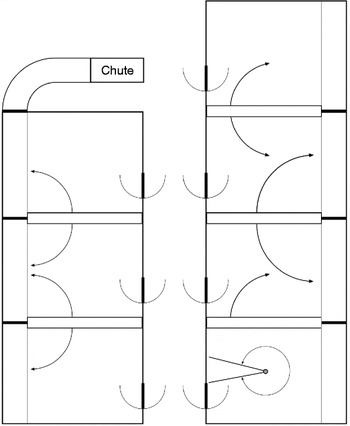
It should be emphasized that the flight response of a particular species or individual can be used to the advantage of personnel, and should always be considered in the design of penning and handling areas. Apprehension toward human activity and the resulting flight response instinctively moves animals into more open areas to escape perceived danger. By designing facilities in a way that utilizes these natural instincts, animals can be habituated to predictably move through handling areas. After a period of acclimation, which likely differs between species, the predicted movement through the facility can be subverted to alleys and other handling equipment for restraint and sampling. For example, our large animal rooms were primarily designed for handling bison (Fig. 1). Housing areas in these rooms have swinging gates which reduce the area within a pen, allowing a gate to constantly separate personnel from the bison, while also encouraging the animal to move through an open rear gate into a larger area within an unoccupied adjacent pen. Bison quickly adapt to pen-to-pen movement allowing personnel the opportunity to safely work within the now empty pen. When animal sampling is required, exit through the rear gate can be diverted into an alley leading to a squeeze chute rather than into an adjacent pen.
Diagram of rooms designed primarily for handling bison. There are swinging gates that are used to constantly separate personnel from the bison and encourage the animal to move through an open rear gate into an unoccupied adjacent pen. When sampling is required, exit through the rear gate can direct the animal into an alley leading to a squeeze chute.

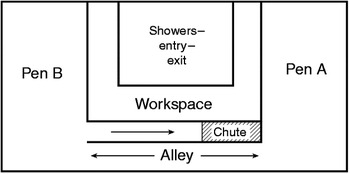
In our cervid rooms, there are two large pens with an alleyway between them forming a ‘U’-shaped design (Fig. 2). When personnel enter one side of the room, deer will instinctively move to the opposite side, through a connecting alley. Visually and physically separated from personnel, deer perceive their new environment as safe, allowing personnel to safely clean the empty side. The procedure is reversed to clean the opposite side of the room. When personnel move in a calm slow manner, animal movement is orderly and predictable. When sampling is required, an alley containing capture boxes and chute, running parallel to the connecting alley, is used to move and individually sample deer from one side of the room to the other.
Cervid rooms consisting of two large pens connected by an alleyway forming a ‘U’-shaped design. An alley parallel to the connecting alley and containing capture boxes and chute is used to facilitate collection of samples.

Social status and hierarchy can limit some housing and penning options. Infrequently we will house an especially dominant deer with one that is especially submissive. The constant dominant behavior increases stress, and likelihood of injury, especially of the submissive individual. Prior to initiation of an experiment in containment it is good practice to allow time for animals to acclimate to their new and puzzling surroundings. This is also a good time to watch for signs of excessively dominant behavior.
In our experience, aggressive behavior toward personnel is more likely to occur with domestic livestock as they are more habituated to humans and less fearful of people. Wildlife may be aggressive toward personnel within the confined spaces of containment conditions, especially if personnel invade their flight distance, causing them to feel trapped with no route to escape. In these situations aggressive behavior is more a protective response than a desire to attack or injure personnel. Whenever large animal experimental procedures involve parturition and the separation of dam from young, one should be especially vigilant for unusually aggressive or protective behavior. Brucellosis studies at our facility often involve birthing inside containment. Experimental protocols often involve removal of young from the mother soon after delivery. Under these circumstances, all animals, even those previously considered to be predictable or docile, may exhibit unexpected or aggressive behavior.
The manifestation of aggressive behavior differs between species. Bison may try to overrun, to gore, or to kick personnel with their hind legs. In contrast, elk are more likely to try to strike with their front legs. As any species may try to attack with horns or antlers, safety or handling considerations may suggest that horns and antlers be removed. With white-tailed deer, it is our practice to safely and humanely remove antlers whenever possible prior to entry into containment. However, we typically do not dehorn bison as the horns facilitate capture and restraint in a squeeze chute. Importantly, personnel handling animals in containment facilities should utilize gates or other barriers to separate themselves from animals, and avoid pressuring animals to the point of provoking an aggressive response. Animal care personnel are encouraged to work in pairs and are instructed to avoid entering occupied animal pens. If entry into a pen is necessary, assistance or monitoring from other personnel is encouraged.
With some wildlife species, human behavior can be an important influence under containment conditions. With white-tailed deer, our experience has been that the same person(s) should clean, feed, and handle a group of animals. In addition, that person should follow the same routine each time the animal room is entered (e.g. entering through the same door, walking to the same side of a room, etc.). Some cervids are very perceptive, and can sense when an unfamiliar person enters the room or activity deviates from the norm, and may become more agitated and fearful.
Lastly, but probably of greatest importance, is the ability to accurately predict the behavior of the animals under working conditions, whether in containment or outside of containment. Human injuries inflicted by animals generally result from unanticipated animal behavior. Although animals and people can behave in unpredicted ways, a well-designed facility has features that can accommodate unanticipated actions during animal handling while maintaining a safe barrier between animals and humans. Penning and gating can be designed to contain aggressive animals, but design based on this consideration alone may not be sufficient to meet research needs for sampling or conducting procedures. The ability of personnel to interpret how an animal will respond by observing posture, behavior, or other subtle signs is critical for the safety of humans and preventing animal injury within the facility. Injuries associated with animal handling in containment may occur when personnel familiar with handling livestock, but untrained to handle quicker species such as wildlife, attempt to use practices adequate for livestock, but inappropriate for wildlife species. Similarly, personnel may become habituated to domestic livestock and may put themselves into positions during handling of large animals, domestic livestock, or wildlife, in which they are at risk for injury if the animal does not behave in the predicted manner. It should be emphasized that even with well-designed containment facilities and highly trained personnel, it is impossible to eliminate all safety issues under ABSL-3 and BSL-3-Ag containment due to the size, speed, and physical capabilities of large animals and wildlife.
Outcomes
As a result of experiments with brucellosis in cattle conducted in our facility, the first new brucellosis vaccine in over 60 years was approved for use in cattle (Stevens et al., Reference Stevens, Olsen, Palmer and Cheville1997). This new vaccine, B. abortus strain RB51, allowed serologic differentiation between vaccinated and infected cattle and enhanced regulatory efforts to eradicate brucellosis from cattle in the United States. The vaccine is now being used in many countries around the world. Owing to the expansion of feral swine in the United States, and the regulatory issues associated with the transmission of B. suis to cattle, studies with B. suis have been conducted in cattle, domestic swine, and feral swine (Stoffregen et al., Reference Stoffregen, Olsen and Bricker2006; Olsen and Hennager, 2010). Knowledge gained in these studies has provided guidance for ongoing work to develop new vaccines and diagnostics to address the prevalence of B. suis under field conditions. In a similar manner, studies with brucellosis in bison and elk has characterized differences in the pathogenesis of the disease, evaluated immunologic responses to vaccination, and quantified the efficacy of vaccines under experimental conditions (Olsen et al., Reference Olsen, Jensen, Stoffregen and Palmer2003, Reference Olsen, Fach, Palmer, Sacco, Stoffregen and Waters2006, Reference Olsen, Boyle, Schurig and Sriranganathan2009). This work has been of value to agencies with responsibilities for addressing brucellosis issues associated with free-ranging wildlife.
Experiments with tuberculosis in cattle, reindeer, and white-tailed deer have enhanced knowledge on vaccines and diagnostics for regulatory programs against M. bovis. A reproducible challenge model that mimics natural infection was developed (tonsil delivery) and the efficacy of vaccines in protecting cattle and deer against experimental challenge has been characterized (Palmer et al., Reference Palmer, Whipple and Olsen1999). Due to problems associated with false positive tuberculosis skin tests in reindeer caused by Mycobacterium spp. found in soil, pathogenesis studies under BSL-3 containment allowed the development of a new dendrogram for reindeer that significantly reduced the numbers of results classified as positive (Palmer et al., Reference Palmer, Waters, Thacker, Stoffregen and Thomsen2006). As tuberculosis has not been confirmed in reindeer from the United States at this time, this new dendrogram reduced numbers of reindeer that had to be euthanized due to positive skin tests without impairing regulatory surveillance. Studies also characterized the role of artificial food sources in transmission of tuberculosis between cattle and white-tailed deer and characterized the survivability of M. bovis in feed (Palmer et al., Reference Palmer, Whipple and Waters2001, Reference Palmer, Waters and Whipple2004a, Reference Palmer, Waters and Whipple2004b, Reference Palmer, Waters and Whipple2004c; Palmer and Whipple, Reference Palmer and Whipple2006). Additional studies have characterized the pathogenesis of tuberculosis in cattle and white-tailed deer, evaluated immunologic responses after infection or vaccination, and evaluated new diagnostics for the detection of tuberculosis-infected animals (Palmer et al., Reference Palmer, Waters and Whipple2002; Waters et al., 2010, Reference Waters, Buddle, Vordemeier, Gormley, Palmer, Thacker, Bannantine, Stable, Linscott, Martel, Millian, Foshaug and Lawrence2011a, Reference Waters, Palmer, Thacker, Davis, Sreevatsan, Coussens, Meade, Hope and Estesb, Reference Waters, Thacker, Nonnecke, Palmer, Schiller, Oesch, Vordemeier, Silva and Estes2012).
Conclusions
Regulations in the United States require ABSL-3 or BSL-3-Ag containment for many endemic zoonotic pathogens and etiologic agents of foreign animal disease. As guidelines in the BMBL for biolevel 3 (BL3) facilities are primarily directed toward laboratory or vivarium facilities, additional issues should be considered in designing large animal-containment facilities. After completing numerous studies over many years, our experience has been that studies with zoonotic pathogens can be safely conducted in natural hosts, including wildlife, while contained under ABSL-3 or BSL-3-Ag conditions. Flight distance, herd orientation, social needs, aggressiveness, and predictability are all factors to be considered on a species-by-species basis in designing containment facilities for working with large ruminants, and prior to initiation of studies. Although safety risks cannot be eliminated when working with large animals, these types of studies in natural hosts are critical for advancing vaccine and diagnostic development, and providing basic knowledge of disease pathogenesis in natural hosts. In addition to livestock owners, state and federal personnel with regulatory responsibilities benefit from improvements in strategies or tools to control or eradicate animal disease, particularly zoonoses in which domestic livestock are the natural hosts. There are also public health benefits when the prevalence of zoonotic pathogens such as Brucella and Mycobacterium bovis are reduced, leading to reductions in human infection and associated economic costs. As domestic livestock were the most likely source of infection for tuberculosis and brucellosis in wildlife, it is ironic that wildlife is now the major source for transmission of infection to domestic livestock. Research to develop new tools that address the prevalence of disease in wildlife reservoirs is necessary as failure to do so will lead to re-emergence of these diseases in domestic livestock.