Implications
The implications of this paper are economic, as the viability of goat dairy farms can be affected by the type of rearing system used. The factors involved are those linked to the effect of the rearing system on the average milk production level of the goats, the degree of milk production drop at weaning of the does that raise their kids, the prolificacy of the herd, the labour required and the cost and price of the different affected inputs and outputs. This work quantifies all these factors, allowing us to determine the most appropriate lactation rearing system for each farm and thus improve its returns.
Introduction
The mixed rearing system (MRS), which involves a suckling and milking period postpartum and usually once-a-day milking (Gargoury et al., Reference Gargouri, Caja, Such, Ferrett, Casals and Peris1993), and the artificial rearing system (ARS), with exclusive milking from parturition (McKusick et al., Reference McKusick, Thomas and Berger2001), are two customary systems for the production of ewe and goat milk in Spain (Peris et al., Reference Peris, Caja, Such, Casals, Ferret and Torre1997; Delgado-Pertíñez et al., Reference Delgado-Pertiñez, Guzmán-Guerrero, Mena, Castel, González-Redondo and Caravaca2009a and Reference Delgado-Pertiñez, Guzmán-Guerrero, Caravaca, Castel, Ruiz, González-Redondo and Alcalde2009b). It is commonly accepted that, in the former, lamb suckling significantly increases (29% to 42%) the ewe’s milk yield, compared with the milk yield obtained by ARS (Louca, Reference Louca1972; McKusick et al., Reference McKusick, Thomas, Romero and Marnet2002), and that milk production drops by approximately 17% to 40% after weaning (Labussière, Reference Labussière1988; McKusick et al., Reference McKusick, Thomas, Romero and Marnet2002). So, a low milk drop at weaning could maintain the MRS lactation curve above the one corresponding to the ARS for the rest of the lactation. In goats, while Peris et al. (Reference Peris, Caja, Such, Casals, Ferret and Torre1997) and Keskin (Reference Keskin2002) found no differences in milk yield throughout lactation between both management systems, Delgado-Pertíñez et al. (Reference Delgado-Pertiñez, Guzmán-Guerrero, Mena, Castel, González-Redondo and Caravaca2009a and Reference Delgado-Pertiñez, Guzmán-Guerrero, Caravaca, Castel, Ruiz, González-Redondo and Alcalde2009b) obtained a higher (24% to 32%) milk production up to weaning and Delgado-Pertíñez et al. (Reference Delgado-Pertiñez, Guzmán-Guerrero, Caravaca, Castel, Ruiz, González-Redondo and Alcalde2009b) a higher (17%) milk production from weaning to the end of lactation for MRS compared to ARS. On the other hand, for both sheep and goats in the ARS, extra milk marketed from one mother during suckling period must compensate for the potential higher costs in this period, which would be increased by a greater prolificacy. So, some of the most important factors that determine the economic interest of the production system depend on the average level of milk yield of the flock/herd, the possible effect of the newborn suckling on the milk yield, the level of milk yield drop at weaning and the prolificacy. It is hypothesised that the weaning system affects potential economic returns on dairy goat flocks, because the MRS could increase the amount of milk yield and sold after weaning while the ARS, although presumably it will have higher costs during suckling period, could also enable a higher amount of milk sold during this period. Therefore, the objectives of the present study were as follows: (1) to evaluate the possible effect of rearing one kid by MRS v. ARS on lactation curve and milk composition; (2) to evaluate the milk drop that occurs at weaning in the MRS system; and (3) to estimate the relative impact of MRS and ARS on economic returns in a herd of Murciano-Granadina breed goats.
Material and methods
Goats and general procedures
Forty-eight multiparous (3±0.4) Murciano-Granadina breed goats (45±2 kg) were used at the experimental farm of the Universitat Politècnica de València (Spain). Mating and parturition of the goats, their distribution in experimental groups, the handling of the feeding, the conditions of the milking machine and the milking routine management were similar to those of Fernández et al. (Reference Fernández, Balasch, Pérez, Rodríguez and Peris2013). The only differences were that, in this experiment, there were 24 goats per experimental group (MRS or ARS) and the prolificacy level was the same in both groups. In the MRS, each goat suckled one kid for 24 h a day and was subjected to once-a-day milking (0800 h) for the entire lactation period studied (0 to 12 weeks postpartum) and kids were weaned at 6 weeks of lactation. In the ARS, kids were separated from their dams at kidding, colostrum and artificially reared in straw-bedded pens (size=0.3 m2/kid; two bowl water troughs) from birth and goats were also milked once a day until 12 weeks of lactation. Kids were trained to suckle from a teat connected to a unit for feeding liquid diets (Legrain, LACTEK, Francia). A commercial kid milk replacer (Nantamilk corderos y cabritos, NANTA, NUTRECO, Spain) was given, reconstituted at 180 g milk replacer per litre of water, continuously mixed (half a litre each time) and offered ad libitum on a 24 h basis. Gross energy of reconstituted milk replacer and average potential goat milk at the suckling period (3.8 and 3.85 MJ/l, respectively) were analysed using an isoperibolic calorimeter (AC-500; LECO Instruments, USA). Water was supplied ad libitum to kids. All adult goats received the same mixed feed ration twice daily (0900 and 1800 h), although both experimental groups remained separated until the kids were weaned, whereupon all goats were kept together in the same pen (size=1.5 m2/goat; feeder=0.5 m/goat; five bowl water troughs). Throughout the experimental period, in the MRS pens, feeders were arranged so that the kids had no access to the feed provided to the dams, and therefore the only source of nutrients available to the kids was maternal milk. The terms pre- and post-weaning were used to describe the stages of lactation: days 1 to 42 and 43 to 84, respectively. Milk production and composition for the stages of lactation were calculated based on weekly testing. Kids were weighed at birth and weekly thereafter until weaning from their dams (MRS kids) or from the milk replacer (ARS kids), and adjusted 42-day weights were calculated.
Experimental data and sample collection
Marketable milk yield was recorded once a week at 0800 h on Tuesday. Separate measurements were recorded of the milk obtained by machine milking (MM) and machine stripping (MS). Immediately afterwards, potential milk yield was determined according to the double oxytocin injection method (McCance, Reference McCance1959; Doney et al., Reference Doney, Peart, Smith and Louda1979). Goats were injected twice with 3 International Units of oxytocin (Hormonipra; Laboratorios HIPRA, Spain) into the jugular vein, with a 4-h time interval between injections. After the first injection, the udder was emptied by machine to obtain residual milk and the milk volume obtained after the second injection was multiplied by a number in proportion to the exact time interval between milkings, to obtain 24-h production (potential milk; Doney et al., Reference Doney, Peart, Smith and Louda1979). Samples (50 ml) of marketable (MM + MS) milk were collected and immediately analysed for milk composition and somatic cell count (SCC). The milk composition and SCC analysis, and the expression of the milk yield as fat-corrected milk were similar to those in Fernández et al. (Reference Fernández, Balasch, Pérez, Rodríguez and Peris2013). On record days, the kids suckled until the time of daily milking (0800 h) and after 1600 h.
Attributable costs
For economic comparisons of the rearing systems, calculations were based on the production of one goat and her only kid, taking into account only differential costs between systems. The average price received for commercial milk and for live kid marketed at 42 days of age was 0.85€/l and 6€/kg live weight, respectively. For the calculation of the labour occupation during rearing period, the times used by the workers in the specific tasks were noted every day, and the total time dedicated to each one was divided among the corresponding number of kids. The extra expenses for the MRS goats compared with ARS goats included extra labour to separate kids from the dams once per day for 42 days (7.9 min/day per group at 9.0€/h) and extra feeding to maintain the same body condition (230.9 v. 218.0=12.9 l). The extra expenses for the ARS kids compared to the MRS kids included milk replacer (9.5 kg/kid at 2.51€/kg), labour for kid assistance and machine handling, maintenance, machine depreciation and supplies (electricity, water). The kids consumed only milk (natural or artificial, according to the group).
Statistical analysis of results
Separately for each rearing system (ARS or MRS), the evolution of milk produced per goat on the record days was statistically analysed with a repeated measures model that included the fixed effects of milk evaluation type (marketable or potential), week of lactation and their interaction, the random effect of animal and residual error. When an interaction was non-significant (P>0.05), the corresponding interaction term was pooled with the error. These models were analysed by a mixed model (MIXED procedure; SAS Institute, 2011). The total marketable and total potential milk yield produced, as well as the average milk composition and SCC belonging to the pre-weaning, post-weaning and global lactation, were analysed statistically using a model (model two) that included the fixed effect of rearing system and residual error. The SCC logarithm (SCClog) was used to normalise SCC distribution (Ali and Shook, Reference Ali and Shook1980). Kid growth and weaning weight were analysed with a model (model 3) that included the fixed effect of rearing system and birth weight as covariant. The GLM procedure (SAS Institute, 2011) was used with models 2 and 3. For all models, separation of the means for the determination of a significant (P<0.05) main effect was performed using pairwise contrasts (PDIFF option from SAS Institute, 2011).
Results
Lactation pattern, milk yield and composition
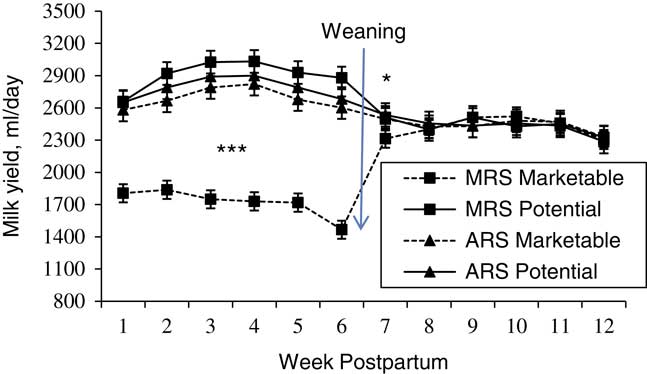
Figure 1 shows least square means of daily milk yield evolution for goats under MRS (n=24) and ARS (n=24). Four curves corresponding to MRS potential milk, MRS actual milk, ARS potential milk and ARS actual milk are described. For ARS, there were no significant effects of type of milk evaluation or interaction between the milk evaluation type and week of lactation (P=0.9921).
Least square means (±SEM) of daily milk yield evolution for Murciano-Granadina goats under mixed rearing system (MRS=24) and artificial rearing system (ARS=24). ***Indicates a significant difference (P<0.001) for the whole pre-weaning period, whereas *indicates a significant difference (P<0.05) at 7th week between MRS potential milk and MRS actual milk.

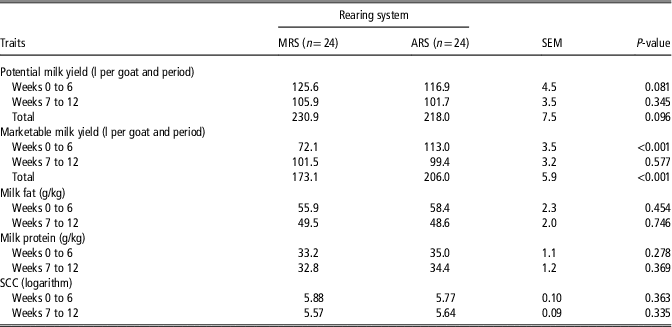
For MRS, interaction (type of milk evaluation×week of lactation) was significant (P<0.001), as significant differences were found between actual and potential milk for all weeks from the pre-weaning period (P<0.001), but only for the 1st week post-weaning (P=0.041). A drop of 367 ml (12.3%) and 148 ml (5.5%) was observed in potential milk yield between weeks 6 and 7 for MRS and ARS, respectively. When all the lactation was taken as a whole (Table 1), differences in total potential milk yield between systems were non-significant (P=0.096). Likewise, neither differences for total potential milk yield (P=0.081) during the pre-weaning term, nor over the post-weaning period (P=0.345), were found between systems. Significantly (P<0.001) more marketable milk is produced when kids are artificially reared from kidding than when suckling (weeks 0 to 6). However, after weaning no significant differences were observed (P=0.577) for marketable milk between ARS and MRS (weeks 7 to 12). Milk composition (fat, protein) and SCClog in milk were similar for dams in MRS and ARS for all weeks of lactation (Table 1).
Least square means (±SEM) for lactation traits of Murciano-Granadina goats under mixed rearing system (MRS) or artificial rearing system (ARS)

SCC=somatic cell count.
Kid growth
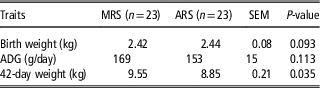
One kid per system died during the trial. Table 2 shows the kid’s average daily weight gain and live weight at 42 days depending on the rearing system. Rearing system affected significantly (P=0.035) live weight at 42 days but not average daily gain (P=0.113). Taking into account that, during rearing phase, potential milk overestimates 3.3% of marketable milk for ARS, the real milk production for MRS goats would be 3.3% less than 125.6 l (121.46 l) during this phase. Thus, the difference between potential and marketable milk until weaning for MRS (49.3 l) indicates that each kid suckled an average of 1.17 l/day, while the average consumption of kids from ARS was 1.24 l/day. So, during the rearing period, estimated average total gross energy per kid was 189.2 and 197.9 MJ for MRS and ARS, respectively.
Least square means (±SEM) for kid growth traits under mixed rearing system (MRS) or artificial rearing system (ARS) with Murciano-Granadina goat breed

ADG=average daily gain from birth to 42 days of age.
Economic analyses
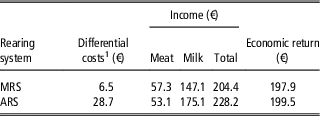
A total of 6.5 and 28.7€ of differential costs (Table 3) during the 6 weeks post-kidding, and a total income of 204.4 and 228.2€ (Table 4) were computed for MRS and ARS, respectively. So, economic returns of 197.9 and 199.5€ were obtained for MRS and ARS, respectively.
Time employed on the different tasks and differential costs per kid during rearing phase (0 to 6 weeks) under mixed rearing system (MRS) or artificial rearing system (ARS) with Murciano-Granadina goat breed

1 Kid assistance and separating kids from their mothers.
2 Milk replacer machine.
3 Milk replacer for ARS and the extra feeding to compensate extra milk production for MRS.
4 Labour costs for kid assistance and machine handling.
5 Electricity, water, machine cleaning.
Differential economic returns for mixed rearing system (MRS) and artificial rearing system (ARS) with Murciano-Granadina goat breed

1 Differential costs for the suckling period and the maintenance of goat body condition score due to the higher total milk produced by the MRS.
Discussion
The milk yield finding agrees with the figures reported by Peris et al. (Reference Peris, Caja, Such, Casals, Ferret and Torre1997), but disagrees with Delgado-Pertíñez et al. (Reference Delgado-Pertiñez, Guzmán-Guerrero, Mena, Castel, González-Redondo and Caravaca2009a and Reference Delgado-Pertiñez, Guzmán-Guerrero, Caravaca, Castel, Ruiz, González-Redondo and Alcalde2009b), who found differences between MRS and ARS for any lactation period. The different results observed could be due to the fact that, for Delgado-Pertíñez et al. (Reference Delgado-Pertiñez, Guzmán-Guerrero, Mena, Castel, González-Redondo and Caravaca2009a and Reference Delgado-Pertiñez, Guzmán-Guerrero, Caravaca, Castel, Ruiz, González-Redondo and Alcalde2009b), the goats under MRS increased their potential milk production by 24% and 32%, respectively, compared with the goats under ARS, while that increase was much lower for Peris et al. (Reference Peris, Caja, Such, Casals, Ferret and Torre1997) (1.1%) and for this work (7.4%), and that the two milkings per day after weaning allowed goats under MRS to maintain an advantage of 17% in milk production over ARS from weaning to the end of lactation.
The fact that in this experiment kid suckling did not significantly increase potential milk yield compared to an ARS management also contrasts with what usually happens in ewes according to Labussière et al. (Reference Labussière, Combaud and Petrequin1974) and McKusick et al. (Reference McKusick, Thomas, Romero and Marnet2002), who demonstrated the importance of a low milk yield drop at weaning that would allow them to maintain a higher lactation curve pattern throughout the rest of lactation and so improve economic returns for the MRS. After weaning, MRS marketable and potential milk yield were different only for the 1st week (week 7; Figure 1), which seems to show a certain inhibition of milk reflection reflex and a significant retention of milk in the udder at weaning, as found by Marnet and Negrão (Reference Marnet and Negrão2000) and McKusick et al. (Reference McKusick, Thomas and Berger2001) in ewes. Milk retention may slow down cell secretion activity by the accumulation of autocrine regulators of milk secretion, such as feedback inhibitor of lactation (Rennison et al., Reference Rennison, Kerr, Addey, Handel, Turner, Wilde and Burgoyne1993; Peaker and Wilde, Reference Peaker and Wilde1996). On the other hand, Stull et al. (Reference Stull, Pai, Vomachka, Marshall, Jacob and Horseman2007) proposed that serotonin alters barrier function and dissipates the transepithelial gradients necessary for milk secretion, thus acting as an inhibitor. On the contrary, Silanikove et al. (Reference Silanikove, Merin and Leitner2006) and Silanikove et al. (Reference Silanikove, Leitner, Merin and Prosser2010) proposed that a lower milk volume in upper parts of the udder dilute the content of β-CN ƒ(1–28), which in turn reduces the inhibition of fluid secretion. All these explanations indicate that milk retention in the upper parts of the udder entails, among other things, a lower milk secretion at weaning, as occurred in ewes.
Our observation regarding the similar milk fat composition during pre- weaning period for MRS and ARS does not agree with those reported by Eik et al. (Reference Eik, Eknœs, Havrevoll, Garmo, Raats and Ädnøy1999) in goats or by Gargouri et al. (Reference Gargouri, Caja, Such, Ferrett, Casals and Peris1993) and Requena et al. (Reference Requena, Balasch, Peris, Rodríguez and Fernández2010) in ewes, who found a lower commercial milk fat content for MRS during the partial suckling period. This difference may be due to the management performed, as in this experiment the kids stayed with their mothers until milking time, while in the other cases they were separated some hours before going up to the milking parlour. Requena et al. (Reference Requena, Molina, Fernández, Rodríguez, Peris and Torres1999) showed that the low fat milk obtained during early lactation from ewes under MRS could be one of the major concerns for cheese-processing facilities.
Average birth weight (2.43 kg) was similar to the results of Pérez-Baena et al. (Reference Pérez-Baena, Dorantes, Sánchez-Quinche, Gutiérrez, Fernández, Rodríguez, Gómez and Peris2013) and lower than those of Sanz (Reference Sanz2005) for the same breed (2.46 and 2.7 kg, respectively). In terms of average daily gain, Sanz (Reference Sanz2005) found significant differences between systems (169 v. 118 g/day for MRS and ARS, respectively), and Pérez-Baena et al. (Reference Pérez-Baena, Dorantes, Sánchez-Quinche, Gutiérrez, Fernández, Rodríguez, Gómez and Peris2013) also obtained higher values for MRS compared to ARS (151 v. 128 g/day, respectively), using the same facilities as in this experiment but in a bucket rearing system. Growth essentially depends on the ingested energy, so the higher growth of MRS kids from this experiment may be explained by the fact that, although the estimated ingested gross energy per kid was slightly higher for ARS, goat’s milk usually has higher digestibility (Sanz et al., Reference Sanz, Hernández-Clua, Naranjo, Gil and Boza1990) and may also have growth promoters, as well as what was observed in cattle by Baumrucker and Blum (Reference Baumrucker and Blum1993).
A similar economic return per goat and kid from ARS and MRS was obtained in this experiment, as the extra commercial milk achieved using ARS and the price applied more or less exactly compensated for the extra costs of artificial rearing compared with MRS. However, as the herd’s prolificacy is 1.8, the actual results would be 16.2€ per goat in favour of MRS.
In conclusion, ARS entailed an increment of 22.2€ in rearing production cost of kids compared to the MRS. A similar economic return per goat and kid was obtained from ARS and MRS in this experiment, although, due to one herd’s prolificacy of 1.8, the actual results would be 16.2€ per goat in favour of MRS. Beyond the results in a given flock, the real interest of this experiment may be the producer’s possibility of extrapolation to different levels of milk production, prolificacy, and prices and costs for incomes and outputs, to estimate the weaning system that increases returns in a specific situation.
Acknowledgement
This work was funded by the project RTA2013-00107 (INIA) with FEDER funds.
Declaration of interest
None.
Ethics statement
Housing and handling the experimental animals followed the principles required for care and use of experimental animals in Spain (Real Decreto 53/2013, Boletín Oficial del Estado 34, 11370-11421).
Software and data repository resources
None of the data were deposited in an official repository.