Introduction
Interpreting an individual’s neuropsychological (NP) test performance is problematic without the proper normative context. Beyond traditional considerations of age, education, and in many cases, gender (Finlayson, Johnson, & Reitan, Reference Finlayson, Johnson and Reitan1977; Heaton, Grant, Matthews, & Avitable, Reference Heaton, Matthews, Grant and Avitable1996) as defining a normative standard against which a given neurocognitive performance may be interpreted, the influence of other demographic and personal factors, such as literacy (Dotson, Kitner-Triolo, Evans, & Zonderman, Reference Dotson, Kitner-Triolo, Evans and Zonderman2008; Manly et al., Reference Manly, Jacobs, Sano, Bell, Merchant, Small and Stern1999; Manly, Jacobs, Touradji, Small, & Stern, Reference Manly, Jacobs, Touradji, Small and Stern2002) and ethnicity (Heaton, Ryan, & Grant, Reference Heaton, Ryan, Grant, Grant and Adams2009; Heaton, Taylor, & Manly, Reference Heaton, Taylor, Manly, Tulsky, Saklofske, Chelune, Heaton, Ivnik, Bornstein, Prifitera and Ledbetter2003) have begun to be appreciated. Although the inclusion of the latter in normative projects has been the subject of some debate (Brandt, Reference Brandt2007; Manly, Reference Manly2005), the variance in normal NP performance accounted for by these factors makes a strong case for inclusion. Ultimately, the goal of including appropriate normative corrections for a test is to obtain an optimal estimate of expected performance in the absence of any acquired brain dysfunction to maximize precision in classifying disease-related NP impairment or its absence.
This goal of accurately estimating normal performance in individual people is further complicated in international assessment, where a variety of background factors beyond those mentioned above may have substantial influences on test performance [e.g., linguistic background, exceptionally low socioeconomic status (SES) and associated quality of formal and informal educational opportunities, nutrition in the early years of life and after, and access to modern health care]. Especially in developing areas of the world, these latter factors tend to be strongly related to whether people were born and grew up in rural versus urban areas (Singh & Ladusingh, Reference Singh and Ladusingh2009; Snow, Schellenberg, Forster, Mung’ala, & Marsh, Reference Snow, Schellenberg, Forster, Mung’ala and Marsh1994; Vegas, Reference Vegas2007; Zeck & McIntyre, Reference Zeck and McIntyre2008). Therefore, particularly in developing nations, urban versus rural upbringing could bring to bear several factors that differentially influence neurocognitive performance. In fact, several investigations represent efforts to explore these relations. Alvarado, Zunzunegui, Del Ser, and Beland (Reference Alvarado, Zunzunegui, Del Ser and Beland2002) examined the association between occupation, particularly farm work, and cognitive decline in an elderly Spanish cohort. They found that although occupational status as a farm worker was difficult to disentangle from educational achievement, since most such subjects completed few years of education, farm workers displayed the lowest cognitive performance at baseline and high rates of subsequent cognitive decline. Nguyen, Couture, Alvarado, and Zunzunegui (Reference Nguyen, Couture, Alvarado and Zunzunegui2008) found that in an international multi-site sample from across Latin America and the Caribbean, childhoods spent in rural environments were associated with increased rates of cognitive impairment in later life. It is unclear whether these associations are primarily due to the confounds of limited educational opportunities, the vagaries of rural life (e.g., lack of access to optimal nutrition, medical care, or health education), or directly due to the lack of cognitive stimulation characterized by farm work, or even the neurocognitive effects of exposure to pesticides and other toxic agricultural chemicals, which are more commonly used in the developing world (Dartigues et al., Reference Dartigues, Gagnon, Letenneur, Barberger-Gateau, Commenges, Evaldre and Salamon1992). SES, which tends to covary with urban and rural backgrounds, also has been shown to be associated with cognitive outcomes. For example, Singh-Manoux, Richards, and Marmot (Reference Singh-Manoux, Richards and Marmot2005) modeled the relations among childhood SES, education, adulthood SES and cognition in middle age, and found that the effects of education and adult SES (including occupation) were the strongest predictors of adult cognition. This speaks to the importance of several factors throughout the life course that either directly or indirectly affect adult cognition.
The relative effect of childhood SES and subsequent adult SES on cognition in late middle age is robust in the developed world as well. Turrell et al. (Reference Turrell, Lynch, Kaplan, Everson, Helkala, Kauhanen and Salonen2002) found that SES and social mobility in a Finnish sample appeared to have a graded effect, such that those who began and remained in low SESs throughout life had the poorest neurocognitive performance, followed by those who started out higher in SES during childhood and subsequently experienced low SES in adulthood. Those who experienced low SES during childhood and subsequently experienced higher SES had the next best cognitive performance, and finally those who started out and remained in high SES tended to have the best cognitive outcomes in late-middle life.
Because of the general confluence of rural life, farming as occupation and lower educational attainment in the developing world, their relative influences on cognition are difficult to assess. Therefore, we obtained detailed background and cognitive data from large samples of rural- and urban-dwelling subjects in a developing country (mainland China), and compared their performances on a variety of Western tests of neurocognitive functioning, while statistically controlling for the effects of age, education, and gender. Controlling the contribution of personal demographic and educational factors enabled the evaluation of the effect of rural versus urban backgrounds (including adult use of academic skills in daily life) on cognition in greater resolution.
We hypothesized that there would be differences in NP performance across urban (Yunnan province) and rural (Anhui province) groups on individual NP tests and ability domains. Specifically, we hypothesized that, despite controlling for demographic characteristics, the urban group would outperform the rural group on every NP measure. We also hypothesized that due to presumed higher quality of education in the urban context, and more culturally related risk for lower cognitive development and maintenance in the rural area (less cognitive stimulation, differences in nutrition, healthcare, and exposure to occupational toxins), greater education effects on NP performance would be seen in the urban Yunnan cohort, while greater cross-sectional evidence of age-related decline would be observed in the rural Anhui cohort.
Method
Sample
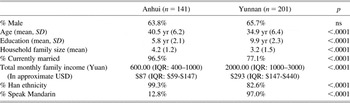
As part of an ongoing study of the neurobehavioral effects of HIV infection in China (Cysique et al., Reference Cysique, Letendre, Ake, Jin, Franklin and Gupta2010; Heaton et al., Reference Heaton, Cysique, Jin, Shi, Yu and Letendre2008; Spector et al., Reference Spector, Singh, Gupta, Cystique, Jin and Letendre2010), the NP performance of large samples of healthy, HIV uninfected (HIV-) control participants was evaluated in urban Yunnan (n = 201) and rural Anhui (n = 141). Subjects from Anhui were volunteers recruited through a registry of plasma donors at the CDC in Fuyang, Anhui, who tested negative for HIV and hepatitis C virus. Subjects from Yunnan were recruited from the general community in Kunming, Yunnan, through the use of flyers posted in local area businesses. Participants were reimbursed 80 Chinese Yuan ($10–11) for their participation. Table 1a displays the demographic characteristics of these samples. All human subjects data were collected in accordance and compliance with standards outlined by our Institutional Review Board (IRB), and the IRBs of the China Center for Disease Control, Peking University, and the National Center for AIDS. Exclusion criteria consisted of history of head injury, stroke, epilepsy, psychotic disorders, and illiteracy (all subjects must have completed at least 3 years of formal education and be able to read the basic Chinese characters used in stimulus materials). Participants were also excluded on the basis of significant substance use histories, defined as more than three alcoholic drinks per day during the last 30 days or use of any illicit drugs over the last 30 days. All subjects were tested by trained examiners in the language and dialect in which they were most comfortable. Regardless of whether subjects spoke Mandarin or a local dialect, the printed stimulus materials and instructions were identical and mutually intelligible.
Basic and extended demographics of Anhui and Yunnan samples

Note. Total monthly family income expressed is in Chinese Yuan currency, reported as medians and interquartile range and compared using nonparametric Wilcoxon rank sum test; USD = U.S. dollars; IQR = interquartile range. Non-Mandarin speakers spoke regional Mandarin dialect with written form equivalent to that of formal Mandarin.
These groups significantly differ along most of the background dimensions displayed, and, therefore, we expected to see significant differences in NP performance across the battery of tests before controlling for demographic variables and education (see Table 2). In particular, these differences in NP performance could be attributable to group differences in age or education, rather than U/R background per se. For illustration purposes, results of U/R group comparisons will be presented before and after controlling for personal demographic variables.
Neuropsychological (NP) Test Battery
Each participant was administered a 2-hr battery of Western NP measures chosen for their cultural neutrality and sensitivity to the effects of HIV infection (Cysique et al., Reference Cysique, Jin, Franklin, Morgan, Shi and Yu2007). The individual NP tests and their respective ability domains are listed in Table 1b. The ability domains that are represented include executive functions, attention/working memory, learning, memory (delayed recall), speed of information processing, language fluency, and motor speed/dexterity. Since the Chinese use a logographic writing system rather than a phonemic alphabet, language fluency measures included semantic (animals) and verb (action words) fluency, but not phonemic (letter) fluency. For the same reason, Color Trails 2 was substituted for the Trail Making Test B where letters of the alphabet are used.
NP test battery

Use of Academic Skills in Everyday Life
We also used a questionnaire to assess group differences in daily use of academic skills. The items of interest concerned the frequency with which respondents used reading, writing and arithmetic in their daily lives, and response choices were on a 4-point scale for each item (1 = never, 2 = rarely [<1×/day], 3 = sometimes [1–2×/day] and 4 = often [≥3×/day]). These data served to evaluate the extent to which NP performance, after controlling for age, education, gender, and province may be explained by self-reported use of academic skills in daily life.
Data Analysis
Raw NP scores of all subjects in both samples were converted to scaled scores based on the combined groups. The scaled scores, which range from 1 to 19 (mean = 10, SD = 3) and were normally distributed, provided a uniform metric on which to place the absolute performance of groups and individuals, and a general normative context in which to understand their NP performances. One-way analyses of variance (ANOVAs) were conducted using the scaled scores of each NP test, summary scores for each ability domain (calculated as mean scaled scores of tests within the domain), and total mean of scaled scores (overall NP performance) across the entire battery of tests. The associations between overall NP performance and education and overall NP performance and age were also analyzed for each of the provinces’ samples using Pearson’s correlation, and the differences between groups in the strength of correlations were evaluated using Fisher r-to-z transformations. Gender differences in mean scaled score were also analyzed separately, by province, via one-way ANOVAs.
In contrast to the ANOVAs above, multivariate regression analyses were conducted, predicting the scaled scores of each NP test, and total mean of scaled scores from urban versus rural residence, but with age, education, and gender entered as covariates. Where differences between urban and rural groups remained significant after controlling for demographic factors, we calculated the Cohen’s d effect size of the urban/rural difference after controlling for demographics. This was accomplished by dividing the difference in means of the two groups, by the pooled (residual) standard deviation.
We then added self-report of daily use of academic skills to the models above to assess the relative contribution of daily academic skill use in explaining NP outcome across the combined urban and rural sample. Significant main effects of academic skill use would delineate the relations between the use of these skills and NP performance, while controlling for the effect of demographics and province.
Finally, we were interested in whether the report of these skills was more highly related to the outcomes (NP performances) in one province than another. We hypothesized that where such interactions were significant predictors of NP performance, it would be more predictive in Anhui than Yunnan. Therefore, we added interaction terms to the models.
Results
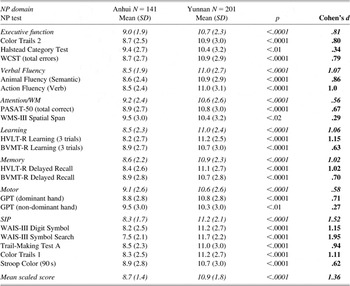
NP performance was placed into a common normative context (scaled scores), as described above. Table 2, which shows the mean scaled scores of NP tests, ability domains, and overall battery mean scaled score (raw scores converted to standardized scaled scores with no demographic correction), indicates that the urban group significantly outperformed the rural group in each case. The preceding result was unsurprising, given the considerable difference across groups in average number of years of education and, to a lesser extent, average age.
Comparison of neuropsychological performance of the Anhui and Yunnan samples by individual test, ability domains, and mean scaled score using combined scaled scores

Note. Data are scaled score means and standard deviations; WM = Working memory; SIP = Speed of information processing; WAIS-III = Wechsler Adult Intelligence Scale-Third Edition.
Before turning to demographically adjusted evaluations of effect of province, we examined the relations among overall NP competence (mean scaled score) and age and education separately, for the samples in each province. The correlation between total mean scaled score and education for the Anhui sample was r = .23, p < .01, and for the Yunnan parent sample it was r = .47, p < .0001. Fisher’s r-to-z transformation comparing the difference in these two correlations was significant (p < .01), as hypothesized. Correlations between total mean scaled score and age for Anhui and Yunnan samples were r = −.29, p < .001 and r = −.42, p < .0001, respectively. Although the observed difference was in the predicted direction, Fisher’s r-to-z transformation comparing the difference in these latter two correlations was not significant (p > .10). These results suggest that the effect of education is significantly greater in relation to global NP performance within the parent urban group as compared to the parent rural group, while there appear to be relatively similar age-related declines in global NP for both groups. Comparing the overall NP performances of males and females within each province separately, we found significant differences only in the Urban Yunnan group (males, m = 11.1[SD = 1.7]; females, m = 10.5 [SD = 1.8]); t (199) = 2.24, p = .03.
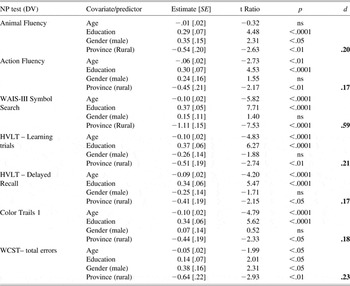
Table 3 displays analyses regressing the NP test performance or overall NP competence (mean scaled scores) on province, while controlling for age, education, and gender. Only analyses in which province was a significant predictor of the outcome are reported. The results of these analyses indicate that after controlling for demographic variables, the NP performances of the urban and rural groups differed significantly for 7 of 18 total NP tests, each with an urban advantage. Conspicuously, our measure of overall NP competence, or mean scaled score, failed to appear on this table, suggesting that with demographics being equal, the overall NP performance was not different between the two groups. Table 3 also displays effect sizes for the differences associated with province, after accounting for age, education, and gender.
Multivariate regressions evaluating the urban/rural effect on NP performance with demographic variables held constant

Note. ns = non significant (p > .05); d = Cohen’s d for difference in means between urban and rural groups after controlling for demographic variables; HVLT = Hopkins Verbal Learning Test; WCST = Wisconsin Card Sorting Test; WAIS-III = Wechsler Adult Intelligence Scale-Third Edition.
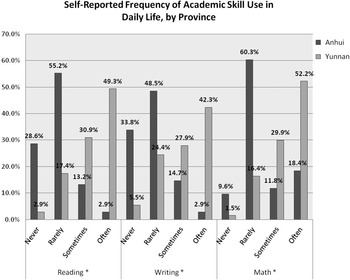
Figure 1 displays group differences in the self-reported frequency of academic skill use in the rural (Anhui) and urban (Yunnan) samples. The graph indicates that across all three academic skills, respondents from Anhui most often endorsed “rarely” using the academic skill, which means they report not using these skills on a daily basis; respondents from Yunnan most frequently endorsed “often” using the academic skill, indicating they use daily and multiple times per day (>3×/day). Contingency analyses comparing the two groups in their self-reports of daily academic skill use was highly significant (p < .0001) across all three academic skills queried.
Self-reported frequency of academic skill use in daily life, by province. *p < .0001.

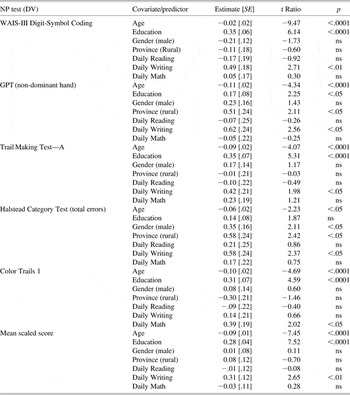
These responses were used to assess whether demographic- and province-adjusted differences in NP performance could be explained by academic skill use. Specifically, we added these academic skill use self-reports to the regression models above to evaluate whether they explained additional variance in NP performance, above and beyond demographics and province. Additionally, we were interested in finding out in which cases the effect of province would be rendered non-significant, once academic skill use was included in the models. Table 4 displays only the results of models in which any academic skill use was a significant predictor.
Multivariate regressions evaluating daily use of academic skills in predicting NP performance, controlling for demograhics and province

Note. NP = neuropsychological; ns = non significant (p > .05); WAIS-III = Wechsler Adult Intelligence Scale-Third Edition; GPT = Grooved Pegboard Test.
Self-report of daily use of writing significantly explained variance in Wechsler Adult Intelligence Scale-Third Edition (WAIS-III) Digit Symbol, Grooved Pegboard Test (Non-dominant hand), Trail Making Test-A, Category Test and mean scaled score (overall NP competence). Daily use of math was a significant predictor of Color Trails 1 performance, while self-reported daily use of reading failed to predict performance on any of the NP measures. It is also notable that once the daily use of academic skill variables were included in the model predicting Color Trails 1, province was no longer a significant predictor. In contrast, when they were added to the model predicting Grooved Pegboard Test (non-dominant hand) province became a significant predictor, whereas province was not a significant predictor without academic skills in the model.
To evaluate hypotheses regarding daily use of academic skills being more important for Anhui in predicting NP performance, we included province by academic skill interaction terms to the model. Contrary to expectations, no significant interactions were noted.
Discussion
As predicted, when NP performances were compared for the large samples of normal adults from Anhui and Yunnan, the urban Yunnan groups did significantly better on all neurocognitive measures in the test battery. However, several of these disparities in test performance were found to be attributable to basic demographic differences; that is, the Yunnan cohort was younger and had completed substantially more years of formal education than the Anhui cohort.
Therefore, we reassessed for urban/rural differences, while controlling for age, education, and gender. Such urban versus rural province differences were found to be significant predictors of only a subset of the tests in the complete battery, and even in these cases, considerable reductions can be observed in the effect sizes associated with the differences in NP performance across groups. Notably, both measures of verbal fluency pointed to an urban advantage, even after control of demographic influences. Likewise, we observed an urban advantage for both measures from the Hopkins Verbal Learning Test-Revised, while neither analogous measure from the Benton Visual Memory Test-Revised showed an effect of province. Also, analysis of two component measures of the Speed of Information Processing domain, Color Trails 1 and WAIS-III Symbol Search revealed significant differences across rural and urban groups, with the latter performing better. The urban group also outperformed the rural in their demographically adjusted performance of the Wisconsin Card Sort Test – Total Errors.
While no differences between U/R groups were found in overall NP (mean scaled score) performance after adjusting for differences in demographics, certain important differences were evident in specific domains or tests. For want of empirical evidence to explain these effects, we can only offer conjecture regarding the bases of these differences. With this proviso in mind, it is clear that the WAIS-III Symbol Search subtest was the most sensitive to urban/rural group differences both before and after controlling for demographic differences across groups. This may have particular relevance to the Chinese system of written language, which is logographic and where quick identification of symbols is associated with reading fluency and the number of symbols one knows is a measure of literacy in general. The urban group outperformed the rural in the WAIS-III Symbol Search task, and by a large effect size. Each of the other six NP tests where U/R differences were observed indicated demographically adjusted Cohen’s d effect sizes close to .20. Four of these six NP tests drew upon verbally mediated abilities of verbal fluency and verbal learning and recall. This consistency may suggest that cultural, economic and environmental factors confer some advantage to the urban group in the development and/or maintenance of verbal skills. Perhaps daily encounters with fewer numbers of different people and, therefore, exposure to fewer diverse modes of verbal expression may impoverish the rural group’s performance on these tasks. Additionally, employment opportunities found in urban settings may more regularly demand use of verbal exchange, whereas such opportunities may be more limited in agrarian settings. Participants in Yunnan speak more of a mainstream Mandarin, while the Anhui subjects speak a more local dialect of the same language. This raises the specter of cultural disenfranchisement as possibly accounting for some of these observed differences. Also, superior quality of formal education may contribute to the differential development of these skills in the urban group. There is evidence for this in the significantly larger correlation between overall NP performance and years of education we observed in the urban group, as compared to the rural group.
Color Trails 1 also showed an urban/rural effect, this was no longer significant once the self-reported daily use of math was considered. Although Color Trails 1 only requires the ability to identify numbers and count, the daily use of math and its attendant familiarity with numbers could in fact result in faster completion of this task, whereas those who rarely use math may need to apply more conscious processing (and, therefore, increased latency) to identify the next number in the series. Regardless, this effect was notable, in that it cut across provinces. Similarly, the self-reported daily use of writing predicted performance on the WAIS-III Digit Symbol Coding, Category Test, Trail Making Test-A, Grooved Pegboard Test (non-dominant hand) and overall NP performance. Each of these also cuts across provinces and suggested that perhaps the coordination of cognitive and fine motor skills deployed in daily writing activities might also confer an advantage in completing these tasks and in overall NP competence.
Of interest, in the cases of the Grooved Pegboard Test (non-dominant hand) and Category Test, adding academic skills to the models seemed to uncover a rural advantage in completing these tasks where a significant province effect was not observed when these academic skills were not included in the analysis. It seems that, after equalizing all participants on their self-reported daily use of writing (and demographics), the subjects from Anhui performed better on these tasks than those from Yunnan. There is no obvious reason why writing would relate to performance on these tests, but only in Anhui did substantial numbers of subjects not regularly use academic skills, and perhaps cognitive activity associated with writing may have some benefit.
Overall NP performance as assessed by mean scaled scores suggest that overall, and after controlling for age, education, and gender, the rural group demonstrates NP performances on par with their urban counterparts. Although we had expected to find evidence for a greater rural/urban effect, in retrospect it is perhaps entirely consonant with the likelihood that these groups share many important background characteristics. Given that they have the same ethnicity, and that the tests were selected to be cross-culturally viable, cultural and educational influences may not be expected to affect NP performance considerably more than observed in this study. It is difficult to know for certain how likely this explanation is, due to the dearth of strictly analogous studies of urban and rural cohorts. However, in an international multi-site normative study (conducted in five Latin American Countries, China, and India) of performance on a cognitive test battery, Sosa et al. (Reference Sosa, Albanese, Prince, Acosta, Ferri, Guerra and Stewart2009) evaluated the independent effects of urban versus rural location, while statistically controlling for age, sex, education, and region (Latin America, China, or India), and found that U/R status accounted for only between 0.0% and 4.1% of variance in cognitive test performance, depending on which of four tests was being evaluated. Unfortunately, this was a study-wise result, and results of the U/R effect by individual country were not reported independent of other demographics. In our study, we found that the U/R effect failed to explain a significant proportion of variance in overall NP test performance (mean scaled score) after controlling for demographics. For the sake of additional comparison, we calculated the effect sizes associated with U/R differences in the Sosa et al. Chinese samples for their measure of “global cognitive function,” using the urban and rural means and standard deviations they reported by four age groups (unadjusted for gender or education). They ranged from d = .24 for the youngest group (65–69 years old) to d = .55 for the oldest group (80+ years old). There was a general increase in effect with increasing age groups and the mean effect size across all four groups is d = .41. In light of these results, the unadjusted effect size of the U/R difference we obtained for overall NP performance was d = 1.36, suggesting that if Sosa et al. had applied statistical control of demographics consistent with our approach, it is likely they too would have found little effect of urban versus rural residence in overall NP performance.
Equivocal overall performances across provinces notwithstanding, it seems clear that these groups display important differences in certain NP ability domains and/or specific NP skills. To the extent these are mediated by environmental differences versus more fundamental predispositions is unclear. For example, we must consider the extent to which the observed differences are associated with endogenous motives for living in urban or rural environs, versus limitations on social mobility imposed by social class. This is particularly difficult to disentangle because these groups hail from very different, non-contiguous provinces in China, separated by over 1000 miles. Had they been from the same province, in closer proximity to one another and with fewer barriers to residing in either region, we might have greater potential for answering this question.
Nonetheless, it would be interesting to know whether people who migrate from rural to urban settings are more neuropsychologically competent or become so as a result of living in a city. Although this study was not designed to address this question since we do not have access to subjects from Anhui who left for more metropolitan areas and did not return, we did query subjects about whether they had ever traveled to a city for seasonal work. In Anhui, just over half (52.4%) indicated that they had traveled to a city for seasonal work and their mean scaled scores were significantly (p < .01) higher than those who never left Anhui [mean (SD): 9.0 (1.4) and 8.3 (1.4), respectively]. Those who left for seasonal work also tended more often to be female (77.0% vss. 23.0%, p < .001), and have completed more years of education [6.2 (2.2) vs. 5.4 (1.9), p < .05]. After controlling for these demographic factors, travel to a city for work remained a significant predictor of overall NP performance (p < .05). Smaller proportions of subjects from Yunnan reported travel for seasonal work (16.4%), and it was not associated with NP performance. These findings indicating that the migrant workers in Anhui are mostly women, better educated, and more neuropsychologically competent are notable because men in Anhui overall outperform women. Therefore, this group of migrant working women may be different from their counterparts who do not leave their rural villages for work. Perhaps their superior cognitive status is attended by a greater resourcefulness vis-à-vis economic survival. Conversely, it is conceivable that having traveled for work provides for a more varied life experience and potentially, opportunities to develop more elaborated cognitive abilities.
The pattern of results overall however, suggests that reported current daily use of academic skills, particularly writing, significantly contributes to the prediction of NP performance and should be entertained as another personal/demographic covariate in the development of NP norms, particularly in locales where quality of formal education opportunities may be poor or otherwise relatively unrelated to NP performance in adulthood. This and similar approaches may also offer a more psychometrically defensible means of correcting for ethnic, cultural, or regional group differences than correcting for performance-based measures of literacy (as proxies for educational quality, e.g., Manly et al., Reference Manly, Jacobs, Touradji, Small and Stern2002). The latter may be subject to the criticism that NP performance is being corrected by NP performance, while self-report use of academic skills or some similar self-reported indexes of the daily engagement in a range of cognitive tasks would not suffer from this limitation. We acknowledge the potential challenge in including this covariate in norms development would require somewhat larger samples, but self-reported daily use of academic skills has been shown to be a robust predictor of performance on several tests, even after controlling for demographics and province. We see this as potentially worth the effort, particularly in developing areas of the world where number of years of education may not mean the same thing as in more resource-abundant settings.
Overall, these between-group differences and the differential patterns of within-group associations among NP performance and demographics underscore the importance of applying appropriate norms to various groups under study internationally, as the NP effects of education and gender, in particular, were quite different in urban versus rural settings. These also represent a methodological challenge as we sought to make sense of the results. Specifically, our analyses were complicated by the fact that, to compare two demographically different groups, we equated them on demographic variables that may not carry the same meaning for each group. Specifically, the urban group displayed a significantly larger correlation between mean scaled score and education than that observed in Anhui, yet in the larger analysis, we were forced to overlook this complication to attempt to control the effect of education. The same is true in the case of NP performances by gender, where an effect of gender was observed in Yunnan only (only the correlations between overall NP performance and age were not different across groups). These represent interactions worth exploring with larger sample sizes, and which may have adulterated our results to some degree. These within-group differences also remind us of the dynamic tension that can emerge when endeavoring to equate non-equivalent groups. Bearing this caveat in mind, our results nonetheless provide considerable evidence for the effect of U/R on specific NP performances while accounting for demographic variables that often have confounded similar investigations. Yet, additional limitations should be acknowledged. A larger sample size with a broader range of age, in particular, would better elucidate the relations under study. Additionally, our two groups differed in the dialect spoken; however, they shared a common written language so stimulus materials were compatible across groups, and all were tested by examiners in their preferred language/dialect. Nonetheless, differences in spoken dialect may have sociopolitical and cultural implications for access to opportunity and education, and could, therefore, have influenced the results. With these limitations in mind, the evidence remains compelling that rural and urban upbringing and residence have important implications for the development of NP abilities and normative standards, and that along with gender, age, and education, rural versus urban status and measures of engagement in academically related activities on a daily basis may need to be included as potential covariates in developing international NP norms.
Acknowledgments
Dr. Heaton receives royalties from the publisher of the Wisconsin Card Sorting Test. All authors declare they have no other conflicts of interest. This study was supported by the NIMH grant 5 R01 MH073433-04 (Dr. Heaton, P.I.). The HIV Neurobehavioral Research Center (HNRC) is supported by Center award MH 62512 from NIMH.