


Introduction
Over the last century, constitutions worldwide have massively expanded formal protections for individual rights (Brinks and Gauri Reference Brinks and Gauri2014; Law and Versteeg Reference Law and Versteeg2011; Melton et al. Reference Melton, Elkins, Ginsburg and Leetaru2013). Yet significant gaps between state promises to protect rights and rights respecting behavior remain (Law and Versteeg Reference Law and Versteeg2013). Scholars attribute this gap, in part, to constitutions failing to make rights promises justiciable and, thus, enforceable in courts of law (Jung, Hirschl, and Rosevear Reference Jung, Hirschl and Rosevear2014). State officials inevitably fail to respect rights in some instances, even in states with strong rule-of-law traditions. Legal mechanisms for remedying these violations are therefore essential to effective rights regimes.
This argument depends on a number of conditions, including a sufficiently independent judiciary willing to exercise meaningful oversight and a well-resourced legal support structure capable of helping individuals pursue their rights (Epp Reference Epp1998). It also envisions state officials fully complying with judicial orders designed to remedy rights violations. This is not always the case. Some officials in some cases implement judicial orders incorrectly or not at all (Kapiszewski and Taylor Reference Kapiszewski and Taylor2013; Trochev Reference Trochev2008). If universal compliance with court orders cannot be assumed, then even promises to respect justiciable rights may be limited to parchments. Thus, noncompliance with judicial orders directing the state to remedy individual rights violations hampers the proper functioning of rights regimes.
Drawing on models of judicial politics in which judges’ power derives from public support for compliance (Gibson, Caldeira, and Baird Reference Gibson, Caldeira and Baird1998; Krehbiel Reference Krehbiel2016; Vanberg Reference Vanberg2005), one potential solution is to make information about noncompliance publicly available so that pro-compliance coalitions, including nongovernmental organizations, litigants, the media, and elected officials, can mobilize public pressure to address it (Dancy and Montal Reference Dancy and Montal2017; Rodríguez-Garavito Reference Rodríguez-Garavito2010). This “public enforcement” solution is effective to the extent that citizens value judicial compliance, reject common excuses for noncompliance, and are willing to sanction noncomplying entities. And finally, informing the public about noncompliance must not undermine support for the very legal institutions used to defend rights.
Furthermore, this solution’s effectiveness, we posit, depends on a psychological issue extant models overlook. Scholars from diverse traditions find individuals evaluate information relative to expectations (Damore Reference Damore1997; Kahneman and Tversky Reference Kahneman and Tversky1979; Shepperd and McNulty Reference Shepperd and McNulty2002). That is, people commonly perceive the same outcome to be worse (better) when it fails to meet (exceeds) their expectations. The effects of informing people about compliance rates may well turn on their expectations of compliance.
Perhaps the tallest hurdle to evaluating these claims empirically is that rates of noncompliance with judicial orders are, generally, unknown. And studies that estimate them (e.g., Spriggs Reference Spriggs1997; Staton, Gauri, and Cullell Reference Staton, Gauri and Cullell2015) examine neither how citizens view noncompliance nor how they react to information about a given rate. We address this problem with a nested research design surrounding a specific rights-protection mechanism: Colombia’s tutela action. Our initial step is a rigorous tracking study to estimate the hitherto unknown rate of noncompliance with tutela orders. We then embed this estimate in three survey experiments to test a series of behavioral claims.
Our study proceeds as follows. First, we describe Colombia’s tutela and the analytic leverage it grants us. We then discuss known advantages and pitfalls of making noncompliance publicly visible before deriving novel predictions based on individuals’ expectations. We then describe our designs, report findings, and explore the implications of the results.
The Colombian Tutela
Colombia’s tutela is an individual constitutional complaint (ICC) designed to protect “fundamental rights,” as enumerated in the Constitution’s Title II, Chapter I, against the action or omission of any public authority (Brewer-Carías Reference Brewer-Carías2009). It was adopted in the 1991 constitutional reform sparked by a national student movement (Movimiento de la Séptima Papeleta) amidst violent conflict and widespread concerns with corruption and the state’s inability to ensure justice. Using state-of-siege powers, President Virgilio Barco Vargas declared a national referendum in 1990 on whether to hold a Constituent Assembly. Despite the move’s questionable legality, 88% of voters approved it (Schor Reference Schor2011, 185). A highly fractionalized Assembly converted this mandate into radical constitutional change (Fox and Stetson Reference Fox and Stetson1992). As Schor (Reference Schor2011) notes, the new charter “addressed Colombia’s democratic deficits: a system of representation that had done a poor job of aggregating voter preferences; an overly powerful president; and a broad failure to effectuate individual rights” [emphasis added]. Former Constitutional Court judge, Manuel José Cepeda Espinosa, sheds light on the tutela centrality’s to fulfilling the 1991 Constitution’s formal rights commitments, calling the tutela “a bridge between the Constitution and reality that goes beyond a juridical procedure to become a material source of the enjoyment of rights.”Footnote 1
The role of the Constitutional Court in tutela decisions and interpretation links this case to a broader class of institutional mechanisms at the judiciary’s disposal to effect social change by promoting rights in Colombia (Cano-Blandón Reference Cano-Blandón2017), in Latin America (Botero Reference Botero2018), and across the developing world (Rodríguez-Garavito and Rodríguez-Franco Reference Rodríguez-Garavito and Rodríguez-Franco2015). We stress that since its creation three decades ago, the tutela has become a first stop—and perhaps the only stop (Taylor Reference Taylor2018)—for rights protection and integral to Colombia’s sociolegal culture. These twin elements grant us significant leverage vis-à-vis the conditions undergirding the public enforcement mechanism thesis.
Tutela as a Rights-Protection Mechanism
A tutela may be moved by any individual or on behalf of any individual, before any judge in Colombia, at any time. It seeks swift justice: formally, tutelas filed should be resolved in no more than 10 days.Footnote 2 Because the Constitutional Court of Colombia enjoys discretionary jurisdiction over all tutelas filed,Footnote 3 following any appeal all tutela actions are sent to Bogotá for review. The Constitutional Court has, over time, interpreted its powers to include defining what constitutes a “fundamental right.” This approach, coupled with the Constitutional Court’s outsized role in shaping Colombian politics (Dixon and Issacharoff Reference Dixon and Issacharoff2016; Landau Reference Landau2005), have endowed the writ with a wide range of protections for social and economic rights. Merhof (Reference Merhof2015, 720) writes “Suddenly, people could file a tutela because their pensions or their salaries were not paid properly—but only in exceptional cases where without those payments their minimum subsistence could no longer be guaranteed.” The flexible and widely applicable tutela thus offers Colombians a powerful legal tool for remedying the state’s failure to deliver on its promises to protect individual rights and liberties.
Tutela and Colombia’s Sociolegal Culture
Beyond empowering citizens and courts to protect rights via the tutela, Colombia’s overall sociolegal culture is compatible with citizens exerting pressure on noncomplying agents in tutela cases. Colombians are strikingly aware and supportive of the tutela and demand probity from public officials.
Hilbink et al. (Reference Hilbink, Gallagher, Sanin and Salas2019) provide a window into Colombia’s sociolegal culture, contrasting citizens’ understanding of their rights and familiarity with legal provisions to protect them across a series of focus groups in Medellín, Colombia, and Santiago, Chile. Although Colombians and Chileans express similar levels of confidence in the judiciary, the authors conclude that “Colombians across social categories have a deeper knowledge of their rights and of the nuances of the justice system” than Chileans.
More broadly, a 2017 nationally representative poll conducted by the National Administration of Statistics Department (Departamento Administrativo Nacional de Estadística) reveals more Colombians know of the tutela (87.4%) than any other rights-protection instrument, including the right of petition (81.7%). Near universal awareness suggests public opinion surveys about the tutela will tap real attitudes, not nonattitudes delivered for the sake of completing a questionnaire.
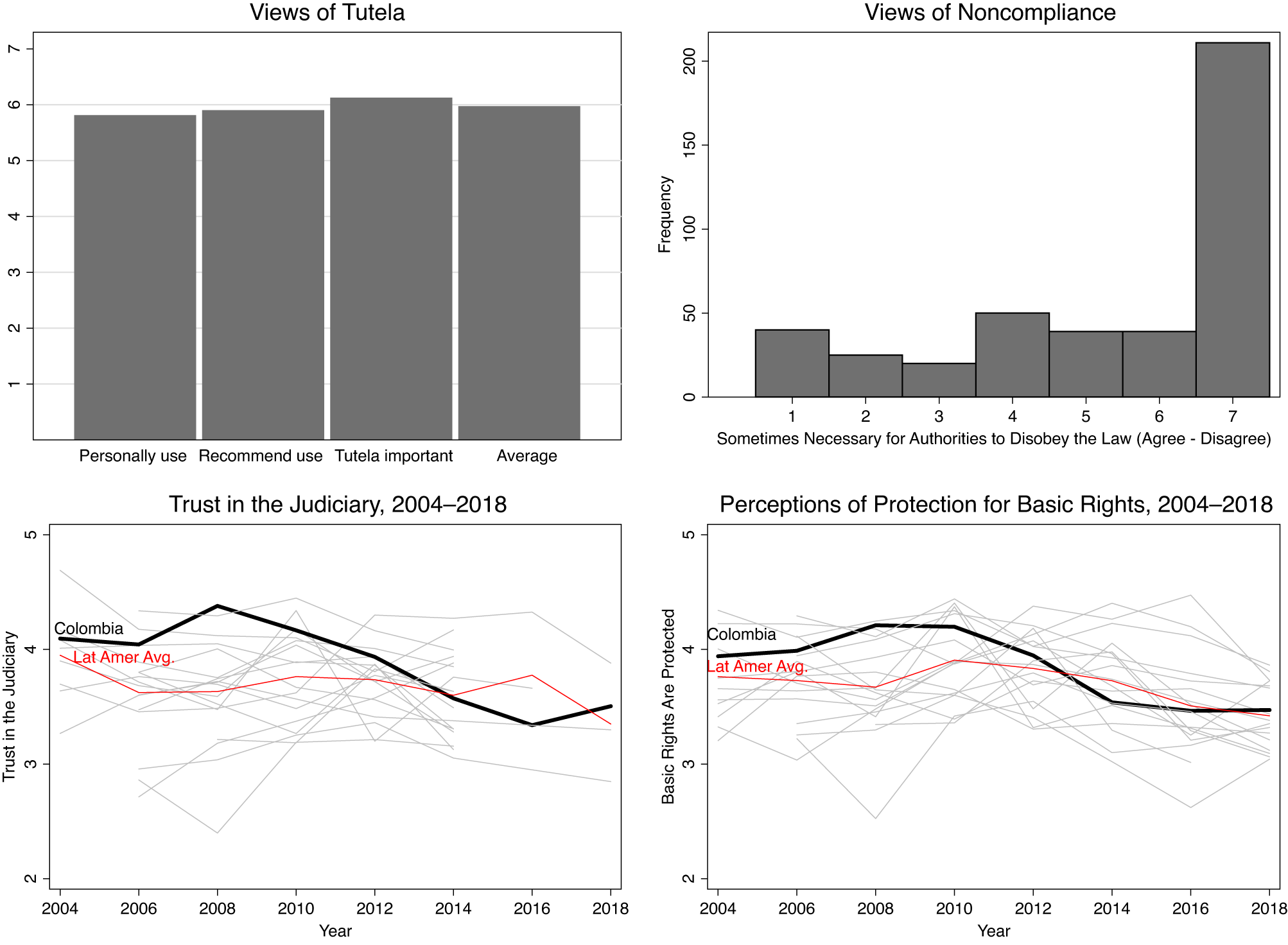
Our 2021 survey experiment on a national sample (detailed below) gauged Colombians’ general views on tutela. Footnote 4 Respondents indicated their likelihood of using the tutela if they felt their constitutional rights were being violated, their likelihood of recommending a friend to file a tutela if their constitutional rights were being violated, and how important they felt it was for Colombians to file a tutela action if their rights were being violated.Footnote 5 Responses in our control group, scored weakly (1) to highly supportive (7) of tutela use, tap a single latent dimension and reliably scale (α = 0.85). Figure 1’s northwest quadrant shows exceedingly positive orientations across the board. Sample means for each item hover around 6 (SDs 1.4–1.6). Colombians clearly value the tutela as a mechanism for enforcing rights.
Colombians’ Views on the Use of Tutela and Acceptability of Public Authorities Sometimes Disobeying the Law
Note: Data in the top panels were collected in 2021 online national quota survey administered by Netquest described in Study 3. Temporal series for trust in the judiciary and perceptions that basic rights are protected gathered from the AmericasBarometer. Each gray line represents a distinct Latin American country. Colombia is shown in black. The red line represents an equally weighted average by country for each country available in a given AmericasBarometer round.

On the flip side of our theoretical coin, Colombians also appear sensitive to agents who fail to comply with judicial orders: they vehemently disagree with the notion that sometimes it is necessary for public officials to disobey the law. The northeast quadrant displays the distribution of responses (1–7), where higher values signify disagreement. Roughly 70% of respondents register disagreement above the midpoint (5–7), including 50% at the scale’s maximum (7). The sample mean is 5.3 (SD = 2.1). By comparison, Colombians are less dismissive of the idea that citizens sometimes need to disobey the law (mean = 4.4, SD = 2.2). These statistics point to a sociolegal culture that pairs almost universal support for the tutela with a conviction that state agents should be held accountable.
AmericasBarometerFootnote 6 trends in the bottom panels of Figure 1 place Colombia near the regional average for trust in the judiciary and belief that basic rights are protected. But the tutela itself holds a special significance to Colombians. Taylor’s (Reference Taylor2018) study of legal consciousness in Colombia suggests that Colombians are committed to the tutela not because they believe in the “majesty of the law” or in the state’s ability to ensure the enjoyment of rights but, rather, because when it comes to claiming their rights, “every other option is less promising; there is no other alternative to the tutela” (364). This dependence on the tutela, coupled with some concern over noncompliance (356), means it is reasonable to expect Colombians to reject noncompliance with judicial orders in tutela cases and to mobilize in support of this rights empowerment mechanism.
In sum, the tutela’s existence and Colombia’s rights-centric sociolegal culture suggest that tracking and publishing noncompliance could grant pro-compliance coalitions a useful tool for mobilizing public sentiment to raise pressure on state agents to comply. It may, simultaneously, be a hard test case to evaluate the predictions of this approach because experimentally altering Colombians’ perceptions of judicial processes, in general, and the tutela, in particular, could prove difficult. Our findings’ generalizability can and should be probed among the broader class of ICCs and judiciaries that wield institutional mechanisms to promote rights. We return to this point in our conclusion.
Theoretical Background
What do we mean by compliance? Scholars from diverse traditions have studied multiple aspects of the concept (Kapiszewski and Taylor Reference Kapiszewski and Taylor2013). Researchers in the law and psychology tradition have developed a robust literature about why individuals comply with the law and come to accept the decisions of legal authorities. Some highlight the importance of perceptions of procedural fairness (e.g., Murphy and Tyler Reference Murphy and Tyler2008; Nagin and Telep Reference Nagin and Telep2017; Tyler Reference Tyler1988) and the legitimacy of judicial institutions (Gibson Reference Gibson, Bornstein and Tomkins2015; Gibson, Lodge, and Woodson Reference Gibson, Lodge and Woodson2014). Others have studied how faithfully United States lower courts implement legal rules developed by courts above them in the judicial hierarchy. This literature underscores the import of carefully managing the process of “whistleblowing” by the lower court allies of higher courts (Beim, Hirsch, and Kastellec Reference Beim, Hirsch and Kastellec2014; Kastellec Reference Kastellec2007). Research in international law often focuses on how closely states align their domestic practices with international commitments. This scholarship prioritizes understanding nonrandom selection into treaty commitments that makes it appear as though international law is binding when states that intend to comply are those that opt into international regimes (e.g., Downs, Rocke, and Barsoom Reference Downs, Rocke and Barsoom1996). This literature also suggests that the bureaucratic capacity powerfully influences states’ compliance (e.g., Chayes and Chayes Reference Chayes and Chayes1993).
Our study most directly addresses the scholarship on compliance with court rulings developed in American politics, international relations, and comparative politics (Carrubba Reference Carrubba2005; Hillebrecht Reference Hillebrecht2014; Huneeus Reference Huneeus2011; Spriggs Reference Spriggs1997; Vanberg Reference Vanberg2005). We adopt Kapiszewski and Taylor’s (Reference Kapiszewski and Taylor2013) definition of compliance as the “full execution of the action (or complete avoidance of the action) called for (or prohibited) in one or more court rulings” (806). We study how individuals react when they learn about noncompliance with judicial orders. To the best of our knowledge our study is the first of its kind, though it is related to a growing set of studies of public reactions to forms of “court curbing” (e.g., Driscoll and Nelson Reference Driscoll and Nelson2019; Svolik Reference Svolik2020).
To clarify the importance of understanding these reactions, it is useful to situate our study in the literature on why state officials comply with court orders. We adopt an instrumental approach, which envisions what we will refer to as a “public enforcement mechanism” for judicial orders. Elites’ decisions to comply in this approach are sensitive to the political consequences of mass evaluations of their behavior (e.g., Trochev Reference Trochev2008; Vanberg Reference Vanberg2005). Obvious challenges of coordination and collective action make it unlikely that the mass public would pressure for compliance in particular cases. But the public nevertheless plays important roles in supporting and responding to pro-compliance coalitions. Such coalitions often include rights-oriented nongovernmental organizations, rights-promoting lawyers, and the media. They play critical roles in linking elite decisions and mass reactions—namely, by confronting government officials with information about noncompliance, supporting litigants in their search for effective remedies, and informing the public generally as a way of pressuring the state (Dancy and Montal Reference Dancy and Montal2017; Rodríguez-Garavito Reference Rodríguez-Garavito2010). A court’s power over state officials ultimately derives from public commitments to the normative propositions that state officials ought to be subject to legal limits on their authority (Raz Reference Raz1977) and that courts are the appropriate arbiters of disagreements over whether officials have violated these limits (Gibson and Nelson Reference Gibson and Nelson2014; Spriggs Reference Spriggs1997; Vanberg Reference Vanberg2005).
The main idea is that pro-compliance coalitions can mobilize public pressure for compliance when it exists. Thus, courts can depend on significant pressure for compliance in contexts where individuals are strongly committed to the rule of law, where particular courts enjoy significant levels of legitimacy, or when the masses are strongly committed to a particular judicial mechanism for remedying rights violations. For this mechanism to work, however, compliance must be visible, or at least it must be possible for noncompliance to be made visible by pro-compliance organizations (Cavallaro and Brewer Reference Cavallaro and Brewer2008; Vanberg Reference Vanberg2005). The mass public must also believe that noncompliance is inappropriate. In Colombia, where support for tutela is extremely high, we should expect that informing people about noncompliance could offer organizations considerable leverage in their efforts to pressure for compliance.
All extant accounts suggest that making noncompliance visible should promote compliance by making it possible to leverage public pressure when it exists. Yet, even instrumental models that point to the role of the mass public do not suggest that informing the public will always translate into greater pressure for compliance. The public might excuse noncompliance for a number reasons. Informing a public about noncompliance may undermine beliefs in the value of the legal institutions that are being defied. And finally, judicial scholars have not incorporated research from multiple fields suggesting that responses to information will depend on how the outcomes reported compare with prior expectations. Thus, it is not obvious that a strategy of making noncompliance visible would, in fact, generate additional pressure for compliance. It might not change anything, and it could even backfire.
This is a particularly crucial concern in so far as tracking compliance with judicial orders requires a nontrivial state investment. Information about the litigants who file complaints, the nature of their complaints, and the outcome of judicial processes are readily available in almost all legal systems. Information on compliance outcomes is different. Although the institutional framework for the individual constitutional complaint includes mechanisms for remedying noncompliance (e.g., the incidente de desacato in the Colombian tutela or the incidente de inejecución in the Mexican amparo), these must be initiated by the complainant herself. If she does not realize that a form of noncompliance has occurred or if she lacks the resources to continue, no concern will be raised. We cannot, therefore, rely on self-reported incidents of noncompliance. Instead, we must seek information from complainants and, if possible, check with defendant agencies. This is time-consuming and costly work. Creating and supporting a reliable, rigorous tracking methodology entails real investments in technology, data infrastructure, and labor. Given the costs of implementing a tracking system, the potential blind spots of the public enforcement mechanism should not be ignored.
How Information Could Promote Excusing Noncompliance
In informing the public about noncompliance, individuals will not only learn simple facts like the rate of compliance. They will likely learn about patterns of noncompliance, and prior scholarship suggests that several features of rights litigation could present reasons to excuse the failure of the state to comply. Research suggests that judges sometimes craft judicial orders that are vague or hard to interpret (Spriggs Reference Spriggs1997). This is problematic on several fronts. Most obviously, vague orders make it difficult to determine whether an order has been defied (Staton and Vanberg Reference Staton and Vanberg2008), hindering the reliable tracking of judicial compliance. More crucially, it forestalls justice. Vague orders may simply not be actionable on the part of state agencies. Alternatively, state agents may misdiagnose the resolution to a vague order. If the public learns that judicial orders are often unclear, they may ultimately infer that noncompliance is the natural consequence of judges’ failure to clearly articulate their orders. From a practical standpoint, vague orders can leave litigants in the lurch. From a theoretical standpoint, issuing vague orders may undercut the public enforcement mechanism.
Making good on constitutional rights can also require significant budget outlays. For example, Costa Rica’s constitutional right to health obliges the state to provide universal access to the drugs and therapies needed to treat HIV/AIDS. Costa Ricans with HIV/AIDS denied such treatments can file an amparo which judges can, in turn, use to enforce this right. Guaranteeing this right required a massive hike in public expenditures (Wilson Reference Wilson, Figueroa and Helmke2011; Wilson and Cordero Reference Wilson and Rodríguez Cordero2006). If judicial enforcement is made visible, citizens may recognize that high costs of compliance imply potential trade-offs in the provision of public services. Therefore, individuals may be more (less) willing to forgive noncompliance in cases where the real costs of compliance are high (low). In short, if people learn that judges often ask for outcomes that would bust public budgets, especially if done at scale, pressure for compliance may be reduced.
Scholars of social and economic rights enforcement have voiced skepticism as to whether justice is blind to social class (e.g., Brinks and Gauri Reference Brinks and Gauri2014). Instead, the legal system’s outputs appear biased toward people with higher socioeconomic status. If the social system that structures the law is organized around class, individuals may perceive noncompliance with judicial orders as less problematic when it harms the poor and the poorly educated than when it harms middle-class or wealthy, educated individuals. The opposite is of course true as well. The mass public may expect constitutional actions like the tutela to protect society’s most vulnerable. Below we consider one aspect of social class, focusing on the effect of informing respondents that users of tutela frequently have low levels of education.
How Information about Noncompliance Might Backfire
Informing the public about noncompliance rates could have negative attitudinal externalities. Namely, reporting relatively high rates of noncompliance could undermine support for the rule of law or specifically for the legal institution that is being defied. The reason is that the information may communicate that compliance is not a norm but rather a behavior that might reasonably respond to a variety of forces. Sarsfield (Reference Sarsfield2012) frames the issue in terms of rationality. Highlighting how poorly and frequently institutions can bind social actors to legal limits makes following the law less rational. Informing the public of any—and particularly high—rates of judicial noncompliance could, therefore, fail to generate appreciable pressure for compliance. Citizen tolerance of noncompliance should rise as respect for the law and the justice system falls. Visibility, in short, could reduce pressure for compliance by normalizing noncompliance. If so, it would gut the public enforcement mechanism.
The Role of Expectations
It is plausible to assume that a very large majority of Colombians want compliance with tutela orders; however, it may be that particular individuals respond to the information about noncompliance differently. We consider the role of expectations. Differences between what we expect from a political process—our reference point—and what we observe can have powerful effects on how we interpret information about that process. Cognitive psychologists have long contended that individuals evaluate outcomes with respect to a variable reference point (Kahneman and Tversky Reference Kahneman and Tversky1979; Medvec, Madey, and Gilovich Reference Medvec, Madey and Gilovich1995). Consumers, for example, are less (more) satisfied with products that perform below (above) expectations than with products that perform as expected (Erevelles and Leavitt Reference Erevelles and Leavitt1992; Spreng, MacKenzie, and Olshavsky Reference Spreng, MacKenzie and Olshavsky1996). Stock prices are highly sensitive to earnings reports that exceed or fall below expectations (Shepperd and McNulty Reference Shepperd and McNulty2002). Public approval of political figures is anchored in prior expectations (Damore Reference Damore1997; Van Ryzin Reference Van Ryzin2004).
The public’s reaction to rates of noncompliance with judicial orders may well conform to a similar “expectation-outcomes” dynamic. If so, any expectation citizens hold about bureaucratic responses to tutela orders would serve as a reference point. Individuals would, then, likely process reported rates of compliance against this reference point. Reports of noncompliance that are lower than expectations may fuel apathy and, in turn, reduce the public’s ability to mobilize in support of the judiciary at crucial junctures. By the same token, reports of relatively high rates of noncompliance might be perceived as acceptable to people who believed that noncompliance was more common. In sum, individuals’ reactions to the actual noncompliance rate will depend heavily upon their prior beliefs about it.
Empirical Goals and Expectations
We now introduce our nested research design in the context of the Colombian tutela. First we describe the compliance tracking process we carried out Colombia. Our approach resembles the system employed by the Constitutional Bench of the Costa Rican Supreme Court and highlights the costs of tracking compliance, especially in a busy legal system. Crucially, it renders a plausible—and significant—estimate of the overall noncompliance rate with tutela decisions in Colombia. We then embed this estimate of the noncompliance rate into three experimental surveys to test a series of propositions related to the effectiveness of the public enforcement mechanism framework.
Study 1 permits causal tests of two simple expectations vis-à-vis informing citizens about noncompliance based on Colombia’s rights-conscious legal culture and the tutela’s place in it:
Informing Colombians about the noncompliance rate in tutela will make them: (1) less accepting of noncompliance and (2) more willing to take a costly remedial actions.
Study 1 also allows causal examinations of the following claims, suggested by the literature, that certain case features provide compelling rationales that alter how citizens react to noncompliance:
Colombians will be more accepting of noncompliance and less willing to take costly remedial actions when they are informed that (1) judicial orders in tutela actions are expressed vaguely, (2) compliance with judicial orders in tutela actions would require considerable public expenditure, and (3) complainants in tutela actions have relatively low education levels.
As such, Study 1 will examine key extant arguments about the public enforcement mechanism’s microfoundations.
Study 2 probes the implications of expectations-outcomes differentials, or reference points, in the context of informing citizens about noncompliance:
Colombians will be less (more) accepting of noncompliance and more (less) willing to take a costly remedial action when they are informed about a noncompliance rate in tutela that is higher (lower) then their prior expectations.
Thus, Study 2 will shed light on a hitherto unexplored cognitive-psychological dimension of the public enforcement mechanism.
Finally, Study 3 considers the potential negative externality that informing the public about the rate of judicial noncompliance in the tutela undermines support for the tutela itself. Accounting for prior expectations, per research on expectations-outcomes differentials, we test the following expectation:
Colombians will be less (more) supportive of the tutela if they learn that noncompliance with judicial orders in tutela cases is higher (lower) than they expected.
Study 3’s results will inform normative and practical debates surrounding making noncompliance publicly visible. Altogether, these three studies will advance our theoretical understanding of how to bolster rights regimes.
Noncompliance-Tracking Study
Tracking noncompliance with court orders in the Colombian tutela is a critical first step for two reasons. First, we cannot validly gauge public reactions to the rate of noncompliance in tutela cases without estimating it. Second, the intricacies of the methodologies and the lengthy time commitment hint at the costs of estimating just a single, overall indicator of noncompliance. By documenting our approach to tracking noncompliance and flagging the practical difficulties encountered, we allow readers to consider how the public might compare the benefits of making noncompliance visible against its real costs.
Logistical challenges begin with the fact that all tutela decisions in Colombia must be sent for potential review to the Constitutional Court, a massive nine-floor building in downtown Bogotá whose security windows let in very little sunlight. The roughly 2,000 case files that arrive daily are quickly registered, bundled in packages of 20, and stored for 2–3 weeks to allow representatives of the chambers to select cases for review. One floor of this building hosts the tutela files that the Court has to summarily study to decide whether to select for revision (or not) (photograph in Figure 2 displays part of the archive). After this brief period, all tutela files are returned to the originating court for permanent archiving. In sum, the bundles of case files are in constant motion during this period—moving from a registration area, to a review area, to a staging area for departure.
Constitutional Court Archive
Note: This photograph displays an image of the Constitutional Court’s archive. Depicted are stacks of tutela case files organized in groups of 20.

Our research team was embedded in the archive working closely with Court’s staff. Reviewing case files involved disturbing a massive temporary archiving operation. Case files were only available for our review in one location for a short period. To avoid fundamentally disturbing their work, the Court limited the team to 45 cases per day, for four of five work days. Additionally, our team committed to reviewing only decisions that the Court declined to review—over 99% of the total cases resolved in Colombia. Thus our sample includes decisions of lower courts throughout the Colombian system.
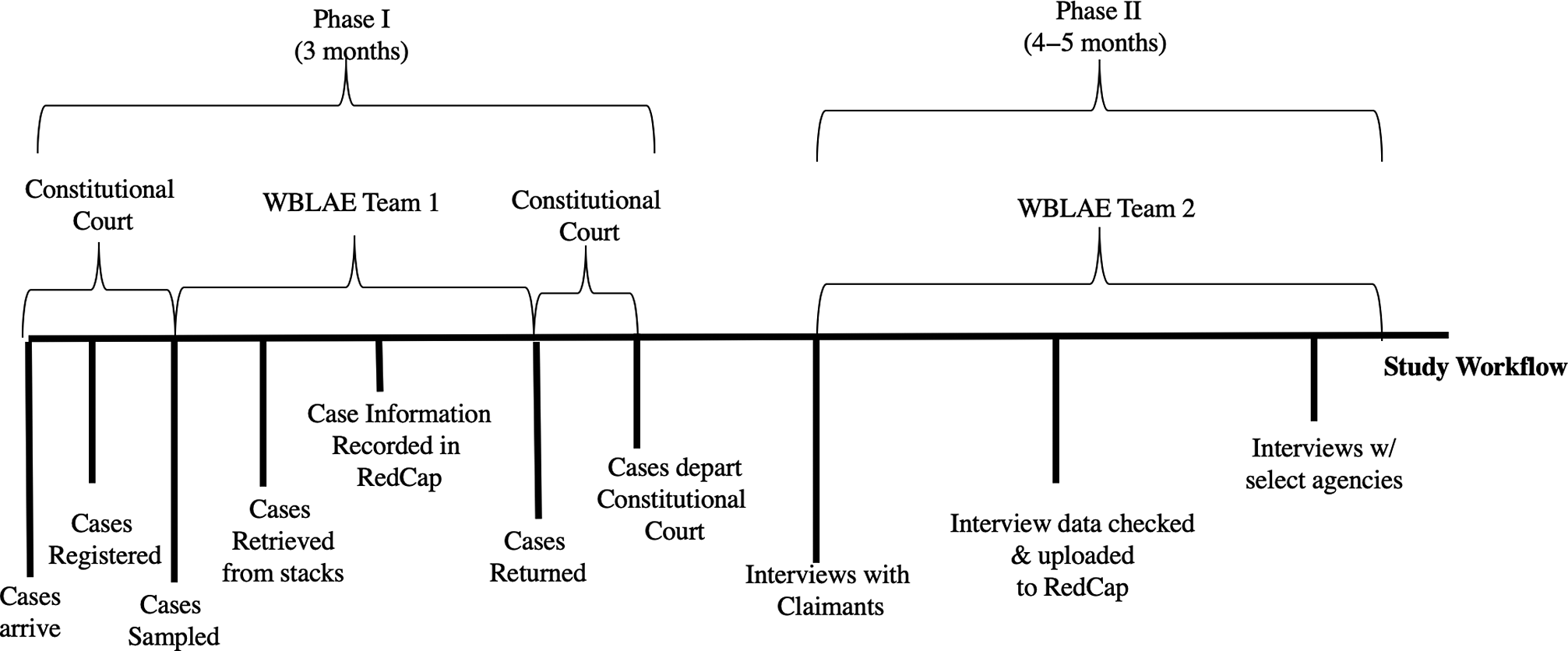
Figure 3 summarizes the study’s workflow. After a pilot study in the Spring of 2013, the team began compliance tracking on October 1, 2014. The study terminated July 31, 2014. The work was divided into two phases and carried out by two separate teams in partnership with the Court’s Registry led by Secretary General of the Constitutional Court, Martha Sáchica Moncaleano.Footnote 7
Compliance-Monitoring Study Workflow
Note: The study was carried out in two phases. In Phase 1, the research team from the World Bank, Universidad de los Andes, and Emory University (WBLAE) sampled case files from the Constitutional Court’s archives and recorded case information. In Phase 2 the WBLAE team interviewed complainants to measure compliance.

Phase 1: Case Sampling and Coding
Cases are registered upon arrival. The Court sent our team a weekly sampling frame, which included four pieces of information: case number, name of defendant agency, and two decision codes, which indicated whether the complainant had prevailed in her claim in the first and/or second instance. We selected a random sample of 180 cases per week, dividing their selection across the four days per week we were permitted to work. Our first team retrieved the sampled case files from the stacks and recorded information pertaining to the case including (1) features of courts that had heard it; (2) case facts; (3) features of the legal argument including the rights claims made and requests for remedy; (4) features of the decision, including the full text of the direct orders and the deadline for compliance; and (5) features of the complainant and her representatives, if applicable.
Phase 2: Interviews to Measure Compliance
A second team was responsible for conducting phone interviews with complainants after the deadline for compliance. Footnote 8 To measure compliance, we first reminded each complainant what the formal order required. We then asked the complainants if the action that the authority had been required to take had been taken in fact. Our team listened to their story and recorded whether, in our judgment, in light of the complainant’s story, that the authority had complied by the deadline.
The compliance monitoring study produced a number of descriptive inferences. Of central importance to this study was the overall noncompliance rate. We found evidence of noncompliance in 28% (95% CI [26%, 30%]) of the 1,741 cases we tracked. For the experimental study below, we round this to 30%. In addition, a review of the court orders revealed that Colombian judges were extremely clear in their instructions to agencies in 30.3% of cases; they were extremely vague in 12% of cases. Another kind of vagueness concerns the deadline. By law, the default deadline for compliance is 48 hours; however, judges do extend the time frame depending on the circumstances. We found that in nearly 15% of cases, judges’ orders gave an indefinite deadline, raising the question of whether it would be possible to fail to comply.Footnote 9 Regarding the education levels of the complainants, 77% had secondary education or lower. The bureaucratic effort implied by the orders varied greatly. Compliance with some actions required almost no effort at all—simply informing a person about her status. Other actions involved significant state resources—for example, providing long-term medical care to a permanently disabled person.
To gauge the public’s reaction to the level of noncompliance we found in the tracking study, we conducted three experiments embedded in two surveys. Footnote 10 Each design examines the specific expectations laid out above. Let us consider them in turn.
Study 1
Study 1 was conducted in September 2017 with a sample (n = 3,200) of Colombians in Netquest’s online panel.Footnote 11 Using quotas, the sample is designed to be nationally representative of the Colombian public based on sex, age groups, and region. NetQuest panelists receive points (called “caracoles”) for participation, which are exchangeable for goods. None of our studies employed deception; all information we provided to the respondents was factual.
Experimental Design
Respondents in Study 1 were randomly assigned to one of six groups. Those in the first five groups answer a series of pretreatment items listed in the Appendix, which we refer to as “covariates” in our discussion. All respondents, however, read the following description of the tutela action, which we refer to as the “Main Text.”
Main Text: When Colombians feel that their fundamental rights (for example, rights to health, due process, information, etc.) are threatened or violated, they can present a tutela claim before a judge to demand protection of those rights. When the judges order an authority to protect the fundamental rights of a citizen, the authority is obligated to obey by law.
Respondents in the sixth group only read this main text and, thus, represent a pure Control group. Because our compliance study on the Colombian tutela was the first of its kind, it was unclear what rate of noncompliance Colombians might expect. The Control group permits us to test whether informing respondents (in a variety of ways) about the study and its core findings changes beliefs and behavior.
Respondents assigned to all other groups learn the additional information that the overall noncompliance rate in our tracking study was 30% by reading the “Study Text” below.
Study Text: [MAIN TEXT] … An academic study in 2014 found much variation in compliance with judges’ orders in these cases. For example, requested authorities failed to comply with the judge’s order to fulfill fundamental rights in almost 30% of the total cases reviewed.
Respondents assigned to Study 1’s second arm read only “Main Text” and “Study Text.” Those assigned to the third, fourth, and fifth arms read “Main Text,” “Study Text,” and information about one of three findings in our compliance study related to factors that could mitigate support for compliance—the vagueness of the judicial order, the high costs of complying with some judicial orders, and the proportion of citizens of low education levels that received protection via the tutela process. Specifically, respondents in the third arm read the following:
Vague Orders: [MAIN TEXT] … [STUDY TEXT] … The study also found that a significant percentage of the judges’ orders to the defendant authorities were vague, for example they did not include a definite time frame.
Respondents in the fourth arm read the following:
High Cost of Compliance: [MAIN TEXT] … [STUDY TEXT] … The study also found that a significant percentage of the judicial orders required a significant monetary cost on the part of the defendant authorities.
Respondents in the fifth arm read the following:
Low Education of Claimant: [MAIN TEXT] … [STUDY TEXT] … The study also found that a significant percentage of the individuals that received protection through tutela claims only had a primary education.
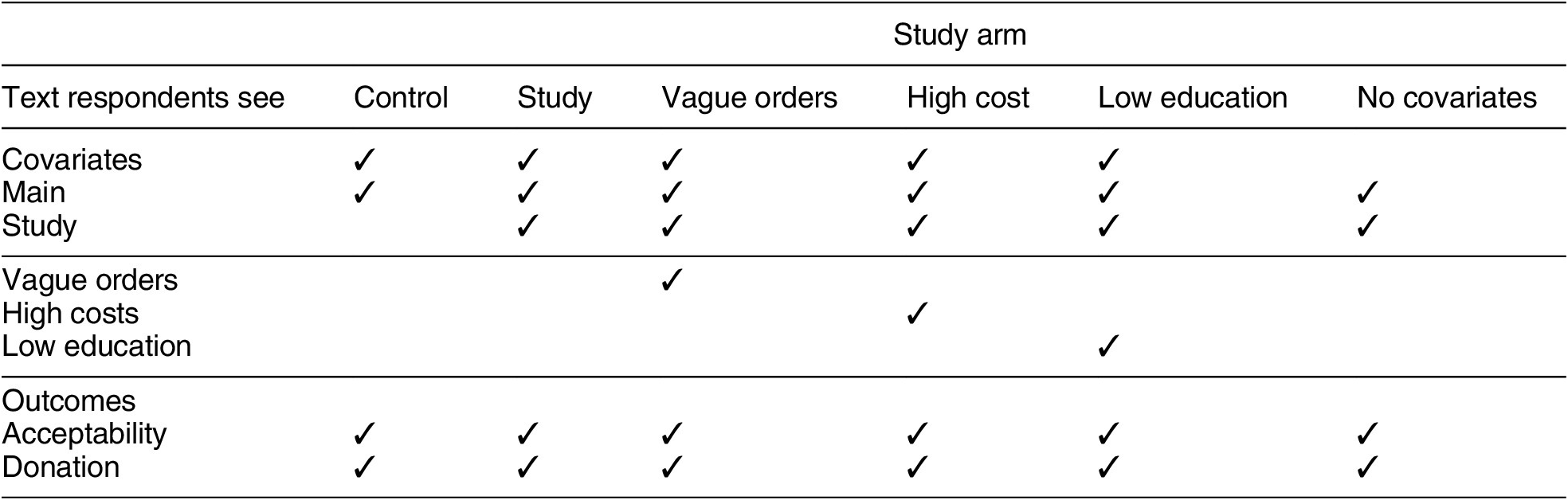
Respondents in the sixth group read the same texts about the tutela and the compliance study as the Study group (second arm); however, as mentioned, these respondents do not answer the series of questions administered pretreatment. Thus, this sixth arm allows us to gauge whether these pretreatment items prime particular kinds of answers and behavior in ways that might overstate treatment effects. Table 1 provides a visual summary of the design. A full description of the flow of questions for each arm can be found in the Appendix.
Study 1 Design Summary

Note: A Control group is exposed only to the main text summarizing the tutela process. In addition to the main text, groups in the Study arm learn the overall noncompliance rate from the tracking study. Treatment groups Vague Orders, High Cost, and Low Education read the main text; the study text; and text related, respectively, to vagueness, the cost of compliance, or the education level of beneficiaries. The No covariates group receives the same information as the Study group but answers no pretreatment items.
Outcomes Related to Public Enforcement Mechanism
Before describing our experimental designs, we outline two outcome measures linked to our theoretical expectations (see Appendix for Spanish wordings).Footnote 12 The first is an attitudinal measure of how acceptable respondents find the 30% rate of noncompliance that resulted from our tracking study. Specifically, we ask “To what extent would you say that the rate of noncompliance with judges’ orders in tutela cases is acceptable or unacceptable?” Our measure, Acceptability, captures responses to this question on a seven-point scale from “not at all acceptable” to “totally acceptable.”
A second, behavioral, outcome taps Colombians’ willingness to take a costly action in order to reduce the noncompliance rate we reported. Leveraging the fact that NetQuest panelists earn points redeemable for items of value for participating in our survey, the item asks “The authors of the study would like to inform the Colombian public about the level of noncompliance with tutela claims. How many of your caracoles would you be willing to donate to contribute to fund the diffusion of the results?” Our measure, Donation, provided respondents a donation range from 0 to 7 points but allowed them to enter larger amounts. Donations ranged from 0 to 17 points. We cannot infer from this measure how willing an individual is to complain to a public official or to join a protest campaign about noncompliance. Yet the donation decision does reflect costly actions very much related to the public enforcement mechanism itself—citizens aggregating their resources via civil society groups and/or public shaming campaigns to achieve a multiplier effect strong enough to hold state agents accountable. As such, by approximating individuals’ willingness to promote the dissemination of noncompliance information to the public at personal cost, Donation is a reasonable indicator of the range of actions implied by the public enforcement mechanism approach.
Covariate balance tests and manipulation checks suggest, respectively, that randomization produced excellent balance and our treatments stimulated respondents as expected. See details in the Appendix.
Distribution and Association of Acceptance and Donation Outcomes
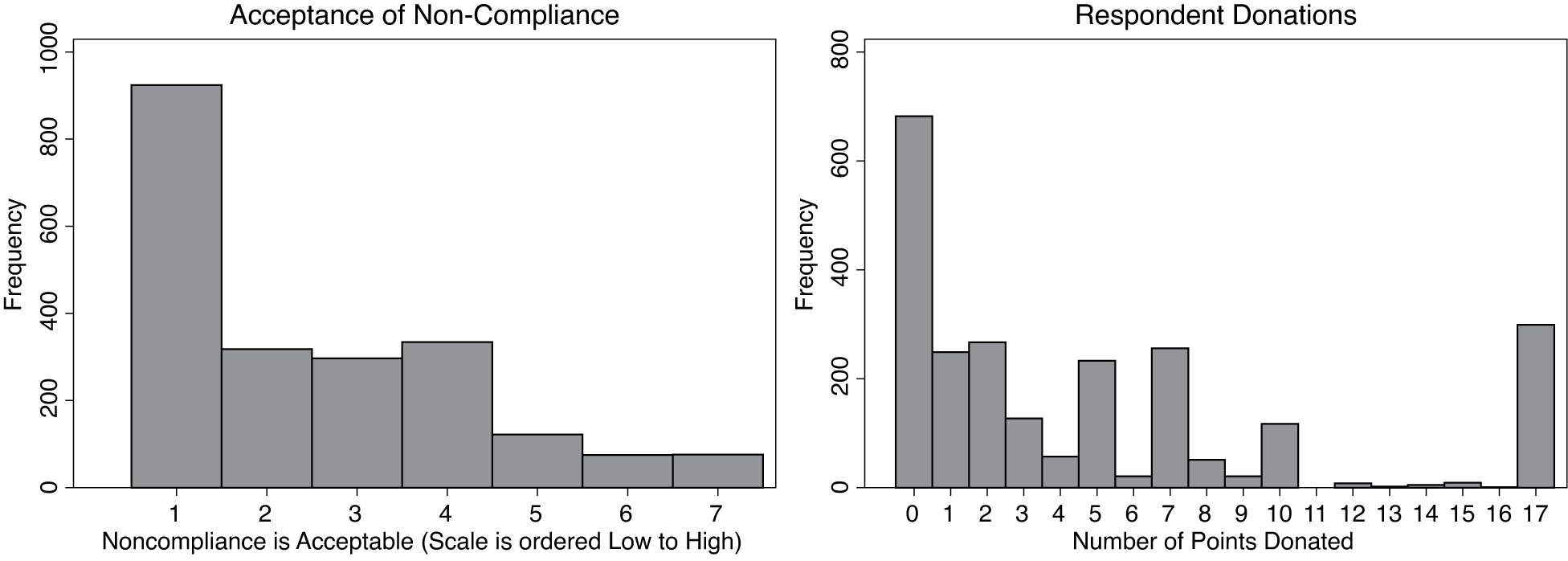
We begin with a summary of the outcome measures, focusing on respondents who we informed about the noncompliance rate. Histograms of the acceptance and donation measures in Figure 4 reveal two main findings. First, a very large proportion of the sample did not find the rate we reported acceptable. On the seven-point scale, the mean response was 2.51 and the median was 2. If we collapse the scale into three categories (1–3 unacceptable; 4 neutral; 5–7 acceptable), we find that 71.5% of the sample found the rate unacceptable; only 12.75% of the sample found it acceptable. Concerning the donation question, the modal response was 0 points; however, the mean was nearly 5 points and the median was 3. Overall, 73% of respondents made a positive donation.
Distributions of Acceptability and Donation Outcome Measures
Note: The mean acceptability response was 2.51; the median was 2. The mean donation was 4.98 caracoles; the median was 2.

The public enforcement mechanism for judicial orders requires that citizens find state agents’ actions unacceptable and do something about it. Our study cannot observe citizens’ actual willingness to mobilize in the form of a public protest. Rather, our donation measure taps into willingness to take costly actions when confronted with judicial noncompliance. As expected, respondent acceptability of noncompliance and donation choices are negatively associated in a bivariate regression (β = -0.31, SE = 0.07) and a linear regression (β = -0.28, SE = 0.08) with controls (age, SES, region, judicial legitimacy, social trust, and rule-of-law preferences). In summary, Colombians who do not accept the noncompliance rate are more likely to contribute to an effort to make it publicly visible.
Learning the Noncompliance Rate: Acceptability and Costly Remedial Action
We now consider whether Colombians who learn about our tracking study’s estimate of the compliance rate in the tutela alter their perceptions of the acceptability of noncompliance and their willingness to take costly actions directed at remedying the problem. Let
 $ {Y}_i^D $
and
 $ {Y}_i^A $
denote the values of the donation and acceptability outcome measures for respondent i. We regress these measures on four dummy variables (
 $ {D}_i^s $
,
 $ {D}_i^v $
,
 $ {D}_i^c $
,
 $ {D}_i^{led} $
) marking the Study, Vague Orders, High Cost, and Low level of education of litigants treatments. We include an additional dummy variable,
 $ {D}_i^{noc} $
, marking the arm of the study in which respondents did not answer pretreatment covariates. We then fit the following models, where
 $ {Y}_i^b $
for
 $ b\,\in\,\left\{D,A\right\} $
:
 $$ {Y}_i^b={\beta}_0+{\beta}_1{D}_i^s+{\beta}_2{D}_i^v+{\beta}_3{D}_i^c+{\beta}_4{D}_i^{led}+{\beta}_5{D}_i^{noc}+{\varepsilon}_i. $$
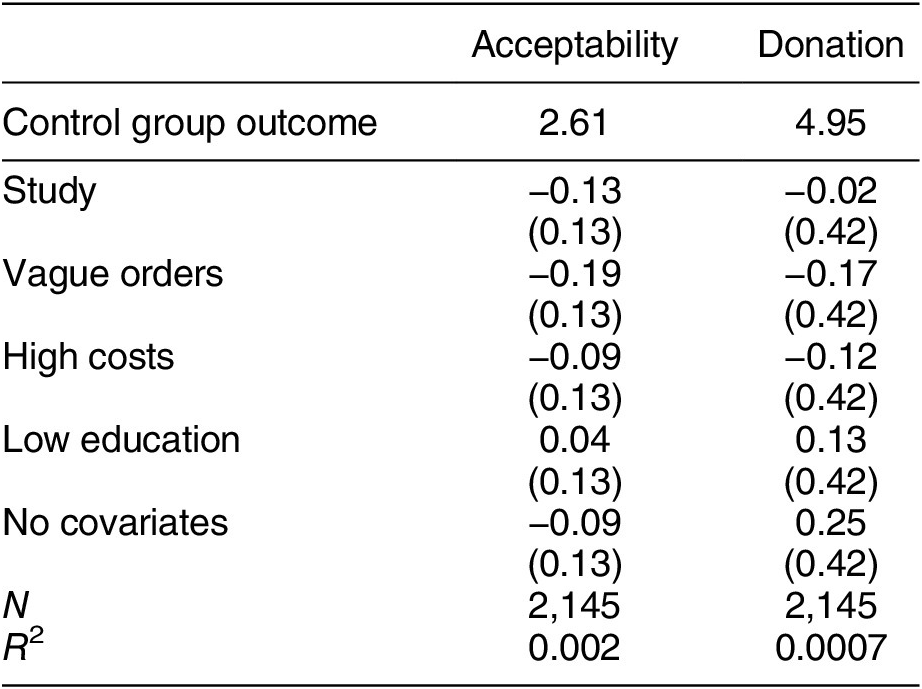
Table 2 summarizes the results. As is clear, there are no significant treatment effects. Relative to the control group, which received no information about the actual noncompliance rate (or any other information from the study for that matter), the average acceptability ratings and donation amounts are the same across our treatment arms. Indeed, the estimates are very close to 0; the largest is the acceptability effect for the Vague Orders treatment (-0.18 on a 1–7 scale).Footnote 13
Effects of Learning about the Noncompliance Rate

Note: The comparison category in all models is the study’s pure control group. *p < 0.10, ** p < 0.05, *** p < 0.01.
Rationales for Noncompliance: Acceptability and Costly Remedial Action
Do some features of tutela cases provide convincing rationales that make noncompliance more acceptable and undermine public reactions to compel state agents to comply? To focus on the effects of providing information about judicial order vagueness, cost of compliance, and the social status of beneficiaries, an appropriate baseline for comparison are the mean outcomes in the Study group. Therefore, we regress
 $ {Y}_i^b $
on
 $ {D}_i^v $
,
 $ {D}_i^c $
, and
 $ {D}_i^{ses} $
.
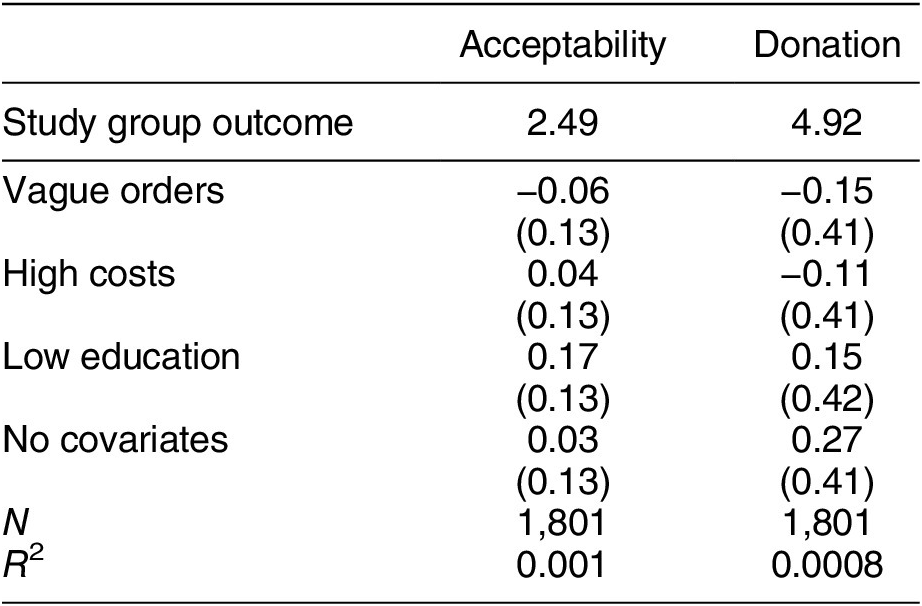
Table 3 summarizes our model results. Column 1 shows results for the acceptability outcome; column 3 shows the results for the donation outcome. Because the base category in this model is the “Study” group, we label the constant “Study Group Outcome.” As these specifications imply, we exclude from this analysis respondents who did not learn about the noncompliance rate so that we can highlight comparisons among individuals who only learned the rate and individuals who learned the rate as well as other information about the cases. Results are separated by experimental effects.
Effects of Case and Litigant Characteristics

Note: The comparison category in all models is the group that learned about the study and the rate of noncompliance but learning nothing else about the cases or litigants. *p < 0.10, ** p < 0.05, *** p < 0.01.
None of the effects in the Acceptability model approach conventional levels of statistical significance. Put another way, receiving information about the mitigating circumstances that bureaucratic agents face in complying with judges’ orders in tutela cases—orders are vaguely and very costly—did not alter how acceptable respondents rated the reported level of noncompliance. Nor did learning that the tutela disproportionately helps Colombians of lower social strata.
Results of the Donation model suggest similarly that varying information about the vagueness, the costs of compliance, or litigant education had virtually no effect on their willingness to donate to publish the study’s results. Thus, our treatments did not reliably alter attitudes or behaviors beyond the average rate of acceptability or donating among the Study group. We find no support for propositions in the literature that pressure for noncompliance might be lowered by the order, case, and complainant features we varied.
To lend greater confidence to these null results, we probed the possibility that respondents’ reactions to our treatments hinged on their preexisting levels of judicial legitimacy, preferences for the rule of law, and trust in the judiciary. We discuss our (fairly standard) measurement of these concepts in the Appendix. This effort was largely fruitless, and we only summarize it here. For Acceptability, we fit 12 models and 36 interactions across them. In all, we found a statistically significant interaction term six times, but not consistently for the same treatment and not always in the same direction.Footnote 14 For Donations, the same numbers of models and interactions produced zero statistically significant interactions. Given that this strategy creates so many comparisons and such little systematic evidence, we doubt our results are masking reliable heterogeneous treatment effects on these factors.
That said, rule-of-law values and perceptions of judicial legitimacy are not wholly irrelevant to opinions about noncompliance. Rule-of-law values are negatively associated with accepting noncompliance and positively associated with donations.Footnote 15 Perceptions of judicial legitimacy are associated negatively with accepting noncompliance as well. Future efforts to predict opinions about noncompliance would do well to include them. Crucially, treatment effects do not depend on these factors.
Study 2
Study 2 incorporates a new arm from the same survey described in Study 1 to test the “expectations-outcomes differentials” or “disconfirmation” hypothesis: respondents’ expected rate of noncompliance with judicial orders in the tutela conditions whether learning of the actual rate elicits an attitudinal and/or behavioral response. If respondents expect noncompliance is fairly rare, then 30% might appear problematic and, in turn, stimulate the sorts of attitudes and actions theorized in the public enforcement mechanism; if they expect rampant noncompliance, the comparatively good news of 30% noncompliance is unlikely to alter such behaviors.
Experimental Design
Our design includes a control group and the Study treatment. Before respondents read the Study text informing them about the 30% noncompliance rate, we elicited prior beliefs about compliance in the tutela. Specifically, we asked respondents to provide an estimate of the noncompliance rate. To observe whether the “Study” treatment confirmed or disconfirmed respondents’ beliefs about the noncompliance rate, our measure places respondents’ beliefs on the percentage scale. However, we suspected some individuals might have very uncertain beliefs about compliance in the tutela. In principle, this presents no problem, as uncertain individuals can report a best guess (say, the mean level of noncompliance). That said, we were concerned that respondents with relatively high uncertainty, who nevertheless did have a guess, might be particularly likely to respond “don’t know” if immediately pressed to provide a percentage. Our approach mitigates these issues in two steps.
We first ask respondents which statement best reflects their existing beliefs: (1) Authorities never fail to comply with judicial orders in tutela cases, (2) authorities rarely fail to comply with judicial orders in tutela cases, (3) authorities frequently fail to comply with judicial orders in tutela cases, (4) authorities always defy judicial orders in tutela cases, and (5) I do not have an assessment of the frequency of compliance with judicial orders. Respondents who give a substantive answer (1–4) are asked to estimate the noncompliance rate on a sliding scale. Respondents who respond do not know (5) are prompted to give an estimate, even though the study administrator recognizes their uncertainty.
Acceptability of Noncompliance and Remedial Action, Conditional on Priors
Individuals’ reliance on reference point heuristics to make decisions gives us reason to believe that Colombians’ reactions to information about noncompliance will depend on their expectations. To consider the effects of learning about our study and its outcomes, conditional on prior expectations, we must track respondents’ priors vis-à-vis compliance in the tutela. Thus, we define a dummy variable
 $ {D}_i^{above} $
that indicates that the ith
person reported an expected compliance above what we report in the “Study” text. Recall that we are comparing individuals in the Control with those in the Study arm.Footnote
16 We then fit the following model:
 $$ {Y}_i^b={\beta}_0+{\beta}_1{D}_i^s+{\beta}_2{D}_i^{above}+{\beta}_3\left({D}_i^s\ast {D}_i^{above}\right)+{\varepsilon}_i. $$
Given the interactions, we provide a brief interpretation of the coefficients reflecting the model’s main effects. Consider
 $ {Y}_i^A $
. The constant term,
 $ {\beta}_0 $
, reflects the mean level of acceptability for members of the control group who reported a prior expectation below the rate we informed them;
 $ {\beta}_1 $
gives the effect of learning the noncompliance rate for individuals who expected a lower rate than we reported;
 $ {\beta}_2 $
gives the change in the mean response for control group respondents who had prior expectations of a higher noncompliance rate than we reported; and
 $ {\beta}_1+{\beta}_3 $
is the effect of the information treatment for individuals who expected a higher noncompliance rate. Similar interpretations apply for
 $ {Y}_i^D $
, the donation outcome.
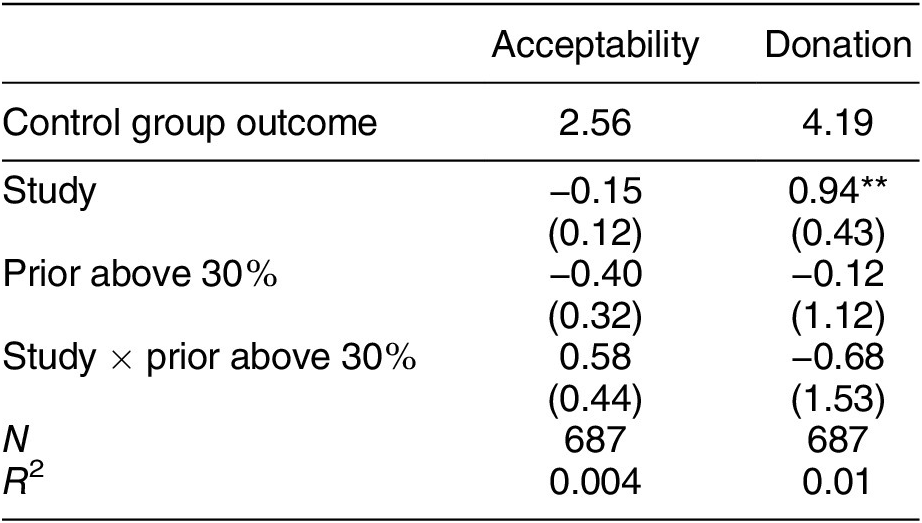
Table 4 summarizes the results. We find no effects of information related to the acceptability outcome regardless of whether respondents expected a higher or lower noncompliance rate. Given the very low baseline levels of acceptability, it is unsurprising that we find no additional effect of information.
Effects of Learning the Noncompliance Rate Conditional on Prior Beliefs

Note: The baseline category in these models in the pure control group in the study who had prior beliefs about the noncompliance rate below 30%. *p < 0.10, ** p < 0.05, *** p < 0.01.
We nevertheless find a fairly strong effect of information in the donation model among those expecting a lower noncompliance rate. The average treatment effect of providing information for respondents who expected a noncompliance rate below what we reported (i.e., 30%) is 0.94 caracole points, with a 95% confidence interval of (0.10, 1.78). Yet the effects are asymmetric. For respondents who expected a noncompliance rate above what we reported, the average treatment effect is estimated to be 0.28, with a very wide 95% confidence interval of (-2.62, 3.14).Footnote 17
In sum, learning that noncompliance is more widespread than one believed does not make Colombians more accepting of it. Such information does, however, lead them to donate earned resources to publicize the rate of noncompliance. We do not find evidence suggesting that informing a respondent about the true rate would reduce their willingness to donate points when the rate is lower than they expected.Footnote 18
Study 3
Findings from Studies 1 and 2 suggest that Colombians roundly reject noncompliance with judicial orders in tutela actions, a fact unchanged under a host of theoretically plausible conditions. And when they learn of a noncompliance rate that disconfirms their overly rosy prior beliefs, they are willing to take costly actions to help publicize noncompliance rates, a crucial first step toward pressuring state agents to comply. It is, nonetheless, conceivable that learning the rate of noncompliance could have ill effects on the tutela. Namely, it may erode citizens’ reliance on this powerful rights-enforcement mechanism when their rights are subverted. Informing citizens of the extent of noncompliance might alter citizen perceptions of the tutela as an effective way to redress constitutional grievances. Such consequences could be particularly acute among those who believed noncompliance to be lower than it actually is. Exploring these questions is critical for how we interpret and communicate our findings.
Experimental Design
We addressed these questions by conducting a survey experiment in March 2021 with another sample (n = 430) of Colombians from Netquest’s online panel. As with the survey used in Studies 1 and 2, quotas for sex, age groups, and region were used to achieve representation on these population parameters. Human subjects protocols were also replicated.
We followed the same design as described for Study 2, which includes a control group and the Study treatment. As before, our instrument began with a battery of covariates. Again we elicited expectations about the rate of judicial noncompliance in tutela cases using the same approach as in Study 2. Respondents were then randomly assigned to the Study group, informing them of the rate of noncompliance from our tracking study, or to control, in which case they remained uninformed about the noncompliance rate.
Outcomes Related to Supporting the Tutela
Earlier, we introduced three indicators of citizens’ willingness to employ the tutela as a rights-enforcement mechanism and footnoted the items in Spanish. To recap, respondents indicated (1) their likelihood of using the tutela if they feel their own constitutional rights are being violated, (2) their likelihood of recommending a friend to file a tutela if their friend’s constitutional rights were being violated, and (3) how important it is for Colombians to file a tutela action if their rights were being violated. These items form a reliable scale (1–7,
 $ \alpha $
= 0.85) increasing in support for the tutela, as noted. The average of the scores represent the outcome in this experiment.
Learning the Noncompliance Rate and Tutela Support, Conditional on Priors
We fit two models in which our index of Tutela Support is the dependent variable and the base category represents individuals in the control group who expected a noncompliance rate below 30%. The first model estimates the effect of learning the noncompliance rate via “Study” text, without taking account of prior expectations about noncompliance. The second model considers whether the effect of learning the noncompliance rate depends on prior expectations (see Equation 2).
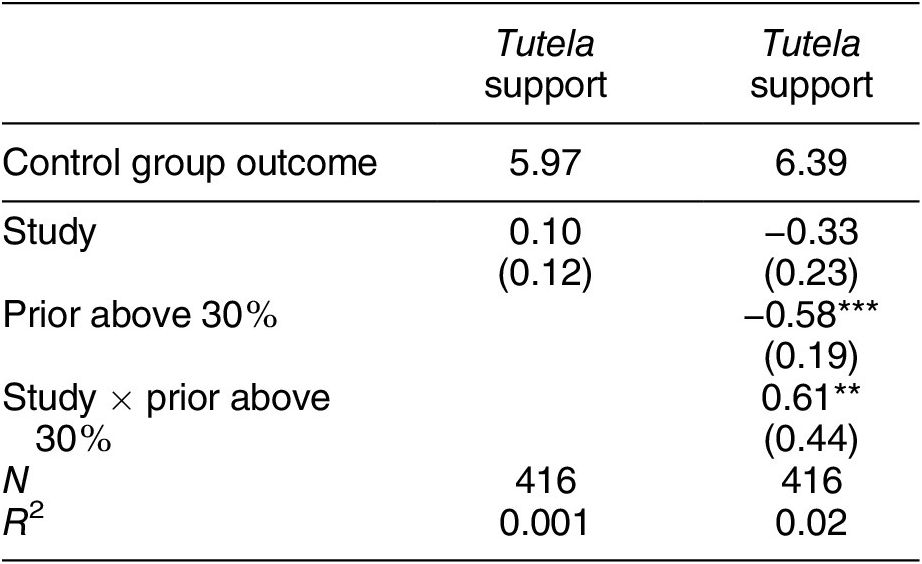
There is balance in prior expectations across the treatment conditions. In the control group, the proportion of individuals with beliefs above 30% was 0.70; it was 0.73 in the treatment group. The first column of Table 5 suggests that learning the rate of noncompliance alone has no discernible effect on Colombians’ support for using the tutela. Reflecting the findings of Study 2, the second column suggests that the effect of learning the noncompliance rate depends on prior expectations. Specifically, learning that the noncompliance rate is 30% boosts support for the tutela among respondents whose priors placed the rate above 30%. To be sure, the effect size is modest: roughly a quarter of point (0.28) on the seven-point scale. This is less than one third of the index’s standard deviation. To summarize, informing Colombians about the true noncompliance rate will cause increase in support, albeit small, for the legal device among people who expect a higher rate of noncompliance than the rate we obtained via tracking.Footnote 19
Effects of Learning the Noncompliance Rate on Support for Tutela

Note: The baseline category are control group respondents who had prior beliefs about the noncompliance rate below 30%. *p < 0.10, ** p < 0.05, *** p < 0.01.
A more significant concern is that informing Colombians about the noncompliance rate could reduce their support for the tutela. The results in column 2 of Table 5 indicate that among those individuals with priors below 30%, information about the true rate had a negative effect on support for the tutela; however, this effect is not statistically distinguishable from 0 (p = 0.15). More importantly, the effect is extremely small. The expected level of support for tutela in the control group is 6.39 on a seven-point scale. A reduction of -0.33 points would still result in a level of support above 6, a sign of very high support for the institution.Footnote 20
Discussion and Conclusions
This study considers the reactions of individuals to becoming informed about the rate of noncompliance with judicial orders, using the Colombian tutela as a case study. We carried out an unprecedented tracking study to estimate the noncompliance rate and embedded that rate into three online studies in national samples to gauge how Colombians reacted to it. To standard accounts of the public enforcement mechanism, we incorporated theoretical insights from cognitive psychology on expectations-outcomes differentials, which turn out to be important to understanding public reactions to noncompliance. Our main findings are as follows.
By our estimate, Colombian state agents failed to comply with judges’ orders in roughly 30% of randomly selected tutela cases we tracked. Colombians overwhelmingly consider this level of noncompliance unacceptable. Particularities of tutela cases—their vagueness, costs, and educational attainment of beneficiaries—that might, theoretically, compel citizens to excuse this noncompliance rate do not. A potential explanation for these results is that support for compliance with orders in tutela cases is so high among the Colombian public that learning information about noncompliance could not reasonably be expected to increase support and support is so strong that learning information that could decrease support for compliance is largely ignored. Although we believe that the deep connection and support we have demonstrated among the Colombian public to the tutela is an important part of the story, it is also important to stress that reactions to information about the outcomes of tutela actions depend on prior expectations. Colombians presented with noncompliance rates that are higher than they expected are more likely to donate to efforts to inform the public and do not systematically withdraw support for the tutela. That learning rates are lower than expected does not affect Colombians’ donation behavior but it does slightly increase their support for using the tutela. The null findings we report in Study 1 can also be understood as the result of failing to take account of prior expectations.
Given this evidence, should the Colombian judiciary make noncompliance visible to the public? First and foremost, our tracking study certainly demonstrated that accurately learning about compliance with judicial orders is costly. Any evaluation of a process that will make noncompliance visible will have to wrestle with this fact. Disclosing information about noncompliance would allow nongovernmental organizations to pressure for and promote judicial compliance. We cannot say whether releasing the information will reduce noncompliance, as this was not the goal of our studies. We can say that Colombians value the tutela mechanism and in overwhelming numbers expect compliance. We can also say that the effect of learning this information will depend on their expectations. Specifically, among those for whom the information is upsetting, we may see an increase in willingness to do something about it that is not offset by a meaningful decrease in support for tutela itself.Footnote 21
Regarding the generalizability of our findings, we make the following observations. Compliance tracking takes place in several courts around the world. The most well-known cases include the processes used by the European Court of Human Rights and the Inter-American Court of Human Rights (Hawkins and Jacoby Reference Hawkins and Jacoby2010; Hillebrecht Reference Hillebrecht2014; Huneeus Reference Huneeus2011). Compliance tracking is not generally used to directly inform the public; information that arises in these processes, however, aids the efforts of litigants and nongovernmental organizations to promote state compliance with human rights norms (Cavallaro and Brewer Reference Cavallaro and Brewer2008). Among other strategies, these groups leverage the transparency that the tracking systems offer in order to take advantage of latent public pressure for adherence to the rule of law. The Supreme Court of Costa Rica, for example, directly informed the Costa Rican public of the early results of its compliance-tracking mechanism. Staton, Gauri, and Cullell (Reference Staton, Gauri and Cullell2015) find observational evidence that this information resulted in more timely compliance. The Supreme Court of India occasionally undertakes efforts to monitor compliance with its own orders, particularly with respect to its structural orders, such as in a series of orders on the right to food cases, but also in relation to individualized demands for fundamental rights redress (Chitalkar and Gauri Reference Chitalkar, Gauri, Langford, Rodríguez-Garavito and Rossi2017). While our findings directly address the Colombian experience, we propose some guidelines for thinking about where efforts to make compliance visible might produce similarly positive effects.
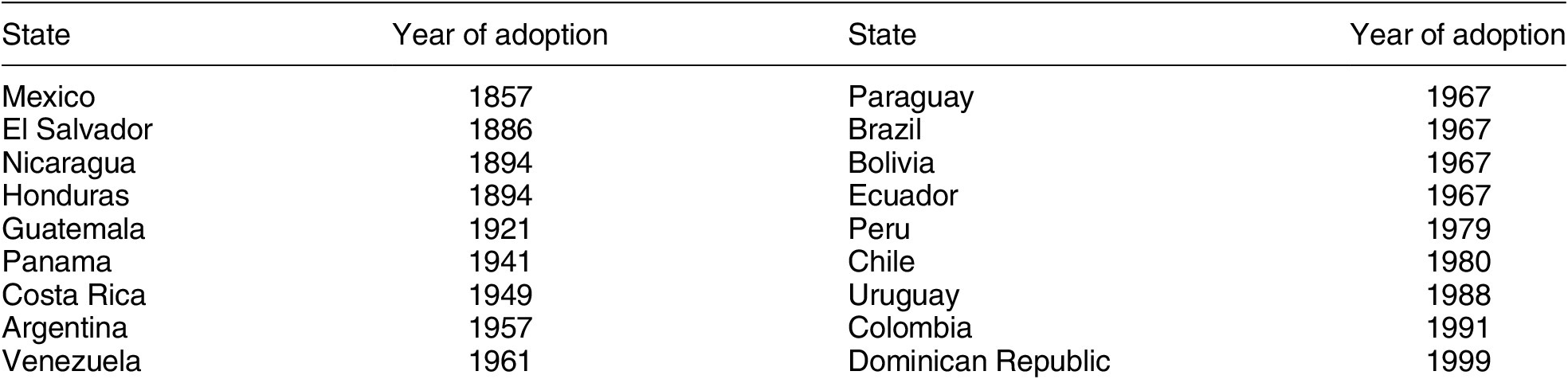
Assessing whether our conclusions can be expected to hold beyond Colombia’s tutela requires consideration of the constitutional complaint itself as well as the broad legal-cultural context. Crucially, individuals in 18 Latin American countries enjoy recourse to some form of an ICC. As Table 6 shows, Colombia was a regional latecomer to this innovation, as many other states adopted an ICC more than a century before. As we discuss above, the tutela was a central part of a constitutional reform designed to genuinely bring constitutional promises to the public. The tutela’s relative success has created a source of considerable support for its enforcement. This is not true of the region generally. The Mexican amparo, for example, was developed over a far longer period and under very different political and sociolegal contexts. It is understood to be far less accessible than the tutela and far less useful as a means of promoting individaul rights (Baker Reference Baker1971; Ríos-Figueroa Reference Ríos-Figueroa2016; Rubio, Magaloni, and Jaime Reference Rubio, Magaloni and Jaime1994). We might reasonably expect the Mexican public to respond quite differently to information about compliance with the amparo than we observed in Colombia. More broadly, our study points to the importance of context. Public reactions are likely to vary considerably across contexts because histories of rights protection and judicial–government interactions will set different expectations, which in turn will influence how information about compliance is interpreted.
Latin American States with a Form of Individual Constitutional Complaint and Year of Adoption

Beyond Latin America, examples of ICCs can be found in Europe (Albania, Austria, Belgium, Croatia, Czech Republic, Estonia, Georgia, Germany, Hungary, Latvia, Macedonia, Montenegro, Poland, Serbia, Spain, and Switzerland) and Asia (Armenia, Azerbaijan, India, Mongolia, the Philippines, Russia, Taiwan, Turkey, and Ukraine). ICCs are less prevalent in Africa: the South African constitution establishes an ICC, but court rules restrict access, with the result that there is about one ICC case per year (Dugard Reference Dugard2015). Even in countries without ICCs, the findings we report may be useful for supporting compliance with high-volume decisions rendered by social security administrative law judges, immigration judges, and other agency adjudicators (Gelbach and Marcus Reference Gelbach and Marcus2017).
We do not mean to downplay differences in the nature of ICC among these jurisdictions—they vary in whether citizens can directly reach the supreme or constitutional court, criteria for and effective cost of access, and other legal and institutional variables (Gentili Reference Gentili2010). However, largely because our findings underscore the importance of understanding local context and individual-level variation in perceptions, we believe our conclusions in the Colombian case have the potential to inform our understanding of ICCs in a wide array of contexts.
Our study has implications for theories of compliance that rely on public enforcement mechanisms (Carrubba Reference Carrubba2009; Carrubba and Gabel Reference Carrubba and Gabel2015; Trochev Reference Trochev2008; Vanberg Reference Vanberg2005). Models that invoke the public do so in general terms. These accounts purport that mass publics will always influence the ability of courts to induce compliance with their orders. When public support for courts is significant, the public’s ability to learn about instances of noncompliance will shape the behavior of officials subject to the court’s jurisdiction. When public support is low, this ability will not matter.
Accounts like these are useful for highlighting a general mechanism but do not offer sufficient detail to guide a policy reform directed at promoting compliance. Our study’s most important finding is that the effect of learning information about noncompliance differs among individuals who learn that the noncompliance rate is higher than expected as compared with individuals who learn that the noncompliance rate is lower than expected. The theoretical implication is that scholars of compliance should incorporate expectations into their accounts. Critically, this means more than simply building models in which uncertainty about features of the world are described via prior beliefs about key parameters, as is commonly done in game theoretic models of judicial–government interaction (e.g., Staton Reference Staton2010; Vanberg Reference Vanberg2005). That approach offers a way of incorporating uncertainty about the world. The point of the expectations-outcomes differential literature is that the actual value individuals attach to outcomes depends on expectations.
Supplementary Materials
To view supplementary material for this article, please visit http://doi.org/10.1017/S0003055421000903.
Data Availability Statement
Research documentation and data that support the findings of this study are openly available at the American Political Science Review Dataverse: https://doi.org/10.7910/DVN/LCCOH6.
Acknowledgments
We are grateful to the Colombian Constitutional Court for its cooperation and for allowing our team access to the tutela case files. Previous drafts benefited from generous comments provided by Sandra Botero, Daniel Brinks, Natalia Bueno, Amanda Driscoll, Jennifer Gandhi, James Gibson, Danielle Jung, Nahomi Ichino, William Mishler, Michael Nelson, Susanne Schorpp, Miguel Rueda, Renard Sexton, Georg Vanberg, and Erik Wibbels, as well as audiences at Duke University, the University of Texas, the University of Georgia, the Southeast Latin American Behavior Group (SeLAB), the Atlanta Comparative Political Economy Working Group, the Georgia Human Rights Network, and the Varieties of Democracy Institute.
Funding Statement
Funding for this project was provided by the World Bank’s Research Support Budget and its Human Rights Trust Fund. The findings and views expressed in this paper do not necessarily represent those of the World Bank or its Executive Directors. Additional support was provided by Emory University.
Conflict of Interest
The authors declare no ethical issues or conflicts of interest in this research.
Ethical Standards
The authors declare the human subjects research in this article was reviewed and approved by Emory University, Georgia State University, and the Universidad de los Andes, and certificate numbers are provided in the text. The authors affirm that this article adheres to the APSA’s Principles and Guidance on Human Subject Research.





Comments
No Comments have been published for this article.