


Despite a huge scholarly output on crashes since the meltdown of 2007–2008, there has not been a boom in histories of financial and economic crises. The interest of political and cultural historians in the economy is still limited and the field too readily yields to quantitative methods, writes Youssef Cassis. Other than the divided state of the academy, this is because “their periodical recurrence makes [economic crises] prone to a treatment where theoretical hypotheses can be tested empirically,” explains Cassis. “As a result, economic and financial crises have tended to be considered not as unique historical facts but as a sequence of events displaying common characteristics.” Capitalism's reemergence as a concept, however, offers a great chance to rekindle the interest of political, social, and cultural historians and help “free the history of economic crises from a strictly economic analysis.”Footnote 1
Cassis may be calling for a shift already well underway. Recently, historians have studied financial crises and economic change less through theories and data sets, and more from a broader cultural perspective.Footnote 2 Given the thriving scholarly and popular interest in the new “history of capitalism,” this comes as no surprise. The field understands the “marketplace” as a deliberate political, legal, social, and cultural construction. Historians of capitalism thus emphasize the investigation of perceptions, emotions, and assumptions. They research how social relations and a specific cultural environment influenced the construction of historical complex systems and directed the allegedly “invisible hand” of the market.Footnote 3 Behavioral economists have helped this push by declaring that the origins of crashes “lie in human nature,” and that financial crises should be seen, first and foremost, as crises of confidence.Footnote 4
Perhaps historian Jessica Lepler's recent work on an early nineteenth-century American crash is the best example of historians bringing a highly detailed cultural approach to financial panics.Footnote 5 “[A]ttention to historical nuance reveals that economic events rely on” specific historical contexts, Lepler states, “contexts that cannot be explained by quantitative research or theoretical models.” She advocates that scholars should acknowledge that “to some extent, the economy is culture.”Footnote 6 In this she is in tune with historians like Louis Hyman, who asserts that the defining feature of the history of capitalism is the study of historical “reality, more than any theory.”Footnote 7
Yet theory and historical nuance can and should be complementary. This article does not attempt to turn back the clock on how to study financial crises. Instead, I suggest that even historians who foreground the cultural idiosyncrasy of “their” panic should not hesitate to explore the economic mechanisms that lie at the heart of capitalism (yet which should not be mistaken for their specific historical representations). What stands out from even a cursory reading of financial crisis theory are the fundamental roles of credit and confidence, and their inextricable mutual connection. Such ideas can easily be translated to a certain historical context. They can then give historians a framework within which to situate their evidence and guide their inquiry. I argue that employing basic concepts of economic theory will in fact point to the need for contextual cultural explanations and can therefore complement new questions and approaches to financial crises. Thus, simply being aware of theoretical concepts can help guide, undergird, and expand historical explanations proposed by scholars of capitalism.
With few exceptions, however, a historical perspective is seldom combined with a theoretical framework.Footnote 8 This is particularly true for financial and economic crises of the Gilded Age and Progressive Era. The present article is therefore intended to show how theory and history can be jointly applied by weaving together concepts of economic theory with a narrative explanation of the causes and triggers of the Panic of 1873.Footnote 9
I
The Panic of 1873 was the first in a series of late nineteenth-century economic crises and heralded America's “Gilded Age.”Footnote 10 Originally remembered by contemporaries as “the Great Depression” of the 1870s, it was followed by several years of hardship. In the words of seasoned Wall Street journalist Alexander Dana Noyes, for the people of the late nineteenth century, “the financial crash of September, 1873, had been as memorable a landmark as, to the community of half a century later, was the panic of October, 1929.”Footnote 11
The dramatic experience of the Panic was arguably due to the harsh economic downturn that emerged from it. According to the National Bureau of Economic Research, the sixty-five months following October 1873 saw the longest economic contraction in U.S. history.Footnote 12 Newspapers spoke of “years of gloom.”Footnote 13 By August 1875, one contemporary claimed that “the panic …, has caused thousands and hundreds of thousands of able-bodied men to stalk the land, hunting for work.”Footnote 14 Yet scholars debate whether the Panic was indeed followed by severe and widespread depression. One recently stated that “contemporaries got it wrong,” and that, while damaged, the U.S. economy rebounded relatively quickly.Footnote 15 This is akin to the argument that uncertainty in the wake of the Panic created a perceived depression.Footnote 16
Perhaps equally striking for contemporaries, however, was the downfall of Jay Cooke, America's most reputable private banker at the time. His failure shocked observers, who also simply spoke of the “Jay Cooke panic.”Footnote 17 The bankruptcy on September 18, 1873, of Jay Cooke & Co., formerly a stronghold of stability, triggered the stock market crash in New York. Mistrust and panic subsequently spread to the overall financial sector and rattled customers and investors, causing heavy runs on banks. Countless financial houses suspended operations over the next years, severely damaging the availability of credit in the economy.
II
Financial and banking panic theory can guide the historical explanation of what critically impacted the confidence of capitalists and depositors in 1870s America. To get a good idea of where to look for explaining when and why investors decided to leave the market in 1873, it is useful to start by employing a cyclical model of crisis. The emphasis here is on understanding the power and fragility of credit in both boom and bust.
In emphasizing the recurrent appearance of speculative booms in financial panics, Charles Kindleberger has popularized a model devised by economist Hyman Minsky: Investors initially identify a new opportunity to make money, such as a technical innovation, a promising business idea, or access to a new market.Footnote 18 Profits result, which trigger further investments into a rising sector. At some point, new investments are made solely on the anticipation of buying a booming asset that will be sold for profit later on. This speculation is heavily dependent on the sufficient supply of credit; credit booms usually precede financial crises.Footnote 19 As long as new money is coming in to finance purchases and provide enough liquidity to service outstanding interest payments on old loans, enormous speculative gains based on skyrocketing asset values are possible. Expectations are high and “irrational exuberance” about ever-increasing prices prevails.Footnote 20
Yet investor optimism will eventually falter due to some kind of new information or circumstance that severely undermines future prospects. This “shock” turns the trickle of participants who exit the market to realize their profits into a flood of people wanting to get out. Once-promising securities in the booming sector are now sold in masses and thus tumble in value. The market collapses and panic ensues. Speculators find themselves in trouble trying to service their large debts; refinancing is no longer possible as their stocks and bonds are now falling in value and creditors no longer consider them attractive collateral. Anyone holding such securities without sufficient money at hand is similarly caught short. These stakeholders are thus forced to call in outstanding loans, further tightening the market; and seek to liquidate any assets they hold, causing a further and more general fall in prices. This might even include sizable sales of stable investments in unrelated markets, leading to widespread drops in prices and a widening of panic.
III
The Minsky model emphasizes the importance of capital flows for turning a boom into a bubble. After the Civil War and particularly during the early 1870s, the U.S. railroad industry provided the boom, while European capitalists provided most of the credit that was inflating the speculative bubble.
The most important sector of the American economy at the time, railroads were an important motor of U.S. economic growth. Inspired by the completion of the first continuous track from the Atlantic to the Pacific coast in 1869, other emerging transcontinental railroads amassed enormous federal land grants and gained peculiar appeal with investors and high-powered speculators.Footnote 21 Between 1865 and 1873, total railroad mileage in the United States more than doubled, with most of the tracks laid in 1870–72. Total capital investment also doubled between 1868 and 1873. And investments in railroads contributed to the growth of adjoining sectors like housing and the steel industry.Footnote 22 According to one contemporary observer, the years before the crisis could thus generally be characterized by “a rise of prices, great prosperity, large profits, high wages, and strikes for higher; large importations, a railway mania, expanded credits, over-trading, over-building, and high living.”Footnote 23
Yet American railroads had to contend with financial challenges. Vast sums had to be raised for an ever-expanding network of tracks. At a rate of $29,000 a mile, mileage in 1873 alone cost $121 million ($2.47 billion in 2015 dollars).Footnote 24 Large running costs conflicted with revenues generated chiefly in harvest season. Competition was fierce, and agricultural prices and freight rates fell simultaneously.Footnote 25 To generate liquidity, companies thus promised great returns on issued bonds, with continuously high interest rates.Footnote 26 Newspapers increasingly reported on the high risk for securities of seemingly profitable but often reckless or even fraudulent enterprises. When passenger and freight demand began to lag behind construction, or when estimated demand for new lines did not materialize, economic conditions for railroads deteriorated and many companies failed. While from 1868–71 there were a combined six failures of railroad corporations, this number rose to eighteen by 1872, and to at least fifty-three in the last nine months before the Panic.Footnote 27 The failure to generate revenue coupled with the inability to secure new investments or roll over credit were the main reasons why many companies defaulted on interest payment on their bonds.Footnote 28
A massive influx of European credit had fueled the investment boom in railroad bonds and shares after the Civil War.Footnote 29 Total capital flow into the United States between the end of the war and the year of the financial panic amounted to $1.14 billion, rising steadily from 1865 to its peak of $260 million in 1872. While bonds issued by the U.S. government still accounted for more than 70 percent of aggregate foreign investments by the end of 1869, American railroads were already thriving as an attractive foreign investment.Footnote 30 Their bonded debt exploded from $416 million in 1867 to a staggering $2.23 billion in 1874. Not all of this money reached the railroads, as most bonds sold at a discount.Footnote 31 The majority of U.S. railroad securities were always sold in London, but German and Dutch investors in addition to British capitalists increasingly bought up the bonds.Footnote 32
Without European capital the U.S. railroad boom would not have been possible.Footnote 33 Several scholars have thus taken a more international angle to the Panic of 1873. They particularly look at the causes of the increasingly more cautious attitude of investors and creditors that ultimately led to the bursting of the bubble. By employing the Minsky model and focusing on potential reasons for faltering investor confidence that ultimately also limited credit, Kindleberger has considerably broadened the origins of the American crash in 1873.Footnote 34 Rather than one decisive event, there seemed to be a series of shocks that altered investor behavior in the early 1870s.Footnote 35
First, post Franco-Prussian War investment booms in Europe itself gave continental investors a profitable market at their fingertips. Helped by the relaxation of German corporate laws in 1871 (producing a flood of new joint stock companies, especially investment banks) as well as expanded monetary supply resulting from French war reparations entering circulation in Germany, a credit boom fueled enormous growth in the railroad and housing sectors of both the German and the Austrian political economies.
Second, American investment opportunities were looking increasinly questionable to European investors. Continental creditors faced a considerable time lag for news and had to work with insufficient information, rendering American bonds and shares less attractive once alternatives could be had. Since the first transoceanic cable in 1866, the network circuitry between the old and the new world had become more reliable and telegraph companies were booming just as much as railroads. Telegraphy itself nonetheless remained an elite medium at the time.Footnote 36 Maybe more importantly, telegrams seldom conveyed enough details for pressing investment decisions and were not suitable for establishing the trust that was necessary for such transactions.Footnote 37 Overall, it was very difficult for continental investors, faced with a huge selection of competing U.S. railroad bonds, to find “truthful sources from which to gather authentic information,” as one German journalist moaned in 1873.Footnote 38
Tied to the information problem was the troublesome reputation of “American” political-economic practices. Manifold warning signs proliferated concerning the material nature of American railroads. Many newspaper reports detailed questionable business prospects and deteriorating conditions of railroad enterprises.Footnote 39 By 1872–73, more and more defaults on interest payments by railroad companies led European investors to realize that promised yields on bonds would seldom be reached, and that the risks were higher than anticipated. States, too, were defaulting, further worrying Europeans about to invest in American opportunities.
And news of major political scandals tarnished the reputation of American capitalism and its close nexus between business and government. Of particular importance was the revelation, in September 1872, of fraud and corruption around Crédit Mobilier, the financial company behind the Union Pacific Railroad that liberally bribed congressmen.Footnote 40 As Henry Adams had observed from England several years before, extensive swindles had the power to “cast all American railways here into discredit.”Footnote 41 By December 1872, it seems, this ill repute had spread beyond just the roads: “So many Railroad corporations have failed to pay their interest coupons as they became due, and states even have failed to make good their guarantees …,” reported the American consul in Frankfurt. “[T]he buyer now considers everything American uncertain.”Footnote 42 In short, due to the nature and provenance of their enterprise, even sound railroads could not escape growing distrust and a skeptical evaluation of their credit by overseas investors.
Finally, the European panics following the crash in Vienna in May 1873 forced rattled investors to back out of American securities. In addition to the substantial reduction of aggregate investments in U.S. rails, the transmission of economic pessimism from Europe to the United States and diminished confidence among financial market participants in general likely also played an important role, though economists debate the evidence of “financial contagion.”Footnote 43
As transatlantic investments petered out, banks that had loaned crucial funds to railroads by underwriting their bonds were scrambling to sell to new investors. Railroad companies and their financial agents were forced to borrow in an increasingly tight short-term money market in order to service their debts and interest payments and keep business running. Ever since the end of the Civil War, the U.S. treasury had been contracting the amount of paper money and securities in circulation in preparation for a resumption of specie payments (finally achieved in a return to the gold standard in 1879). This contributed to alarming stringency on American money markets at times, particularly from late 1872 throughout 1873.Footnote 44
In the nineteenth century, the London market usually provided emergency liquidity for Americans banks. One of the principal methods was to have a financial institution buy (“discount”) loans coming due in the future. The Bank of England was the world's most powerful credit institution and changed its discount rate quite frequently in 1873. Yet the argument that rising continental interest rates in the wake of European crashes were critical to the liquidity problems of American banks and “a recipe for international panic,” as one scholar states, is not fully convincing.Footnote 45 Guiding the prices of short-term lending, Bank of England discount rates were at their two-year low for nearly a full month before the September panic, giving New York bankers access to cheap money at the supposedly most critical time. A money stringency in London itself, meanwhile, did not reflect in the rates until November 1873.Footnote 46 Rather than contribute to the tightness of the American money market, however, the fluctuating London rates did add to the uncertainty of investors faced with decisions about U.S. railroad securities.
IV
One of the railroads struggling to attract investments was the Northern Pacific. In January 1870, prominent banker Jay Cooke had committed himself to creating vast sums for the ambitious transcontinental, telling a partner that “it will have to be raised just as all other roads raise their interest—from the sale of bonds … etc.,” secured by mortgage upon rails, telegraphs, and land.Footnote 47 The Philadelphian consequently began an all-out campaign promoting the railroad's allegedly boundless prospects, and, not least, its patriotic value in conquering the continent.Footnote 48 A large amount of his efforts went into acquiring sales partners among “the capitalists of Europe.”Footnote 49 Cooke tried to negotiate a widespread banking consortium that would market the railroad bonds in London and all over the continent. After initial interest, European financiers became wary once the Franco-Prussian War broke out. Undeterred, Cooke and his agents continued to create sales structures and buy into newspapers in order to advertise to European settlers the enormous, fertile lands alongside the Norther Pacific's promised tracks. His schemes on occasion became somewhat too creative: Cooke attempted to attract German settlers by naming the present-day capital of North Dakota “Bismarck”; praised Duluth, Minnesota, as the Paris of the prairies; and portrayed the northwest as a lush tropical paradise, which led to more ridicule than success.Footnote 50
The banker had good reason for his vigorous marketing activity. Cooke had underwritten Northern Pacific bonds for the huge sum of $100 million, half of which he had planned to float abroad. As international investments were drying up, domestic sales became more pressing. The railroad's business was going poorly for various reasons.Footnote 51 Cooke's partner Harris Fahnestock warned that “the present condition of the Northern Pacific, if it were understood by the public, would be fatal to the negotiation of its securities.”Footnote 52 Yet negative reports did appear left and right. One article, looking closely at the Northern Pacific, warned that business was “making ready for the storm. Woe to the company now in the West which has to borrow money or place bonds!”Footnote 53 By the summer of 1873, the line owed Cooke's bank $7 million, with no prospects of repayment anytime soon. Cash flow became a serious problem. Unbeknownst to the public, the Philadelphia banker indeed became distressed enough to secretly enlist his brother Henry, director of the Freedman's Savings Bank, to invest his depositors’ hard-earned money into the Northern Pacific.Footnote 54
The Northern Pacific was just one of many failing railroad enterprises, but its banker was among the most prominent financiers. Reports of widespread disturbances over the second half of the year indicated that many railroads and their financial agents were in dire straits. “Shall we have another Black Friday?” asked Harper's Weekly in early September.Footnote 55 Jay Cooke was not the only overextended house nearing insolvency in September 1873, but amid sliding bond prices, well-known bankers Kenyon, Cox & Co.’s failure on the 13th, for example, merely threw Wall Street “into a fever.” Only once Cooke's failure was announced did September 18, in the words of one broker, turn into “black Thursday, … the worst disaster since the Black Death.”Footnote 56
Contemporary accounts provide a vivid picture of the panic, as journalists competed for the most lively description. Brokers “surged out of the Exchange, stumbling pell mell over one another in general confusion and reached their offices in race horse time.”Footnote 57 The New York Tribune drew another analogy: “Many tore their hair and ran about as if crazy … [A] stranger might have well believed himself in a mad house.”Footnote 58 Stock indices show that panic on Wall Street was now in full swing.Footnote 59 A sharp observer, George Templeton Strong, noted on the evening of September 18, 1873, that the failure of Cooke was indicative of “the general smash that must come before long.”Footnote 60
As reports confirmed that all of Jay Cooke & Co.’s domestic branches, including Philadelphia and Washington, D.C., had closed, the next day turned into “Black Friday.” “[M]en rushed to and fro trying to get rid of their property,”The Nation later recapped, “almost begging people to take it from them at any price.”Footnote 61 Fisk & Hatch, which had also worked U.S. government bonds during the Civil War, suspended alongside countless brokerage houses. Stocks collapsed and were battered mercilessly.Footnote 62 As investors desperately sought liquidity, a currency premium emerged. With images of people crowding to recoup their deposited money from the banks, the Panic soon had its classic visual symbol to appear in newspapers.Footnote 63
Losses on the New York Stock Exchange reached a high point on September 20, when, for the first time in history, the exchange closed its doors indefinitely. A “seething mob” of investors was turned out on the corner of Wall and Broad Street.Footnote 64 The market remained closed for a full ten days. Money stayed so short that only a few loans were made altogether, with interest rates reaching 1.5 percent a day.Footnote 65
The immediate political reaction to the crisis was limited. Ulysses Grant dismissed pleas to increase the currency in circulation, such as lending the treasury reserve of $44 million in legal tenders to the banks in order to alleviate the money stringency and replenish reserves. Skeptical of Wall Street, the president planned on leaving it to its fate. “[T]he money corporations have become stampeded, and in turn startled and stampeded the whole country,” he stated in an interview in early October, doubtlessly thinking of the downfall of great houses like Cooke. Grant nevertheless maintained that “[t]he effect [of the Panic] is going to be beneficial in many ways to the country at large, though the cost to some individuals … may be severe.”Footnote 66 Committed to hard, that is, gold-backed money, the president was not inclined to bail out the banks by inflating the paper currency. Secretary of the Treasury William Richardson only bought back outstanding government bonds to the value of $14 million by the first week, and $26 million altogether.Footnote 67 Acknowledged by Grant as “not so much real as moral” help, the money was quickly hoarded and never reached the New York banks that were in serious danger.Footnote 68 As August Belmont, the Rothschild's partner in New York, observed: “[T]he parties requiring aid are not those who have Bonds, and the sums offered … are not sufficient to ease the money market.”Footnote 69
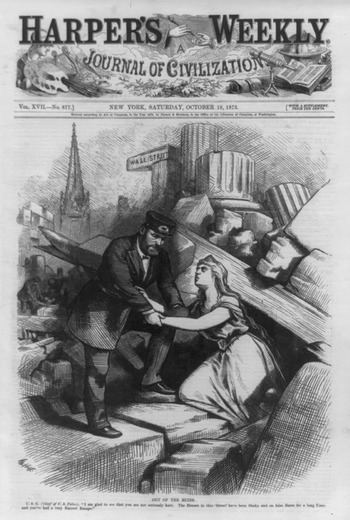
Over the next half-decade after the Panic, the nation was not to emerge from the collapse quite as unscathed as cartoonist Thomas Nast suggested when he sketched President Grant as a disappointed chief of police helping an unhurt Lady Liberty rise from the ruins of Wall Street. (Library of Congress)
Much more powerful than similar institutions today, which are confined to settling balances among banks, the New York Clearing House (NYCH) brought together all of the city's most important bankers. This enabled the house to set collective rules.Footnote 70 The first action taken to cope with worsening bank runs was to issue loan certificates. Accepted as joint liability by all member banks of the NYCH, they became artificial currency, capable of settling the important interbank debts that accounted for strenous “silent runs.” In order to cope with withdrawals by the nonbank public, to whom the loan certificates were useless, member banks also pooled their currency reserves.
Even though these measures helped distribute the pressure, bank runs remained severe. In New York City, they would only reach their peak after about three weeks of heavy withdrawals.Footnote 71 On September 23, the large house of Henry Clews & Co. had to close its doors, further increasing anxiety. The next day, the NYCH decided to restrict cash payment to households by paying off larger sums in certified checks, not greenbacks. As the checks quickly fell to a discount relative to the legal tender, this was de facto a suspension of currency payments. It lasted for six weeks after the Cooke failure and set a precedent for banks all over the country to follow suit.Footnote 72
V
Sectoral downturn in the railroad industry had arguably been happening from late 1872 onward. Credit supply in the American markets had been extremely stringent, and increasingly skeptical overseas investors had been pulling out their money, rejecting new investment opportunities in U.S. enterprises. Yet apart from minor crashes no full-blown panic happened during the seasonal monetary stringency in March, or after the Viennese crash in May, until the bankruptcy of Jay Cooke & Company in September 1873. In order to explain this problem, understand the significance of the failure, and describe the importance of the ensuing bank runs—which seem largely responsible for the real economic severity of financial crises in general—we have to turn to banking panic theory.Footnote 73
A banking panic happens when critical numbers of customers somehow lose trust in the safety of their deposits and accordingly withdraw their funds from banks. This leads to further withdrawals by other customers who also lose confidence.Footnote 74 One theory assumes that banking panics are unpredictable and mostly random events. Douglas Diamond and Philipp Dybvig believe that it is sufficient for “anxious depositors” to assume, for any reason whatsoever, that a number of unknown customers of the same bank are withdrawing their money or will do so in the near future. Thus a panic could happen if anxious depositors observed a long queue in front of a bank, perceiving that it might be in trouble—only that in Hong Kong in 1985, for example, people had been queuing for a bakery next to the bank.Footnote 75
Even if (assumed) mass withdrawals are not happening right in front of anxious depositors, they suspect that any random, ostensibly significant new development might in fact be forcing other clients to seek liquidity and draw out funds. Anxious depositors know that banks are limited by “sequential service constraint” and will thus only pay out to a certain number of customers on a first-come, first-served basis. Dreading inaction, anxious depositors find themselves in a prisoner's dilemma and therefore opt to be on the safe side by drawing out their own deposits, just in case. By doing so, however, they might propel the very panic they imagined and feared.Footnote 76
What the random withdrawal model cannot explain is how and when these urges to withdraw form. Other scholars argue that differences in the availability and credibility of information between a variety of actors in the financial market account for these actions. Banking panics, the argument goes, are “systematic responses by depositors to changing perceptions of risk, based on the arrival of new information, rather than random events.”Footnote 77 Such an “information shock” could come from any large public signal, whether that is a published statement or a high-profile failure. Investors who lack further evidence but who have the nagging feeling that there may be something they don't know, generally see shocks as indicators of negative economic development, whether on the financial markets or in the real economy. Structural information asymmetry thus is the root cause for depositors’ beliefs that they have to withdraw. Depositors are not necessarily anxious, but lack important information.
Information asymmetry is critical to both the original assessment of the information shock, and to determining the decision to withdraw currency from banks. Some kind of shock prompts investors who face information asymmetry to liquidate classes of assets (e.g., railroad bonds) that they think may be negatively affected by the new development. This leads to a fall in prices among those securities, some of which banks may hold as collateral for short-term loans on the money market. A stock exchange crash even in a completely different market, however, will cause some investors to default on short-term loans. Since the promised collateral has declined in value, banks then may be in danger of overextending and becoming insolvent.
Depositors suffer from insufficient information about which banks hold such securities and which ones will thus be stretched thin by the recent development. Their risk assessment therefore prompts them to liquidate assets and withdraw funds from all banks for as long as uncertainty (i.e., a lack of accessible or trustworthy information) remains about which banks are sound or unsound.Footnote 78 In 1873, rising informational asymmetry in the marketplace resulted in uncertainty among depositors about which banks were connected to “toxic” railroads and other ruinous speculative investments.
Banking panic theory gives the historian some guidelines into inquiring why, when, and how depositors decided that their money was in danger. And information asymmetry is specific to the market structure—in other words, it is historically specific. The model therefore also emphasizes people's perceptions of what seemed important at the time. Informational banking panic theory can thus link a thorough reconstruction of the historical context of markets and investors—something firmly on the mission statement of historians of capitalism—to identifying the mechanisms behind crashes, bank runs, and the ensuing spread of panic throughout the financial sector. In short, it provides a starting point as well as a framework for the study of financial crises from a cultural perspective.
Specific to 1873, an information-shock perspective can help us untangle how the fate of Jay Cooke & Co., intricately tied to the railroad sector alone, helped turn a sectoral recession that was already under way into a major crash, bank runs, and eventually an all-out slump. The question now becomes how Cooke's bankruptcy could constitute a major information shock.
VI
A respected Philadelphia investment banking house with additional branches in Washington, D.C., New York City, and London, Cooke & Co. was a small but important part of the capital institutions upon which the rest of the nation's money supply depended.Footnote 79 This unbalanced distribution of capital resulted because banks in the interior mainly financed farmers, so their major cash needs arose during sowing and harvesting seasons. For most of the year, therefore, these “country banks” transferred their reserves to East Coast banks. In 1873, between 70 and 80 percent of bankers’ deposits from the country were held by just seven major New York banks.Footnote 80
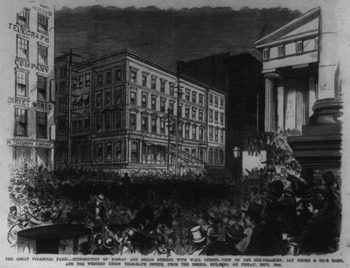
Situated near the corner of Wall and Broad Street, Jay Cooke & Co. was also geographically central to the panic. (Supplement to Frank Leslie's Illustrated Newspaper, October 4, 1873. Library of Congress)
Seasonal demands by country banks thus led to severe, though predictable, currency stringency in the eastern financial centers, particularly during spring and fall.Footnote 81 Deposit withdrawals drew down banks’ currency reserves, which were difficult to replenish, as interest rates skyrocketed and the money market tightened.Footnote 82 The country bank funds were normally loaned out to Wall Street stockbrokers in large packages on a daily “on call” basis, secured by stocks. In the event of a stock market collapse, however, the value of these securities rapidly decreased, possibly leaving key banks with costly loan defaults and short of currency to service withdrawals. A structurally fragile financial system made conditions harder on banks, particularly those engaged in financing a slowing railroad industry.
Jay Cooke stood out to many people for his patriotic efforts, his continued influence on the treasury, and his willingness to take on big projects. Cooke had acquired a heroic reputation for financing the northern war effort by successfully selling U.S. government bonds during the darkest days of the conflict. He maintained close ties to the federal government and was well known to be an extension of the treasury after the Civil War. A string of successes increased his status as America's preeminent banker in the late 1860s and early 1870s. Adding to his domestic efforts, Cooke & Co. in 1871 almost single-handedly brokered the refinancing of U.S. treasury debts in Europe. This operation put the bank “a head and shoulders above any American house in Europe,” as even rival Levi P. Morton acknowledged.Footnote 83 As a result of all this, Cooke had enormous exposure. The financier's “operations since the war are a part and parcel of the history of the day,” wrote the New York Times in something resembling an obituary on the day after his failure. It concluded the bankruptcy was “indeed a matter of national regret.”Footnote 84
At a time when financial questions also gained an increasingly moral dimension, backed by an emphasis on ethics within economic thinking, huge scandals put Wall Street financiers and their cronies in politics and press under general suspicion.Footnote 85 The financial giants Jay Gould and Jim Fisk, for instance, notorious for being deeply involved in the infamous “Erie Ring,” attempted to manipulate the gold price in 1869. Their doings resulted in a stock market panic that reinforced perceptions of a reckless and corrupt Wall Street.Footnote 86
Cooke distinguished himself through his visibility and relative standing in the eye of the general public. Modest, temperate, and pious in his demeanor, the well-known Philadelphia banker did not fit people's picture of a reckless Wall Street trader and had simply not been part of any of the big scandals that shook the financial and political world. During the important 1869 gold corner, he even called for stability over speculation and denounced the main culprits Fisk and Gould.Footnote 87 Cooke's character contrasted favorably with that of Gould, easily “the most hated man in America” at the time.Footnote 88
In the credit business of the nineteenth century, character mattered a lot. Credit rating agencies like Bradstreet that prospered after the Civil War traditionally tied risk assessment to assumptions about correct moral behavior.Footnote 89 Investment banking, especially with small investors, fundamentally relied on the trustworthiness of the leading banker of a house. Having pioneered new ways of marketing bonds via domestic sales networks aimed at small investors, Cooke was also at the heart of integrating small American investors into a new and patriotic national market.Footnote 90 Reminiscent of his modus operandi in marketing government bonds during the war, when he often advertised by means of a personal letter to the public, Cooke thus made a point of personally guaranteeing the soundness of his investment proposals. Aware that “credit is a tender plant” that had to be nursed over an extended time, he maintained that people “purchased simply on my word, not on the word of Jay Cooke and Company … so much as my personal reputation.”Footnote 91
This was characteristic of the time during which people focused on key figures. Cultural historian Peter Knight argues that America's Gilded Age saw its own particular brand of capitalism that was still very much rooted in earlier times. The market economy did not replace the moral economy, but merely added to it. Americans did not place trust in an opaque financial system, increasingly complicated instruments, or abstract economic ideas, but humanized the market through “sentimental personifications.”Footnote 92
These personifications indeed helped people deal with rapid changes.Footnote 93 The Industrial Revolution that took off after the Civil War, and the emergence of sophisticated financial instruments that accompanied it, commodified risk itself. Financializing property blurred perceptions of “honest” buying and selling and “dishonest” speculation.Footnote 94 Jonathan Levy, in fact, argues that the Panic of 1873 effectively and publicly showed that “risk was becoming systemic in character.” The crisis was nothing less than “a profound cultural event, the coming-out party for the economic chance-world,” revealing, not least through the unexpected fall of Cooke, the degree to which speculative dealings and risky investments appeared fundamental to the United States’ economic boom.Footnote 95 Capitalism ran on what Steven Mihm has called the “confidence game.”Footnote 96
Even though the political economy of the United States in 1873 was still very much a family capitalism dominated by small enterprises, their trade relied equally on credit and confidence. Instruments like bank drafts and trade acceptances used to contract mercantile credit had become more financialized and tradable after the Civil War, which increased the importance of banks for small businesses. A high-profile crash like Cooke's might have also set back confidence in the world of mercantile credit, because, as Rowena Olegario concludes, “trust was a functional component of the entire national economy.”Footnote 97
Wall Street, too, played a pervasive role despite its relatively small size. The United States were several decades away from becoming a “shareholder nation” and a majority of people thought speculative dealings unethical and irreconcilable with traditional ideals, values, and practices. Financial markets were considered rigged, the dice heavily loaded in favor of Wall Street insiders.Footnote 98 But Wall Street commanded a certain fascination. Henry Adams recounted how “the whole nation flung itself into the Stock Exchange” during the Civil War.Footnote 99 After the war, Wall Street's financial giants dominated the political and economic landscape. Some marveled at them, others considered them sinners, but the Street certainly polarized. As it entered its “flash age,” Wall Street for the first time captured broad attention.Footnote 100 Now an object of mass fascination, it inspired delusions of grandeur in everyone. Americans, particularly of the middle class, were “emotionally invested in the stock market long before they became financially invested,” argues Knight.Footnote 101
All of this helped make Jay Cooke the main character in the drama of 1873. The Cooke failure, particularly through the anxiety conveyed in correspondence as well as press coverage, seemed to shatter many people's confidence.Footnote 102 Informed by finanial crisis theory, we can confidently argue that the failure of the infallible banker created confusion and information chaos, thus forcing fearful depositors to withdraw after scrambling for information. Even insiders reacted with dread upon hearing that Jay Cooke & Co. was in trouble. J. P. Morgan, for example, decided to overrule his partner and call in all of Drexel, Morgan & Co.’s loans, particularly the high interest ones, risking a great loss of revenue. “Impossible [to] foresee [the] future,” he then cabled to his father in London on the day after Cooke's insolvency.Footnote 103
Bankers like Cooke held great sway over the American financial world, but their power over people's confidence was magnified by the larger-than-life role they played for the Gilded Age public. “[P]eople asked each other in dismay, whom can we now trust, and the answer was, no one,” recounted one paper. Disbelief quickly led to “a feeling of doubt and insecurity among depositors,” wrote the Commercial and Financial Chronicle. As another newspaper explained, “general distrust … caused a general and rapid calling in of loans.”Footnote 104 Maybe the memoirs of a contemporary entrepreneur who witnessed events put it best:
Only those who were in business then can have an idea of what that news meant to us in [New] York and to every citizen in the nation. Jay Cooke … had become the foremost financier of the country; to the people in general who knew nothing of finance, he was almost the financial father. That his firm could fail was all but unthinkable; as the Philadelphia Inquirer put it, no one could have been more surprised ‘if snow had fallen amid the sunshine of a summer noon.’ A policeman arrested a newsboy in Philadelphia for crying ‘All about Jay Cooke's Failure’—he could not imagine the fact of failure and thought the boy had gone mad.Footnote 105
CONCLUSION
Late in his life, the influential columnist Alexander Noyes looked back upon the long history of American financial crashes he had witnessed and noted that people yet again seemed to have forgotten “old rules and principles and precedent of finance” in their pursuit of speculative gain.Footnote 106 More prominently termed the “this time is different”-syndrome, this assessment is illustrative of the fact that every age made its own money-making culture.Footnote 107
In the Gilded Age and Progressive Era, money making was heavily attached to trust in big names. Reliance on their standing and reputation helped make people accept financial dealings in a system based on paper currency. Thus high-profile figures like Jay Cooke facilitated the systematization of dealing in risk. Both an information-based theoretical approach and the historical evidence show Jay Cooke's impact on the (de-)construction of confidence in the financial marketplace as well as the wider credit-dependent society. Being associated with an outstanding position in all matters of American finance multiplied the information chaos as well as the psychological shockwaves that spread in the wake of his bankruptcy. This explanation of the causes of banking panic in 1873 reasserts classic interpretations like Oliver Sprague's, who concluded that it was “the general feeling of distrust” that caused more damage than direct financial losses.Footnote 108
Moreover, contemporary accounts thus seem much closer to the underlying mechanics of the panic than their somewhat intuitive and colorful observations might at first indicate. “[T]here has not been such a panic in the money market … that has produced such a general feeling of uncertainty throughout the commercial community of the City,” an incredulous New York Times journalist wrote. “Nobody knew how to act or where to place confidence. In fact, there was little disposition to trust any firm however solvent.”Footnote 109 Well over a month after the initial panic, then, one diarist noted that “faith in financial agents is gone” and that “[e]very treasurer and cashier” remained suspect.Footnote 110
Many studies about interest rate spreads or business cycles might drown out these individual historical voices, but qualitative concepts in financial crisis theory seem able to embrace them. In turn, economic theory as both a framework and a starting point to an explanation of financial crises can add texture to Lepler's assertion that “the economy is culture” by helping to explain why and how some structures of exchange systematized and conditioned human confidence. When acknowledging the centrality of credit and its cyclical use, as laid out in the Minsky model, as well as recognizing the importance of information asymmetry specific to market structure, historians will find many new questions to ask of the wider political, social, and cultural contexts of historical panics.
The big advantage of the concept of capitalism, as Cassis points out, is its broadness and capacity to include diverse approaches.Footnote 111 Whether the historiographical pendulum has already swung toward cultural histories of financial crises or not, historians of capitalism should also continue to engage with economic concepts, models, and ideas in order to explore the past.


