1. Introduction
When it comes to the liberalization of trade in services, reciprocal negotiations of specific commitments on market access and national treatment have a limited role to play. At best, they have contributed to consolidate applied regulatory policies.Footnote 1 But conditions for the effective integration of service markets cannot be met just by removing market access restrictions and discriminatory measures from the rule book. The regulatory intensity of service markets makes trade in services particularly vulnerable to regulatory divergence. Information asymmetries, negative externalities, or imperfect competition, and a range of public policy reasons, justify all sorts of regulatory interventions. Inevitably, the extent and modalities of such interventions vary across jurisdictions in accordance with socio-economic and political factors, cultural values, and legal traditions. As a result, the same service or service supplier remains subject to different regulations in different jurisdictions.
The need to adjust supply to non-discriminatory but different import country licenses or qualification requirements raises the cost of trade in services,Footnote 2 not to mention the additional problems caused by redundant or unclear regulations and arbitrary or inefficient regulatory practices. The problem is here to stay. In fact, the extent of regulatory diversity is expected to grow due to technological reasons – the digital economy creates a whole new platform for regulation – and consumer demands – the rise of the middle class in emerging markets is accompanied by a rise of demand on stronger safety and environmental protections.Footnote 3
Addressing the trade costs stemming from ‘pure’ regulatory heterogeneity of services regulations, i.e. differences that are not in any way attributable to protectionist or anti-competitive goals,Footnote 4 is a delicate task. It is uncontroversial that Preferential Trade Agreements (PTAs) must address regulatory protectionism, whether it is embedded in domestic regulations themselves, or in the way they are administered and applied.Footnote 5 But it remains debatable how far they should go in addressing trade costs stemming from strictly non-discriminatory regulatory divergences.Footnote 6 Avoiding tackling the problem altogether, for the sake of preserving the right to regulate the supply of services in pursuance of legitimate public policy objectives, would render trade agreements incapable of delivering effective market integration beyond applied regimes. Yet, opting for trade disciplines that push the quest to iron out disparities between strictly non-discriminatory regulations too far could restrict the right to regulate beyond what is politically acceptable.Footnote 7
The drafters of the GATS opted to focus on the removal of quantitative and discriminatory restrictions, including only rudimentary tools for tackling regulatory divergence: basic transparency disciplines,Footnote 8 procedural disciplines for the application, administration and review of domestic regulations,Footnote 9 and a mandate for the negotiation of disciplines for the development of licensing requirements and procedures, qualification requirements and procedures, and technical standards.Footnote 10 Although these negotiations have recently picked up some pace,Footnote 11 this momentum has only served to highlight the profound differences that exist among WTO Members on the extent and methods for addressing trade costs stemming from non-discriminatory regulations.Footnote 12
At the regional level, however, it appears that the pendulum is swinging in a different direction. A cursory review of the latest PTAs reveals a whole new range of disciplines designed to iron out regulatory disparities on services, ranging from the expansion of transparency disciplines to a whole new spectrum of disciplines on regulatory coherence and regulatory cooperation.Footnote 13 These changes are part of a broader trend characterized by the increasing number of services PTAs.Footnote 14
Before discussing the merits of this trend, there is a need to establish the facts: what are the characteristics and the extent of these new trade disciplines? Is it simply about an expansion of existing GATS provisions (‘GATS plus’) or do they cover matters not addressed by the multilateral agreement (‘GATS extra’)? Are the new disciplines legally enforceable? What are the similarities and differences between them across PTAs? Surprisingly, in spite of the increasing relevance of services PTAs, and the potential implications of these new disciplines for the right to regulate, there is relatively scant literature covering this matter. Most of the literature on services PTAs is focused on assessing the extent of their market access and national treatment preferences.Footnote 15 Few studies focus exclusively on PTAs’ services rules, let alone on those rules specifically designed to tackle regulatory divergence in services.Footnote 16 Against this background, the aim of this paper is to carry out a comprehensive and comparative review of recent PTA disciplines aimed at tackling regulatory divergence in services, and to offer a preliminary assessment of the likelihood of these PTAs cutting down trade barriers beyond applied regimes.
At the outset, some clarification of the terminology used by this paper is required. Polanco and Sauvé use the term ‘regulatory convergence’ to refer to the ‘overarching notion of reducing unnecessary regulatory incompatibilities between countries in order to facilitate trade and investment’,Footnote 17 and identify different mechanisms to achieve regulatory convergence, with different nomenclatures – regulatory cooperation, coherence, improvement, coordination, or harmonization, among others. They rightly note that scholars use these concepts interchangeably, without much clarification of underlying differences – if any.Footnote 18 The vocabulary found in PTAs is also inconsistent and ambiguous.
This paper will focus on three types of trade disciplines aimed at tackling regulatory divergence in services: (a) disciplines on regulatory transparency, i.e. provisions prescribing duties aimed at disseminating information about regulatory measures affecting trade in services; (b) disciplines on regulatory coherence, i.e. provisions prescribing minimum standards and principles that must be observed when developing, applying, administering, and reviewing domestic regulations; and (c) disciplines on international regulatory cooperation, i.e. provisions aimed at encouraging dialogue, exchange of information, and other forms of cooperation between domestic regulators. As with any classification of legal concepts, there are no hard boundaries between them. Further specifications are provided in the relevant sections below.Footnote 19
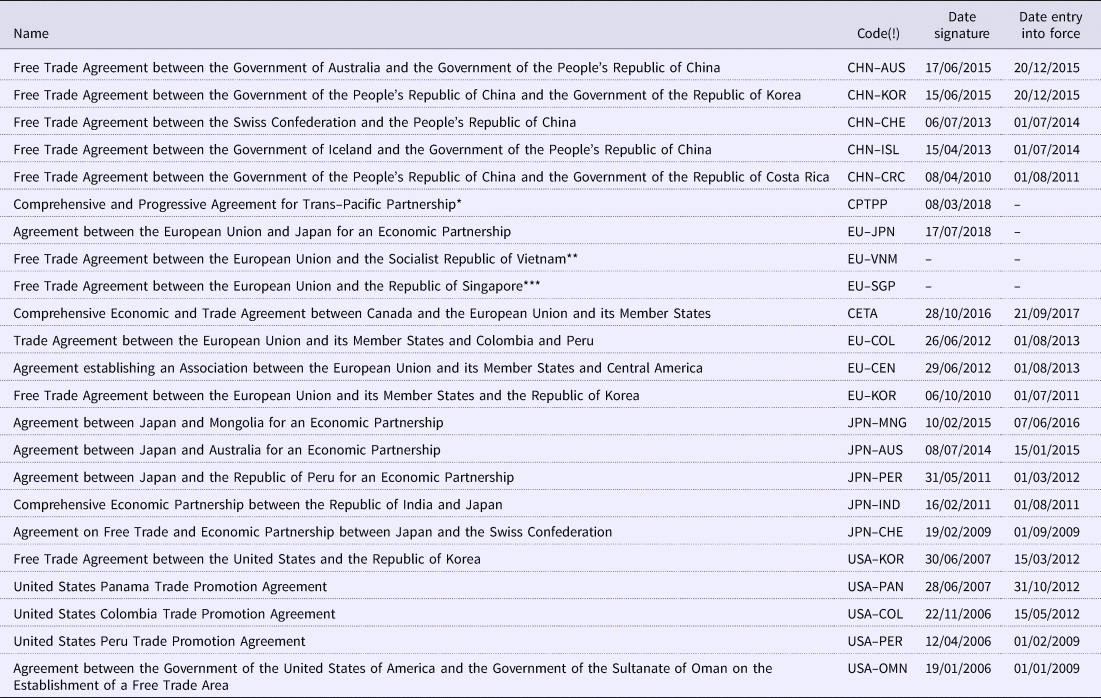
The paper reviews 23 PTAs entered into by the four largest trading players in the world, i.e. China, EU, Japan, and USA, including some of the most comprehensive and innovative PTAs that have recently been signed. The sample consists of the last five PTAs signed by China and Japan, the last six PTAs signed by the USA, including the TPP,Footnote 20 and the last five PTAs signed by the EU, plus the text of the EU PTAs reflecting the outcome of the negotiations with Singapore and Vietnam, which are awaiting signature (see Table 1). Although the four of them have signed agreements covering trade in services that go back to the early 2000s, the period of analysis covers PTAs that go back to 2010 for China and EU, 2009 for Japan, and 2006 for USA. Clearly, this is not a representative sample of the universe of PTAs currently in force and no statistical inferences should be drawn from the information provided below. Notwithstanding the illustrative nature of this sample, given the relevance of these trading playersFootnote 21 and the date of adoption of the agreements, it is not unreasonable to suggest that it provides a fair overview of the most recent developments of PTA disciplines on trade in services.
Recent preferential trade agreements from China, EU, Japan, and USA

Notes: *Text signed on 8 March 2018, www.mfat.govt.nz/en/trade/free-trade-agreements/free-trade-agreements-concluded-but-not-in-force/cptpp/comprehensive-and-progressive-agreement-for-trans-pacific-partnership-text/#chapters.
** Text at the end of the negotiations as of January 2016. Subject to legal revision in order to verify the internal consistency and to ensure that the formulations of the negotiating results are legally sound. It will thereafter be transmitted to the Council of the EU and to the EP for ratification, http://trade.ec.europa.eu/doclib/press/index.cfm?id=1437.
*** Text presented by EU Commission to the Council on 18 April 2018, http://trade.ec.europa.eu/doclib/press/index.cfm?id=961.
!For ease of reference, other than CETA and CPTPP, we use country name abbreviations to refer to the PTAs based on the ISO 3166-1 alpha-3 three-letter country codes. For the European Union we use ‘EU’. The partner under examination always go first.
The article examines relevant provisions on regulatory transparency, regulatory coherence, and regulatory cooperation included in the services chapter, specific chapters on telecommunications, financial services, electronic commerce and movement of natural persons, and, where available, horizontal chapters on transparency and regulatory cooperation or regulatory coherence. It compares PTA disciplines with those of the GATS, identifying ‘GATS plus’, ‘GATS extra’, or ‘GATS minus’ developments, and compares similarities and differences across PTAs. In order to assess the likely impact of these provisions in tackling regulatory divergence, it also evaluates their legal enforceability.Footnote 22 The rest of the paper is organized as follows: section 2 focuses on regulatory transparency, section 3 on regulatory coherence, section 4 on regulatory cooperation, and section 5 concludes.
2. Regulatory Transparency
2.1 Overview
Regulatory transparency supports informed and accountable rule-making practices. It fosters fair and effective governance, public confidence in regulatory performance, and economic efficiency.Footnote 23 Conversely, lack of transparency increases transaction costs, causes delays, fosters opaque and arbitrary decision-making practices, and increases the risk of duplications or over-regulation. From a trade perspective, regulatory transparency helps to raise awareness of the social and economic costs and benefits of domestic regulation.Footnote 24 It is an essential pre-condition to facilitate trade, particularly on regulatory intensive sectors, such as services. Quite sensibly, most trade agreements include disciplines on regulatory transparency.
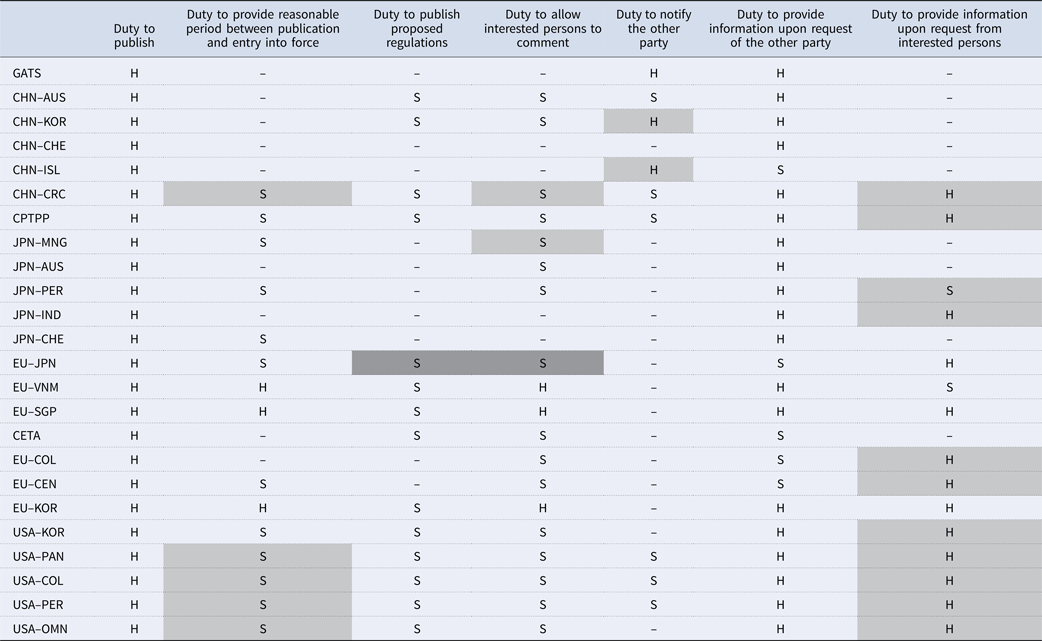
Table 2 compares GATS and PTA disciplines on transparency applicable to services regulations, irrespective of their location within the agreement.Footnote 25 For the sake of clarity, transparency disciplines are classified into three sub-categories: duty to publish, duty to consult, and duty to inform. The table distinguishes disciplines phrased in hard terms (i.e. ‘shall’) from those phrased in soft terms (e.g. ‘to the extent possible’).Footnote 26
Transparency

Notes: ‘H’ = Hard Obligation (i.e. ‘shall’); ‘S’ = Soft Obligation (e.g. ‘shall endeavour to…’), ‘–’ = Not Applicable.
 Applicable only to the chapter on services.
 Applicable only to regulatory measures as defined by Article 18.2.
2.2 Duty to Publish
GATS’ duty to publish is prescribed by Article III.1. On scope, rationae materiae, it covers ‘all relevant measures of general application which pertain to or affect the operation of this Agreement’, including international agreements to which a Member is a signatory. On scope, rationae personae, it captures measures adopted by central governments, but not those adopted by regional and local governments and non-governmental bodies in the exercise of delegated powers.Footnote 27 Instead, it is for Members to take reasonable measures as may be available to them to ensure that these bodies publish the measures of general application they adopt.Footnote 28 Article III.1 also stipulates that the duty to publish must be discharged ‘promptly’ and, ‘at the latest by the time of the measure enters into force’, except in emergency situations. But Article III.2 softens these terms by acknowledging that there may be situations where the duty to publish may not be practicable. In such cases, the obligation is to resort to alternative means to make the information publicly available.Footnote 29 There is no specific reference to the right of interested persons to become acquainted with such measures.
As apparent from Table 2, all PTAs under examination include a hard horizontal duty to publish product and services regulations, which, in general terms, goes well beyond that of GATS. On scope, rationae materiae, most PTAs offer a more precise definition of the measures to be published.Footnote 30 Some PTAs even include ‘judicial decisions’ that may affect the operation of the Agreement within the scope of measures to be published.Footnote 31 On scope, rationae personae, most PTAs’ duty to publish captures measures adopted by central, regional, or local governments and non-governmental bodies in the exercise of delegated powers in the same way, without introducing differences according to the level at which the measure has been adopted.Footnote 32
Almost all PTAs stipulate that, if not published, the measures must be otherwise made available in such a manner as to enable not just the other Party but also ‘interested persons' of the other Party to become acquainted with them. This and various other references to ‘interested persons’ indicated below mark a clear trend in recent trade agreements to go beyond traditional horizontal obligations, i.e. those owed by one party to the other, and include vertical obligations owed by each party to traders and other relevant stakeholders.Footnote 33 But, of course, this does not automatically entitle the interested persons to claim such protection at the international or the domestic level. Treaty enforcement remains strictly intergovernmental.
Like the GATS, the requirement to publish the relevant measures ‘promptly’ is also included in most PTAs, and save for CHN–CHE, JPN–CHE, and CHN–ISL there is no ‘emergency situation’ exception to escape from such obligation. In addition, most PTAs include some or all of the following GATS plus obligations: a duty to publish an explanation of the purpose and rationale for the regulation of measures adopted by central governments;Footnote 34 a duty to publish measures on specific outlets;Footnote 35 and a duty to confer a reasonable period of time between publication and entry into force.Footnote 36
On a sectoral level, the GATS includes additional transparency disciplines in its Annex on TelecommunicationsFootnote 37 and in the Telecommunications Reference Paper (TRP) added by some WTO Members to their schedule of specific commitments.Footnote 38 These obligations are matched by all PTAs except CHN–CHE, CHN–ISL, CHN–CRC, JPN–CHE, EU–VNM, EU–COL, –EU–CEN, and EU–KOR. Some of them include an additional obligation requiring major suppliers to file all interconnection agreements to which they are party with the telecom regulatory body.Footnote 39
On financial services, some PTAs include a ‘GATS extra’ obligation requiring parties to take reasonable measures to ensure that the rules of general application adopted or maintained by Self-Regulatory Organizations (SROs) are promptly published or otherwise made publicly available.Footnote 40 PTA chapters on financial services, telecommunications, and movement of natural persons also include a hard duty to publish or to ensure the public availability of licensing criteria and information relating to immigration requirements and procedures.
2.3 Duty to Consult
The duty to consult is designed to foster ex ante regulatory convergence. It consists of the twin obligations to publish in advance proposed measures of general application, and to provide interested persons and other parties a reasonable opportunity to comment on such proposed measures before their adoption. The duty to consult has been has been in place for some time now with respect to product regulations,Footnote 41 but it was only recently that it has been extended to regulations on services. It is, by far, the most significant innovation on regulatory transparency of services regulations.
As Table 2 indicates, 19 of the 23 agreements under examination include a horizontal duty to consult, although there are considerable variations among them on the extent of such discipline.Footnote 42 Of these, five just include a soft obligation to allow interested persons to comment,Footnote 43 11 include soft obligations to publish proposed regulations and to allow interested persons to comment,Footnote 44 and three include a soft obligations to publish proposed regulations and a hard one to allow interested persons to comment.Footnote 45
At its most basic, Japanese and Chinese PTAs either do not include such a duty to consult or simply include a soft obligation (‘to the extent practicable’) to maintain public comment procedures. At the other end of the spectrum, the USA–KOR Transparency chapter includes a provision that requires the parties to publish in advance the laws, regulations, procedures, and administrative rules of general application it plans to adopt and to provide interested persons and the other Party a reasonable opportunity to comment on such proposed measures.Footnote 46 It adds further requirements for proposed regulations of general application adopted at the central level of government, namely, that they must be published in a single official journal of national circulation and the party must encourage their distribution through additional outlets; the proposed regulations should be published not less than 40 days before the date public comments are due; and the publication must include an explanation of the purpose of, and rationale for, the proposed regulations.Footnote 47 It also imposes a duty to address comments received during the comment period and explain in specific platforms substantive revisions made to the proposed regulations.Footnote 48 The Agreement also stipulates that when the Party does not provide advance notice of, and the opportunity for comment on, regulations it proposes to adopt relating to trade in services, it should, to the extent possible, address in writing the reasons for not doing so.Footnote 49 EU–KOR includes a similar provision,Footnote 50 and defines ‘interested persons’ as ‘any natural or legal person that may be subject to any rights or obligations under measures of general application’.Footnote 51 The definition includes foreign natural and legal persons, who are entitled to comment on proposed regulations to be adopted by the importing country.
Some PTA chapters on specific service sectors also include a duty to consult. CPTPP, USA PTAs, CHN–AUS, and CHN–KOR include a duty to consult in their chapter on telecommunications that goes beyond their horizontal duty to consult. For instance, the CPTPP and USA–KOR add the obligations to make publicly available all relevant comments filed by interested persons and to respond to all significant and relevant issues raised in comments filed.Footnote 52 On Financial Services, USA PTAs, CPTPP, CHN–KOR, CHN–CRC, CETA, EU–COL, and EU–CEN also include a specific duty to consult on proposed financial regulations that go beyond the horizontal one. The CPTPP offers the most comprehensive provision on this matter.Footnote 53
The inclusion of a duty to consult on proposed regulations on services is a valuable addition to a PTA toolbox to tackle regulatory divergence ex ante. Stakeholder engagement on the rule-making process could be particularly useful on highly technical and fast-changing matters linked to the digital economy, such as online consumer protection or protection of personal information.Footnote 54 Industry representatives can identify regulatory needs and suggest smart regulatory strategies to address them. They can alert regarding proposals on matters that have already been addressed by the industry or regulated elsewhere and avoid overregulation, and they can bring ideas from other jurisdictions on how to regulate the matter at stake, fostering ex ante regulatory coherence.
However, the actual contribution of this new discipline to tackle regulatory divergence will depend, like all others, on its effective implementation. Due to their limited administrative capacity, public notice and comment procedures are not as widespread in developing countries as they are in some OECD members.Footnote 55 So, it is reasonable to expect that the administrative burden required to implement these new transparency disciplines will not be evenly distributed in PTAs between developed and developing country parties. This may compromise their effective implementation, precisely in those cases where regulatory disparities among the parties are expected to be higher. Ideally, PTAs should acknowledge this problem; for example, through special and differential treatment provisions. But the PTAs under examination provide no evidence for this.
Finally, it has been argued that creating avenues for stakeholder engagement can risk granting foreign corporate interests an avenue to capture the regulatory process to the detriment of the public interest.Footnote 56 This is a risk that should neither be overlooked nor overstated. It must be noted that the duty to consult is limited to give opportunities to interested persons to comment on regulatory proposals, not to take the comments on board. And the interested persons entitled to comment are not just corporations but any natural or legal persons, including NGOs, trade unions, and other civil society organizations. Rather than giving away the opportunity to hear in advance from those who will be affected by the regulations, the right antidote to regulatory capture – which may happen with or without a duty to comment – is the observance of high transparency and accountability standards.
2.4 Duty to Inform
The duty to inform includes the duty to notify measures to the other party and the duty to provide information, upon request, to the other party, and, where applicable, to interested persons. With respect to the former, Article III.3 of GATS requires Members to notify the Council of Trade in Services of the introduction of any new, or any changes to existing, laws, regulations, or administrative guidelines which significantly affect trade in services covered by their specific commitments. The obligation is due only when the Member in question considers that the measure ‘significantly’ affects trade in services, but Article III.5 confers other Members the right of reverse notification when they believe that the Member in question has failed to notify relevant measures.
As Table 2 shows, most PTAs under examination do not include a duty to notify like the GATS. Only eight out of the 23 agreements do. In CHN–KOR and CHN–ISL, the provision is included in the services chapter and phrased in hard terms, like GATS Article III.3.Footnote 57 In CHN–AUS, CHN–CRC, USA–PAN, USA–COL, USA–PER, and CPTPP, the duty to notify is included in the stand-alone transparency chapter and it is phrased in soft terms (‘to the extent possible’). At the sectoral level, EU–JPN includes a soft provision in the chapter on the movement of natural persons that requires parties to inform each other of the introduction of new requirements relating to immigration formalities.Footnote 58
With respect to the duty to provide information upon request, GATS Article III.4 requires Members to respond promptly to all requests by any other Member for specific information on any of its measures of general application. It also requires Members to establish one or more enquiry points to provide specific information to other Members, upon request, on all such matters. Both obligations are limited to requests from the other Party. Paradoxically, service suppliers and other non-state actors, who are the ones directly affected by the measures, are not entitled to file requests for information.Footnote 59
Table 2 reveals that all PTAs include a horizontal duty to provide information upon request to the other Party which, in most cases, contains ‘GATS plus’ elements. For example, in the CPTPP and USA PTAs the duty to inform covers actual or proposed measures that the requesting Party considers might affect the operation of the Agreement, and some PTAs specify a time limit to respond.Footnote 60 But perhaps the most significant improvement vis-a-vis the GATS includes extending the duty to inform not just to the other party but also to interested persons. Fifteen PTAs include a duty to provide information upon request from interested persons either in the stand-alone transparency chapter or in the services chapter.Footnote 61
EU–KOR stands out for including a duty that goes beyond the mere provision of information. It requires the parties to create enquiry points for interested persons of the other party ‘with the task of seeking to effectively resolve problems for them that may arise from the application of measures of general application’.Footnote 62 It further stipulates that such processes should be ‘easily accessible, time-bound, result-oriented, and transparent’.Footnote 63
In sum, transparency disciplines applicable to services regulations included in PTAs go well beyond those prescribed by GATS. The findings provide evidence of ‘GATS plus’ disciplines on the duty to publish and the duty to inform and ‘GATS extra’ disciplines with respect to the duty to consult. There are, however, significant differences across PTAs. EU and US PTAs have more comprehensive transparency disciplines than Chinese and Japanese PTAs, but for the duty to notify the other party where the Chinese PTAs stand out. With respect to their legal enforceability, however, the picture is mixed. While the duties to publish and the duty to inform tend to rest on hard provisions, the duty to consult is, predominately, phrased in soft terms.
3. Regulatory Coherence
3.1 Overview
Disciplines on regulatory coherence prescribe minimum standards and principles that must be observed when developing, applying, administering, and reviewing domestic regulations. Their aim is to tackle regulatory divergence by fostering minimum common quality standards across jurisdictions for the entire regulatory cycle, and to combat arbitrary, unreasonable, and inconsistent administrative practices. It is assumed that by observing minimum common quality standards throughout the regulatory cycle, domestic regulators from different jurisdictions will end up developing, applying, administering, and reviewing domestic regulations in ways that are more similar and compatible. For the purpose of this paper, disciplines on regulatory coherence include substantive disciplines for the development of specific domestic regulations, procedural disciplines for the administration and review of regulations (section 3.2 below) and good regulatory practice standards (section 3.3 below).
3.2 Domestic Regulation
This section covers substantive disciplines for the development of specific domestic regulations on services (qualification requirements and procedures, licensing requirements and procedures, and technical standards) and procedural disciplines for authorization, administration, and review of measures affecting trade in services. Substantive disciplines prescribe general principles that should be met by a measure's content, for example, being based on objective criteria or not being more burdensome than necessary, but falling short of prescribing any kind of specific content. Procedural disciplines refer not to the measures themselves but to their application, administration, and review.Footnote 64
3.2.1 Substantive Disciplines
At the time of its drafting, GATS Members acknowledged that qualification requirements and procedures, licensing requirements and procedures, and technical standards could create unnecessary barriers to trade in services, but failed to agree on substantive disciplines for their development. Instead, they opted for including a mandate to negotiate such disciplines within certain guidelines; namely, to ensure that the regulations are based on objective and transparent criteria, which are not more burdensome than necessary to ensure the quality of the service, and, in the case of licences procedures, are not in themselves a restriction on the supply of the service.Footnote 65 They also agreed to a temporary obligation, pending the adoption of the disciplines, not to apply such measures in a way that nullifies or impairs their specific commitments.Footnote 66 So far, members have only managed to adopt disciplines on domestic regulation for the accountancy sector, but they have not yet entered into force.Footnote 67 As mentioned, the negotiations for horizontal disciplines on domestic regulation have recently gained traction, but profound divisions among Members remain.Footnote 68
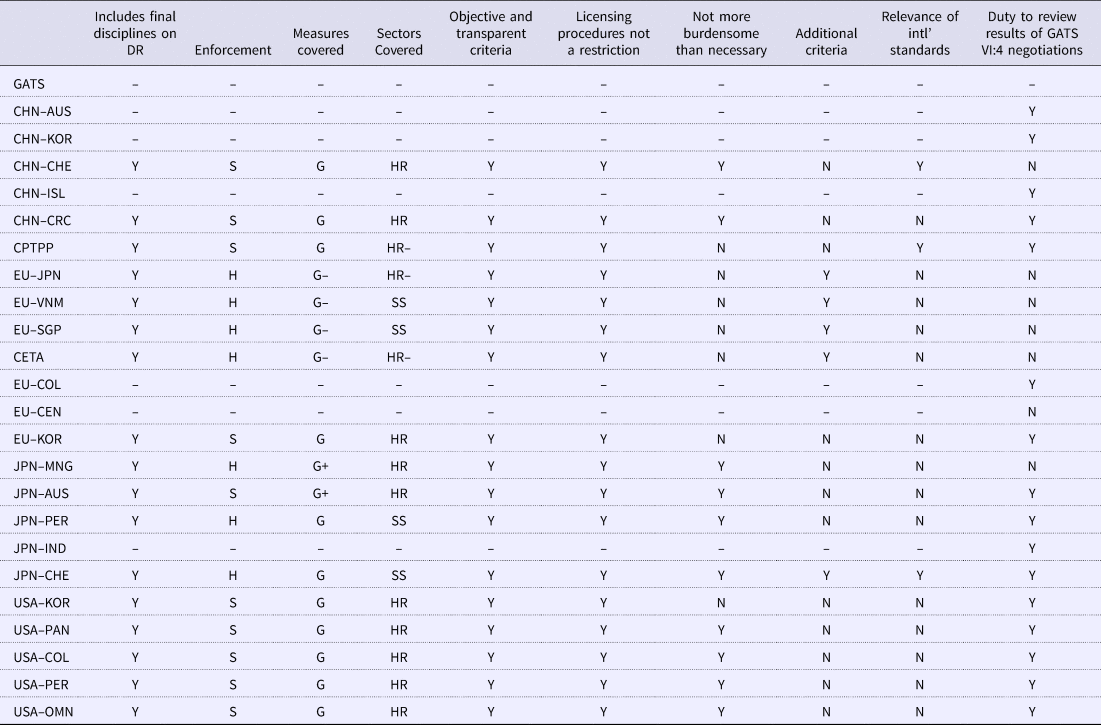
As Table 3 shows, the PTAs under examination offer a mix of ‘GATS plus’ and ‘GATS minus’ evidence on this matter.Footnote 69 The EU–CEN does not even refer to substantive disciplines on domestic regulation. Three Chinese PTAs, one EU, and one Japanese PTA simply include a duty to review the results of the GATS negotiations, with a view to their incorporation in the Agreement plus a temporary obligation, pending the conclusion of such negotiations, similar to GATS VI.5.Footnote 70 The remaining 17 PTAs include final disciplines on domestic regulation, i.e. not subject to further negotiations.Footnote 71 Of these, only seven – JPN–MNG, JPN–PER, JPN–CHE, EU–JPN, EU–VNM, EU–SGP, and CETA – use hard language to phrase the disciplines (i.e. ‘shall’), while the other ten use soft language (e.g. ‘shall endeavour to’, ‘shall aim to ensure’).Footnote 72
Substantive disciplines on domestic regulation

Notes: Enforcement: ‘H’ = Hard Obligation (i.e. ‘shall’); ‘S’ = Soft Obligation (e.g. ‘shall endeavour to…’), ‘–’ = Not Applicable.
Measures covered: ‘G’ = Licensing requirements and procedures, qualification requirements and procedures and technical standards. ‘G+’ = the previous five plus ‘Authorisation’; ‘G–’ = does not include technical standards.
Sectors covered: ‘HR’ = applicable across all sectors; ‘HR–’ = applicable across all sectors but for measures included in annexes of non-conforming measures, ‘SS’: applicable only in sectors where specific commitments have been made.
Objective and transparent criteria: ‘Y’ = Yes, ‘N’ = No; ‘–’ = Not Applicable.
Licensing procedures not a restriction on the supply of services: ‘Y’ = Yes, ‘N’ = No; ‘–’ = Not Applicable.
Additional criteria: ‘Y’ = Yes, ‘N’ = No; ‘–’ = Not Applicable.
Relevance of international standards for determining conformity with obligation: ‘Y’ = Yes, ‘N’ = No; ‘–’ = Not Applicable.
Duty to review results of GATS VI:4 negotiations with a view to bring them into effect, as appropriate, under the agreement: ‘Y’ = Yes, ‘N’ = No; ‘–’ = Not Applicable.
Table 3 also reveals that in terms of their scope rationae materiae, most PTA disciplines cover qualification requirements and procedures, licensing requirements and procedures, and technical standards. JPN–MNG and JPN–AUS also cover ‘authorization’. However, EU PTA disciplines (other than EU–KOR and EU–JPN) do not cover technical standards. Considering the increasing relevance of technical standards on services and their potential impact on trade, this is a noticeable handicap.Footnote 73 In 14 out of these 17 PTAs, the obligation applies to all sectors or to all sectors minus non-conforming measures included in the Annexes. In the remaining three PTAs – JPN–PER, JPN–CHE, and EU–SGP – the obligation only applies in sectors where specific commitments have been made.
With respect to their content, all substantive disciplines on domestic regulations require covered measures to be based on objective and transparent criteria, and licensing procedures not to be a restriction on the supply of services. The most controversial standard – not more burdensome than necessary to ensure the quality of the serviceFootnote 74 – is included only in ten PTAs, and within them, only three PTAs – JPN–MNG, JPN–CHE, and JPN–PER – phrase the obligation in hard terms.Footnote 75 Neither the CPTPP nor the EU PTA disciplines on domestic regulation include the so-called necessity test. However, some EU PTAs include additional criteria such as ‘clarity’, ‘advance public availability’, and ‘accessibility’.Footnote 76
Substantive disciplines differ on the role assigned to international standards. The CPTPP, CHN–CHE, and JPN–CHE recognize the relevance of a party's application of international standards in determining whether the party is in conformity with its obligation. JPN–CHE goes even further, requiring the parties to base their technical standards on international standards when available and provided they do not undermine the fulfilment of legitimate objectives.Footnote 77 The substantive disciplines on domestic regulation included in the remaining PTAs do not refer to international standards.Footnote 78
As the findings displayed by Table 3 suggest, Japan is the keenest in embracing substantive disciplines on domestic regulation. Most Japanese PTAs include a necessity standard. In JPN–AUS, the parties also committed to implement WTO disciplines on the accountancy sector and to encourage non-governmental bodies to comply with substantive disciplines.Footnote 79 In EU–JPN, the parties committed to encourage its competent authorities to adopt technical standards through open and transparent processes, and to encourage anybody designated to develop technical standards to do the same.Footnote 80 JPN–CHE's Annex on Domestic Regulation includes the most ambitious substantive disciplines on domestic regulation.
3.2.2 Authorization Processes
Authorization to supply services
In many sectors, suppliers must apply for a licence in order to supply their services. Lack of information and differences in licensing criteria across jurisdictions, delays, or arbitrary handling of the application process restrict trade. Minimum due process requirements have made their way into trade agreements to address this problem.
The GATS prescribes minimum due process obligations for processing applications for authorization to supply services.Footnote 81 The provision presupposes the existence of a mandatory authorization requirement for the supply of the service and the submission of an application for authorization by a prospective supplier.Footnote 82 It imposes three hard procedural obligations relating to the authorization process: (a) duty to take a decision within a reasonable period of time, (b) duty to inform the applicant of the decision within a reasonable period of time after a complete submission of an application; and (c) duty to provide, at the request of the applicant, information concerning the status of the application.Footnote 83 The scope of application of these obligations is limited to sectors where specific commitments have been made.Footnote 84
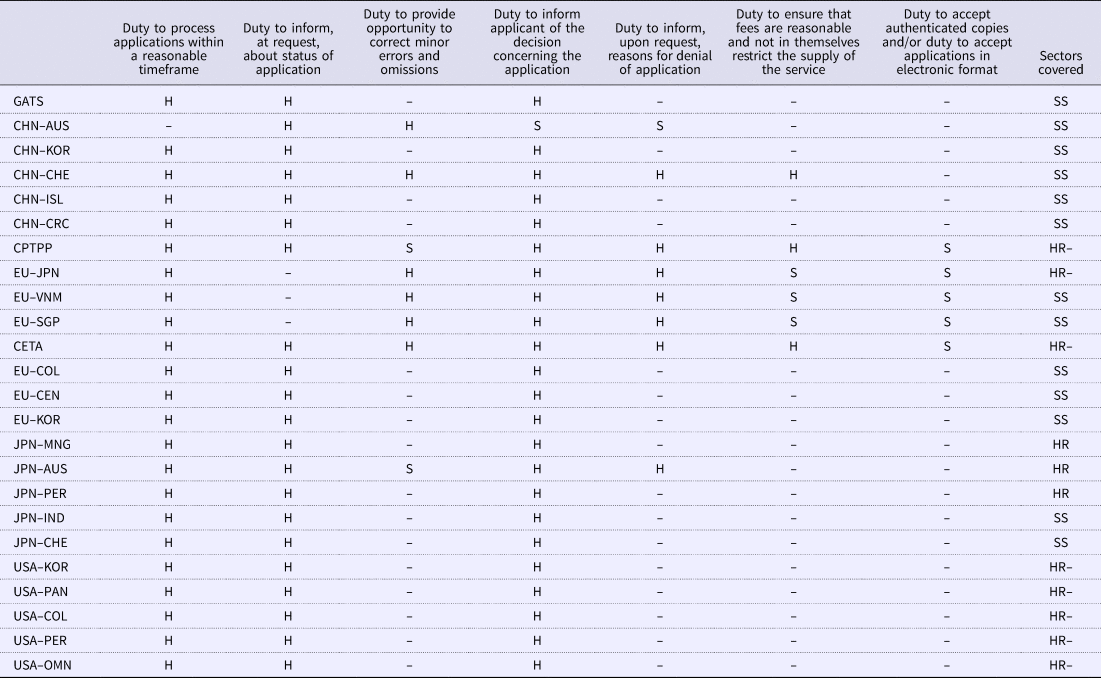
Table 4 shows that all PTAs include procedural disciplines that at least match or go beyond GATS.Footnote 85 CPTPP, CHN–AUS, CHN–CHE, JPN–AUS, EU–JPN, EU–VNM, EU–SGP, and CETA contain ‘GATS plus’ disciplines. For example, some or all of them include a duty to inform the applicant, upon request, the reasons for the denial of an application; a duty to ensure that fees are reasonable, transparent, and not in themselves a restriction on the supply of the service; a duty to accept authenticated copies of documents or accept applications in electronic format and, in case of incomplete applications, a duty to provide the applicant with an opportunity to correct minor errors and omissions. Some of these additional disciplines are couched in a soft language.Footnote 86
Disciplines on authorization to supply services

Notes: ‘H’ = Hard Obligation (i.e. ‘shall’); ‘S’ = Soft Obligation (e.g. ‘shall endeavour to…’), ‘–’ = Not Applicable.
Sectors covered: ‘HR’ = applicable across all sectors; ‘HR–’ = applicable across all sectors but for measures included in annexes of non–conforming measures, ‘SS’: applicable only in sectors where specific commitments have been made.
Table 4 also reveals ‘GATS plus’ evidence with respect to the scope of application of these procedural disciplines. While in 13 PTAs they apply only in sectors where the parties have undertaken specific commitmentsFootnote 87, in the other ten they apply horizontally across all sectors except for measures included in annexes of non-conforming measures.Footnote 88
CHN–CHE, CPTPP, EU–JPN, EU–VNM, EU–SGP, and CETA are the ones that impose the highest due process standards for processing applications for authorization to supply services. In addition to the matters referred to above, they call, inter alia, for the simplification of procedures, and to observe standards of impartiality and independence in the decision-making process.Footnote 89 CETA provisions stand out for defining the terms ‘authorization’, ‘competent authority’, ‘licensing procedures’, ‘licensing requirements’, ‘qualification procedures’, and ‘qualification requirements’.Footnote 90 CHN–CHE further stipulates that when the application is approved, the licence or approval must enable the applicant to start the commercial operations upon registration of the commercial presence and that such registration must be completed, as a rule, within two months of the submission of a complete application.Footnote 91
Authorization to supply telecommunications services
At the multilateral level, the Telecommunications Reference Paper (TRP) requires to guarantee minimum transparency and due process standards when a licence is required for the supply of telecommunication services.Footnote 92 On due process, it requires to inform the applicant, upon request, the reasons for the denial of an application.Footnote 93
At the PTA level, all the agreements examined, but CHN–CRC, include disciplines on the authorization process to provide telecommunication services,Footnote 94 which at least match the TRP standards. The CPTPP and CHN–KOR go further by requiring the authority to inform the applicant, on request, about the reasons of its decision, not just when it denies an application, but also when it imposes specific conditions for the supply of the service, or when it refuses to renew the licence. Japan PTAs (other than JPN–IND) and EU–JPN impose a duty to notify the applicant of the outcome of its application – whatever its content – without undue delay and without the need to wait for a request from the applicant. EU PTAs also guarantee the applicant's right to seek recourse before an appeal body when a licence has been denied, and require that fees must be commensurate with the administrative costs of the regulatory authority and do not in themselves restrict the supply of the service.
CHN–AUS includes a hard obligation to ensure that licensing requirements for suppliers of telecommunications networks or services are applied in the least restrictive manner and are not more burdensome than necessary.Footnote 95 CETA and EU–CEN require that the authorization to supply telecommunications services, wherever possible, should be based upon a simple notification procedure. EU–COL and EU–KOR include a soft obligation (‘shall endeavour’) to apply simplified procedures in authorizing the provision of telecommunication services. EU–JPN includes one of the most thorough provisions on this matter.Footnote 96
Authorization to supply financial services
The GATS does not prescribe minimum due process obligations specifically focused on the authorization to supply financial services, but most PTAs do.Footnote 97 A basic component of such disciplines includes a duty to make publicly available the requirements for completing an application relating to the supply of financial services. Beyond this obligation, the extent of ‘due process’ disciplines varies extensively across PTAs.
For instance, USA PTA disciplines on the authorization of financial services include the obligation to process the application within a specific time limit (120 days), the duty to notify the applicant when additional information is required and, when the application is denied, to inform the applicant, to the extent practicable, of the reasons for the denial. By contrast, EU PTAs include only basic references to the authorization process for the supply of financial services, but very demanding disciplines for the general licensing and qualification requirements and procedures. The CPTPP pattern is different from both USA and EU PTAs because it includes strong due process disciplines both for the authorization to supply financial services and for the authorization to supply services in general. However, it is JPN–CHE that includes the highest procedural standards for processing of applications for the supply of financial services.Footnote 98
Finally, all USA PTAs and the CPTPP include a provision aimed at expediting the offering of insurance services by licensed suppliers. For example, the CPTPP prohibits the requirement of product approval or authorization of insurance lines for insurance other than insurance sold to individuals or on compulsory license, not imposing limitations on the number or frequency of product introductions.Footnote 99
Application for immigration formalities
The GATS includes an annex on movement of natural persons supplying services, but its content is mostly concerned with carving out measures regarding citizenship, residence, or employment on a permanent basis from the agreement's scope of application. At the PTA level, however, there is plenty of evidence of ‘GATS extra’ disciplines. China and Japan PTAs, EU–JPN, CETA, and the CPTPP contain a separate chapter with specific disciplines on the movement of natural persons.Footnote 100 Such disciplines include, among others, transparency prescriptions covering information relating to procedures and requirements for visas and temporary entries, and disciplines on application procedures for immigration formalities such as visas, permits, and other documents granting temporary entry.
Procedural disciplines are aimed at guaranteeing the right of the applicants to a fair application process. At a minimum, they cover the typical due process standards prescribed by GATS VI.3, either in softFootnote 101 or hardFootnote 102 language. Some PTAs include additional procedural disciplines, such as the obligation to process applications within strict time limits.Footnote 103 Many include a duty to ensure that fees charged for processing applications must be reasonable and must not in themselves represent an unjustifiable impediment to the movement of natural persons. Other due process disciplines include, inter alia, a hard obligation to inform, upon request, about status of application; a duty to provide opportunity to correct minor errors and omissions in the application, and a soft commitment to accept and process applications in electronic format.Footnote 104
EU–JPN offers the most comprehensive set of due process requirements relating to applications for immigration formalities.Footnote 105 In addition, some PTAs include a soft commitment to take measures to simplify the immigration requirements and facilitate the application procedures for immigration formalities.Footnote 106 However, the potential impact of these disciplines is limited by their restricted enforceability. All PTAs except for CHN–CHE, CHN–ISL, JPN–CHE, EU–JPN, and CETA, condition the application of the dispute settlement mechanism to the chapter on the movement of natural persons to situations where the matter involves a pattern of practice and subject to the prior exhaustion of domestic administrative remedies.Footnote 107
3.2.3 Administration and Review of Measures
Frequently, discriminatory treatment against foreign suppliers is not written into published laws and regulations but it is a matter of official practice.Footnote 108 The higher degree of state intervention on service markets and, in particular, the intense and ongoing relationship between regulators and industry operators increases the risk of discriminatory administrative practices against foreign suppliers. Observance of minimum standards for the administration and review of administrative measures and holding those who exercise administrative power over service suppliers to account contribute to an open and non-discriminatory regulatory environment.
Administration of measures
The GATS prescribes that measures of general application affecting trade in services must be administered in a reasonable, objective, and impartial manner.Footnote 109 The obligation, phrased in hard terms, applies to measures of general application affecting trade in services, but only in sectors where specific commitments have been made.Footnote 110
At the PTA level, 12 out of the 23 agreements under examination include a provision in their services chapter that matches GATS Article VI.1. That is the case for the CPTPP, all Chinese PTAs, all Japanese PTAs (but JPN–PER), and two EU PTAs (EU–JPN and EU–COL). In JPN–MNG and JPN–AUS, the scope of application of the discipline is not limited to those sectors where specific commitments are undertaken.Footnote 111
USA PTAs and the rest of the EU PTAs (EU–VNM, EU–SGP, CETA, –EU–CEN, and EU–KOR) do not include a provision to tackle arbitrary administrative practices in their services chapter, but they include a similar one in their stand-alone ‘Transparency’ chapter, applicable to administrative practices on any matter covered by the agreement.Footnote 112 Like GATS Article VI.1, a typical horizontal provision requires a party to administer measures of general application in a ‘consistent (instead of objective), impartial and reasonable manner’. In addition, it goes beyond GATS, by prescribing a series of due process guarantees that must be observed to meet such standards, including the duty to provide directly affected persons of the other Party with reasonable notice of the initiation of administrative proceedings, afford them a reasonable opportunity to present facts and arguments in support of their position prior to any final administrative action, and ensuring that such proceedings are in accordance with the Party's law.Footnote 113
Review of administrative decisions
GATS Article VI.2 requires WTO members to offer service suppliers a guarantee for the independent review of administrative decisions affecting trade in services and, where justified, for the provision of remedies. The obligation is watered down by the use of soft language (‘as soon as practicable’). Moreover, paragraph VI.2(b) includes a ‘constitutional safeguard clause’ that offers extra flexibility, allowing Members not to institute such tribunals or procedures where this would be inconsistent with their constitutional structure.Footnote 114
At the PTA level, 15 out of the 23 agreements under examination include in their services chapter a provision akin to GATS Article VI.2. That is the case for all Chinese and EU PTAs, JPN–AUS, JPN–CHE, and JPN–IND.Footnote 115 Generally speaking, the wording calls for institutional requirements which at least match those required by GATS Article VI.2. In some PTAs, the provision goes further, either by dropping GATS’ qualifying language (‘as soon as practicable’) or by avoiding the constitutional safeguard clause.Footnote 116
By contrast, none of the USA PTAs, the CPTPP, JPN–MNG, and JPN–PER includes in their services chapter a provision on administrative remedies akin to GATS VI.2. However, they include a horizontal provision on review and appeal in their stand-alone ‘Transparency’ chapter, which further specifies due process guarantees for the parties to the proceedings, including a reasonable opportunity to support or defend their respective positions and the right to a decision based on the evidence and submissions of the record.Footnote 117 The provision also requires that the decision subject to review must be implemented and govern the practice of the authority with respect to the administrative action at issue.Footnote 118
3.3 Good Regulatory Practices
In addition to substantive disciplines for the development of regulations on services of a specific type as well as procedural disciplines for their application and review, the quest to iron out regulatory disparities is also pursued by prescribing minimum standards for the development of regulations in general known as ‘good regulatory practices’.Footnote 119 The underlying assumption is that the observance of these standards contributes to enhance the quality of regulatory outputs, avoiding unnecessary, duplicative, or inefficient regulations. Ultimately, the observance of common rule-making practices by regulators from different jurisdictions should contribute to mitigate regulatory divergence and foster regulatory compatibility.
Two of the PTAs under examination – EU–JPN and CPTPP – include detailed disciplines on good regulatory practices. In EU–JPN, such disciplines are included in a stand-alone chapter on ‘Good Regulatory Practices and Regulatory Cooperation’ applicable to regulatory measures with respect to any matter covered by the agreement.Footnote 120 The duties to be observed during the rule-making process are specified in very detailed and comprehensive terms. They include, inter alia, duties to maintain internal coordination processes or mechanisms;Footnote 121 provide information to the public of prospective regulatory measures;Footnote 122 consult the public, provide reasonable opportunities for any person to provide comments and consider the comments received;Footnote 123 carry out an impact assessment of proposed regulatory measures;Footnote 124 and conduct periodic retrospective evaluations of regulatory measures in force.Footnote 125 Although the duties are phrased in hard terms, they are not enforceable through the dispute settlement mechanism.Footnote 126
In the CPTPP, the disciplines on good regulatory practices are also included in a stand-alone chapter on ‘Regulatory Coherence’. But in this case, it is for each party to determine the scope of the covered regulatory measuresFootnote 127. The required standards are similar to those prescribed by EU–JPN. In addition to the duties mentioned above, the CPTPP good regulatory practices also require the Parties to ensure that proposed regulatory measures are plainly written, clear, concise, and easy to understandFootnote 128 and to consider regulatory measures in other Parties as well as relevant developments in international, regional, and other fora when planning covered regulatory measures.Footnote 129 Like in EU–JPN, parties are prevented from having recourse to dispute settlement for any matter arising under this chapter.Footnote 130
In sum, the PTAs under examination offer plenty of evidence of ‘GATS plus’ and ‘GATS extra’ disciplines on regulatory coherence, including substantive disciplines for the development of domestic regulations, higher due process standards for authorization processes and administration of measures, more effective remedies against administrative decisions and disciplines on good regulatory practices. With respect to their legal enforceability, only a minority of PTAs include hard substantive disciplines on domestic regulations. However, for a large majority of PTAs, most of the procedural disciplines applicable to authorization, administration, and review of administrative measures are phrased in hard terms.
Arguably, these substantive, procedural, and ‘good regulatory practices’ disciplines have a huge potential to address regulatory disparities. But, like the transparency disciplines, much will depend on their effective implementation. And again, the disparate administrative capacities between developed and developing country members open a question mark in this respect. For the most part, developed countries’ domestic legal systems already feature the requirements demanded by these international disciplines.Footnote 131 Many developing countries, however, would need to undertake profound domestic reforms in order to align their domestic legal systems with these international obligations. Ideally, to ensure their effective implementation, and realize the expected trade gains PTAs are meant to generate, trade obligations should be complemented with international assistance for domestic regulatory reforms.Footnote 132 Nothing of this sort is included in the PTAs under examination.
4. Regulatory Cooperation
4.1 Overview
Another mechanism to tackle regulatory divergence is through international regulatory cooperation. Unlike regulatory coherence, which is concerned with the quality of the domestic regulatory process, regulatory cooperation denotes the presence of an international element.Footnote 133 In a review of state practice on this matter, the OECD illustrates how the extent of such cooperation spans through different degrees of complexity and levels of engagement, from non-binding and loose mechanisms such as exchange of information among regulatory bodies at the bottom, to binding agreements at the top.Footnote 134 At a minimum, non-binding dialogue and exchange of information can contribute to build trust and mutual understanding between domestic regulators and avoid unnecessary divergences in future regulation, all the way up to mutual recognition agreements on licenses, qualification requirements or technical standards, and binding arrangements on the supervision and enforcement of existing regulation.
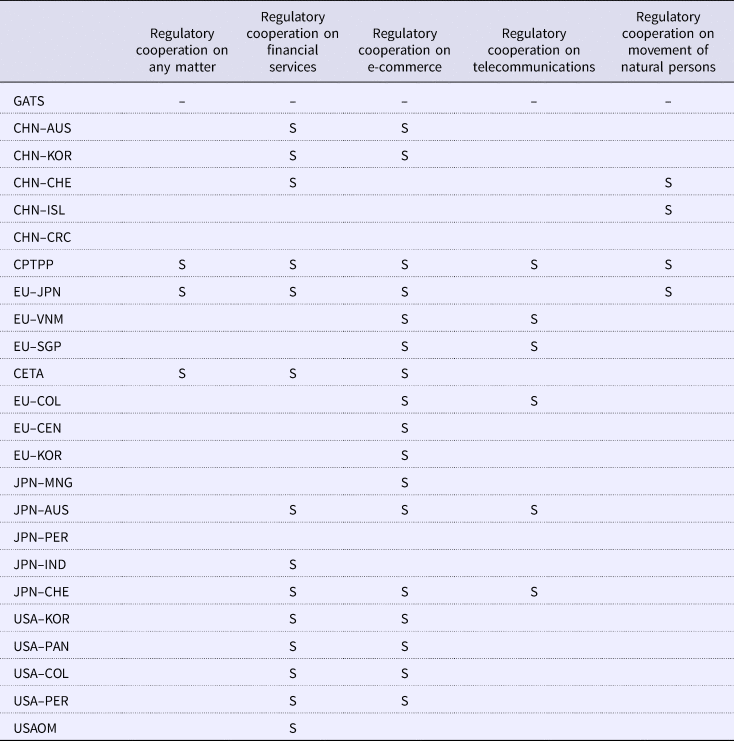
The inclusion of disciplines on regulatory cooperation on services in trade agreements is relatively recent. As Table 5 shows, it is of an entirely ‘GATS extra’ nature. Only three of the PTAs under examination include stand-alone chapters on regulatory cooperation on any matters covered by the agreement, and a few additional ones include disciplines on regulatory cooperation on specific service sectors (telecommunications and financial services) or modes of supply (movement of natural persons and e-commerce).Footnote 135 The former are examined in section 4.2 and the latter in section 4.3 below.
Regulatory cooperation

Note: S: Soft obligation.
4.2 Regulatory Cooperation on Any Matters
Only three PTAs – EU–JPN, CPTPP, and CETA – include stand-alone chapters on regulatory cooperation on any matter covered by the agreement, including services.Footnote 136
EU–JPN defines the aim of regulatory cooperation broadly: to enhance bilateral trade and investment by ‘(a) promoting an effective, transparent and predictable regulatory environment; (b) promoting compatible regulatory approaches and reducing unnecessarily burdensome, duplicative or divergent regulatory requirements; (c) discussing regulatory measures, practices or approaches of a Party, including how to enhance their efficient application; and (d) reinforcing bilateral cooperation between the Parties in international fora.’Footnote 137 But, at the same time, the agreement expressly stipulates that regulatory cooperation shall not affect the right of a Party to define or regulate its own levels of protection in pursuit or furtherance of its public policy objectives.Footnote 138
Regulatory cooperation activities are entrusted to a Committee on Regulatory Cooperation composed of representatives of the Parties.Footnote 139 In spite of the Committee's intergovernmental composition, the chapter opens the door for non-state actors’ participation. Interested persons may submit proposals of regulatory cooperation activities to the CommitteeFootnote 140 and the Committee may invite them to participate in its meetings.Footnote 141 The chapter provides some examples of an open-ended list of regulatory cooperation activities,Footnote 142 including, among others, exchange of information on planned or existing regulatory measures,Footnote 143 exchange of information on good regulatory practices,Footnote 144 and bilateral cooperation and cooperation with third countries in relevant international fora.Footnote 145 The committee must ‘discuss’, ‘promote’, ‘support’, and ‘encourage’ these types of activitiesFootnote 146, but it has no binding decision-making power. The whole regulatory cooperation mechanism is embedded in a soft law framework.Footnote 147
The CPTPP chapter on regulatory coherence is very similar to the EU–JPN one, albeit less detailed and with additional flexibilities. It covers both good regulatory practices (examined above) and regulatory cooperation,Footnote 148 and it also expressly protects the parties’ right to regulate.Footnote 149 It establishes an intergovernmental Committee to carry out the regulatory cooperation activitiesFootnote 150 but, like the EU–JPN, it also opens participation mechanisms for non-state actors.Footnote 151 The list of regulatory cooperation activities is also open-ended, including information exchanges, dialogues, meetings, and other relevant activities between regulatory agencies.Footnote 152 And, like the EU–JPN, regulatory cooperation is strictly voluntary, with no resort to dispute settlement.Footnote 153 Moreover, it is for each party to define the scope of the covered regulatory measures subject to these disciplines.Footnote 154
The CETA chapter is focused on regulatory cooperation only, with no reference to regulatory coherence or good regulatory practices.Footnote 155 The objectives and principles, scope, subjects, institutional framework, and non-binding character of regulatory cooperation are similar to those defined by the relevant EU–JPN and CPTPP chapters. However, the CETA chapter contains a few distinctive features which are worth highlighting.
First, when it comes to defining the objectives of regulatory cooperation, in addition to the facilitation of bilateral trade and investment, the agreement also refers to the objective to ensure high levels of protection of human life, health or safety, animal or plant life or health and the environment, improve the quality of regulations, and contribute to the improvement of competitiveness and efficiency of industry.Footnote 156 While this could be seen as a useful antidote against a regulatory race to the bottom, it also raises serious questions about the competence of trade agreements. To what extent should improvement in the quality of regulations per se, irrespective of their trade effects, fall within the mandate of trade agreements? This type of obligation sits uncomfortably in a context where political support for trade agreements that constrain domestic policy discretion outside strictly trade policy instruments is dwindling. It would have been preferable to limit the expansion of new trade disciplines to those whose contribution to trade liberalization is clear, direct, and, where possible, fact-based.
Second, general terms such as ‘dialogue’ and ‘exchange of regulatory experiences’ are spelled out at a granular level. For example, the chapter requires the parties to consult with each other and exchange information throughout the regulatory development process, share non-public information to the extent that the laws of the Parties allow for this, compare data collection practices, conduct cooperative research agendas, and conduct post-implementation reviews of regulations and policies, to name but a few.Footnote 157 The chapter also requires each party to consider the regulatory measures or initiatives of the other party on the same or related topics.Footnote 158
4.3 Regulatory Cooperation on Specific Matters
On financial services, disciplines on regulatory cooperation are gaining relevance but, as the PTAs under examination show, the extent of such cooperation varies significantly across the agreements. Table 5 reals that nine PTAs contain no express reference to regulatory cooperation on financial services.Footnote 159 The remaining 14 do include disciplines on this matter, although the prescribed terms for cooperation vary significantly among them. At the bottom end, some PTAs simply envisage the possibility of exchanging views on issues relating to financial services or exchanging information, upon request, on regulations on financial services, but falling short of establishing a specific institutional body to this effect.Footnote 160
Another group goes a step further, establishing specific committees on financial services composed of financial regulators rather than simply government representatives, entrusted with a broad range of tasks, including the supervision and implementation of the agreement and the consideration of regulatory issues regarding financial services.Footnote 161 Still a non-binding talking forum, but among sector-specific regulators, and with a specific role in the governance of the agreement.
Finally, a few PTAs provide for more advanced forms of regulatory cooperation that go beyond dialogue and exchange of information. CHN–KOR and USA–KOR include soft commitments to cooperate on the supervision and enforcement of existing regulation on matters relating to cross-border activities.Footnote 162 In its turn, the EU and Japan agreed, wherever possible, to rely on each other's rules and supervision. To this end, the parties committed to keep each other informed on how they provide for effective supervision and enforcement of rules,Footnote 163 in particular in the areas where one of the Parties relies on the regulatory and supervisory framework of the other Party.Footnote 164
Table 5 shows that 17 PTAs include soft disciplines on regulatory cooperation on e-commerce, encouraging the parties to share information, experiences, and best practices on the regulation of the interface between e-commerce and a number of cross-cutting public policy issues, such as consumer protection, cyber-security, public morals, protection of intellectual property, personal data protection, and the fight against unsolicited commercial electronic messages.Footnote 165 Cooperation remains voluntary and no specific committees are established for this purpose but, given the fact that the regulation of e-commerce is still in its infancy, the potential of this type of provisions to minimize future regulatory divergence should not be underestimated.
In a limited number of PTAs, the extent of regulatory cooperation goes beyond dialogue and exchange of information and covers enforcement. Within this group, some PTAs expressly recognize the importance of cooperation, in order to enhance consumer welfare, between their respective national consumer protection agencies or other relevant bodies on activities related to cross-border electronic commerce.Footnote 166 Others go further by imposing a soft obligation to cooperate, in appropriate cases of mutual concern, in the enforcement of laws against fraudulent and deceptive commercial practices in electronic commerce, subject to their respective laws and regulations.Footnote 167
On telecommunications, disciplines on regulatory cooperation are far less common than in the previous two sectors. Table 5 indicates that just six of the 23 agreements examined include disciplines on this matter.Footnote 168 In JPN–CHE, the parties simply agreed to ‘exchange information related to telecommunications services, including information on legislative processes, recent developments, regulatory frameworks, and respective activities of the Parties in international fora’.Footnote 169 The EU–SGP telecom chapter lists areas for cooperation, which include the ‘exchange of views on policy issues such as the regulatory framework for high-speed broadband networks and the reduction of international mobile roaming charges’.Footnote 170 Only the CPTPP and JPN–AUS establish a committee composed of government representatives, with the functions, inter alia, to discuss any issues relevant to the telecommunications sector as may be decided by the Parties.Footnote 171 On enforcement, some EU PTAs call the regulatory authorities of the Parties to coordinate their efforts to resolve cross-border disputes arising between suppliers of telecommunications networks.Footnote 172
Finally, on the movement of natural persons, some PTAs call for cooperation between relevant authorities for streamlining immigration procedures to facilitate the movement of natural persons in certain areas.Footnote 173
In sum, the review identifies a number of emerging disciplines on regulatory cooperation. The majority of the regulatory cooperation mechanisms are conceived as non-binding forums for dialogue and exchange of information between sector-specific regulators. It remains to be seen how effective these fledging regulatory cooperation mechanisms will be in addressing regulatory disparities and furthering the liberalization of trade in services. In principle, however, there are reasons to believe in their potential to do so.
First, despite the fact that they operate on an entirely voluntary basis, the creation of institutional mechanisms for regulatory cooperation within the governance structure of a trade agreement offers regulators the opportunity to get to know each other, understand their regulatory practices, and build the mutual trust necessary for paving the way for further market integration. One PTA even envisages the possibility to exchange regulatory officials.Footnote 174 It can also be a useful tool particularly for tackling regulatory divergence in areas that are yet to be regulated.
Second, it can be a first step for addressing the ‘hold back’ problem caused by regulatory externalities. Mattoo notes that countries are reluctant to undertake market access commitments when regulators in the jurisdiction of the service exporter are either not capable or not inclined to take into account the consequences of market failure for consumers in the jurisdiction of the service importer.Footnote 175 For example, inadequate financial regulation in the exporting country affecting consumers and financial stability in the country to which its financial institutions export services, weak data protection in a country that exports data-processing services compromising the privacy of citizens of the country that imports such services, or imperfect policing and emigration checks in a country whose individuals travel abroad to provide consultancy services, undermining law and order in the country that hosts the service suppliers.Footnote 176
Mattoo suggests that when a country is assured that imported services are adequately regulated, such a country will be more forthcoming to undertake greater market opening and commitments.Footnote 177 He, therefore, advocates for regulatory cooperation mechanisms, including exporting countries’ commitments to minimize their regulatory externalities.Footnote 178
The PTAs under examination offer some evidence in this direction. For example, in the CPTPP, the parties agreed to allow the cross-border transfer of information by electronic means, including personal information,Footnote 179 in return for obligations to protect consumers engaged in online commercial activitiesFootnote 180 and to protect the personal information of the users of electronic commerce.Footnote 181, Footnote 182 Similarly, in EU–JPN, in order to enhance the movement of natural persons, more ambitious commitments on their movement (relative to other PTAs) sit alongside a provision that expressly acknowledges the need for full cooperation on return and readmission of natural persons staying in the territory of a Party in contravention of its rules for entry and temporary stay.Footnote 183
5. Conclusions
The paper reviewed the disciplines for tackling regulatory divergence in services included in the most recent PTAs entered into by the four largest trading players in the world: China, EU, Japan, and USA. The study identified a remarkable expansion in the number and extent of disciplines on regulatory transparency, regulatory coherence, and regulatory cooperation compared with the GATS.
On regulatory transparency, the study identified ‘GATS plus’ disciplines on the duty to publish and the duty to inform and one significant ‘GATS extra’ discipline, namely, the duty to consult, consisting of the twin obligations to publish proposed regulations and to give interested stakeholders (not just the other party) an opportunity to comment on them. On regulatory coherence, the significant expansion of minimum due process standards for processing applications for the supply of services and, more generally, for administering and reviewing administrative decisions affecting trade in services stand out. Both developments denote a clear trend in recent PTAs to complement traditional horizontal obligations, i.e. those owed by one party to the other, with vertical obligations owed by each party to traders and other relevant stakeholders. Finally, the most innovative development compared with GATS is the incorporation of disciplines on regulatory cooperation on services. While still very basic and not yet widely spread across PTAs, the adoption of disciplines on regulatory cooperation and the creation of institutional bodies within the governance structure of trade agreements, where sector specific regulators (rather than trade diplomats) meet, deserve to be highlighted. They constitute an interesting departure from the hitherto strictly intergovernmental character of PTAs.
The study also identified some common patterns within each of the four trading actors’ PTAs, but nothing close to identical traits. On the contrary, the findings confirmed that each PTA has its own particularities. It appears that no trading actor, regardless of its negotiating power, is capable of imposing the exact same PTA template on each and every one of its trading partners.
In principle, this new set of tools place recent PTAs in a much better position than the GATS to tackle the trade restrictive effects caused by regulatory divergence in services and to combat arbitrary, unreasonable, and inconsistent administrative practices. However, the extent to which they will be able to deliver a degree of market integration beyond what could be achieved simply by removing market access restrictions and discriminatory measures from the rule book, is contingent on their effective implementation. Although it is difficult to anticipate what will actually happen, there are at least two known factors that will condition implementation.
The first one relates to the legal enforceability of these new disciplines. The study has shown that two of the most innovative disciplines – the duty to consult and regulatory cooperation – are phrased predominately in soft terms. The fact that their observance rests on the willingness of the parties, calls for some restraint when estimating the potential impact of these PTAs in tackling regulatory divergence.
The fact that the duty to consult, and a number of minimum due process provisions confer to ‘interested persons’ clearly defined and self-executable rights, could potentially pave the way for domestic courts to play a role in enforcing the agreement. But this is contingent on domestic courts’ interpretation of treaties. Moreover, some treaties have expressly forbidden to construe the agreements as conferring rights or imposing obligations on persons other than the parties.Footnote 184
The second factor relates to the implementation costs. The observance of broad and encompassing disciplines on the development, administration, application, and review of domestic regulations requires having in place a highly sophisticated domestic institutional framework for the governance of service markets. Now, while in most developed countries the existence of these institutions may be taken for granted, for most developing countries this may not necessarily be the case. When the parties to a PTA have very different regulatory infrastructures, government resources, and institutional capabilities, implementation costs will not be evenly distributed among them and this may compromise the effective implementation of the agreement. For example, that could be the case in JPN–MNG, EU–VNM, or USA–PAN. Special and differential treatment provisions and/or the provision of technical assistance for domestic regulatory reforms could contribute to address this problem. But the PTAs under examination include none of them.
Last, but not least, a word of caution. Notwithstanding the fact that regulatory disparities raise trade costs, this renewed impetus to address regulatory divergence in services should not attempt to override regulatory diversity altogether. In spite of an increasingly globalized and interconnected world, deep differences among countries remain in terms of local preferences, policy choices, legal traditions, degrees of development, regulatory needs, regulatory capacity, and, ultimately, regulatory outputs. These variances are compounded by the idiosyncratic nature of services. In other words, there is an inevitable degree of divergence that parties to a PTA should accept as a natural consequence of the exercise of the right to regulate the supply of services in different contexts and with different capacities and priorities. Moreover, pushing the goal to iron out regulatory disparities of services regulations too far may exacerbate concerns relating to the undue degree of intrusion of PTAs on the right to regulate, further undermining the increasingly feeble political support for these agreements.
Acknowledgements
The article has benefited from feedback provided by two anonymous reviewers and attendants to the presentation of an earlier version of this paper at the SIEL Biennial Conference, American University Washington College of Law, 12–14 July 2018. The usual caveats apply.