INTRODUCTION
Methamphetamine (MA) is a highly addictive and widely used psychostimulant that induces adverse effects on the central nervous system (CNS), predominantly through alteration of monoaminergic pathways. Chronic exposure to MA and other amphetamines is associated with a host of neurotoxic processes including gliosis, neuronal apoptosis, oxidative stress, brain thermotoxicity, and neuroinflammation (Cadet et al., Reference Cadet, Jayanthi and Deng2003; Yu et al., Reference Yu, Zhu, Shen, Bai and Di2015). Consequently, conditions of neurochemical and cerebrovascular abnormalities, including increased blood–brain barrier permeability and ischemic stroke, are more prevalent among stimulant users (Sajja et al., Reference Sajja, Rahman and Cucullo2016; Turowski & Kenny, Reference Turowski and Kenny2015; Yen et al., Reference Yen, Wang, Ju, Chen, Liao, Fuh and Hu1994) and can disrupt neural circuits, particularly fronto-striatal systems that support neurocognitive abilities. It has been widely documented that MA-dependent individuals are vulnerable to a constellation of neurocognitive deficits including impairments in episodic memory, executive functioning, working memory, information processing speed, verbal fluency, attention, and motor skills (Kalechstein et al., Reference Kalechstein, Newton and Green2003; Scott et al., Reference Scott, Woods, Matt, Meyer, Heaton, Atkinson and Grant2007; Wood et al., Reference Wood, Sage, Shuman and Anagnostaras2014).
Whereas it is evident that MA dependence is associated with neurocognitive dysfunction, the severity of such neurocognitive deficits remains unclear. Synthesis of clinical studies comparing neurocognitive profiles of MA-dependent individuals to non-using controls not only indicates a mild-to-moderate deleterious effect of MA on neurocognition, but also reveals considerable inter-individual variability in which many MA-dependent persons perform within normative standards whereas others may exhibit severe deficits (Dean et al., Reference Dean, Groman, Morales and London2013; Hart et al., Reference Hart, Marvin, Silver and Smith2012). Variation in use patterns of MA alone does not appear to account for these individual differences in vulnerability to MA-related brain dysfunction as the existing human literature has generally failed to find a consistent dose-dependent relationship between MA exposure parameters and neurocognitive impairment (Chang et al., Reference Chang, Ernst, Speck, Patel, DeSilva, Leonido-Yee and Miller2002; Cherner et al., Reference Cherner, Suarez, Casey, Deiss, Letendre, Marcotte, Vaida, Atkinson, Grant and Heaton2010; Johanson et al., Reference Johanson, Frey, Lundahl, Keenan, Lockhart, Roll, Galloway, Koeppe, Kilbourn, Robbins and Schuster2006; McCann et al., Reference McCann, Kuwabara, Kumar, Palermo, Abbey, Brasic, Ye, Alexander, Dannals, Wong and Ricaurte2008). Given the unimpressive predictive utility of MA exposure parameters as moderators of neurocognitive impairment, susceptibility to MA-related neurocognitive dysfunction may be better explained by the influence of other modulating variables.
Considering that MA is seldom used on its own, patterns of polysubstance use among primary MA users may modulate vulnerability to neurocognitive impairment. Alcohol is of particular interest as it is the most commonly used secondary substance among primary MA users (Halkitis et al., Reference Halkitis, Green and Mourgues2005; Wang et al., Reference Wang, Min, Krebs, Evans, Huang, Liu, Hser and Nosyk2017) and heavy drinkers are 4–5 times more likely to report using MA as compared to non-drinkers (Bujarski et al., Reference Bujarski, Roche, Lunny, Moallem, Courtney, Allen, Hartwell, Leventhal, Rohrbaugh and Ray2014; Caetano & Weisner, Reference Caetano and Weisner1995; Furr et al., Reference Furr, Delva and Anthony2000). The detrimental effects of chronic excessive alcohol consumption on CNS and neurocognitive functioning have been extensively studied. Briefly, heavy alcohol-related risks for brain damage include disruption to neurotransmitter systems, neuroinflammation, neurodegeneration, and cerebrovascular disease (Gorelick, Reference Gorelick1987; Oscar-Berman & Marinkovic, Reference Oscar-Berman and Marinkovic2003; Syapin et al., Reference Syapin, Hickey and Kane2005). Long-term alcohol misuse has been linked to alterations in frontal and limbic neural circuitry, most commonly resulting in neuropsychological deficits of episodic memory, problem solving, and cognitive control (Bernardin et al., Reference Bernardin, Maheut-Bosser and Paille2014; Oscar-Berman et al., Reference Oscar-Berman, Valmas, Sawyer, Ruiz, Luhar and Gravitz2014; Sullivan et al., Reference Sullivan, Harris and Pfefferbaum2010).
Given that MA and alcohol independently disrupt overlapping neurobiological mechanisms, neuroanatomical structures, and neurobehavioral functions, one may expect a synergistic neurotoxic effect of combined MA and alcohol misuse. Previous animal studies have reported that alcohol enhances the absorption and delivery of MA in the brain (Liang et al., Reference Liang, Liu, Zheng, Ananda and Liu2012). Additional animal model research has shown that concurrent exposures to MA and alcohol synergistically increase oxidative stress in the rat hippocampus and contribute to behavioral impairments in learning, discrimination, and spatial working memory above and beyond the effects of either substance alone (Vahed, Reference Vahed2014; Yamamura et al., Reference Yamamura, Hishida, Hatake, Taniguchi and Ouchi1992). In vitro human brain tissue models provide converging evidence that both alcohol and MA impair glucose metabolism in astrocytes and neurons, a process that is a precursor to oxidative stress-mediated neurotoxicity (Abdul Muneer et al., Reference Abdul Muneer, Alikunju, Szlachetka and Haorah2011a, Reference Abdul Muneer, Alikunju, Szlachetka, Mercer and Haorah2011b). Although less is known about combined MA and alcohol-induced biological damage in vivo, there is evidence that acute as well as repeated concurrent exposure induces adverse vascular effects, including increased heart rate and myocardial oxygen consumption (Kirkpatrick et al., Reference Kirkpatrick, Gunderson, Levin, Foltin and Hart2012; Mendelson et al., Reference Mendelson, Jones, Upton and Jacob1995). Consistent with neurocognitive profiles of adult MA users, pediatric studies demonstrate that prenatal exposures to MA and alcohol synergistically damage fronto-striatal networks and compromises working memory abilities in children aged 5–15 (Roussotte et al., Reference Roussotte, Bramen, Nunez, Quandt, Smith, O’Connor, Bookheimer and Sowell2011; Sowell et al., Reference Sowell, Leow, Bookheimer, Smith, O’Connor, Kan, Rosso, Houston, Dinov and Thompson2010).
Chronic exposure to cocaine, another potent psychostimulant, is associated with moderate deficits in neurocognition across a range of domains, with the largest effects in executive function, working memory, and verbal learning/memory (Potvin et al., Reference Potvin, Stavro, Rizkallah and Pelletier2014). Whereas combined cocaine and alcohol use has been linked to altered neurophysiological activity (Althobaiti & Sari, Reference Althobaiti and Sari2016), including abnormal cerebral blood perfusion (Gottschalk & Kosten, Reference Gottschalk and Kosten2002), elevated heart rate and cortisol levels (Farré et al., Reference Farré, De La Torre, González, Terán, Roset, Menoyo and Camí1997), and dysregulated dopaminergic and serotonergic transmission (Horowitz & Torres, Reference Horowitz and Torres1999), literature on the neurocognitive effects of comorbid cocaine and alcohol use disorders is mixed. Some studies report that increasing alcohol use provides an additive deleterious effect on neurocognition in primary cocaine users (Bolla et al., Reference Bolla, Funderburk and Cadet2000; Woicik et al., Reference Woicik, Moeller, Alia-Klein, Maloney, Lukasik, Yeliosof, Wang, Volkow and Goldstein2009) and can also attenuate improvements in verbal memory following abstinence from cocaine (Rosselli & Simmers, Reference Rosselli and Simmers2016). Nevertheless, others have failed to detect a significant impact of alcohol consumption on neurocognition in the context of cocaine dependence (Abi-Saab et al., Reference Abi-Saab, Beauvais, Mehm, Brody, Gottschalk and Kosten2005; Bolla et al., Reference Bolla, Rothman and Cadet1999; Goldstein et al., Reference Goldstein, Leskovjan, Hoff, Hitzemann, Bashan, Khalsa, Wang, Fowler and Volkow2004).
Although combined alcohol and MA misuse is common and may result in a convergence of mechanisms of neural injury, it remains unclear how historical patterns of alcohol use relate to neurocognitive functioning among primary MA users. Therefore, the current study aimed to address this gap in knowledge by examining the relationships between a continuous estimate of lifetime alcohol consumption and neurocognitive functioning in a sample of MA-dependent and MA-nonusing individuals. We hypothesized that greater reported lifetime alcohol consumption would contribute to poorer neurocognitive functioning regardless of MA dependence, but would exhibit significantly larger effects among MA-dependent individuals compared to MA-nonusing persons. Examination of these associations may assist in identifying specific risk factors for neurocognitive impairment among MA-dependent individuals, and may guide development of targeted polysubstance use prevention and treatment strategies for this population.
METHODS
Participants
Eighty-seven MA-dependent (MA+) and 114 MA-nonusing comparison (MA−) participants were evaluated at the HIV Neurobehavioral Research Program (HNRP) at the University of California, San Diego (UCSD), as part of federally funded, institutionally approved projects focusing on neuroAIDS effects of methamphetamine. All were recruited from substance dependence recovery programs or from the general San Diego community, and gave written informed consent as approved by the UCSD Institutional Review Board. Participants were confirmed to be HIV and HCV uninfected by standard antibody testing and were free of medical conditions that might confound interpretation of neurocognitive testing results, such as traumatic brain injury, stroke, or epilepsy. The MA+ individuals met criteria for a lifetime diagnosis of MA dependence according to the Structured Clinical Interview for DSM-IV (SCID-IV; Spitzer et al., Reference Spitzer, Williams, Gibbon and First1995), with use within the previous 18 months. The MA− group consisted of participants who never met criteria for amphetamine use disorders and were not habitual users of any stimulant. Exclusion criteria for both groups included other substance dependence, except alcohol or cannabis, within 5 years, or abuse within the past 12 months. Participants were requested to be abstinent from MA for at least 10 days prior to testing and were required to show a negative urine toxicology for any non-prescribed substance except cannabis, as well as a negative Breathalyzer test for alcohol on the day of neurocognitive testing.
Procedures
Substance use and psychiatric information
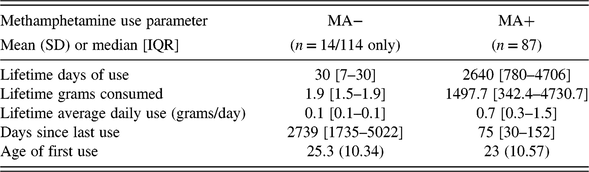
The methods of drug use characterization have been described elsewhere (Cherner et al., Reference Cherner, Suarez, Casey, Deiss, Letendre, Marcotte, Vaida, Atkinson, Grant and Heaton2010; Gonzalez et al., Reference Gonzalez, Rippeth, Carey, Heaton, Moore, Schweinsburg, Cherner and Grant2004). Briefly, participants were administered structured interviews from selected modules of the SCID-IV to assess history of substance dependence and mood disorder. A semi-structured timeline follow-back interview was administered to gather a detailed history of quantity, frequency, and duration of substance consumption over a participant’s lifetime. Variables of alcohol, MA, and cannabis use derived from this interview were age of first use, days since last use, estimated lifetime grams (MA and cannabis) and drinks (alcohol) consumed, estimated lifetime days of use, and average grams per day of use (MA and cannabis) and average drinks per drinking day (referred to as “lifetime average daily alcohol use”). We conceptualized lifetime average daily alcohol use, an established metric utilized to quantify alcohol misuse (Dawson et al., Reference Dawson, Grant and Li2005), as a proxy for typical level of alcohol use throughout the lifetime. Parameters of cannabis use were specifically examined because study criteria did not exclude recent cannabis use and prior research has suggested cannabis may be associated with better neurocognitive functioning among MA users (Gonzalez et al., Reference Gonzalez, Rippeth, Carey, Heaton, Moore, Schweinsburg, Cherner and Grant2004). Table 1 displays the MA use parameters of the MA+ group in addition to the 14 MA− participants who reported having tried MA occasionally (fewer than 10 lifetime uses). Current mood symptoms were assessed using the Beck Depression Inventory II (BDI-II; Beck et al., Reference Beck, Steer and Brown1996).
Methamphetamine use parameters by methamphetamine status

Note. MA – use represents occasional experimentation.
Neurocognitive assessment
All participants completed a comprehensive neurocognitive evaluation that has been described in detail elsewhere (Rippeth et al., Reference Rippeth, Heaton, Carey, Marcotte, Moore, Gonzalez and Group2004). In short, this neurocognitive test battery covers seven ability domains: verbal fluency, abstraction/executive functioning, processing speed, learning, delayed recall, attention/working memory, and complex motor skills (see Supplementary Table 1 for individual tests in each domain). Raw test scores were converted to demographically corrected standard T scores (mean of 50 and standard deviation of 10) that adjusted for the effects of age, education, sex, and race/ethnicity, as appropriate (Heaton et al., Reference Heaton, Miller, Taylor and Grant2004; Heaton et al., Reference Heaton, Taylor and Manly2003; Norman et al., Reference Norman, Moore, Taylor, Franklin, Cysique, Ake, Lazarretto, Vaida and Heaton2011). The demographically corrected T scores for each measure were averaged to compute global and domain-specific T scores within each neurocognitive ability area. To determine the presence of neurocognitive impairment, individual test T scores were converted to deficit scores that give differential weight to impaired scores (>1 standard deviation below the mean), as opposed to normal scores. Deficit scores range from 0 to 5 according to the following T scores and impairment descriptors, based on half standard deviation decrements: 0 = T ≥40 (no impairment); 1 = T 35–39 (mild); 2 = T 30–34 (mild-to-moderate); 3 = T 25–29 (moderate); 4 = T 20–24 (moderate-to-severe); 5 = T <20 (severe). Deficit scores for each measure were averaged across the entire test battery to derive a global deficit score (GDS) and within each domain to derive domain-specific deficit scores (DDS). Consistent with prior studies (Blackstone et al., Reference Blackstone, Moore, Franklin, Clifford, Collier, Marra, Gelman, McArthur, Morgello, Simpson, Ellis, Atkinson, Grant and Heaton2012; Carey et al., Reference Carey, Woods, Gonzalez, Conover, Marcotte, Grant and Heaton2004), the presence of global impairment was defined by GDS ≥ 0.5 and domain-specific impairment by DDS > 0.5. The dichotomous GDS classification of impaired/unimpaired was used as an outcome measure in logistic regression analyses predicting global neurocognitive impairment.
Statistical Analysis
MA group comparisons of neuropsychological outcomes (i.e., T scores and impairment status), demographics, depressive symptoms, alcohol and cannabis use, and other lifetime substance dependence were conducted using Student’s t tests, Wilcoxon Rank Sum tests, chi-square tests, and Fisher’s exact tests as appropriate. MA group differences in neurocognitive performance were evident across domains. Given this non-specific pattern of MA group differences, and in order to limit multiple comparisons, we present the global T scores and global impairment classifications as outcome variables in linear and logistic regression analyses, respectively. Details of domain-specific results appear in Supplementary Table 2.
We first tested whether MA group differences in global functioning were attenuated by differences in estimated premorbid ability and neuropsychiatric factors by entering MA status along with performance on the Wide Range Achievement Test (version 3 or 4) Reading subtest (WRAT; Wilkinson & Robertson, Reference Wilkinson and Robertson2006), lifetime major depressive disorder (MDD), and lifetime average daily cannabis as covariates into each model. Age, education, race/ethnicity, and sex were not considered as model covariates because they were already included in the neurocognitive test T score demographic adjustments. Next, we added lifetime average daily alcohol use and days since last alcohol use to test whether historical alcohol use, controlling for recency of alcohol use, incrementally predicted global functioning independent of MA status. Finally, an interaction term between MA status and lifetime average daily alcohol use was added to examine whether lifetime alcohol use modulated MA group differences in neurocognition. To probe interaction effects, simple slope analyses were conducted by examining the association of global functioning with lifetime average daily alcohol use within each MA group, adjusting for covariates. To avoid multicollinearity with lifetime MDD, BDI-II was not included as a covariate in initial models. Instead, BDI-II was added as a post-hoc covariate to final models in order to rule out the potential confounding influence of active depressive symptoms. To enhance interpretability of the logistic regression results predicting likelihood of global neurocognitive impairment, we present odds ratios (OR) estimated with 95% confidence intervals (CI). All analyses were performed using JMP Pro version 12.0.1 (JMP®, Version <12.0.1>. SAS Institute Inc., Cary, NC, 1989–2007).
RESULTS
Demographic and Clinical Characteristics
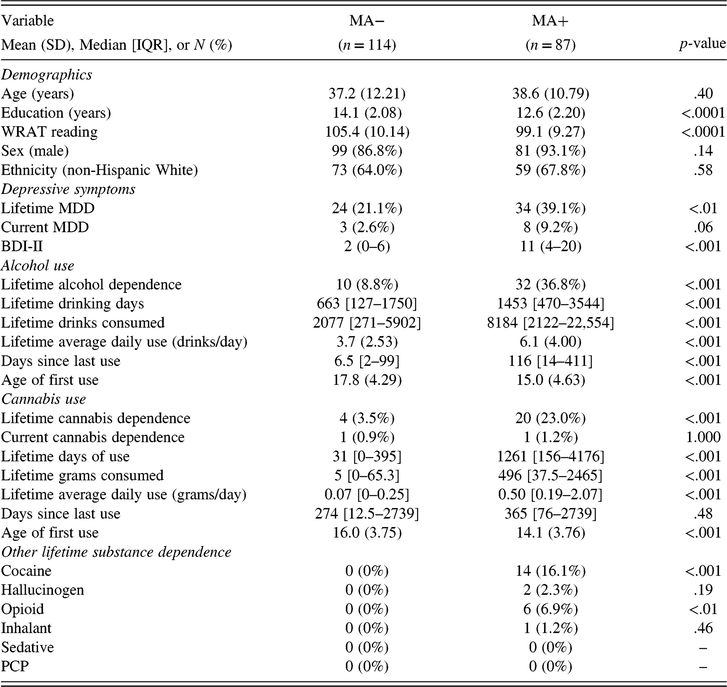
Demographic and clinical characteristics for each MA group are displayed in Table 2. Although groups were comparable with respect to age, sex, and race/ethnicity, the MA+ group had significantly fewer years of education and lower WRAT performance. The MA+ group displayed higher BDI-II scores as well as greater prevalence of lifetime non-MA substance use disorders and lifetime MDD.
Demographic and clinical characteristics

Note. Alcohol dependence greater than 12 months ago; other drug dependence greater than 5 years ago; cannabis may be recent.
MA = methamphetamine status; WRAT Reading = Wide Range Achievement Test; MDD = major depressive disorder; BDI-II = Beck Depression Inventory-II.
With respect to parameters of alcohol consumption, the MA+ group generally reported a more extensive history of drinking behavior than the MA– group. Specifically, MA+ individuals on average drank on more days, consumed more total drinks, and subsequently had a greater lifetime average daily alcohol use than MA− individuals (p < .001). Furthermore, the MA+ group had a younger age of first alcohol use (p < .001). Conversely, the MA– group reported significantly fewer days since last alcohol use than the MA+ group (p < .0001). With the exception of days since last cannabis use (p = .48), MA+ individuals also reported a more extensive history of cannabis use. Spearman’s correlations were conducted to examine the associations between lifetime average daily alcohol, cannabis, and MA use. Alcohol use positively correlated with both MA use (rs = .21, p = .038) and cannabis use (rs = .36, p < .001) indicating that MA+ individuals with elevated lifetime drinking patterns were also more likely to show elevated lifetime MA and cannabis use patterns. Although lifetime average daily MA use positively correlated with lifetime average daily cannabis use, this association failed to reach statistical significance (rs = .13, p = .194)
Neurocognitive Performance Across MA Status
With respect to global performance, the MA+ group had significantly lower global T scores (47.5 vs. 49.9; d = −0.45; p = .002) and higher impairment rates (27.6% vs. 15.8%; OR = 2.03; p = .042) compared to the MA– group. Domain-specific neurocognitive T scores and impairment rates for MA groups are displayed in Supplementary Table 2. The MA+ group demonstrated worse neurocognitive performance compared to the MA– group across all ability areas for both T scores (Cohen’s d range: −0.07–0.48) and impairment rates (OR range: 1.18–2.13).
Interaction of Lifetime Average Daily Alcohol Use and MA Status Predicts Neurocognitive Performance
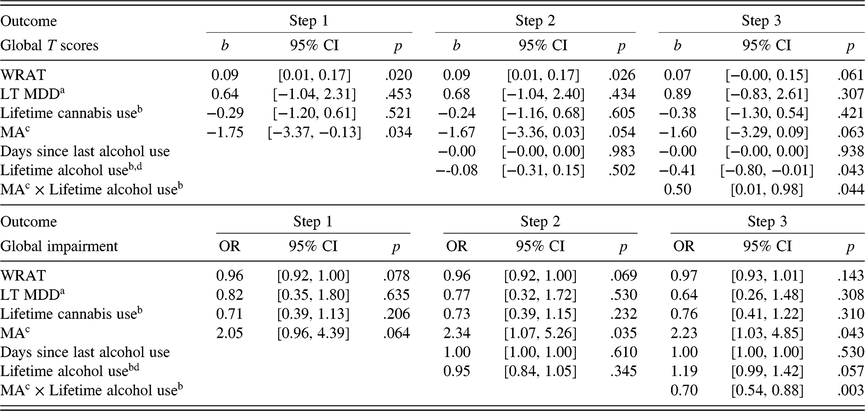
Table 3 reports results for the stepwise multivariable linear regression analysis predicting global T scores. Step 1, which examined the independent effect of MA status while controlling for WRAT scores, lifetime MDD, and lifetime average daily cannabis use, demonstrated significantly lower global T scores in the MA+ group compared to the MA– group (b = −1.75, p = .034). Of the covariates examined, only WRAT scores independently predicted global T scores, with higher WRAT performance predicting higher global T scores (b = .09, p = .020). Step 2, which added lifetime average daily alcohol use and days since last alcohol use as predictors of global T scores, did not demonstrate a significant effect of lifetime average daily alcohol use on global functioning independent of MA status and covariates (b = −.08, p = .502). Step 3, which examined whether lifetime average daily alcohol use modulated the effects of MA status on global T scores, showed a significant interaction of lifetime average daily alcohol use and MA status for global performance (b = .50, p = .044). Simple slope analyses indicated that lifetime average daily alcohol use negatively related to global functioning among MA− persons (b = −0.44, p = .030), but did not significantly predict global functioning among MA+ participants (b = 0.08, p = .586; Figure 1). Post-hoc adjustment for BDI-II scores did not attenuate the significant interaction effect of lifetime average daily alcohol use and MA status on global T scores.
Global T scores by lifetime average daily alcohol use, with predicted slopes for methamphetamine dependence (MA) status groups controlling for WRAT, BDI-II, lifetime MDD, days since last alcohol use, and lifetime average daily cannabis use. Higher lifetime average daily alcohol use significantly predicts lower global T scores among MA− individuals only.

Stepwise multivariable linear and logistic regression models predicting global T scores and impairment

OR = odds ratio; CI = confidence interval; WRAT = Wide Range Achievement Test; MA = methamphetamine status; MDD = major depressive disorder.
a Lifetime diagnosis of MDD compared to no lifetime diagnosis of MDD.
b Represents lifetime average daily use.
c Effect of MA+ compared to MA−; Step 3 effect represents effect of MA group only at mean level of lifetime average daily alcohol use.
d Step 3 effect represents effect of lifetime average daily alcohol use in MA− individuals only (reference group).
Results for the binary logistic regression analysis predicting global impairment are also reported in Table 3. Similar to the step 1 global T score analyses, the MA+ group had a higher likelihood of global impairment (OR = 2.05, p = .064) and higher WRAT scores reduced the likelihood of impairment (OR = 0.96, p = .078), yet these effects only approached significance. The step 2 model did not demonstrate significant main effects for lifetime average daily alcohol use or days since last alcohol use on probability of global impairment. However, step 3 showed a significant interaction of lifetime average daily alcohol use and MA status for global impairment (p = .003). Simple slope analyses indicated that greater alcohol consumption increased the likelihood of global impairment (OR = 1.22, 95% CI [1.01; 1.48], p = .033) in MA− persons, but significantly decreased the likelihood of global impairment (OR = 0.82, 95% CI [0.68; 0.96], p = .020) in MA+ individuals. Similar to the T score analysis, post-hoc adjustment for BDI-II scores did not attenuate the significant interaction effect of lifetime average daily alcohol use and MA status on global impairment.
DISCUSSION
The present study explored how lifetime patterns of alcohol consumption, specifically a metric averaging drinks per drinking day over the lifetime, related to neuropsychological performance among MA-dependent and MA-nonusing individuals. Based on the current literature detailing the independent, adverse neurobehavioral contributions of chronic MA and alcohol consumption, it was hypothesized that the MA+ group would exhibit worse neurocognitive performance and that greater alcohol use would exacerbate the deleterious neurocognitive effects of MA use. Consistent with prior studies, we demonstrate that MA+ individuals perform worse on average across all neurocognitive domains while exhibiting modestly higher rates of neurocognitive impairment (Cherner et al., Reference Cherner, Suarez, Casey, Deiss, Letendre, Marcotte, Vaida, Atkinson, Grant and Heaton2010; Scott et al., Reference Scott, Woods, Matt, Meyer, Heaton, Atkinson and Grant2007) and consuming more alcohol and cannabis than their MA– counterparts. Whereas heavier drinking increased the likelihood of global neurocognitive impairment in the absence of MA dependence, no additive effects of alcohol were observed among MA+ participants. Contrary to expectations, lifetime average daily alcohol use did not predict global T scores and in fact was associated with reduced risk of global neurocognitive impairment in the MA+ group. To our knowledge, this is the first study to explore potentially modulating effects of historical patterns of alcohol consumption, as opposed to recent heavy drinking, on MA-associated neurocognitive performance.
Given the known neurotoxic and neurobehavioral consequences of heavy alcohol use (Brust, Reference Brust2010; Grant, Reference Grant1987), these results must be interpreted with caution. However, our finding that elevated historical levels of alcohol consumption attenuate MA-related global neurocognitive impairment is consistent with prior studies demonstrating that singly addicted stimulant abusers consistently experience greater levels of neurocognitive dysfunction than those who simultaneously abuse stimulants and alcohol (Lawton-Craddock et al., Reference Lawton-Craddock, Nixon and Tivis2003; Robinson et al., Reference Robinson, Heaton and O’Malley1999). These prior findings are particularly applicable to the current investigation as both studies classified participants based on lifetime patterns of chronic stimulant and alcohol use (i.e., dependence) and administered comprehensive and validated neuropsychological batteries. Although studies of the neurocognitive effects of acute, combined stimulant and alcohol use may be less generalizable to our results, some studies have reported that administration of dextroamphetamine or amphetamine sulfate following ethanol-induced intoxication in humans may dampen ethanol-related neuropsychological decrements in psychomotor performance, executive function, and working memory (Perez-Reyes et al., Reference Perez-Reyes, White, McDonald and Hicks1992; Wilson et al., Reference Wilson, Taylor, Nash and Cameron1966). Nevertheless, further research is required to determine whether acute alcohol administration following MA-induced intoxication exhibits similar neurocognitive effects and to what extent such findings can be extrapolated to chronic substance abusers.
Our unanticipated results with respect to MA+ participants necessitate that we critically examine potential statistical and behavioral confounds. The significant relationship between lifetime average daily alcohol use and the dichotomous global impairment variable, as opposed to the null effect of lifetime alcohol use on continuous global T scores, reflects fundamental differences between these two measures of global neurocognition. Global T scores are computed by averaging individual T scores across the entire battery and can represent performance across the entire neurocognitive spectrum (e.g., severely impaired to very superior). As a result, above average performance on some measures can mask impaired performance elsewhere. Conversely, the GDS-based impairment classification accounts for the frequency and severity of deficits across the test battery with less consideration given to performance in the normal range (i.e., normal scores are set to zero; Blackstone et al., Reference Blackstone, Moore, Franklin, Clifford, Collier, Marra, Gelman, McArthur, Morgello, Simpson, Ellis, Atkinson, Grant and Heaton2012). Figure 1 demonstrates that although average global T scores in MA+ individuals remain stable as lifetime average daily alcohol use increases, resulting in a null association, there is greater variability in performance at low levels of alcohol use, resulting in a higher percentage of MA+ individuals being classified as impaired on the GDS at low levels of use. Similarly, the MA+ group had an average global T score that only fell .35 standard deviations below the mean (i.e., T = 47.5), yet was twice as likely to have global impairment as compared to MA– individuals, suggesting that a global index of impairment may enhance detection of the subset of MA users that are disproportionally vulnerable to MA-related brain insults. Conversely, MA group comparisons on domain-specific performance illustrate the utility of T scores in detecting subtle yet significant differences that do not necessarily translate to differences in rates of impairment. The hypothesis that neurocognitive performance attributable to MA-induced neural injury may hinder the ability to detect the relatively subtle influence of alcohol is supported by evidence that MA abuse poses greater risk for neurocognitive deficits than alcohol abuse (Bechara & Martin, Reference Bechara and Martin2004; Gonzalez et al., Reference Gonzalez, Bechara and Martin2007). Although our data demonstrate an adverse, multi-domain effect of MA dependence, this effect is modest and therefore unlikely to preclude us from detecting any additional influence of alcohol use patterns.
From a polysubstance use perspective, the strong positive correlation between self-reported lifetime MA and alcohol use indicates that the observed relationship between greater alcohol use and lower likelihood of global neurocognitive impairment is not an artifact of heavy drinkers having less exposure to MA. Although cannabis use correlated with alcohol use, and prior evidence suggests cannabis use may attenuate MA-related neurocognitive deficits (Gonzalez et al., Reference Gonzalez, Rippeth, Carey, Heaton, Moore, Schweinsburg, Cherner and Grant2004), lifetime cannabis exposure did not suppress our significant findings nor did it account for variance in neurocognitive performance. Furthermore, the negligible effects of days since last alcohol use and depressive symptoms rule out MA group differences in recent alcohol consumption and psychiatric comorbidities as a source of variance in neurocognitive performance. In a meta-analysis examining the neurocognitive effects of duration of alcohol abstinence, Stavro and colleagues found that neurocognitive dysfunction decreased following sustained abstinence for at least a year (Stavro et al., Reference Stavro, Pelletier and Potvin2013). Importantly, this meta-analysis only included patients who met criteria for alcohol use disorder and excluded patients with non-alcohol substance use disorders. Given that the present study sample included MA-dependent individuals with varying levels of alcohol consumption, neurocognitive recovery facilitated by increased duration of abstinence from alcohol may be more prominent for heavier drinking populations without comorbid substance use disorders. Moreover, our study criteria excluded DSM-IV-based alcohol dependence within the past year as well as evidence of long-term lifetime alcoholism. Therefore, those meeting dependence criteria would have done so only in the past and on an episodic basis. With regard to MA group differences in time since last alcohol use, these are largely explained by many MA+ participants being in recovery and abstaining from all substances currently, whereas MA– participants may include current social drinkers. Nevertheless, days since last alcohol use did not predict our outcomes.
Drawing inferences about specific biological mechanisms underlying polysubstance use in humans is particularly challenging given that substance use disorders, such as MA dependence, cannot be experimentally modeled as independent factors in randomized controlled trials, and observational studies are often underpowered to examine potential confounds. Although the nature of our data prevents us from empirically investigating specific biological mechanisms that may explain the interactive effects of MA status and lifetime average daily alcohol use on neurocognitive functioning, we offer several plausible neurobiological interpretations. First, the cerebrovascular abnormalities evidenced in MA use are partially attributable to the vasoconstrictive properties of MA that result in platelet aggregation (Ho et al., Reference Ho, Josephson, Lee and Smith2009; Kiyatkin & Sharma, Reference Kiyatkin and Sharma2009). Alcohol, in contrast, is recognized to have vasodilating properties that reduce platelet aggregation (Bau et al., Reference Bau, Bau, Naujorks and Rosito2005). Thus, alcohol-driven attenuation of MA-induced vasoconstriction may reduce the magnitude of neurovascular dysfunction and subsequent neurobehavioral deficits experienced by MA users. It is important to note, however, that certain studies have demonstrated a biphasic vasoregulatory effect in which alcohol’s vasodilating properties may be limited to light-to-moderate drinkers, whereas heavier drinkers are at risk for a rebound effect in which an increase in platelet aggregation is observed following acute withdrawal from alcohol (Piano, Reference Piano2017; Renaud & Ruf, Reference Renaud and Ruf1996).
An additional source of MA-associated neurotoxicity is the induction of brain hyperthermia through increased neural activation (Brown et al., Reference Brown, Wise and Kiyatkin2003; Kiyatkin & Sharma, Reference Kiyatkin and Sharma2009). Brain thermotoxicity is mediated through multi-level mechanisms in which adverse cellular (e.g., protein denaturation), local (e.g., infarction), and systemic (e.g., cerebral blood flow dysregulation) events can contribute to neurocognitive difficulties (Walter & Carraretto, Reference Walter and Carraretto2016). Despite the sensations of warmth experienced during alcohol consumption, alcohol’s vasodilatory properties result in brain and body heat dissipation (Lee et al., Reference Lee, Schoener, Nielsen, Kelly, Lin and Berman1990) that may counteract the hyperthermic consequences of MA use. Animal experiments have demonstrated that rats exposed to alcohol before and after TBI recover from TBI-induced brain hyperthermia faster and exhibit fewer deficits in spatial learning than alcohol-naïve rats (Janis et al., Reference Janis, Hoane, Conde, Fulop and Stein1998; Taylor et al., Reference Taylor, Romeo, Beylin, Tio, Rahman and Hovda2002). Whether such thermoregulatory benefits of alcohol, and subsequent attenuation of neurocognitive impairments, hold in the context of MA-induced hyperthermia requires further investigation.
Although the neurophysiological alterations associated with increased alcohol consumption may provide neuroprotective benefits in the context of MA addiction, our data demonstrate an adverse effect of lifetime average daily alcohol use on neurocognitive function in the absence of MA dependence. Unlike the MA+ group, who on average reported heavy lifetime alcohol consumption (i.e., >4 drinks/day), MA− individuals on average reported low-risk alcohol intake (National Institute on Alcohol Abuse and Alcoholism (U.S.), 2005). Neurocognitive performance in nondrinkers, low, and moderate drinkers has been widely studied yet has yielded mixed results. Whereas many researchers posit a “j-shaped” relationship, in which light-to-moderate consumption confers neurocognitive benefits over nondrinking but heavy consumption is more neurotoxic than abstinence (Britton et al., Reference Britton, Singh-Manoux and Marmot2004; Elias et al., Reference Elias, Elias, D’Agostino, Silbershatz and Wolf1999; Neafsey & Collins, Reference Neafsey and Collins2011; Rodgers et al., Reference Rodgers, Windsor, Anstey, Dear, Jorm and Christensen2005), other studies have either found no relationship or a negative association between low-to-moderate consumption and neurobehavioral outcomes (Gross et al., Reference Gross, Rebok, Ford, Chu, Gallo, Liang, Meoni, Shihab, Wang and Klag2011; Kalapatapu et al., Reference Kalapatapu, Ventura and Barnes2017; Topiwala et al., Reference Topiwala, Allan, Valkanova, Zsoldos, Filippini, Sexton, Mahmood, Fooks, Singh-Manoux, Mackay, Kivimäki and Ebmeier2017). Our findings are most consistent with the latter group of studies suggesting a deleterious dose-dependent effect of alcohol consumption, even at moderate levels, on cognition and brain structure (Gross et al., Reference Gross, Rebok, Ford, Chu, Gallo, Liang, Meoni, Shihab, Wang and Klag2011; Topiwala et al., Reference Topiwala, Allan, Valkanova, Zsoldos, Filippini, Sexton, Mahmood, Fooks, Singh-Manoux, Mackay, Kivimäki and Ebmeier2017). It is important to note that despite reaching statistical significance, our findings represent a small effect size in which one extra drink per day equates to about a one-half unit decrease in global T scores. As a result, the clinical significance of this relationship may be far more relevant for heavier drinkers with borderline neurocognitive performance than higher performing drinkers. Although the present study focuses on the conditional role of alcohol in MA-related neurocognitive performance, further studies that probe the neurocognitive effect of alcohol at varying levels of consumption and model non-linear relationships are warranted regardless of MA status.
Understanding limitations of the current study may guide future research to clarify the observed differential effects of alcohol use on neurocognitive functioning among MA+ and MA− individuals. Unsurprisingly, the MA+ group displayed significantly greater lifetime average daily alcohol use than the MA− group. Although the distribution of residuals from regression models were carefully examined to ensure no assumptions of normality were violated, the group difference in lifetime average daily alcohol use may impact the reliability of our MA effect estimates at high levels of consumption in which the MA– group is underrepresented. Additionally, these estimates of lifetime alcohol consumption are fully dependent on participant self-report. Given that the vast majority of participants began drinking during teenage years and must therefore recall multiple decades of alcohol use, estimates of alcohol consumption will naturally deviate from the true amount of alcohol exposure. Consequently, it is recommended that our estimates related to alcohol use and neurocognition be interpreted conservatively with a greater emphasis on directionality than exact magnitude.
The cross-sectional nature of our data prevents us from disentangling the effects of alcohol and MA use from longstanding individual differences in neurocognitive capacities (e.g., cognitive reserve). However, the inclusion of the WRAT Reading subtest as a covariate in all regression models increases our confidence that the observed effects of substance use on neurocognitive performance are not attributable to premorbid functioning. Furthermore, the application of demographic corrections to neuropsychological test scores improves the comparison of results between the MA groups despite differences in education. The positive association between WRAT scores and global neurocognition highlights the incremental predictive value of the WRAT above and beyond demographic effects, most notably education. These findings align with prior substance use studies that suggest that intellectual enrichment, as indicated by high IQ, can increase cognitive reserve and mitigate the deleterious effects of stimulant-induced neural injury on neurocognition (Cherner et al., Reference Cherner, Suarez, Casey, Deiss, Letendre, Marcotte, Vaida, Atkinson, Grant and Heaton2010; Mahoney et al., Reference Mahoney, Kalechstein, De Marco, Newton and De La Garza2017). Unsurprisingly, MA+ individuals more frequently met criteria for lifetime dependence for other substance use than MA– individuals. However, study exclusion criteria necessitated that such dependence be episodic in nature and remote (>5 years ago; alcohol >1 year ago; cannabis no restriction). Additional individual differences that we were not able to capture in the present study include potential genetic differences in vulnerability to alcohol effects (e.g., metabolic differences); however, these would presumably be equally distributed among MA+ and MA– individuals.
The unexpected finding that alcohol reduces the likelihood of neurocognitive impairment in MA+ individuals raises intriguing biologically driven theories of neuroprotection that we unfortunately cannot answer with our data. Simultaneous administration of MA and alcohol versus non-overlapping periods of single substance use is an issue central to conceptualizing the interaction between MA and alcohol use. Many primary MA users report alternating use of MA and alcohol throughout a given binge in order to titrate their subjective experience of intoxication (Park & Nordahl, Reference Park and Nordahl2014). This coordinated pattern of MA and alcohol use may attenuate MA-related sleep disturbances, but may also increase risky behaviors (e.g., impaired driving) due to decreased perceptions of intoxication (Kirkpatrick et al., Reference Kirkpatrick, Gunderson, Levin, Foltin and Hart2012). Although the lifetime average daily alcohol use metric captures lifetime alcohol patterns, it does not capture chronicity and persistence of alcohol use nor does it distinguish periods of concurrent MA and alcohol use from intervals of monosubstance use among the MA+ individuals. Such a distinction between lifetime periods of simultaneous intoxication versus non-overlapping intoxication would permit for a more nuanced understanding of the aforementioned neurophysiological hypotheses. Additionally, although our neurocognitive variables reflect the behavioral outputs of neural functioning, they do not directly measure the integrity of neural circuitry and neurobiological activity. Therefore, the inclusion of genetic, neuroimaging, and fluid-based biomarker data that more directly reflect neurobiological pathways is recommended for future studies of polysubstance use.
CONCLUSION
Taken together, our findings demonstrate a differential effect of lifetime alcohol consumption on neurocognitive performance such that hypothesized deleterious contributions of alcohol use were only detected in MA-nonusing individuals. Contrary to expectations, lifetime average daily alcohol use was associated with a reduced likelihood of global neurocognitive impairment in MA-dependent persons. Our findings are supported by prior animal and human studies identifying neurobiological mechanisms by which alcohol may attenuate the vasoconstriction and brain thermotoxicity associated with stimulant use (i.e., vasodilation and heat dissipation). Alcohol may diminish aspects of the neural dysregulation cascade that results in MA-associated neurocognitive dysfunction. Replication and examination of neurophysiologic mechanisms (e.g., neurovascular and metabolic effects) underlying alcohol use in the context of MA dependence, including concurrent use as well as acute and long-term effects, is warranted to elucidate whether alcohol confers a degree of neuroprotection in MA dependence.
SUPPLEMENTARY MATERIAL
To view supplementary material for this article, please visit https://doi.org/10.1017/S1355617719000493.
ACKNOWLEDGMENTS
Data for this study were collected as part of a NIDA-funded research program that includes the Translational Methamphetamine AIDS Research Center (TMARC), supported by award P50DA026306 and the program projects on NeuroAIDS Effects of Methamphetamine and NeuroAIDS Effects of Methamphetamine & HCV, and supported by award P01DA012065. Stipend support to RS is funded by NIAAA award T32AA013525. The authors declare no conflicts of interest. The Translational Methamphetamine AIDS Research Center (TMARC) is supported by Center award P50DA026306 from the National Institute on Drug Abuse (NIDA) and is affiliated with the University of California, San Diego (UCSD), the Sanford-Burnham Medical Discovery Institute (SBMDI), and the University of California, Irvine (UCI). The TMARC comprises: Administrative Coordinating Core (ACC) – Executive Unit: Director – Igor Grant, M.D.; Co-Directors – Ronald J. Ellis, M.D., Ph.D., Scott L. Letendre, M.D., and Cristian L. Achim, M.D., Ph.D.; Center Manager – Mariana Cherner, Ph.D.; Associate Center Managers – Erin E. Morgan, Ph.D. and Jared Young, Ph.D.; Data Management and Information Systems (DMIS) Unit: Anthony C. Gamst, Ph.D. (Unit Chief) and Clint Cushman, B.A. (Unit Manager); ACC – Statistics Unit: Florin Vaida, Ph.D. (Unit Chief), Ian S. Abramson, Ph.D., Reena Deutsch, Ph.D., and Anya Umlauf, M.S.; ACC – Participant Unit: J. Hampton Atkinson, M.D. (Unit Chief), Jennifer Marquie-Beck, and M.P.H. (Unit Manager); Behavioral Assessment and Medical (BAM) Core – Neuromedical and Laboratory Unit (NLU): Scott L. Letendre, M.D. (Core Co-Director/NLU Chief) and Ronald J. Ellis, M.D., Ph.D.; BAM Core – Neuropsychiatric Unit (NPU): Robert K. Heaton, Ph.D. (Core Co-Director/NPU Chief), J. Hampton Atkinson, M.D., Thomas D. Marcotte, Ph.D., Erin E. Morgan, Ph.D., and Matthew Dawson (NPU Manager); Neuroimaging (NI) Core: Gregory G. Brown, Ph.D. (Core Director), Thomas T. Liu, Ph.D., Miriam Scadeng, Ph.D., Christine Fennema-Notestine, Ph.D., Sarah L. Archibald, M.A., John R. Hesselink, M.D., Mary Jane Meloy, Ph.D., and Craig E.L. Stark, Ph.D.; Neuroscience and Animal Models (NAM) Core: Cristian L. Achim, M.D., Ph.D. (Core Director), Marcus Kaul, Ph.D., and Virawudh Soontornniyomkij, M.D.; Pilot and Developmental (PAD) Core: Mariana Cherner, Ph.D. (Core Director), Stuart A. Lipton, M.D., Ph.D.; Project 1: Arpi Minassian, Ph.D. (Project Director), William Perry, Ph.D., Mark A. Geyer, Ph.D., and Jared W. Young, Ph.D.; Project 2: Amanda B. Grethe, Ph.D. (Project Director), Susan F. Tapert, Ph.D., and Assawin Gongvatana, Ph.D.; Project 3: Erin E. Morgan, Ph.D. (Project Director) and Igor Grant, M.D.; Project 4: Svetlana Semenova, Ph.D. (Project Director).; Project 5: Marcus Kaul, Ph.D. (Project Director). The views expressed in this article are those of the authors and do not reflect the official policy or position of the United States Government.