The key role of the interplay between biologically founded child characteristics and qualities of parenting for future adaptive and maladaptive developmental cascades has long been beyond dispute (e.g., Bates, Schermerhorn, & Petersen, Reference Bates, Schermerhorn, Petersen, Zentner and Shiner2012; Dodge, Coie, & Lynam, Reference Dodge, Coie, Lynam, Damon, Lerner and Eisenberg2006; Frick & Morris, Reference Frick and Morris2004; Kiff, Lengua, & Zalewski, Reference Kiff, Lengua and Zalewski2011; Kim & Kochanska, Reference Kim and Kochanska2012; Kochanska, Kim, Barry, & Philibert, Reference Kochanska, Kim, Barry and Philibert2011; Nigg, Reference Nigg2006; Propper & Moore, Reference Propper and Moore2006; Rothbart & Bates, Reference Rothbart, Bates, Damon, Lerner and Eisenberg2006; Thomas & Chess, Reference Thomas and Chess1977). Growing availability of molecular genetic measures and refinements in behavioral assessments of biologically based temperament have fueled rapid progress in developmental research aimed at elucidating specific forms of such interplay.
A well-established body of evidence has shown that children who are considered at risk due to a number of characteristics, including specific genetic polymorphisms or difficult temperaments, and who are exposed to negative, unresponsive, power-assertive parenting, are likely to develop a broad range of behavior problems (a phenomenon long known as the diathesis–stress model). However, warm, responsive, mutually positive parenting, deemphasizing the use of power, can effectively offset those risks (e.g., Bates, Pettit, Dodge, & Ridge, Reference Bates, Pettit, Dodge and Ridge1998; Bradley & Corwyn, Reference Bradley and Corwyn2008; Giliom & Shaw, Reference Gilliom and Shaw2004; Kochanska & Kim, Reference Kochanska and Kim2013; Lerner, Nitz, Talwar, & Lerner, Reference Lerner, Nitz, Talwar, Lerner, Kohnstamm, Bates and Rothbart1989; Messman et al., Reference Mesman, Stoel, Bakermans-Kranenburg, van IJzendoorn, Juffer and Koot2009; Stright, Gallagher, & Kelley, Reference Stright, Gallagher and Kelley2008).
Belsky and colleagues (Belsky, Reference Belsky1997; Belsky, Bakermans-Kranenburg, & van IJzendoorn, Reference Belsky, Bakermans-Kranenburg and van IJzendoorn2007; Belsky & Pluess, Reference Belsky and Pluess2009a, Reference Belsky and Pluess2009b; Pluess & Belsky, Reference Pluess and Belsky2010), as well as Boyce and Ellis (Reference Boyce and Ellis2005) and Ellis, Boyce, Belsky, Bakermans-Kranenburg, and van IJzendoorn (Reference Ellis, Boyce, Belsky, Bakermans-Kranenburg and van IJzendoorn2011) have argued that certain traits, typically seen as “risk factors” (e.g., carrying a short allele in a polymorphism in the serotonin transporter linked polymorphic region, 5-HTTLPR, or having a difficult temperament) are more accurately viewed as reflections of “plasticity,” “malleability,” or “sensitivity to context.” When subjected to adverse, suboptimal parenting, children with those characteristics do have worse outcomes than children without them. Given optimal parenting, those “high-risk” children not only do not have maladaptive outcomes but also can do better than the “low-risk” children. In addition, children who do not have “risk” factors are generally unaffected, or affected much less, by a range of parenting qualities, either adverse or beneficial. This model is referred to as differential susceptibility.
To elucidate further the two models and their roles in developmental adaptive and maladaptive cascades, Belsky and Pluess (Reference Belsky and Pluess2009a, Reference Belsky and Pluess2009b) called for including both negative and positive parenting characteristics and both adaptive and maladaptive outcomes in investigations of the interplay between biologically based child qualities and dimensions of their parenting environment. Such an approach has been productive.
For example, Spinrad and Stifter (Reference Spinrad and Stifter2006) reported that highly anger-prone infants showed less prosocial behavior than infants who were not anger prone when their mothers were unresponsive, but more prosocial behavior if their mothers were highly responsive. Van Zeijl et al. (Reference van Zeijl, Mesman, Stolk, Alink, van IJzendoorn and Bakermans-Kranenburg2007) found that toddlers with difficult temperaments were more susceptible to maternal negative discipline (more externalizing problems) and to positive discipline (fewer externalizing problems). We have recently shown that infants' negative emotionality can be seen as a marker of plasticity: highly emotionally negative infants were more affected by differences in positive, mutually responsive relationships with their mothers than those who were not negative. Further, when exposed to optimal, mutually positive parenting, highly emotionally negative infants had better developmental outcomes than did infants not prone to negative emotionality (Kim & Kochanska, Reference Kim and Kochanska2012).
We note, however, that such pattern has not been universal. Across different ages, outcomes, or moderators (e.g., a polymorphism in the serotonin transporter linked promoter region, 5-HTTLPR), some interaction effects were consistent with the differential susceptibility model, while other effects were consistent with the diathesis–stress model (Kochanska et al., Reference Kochanska, Kim, Barry and Philibert2011). In another study, with a highly stressed, low-income sample, and child difficult temperament as the moderator, the interactions were consistent with the diathesis–stress model (Kochanska & Kim, Reference Kochanska and Kim2013).
Negative emotionality, anger proneness, or generally difficult temperament are very typical behavioral markers of biologically based vulnerability or plasticity; recent studies, however, have increasingly relied on molecular genetic markers. One of the most commonly studied constructs is a polymorphism in the 5-HTT gene regulatory region (5-HTTLPR). The 5-HTTLPR polymorphism has two common alleles, the short and the long. The short allele has been linked to reduced 5-HTT transcription, lower 5-HTT protein levels, and diminished serotonin reuptake compared to individuals with the long allele, and implicated in a broad range of difficulties, including regulation of mood, attention, executive function, aggression, high-risk behaviors, substance use, and depression or anxiety (Auerbach, Faroy, Ebstein, Kahana, & Levine, Reference Auerbach, Faroy, Ebstein, Kahana and Levine2001; Barr et al., Reference Barr, Newman, Lindell, Shannon, Champoux and Lesch2004; Champoux et al., Reference Champoux, Bennett, Shannon, Higley, Lesch and Suomi2002; Hariri et al., Reference Hariri, Drabant, Munoz, Kolachana, Mattay and Egan2005; Lesch et al., Reference Lesch, Bengel, Heils, Sabol, Greenberg and Petri1996; Lucki, Reference Lucki1998; Propper & Moore, Reference Propper and Moore2006; Sourbrie, Reference Sourbrie1986; Suomi, Reference Suomi2006; van Goozen, Fairchild, Snoek, & Harold, Reference van Goozen, Fairchild, Snoek and Harold2007). A broad approach to research on the 5-HTTLPR polymorphism that encompasses maladaptive and adaptive outcomes in multiple aspects of personality and psychopathology has been advocated (Canli & Lesch, Reference Lesch2007; Lesch, Reference Lesch2007). In the developmental literature, the 5-HTTLPR polymorphism has been frequently considered as a moderator of effects of parenting (Belsky & Pluess, Reference Belsky and Pluess2009a, Reference Belsky and Pluess2009b; Brody et al., Reference Brody, Beach, Philibert, Chen, Lei and Murry2009; Kaufman et al., Reference Kaufman, Yang, Douglas-Palumberi, Crouse-Artus, Lipschitz and Krystal2007; Kochanska et al., Reference Kochanska, Kim, Barry and Philibert2011; Pluess & Belsky, Reference Pluess and Belsky2010, Reference Pluess and Belsky2013; Suomi, Reference Suomi2006).
Many longitudinal developmental studies that employ labor-intensive behavioral coding, including ours, do not have a sample size sufficient for the explicit testing of G × E interactions (Johnston, Lahey, & Matthys, Reference Johnston, Lahey and Matthys2013). In the present study, we propose a biobehavioral approach to conceptualization and measurement of children's vulnerability (or plasticity) construct. Toward that end, we adopt a strategy that integrates two well-established markers: molecular genetic (a short 5-HTTLPR allele) and behavioral (a highly negative, anger-prone temperament, assessed in multiple standardized observations). As stated in the previous review, both characteristics have been consistently shown to moderate the impact of the parenting environment in producing adaptive or maladaptive developmental cascades. We propose that a combination of both characteristics, having a short 5-HTTLPR allele and a highly anger-prone temperament, may constitute a promising marker of individual risk. We see this approach as mirroring a common strategy in health sciences and health care. Health providers consider both the patient's genetic vulnerability factors (family history of, for example, lung cancer, heart disease, or obesity) and behavioral risk factors (smoking, high-cholesterol diet, or high calorie intake, respectively). Although the genetic vulnerability factors and behavioral factors need not be correlated (they may even be modestly negatively related due to doctors strongly advising some patients to reduce their specific high-risk behaviors), nevertheless, a person with a combination of both genetic and behavioral factors would certainly be considered at a higher biobehavioral risk than a person who has only one factor or neither factor.
As urged by Belsky and colleagues, we wished to examine both positive and negative dimensions of the childrearing environment. Toward that end, we targeted positive, mutually responsive parenting and power-assertive parenting, and derived observational measures from robust and very large samples of observed behavior over five assessments during the period of 4.5 years, from toddler (25 months) to early school age (80 months).
We collected parallel data on mother– and father–child relationships. The literature on the interplay of biologically based child characteristics and parenting includes relatively few studies that have involved fathers. Consequently, most of the extant knowledge on parenting environment is incomplete, because it is based only on measures from one parent (typically the mother). Our aim was to obtain robust and more complete representation of the child's history of parenting experience. Toward that end, we created rich overall parenting measures, based on lengthy observations of both the mother and the father in interactive contexts with the child.
The positive parenting dimension was conceptualized as a mutually responsive orientation (MRO) between the parent and the child, a reciprocal, close, mutually cooperative, affectively positive relationship that has been repeatedly linked to adaptive developmental outcomes. Multiple studies, across many assessments, ages, and both mother– and father–child relationships, have demonstrated that MRO has important, broadly ranging, beneficial implications for the child's socialization outcomes (e.g., Kochanska, Aksan, Prisco, & Adams, Reference Kochanska, Aksan, Prisco and Adams2008). Furthermore, MRO can effectively offset biologically based risks due to difficult temperament (Kim & Kochanska, Reference Kim and Kochanska2012).
The negative parenting dimension was defined as power assertion, assessed during routine discipline contexts. A very large literature has depicted power-assertive parenting as a factor that sets in motion maladaptive trajectories (Gershoff, Reference Gershoff2002; Hoffman, Reference Hoffman, Higgins, Ruble and Hartup1983; McCord, Reference McCord1997). This has been true even in well-functioning community families, where power assertion is typically infrequent, as was the case in the current study (Bender et al., Reference Bender, Allen, Boykin Mcelhaney, Antonishak, Moore and O'Beirne Kelly2007; Kochanska, Aksan, & Nichols, Reference Kochanska, Aksan and Nichols2003; Kochanska & Kim, Reference Kochanska and Kim2012).
We focused on predicting socialization outcomes assessed during the transition to preadolescence, at age 10, immediately prior to the period when probabilities of substance use and other high-risk behaviors begin dramatically and steeply to increase (Boyer, Reference Boyer2006; Moffitt, Reference Moffitt1993; Steinberg & Morris, Reference Steinberg and Morris2001). Relatively few studies have examined how interactions between biologically based child characteristics and early parenting predict adaptation to the challenges in preadolescent and adolescent years. Brody et al. (Reference Brody, Beach, Philibert, Chen, Lei and Murry2009) found that youths who carried a 5-HTTLPR short allele were likely to increase substance use over time, but mother-reported responsive and involved parenting significantly attenuated that risk. In a rare long-term study, Pluess and Belsky (Reference Pluess and Belsky2010) reported that mother-rated difficult temperament in infancy moderated the links between maternal sensitivity from toddler to preschool age and children's socioemotional outcomes, rated by teachers in sixth grade, such that children with histories of difficult temperament were more susceptible to early rearing effects at age 11.
The outcome measures were tailored to reflect our general view of the socialization process and targeted children's broad acceptance of and cooperation with parental socialization influence and agenda. Such an accepting, willing stance is critical for the development of internalized controls of conduct, or conscience, emerging over the course of early development (Grusec & Goodnow, Reference Grusec and Goodnow1994; Kochanska, Kim, & Boldt, Reference Kochanska, Kim and Boldt2013; Thompson, Reference Thompson, Damon, Lerner and Eisenberg2006, in press). The child's accepting, cooperative attitude toward parental socialization, with the child willingly embracing the parent's values and standards of conduct, is perhaps the single most powerful factor that promotes adaptive, competent trajectory and prevents destructive, antisocial, and callous behavioral cascades (Kochanska, Koenig, Barry, Kim, & Yoon, Reference Kochanska, Koenig, Barry, Kim and Yoon2010).
Toward that end, we assessed four outcomes that reflected children's willing, positive, accepting attitudes toward parental influence and standards of behavior. Parents reported on children's willing, active cooperation with parental monitoring with regard to daily schedules and activities. Monitoring becomes a key dimension of parent–child socialization in preadolescence, when direct control and supervision decline (Sroufe, Egeland, Carlson, & Collins, Reference Sroufe, Egeland, Carlson and Collins2005) and the child's active cooperation indicates a willing, accepting stance toward parental influence (Darling, Cumsille, & Martinez, Reference Darling, Cumsille and Martinez2008; Kerns, Aspelmeier, Gentzler, & Grabill, Reference Kerns, Aspelmeier, Gentzler and Grabill2001; Stattin & Kerr, Reference Stattin and Kerr2000). Parents also reported on children's callous–unemotional (CU) tendencies, which include a disregard for values and standards of behavior and for feelings of others and an absence of concern about good conduct (Frick & Viding, Reference Frick and Viding2009; Frick & White, Reference Frick and White2008).
Children were individually interviewed. They reported their negative attitude toward smoking and drinking, a well-known protective factor (Brody et al., Reference Brody, Murry, Kogan, Gerrard, Gibbons and Molgaard2006). They also reported how much they endorsed and internalized adult values with regard to desirable conduct, for example, doing well in school, respecting authority figures (parents and teachers), and following those adults' rules (Allen, Weissberg, & Hawkins, Reference Allen, Weissberg and Hawkins1989).
In sum, this is a multimethod, multitrait, multiple-informant, multiassessment investigation that integrates molecular genetic measures; rich behavioral observations of mothers, fathers, and children; and parents' and children's reports, and employs a developmental longitudinal design spanning the period from toddler age to preadolescence. We examine the interplay between individual differences in children's biobehavioral risk, a construct that incorporates known genetic and behavioral risk characteristics, and the qualities of the childrearing environment, conceptualized as a global history of parenting children have received. We study effects of such interplay on key socialization outcomes of preadolescent development.
Based on the rapidly growing body of evidence, we expected that biobehavioral risk would significantly moderate the effects of parenting on socialization outcomes. We anticipated that children at higher risk, identified as having a combination of a molecular genetic characteristic (a short 5-HTTLPR allele) and behaviorally assessed difficult temperament, or anger proneness, would be more sensitive to variations in parenting than children at lower risk. We articulated no specific expectations, however, regarding the form of the interactions (diathesis–stress vs. differential susceptibility). We certainly expected, in accord with both models, that children at high biobehavioral risk who also received suboptimal parenting (low positive mutuality and high power assertion) would have less adaptive outcomes at age 10. However, as indicated in the earlier review, the extant findings on children who are at high risk but who receive optimal parenting have been mixed. In some studies, or with regard to some outcomes, those children have been found to do no worse (but not better) than their low-risk peers, but in other studies, or with regard to other outcomes, the high-risk children who had the benefit of optimal parenting have outperformed their low-risk peers. Consequently, this direction was exploratory.
To examine the form of the interaction effects, we adopted a relatively new formal approach to the testing of interactions that involved the analysis of regions of significance (Aiken & West, Reference Aiken and West1991; Hayes & Matthes, Reference Hayes and Matthes2009; Preacher, Curran, & Bauer, Reference Preacher, Curran and Bauer2006). This approach was successfully used to address a similar goal in the past (Kim & Kochanska, Reference Kim and Kochanska2012; Kochanska et al., Reference Kochanska, Kim, Barry and Philibert2011), and it has been since advocated as particularly appropriate for distinguishing differential susceptibility from diathesis–stress (Roisman et al., Reference Roisman, Newman, Fraley, Haltigan, Groh and Haydon2012).
Method
Participants
Two-parent community families from a college town, a small city, and rural areas and towns in the Midwest who had normally developing infants (N = 102) volunteered for this longitudinal study in response to flyers and ads posted in community venues and mailed to pediatricians' offices, daycare providers, and so on. The families ranged broadly in education. Among mothers, approximately 25% had a high school education (or less), 54% had an associate or college degree, and 21% had a postgraduate education. Among fathers, the respective figures were approximately 30%, 51%, and 20%. The annual incomes ranged from less than $20,000 (8%), to $20,000–$40,000 (17%), to $40,000–$60,000 (26%), to over $60,000 (49%). In terms of the ethnicity, 90% of mothers were White, 3% Hispanic, 2% African American, 1% Asian, 1% Pacific Islander, and 3% other non-White. Among fathers, 84% were White, 8% Hispanic, 3% African American, 3% Asian, and 2% other. In 20% of families, one or both parents were non-White.
Overview
In this article, we report data collected at six time points: at 25 months (N = 100, 50 girls), at 38 months (N = 100, 50 girls), at 52 months (N = 99, 49 girls), at 67 months (N = 92, 45 girls), at 80 months (N = 90, 43 girls), and at 123 months (N = 82, 37 girls). There were two 1.5- to 3-hr laboratory sessions at each time, one with each parent (at 38 months, there was one home and one laboratory session, with each parent participating in half of each). All sessions were conducted by female experimenters and recorded for future coding. The laboratory includes a naturalistic living room and a sparsely furnished playroom.
Mother–child and father–child MRO and power-assertive discipline were observed during lengthy naturalistic contexts at 25, 38, 52, 67, and 80 months. At those same times, we assessed children's anger proneness in standardized episodes (two at each time, except at 38 months, when there was one). Children's cheek swabs for genotyping were performed at 52 months.
At 123 months (age 10), children's outcomes were assessed. Both parents reported on the child's cooperation with the process of monitoring and on his or her CU traits. Children were individually interviewed by a female experimenter, who read the questions to the child, to assess the child's negative attitude toward substance use (beer and cigarettes) and internalization of adult values more broadly. There were no significant differences between the families that did and did not return at age 10 with regard to any of the measures examined in this study.
All behavioral data (MRO, power assertion, and anger proneness) were coded by multiple teams. Reliability was typically established on approximately 15%–20% of cases, and followed by frequent realignments to prevent observer drift. Kappas, weighted kappas, and alphas or intraclass correlations (ICCs; note that the best practices have evolved over the last 10 years) were used. Because all three sets of behavioral constructs have been published previously (e.g., Kochanska & Kim, Reference Kochanska and Kim2012, Reference Kochanska and Kim2014), the current description is abbreviated (for details, please contact the first author).
Measures of positive parenting, 25–80 months
Observed contexts
Positive, mutually responsive parenting (MRO) for each parent–child dyad was observed in naturalistic, carefully scripted contexts that encompassed play, chores, preparation of snacks, snack time, parent busy with questionnaires, free time, a craft project, and so forth. The number of coded contexts and total time with each parent were 6 contexts and 47 min at 25 months, 9 contexts and 77 min at 38 months, 6 contexts and 65 min at 52 months, 6 contexts and 60 min at 67 months, and 6 contexts and 60 min at 80 months. Overall, each mother– and father–child dyad was observed in 33 contexts (309 min) and each child in 66 contexts (618 min) from 25 to 80 months.
Coding
Coders assigned one overall MRO rating for each observed context,Footnote 1 ranging from 1 (very untrue of the dyad) to 5 (very true of the dyad). That rating integrated four dyadic dimensions described below.
1. Coordinated routines. Low: The dyad has no routines, or routines are choppy, rough, and conflict producing. High: The dyad easily settles into comfortable, coordinated routines.
2. Harmonious communication. Low: The dyad communicates very little or not at all. High: Communication is smooth, connected, and harmonious.
3. Mutual cooperation. Low: The dyad is unable to cooperate and struggles escalate. High: The parent and child have a willing, receptive stance toward each other, with subtle cues sufficient for cooperation.
4. Emotional ambience. Low: Negative ambience and bouts of negative affect. High: The parent and child enjoy each other, ambience is positive and warm, with bouts of joy, good humor, and affection.
The conventions specified how to integrate the dimensions to arrive at the overall score for each context. The reliability ranged from κ = 0.72 to 0.83.
Data aggregation
At each assessment, the scores across all observed contexts cohered substantially. The Cronbach α values for the mother–child dyad and father–child dyad were 0.82 and 0.82 at 25 months, 0.72 and 0.79 at 38 months, 0.79 and 0.75 at 52 months, 0.81 and 0.78 at 67 months, and 0.76 and 0.78 at 80 months, respectively. Consequently, they were averaged across all contexts into one score for each parent at each time.
Those scores correlated across all five assessment times: αs were 0.85 and 0.83 for mother– and father–child dyads, respectively. They were therefore standardized and aggregated into one overall MRO score from 25 to 80 months for each parent.
The mother– and father–child overall MRO scores correlated, r (100) = .56, p < .001. They were aggregated into the overall positive parenting score from 25 to 80 months for each child.
Measures of power-assertive parenting, 25–80 months
Observed contexts
At each age, each mother– and father–child dyad was observed in “Do” control context (when the parent requested that the child pick up all the many toys scattered after play) and several “Don't” contexts (periods in the laboratory room with extremely attractive objects on a low table, designated as off-limits for the child; the parent was asked to keep the child from touching them). The coded total times with each parent for “Do” and “Don't” were 10 and 37 min at 25 months, 15 and 27 min at 38 months, 10 and 65 min at 52 months, 10 and 60 min at 67 months, and 10 and 60 min at 80 months, respectively. Overall, each mother– and father–child dyad was observed in 304 min of control contexts, and each child in 608 min from 25 to 80 months (note that the observed contexts overlapped with those of positive parenting, but were coded by independent teams).
Coding
The approach to coding and aggregation has been published (e.g., Kochanska & Kim, Reference Kochanska and Kim2012). The parent's style of control was coded for every 30-s segment (throughout the entire toy cleanup and whenever the parent and/or child became involved with the off-limits objects). The codes included the global ratings for each segment and records of all physical techniques in each segment. The global ratings included no interaction, social exchange (sociable interaction but no control), gentle guidance (parent hints or suggests), control (parent controls in an assertive, firm manner, with direct commands and prohibitions, such as “No!,” “We are not playing now,” or “Those are only for looking”), and forceful, negative control (parent uses threats, negative, angry control, commands, or prohibitions issued in a raised or irritated voice, negatives, such as “Stop this minute!,” “Clean up right now or no pool today,” “What did I tell you?,” or “Will you listen!”). Reliability ranged from κ = 0.76 to 0.94. The physical techniques included “assertive interventions” (holding the child's hand firmly, physically preventing the child from leaving the chore, or blocking access to toys) and “forceful interventions” (yanking a toy away or handling the child roughly). Reliabilities ranged from κ = 0.66 to 1.00.
Data aggregation
For each context (“Do” and “Don't”), each code was tallied and divided by the number of segments. Then weights were applied to reflect parental power used: –2 = no interaction, –1 = social exchange, 1 = gentle guidance, 2 = control, 3 = forceful control, 4 = physical assertive, and 5 = physical forceful. Those figures were summed, creating one weighted power assertion composite for “Do” and one for “Don't” at each assessment for each mother and each father. At each assessment, those two scores were standardized and averaged into one power assertion score. Those scores were coherent across the five assessments, α = 0.76 for mothers and α = 0.77 for fathers, and they were then aggregated into one overall power-assertive parenting score from 25 to 80 months for each parent.
The mothers' and fathers' overall power-assertive parenting scores correlated, r (100) = .69, p < .001. They were therefore aggregated into the overall power-assertive parenting score from 25 to 80 months for each child.
Measures of children's anger proneness, 25–80 months
Observed episodes
Children's proneness to anger was assessed using age-appropriate standard laboratory episodes from the well-established Laboratory Temperament Assessment Batteries, developed for toddlers (Goldsmith & Rothbart, Reference Goldsmith and Rothbart1999) and preschoolers (Goldsmith, Reilly, Lemery, Longley & Prescott, Reference Goldsmith, Reilly, Lemery, Longley and Prescott1993). Those involved retracting a toy out of reach of the child or making access to it impossible, demanding a “perfect” drawing, dividing candy rewards very unfairly, or presenting a puzzle that was impossible to solve. The episodes were as follows: at 25 months, two toy retraction episodes; at 38 months, one toy retraction episode; at 52 months, “perfect drawing” and an inaccessible locked toy; at 67 months, “perfect drawing” and unfair candy rewards; and at 80 months, an impossible puzzle and unfair candy rewards. After a brief scripted frustrating period, every child was allowed access to the desired toy or the frustration was otherwise fully alleviated or remedied.
Coding
The coding principles were based on Laboratory Temperament Assessment Batteries manuals, and were generally consistent across assessments, although they reflected minor age-appropriate adjustments (e.g., coding anger expression in specific modalities, facial, bodily, and vocal at 25 and 38 months, but overall expression from 52 months on). The codes were strongly behaviorally grounded, and the conventions clearly specified the guidelines for judgment. The presence of the child's anger expression was coded for each of the 5-s segments. Across assessments, κs ranged from 0.52 to 0.95. The peak intensity of anger expression, commonly coded for the entire episode, ranged typically from 0 (no anger), to 1 (mild anger), to 2 (moderate anger), to 3 (strong, intense anger). Cronbach αs ranged from 0.84 to 0.99, and the ICC was 0.95. Latency to first anger expression was also coded. Cronbach αs were all above 0.95, and ICC was 0.94.
Data aggregation
Data were aggregated at several levels, following the standardization of scores. Generally, facial, bodily, and vocal expressions, the intensity scores, and (reversed) latency scores cohered highly within an episode, and were thus aggregated into a composite for the whole episode. At each age, those composites significantly correlated across the two episodes (note there was only one at 38 months), from .21 to .58 (ps = .001–.05), and were aggregated into one score of anger proneness at each age.
When the coherence of all five such composite anger-proneness scores was examined, we found that α was low (0.49) due to the score at 52 months, which did not cohere with the remaining scores. Once the 52-month score was removed, α increased to 0.58. Consequently, we averaged across the composite scores for anger proneness at 25, 38, 67, and 80 months (recall they had been already standardized at several levels) to create the child's overall score of anger proneness from 25 to 80 months.
Measure of children's 5-HTTLPR status: Genotyping assessment, 52 months
Parents of 89 children agreed to genotyping. DNA was obtained using buccal swabs; genotype at the 5-HTTLPR was determined for each sample, with 88 successfully genotyped (for details, see Kochanska, Kim, Barry, & Philibert, Reference Kochanska, Kim, Barry and Philibert2011). There were 13 short–short (SS) homozygotes (3 girls, 10 boys), 47 short–long (SL) heterozygotes (23 girls, 24 boys), and 28 LL homozygotes (18 girls, 10 boys). Hardy–Weinberg equilibrium testing was nonsignificant (p < .66). The difference in gender distribution across different genotypes, SS/SL versus LL, was not significant (χ2 = 3.35, df = 1, p < .10).
Measure of biobehavioral risk
To identify the group of children at high biobehavioral risk, we selected those who carried a short 5-HTTLPR allele (SS or SL) and scored above the median on the overall anger-proneness score from 25 to 80 months. There were 32 such children; they were classified as high on biobehavioral risk variable (coded as 1 in the analyses). All other children were coded as 0.
Measures of children's socialization outcomes, age 10
Cooperation with parental monitoring
Both parents completed a 12-item (1 = yes, 0 = no) child check-in questionnaire developed by Kerns (Kerns et al., Reference Kerns, Aspelmeier, Gentzler and Grabill2001; Kerns & Seibert, Reference Kerns, Seibert, Waters, Vaughn and Watersin press) to assess children's willing cooperation with and contributions to the process of parental monitoring. The items describe the child's “check-in” behaviors, such as volunteering information about plans and activities, contacting the parent about a change in plans, and complying with an agreed-upon schedule. The measure has shown good psychometric qualities and expected empirical links with other constructs.
The scores for both the mother's and the father's versions were the means of all 12 items (with 1 item reversed). Their perceptions of child cooperation converged, r (77) = .58, p < .001, and thus were averaged into one score of overall cooperation with parental monitoring.
Negative attitude toward substance use
Children indicated their agreement with three items describing negative attitude toward drinking beer and smoking cigarettes (Brody et al., Reference Brody, Murry, Kogan, Gerrard, Gibbons and Molgaard2006), for example, “I don't have a very high opinion of kids who drink beer or smoke cigarettes,” from 0 = not true, to 1 = somewhat or sometimes true, to 2 = very true or often true. The three scores were summed (α = 0.71).
Internalization of adult values
Children responded to a 17-item questionnaire, slightly adapted from Adolescent Values Inventory (Allen et al., Reference Allen, Weissberg and Hawkins1989) to reflect children's younger age and cultural changes (e.g., texting in class as a new issue). The format followed Harter's (Reference Harter1982) scale, for example, “Some kids think it's important to do very well on tests BUT Other kids think getting the best grades is not so important,” followed by “Really true of me” or “Sort of true of me.” The subset of 12 items, rated from 1 to 4, was identified by Allen at al. (Reference Allen, Weissberg and Hawkins1989) as representing internalization of adult values; those were averaged into one score (α = 0.69).
CU tendencies
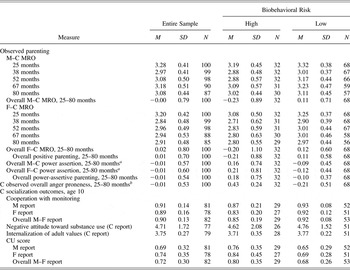
Both parents completed the 24-item Inventory of Callous–Unemotional (ICU) tendencies (Frick, Reference Frick2003). The ICU captures absence of concern about others and disregard for rules and standards of behavior (e.g., does not care if she or he is in trouble, does not like to put time into doing things well, feelings of others are unimportant). We computed the mean of all items for each parent (rated as 0 = not true at all, 1 = somewhat true, 2 = very true, and 3 = definitely true). The Cronbach αs = 0.84 for mothers and 0.87 for fathers. The scores correlated, r (77) = .60, p < .001, and were averaged into one score of the child's CU tendencies. All descriptive data are in Table 1.
Descriptive data for all measures

Note: M, Mother; F, father; C, child; MRO, mutually responsive orientation; CU, callous–unemotional.
aAt each age, for each parent, two power assertion weighted scores (for do and don't contexts) were standardized and averaged; thus, all means were around 0. Consequently, only the overall scores, averaged across 25, 38, 52, 67, and 80 months, are reported.
bAt each age, composites for each anger episode were created by averaging across standardized scores, and then averaging across the episodes; thus, all means were around 0. Consequently, only the overall score, averaged overall across 25, 38, 67, and 80 months, is reported (the 52-month score was excluded).
Results
Preliminary analyses
A pairwise deletion approach was used in the analyses. Among the children for whom data were available at age 10, there was a marginally significant relation between gender and biobehavioral risk: 20 boys and 9 girls were in the high-risk group, and 25 boys and 28 girls were in the low-risk group (Pearson χ2 = 3.60, df = 1, p < .10). The child's ethnicity (having at least one non-White parent vs. having both White parents) had no relation with any construct examined in this study: Pearson χ2 values for its relation with biobehavioral risk and with 5-HTTLPR were both <1; t tests comparing the two ethnicity groups in terms of anger proneness and positive parenting yielded ts of –1.07 and –1.27, respectively (both ns); and power-assertive parenting and all four outcomes yielded ts that were all <1.
Analyses of variance for positive and power-assertive parenting with children's gender and biobehavioral risk as the between-subject factors revealed that children in the high-risk group received less positive parenting, F (1, 96) = 4.07, p < .05, M = –0.21, SD = 0.88, than those in the low-risk group, M = 0.11, SD = 0.58. The high-risk group also received more power-assertive parenting, F (1, 96) = 4.38, p < .05, M = 0.18, SD = 0.75, than the low-risk group, M = –0.10, SD = 0.37.
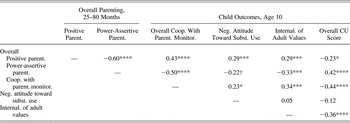
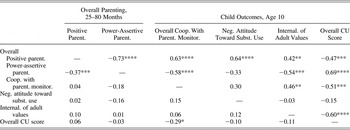
We examined the correlations among the constructs for the entire sample (see Table 2) and separately for the low- and high-risk groups (see Table 3). In the whole sample, positive and power-assertive parenting scores were robustly inversely related. There were expected relations between positive parenting and all adaptive child outcomes at age 10: positive correlations with overall cooperation with parental monitoring, negative attitude toward substance use, internalization of adult values, and negative correlations overall CU scores. Power-assertive parenting was negatively related with overall cooperation with parental monitoring, negative attitude toward substance use, and internalization of adult values, and positively related with overall CU scores.
Correlations among all measures

Note: CU, Callous–unemotional.
†p < .10. *p < .05. ***p < .01. ****p < .001.
Correlations among all measures for children in high and low biobehavioral risk groups

Note: Correlations above the diagonal are for the high biobehavioral risk group (SS/SL 5-HTTLPR and highly anger prone, ns = 26–32); correlations below the diagonal are for the remaining children (low biobehavioral risk group, ns = 51–68). CU, Callous–unemotional.
**p < .025. ***p < .01. ****p < .001.
With regard to the four outcomes, four out of six intercorrelations were significant and modest to moderate. Children who were seen as highly cooperative with parental monitoring expressed more negative attitude toward substance use, endorsed more strongly adult values, and were seen as having lower CU scores. Children seen by parents as having higher CU scores showed less internalization of adult values.
Table 3 presents the correlations separately for the groups with high and low biobehavioral risk. For children who had SS/SL 5-HTTLPR allele and were highly anger prone, there were robust correlations between the history of positive parenting from 25 to 80 months and all four socialization outcomes at age 10, and between the history of power-assertive parenting and three outcomes: overall cooperation with parental monitoring, internalization of adult values, and CU scores. By contrast, for the remaining children, no correlation between parenting (either positive or power assertive) and a socialization outcome reached significance.
Positive and power assertive parenting at 25–80 months and biobehavioral risk as predictors of socialization outcomes at age 10: Multiple regression analyses and regions of significance
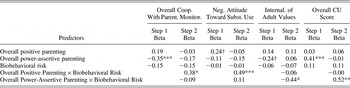
We conducted four hierarchical multiple regressions, one for each outcome. The results are in Table 4. In each equation, the three main effects, positive parenting, power-assertive parenting, and biobehavioral risk (coded as 0 = low, 1 = high), were entered in Step 1. The two interactions (Positive Parenting × Biobehavioral Risk and Power-Assertive Parenting × Biobehavioral Risk) were entered in Step 2.
Overall positive and power-assertive parenting (25–80 months) and biobehavioral risk as predictors of outcomes at age 10

Note: Predictors entered: Step 1: Overall positive parenting (25–80 months), overall power-assertive parenting (25 – 80 months), and biobehavioral risk (0 = low, 1 = high). Step 2: Interactions (Overall Positive Parenting × Biobehavioral Risk and Overall Power-Assertive Parenting × Biobehavioral Risk). For the final equations, Fs were: for overall cooperation with parental monitoring, F (5, 76) = 8.98, p < .001, negative attitude toward substance use, F (5, 71) = 3.91, p < .01, internalization of adult values, F (5, 73) = 3.44, p < .01, overall CU score, F (5, 76) = 5.45, p < .001.
†p < .10. *p < .05. **p < .025. ***p < .01.
All equations were significant, explaining between 19% and 37% of variance (see Table 4 for F values). Most important, in each final equation, there was a significant effect of an interaction involving parenting and biobehavioral risk, with biobehavioral risk significantly moderating the links between parenting and the given outcome. For children's overall cooperation with parental monitoring and negative attitude toward substance use, the interactions involved positive parenting. For internalization of adult values and the CU score, the interactions involved power-assertive parenting.
Because of the marginally significant relation between gender and biobehavioral risk, all four regressions were also rerun with child gender as a covariate. The findings were identical, with all the interaction terms unchanged.
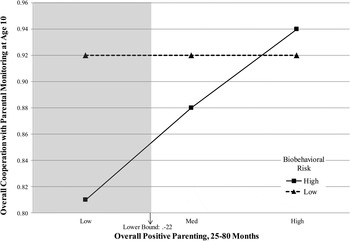
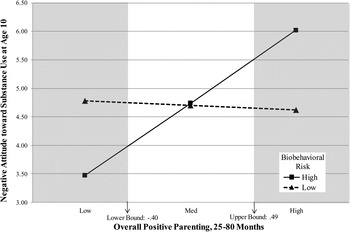
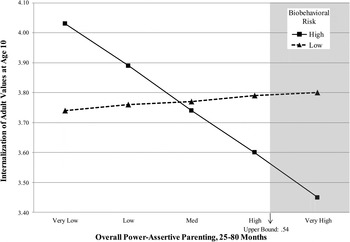
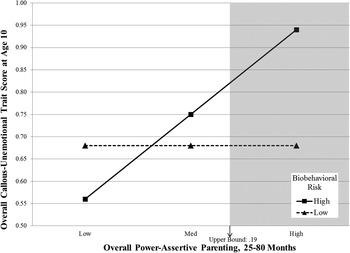
Those interaction effects were examined using simple slopes (Aiken & West, Reference Aiken and West1991) and are graphed in Figures 1–4. The parenting dimensions served as independent variables (low = –1 SD, high = +1 SD), and biobehavioral risk served as the moderator.
Children's biobehavioral risk moderates the effect of overall positive parenting from 25 to 80 months on their overall cooperation with parental monitoring at age 10. The solid line represents a significant simple slope, and the dashed line represents a nonsignificant simple slope. The shaded area represents the region of significance.

Children's biobehavioral risk moderates the effect of overall positive parenting from 25 to 80 months on their negative attitude toward substance use at age 10. The solid line represents a significant simple slope, and the dashed line represents a nonsignificant simple slope. The shaded areas represent the regions of significance.

Children's biobehavioral risk moderates the effect of overall power-assertive parenting from 25 to 80 months on their internalization of adult values at age 10. The solid line represents a significant simple slope, and the dashed line represents a nonsignificant simple slope. The shaded area represents the region of significance.

Children's biobehavioral risk moderates the effect of overall power-assertive parenting from 25 to 80 months on their callous–unemotional score at age 10. The solid line represents a significant simple slope, and the dashed line represents a nonsignificant simple slope. The shaded area represents the region of significance.

Furthermore, Figures 1–4 indicate the upper and lower bounds of the regions of significance, that is, the specific values of the independent variable (positive or power-assertive parenting) below which and above which the regression lines for the two studied groups (high and low biobehavioral risk) differ significantly in terms of a specific outcome (Aiken & West, Reference Aiken and West1991; Hayes & Matthes, Reference Hayes and Matthes2009; Preacher et al., Reference Preacher, Curran and Bauer2006). For a more detailed description of this approach, see Kim and Kochanska (Reference Kim and Kochanska2012) or Kochanska et al. (Reference Kochanska, Kim, Barry and Philibert2011).
Figure 1 presents the findings for overall cooperation with parental monitoring. The simple slope of positive parenting on children's cooperation was significant for children with high biobehavioral risk (SS/SL allele and highly anger prone; b = 0.10, SE = 0.03, p < .005); for those children, variation in the history of positive parenting from 25 to 80 months was associated with differences in their cooperation with parental monitoring at age 10. The high-risk children who had experienced little positive parenting had particularly low scores on cooperation, but the high-risk children with a history of high positive parenting cooperated as well as children at low risk. Positive parenting was unrelated to cooperation for the low-risk group (b = –0.01, SE = 0.03, ns).
The respective lower and upper bounds of regions of significance were –0.22 (approximately –0.33 SD) and 3.56 (note that this is well beyond the observed range, approximately +5 SD, and is thus of no practical utility). We therefore infer that this pattern is consistent with the diathesis–stress model, because the two regression lines were significantly different for all possible points when the score of overall positive parenting was lower than –0.22. The shaded area of Figure 1 represents the region of significance.
Figure 2 shows the findings for children's negative attitude toward substance use. The simple slope of positive parenting on such attitudes at age 10 was again significant for children with high biobehavioral risk (b = 2.09, SE = 0.57, p < .005). For the high-risk children, differences in the history of positive parenting was associated with differences in their attitudes toward substance use, such that those who had experienced little positive parenting had particularly low scores, but those who had a history of high positive parenting had particularly high scores, higher than children at low risk. Positive parenting was again unrelated to cooperation for the low-risk group (b = –0.13, SE = 0.42, ns).
The respective lower and upper bounds of the regions of significance were –0.40 and 0.49. Thus, the two regression lines were significantly different for all possible points when the score of positive parenting was lower than –0.40 (within –1 SD) or higher than 0.49 (within +1 SD). The shaded areas of Figure 2 represent the regions of significance. We infer that this pattern conforms to the differential susceptibility model.
Figure 3 shows the findings for children's internalization of adult values. The simple slope of power-assertive parenting from 25 to 80 months on internalization at age 10 was again significant for children with high biobehavioral risk (b = –0.32, SE = 0.13, p < .05). For the high-risk children, differences in the amount of received power assertion were associated with varying levels of internalization, such that those who had experienced more power assertion had particularly low scores, but those who experienced little power had particularly high scores. Variations in power assertion were again unrelated to internalization in the low-risk group (b = 0.04, SE = 0.11, ns).
The respective lower and upper bounds of the regions of significance were –2.54 and 0.54. Thus, the two regression lines were significantly different for all possible points when the score of power-assertive parenting was lower than –2.54 (note that this is well beyond the observed range, approximately –4 SD, and is of no practical utility) or higher than 0.54 (within +1.5 SD). The shaded area of Figure 3 represents the regions of significance, consistent with the diathesis–stress model.
Figure 4 illustrates the findings for children's overall CU scores. The simple slope of power-assertive parenting from 25 to 80 months on CU scores age 10 was again significant for children with high biobehavioral risk (b = 0.37, SE = 0.10, p < .001). For the high-risk children, differences in the history of power-assertive parenting were associated with differences in CU scores; among those children, the recipients of more power assertion had particularly high CU scores, but those who had received little power had scores comparable to their low-risk peers. Variations in power assertion were unrelated to CU scores in the low-risk group (b = –0.00, SE = 0.11, ns).
The respective lower and upper bounds of the region of significance were –1.42 (approximately –3 SD, thus of no practical utility) and 0.19. The two regression lines were significantly different for all possible points when the score of power-assertive parenting was lower than –1.42 (well beyond the observed range), or higher than 0.19 (within +0.5 SD). The shaded area of Figure 4 represents the region of significance, consistent with the diathesis–stress model.
Discussion
The transition from middle childhood to preadolescence is commonly recognized as one that involves multiple salient issues of adaptation, including the navigation of increased pressures toward high-risk behaviors (Allen, Chango, Szwedo, Schad, & Marston, Reference Allen, Chango, Szwedo, Schad and Marston2012; Brody et al., Reference Brody, Beach, Philibert, Chen, Lei and Murry2009; Sroufe et al., Reference Sroufe, Egeland, Carlson and Collins2005; Steinberg & Morris, Reference Steinberg and Morris2001). The child functions simultaneously in the social worlds of family and peers, and often experiences peer influences that contradict the family's socialization messages. At the same time, the fabric of parenting shifts from direct control and guidance to distal supervising and monitoring. Given that the incidence of high-risk behaviors, for example, substance use, increases steeply in adolescence, children's active cooperation with parental socialization, and a willing, accepting, internalized stance toward parental values and standards of conduct, play key roles in successful adaptation (Kochanska et al., Reference Kochanska, Koenig, Barry, Kim and Yoon2010). The history of past parenting is seen as a significant predictor of such adaptation. However, as we increasingly appreciate, the impact of parenting may be robustly moderated by children's biologically based characteristics. Some children show a remarkable lack of sensitivity to environmental influences, including parenting experience, whereas others are profoundly affected (for better or worse) by variations in its positive and negative dimensions. Elucidating such processes has been a key challenge in recent research on diathesis–stress, differential susceptibility, or sensitivity to context (Belsky, Reference Belsky1997; Belsky et al., Reference Belsky, Bakermans-Kranenburg and van IJzendoorn2007; Belsky & Pluess, Reference Belsky and Pluess2009a, Reference Belsky and Pluess2009b; Boyce & Ellis, Reference Boyce and Ellis2005; Ellis et al., Reference Ellis, Boyce, Belsky, Bakermans-Kranenburg and van IJzendoorn2011; Pluess & Belsky, Reference Pluess and Belsky2010).
In this multimethod multitrait longitudinal study of the interplay of biobehavioral risk and the history of parenting in community families, where children were followed from toddler age to preadolescence, we focused on a set of developmental outcomes that capture salient issues facing preadolescent youths. The pattern of findings was remarkably consistent across all those outcomes. Children at higher biobehavioral risk were affected by variations in parenting. For those children, more optimal parenting from toddler to early school age (more mutually positive and less power assertive) was associated with better socialization outcome at age 10, and less optimal parenting was associated with poorer outcomes, for all our outcome measures. A combination of high biobehavioral risk and suboptimal parenting was associated with the worst outcomes at age 10. Children who had high biobehavioral risk and whose relationships with parents had been characterized by relatively low positive mutuality were seen as least cooperative with parental monitoring, and they reported the least negative attitude toward smoking and drinking. Those high-risk children who had received relatively highly power-assertive discipline reported the lowest internalization of adult values and were seen by parents as most highly disregarding standards of behavior and feelings of others. Unfortunately, as is commonly found, such more difficult children (particularly highly anger prone) were also more likely to receive less adaptive parenting, which additionally strengthened their paths toward negative developmental cascades. A full understanding of the interplay between children's biologically based difficulty and parenting needs to involve a complex testing of parent–child transactions over time in addition to analyses of interaction effects (Lipscomb et al., Reference Lipscomb, Leve, Harold, Neiderhiser, Shaw and Ge2011; Pardini, Reference Pardini2008).
In contrast, children who were at a lower biobehavioral risk were not affected by differences in their parenting histories. In that group, parenting was unrelated to any outcome. This pattern overall is fully consistent with the tenets of the models of differential susceptibility and biological sensitivity to context. In that respect, the findings were straightforward and consistent with each other and with research in the field.
The pattern of results in terms of diathesis–stress versus differential-susceptibility models supported, in part, the benefits of including measures of both negative and positive aspects of the environment, as advocated by Belsky and Pluess (Reference Belsky and Pluess2009a, Reference Belsky and Pluess2009b) and Ellis at al. (Reference Ellis, Boyce, Belsky, Bakermans-Kranenburg and van IJzendoorn2011). Both interactions that involved the negative parenting dimension (power assertion) were consistent with the diathesis–stress model. Children at high biobehavioral risk who also had histories of relatively high power-assertive discipline had particularly low scores on internalization of parental values and particularly high scores on CU tendencies. When raised by parents who avoided power assertion, however, those children's outcomes were no worse (although not significantly better) than their peers' who were at low risk.
For the two interactions that involved the positive parenting dimension, one was consistent with differential susceptibility. Children who were at high biobehavioral risk and who had received suboptimal parenting had particularly poor outcomes with regard to attitudes toward substance use. However, those high-risk children who had received optimal, highly positive parenting had higher scores on that measure than their low-risk peers (and thus in this case, plasticity may perhaps be a more accurate construct than risk). This is consistent with a past finding that also involved an interaction between children's biological marker (a short 5-HTTLPR allele) and maternal responsiveness (Kochanska et al., Reference Kochanska, Kim, Barry and Philibert2011), and a conceptually related outcome variable: moral internalization at age 5.5.
It cannot be readily explained why only that one effect conformed to the differential-susceptibility model. However, note that the measure of negative attitude toward substance use was the only outcome that did not correlate with other measures, whereas the other three outcomes were all interrelated (for the high-risk children).
The other interaction that involved positive parenting (for children's cooperation with parental monitoring), however, nevertheless conformed to the diathesis–stress model. Children with high biobehavioral risk who received suboptimal parenting had particularly poor outcomes, but when raised in an optimal, highly positive environment, they fared as well as (but no better than) their low-risk peers. As indicated earlier, the extant picture in the literature with regard to the diathesis–stress versus the differential-susceptibility models is far from consistent, and more research is needed.
Pluess and Belsky (Reference Pluess and Belsky2013) recently proposed a construct of vantage sensitivity to describe the notion that some individuals are more sensitive and positively responsive to the environmental advantages to which they are exposed (but without being at the same time more vulnerable to the lack of positive experiences). It is theoretically possible that, at a future follow-up, the pattern of the interactions might become consistent with vantage sensitivity (e.g., provided that positive parenting continues into adolescence, the youth defined as having high biobehavioral risk may show robust benefits).
This study has several limitations. The nature of the sample raises questions about the generalizability of the findings. The families were mostly well functioning, and the level of power assertion was low. This is a well-known issue in observational research with community parents, and researchers resort to a variety of ways to handle it in data aggregation (e.g., Joosen, Mesman, Bakermans-Kranenburg, & van IJzendoorn, Reference Joosen, Mesman, Bakermans-Kranenburg and van IJzendoorn2012). We believe that our weighing system and robust aggregation of the scores assured a reasonable distribution of the final measure. However, despite the infrequent parental use of power, the expected patterns were found nevertheless. Our findings are consistent with other studies that have found even mild power assertion to be associated with negative outcomes, both in childhood (Kochanska & Kim, Reference Kochanska and Kim2012) and in adolescence (Bender et al., Reference Bender, Allen, Boykin Mcelhaney, Antonishak, Moore and O'Beirne Kelly2007). Of note, the significant differences in the regression lines for high- and low-risk children appeared already within half of the standard deviation of the power-assertive parenting score for CU tendencies (and 1.5 for internalization of adult values). Thus, even modestly elevated power assertion was already sufficient to trigger significantly detrimental effects, consistent with the diathesis–stress model (see Figures 3 and 4). This may indicate high sensitivity to this aspect of the childrearing environment for children who carry a short 5-HTTLPR allele and are highly anger prone (perhaps because they get negatively aroused by forceful discipline and their emotion regulation skills are poor). Nevertheless, replications with families where parents resort to harsh discipline or physical abuse, and thus, for whom power assertion can be more robustly measured, are needed.
In addition, the children were largely typically developing in this low-risk sample; they were highly competent, cooperative with their parents, successfully navigating the normative developmental challenges, and highly accepting of parental socialization values and agenda, as indicated by their high scores on the measures of positive outcomes and low CU scores. Even so, the expected patterns were nevertheless found. Studies that replicate the findings with children who show elevated levels of conduct problems would be very valuable.
The relatively small sample is also a significant limitation. However, it is to some extent offset by considerable methodological strengths: rich, robust, behavioral measures of environment collected over an 8-year period of development from toddlerhood to preadolescence, a very large sample of behavioral observations, a combination of biological and behavioral measures, and the use of multiple informants. The inclusion of data from both mothers and fathers allows for a more complete picture of parenting history than typically reported.
Note that approximately 10% of parents did not consent to genetic testing at 52 months. Consequently, among the children who returned at age 10, there were five who had missing genetic data and were above the median on anger proneness. It is possible that some of those five children (now included in the low-risk group) did have a short 5-HTTLPR allele and therefore belonged in the high-risk group. With larger samples, children with incomplete data could be excluded from the analyses.
We also note that we conducted all the analyses separately for the mother–child and father–child relationships (examining the history of positive and power-assertive parenting for each parent). The findings revealed essentially similar processes in both relationships. Specifically, for cooperation with parental monitoring, the interactions (betas) for Positive Parenting × Biobehavioral risk for mothers and fathers were 0.25, p = .10 and 0.32, p < .10; for negative attitude toward substance use, Positive Parenting × Biobehavioral risk, 0.20, ns, and 0.48, p < .01; for internalization of adult values, Power-Assertive Parenting × Biobehavioral Risk, –0.38, p < .05 and –0.36, p < .05; and for CU score, Power-Assertive × Biobehavioral Risk, 0.52, p < .01, and 0.40, p < .05. The entire equations were all significant, with only one exception, for negative attitude toward substance use (mothers' parenting), which was marginally significant at p < .07. This increases our confidence in the reported findings for the parenting variables combined across mothers and fathers (as reported in Table 4).
We believe that the construct of biobehavioral risk, which resembles other cumulative risk indices commonly used in developmental psychopathology, may be quite useful. Moreover, we believe that such an approach may be implemented more broadly, as behavioral researchers increasingly incorporate genetic and physiological measures in their protocols. As we mentioned earlier, many studies do not have sufficiently large samples for robust genetic analyses, but they may have rich behavioral data. Consequently, it may be possible to conduct informative analyses with groups of children who have zero, one, two, or more risk factors, both biological and behavioral.
One question that awaits inquiry concerns causal mechanisms behind the interaction effects. For example, why is the history of parent–child MRO so beneficial to children at high biobehavioral risk? We know that early positive mutuality promotes the child's ability for self-regulation, from modulating emotional arousal to complex executive capacities (Hofer, Reference Hofer1994; Schore, Reference Schore2001; Sroufe, Reference Sroufe1996). Perhaps for children with difficulty in modulating emotional arousal (often linked to both short 5-HTTLPR allele and to anger proneness), early relationships that promote self-regulatory capacity are particularly consequential (Kim & Kochanska, Reference Kim and Kochanska2012). In turn, self-regulation may directly underpin a broad range of positive developmental outcomes.
Future analyses with much larger samples that allow for separating effects due to the biological and behavioral risk factors may elucidate such questions. In such larger samples, the simultaneous testing of separate interaction terms that involve the two risk factors would be highly desirable (see Belsky & Pluess, Reference Belsky and Pluess2013, for an example).
We have conducted such analyses for purely exploratory purposes; note that they lack sufficient robustness due to the low total numbers to predictors ratio. In each equation, we entered positive parenting, power-assertive parenting, child 5-HTTLPR status (SS/SL vs. LL), child anger proneness, and four interactions (Positive and Power-Assertive Parenting × 5-HTTLPR Status, and Positive and Power-Assertive Parenting × Anger Proneness). We followed up the significant (or marginal) interactions with simple slopes.
For the child's cooperation with parental monitoring, the interaction Positive Parenting × Anger Proneness was marginal (p < .10). For highly anger-prone children, more positive parenting was associated with more cooperation (p < .01), but there was no relation for children who were not anger prone. For the child's negative attitude toward substance use, the interaction Positive Parenting × Anger Proneness was significant (p < .01). For children who were highly anger prone, more positive parenting was associated with more negative attitude (p < .01), but there was no relation for children who were not anger prone.
For the child's internalization of adult values, the interaction Power-Assertive Parenting × 5-HTTLPR was marginal (p < .10). For SS/SL children, more power assertion was associated with weaker internalization (p < .10). There was no relation for LL children. For the child's CU scores, the interaction Power-Assertive Parenting × 5-HTTLPR was significant (p < .01). For SS/SL children, more power assertion was associated with higher CU scores (p < .05), but there was no relation for LL children.
Those exploratory analyses, with all due caution, suggest future possible hypotheses. Perhaps high positive affect that permeates parent–child mutually responsive relationships may effectively defuse the child's anger and resentment. Perhaps heightened emotional arousal associated with more forceful discipline is particularly detrimental for children with a short 5-HTTLPR allele, due to the possible link between the short allele and poor emotion regulation.
A final (perhaps most important) caveat is in order with regard to our construct of biobehavioral risk, as operationalized in this (or any) study. This construct can be only as robust as its components. We selected the 5-HTTLPR polymorphism and children's negative emotionality (anger proneness), because in the context of biology–environment interactions, those are among the most commonly studied risk, vulnerability, or plasticity characteristics (Belsky & Pluess, Reference Belsky and Pluess2009a; Lesch, Reference Lesch2007; Lucki, Reference Lucki1998; Pluess & Belsky, Reference Pluess and Belsky2013). However, we note that pertinent evidence has been evolving and science is far from settled, particularly with regard to Gene × Environment research (Duncan & Keller, Reference Duncan and Keller2011; Manuck & McCaffery, Reference Manuck and McCaffery2014).
As Ellis and colleagues (Boyce & Ellis, Reference Boyce and Ellis2005; Ellis et al., Reference Ellis, Boyce, Belsky, Bakermans-Kranenburg and van IJzendoorn2011) and Belsky and Pluess (Reference Belsky and Pluess2009a, Reference Belsky and Pluess2009b) observed, research on differential susceptibility and sensitivity to context is rapidly transforming our thinking about Person × Environment interactions in development and our understanding of risk, resilience, and adaptive and maladaptive cascades. This study, although making a contribution to that research, also elucidates the need for future replications and extensions.