In the first half of the nineteenth century, Portuguese-speaking traders clustered in small ports along the Congo coast, increasingly dominating the supply of slaves for the Brazilian coffee economy.Footnote 1 There, they found local polities and pre-existing trading diasporas, such as the Kongo and Ngoyo monarchies and the old Vili trade diaspora, with longstanding traditions of engagement with the Atlantic world.Footnote 2 Their commercial networks connected vast regions of Central Africa, but historians have recently discovered that most enslaved Africans trafficked by Luso-Brazilian merchants came from either the Lower Congo region itself or nearby regions.Footnote 3 Records of slave ships captured by the British navy, in particular, have proven useful in recovering the ‘ethnolinguistic origins’ of enslaved Africans in the Atlantic world. However, the complexity of Lower Congo peoples’ political responses to the growth of trade and the violence of enslavement exceed the explanatory power of narratives centered on the concept of ethnolinguistic groups.Footnote 4 The static congruency between identity and language that this concept implies cannot capture the ways in which enslaved Central Africans employed such politics in the diaspora in the very moment those records were being made. A social history of African languages in the South Atlantic addresses this issue by revealing how enslaved Africans shaped their diasporic experience by rebuilding severed speech communities and drawing on their categories of thought. In fact, recent developments in Central African linguistic historiography have reached a far deeper understanding of the ecology and historical relationships of languages in the region. When used alongside records of slave ships from the Atlantic world, this scholarship allows the historian to have a more historicized understanding of the process through which Africans created ethnicities in concert with social contacts and political concepts indigenous to nineteenth-century Central Africa.Footnote 5
This article examines the cataloged nações (nations) of 290 Africans found in just one slave ship, the Jovem Maria, which left the Congo river and was captured by the Brazilian Navy in 1850, the same year Brazilian parliament passed a second law suppressing the slave trade. The ship was condemned, or found guilty of illegal slave trading, by the Auditoria Geral da Marinha (Navy Auditor Court) in Rio de Janeiro, an institution created by this law to decide cases related to illegal slave trading. A linguistic analysis of the field of ‘nations’ recorded on the Jovem Maria’s registers reveals interpreters and recaptives debating the intellectual content of African political categories in their languages. To be sure, important features that compose identification, such as the feeling of connectedness conveyed by genealogical discourses, are beyond the reach of the Atlantic archive. However, if we accept that the political categories Africans expressed in their languages provided the terms of a contest over political categories, then understanding what those terms could mean in their original contexts will open up new ways to the domains of knowledge grounded in Central Africa that framed the experience of recaptives during the very making of those records.Footnote 6 Foregrounding the interactions between interpreters and newcomers can thus redress the persistence of the concept of ‘ethnolinguistic group’ in Atlantic history by opening a set of questions about the use of African languages and concepts in the South Atlantic world.Footnote 7
Names, Nations, and Languages on the Slave Ship
Africans on slave ships performed acts of political imagination to assert themselves in relation to others, as they ‘discovered who they thought they were in reaction to whom they met.’Footnote 8 Records from Havana and Freetown Mixed Commissions registered African names and body marks (and sometimes ‘nations’), and historians have used them to investigate the ethnolinguistic origins of enslaved Africans.Footnote 9 In the South Atlantic, cases of apprehended slave ships judged by the Anglo-Brazilian Mixed Commission in the 1830s and the Brazilian Navy Auditor Court in the early 1850s also open a window onto a dialogical dynamic among Africans. Although these institutions in Brazil did not record African personal names, the labyrinth of ‘nations’ found in many ship records exceeded the ethnographic knowledge of their Euro-Brazilian agents.Footnote 10 It is clear that, in all these cases, African interpreters — usually liberated Africans from previously captured ships from the same region — were crucial to creating these records.Footnote 11
Historians looking for the origins of the enslaved have linked names recorded by Court Officers of Freetown and Havana Mixed Commissions with naming patterns of ‘ethnolinguistic groups’ in Africa.Footnote 12 The method consists of linking the clerk's phonetic renditions of names uttered by recaptives with equivalents in modern ethnolinguistic communities. Thus, ‘Boe’, ‘Boey’, and ‘Boi’ found in the historical records are equated with ‘Boi’, a ‘Mende/Sherbro’ name. Similarly, a man from the Pongo river named ‘Aasomanee’ and ‘Ansoomanea’ in two distinct records referred to ‘Ansoomanoo, a distinctive Mandingo name’, according to the proponents of the method.Footnote 13 Identification of ‘nations’ follows the same pattern. Thus, in the Havana registers, Henry Lovejoy found sub-classifications that could be related to realities in West Africa, such as ‘Mina Fante’ for ‘Fante’ or ‘Lucumí Agusá’ for ‘Hausa.’Footnote 14 The methodology allows the historian to approximate the origins of recaptives in Africa and extrapolate the results to the larger group of enslaved Africans that continued their journey to slavery in the Americas.
While important, this methodology nonetheless sets aside the complexities of speech interactions inherent in a context of intense linguistic contact, leaving unanswered questions about how enslaved Africans re-deployed their languages and conceptual frameworks to re-establish speech communities in the Atlantic world. Indeed, for enslaved Africans struggling with alienation and displacement, the re-establishment of speech communities was a pressing need. It was part of a complicated process that Vincent Brown called the ‘politics of survival' under slavery, that is, ‘the struggle to define a social being that connects past and present.'Footnote 15 The politics of survival was a cognitive struggle that the enslaved fought in African languages. Historians interested in exploring this politics must look beyond the formal similarities between phonetic transcription in the historical records and name patterns in modern Africa. They must ask questions about the specific linguistic context in which interactions took place (demographic variables, number of ‘languages’, and typological variations between them) as well as the grammatical features and semantic content through which enslaved Africans organized their thoughts and shared information.Footnote 16 By taking seriously the full methodological and epistemological challenges posed by the use of African languages in these records, we can better understand how enslaved Africans made new speech communities, and consequently, improve our understanding about the context in which personal names and nations were produced.Footnote 17 This article explores this methodology by focusing on a single slave ship captured in the South Atlantic, a crucial area of the Atlantic World that is nonetheless underrepresented in the records of the British Commission in Freetown and Havana.Footnote 18
Since the sixteenth century, the South Atlantic slave trade created a social and cultural continuum connecting Angola and Brazil and encompassed a pluralistic world.Footnote 19 In the first half of the nineteenth century, abolitionist measures affected the South Atlantic slave trade in various ways. Yet despite these efforts, Luso-Brazilian and African slave traders in ports of Angola and near the River Congo were able to embark 1.4 million Africans to the Americas.Footnote 20 This was in part a response to the rise of the demand for enslaved labor by Brazilian planters, who were expanding their coffee crops towards the highlands of southeastern Brazil.Footnote 21 In this context, historian Robert Slenes has long argued for the existence of a ‘Bantu’ lingua franca in coffee plantation slave quarters.Footnote 22 This language first took shape inside the slave ships, but social conditions in coffee plantation slave quarters — especially low rates of manumission and high density of Central Africans — were conducive to a process of linguistic convergence incorporating Kikongo, Kimbundu, and Umbundu languages.Footnote 23 According to Slenes, the close genetic relationship between these Bantu languages facilitated the creation of a Bantu-based lingua franca, which occurred alongside a process of class formation and ethnogenesis, as Central Africans negotiated their institutions to create new forms of belonging. Slenes also argues that a distinctive Africanized slave culture that grew in the slave quarters of southeastern Brazil was strongly influenced by what he calls ‘Kongo’ and ‘near-Kongo’ groups (including, for the author, Mbundu groups), who were able to dictate the terms of what would become a powerful code emblematic of African social identity in southeastern Brazil.Footnote 24
Both the recent historiography on the British Mixed Commissions and Slenes's Bantu lingua franca assume a relationship between ‘identity’ and ‘language.’ While the former resort to the concept of ‘ethnolinguistic group’ to assume a one-to-one relationship between language and identity, the latter takes a lingua franca based on deep genetic relatedness as equivalent to an overarching moral community. To be sure, these assumptions are not wrong. The one-to-one relationship between language and identity might capture the reality of small peasant villages where these features tend to be congruent, while a macro-language such as a lingua franca grasps the context in which speakers are interested in crafting a means for mutual intelligibility in the name of a strong shared identity. However, these approaches only capture the two extreme poles of a range of situations in which linguistic codes and identity claims interact. More importantly, they fail to do justice to the complicated process in which Euro-Brazilians, enslaved Africans, and interpreters created a field of communication and probed its limits. Excavating this process of knowledge production requires that historians develop new methodologies to read the Atlantic archive, interpreting these registers in light of less conventional bodies of evidence, such as those found in linguistics and early ethnography in Central Africa, to find ways of telling the inter-African histories woven in those documents.Footnote 25
In fact, present-day historians of Central Africa have a growing body of linguistic histories on West-Central Africa to ground the lives of enslaved Africans in the Atlantic in a more historicized understanding of the many other ‘worlds’ enslaved Africans came from. By integrating Central Africa's hinterland into a broader context, a social history of African languages in the Atlantic era opens an exciting opportunity to think historically about the ways in which Africans maintained and recreated their languages as part of the politics of survival in a coercive setting.
Interpreters and Nations in the Navy Auditor Court
On 29 December 1850, the Brazilian warship Urânia, while patrolling the southern coast of Rio de Janeiro Province, seized the slave ship Jovem Maria coming from the Congo river with 291 Africans ‘of different ages and nations.’Footnote 26 The Urânia‘s Brazilian captain immediately sent the vessel to stand trial at the Auditoria Geral da Marinha. Once the Africans disembarked and were imprisoned in Rio de Janeiro's House of Correction, the judge nominated Manoel Benguela and Antonio Congo, two Africans working in the building, to serve as interpreters. Liberated Africans themselves, these two men knew all too well the torment that newcomers experienced. Together, they were charged with ‘transmitting to the Africans in African language [sic] the questions needed and translating into the Brazilian language their answers.’Footnote 27 Relying on Manoel and Antonio to discover ‘to which nations the Africans belonged’, the judge organized a list containing their numbers, names (of baptism), presumed ages, and their ‘nations’.Footnote 28
In the Atlantic world, the idea of ‘nations’ played an important role in creating a new public identity for Africans in a colonial society.Footnote 29 The ‘nation’ as a category has a greater historical depth in Europe, where it was used by the Roman state and its heirs to codify foreign minorities within an Imperial framework.Footnote 30 As colonial constructs, historians rightly argue that such categorizations were usually stereotypical labels devised by masters and traders to encompass slaves from broad regions of Africa, even though some enslaved Africans were able to bring political language to the greater Atlantic world forms of groupness that were first developed in the historical contexts of their homelands.Footnote 31 However, the use of the term ‘nation’ as an instrument of categorization grew even more complex in the context of the abolition of the slave trade, precisely because imperial authorities resorted to African informants to collect information from newcomers.Footnote 32 It was this recourse that brought the claims and aims of Africans’ use of the term to the fore for the first time. The dialogical nature of these records consequently expanded the range of the semantic domain of the category of the ‘nation.’
This instrumental use of the term ‘nations’ is clear in the records of the Navy Auditor Court in Rio de Janeiro. Although lesser known, the Navy Auditor Court was a Brazilian correlate of the Anglo-Brazilian Mixed Commission that functioned in theory up to 1845, when the British government shifted to a more aggressive policy against illegal slave trading. In 1850, in part as a response to British actions in the South Atlantic and the threats of slave revolts in southeastern Brazil, the Brazilian government passed a second law against the slave trade, finally showing a real commitment to curb imports of enslaved Africans.Footnote 33 The Navy Auditor Court was created in this context to judge ships and their crews for slave trading and to determine whether Africans found on board were illegally imported into the country. Recaptives were to be taken to the house of correction in Rio, where the state collected information about sex, age, and ‘nations’, and ordered their baptism and naming. If recaptives were considered ‘boçais’ (newly-arrived Africans that did not speak Portuguese), they had the right to be emancipated as liberated Africans.Footnote 34
Although guided by different laws and decrees, British Mixed Commissions scattered across the Atlantic and the Navy Auditor Court needed to determine Africans’ statuses as liberated Africans to protect them against re-enslavement.Footnote 35 Interpreters were thus used to individualize as much as possible the registers of recaptives and, though African personal names were not registered, the use of the field ‘nations’ was particularly conspicuous in Rio de Janeiro. Of course, the disposition for particularizing the records did not always govern the practice of authorities. These courts, nonetheless, collected a huge amount of information from recaptives. In 1838, when the Anglo-Brazilian Mixed Commission condemned the slave ship Feliz, the judge asked the clerk to make a list of the 217 Africans found on board and to declare ‘sex, marks, the names of nations and age as accurately as possible.’Footnote 36 Indeed, the clerk registered no fewer than 148 ‘nations’. Similarly, when the slave ship Rolha was captured in southern Rio de Janeiro in 1850 and taken to the recently-formed Navy Court, the Brazilian Navy Auditor relied on African interpreters to categorize 212 Africans into 95 ‘nations’.Footnote 37 Although not every Brazilian clerk elicited as much detail as in these two cases, these records show that African interpreters were not parroting colonial stereotypes when performing their work. Rather, in conversation with African newcomers, they were working with the information collected to come up with their own forms of categorization within the state's purview.
Not much is known about the interpreters, beyond their baptismal names and their ‘nations'. In the case of the Auditor Court, the judge usually recruited interpreters in the House of Correction. It is possible, however, to see how interpreters were an integral part of the slaving business from coast to coast since slavers used them to conduct transactions and to communicate with the enslaved. The Portuguese word for interpreter, língua, became a loan word in Lower Congo languages and the local population vividly remembered the role of local interpreters (dingizi/lingisi) as brokers of the slave trade.Footnote 38 Moreover, Mariana Cândido and Joan Fayer have both argued for the importance of African sailors as interpreters on the slave ship.Footnote 39 In fact, two Africans found on board the Jovem Maria, Cabindans Firmino and Pompeo, spoke Portuguese. They provided critical testimony in accusing the crew of illegal trafficking. Firmino and Pompeo also testified that they had learned Portuguese on the coast of Cabinda from a man named Francisco Hespanhol, before being kidnapped and sold to a man named D. Firmino. Shortly thereafter, their new owner transferred them to the Jovem Maria’s captain. Local brokers (mafuk’) on the Congo coast often gave an mbomba, or enslaved overseer, to a ship's captain who used the mbomba to help control slaves on board.Footnote 40 Thus, from local lingisi as coastal brokers to the use of mbomba on the slave ship, the act of translation between African and European languages was a crucial component of the business of slave trading in the region. It remained so after 1845 when abolitionist pressure finally strangled Luanda port, leaving the Congo coast as the last great hub of slavers in Atlantic Africa.Footnote 41
Between 1845 and 1850, the slave trade boomed in the region as demand from southeastern Brazil soared, and the Jovem Maria was part of an important network linking the Congo coast with the southern coast of Rio de Janeiro province. Slave ships from the Congo coast after 1830 usually carried a high ratio of children under 15 years (51 per cent) and males (80 per cent).Footnote 42 The records of the Jovem Maria show a male-female ratio of 80.3 per cent, but slaves on board were considerably older than the average, with only 29.3 per cent under 15. As such, the data sample it provides is small in comparison to the influx of enslaved Africans crossing the South Atlantic after 1845, and thus lessons learned from these records should be generalized with caution. Nonetheless, the ‘nations’ recorded during the case provide a unique window into the forms of identification and linguistic backgrounds of enslaved Africans leaving the Congo coast during the boom.
The Category of ‘Nation’: A New Methodology for the Relational Nature of the Process of Identification
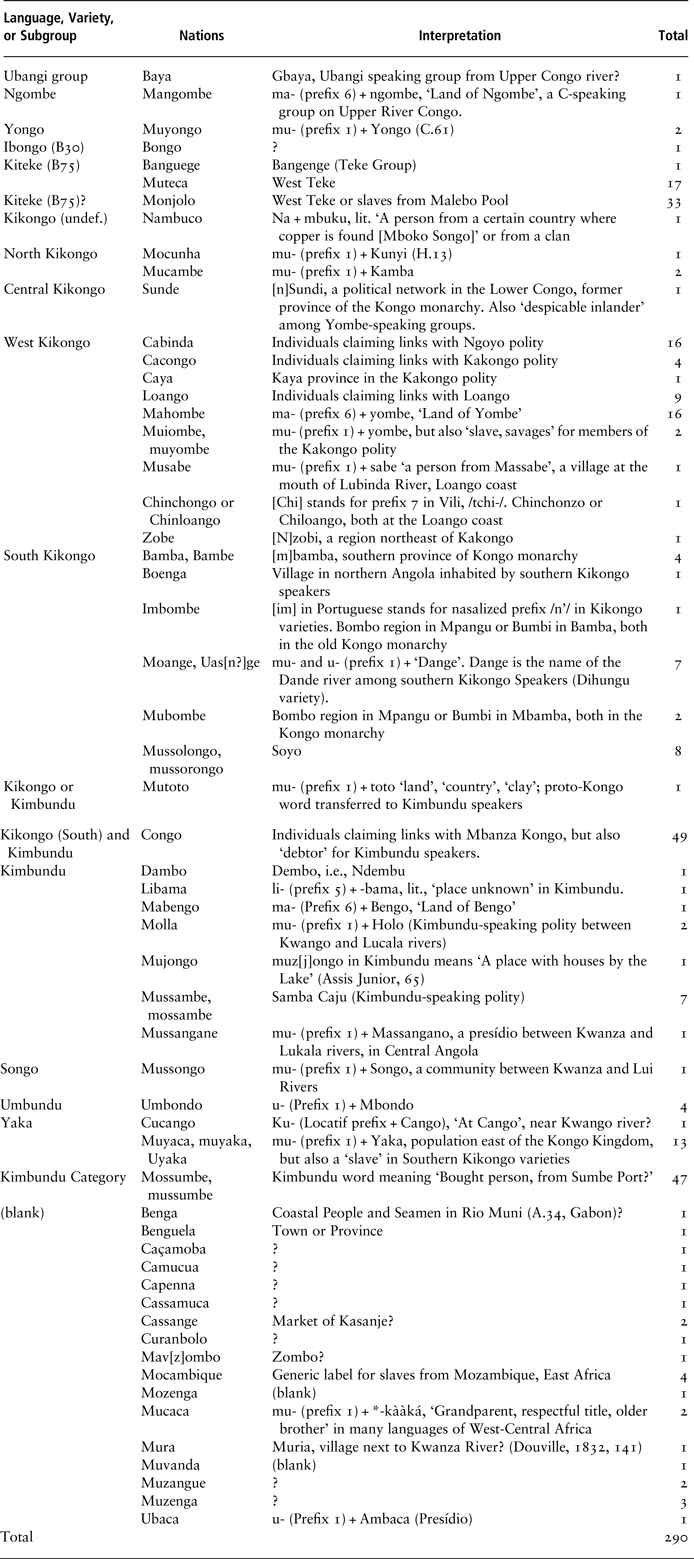
The interpreters Manoel Benguela and Antonio Congo interviewed the newcomers and passed the information to the clerk. They categorized the 290 Africans found on board the Jovem Maria as belonging to 66 ‘nations’, most of which likely held no meaning for the Brazilian authorities. Although the Jovem Maria registers categorized 18 per cent of the recaptives within 3 common Atlantic nations, Benguela (1), Cabinda (16) and Monjolo (32), the clerk registered no less than 63 other designations as ‘nations’ on the Jovem Maria list (See Table I in the Appendix). Nations such as Caya, Bamba, Sunde, Mangombe, Umbondo, Molla point to West-Central African categories. Still, amidst this multitude of terms, no less than forty-nine (16.9 per cent) Africans were categorized as Congo. If we attend to the contexts of communicative practices between African interpreters and newcomers, by deciphering the codes through which they build these ‘nations,’ we can understand how some of these labels contain ‘traces’ of the interview process. These ‘traces’ offer clues about the geographical origins and languages of the enslaved Africans, but they also illuminate the political and social concepts they were bringing with them.
Understanding the relational nature of this process of identification requires new conceptual and methodological tools for historians dealing with the tangled nature of ‘language’ and ‘identity’ in these registers. Until now, historians have relied on the category of ‘ethnolinguistic group’ to analyze similar lists elsewhere, presupposing an overlap between geographical space, a single language, and social identity in Africa that slaves could replicate on a slave ship.Footnote 43 Instead, I look to the process of identification and the formation of speech communities to move away from a static delineation of ‘nations’ and ‘ethnolinguistic groups’ in order to understand the communicative practices between interpreters and recaptives.
As Frederick Cooper and Rogers Brubaker have insisted, identification ‘invites specification of the agents that do the identifying.’Footnote 44 Because the Jovem Maria case recorded the names and nations of the interpreters, it offers a unique opportunity in the South Atlantic to historicize the process of identification elaborated in the conversation between recaptives and interpreters, which produced the ‘nations’ that the Brazilian state's clerk listed. Yet, in a multilingual setting such as the Jovem Maria, this process was indissociable with the need for establishing a basic means of communication between state authorities and recaptives. As interpreters, Manuel Congo and Antonio Benguela's most important task was thus to recreate a speech community, that is, a ‘population of speakers who interact among themselves in a definable “space”’ and who negotiate a ‘mutually intelligible symbolic and ideological communicative system’ to share knowledge through meaningful utterances.Footnote 45
Scholars have argued that massive spatial dislocation of speakers of different languages creates a complex situation of interwoven speech communities with distinct linguistic means and moral terms (Fig. 1). It is precisely the overlap between language and identity implied in the concept of ethnolinguistic group that is disrupted by population movements. In these contexts, speech communities in a context of massive dislocation do not arise out of a single language, but their communicative cooperation may generate a common language or languages. Initial interactions attempt to establish communication, which, if successful, leads to the sharing of knowledge. The cycle of communication and shared information builds and strengthens a communicative system which, in turn, sets the stage (and provides the terms) not for unanimity, but rather for an arena in which the political debate of co-identification takes place.Footnote 46 The conditions in which recaptives might develop a communicative practice depend fundamentally on the kinds of linguistic systems they brought with them, their typological variation, genetic relationship, and number of speakers. In other words, these features will determine to what extent speakers will be successful in negotiating a ‘mutually intelligible symbolic and ideological communicative system’ through which they can discuss origins and political membership. The more we disentangle the topic of discussion, the means of communication, and the group of speakers and listeners, the more we see the multiple ways in which they may interact with one another.
Relationship Between Social Group (□), Speech Community (○), and Language (∆), And the Effects of Mass Dislocations on ethnolinguistic groups (Based on Xu (2016)).

Sociolinguists and linguistic anthropologists rely on direct observation and fieldwork to explore these issues. Historians, on the other hand, must work with the archive, abandoning a fully-fledged understanding of such complex linguistic situations in the past. After all, people such as Cândido Bittencourt, the Brazilian clerk in charge of listing Africans for the Auditor Court, are often the only link left between the historian and the communicative practice between Africans. Bittencourt was at a loss when he tried to put the chain of sounds produced by interpreters on paper. Short of any linguistic training and any more in-depth knowledge of the languages used, Bittencourt could do no more than a somewhat impressionistic transcription highly constrained by the grammar and phonemic rules of his language, Portuguese. All a historian can do is to parse the transcription over his shoulders.
The task of transcription requires knowledge of the essential features of the Bantu linguistic family, to which most of the languages in Central Africa belong. Morphologically, Bantu languages agglutinate. Like German, speakers encode information in morphemes that get attached to the different parts of speech. This, in turn creates new words and conveys information that is usually an entire sentence in languages such as English or Portuguese.Footnote 47 Nouns, particularly, fall into classes broadly corresponding to semantic domains. Classifiers such as these are one of the richest sources for human thought because they encode in a morpheme, a principle of categorization shared by speakers of a given language.Footnote 48 Thus, speakers of nineteenth-century Kisikongo (Mbanza Kongo Kikongo variety) express the idea of ‘slave’ joining the stem –bundu to a prefix n’- (one of the classes linguists recognize as class 1, which includes human and other beings), forming the word m'bundu. An Umbundu speaker does the same by using omu- or u- to make omu-nu, person, or u-pika, a slave. Unaware of these essential features of Bantu languages, Bittencourt might have recorded several different prefixes that provide valuable information about the languages used and the forms of categorization employed in the register.
A fine-grained morphosemantic study of the information recorded as ‘nations’ thus allows historians to shed light on both socio-relational strategies and the conceptual world inherited in the process of identification. To tackle the former, I provide a morphological and phonological analysis to read the ‘nations’ against the grain of Bittencourt's transcription. I suggest that such registers contain traces of the communicative practices between African interpreters and newcomers. For example, in the list of the 95 nations found on the slave ship Rolha, 27 categories began with na-, such as nahombe, napugandongo, nandongo, nandondo, etc. As it turns out, this particle na- is found in East-Central Savanna languages as well as Umbundu as a preprefix or prefix derived from an ancient root *-ina ‘mother.’Footnote 49 The interpretation of such nouns does not necessarily imply ‘Mother of x,’ but rather the opposite: ‘someone whose mother is x.’ Thus, as a prefix, it ascribed initially female gender to nouns but also extended its meaning to categorize kinship relations, personal names, and ethnonyms.Footnote 50 Indeed, the ship left Novo Redondo in southern Angola, and although the name of the interpreter is not known, this evidence tells us that at least one interpreter spoke a Central or southern Njila language, probably Umbundu, the most common language in the region where this particular ship came from.Footnote 51 By recording this particle ahead of the nouns, the clerk not only recorded a trace of the interpreter's main language but also registered how the interpreter was categorizing the information he was hearing from recaptives and repeating to his Brazilian audience, revealing the complexities of the process of identification and formation of a speech community.
Applying this type of analysis to the material in the registers of the Jovem Maria reveals important variables in the linguistic context, such as the number of languages, the typological variation between them, and the competition and selection of linguistic features. As for the conceptual worlds shaping the politics of debate over co-identification, once we understand Africans’ communicative practices, we can treat the recorded nations as categories of groupness pertaining to Central Africa's political culture and track down the full distribution of its meanings in the region.
Prefixes: Traces of Languages, Signs of a Speech Community?
Several prefixes allow us to assign the designation to a language or a specific group of languages. The use of prefix li- as a class five marker of a noun in the singular (libama) points to a speaker of Vili, in the Loango coast, or Libolo or Songo, languages of the Northern Njila family spoken in the upper Kwanza river.Footnote 52 However, it is only among daughter languages of the Northern Njila subgroup that we find -bama as a stem meaning ‘a generic site, or some unknown place.’Footnote 53 Similarly, the small set of nations whose names start with ‘U’ reveals the use of prefix /u-/, which is used among southern Angolan languages as a class 1 marker, especially in Umbundu, to express the compounding meaning ‘Person-x.’ This noticeable trace of Umbundu turned up in only 4 nations categorizing seven males: Uyaka (1), Uas[n]ge (1), Ubaca (1), and Umbondo (4). The last term referred to four males who probably expressed themselves in Umbundu and came from the vast plateau in Southern Angola, near Benguela. Indeed, taking the educated guess that between the two interpreters Manoel Benguela likely spoke Umbundu, his linguistic competence appears useful to the clerk to facilitate communication with only a small set of recaptives coming from southern Angola. Finally, a single register starting with na-, Nambuco, reveals, as in the case of the Rolha ship, the use of the na- prefix to assign individuals to groups or places (indeed, mbuku means in Kikongo a ‘country where copper is found’ or a ‘clan name’).Footnote 54
The Jovem Maria registers also reveal information on the varieties of Kikongo in use on the ship. A recent classification of the Kikongo cluster of languages concluded that its distinct subgroups — East, North, West, and South — had fully diverged by 500 C.E.Footnote 55 Since then, Kikongo has become a dialect continuum, a chain of varieties whose mutual intelligibility decreased as the geographical distance increased from one end of the chain to the other. Varieties spoken at either end of the chain have the lowest mutual intelligibility. This happened in part because the later expansion and prestige of the Kingdom of Kongo created a zone of linguistic convergence at the core of the Lower Congo where people speaking different Kikongo varieties exchanged linguistic features as they interacted. People at the northernmost and southernmost edges of the Kikongo language cluster were thus less affected by these linguistic exchanges.
One form of linguistic exchange signaled the prestige of the variety spoken at Mbanza Kongo. A recent study on prefix reduction shows that the class one prefix mu- in most Kikongo varieties underwent a phonological change known as syncope, which reduces a syllabic prefix (mu) to a syllabic or homorganic nasal (n’, n), particularly before consonants.Footnote 56 For example, muleke (‘boy, subordinated’) changed to nleke. This change was initiated in seventeenth-century KisiKongo, the variety of Kikongo spoken at the monarchy's capital, Mbanza Kongo, and spread widely in the lower Congo because of the prestige of the Kongo monarchy. By the nineteenth century, this change had reached almost all Kikongo varieties, but it never affected Kikongo's northernmost varieties, and it is presented only partially in the dialects of Kikongo spoken in the southernmost reaches of the dialect continuum. Footnote 57 This is significant because, even though Cândido Bittencourt knew nothing about Bantu languages, some Lower Congo ‘nations’ show perfect agreement between prefix reduction and the area that the recaptive, according to the stem attached to the prefix, came from. Thus, recaptives categorized as mucunha and mucambe most likely came from lower Congo's northernmost areas where they spoke Kunyi and Kaamba, varieties that retained the mu- as prefix class one. On the other hand, nations such as [n]sunde, [n]zobe, [m]bamba, [m]bambe, imbombe refer to identities or regions pertaining to Western, Central, and Southern areas of the Kikongo continuum and they accordingly present evidence of prefix reduction before consonants. Since Portuguese speakers do not recognize syllabic nasals, Bittencourt either put a vowel before the nasal to make an entire syllable, or he erased it altogether, as in sunde for Nsundi.
While analysis of these prefixes allows us to understand them as traces of different Kikongo varieties, the many instances of mu- in the registers allow us to pin down neither the producer nor the specific language in which those prefixes belong. The same happens to the prefix ma- (class six, which categorizes mass terms), which interpreters used to create compounds expressing ‘land of -x,’ such as in words mahombe and mabengo, respectively, ‘land of Yombe (Congo coast)’ and ‘land of Bengo (Angola).’ This is because several Bantu-speaking groups have retained those morphemes practically unaltered from their common ancestor. Given the historical importance of Kimbundu to the South Atlantic, one suspects, however, that Kimbundu speakers produced most mu- nations. The suspicion increases when we look at the stems attached to mu- categories. For example, although the verb -sumba ‘to buy’ is used throughout Central Africa and beyond, only Kimbundu speakers fashioned a noun out of it: mossumbe, ‘bought slaves (generic)’ or slaves sold in the Sumbe Port.’Footnote 58 The category mussumbe, assigned to 39 recaptives, could only be Kimbundu because the circulation of this word in West-Central Africa, as far as we know, was restricted to Kimbundu-speaking areas. However, given its meaning, it was more likely imposed by the interpreter than chosen by the recaptives, implying that the recaptives need not have been Kimbundu speakers themselves. Besides, a few other mu- categories in the Jovem Maria registers have stems nearly restricted to Kimbundu, such as mujongo (‘a place with houses by the lake’) and perhaps mutoto, the latter a proto-Kikongo word meaning ‘land, soil’, transferred to a Kimbundu variety as ‘clay for building houses’.Footnote 59
Historians have been working with Kikongo and Kimbundu as if they were two bounded entities as close to each other as Portuguese and Spanish. From a historical point of view, this is misleading. Kikongo and Kimbundu language clusters are genetically quite distant and internally diversified.Footnote 60 As Jan Vansina writes, the diversity within the Kimbundu cluster could still be recorded by missionary Sigismund Koelle in Sierra Leone around the same time of the Jovem Maria's registers.Footnote 61 Still, some neighboring Kikongo and Kimbundu varieties had been exchanging linguistic material as a result of prolonged forms of contact based on state expansion, trade and violence over the preceding 700 years.Footnote 62 In the nineteenth century, the boundary between these two language clusters runs from the mouth of the Lifune River, around 45 miles from Luanda, towards the Onzo.Footnote 63 It was therefore further south than is generally assumed.Footnote 64 Systematic study in the southern Kikongo/Kimbundu linguistic border would be of great value for linguists and historians alike as it may reveal that the intense forms of contact between speakers of local varieties of these two languages may have created an area of linguistic convergence in Northern Angola.Footnote 65 It might have been this zone of linguistic convergence and not merely a deep genetic relationship between Kikongo and Kimbundu clusters that led historians to think that these varieties were mutually intelligible.
For now, we know that the diffusion of linguistic features has always been a dominant element in the language history of West-Central Africa as a result of the contact between speakers of different Bantu languages.Footnote 66 These transfers were the linguistic byproduct of several communicative strategies by speakers in different historical contexts to overcome language barriers by resorting to code-switching, passive bilingualism, or speech accommodation (when one adapts one's speech to their listeners).Footnote 67 Because of these strategies, there is no evidence of a lingua franca in the Lower Congo and Equatorial Africa before European colonialism, although Kibangi was widely used in Upper Congo.Footnote 68 However, by the eighteenth century, a lingua franca based in Kimbundu emerged in the late seventeenth century as a byproduct of growing trans-regional networks of economic relations connecting the coast around Luanda with the interior as far as Matamba and Kasanje.Footnote 69 Communicative strategies Africans learned at home favored convergence processes, in which several languages transfer linguistic material from one another, thus fostering a higher degree of linguistic uniformity across speech communities.Footnote 70 Once on slave ships, these antecedents undoubtedly helped Africans to devise new forms of communication to cope with the staggering number of languages in a single space.
Therefore, based on linguistic information encoded in the field of ‘nations’, the Jovem Maria confined together Bantu languages from as far afield as Gabon, the Lower Congo, the rainforest and the Western Savannah, but a varying number of speakers supported each of these varieties. Speakers of Kikongo and Kimbundu varieties left a plurality of traces in the registers. Many ‘nation’ designations point to the Lower Congo, especially the West Kongo and South Kongo linguistic subgroups. Similarly, nine labels denoting northern Njila polities or Kimbundu concepts categorize 15 recaptives. The number of Kimbundu and southern Kikongo speakers was likely higher because 49 recaptives were labeled as Congo. Indeed, Silva's recent analysis of the African names of recaptives on the ship Brilhante condemned by the Anglo-Brazilian Mixed Commission in 1838 indicates that at least 40 per cent of those categorized as Congo were Kimbundu speakers.Footnote 71 Another 55 per cent were likely composed of speakers of southern Kikongo varieties.Footnote 72 Naturally, languages with an overall higher number of speakers tend to predominate over others, but because of the widespread use of mu- categories, the Jovem Maria source resists conclusions about which linguistic code(s) people chose for the process of identification. Still, the preponderance of evidence accommodates a straightforward proposition that mu- categories came from Kimbundu speakers and, together with southern Kikongo varieties, these became the base languages for the emerging speech community. It is tempting to see Antonio Congo as eliciting nations in Kimbundu and possibly southern Kikongo languages while recaptives had at least a passive competence in one of those varieties.
Conceptualized in these terms, the case of the Jovem Maria reveals a mutually constitutive relationship between communication and co-identification with a strong influence from northern Angolan forms of communication. However, as expected in a context of mass dislocation, a much more complex social process was virtually certain to have been at play between people on the ship than their merely gaining general competence in two languages. The use of the prefix u- tell us that the names of at least a few nations were elicited in Umbundu. Moreover, the high number of people labeled as muteca, monjolo, banguenge, and muyaka, for example, remind us that recaptives could sustain communication through the use of other well-represented languages in the ship such as Kiteke and Kiyaka varieties. Still, other categories suggest that communication could be precarious. Indeed, the speech-community-as-a-political-arena was a highly unequal stage, for enslaved Africans had different linguistic abilities and different competencies in the most used languages.
It may be impossible to ascertain all the principles, categorical attributes, and network links that motivated and structured the process of identification. Reading against the grain of such registers, for example, will never reveal the common ground or viewpoint that established differences between muteca, monjolo, and bangenge. But it is not necessary to reconstruct all the principles shaping the choices of ‘nations’ in order to see that the process of identification among recaptives mobilized knowledge and practices from their and their interpreters' political traditions. What historians can do, instead, is ask what some of those same labels meant in the political contexts of the places from which recaptives came.
Meanings of ‘Nations’: Terms of Belonging and Exclusion Among Central Africans
As interpreters gained knowledge through a relational process of identification, they nested vernacular categories within the Brazilian state's category of ‘nation.’ Labelers and claimers devised categories that reflected different levels of generalization and specialization and they drew on vernacular semantic resources in different ways. While many of these labels remain opaque, some of these categories reveal the use of a contested political vocabulary from Central Africa marked by knowledge and practices of relational groupness, social stereotypes and a lexicon of reputation, all of which interpreters and recaptives mobilized and disputed amidst the violence of enslavement in nineteenth-century West-Central Africa.
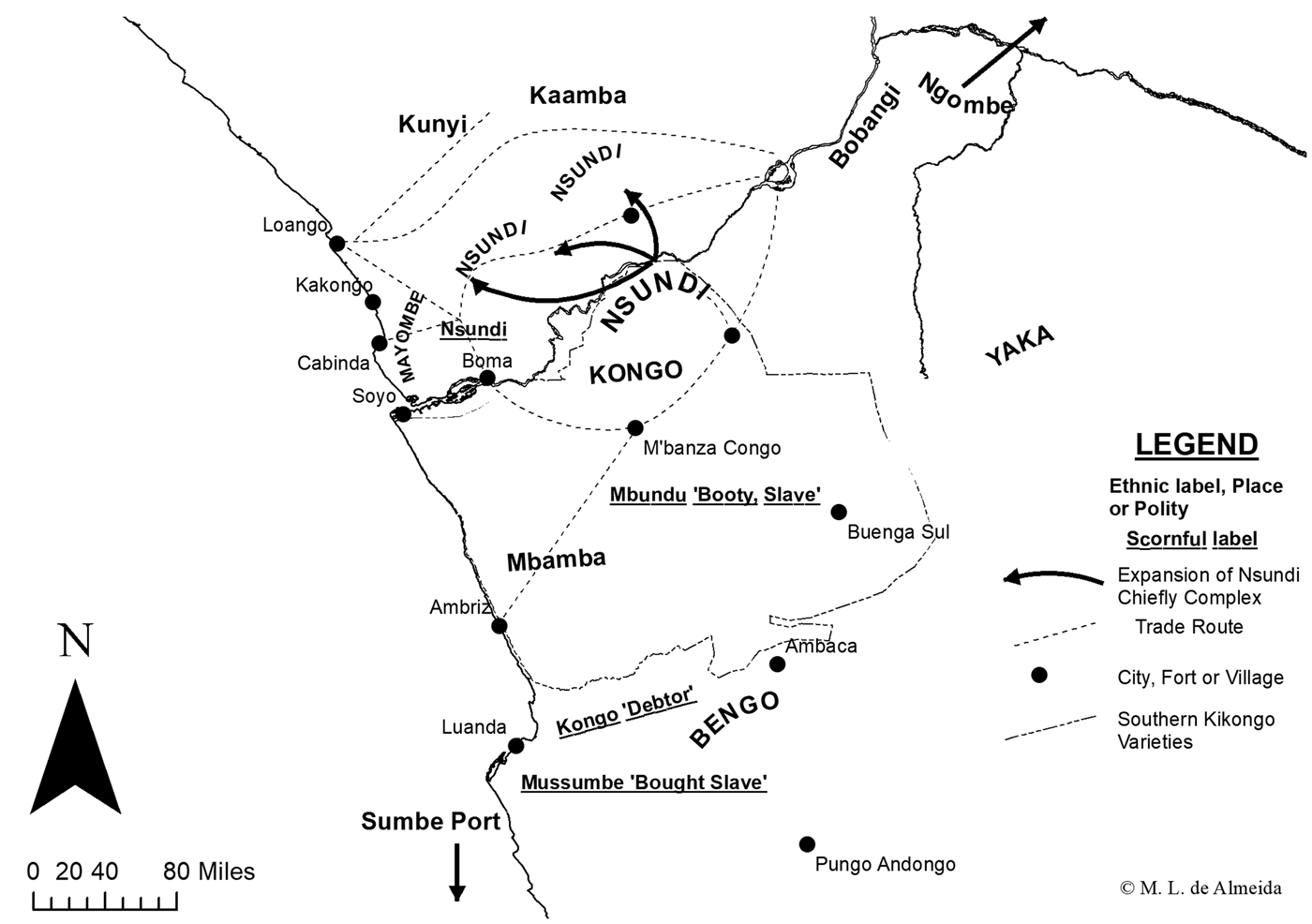
Claimers asserted their belonging to several kinds of polities in West-Central Africa. In the nineteenth century, Lower Congo peoples mobilized ritual practices and the matrilineal principle to build commercial relations, to establish ritual clientage, and to maintain those deemed to be ‘slaves’ in subjugation.Footnote 73 Different forms of chiefship emerged as clans’ leaders formed alliances through marriage and ritual offices, constituting an oligarchy based on slaving and trading networks that connected distant places in Central Africa with the Atlantic trade. At the core of a matriclans’ ideology were clan migration histories, through which contenders claimed origins where their ancestors were buried.Footnote 74 By establishing alliances and securing political and ritual offices, local oligarchs added and subtracted slaves through different forms of transactions and organized violence to keep the flow of wealth running from their contacts with the Atlantic trade.Footnote 75 Losers in such a political game — the kidnapped or those scorned for having ‘lost’ ties to their matrilineal groups — were vulnerable to being transferred to the coast.Footnote 76 Indeed, the contested field of enslavement in the region shaped the range of meanings of many terms found in the Jovem Maria registers, because widespread slaving made terms of relational connectedness in one community become an ‘intrusive mode of representing social death’ in neighboring societies.Footnote 77 This is evidence that, in spite of mutual intelligibility, these communities were representing the enslaved as foreign captives. Besides its inherent ideological perspective, the areal spread of some of these terms indicate source of slaves and the directionality of trade, not unlike the very history of the term sklavus in the Medieval Mediterranean world (Fig. 2).Footnote 78
Map of Political Terms, Trade Routes, and Associated Lexicon for 'slave'. Sources: J. Vansina, Paths, 223; W. MacGaffey, Kongo, 73; P. Martin, Family, 66.

In nineteenth-century Lower Congo, the three sources of chiefly power were Loango in the northwest, Mbanza Sunde in the east, and Mbanza Kongo in the south. Indeed, each of these places controlled trade networks and held sacred cemeteries from which chiefs derived their titles.Footnote 79 Therefore, when the recaptive baptized as Onofre claimed he was the only Sunde in the ship, he evoked a form of belonging in a particular network of clans established through a set of ritually sanctioned alliances that reckoned their ancestors to be buried at Mbanza Sunde.Footnote 80 That is, Onofre set himself apart by claiming an exclusive political membership, even though he likely spoke a variety of Kikongo that could be well understood by others. Similarly, those who claimed to be Loango or Solongo since, despite the fragmentation process, Loango's capital and Mbanza Soyo continued to play a key role in Lower Congo politics as imagined centers of prestige.Footnote 81 To reclaim belonging to these polities allowed some recaptives to find common ground with strangers. Yet each of those terms, however flexible, was not available for everyone to claim and, for some, they might have been claims of superiority.
Historians of the South Atlantic primarily treat the label Congo as an umbrella term, encompassing all enslaved Africans who embarked from the Congo coast.Footnote 82 However, the word was also part of the political culture that newly-arrived recaptives brought with them, insofar as it referred to people claiming association with Mbanza Kongo.Footnote 83 Similar to Sunde, Mbanza Kongo was a source of chiefly titles associated with trade routes in southern regions. Among southern traditions, the city is an axis Mundus, having cosmological value to many southern Kongo speakers as the land of the dead, famously containing the tombs of Kongo kings.Footnote 84 This is why people on the southern fringes buried the deceased facing the north, where the city was located.Footnote 85 By using ‘Na Kongo’ in its name, a clan indicates its association with the power emanating from Mbanza Kongo, and the word was widely understood in this way throughout Central Africa. The word, as understood by recaptives, was thus less an empty label than a political claim linked to southern lower Congolese forms of governance.
Still, widespread slaving across neighboring communities could shift the ideological weights of each of these terms, transforming self-assigned terms of belonging into scornful labels. For example, Father Bernardo Cannecatim, a Capuchin missionary who lived for more than twenty years in the Bengo province in Angola and wrote extensively about Kimbundu, noted that while the word Congo meant ‘rulers’ among Kikongo speakers, early nineteenth-century Kimbundu speakers shifted its meaning to ‘debtors’, a denotation that continued into the twentieth century.Footnote 86 Conversely, southern Kongo speakers did the opposite, transforming m'bundu in a word for ‘booty, slave’, and indeed, Cannecatim himself witnessed southern Kikongo polities raiding Kimbundu speakers in the Bengo region.Footnote 87 The word was borrowed from Southern Kongo varieties to West Kongo languages, such as KiYombe, suggesting the importance of a slave trade route connecting northern Angola to the Lower Congo.Footnote 88
A similar shift happened in the Mayombe region with the label nsundi. As Mayombe clans raided the neighboring Sundi network — many of whom were sold to the coast — slavers came to recognize Nsundi as ‘despicable inlanders’.Footnote 89 But the term Mayombe itself was an external geographical label assigned to people next to the mountains, who recognized themselves through different names.Footnote 90 As they too were preyed upon by Kakongo slave raiders, the term mayombe among the Kakongo came to signify ‘land of slaves’ and muyombe as ‘savages, slaves.’Footnote 91 Indeed, linguistic evidence found in Haiti suggests that Mayombe inhabitants were not merely middlemen as Phyllis Martin proposed, but also were enslaved in large numbers.Footnote 92 The politics of claiming belonging and dishonoring captives underlay the use of these words in the lower Congo and northern Angola where they acquire distinct values according to whom the speaker was. It thus suggests the range of contents labelers and claimers in the Jovem Maria could mobilize over the categories they valued.
Central Africans also devised terms that refer to Central and Southern Angolan political culture. Two designations stand out as representing the extreme poles of political subjectivities in the slave ship: mucaca and mussumbe. The word mucaca has a deep history in West-Central Africa as the root *-kààká means in different languages of the region ‘Grandparent,’ ‘chief (very respectful title)’, and ‘Older Brother’. It is impossible to know which meanings were conveyed among interpreters and newcomers as they uttered mucaca. But it is remarkable that only two of the oldest men in the group, Antonio and Ambrósio, both over thirty years old, were designated with the ‘nation' mucaca.
Contrasting to this restricted use of a prestigious sign, the widespread use of the word mussumbe categorizing 39 individuals marked them with an external identification that emphasized the commercial exchange to which those people had been subjected. As noted above, the word circulated only among Kimbundu speakers. Its meaning might have been specific to those sold at the Sumbe Port, where it also became an ethnonym, but its earlier, literal meaning is a Kimbundu word for ‘bought slave’.Footnote 93 While the term tells us nothing about what sorts of people were categorized as such, it at least suggests the existence of people on the Jovem Maria who were unable to counter the effects of that dehumanizing label.
In sum, closely reading the vernacular categories that interpreters and newcomers devised together allows a historian to do more than pinpoint a given ‘origin’ for recaptives. It opens the formative moment of co-identification among enslaved Central Africans, allowing us to explore how Africans overcame language barriers in a distraught situation, negotiating a speech community and a shared political language. When we recover some of the meanings that such words could prompt in Central-African minds, the list ceases to be about a neutral geographical identification and becomes instead a fraught discussion about where ancestors were buried, who could speak and who could not, who were elders and who were slaves.
Conclusion
This article suggests that a social history of African languages in the Atlantic world foregrounds Africans’ intellectual contributions to that pluralized world. Indeed, a careful reading of the category of ‘nation’ based on linguistic evidence reveals neither the use of colonial categories nor a simple path to ‘origins’. Instead, it highlights a fraught intellectual negotiation between newcomers and interpreters in several West-Central African languages over the different ways in which they strove to connect, recalling the major struggle of the ‘politics of survival’, past and present.
Such a reading of the Jovem Maria reveals a complicated situation of overlaps between language, speech community, and forms of identification. While common typological features and communicative practices learned at home could facilitate communication among recaptives and interpreters, the abundance of languages, their diversity, and numbers of speakers precluded the use of a single communicative system. Yet, the Jovem Maria was not a Tower of Babel, but an unequal speech community sustained by participants through the use of different languages, and perhaps even a chain of unofficial interpreters among recaptives, which might explain the vagueness of some terms such as libama, mujongo, and mutoto. Judging by designations claimed by recaptives, labels created by interpreters, and a linguistic analysis of traces of communication, the record suggests that southern Kikongo varieties (and likely Kimbundu varieties) were used as base languages by interpreters to do most of the work of identification. In this context, enslaved Central Africans from different regions, with different linguistic skills, and subjected to varying forms of enslavement had different points of leverage on which to claim connections. Indeed, on a single slave ship, we see individuals asserting their prestigious role as mucaca while others were lumped together as mussumbe.
Linguistics brings into bold relief the role of African ideas and experiences in Atlantic history. It helps historians, interested in foregrounding biographies of Africans in the Atlantic world, to place these lives in relation to regional narratives grounded in Africa. Rather than relying on abstract, stable notions of ‘ethnolinguistic groups,’ such a methodology offers a way of historicizing the political concepts and linguistic worlds Africans were coming from that ultimately shaped how they understood their existential struggle in the Atlantic world. For the South Atlantic historiography, the analysis substantiates Slenes's pioneering thesis about a ‘Bantu’ lingua franca spoken in Southeastern Brazil, but it also refines it in important ways. First, Umbundu played only a marginal role as a facilitator between Africans from different places, at least in the Jovem Maria registers.
Second, overarching concepts such as ‘BaKongo’, ‘Kikongo’, and ‘Kimbundu’ were the byproduct of late ethnic imaginations and linguistic standardization, not ethnolinguistic categories of great time-depth. If slaves from the Lower Congo and neighboring regions were fostering processes of convergence within slave quarters based on a common cultural reservoir, the Jovem Maria registers show they had to cope first with a contested political language created in the wake of political decentralization, trade networks, and widespread violence in their old homes. Similarly, considerable linguistic diversity existed within Kikongo and Kimbundu language clusters in the nineteenth century while at the same time they exerted different levels of impact on others and among them. Thus, enslaved Africans’ ‘common cultural reservoir’ must be specified further. Instead of a ‘Bantu’ lingua franca based on Kikongo, Kimbundu, and Umbundu, we can begin to discern that some southern Kongo and some Kimbundu varieties might have been the primary languages behind that lingua franca.
Of course, it is not yet possible to argue these points with a conviction based on exhaustive research based on available ethnographic, linguistic, and documentary sources from both sides of the Atlantic. Instead, this article shows the urgent need for this type of research agenda. Any use of the concept of ‘ethnolinguistic group’ by historians must take full account of all historical complexities at play in the interior of Central Africa, or Africa more generally. Similarly, the emergence of any Central African lingua franca in the South Atlantic must consider not only the broad genetic relatedness between languages but also the social history of African languages during the Atlantic period. Only by marshaling a diverse body of sources and reading them against a growing knowledge about West-Central African languages will scholars be able to shed light on this central problem of South Atlantic history.
Appendix