1 Introduction
Clicks are well known for not exhibiting allophonic variation. This lack of variation has been attributed to articulatory constraints on the coronal constrictions that arise from the existence of a second dorsal constriction, and from the wide variety of contrastive coronal click consonants that occur within languages having four or more contrastive click types. This study investigates possible allophonic variation in the release properties of palatal click consonants. If coronal clicks exhibit secondary articulation of the coronal constrictions, as investigated here, this would provide evidence that both the coronal and dorsal constrictions of clicks can exhibit secondary articulations. This has important implications for the phonological structure of click consonants.
Sound changes involving clicks are classified into two categories known as click loss and click replacement (Traill & Vossen Reference Traill and Vossen1997). Click loss refers to cases where a click consonant, which is articulated with a lingual (a.k.a. velaric) airstream, changes into a pulmonic consonant. The change involves not only a change in airstream, but also typically involves a change from a doubly articulated consonant to a single articulation. There are several known instances of click loss involving the palatal click type in the Khoe and Tuu language families (Traill & Vossen Reference Traill and Vossen1997, Fehn forthcoming), as well as in the Bantu language Yeyi (Fulop et al. Reference Fulop, Ladefoged, Liu and Vossen2003), and the Kx’a language Mangetti Dune !Xung (Miller & Elsner 2017). In all of the known cases of click loss, the palatal click type changes to a coronal pulmonic consonant, though there is variation in the consonants that result from the change across different languages.
Click replacement refers to cases where one click type is replaced by another click type. Click replacement involving the palatal click type occurs in the Juu subgroup of the Kx’a language family, where a palatal click type in proto-Juu has changed to a new click type in Ekoka !Xung (Sands Reference Sands, Brenzinger and König2010, König & Heine Reference König and Heine2015). While König & Heine tentatively call this new click type a retroflex click, Miller & Holliday (Reference Miller and Holliday2014) provide articulatory and acoustic evidence that it is a fricated laminal alveolar click, which contrasts in the same language with the typical apical post-alveolar click, [!].Footnote 1
Traill & Vossen (Reference Traill and Vossen1997) suggest that loss of the palatal click may occur in the high front vowel context. However, all previous acoustic investigations of click consonants have investigated clicks in back vowel contexts, where it is possible to find a minimally contrastive word set with each of the initial clicks. Traill & Vossen note that known cases of click loss only occur among the non-fricated clicks, which are the alveolar and palatal click types.
The current study investigates the acoustic properties of click consonant releases in both the high front vowel and high back vowel contexts in Mangetti Dune !Xung. The study investigates the presence or absence of five possible acoustic intervals found in the C–V transition between the click closures and the onset of voicing in the following vowel, as well as the duration of each of the visible phases. The results are analyzed to determine if the strict dichotomy of non-affricated vs. affricated clicks that occurs in back vowel contexts, is maintained in the /i/ context. The research question and hypothesis are as follows:
RQ: What visible acoustic phases are present in the C–V transitions of the four coronal click types? Are the posterior release bursts visible in all four coronal click types in the high front vowel context, or only in the abrupt clicks? Is there a binary distinction between non-fricated palatal and alveolar click types, and fricated dental and lateral click types in the /i/ context, just as there is in the /u/ context?
H: The palatal click type in the /i/ context has secondary palatal affrication in Mangetti Dune !Xung, which differentiates it from both the abrupt alveolar click type and the affricated dental and lateral click types. The dorsal pulmonic noisebursts are not visible in the dental and lateral click types that have more gradual coronal releases.
A more affricated click burst is expected to exhibit an extended frication noise interval following the low amplitude dorsal release bursts found in clicks. This is investigated in the current study. The results of the study are discussed in terms of their relevance to the phonological structure of click consonants, and to documented sound changes involving loss and replacement of the palatal click type.
2 Phonetic background
Previous acoustic investigations have focused on two main properties of click consonants. The first area of investigation focuses on temporal properties of clicks, such as click burst duration, rise time to peak amplitude in the bursts, maximum amplitude in the bursts, and the abruptness of acoustic damping in the bursts, which signal manner of articulation contrasts among clicks. The second area of investigation has focused on spectral properties of the click bursts, which reflect place of articulation contrasts in clicks, known as click type contrasts. Different clicks have been shown to display different concentrations of energy in the bursts (Kagaya Reference Kagaya1978, Sands Reference Sands1991, Ladefoged & Traill Reference Ladefoged and Traill1994, Miller, Brugman & Sands Reference Miller, Brugman, Sands, Trouvain and Barry2007). Only the first set of acoustic properties, which are related to manner of articulation, are relevant to the current study. First, in Section 2.1, I review terminology that is relevant to a discussion of click acoustics. In Section 2.2, I discuss previous studies on click acoustics that refer to the presence or absence of dorsal pulmonic bursts in different click types. Then, in Section 2.3, I review the literature on manner of articulation differences found among different click types.
2.1 Terminology associated with click acoustics
As clicks have two constrictions (one anterior and one posterior), there are two release bursts associated with the releases of the anterior and posterior constrictions. The anterior constriction in clicks can be labial or coronal. Since Mangetti Dune !Xung does not contain a labial click in its inventory (see Section 3 below), the anterior constrictions discussed in this study are all coronal (dental, central alveolar, lateral alveolar, and palatal). The anterior place of articulation contrasts are known as click type contrasts. In previous work (see e.g. Ladefoged & Traill Reference Ladefoged and Traill1994), the anterior release burst that is produced using the lingual ingressive airstream mechanism, is referred to as the click burst. The posterior burst occurs after the release of the anterior constriction (see e.g. Ladefoged & Traill Reference Ladefoged and Traill1994), and thus is produced using a pulmonic egressive airstream mechanism. This second burst is referred to as the posterior (or dorsal) pulmonic burst. The dorsal constrictions in clicks have been shown with quantitative evidence to be back velar or uvular in the dental, alveolar and lateral click types, but uvulo-pharyngeal in the palatal click type in Mangetti Dune !Xung (Miller Reference Miller2016), and in the Khoe language Khoekhoe (Miller, Namaseb & Iskarous Reference Miller, Namaseb, Iskarous, Cole and Hualde2007). The back velar vs. uvulo-pharyngeal contrast has also been shown to exist qualitatively in the alveolar vs. palatal clicks in the Tuu language N|uu (Miller, Brugman et al. Reference Miller, Brugman, Sands, Namaseb, Exter and Collins2009, Miller Reference Miller, Fuchs, Toda and Żygis2010).
2.2 Presence vs. absence of posterior pulmonic bursts
The majority of previous durational studies of clicks have focused solely on the properties of the click bursts. Miller, Brugman et al. (Reference Miller, Brugman, Sands, Namaseb, Exter and Collins2007) use the term lingual bursts to differentiate the anterior click bursts from the pulmonic bursts associated with the dorsal release. They provide the duration of click bursts in the Tuu language N|uu. Although pulmonic dorsal bursts were labeled in their study, and were reported in the more complex airstream contour segments found in that language, there are no measurements provided for the pulmonic bursts in any of the fully lingual (a.k.a. velaric) clicks, because they were not consistently visible in the data.
Waveforms of the three contrastive clicks in the Bantu language Xhosa that are provided in Sands (Reference Sands1991) display no evidence of a second pulmonic burst. As Sands (Reference Sands1991: 27) notes,
[a] velar release burst is not easily seen in waveforms and spectrograms of the clicks. This is apparently because the release of the back closure occurs quite soon after the release of the front closure. The noise associated with the release of the back closure is obscured by the noise of the front release. In the alveolopalatal clicks, which have a less fricated burst, it is sometimes possible to see a small burst occurring approximately 5 ms after the initial burst.
Thus, it is clear that in Xhosa, velar bursts are more commonly visible in alveopalatal clicks (which are most similar to the alveolar clicks in languages that contrast alveolar and palatal click types). Even in the alveopalatal clicks, they are not always visible.
Waveforms of !Xóõ clicks in the [ɑ] context provided in Ladefoged & Traill’s (Reference Ladefoged and Traill1994) study show click bursts that display even damping throughout the burst, and no acoustic evidence of a second posterior burst (except perhaps in the palatal click type). Additionally, Miller & Shah’s (Reference Miller and Shah2009) Figure 1 provides waveforms of Mangetti Dune !Xung clicks before [u], which similar to the !Xóõ click waveforms, lack acoustic evidence of pulmonic dorsal noisebursts. Wright et al. (Reference Wright, Maddieson, Ladefoged and Sands1995) provide waveforms of the three contrastive glottalized click types that occur in the East African non-Bantu language Sandawe, which also provide little evidence of posterior bursts.
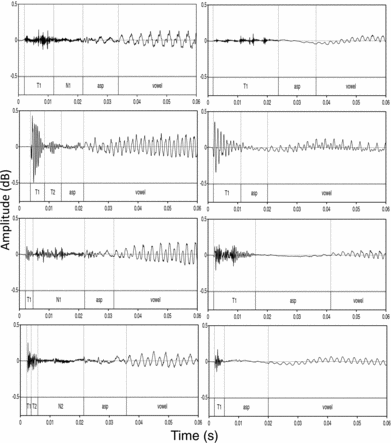
Waveforms of click releases for the four click types in the /i/ context (left) and /u/ context (right) produced by Speaker TK. (From top to bottom: Dental, Alveolar, Lateral, Palatal.)

Spectrograms of all four of the coronal clicks in Yeyi provided in Fulop et al. (Reference Fulop, Ladefoged, Liu and Vossen2003) have visible lingual and pulmonic bursts, showing that the clicks in Yeyi differ from those in Xhosa, Mangetti Dune !Xung, N|uu and !Xóõ. The posterior release bursts occur fully after the lingual bursts in Yeyi, even in the dental and lateral click types where they are obscured in !Xóõ, N|uu, Mangetti Dune !Xung and Sandawe. We can conclude that there are language specific differences in click languages, in whether the posterior bursts of clicks are visible.
2.3 Abrupt vs. affricated clicks
Manner of articulation contrasts among clicks have been recognized since Beach (Reference Beach1938), who refers to the palatal and alveolar clicks in Khoekhoe as implosive (‘instantaneous’), and the dental and lateral click types as affricative.Footnote 2 Kagaya (Reference Kagaya1978) notes that the contrast is in terms of the click release durations.
Durational differences have been noted between these two classes of clicks in a number of languages. The waveforms of the three contrastive Sandawe clicks provided in Wright et al.’s study display a similar contrast between noisy dental and lateral clicks, and abrupt alveolar clicks. Miller & Shah (Reference Miller and Shah2009) provide an analysis of click bursts in Mangetti Dune !Xung in the [u] context, and show that the alveolar and palatal clicks in the [u] context in the language have short rise times to peak amplitude, providing evidence that both clicks are abruptly released and non-affricated. The authors point out that the relationship between click burst duration and rise time to peak amplitude in the bursts is likely similar to the relationship between frication duration and rise time to peak amplitude in the frication noise in the fricative/affricate contrast in English (Diehl, Molis & Castleman Reference Diehl, Molis, Castleman, Johnson and Hume2001). Perceptual studies similar to those undertaken in English (Castleman Reference Castleman1997) are needed to determine which acoustic cues are perceptually relevant for the click contrast.
There are quantitative durational analyses of the phases involved in click production in the Bantu languages Zulu (Thomas Reference Thomas1997, Thomas-Vilakati Reference Thomas-Vilakati2010) and Yeyi (Fulop et al. Reference Fulop, Ladefoged, Liu and Vossen2003), and the Tuu language N|uu (Miller, Brugman et al. Reference Miller, Brugman, Sands, Namaseb, Exter and Collins2007). The Zulu and Yeyi duration measurements are not comparable to those provided in the current study. However, the Fulop et al. study is important because the Yeyi data provide evidence of a language where the palatal click is affricated. The N|uu data show that mean durations of the alveolar and palatal lingual (click) bursts are about 10 ms, while the mean duration of the click bursts in the dental click type are more than twice that duration (> 20 ms), supporting an analysis where the dental click type is noisy, and the alveolar and palatal click types are abrupt. Footnote 3
Both acoustic and articulatory features have been proposed to capture the contrast between the two classes of clicks. Johnson (Reference Johnson1993) proposes an acoustically based feature [+/–noisy] that distinguishes the different click types in Xhosa, and this is adopted by Ladefoged & Traill (Reference Ladefoged and Traill1994) to describe the clear vs. fricated contrast in the !Xóõ clicks. The terms noisy and abrupt, or [+/–noisy], refer to properties of the click burst. Traill & Vossen (Reference Traill and Vossen1997: 23) describe abrupt clicks as being ‘impulse-like with rapid damping’, and noisy clicks as ‘being noisy and not rapidly damped’. Ladefoged & Traill (Reference Ladefoged and Traill1994) provide measurements of Rise Time to peak intensity in click bursts, and the duration of the click bursts in !Xóõ in the [ɑ] context, to provide quantitative evidence for the binary abrupt vs. noisy classification of the four coronal clicks (and the fifth contrastive bilabial click that occurs in !Xóõ, which is also noisy).
Stevens (Reference Stevens1999) recognizes the articulatory differences that may lead to the [abrupt] vs. [noisy] properties of click bursts. He notes that the front release in clicks generally precede the dorsal release, but also that some clicks have a more gradual front release that results in a more distributed source. Thomas (Reference Thomas1997) and Thomas-Vilakati (Reference Thomas-Vilakati2010) provides aerodynamic evidence that illustrates which clicks in Zulu have a more abrupt vs. gradual release (see Figure 83 in the 2010 study). The lateral click type displays the lowest duration of overlap of the two constrictions, followed by the alveolar click, and then the dental click.
Thomas-Vilakati’s (Reference Thomas-Vilakati2010) study investigated the effect of vowel context. However, the results showed no significant effect of vowel context, which she suggests may be due to a low number of tokens. The qualitative differences seen in her study suggest that it is necessary to control for vowel context in durational investigations of click releases. Her study did not compare clicks in high front vs. high back vowel contexts, which is the main effect being investigated in the current study.
3 Language background
Mangetti Dune !Xung is an under-described language spoken in the Western Tsumkwe area of the Otjizondjupa region of Namibia in the towns of Mangetti Dune, Omataku, and surrounding areas. The language belongs to the Northern branch of the Juu subgroup of the Ju-ǂHoan language family according to Sands’ (Reference Sands, Brenzinger and König2010) classification. The language family is currently known as the Kx’a family (Heine & Honken Reference Heine and Honken2010). The group of languages used to be thought to belong to the Northern Khoisan branch of the Khoisan language family (Greenberg Reference Greenberg and Voegelin1966). When the different branches of the Khoisan language family were split off into three separate families (Güldemann Reference Güldemann2001), the Northern Khoisan group was referred to as the Ju-ǂHoan language family for a short time, before it was renamed as the Kx’a language family.
There are approximately 500 speakers of Mangetti Dune !Xung in Namibia. There are additional speakers of the language residing in Plattfontein, South Africa, and the language is also sometimes referred to as South African !Xung. The language was originally spoken in southern Angola and northern Namibia, and there are still speakers residing in the town of Omega in the Caprivi strip in Namibia.
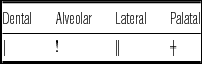
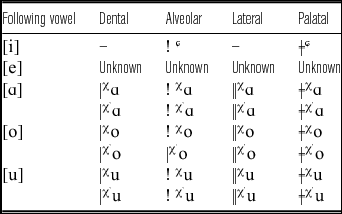
The language contains the four contrastive coronal click types recognized by the IPA (2006), which are provided in Table 1. The full sound inventory of the language is provided in Miller (Reference Miller2016: 123–124).
Four contrastive coronal click types in Mangetti Dune !Xung.

4 Method
4.1 Speakers and wordlist
Acoustic recordings were collected in Mangetti Dune, Namibia in 2008 from five speakers of Mangetti Dune !Xung, who were all in their early twenties at the time of the recording. Three of the speakers produced data in both /i/ and /u/ vowel contexts. These include two male speakers, Jenggu Rooi Fransisko (JF) and Martin ||Oce Aromo (MA); and one female speaker, Thumbo Caroline Kaleyi (TK). Two additional female speakers produced the clicks only in one vowel context. Sabine Towe Riem (SR) only produced the clicks preceding /i/, and Speaker Bingo Kanehe Costa (BC) only produced the clicks preceding /u/. Since it is only possible to compare the clicks in the two vowel contexts for three speakers, these results are analyzed in Section 5.1. The raw results for the two additional speakers are provided in Appendix B, and the similarities and differences between these two speakers’ productions and the first three speakers’ productions are discussed in Section 5.2.
The wordlist recorded for this study is provided in (1), which contains the orthographic form, phonetic transcription, and English gloss for each word.
(1)


The superscripted ɡ that precedes the clicks in the phonetic transcriptions indicates that the clicks are voiced. This follows Miller, Brugman et al.’s (Reference Miller, Brugman, Sands, Namaseb, Exter and Collins2009) transcription system, where closure and release properties of clicks are superscripted, rather than written as separate segments, to clearly indicate what counts as a single segment. The /i/ recordings have the clicks occurring in the focused position in the frame sentence in (2a), and the /u/ recordings have the clicks occurring in the focused position in the frame sentence in (2b).
(2)

The initial click consonant in each of the target words is analyzed. The transcriptions of the vowels that are provided are somewhat broad; as the vowel quality following each of the click types differs, and there is both within and across speaker variation in vowel quality, especially following the palatal click type (Miller Reference Miller2016: 141). The differences in the vowels following the clicks arise from C–V coarticulation between the clicks and following vowels, which is phonologized in the form of a co-occurrence restriction known as The Back Vowel Constraint (Traill Reference Traill1985, Miller-Ockhuizen Reference Miller-Ockhuizen2003, Nakagawa Reference Nakagawa2006).
The acoustic recordings for the /i/ data were made with a Shure SM10A head-mounted microphone, using a Canopus ADVC-100 Audio-Video Mixer that was input into a Dell 8600 laptop. These acoustic recordings are time-aligned with lingual ultrasound recordings, as the articulatory and acoustic data were collected simultaneously using the CHAUSA (Corrected High Frame Rate Anchored Ultrasound with Software Alignment) method (Miller & Finch Reference Miller and Finch2011). Analysis of the ultrasound recordings are provided elsewhere (Miller Reference Miller2016). The acoustic recordings for the /u/ data were made with a Shure SM10A head-mounted microphone connected to a Shure FP23 preamp, which was connected to a Dell 8600 laptop computer through the microphone input. The sampling rate for both sets of acoustic recordings was 44,100 Hz.
4.2 Acoustic analyses
Ladefoged & Traill (Reference Ladefoged and Traill1994) use click burst duration and rise time to peak amplitude as measurements of the manner of articulation contrast found between non-affricated clicks and affricated clicks. Rise time to peak amplitude is a general measure of manner of articulation that has been used to measure differences between the pulmonic sibilant fricative vs. affricate contrast in English (see e.g. Howell & Rosen Reference Howell and Rosen1983). Click burst duration was a sufficient measure to capture the contrast between non-affricated and affricated clicks in !Xóõ in back vowel contexts. However, the more complex click releases found in the /i/ context require more complex measures to properly describe the three-way contrast between the non-affricated clicks, the affricated clicks, and the affricated allophone of the palatal click that occurs in the /i/ context in Mangetti Dune !Xung.
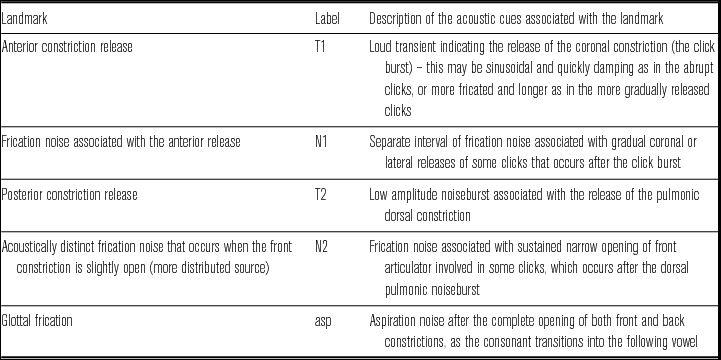
The current study measures all of the relevant phases that are identified to occur in pulmonic stop releases by Stevens (Reference Stevens1999). There are five potentially visible acoustic phases that can be identified in the release portions of the waveforms of click productions. These are described in Table 2. Silent intervals corresponding to the lingual closures and click bursts are visible in all tokens of all click types. The beginning of the closure phases in voiceless clicks could not be consistently identified due to a pause preceding the target word in the recordings, which likely helps signal focus. Therefore, closure durations are not reported.
Acoustic phases that are visible in some acoustic representations of click consonants.

Not all acoustic phases associated with the two releases listed in Table 2 are visible in all click productions. The visible phases were labeled in Praat (Boersma & Weenink Reference Boersma and Weenink2015) using the labels listed in Table 2 for all productions of the four click types produced by the five speakers. When the pulmonic dorsal release follows quickly after an abrupt coronal release, a change in the amplitude and shape of the waveform occurs. This is how the posterior release is identified. The two frication noise intervals occur following the click burst and dorsal pulmonic release burst. The labeling distinguishes noisy click bursts from a separate period of frication noise that follows the click burst. Each noise phase – the N1, N2, and asp intervals, described in Table 2 –has a clearly different shape in the relevant portion of the waveform from the other noise phases, which corresponds to the different frequency of the energy seen in spectrograms.
It is important to note that the aspiration phase in the voiceless and voiced unaspirated clicks in this study is very short, as is typical of unaspirated consonants across languages (see Cho & Ladefoged Reference Cho and Ladefoged1999). It is much shorter than the 80–100 ms aspiration noise phase seen in the contrastively aspirated clicks found in the related language Ju|’hoansi (see Miller Reference Miller2007). Similar to Ju|’hoansi, Mangetti Dune !Xung has a four-way Voice Onset Time contrast (Miller Reference Miller2016).
Some of the high amplitude click bursts in the acoustic recordings of the clicks in the /i/ context are clipped. This precludes measures of click burst amplitude and COG for the /i/ data as were provided for the /u/ data in Miller & Shah (Reference Miller and Shah2009).
A second acoustic analysis investigates the spectral properties of the frication noise found following the pulmonic release burst in the palatal click tokens that were identified in the first analysis, and labeled with the N2 label. Spectra were created using a 25 ms Hanning window that was aligned to the beginning of the frication noise interval labeled N2. Spectra were filtered to only allow energy between 2000 Hz and 11025 Hz to be included in the analysis. This was done to exclude energy from the first and second formants in the following vowel, which seemed to be visible in some of the non-filtered spectra. The center of gravity (the first spectral moment) and standard deviation (the positive square root of the second spectral moment) of the spectra were measured using the built-in Praat functions, following Forrest et al. (Reference Forrest, Weismer, Milenkovic and Dougall1988). For the center of gravity calculations, weighting was accomplished using the power spectrum.
4.3 Statistical treatment
Linear mixed effects models were fit separately for the total release duration as well as the separate acoustic phases that were visible in each of the clicks using the lme4 package (Bates et al. Reference Bates, Maechler, Bolke and Walker2014) in the R Statistics software (R Core Team 2014). The total release duration was calculated as T1+N1+T2+N2+asp (refer to Table 2 for the description of each of the labels). Each of the four models contained a random intercept for speaker, and the interaction of speaker and click type. The fixed effects of click type, vowel and their interaction were tested. The palatal click type was chosen as the reference value to which the other three click types were compared. Significance levels were calculated using Satterthwaite’s (Reference Satterthwaite1946) approximations for the degrees of freedom using the lmerTest library (Kuznetsova, Brockhoff & Christensen Reference Kuznetsova, Brockhoff and Christensen2016). Broad significance classes are indicated with * (< .05), ** (< .01), and *** (< .001) in the outputs of the models. The duration of the dorsal pulmonic burst (T2), and the duration of the second noise interval (N2) that sometimes follows the pulmonic burst, were not present in enough contexts or tokens to allow statistical comparisons. Therefore, these acoustic intervals are discussed solely based on the number and percentage of tokens where they occur in the each of the vowel contexts.
5 Results
5.1 Durational analysis of visible acoustic intervals
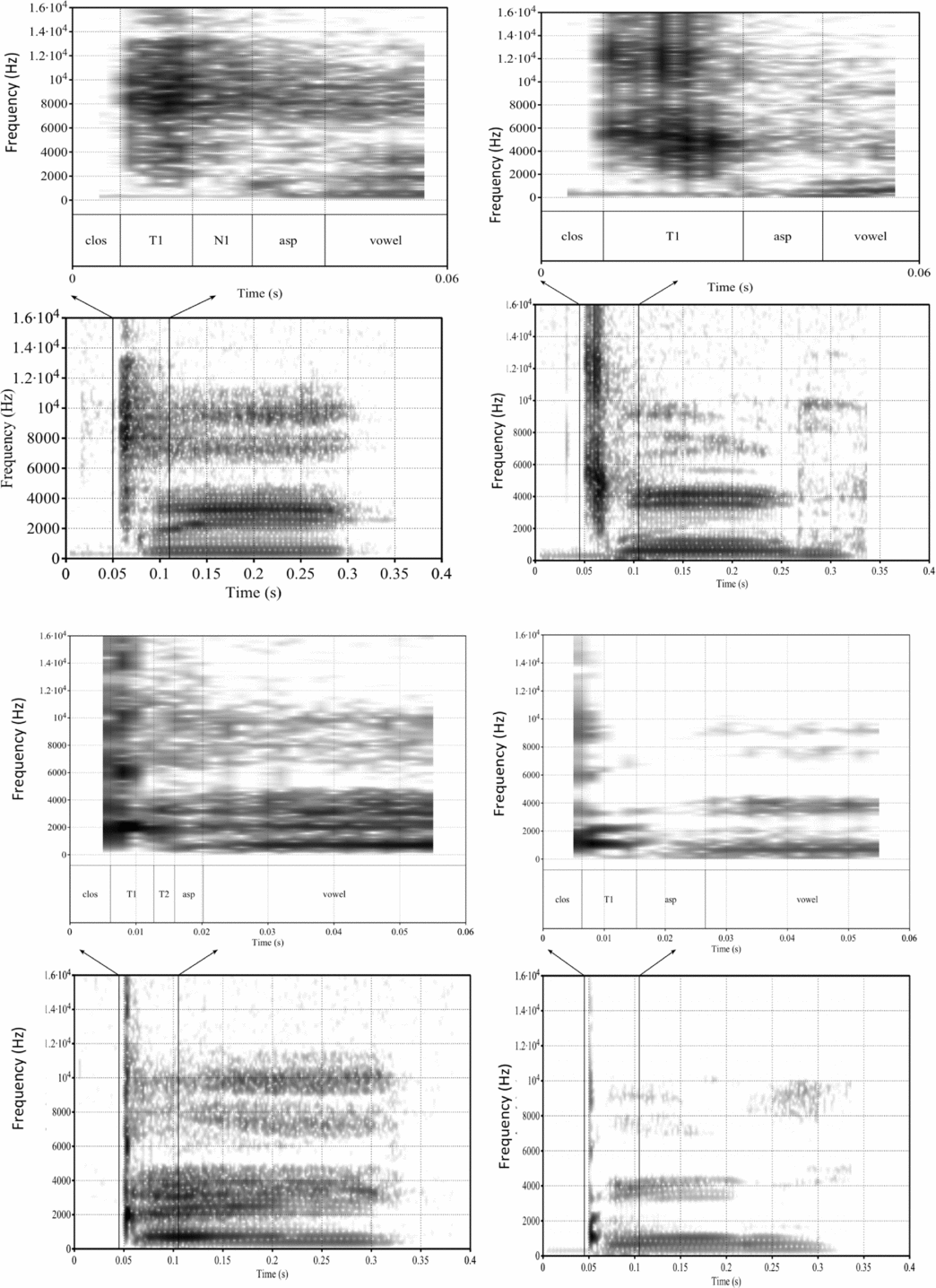
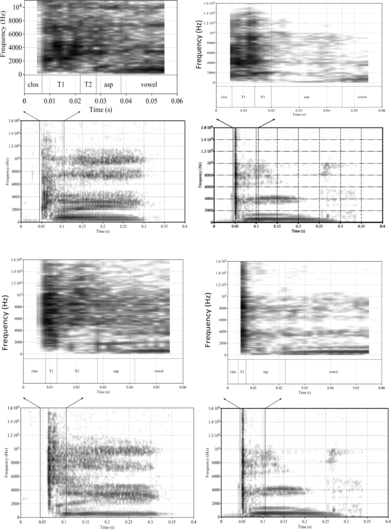
Figure 1 below provides waveforms of the click noisebursts, the C–V transitions, and the initial part of the following vowels, in one token of each of the four click types preceding /i/, and one token of each of the four click types preceding /u/ produced by Speaker TK, with the labels defined in Table 2 shown. Figure 2 provides spectrograms of TK’s productions of one token of the words that commence with the dental and alveolar click types in the /i/ and /u/ contexts, as well as close-up spectrograms of the 60 ms that contains 5 ms of the click closures, and 55 ms of the C–V transition for each of the clicks extracted from these words. Figure 3 provides both close-up and full word spectrograms of TK’s productions of the words used in this study that commence with the lateral and palatal click types in the /i/ and /u/ contexts. These spectrograms demonstrate clearly the differences in frication noise, which exhibits energy in the upper frequency range; and aspiration noise, which exhibits low amplitude and low frequency energy contributed by the formant frequencies of the following vowel. It is clear from looking at the two spectrograms of the palatal click, that the palatal click in the /i/ context has a separate frication noise interval that is separable from the click burst, while the palatal click in the /u/ context is lacking this separate frication noise interval. The dental and lateral clicks in the /i/ context exhibit extended frication noise in the 8,000–10,000 Hz range that is not visible in the /u/ context. For these click types, the frication noise is part of the burst, and does not follow the burst, as in the palatal click type. Thus, although the dental, lateral and palatal click bursts are all more fricated before /i/, the frication noise is only a secondary articulation in the palatal click type.
Spectrograms of the click releases and full words containing the dental (upper) and alveolar (lower) click types in the /i/ (left) and /u/ contexts (right) produced by Speaker TK.

Spectrograms of the click releases and full words containing the lateral (upper) and palatal (lower) click types in the /i/ (left) and /u/ contexts (right) produced by Speaker TK.

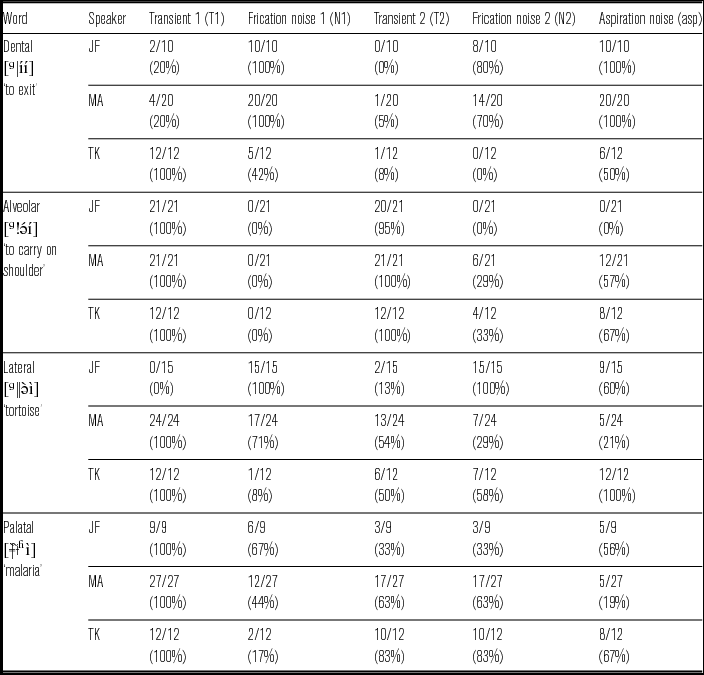
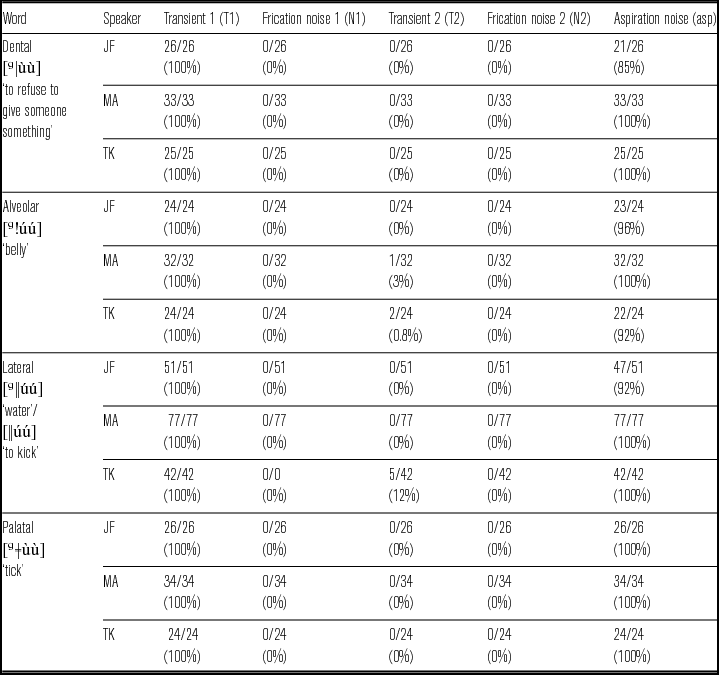
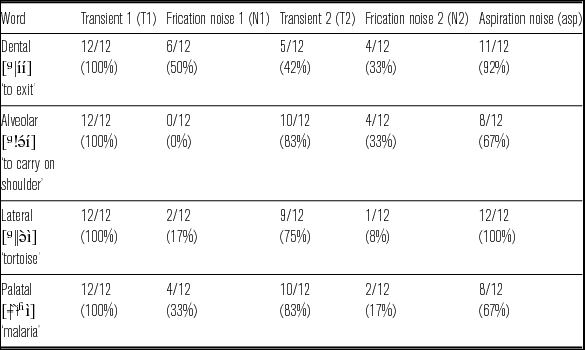
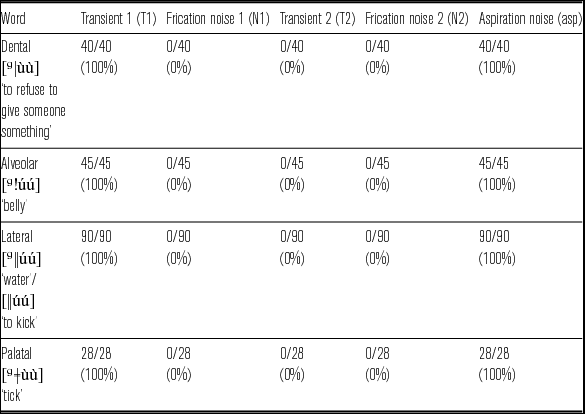
Table 3 above provides the number and the percentage of tokens of each click type in the /i/ vowel context that display identifiable acoustic intervals of each of the five types. Table 4 below provides a similar table for each of the clicks in the /u/ vowel context. Note that the relatively larger number of tokens of the lateral click type in the /u/ context reflects the fact that there were recordings of two words of this type collected for this study.
Number and percentage of tokens of each click type in the /i/ context that contain visible acoustic landmarks by speaker.

Number and percentage of tokens of each click type in the /u/ context that contain visible acoustic landmarks by speaker.

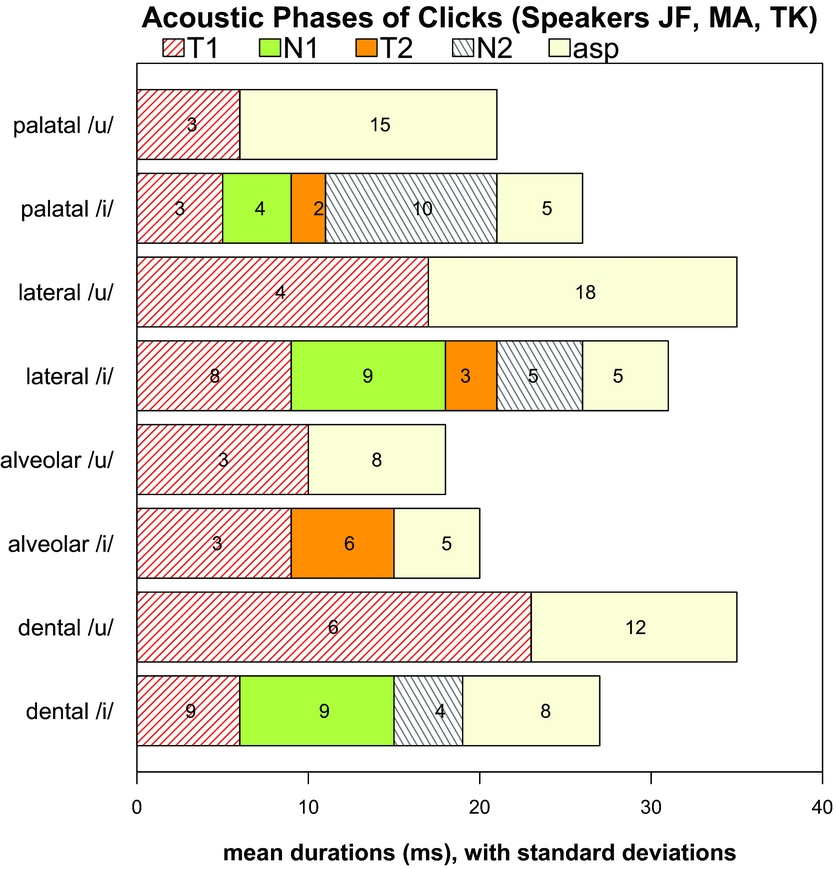
Means and standard deviations of the durations of each of the five acoustic phases found in all of the waveforms of the click releases in both vowel contexts produced by the three speakers are provided in the stacked barplot in Figure 4 below. The effect of vowel context is clear. For all three speakers (JF, MA and TK), the productions of the dental, lateral and palatal click types differ across vowel contexts. There are no separate frication noise phases following either the click burst, or the posterior burst in the /u/ context, for any of the clicks. In fact, the posterior (dorsal) pulmonic burst is only visible (and thus likely audible as a separate event) in the lateral click in the /u/ context. There are only 5/42 tokens of the lateral click productions that exhibit a visible posterior pulmonic burst in the /u/ context for one speaker (TK). The number of tokens exhibiting posterior bursts in the palatal click productions before /u/ vary widely by speaker.
Duration of visible acoustic phases in the four coronal click types in the /i/ and /u/ vowel contexts.

The dental click type is fricated in both vowel contexts, but the lingual release burst is shorter (less fricated) in the /i/ context than in the /u/ context. The click burst itself is more fricated (longer) before /u/, but shorter with a separate frication noise interval in the /i/ context. This is apparent in the waveforms in Figure 1 and spectrograms in Figure 2 above. The pattern of variation across the three speakers’ productions can be partially gleaned from the standard deviations provided in Figure 4.
The alveolar click is the most abrupt click of the four coronal click types. Two clear transients are seen in the waveform of this click in both vowel contexts, with the transient associated with the posterior pulmonic release occurring immediately after the end of the transient release of the lingual coronal constriction, and a periodic vowel starting < 10 ms after the posterior release of the click. As seen in Tables 3 and 4, the three speakers’ productions of the alveolar click type have visible posterior release transients (T2) for > 80% of the tokens of this click in the /i/ context, and for between 95–100% of the tokens in the /u/ context. There is no frication noise in any of the speakers’ productions of this click type in either vowel context, so there is nothing to obscure the dorsal pulmonic release burst (T2), either visually or auditorily.
The palatal click type exhibits the greatest difference in production in the two vowel contexts. The waveform of TK’s production of the palatal click type in the /i/ context in Figure 1 displays two transients associated with the releases of the lingual (a.k.a. velaric) coronal and pulmonic dorsal constrictions. Both transients are extremely short. However, there is an interval of frication noise (≅15 ms) following the two transients (N2 interval). The acoustic evidence points to the front and back constrictions releasing quickly following upon each other, with the front constriction maintaining a relatively close position beyond the dorsal pulmonic release, which leads to frication noise. The token of TK’s production of a palatal click in the /u/ context in Figure 1 has no frication noise following the lingual (click) burst. Instead, we see a period of low amplitude aspiration noise. The mean values in Figure 4 display a similar pattern for all three speakers’ productions. However, as seen in Tables 3 and 4 above, the detailed labeling was able to identify a pulmonic burst transient for all speakers’ productions of the palatal click before /i/, and frication noise intervals following the lingual and pulmonic bursts. In the /u/ context, only the lingual burst is visible (and thus likely audible), followed by a period of aspiration. The lack of a visible dorsal pulmonic burst in the /u/ context suggests that this click type involves a more simultaneous release of the coronal and dorsal constrictions.
The waveform of the lateral click type has louder frication noise associated with the lateral release than the coronal release associated with the dental click type. This is particularly evident in the waveforms in Figure 1 in the /u/ vowel context. Because of the loud frication noise associated with the lateral release, it is difficult to determine the location of the posterior release burst. The quantitative data in Figure 4 show that the lateral click type exhibits two visible acoustic phases following the click closures for Speaker MA’s productions, and three phases following the click closures for the other two speakers’ productions (JF and TK). For Speaker MA’s productions, the two visible phases are the anterior lingual and posterior pulmonic transients. However, as with the dental click, the click bursts themselves are fricated (longer in duration), as there is noise associated with the tongue pulling away from the front upper teeth in the dental click type, and the back teeth on one or both sides of the mouth for the lateral click type. The fricative noise source is assumed to be additive to the lingual airstream source in the dental and lateral click types.
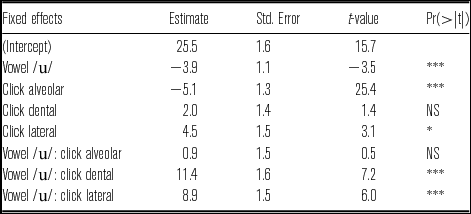
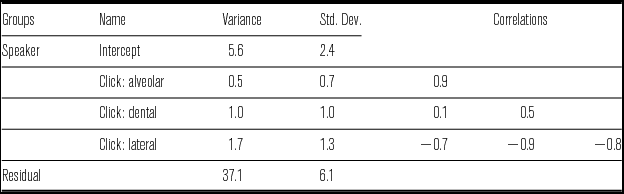
Statistical tests are used to determine the significance of the effect of click type, vowel, and their interaction on the duration of the various acoustic intervals. Table 5 provides the results of the linear mixed effects model that investigated these fixed effects on the total click release duration. The results for the random interaction between speaker and click type on the total release duration are provided in Table A1 in Appendix A. The results show that across vowel contexts, the lateral click type has a longer release duration than the palatal click type, while the alveolar click type has a shorter release duration than the palatal click type. The palatal click release durations in the /u/ vowel context are overall shorter than the palatal click in the /i/ context. The dental and lateral clicks are longer in the /u/ context than in the /i/ context. The alveolar click release duration is quite similar in both vowel contexts.
Results of a linear mixed effects model testing for the effect of click type, vowel and the interaction between click type and vowel on the total release duration.

Broad significance classes: *< .05; ***< .001
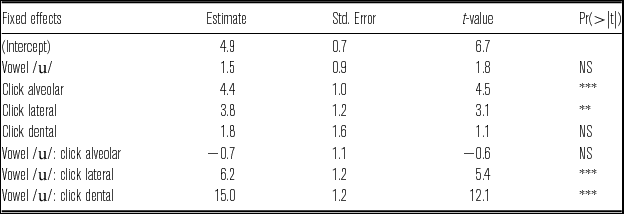
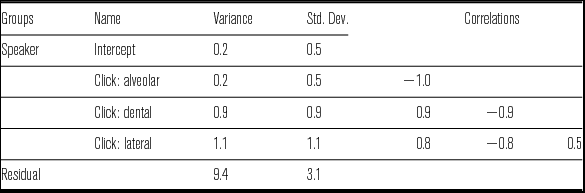
Table 6 provides the results of the model that tests for the effect of click type, vowel, and the interaction between click type and vowel on the duration of the click burst (T1 interval). The results of the random interaction of speaker and click type for this model are provided in Table A2 in Appendix A. The size of the effect differs from the overall release duration results in various ways for different click types. The palatal and alveolar click bursts in the /u/ context do not differ significantly from the bursts of these clicks in the /i/ context. Significant effects of vowel context are seen with the dental and lateral click burst durations, with a larger effect (15.0 ms lengthening effect) being found for the dental click type in the /u/ context.
Results of a linear mixed effects model testing for the effect of click type, vowel and the interaction of click type and vowel context on the duration of the click burst (T1).

Broad significance classes: **< .01; ***< .001
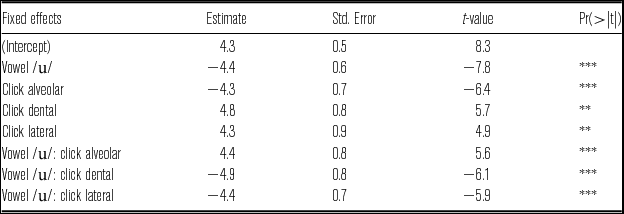
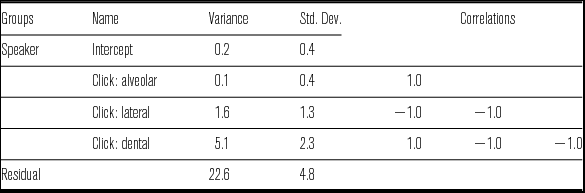
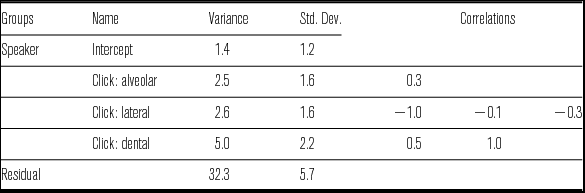
Table 7 provides the results of the linear mixed effects model investigating the effect of click type, vowel, and their interaction, on the frication noise interval that follows the click burst (N1 interval). The results for the random interaction between click type and speaker for this model are provided in Table A3 in Appendix A. The alveolar click displays a slightly shorter noise phase than the palatal click type, while the dental and lateral click types have longer frication noise intervals than the palatal click type by 4.8 ms and 4.0 ms respectively. The palatal, dental and lateral click types have 4.4 ms, 4.9 ms, and 4.4 ms shorter frication noise phases in the /u/ context than in the /i/ context respectively.
Results of a linear mixed effects model testing for the effect of click type, vowel and the interaction of click type and vowel context on the duration of the 1st noise phase (frication noise following the click burst, N1).

Broad significance classes: **< .01; ***< .001
The dorsal pulmonic burst is not visible in enough tokens to undertake reliable statistical comparisons across clicks. However, by comparison of Tables 3 and 4, it is clear that generally, the dorsal pulmonic bursts are less often visible in the /u/ context than in the /i/ context. For the alveolar click, however, the majority of tokens produced by all three speakers display a visible dorsal pulmonic burst. There is a great deal of inter-speaker variability with respect to the percentage of tokens that had visible dorsal pulmonic bursts for the lateral and palatal click types. The dental click productions display a very low percentage of visible dorsal pulmonic bursts – even in the /i/ context. The second noise interval (N2) that follows the dorsal pulmonic burst occurs only in the palatal click type in the /i/ context.
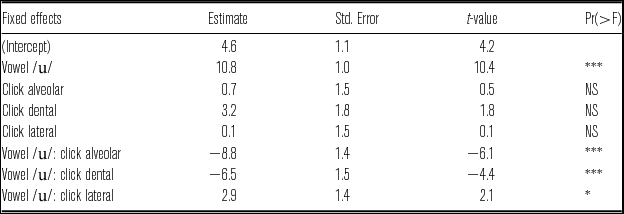
Table 8 provides the results of the linear mixed effects model that investigated the effect of click type, vowel, and their interaction on the duration of the aspiration noise interval (asp). The results for the random interaction between speaker and click type for this model are provided in Table A4 in Appendix A. Results show that the aspiration phase in the palatal and lateral click types are longer in the /u/ context than in the /i/ context, while the aspiration phase in the alveolar and dental click types are shorter in the /u/ context than in the /i/ context.
Results of a linear mixed effects model testing for the effect of click type, vowel and the interaction of click type and vowel context on the duration of the aspiration phase (asp).

Broad significance classes: *< .05; ***< .001
5.2 Durational analysis for two additional speakers
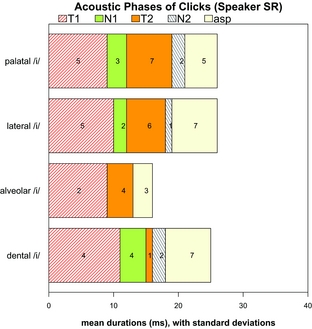
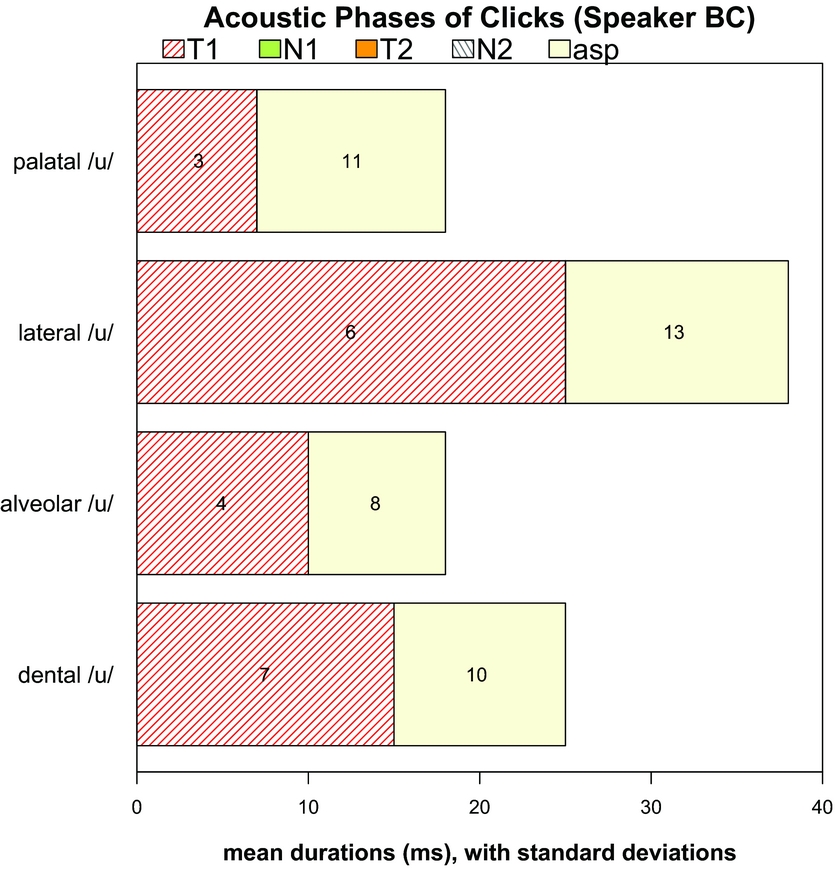
Results for the additional two speakers who produced clicks in only one of the vowel contexts are provided in Appendix B. Figures B1 and B2 contain stacked barplots for Speaker SR’s productions of the four clicks in the /i/ context, and Speaker BC’s productions of the four clicks in the /u/ context. Tables B1 and B2 provide the number and percentage of tokens of each click type that exhibits each of the acoustic intervals that were labeled in this study. Speaker SR’s productions of the dental click before /i/ differs from the other three speakers’ productions presented above, in that her productions exhibit visible dorsal pulmonic (T2) burst transients that occur between two acoustically distinct frication noise phases. Her productions of the alveolar, lateral and palatal click types are quite similar to the other speakers’ productions. Speaker BC’s productions of the four click types in the /u/ context are quite similar to those found for the other three speakers.
5.3 Spectral analysis of secondary frication in the palatal click type
Given that the second frication noise phase (N2) in the palatal click type follows the dorsal pulmonic release burst (T2), it is necessary to show that the frication noise is due to a close anterior constriction (not a posterior one associated with the dorsal release of the click). Table 9 provides the means and standard deviations of the centers of gravity (COGs) for the noise interval (N2) that follows the dorsal release burst in the palatal click type in the /i/ vowel context. The results show that the mean COG values of the frication noise are between 4200–4800 Hz for 3/4 speakers, while TK’s mean COG value is a bit higher at 6223 Hz. Results are consistent with analyzing this fricated interval as palatal frication (Shadle Reference Shadle1991), as occurs in the palatal fricative [ҫ] in Greek (Nirgianaki Reference Nirgianaki2014), and is also consistent with the palatal fricative COG values seen in Gordon, Barthmeier & Sands’ (Reference Gordon, Barthmeier and Sands2002) cross-linguistic study of fricatives.
Means and standard deviation values of the center of gravity of the frication noise intervals found following the posterior release bursts in the palatal click type in the /i/ vowel context.

6 Discussion
6.1 Vowel context effects on click acoustics
Previous studies have described a binary distinction between abrupt vs. affricated clicks. Ladefoged & Trail (Reference Ladefoged and Traill1994) have described the alveolar and palatal clicks in the Tuu language !Xóõ as [–noisy], and the dental and lateral click types in the same language and same context as [+noisy]. However, Fulop et al. (Reference Fulop, Ladefoged, Liu and Vossen2003) have provided evidence that the palatal click type in the Bantu language Yeyi is fricated, which differentiates it from the abrupt palatal click type described in the other languages that have been studied. The current study shows that the results in the /u/ context in Mangetti Dune !Xung are consistent with previous studies – namely, the dental and lateral click types are fricated (as shown by the longer click bursts), and the alveolar click type is abrupt (very short click burst duration).
The results of the current study show that vowel context has a significant effect on click release acoustics in the Kx’a language Mangetti Dune !Xung. The overall release duration is shorter for the palatal and alveolar clicks in the /u/ context than in the /i/ context, but longer for the two clicks that are consistently noisy (dental and lateral click types) in the /u/ context. This result supports the binary distinction between fricated (noisy) vs. non-fricated (clear) click types described in the literature on click acoustics.
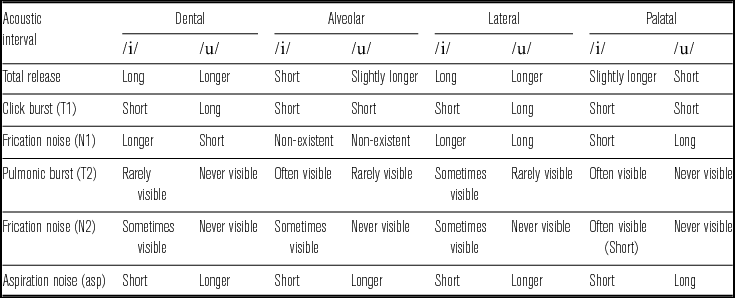
The different phases of the clicks were investigated statistically to determine the relative contributions of each phase to the overall release duration differences. Table 10 summarizes the differences seen in the current study. The click burst (T1) durations do not differ much for the palatal and alveolar click types in different vowel contexts. However, the two noisy (dental and lateral) click types have longer click burst durations in the /u/ context. This means that the bursts themselves are longer and noisier in the /u/ context for the two noisy clicks. The comparison of the frication noise phase that sometimes follows the click burst in the palatal, dental and lateral click types, shows that the frication noise interval is shorter in the /u/ context than in the /i/ context. This result can be interpreted as a trading relation between fricating the click burst itself as seen in the /u/ context; and producing a shorter less fricated click burst, but instead adding a separate frication noise interval that follows the click burst proper in the /i/ context. This effect seems to be quite similar in its magnitude for the palatal, dental and lateral click types, providing evidence for the palatal click type behaving as a fricated click, not as an abrupt click, as exhibited in the total release duration patterns.
Summary of the durational differences seen among the release phases of the different click types.

The visibility of dorsal pulmonic bursts and the duration of the aspiration phase differs across vowel contexts. The dorsal pulmonic burst is more often visible in the /i/ context than in the /u/ context, especially for the alveolar click type (and less so for the lateral and palatal click types). The duration of the aspiration phase is quite a bit longer in the /u/ context than in the /i/ context for the palatal click type, only slightly longer in the /u/ context for the lateral click type, and shorter in the /u/ context for the dental and alveolar click types. This effect seems to indicate an additional trading relation between the degree of frication noise that follows the click burst, and the degree of aspiration noise that follows the fricated interval, especially for the palatal click type. The palatal and lateral click types have a greater degree of frication noise in the /i/ context, and a lesser degree of aspiration noise in this context. Conversely, the dental click type has a greater degree of frication noise in the /i/ context, and a greater degree of aspiration noise – so that the effects are additive for the dental click type.
The current study shows that the dental, lateral and palatal click types all display a secondary frication noise interval (N1) that follows the click burst in the /i/ context, that is not visible in the /u/ context. This might at first blush seem to be in keeping with an analysis of all three of these click types in the /i/ context as involving secondary palatalization. However, it is not clear if the second rather short noise phase (N2) in the dental and lateral click types is distinguishable from the first frication noise phase that follows the click burst (N1), because the dorsal pulmonic burst is less visible and shorter in duration when it is visible (and thus likely inaudible). Thus, in the dental and lateral click types, there is no acoustic landmark that separates the two different noise phases. These are only distinguishable in the acoustic waveforms by slightly different waveform shapes, which can be difficult to separate visually (and may also be difficult to distinguish perceptually).
The noisebursts and C–V transitions of the palatal click type display a hybrid pattern. Clear (non-fricated) anterior and posterior transients are visible preceding /u/, showing that the initial releases are rather abrupt, as in the [ɑ] context in !Xóõ, as described by Ladefoged & Traill (Reference Ladefoged and Traill1994) and Traill & Vossen (Reference Traill and Vossen1997). However, a period of frication noise that is produced using the pulmonic airstream follows the pulmonic dorsal release burst of the palatal click when the click precedes /i/. This frication noise has energy in a frequency range that is similar to that found in a pulmonic palatal fricative (Shadle Reference Shadle1991, Ngirianaki Reference Nirgianaki2014), and is thus consistent with the transcription of the palatal click in the /i/ context as [ǂɕ], a variant of the palatal click that contains secondary allophonic palatalization. The acoustic properties of the palatal click noisebursts thus provide indirect evidence that the coronal constriction (tip and blade) opens only narrowly at the initial release, and that the limited opening is sufficient to allow the dorsal release to have a visible (and likely audible) noiseburst. We can deduce that the tongue blade maintains a relatively close constriction associated with frication noise.
Secondary palatalization of the palatal click differs from the sustained frication noise associated with the coronal constriction found in the noisy dental and lateral click types. The fricated anterior releases involved in the dental and lateral click types often obscure the posterior release transients in the clicks. It can be deduced from the acoustic results that the tongue front remains high throughout the posterior release of the click, and that the majority of the audible noise associated with the front release in the dental click type is due to frication noise. The secondary palatalization is more likely perceptible as a separate event in the palatal click, since the second noise interval (N2) is clearly demarcated from the click burst (T1) by an intervening dorsal pulmonic burst (T2).
Perceptual experiments are needed to determine the audibility of the clear vs. fricated release burst contrast found among the dental, lateral and palatal clicks in different vowel contexts, and to ascertain if listeners can determine the following vowel context based on hearing the click in isolation. Further, it is necessary to see if the results differ across the different click types. Based on the results provided in the current study, it is expected that there will be interactions between click type and vowel context in perception.
6.2 Implications for synchronic phonology
Results of the current study have important implications for the synchronic phonology of click consonants. Most importantly, palatal click allophony is the first known case of click allophony found in any language. It has been thought that clicks do not assimilate to following vowels because of the presence of two constrictions, which limit the movement of the tongue front and tongue dorsum. It is important to note that the allophonic pattern seen here has to do with degree of stricture of the palatal constriction rather than change in place of articulation of either constriction. That is, the two allophones of the palatal click that occur in Mangetti Dune !Xung are a plain palatal click type, and a palatal click type with secondary allophonic palatalization. Thus, this allophonic pattern is consistent with previous assumptions about limits on the movement of either constriction in coronal clicks.
The finding that coronal clicks display secondary articulations that are associated with their coronal constrictions has important implications for understanding the synchronic phonology of clicks, and the phonology of the languages that they occur in (see Kochetov Reference Kochetov2011, van de Weijer Reference van de Weijer2011 and references therein for discussion of issues involved with representing secondary allophonic palatalization on pulmonic consonants). Table 11 provides a complete set of the known clicks with secondary articulations. There are two known clicks with secondary coronal articulations – the palatalized palatal click in Mangetti Dune !Xung described in the current study, and a fricated laminal alveolar click that occurs in Ekoka !Xung (see Miller & Holliday Reference Miller and Holliday2014). The remaining secondary articulations that occur with clicks are post-velar. These are limited in their occurrence to back vowel contexts.Footnote 5
Types of secondarily articulated clicks.

Sagey (Reference Sagey1986) argued that the dorsal constriction in clicks can be defined as the major articulator, based on the understanding at that time, that (i) secondarily articulated clicks only display modification of the dorsal constriction (e.g. uvularized clicks and uvularized ejected clicks); and (ii) it is only the dorsal constriction that interacts with following vowels. The occurrence of palatalized clicks in Mangetti Dune !Xung suggests that it is not only the dorsal release of clicks that can be modified (e.g. as having uvularized and uvularized ejected releases) as noted by Sagey (Reference Sagey1986), but rather the coronal releases of clicks can be modified as well, in the form of secondary allophonic palatalization. This leads to the realization that both constrictions of the dental, lateral and palatal clicks interact with following vowels. It is only the central alveolar click type, with an abrupt coronal release that completes well before the beginning of the dorsal release, which does not display interaction of the coronal release with following vowels.Footnote 6
6.3 Implications for diachronic phonology
6.3.1 Click loss
Results of the current study have implications for our understanding of two known diachronic sound changes involving the palatal click type in the southern African non-Bantu click languages. The first known change is click loss – the change of a palatal click consonant to a palatal pulmonic stop consonant in the Khoe languages. Traill & Vossen (Reference Traill and Vossen1997) and Fehn (forthcoming) describe loss of alveolar and palatal clicks as prior to the loss of dental and lateral click types in the Khoe language family, as loss targeting the [abrupt] click types, resulting from consonant weakening. Thus, sound change involving palatal clicks assumes a coherent difference between fricated and non-fricated clicks across vowel contexts. However, if there were allophonic secondary palatalization of the palatal click in the /i/ context in the Khoe languages, as found here for Mangetti Dune !Xung, this would predict that loss of the palatal click type in back vowel contexts where it is abruptly released, would precede loss of noisy palatal clicks in the /i/ context. Future investigation is needed to determine if palatal clicks in other languages, and other language families, also exhibit secondary allophonic palatalization.
The palatal click in the Western Khoe languages Naro, |Gui and ||Gana corresponds to a palatal pulmonic stop in the related Eastern Khoe languages Kua and Ts’ixa (Traill & Vossen Reference Traill and Vossen1997, Nakagawa Reference Nakagawa and Schladt1998, Fehn forthcoming), which is described by Traill & Vossen (Reference Traill and Vossen1997) as click loss (a change from a click consonant to a pulmonic stop). Traill & Vossen (Reference Traill and Vossen1997: 33) note that:
A high front vowel appears immediately after the palatal click [my correction – ALM] with or without the ʔ efflux but this vowel is absent in ||Ani, Naro and Khute.Footnote 7
Further, they note that the [i] vowel occurs in Eastern Khoe languages in association with ǂ without the glottal stop accompaniment. Traill & Vossen analyze the [i] vowel that occurs after the palatal click in these languages as an intrusive vowel.
Fehn (forthcoming) notes that all varieties of Shua and Thwa Eastern Kalahari Khoe languages replace at least a subset of their palatal clicks with palatal stops. She also notes that ‘[i]n Traill’s Kua varieties . . . ongoing click loss and eventual replacement with a non-click consonant is sometimes accompanied by raising of V1 of the rhyme following the weakened click or non-click consonant’.
Data presented in Traill & Vossen (Reference Traill and Vossen1997: 41) illustrate correspondences between the palatal click followed by [i] in the Tuu language !Xóõ, and a pulmonic palatal stop in the related Tuu language ||Xegwi, based on data from Lanham & Hallowes (Reference Lanham and Hallowes1956a, Reference Lanham and Hallowesb). Unfortunately, the Lanham & Hallowes data are limited to a small number of examples, making it difficult to generalize. Miller & Elsner (Reference Miller and Elsner2017) show that one elderly speaker of Mangetti Dune !Xung also produces voiceless and voiced palatal stops in place of palatal clicks in his performances of folktales that have been transcribed by Augumes et al. (Reference Augumes, Miller, Namaseb and Prata2011–2013).
The diachronic analysis of the front vowel following palatal clicks as an intrusive vowel in the Khoe language family follows Traill’s analysis of the synchronic allophony of [i] as an allophonic variant of /ɑ/ following all four click types. Traill’s (Reference Traill1985) analysis of the synchronic gap in the lexicon of !Xóõ involving alveolar and lateral clicks with [i] involves two ordered rules. The first rule is known as the Back Vowel Constraint, which results in retraction and lowering of /i/ to [ɑ] following all click types. A second process, which Traill (Reference Traill1985) and Sagey (Reference Sagey1986) refer to as Dental Assimilation, raises /ɑ/ to [i] between dental and palatal clicks, and a following [i] vowel. A reanalysis of the synchronic facts that is in line with Miller-Ockhuizen’s (Reference Miller-Ockhuizen2003) analysis of front vowels following palatal clicks in Ju|’hoansi as original, rather than intrusive, would allow reanalysis of the diachronic phonology as occurring in two stages. Allophonic palatalization of the palatal click in the following high front vowel context may have occurred first, followed by click loss, as shown in (3).
(3)

6.3.2 Change from a palatal click type to a laminal alveolar click type
A second diachronic sound change involves the change of a palatal click type to a new click type that is currently unrecognized by the IPA (2006). In the Juu subgroup of the Kx’a language family (formerly known as the Northern Khoisan branch of the Khoisan family), there are cognates where all but one of the languages that have been described in the group has a palatal click type, and Ekoka !Xung has a click that König & Heine (2012) describe as a retroflex click. Miller & Holliday (Reference Miller and Holliday2014) provide articulatory and acoustic evidence that this innovative click is an affricated laminal alveolar click, that contrasts in the same language with the typical apical post-alveolar click [!]. The innovative click type is clearly a noisy click. Thus, the description of the palatal click when it precedes [i] in Mangetti Dune !Xung as an abrupt click with secondary frication following the posterior release of the click provides a potential explanation for the change from a palatal click to a fricated laminal alveolar click type in the related language Ekoka !Xung. Further analysis of the articulatory and acoustic properties of the innovative click in Ekoka !Xung is needed in order to fully understand this sound change. However, secondary frication of the palatal click type in the closely related language, Mangetti Dune !Xung, is relevant. The secondarily articulated abrupt palatal click type could have changed to a noisy laminal alveolar click in the [i] context, which could have then been leveled across vowel contexts. However, investigation of the properties of the innovative click in Ekoka !Xung across vowel contexts has not yet been undertaken, so variation across vowel contexts could be present, as has been shown to exist in the palatal click type in Mangetti Dune !Xung in the current study.
Investigation of phonetic contexts that determine sound changes in non-Bantu click languages has been hindered by the severe endangerment of the Khoe languages, and the extinction of the Tuu language ||Xegwi. This is not surprising given that Traill &Vossen (Reference Traill and Vossen1997), Batibo (Reference Batibo, Pütz, Fishman and Neff-van Aertselaer2006) and Fehn (forthcoming) have noted that the sociolinguistic basis for click loss involves marginalization of the communities involved. Fehn has argued that the level of marginalization correlates with the degree of click loss. Fehn has collected additional data from the endangered Khoe languages that exhibit click loss, and has undertaken statistical investigation of correspondences of the different types. Unfortunately, even with the additional Khoe data documented by Fehn, the existing data were not sufficient to allow her to complete a thorough investigation of the effect of phonetic context on the degree of click loss. It is hoped that documentation of the severely endangered Khoe languages will continue, and make the investigation of the effect of vowel context on click loss possible in the future.
7 Conclusion
The current study has shown that phonetic documentation of sounds in under-described languages should not be limited to contexts where full minimal sets can be found. The limitation of investigation of clicks in minimal sets that occur in back vowel contexts has missed the fact that palatal clicks exhibit secondary palatalization in the high front vowel context in at least one language. It had previously been thought that clicks do not differ in the various environments where they occur. This study provides evidence for the first known case of click allophony. The existence of palatalized palatal clicks has strong implications for our understanding of the synchronic and diachronic phonology of click consonants. Synchronically, it shows that not only the dorsal constrictions of clicks can have secondary articulations, but also the coronal constrictions. The existence of both types of secondary articulations on clicks has implications for the phonological structure of clicks. Diachronically, the existence of a palatalized palatal click could represent an intermediate change from an abrupt palatal click to a fricated palatal pulmonic stop in the Khoe languages. It also has implications for our understanding of the diachronic process of change from a palatal click type in Proto-Kx’a to a fricated laminal alveolar click type in Ekoka !Xung. Researchers documenting the phonetics and phonology of click languages should be aware of the possible existence of clicks with secondary articulations that share constriction location with the anterior constrictions that they exhibit (e.g. palatalization for coronal clicks, and labialization of labial clicks).
Acknowledgements
I acknowledge the support of the late !Xung Chief John Arnold and the Mangetti Dune Councilor Costa Swau as well as logistical assistance from Sara Sungu and Tina Kalezi. I thank Rev. Van Zyl and the Mangetti Dune Dutch Reformed Church Council, who allowed us to use their church for recording purposes. I acknowledge the assistance of Bonny Sands and Sheena Shah with data collection, and Abigail Scott, Vicki Lynn Krebs and Yourdanis Sedarous for assistance with data processing, as well as Ping Bai for assistance with R scripting. I acknowledge the support of two National Science Foundation grants: Explaining the Rarity of Clicks as Consonants in the Languages of the World (#BCS-1123634, PI A. Miller) and Collaborative Research: Phonetic and Phonological Structures of Post-velar Constrictions in Clicks and Laterals (#BCS-0726198, PIs A. Miller & B. Sands) as well as a grant from the Endangered Languages Documentation Programme, A Video and Text Documentation of Mangetti Dune !Xung (SG012, PI A. Miller). I acknowledge the helpful comments of several anonymous reviewers, as well as the Editor, Amalia Aravaniti.
Appendix A. Random effect results for linear mixed effects models
Results of random effects of speaker, and the interaction between speaker and click type for the linear mixed effects model testing for the effect of click type, vowel, and the interaction between click type and vowel on the total release duration.

Results of random effects of speaker and click type for the mixed effects model testing for the effect of click type, vowel, and the interaction between click type and vowel on the duration of the click burst (T1).

Results of random effects of speaker and click type for the mixed effects model testing for the effect of click type, vowel, and the interaction between click type and vowel on the duration of the 1st Noise Phase (frication noise following the click burst, N1).

Results of random effects of speaker and click type for the mixed effects model testing for the effect of click type, vowel, and the interaction between click type and vowel on the duration of the aspiration phase (asp).

Appendix B. Results for two additional speakers that produced the clicks only in one vowel context
Duration of visible acoustic phases in the four coronal click types in the /i/ vowel context.

Duration of visible acoustic phases in the four coronal click types in the /u/ vowel context.

Number and percentage of tokens of Speaker SR’s productions of each click type in the /i/ context that contain visible acoustic landmarks.

Number and percentage of tokens of Speaker BC’s productions of each click type in the /u/ context that contain visible acoustic landmarks.