According to data from the World Bank, the global number of migrants almost doubled between 1960 and 2000, rising from 92 million to 165 million. The United Nations (1998, 6) defines a migrant as a person who changes country of usual residence (see also Beine, Docquier and Özden Reference Beine, Docquier and Özden2011). Özden et al. (Reference Özden, Parsons, Schiff and Walmsley2011) show that migration from the South (developing countries) to the North (developed countries) increased from 14 million to 60 million between 1960 and 2000, mostly driven by movements to the United States, Western Europe, and the Persian Gulf. Given the global dimension of this phenomenon, it is not surprising that scholars have been and continue examining the economic and political consequences of migration for both the destination state and the migrant’s country of origin. For instance, there is a well-established body of economic literature on the impact of migrants on wages, employment, or public spending (for an overview, see e.g., Constant and Zimmermann Reference Constant and Zimmermann2013; Zanfrini Reference Zanfrini2016). Other studies focus on migrants’ efforts to democratize authoritarian regimes in their homeland (Shain Reference Shain1999), or their capacity to make resources available to support state or non-state actors in armed conflicts (Smith and Stares Reference Smith and Stares2007). More recent works focus on migrants’ influence on terrorism (Bove and Böhmelt Reference Bove and Böhmelt2016) and the likelihood of (civil) conflict in their target state (see e.g., Salehyan and Gleditsch Reference Salehyan and Gleditsch2006; Kathman Reference Kathman2011) or country of origin (Miller and Hencken-Ritter Reference Miller and Hencken-Ritter2014). Evidently, migrant communities are potentially powerful actors in international politics.
We contribute to this literature by analyzing the impact of migrants on third-party military intervention in civil wars. Intrastate wars are the prevailing form of violence in the contemporary world: e.g., more than 20 percent of all nations experienced at least ten years of civil war between 1960 and 2010, while a third of the Sub-Sahara African countries had active civil wars during the mid-1990s. That said, despite a traditional emphasis on the internal causes and consequences of civil wars, most of the these conflicts do have an international dimension as well (see also Gleditsch Reference Gleditsch2007). Particularly important for this research, about two-thirds (97 out of 150) of all civil wars in the post-World War II era attracted external military interventions by single states or a coalition of countries (Regan Reference Regan2002). But why do some civil wars see the military involvement of foreign actors, while others do not? More specifically, which foreign powers are more likely to militarily intervene? With this study, we seek to shed new light on these questions by introducing the element of migrants to the debate.
For linking migration with third-party military intervention, we advance four different, yet interrelated arguments that focus on the relevant groups and actors: migrant communities and the government of a potential intervener. First, migrant communities in a third-party state—i.e., immigrants from a civil-war country that live in a third-party country—can attract refugees. Civil wars frequently lead to large-scale population dislocations and refugee flows across national boundaries. However, refugees might spread conflict across these borders and destabilize receiving states (e.g., Salehyan and Gleditsch Reference Salehyan and Gleditsch2006). Moreover, incoming refugees require humanitarian aid or host-country protection, and, hence, can impose economic costs on the target country of migration. As refugees (and migrants more generally) tend to settle in “enclaves” where other people from their country of origin already live, the burden is likely to be primarily borne by states with a (pre-civil war) significant share of settled immigrants originating from the nation at war. Due to potentially rising tensions at their domestic level and to stop further migration flows, the incentives of third-party states to militarily intervene in the ongoing civil war should, ceteris paribus, increase.
Second, third-party immigrants may get involved in the internal conflict of their homeland for feelings of solidarity, kinship, or emotional attachment. In turn, migrant associations can lobby host governments to formulate policies in favor of or against a homeland government. These lobbying activities may then also increase the likelihood of military action of the host country. Third, from a different perspective, we contend that third-party countries will seek to protect their own citizens living abroad—i.e., third-party emigrants—and military assistance is one form of response to political upheavals when they pose a threat to their citizens. Civil wars can result in a large number of casualties and, therefore, directly endanger the lives of third-party emigrants. We expect that third parties accordingly face pressure from domestic constituencies to intervene when a large population of expatriates lives in the country at war. Finally, we contend that the effect of migrants on the likelihood of third-party military intervention in civil wars might depend on the host (in the case of third-party immigrants) or home (in the case of third-party emigrants) country’s receptivity to the migrants’ requests. Specifically, we argue for a conditional effect, which predicts that the impact of immigrants (emigrants) on the likelihood of their home (host) country militarily intervening in their host (home) state will dissipate with decreasing permeability of the third party to social and political pressures.
In support of our arguments, there is plenty of anecdotal evidence highlighting the importance of migrants for their countries of origin and migrants’ lobbying in their states of residence. The Sri Lankan migrant community, e.g., significantly influenced foreign policy toward its home country in a number of Western nations (Harris Reference Harris2010, 2). Moreover, some migrant communities in the United Sttaes supposedly have had a critical impact on US policies toward their homelands, “including the Iraqi lobby, which has been credited with pushing the United States into war in Iraq” (DeWind and Segura Reference DeWind and Segura2014, 4). However, while migrant communities can, in principle, be important for shaping the foreign policy of their host country, little is known about the extent of this influence, i.e., whether they could also exert a marginal influence on the likelihood of military interventions.
As such, a better understanding of the described dynamics seems to be crucial for policymakers, public institutions, and scholars alike. Thus far, however, we lacked systematic evidence on the extent migrant communities can be a key factor that influences countries’ decisions to militarily intervene in civil wars. We seek to contribute to addressing this shortcoming in the literature. We use data on international migration that cover the time period from 1960 to 2000 for testing our theoretical arguments. With an analysis of these time-series cross-section data where we also control for various known alternative determinants of third-party military intervention, we find that external military intervention becomes more likely with a larger number of immigrants at home and emigrants in the conflict state. However, also in light of a broad set of robustness checks, there is only weak support for the intervening influence of a third-party’s level of democracy.
The Determinants of Third-Party Military Intervention: An Overview
The seminal work by Mitchell (Reference Mitchell1970) identifies four general factors that may lead to a higher likelihood of external military intervention (see also Findley and Teo Reference Findley and Teo2006): (1) the characteristics of the “disrupted state;” (2) the characteristics of the (potential) intervener, as certain states are more “aggressive” (willingness) and/or have more capabilities for intervention (opportunity) than others; (3) the structure of the international system, which can facilitate or hamper states’ military involvement; and (4) the ties between “domestic groups seeking external assistance, and the external parties that are either appealed to or that become involved in an ongoing process of internal conflict” (Mitchell Reference Mitchell1970, 170).
Other studies reveal two main alternative motives for military intervention: (1) the promotion of peace and humanitarian goals and (2) more directly defined strategic interests. On one hand, humanitarian disasters and crises caused by civil conflict can induce international outcry and public demand for military intervention (e.g., Regan Reference Regan1998; Finnemore Reference Finnemore2004). Moreover, interventions in conflicts with large refugee flows are frequently backed by international law (Dowty and Loescher Reference Dowty and Loescher1996). On the other hand, strategic and economic interests, e.g., the access to natural resources, may be pivotal in encouraging third parties to intervene (e.g., Aydin Reference Aydin2008; Bove, Gleditsch and Sekeris Reference Bove, Gleditsch and Sekeris2016), in particular if they are major powers (e.g., Gent Reference Gent2007).
While we control for these various influences in our empirical models here and in the appendix, and thus take into account the known determinants of external military intervention, this study theoretically and empirically focuses on the link between domestic actors and the third party. Although migrants as such have not been thoroughly examined in the literature on military intervention in civil war, the salience of ethnic ties between a third party and the target state is prominently discussed. Ethnic kin is likely to influence states’ foreign policy behavior as members of an ethnic group tend to be concerned about the well-being of other members of their group, despite—or, actually, because—they live abroad (see Davis and Moore Reference Davis and Moore1997).Footnote 1 For instance, Saideman (Reference Saideman2002) explores why some ethnic groups in conflict receive more external support than others, focusing on factors such as regime type and nearby separatism. Koga (Reference Koga2011) reports that the existence of an ethnic tie between a rebel group and a democratic third-party state raises the likelihood of military intervention in favor of that group. And Nome (Reference Nome2013) moves beyond ethnic affinities and considers transnational relations between politically marginal ethnic groups and co-ethnics in civil conflicts. His results suggest that countries hosting marginal groups with ties to either a dominant or a marginal ethnic group in a civil conflict elsewhere are more likely to intervene than countries without those ties. In the following, we build on and extend this literature on ethnic ties, as we broaden the perspective by elaborating on the role of migrant communities in both the civil-war and (potentially) intervening states. In the Online Appendix, we further discuss the important differences between our work and those studies suggesting that shared ethnic kin or refugees motivate intervention.
Migrants and Third-Party Military Intervention
Migrants usually maintain a tie, psychologically and/or materially, to their place of origin (Brinkerhoff Reference Brinkerhoff2011, 116). They are thus connected to two different societies at the same time and effectively considered as transnational communities. Over the past few decades, new communication technologies have improved their ability to mobilize, while multi-culturalism policies in host countries have reinvigorated their pride and assertiveness (Vertovec Reference Vertovec2005). These changes transformed the role of migrant communities in the world. According to Shain and Barth, migrants “are among the most prominent actors that link international and domestic spheres of politics” (Reference Shain and Barth2003, 451). As such, we expect that migrant networks form one important factor influencing the incentives of a third-party state to intervene in an ongoing civil strife.
Specifically, we contend that migrant communities act as a powerful actor, which can—due to incentives and characteristics—prompt third-party military intervention in civil wars. We distinguish between two types of migrants. First, there are third-party immigrants, i.e., people who left the country that is (now) at war and settled in the (potential) third-party intervener. Second, we examine third-party emigrants, i.e., citizens of the third-party state who settled in the country that is (now) at war. We envisage three direct mechanisms through which these two types of migrants can encourage external parties to militarily intervene in an ongoing civil war. Finally, we also argue that the regime type of the third-party country conditions the proclaimed effects.
The Impact of Immigrants in the Host Country
Conflicts usually lead to refugee flows (for an overview, see e.g., Moore and Shellman Reference Moore and Shellman2007), which impose substantial costs on the receiving country. From the moment of arrival, refugees require medical assistance, water, food, or housing. In the long run, they can place substantial demands on social services, including education and health, as well as on natural resources, energy, and transportation. They may also lead to increases in the level of unemployment of natives and decreases in wages (United Nations High Commissioner for Refugees (UNHCR) 2004), or pose a threat to the security of the host country by changing its internal political and ethnic balance (Krcmaric Reference Krcmaric2014). In fact, the risk of conflict spill-over into neighboring countries features prominently in the literature; accordingly, the transnational spread of civil war can affect the incentives of neighboring states to contain conflict (e.g., Gleditsch Reference Gleditsch2007; Kathman Reference Kathman2011).
How is this related to migrants, however? According to Moore and Shellman (Reference Moore and Shellman2007, 831), refugees have a strong tendency to migrate either to neighboring countries or “where others like them have gone in the past.” That is, as the existence of “enclaves” increases the chances of finding family members and people with a similar culture, while reducing transaction costs through the facilitation of the relocation to and integration in the host country (Faist Reference Faist2000), people settle in enclaves established by earlier migrants from the same country of origin (see also, e.g., Card Reference Card2001). Therefore, third-party states with a large share of settled migrants from the country (now) at war are likely to be strongly affected by potential inflows of refugees,Footnote 2 since these are likely to go to those states where other people from their country of origin already live. We argue, in turn, that precisely these countries have, ceteris paribus, a higher willingness and, therefore, chance to militarily intervene: the likelihood of intervention should increase as it can address potential negative externalities in the form of large population displacements and refugees fleeing the country at war to their borders, as these factors can lead to rising tensions at the domestic level and induce conflict spill-over.
Second, migrant communities may not only attract refugee flows, but can promote transnational ties and act, more directly, as bridges between their homeland and host country. Migrant group members identify themselves as part of the homeland’s community, and are usually materially and emotionally concerned with its security and well-being (Brinkerhoff Reference Brinkerhoff2011, 116). The homeland is the place where relatives, friends, and kin live, and where they may return to once they decide to leave their host country. Moreover, a collective memory about their homeland, a sense of common history and culture, and commitment to its safety foster strong ties between migrants and their country of origin (Cohen Reference Cohen1996). Against this background, there is evidence that a common cultural identity not only drives interests and obligations toward the home country, but also affect political activism and involvement in the migrants’ homeland’s domestic affairs (see e.g., Brinkerhoff Reference Brinkerhoff2011).
In the case of civil war “at home,” according to Brinkerhoff (Reference Brinkerhoff2011), migrants’ activities can take the form of conflict entrepreneurial actions such as the support of insurgents or the government and the open interference with peace negotiations. Moreover, even after peace is established, migrants can actively contribute to post-conflict reconstruction and development. A recent report by the Public International Law & Policy GroupFootnote 3 shows that migrant networks have actively engaged in shaping the peace processes in Burundi, Nepal, or Sudan. Most relevant for our study, however, migrant communities can exert political influence in their host country to make the latter supporting peace, reconciliation—or to intervene militarily.
In other words, migrant communities operate as lobbies in their host country and as advocates of the interests of their homeland (Shain and Barth Reference Shain and Barth2003). When their homeland is ravaged by civil war, feelings of solidarity and emotional attachments may move migrants to exert pressure in the host country to lend military support to their kin (see also Cochrane Reference Cochrane2007). Migrant communities can also directly affect the quality of bilateral military relations between the host country and other states. Consider the role of the transnational Armenian community in Europe, for example. After the French National Assembly unanimously recognized the Armenian massacre of 1915 as a genocide, Turkey curtailed its relations with France, notwithstanding their common membership in NATO and Turkey’s bid to join the European Union (Shain Reference Shain2002).
To achieve their goals, migrants living in the third-party state can use a variety of tools to affect the foreign policy of the host country, including the use of financial resources to support parties and candidates closer to their preferred foreign policy. In many cases, “their financial input is perceived as justifying a political voice” (Shain and Barth Reference Shain and Barth2003, 461). They also give financial and other support to social movements and civil society organizations (Vertovec Reference Vertovec2005), and can exert influence by providing information to the third-party state about their home country. Thus, migrants can be an important source of information and also manipulate the international image of their homeland, so as to affect the foreign policy of the host country (Shain and Barth Reference Shain and Barth2003). The most notable example here is the role played by Ahmad Chalabi and other prominent members of the Iraqi migrant community and the Iraqi National Congress in facilitating the 2003 US invasion of Iraq by providing (false) information about Iraq’s weapons of mass destruction and Saddam Hussein’s links to al-Qaeda.
In sum, these two mechanisms lead to the same expectation that host countries of civil-war migrants are more likely to militarily intervene—regardless of whether this occurs in support of the government or rebel forces. We thus seek to test the following hypothesis:Footnote 4
Hypothesis 1: The larger the number of immigrants originating from the civil-war country living in a third-party state, the higher the likelihood of intervention by this host country.
The Impact of Emigrants in the Civil-War Country
Similar to our argument above, expatriate communities living in the conflict state might push their homeland leaders to intervene. Here, analogous reasons of empathy and solidarity with fellow citizens can be put forward as motivating third parties to militarily intervene in another state’s domestic affairs. Military interventions by Western countries, such as the French in Gabon (1990) or Mali (2013), have often been regarded as an inevitable act against the party that endangered their expatriates (Rouvez Reference Rouvez1994). In line with this, US President Obama announced on September 10, 2014 that US forces would increasingly attack Islamic State of Iraq and the Levant (ISIL) forces in Syria and Iraq to protect US citizens living there: “ISIL poses a threat to the people of Iraq and Syria, and the broader Middle East—including American citizens.”Footnote 5
In addition to this mechanism, Hillebrecht, White and McMahon (Reference Hillebrecht, White and McMahon2013) claim that protecting one’s citizens in another state has also historically been considered a legitimate reason for intervention. Furthermore, military intervention has a political nature and entails a number of audience costs tied to domestic constituency groups (e.g., Regan Reference Regan1998). The decision to intervene by a third-party state may also reflect public opinion and media pressure to stop violence against their own citizens living in a country at war. In sum, our expectations in terms of emigrants can be summarized as follows:
Hypothesis 2: The larger the number of third-party emigrants living in the civil-war country, the higher the likelihood of intervention by their home country.
The Potential Intervener’s Political Regime: A Conditional Effect
Whether third parties are responsive to migrant communities’ demands and lobbying activities, and whether these third parties are more likely to care about the safety of their emigrants living in a civil-war state, might depend on the third party’s permeability to the migrants’ request and, hence, this country’s level of accountability. On one hand, the host state’s political environment may encourage migrants’ political participation, or it can be a significant hurdle to their identity expression. According to Shain and Barth (Reference Shain and Barth2003), the nature of the third party’s regime is likely to condition whether and how the migrant community organizes and exerts influence, and whether this country is accountable to the demands by immigrants (and, as discussed below, emigrants). In fact, regime type “determines the ability to organize at all. Generally, in non-democratic regimes, civil society organizations are at least discouraged, if not prohibited” (Shain and Barth Reference Shain and Barth2003, 464). Only when migrants reside in more democratic states, political inclusiveness may give them the possibility to voice their policy agenda.
On the other hand, a similar reasoning applies to third-party emigrants. The permeability of the (potential) intervener to societal pressures can affect the extent to which emigrants have leverage over their home country’s foreign policy. Humanitarian emergencies associated with civil conflicts could lead to a sense of insecurity for the country’s expatriates on the part of a domestic audience, who will exert pressure on their government to take action and militarily intervene to protect their own citizens. Moreover, the degree to which the migrant community is perceived as an “asset” by the homeland, and whether the latter does care about the security of its citizens abroad, depends on whether they may potentially constitute an electorate base, i.e., it could hinge on the level of accountability of a regime (Tago Reference Tago2005, 589). Basically, citizens can express their will on the performance of a government more effectively in more accountable (i.e., democratic) countries. In fact, popular consensus is vital to politicians seeking re-election in democracies, and states with sizeable migrant communities are likely to care about the votes from their emigrants. For example, expatriates can vote in large numbers at overseas embassies or they may return home to participate in elections, sometimes with political parties paying for flights (Vertovec Reference Vertovec2005).
Bueno de Mesquita et al. (Reference Bueno de Mesquita, Smith, Siverson and Morrow2005) argue then that the higher a regime’s level of accountability, the more likely it is that it has an extra incentive to make policies that are favorable to the domestic audience. This is driven by a leader’s primary goal of retaining office. A state’s military intervention in a civil war to protect own citizens may not be an exception here. In other words, it may well be the case that third-party immigrants (emigrants) influence the foreign policy of their host (home) nation and increase the likelihood of external military involvement in civil wars conditional on this third-party state’s level of democracy:
Hypothesis 3: A third party’s level of democracy affects the impact that immigrants (emigrants) have on the likelihood of military intervention in civil wars.
Research Design
Data, Dependent Variable, and Methodology
Primarily due to data availability on migrants, this study covers the period between 1960 and 1999 only. For our dependent variable, we rely on the definition in Regan (Reference Regan1998, 756), i.e., military interventions are defined as “convention-breaking military […] activities in the internal affairs of a foreign country targeted at the authority structures of the government with the aim of affecting the balance of power between the government and opposition forces.” We take the data from Koga (Reference Koga2011), who extended Regan’s (Reference Regan2002) original intervention data set with information from Pearson and Baumann (Reference Pearson and Baumann1993) and Pickering and Kisangani (Reference Pickering and Kisangani2009). In the Online Appendix, we further discuss the our data on civil wars and third-party intervention. In order to capture the dyadic nature of migrant flows between states, we focus on the civil-war state–potential intervener dyad-year, i.e., countries at civil war are paired with potential interveners for all the years of the conflict. We consider every state in the international system as a potential intervener.Footnote 6 This leads to 127,676 observations between 1960 and 1999, of which 0.22 percent (N=281) have seen external military interventions. Note that due to missing values for some of our covariates, the sample size decreases in terms of the models presented below.Footnote 7
We consider all types of military interventions, in favor as well as against the government (or the rebels). The side taken by the third party does not change the rationale behind our theoretical argument, as the aim of any military intervention is to affect the balance of power between the government and opposition forces. A “by-product” of this is that the level of violence potentially threatening the local population may be reduced (at least in the long run). In fact, shifting the balance of power between belligerents is a key objective of any external intervener (Gent Reference Gent2007). By altering the balance of power in favor of a supported side (regardless, however, whether this is the government or the opposition), the intervention increases the prospects for victory of that side and may shorten the war. This is consistent with the definition of intervention we use (Regan Reference Regan1998). It also mirrors research on the material incentives for intervention, which finds that the intervener needs to stabilize a region to protect trading partners and the production of valuable goods (e.g., Aydin Reference Aydin2008; Bove, Gleditsch and Sekeris Reference Bove, Gleditsch and Sekeris2016). Hence, who is involved in a war, interveners’ connection to them, or interveners’ bias toward who ought to win that conflict, is of minor importance in this research. It only matters whether an intervention takes place or not—regardless of the intervention’s bias.Footnote 8
Moreover, empirically, there is the lack of coding of the migration data: while we have data on migrants (discussed below), a specific link to either side of the civil war’s belligerents is not given in these data. We estimate probit regression models,Footnote 9 while the standard errors are clustered by state dyads to take into account in-group correlations and heteroscedasticity. All positive, continuous explanatory variables are log-transformed.
Migrant Items and Control Variables
As elaborated above, we focus on two different types of migrants: (1) migrants from a potential intervener residing in the conflict state and (2) migrants in the third-party state that originally stem from the civil-war country. Accordingly, our key explanatory variables measure (1) total number of migrants from the country at war residing in the third-party state and (2) total number of migrants from the third-party state residing in the country at war.
Data on migrants are taken from the World Bank. We define international migrant numbers as the number of people born in a country other than that in which they live. As this may also include refugees, we follow Özden et al. (Reference Özden, Parsons, Schiff and Walmsley2011) who subtracted the number of refugees from total migrant numbers for the cases that are based on the Trends in International Migrant Stock Database. The World Bank estimates are derived from over 1100 national individual census and population register records for more than 230 destination countries and territories between 1960 and 2000. This information takes the form of 226-by-226 bilateral matrices of migrants for each decade (therefore 5-by-226-by-226 matrices). From these raw data, we computed the number of immigrants (third-party immigrants) and emigrants (third-party emigrants), and merged their log-transformed values into our dyad-year data set. As each census round was conducted during a ten-year window,Footnote 10 we linearly interpolated all missing data between two consecutive rounds. However, we also conducted robustness checks using alternative approaches to deal with these missings. In the Online Appendix we discuss a number of issues pertaining to these data that merit additional discussion.
Our set of control covariates follows those previous studies we discussed in the literature review above. Hence, we include the polity2 scores of the Polity IV data for both the potentially intervening country (Third-Party Democracy) and the country at war (Conflict Democracy). Democratic countries are more likely to intervene (Lemke and Regan Reference Lemke and Regan2004), and intervention may be driven by an attempt to affect the regime of the target state (e.g., Aydin Reference Aydin2010). For the empirical test of our third hypothesis, we also include a multiplicative term between Third-Party Democracy and third-party immigrants as well as third-party emigrants. We also take into account the capability gap between the warring parties, and between a potential intervener and a conflict state. Therefore, we consider Rebel Strength, which is an ordinal measure of the military strength of rebels relative to the government. This item is meant to proxy the ability to target government forces, the ability of rebel groups to resist repression, and the availability of non-violent alternatives (Cunningham, Gleditsch and Salehyan Reference Cunningham, Gleditsch and Salehyan2009). As scholars have underlined that asymmetric capabilities between states can affect military intervention (e.g., Findley and Teo Reference Findley and Teo2006), we also incorporate Capability Ratio, which is the ratio of the capabilities of the third-party over the conflict state, based on the Correlates of War Project’s Composite Index of National Capabilities (Singer, Bremer and Stuckey Reference Singer, Bremer and Stuckey1972).
We control for connections between the external state and the country at war, in particular the capital-to-capital distance (Distance) between the conflict state and the third party, and the existence of ethnic ties (Ethnic Ties) between the key supporters of a political leader in a third-party state and an ethnic group in power in the civil-war country. Data on ethnic ties were assembled by Koga (Reference Koga2011), drawing on information from Nome (Reference Nome2013) and Fearon, Kasara and Laitin (Reference Fearon, Kasara and Laitin2007). To reduce the risk of endogeneity from omitted variable bias, we also account for the presence of a colonial history (Colonial History), which could affect both the presence of migrants and the likelihood of intervention.
In addition, we include dummy variables for the Cold War (Cold War) and for whether the third-party state is a major power as defined by the Correlates of War Project (major power) (Singer, Bremer and Stuckey Reference Singer, Bremer and Stuckey1972) as major powers may intervene to enlarge their sphere of influence. We also follow Koga (Reference Koga2011) by incorporating a dichotomous variable on alliance linkages between a civil-war state and the third party, taken from the Correlates of War Project’s “Formal Alliances Data Set” (Gibler Reference Gibler2008).Footnote 11
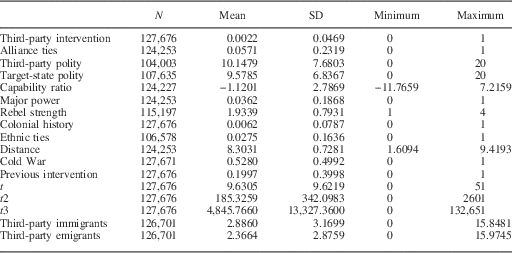
Finally, we control for previous interventions (previous interventions) by other countries in the same civil conflict and include a cubic polynomial of the number of years elapsed since the last military intervention in the case of each dyad (t, t2, t3). On the one hand, the inclusion of the t, t2, and t3 ensures that we explicitly model any temporal dependence in the occurrences of interventions (Carter and Signorino Reference Carter and Signorino2010). On the other hand, previous interventions by other countries pertain to a spatial dependency effect, i.e., not only earlier interventions by the country under study, but also other states may increase the chances for third-party military intervention. Table 1 summarizes the descriptive statistics of the variables discussed.
Descriptive Statistics

Empirical Findings
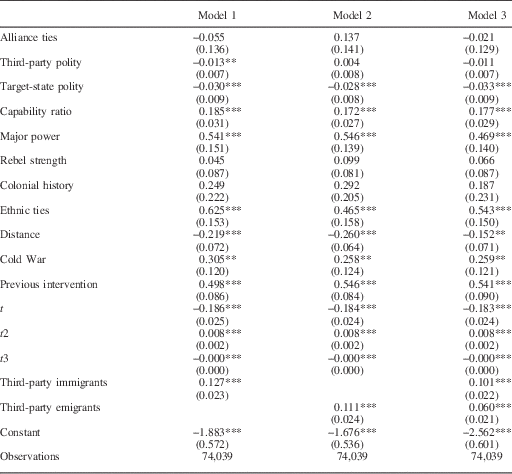
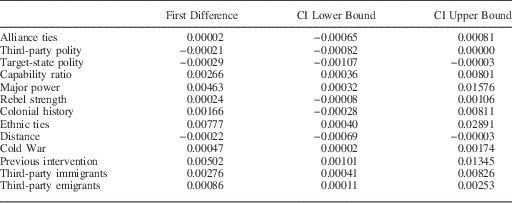
The analyses summarized in Table 2 are based on a sample of all countries in the world, which allows us to draw useful inferences about the decision process of potential interveners and makes our results comparable to previous work by, e.g., Lemke and Regan (Reference Lemke and Regan2004), Koga (Reference Koga2011), Kathman (Reference Kathman2011), and Nome (Reference Nome2013). All estimations are based on probit regressions, and the differences between the models stem from the inclusion of our core variables: while Model 1 focuses on third-party immigrants, Model 2 replaces this item by third-party emigrants; finally, Model 3 includes both migration variables simultaneously.Footnote 12 We also present substantive quantities of interest, i.e., first difference estimates for third-party military intervention=1. To this end, we focus on changes in the probability of military intervention when raising a specific explanatory variable from its mean by 1 SD (holding all other variables constant at their median; dichotomous variables are exceptions to this rule as we simply increase them from 0 to 1) (King, Tomz and Wittenberg Reference King, Tomz and Wittenberg2000). These calculations are based on Model 3 and shown in Table 3.
Third-Party Military Intervention in Civil Wars: Baseline Models

Note: Clustered robust standard errors in parentheses.
*p<0.10, **p<0.05, ***p<0.01.
Third-Party Military Intervention in Civil Wars: First Difference Estimates

Note: Table entries based on Model 3 and multiplied by 100 to facilitate interpretation.
Third and fourth columns pertain to 90 percent confidence intervals (CIs).
Tables 2 and 3 provide strong support for our first hypothesis. Third-party immigrants is positively signed throughout Models 1–3 and statistically significant at the 1 percent level. More substantively, according to Table 3, the probability of a third-party military intervention increases by about 0.003 percentage points when third-party immigrants is raised from its mean value by 1 SD. In absolute terms, this number appears to be small. Recall, however, that external military interventions are rare events (only 0.22 percent of the cases in our sample are coded as 1), which makes the probabilities estimated by any statistical model small by default. In comparison, however, the magnitude of the effect is bigger than the effects of most other features highlighted as important determinants of military intervention, such as geographic distance. In fact, our migration variables are among the strongest-effect variables according to Table 3. Ultimately, we find robust support for our first hypothesis: a larger number of immigrants originating from a civil-war country living in a third-party state increases the likelihood of intervention by this host country.
We also find support for our second hypothesis: a larger number of third-party emigrants living in the civil-war country raises the likelihood of intervention by their home country. Third-party emigrants is positively signed in all models of Table 2 and highly significant. Table 3 reveals the substantive impact: when increasing third-party emigrants from its mean by 1 SD, the probability of third-party military intervention increases by 0.0009 percentage points. Again, the rather low value in absolute terms is driven by the unit of analysis and the rare-events process behind external military interventions. Eventually, it thus seems that states do care about their citizens abroad: empathy and solidarity with fellow citizens, the internationally recognized legitimacy to intervene when citizens abroad are in danger, or public opinion and media pressure are likely to be at work and positively affect the government’s decision to intervene.
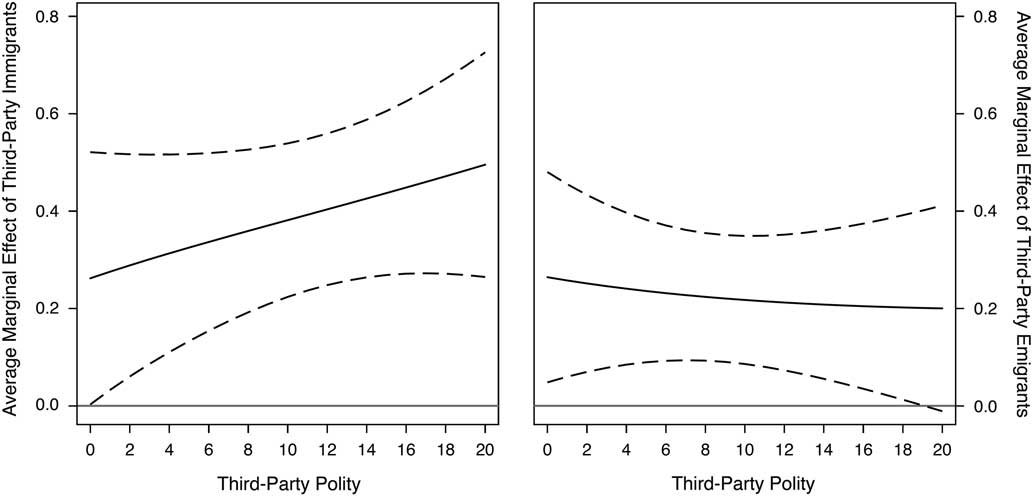
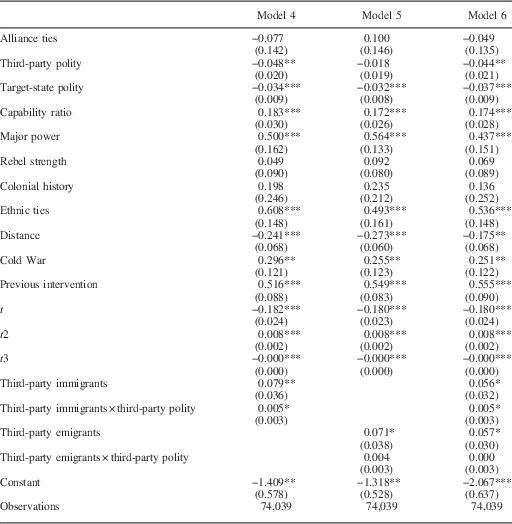
Coming to our third hypothesis, Table 4 seems to point to some evidence for an interactive relationship as some of the multiplicative terms are statistically significant. However, we largely cannot directly interpret the size, signs, and z-statistics of the components of a multiplicative specification, and, hence, present predicted probabilities for third-party immigrants and third-party emigrants, respectively, according to Third-Party Polity. Figure 1 depicts our findings. In general, we only find weak support for our third hypothesis. Specifically, the left panel in Figure 1 indicates that the impact of third-party immigrants on the risk of third-party military intervention increases with higher levels of democracy. This mirrors our argumentation above: it is only when immigrants and their civil society organizations have the opportunity to raise their voice that governments will listen. Generally, this is only given in democratic states (see also Shain and Barth Reference Shain and Barth2003). That said, the right panel in Figure 1 suggests that our argument does not apply to emigrants. The influence of third-party emigrants on the probability of third-party intervention does actually not increase, but remains virtually unchanged with higher levels of democracy. Ultimately, we reject the validity of our third hypothesis for emigrants, but conclude that our reasoning could apply to immigrants living in a potentially intervening state.
Average marginal effects of migrants variables conditional on third-party polity Note: Dashed lines pertain to 90 percent confidence intervals; graphs based on Model 6; marginal effects multiplied by 100 to facilitate interpretation; solid horizontal line marks average marginal effect of 0.

Third-Party Military Intervention in Civil Wars: Interaction Models

Note: Clustered robust standard errors in parentheses.
*p<0.10, **p<0.05, ***p<0.01.
We believe that the insignificant finding for the right panel in Figure 1 can be explained by the simultaneous influence of two opposing mechanisms. Specifically, recall that a set of prominent studies argues that democracies are more likely to avoid military intervention (e.g., Reiter and Stam Reference Reiter and Stam1998; Vasquez Reference Vasquez2005; Gartner Reference Gartner2008). If subscribing to this claim, we would observe a statistically negative average effect in the right panel of Figure 1. Similarly, while developed and democratic countries are likely to receive the greatest number of immigrants, they would have fewer incentives to get militarily involved. Hence, most reckless interveners would be autocratic, less developed states. Though even in this case, one would see more indirect approaches rather than direct military involvement adopted by these actors as in the case of the UAE, Qatar, and Turkey in Syria. Eventually, if both mechanisms are at work, i.e., the one arguing for a positive impact of democracies and the alternative, opposing rationale that democracies are less likely to militarily intervene, we could obtain a statistically insignificant finding—and this is precisely what the right panel in Figure 1 reveals.
Briefly discussing the results of our control covariates, our findings are largely in line with previous studies. Due to space limitations, we focus on the statistically significant variables only. The more democratic the civil-war state, the less likely that outside parties intervene. Third parties might be more reluctant to intervene when a legitimate democratic government is in power; moreover, an intervention on behalf of the government may not be necessary, as democracies are generally more effective militarily (e.g., Reiter and Stam Reference Reiter and Stam1998). Second, the more powerful the potential intervener, the more likely it is that a military intervention does indeed occur. This applies to both absolute and relative (to the conflict state) terms as both major power and Capability Ratio are positively signed and significant. For example, then, when increasing Capability Ratio from its mean value by 1 SD, while holding all other variables constant at their median, we see an increase in the probability of military intervention of about 0.003 percentage points. Third, in line with Koga (Reference Koga2011) or Nome (Reference Nome2013), we find support for the claim that ethnic ties between two states substantially increase the risk of military intervention. Colonial ties do not seem to matter much.Footnote 13 Fourth, the larger the distance between two states, the less likely it is that we observe external interventions. Hence, Distance is the only significant variable of the set of proxies for strategic interests (e.g., Lemke and Regan Reference Lemke and Regan2004). Finally, and not surprisingly, interventions were more likely during the Cold War and their likelihood also increases with previous interventions over the course of a civil war. In the Online Appendix we include and discuss a battery of alternative specifications, including additional models to address issues of reverse causality and omitted variable bias.
Conclusion
This research provides the first quantitative evidence that migrants act as a conduit for foreign military intervention across country pairs. We developed a theoretical framework for understanding migrants’ role in global politics, particularly with regard to their influence in prompting third-party military intervention in civil wars. Our core models and the robustness checks largely provide support for the arguments. Specifically, third parties are substantially more likely to intervene in a civil-war country when they have a larger number of migrants from that country living in their territory. Second, states are also more likely to intervene in civil wars when larger shares of their own citizens live there. We argued for this with several mechanisms including public opinion and media concerns, empathy and solidarity with fellow citizens, the internationally recognized legitimacy to intervene when citizens abroad are in danger, and other political considerations tied to domestic constituency groups. Third, however, there is only weak support for the claim that regime type conditions the effect we argued for in the first two hypotheses.
We hope that this research provides important insights into the mechanisms underlying external military intervention in civil wars, particularly with regard to the role of migrants in this context. Several important avenues for further research might emerge from our work, while it also points to critical implications for practitioners. First, we decided to focus on military interventions only. Other types of third-party engagements, including economic sanctions or mediation, could well be affected by migrants, too. Due to likely different theoretical mechanisms than those we presented here, examining other types of third-party engagement is beyond the scope of this article, but we hope to address this in future work. Second, our data on migrants have certain limitations. For example, we cannot capture why people moved from one country to another in the first place, what monetary resources migrants have, etc. In other words, we need more specific and accurate data on migrants, as this could further add to the literature in new ways. Perhaps more importantly, however, we do not tease out the two competing mechanisms behind Hypothesis 1, i.e., the risk of refugee flows and the political influence exerted by the immigrants. Although in the Online Appendix we introduce a measure capturing the ease of refugees moving from between two countries, we are still unable to convincingly gauge the individual effect of each mechanism, and new data on, e.g., the relative economic and political importance of each migrant community are needed to address this shortcoming.
Finally, regarding the policy implications of our work, this research suggests that migrant networks are influential players in global governance. Hence, not only do we need additional qualitative work that examines our proclaimed mechanisms in more detail, but policymakers should and must be aware of this influence. For instance, given that immigrants do have an impact on their host-state foreign policy, but are usually not allowed to engage with the regular channels of political participation (e.g., voting in elections), our work could point to some problems regarding democratic principles and voter representation. Also, given the pattern that third parties are more likely to militarily intervene in those states that host their citizens, we might be able to better predict the onset of military interventions more generally.