Prenatal hurricane exposure could be an important contributor to poor reproductive health outcomes, as hurricane-related morbidity is anticipated to increase with growing coastal populations as well as hurricane intensity.Reference Adamo and de Sherbinin 1 In the current literature, mixed associations have been suggested between hurricane exposure and reproductive health outcomes.Reference Harville, Xiong and Smith 2 - Reference Harville, Tran and Xiong 6 The biological pathways for potential effects have been hypothesized through injury, psychosocial stress, and disruption of preventative health care.7, Reference Badakhsh, Harville and Banerjee 8
Birth and fetal death rates are often hypothesized to be influenced by disaster events. However, the associations between hurricane exposure and fetal death and birth rates have not been well established, potentially as a result of small, nongeneralizable clinic-based populations.Reference Hamilton, Sutton and Mathews 4 , Reference Harville, Tran and Xiong 6 , Reference Cohan and Cole 9 , Reference Harville, Xiong and Buekens 10 Regarding adverse birth outcomes (eg, fetal death, preterm birth, and birth weight), the current literature addresses primarily Hurricane Katrina and reports mixed and nonsignificant associations.Reference Hamilton, Sutton and Mathews 4 , Reference Harville, Xiong and Buekens 10 These results vary depending on exposure method and geographic area, which may be a result of limitations associated with using an ecological analysis or using a pre-post analysis. Both study types can be problematic regarding controlling confounding in nonhomogeneous areas.
The mixed associations reported in the current literature may be partially due to residual confounding. To expand upon these studies, we assessed the association between hurricane exposure and 3 reproductive health outcomes using a difference-in-difference analysis technique for confounding control on a cohort of Florida pregnancies.
METHODS
Study Population
We used a retrospective cohort of Florida live births and fetal deaths from 2003 and 2004 to perform analyses on the relationship between county-level hurricane exposure with rates of low birth weight, fetal death rates, and birth rates. In the 2004 hurricane season, 4 hurricanes made landfall in Florida, exposing the majority of the 67 counties to hurricane weather conditions. In comparison, in the 2003 season, no hurricanes made landfall. Our source population, from vital records data, included all documented Florida pregnancies that completed a minimum of 20 weeks’ gestation, conceived between January 2003 and October 2004. More detail on the cohort, including exclusion criteria, has been published previously.Reference Grabich, Robinson and Engel 11
Hurricane Exposure
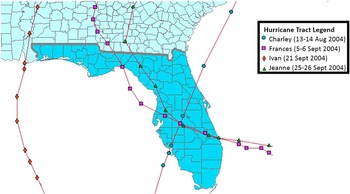
During the 2004 hurricane season, 4 hurricanes made landfall in Florida (Figure 1): Charley (August 13), Frances (September 5), Ivan (September 21), and Jeanne (September 25). Counties were classified with respect to hurricane severity on the basis of 2 binary cutoffs of maximum wind speeds using the Saffir-Simpson Hurricane scale: (1) greater than or equal to 39 mph, indicating tropical storm wind speed, and (2) greater than or equal to 74 mph, indicating hurricane-level wind speed.Reference Grabich, Horney and Konrad 12
2014 Florida Hurricane Track County Map.

Outcomes
Low birth weight infants are live births born after 20 weeks’ completed gestation and less than 2500 g (5.5 pounds). Low birth weight rates were calculated as the number of eligible low birth weight births divided by the total number of births (live births and fetal deaths) multiplied by 100 for each county.
Fetal deaths were defined as deaths prior to complete expulsion or extraction from the mother, excluding induced abortions that showed no evidence of life.Reference Kowaleski 13 Fetal death rates were calculated as the eligible number of fetal deaths divided by the total population of births (live birth plus fetal deaths) times 1000 for each county.
Live births were defined as fetuses who showed any evidence of life following delivery.Reference Kowaleski 13 , Reference Wier, Pearl and Kharrazi 14 Live birth rates were calculated as the number of eligible county live births divided by the total population at midyear times 1000 for each county. Since we did not have an accurate estimate of the total population at the midpoint of our study period, we used the population at the midpoint of 2003 (n=17,074,368) and 2004 (n=17,476,489) for the unexposed and exposed time periods, respectively.
Statistical Methods
We calculated county-level low birth weight, fetal death, and live birth rates for the exposed (2004) and unexposed (2003) time periods. Separate analyses were conducted for exposure to each independent hurricane by using the 2 previously defined exposures and then cumulatively to any hurricane in the exposure period. Results are reported as the difference-in-difference rate with 95% confidence interval (CI). Difference-in-difference is a statistical technique that attempts to mimic experimental research study design for analyses of observational data using 2 or more time points by differencing of the average change in the exposed group minus the change in the unexposed group.Reference Allison 15 -17
The at-risk period for the exposed cohort for the fetal death and low birth weight analysis included women whose dates of conception fell between November 9, 2003, and October 4, 2004. These women would have been at risk of hurricane exposure at some point during pregnancy (42 weeks before the first hurricane through 1 week after the last hurricane). We included October 4, 2004, a week after the last hurricane occurrence, because we know that vital statistics data on gestational age are measured with at least 2 weeks of error. For the difference-in-difference analysis, we compared the exposed cohort to women pregnant during the same calendar dates during the control 2003 hurricane season. For the birth rate analysis, the exposed cohort included women who conceived in the window 3 months after the first hurricane (between August 14, 2004, and October 31, 2004), and the unexposed comparison included women pregnant during the same calendar dates during the control 2003 hurricane season. This time period differed from the fetal death and low birth weight analyses because we assumed the exposure operated through its influence on conception and not the in utero environment.
All analyses were conducted in SAS 9.2 (SAS Institute Inc, Cary, NC). This research was approved by the Florida Department of Health Institutional Review Board (#H13049) and the Institutional Review Board of the University of North Carolina at Chapel Hill (#13-0784).
RESULTS
A total of 382,700 total births were included in the fetal death and low birth weight analyses, including live births from 2003 and 2004 (193,309 and 187,116, respectively) and fetal deaths from 2003 and 2004 (1316 and 959, respectively). A total of 138,005 births were included in the birth rate analyses, including 72,398 live births from 2003 and 65,607 from 2004.
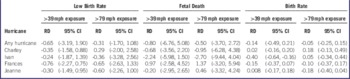
Overall, we found no indications of association between hurricane exposure and low birth weight, fetal death, and live birth rates (Table 1). The direction of associations varied across exposure metrics and hurricanes. In the low birth weight analyses, the estimates of largest magnitude tended to be negative associations, suggesting that the proportion of low birth weight infants could decrease with increasing hurricane exposure. For example, the estimate of largest magnitude was Hurricane Frances >39 mph wind speed (rate difference: -0.76; 95% CI: -2.27, 0.75). In the fetal death analyses, the direction of associations varied greatly across exposure metric and hurricane, and no trends in associations could be determined. In addition to our 67 Florida counties, 15 counties (22%) had fewer than 5 fetal death events in 2004, leading to imprecise estimates as indicated by the wide 95% CIs (eg, >39 mph wind speed and Hurricane Ivan [rate difference: -2.24; 95% CI: -5.98, 1.50]). Similar to the other outcomes, models between hurricane and birth rates were mixed and indicated very few strong associations. Results investigating Hurricanes Charley and Ivan were previously published as an example in our difference-in-difference methods article.Reference Grabich, Robinson and Engel 11 There was some possible evidence of negative associations between Hurricane Ivan >39 mph wind speed and live birth rate (rate difference: -0.40; 95% CI: -0.64,-0.16); however, there was no consistency across hurricanes or wind speed cutoffs.
Difference-in-Difference Rate Difference Analysis of Hurricane Exposure and Low Birth Weight, Fetal Death, and Birth Rate (n=67 counties)Footnote a

a Abbreviations: CI: confidence interval; RD, rate difference.
DISCUSSION
This study sought to estimate the effect of county-level hurricane exposure on reproductive health outcomes by using the difference-in-difference method for confounding control. Overall, we found no associations to suggest that a relationship between hurricane exposure and reproductive health outcomes existed during our study time.
There is, as of yet, no consensus on the impact of hurricane exposure on reproductive health, with associations varying widely across studies.7, Reference Harville, Xiong and Buekens 10 These mixed findings are potentially the result of varied mechanisms of exposure (eg, stress, economics, injury) or exposure definitions, incomparable study populations, incomplete confounding control, and potential heterogeneity of hurricane effects. Only one prior study has investigated the effect of exposure to multiple hurricanes in a single population to address the limitations of finite populations and heterogeneity of hurricane exposure.Reference Currie and Rossin-Slater 18 Other studies investigating hurricane exposure looked at a single storm, often in a pre-post analysis or using clinic-based populations.
The current literature on low birth weight has been conducted primarily on Hurricane Katrina,Reference Xiong, Harville and Mattison 3 , Reference Hamilton, Sutton and Mathews 4 , Reference Harville, Tran and Xiong 6 with one more comprehensive study of Texas hurricanes.Reference Currie and Rossin-Slater 18 Two of the 3 Katrina studies found significant positive associations between hurricane exposure and low birth weight, whereas the larger Texas study found no association. We performed additional supplemental analysis on preterm birth status and saw results similar to those of Currie and Rossin-SlaterReference Currie and Rossin-Slater 18 (results not shown). We believe that the association from the smaller populations using a single hurricane may suggest evidence of uncontrolled residual confounding.
Only 2 US studies have investigated the relationship between hurricane exposure and fetal death. The first study by Janerich et alReference Janerich, Stark and Greenwald 19 looked at 4 New York counties in a pre-post analysis after Hurricane Agnes and found no association. A recent study by Zahran et alReference Zahran, Breunig and Link 20 found a strong association between damage from Hurricane Katrina and proportion of fetal death. We found no evidence for positive associations between hurricane exposure and fetal death; however, the analysis was too underpowered to imply true relationships.
We found very few associations between hurricane exposure and birth rates. Most evidence to support this hypothesis is generated by clinical observations and media reports, suggesting possible publication bias, and the few studies that have been conducted used pre-post analyses and comparisons to surrounding counties after a single storm. Cohan and ColeReference Cohan and Cole 9 investigated birth rates in South Carolina before and after Hurricane Hugo and found that before the hurricane birth rates decreased, whereas after the hurricane birth rates increased in the disaster-declared counties. Hamilton et alReference Hamilton, Sutton and Mathews 4 also investigated county birth rates in the Gulf Coast states following Hurricane Katrina and found mixed results by state.
Our study’s major strengths were the ability to investigate the effects of exposure to multiple hurricanes in a large, diverse population. Some associations in the current literature may be true associations, which differ due to the heterogeneity of individual hurricanes; however, with the use of difference-in-difference techniques for confounding control, statistical evidence of associations between hurricane exposure and reproductive health outcomes were not found. We previously published an article comparing spatial generalized linear models with the difference-in-difference model and demonstrated possible uncontrolled confounding in the relationship between hurricanes and birth rates.Reference Grabich, Robinson and Engel 11 We showed in this article that traditional spatial methods (ie, comparing surrounding counties to exposed counties) indicated associations between hurricane exposure and birth rates but difference-in-difference methods showed little to no associations.
A major limitation of our study was that 3 of the 4 hurricanes crossed through the central part of Florida in rapid succession, thus limiting our ability to understand independent hurricane effects. Vital statistics data will not capture pregnancy loss before 20 weeks gestation and also did not give us the ability to understand evacuation patterns or residence prior to delivery. While we assumed migration in and out of our Florida cohort was equal, we had no way to document births that occurred outside of the state of Florida owing to relocation or evacuation. The aggregate-level exposure estimated exposure based on residence and did not necessarily equate to personal exposure. Each of the 4 storms led to mass evacuation along storm paths that we could not take into account in our measurements.
While the potential impact of hurricane exposure on reproductive health outcomes has been studied, the potential heterogeneity of exposure measures and the case study nature of most research makes comparability across places and events difficult. In a recent review, Zotti et al7 found inconsistent evidence that reproductive outcomes are associated with maternal exposures to natural disasters. In this study, evidence of association was not found, leading to the potential conclusion that exposure to hurricanes does not lead to reproductive health effects, at least on an aggregate level. While more studies should be conducted owing to the mixed evidence in the current literature, individual studies using reproducible exposure methods, such as wind speed, could strengthen our long-term understanding of the effects of hurricanes on health outcomes and improve preparedness for future hurricanes among populations such as pregnant women.