Percutaneous transcatheter closure of patent ductus arteriosus has been well described with the coils and different devices, and is now the standard of care.Reference Masura, Walsh and Thanopoulous 1 – Reference Bilici, Demir, Akin, Ture, Balik and Kuyumcu 7 Once the Amplatzer duct occluder I, which is convenient for the most commonly encountered morphologic types of patent ductus arteriosus, had been developed, and then shown to be safer, more effective, and relatively easier to use in larger ducts than coils, the spectrum of patent ductus arteriosus amenable to transcatheter closure has continued to increase.Reference Atiq, Aslam and Kazmi 2 , Reference Bilkis, Alwi and Hasri 8 – Reference Masura, Tittel, Gavora and Podnar 10 With advances in both device technology and closure techniques increasing with experience, only very small premature infants with large symptomatic ducts, and ducts with unfavourable anatomy or failed device closure, are currently candidates for surgical closure.Reference Moore, Levi, Moore, Schneider and Berdjis 11 , Reference Galal, Hussain and Arfi 12
The number of specifically designed or off-label devices used for patent ductus arteriosus closure has increased significantly in recent years. They range from close copies of the Amplatzer design to devices with different shapes and/or release mechanisms, such as Cera, CeraFlex and Occlutech duct occluders, and off-label vascular plugs for unfavourable anatomy.Reference Celebi, Demir and Saritas 5 – Reference Bilici, Demir, Akin, Ture, Balik and Kuyumcu 7 , Reference Bass and Wilson 13 – Reference Sudhakar, Jose and George 15
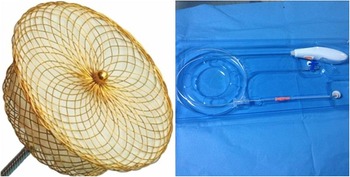
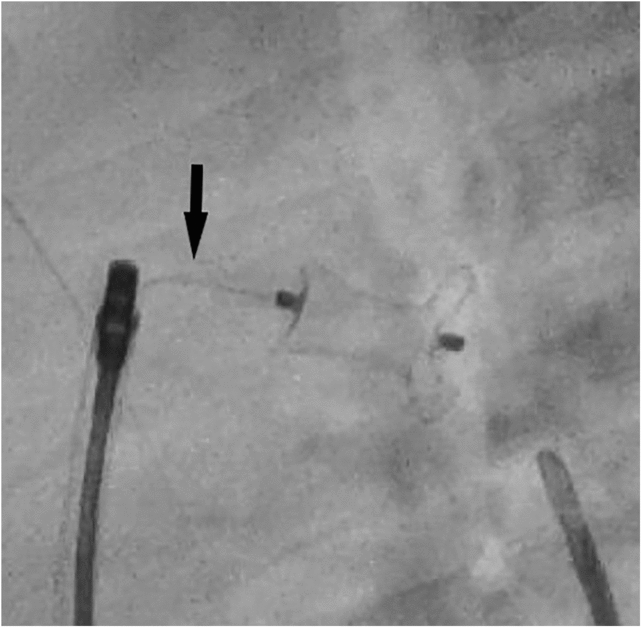
The CeraFlexTM PDA occluder is a relatively new device with similar properties in shape to Amplatzer duct occluder I, except that is plated with titanium nitride bioceramic on all metallic structures. It also has several different characteristics: it comes preassembled, connected to the delivery cable, which is ready to use, has a unique delivery system and lock–release mechanism (Fig 1) and the device is connected to the delivery cable by a loop (Fig 2). The aim of this study is to prospectively evaluate the safety and efficacy of the CeraFlexTM PDA occluder device in patent ductus arteriosus closure, the device behaviour patterns during and just after release, and to present early and intermediate term results.
The CeraflexTM PDA occluder device and delivery system.

The loop made of surgical thread provides the device to become flexible in 360° directions.

Material and methods
The study was performed in three tertiary centres from different regions of Turkey: the Siyami Ersek Hospital for Cardiology and Cardiovascular Surgery (Istanbul), the Van Education and Research Hospital (Van), and Ataturk University Medical Faculty (Erzurum). A total of 21 patients underwent transcatheter closure with a CeraFlexTM PDA occluder between November 2015 and February 2016.
Indications for patent ductus arteriosus closure were similar to those recommended in the guidelines.Reference Moore, Levi, Moore, Schneider and Berdjis 11 , Reference Baruteau, Hascoet and Baruteau 16 – Reference Arora 19 Detailed physical examination, basic blood analysis tests, an electrocardiogram, and echocardiographic examination were performed in all patients prior to the procedure. A pre-procedural echocardiogram was concentrated on the size of the defect, colour, and spectral Doppler characteristics of the shunt through the duct, cardiac chambers, associated lesions, and the haemodynamic importance of the patent ductus arteriosus.
All ducts were haemodynamically important. Exclusion criteria included a weight <5.0 kg, pulmonary vascular resistance >8 Wood U × m2, pulmonary vascular resistance to systemic vascular resistance ratio of >0.5, and associated cardiac anomalies, and unsuitable ductal shapes for transcatheter closure, that require cardiac surgery.
Small ducts without audible continuous murmur were not closed and not included in this study. Informed consent was obtained from the parents of all patients, or from themselves if they were > 18 year old. Cephazolin was given 30 minutes prior to the procedure at a dose of 50 mg/kg. The procedures were performed under deep conscious sedation or general anaesthesia. Both femoral artery and vein were cannulated, and intravenous heparin was administered to keep the activated clotting time level >200 seconds during the procedure.
To reduce conditions that could be related to the operator, the first operator – with personal experience of more than 1000 transcatheter patent ductus arteriosus closures – was the same for all the procedures, and the second operator was a local paediatric cardiology interventionist with personal experience of at least 200 procedures.
Haemodynamic study was performed in all, except those patients with a mean pulmonary artery pressure <25 mmHg. Descending aortic angiograms were made in left lateral (90°) and right anterior oblique (30–40°) projections to show the morphology and size of the duct and to take measurements. We sometimes also advanced the delivery sheath through the duct and repeated the angiographies for final measurements if there was any concern about sizing.
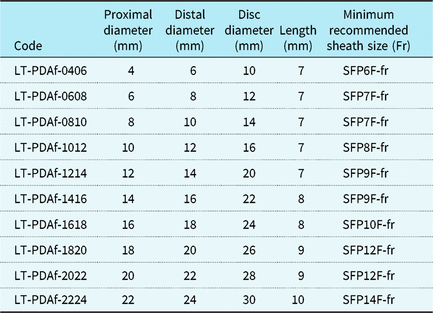
Device size selection was based on the manufacturer’s recommendations that the pulmonic end of the occluder shank be at least 1.5–2.0 mm larger than the narrowest diameter of the duct. The minimum delivery sheath size recommended by the manufacturer was used (Table 1). An angiogram was performed to confirm the device position and evaluate residual shunt before and after releasing the device.
CeraFlexTM PDA occluder device characteristics

A clinical examination and echocardiographic evaluation were performed in all patients the day after the procedure, and 1st and 6th months after the procedure in the follow-up.
Results
A total of 21 patients underwent PDA closure with the intention of using a CeraFlexTM PDA occluder during the study period. The median age of the patients was 1.2 years, ranging from 6 months to 28 years, and median body weight was 9.6 kg, ranging between 5.4 and 82 kg. A total of 11 patients were under a year old, and all were on anti-congestive treatment due to congestive heart failure. All patients had continuous cardiac murmur at the upper left sternal border on physical examination. The 11 patients had pulmonary hypertension (mean pulmonary artery pressure >25 mmHg). All ducts were type A except one type E. The mean narrowest duct diameter at the pulmonary side was 4.1 ± 1.7 mm (range from 2.2 to 8.2 mm, median 3.8 mm). The ampulla diameter was between 7.8 and 25 mm (median 11.7 mm) and the length of the duct was between 6 and 19 mm (median 10.9 mm).
The procedure was successful in all cases. The 06/08 mm device was most commonly used (38.1%, n: 8), followed by 08/10 mm in six (28.5%), 04/06 mm in four (19%), 10/12 mm in two (9.5%), and 12/14 mm in only one (4.7%). Fluoroscopy images during releasing the device were recorded in all. Final angiograms 10 minutes after release showed complete closure in 17/21 (81%) patients. There was no significant pressure gradient between the ascending and descending aorta, either before or after release.
We retrospectively evaluated the patterns of device behaviour during release on cine-records and classified them according to release difficulty and changes in the device position just after releasing. Three different modes were observed.
Mode 1: no difficulty during release and no change in device position, which was exactly the same as before being released (Video 1).
Mode 2: release difficulty requiring small manoeuvres but no change in device position after release (Video 3).
Mode 3: both release difficulty and changes in device position after releasing (Video 3).
Mode 1 was seen in 13 patients (62%); Mode 2 was in 6 (28.5%); and Mode 3 in 2 (9.5%) procedures. Echocardiography achieved complete occlusion for all patients on the next day.
Transient loss of the femoral pulse was seen in one patient (4.7%) as a minor complication. Device embolisation to the descending aorta in one patient (4.7%) was the only major complication. In this patient with Down syndrome the PDA was closed with a 04/06 mm device, and the device embolised to the descending aorta after persistent coughing 24 hours later. The device was snared via a femoral vein approach and re-closure performed with a 06/08 mm Amplatzer duct occluder, because that size CeraFlexTM device was not available from the local distributor at that time.
We did not observe atrioventricular block or any other rhythm abnormalities during passage of the delivery sheath from RVOT to PDA and through descending aorta in any patient.
During more than 2 years of follow-up, none of the patients showed residual shunt or evidence of stenosis at the main or branch pulmonary artery, or at the descending aorta, by echocardiography. No clinical or echocardiographic features of pulmonary hypertension were observed in patients with pre-procedural pulmonary hypertension during the follow-up period.
Discussion
The CeraFlexTM PDA occluder is a recently designed device that has been used for a couple of years. The device is made of knitted nitinol wire mesh, similar to the Amplatzer duct occluder, except that all metallic structures are plated with titanium nitride bioceramic coating which tends to prevent nickel leaching, accelerate endothelisation, and close defects rapidly. A polytetrafluoroethylene membrane is sewn into the device to decrease residual shunt. The device comes preassembled with the delivery cable, with a loop connection through the holes and ready to load via the loader on the delivery cable. The loop is made of surgical thread that allows the device to become flexible in 360° directions and fit the ductal shape before release. The device also has a unique lock–release mechanism consisting of a plastic handle, which differentiates it from the Amplatzer duct occluder device. The device has 10 different size options, with a proximal diameter ranging from 4 to 22 mm and a distal diameter 2 mm larger than the proximal end. The device size is defined by the first two digits, giving the pulmonic side, and the last two digits, giving the aortic side of the device in millimetres. Recommended delivery sheath sizes are at least 6Fr for the smallest device, which is the 04/06 mm device, increasing to 14 Fr for the biggest device, which is 22/24 mm. Lengths vary from 7 to 10 mm, increasing with the device diameter (Table 1).
Changing of the device position or the device jumping towards the descending aorta and protrusion of the aortic disc to the descending aorta may cause iatrogenic coarctation as a potential complication of the procedure, in especially small infants with small descending aorta and short ampulla.Reference Liddy, Oslizlok and Walsh 20 – Reference Backes, Kennedy and Locke 22 The rigid delivery system of the Amplatzer duct occluder devices, which is screwed for the deployment, causes tension/retraction on the device before releasing and the device may move to the aortic side to various degrees after release.Reference Santoro, Giordano and Gaio 23 The incidence of device protrusion into the aorta has been reported to be between 1.5 and 16%, in the literature.Reference Liddy, Oslizlok and Walsh 20 , Reference Saliba, El-rassi and Helou 21 , Reference Backes, Rivera and Bridge 24 , Reference Masri, El Rassi, Arabi, Tabbakh and Bitar 25 Additionally, to our experience, sometimes it may not be able to decide whether the device is on its final position before releasing. The innovative delivery system and loop connection of the CeraFlexTM PDA occluder device to the delivery cable are reported by the manufacturer as giving the advantage of reaching the device’s final position before release. In our study, the device position did not change after release in 19 patients (90.4%) confirming this suggestion. In two patients (9.6%) with changes in device position, there was no significant pressure gradient between the ascending and descending aorta, supporting iatrogenic coarctation, and also no main pulmonary artery or left pulmonary artery gradient indicating main or branch pulmonary artery stenosis.
The unique lock–release mechanism is said to be easy and safe; however, we experienced release difficulties that required small manoeuvres in eight patients (38%), and the device position also changed in two patients (9.5%), but these procedures were all completed successfully.
Device embolisation is a potential complication of transcatheter patent ductus arteriosus occlusion procedures. The mechanism of embolisation may be due to a number of factors. Incorrect device selection, as well as the inappropriate placement of the device, may play a role.
There are many reports of the embolisation of various devices in the literature but the only report about the embolisation of the CeraFlexTM PDA occluder that we could find in the literature was in the study of Buys et al.Reference Buys, Greig and Brown 26 They reported their experience with the CeraFlexTM PDA occluder in 12 patients and CeraTM occluder in 4. They used a 04/06 mm device in seven patients (58.4%), 08/10 mm in three (25%), and 06/08 mm in two (16.6%) in the CeraFlexTM occluder group. They experienced device embolisation in two patients overall (12.5%), one immediately after releasing, and one 12 hours after the procedure. The brand of embolised device used (Cera or CeraFlex) was not mentioned in the study, except that both were 04/06 mm device. They were able to snare the device and reposition the same device in both patients. They speculated that smaller device sizes have higher risks of embolisation. In comparison, our patients had larger ducts so larger devices were used, with a 06/08 mm and larger, up to 12/14 mm device, used for 81% of the patients, whereas a 04/06 mm device was used in only 19% of all patients. The embolised device in our study was also 04/06 mm. Our lower embolisation rate (about 1/3 of Buys et al study) is probably due to the experienced operators in the study and perhaps also to the greater use of larger devices in our study, supporting speculations about the relationship between device size and embolisation rate. Release difficulty and positional change of the device may also be associated with embolisation, but as the number of patients was only two in this mode, more studies with larger case series are required to make more accurate comments about the relationship between device embolisation and Mode 3. Two procedures in our study were described as Mode 3 and device embolisation occurred in one (50%), and no device embolisation occurred in Mode 1 or 2, so changes in the device position after release may offer a clue regarding the risk of embolisation. This issue will be investigated in further studies.
Study limitations
This study was limited by the relatively small number of patients and lack of a control group. Additionally, almost all of the patients had a morphological type A duct, with only one having type E, so this situation is limited for evaluating the efficacy of the CeraFlexTM PDA occluder device in other types of patent ductus arteriosus. Another limitation of this study is that ADO and Ceraflex devices are not compared.
Conclusions
Our study showed that the CeraFlexTM PDA occluder is a safe and efficacious device for the closure of moderate to large ducts in children, adolescents, and adults with type A duct. Its uniquely designed delivery system has the advantage of reducing the tension applied to the device, which provides a stable position and an unchanging device position during and immediately after release. This unique feature may provide an opportunity to be sure that the device is unlikely to protrude into the aorta after release. The device can be easily snared if embolised. The advantages of the device are its unique delivery system and lock–release mechanism, and bigger and longer device options compared to the Amplatzer duct occluder I. The major disadvantage of this device is that it requires larger long sheaths, which are not good for infants. Another disadvantage is that it requires the placement of two sheaths, which is sometimes unnecessary with alternative techniques and devices, such as the deployment of vascular plugs in the ductal position. Further studies with larger series, different types of ducts, and long-term follow-up results are needed.
Supplementary material
To view supplementary material for this article, please visit https://doi.org/10.1017/S1047951119000349.
Author ORCIDs
Serdar Epçaçan 0000-0002-0189-0063