I. INTRODUCTION
State-owned enterprises (‘SOEs’) present a challenge for the international economic legal order. In December 2016, an OECD report called for governments to ‘identify and remedy gaps in the coverage of multilateral rules regarding trade-distorting government and enterprise behaviour’.Footnote 1 At the 11th WTO Ministerial Conference in December 2017, the US, the EU and Japan expressed serious concerns about the impacts of the activities of SOEs on ‘the proper functioning of international trade’ and called for new rules to ensure a global level playing field.Footnote 2
While State sectors remain significant in many countries,Footnote 3 China has been at the centre of academic and policy debate given its growing influence on the global economy and the size and complexities of its State sector. Many of the contemporary challenges in international trade regulation are reflected in China's State capitalism. These include, for example, the EU's amendments of anti-dumping regulation to specifically address market distortions caused by State intervention,Footnote 4 the US's refusal to recognise China as a market economy,Footnote 5 and the escalating US–China trade conflicts and tit-for-tat protectionist moves through retaliatory tariffs.Footnote 6
In these debates, the key question is whether the existing WTO rules are adequate to address the effects of the Chinese government's intervention in the domestic market on trade and competition. In a speech on US trade policy priorities, US Trade Representative Robert Lighthizer called China's State capitalism ‘[an unprecedented] threat to the world trading system’ and criticised the inadequacies of the WTO rules for ensuring ‘that a market-based economy prevails’.Footnote 7 This view was repeated by US Ambassador to the WTO Dennis Shea, who argued at the General Council meeting on 26 July 2018 that ‘change is necessary if the WTO is to remain relevant to the international trading system’, but ‘the WTO itself does not currently provide the tools needed to bring about that change’.Footnote 8 This view is becoming increasingly popular in the international trade community, which not only regards the current set of multilateral rules as insufficient for dealing with China but also deems this a systemic failure of the WTO.Footnote 9
Are WTO rules indeed premised on market economy principles? Does WTO membership really presume the existence of a market economy? These are important questions concerning both the letter and spirit of WTO rules but are beyond the scope of this article, which argues that, while not entirely agreeing with these propositions, certain WTO rules are more aligned with market economy principles than others and, if used well, could help ‘build’ a market economy, to paraphrase the critics.
Against this background, this article provides fresh insights into the current debate by exploring the challenges that China's SOE reform may pose to the world trading system and how the WTO rules could be utilised to overcome these challenges. Section II provides a detailed review of China's current SOE reform, which commenced in 2013. It argues that the reform seems to have been designed (and implemented) to create national champions and to ensure that the market-based transformation of SOEs does not undermine the effectiveness of governmental control. While market liberalisation and market-oriented economic reforms continue to progress in China, the resurrection of State capitalism also presents new challenges for the multilateral trading system.
Section III discusses the limitations of using GATT/WTOFootnote 10 rules to tackle the various issues relating to SOEs in the context of China's current SOE reform. Being cognisant of the limitations of the market economy hypothesis, it is argued that the WTO does not provide a comprehensive code of conduct to govern anti-competitive behaviour of SOEs or even enterprises in general,Footnote 11 but only restrains Member governments from using certain policy instruments to undermine the expected conditions of competition. Through an analysis of the GATT rules on (1) honouring tariff concessions by import monopolies, (2) non-discrimination requirements for State trading enterprises (‘STEs’), (3) trade restrictions by STEs, (4) transparency, and (5) anti-dumping measures, it is argued that the first three rules are limited in terms of the types of policy instruments and the scope of obligations. Furthermore, transparency mechanisms have been ineffective to ensure adequate notifications by WTO Members in general and in inducing China to provide sufficient information about SOEs. Finally, the WTO jurisprudence has developed in a way that gradually removes flexibility in using anti-dumping to address market distortions caused by State intervention.
Recognising the limitations of general WTO rules, WTO Members have negotiated China-specific rules to tackle China's State capitalism. These are discussed in Section IV, which explores China's WTO-plus obligations concerning subsidies, pricing, and the commercial behaviour of SOEs. It is argued that WTO rules on subsidies and countervailing measures, coupled with these China-specific commitments, have already provided sufficient tools for Members to use when dealing with China. Therefore, instead of trying to negotiate new rules, WTO Members should make more active use of the existing provisions.
II. CHINA'S CURRENT SOE REFORM
SOE reform was one of the central elements of China's landmark economic reforms launched in 1978–1979.Footnote 12 Prior to the commencement of the current round of reform, which began in 2013, previous phases had achieved much, including the devolution of corporate power through increasing operational autonomy (1978–1986)Footnote 13 and managerial authority (1987–1992),Footnote 14 privatisation, corporatisation and modernisation (1993–2002),Footnote 15 and finally, with the establishment of the State-owned Assets Supervision and Administration Commission (‘SASAC’) in March 2003, a significant shift towards the preservation and expansion of State assets and the creation of ‘national champions’ of large SOEs, especially in strategic sectors.Footnote 16
Before the launch of the current reforms, in many sectors, the number of SOEs and of their employees had shrunk, as had their market share.Footnote 17 However, they had also become even more significant and influential in the economy. For example, in 2013, the 110 central SOEs (under the supervision of the SASAC) held 38,423 subsidiaries (compared with 16,290 subsidiaries in 2005) and controlled State assets worth a total of RMB 9.3 trillion (compared to RMB 3.7 trillion in 2005).Footnote 18 The efforts to create ‘national champions’ had remarkable results, with 85 mainland Chinese companies (the majority of which were SOEs) included in the Fortune Global 500 list of the world's largest corporations in 2013, whereas there had been only six in 2003.Footnote 19 Notably, all of the 11 Chinese companies in the top 100 list in 2013 were central SOEs. The assignment of multiple roles to the SASAC and its local branches further enhanced the role of government in the management and operation of SOEs and hence increased the likelihood of government intervention in their business activities.Footnote 20 In addition, the Communist Party of China (‘CPC’ or ‘Party’) played an important role in SASAC-controlled entities, maintaining a high level of influence over their operations.Footnote 21 These issues provoked robust debates, both internationally and domestically, over the need to push forward SOE reform and how to do so.Footnote 22
The current phase of SOE reform was launched by the Third Plenum of the 18th Party Congress in November 2013, which adopted the Decision on Matters on Comprehensively Deepening Reform.Footnote 23 The Decision sought further comprehensive economic reforms, focusing on enabling the market to play a decisive role in the allocation of resources and managing government intervention in a way that enhances fair competition. It reiterated the significance of pursuing a ‘modern enterprise system’ through the further severing of regulatory and business functions, improving corporate management and governance, and exposing SOEs to market competition. The Decision contemplated several important initiatives, including the classification of SOEs, the creation of State asset management entities, and the introduction of private ownership to industries or projects that were previously reserved for SOEs. At the same time, however, the Decision envisaged that the economic reforms would be carried out under the Party's leadership, which would be strengthened and improved. To implement the Decision, the Central Committee of the Party and the State Council jointly issued the Guiding Opinions on Deepening the Reform of State-Owned Enterprises Footnote 24 (‘Guiding Opinions’) in August 2015, which was followed by over 110 implementing regulatory instruments at the central level and over 830 at the local level.Footnote 25 Since the implementation of the reforms only started after the release of the Guiding Opinions, their current impact and future prospects are far from clear. The numerous policy documents served to complicate rather than clarify the reform process, and implementation has been fragmented due to their inconsistent interpretation both within government and by other responsible authorities. Overall, the reform seems to have been conducted in a way that ensures that the market-based transformation of SOEs creates more powerful and competitive SOEs while not undermining effective governmental control. It therefore seems that the current reform is more likely to become an extension of the previous round, which concentrated on the protection of State assets and the creation of national champions, than to pursue fundamental change.
A. Classification of SOEs
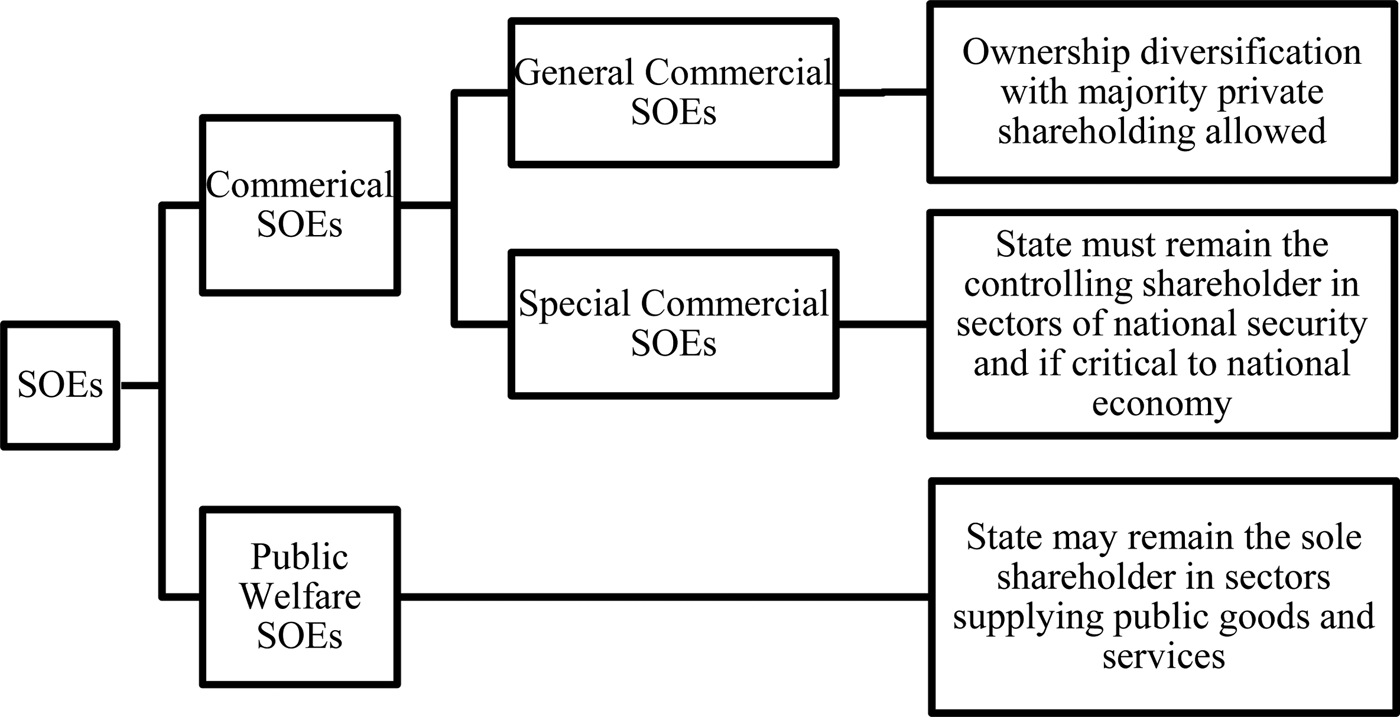
The first element of the current reform concerns the classification of SOEs into ‘Commercial SOEs’ and ‘Public Welfare SOEs’.Footnote 26 This classification is aimed at further integrating SOEs into market-based economic reforms and promoting both their commercial and social functions. In general, Commercial SOEs are expected to operate independently in the market and continue to pursue corporatisation and ownership diversification with majority private shareholding allowed (‘General Commercial SOEs’). Their performance is evaluated against three key criteria, including general financial indicators (eg revenue and profits), returns on State asset investment, and market competitiveness. A subcategory of Commercial SOEs are those whose core business falls within industries or fields related to national security and essential to the national economy or those which undertake projects or tasks designated by the State (‘Special Commercial SOEs’). While these SOEs are also open to private capital and mixed ownership, the State must remain the controlling shareholder. In addition to the performance criteria applicable to General Commercial SOEs, Special Commercial SOEs are also required to contribute to the implementation of national strategies, the protection of national security, and the development of strategic industries. Public Welfare SOEs, which exercise a social function and provide public goods and services, can decide themselves whether to remain wholly State-owned or diversify ownership. The performance criteria for such SOEs concern their capacity to make social contributions, such as cost control, quality of services, and efficiency. The classifications of SOEs are summarised in Diagram 1 below.
SOE Classifications

General Commercial SOEs are most likely to operate as privately owned enterprises (‘POEs’). In contrast, Special Commercial SOEs and Public Welfare SOEs largely remain under the control of the State and are likely to be shielded from market competition. In practice, the process of classification has been implemented by the SASAC and its local branches. Due to the large number of local SASAC departments,Footnote 27 the reform has had mixed results, with uncertain and fragmented classifications.Footnote 28 For instance, Shanghai SASAC, Chongqing SASAC, and Shanxi SASAC have classified their SOEs into three groups, namely, competitive, functional, and public service.Footnote 29 In contrast, Sichuan SASAC has defined all of its SOEs as commercial SOEs.Footnote 30 These inconsistent practices suggest that the categorisation of SOEs, by itself, may not provide clear guidance on whether an SOE is more market-oriented, policy-oriented or whether it operates and competes according to market forces. Therefore, it is necessary to consider other elements of the reform or other features of SOEs when assessing their function and conduct.
B. Corporate Governance
The second element focuses on furthering the corporatisation and modernisation of SOEs.Footnote 31 The reform seeks to promote the restructuring of SOEs and group companies for public listing, ownership diversification, and regulation of shareholders’ conduct, as well as to enhance the decision-making role of boards of directors and the autonomy of management. Accordingly, this element can be further broken down into three key components: corporate governance (which is discussed below), mixed ownership (which is discussed in subsection C), and restructuring and reorganisation (which is discussed in subsection D).
The implementation regulation for corporate governance reform, released in April 2017, set the deadline for the corporatisation of central SOEs by the end of 2017.Footnote 32 This regulation required clarification of the rights and responsibilities of all organs and individuals central to the corporate governance system of SOEs, including shareholders, boards of directors, management, boards of supervisors, the Party, and employee representatives (Section 2). According to the OECD, over 80 per cent of central SOEs have finalised the process of establishing a board of directors, although ‘this is mainly happening at the lowest tiers of enterprise groups, not at the group level’.Footnote 33 However, there is limited information on their progress in the other elements of corporatisation. Most significant is the uncertainty relating to how government intervention in business decision-making can be effectively managed or avoided. Despite the broad coverage of the reform, the Guiding Opinions stress that the Party will play a leadership role in SOEs through a representative committee created within enterprises (‘Party Committee’).Footnote 34 The constitutions of SOEs will specify the functions of the Party Committee and the processes by which senior committee members will undertake executive roles in the firm and firm executives will undertake senior committee positions. In principle, the Party secretary of the committee will also serve as the chairman of the board. In the past, the involvement of the Party in the corporate governance of SOEs was typically linked to the appointment of senior executives, a practice that generated concerns about State intervention in SOE management and decision-making. As Lin observed,
[i]n 53 central enterprises, the occupants of top positions, including the board chairman, CEOs, and party secretaries, are appointed and evaluated by the Central Organization Department of the Chinese Communist Party. This appointment practice predates the establishment of SASAC and persists until today.Footnote 35
Under the current reform, the role of the Party is enhanced through explicit power to directly participate in the decision-making of the board beyond personnel appointments.Footnote 36 In practice, the implementation of the Guiding Opinions has led SOEs to amend their articles of association. By 2017, all 98 central SOEs had incorporated provisions on Party Committees into their articles of association,Footnote 37 and over 30 HK-listed SOEs had established Party Committees through amendments to their articles of association.Footnote 38 For example, the amended Articles of Association for Datang International Power Generation Co., Ltd, a HK-listed central SOE, includes the following clauses:
Article 10 In accordance with the requirements of the Constitution of the Communist Party of China, an organization of the Communist Party of China shall be established and play the core leadership role, functioning as the political core of the Company, providing direction, managing the overall situation and ensuring implementation…
Article 139 (Item 20) The opinions of the Party Committee shall be heard before the board of directors decides on material issues of the Company.Footnote 39
Such clauses leave considerable room and flexibility for the Party to exert influence over the boards of directors, thereby creating clear tension between the pursuit of corporatisation and modern corporate governance. Thus, despite the classifications of SOEs, it remains possible that the commercial decisions of all types of SOEs will be affected by the Party. This possibility tends to be higher in Special Commercial SOEs and Public Welfare SOEs than in General Commercial SOEs, which are expected to optimise their commercial performance and competitiveness.
C. Ownership Diversification
The second component of corporatisation and modernisation is ownership diversification.Footnote 40 On the one hand, ownership diversification allows the injection of private capital in SOEs in various ways and the involvement of private investors in the restructuring and management of SOEs; it also provides full protection of the property rights and interests of all shareholders. In sensitive sectors such as oil, natural gas, electricity, railway, telecommunications, resources, and public utilities, non-State capital is only allowed limited access to investment upon completing security reviews in accordance with relevant laws and regulations. In theory, the introduction of non-State interests to SOEs should contribute to the corporate governance reform, as it would introduce additional checks and balances and improve transparency in their decision-making.Footnote 41 In practice, the reform has led to the sale of either a majority (ie, General Commercial SOEs) or minority interest (eg Special Commercial SOEs) in SOEs to private investors. A typical example of the former is the diversification of ownership in Yunnan Baiyao Holdings, a provincial SOE that was initially 100 per cent owned by Yunnan SASAC. The State interest was diluted to 50 per cent with the injection of private capital by New Huadu Industrial Group in 2016, and then to 45 per cent with the introduction of another private investor, Yuyue Technology Development Co, Ltd, in 2017.Footnote 42
With respect to Special Commercial SOEs, the mixed ownership reform is restricted to a list of industries specified in the Opinions of the State Council on the Development of Mixed Ownership Economy by State-Owned Enterprises Footnote 43 (‘Mixed Ownership Reform Opinions’). These industries include, for example, important communications infrastructure, water supply and conservation, oil and gas, power, forest and strategic mineral resources, and key public technology. In these industries, the participation of private capital is limited to certain activities, while the State retains the role of sole or controlling shareholder. Thus, the State will own or effectively control the SOEs in those sectors. The mixed ownership reform of China United Network Communications Group Co., Ltd. (‘China Unicom’), a central SOE, offers a good illustration of how the reform of Special Commercial SOEs may proceed. As one of six candidates selected for a pilot mixed ownership reform in 2016,Footnote 44 China Unicom reduced its shareholdings in China United Network Communications Co., Ltd.—a Shanghai-listed subsidiary company—from 62.74 per cent to 36.67 per cent in 2017.Footnote 45 The other major shareholders included State-owned China Life Insurance Company (10.22 per cent) and China Structural Reform Fund Co., Ltd. (6.11 per cent) and the private investors Tencent (5.18 per cent), Baidu (3.30 per cent), JD.com (2.36 per cent), Alibaba (2.04 per cent), Suning Commerce Group (1.88 per cent), Kuang-Chi Group (1.88 per cent), and Shenzhen Huaihai Ark Information Fund (1.88 per cent). Thus, the reform maintained the majority State ownership (ie 53 per cent) in the subsidiary SOE to maintain the State's control over the entity.
As far as Public Welfare SOEs are concerned, the Mixed Ownership Reform Opinions largely reproduces the relevant section of the Guiding Opinions and merely adds several examples of industries and fields supplying public goods and services. These industries include utilities (ie, water, electricity, natural gas, heat), public transportation and infrastructure. In these sectors, ownership diversification is to be guided according to the condition of the SOE.
The other important aspect of the mixed ownership reform pertains to the encouragement of State capital investment in POEs with a focus on public services, advanced technology, ecological and environmental protection, and other strategic industries. Article 4(13) of the Mixed Ownership Reform Opinions further clarifies that State-owned capital investment and operating companies (which are discussed in subsection E below) should play a major role in such investment. While it remains to be seen how the reform will proceed on this front, there is potential for the State to influence the private sector. As Naughton has observed, the reform ‘may actually encourage the extension of SOEs into competitive markets where they do not currently have a presence … [by] encouraging State capital to expand its investment in, and control of, private firms’.Footnote 46
D. Restructuring and Reorganisation
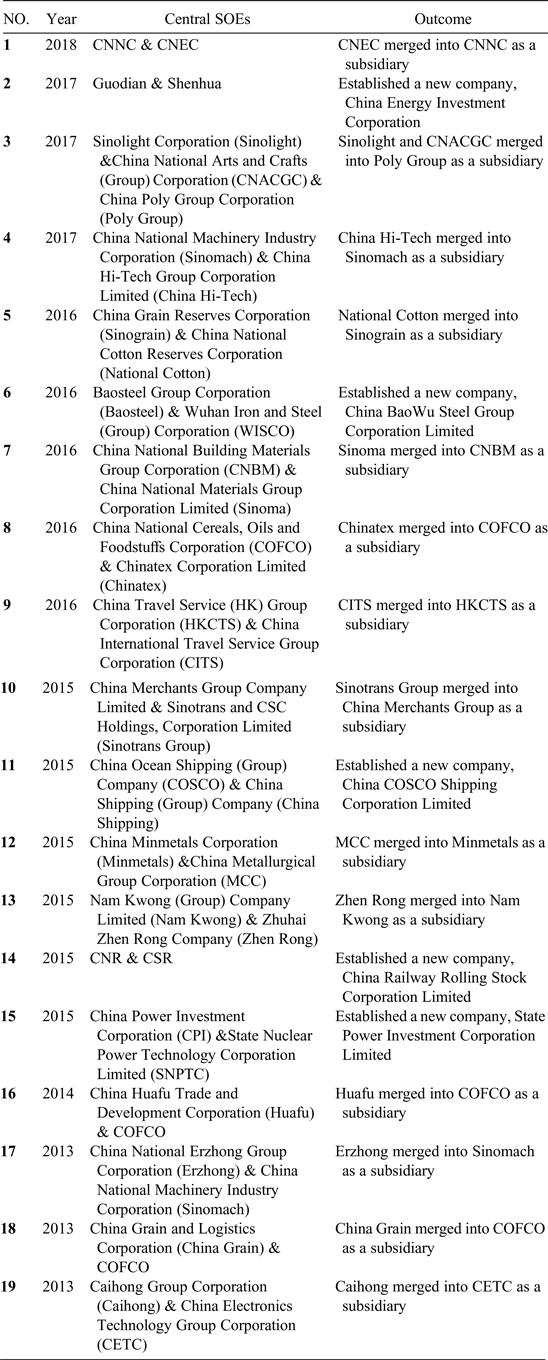
The third component of corporatisation and modernisation involves the restructuring and reorganisation of SOEs. The Guiding Opinions on Promoting the Restructuring and Reorganisation of Central SOEs Footnote 47 (‘Restructuring Opinions’), released by the State Council in 2016, set out three key objectives of the reform. The first is to enhance central SOEs’ capability to protect and stabilise sectors of national security, their control in sectors of critical importance to the national economy, and their influence and leadership in strategic and priority sectors such as high-end equipment manufacturing, information technology, biotechnology, aviation and aerospace, new energy, new materials, energy conservation and environmental protection. The strategic and priority sectors are consistent with those identified in China's overarching guiding policies such as the 12th Five Year Plan (2010–2015), the Made in China 2025 Action Plan, and the 13th Five Year Plan (2016–2020).Footnote 48 The second goal is to improve the efficiency and allocation of resources through mergers and acquisitions, institutional innovation and cooperation, the reduction of overcapacity, and the disposal of inefficient and non-performing assets. The third is to boost the growth and internationalisation of the central SOEs. Overall, the reform is expected to establish a group of world-class multinational companies with innovative capacity and international competitiveness by 2020. Between January 2013 and 31 January 2018, 37 central SOEs were restructured through 19 horizontal or vertical mergers, as summarised in Table 1 below. Typical examples of horizontal mergers include the mergers of two rival companies in selected industries, such as the railway equipment industry (ie, the two largest railway equipment groups—China CNR Corporation Limited (‘CNR’) and CSR Corporation Limited (‘CSR’)) in 2015, the shipping industry (ie, the two largest shipping groups—China Ocean Shipping (Group) Company and China Shipping Group) in 2016, and the nuclear energy industry (ie, China Nuclear Engineering and Construction Corp. (‘CNEC’) and China National Nuclear Corp. (‘CNNC’)) in 2018. This last merger reduced the number of central SOEs to 97 and created ‘a new nuclear powerhouse with assets worth more than 600 billion yuan ($95.4 billion)’.Footnote 49 With respect to vertical mergers, one remarkable example is the merger between electricity producer China Guodian Corporation (‘Guodian’) and coal producer Shenhua Group Corporation Limited (‘Shenhua’) in 2017 to create ‘the world's largest power company by capacity, with combined assets of 1.8 trillion yuan’.Footnote 50 While the restructuring of SOEs has also been carried out at the local level, to date, the reform seems to have prioritised the mergers of central SOEs.Footnote 51 Overall, the restructuring and reorganisation of SOEs, at least at the central level, has clearly advanced the efforts of the previous round of reform to create ‘national champions’ in strategic industries.Footnote 52 As the reform continues to proceed in that direction, the tension between the growing concentration and influence of SOEs in pillar industries and the market-oriented reform of SOEs will intensify.
List of Central SOE Mergers between January 2013 and January 2018Footnote 53

E. State Asset Management System
The fifth and final element concerns improvement of the State-owned asset management system.Footnote 54 This reform aims to transform the functions of State assets regulatory bodies (ie, SASAC and its local branches) by shifting the focus of the supervision from enterprise to capital, defining the boundaries of the supervision, and clarifying their rights and responsibilities. The reform has resulted in the creation of two types of companies, namely, State Capital Investment Companies (‘SCICs’) and State Capital Operation Companies (‘SCOCs’), or, collectively, State Capital Investment and Operation Companies (‘SCIOs’). These companies specialise in the management of State assets and operate under the authority granted by the SASAC or its local branches. While the management of State assets will be guided by the market, it is also required to serve national strategies, industrial policies, and the capital needs of the most competitive SOEs. Thus, SCIOs are essentially subordinates of central or local SASACs and are expected to support national or provincial industrial policy and the development of strategic and emerging industries.Footnote 55 By the end of 2017, there were 89 SCIOs established at the central and local levels.Footnote 56
The differences between SCICs and SCOCs are not clearly defined in the existing regulatory documents. However, practice suggests that they may serve different functions. For example, China Chengtong Holdings Group Ltd. (‘Chengtong’), a SCOC created in 2016, initiated the China Structural Reform Fund to participate in the reorganisation of SOEs,Footnote 57 including the mixed ownership reform of China United Network Communications Limited as discussed above. By contrast, the China Reform Holdings Corp., a SCIC established around the same time as Chengtong, partnered with two banks and one investment fund to inject RMB200 billion into innovative technology and industrial upgrading projects.Footnote 58 Accordingly, future reform may witness a division of labour between SCOCs and SCICs, with the former focusing on the restructuring of SOEs and the latter on investment in priority industries.Footnote 59 More significant than the possible functional differences between SCOCs and SCICs is the common purpose that SCIOs serve and their far-reaching impacts on the SOE reform. As indicated in Table 1 above, SCIOs are established through mergers between large SOEs to create a massive fund to finance the reorganisation of SOEs or investment in strategic industries. These reforms will considerably strengthen and expand the influence of SOEs or the State in targeted industries and will increase concerns about China's State capitalism.
F. China's State Capitalism as a Challenge to the World Trading System
In essence, ‘state capitalism’ concerns the magnitude of government involvement in business activities based on ‘state ownership stake in or significant influence over’ the business sector.Footnote 60 While State capitalism takes different forms in different economies,Footnote 61 a common feature pertains to the extensive role that SOEs have been playing in consolidating and expanding State capitalism.
China's current SOE reform has been dedicated to bolstering the State sector and reinforcing the role of the State and Party in pursuing various policy objectives. Accordingly, the reform is heading in a direction that strengthens rather than weakens State capitalism. By 2017, the number of mainland Chinese companies on the Fortune Global 500 list of the world's largest corporations had increased to 109 (from 85 in 2013), including 48 central SOEs and 18 local SOEs.Footnote 62 The restructuring of central SOEs has increased the power of some of the world's largest companies. For example, China BaoWu Steel Group Corporation Limited, the new company created through the merger of Baosteel and WISCO in September 2016, was ranked 204th in 2017, up from Baosteel's ranking of 275th in 2016.Footnote 63 Similarly, Minmetals’ ranking rose from 323rd in 2016 to 120th in 2017 after the reorganisation with MCC in December 2015. In short, despite the rapid growth of the private sector and progressive liberalisation in China, SOEs will remain one of the principal mechanisms of Chinese State capitalism for the foreseeable future.Footnote 64
The control of SOEs by the State/Party is not necessarily problematic, at least not under the rules of the WTO, as we argue below. However, combined with other factors, such control could and often does result in anti-competitive effects. As noted by a recent OECD report, the main concern is that SOEs ‘may not behave like private firms’ and ‘decisions may not be driven by business objectives and the underlying creation of economic value’ but ‘by political or public policy goals’.Footnote 65 The report identifies a range of unfair competitive advantages given to SOEs, ranging from subsidies and preferential financing to privileged access to information, regulatory advantages, protected monopolistic positions, and other forms of government support.Footnote 66 These problems are further exacerbated by China's unique economic model, which treats SOEs as the primary economic agents of the State and the main instrument for implementing industrial and other national policies.Footnote 67 Frequently, large SOEs that are already market leaders individually are merged by the State to create behemoth national champions in disregard of antitrust concerns.Footnote 68 While such mergers are often motivated by national pride rather than the desire for market dominance, other firms in the same sectors often become collateral damage in such ambitious campaigns. In addition to squeezing competitors out of the relevant Chinese market, SOEs have also been used as a vehicle to restrict market access to China by foreign competitorsFootnote 69 and expand China's presence in foreign markets through aggressive bids and other means, often with the financial backing of the Chinese government.Footnote 70 Moreover, State/Party controls not only create such anti-competitive effects but also tend to sustain those effects by preventing markets from self-correcting through the confluence of factors such as vertical policy actions, administrative monopoly, and preferential support for SOEs.Footnote 71 Accordingly, these practices not only raise concerns about competition in general but also pose mounting challenges to the multilateral trading system, as they undermine the conditions of competition that the WTO is designed to maintain. Therefore, they put to the test the adequacy and efficacy of WTO rules in coping with Chinese State capitalism.
III. THE LIMITATIONS OF GATT/WTO RULES IN CHALLENGING STATE CAPITALISM
The post-war effort to construct a multilateral system of world trade culminated in the conclusion of the GATT in October 1947, which, during the decades before the birth of the WTO in 1994, operated as a de facto international institution for the negotiation of trade liberalisation and the settlement of trade disputes.Footnote 72 Many GATT rules were designed to control and reduce the degree of governmental interference with commercial transactions to achieve a better allocation of international resources and increase economic welfare worldwide.Footnote 73 More specifically, these rules impose a series of general rules to limit governments’ ability to use various policy instruments such as tariffs, quantitative restrictions, certain customs rules and formalities, internal taxes and regulations, and subsidies. However, these rules are ill-equipped to deal with SOEs, as noted by Jackson, Davey and Sykes below:
Many GATT rules … restrict the types of regulations which governments can impose on international traders, but do not purport to regulate the traders themselves. If the government is the trader or controls the trader, the rules may be ineffective since decisions ostensibly made independently by the trader may in fact reflect actions of the government.Footnote 74
Indeed, GATT draftsmen realised that governments may act through firms or enterprises to indirectly influence trade.Footnote 75 Thus, several GATT provisions seek to regulate such conduct by prohibiting the imposition of import mark-ups by import monopolies (Article II:4), import and export restrictions through State trading operations (the interpretative note to Articles XI, XII, XIII, XIV and XVIII), and discriminatory conduct by STEs (Article XVII:1).
Furthermore, subsidies, as a typical form of State intervention, can be used to enhance the international trading position of domestic firms in the pursuit of certain policy goals, such as discouraging imports or promoting exports.Footnote 76 The GATT treats subsidies as trade-distortive instruments, regulates the provision of subsidies, and allows the use of countervailing measures to offset the effect of subsidies. Subsidies are regulated under the WTO Agreement on Subsidies and Countervailing MeasuresFootnote 77 (‘SCM Agreement’), which elaborates the relevant rules under GATT Articles VI (ie, countervailing measures) and XVI (ie, subsidies). In addition, GATT Article VI and the WTO Anti-Dumping AgreementFootnote 78 (‘AD Agreement’) allow WTO Members to take action against ‘dumping’, a practice in which companies sell goods in a foreign market at a price (ie, export price) lower than the price of those goods in the market of exportation (ie, normal value). Anti-dumping (‘AD’), typically in the form of import tariffs, has become one of the most popular instruments used by countries to tackle the so-called ‘unfair trade practice’ which is sometimes made possible by State intervention in the market.
Another reason for the limitations of the GATT rules in addressing State intervention in commercial activities is due to the GATT having been negotiated predominantly amongst market-oriented economies without much consideration of rules that apply to the so-called non-market economies (‘NMEs’).Footnote 79 Therefore, in economies where SOEs play a significant role or State intervention is pervasive, the GATT rules tend to be insufficient to ensure that their benefits are not nullified or impaired by the operation of these economies.Footnote 80 In the 1950s–1960s, the accession of certain NMEs (eg Poland, Romania, and Hungary) to the GATT led to the creation of a special AD rule to address certain extreme situations in which markets were dominated by State monopolies (which will be discussed in Section III.E).Footnote 81 However, as these NMEs were ‘relatively small in terms of their impact on trade’,Footnote 82 the limits of the GATT rules in addressing NME-related problems did not escalate into a systemic issue until the negotiations of China's accession to the GATT/WTO. During the accession negotiations between 1986 and 2001, the Chinese economy underwent unprecedented and far-reaching market-oriented reforms and liberalisation.Footnote 83 The fact that China was no longer a purely centrally controlled economyFootnote 84 largely rendered the above-mentioned special AD rule inapplicable. However, as China was still in the process of transitioning into a market economy at the time of the accession negotiations, GATT/WTO Members were concerned that the general rules would be ineffective in dealing with China.Footnote 85 Consequently, China agreed to undertake a range of WTO-plus obligations under its accession instruments—the Protocol on the Accession of ChinaFootnote 86 (‘AP’) and the Report of the Working Party on the Accession of ChinaFootnote 87 (‘WPR’).
The remainder of this article discusses the extent to which the general WTO rules and the China-specific WTO-plus obligations can be applied to Chinese State capitalism, particularly in the context of China's current SOE reform. Due to space constraints, our discussions will focus on the rules relating to trade in goods as opposed to trade in services.Footnote 88
A. Non-Discrimination and STEs
The non-discrimination principle, enshrined in the most-favoured-nation (‘MFN’) rule (GATT Article I:1) and the national treatment (‘NT’) rule (GATT Article III), is one of the fundamental pillars of the WTO edifice. The activities of government-related enterprises may undermine the operation of these rules if business decisions are made that discriminate amongst imports or between imported and domestic goods based on origin. Accordingly, one of the key proposals during the negotiations of the GATT was the imposition of an obligation on governments to ensure that STEs ‘operate on a non-discriminatory basis, allowing their sales and purchases to be governed only by commercial considerations’.Footnote 89 This obligation was eventually codified in GATT Article XVII:1 which reads in its substantive parts:
(a) Each contracting party undertakes that if it establishes or maintains a State enterprise, wherever located, or grants to any enterprise, formally or in effect, exclusive or special privileges, such enterprise shall, in its purchases or sales involving either imports or exports, act in a manner consistent with the general principles of non-discriminatory treatment prescribed in this Agreement for governmental measures affecting imports or exports by private traders.
(b) The provisions of sub-paragraph (a) of this paragraph shall be understood to require that such enterprises shall, having due regard to the other provisions of this Agreement, make any such purchases or sales solely in accordance with commercial considerations, including price, quality, availability, marketability, transportation and other conditions of purchase or sale, and shall afford the enterprises of the other contracting parties adequate opportunity, in accordance with customary business practice, to compete for participation in such purchases or sales.
Two major elements may affect the scope of Article XVII:1 in dealing with SOEs: the enterprises covered and the obligations imposed.
Article XVII:1 deals with ‘STEs’, which are defined under Article 1 of the Understanding on the Interpretation of Article XVII (‘Understanding’) as follows:
Governmental and non-governmental enterprises, including marketing boards, which have been granted exclusive or special rights or privileges, including statutory or constitutional powers, in the exercise of which they influence through their purchases or sales the level or direction of imports or exports.
This definition leaves two major issues unclarified: (1) the scope of the ‘exclusive or special rights or privileges’ and (2) the degree of influence required to become an STE. These two issues are arguably at the core of determining whether an enterprise is subject to the obligations under Article XVII:1. Since it is impossible to envisage all possible trade-distorting activities of STEs, Article XVII:1 seeks to tackle the underlying sources of such trade distortions, namely, the use of special rights and privileges by an enterprise to influence trade.Footnote 90 Without limiting the scope of ‘exclusive or special rights or privileges’Footnote 91 or requiring any specific degree of influence, Article XVII:1 is flexible enough to cover a broad range of enterprises, including SOEs and private firms, that utilise special rights or privileges bestowed by governments to influence trade through ‘purchases or sales’ activities. Along these lines, the Working Party on STEs, established under Article 5 of the Understanding, produced an illustrative list of notifiable STEs.Footnote 92 While the list did not define STEs, it considered a wide spectrum of government-entity relationships and enterprise activities, showing the willingness of WTO Members to maintain a flexible definition of STEs.Footnote 93 Accordingly, in the context of China's SOE reform, Public Welfare SOEs and Special Commercial SOEs would fall within the definition of STEs because they either explicitly or implicitly undertake governmental functions or carry out government-mandated policies. Article XVII:1 can also be applied to General Commercial SOEs or private enterprises insofar as special rights or privileges are conferred upon these entities, enabling them to influence trade through ‘purchases or sales’ or associated activities.Footnote 94
In contrast to the potentially broad coverage of STEs, the substantive obligations imposed by Article XVII:1(a) and (b) are limited. According to Jackson, these provisions were intended to impose an MFN obligation only.Footnote 95 However, the question of whether Article XVII:1(a) also covers an NT obligation remains unsettled to date.Footnote 96 In Canada–FIRA, the GATT panel concurred with Canada's submission that only the MFN and not the NT obligations fall within the scope of Article XVII:1(a).Footnote 97 In contrast, the WTO panel, subsequently in Korea–Beef, observed that the general principle of non-discrimination under Article XVII:1(a) ‘includes at least the provisions of Articles I and III of GATT’.Footnote 98 In Canada–Wheat, the Appellate Body (‘AB’) was asked to consider the relationship between paragraphs (a) and (b) of Article XVII:1 and did not clarify the exact scope of the non-discrimination principles under Article XVII:1(a).Footnote 99
Another important issue is whether Article XVII:1(b) establishes a stand-alone obligation beyond non-discrimination, that is, requiring STEs to ‘make … purchases or sales solely in accordance with commercial considerations’ (‘Commercial Considerations Requirement’) and ‘afford the enterprises of the other contracting parties adequate opportunity … to compete for participation in such purchases or sales’ (‘Adequate Opportunity Requirement’). In Canada–Wheat, one of the US's major claims was that the Commercial Considerations Requirement, in addition to non-discrimination, compels STEs to ‘make sales solely in accordance with commercial considerations’.Footnote 100 The AB disagreed, holding that the opening phrase of Article XVII:1(b) makes it ‘abundantly clear’ that the remainder of that provision merely defines and clarifies the requirement in Article XVII:1(a) and does not create obligations separate or independent from non-discrimination.Footnote 101 The AB concluded that ‘Article XVII:1 was intended to impose disciplines on one particular type of STE behaviour, namely discriminatory behaviour, rather than to constitute a comprehensive code of conduct for STEs’ or impose ‘comprehensive competition-law-type obligations on STEs’.Footnote 102 Regarding the Adequate Opportunity Requirement, the AB rejected the US's allegation that this requirement means that ‘the CWB must offer the requisite opportunity to any enterprise that is … selling wheat in the same market as the CWB’,Footnote 103 because this requirement ‘refer[s] to the opportunity to become the STE's counterpart in the transaction, not to an opportunity to replace the STE as a participant in the transaction’.Footnote 104
In light of the above, while Article XVII:1 is sufficiently broad to capture SOEs, it is limited to anti-discrimination and does not address other trade-distorting SOE behaviours. Other than discrimination, Article XVII:1 does not prohibit anti-competitive behaviour by SOEs and does not require SOEs to act as private entities, thereby giving WTO Members the flexibility to use SOEs for various regulatory purposes.Footnote 105 Finally, the application of Article XVII:1 may be qualified by the availability of other WTO rules applicable to the trade-distorting conduct of SOEs. As the AB observed in Canada–Wheat, ‘Article XVII:1 was never intended to be the sole source of the disciplines imposed on STEs’ and ‘a number of additional obligations, under different covered agreements, operate to further constrain the behaviour of STEs’.Footnote 106 These obligations include, inter alia, GATT Article II:4, the Ad Note to Articles XI, XII, XIII, XIV and XVIII, and GATT Article VI as implemented by the SCM Agreement and the AD Agreement.Footnote 107 In practice, GATT/WTO tribunals have relied on the other disciplines, in preference to Article XVII:1, in condemning the conduct of STEs.Footnote 108
B. Tariffs and Import Monopoly
Another fundamental GATT/WTO rule, as codified in GATT Article II:1, serves to protect the value of tariff concessions by preventing a WTO Member from increasing import tariffs beyond the ‘bound’ levels recorded in its WTO ‘Schedules of Concessions on Goods’ (‘Goods Schedule’). While this rule limits the permissible conduct of governments, it is not directly applicable to the activities of companies. Thus, if a trading company acquires a monopoly position in the importation of certain goods, it may simply make a business decision to increase the resale price of those goods in the domestic market, which would effectively offset the benefits of tariff concessions. To address such a situation, GATT Article II:4 stipulates:
If any contracting party establishes, maintains or authorizes, formally or in effect, a monopoly of the importation of any product described in the appropriate Schedule annexed to this Agreement, such monopoly shall not, except as provided for in that Schedule or as otherwise agreed between the parties which initially negotiated the concession, operate so as to afford protection on the average in excess of the amount of protection provided for in that Schedule … .
Thus, Article II:4 limits the level of protection an import monopoly may provide for a ‘bound’ product by requiring that the maximum permissible monopoly protection must not, on average, exceed the amount of protection specified in the Goods Schedules.Footnote 109 The Ad Note to Article II:4 suggests that the relevant provisions of Article 31 of the Havana Charter would assist in the interpretation of this obligation. Article 31(4) of the Havana Charter relevantly provides that a ‘bound’ import duty
shall represent the maximum margin by which the price charged by the import monopoly for the imported product (exclusive of internal taxes conforming to the provisions of Article 18 [i.e. GATT Article III], transportation, distribution and other expenses incident to the purchase, sale or further processing, and a reasonable margin of profit) may exceed the landed cost … .Footnote 110
Accordingly, several GATT panels interpreted Article II:4 as only allowing for protection that has been included in Goods Schedules. In Canada–Provincial Liquor Boards (EEC), since all imported alcoholic beverages are bound under Canada's Goods Schedule, the panel ruled that applying a profit margin on imported alcoholic beverages higher than that on ‘like’ domestic ones ran afoul of Article II:4.Footnote 111 The panel held that an import monopoly may charge, beyond an import duty, the costs associated with importation and a ‘reasonable amount of profit’.Footnote 112 However, a profit margin obtained from a monopoly position—ie, not under normal conditions of competition—is not ‘reasonable’ and would constitute a ‘mark-up’ prohibited by Article II:4.Footnote 113 Regarding the costs associated with importation, the panel in Canada–Provincial Liquor Boards (US) clarified that they must reflect the variable costs directly associated with the importation of the goods or the ‘charges for fixed assets employed that were calculated in proportion to the use of these assets by the imported product’.Footnote 114 Accordingly, the panel found that the cost-of-service differential between imported and domestic products, which was equivalent to the differential profit margin applied previously in Canada–Provincial Liquor Boards (EEC), did not represent ‘additional costs necessarily associated with the marketing of imported products’.Footnote 115 To date, Article II:4 has not been considered by WTO tribunals, suggesting that import monopolies ‘are less of an issue nowadays’ than they were during the GATT era.Footnote 116
The scope of Article II:4 in dealing with SOEs is limited in at least three aspects. First, Article II:4 concerns whether an entity maintains a monopoly position in the importation of goods. Thus, SOEs that do not have such a monopoly position would fall outside the ambit of Article II:4. Second, Article II:4 regulates import tariffs only and does not deal with other types of policy instruments that may or may not be covered by other GATT/WTO rules. For example, Article II:4 does not apply to quantitative restrictions, which are governed by GATT Article XI:1, nor does Article II:4 apply to export tariffs, which are generally excluded from GATT disciplines. Thirdly, Article II:4 applies to ‘bound’ goods only and does not apply to goods that are ‘unbound’ (ie, not included in Goods Schedules), although the current coverage of bound tariff lines is broad.Footnote 117
C. Quantitative Restrictions and STEs
Import or export quantitative restrictions (ie, quotas), which are generally prohibited under GATT Article XI:1, may also be applied via STEs. Thus, the Ad Note to Articles XI, XII, XIII, XIV and XVIII stipulates that:
Throughout Articles XI, XII, XIII, XIV and XVIII, the terms ‘import restrictions’ or ‘export restrictions’ include restrictions made effective through state trading operations.Footnote 118
This Ad Note has been applied in a number of disputes to successfully challenge the conduct of STEs. For example, in Canada–Provincial Liquor Boards (EEC), the GATT panel found that ‘the practices concerning listing/delisting requirements and the availability of points of sale [as maintained by the Canadian import and distribution monopoly of alcoholic beverages] which discriminate against imported alcoholic beverages were restrictions made effective through State trading operations contrary to Article XI:1’.Footnote 119 The panel observed that such ‘systematic discriminatory practices’ were ‘restrictions made effective through ‘‘other measures’’ within the meaning of Article XI:1’.Footnote 120 In Korea–Beef, the WTO panel clarified that in cases where an STE exercises effective controls over both the importation and the distribution channels, ‘the imposition of any restrictive measure, including internal measures, will have an adverse effect on the importation of the products concerned, which will trigger the application of the Ad Note.Footnote 121 Consequently, the panel found that because the Livestock Products Marketing Organisation (Korea's State trading agency for beef) had an exclusive import right over 30 per cent of imported beef, its refusal to distribute imported beef in the domestic market constituted import restrictions on foreign beef contrary to Article XI:1 through the application of the Ad Note, amongst other WTO rules.Footnote 122
Given the definition of STEs, the scope of the Ad Note is not confined to import or export monopolies or STEs with exclusive rights over importation or exportation. However, like Articles XVII:1 and II:4, the Ad Note merely deals with one type of trade-restrictive policy instrument. The combined scope of these provisions is therefore limited, as they leave other forms of trade-distorting measures unregulated. Finally, it must be noted that the Ad Note does not prohibit Members from using STEs for importation or exportation per se. As ruled by the WTO panel in India–Quantitative Restrictions,
the mere fact that imports are effected through state trading enterprises would not in itself constitute a restriction. Rather, for a restriction to be found to exist, it should be shown that the operation of this state trading entity is such as to result in a restriction.Footnote 123
This suggests that to establish a violation of the Ad Note, the granting of ‘trading rights’ (ie, the right to import or/and export) to an entity with exclusive or special privileges (ie, an STE) and the prohibition of imports of the subject goods during certain periods are not, in themselves, sufficient.Footnote 124 One must further prove that the absence of imports is caused by the STE.
D. Transparency
As an underlying WTO principle, transparency serves to reduce ‘information asymmetries among governments, and between the State, economic actors, and citizens’ and is essential for the systemic stability of the trading system.Footnote 125 In general, the GATT/WTO rules on transparency comprise three key elements: (1) publication of trade-related laws, regulations and other governmental measures (eg GATT Article X), (2) notification of such regulatory measures under various WTO agreements through the relevant WTO committees, and (3) periodic review of trade policies and regulations pursuant to the Trade Policy Review Mechanism (‘TPRM’). For various reasons, however, the implementation of these rules in practice has been uneven under the different notification mechanisms.Footnote 126
Transparency is more crucial to the operation of the trading system when dealing with NMEs or SOEs, whose impact on trade is often difficult to observe.Footnote 127 During the 1954–1955 Review Session, GATT Article XVII:4 was added with the aim of ensuring adequate disclosure of the activities of STEs to bring them under closer international scrutiny.Footnote 128 Sub-paragraphs (a)–(c) of Article XVII:4, respectively, require Members to notify the products traded by STEs, the import mark-up applied by import monopolies, and any STE operations that have adversely impacted the interests of other Members. Sub-paragraph (d) excludes confidential information from the disclosure obligations. Subsequently, the GATT Contracting Parties adopted standard questionnaires and procedures for STE notifications in 1960 and 1962, which, however, did not facilitate adequate notifications.Footnote 129 The Understanding on Article XVII was then designed to improve the notifications by (1) requiring Members to review their policies regarding the submission of STE notifications to the Council for Trade in Goods, (2) encouraging Members to maximise transparency in the notification of STE operations and the effect on trade, and (3) allowing other Members to make counter-notifications against inadequate notifications. The Working Party on STEs was tasked with reviewing notifications and counter-notifications. In 2003, the Working Party produced a revised questionnaire requesting a wide range of information on STEs, their activities, and their impact on trade.Footnote 130 Despite these efforts, notifications have remained strikingly inadequate, with a decreasing number of notifications over the notification periods despite the expansion of WTO membership.Footnote 131 In the latest notification period in 2016, only 45 new and full notifications were submitted, while 91 Members—including China—did not submit a notification.Footnote 132
Under the TPRM, China's Trade Policy Review (‘TPR’) documents in 2016 did contain information on SOEs. However, the information provided by China was too sparse to satisfy the purpose of STE notifications.Footnote 133 This sparseness contrasted with the WTO Secretariat's Report on China's TPR, which contained much more detailed information on the operation of Chinese SOEs and identified certain areas where more information was required.Footnote 134 Many WTO Members raised questions about Chinese SOEs and requested concrete details of the SOE reform, reflecting a significant lack of transparency in China's submissions and a lack of knowledge on the (potential) impact of SOEs on trade and competition.Footnote 135 In the latest TPR of China in July 2018, China provided almost no further information on issues relating to SOEs, including the SOE reform,Footnote 136 even though these issues remained a major matter of concern.Footnote 137
In addition, the records of notification of subsidies granted to or through SOEs have also been poor in general.Footnote 138 Collectively, the inadequacy of notifications under the different WTO transparency mechanisms reveals the limitations or ineffectiveness of the relevant WTO rules in ensuring transparency. The underlying causes of this ineffectiveness stem from, amongst others, the ambiguities in the definition and coverage of STEs, the exclusion of confidential information from notifications, and Members’ lack of capacity or incentives to collect and provide the required information.Footnote 139 These causes apply to WTO Members in general and do not make China a unique case. Nevertheless, given the role of SOEs in the Chinese economy and the complexities of the SOE reform, the lack of transparency in the operation, activities, and impact of Chinese SOEs creates particularly acute challenges for the WTO.
E. Anti-Dumping
AD is the most frequently invoked policy instrument in dealing with NMEs. When an NME is involved in an AD investigation, investigating authorities (‘IAs’) may decide to replace the price of the subject goods sold in the NME market with a surrogate price of ‘like goods’ in a market economy third country in order to determine the dumping margins. The justification for using surrogate prices typically relates to alleged State intervention and resultant distortions in the NME market. As the NME price is regarded as having been artificially lowered by the government, the surrogate price selected is generally higher than the NME price, thereby leading to higher dumping margins and AD duties. In this way, AD duties are used to counteract the injurious effect of State intervention in an NME exporting country on the relevant domestic industry of the importing country.
China has been treated as an NME in many jurisdictions and suffers hefty and often inflated AD duties.Footnote 140 The extent to which the WTO AD rules allow the use of surrogate prices has been vigorously debated and remains contentious.Footnote 141 Instead of fully engaging in that debate, our analysis below focuses on the major constraints on the use of AD to tackle NME-related issues under the WTO AD rules.
Like the other WTO rules, GATT Article VI and the AD Agreement are not designed to specifically deal with NMEs. Arguably, the only AD rule that does so is set out in the second Supplementary Provision to paragraph 1 of GATT Article VI which reads:
It is recognized that, in the case of imports from a country which has a complete or substantially complete monopoly of its trade and where all domestic prices are fixed by the State, special difficulties may exist in determining price comparability for the purposes of paragraph 1, and in such cases importing contracting parties may find it necessary to take into account the possibility that a strict comparison with domestic prices in such a country may not always be appropriate.Footnote 142
In EC–Fasteners, the AB confirmed that the Ad Note ‘allows investigating authorities to disregard domestic prices and costs of … an NME in the determination of normal value and to resort to prices and costs in a market economy third country’.Footnote 143 However, the AB also ruled that surrogate prices and costs may be invoked only when both of the prescribed conditions are found to exist in an economy, that is, ‘the complete or substantially complete monopoly of trade and the fixing of all prices by the State’.Footnote 144 Thus, the Ad Note applies to an extreme type of NME only and does not apply to other types where State intervention exists to a lesser degree.Footnote 145 Given the level of liberalisation and competition in the Chinese market, any claim that China remains such an extreme type of NME must be rejected.Footnote 146 Commentators have repeatedly and correctly pointed out that the current Chinese economy is at least comparable to many other WTO Members, such that the application of the Ad Note to China cannot be justified.Footnote 147
The remaining question is ‘to what extent the AD Agreement allows the use of surrogate prices and costs in dealing with exports from NMEs?’ Under Article 2.2 of the AD Agreement, a normal value is generally established by reference to the price of the subject goods in the market of the exporting country. However, a surrogate price based on sales in a third country, or a constructed normal value (‘CNV’) may be employed where (1) there is ‘no domestic sales of like products in the ordinary course of trade’; (2) a ‘particular market situation’ (‘PMS’) exists in the domestic market; or (3) there is a ‘low volume of sales in the country of exportation’. The third circumstance concerns the technical issue of whether there are sufficient sales in the domestic market for the determination of normal values and is not concerned about State interventions in an NME. The first two circumstances may be relevant to the consideration of NME-related issues in AD actions. However, according to the AB's rulings in US–Hot-Rolled Steel, the ‘ordinary course of trade’ (‘OCT’) test concerns the terms and conditions of sales transactions between enterprises and does not concern market distortions caused by State intervention per se.Footnote 148 In other words, the test focuses on distortions arising from commercial activities and not on governmental or regulatory activities. For example, the OCT test would apply to the sale of goods by a Chinese SOE to a related entity at a price lower than their market value or on terms and conditions more favourable than the sale of the goods to unrelated entities. However, whether the sale of the SOE has benefited from subsidies for the production of the goods or has been influenced by other government policies may not be relevant to the OCT test. As long as the sale is concluded on normal terms and conditions, the existence of State interventions in the market would not prevent the sale from satisfying the OCT test. In this sense, the OCT test would be of limited use in dealing with market distortions caused by government interventions, although the scope of the test is to be further elucidated by the WTO adjudicators.Footnote 149
Compared with the OCT test, the PMS test tends to provide more flexibility to capture State-caused market distortions in AD actions. Due to the absence of a definition of PMS under the AD Agreement and the lack of WTO jurisprudence on how the term should be interpreted and applied, there is currently little constraint on the discretion of IAs to treat State intervention in a market as creating a PMS. However, it is submitted that the application of the PMS test to addressing State interventions in NMEs may be limited, as Article 2.2 does not concern an alleged market situation per se but concerns whether the existence of the situation has precluded a ‘proper comparison’ between export prices and domestic prices of the subject goods.Footnote 150 Thus, an alleged State intervention or market situation would not in itself be sufficient to constitute a PMS; rather, a PMS would exist only if the situation has affected the comparability of domestic prices vis-à-vis export prices. This would require the situation to have affected the two prices asymmetrically or un-evenhandedly.
Furthermore, a finding that a PMS exists merely provides a pathway to the application of the alternative methodology based on the use of CNV for comparison with the export price. The level of the CNV (and ultimate dumping margins) would depend on the production cost, the administrative, selling and general costs, and profits in relation to the manufacture and sale of the subject goods. In practice, WTO Members have predominantly relied on the use of surrogate production costs to address State intervention in raw materials markets (eg steel and aluminium) in NMEs. However, in EU–Biodiesel, the AB has substantially reduced the flexibility in applying surrogate production costs for the construction of normal values, holding that the existence of governmental regulation and resultant distortions in a raw material market does not justify deviation from the use of the costs actually incurred and recorded by the producers/exporters under investigation.Footnote 151 Thus, producers’ costs must still be employed for the calculation of a CNV when State intervention or a PMS is found to exist in the raw material market. Towards this end, the only flexibility left in the AB's rulings (for the application of surrogate costs) will need to be based on the OCT test.Footnote 152 This was confirmed recently by the WTO panel in the US–OCTG (Korea) dispute.Footnote 153 However, as discussed above, the OCT test may not leave sufficient flexibility for consideration of government-caused market distortions.
In short, the special AD rule under the Ad Note to GATT Article VI:1 is not applicable to China. More significantly, WTO jurisprudence has evolved in a way that gradually removes the flexibility in the use of AD to address State intervention and market distortions in NMEs. It is sensible to restrict the use of AD in dealing with NMEs, as it has already resulted in abuses and tit-for-tat AD actions.Footnote 154
IV. USING WTO RULES TO BUILD A MARKET ECONOMY
Given the limitations of the current rules framework, additional rules are needed to help build a market economy in China. Some attempts were made in China's WTO accession package, where the existing WTO rules were either made more specific or supplemented by additional obligations. Broadly speaking, the additional rules correspond to the general WTO rules discussed in the last section including, inter alia, non-discrimination,Footnote 155 tariffs, taxes and other charges,Footnote 156 quantitative restrictions,Footnote 157 transparency,Footnote 158 and trade remedies.Footnote 159 However, many of these tailor-made rules remain general ‘market access’ provisions designed to address certain trade barriers in China and do not specifically address the trade-distorting behaviour of SOEs. Indeed, China's additional transparency obligations are typically broader in scope, more in-depth, and contain more specific and detailed rules; and China did follow through with a satisfactory implementation of most of the transparency obligations.Footnote 160 However, as discussed in Section III.D, China has not done a good job complying with the key obligation relating to SOEs.Footnote 161 In addition, China's commitment to allow Members to treat it as an NME in AD actions and to apply the so-called NME Methodology in calculating normal values arguably expired on 11 December 2016.Footnote 162 This expiration removes the basis for treating China as an NME in AD cases and eliminates the flexibility to deal with State intervention and market distortions in China through AD measures.
This section discusses China's specific commitments on subsidies and countervailing (‘CV’) measures, as well as certain competition-law-type obligations. We show how these rules may be interpreted and applied in addressing China's State capitalism.
A. ‘Market Economy’ Commitments
A number of broad commitments within China's accession instruments that address SOEs and price distortions have been overlooked and underutilised to date. Specifically, China's commitment under Section 6.1 of the AP goes beyond anti-discrimination by preventing China from influencing the commercial decisions of STEs. This commitment is elaborated in paragraph 46 of the WPR, which states:
The representative of China further confirmed that China would ensure that all state-owned and state-invested enterprises would make purchases and sales based solely on commercial considerations, e.g. price, quality, marketability and availability, and that the enterprises of other WTO Members would have an adequate opportunity to compete for sales to and purchases from these enterprises on non-discriminatory terms and conditions. In addition, the Government of China would not influence, directly or indirectly, commercial decisions on the part of state-owned or state-invested enterprises, including on the quantity, value or country of origin of any goods purchased or sold, except in a manner consistent with the WTO Agreement. (Emphasis added.)
Unlike GATT Article XVII:1, discussed in Section III.A, Paragraph 46 does not seem to be limited to a non-discrimination obligation but provides a more comprehensive restriction on the conduct of SOEs and State-invested enterprises (‘SIEs’). Specifically, the emphasised section of the first sentence makes no reference to non-discrimination and requires that the ‘purchases and sales’ activities of these entities be based solely on commercial considerations. In Canada–Wheat, the AB endorsed the panel's interpretation of the term ‘commercial considerations’ as ‘encompassing a range of different considerations that are defined in any given case by the type of ‘business’ involved (purchases or sales), and by the economic considerations that motivate actors engaged in business in the relevant market(s)’.Footnote 163 Thus, paragraph 46 can be interpreted as imposing a general requirement for commercial behaviour from the enterprises concernedFootnote 164 in a wide range of activities as broad as those covered under GATT Article XVII:1.Footnote 165 The second sentence of paragraph 46 above contains a similarly broad obligation, although the activities covered seem to be limited to purchases and sales relating to the quantity, value or country of origin of goods. However, an important distinction exists between the obligations set out in the emphasised section of the first sentence and the second sentence of paragraph 46: the latter refers to the WTO Agreement, while the former does not. The lack of reference to the WTO Agreement may well mean that the exceptions under the GATT cannot be invoked to justify deviations from the stated obligation.Footnote 166 Whether such an ambitious obligation was intended by China during the accession negotiations is questionable, as it would overly restrict China's capacity to pursue regulatory or policy goals via SOEs. It is also potentially unfair that other WTO Members are not subject to such onerous obligations and enjoy ‘a great deal of regulatory freedom [in] … using STEs as instruments of economic policy’.Footnote 167 These concerns may require an interpretation of paragraph 46 (and Section 6.1 of the AP) in a cautious and restrictive manner that pays due deference to China's regulatory freedom. However, based on its text, paragraph 46 seems to provide abundant flexibility for WTO Members to challenge the non-commercial activities of Chinese SOEs.
Another important commitment made by China is set out in Section 9.1 of the AP, which reads:
China shall, subject to paragraph 2 below, allow prices for traded goods and services in every sector to be determined by market forces, and multi-tier pricing practices for such goods and services shall be eliminated.
This commitment reflects WTO Members’ concerns about China's extensive use of price controls in various sectors at the time of the accession negotiations.Footnote 168 Like paragraph 46 of the WPR, this commitment expands far beyond an obligation of non-discrimination and applies to all governmental measures on all prices in all sectors other than a few exempted ones. The exemptions from this broad obligation are confined to a short list of goods and services that may be subject to government pricing or government guidance pricing as envisaged in Annex 4.Footnote 169 Notably, there is no exemption for many of the strategic sectors considered in China's policy documents (as mentioned in Section II) and currently controversial sectors such as the steel and aluminium industries. Thus, it can be argued that China must let the market determine prices in all of these covered sectors, including goods and services, and must not affect prices directly or indirectly through any measures or intervention. China is not allowed to expand the list of exempted sectors ‘[e]xcept in exceptional circumstances and subject to notification to the WTO’.Footnote 170 This statement can be understood as strictly confining the application of this exception to an extraordinary circumstance that justifies the adoption of price controls.Footnote 171 In addition, since Section 9.1 makes no reference to the WTO Agreement, the exceptions permitted under the GATT may not apply here. Collectively, the disciplines imposed under Section 9.1 and paragraph 46 are strongly interrelated. While Section 9.1 prevents the Chinese government from intervening in the market, paragraph 46 requires the government to ensure that no such interventions are implemented through SOEs or SIEs. Given their broad scope, the two obligations may well operate together to provide sufficient restraints on State intervention (including via SOEs) and thereby address the associated market distortions.
That said, the broad wording of the above provisions means that significant gap-filling exercises are required in their interpretation and application. For example, what factors should a WTO panel consider to determine whether Chinese prices are market prices or whether an SOE made a particular decision purely on a commercial basis? How could a complaining Member collect sufficient evidence on these issues, since the determination of price and other business decisions of enterprises are often confidential? Paragraph 46 and Section 9.1 provide little guidance on these matters, and hence their exact scope of application would be subject to the development of WTO jurisprudence. A narrow interpretation of key terms such as ‘determined by market forces’ and ‘commercial considerations’ would limit the capacity of these rules to address SOE-related issues. Comparably, the SCM Agreement currently offers a more workable mechanism for WTO Members to challenge China's State capitalism, although the utility of paragraph 46 and Section 9.1 should also be further explored.
B. Subsidy-Countervailing Measures and China-Specific Rules
Before 11 December 2016, the NME Methodology permitted under Section 15(a) of the AP strongly facilitated AD investigations of China and the application of high duties, thereby making AD the preferred trade remedy tool.Footnote 172 However, this special methodology no longer applies. More importantly, as argued in Section III.E, despite the convenience of using AD measures to deal with NMEs, the WTO AD rules are designed mainly to deal with the practices of businesses or firms and should not be applied to address market distortions stemming from State interventions at the macro level.
There are other reasons why the US and the EU should resort to CV measures, rather than AD measures, if they wish to push for market economy reforms in China. First, the provision of subsidies to SOEs or strategic industries remains one of the major obstacles to China's market economy reforms, and CV measures more specifically target the source of the distortions created by government interventions.
Second, AD measures usually affect private Chinese firms, while CV measures by definition tend to target SOEs or firms on which special rights or privileges have been conferred. Thus, more frequent use of CV measures would place more restraints on SOEs or privileged firms while expanding the space for the growth of private firms, which are the main driving force in a market economy.
Third, to address concerns regarding the large amounts of subsidies granted to SOEs, China agreed that subsidies would be regarded as ‘specific’ if SOEs ‘are the predominant recipients of such subsidies or … receive disproportionately large amounts of such subsidies’.Footnote 173 This commitment expands the list of specific subsidies beyond the categories enumerated under Article 2 of the SCM Agreement and adds ‘ownership’ as the key criterion for determining specificity. Such a tailor-made rule makes it easier to target SOEs in CV investigations.
Fourth, in CV actions, the investigating country has the right to replace China's prices with external benchmarks when determining the benefits conferred by subsidies under Section 15(b) of the AP. This provision states:
In proceedings under Parts II, III and V of the SCM Agreement, when addressing subsidies described in Articles 14(a), 14(b), 14(c) and 14(d), relevant provisions of the SCM Agreement shall apply; however, if there are special difficulties in that application, the importing WTO Member may then use methodologies for identifying and measuring the subsidy benefit which take into account the possibility that prevailing terms and conditions in China may not always be available as appropriate benchmarks. In applying such methodologies, where practicable, the importing WTO Member should adjust such prevailing terms and conditions before considering the use of terms and conditions prevailing outside China. (Emphasis added.)
Unlike the NME Methodology, this right is not subject to an expiration date. This important difference lends strong support to the view that originally, CV actions were intended to be the preferred solution to address system-wide distortions in China resulting from its unique economic system. Arguably, Section 15(b) was created precisely to address the lack of relevant rules on NMEs under the SCM Agreement for the situation where no marketplace benchmarks are available or readily accessible in China.Footnote 174 As we will argue below, Section 15(b) and the new developments in China's SOE reform make it easier to solve three major problems surrounding the use of CV rules against Chinese SOEs.
1. Availability of information
Practically speaking, China's commitment under Section 15(b) increases the convenience of CV investigations for WTO Members, as it should facilitate the determination of benefits conferred by subsidies and hence the magnitude of the subsidies under Article 14 of the SCM Agreement. Given the ability to apply external benchmarks to determine whether an alleged subsidy confers benefits to the recipients of the subsidy, it becomes much easier for IAs to identify both the existence of such benefits and higher subsidies. First, there is almost no obstacle to the invocation of the right to use external benchmarks, as the only condition seems to be that ‘special difficulties’ exist when using Chinese prices. The scope of ‘special difficulties’ is not defined or circumscribed in any way, thus providing considerable latitude for IAs to decide that such difficulties exist. This latitude should be contrasted with the carefully crafted conditions placed on the use of external benchmarks under the general rules of Article 14 of the SCM Agreement. In US–Softwood Lumber IV, the US authority applied external benchmark prices in determining the adequacy of remuneration under Article 14(d) on the grounds that Canadian prices for stumpage did not reflect competitive market prices.Footnote 175 The AB ruled that under Article 14(d), external benchmarks can be applied only if IAs have considered the suitability of private prices in the country of provision and have substantiated that such prices are distorted because the government plays a predominant role in providing the relevant goods.Footnote 176 In US–Anti-Dumping and Countervailing Duties (China), the AB clarified that IAs must consider further evidence to ‘prove distortion of private prices’ if the government is merely a significant (rather than predominant/dominant) supplier of the goods concerned.Footnote 177 The evidentiary burden on IAs under Article 14(d) is therefore significantly heavier than that under Section 15(b). Accordingly, the AB has repeatedly emphasised that ‘the possibility under Article 14(d) for investigating authorities to consider a benchmark other than private prices in the country of provision is very limited’.Footnote 178 Such limitations do not seem to exist under Section 15(b), as the presence of ‘special difficulties’ is not confined to the government being a predominant supplier but could arguably be either systemic difficulties resulting from distortions created by government interventions in the whole market or practical difficulties in obtaining or verifying the information on subsides. For example, such difficulties may exist in cases where IAs find it hard to collect evidence on whether an SOE has received a benefit from subsidies or on the magnitude of such a benefit. In other words, CV measures may be justified in cases of insufficient disclosure or lack of notification by China. This could solve a major problem in CV investigations, which have been plagued by the failure of the government of the exporting countries to provide information or reliable information. Indeed, what constitutes ‘special difficulties’ remains unsettled and may or may not be interpreted as broadly as suggested above. However, it is valid to read ‘special difficulties’ as allowing more flexibility for IAs than Article 14(d).
Furthermore, under normal WTO rules, when an external benchmark is applied, adjustments of that benchmark in relation to ‘price, quality, availability, marketability, transportation and other conditions of purchase or sale’ are required under Article 14(d) to ensure that it reflects the prevailing market conditions in the country of provision.Footnote 179 In US–Carbon Steel (India), an adjustment was required so as not to affect the comparability of the selected benchmark with the relevant Chinese prices.Footnote 180 In contrast, such an adjustment is not mandatory under Section 15(b), as it merely uses best-endeavours language in requesting (as opposed to requiring) IAs to consider adjustments only when ‘practically possible’, although what amounts to ‘practicable’ may vary from case to case.
Thus, the textual difference between Section 15(b) and Article 14(d) at a minimum leads to a less strict interpretation of the former on the requirement for adjustments. In sum, Section 15(b) provides additional rights and flexibilities for IAs in employing external benchmarks to determine the existence and magnitude of subsidies, making it easier to apply CV measures. This difference is significant, as it allows IAs to determine that the Chinese government has provided/purchased goods or services at a price above/below adequate remuneration as long as they encounter ‘special difficulties’ in relying on the Chinese prices.
The same can be said of the policy loans provided by State banks to SOEs or firms in strategic sectors. In US–Anti-Dumping and Countervailing Duties (China), the AB ruled that when determining whether a benefit has been conferred by a government loan under Article 14(b), external benchmarks may be used only ‘in the absence of an actual comparable commercial loan that is available on the market’ of the country of provision due to distortions in the interest rates on the loan resulting from government intervention.Footnote 181 When an external benchmark loan is applied, adjustments must be made to ensure that it ‘approximates the comparable commercial loan which the firm could actually obtain on the market’.Footnote 182 Again, these mandatory requirements do not seem to apply under Section 15(b). Thus, for anti-subsidy measures to be imposed, IAs do not have to determine if the interest rates concerned are distorted by the Chinese government but may simply rely on a lack of information or difficulties in collecting sufficient information, amongst other difficulties, to trigger the application of external benchmarks.
2. The ‘public body’ issue
Anti-subsidy measures may be applied only when the subsidy is provided by a government, a public body or an entrusted private body under Article 1.1 of the SCM Agreement. In his influential article exploring China's unique economic structure and the efficacy of the existing WTO rules in tackling China's State capitalism, Mark Wu treated the determination of ‘which Chinese enterprises, banks, and entities’ are ‘public bodies’ as a primary challenge to the application of the SCM Agreement.Footnote 183 For Wu and many others, this challenge became particularly acute after the US–Anti-Dumping and Countervailing Duties (China) disputeFootnote 184 in which the AB ruled that a public body ‘must be an entity that possesses, exercises or is vested with governmental authority’ and ‘the mere fact that a government is the majority shareholder of an entity does not demonstrate that the government exercises meaningful control over the conduct of that entity’.Footnote 185 This ruling downplays the value of State ownership or interest in an entity as a criterion in a ‘public body’ determination and emphasises the question of whether the entity has the authority to function as an extension of the government. Compared with the ‘ownership-based’ approach, the ‘authority-based’ approach appears to impose a higher evidentiary burden on IAs to establish a ‘public body’. Critics of the AB's ruling were concerned that the ‘authority-based’ approach erected a substantial barrier to the determination of a ‘public body’, thereby creating loopholes for subsidies granted through SOEs to circumvent the WTO disciplines.Footnote 186
However, we believe that the ‘authority-based’ approach leaves ample room for IAs to find a Chinese SOE or SIE to be a ‘public body’, especially under China's current SOE reform. In US–Anti-Dumping and Countervailing Duties (China), the AB observed that ‘the absence of an express statutory delegation of authority [does not] necessarily preclude a determination that a particular entity is a public body’.Footnote 187 The AB directed IAs, in applying the ‘authority-based’ approach, to evaluate ‘core features of the entity’ and ‘its relationship with government’.Footnote 188 The AB elaborated as follows:
In some instances, … where the evidence shows that the formal indicia of government control are manifold, and there is also evidence that such control has been exercised in a meaningful way, then such evidence may permit an inference that the entity concerned is exercising governmental authority.Footnote 189
In applying its rulings, the AB accepted the US's finding of China's State-owned commercial banks as ‘public bodies’ mainly based on evidence relating to (1) State ownership, (2) laws that mandate implementation or consideration of government policies, and (3) influence of the government or the Party on the management and decision-making.Footnote 190
China's current SOE reform has provided most of the evidence necessary for an affirmative finding of ‘public bodies’. As discussed at length in Section II, the SOE classifications constitute an explicit designation of authority for Public Welfare SOEs to undertake government functions in the provision of public goods and services and for Special Commercial SOEs to play a significant role in selected industries in order to contribute to the implementation of national strategies, the protection of national security, and the development of strategic industries. The government's meaningful influence on these entities may be readily inferred according to the limitations on private equity, the mandates on activities, the criteria for performance evaluation, the involvement of SASAC and the Party in management and decision-making, etc. While General Commercial SOEs are intended to operate as private entities, in specific cases, they may also undertake government functions, particularly when investing in strategic sectors as SCIOs.
In this regard, it is worth reiterating that the role of the Party in SOE decision-making has been explicitly recognised and strengthened in recent years. A measure issued by the SASAC Party Committee in 2017 elaborated that the power of the Party Committee includes the following:
1. deliberate and discuss major issues concerning the reform, development, and stability of the company, as well as major operational and managerial issues. Before the Board of Directors decides major issues concerning the company, it shall first seek advice from the Party Committee of the company. More specifically, according to the principle of ‘Party assuming the responsibility for cadres’ affairs’, the Party Committee shall deliberate on the nominations by, and provide advice and suggestions, or make nominations to the Board or the CEO. It shall also evaluate the proposed appointees along with the Board and provide advice and suggestions; and
2. ensure the implementation of guidelines and policies of the Party and the State by the company, the implementation of major strategic decisions by the Party Central Committee and the State Council, and key working arrangements of the SASAC Party Committee and upper-level Party Committees.Footnote 191
While this measure only applies to central SOEs, similar actions have been taken by SOEs at the provincial and municipal levels.Footnote 192 These documents confirm two things: first, the Party controls SOEs, and second, the Party uses such control to ensure the SOEs support achievement of various State policies. One might argue that the Party is not the same as the government or the State. However, any lingering doubts one might have about the separation between the Party and the State should be dispelled by the 2018 amendment to China's Constitution with this addition in paragraph 2 of Article 1: ‘[t]he defining feature of socialism with Chinese characteristics is the leadership of the Communist Party of China’. With the Party leading the State, the control of the Party is equivalent to the control of the State.
In summary, even under the ‘authority-based’ approach, there is sufficient ground for the finding that SOEs are ‘public bodies’ given the new developments in China's ongoing SOE reform.
3. Will CV measures provide sufficient remedy?
Ultimately, one might wonder whether the shift to CV measures could provide sufficient remedy to domestic industries. However, as noted in Bown's comparison of the rates in the US AD/CV cases involving China, the average CV duty rates tend to be higher than the average AD rates.Footnote 193 Given that such AD rates are somewhat inflated due to the application of the NME Methodology, these differences are likely to be much larger when the NME Methodology can no longer be applied. Another interesting fact is that the differentials in the average rates between Chinese and non-Chinese firms are much larger in CV cases than in AD cases. While one may interpret this to mean that China is more likely to provide subsidies compared to other WTO Members, it could also be taken as support for the stronger role that CV actions may play in protecting against unfair trade practices by China. A more aggressive use of CV measures will probably deter China from promoting the further expansion and entrenchment of SOEs.
V. CONCLUSION
Since the start of the economic reform in 1978, China's SOEs have come a long way. While many SOEs were on the brink of bankruptcy at the beginning of the reform, in the years since, they have become bigger, stronger, and more profitable. Many SOEs are now leading players in key sectors and rank high on both domestic and international league tables. With such a remarkable turnaround, one cannot help but recall the prescient language in China's 1982 Constitution, which stated that the SOE ‘is the leading force in the national economy’.Footnote 194
This article has conducted a detailed examination of the contours of China's current SOE reform. While we have yet to fully fathom the implications of the reform, it is safe to say that it aims to further advance and enhance the position of SOEs in key strategic sectors. Domestically, this strategy is very likely to lead to the corresponding retreat of private firms. As these SOEs increase their strength at the international level, the future does not bode well for firms from the other parts of the world either.
How, then, should we deal with the resurgence of State capitalism in China? Many suggestions have been offered, but they all assume that the existing WTO rules are insufficient. Some worry that the key players will start to look for alternatives, leading to weakening of the multilateral trading system.Footnote 195 Policymakers have also started to take action. For example, on the sidelines of the eleventh WTO Ministerial Conference in Buenos Aires last year, the US, the EU, and Japan agreed in a joint statement to ‘enhance trilateral cooperation in the WTO and in other forums’ to address a ‘critical concern’ about the ‘severe excess capacity in key sectors exacerbated by government-financed and supported capacity expansion, unfair competitive conditions caused by large market-distorting subsidies and State owned enterprises’. Footnote 196 On 31 May 2018, the three countries further issued a joint scoping paper to push for the development of stronger rules on industrial subsidies and SOEs.Footnote 197
The problem with these approaches, however, is that there is no guarantee that China will agree to the new rules, at least not without being offered sufficient compensation. Moreover, what China resents most is being singled out.Footnote 198 That is why China balked at the fateful July meeting in 2008 when the US requested that it provide additional concessions on special products in agriculture and sectoral negotiations on industrial goods, even though the same was not expected from other emerging economies such as India and Brazil.
Instead, as this article has argued, we may not need new rules to tackle the problems created by China's SOEs. Rather, the WTO's existing rules on subsidies, coupled with the China-specific obligations, provide sufficient defence against the encroachment of Chinese SOEs beyond their own shores. Unfortunately, China's additional commitments to restraining government intervention in the market and the trade-distorting conduct of SOEs have never been applied. Equally important, for too long, the rules on subsidies have remained considerably underutilised due to three common misconceptions regarding their utility. In this article, we have set the record straight by addressing each of the three misconceptions. The first misconception is that CV actions are impossible without sufficient information about subsidy programmes in China. Our response is that the open-ended language of ‘special difficulties’ in Section 15(b) of the AP does provide wide leeway to IAs in applying CV measures against China, especially in cases where information is lacking, insufficient, or otherwise difficult to obtain. The second misconception is that the AB's narrow interpretation of a ‘public body’ as one with government authority has rendered it very difficult for IAs to find SOEs to be ‘public bodies’. We argue that this is no longer the case following China's designation of certain SOEs as exercising key governmental functions, its push to install Party Committees in SOEs, and its enhancement of the Party Committee's role in SOE decision-making. These moves have made it much easier to identify the exercise of government authority by these SOEs and to observe government control in these firms. The third misconception is that CV actions are ineffective in practice. We believe that CV measures tend to provide higher margins of protection compared to AD measures. Moreover, with the expiration of the NME Methodology, the current set of inflated AD rates can no longer be sustained, leaving CV measures as the only meaningful option.
Thus, the real problem is not the lack of rules to tackle China's State capitalism but the lack of utilisation of the existing rules. If WTO Members, particularly the major players, start bringing well-coordinated CV investigations domestically and ‘big, bold’ casesFootnote 199 challenging China's subsidies and SOEs at the WTO, they will not only help to level the playing field for firms from other countries but also help China to steer its SOE reform back on the right course, as was originally charted by reform pioneers such as Deng and Jiang more than 30 years ago.