



1 Introduction
In his seminal work Semantic Interpretation in Generative Grammar, Jackendoff (Reference Jackendoff1972) opens his discussion on adverbs saying that adverbs are ‘perhaps the least studied and most maligned part of speech, … maltreated beyond the call of duty’ (p. 47). Since then, the syntax of adverbs has received considerable research, with emphasis on adverbs occurring within verb phrases (e.g. Ernst Reference Ernst1984; Travis Reference Travis1988; Alexiadou Reference Alexiadou1994; Cinque Reference Cinque1999; Potsdam Reference Potsdam, van Gelderen and Samiin1999; Buchstaller & Traugott Reference Buchstaller and Traugott2006; Giegerich Reference Giegerich2012; Guz Reference Guz2014). As for adverbs within noun phrases, they have received little attention in the literature with the exception of the works by Kratzer (Reference Kratzer1994), Fu, Roeper & Borer (Reference Fu, Roeper and Borer1995) and Hazout (Reference Hazout1995).
In English, there are two types of adverbs: (i) adverbs that end with the suffix -ly in (1), and (ii) those that look like noun phrases in (2). The latter type is known in the literature as Bare DP-adverbs because most of them consist of a determiner and a noun phrase (Larson Reference Larson1985; Emonds Reference Emonds1987).
(1) suddenly, quickly, widely, funnily, strangely, etc.
(2) this month, this year, that day, tonight, yesterday, now, tomorrow, etc.
The first type is structurally represented as in (3), where suddenly, quickly etc. occupy the head of an adverbial phrase (AdvP).
(3) [AdvP [Adv suddenly/quickly/widely]]
As for the second type, it has been argued that they are DP dominated by PP with a phonetically null preposition (McCawley Reference McCawley1988; Whitman Reference Whitman2002; Trawinski Reference Trawinski2004; Dixon Reference Dixon2005; Shun'ichiro Reference Shun'ichiro2013). Thus, the underlying structures of this month and that day in (2) are in this month and on that day respectively, with the prepositions in and on being null, as in (4) (see Caponigro & Pearl Reference Caponigro, Pearl, Asbury, Dotlačil, Gehrke and Nouwen2008, Reference Caponigro and Pearl2009). According to Emonds (Reference Emonds1987: 224ff.), these covert prepositions in (4) bear semantic features such as Temporal, Direction, Location etc.Footnote 2
(4)
(a) [PP P Ø [DP D this NP month]]
(b) [PP P Ø [DP D that NP day]]
Regarding the remaining adverbs in (2) such as today and tonight, I assume that they are pronouns, thus taking a DP structure. There are three pieces of evidence for this assumption (Huddleston & Pullum Reference Huddleston and Pullum2002: 429). First, adverbs such as yesterday, today, tonight and tomorrow are deictic like other pronouns such as I and you. That is, unlike common nouns, the meanings of yesterday and tonight are not inherent, but they depend on the time and context of the speech. Second, given that pronouns occupy the head D, these adverbs, like pronouns, do not allow determiners, as in (5). Third, unlike other adverbs such as usually and prepositions such as after, these adverbs are similar to possessive pronouns his and its in that they inflect for genitive, as in (6).
(5) Today/*The today is my birthday.
(6) Now's/Yesterday's/*Usually's /*After's performance was great.
Thus, I maintain that tonight and yesterday in (2) are also DPs dominated by a silent preposition, as in (7).
(7)
(a) [PP P Ø [DP D tonight]]
(b) [PP P Ø [DP D yesterday]]
To prove that the so-called DP-adverbs are truly PPs, Larson (Reference Larson1985: 599) shows that they can be coordinated with other adverbial PPs, as in (8). Also, they can be licensed in the same position where PP-complements occur, as in (9).
(8) The entire company will be arriving [PP at two o'clock] and/or [PP Ø the next day].
(9) Peter put the letter [PP in the mailbox]/[PP Ø some place].
McCawley (Reference McCawley1988: 585) also argues that these DP-adverbs behave like regular PPs in that they both cannot occur before verb phrases, as in (10a,b). In contrast, adverbs with -ly can, as in (10c).
(10)
(a) *Smith may have [PP on a subsequent day] withdrawn his lawsuit.
(b) *Smith may have [PP Ø that day] withdrawn his lawsuit.
(c) Smith may have [AdvP subsequently] withdrawn his lawsuit.
Given that these Bare DP-adverbs in (2) are in fact PPs, I will not use the term ‘Bare DP-adverbs’, as found in the literature. For the purpose of clarity, I will rather use the term ‘PP-adverbs’.
In this article, I will focus on the distribution of these PP-adverbs within noun phrases, showing that they differ from those ending with -ly. Adverbs ending with -ly can occur after the head noun and its PP-complement, as in (11) (see Alexiadou Reference Alexiadou1997: 221). However, they cannot separate the head noun from its PP-complement, as in (12).
(11)
(a) the destruction of the city completely
(b) the distribution of the paper widely
(c) the reading of the book loudly
(12)
(a) the destruction (*completely) of the city
(b) the distribution (*widely) of the paper
(c) the reading (*loudly) of the book
In contrast, PP-adverbs can occur before as well as after PP-complements. Consider the following examples extracted from different English newspapers, where the head nouns are surprisingly separated from their PP-complements by PP-adverbs.
(13) The first manual survey this year of California's snowpack revealed Tuesday that it holds about half as much water as normal. (Reno Gazette Journal, 3 Jan 2017, https://bit.ly/2sDuS1t)
(14) He also repeated threats of retribution against the UK for its seizure this month of an Iranian tanker in the Mediterranean Sea off the coast of Gibraltar. (Arab News, 16 July 2019, https://bit.ly/2mePycU)
(15) There is growing talk tonight of possible U.S. military action against the government of Syria. (WNYC, 6 April 2017, https://bit.ly/2mh1w5P)
(16) Let's begin in Seoul and a historical election yesterday of its first female president. (NPR, 20 Dec 2012, https://n.pr/2mLsiDB)
These PP-adverbs can also come after PP-complements, as demonstrated in (17) below.
(17)
(a) the first manual survey of California's snowpack this year
(b) its seizure of an Iranian tanker this month
(c) growing talk of possible U.S. military action tonight
(d) a historical election of its first female president yesterday
The examples in (13) through (16) where the head noun is separated from its PP-complement by PP-adverbs are not uncommon in English. English native speakers find such examples grammatical, and we can still find more instances of this behavior in the following data from other newspapers.
(18) the review today of Venezuela's human rights record is being conducted based on a massive amount of manifestly false information (UN Watch, 1 Nov 2016, https://bit.ly/39e3nMJ)
(19) His remarks were made in advance of publication tomorrow of a major report ‘The Future of Food and Farming’. (The Guardian, 23 Jan 2011, https://bit.ly/2Q27xja)
(20) The murder this month of Member of Parliament Jo Cox, a leader in the effort to keep Britain in the European Union, (The Baltimore Sun, 24 Jun 2016, https://bit.ly/2EW9d7w)
(21) the pay of the Sinaloa cartel because of his leading role in the arrest this year of dozens of the gang's gunmen (Reuters, 14 May 2008, https://reut.rs/2QuoLot)
I assume that the above constructions in (13)–(16) and (18)–(21) are resultant from the fact that the constituents bigger in size generally follow the smaller ones (Wasow & Arnold Reference Wasow and Arnold2003). This is frequently attested in phrasal verbs with heavy objects, as in (22) (see Leech Reference Leech2006: 38).
(22)
(a) ?We'll have to put the next meeting of the General Assembly off.
(b) We'll have to put off the next meeting of the General Assembly.
For sentence (22a) to be more acceptable, the long NP the next meeting of the General Assembly needs to move to the right of the preposition off, as in (22b). Being in the middle of the clause, a long phrase ‘makes the information it contains harder to hold in short term memory. A writer may, therefore, place a long NP at the end of a sentence to make the sentence easier to process (comprehend)’ (Cowan Reference Cowan2008: 338, parenthesis in original). Thus, according to Cowan (Reference Cowan2008: 338, ex. 42), native speakers tend to prefer sentence (23a) over (23b).
(23)
(a) Abby gave the kids foot-long frankfurters that had been roasted over an open hickory fire.
(b) Abby gave foot-long frankfurters that had been roasted over an open hickory fire to the kids.
This grammatical tendency is defined by Greenbaum & Nelson (Reference Greenbaum and Nelson2002) as the Principle of End-Weight, where the longer, heavier constituent must occur later in a sentence. In examples (13)–(16) and (18)–(21), the news reporters seemed to place PP-complements after PP-adverbs because the former are relatively long.
The objective of this article is to propose a syntactic account that captures such a distribution of PP-adverbs within English DPs. I will examine why PP-adverbs sometimes precede PP-complements and at other times follow them; in section 2, I will evaluate three possible accounts for this behavior: (i) adjunction of the PP-complement as well as the PP-adverb, (ii) leftward movement of the head noun or the noun phrase, and (ii) rightward movement of the PP-complement. I will present evidence against the first two analyses, supporting the third one. Concluding remarks will be given in section 3.
2 Analyses of PP-adverbs within English DPs
In section 2.1, I will present my first possible analysis of the facts above, treating both PP-complements and PP-adverbs as adjuncts. After presenting the problems associated with that analysis, section 2.2 develops an alternative movement-based proposal that displaces the head noun (or the noun phrase) leftwards away from its PP-complement. I will show how this leftward movement analysis is also problematic, before moving to section 2.3, which presents a better account that bypasses all the problems arising from the two earlier analyses. The latter proposal will be based on a rightward movement of the PP-complement, and it will receive empirical evidence from island sensitivity.
2.1 Adjunction analysis
Given that PP-adverbs can occur either before or after PP-complements, as in (24), one might take this bi-directionality of PP-adverbs with PP-complements as evidence that they are adjuncts.
(24)
(a) The first survey (this year) of California's snowpack (this year)
(b) its seizure (this month) of an Iranian tanker (this month)
(c) growing talk (tonight) of possible U.S. military action (tonight)
(d) a historical election (yesterday) of its first female president (yesterday)
In other words, the underlined of-phrases in (24) are not PP-complements selected by the head nouns survey, seizure, talk and election as represented in (25). Recall that a complement is a phrase (YP) whose sister is a head (i.e. X) whose mother is its projection (i.e. XP).
(25)


Under the adjunction account, these of-phrases should rather be adjuncts that add non-essential information to the nominal structure as drawn in (26). Recall that an adjunct is a dispensable phrase (i.e. XP) whose sister is also a phrase (i.e. YP), but whose mother is not its projection (i.e. YP).
(26)

Given that PP-adverbs are commonly adjuncts, the free ordering in (24) comes as no surprise given that adjuncts are freely ordered (Bresnan Reference Bresnan1982; Svenonius Reference Svenonius, Duncan, Farkas and Spaelti1994; Stroik & Putnam Reference Stroik and Putnam2013). Adjunct PP-adverbs can follow adjunct of-phrases, as in (27), or precede them, as in (28).
(27)
(28)


This proposal can therefore account for all the facts above. Although the claim that the of-phrases in (24) are adjuncts is so strong that it requires independent evidence, many scholars can justify it. Following Stowell (Reference Stowell1981), for instance, Grimshaw (Reference Grimshaw1990) assumes that the CP in (29a) is a complement to the head verb concluded, but a modifying adjunct to the head noun conclusion in (29b).

Thus, the verb concluded in (29a) assigns an internal θ-role to the CP-complement that the earth is round, but the noun conclusion in (29b) does not. In other words, nouns do not have argument structure as verbs do, thus they do not select complements. What is meant by ‘argument structure’ is whether or not the head, be it a verb or noun, selects a complement to complete its meaning. If so, complements are considered arguments to which the head element assigns θ-roles. If not, the head element is said to not have argument structure, and does not require obligatory complements. It may rather take optional adjuncts.
The literature has reached a consensus that verbs generally have argument structure (Chomsky Reference Chomsky, Jacobs and Rosenbaum1970; Grimshaw Reference Grimshaw1990; Wechsler Reference Wechsler1995; Levin & Hovav Reference Levin and Hovav2005 among others). Thus, in (30) represented in (31), the verb examined assigns an external θ-role to its subject the doctor, and an internal θ-role to its complement the patient.
(30) The doctor examined the patient.
(31)

Grimshaw (Reference Grimshaw1990), however, rejects this option for nouns. She provides two pieces of evidence to support her claim. First, although the subject is obligatory in sentences such as (32a), the same external argument is not required in NPs such as (32b). Second, some verbs like examined require an obligatory complement, as in (33a). However, the noun examination derived from the same verb examine does not require this, e.g. (33b).
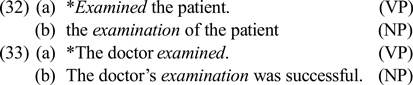
These observations led many other scholars such as Higginbotham (Reference Higginbotham1983), Anderson (Reference Anderson1984) and Dowty (Reference Dowty, Chierchia, Partee and Turner1989, Reference Dowty1991) to conclude that nouns lack argument structure altogether. In short, there is evidence for the adjunction analysis above that the of-phrases in (24) are not complements, but adjuncts that can be freely ordered with other adjuncts.
While attractive, the adjunction analysis is not entirely uncontroversial. There is another stance in the literature that argues that nouns, or at least some of them, in fact select complements and assign θ-roles to them (e.g. Hazout Reference Hazout1991, Reference Hazout1995; Barker & Dowty Reference Barker, Dowty and Schafer1993; Alsina Reference Alsina1996; van Hout & Roeper Reference van Hout and Roeper1998; Borer Reference Borer, Moore and Polinsky2003, Reference Borer2005 among others). Giorgi & Longobardi (Reference Giorgi and Longobardi1991: 2), for instance, note that gerund nouns such as reading (a book) have θ-grids similar to those of corresponding verbs such as read (a book), and any differences at face value are reduced to the modules of grammar that generate variations. Chomsky (Reference Chomsky, Jacobs and Rosenbaum1970: 91) also argues that the item destroy in (34a,b) has fixed selectional properties in the lexicon, and that it is free of categorial features such as [ ± N; ±V]. Thus, destroy in the verb phrase in (34a) and destruct in the noun phrase in (34b) are the same item, thus requiring the same complement, namely the city.
(34)
(a) The enemy destroyed the city.
(b) The destruction of the city by the enemy.
Although she argues that nouns do not have argument structure, Grimshaw (Reference Grimshaw1990: 47ff.) still admits that some nouns do take complements. She distinguishes between different types of nouns in this respect: Class I nouns which consist of complex event nominals such as examination, giving etc., and Class II nouns which consist of result nominals such as exam, gift etc. Grimshaw provides diagnostics that can distinguish between the two classes, and argues that Class I nouns select complements whereas Class II nouns do not. In this article, I will consider only three of these tests to see whether the nouns in (24), namely survey, seizure, talk and election, fall into Class I, thus selecting complements and involving argument structure, or into Class II that does not. According to Grimshaw (Reference Grimshaw1990), Class I nouns can denote an action thus requiring a duration of time, as in (35a), whereas the other class cannot, as in (35b). In Verkuyl's (Reference Verkuyl1993) terms, Class I nouns are durative whereas Class II nouns are terminative.
(35)
(a) The examination of the patient took a long time.
(b) *The exam of the patient took a long time.
Examining the examples in (24), we find that the head nouns, namely survey, seizure, talk and election, are also event-denoting nouns showing duration of time, as demonstrated in (36). Thus, this is the first evidence that the of-phrases in these examples should be treated as complements rather than adjuncts.
(36)
(a) The first survey of California's snowpack took a long time.
(b) Its seizure of an Iranian tanker took a long time.
(c) The talk of possible U.S. military action took a long time.
(d) A historical election of its first female president took a long time.
Another piece of evidence comes from the fact that Class I nouns allow by-phrases in their constructions, as in (37a), but Class II nouns do not, as in (37b).
(37)
(a) the examination of the students by the instructor was generous.
(b) *the gift by my father was generous.
The examples in (24), like Class I nouns, also allow by-phrases, as in (38) below.
(38)
(a) the first survey of California's snowpack by the Americans
(b) the seizure of the Iranian tanker by the British Marines
(c) the growing talk of U.S. military action by the foreign columnists
(d) the election of the first female president by the Germans
Moreover, implicit argument control is permitted in Class I nouns, as in (39a), but not in Class II ones, as in (39b).
(39)
(a) the assignment of easy problems in order to pass all the students
(b) *the exam in order to pass all the students
Like Class I nouns, the examples in (24) allow such argument control as well; see (40).
(40)
(a) the first survey of California's snowpack in order to convince the Americans of the reality of climate change
(b) the seizure of the Iranian tanker in order to stop its suspicious activities
(c) the growing talk of U.S. military action in order to prepare the public for the possibility of war
(d) the election of the first female president in order to guide strategic decisions
In light of these similarities, I conclude that all the head nouns in (24) above behave like the Class I nouns, thus they should select true complements. In other words, the of-phrases in (24) should not be considered adjuncts that can switch positions with PP-adverbs.
Further evidence comes from verb phrases. In the verb phrase domain, PP-adverbs can also separate the head verb from its complements, as in (41).
(41)
(a) Morstead, a punter for the New Orleans Saints, participated this year in the region-wide boycott of the Super Bowl between the Rams and New England Patriots (Los Angeles Times, 14 Sept 2019, https://lat.ms/2nJJzO6)
(b) The Trump administration announced this month that they plan to ban e-cigarette flavors (Washington Examiner, 2 Oct 2019, https://washex.am/2oqEVVy)
(c) Marc Benioff talked last night about how some of his customers are concerned about tariffs (The Street, 5 Jan 2019, https://bit.ly/2mN6yaD).
(d) Diane Abbott and Rebecca Long Bailey voted yesterday for the motion to ditch the deputy role (The Sun, 22 Sept 2019, https://bit.ly/2pdZkxn)
Given that PP-adverbs appear between head verbs and their complements in (41), the adjunction analysis above may argue that the head verbs in (41) should similarly be followed by adjuncts, with which PP-adverbs switch places, rather than selecting complements. However, this account is untenable because it is well established in the literature that verbs have argument structure and select complements (Chomsky Reference Chomsky, Jacobs and Rosenbaum1970; Grimshaw Reference Grimshaw1990; Wechsler Reference Wechsler1995; Levin & Hovav Reference Levin and Hovav2005 among others). In other words, all the elements after the PP-adverbs in (41) are genuine undisputed complements, to which the head verbs assign internal θ-roles. These conclusions pose empirical challenges to the adjunction analysis of the noun phrases above for its inability to be carried over to the verbal constructions in (41). Given that there is evidence that the of-phrases in (24) are complements rather than adjuncts, and that the adjunction analysis fails as a unified account for all the similar data in English, I will reject this proposal for the rest of the article.
2.2 Leftward movement of the head noun or the noun phrase
In this section, I will provide an alternative movement-based analysis to the data above. Under this new analysis, the of-phrases in (24) will not be treated as adjuncts. Rather, they will be generated as genuine complements to the head nouns. As for the PP-adverbs, they will occupy the specifier of a functional projection (FP) above the lexical NP, as shown in (42).
(42)
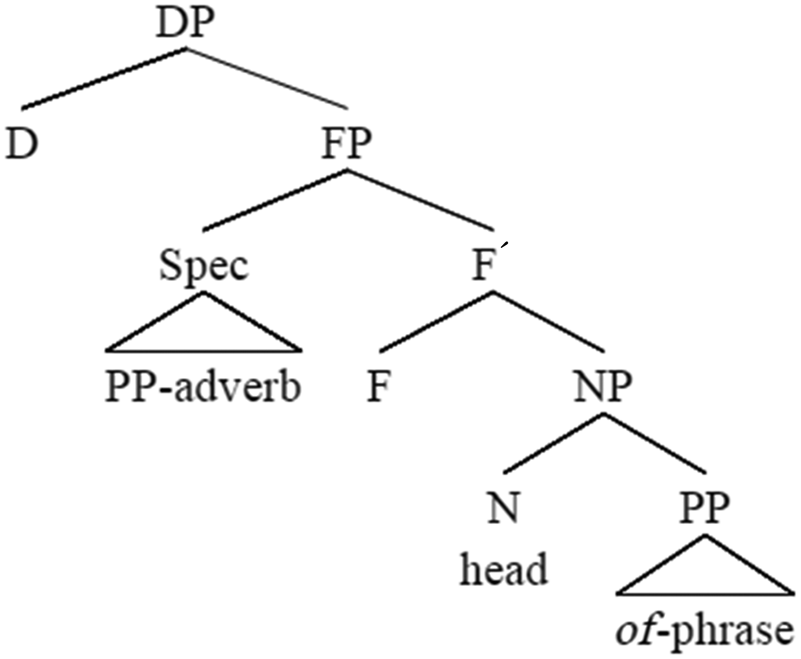
Structure (42) is elegant for three reasons. First, the of-phrase is not an adjunct but a complement, to which the head event-related noun assigns a θ-role. This is in line with the evidence presented in the earlier section for the availability of argument structures for the head nouns in (24). Second, the placement of PP-adverbs in spec,FP is in harmony with Cinque's (Reference Cinque1999) proposal for the position of adverbs within VPs, and it is the same position proposed by Valois’ (Reference Valois1991) for other modifiers such as adjectives. Thus, if both adjectives and adverbs appeared within the NP, they would uniformly take the same positions, namely spec,FP, as in (43).
(43)

Third, structure (43) respects Kayne's (Reference Kayne1994) Antisymmetric Theory of Linearization. According to Kayne (Reference Kayne1994), the universal word order implies that non-complements such as modifiers and subjects, be they derived or base-generated, must precede the heads of their phrases. Thus, PP-adverbs, being non-complements, must precede the head noun. This requirement is satisfied in (43). Any peculiar word order, as shown in the examples in (24) where PP-adverbs separate the head noun from its complement, can be resolved by the leftward movement of the head noun given that ‘no movement rule can adjoin anything to the right of anything’ (Kayne Reference Kayne1994: 71). This Kaynian proposal finds support from Greenberg's (Reference Greenberg and Greenberg1963) observation that most languages place the subject (i.e. a non-complement element) to the left of the verb, and from Dryer (Reference Dryer, Dryer and Haspelmath2013) who notes that wh-phrases are mostly displaced to the left and ‘a few languages exhibit at least a weak tendency to place interrogative phrases at the end of sentences’.
Turning to the word order in (24) where PP-adverbs separate the head noun from its PP-complement, I propose the head N must move leftwards somewhere higher than PP-adverbs. For the example in (44), I argue that the head N moves to the head of the FP that hosts the adjective, as shown in (45).
(44) The first survey this year of California's snowpack
(45)
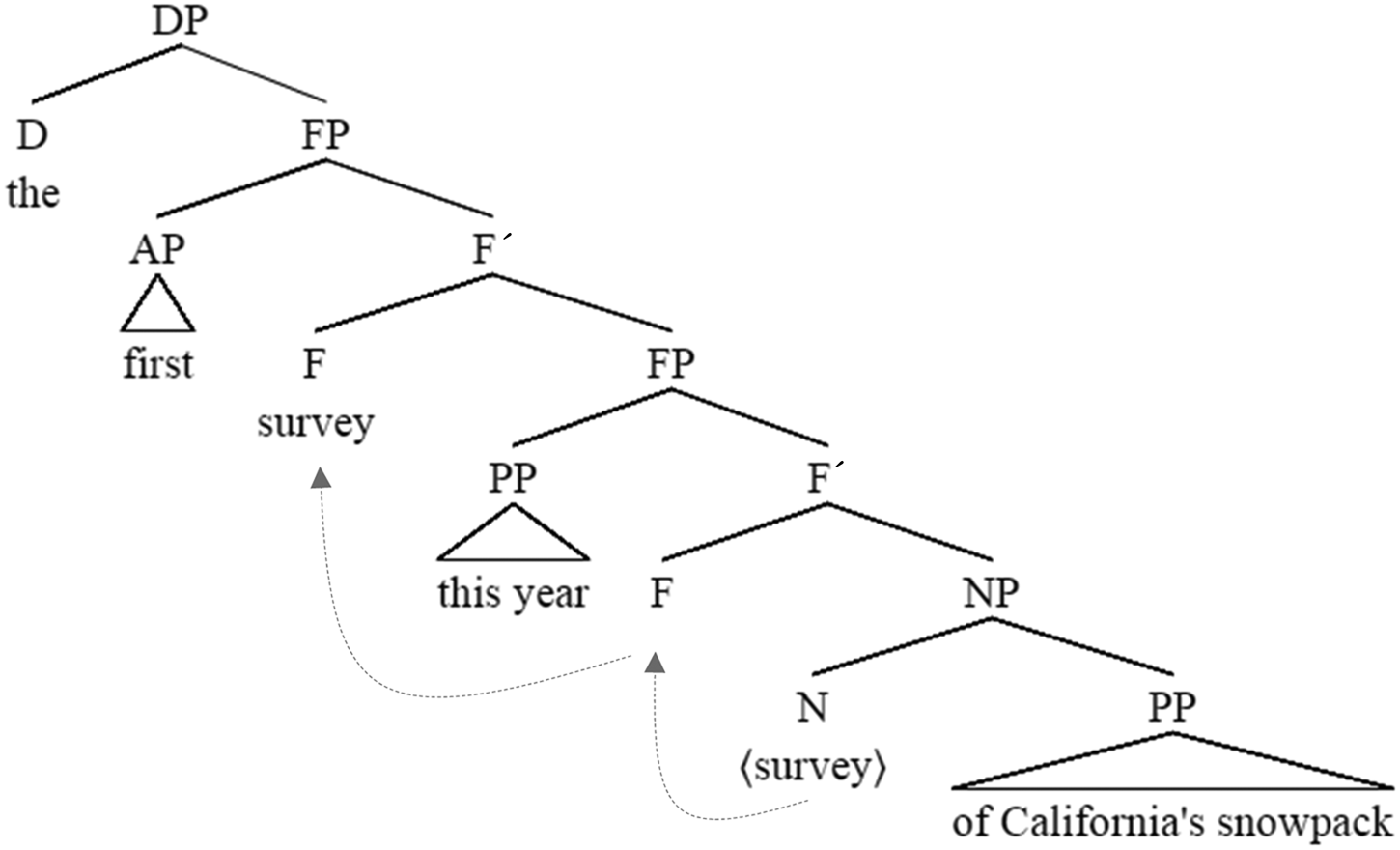
Although this derivation allows PP-adverbs to separate the head noun from its PP-complement, the same analysis cannot derive the cases where PP-adverbs follow the PP-complement, as in (46).
(46) The first survey of California's snowpack this year
For (46), the whole NP, i.e. the head noun as well as its PP-complement, must rise higher than PP-adverbs, but it is not clear where they should land. The movement of the whole NP to spec, DP, which is the only empty position, would produce the wrong word order where the definite article would follow the NP, as shown in (47). There is no empty position where the NP can land other than spec, DP.
(47)

Thus, the derivation of the cases that place PP-adverbs after the PP-complement would always be impossible under this account. In fact, even the cases where PP-adverbs precede the PP-complement would be non-derivable in the absence of adjectives. In that case, the head of the missing FP that hosts adjectives would not be available for the head noun to land on. Consider representation (49) for example (48), where the adjective first is missing.
(48) The survey this year of California's snowpack
(49)

Due to the absence of the FP of adjectives, the head noun in (49) will have no option but to land on the head D. That position, however, is filled by the definite article. In syntactic theory, it is unlikely that an element will move to a syntactic position which is lexically filled, as in (50) (see Shlonsky Reference Shlonsky2004: 8, ex. 16).

In (50a), the auxiliary had can move from the head I to the head C because the latter position is empty, i.e. because the complementizer if is missing. However, the presence of the complementizer if in the head C precludes the movement of the auxiliary, as in (50b,c). I assume that this is the case in (49), where the definite article should not allow the head N to occupy its position. Based on these observations, I also reject the leftward movement analysis for the rest of the article for its inability to derive the required data.Footnote 3
2.3 Rightward movement of the PP-complement
In the previous two sections, it was shown that the adjunction analysis is problematic because it treats of-phrases as adjuncts when they are genuine complements selected by head nouns. Although the leftward movement analysis subverts this problem, it fails to derive the variations attested in (24). In this section, I will present an alternative account that maintains that the of-phrases in (24) are complements. However, this account does not follow the leftward movement proposal that both adjectives and adverbs occupy different specifiers of FPs. Adjectives and adverbs, under this proposal, are simply adjoined to the NP. Adjectives are left-adjoined whereas PP-adverbs are adjoined to the right, as in (51).
(51)

This proposal is reasonable in that adjectives do precede the head noun in English, as in (52). Thus, they should be structurally left-adjoined as well. However, PP-adverbs, as in (53a), appear only to the right, similar to other constituents in English such as PP (e.g. 53b), relative clauses (e.g. 53c) and complement-selecting adjectives (e.g. 53d). Because all the constituents in (53) are heavy, Emonds (Reference Emonds1985) and Di Sciullo et al. (Reference Di Sciullo and Williams1987) assume that they should be structurally right-adjoined, as shown in (51).
(52) The (first/last) question (*first/last).
(53)
(a) The (*this year) survey (this year)
(b) The (*on Thursday) exam (on Thursday).
(c) The (*that we took) exam (that we took).
(d) The (*afraid of the dog) boy (afraid of the dog).
All else being equal, structure (51) can directly derive data such as those in (54), where PP-adverbs follow of-phrases. Consider the tree in (55), which represents example (54a).
(54)
(a) The first survey of California's snowpack this year
(b) its seizure of an Iranian tanker this month
(c) growing talk of possible U.S. military action tonight
(d) a historical election of its first female president yesterday
(55)

As for the data where PP-adverbs separate the head noun from its complement, as in (56), I follow the theorists of rightward movement such as Ross (Reference Ross1967), Larson (Reference Larson1988) and Overfelt (Reference Overfelt2015) who call such constructions Complex-NP Shift, and propose that the of-phrase extraposes and adjoins to the right of the PP-adverb, as shown in (57) representing example (56a).
(56)
(a) the first survey this year of California's snowpack
(b) its seizure this month of an Iranian tanker
(c) growing talk tonight of possible U.S. military action
(d) a historical election yesterday of its first female president
(57)

Extraposition of the PP-complement to the right of the PP-adverb captures the data in (56). This analysis therefore accounts for all the data in question, in contrast to the adjunction analysis and the leftward movement of the head noun or the noun phrase.
One piece of evidence that supports the extraposition analysis over the other two analyses comes from island-sensitivity. Under the rightward movement account, I predict that we can ask about the elements inside the PP-complements in (58) before they move to the right of the PP-adverbs. In fact, the elements inside these PP-complements can be questioned, as demonstrated in (59).
(58)
(a) He wrote the first manual of physical education this year.
(b) There is growing talk of possible US military action tonight.
(59)
(a) What did he write the first manual of ___ this year?
(b) What is there growing talk of ___ tonight?
If the PP-complements are really dislocated to the right outside the PP-adverb as proposed in (57), they then become adjuncts. We know that adjuncts form island domains, disallowing any extraction of their embedded elements. This is known in the literature as Adjunct Island Condition (see Huang Reference Huang1982).
(60) Adjunct Island Condition
If an XP is in an adjunct position, nothing may move out of it.
If the dislocated PP-complements become adjuncts, i.e. islands, I predict that no element can be extracted from their domains. In fact, this prediction is borne out as shown in (62) below, where extraction is impossible after the PP-complement extraposes as an adjunct to the right.
(61)
(a) He wrote the first manual this year of physical education.
(b) There is growing talk tonight of possible US military action.
(62)
(a) *What did he write the first manual this year of ___?
(b) *What is there growing talk tonight of ___?
In conclusion, the rightward movement analysis is superior in that it can also account for the contrast in extraction between (59) and (62). The contrast shows that PP-complements adjoin to the right above PP-adverbs, and form islands out of which no element is extractable. The rightward movement analysis becomes preferable in that it can also account for the verb phrases in examples (63), which exhibit the same behavior. Note that it is possible to extract from the complements in (64), but not from the same phrases after they are dislocated as adjuncts after the PP-adverbs in (65).
(63)
(a) Marc Benioff talked last night about how some of his customers are concerned about tariffs (The Street, 5 Jan 2019, https://bit.ly/2mN6yaD).
(b) Diane Abbott and Rebecca Long Bailey voted yesterday for the motion to ditch the deputy role (The Sun, 22 Sept 2019, https://bit.ly/2pdZkxn)
(64)
(a) What did Mark Benioff talk about ___ last night?
(b) What did Diane Abbott and Rebecca Long Bailey vote for ___ yesterday?
(65)
(a) *What did Mark Benioff talk last night about ___ ?
(b) *What did Diane Abbott and Rebecca Long Bailey vote yesterday for ___?
Unlike the rightward movement proposal, the adjunction and leftward movement analyses become progressively worse because they are unable to account for the significant contrast just discussed. Under the adjunction analysis, both PP-complements and PP-adverbs are adjuncts, as in (66), thus being freely ordered. If this is true, I predict that they both form adjunct islands from which no element is allowed to move. However, we have already noted that extraction is possible from the of-phrases in (59) above, which confirms that the of-phrases in (66) should not be adjuncts.
(66) Adjunction analysis

The leftward movement analysis also faces this problem. Assuming that it is not problematic for the head noun to land on the head D, as shown in (67), it is not clear why the PP complement does not allow any extraction of its embedded element, as in (62). There is no clear justification for why the PP-complement in (67) disallows such movement if it is not an adjunct.
(67) Leftward movement analysis

on island sensitivity evidence, I conclude that the rightward movement analysis is superior to the other two accounts. Unfortunately, and due to the smallness of the DP domain, it is challenging to bring evidence besides island sensitivity to support the rightward movement proposal. The small body of evidence should not, however, be taken as insufficient or inconclusive. The other two analyses have been shown to be seriously flawed. The adjunction analysis fails to treat the of-phrases as complements, and the leftward movement proposal cannot derive the variations in the first place. The rightward movement proves plausible in that it accounts for all the data, and it receives independent evidence from island conditions.
3 Conclusion
In this article, I have discussed the distribution of the PP-adverbs within the nominal domain, showing that PP-adverbs can occur before or after PP-complements. Three syntactic accounts are proposed for this behavior, namely adjunction, leftward and rightward movement. The article shows that the adjunction analysis fails to maintain the important generalizations regarding argument realization whereas leftward movement cannot derive the required data. In contrast, the rightward movement proposal respects the complement selection requirements, and it derives all the data under study. It also finds further support from island sensitivity where moved PP-complements to the right of the NP form adjunct islands, from which elements cannot be extracted.


