INTRODUCTION
There are 36 million sheep in the UK, and about 13 million are sold through 150 markets every year (Farm Animal Welfare Council 2005). About 0·40 of slaughter sheep are sold through auction markets just before slaughter. The future of fat stock markets is under threat because some supermarket companies are now asking their suppliers not to source lambs from auction markets. This is partly because there is a perception that the welfare of sheep sold through livestock markets is poorer than for animals sold directly to abattoirs (Murray et al. Reference Murray, Davies, Cullinane, Eddison and Kirk2000). The welfare concerns for market-sold sheep include fatigue, fear, distress, fasting, dehydration and injuries. For example, sheep arriving at abattoirs from a market sometimes drink for longer and sit down sooner, in comparison with sheep sent directly to an abattoir from a farm, suggesting that they are thirsty and more foot-tired (Kim et al. Reference Kim, Jackson, Gordon and Cockram1994). It is also recognized that the prevalence of bruising in carcasses from fat lambs sold through markets can be higher than for lambs sold direct to abattoirs (Knowles et al. Reference Knowles, Maunder and Warriss1994a; Jarvis & Cockram Reference Jarvis and Cockram1995). Wool pulling, riding behaviour, hits and squashing have been implicated as causes of the additional bruising, and it has even been suggested that most preslaughter bruising occurs while lambs are at markets (Cockram & Lee Reference Cockram and Lee1991; Knowles et al. Reference Knowles, Maunder and Warriss1994a). In addition, it was reported at one abattoir that lambs were four times more likely to die in lairage or during transport if they had been purchased in a market, compared with direct supply to the abattoir from farms (Knowles et al. Reference Knowles, Maunder, Warriss and Jones1994b). However, the overall mortality rate in transit and in lair age was very low (less than 0·0002 per sheep) and corresponded mainly with times of the year when pleurisy, abscesses and arthritis were most prevalent.
The current study and a parallel study on cattle (Gregory et al. Reference Gregory, Benson and Masonin press) examined the facilities and handling standards used for sheep and cattle at 24 livestock markets in the UK. The primary aim was to establish whether or not the welfare concerns about facilities and handling practices were justified. Comparisons were made according to throughput of the markets and between store and fat stock sale days.
MATERIALS AND METHODS
Twenty-four markets in England, Wales and Scotland were selected from a list provided by the Livestock Auctioneers' Association together with a map produced by the Meat and Livestock Commission. The sample was selected to include eight markets in each of three size categories (>300, 100–300 and <100 livestock units (LU) per week). In addition, there was a preference for selecting markets that sold store sheep as well as fat sheep, because one of the aims was to compare handling methods for the two classes under similar conditions. Two out of the 24 selected markets were unable to take part in the study and were replaced by two additional markets selected from the sampling frame. There were 23 and 12 markets that were visited on the days fat and store lambs were being sold, respectively. For the sake of consistency, the same person at each of the markets assessed almost all of the individual features.
Interview with the market manager
The market manager was interviewed to determine general policy and awareness about animal welfare at the market. Seventeen questions were asked, which encompassed training, supervision and inspection of animal welfare standards, presence of dogs, access to drinking water, overnight holding and procedures used for escapees, sick or injured animals.
Facilities
The following facilities were inspected at every market: vehicle reception area, unloading/loading bays, unloading/loading pens, grading station, corridors, gateways, holding pens, isolation pen and sale ring. Field holding areas were examined where present. The approach used during the inspection was to start with the assumption that the facilities were good. Anything that deviated from that expectation was recorded. Particular attention was given to adequacy of the capacity of the facility, suitability for the species, location of the facilities, protection from inclement weather, escape-proof features, visibility of exits for stock in sale rings, floor surfaces in terms of non-slip properties, potential balking features, drainage, bruising or impact points, protection from jumping injuries, interlocking double entry/exit gates, maintenance of gate hinges and latches, noise control with baffles and access to bedding and to water.
In the grading and selling facilities, ‘gates’ included all gates within the system except for exit gates, which were assessed separately. In the categories used for vehicles, ‘pick-ups’ did not have a tailboard.
Unloading, grading, selling, loading
The classes of animal examined were:
- Fat lambs
lambs due to go to slaughter.
- Store lambs
lambs sold for transfer to another farm where they will be grown further before slaughter, ewe lambs due to be used for breeding, lambs submitted as fat lambs but not fit for slaughter because underweight or insufficient finish, including lambs returned to the farm of origin without being sold because of insufficient finish. It did not include lambs sold as lambs at foot with ewes.
- Ewes and rams
included cull breeding sheep and breeding sheep sold for further breeding either as broken mouth or full mouth sheep, but excluded ewe lambs and sheep sold as ewes with lambs at foot.
Although the intention was to compare store and fat animals within a market it should be noted that these two classes were not always managed in the same part or through the same facilities within each market. For example, market staff did not grade store lambs unlike most fat lambs and so they did not pass through a grading facility. Instead, they were usually sold in lots as supplied. In some cases, store lambs were sold in a different ring from fat lambs. In addition, some markets sold fat lambs on store lamb sale days, and in that situation there was a greater likelihood that fat lambs were not graded. In these respects, the current study could not provide a precise comparison of the two lamb classes passing through identical facilities and procedures and so in the analysis it was decided to group the data into store or fat lambs across all the markets.
The sheep were inspected as they came off (unloading) and onto (loading) vehicles at the markets. In each of these situations the behavioural features were mutually exclusive and they were not counted more than once in the same animal. For example, if a lamb jumped, slid and fell over as it came off a truck, the worst outcome only would be recorded, which in this case would be the fall.
The sheep were examined and assessed for the following behaviours or situations:
- Refusal to move
refusal to move in the required direction while subjected to repeated attempts to get them to move. This included refusal to step onto the tailboard when trying to load the animals into a vehicle, refusal to load and instead the animals ran back past the person doing the loading, and refusal to move further into the vehicle when attempting to close the tailboard side gates or a vehicle pen gate. The number of lambs that refused to move was counted.
- Balking
an unwanted arrested flow due to an apparent distraction or intimidation.
- Slips
foot slide or stumbling that did not result in a fall but nearly did
- Fall
animal went down on its side or both knees or was off both its hind feet.
- Impact
a hard strike by another animal or with a physical feature such as a gate.
- Jumping
leaping with all four feet simultaneously off the ground in a manner or situation that could be hazardous for the animal.
- Inappropriate handling included:
wool pulling or skinfold pulling, restraining or pulling an animal by its tail or ears, dragging an animal off a vehicle by a leg while it was lying on its chest or side, kicking or standing on a sheep, throwing a sheep, turning or pushing an animal in a manner that caused it to go down or fall over.
- Isolation leading to distress included:
isolation with physical arousal indicated by emotional disturbance including pacing or circling, vocalizing, attempts at joining other animals, gate charging or excessive measures taken in avoiding a person.
- Confusion
failure to manage the flow of animals in the required direction or speed due to either an interference, encumbrance or inattention in managing the animals, resulting in the stock moving in a way or direction that was unwanted or they failed to move altogether when movement was required. This included animals that were unloaded or loaded twice and animals that escaped from the pen or facility and ran about in an inappropriate area (e.g. vehicle parking area).
The sheep were also assessed for the first seven of these behaviours during grading, at the time they were put up to the sale ring, whilst in the sale ring and as they came back from the sale ring to a post-sale holding pen. In those situations, the behaviours were mutually exclusive but, where relevant, an individual behaviour was counted more than once in the same animal. For example, if an animal slipped twice while in the same facility, it would have been recorded as two slips. In this respect, the prevalence estimate was a measure of the behavioural feature rather than the prevalence of animals showing the behavioural feature.
Holding after the sale
A total of 3584 sheep were examined in their holding pens after the sale at 18 markets. The prevalence of panting (more than 90 breaths per min), rumination and sitting (in sternal recumbency) was assessed while standing outside the pen and observing the undisturbed sheep in the pen for a period of up to 2 min.
Noise measurements
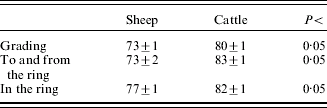
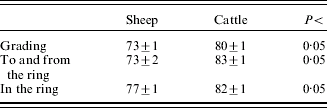
Noise measurements were made with a sound meter (Model CR303, Cirrus Research plc, UK) at three sites within each market, namely grading, taking the animals to and from the ring and in the ring. The recording for each site was the mean of four measurements taken at 10 s intervals. The results were compared with those measured at the equivalent sites in the cattle markets described by Gregory et al. (Reference Gregory, Benson and Masonin press).
Data analysis
All the prevalence estimates (as proportions of one animal) in Tables 2–8 apply to the proportion of sheep. The prevalence estimates (as proportions of one market) in Table 1 apply to the proportion of markets. The statistical significance of the difference between two proportions was evaluated with Fisher's exact test or Chi-square test and relationships between variables were assessed with linear regression analysis.
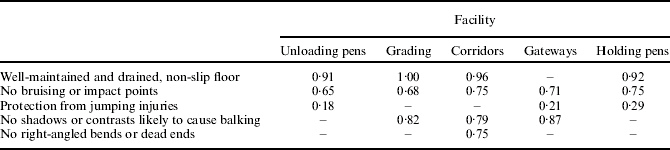
Frequency of good features in the facilities at 24 markets that should help minimize sheep handling difficulties and injuries
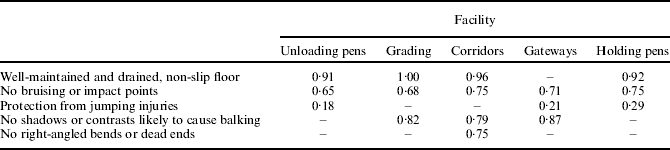
Values are the frequencies expressed as proportions of 1·00.
RESULTS
Interview with the market manager
All the markets had a designated animal health and welfare officer and at 0·7 of the markets those people were clearly identified. A written animal welfare policy was found at 0·83 of the markets and, at those markets, it was claimed that all staff were aware of it and understood it. At 0·83 of the markets the stock handlers had been given formal training, which encompassed animal welfare requirements. This was usually a National Vocational Qualification at a college. At 0·75 of the markets the stock handlers were clearly identifiable, usually from the smocks or coats they wore.
Access to the animal health office was prominently displayed within 0·92 of the markets. Dogs were not allowed in the livestock areas at 0·67 of the markets.
Facilities
The features that could help minimize handling difficulties and injuries are shown in Table 1. During the inspection the floor surfaces were usually considered to be non-slip when clean and dry. Potential bruising or impact points were completely absent from 0·42 of the markets. Where they did occur, they were usually protruding gate hinges. There were no obvious potential leg traps if an animal jumped over a gate or pen wall at 0·17 of the markets. Those markets used leg excluders, which stopped a leg sliding down between the gatepost and a gate. Most of the markets managed to minimize right-angled bends in corridors that presented visual dead ends, as well as shadows that could cause balking in corridors. None of the gates at any of the markets was baffled to reduce noise.
The sheep markets were generally open to the weather. Only 0·04 of the markets provided protection from inclement weather in the vehicle reception area and 0·33 had covered or protected sheep unloading pens.
Unloading bays were considered escape proof when used properly at 0·92 of the markets, and 0·67 of the vehicle reception areas were considered escape proof should an animal run loose in the vehicle area.
Water in the sheep unloading/loading pens was provided in 0·09 of the markets, and none of the markets offered free access to water for all the sheep in the holding pens.
Few markets (0·08) had poorly lit gateways that produced the appearance of a dead end.
Holding pens that could be modified using gates to increase or reduce their size were found in 0·37 of the markets and 0·29 had holding pens with interlocking, double entry/exit gates.
The markets either had a dedicated isolation pen for sick or injured sheep or used an existing holding pen as an isolation pen as and when needed. In most cases (0·85 of the markets) this pen was within 20 m of the unloading area and it was ready for immediate use with bedding in 0·9 of markets. In 0·45 of the markets, the isolation pen was totally enclosed with solid walls and gates, and 0·37 had free access to water.
Unloading
Sheep unloading was observed from a total of 652 vehicles. Of the vehicles, 0·63 were single deck, 0·35 multidecks and 0·02 pick-ups.
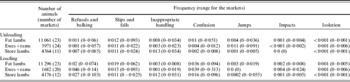
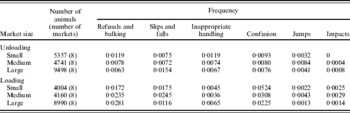
There were very few handling difficulties during unloading, but they included the following (Table 2). Of the 154 cases of refusal plus balking, 0·95 were sheep that refused to come off the vehicle. Of the 156 sheep experiencing inappropriate handling, 0·96 were wool pulls or skinfold pulling and usually occurred when the person doing the unloading was trying to get the first sheep to run off the vehicle. Of 209 cases of slips and falls, 0·52 occurred on dry concrete and 0·19 were on wet or dirty concrete; 0·18 were on the tailboards and 0·11 were either on the internal ramps or floor inside the vehicle or resulted from jumping or falls from the top deck or occurred when an animal lost balance as it was being turned by hand during unloading. Of the 123 cases of confusion, 0·98 were sheep that had to be unloaded more than once because they went back into the vehicle.
Frequency of problems during unloading and loading at sheep markets in the UK

Values are the frequencies expressed as proportions of 1·00.
Grading
Two of the 24 markets did not grade fat sheep on the day of the visit, and none of the markets graded store lambs either on the day of the visit or as normal practice. Fat lamb grading was done either on a weigh platform or a grading pen. The sheep were assessed for condition, sorted into smaller groups and may have been spray painted before being penned in sale lots. They were sold either in those pens or in a sale ring.
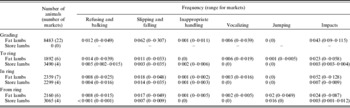
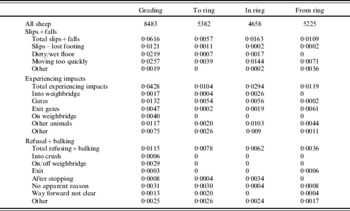
Grading caused more problems than any other procedure during the marketing period. In particular, it was associated with slipping, falling and impacts (Table 3). Slips and falls occurred on wet or dirty weighbridge floors and when sheep were moving too fast (Table 4). Impacts with gates and with each other accounted for 0·58 of the total impacts during grading. Of the cases of refusal to move and balking, 0·25 were when the sheep were expected to come onto or off the weighbridge and 0·11 were because there was an obstruction ahead.
Frequency of handling problems and vocalizing at sheep markets in the UK

Values are the frequencies expressed as proportions of 1·00.
Frequency of sheep handling problems at different stages in livestock markets in the UK

Values are the frequencies expressed as proportions of 1·00.
Selling
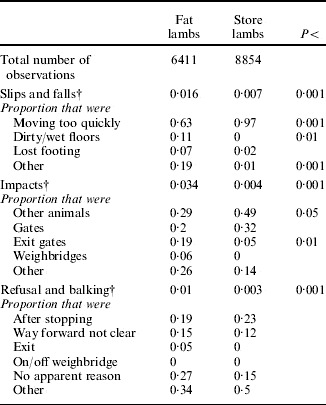
In the southern half of the UK, sheep are usually sold in their holding pens, whereas in the north they are sold through a ring. Seven fat lamb markets sold the lambs through a sale ring, and the remaining markets sold them in their holding pens. The corresponding number of markets selling store lambs through a ring was four out of 12, and those markets also sold fat lambs through a ring, but not necessarily the same ring. In the south, sheep were not assessed for behaviours around the time of the sale. The most common problems were impacts, slips and falls (Table 3). Slips and falls mainly occurred when lambs moved quickly (Table 4). Impacts were mainly with gates and other animals. Fat lambs were particularly prone to slipping when on wet or dirty floors, compared with store lambs (Table 5). They were also more prone to striking exit gates.
Reasons for handling problems in fat and store sheep at markets when moved to, within and from the sale ringFootnote *

Values are the frequencies expressed as proportions of 1·00.
* Does not include grading, because grading was only performed on fat lambs.
† Proportion of total number of animals in the respective class.
Holding after the sale
The prevalence of ruminating and sitting was 0·22 and 0·07, respectively. The prevalence of panting was 0·09 (range 0–0·28) and it was correlated to ambient temperature (r=0·53, P<0·05). The range in ambient temperature was 3–27°C.
Loading
Sheep were drafted from their holding pens into a corridor by truck drivers during selling or as soon as selling ended. They were then taken to a loading pen at the loading bay. Sheep loading was examined for 219 vehicles of which 0·48 were single deck, 0·51 multidecks, and 0·01 pick-ups.
Problems were more frequent during loading compared with unloading (Table 2). For example, the prevalence of refusal plus balking was higher, and there were also more cases of impacts and confusion. Of the 423 cases of refusal plus balking, 0·67 were sheep that refused to move onto the vehicle. The second most important cause of refusal to move occurred when the driver was trying to close a pen door in the vehicle. Of the 83 cases of inappropriate handling, 0·87 were wool pulls or skinfold pulling. Less common forms of inappropriate handling included pulling sheep by the ears, kicking, inappropriate use of sticks and striking sheep with a gate. Of 288 cases of slips and falls, 0·53 occurred on wet or dirty concrete, 0·11 were on dry concrete, 0·25 on tailboards, and 0·11 were either on the internal ramps or a weighbridge near the loading pen or during hazardous jumping while running towards the vehicle. Of the 541 cases of confusion, 0·96 were sheep that had to be loaded more than once because they turned back and came off the vehicle. Of the 37 impacts, 0·76 were with gates and were often cases of gate charging, and 0·08 were with loading pen railings.
Market size
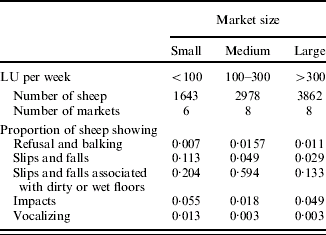
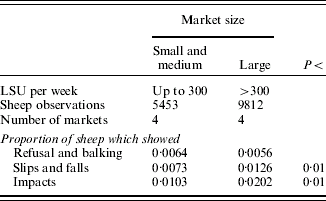
Many of the sheep handling problems occurred during grading (Table 4) and small markets experienced most slips and falls, impacts and vocalization during grading (Table 6). They also had a higher prevalence of inappropriate handling during unloading and higher prevalence of confusion during loading (Table 7). Refusing to load was less common at small markets. There was no simple relationship between size of market and the prevalence of slips and falls, but large markets had the least problems with slips and falls due to wet or dirty floors during grading (Table 6). However, when lambs were being moved to, within and from the sale ring, there was a higher prevalence of slips plus falls and impacts in the larger markets (Table 8).
Incidents when grading fat lambs at 22 markets according to size of market throughput
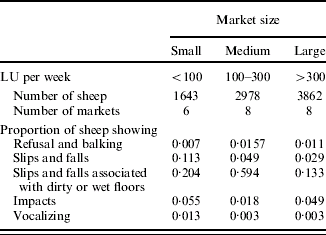
Proportion of sheep is expressed as a proportion of 1·00.
Frequency of problems during unloading and loading at sheep markets in the UK

Values are the frequencies expressed as proportions of 1·00.
Incidents in sheep when moved to, within and from sale rings at eight markets
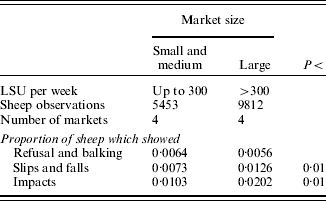
Values are the frequencies expressed as proportions of 1·00.
Noise
On average noise intensity in the sheep grading area when the sheep had recently arrived at the market was 73 dB (Table 9). Sources of noise included gates clanging, vocalizing from nearby sheep and more distant cattle, amplifiers used for broadcasting the bidding, vehicles driving nearby and people shouting while driving animals along corridors and into vehicles. Noise measurements did not differ substantially between the various sites within sheep markets, but they were c. 9% lower than equivalent sites in cattle markets (Table 9). The overall range in noise intensity between the markets was quite large. The lowest noise measurement was during grading at two sheep markets (66 dB) and the highest was when taking cattle to and from a ring (91 dB). There was no difference in noise intensity between the three market size categories. Average noise levels at various sites in the sheep markets were always less than 86 dB, whereas there were three cattle markets where the average noise levels were greater than or equal to 90 dB.
Noise measurements (dB±s.e.) at three sites in UK sheep and cattle markets
Fat lambs vocalized more than store lambs (P<0·05).
DISCUSSION
In the current study, the prevalence of handling difficulties at the sheep markets was low and this gives a favourable impression of welfare standards. However, a 0·03 prevalence of impacts or a 0·01 prevalence of inappropriate handling would correspond to an annual national incidence of about 390 000 and 130 000, respectively. Viewed in this way, it indicates there could be opportunities for improvement.
The people handling sheep at markets are farmers during unloading, market staff during penning, grading and selling, and truck drivers plus buyers during drafting to the loading area and loading onto vehicles. Farmers also load store lambs and breeding sheep. This diversity in stock handlers makes it complicated when advising on how standards for handling could be improved. The discussion focuses on advice and potential solutions that could be given in the first instance to market operators, but some points could also be relayed to farmers and drivers.
Facilities
In 1986, it was reported that few markets in the UK had purpose-built unloading bays or ramps (Farm Animal Welfare Council 1986). That situation has changed. All the markets in the present study had purpose-built unloading bays or ramps for sheep. Generally, the facilities were suitable for unloading. The proportion of markets with 0·01 or less slips and falls when unloading fat lambs was 0·78. The market with the highest prevalence (0·093) had a problem because of wet concrete plus an inappropriate slope at a turning point.
Usually there was a single corridor at the end of the unloading pens. Market staff and farmers working in this corridor can cause confusion for sheep coming off other vehicles in two ways. Sheep sometimes turn back and try to re-enter the vehicle. They may also congregate at the tailboard creating congestion, which hinders unloading. Both these effects are frustrating for the farmers who are trying to unload their trailers.
Double corridors at the end of the unloading pens were available at three markets. The partition between adjacent corridors needs to be panelled, so that staff can use the furthest corridor without causing sheep to turn back and re-enter the vehicles during unloading. Confusion occurred at one market where there was a counter-flow in sheep movement, and if the railings that separated the two corridors had been panelled, this might have been prevented. Double corridors can also help during loading if the partition between the two corridors is gated, allowing sheep to pass across both corridors to the loading pens.
Confusion and impacts also occurred when loose gates or hurdles were not secured during unloading. Some trailers had broken or missing tailboard side gates, which presented an escape risk.
The main weaknesses in the sheep holding facilities were absence of drinking equipment under hot conditions, absence of leg excluders between gates and gatepost, and potential bruising or impact points in the corridors. Although few markets had installed leg excluders no cases of leg trapping were observed during the course of the visits.
In the markets, 0·7 sold fat lambs in their holding pens instead of a sale ring. This has distinct advantages as there is less handling and movement, and so less opportunity for injuries and stress. The study showed that putting fat lambs up to and through a ring resulted in additional impacts, slips and falls. Nevertheless, the advantage in putting lambs through a ring is that it allows buyers to assess the lambs' movement, but this is more useful when buying store lambs and breeding stock compared with fat lambs. If in-ring selling could be limited to stores and breeding stock, there would be some animal welfare benefits.
The unloading/loading pens and corridors inevitably get dirty as the day progresses, and the floors become slippery. One market managed this by turning on sprinklers in the empty loading pens during bidding. The pens were then clean and less slippery when selling had finished and sheep were ready for loading. This had an additional advantage, as it meant that any fat lambs that fell over were less likely to get dirty and so they should be more acceptable at the abattoir as clean stock.
Ponding in the loading bay caused obvious balking at two markets. The splash created when sheep ran through the water probably contributed to dirtiness on the legs and belly. Avoiding ponding with adequate surface drainage should provide hygiene as well as ease of handling benefits.
At some small sheep markets the weighbridge and grading station was directly in line with the loading bay. This meant that sheep had to pass over the platform when being taken to the loading pen after the sale. Metal weighbridge platforms that were dirty and wet with manure were hazards because they were very slippery. This contributed to some of the slips and falls and they might have been reduced if the weighbridge had been hosed down before loading commenced.
Unloading and loading
Refusal to unload occurred in more than 0·01 of the fat lambs at 0·39 of the markets. It was usually due to lambs refusing to leave the other sheep in the vehicle. Refusal to descend an internal ramp from an upper deck was less common. Unloading was easier if the sheep have a clear view of other sheep in holding pens within the market. At some markets the unloading pens faced a wall, which obscured the view of other sheep and getting unloading started was more difficult.
Loading can be one of the most stressful parts of a journey for lambs (Broom et al. Reference Broom, Goode, Hall, Lloyd and Parrott1996; Parrott et al. Reference Parrott, Hall and Lloyd1998), and the current study showed that there was more difficulty loading ewes and rams than lambs. Sheep were sometimes reluctant to mount the tailboard and enter the vehicle. It is thought that this is an increasing problem because of the greater use of Texels as a terminal sires, which produce offspring that are difficult to load compared with other breed types (Tompsett & Gregory Reference Tompsett and Gregory2008). At one market the docking area sloped downwards towards the unloading bay. This made unloading easy, because the sheep had a clear view of the holding pens. However, loading was a problem and the sheep had to be pushed onto the vehicles. The slope also meant that lambs crowded at the lower end of the pens within the vehicles, making it more difficult to achieve a full load. It was reported that if the sheep stayed pressed together at the rear of each vehicle pen, there was a risk of smothering during the subsequent journey to the abattoir.
A problem at some markets was the absence or inappropriate location of forcing gates in the loading pens. The forcing gates need to be at a point in the pen that allows up to 40 sheep to stand between the forcing gates and the truck tailboard. Forty sheep corresponds to the highest number of forward store or fat lambs that fills a pen inside multi-deck vehicles. Drivers working at markets where there were no forcing gates had difficulty getting lambs to advance onto the tailboard and into the vehicle. Forcing gates situated too far from the tailboard made it more difficult to crowd the sheep onto the tailboard, especially in wide loading pens or if the loading pen was over-filled with sheep.
Inappropriate handling
The prevalence of inappropriate handling during unloading and loading was higher in store lambs than fat lambs. Young store lambs tend to be more cohesive as a group and greater pressure is required to get them started off a vehicle during unloading. The main method that is used is to turn some lambs at the rear of the trailer by hand in the appropriate direction, and farmers sometimes pull them by the wool or a skinfold when doing this, until they start to run as a group. Wool pulling can cause bruising and it was more common at small markets presumably because there were fewer sheep in the market and less visual draw and so more persuasive action was needed in getting them started. In retrospect, it was surprising that the prevalence of wool pulling when loading store lambs was similar with that during unloading. This was due to difficulties in getting the lambs to face the right direction and it sometimes occurred when lead lambs were selected and forced by hand onto the vehicles.
Grading
Most of the impacts occurred during grading. Grading at the holding pens instead of the weighbridge platform could reduce them. Markets situated in the south grade fat lambs at the holding pens and it is possible that this practice could be adopted at all markets.
At some markets, fat lambs were removed from the weighbridge after grading by an operator approaching them from the exit. This approach increased the risk of lambs injuring themselves.
Feed and water
Sheep put through markets before slaughter are likely to be without feed for longer than sheep sent directly to abattoirs. For example, none of the markets in the current study provided feed for sheep that arrived and left the market on the same day. Most of the fat stock left the markets after midday and since UK abattoirs do not usually operate two shifts, many of the animals would not be slaughtered until the following day. Withholding feed before slaughter helps reduce the burden of gut contents at the abattoir and the risk of faecal soiling of the body surface during the preslaughter period. Presale fasting also has some practical benefits. It helps eliminate variation in gut fill and allows buyers to estimate dressing percent more accurately. The period at which the benefits begin to operate has not been clearly defined, nor has the period at which hunger becomes substantially worse. It is a legal requirement that stock should be given feed whilst held overnight at markets to avoid the unwanted risks (Welfare of Animals at Markets Order 1990). In the current study, four out of five markets that held stock the night before the sale provided feed (hay) and water for all the animals. Only one market did not provide feed and water for all those animals.
The need for providing water for animals at markets depends on species, the time the animals are likely to be without water and weather conditions. One view is that water should be provided for all stock to avoid the risk of thirst, and that animals can and do drink water at markets and so providing water for all animals is not always superfluous to their need for water (Kim et al. Reference Kim, Jackson, Gordon and Cockram1994; FAWC 2005). In sheep, water requirements are increased when feed is withheld under hot conditions. There is greater reliance on drinking to appease heat discomfort, although it is not an efficient way of reducing heat burden (Blaxter et al. Reference Blaxter, Graham, Wainman and Armstrong1959). The excess water is voided in urine and there is some loss through vaporization during panting. Shade can act as an alternative to drinking in avoiding heat stress but this is not always provided at sheep markets. An alternative view is that water does not have to be provided for every animal (FAWC 1986). Sheep are well adapted physiologically to drinking once every 2 days even in hot semi arid conditions (Abdelatif & Ahmed Reference Abdelatif and Ahmed1994). They can withstand greater extracellular water loss than humans and they can concentrate their urine up to six-fold when water deprived (Brown & Lynch Reference Brown and Lynch1972). It is said that when feeding on succulent pasture, sheep go voluntarily without drinking any water for many days, relying instead on moisture obtained from feed. Most fat sheep presented for sale at UK markets are taken off pasture that has high moisture content and they should be adequately hydrated at the time they leave their farms of origin. Sheep taken off pasture at 07.00 h and put through a market before arriving at an abattoir at 19.00 h the same day would experience a 12 h water-withholding period. This would probably be typical for many sheep, but it would be correspondingly longer for sheep trucked overnight before arriving at a more distant abattoir.
Panting was observed in 0·09 of undisturbed sheep during the current study and no doubt, water loss was elevated in those animals whilst they were standing in their pens after the sale. Whether this was sufficient to cause suffering from thirst is far from clear and, in view of this species' predisposition to panting, its original adaptation to a semi arid habitat and its resilience to water deprivation, it is probable that short marketing periods in the predominantly cool temperate conditions experienced in the UK would be a minor imposition compared with other issues such as trauma. There is, of course, a greater risk in hot conditions. It was found that there was a positive relationship between ambient temperature and the prevalence of panting at the markets suggesting that high summer temperatures in the UK could be creating a stress especially where there was no shade.
Water was provided in 0·42 of the markets in a limited number of pens. Some loading bays had water available in troughs near the front of the loading pen in a Y-shaped recess. This recess also acted as a funnel and facilitated loading by reducing the opportunity for lambs to turn back when required to go onto and up the tailboard. It also reduced the likelihood of sheep traps between the tailboard side gates and the front gates of the loading pen. Clearly, these recesses offered a number of benefits and it is suggested that they should be considered more often as a design feature at livestock markets.
CONCLUSIONS
The overall impression from the current study was that the prevalence of impacts, slips, falls and inappropriate handling at sheep markets was low. Since these are the main welfare concerns in market-sold animals, this study raises the question whether the perception that sheep markets have poor welfare standards is justified. It also questions whether a total embargo imposed by some supermarkets on procuring lambs for the meat trade from markets is in fact appropriate. Most of the potential injuries in sheep occurred during grading and selling in a sale ring. These could be avoided or reduced by selling the sheep in their holding pens. If embargos have to be imposed, perhaps they should be directed instead at markets that sell fat lambs through a ring.
Sheep markets are said to have at least eight functions in the community (Gregory Reference Gregory2007). They act as assembly points for large numbers of animals and this makes procurement easier for buyers. They reduce the need for buyers to visit farms when selecting animals suitable for their particular trade and this has some disease control benefits. Markets give vendors and buyers a clear indication of the state of the market and encourage competitive buying and fair prices, while helping to set livestock prices for other sectors of the industry. They serve as sites where bio security and welfare standards can be enforced and they act as trading and community centres for both rural and urban people. They also help span the urban-rural gap in awareness about the meat and livestock industry. These benefits need to be considered when deciding whether or not to procure fat stock from livestock markets and they need to be balanced against the animal health hazards associated with centralized gatherings at markets. Those health hazards are skin disorders including ectoparasites, foot conditions such as foot rot and the dispersal of epidemic diseases such as foot and mouth disease.
This project was funded by Defra and supported through advice by the Livestock Auctioneers Association.