Introduction
Dural arteriovenous fistula (DAVF) is a rare type of intracranial vascular abnormality in which the branches of dural arteries have abnormal connection to dural veins or sinuses. This lesion can arise anywhere along the intracranial dura mater. The incidence of DAVF accounts for 10–15% of all intracranial vascular malformations. Reference Gupta and Periakaruppan1 However, the true incidence may be higher than currently diagnosed. Some reports showed several percentages in clinically silent patient or spontaneous regression of DAVF. Reference Luciani, Houdart, Mounayer, Saint Maurice and Merland2,Reference Rohr and Gauthier3 DAVF is commonly diagnosed between the age of 40 and 60 but it can present at any age of life. Reference Elhammady, Ambekar and Heros4 The definite etiology of vascular shunt in DAVF remains unclear. Some authors proposed an acquired cause predisposing from prior cerebral venous thrombosis after surgery, trauma or clinical states associated with hypercoagulability, including infection and pregnancy. Reference Kim, Han, Kwon, Oh and Han5,Reference Sarma and ter Brugge6 The thrombosis may alter a local vascular system and promote the opening of pre-existing small dural shunts or may activate angiogenesis by abnormalities in various angiogenic growth factors change which proceed to newly developed dural shunts. Reference Gandhi, Chen, Pearl, Huang, Gemmete and Kathuria7 Clinical presentations in patient with DAVF varies from asymptomatic to serious neurological deficit. In symptomatic patients, the location of shunts and the route of venous drainage are directly related to the symptoms present. Reference Houser, Campbell, Campbell and Sundt8 The previous studies revealed the common location at transverse-sigmoid sinus (50%), followed by cavernous sinus (16%), tentorium cerebelli (12%) and superior sagittal sinus (8%). Reference Kim, Han, Kwon, Oh and Han5,Reference Houser, Campbell, Campbell and Sundt8,Reference Lasjaunias, Chiu, Ter Brugge, Tolia, Hurth and Bernstein9 An increase of dural sinus blood flow from DAVF draining into transverse and sigmoid sinuses conducts pulsatile tinnitus while more serious symptoms associate with venous hypertension or intracranial haemorrhage. These serious sequelae are usually presented of cortical venous reflux (CVR) which is classified as aggressive type of DAVF. Reference Malik, Pearce, Ausman and Mehta10-Reference Baltsavias, Spiessberger, Hothorn and Valavanis12
General management for DAVF relies on the severity of symptoms and angiographic findings. In benign type of DAVF (no CVR) with asymptomatic patients, conservative treatment remains an option as there was some percentage of spontaneous regression. In contrast, more serious conditions or aggressive DAVFs require intervention management such as surgery, endovascular embolization, radiotherapy or a combination of these modalities. Reference Gupta and Periakaruppan1,Reference Miller and Gandhi13 Recently, endovascular embolization has become a first line definitive treatment as it can result in an immediate closure of the fistula. Reference Baharvahdat, Ooi, Kim, Mowla, Coon and Colby14 However, some large lesions or high-risk embolization are suitable for only partial embolization, which have persistent risk of haemorrhage. Radiotherapy techniques for DAVF require a stereotactic process, stereotactic radiosurgery (SRS) or hypofractionationated stereotactic radiotherapy (HF-SRT), resulting in high obliteration rate and low complication rate. However, radiotherapy is not recommended as a first-line treatment in aggressive DAVF as radiation induced obliteration requires a long-term effect. Reference Gupta and Periakaruppan1
There are a limited number of publications on the effectiveness of combined treatment modalities, embolization and radiotherapy, in selected aggressive DAVF. Reference Link, Coffey, Nichols and Gorman15-Reference Yang, Kano and Kondziolka17 This study aims to report clinical and radiological response of aggressive DAVF after combined-treatment of glue embolization followed by hypofractionated helical TomoTherapy (Hypo-HT) in Maharaj Nakorn Chiang Mai hospital, Chiang Mai University.
Materials and Methods
This was a retrospective study in the single institution Maharaj Nakorn Chiang Mai hospital, Chiang Mai University, between June 2015 and March 2020. We evaluated the clinical and radiological outcome of aggressive DAVF patients. All cases underwent glue embolization as a first-line treatment. The patients who had incomplete obliteration of fistula with CVR (confirmed by cerebral digital subtraction angiography; DSA) were also received adjuvant Hypo-HT.
The patients’ demographic data were obtained from medical record of Maharaj Nakorn Chiang Mai hospital. Data collection was comprised of sex, age, presenting symptoms, clinical response, duration of the response and side effects after Hypo-HT.
Once the patients were identified, we reviewed the images from the Picture Archiving and Communication System (PACS) of the Division of Diagnostic Radiology. The angiographic data were collected by reviewing location of DAVF, evidence of CVR, techniques, number of sessions and complication of endovascular embolization. Our study was also approved by the Faculty of medicine Chiang Mai University ethics committee (Study code: RAD-2563-07566, Research ID 7566).
Glue embolization
Cerebral DSA and embolization were performed on a biplane angiographic unit (Infinix-I, Toshiba Medical Systems, Tustin, California, USA) under general anaesthesia. Selective angiogram of bilateral internal carotid arteries, bilateral external carotid arteries (ECA) and vertebral artery was performed in all patients to evaluate location of fistula, arterial feeders, pattern of venous drainage and CVR. Superselective trans-arterial glue embolizations were done mostly via ECA branches to obliterate fistula by using the Histoacryl glue, n-butyl-cyanoacrylate (NBCA), which is part of fast-acting adhesives. NBCA was mixed with Lipiodol to make it radiopaque and to adjust its polymerization time in individual cases.
Hypo-HT
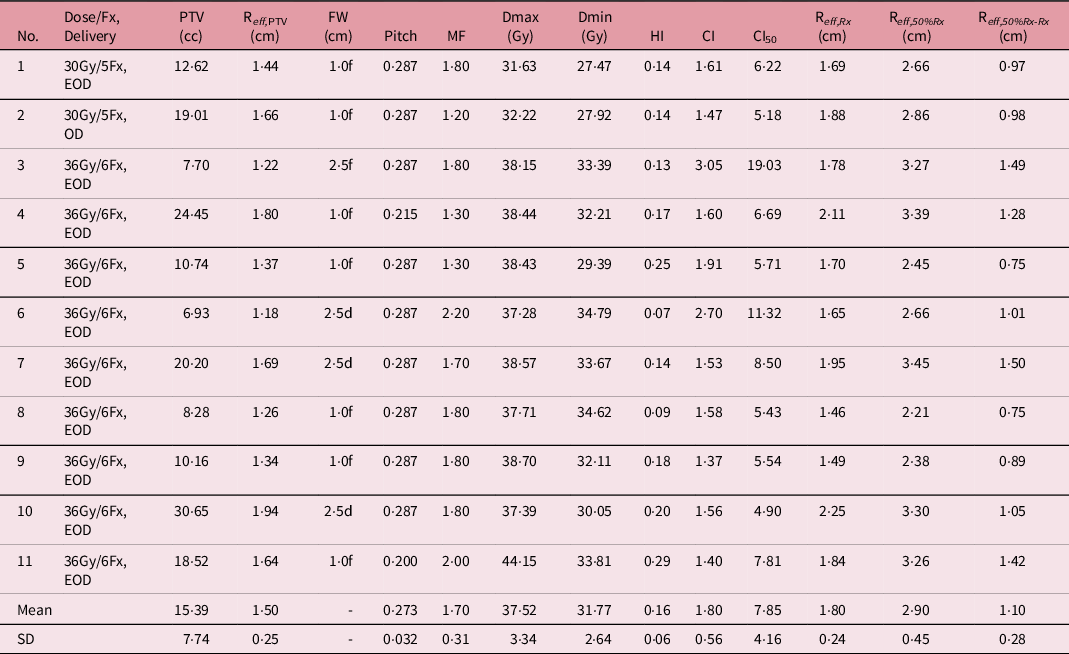
Treatment plan for all patients was created by using Hi-Art treatment planning system (TomoTherapy®, Accuray, Madison, USA) and treated by helical technique. The dose prescription range was 30–36 Gy in 5–6 fractions. The schematic delivery was daily (OD) or every other day (EOD). The planning target volume (PTV) was a 3 mm expansion from the gross target volume. The plan parameters were set in the range of 1·00–2·50 cm both in fixed and dynamic jaws mode, 0·200–0·287 and 1·50–2·20 for the field width (FW), pitch and modulation factor (MF), respectively. The fine grid (1·95 × 1·95 mm2) was used for the resolution of dose calculation. The dose prescription and plan evaluation were done according to ICRU83. Reference Hodapp18 The plan quality was reported in maximum dose (Dmax), minimum dose (Dmin), homogeneity index (HI), conformity index (CI) and conformity index at 50% of treated dose (CI50). The effective radius of 100% (R effRx ) and 50% (R eff50%Rx ) dose prescription were also calculated by , whereas V was the volume of interest.
Response evaluation
Symptomatic response after combined glue embolization and Hypo-HT was grouped into complete recovery, partial recovery, no recovery and progression of symptoms. Radiological response was classified as total obliteration, subtotal obliteration, indicating >90% regression of DAVF or a few small residual CVR, partial obliteration indicating >50% regression of DAVF, stable and progression of the disease. The clinical response and acute side effects were assessed at 6 weeks after Hypo-HT completion. Then the clinical follow-up was done every 2 months in the first year and every 6 months thereafter. MRI/MR (SIGNA 1·5 Tesla, GE,) angiography or CT (SOMATOM FORCE, Siemens, Forchheim, Germany) angiography were also performed at 6 months interval in the first two years, and yearly thereafter to evaluate DAVF response and post radiation effect. We planned further cerebral DSA examination for patients who developed worsening clinical symptoms or progression of DAVFs and CVR on magnetic resonance angiography (MRA) or computed tomography angiography (CTA).
Results
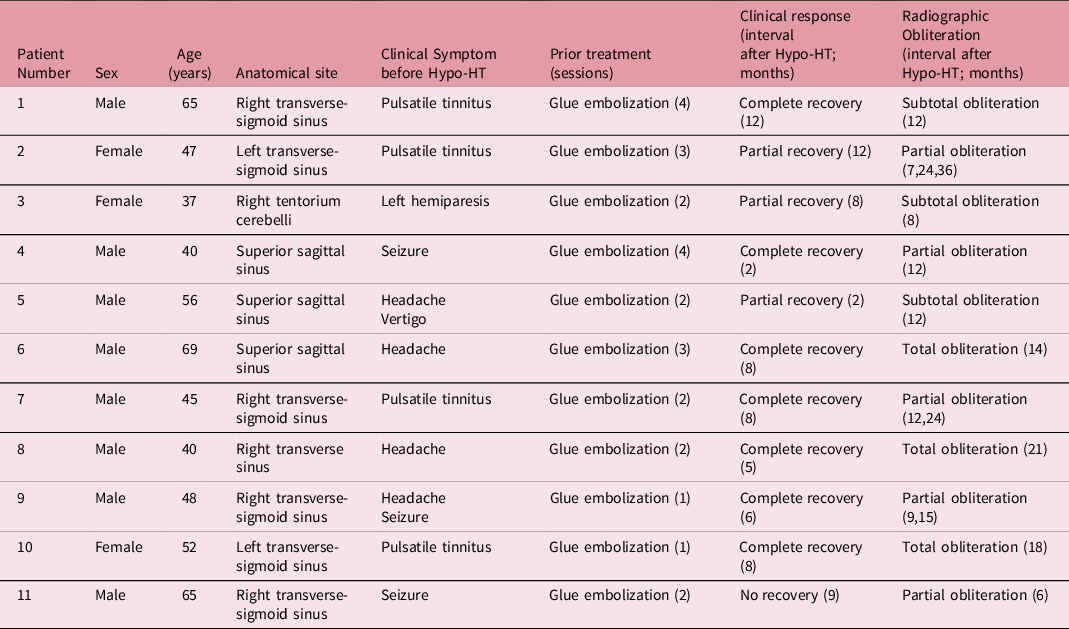
Eleven aggressive DAVF patients were treated with combined glue embolization, followed by Hypo-HT. The age of patients ranged from 37 to 69 years, with an average of 51·2 years. There were eight men (72·7%) and three women (27·3%) with a male and female ratio of 2·67. The most common affected location of DAVF were transverse-sigmoid sinus (n = 7, 63·6%), followed by superior sagittal sinus (n = 3, 27·3%) and tentorium cerebelli (n = 1, 9·1%). Pulsatile tinnitus and headache were the most common presenting symptoms. Four patients (36·4%) had history of pulsatile tinnitus, four patients (36·4%) presented with headache, three patients (27·3%) had history of seizure and one patient (9·1%) presented with left hemiparesis from intracranial haemorrhage. The patients received 1–4 times (median 2) glue embolization prior Hypo-HT. None of the patient experienced embolization complication during the follow up period.
The mean follow-up after Hypo-HT was 28·5 months (range 9–48). The complete symptomatic recovery was found in 72·7% (8 patients) within 2–12 months (mean = 7) after Hypo-HT. Partial symptomatic recovery was reported in 18·2% (2 patients) at 2 and 8 months. No recovery was found in 9·1% (1 patient) at 9 months, with recurrent seizure. Follow up MRI and MRA was performed in seven patients. Four patients underwent follow up CTA. The total radiographic obliteration rate was 27·3% (three patients) within 14–21 months (mean = 17·6), subtotal obliteration was 27·3% (three patients) within 8–12 months (mean = 10·6) and partial obliteration rate was 45·4% (five patients) within 6–36 months (mean = 18·6). The side effect of Hypo-HT was focal alopecia in all cases (100%). No patient experienced new haemorrhage after treatment. Post radiation imaging demonstrated hyperintense post-radiation change in only one (9·1%) asymptomatic patient with T2/FLAIR sequence on MRI. Table 1 shows the patients’ characteristics and the outcome after Hypo-HT.
Patient characteristics and outcomes after Hypo-HT

Abbreviation: Hypo-HT, hypofractionated helical TomoTherapy.
Table 2 describes the parameters, dosimetric analysis and quality indexes of the treatment plans. The mean pitch and MF of treatment plans are 0·273 ± 0·032 and 1·70 ± 0·31, respectively. The average size of PTV are 15·39 ± 7·74 cc whereas the R eff,PTV is 1·50 ± 0·25 cm. The average Dmax and Dmin are 37·52 ± 3·34 and 31·77 ± 2·64 Gy, respectively. HI, CI and CI50 are 0·16 ± 0·06, 1·80 ± 0·56 and 7·85 ± 4·16, respectively. The R eff,Rx and R eff,50%Rx are 1·80 ± 0·24 and 2·90 ± 0·45 cm, respectively. The R eff between 50%Rx and 100%Rx is 1·10 ± 0·28 cm on average.
Plan parameters, dosimetric analysis and plan quality index

Abbreviations: Fx, fraction; PTV, planning target volume; R effPTV , effective radius of PTV; FW, field width; MF, modulation factor; Dmax, maximum dose; Dmin, minimum dose; HI, homogeneity index; CI, conformity index; CI50, conformity index at 50% prescribed dose; R eff,Rx , effective radius of prescribed dose; R eff,50%Rx , effective radius of 50% prescribed dose; R eff,50%Rx-Rx , the distance between R eff,50%Rx and R eff,Rx ; Gy, grey; EOD, every other day; OD, once a day; SD, standard deviation.
Discussion
The natural history of aggressive DAVFs is unfavourable. The annual risk of haemorrhage is 8·1%, non-haemorrhagic neurodeficit is 6·9% and annual mortality rate is 10·4%. Reference van Dijk, terBrugge, Willinsky and Wallace19 According to these high morbidity and high mortality rates, all patients with aggressive DAVFs should be treated. There are diversified treatment options, including surgery, endovascular embolization, radiosurgery/radiotherapy or a combination of these treatments. The goal is to achieve a complete occlusion of the fistula and CVR.
Surgical treatment involves the surgical excision of the meningeal arteries and veins, packing of the dural sinus, as well as skeletonization of the involved dural sinus with the disconnection of the draining leptomeningeal veins. Surgical risks for disconnecting DAVF include blood loss, intracranial haemorrhage, cerebral infarction and cerebrospinal fluid leakage. Reference Miller and Gandhi13 At the present time, an open surgical approach is generally reserved for aggressive DAVFs that are not manageable with endovascular embolization, however surgery is ideal for specific DAVF location at the anterior cranial fossa. Reference Baharvahdat, Ooi, Kim, Mowla, Coon and Colby14 Endovascular embolization is the first-line treatment to immediate closure of aggressive fistula. The fistula and proximal draining vein of DAVFs is targeted to curative embolization by trans-arterial route with liquid embolic agent or transvenous route with coils and/or liquid embolic agent. Reference Baharvahdat, Ooi, Kim, Mowla, Coon and Colby14 Post embolization complications occur in 2–10% of cases. Reference Koebbe, Singhal and Sheehan20 Although trans-arterial embolization is an effective method, the previous studies revealed incomplete obliteration of DAVF in 50% or more of the cases. Reference Yang, Kano and Kondziolka17 Incomplete obliteration leads to the recruitment of collateral vessels and contributes to the persistent risk of intracranial haemorrhage. For patients who have incomplete obliteration of their fistula, no accessible feeding vessels or high risk embolization, partial embolization may temporarily reduce symptoms, but it is unlikely to result in a long-term good outcome. Reference Miller and Gandhi13
Radiotherapy for DAVF requires a stereotactic process, stereotactic radiosurgery (SRS) or hypofractionation stereotactic therapy (HF-SRT). Complete obliteration rate from radiotherapy is reported to be approximately 44–87%. Reference Guo, Pan and Wu21-Reference Park, Park, Kang, Hwang and Hwang23 Previous reports showed that benign DAVF had higher occlusion rate than aggressive DAVF (75% versus 56%). Reference Pan, Chung and Guo24 However radiotherapy is not recommended as the first-line treatment strategy in aggressive DAVFs because of its long latency period about 6–12 months Reference Gupta and Periakaruppan1 during which patients remain at risk of intracranial haemorrhage. This technique has become an important additional treatment of aggressive DAVF.
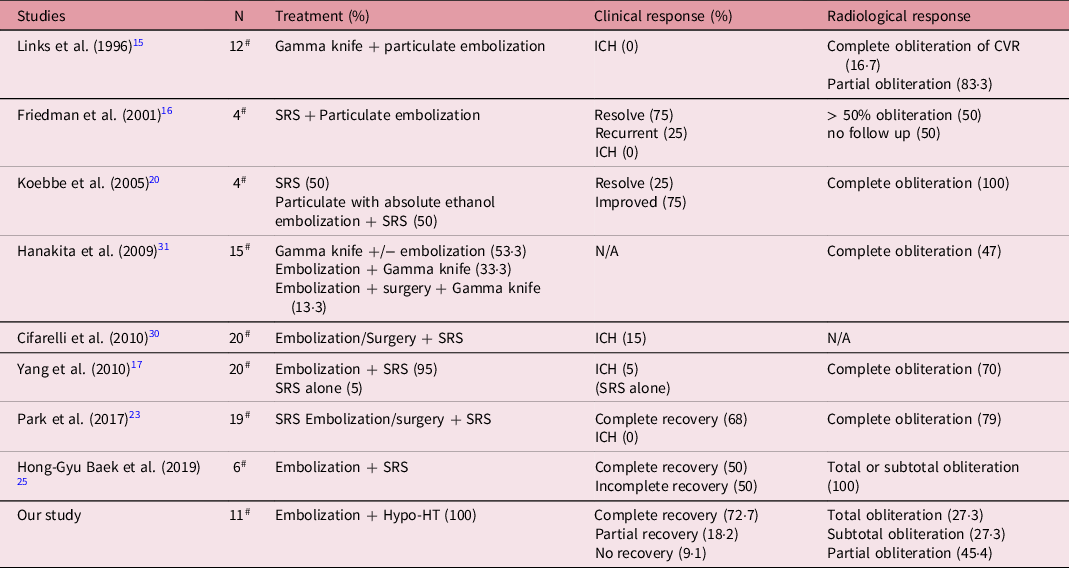
Table 3 summarizes the published outcomes of combined treatments of aggressive DAVF. In our study, we provide a precise and in-depth understanding of aggressive DAVF, thus we selected and demonstrated only aggressive DAVF patients. In our institution, all aggressive DAVF patients with incomplete embolization received radiotherapy. The reason for this approach is to provide immediate patients’ symptoms relief and reduce the risk of intracranial haemorrhage by glue embolization as much as possible, then followed by complementary radiotherapy to permanently occlude the fistula. The results of our study showed satisfactory clinical symptom recovery of aggressive DAVF in all treated patients by combining glue embolization to hypo-HT. Only one patient in our study had no improvement with recurrent seizure because of brain damage from the previous intracranial haemorrhage. No patient experienced new haemorrhage or worsening symptom after treatment. One side effect of hypo-HT is focal alopecia in all cases. Our results were supported by Park et al. (2017) Reference Park, Park, Kang, Hwang and Hwang23 who reported 19 cases of embolization or surgery before SRS and SRS alone with complete symptoms recovery of 68%. Friedman et al. (2001) Reference Friedman, Pollock, Nichols, Gorman, Foote and Stafford16 showed four cases with SRS before particulate embolization. The patient symptoms resolved in three cases (75%) and recurred in one case (25%). More recently in 2019 Hong-Gyu Baek et al. Reference Baek, Park, Park, Kang, Hwang and Hwang25 demonstrated 6 cases of aggressive DAVFs treated by embolization before SRS. The results showed complete symptoms recovery in three cases (50%) and partial symptoms recovery in three cases (50%).
Comparison between combined embolization and radiotherapy in aggressive DAVF and other studies.

Abbreviations: # selected only in aggressive DAVF; SRS, stereotactic radiosurgery; Hypo-HT, hypofractionated helical TomoTherapy; ICH, intracranial haemorrhage.
In our study, the radiological response showed 27·3% total obliteration, 27·3% subtotal obliteration and 45·4% partial obliteration. The percentage of total obliteration rate is less than in previous literature reviews in Table 3, however the mean follow-up of the subtotal obliteration group in our study was only 10·3 months and partial obliteration group was 18·6 months. We need more follow up time due to the latency period of radiation effect for further fistula obliteration evaluation. For follow-up study assessed by cerebral DSA, we limited it only to patients who developed worsening clinical symptoms or progression of DAVFs and CVR on MRI/MRA or CTA. However, none of our patients fill these criteria. The lack of cerebral DSA confirmation is a limitation of our study, however MRI and MRA have a 90% specificity for confirming obliteration compared to cerebral angiogram in arteriovenous malformations that underwent SRS. Reference Pollock, Kondziolka, Flickinger, Patel, Bissonette and Lunsford26
The Hypo-HT was selected instead of stereotactic radiosurgery because of the size of the PTV based on the study by Sung et al. Reference Sung, Choi, Song and Kim27 who showed that hypo-fractionated treatment was used for target volume larger than 7 cc. The average target volume in our study was 15·39 cc. The distance of the dose falloff outside target was calculated by the direct subtraction between the Reff of 100%Rx and 50%Rx. The distance of the dose falloff was within 1·50 cm and showed excellence on average result (1·10 ± 0·28 cm), whereas the dose prescription followed ICRU83 Reference Hodapp18 recommendations. However, Reynolds TA et al. Reference Reynolds, Jensen, Bellairs and Ozer28 showed that the dose gradient depends on the size and shape of the PTV, especially for large target volume.
Prior studies revealed that patients underwent radiotherapy before or after particulate embolization. Reference Link, Coffey, Nichols and Gorman15,Reference Friedman, Pollock, Nichols, Gorman, Foote and Stafford16,Reference Koebbe, Singhal and Sheehan20 The timing of embolization and radiotherapy is still controversial. Some literature states that embolization before SRS reduces target volume and blood flow, which promotes fistula occlusion. On the other hand, some authors argue that the target margin may be obscured when embolization was done prior to SRS, leading to ineffective radiotherapy. Reference Chen, Lee and Ding29 In our opinion, in case of benign DAVF, the sequence for the combination could be done either way, because of the natural history of this type of benign DAVF, it can be ‘wait and see’ without any dangers. However, in case of aggressive DAVF, embolization before radiotherapy might be more effective because the goal is to obliterate the fistula and CVR to prevent risk of intracranial haemorrhage or other non-hemorrhagic neurological deficit and followed by long-term effect of radiotherapy. There are few reports of post SRS intracranial haemorrhage; Yang et al. (2010) Reference Yang, Kano and Kondziolka17 reported one case of aggressive DAVF treated by SRS alone. Cifarelli et al. (2010) Reference Cifarelli, Kaptain, Yen, Schlesinger and Sheehan30 reported three cases (15%) of post SRS haemorrhage after combined embolization or surgery and SRS. More recently in 2015, meta-analysis by Chen et al., Reference Chen, Lee and Ding29 showed 4·2% haemorrhage after SRS alone and combined treatment. Based on these studies, we thought that radiotherapy is not recommended as the primary treatment strategy in aggressive DAVFs because of risks of fatal haemorrhage.
This research has some limitations. As mentioned above, we used non-invasive imaging (CTA or MRA) in follow up radiographic response of aggressive DAVF treatment, which is less accuracy than cerebral DSA. Moreover, we still need an extended follow up time for further assessment on radiological obliteration rate and the late side effects of treatment.
Our practice has shown satisfactory clinical response of aggressive DAVF in all treated patients by combining glue embolization and Hypo-HT. No patient experienced new intracranial haemorrhage or new neurological deficit after treatment. This can be an alternative technique in our future practice, particularly in non-curative aggressive DAVF by endovascular treatment alone.
Conclusion
Combined glue embolization and Hypo-HT offered a satisfactory therapeutic effect in both symptomatic recovery and radiological obliteration rate. Though we require more follow up time to explore the ultimate treatment outcome and late radiation side effects.
Acknowledgement
None.
Financial Support
None.
Conflicts of Interest
None.
Ethical Standards
This protocol is exempt from review by Research Ethics Committee of Faculty of Medicine, Chiang Mai University. Date of issue: 27 August 2020. This Ethics Committee is organized and operates according to GCPs and relevant international ethical guidelines, the applicable laws and regulations. (Study code: RAD-2563–07566, Research ID: 7566.)