Lewis Carroll's (Reference Carroll1917) Through the Looking Glass is a sequel to Alice in Wonderland, which draws attention to the long-held philosophical idea that we could all exist simply as characters in people's dreams. ‘Through a glass darkly’ comes from 1 Corinthians 13:12 (New International Version), which speaks to the idea that we do not see reality clearly, but darkly. We use both of these literary references to draw attention to how hate may cloud or obscure our reality and the perception of hated individuals. In psychology, the current literature on person perception and mood has been long established (e.g., Forgas & Bower, Reference Forgas and Bower1987; Forgas, Reference Forgas2011); however, very little research has been done to examine the specific emotion of hate and its relationship with how we perceive people we hate. Considering that current research on hate suggests that hate and love are closely related (e.g., Aumer-Ryan & Hatfield, Reference Aumer-Ryan and Hatfield2007; Zeki & Romaya, Reference Zeki and Romaya2008) and this relationship may be dependent on cultural factors (Shiota, Campos, Gonzaga, Keltner, & Peng, Reference Shiota, Campos, Gonzaga, Keltner and Peng2010), it is necessary to better understand how one's hatred may impact or influence one's perception of people, especially since these people are often people we love or have once loved.
There is considerable research and debate concerning the effect of seeing one's romantic partner in a positive light (for reviews, see Fletcher, Simpson, & Boyes, Reference Fletcher, Simpson, Boyes, Schaller, Simpson and Kenrick2006; Gagné & Lydon, Reference Gagné and Lydon2004). Gagné and Lydon (Reference Gagné and Lydon2004) suggest that the positivity versus accuracy one sees in their partner is dependent on the goals and perceptions of the relationship. Most research also demonstrates that the positivity bias tends to be more prevalent for traits that are considered important for the relationship (Boyes & Fletcher, Reference Boyes and Fletcher2007). And although there is debate (Swann, Pelham, & Krull, Reference Swann, Pelham and Krull1989) about what makes one more satisfied in the relationship (i.e., positivity bias, similarity, or accuracy — aka self-verification), recent research by Luo and Snider (Reference Luo and Snider2009) demonstrated that both accuracy and similarity seem to be an important factor in predicting satisfaction for both one's partner and self, while positivity bias may be more influential over one's own satisfaction in the relationship. The positivity versus accuracy bias is also prevalent in other relationships such as those with friends, coworkers, and dorm mates (Swann, Chang-Schneider, & Larsen McClarty, Reference Swann, Chang-Schneider and Larsen McClarty2007). But, what happens when we hate someone? Do our perceptions of that person suddenly become more accurate, or more negative, or possibly more positive? Do we see them as completely different than we see ourselves?
There is little empirical research on how our perceptions of someone change when we hate them. Interestingly, there is little empirical research on hate in general. Much of the research on hate has primarily focused on intergroup violence or intergroup hate (Altemeyer, Reference Altemeyer1981; Baumeister & Butz, Reference Baumeister, Butz and Sternberg2004; Baumeister & Campbell, Reference Baumeister and Campbell1999; Beck & Pretzer, Reference Beck, Pretzer and Sternberg2004; Brewer, Reference Brewer1999; Levin & Rabrenovic, Reference Levin and Rabrenovic2004; Pedahzur & Yishi, Reference Pedahzur and Yishi1999; Post, Reference Post1999; Sternberg, Reference Sternberg2003; Staub, Reference Staub and Sternberg2004). Other research on hate is also derived from a psychoanalytic perspective (see Blum, Reference Blum1997; Kernberg, Reference Kernberg, Shapiro and Emde1992; Klein, Reference Klein1975; McKellar, Reference McKellar1950; Moss, Reference Moss2003; Strasser, Reference Strasser1999; Vitz & Mango, Reference Vitz and Mango1997) and does not contain much empirical data. Recently, some researchers have begun to look at hatred from an interpersonal perspective (Duck, Reference Duck and Duck1982; Fitness, Reference Fitness2000; Fitness & Fletcher, Reference Fitness and Fletcher1993; Rempel & Burris, Reference Rempel and Burris2005).
Rempel and Burris (Reference Rempel and Burris2005) posited a theory that states that hatred is primarily a motivation geared at directing ill-will or harm towards the person of hatred; that is, a motivator for destruction. They seated their theory in contrast with love, which can be seen as a motivator to do good to the person loved. Rempel and Burris (Reference Rempel and Burris2005) provide an interesting theory that hate and love are very similar, but that the direction of each motivation (love or hate) is very different. Research by Aumer-Ryan and Hatfield (Reference Aumer-Ryan and Hatfield2007) demonstrated that indeed, love and hate may be closely connected in that people who we tend to love or have loved, or spend a considerable amount of time with, are often the focus of our hatred. Rarely do people mention acquaintances as targets of hate; instead they tend to be family members, friends, exes, coworkers, and classmates. Rarely did people mention a group of people, sports teams, or friends of friends. Thus, it may be that love and hate are very much related and with a change in circumstance, an act of betrayal, or a deed of indecency, the direction of that motivation may suddenly turn very negative.
This study utilises an internet survey to better understand how the perceptions of those we love versus those we hate are different. Additionally, we surveyed participants’ motivations to try to better understand if their hatred can actually predict their motivations towards that person. If, however, hate and (negative) motivation are equivalent (Rempel & Burris, Reference Rempel and Burris2005), then there should be a near perfect correlation between their hatred and negative motivation. There were three primary purposes of the study, specifically: (1) to explore the relationship between love and hatred, (2) to better understand how motivation is related to hatred, and (3) to see how perception is affected by our feelings of love and hatred.
Method
Participants
An online survey was constructed using Qualtrics and advertised via email, Facebook, and Sona Systems for undergraduate students in Hawai’i. All methods, procedures, and items in the survey were reviewed and approved by the Hawai’i Pacific University Institutional Review Board. Two hundred and seventy participants (N = 270) initiated the survey, however only 148 (107 women and 41 men) participants completed the survey. The high dropout rate may have been due to the long length of the survey. Average completion time was 20 minutes. The average age of participants was 25.85 (SD = 10.55). As is typical of the Hawai’i population, a variety of ethnic groups were represented (50% White, 23% Mixed, 8.7% East Asian, 7.7% Southeast Asian, 5.8% Hispanic, 1.8% Hawaiian or Part-Hawaiian, 1% Micronesian, 1% Native American, 1% Black).
Procedures
Participants were recruited through the university's subject pool and were asked to participate in a survey involving their feelings of love and hate. Participants were supplied with a link to the survey that was hosted and designed using Qualtrics. After completing a basic demographic questionnaire, which included gender, age, and race, participants then completed the measures listed below about someone they loved and someone they hated. Using a randomising procedure in Qualtrics, half the participants started with filling out the following measures for the person they loved and finished the survey by filling out the same measures for someone they hated, while the other half of participants started by filling out the same measures for a person they hated and finished the survey with filling out the same measures for someone they loved. Follow-up analyses on the following measures revealed no statistically significant differences in order of which the participants took the survey, thus all data was collapsed and organised together.
Ten Item Personality Inventory (TIPI)
The Ten Item Personality Inventory (Gosling, Rentfrow, & Swann, Reference Gosling, Rentfrow and Swann2003) is composed of 10 items that measure the big five personality domains: Openness, Conscientiousness, Extraversion, Agreeableness, and Emotional Stability. Participants are asked to indicate the extent they agree or disagree that the following items apply to themselves — items such as ‘Sympathetic’ and ‘Extraverted’. Answers are provided on a 7-point Likert scale, with alternatives ranging from 1 (strongly disagree) to 7 (strongly agree). The TIPI measure possesses strong convergent validity (Ehrhart et al., Reference Ehrhart, Ehrhart, Roesch, Chung-Herrera, Nadler and Bradshaw2009). Considering the measure has only two items per personality domain, alpha reliabilities would be inappropriate and cannot be obtained for this measure. For this study, we focused on personality as opposed to affect, as previous research has demonstrated that affect tends to be more informative of the judge as opposed to the person being perceived (Beer, Watson, & McDade-Montez, Reference Beer, Watson and McDade-Montez2013). Considering we wanted an assessment of the person being perceived as opposed to the person doing the assessment, this study focuses on personality.
Depending on the order, participants then identified a person they loved and completed a basic demographic questionnaire about this person that included: who they are (e.g., father, mother, boyfriend, girlfriend), age, race, occupation, and education. The concept of ‘love’ and ‘hate’ was not explained or defined for the participants. Instead, participants were only asked: ‘Please identify someone you love (hate)’. Participants were allowed to choose from a list of people (e.g., mother, father, sister, brother); however, they were also allowed to specify a separate person should that person not have been included on that list. This list was generated from previous findings by Aumer-Ryan and Hatfield (Reference Aumer-Ryan and Hatfield2007). Again, participants were allowed to select ‘Other’ and type in a person or even people they hated in a provided textbox. Considering that this survey focused on interpersonal love and interpersonal hatred as opposed to intergroup love and intergroup hatred, we did not ask participants to list groups of people, such as lawyers or doctors or people from other countries. Participants’ answers were later grouped into larger superordinate categories; for example, if a participant chose their father and another participant chose their mother as a person they loved, they were then marked down as both choosing a ‘family’ member as their target of love. Organising members into superordinate categories allowed for simplified statistical analyses.
Triangular Love Measure
Sternberg's Triangular Love Measure (Sternberg, Reference Sternberg1997) is composed of 45 items that measure the following components of love: Intimacy, Passion, and Commitment. Items measuring intimacy assess the level of closeness and warmth of the relationship, such as ‘I have a warm relationship with ________.’ Participants used the name of the person they love to fill in the blank and answer each phrase on a 7-point Likert scale, with alternatives ranging from 1 (strongly disagree) to 7 (strongly agree). Cronbach's alpha reliabilities were strong for each component and were as follows: Intimacy (.94), Passion (.95), and Commitment (.94).
Motivations Questionnaire
Participants then filled out a Motivations Questionnaire that was constructed in our lab and pretested with 10 participants. The Motivations Questionnaire assesses negative, positive, and neutral desires, thoughts, and imaginations one has towards another individual. Neutral motivations were measured with items such as ‘I can imagine this person commuting to work’ or ‘I can imagine saying hi to this person’. Positive motivations were measured with items such as ‘I can imagine wanting this person to have a long and happy life’ and ‘I can imagine having a positive relationship with this person.’ Negative motivations were measured with items such as ‘I can imagine wanting this person to live with severe distress’ and ‘I can imagine being ok knowing this person was no longer alive’. Five items measured neutral motivations (NEU), 10 measured positive motivations (POS), and 10 measured negative motivations (NEG). Participants answered by indicating the extent to which they agreed or disagreed with each statement on a 5-point Likert scale ranging from 1 (strongly disagree) to 5 (strongly agree). The measure had excellent reliability, measured with Cronbach's alpha, for NEG (α = .94) and POS (α = .91) and good reliability for NEU (α = .71).
Participants then identified a person they hated. The order was randomised so that half the participants chose someone they hated first, then someone they loved. Multivariate analysis did not reveal any significant differences on our dependent variables, given order as a predictor. Similar to choosing someone they loved, participants were allowed to choose from a list of people; however, they were also allowed to specify a separate person should that person not have been included on that list. There were a total of 13 possible choices: mother, father, brother, sister, friend (female), friend (male), boyfriend, girlfriend, fiance, husband, wife, coworker, and other. The most common uses for the category of ‘other’ were exes (husbands, wives, boyfriends, and girlfriends), step family members, classmates, and in-laws. Participants’ answers were later grouped into larger superordinate categories in order to simplify analysis; for example, if a participant chose their father and another participant chose their mother as a person they loved, they were then marked down as both choosing a ‘family’ member as their target of hate. Similar to the measures participants filled out for the person they loved, participants completed a basic demographic questionnaire about this person that included: who they are (e.g., father, mother, boyfriend, girlfriend), age, race, occupation, and education. Participants then completed the following measures for the person they identified as hating.
Triangular Hate Scale
The Triangular Hate Scale (Sternberg & Sternberg, Reference Sternberg and Sternberg2008) consists of 29 items that measure Negation of Intimacy/Disgust (DIS), Passion/Anger (ANG), and Devaluation (DEV). Items measuring these three components of hate are similar to those in the Triangular Love Scale; for example, an item measuring disgust: ‘I think that _________ is truly disgusting’. Participants fill in the blank with the person they have previously identified as hating. Participants answer to the extent they agree or disagree with each statement on a 7-point Likert scale from 1 (strongly disagree) to 7 (strongly agree). There was strong internal consistency measured with Cronbach's alpha for items in each component: DIS (.95), ANG (.94), and DEV(.97).
Motivations Questionnaire
Participants then filled out the same Motivations Questionnaire they completed earlier, which asked about the person they loved and for the person they hated. The exact same items were used. The measure had excellent reliability, measured with Cronbach's alpha, for NEG (α = .93) and POS (α = .96) and good reliability for NEU (α = .86).
Results
Due to the long length of the survey, many participants (45%) dropped out of the survey or did not complete the survey. Of the 148 people who did complete the survey, 35 of those participants said they do not hate anyone or ‘hate is too strong’, but they do ‘extremely dislike’ someone. These 35 people continued to answer the questions about the person they ‘extremely disliked’ but ‘did not hate’. To examine if these people differed on any personality traits from the 113 people who said they did hate, we conducted a MANOVA, using their answers ‘hate’ or ‘extremely dislike’ as predictors and their TIPI scores as dependent variables. Participants did not differ on any of the Big Five personality characteristics when it came to reporting whether or not they ‘hated’ or ‘disliked’ the person; Extraversion: F(1,147) = 2.93, p = .09; Agreeableness: F(1,147) = .01, p = .94; Conscientiousness: F(1,147) = 0.26, p = .61; Emotional stability: F(1,147) = 0.00, p = .99; Openness: F(1,147) = 1.07, p = .33. However, we did find a significant difference in age. Participants who admitted to hating someone were much more likely to be younger (M = 22.71, SD = .82) than were participants who claimed they just ‘extremely disliked’ the person (M = 27.80, SD = 12.6), t(147) = −2.72, p = .007. However, age was not significant in our following analyses and thus was not included as a predictor variable. Although it would appear that those who hate and extremely dislike may be similar and only different in the choice of words used to describe their feelings towards the target of ‘hate’ or ‘extreme dislike’, the 35 people who said they never hated and only extremely disliked were not included in the rest of the analyses and thus the following analyses were completed on the 113 participants who reported hating a target.
As found in Aumer-Ryan and Hatfield (Reference Aumer-Ryan and Hatfield2007), most participants said they hated someone they knew/know well and spent (or spend) considerable time with: 15% family, 31% friends, 12% exes, 22% coworkers or fellow students, 4% stepfamily, 4% authority figures (e.g., bosses), 12% acquaintances or other.
Perception of Target
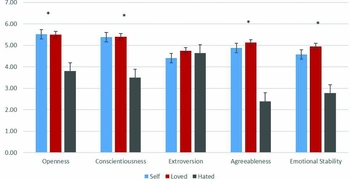
A within-subjects ANOVA with TIPI scores of the participants, person-loved, and target of hate was conducted to see if these scores differed significantly from each other. As can be seen in Figure 1, all F tests were significant, with the exception of extraversion. When it came to rating oneself, the one they love and a person they hated, participants tended to rate all three people as similar on extraversion, F(2, 234) = 1.70, p = .19. When it came to openness, participants rated both themselves and the person they loved as more open than someone they hated, F(2,232) = 65.92, p < .001, η2 = .36. With conscientiousness, participants again rated both themselves and the person they loved as more conscientious than the person hated, F(2,232) = 61.18, p < .001, η2 = .35. Agreeableness showed a similar trend, with the participant and person-loved being ranked higher than the person hated on agreeableness, F(2,232) = 184.21, p < .001, η2 = .61. Similarly, participants rated themselves and the person they loved as more emotionally stable than the person, F(2,232) = 69.10, p < .001, η2 = .37.
Mean scores on the Ten Item Personality Inventory for self, the person loved (in red) and person hated (in black). Significant differences observed were only between the following pairs: Hated versus Self and Hated versus Loved. Note: p < .01.

Given previous research that demonstrated that the relationship one has with a person (e.g., friend vs. family and spouse vs. dating partner) can affect the average personality perception of that person (Beer & Watson, Reference Beer and Watson2008), we conducted a MANOVA with the relationship of the target of hate (and love) as a predictor of their Big Five scores on the TIPI. Bonferroni adjusted pairwise comparisons did not show any difference between any of the Big Five traits and the relationship of the target hated, except for Emotional Stability, F(3,89) = 2.45, p = .02, where family members (M = 1.85, SD = 1.21) who are hated were seen as far less emotionally stable than friends (M = 3.04, SD = 1.32) who are hated (mean difference = −1.19, p = .04). When asked about the personality of a person loved, participants’ perceptions on the TIPI were not significantly different across the different relationship styles, except for emotional stability.
Predicting Motivation
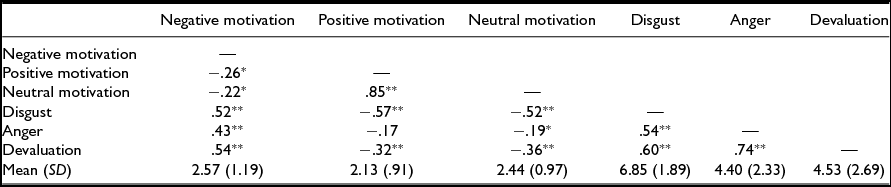
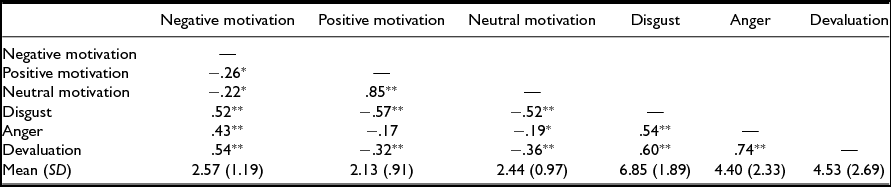
To test if the type of hate could predict motivation, a stepwise multiple regression analysis using Sternberg subscales of hate — disgust, anger and devaluation — as predictor variables, and each motivation — negative, positive and neutral — as dependent variables, was conducted. Correlations, means and standard deviations can be seen in Table 1. Participants’ scores on disgust and devaluation were significant at predicting negative motivation for someone hated, R 2 = .36, F(3,112) = 20.522, p < .001. Thus, the more someone felt disgust, β = .30, t(112) = 3.15, p < .001, or devaluation, β = .36, t(112) = 3.01, p = .003, of a person, the more likely the participant could envision negative things happening to that person, such as no longer living or being in severe distress. However, anger was a not a good predictor of negative motivation, β = −.01, t(112) = −.01, p = .99. For positive motivation, both disgust, β = −.64, t(112) = −6.67, p < .001, and anger, β = .27, t(112) = 2.39, p = .02, were significant at predicting positive motivation; the more disgust someone felt towards the person hated, the less likely they were to envision positive things happening to that person, such as living a long and happy life, or having a happy future relationship with that person. Interestingly, the more anger felt towards the person, the more likely the participant could envision something positive happening to the person hated. The model explained about 36% of the variance, R 2 = .36, F(3,112) = 21.31, p < .001. For neutral motivation, again, both disgust, β = −.52, t(112) = −5.25, p < .001, and anger, β = .26, t(112) = 2.22, p = .03, were significant at predicting neutral motivation, R 2 = .31, F(3,112) = 16.60, p < .001; the more disgust one felt towards someone they hated, the less likely they were to envision seeing or doing neutral things to that person (e.g., saying hi or envisioning them walking to work), while the more anger felt towards the person, the more likely they could envision something neutral happening to the person.
Correlations and Means and Standard Deviations of Motivations and Subtypes of Hate as defined and measured by Sternberg's Hate scale.
Note: *p < .05, **p < .01.
Discussion
The primary purpose of this study was to provide empirical evidence that certain feelings like ‘love’ and ‘hate’ can affect the perception of the target that is loved or hated, respectively. Another purpose of this study was to provide empirical evidence that hate can predict or is correlated with motivation. Previous literature has already demonstrated that love can produce a positivity bias when perceiving the person who is loved (e.g., Fletcher, Simpson, & Boyes, Reference Fletcher, Simpson, Boyes, Schaller, Simpson and Kenrick2006; Gagné & Lydon, Reference Gagné and Lydon2004). The current study demonstrated that there is a relationship between one's hatred and the perception of the person hated. It appears that participants tend to view the person hated as less open, agreeable, emotionally stable and conscientious than they perceive themselves or the person they love. However, interestingly, extraversion in the person hated was not seen differently from the person loved or the self, suggesting that people who are hated may be seen as obnoxiously social without any redeeming qualities, such as being agreeable or emotionally stable. Of course, this study was not intended to address the causal direction of the perception of hatred. It could be that hatred causes a perceptual change in a person, or that people who are high on extraversion and lower on other personality traits are more likely to be hated. Future research can address these issues. Despite not knowing the causal direction of the perceptual difference, these results are important in helping to understand that perception of a person and negative emotions, such as hatred, are related. A better understanding of this relationship may help those who are trying to overcome their hatred or who are in situations that can induce hatred (e.g., during war or competitive sports). Overall, the ‘darkness’ of the perception of hate can be categorised as not overly negative, but a combination of annoying traits.
Aumer-Ryan and Hatfield (Reference Aumer-Ryan and Hatfield2007) demonstrated that there is a close relationship between hate and love in terms of targets. People tend to name people they have an intimate relationships with —family, friends and lovers, or people they spend considerable time with, such as coworkers/classmates — as targets of hate. This study replicated those findings and demonstrates that the relationship between love and hate may be an important part of the course of intimate relationships. This is important to understand, as hate can lead to dangerous consequences, such as domestic abuse and possibly even murder. Considering that the primary suspect in a murder is the spouse, learning more about how hatred can evolve in intimate relationships is important (U.S. Department of Justice, 2009).
When it comes to hate being a motivation, it appears that hate (with its subscales of disgust, anger, and devaluation) are positively correlated with negative motivation and negatively correlated neutral and positive motivation (see Table 1). However, there is not a perfect nor a near perfect correlation between any of the motivations and hate, suggesting that hate, although related to motivations, may involve more than just a direction of motivation. The components of hate (disgust and devaluation) were significant in predicting negative motivation (such as imagining someone in extreme distress or no longer existing) and disgust was significant in predicting a lack of positive motivation. Thus, the more disgust one feels towards someone hated, the less likely a person can envision positive things happening to that person, or having a future positive relationship with that person. This study demonstrates that disgust and devaluation are very important parts of hatred when it comes to predicting motivation. Anger was related to positive and neutral motivation, which is understandable considering that anger can often be considered an approach emotion (Harmon-Jones & Allen, Reference Harmon-Jones and Allen1998). Thus, the anger experienced towards someone hated may actually propel the person to interact with him/her in a non-negative manner. Future research may be warranted to better understand how disgust and devaluation work to compose hatred and how anger may actually be seen as a method of overcoming hate or possibly finding reconciliation with someone hated.
Limitations
The current study shows that perceptions of hated people are different from those who are loved and of the self. The current design of the study does not discern if these perceptions are more or less accurate. This could be rectified in future studies, especially in a class setting (considering classmates were one of the more common people said to be hated, this would be an ideal setting), where participants could fill out personality inventories of themselves and fellow classmates and once all surveys were collected, calculations of accuracy could be obtained. Similarly, this study is not able to ascertain if the personality perceived is the cause of the hatred or is a subsequent result of the target being hated. Again, a similar study done in a classroom where participants are then later surveyed throughout the semester could help illuminate if the personality of the targets of hate change over time.
How hate and motivation are measured is also a limitation of this study. This study's primary purpose was not to create a measure of hate or motivation, but to better understand how the current literature, theory, and measures used can provide empirical evidence for predicting motivation and understanding hatred.