




1 Introduction
Deep-ultraviolet (DUV) lasers, characterized by their short wavelengths and high photon energies, hold broad application prospects in confocal microscopy[ Reference Kasaragod and Aizawa1 ], single-molecule imaging[ Reference Li, Ruckstuhl and Seeger2], semiconductor inspection[ Reference Okamoto, Kuniyasu and Hattori3] and precise micromachining[ Reference Wagner and Harned4]. Among various DUV sources, high-repetition-rate (MHz class and above), short-pulse DUV lasers offer distinct advantages for both scientific research and industrial applications. Pulses at higher repetition rates can improve the signal-to-noise ratio of imaging while mitigating photobleaching and phototoxic effects in biological specimens[ Reference Ji, Magee and Betzig5]. For materials processing, shorter pulse durations effectively reduce the heat-affected zone and enhance ablation efficiency, whereas higher repetition rates increase throughput and processing speed[ Reference Hashida, Semerok, Gobert, Petite, Izawa and Wagner6, Reference Hou, Bai, Wang and Qian7]. In addition, such lasers can serve as drive lasers for free electron lasers, enabling the generation of high-repetition-rate, short-pulse electron bunches[ Reference Decking, Abeghyan, Abramian, Abramsky, Aguirre, Albrecht, Alou, Altarelli, Altmann, Amyan, Anashin, Apostolov, Appel, Auguste, Ayvazyan, Baark, Babies, Baboi, Bak, Balandin, Baldinger, Baranasic, Barbanotti, Belikov, Belokurov, Belova, Belyakov, Berry, Bertucci, Beutner, Block, Blöcher, Böckmann, Bohm, Böhnert, Bondar, Bondarchuk, Bonezzi, Borowiec, Bösch, Bösenberg, Bosotti, Böspflug, Bousonville, Boyd, Bozhko, Brand, Branlard, Briechle, Brinker, Brinker, Brinkmann, Brockhauser, Brovko, Brück, Brüdgam, Butkowski, Büttner, Calero, Castro-Carballo, Cattalanotto, Charrier, Chen, Cherepenko, Cheskidov, Chiodini, Chong, Choroba, Chorowski, Churanov, Cichalewski, Clausen, Clement, Cloué, Cobos, Coppola, Cunis, Czuba, Czwalinna, D’Almagne, Dammann, Danared, de Zubiaurre Wagner, Delfs, Delfs, Dietrich, Dietrich, Dohlus, Dommach, Donat, Dong, Doynikov, Dressel, Duda, Duda, Eckoldt, Ehsan, Eidam, Eints, Engling, Englisch, Ermakov, Escherich, Eschke, Saldin, Faesing, Fallou, Felber, Fenner, Fernandes, Fernández, Feuker, Filippakopoulos, Floettmann, Fogel, Fontaine, Francés, Martin, Freund, Freyermuth, Friedland, Fröhlich, Fusetti, Fydrych, Gallas, García, Garcia-Tabares, Geloni, Gerasimova, Gerth, Geßler, Gharibyan, Gloor, Głowinkowski, Goessel, Gołębiewski, Golubeva, Grabowski, Graeff, Grebentsov, Grecki, Grevsmuehl, Gross, Grosse-Wortmann, Grünert, Grunewald, Grzegory, Feng, Guler, Gusev, Gutierrez, Hagge, Hamberg, Hanneken, Harms, Hartl, Hauberg, Hauf, Hauschildt, Hauser, Havlicek, Hedqvist, Heidbrook, Hellberg, Henning, Hensler, Hermann, Hidvégi, Hierholzer, Hintz, Hoffmann, Hoffmann, Hoffmann, Holler, Hüning, Ignatenko, Ilchen, Iluk, Iversen, Iversen, Izquierdo, Jachmann, Jardon, Jastrow, Jensch, Jensen, Jeżabek, Jidda, Jin, Johansson, Jonas, Kaabi, Kaefer, Kammering, Kapitza, Karabekyan, Karstensen, Kasprzak, Katalev, Keese, Keil, Kholopov, Killenberger, Kitaev, Klimchenko, Klos, Knebel, Koch, Koepke, Köhler, Köhler, Kohlstrunk, Konopkova, Konstantinov, Kook, Koprek, Körfer, Korth, Kosarev, Kosiński, Kostin, Kot, Kotarba, Kozak, Kozak, Kramert, Krasilnikov, Krasnov, Krause, Kravchuk, Krebs, Kretschmer, Kreutzkamp, Kröplin, Krzysik, Kube, Kuehn, Kujala, Kulikov, Kuzminych, La Civita, Lacroix, Lamb, Lancetov, Larsson, Le Pinvidic, Lederer, Lensch, Lenz, Leuschner, Levenhagen, Li, Liebing, Lilje, Limberg, Lipka, List, Liu, Liu, Lorbeer, Lorkiewicz, Lu, Ludwig, Machau, Maciocha, Madec, Magueur, Maiano, Maksimova, Malcher, Maltezopoulos, Mamoshkina, Manschwetus, Marcellini, Marinkovic, Martinez, Martirosyan, Maschmann, Maslov, Matheisen, Mavric, Meißner, Meissner, Messerschmidt, Meyners, Michalski, Michelato, Mildner, Moe, Moglia, Mohr, Mohr, Möller, Mommerz, Monaco, Montiel, Moretti, Morozov, Morozov and Mross8– Reference Zhang, Gilevich, Miahnahri, Alverson, Brachmann, Duris, Franz, Fry, Hirschman, Larsen, Lemons, Li, Lu, Marinelli, Martinez, May, Milshtein, Murari, Neveu, Robinson, Schmerge, Sun, Vecchione, Xu, Zhou and Carbajo10].
As an extension of high-repetition-rate laser systems, burst-mode lasers combine a high intra-burst repetition rate with high pulse energies and have consequently become a major focus of current research[ Reference Elahi, Yılmaz, Eldeniz and Ilday11]. Pulses at a high intra-burst repetition rate within each burst can drive efficient ablation before the target region cools, thereby substantially improving processing quality[ Reference Kerse, Kalaycıoğlu, Elahi, Çetin, Kesim, Akçaalan, Yavaş, Aşık, Öktem, Hoogland, Holzwarth and Ilday12]. Burst-mode lasers can also serve as pump sources and are widely used in pump–probe microscopy[ Reference Piland and Grumstrup13]. They enhance the signal-to-noise ratio by enabling rapid accumulation of pump–probe statistics while keeping the single-pulse fluence low enough to avoid multiphoton excitation[ Reference Filippetto, Musumeci, Li, Siwick, Otto, Centurion and Nunes14]. In addition, drive lasers for some free electron laser facilities operate in burst mode, since this format can produce electron bunches with higher charges[ Reference Decking, Abeghyan, Abramian, Abramsky, Aguirre, Albrecht, Alou, Altarelli, Altmann, Amyan, Anashin, Apostolov, Appel, Auguste, Ayvazyan, Baark, Babies, Baboi, Bak, Balandin, Baldinger, Baranasic, Barbanotti, Belikov, Belokurov, Belova, Belyakov, Berry, Bertucci, Beutner, Block, Blöcher, Böckmann, Bohm, Böhnert, Bondar, Bondarchuk, Bonezzi, Borowiec, Bösch, Bösenberg, Bosotti, Böspflug, Bousonville, Boyd, Bozhko, Brand, Branlard, Briechle, Brinker, Brinker, Brinkmann, Brockhauser, Brovko, Brück, Brüdgam, Butkowski, Büttner, Calero, Castro-Carballo, Cattalanotto, Charrier, Chen, Cherepenko, Cheskidov, Chiodini, Chong, Choroba, Chorowski, Churanov, Cichalewski, Clausen, Clement, Cloué, Cobos, Coppola, Cunis, Czuba, Czwalinna, D’Almagne, Dammann, Danared, de Zubiaurre Wagner, Delfs, Delfs, Dietrich, Dietrich, Dohlus, Dommach, Donat, Dong, Doynikov, Dressel, Duda, Duda, Eckoldt, Ehsan, Eidam, Eints, Engling, Englisch, Ermakov, Escherich, Eschke, Saldin, Faesing, Fallou, Felber, Fenner, Fernandes, Fernández, Feuker, Filippakopoulos, Floettmann, Fogel, Fontaine, Francés, Martin, Freund, Freyermuth, Friedland, Fröhlich, Fusetti, Fydrych, Gallas, García, Garcia-Tabares, Geloni, Gerasimova, Gerth, Geßler, Gharibyan, Gloor, Głowinkowski, Goessel, Gołębiewski, Golubeva, Grabowski, Graeff, Grebentsov, Grecki, Grevsmuehl, Gross, Grosse-Wortmann, Grünert, Grunewald, Grzegory, Feng, Guler, Gusev, Gutierrez, Hagge, Hamberg, Hanneken, Harms, Hartl, Hauberg, Hauf, Hauschildt, Hauser, Havlicek, Hedqvist, Heidbrook, Hellberg, Henning, Hensler, Hermann, Hidvégi, Hierholzer, Hintz, Hoffmann, Hoffmann, Hoffmann, Holler, Hüning, Ignatenko, Ilchen, Iluk, Iversen, Iversen, Izquierdo, Jachmann, Jardon, Jastrow, Jensch, Jensen, Jeżabek, Jidda, Jin, Johansson, Jonas, Kaabi, Kaefer, Kammering, Kapitza, Karabekyan, Karstensen, Kasprzak, Katalev, Keese, Keil, Kholopov, Killenberger, Kitaev, Klimchenko, Klos, Knebel, Koch, Koepke, Köhler, Köhler, Kohlstrunk, Konopkova, Konstantinov, Kook, Koprek, Körfer, Korth, Kosarev, Kosiński, Kostin, Kot, Kotarba, Kozak, Kozak, Kramert, Krasilnikov, Krasnov, Krause, Kravchuk, Krebs, Kretschmer, Kreutzkamp, Kröplin, Krzysik, Kube, Kuehn, Kujala, Kulikov, Kuzminych, La Civita, Lacroix, Lamb, Lancetov, Larsson, Le Pinvidic, Lederer, Lensch, Lenz, Leuschner, Levenhagen, Li, Liebing, Lilje, Limberg, Lipka, List, Liu, Liu, Lorbeer, Lorkiewicz, Lu, Ludwig, Machau, Maciocha, Madec, Magueur, Maiano, Maksimova, Malcher, Maltezopoulos, Mamoshkina, Manschwetus, Marcellini, Marinkovic, Martinez, Martirosyan, Maschmann, Maslov, Matheisen, Mavric, Meißner, Meissner, Messerschmidt, Meyners, Michalski, Michelato, Mildner, Moe, Moglia, Mohr, Mohr, Möller, Mommerz, Monaco, Montiel, Moretti, Morozov, Morozov and Mross8, Reference Winkelmann, Choudhuri, Grosse-Wortmann, Hartl, Li, Mohr, Müller, Peters, Pfeiffer and Salman15]. However, reported burst-mode DUV sources have generally delivered average powers below 1 W, which limits their applicability.
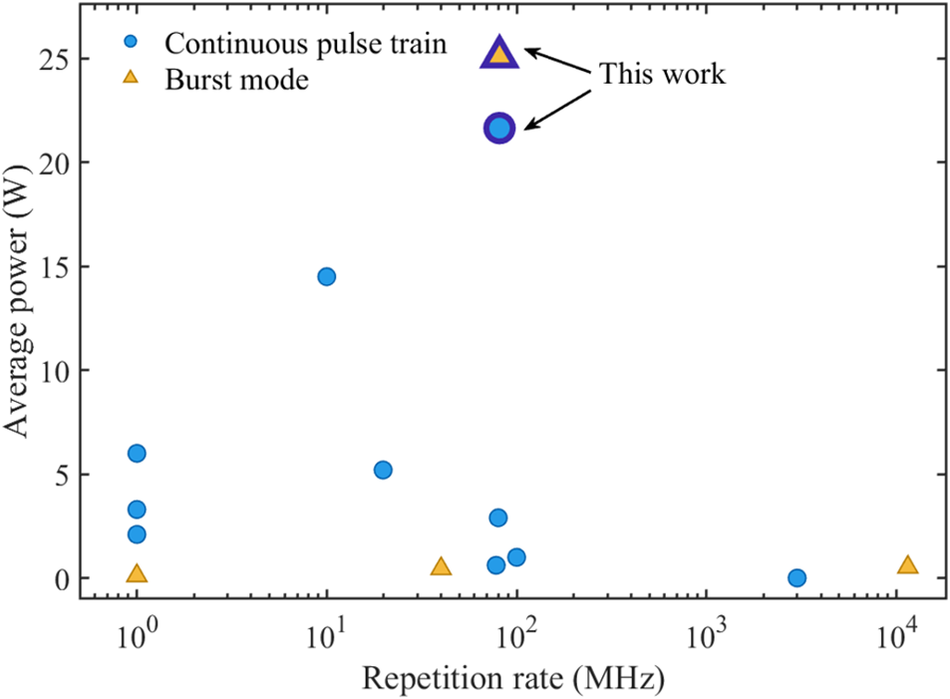
At present, a widely adopted approach for generating DUV radiation is to frequency-quadruple or frequency-quintuple near-infrared (NIR) pulses (centered at 1030–1064 nm) delivered by laser amplifiers[ Reference Zheng, Cong, Liu, Wang and Zhao16]. Although solid-state amplifier systems have achieved DUV output powers around 50 W[ Reference Mennerat, Bizet, Mahieu, Dobroc, Lupinski, Balitsky, Villeval, Lozano, Alahyane, Houard and Wolf17– Reference Schmittner, Röcker, Loescher, Bienert, Dobroc, Balitski, Lupinski, Graf and Ahmed19], all-fiber amplifiers remain highly attractive due to their compactness, high reliability and efficient thermal management for high-repetition-rate, high-average-power operation[ Reference Jauregui, Limpert and Tünnermann20– Reference Pan, Geng and Jiang22]. Moreover, all-fiber amplifiers are capable of delivering high-power sub-picosecond or femtosecond pulses while maintaining good beam quality[ Reference Pedersen, Johansen, Olesen, Michieletto, Gaponenko and Maack23]. Consequently, numerous DUV sources operating based on fiber lasers at MHz-class and higher repetition rates have been reported. For DUV lasers with central wavelengths in the 257–266 nm range, for example, Pan et al. [ Reference Pan, Geng and Jiang22] demonstrated picosecond DUV pulses at 10 MHz with an average power of 14.5 W; Kumar et al. [ Reference Kumar, Casals, Wei and Ebrahim-Zadeh24] achieved 2.9 W at 80 MHz; and Zhou et al. [ Reference Zhou, Yoshitomi, Kobayashi and Torizuka25] reported 1 W of DUV output at 100 MHz. For burst-mode DUV lasers, Xie et al. [ Reference Xie, Liu, Zhang, Deng, Zhou, Xiong, Tang, Lou, Zhao, Luo, Gu and Li26] realized DUV generation with a burst repetition rate of 100 kHz, an intra-burst repetition rate of 41.6 MHz and an average power of 0.45 W. Ye et al. [ Reference Ye, Pontagnier, Dixneuf, Santarelli and Cormier27] further increased the DUV power to 0.52 W in burst mode at an intra-burst repetition rate of 11.48 GHz. However, the pulse energy delivered by amplifiers at high repetition rates is typically limited, making power scaling of high-average-power DUV output both a key objective and a major technical challenge. Figure 1 summarizes recently reported all-fiber-based DUV sources operating at MHz-class and higher repetition rates, with central wavelengths spanning 257–266 nm[ Reference Pan, Geng and Jiang22, Reference Kumar, Casals, Wei and Ebrahim-Zadeh24– Reference Zhang, Li, Liu, Zhu, Zhang, He, Liu, Wu and Yang33].
Performance comparison of recently reported all-fiber-based DUV sources operating at MHz-class and higher repetition rates with central wavelengths in the 257–266 nm range, highlighting the advantages of this work. For burst-mode sources, the repetition rate on the horizontal axis refers to the intra-burst repetition rate.

Figure 1 Long description
A scatter plot with a logarithmic x-axis representing Repetition rate in M H z from 10 super 0 to 10 super 4 and a linear y-axis representing Average power in W from 0 to 25.
Legend:
* Blue circles represent Continuous pulse train.
* Yellow triangles represent Burst mode.
Data Distribution:
* Most reported sources are clustered in the lower-left and bottom regions, with average powers below 7 W across repetition rates from 1 to 10,000 M H z.
* A single blue circle is located at approximately 10 M H z and 14.5 W.
* Two prominent outliers are highlighted with arrows and the label ‘This work’ in the upper-center of the plot. These include a yellow triangle at approximately 80 M H z with 25 W average power and a blue circle at approximately 80 M H z with 22 W average power. These two points represent significantly higher power levels than all other cited fiber-based D U V sources in the 257 to 266 nm range.
In recent years, all-fiber laser systems employing ytterbium-doped (Yb-doped) photonic-crystal fibers (PCFs) as the main amplification stage have attracted a growing attention. PCF-based amplifiers, especially rod-type PCFs (Rod-PCFs), can provide NIR pulses with excellent beam quality and high-power stability at average powers above 200 W[ Reference Pedersen, Johansen, Olesen, Michieletto, Gaponenko and Maack23, Reference Zhao, Sheehy and Minty34], thereby offering a high-quality fundamental for power scaling of DUV generation. Benefiting from the high beam quality of PCF-based amplifiers, efficient frequency conversion has been demonstrated in previous works[ Reference Zhao, Sheehy and Minty34, Reference Zhao, Dunham and Wise35]. In the frequency conversion stages, noncritical phase-matched lithium triborate (LBO) crystals enable efficient and stable second-harmonic generation (SHG). For fourth-harmonic generation (FHG), cesium lithium borate (CLBO) crystals are widely used owing to their lower nonlinear absorption and larger acceptance bandwidth than beta-barium borate (BBO)[ Reference Cui, Sun, Liu and Zhu36], and have repeatedly been shown to support DUV outputs beyond 10 W[ Reference Orii, Yoshii, Kohno, Tanaka, Shibuya, Okada, Mori, Nishimae and Yoshimura18, Reference Kohno, Orii, Sawada, Okuyama, Shibuya, Shimizu, Yoshimura, Mori, Nishimae and Okada37].
Building on these advantages, we employ a two-stage Yb-doped PCF as the main amplifier and successively perform SHG in an LBO crystal followed by FHG in a CLBO crystal to realize high-power, high-beam-quality DUV output. Burst-mode operation is implemented via multi-stage acousto-optic modulation (AOM) for pulse picking, together with burst-envelope shaping. The amplifier delivers NIR pulses at 81.25 MHz with an average power of 203 W, and it also maintains over 200 W average power in burst operation. The subsequent SHG stage generates more than 100 W of green laser output. At 81.25 MHz, we obtain sub-picosecond pulses centered at 259.4 nm with an average power of 21.7 W.
Leveraging the burst-mode operation, we further investigate the output characteristics of high-power FHG at different burst repetition rates and optimize the frequency conversion design accordingly. At a burst repetition rate of 300 kHz with 50 pulses per burst (with the intra-burst repetition rate fixed by the seed at 81.25 MHz), an average DUV power of 20.4 W is achieved, corresponding to a burst energy of 68 μJ. The DUV output power reaches 25.1 W at a burst repetition rate of 750 kHz. The intrinsic merits of the PCF-based amplifier, together with our optimized frequency conversion module, ensure excellent beam quality and power stability of the generated DUV radiation, providing a solid foundation for a broad range of studies and applications based on high-repetition-rate, short-pulse DUV lasers and electron beams.
2 Experimental setup
2.1 Pre-amplification and pulse picking module
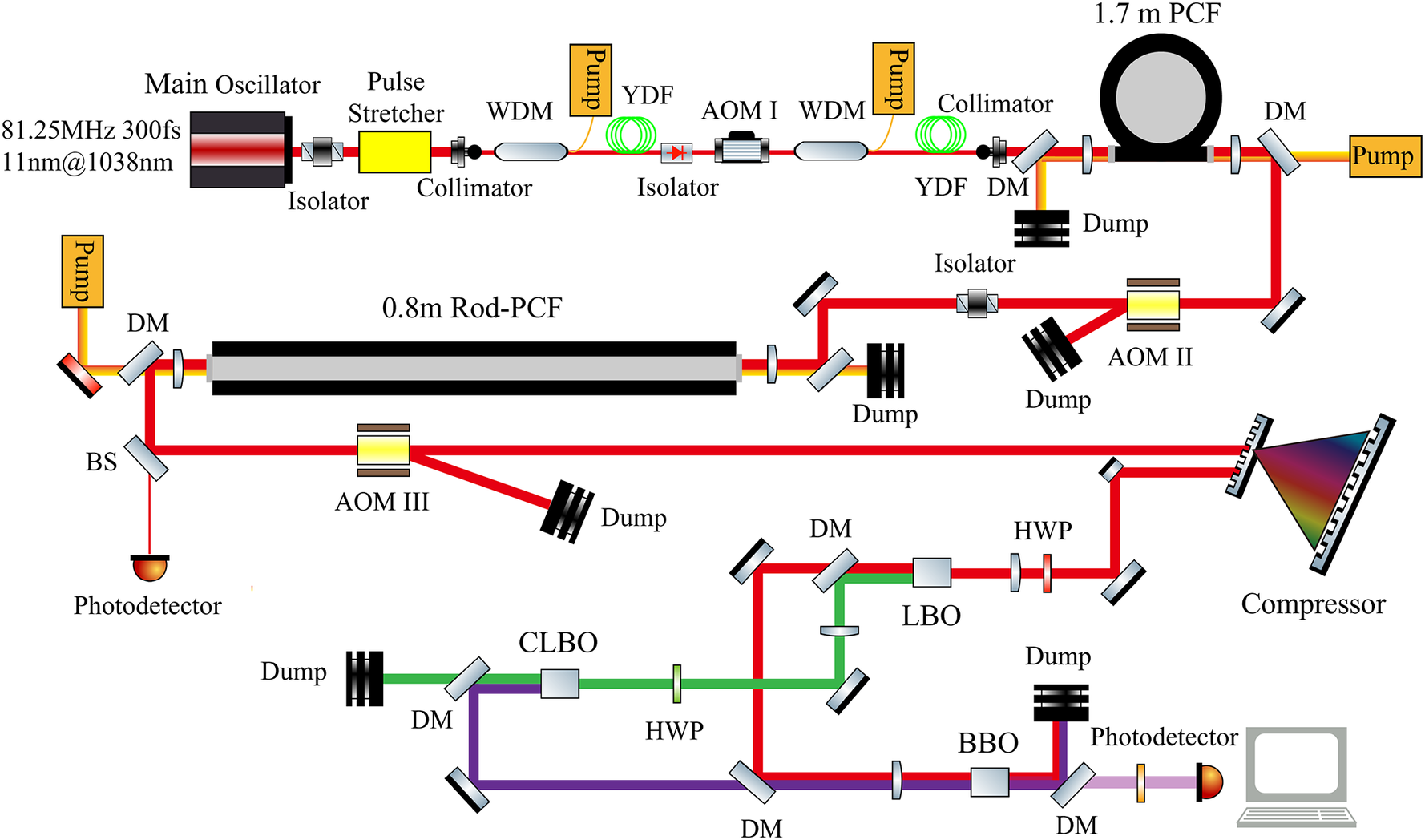
A schematic of the Yb-doped fiber master oscillator power amplifier (MOPA) system employing PCF amplifiers, the frequency conversion module and the cross-correlation measurement setup is shown in Figure 2. A mode-locked femtosecond Yb-doped fiber laser (Menlo Systems, Inc.) is employed as the seed oscillator. It delivers NIR pulses with an average power of 59 mW, a repetition rate of 81.25 MHz, a central wavelength of 1038 nm, a spectral bandwidth of 11 nm (full width at half maximum (FWHM)) and a pulse duration of 157 fs (FWHM). A chirped pulse amplification (CPA) configuration is adopted, employing a Martinez-type stretcher based on a transmission grating (1841 lines/mm, area of interest (AOI) 71.5°) to stretch the pulses to approximately 600 ps. After two passes through the grating, a slit is used to spectrally filter the signal, and the amplifier output spectral bandwidth is set to 3 nm to enable efficient frequency conversion. The stretcher output is then coupled into the fiber pre-amplification modules, with an input signal power of 2.7 mW. Both pre-amplifiers use Yb-doped fiber with a 6 μm core diameter and are pumped by 976 nm laser diodes. With a pump power of 450 mW in pre-amplifier I (Preamp I), the signal is amplified to 70 mW.
Schematic of the PCF-based MOPA system, the frequency conversion module and the cross-correlation measurement setup (WDM, wavelength division multiplexer; YDF, Yb-doped fiber; AOM, acousto-optic modulator; DM, dichroic mirror; PCF, photonic-crystal fiber; BS, beam splitter; HWP, half-wave plate).

Figure 2 Long description
The system begins with an 81.25 MHz, 1038 nm mode-locked oscillator. The pulses pass through an isolator and pulse stretcher, followed by two Yb-doped-fiber pre-amplifiers. AOM I selects individual pulses and generates the required burst formats. The signal is then amplified in a 1.7 m Yb-doped PCF, shaped by AOM II to compensate the intra-burst energy distribution, and further amplified in a 0.8 m Rod-PCF. After the Rod-PCF, a beam splitter directs a small portion of the beam to a photodetector, while the main beam passes through AOM III and a grating compressor. The compressed fundamental beam undergoes second-harmonic generation in an LBO crystal, producing 519 nm radiation. The green beam is subsequently frequency-doubled in a CLBO crystal to generate 259 nm DUV radiation. Dichroic mirrors separate and direct the different wavelengths. A portion of the residual fundamental beam and the DUV beam are combined in a BBO crystal to generate a difference-frequency cross-correlation signal, which is detected by a photodetector and recorded by a computer.
The amplified pulses are subsequently injected into a fiber acousto-optic modulator (AOM I) for pulse picking. With a 6 ns rise/fall time, AOM I can fully gate individual pulses from the 81.25 MHz pulse train, thereby enabling precise control of the burst repetition rate and the number of pulses per burst. In addition to the 81.25 MHz continuous pulse train, we also demonstrate operation modes at burst repetition rates of 750, 500 and 300 kHz, with 50 pulses per burst. Due to the AOM insertion loss and the power loss induced by pulse picking, a second pre-amplifier (Preamp II) is used to amplify the gated signal to enhance the signal-to-noise ratio of the main amplifier. At a Preamp II pump power of 450 mW, the average output power in the 81.25 MHz mode is 117.7 mW. As the burst repetition rate decreases, the signal power injected into Preamp II is reduced, leading to a slight decrease in the average output power. At a burst repetition rate of 300 kHz, the average power is 93.7 mW.
2.2 Two-stage PCF amplification and burst-envelope shaping module
A two-stage main-amplifier configuration is employed to boost the average power of the infrared pulses to beyond 200 W. After pre-amplification, the signal is collimated into free space and, after passing through an optical isolator, is coupled into the first main amplifier, which consists of a 1.7-m-long Yb-doped PCF with a mode-field diameter of 31 μm (DC-200/40-PZ-Yb, NKT Photonics). The fiber is mounted on a water-cooled plate and backward pumped by a 976 nm laser diode with a maximum output power of 60 W. Notably, several watts of residual pump remain unabsorbed by the PCF at the maximum output power. To address this, we replaced the fiber-based signal coupling into the PCF with a free-space coupling scheme. A dichroic mirror is inserted before the coupling lens such that the residual pump is fully absorbed by a beam dump. This modification mitigates excessive heat deposition at the signal coupling end, thereby substantially improving pump efficiency and power stability[ Reference Wang, Xu, Liu, Zhang, Liu, Xu, Feng, Li, Liu and Huang38]. Two three-axis high-precision translation stages equipped with coupling lenses are used for signal and pump coupling. The amplified pulses exhibit a fundamental Gaussian mode and a polarization extinction ratio exceeding 15 dB.
During burst-mode amplification, a nonuniform intra-burst pulse-energy distribution is often observed, which can become more pronounced during subsequent frequency conversion, ultimately limiting the performance and applicability of burst-mode operation. To address this issue, an acousto-optic modulator (AOM II) driven by an analog radio frequency (RF) waveform is inserted between the two main amplifiers. AOM II not only equalizes the burst energy envelope but also provides pre-shaping to compensate burst evolution in the second main amplifier, thereby maintaining a flat-top burst envelope at the amplifier output. After an optical isolator, more than 20 W of signal power is coupled into the second main amplifier.
The second main amplifier employs a 0.8-m-long Yb-doped Rod-PCF with a mode-field diameter of 65 μm (aeroGAIN-ROD-3.1, NKT Photonics). The large mode area significantly suppresses nonlinear effects during amplification. The Rod-PCF is backward pumped by a wavelength-locked diode laser at 976 nm with a maximum output power of 280 W. An average output power exceeding 200 W can be realized in all operating modes.
After amplification, a third acousto-optic modulator (AOM III) is employed, allowing the control of the burst repetition rate over a wide range from 1 Hz to several hundred kHz. In this work, AOM III is kept continuously ON so that all incident pulses pass through with an energy loss of approximately 10%. After AOM III, the pulses are compressed using a pair of transmission gratings (1841 lines/mm, AOI 71.5°) configured in a Treacy structure. The second grating is mounted on a translation stage, and both its angle and the grating separation are carefully optimized to ensure that the introduced second-order (and higher-order) dispersion compensates the dispersion accumulated in the stretcher and amplifiers. The vertical separation between the gratings is 17.3 cm, corresponding to a negative dispersion of 204.3 ps/nm, which matches the stretcher design value.
2.3 Frequency conversion and cross-correlation module
The compressed pulses are subsequently delivered to the frequency conversion module, as schematically shown in Figure 2. SHG is realized in an LBO crystal via type-I noncritical phase matching (NCPM-SHG). In high-repetition-rate SHG, beam focusing is typically required to increase the peak intensity and thereby improve conversion efficiency. Although spatial walk-off is essentially negligible under NCPM-SHG, anisotropic phase mismatch associated with transverse wave vectors of a focused beam can still induce beam distortions. For a given crystal length and fundamental spectral bandwidth, reducing the fundamental beam waist leads to a lower ellipticity of the second-harmonic (SH) beam[
Reference Shi, Wang, Zhang, Liu, Xu and Huang39]. Accordingly, guided by the simulations, a lens with a focal length of 300 mm is employed to focus the fundamental beam to a waist radius of 110 μm, aiming to obtain green laser output with an average power exceeding 100 W and a fundamental Gaussian transverse profile in the experiment. Moreover, temperature fluctuations in the NCPM-SHG crystal can introduce pronounced pointing and power instabilities in the generated SH beam. To ensure stable green laser output, the crystal is housed in a high-precision temperature-controlled oven with a stability of 0.003°C[
Reference Zhang, Xu, Feng, Liu, Wang, Xu, Quan and Huang40]. An LBO crystal with dimensions of 3 mm × 3 mm × 5 mm is adopted for SHG at 81.25 MHz. However, in burst operation, the increased peak power enhances Kerr lensing[
Reference Willenberg, Brunner, Phillips and Keller41] in the crystal, leading to beam divergence and reduced conversion efficiency. We therefore employ a 3-mm-long LBO crystal for SHG in burst mode. Both facets of the crystals are anti-reflection (AR) coated at 1038 and 519 nm. The phase-matching temperature is set to 70°C for both crystals, corresponding to a phase-matching angle of
$\left(\theta, \varphi \right)=\left(90{}^{\circ},11.4{}^{\circ}\right)$
 . This operating temperature is selected to improve thermal stability and system robustness.
The generated green laser beam is collimated by a lens and is then incident on a CLBO crystal (
$\theta =65.2{}^{\circ})$
 for FHG, producing DUV pulses centered at 259.4 nm. Owing to the strong hygroscopicity of CLBO, the crystal is heated to 150°C in a temperature-controlled oven to suppress moisture-induced degradation. The oven is placed inside a dry-air-circulation chamber, where the relative humidity is maintained below 20%. To suppress temperature fluctuation during operation, a CLBO crystal with a relatively small cross-section of 3 mm × 3 mm is employed. Although CLBO is generally considered to exhibit lower nonlinear absorption and thus potentially higher conversion efficiency at elevated pulse energies, the dependence of its FHG efficiency under sub-picosecond pumping at high DUV average powers (>10 W) has not yet been systematically reported. Taking advantage of the repetition-rate tunability of the burst-mode operation, we investigate the high-power FHG performance of CLBO at different repetition rates and present corresponding FHG configurations optimized for different pulse-energy regimes. To further characterize the DUV pulse properties, we also perform difference frequency generation (DFG) cross-correlation measurements using the fundamental pulses after SHG and the generated DUV pulses, as shown in Figure 2.
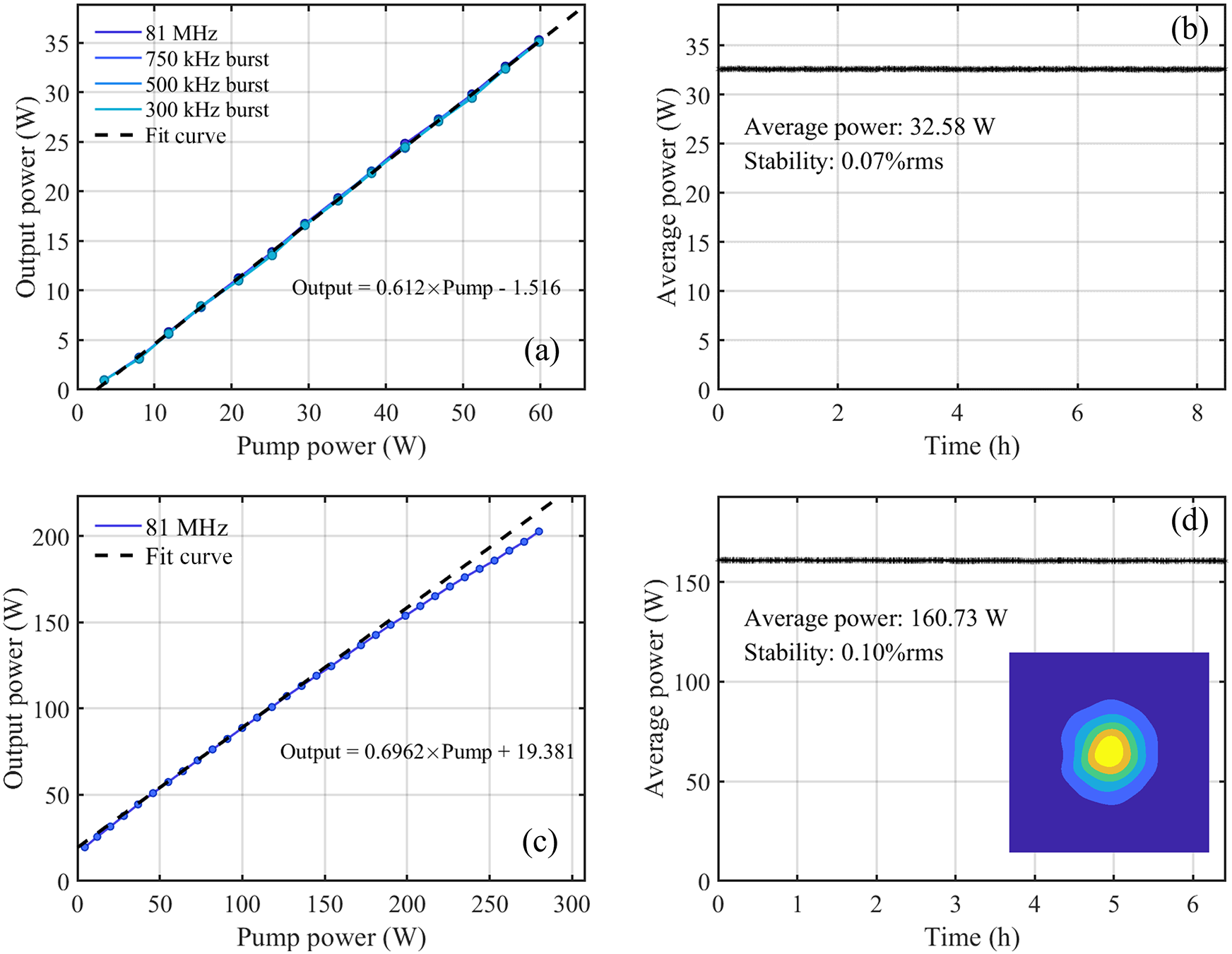
(a) PCF output power versus pump power for 81.25 MHz continuous operation and burst operation. (b) Power stability at 32.6 W PCF output. (c) Rod-PCF output power as a function of pump power. (d) Transverse beam profile and power stability at 160.7 W Rod-PCF output.

Figure 3 Long description
Panel (a) shows PCF output power versus pump power for 81.25 MHz continuous operation and burst operation at 750, 500, and 300 kHz. The four datasets nearly overlap and follow the linear fit Output = 0.612 × Pump − 1.516. Panel (b) shows a stable PCF output near 32.58 W, with a relative fluctuation of 0.07% rms. Panel (c) shows Rod-PCF output power versus pump power at 81.25 MHz. The output increases to 202.7 W at a pump power of 280 W, and the fitted relation is Output = 0.6962 × Pump + 19.381. Panel (d) shows a stable Rod-PCF output near 160.73 W, with a relative fluctuation of 0.10% rms. The inset displays a nearly circular, fundamental Gaussian transverse beam profile.
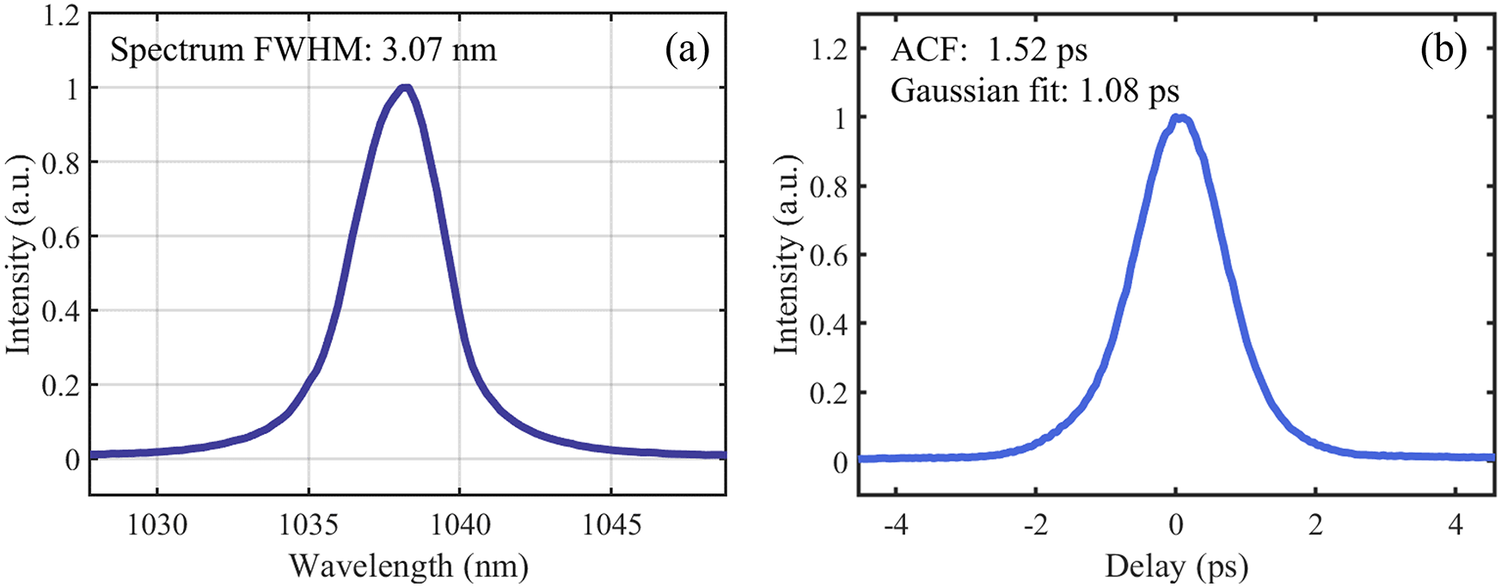
Output NIR spectrum (a) and autocorrelation trace of the compressed pulses (b) at 160.7 W.

Figure 4 Long description
Panel (a) shows normalized spectral intensity versus wavelength. The spectrum is centered near 1038 nm and has a full width at half maximum of 3.07 nm. Panel (b) shows the normalized intensity autocorrelation trace versus delay. The autocorrelation full width at half maximum is 1.52 ps. Assuming a Gaussian temporal profile, the corresponding pulse duration is 1.08 ps.
3 Experimental results
3.1 Characterization of the fundamental wave and second harmonics
Figure 3(a) presents the average output power of the first main amplifier as a function of pump power. No marked difference is observed among the amplified average powers obtained under different burst repetition rates. At a pump power of 60 W, a maximum average output power of 35.3 W is achieved, with a slope efficiency of 61.2%. Under this situation, the spectrum exhibits only a slight gain narrowing at the top, while no spectral broadening or obvious elevation of the spectral sidebands is observed, indicating that no significant amplified spontaneous emission (ASE) occurs. At an output power of 32.6 W, the relative power fluctuation over 7 h is 0.07%, as shown in Figure 3(b).
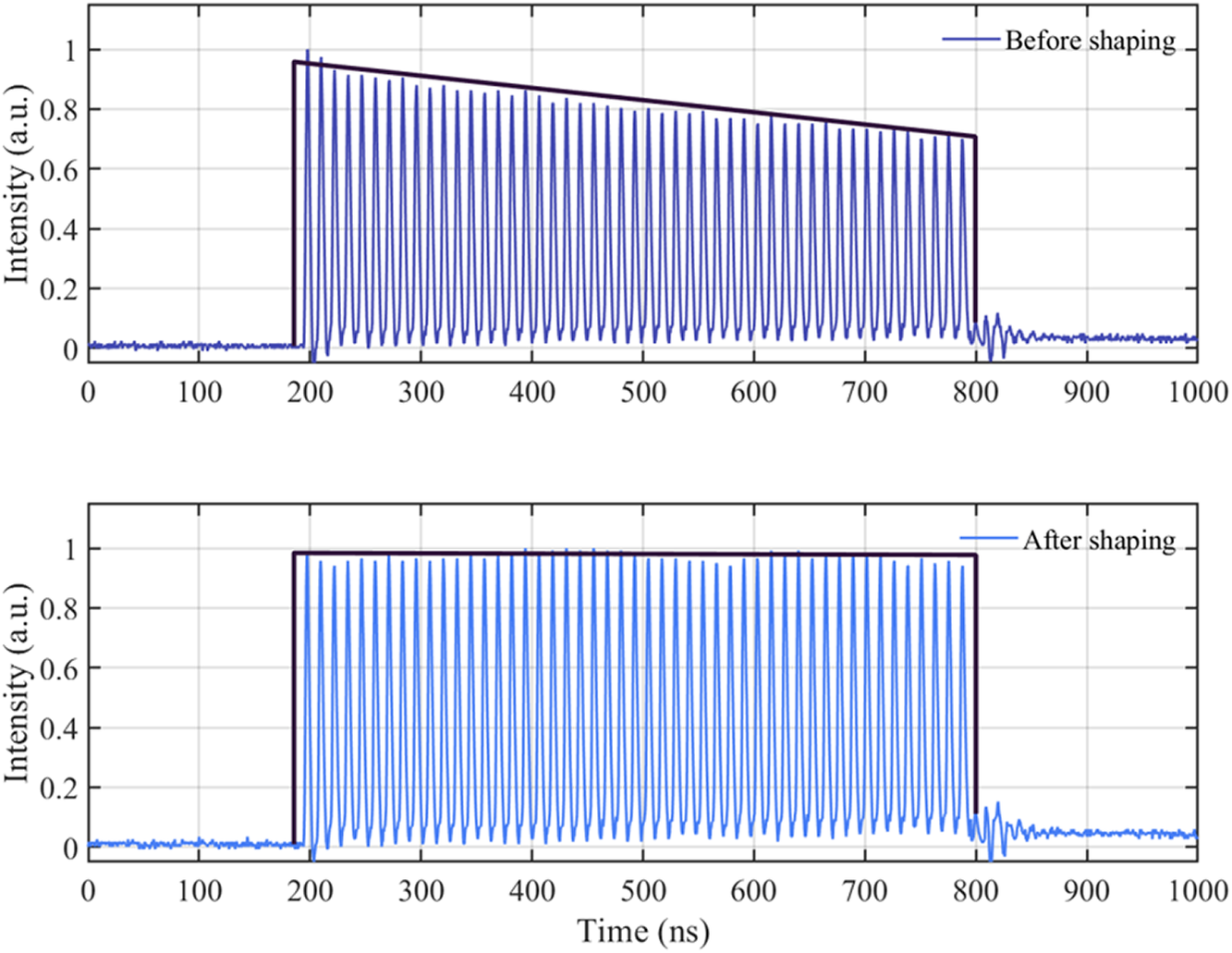
Burst-envelope profiles before and after AOM II burst-envelope shaping for 50 pulses per burst at a burst repetition rate of 300 kHz.

Figure 5 Long description
The two panels show normalized pulse intensity versus time over a 0–1000 ns interval. In the upper panel, before shaping, approximately 50 pulses occur between about 200 and 800 ns, and the pulse energy decreases progressively from the leading edge to the trailing edge of the burst. The leading-edge pulse energy is approximately 1.4 times the trailing-edge value. In the lower panel, after AOM II shaping, the intra-burst pulse energies are nearly equalized and the envelope approaches a flat-top distribution. The measured relative fluctuation of the shaped intra-burst pulse energies is 1.32%.
The laser pulses delivered from the PCF stage undergo burst-envelope shaping by AOM II and are then coupled into the Rod-PCF after an optical isolator. As the burst repetition rate is reduced, the intra-burst pulse energy becomes increasingly higher at the leading edge than at the trailing edge[ Reference Xie, Liu, Zhang, Deng, Zhou, Xiong, Tang, Lou, Zhao, Luo, Gu and Li26], resulting in a lower average power after burst-envelope shaping. We adjust the PCF pump power to keep the average power launched into the Rod-PCF at 24 W, thereby ensuring full saturation of the Rod-PCF amplifier. Similar to the PCF stage, no marked dependence of pumping efficiency on the operating mode is observed. At a pump power of 280 W, the Rod-PCF delivers a maximum average output power of 202.7 W at 81.25 MHz, and the burst energy exceeds 670 μJ at a burst repetition rate of 300 kHz. Figure 3(c) shows the output power of the second main amplifier as a function of pump power in the 81.25 MHz mode. At an output power of 160.7 W, the relative average power fluctuation is 0.10%, and the transverse intensity profile remains close to a fundamental Gaussian mode, as shown in Figure 3(d). During long-term high-power operation, the output power remains nearly unchanged, indicating that no obvious fiber photodarkening occurs. The amplified infrared spectrum exhibits a bandwidth of 3.07 nm, as plotted in Figure 4(a). After pulse picking, the pulses are compressed to 1.08 ps (FWHM) using a Treacy grating pair, with an overall transmission of 82%. Figure 4(b) shows the autocorrelation trace recorded by the autocorrelator (pulseCheck 150, APE GmbH). The pulse duration is mainly limited by higher-order dispersion from the Martinez stretcher and nonlinear phase accumulation in the amplifier chain.
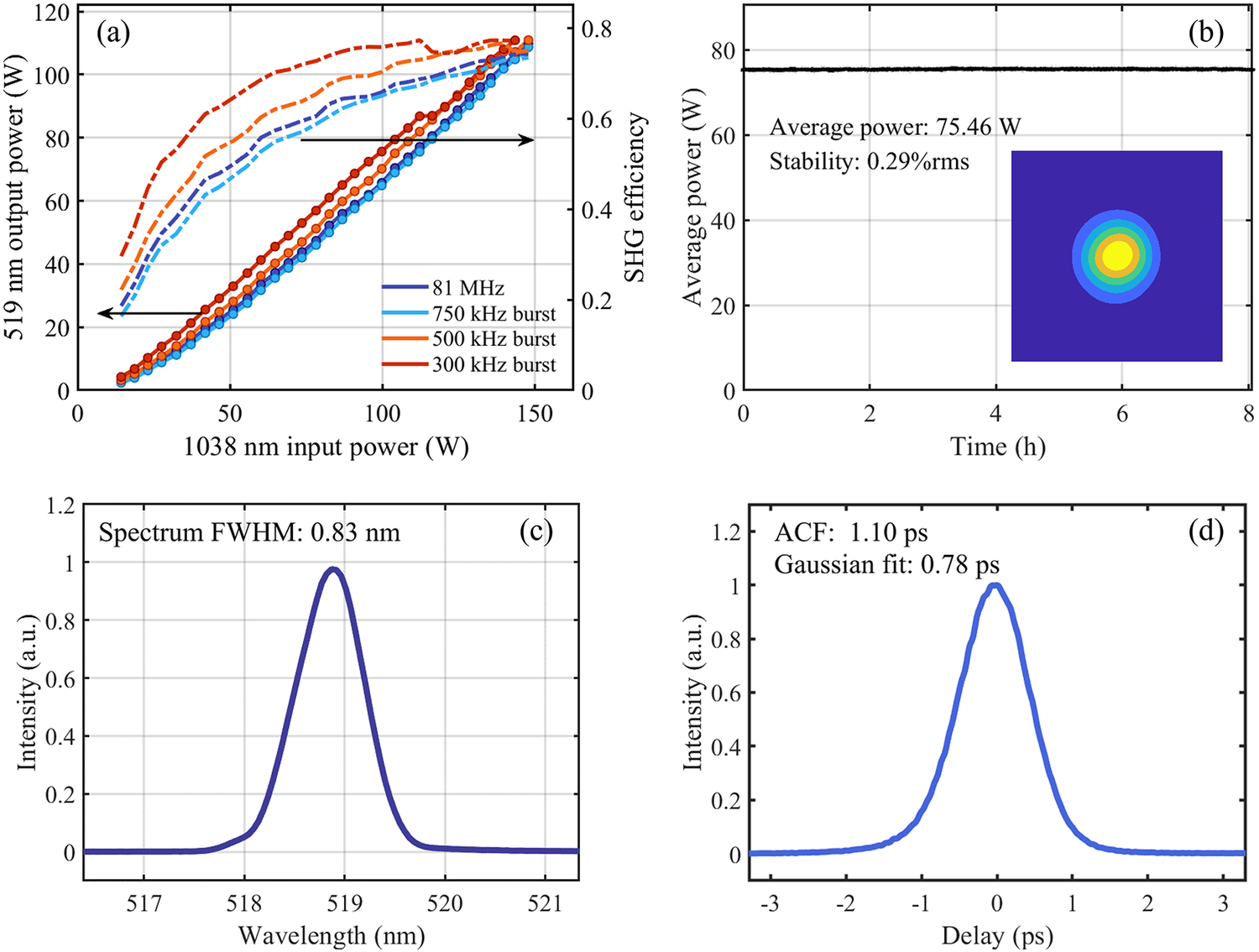
(a) Green laser average power (solid lines) and SHG efficiency (dashed lines) versus pump power under 81.25 MHz continuous pulse train and burst operation. (b) Green laser beam profile and power stability over 8 h. (c) Green laser spectrum. (d) Green laser pulse autocorrelation trace. For (c) and (d), the green laser power is 75.46 W.

Figure 6 Long description
Panel (a) shows 519 nm output power and SHG efficiency versus 1038 nm input power for continuous operation at 81.25 MHz and burst operation at 750, 500, and 300 kHz. Solid curves represent green output power and dashed curves represent SHG efficiency. The maximum green power is 106.6 W in continuous operation and 110.7 W at 300 kHz. The corresponding maximum SHG efficiencies are approximately 75% and 77%. Panel (b) shows an average green power of 75.46 W with a relative fluctuation of 0.29% rms over 8 h. The inset shows a near-Gaussian transverse beam profile. Panel (c) shows a green spectrum centered near 519 nm with a full width at half maximum of 0.83 nm. Panel (d) shows an autocorrelation full width at half maximum of 1.10 ps, corresponding to a Gaussian pulse duration of 0.78 ps.
To obtain flat-top burst envelopes, an open-loop feed-forward control method is employed. The pulse sequence at the output of the second main amplifier is monitored with a photodetector. Based on the measured burst profile, a compensation waveform is generated by an arbitrary waveform generator. The waveform signal is then amplified and applied to AOM II, thereby mitigating the burst-envelope distortion introduced during the amplification process. Figure 5 shows the burst envelopes before and after AOM II shaping for a representative case with 50 pulses per burst at a burst repetition rate of 300 kHz and an average output power of 160.7 W. In the absence of burst-envelope shaping, the pulse energy at the leading edge of the burst is 1.4 times that at the trailing edge. After shaping, the intra-burst pulse energies become substantially more uniform, with a relative fluctuation of 1.32%, and the burst envelope approaches a flat-top distribution. Analogous burst-envelope shaping is performed for each operating mode at different burst repetition rates.
For 81.25 MHz continuous pulse train operation, we achieve a maximum SHG efficiency of 75% and a maximum green laser output power of 106.6 W. The measured green laser output power as a function of the fundamental power is presented in Figure 6(a). The green laser output power and SHG efficiency as functions of the fundamental power at different burst repetition rates are also plotted in Figure 6(a). At a burst repetition rate of 300 kHz, the SHG efficiency reaches a maximum of 77%, and a maximum average green laser power of 110.7 W is obtained at an incident fundamental power of 143.7 W. While burst-mode operation at lower burst repetition rates yields higher conversion efficiency when the fundamental power is below 120 W, no appreciable difference in efficiency is observed once the power exceeds 120 W; in all cases, more than 100 W of green laser output can be generated.
At 81.25 MHz, with a green laser output power of 75.5 W, the relative average power fluctuation over 8 h is as low as 0.29%, and the transverse intensity profile remains close to a fundamental Gaussian mode, as shown in Figure 6(b). As the phase-matching bandwidths of both LBO crystals exceed the spectral bandwidth of the fundamental pulses, the green spectra and pulse durations remain nearly identical across different operating modes. The measured spectra and autocorrelation traces are shown in Figures 6(c) and 6(d), respectively, indicating a spectral linewidth of 0.83 nm and a pulse duration of 780 fs (FWHM).
3.2 Characterization and burst-mode operation of fourth harmonics
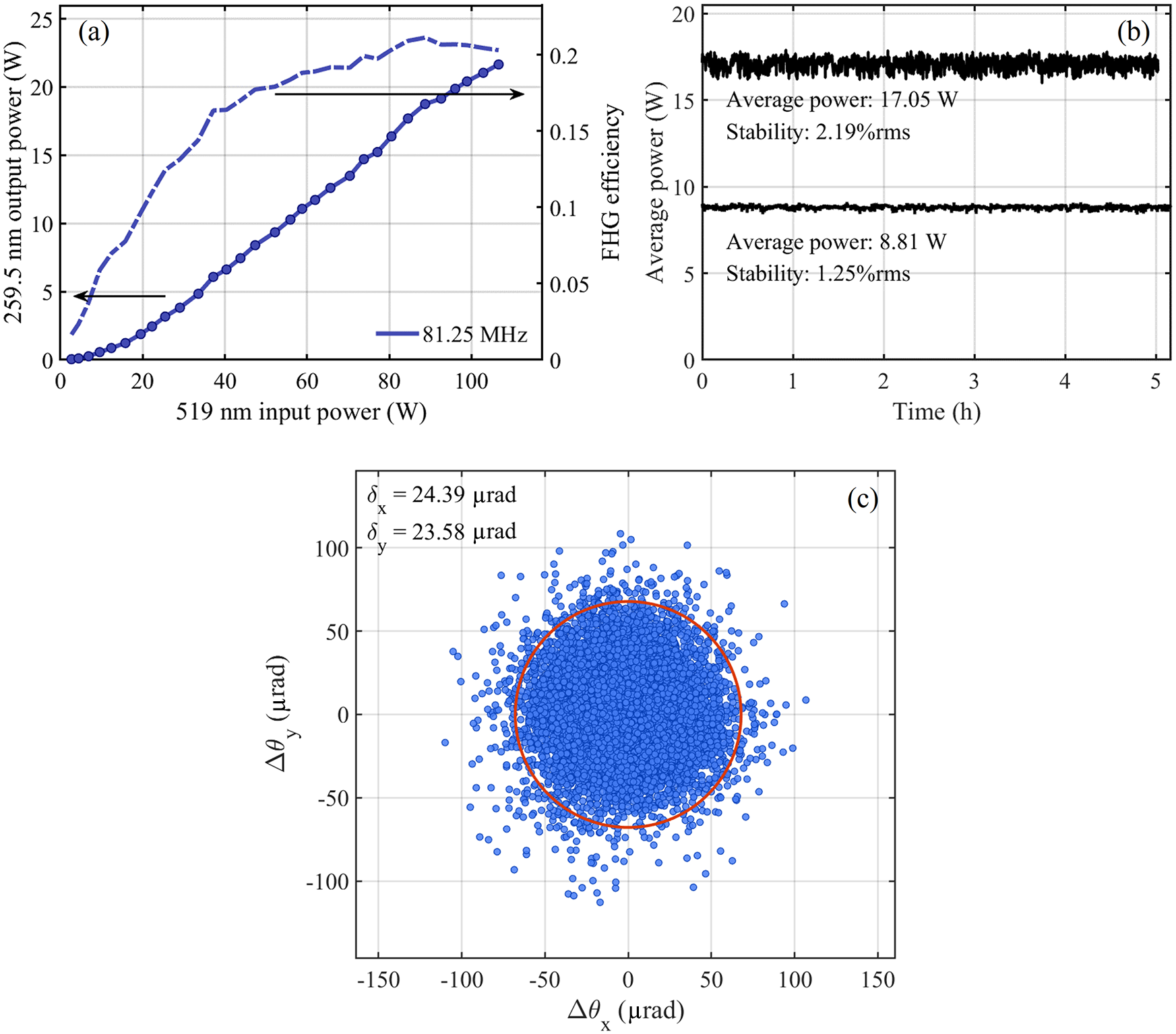
To mitigate spatial walk-off and absorption, FHG is typically implemented using an expanded, collimated beam. Accordingly, for operation at 81.25 MHz, the green laser beam is collimated by an f = 200 mm lens and then directed into a 3 mm × 3 mm × 5 mm CLBO crystal, with a beam diameter of 1.32 mm. The CLBO crystal is housed in the same type of temperature-controlled oven as used for SHG, and its temperature is maintained at 150°C to prevent hygroscopic degradation; both crystal facets are AR coated at 519 and 259 nm. At a green laser power of 88.7 W, a maximum conversion efficiency of 21% is achieved; at an average power of 106.6 W, the DUV output reaches 21.7 W. The generated DUV power and the corresponding FHG efficiency as functions of the green laser power are plotted in Figure 7(a).
(a) DUV average power (solid line) and FHG efficiency (dash-dotted line) versus pump power at 81.25 MHz. (b) DUV power stability over 5 h at average powers of 8.81 and 17.05 W. (c) Beam-pointing stability at 17.05 W over 5 h. A 5-mm-long CLBO crystal and an incident beam diameter of 1.32 mm are employed.

Figure 7 Long description
Panel (a) shows DUV output power and FHG efficiency versus 519 nm input power at 81.25 MHz. The DUV power increases to 21.7 W at a green input power of 106.6 W. The FHG efficiency reaches a maximum of approximately 21% at a green power of 88.7 W and decreases slightly at higher input powers. Panel (b) shows DUV power stability over 5 h at average powers of 8.81 and 17.05 W. The corresponding relative fluctuations are 1.25% and 2.19% rms, respectively. Panel (c) shows the measured angular-position distribution at 17.05 W. The angular jitters are 24.39 µrad in the x direction and 23.58 µrad in the y direction. A 5 mm CLBO crystal and a 1.32 mm incident beam diameter are used.
We monitored the DUV power stability over 5 h at average powers of 8.81 and 17.05 W. The corresponding relative power fluctuations are 1.25% and 2.19%, respectively, and no noticeable power degradation is observed, as shown in Figure 7(b). The growth in power fluctuation with increasing output power is mainly attributed to the higher thermal load in the CLBO crystal. Repeated high-power operation tests have been performed for a cumulative duration over 50 h, with the DUV beam incident on the same spot of the crystal. Throughout these tests, no obvious output-power decay or coating damage is observed. We also measured the beam-pointing stability at 17.05 W for more than 5 h, yielding angular jitters of 24.39 and 23.58 μrad in the x and y directions, respectively, as shown in Figure 7(c).
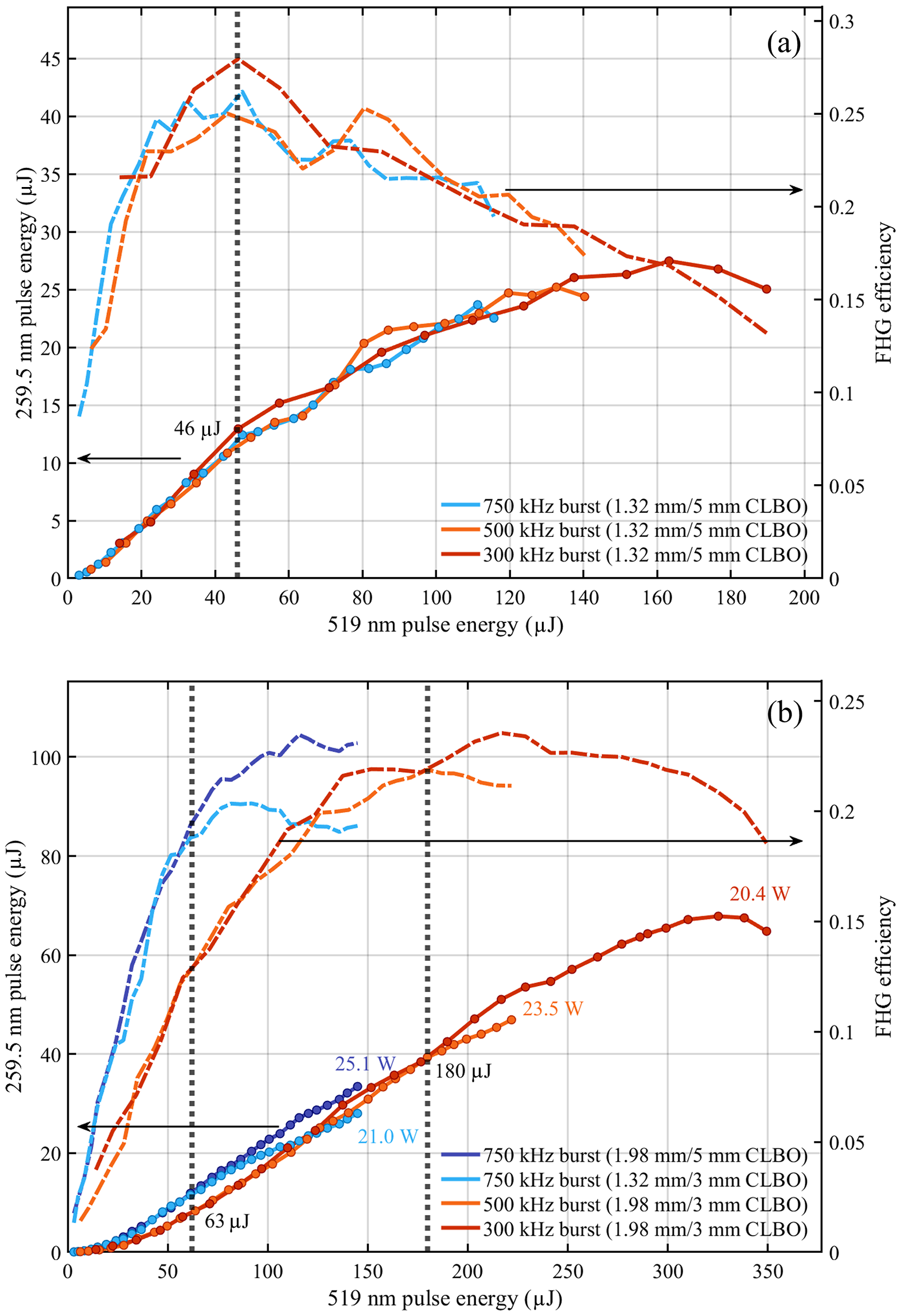
To elucidate the high-power FHG behavior of CLBO under sub-picosecond pumping in the DUV laser, we further compare the FHG output at different burst operation modes under the above conditions. Figure 8(a) shows the DUV burst energy and the corresponding conversion efficiency at different burst repetition rates. When the green laser burst energy exceeds 46 μJ, the conversion efficiency decreases markedly, suggesting that two-photon absorption becomes the dominant factor limiting further power scaling.
Burst energy conversion characteristics of CLBO-based FHG. (a) DUV burst energy (solid lines) and FHG efficiency (dash-dotted lines) versus green burst energy for a 5-mm-long CLBO crystal with a 1.32-mm beam diameter. (b) Corresponding results after optimizing the beam size and CLBO crystal length. The maximum average power for each operating mode is annotated in the figure.

Figure 8 Long description
The two vertically stacked dual-axis plots show DUV burst energy and FHG efficiency versus 519 nm green burst energy. In both panels, solid curves with circular markers represent DUV burst energy and dash-dotted curves represent FHG efficiency. Panel (a) shows results at burst repetition rates of 750, 500, and 300 kHz using a 1.32 mm beam diameter and a 5 mm CLBO crystal. The efficiencies increase at low input energy and subsequently decrease as the burst energy rises. The vertical line at 46 µJ indicates the onset of pronounced efficiency roll-off associated with increasing two-photon absorption. Panel (b) compares optimized configurations: a 1.98 mm beam with a 5 mm crystal at 750 kHz, a 1.32 mm beam with a 3 mm crystal at 750 kHz, and a 1.98 mm beam with a 3 mm crystal at 500 and 300 kHz. The annotated maximum average DUV powers are 25.1, 21.0, 23.5, and 20.4 W, respectively. The line at 63 µJ marks the input energy above which the efficiencies of the two 750 kHz configurations begin to diverge. The line at 180 µJ marks the energy above which the efficiency at 500 kHz becomes lower than that at 300 kHz, indicating an increasing influence of linear absorption and average-power-related thermal loading.
To further increase the DUV output power in burst operation, the beam size and crystal length are properly selected for different burst repetition rates to suppress two-photon absorption. We first employ a 3 mm × 3 mm × 3 mm CLBO crystal to accommodate the higher peak power in burst operation, which increases the DUV output power to 21.0 W at a burst repetition rate of 750 kHz. When the burst repetition rate is reduced to 500 or 300 kHz, the further increased peak power still leads to pronounced absorption. Accordingly, we replace the collimation lens with a focal length of 300 mm, expanding the incident beam diameter to 1.98 mm. Under these conditions, the maximum DUV output powers at burst repetition rates of 300 and 500 kHz increase to 20.4 and 23.5 W, corresponding to maximum burst energies of 68 and 47 μJ, respectively. The DUV burst energy and FHG efficiency curves for burst operation at different burst repetition rates are summarized in Figure 8(b).
As shown in Figure 8, although no substantial two-photon absorption is observed in the 3-mm-long CLBO crystal for DUV burst energies below 60 μJ, the maximum FHG efficiency (23%) remains lower than that obtained with the 5-mm-long CLBO crystal (27%). Notably, when the green laser burst energy exceeds 180 μJ, the conversion efficiency at 500 kHz gradually becomes lower than that at 300 kHz. This indicates that, for high-repetition-rate and high-average-power FHG, linear absorption in the crystal cannot be neglected. In addition to controlling the peak intensity, reducing the average power density is also necessary. For comparison, we perform FHG at a burst repetition rate of 750 kHz using a beam diameter of 1.98 mm and a 5-mm-long CLBO crystal. This configuration further improves the high-power conversion efficiency and yields a maximum average DUV power of 25.1 W. Figure 8(b) directly compares the FHG efficiencies of this configuration with those obtained using a 1.32-mm beam diameter and a 3-mm-long CLBO crystal. The two schemes exhibit similar efficiencies when the green laser burst energy is below 63 μJ, whereas a clear divergence emerges beyond this level, which can substantially enhance the CLBO performance under high-power FHG conditions.
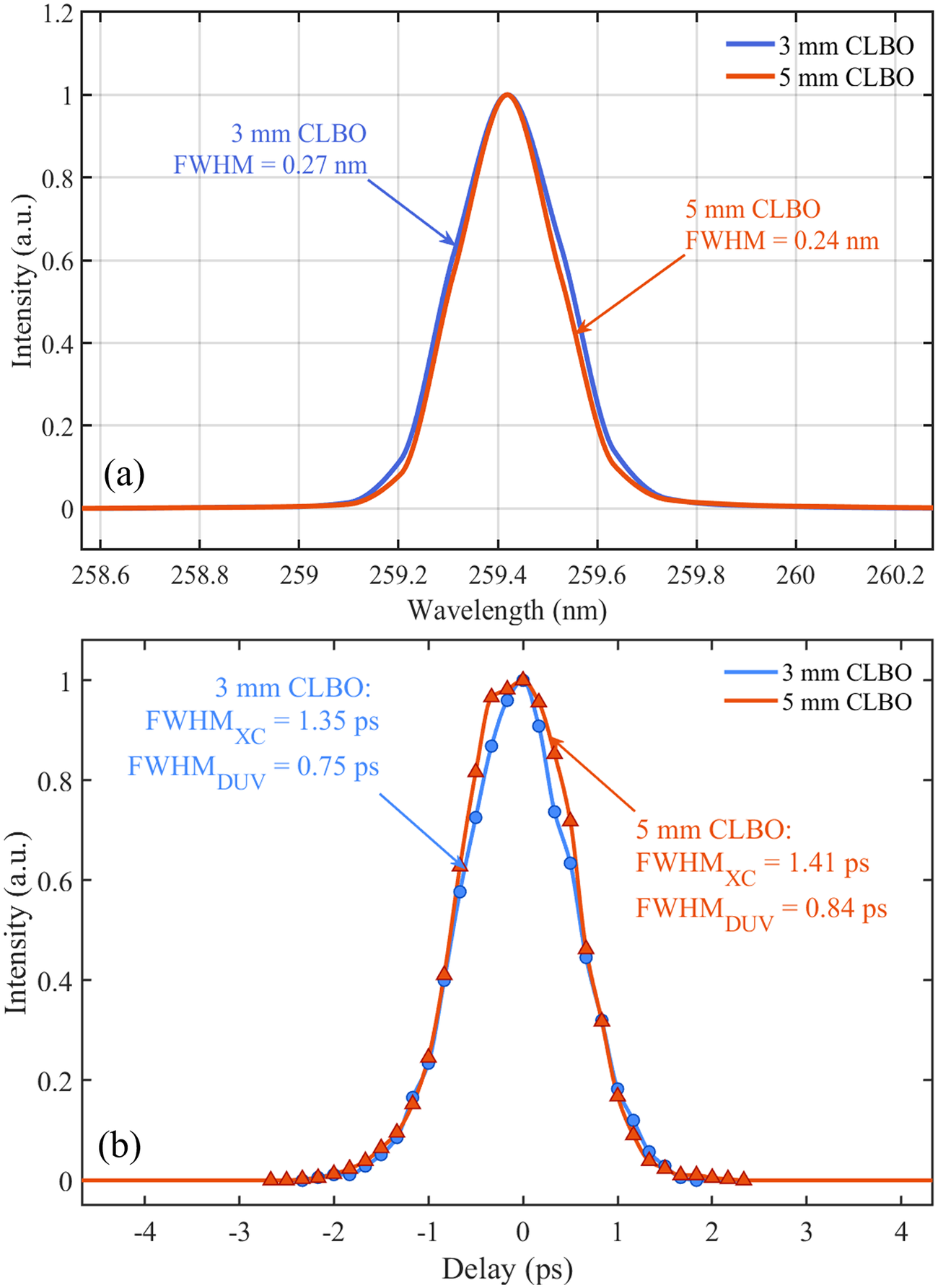
As the FHG stage is implemented with two CLBO crystal lengths, we separately characterize the spectrum, pulse duration and beam quality of the generated DUV radiation. Figure 9(a) shows the measured DUV spectra, with linewidths of 0.27 nm for the 3-mm-long crystal and 0.24 nm for the 5-mm-long crystal. To evaluate the temporal duration of the generated DUV pulses and confirm sub-picosecond operation, the infrared pulses after SHG and the DUV pulses are mixed in a 1-mm BBO crystal to generate a difference frequency signal. The infrared pulses have a duration of 1.13 ps (FWHM) by autocorrelation measurement, whose temporal profile is very close to Gaussian, although a small pedestal can be observed. By scanning the relative delay of the infrared pulses, a DFG cross-correlation trace is obtained, as shown in Figure 9(b). For the DUV pulses generated with the 5-mm CLBO crystal, the cross-correlation full width at half maximum (FWHMXC) is 1.41 ps, whereas a value of 1.35 ps is measured for the 3-mm CLBO configuration; both traces are close to Gaussian. The corresponding DUV pulse durations (FWHMDUV) are therefore estimated to be 840 and 750 fs, respectively.
(a) DUV spectra generated with a 3-mm-long CLBO crystal (blue) and a 5-mm-long CLBO crystal (red). (b) DFG cross-correlation traces and retrieved DUV pulse durations for the 3-mm (blue) and 5-mm (red) CLBO configurations.

Figure 9 Long description
Panel (a) shows normalized DUV spectral intensity versus wavelength. Both spectra are centered near 259.4 nm. The spectrum generated with the 3 mm CLBO crystal has a full width at half maximum of 0.27 nm, while that generated with the 5 mm crystal has a width of 0.24 nm. Panel (b) shows normalized DFG cross-correlation intensity versus relative delay. Blue circles and the blue fitted curve correspond to the 3 mm crystal, while red triangles and the red fitted curve correspond to the 5 mm crystal. For the 3 mm crystal, the cross-correlation full width at half maximum is 1.35 ps and the retrieved DUV pulse duration is 0.75 ps. For the 5 mm crystal, the corresponding values are 1.41 ps and 0.84 ps.
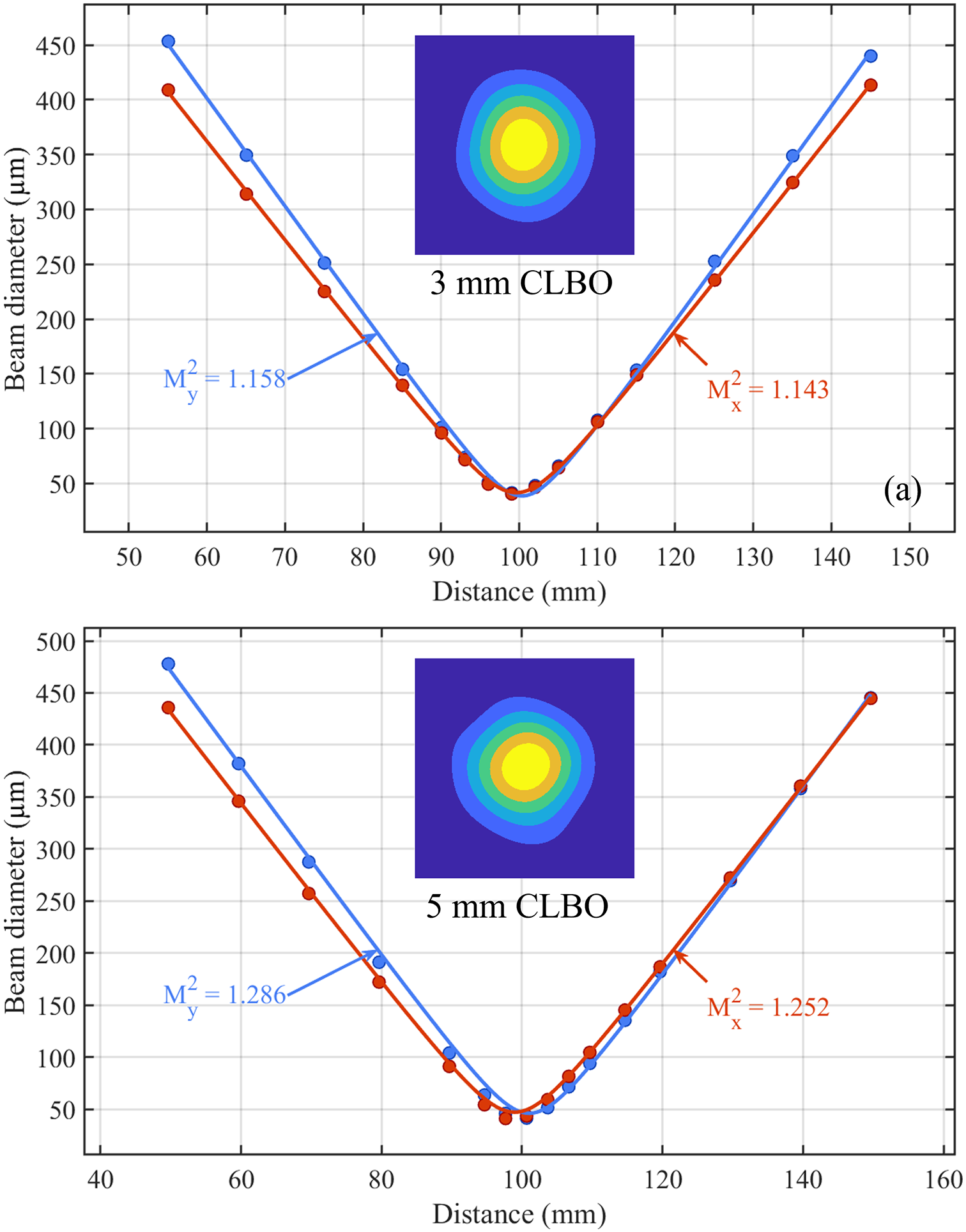
The characterization of the DUV beam for different CLBO lengths is shown in Figure 10. In the M 2 measurement, the beam is focused by an f = 100 mm lens, and the beam profiles are measured using a complementary metal–oxide–semiconductor (CMOS) camera whose second moments are derived as beam diameters. For the 3-mm-long CLBO crystal, the measured beam quality factors are
${M}_x^2=1.143$
 and
${M}_y^2=1.158$
 . For the 5-mm-long CLBO crystal,
${M}_x^2=1.252$
 and
${M}_y^2=1.286$
 , which are slightly larger but still indicate good beam quality. The increase in the M 2 values may be attributed to the larger spatial walk-off introduced by the longer crystal.
Beam quality characterization of the DUV beam generated with CLBO crystals of different lengths: (a) 3 mm and (b) 5 mm. The DUV beam is focused by an f = 100 mm lens, and the beam diameters along the x and y directions are determined by the second moments of the measured intensity profiles. Insets show the corresponding DUV beam profiles.

Figure 10 Long description
The two vertically stacked plots show DUV beam diameter versus propagation distance for the x and y directions. Panel (a) presents the results obtained with a 3 mm CLBO crystal. The fitted beam-propagation curves reach a minimum diameter near a distance of 100 mm and give M²x = 1.143 and M²y = 1.158. Panel (b) presents the results obtained with a 5 mm CLBO crystal. The fitted curves also reach their minimum near 100 mm and give M²x = 1.252 and M²y = 1.286. The insets show the corresponding near-Gaussian DUV transverse beam profiles.
3.3 Further considerations for high-power FHG in CLBO
Since CLBO is strongly hygroscopic, optical coatings are practically unavoidable. The risk of coating damage would rise with increasing peak power. This makes frequency conversion of high-energy femtosecond pulses more challenging[ Reference Cui, Sun, Liu and Zhu36]. Nevertheless, CLBO remains a promising choice for generating high-repetition-rate, high-average-power DUV radiation.
Reliable operation requires strict environmental conditions for the CLBO crystal, especially controlling the humidity and reducing ozone absorption. In our system, the crystal is heated and operated in a chamber with dry-air circulation to suppress moisture-induced degradation. For higher-power implementations, further improvement may be achieved by using an inert-gas environment, such as argon, to better protect the crystal and reduce ozone absorption[ Reference Turcicova, Novak, Roskot, Smrz, Muzik, Chyla, Endo and Mocek42].
One other limitation for high-power implementations is the increased thermal load in the CLBO crystal, which would cause larger temperature fluctuations and therefore degrade output stability. One possible way to mitigate this issue is to enlarge the beam size in the crystal, although this would lead to a lower conversion efficiency[ Reference Pan, Geng and Jiang22, Reference Kohno, Orii, Sawada, Okuyama, Shibuya, Shimizu, Yoshimura, Mori, Nishimae and Okada37].
4 Conclusion
In summary, we have demonstrated a fiber-based sub-picosecond DUV source at 259.4 nm with high average power in 81.25 MHz continuous pulse train and burst operation. A two-stage Yb-doped PCF/rod-PCF MOPA delivers up to 202.7 W of NIR output with a compressed pulse duration of 1.08 ps (FWHM), and SHG in LBO provides up to 110.7 W of green laser output with a near-Gaussian transverse profile. Using CLBO for FHG, we obtain 21.7 W DUV average power at 81.25 MHz. We further systematically investigate high-power DUV generation under different burst repetition rates and FHG configurations, elucidating the impact of two-photon absorption in burst operation and also showing that linear absorption markedly affects the conversion efficiency of high-repetition-rate, high-power FHG. By optimizing the beam size and CLBO length to reduce average power density while maintaining suitable peak intensity, we achieve a maximum DUV average power of 25.1 W (750 kHz, 50 pulses per burst) in burst operation and a maximum burst energy of 68 μJ (300 kHz, 50 pulses per burst). This system provides a robust, power-scalable DUV source with good beam quality and stability, well suited for a broad range of applications, including precise micromachining, pump–probe studies and electron-beam applications.
Acknowledgements
This work was supported by the National Key Research and Development Program of China (Grant No. 2017YFA0701001) and the State Key Laboratory of Nuclear Physics and Technology, Peking University (Grant No. NPT2022ZZ01).

 Open access

