


Introduction
The Improving Access to Psychological Therapies (IAPT) initiative in England aims to train over 10,500 cognitive behavioural therapy (CBT) therapists by 2025 to address 25% of the national prevalence of anxiety disorders and depression (NHS England, 2016). To meet these ambitious goals and support the expansion of CBT training and provision, effective methods to assess therapists’ competence, or skilfulness at delivering CBT, are required. Expert objective ratings of therapy recordings are the gold-standard competence assessment, but are resource-intensive (Rozek et al., Reference Rozek, Serrano, Marriott, Scott, Hickman, Brothers, Lewis and Simons2018). Interest in varied assessment methods, including therapist self-assessment of competence, has consequently grown (Rozek et al., Reference Rozek, Serrano, Marriott, Scott, Hickman, Brothers, Lewis and Simons2018; Singla et al., Reference Singla, Weobong, Nadkarni, Chowdhary, Shinde, Anand, Fairburn, Dimijdane, Velleman, Weiss and Patel2014). Valid and feasible methods to assess treatment integrity and therapy quality – including competence – are integral for the large-scale implementation of evidence-based therapies such as CBT (Shoenwald et al., Reference Schoenwald, Garland, Chapman, Frazier, Sheidow and Southam-Gerow2011). Self-assessment is considered an ‘indirect’ alternative to direct objective assessment, with potential feasibility and cost benefits. Consequently, it may be a resource-efficient method for monitoring therapy fidelity in CBT research and practice and/or a useful tool for quality assurance in routine care. Furthermore, different competence assessment methods – including self-report – may be warranted across the wide variety of contexts in which CBT is studied and implemented and thus should be investigated (McLeod et al., Reference McLeod, Southam‐Gerow, Tully, Rodriguez and Smith2013).
Self-assessment is also an important element of reflective practice that enables therapists to determine their own strengths and areas for improvement, and therefore to engage effectively with supervision and professional development (Fouad et al., Reference Fouad, Grus, Hatcher, Kaslow, Hutchings, Madson, Collins and Crossman2009; Kaslow et al., Reference Kaslow, Grus, Campbell, Fouad, Hatcher and Rodolfa2009). Consequently, it is considered a core skill for professional accreditation that should be developed during training (BABCP, 2012; Hool, Reference Hool2010). The acquisition and persistence of accurate CBT self-assessment skills is therefore an important topic for evaluation.
Self-assessment of competence in experienced therapists
Experienced therapists tend to over-estimate their own ability (Chevron and Rounsaville, Reference Chevron and Rounsaville1983; Parker and Waller, Reference Parker and Waller2015; Perlesz et al., Reference Perlesz, Stolk and Firestone1990; Walfish et al., Reference Walfish, McAlister, O’Donnell and Lambert2012), particularly the least competent therapists with the lowest objectively assessed skill (Brosan et al., Reference Brosan, Reynolds and Moore2008). The ‘better than average’ bias (Brown, Reference Brown1986), the tendency to self-rate one’s abilities as greater than those of the average person, may lead to therapists over-estimating their competence (Waltman et al., Reference Waltman, Frankel and Williston2016). Therapist drift, the conscious or unconscious failure of experienced clinicians to deliver evidence-based treatment despite available resources (Waller, Reference Waller2009), may also negatively impact the accuracy of self-assessments (Waltman et al., Reference Waltman, Frankel and Williston2016). The least competent practitioners may demonstrate the greatest over-estimation as they lack awareness of their own lack of skill (Dunning et al., Reference Dunning, Johnson, Ehrlinger and Kruger2003). Over-estimation of competence, particularly by less objectively competent practitioners, is an important issue as therapists with inaccurately high self-perceptions may feel less motivated to seek out continuing professional development, engage in supervision, or implement feedback to improve their practice (Brosan et al., Reference Brosan, Reynolds and Moore2008). Consequently, quality of therapy may drop below acceptable standards and yield potentially negative impacts on clients and service outcomes. Interestingly, more competent therapists conversely exhibit lower self-ratings and even under-estimation of competence (McManus et al., Reference McManus, Rakovshik, Kennerley, Fennell and Westbrook2012), attributed in part to greater self-reflection and awareness of areas requiring further skill development. Professional self-doubt, which may be reflected in lower self-reported CBT competence, has been correspondingly linked to stronger clinical outcomes in psychotherapy than over-confidence (Meichenbaum and Lilienfeld, Reference Meichenbaum and Lilienfeld2018; Nissen-Lie et al., Reference Nissen‐Lie, Rønnestad, Høglend, Havik, Solbakken, Stiles and Monsen2017).
While poor self-awareness in experienced clinicians is concerning and may indicate that self-report is an inadequate method of assessing competence in routine practice, many studies are cross-sectional and have not accounted for the quality and duration of prior training or ongoing supervision. Training that involves regular comparison between self and expert ratings of competence – an established element of IAPT CBT training – may support accurate self-awareness (Kaslow et al., Reference Kaslow, Grus, Campbell, Fouad, Hatcher and Rodolfa2009; Waltman et al., Reference Waltman, Frankel and Williston2016). Therefore, investigation of self-assessments in CBT trainee cohorts during and after training is indicated.
Self-assessment of competence in CBT trainees
Training courses play an important role in developing therapists’ self-awareness of competence. Learning theory suggests that therapists’ self-representations of their own skill change with increasing levels of feedback and experience (Lyon et al., Reference Lyon, Stirman, Kerns and Bruns2011). Self-representations are further suggested to become more accurate through comparison with expert evaluations (Kaslow et al., Reference Kaslow, Grus, Campbell, Fouad, Hatcher and Rodolfa2009; Waltman et al., Reference Waltman, Frankel and Williston2016). Relevant studies, however, have not reached consensus regarding the relationship between CBT trainees’ self- versus expert evaluations.
Comparison of trainees’ self-ratings and expert ratings of competence for a single session during training (Rozek et al., Reference Rozek, Serrano, Marriott, Scott, Hickman, Brothers, Lewis and Simons2018) and towards the beginning and end of training (Mathieson et al., Reference Mathieson, Barnfield and Beaumont2009) indicated trends towards agreement, with varying significance. Limited longitudinal evidence indicates that while there is considerable variability in the strength of the relationship between self and expert ratings, agreement tends to improve across training (Loades and Myles, Reference Loades and Myles2016; McManus et al., Reference McManus, Rakovshik, Kennerley, Fennell and Westbrook2012). A small study found evidence of trainee over-estimation compared with objective markers (Rozek et al., Reference Rozek, Serrano, Marriott, Scott, Hickman, Brothers, Lewis and Simons2018), while larger studies indicated under-estimation – particularly by more-competent trainees (McManus et al., Reference McManus, Rakovshik, Kennerley, Fennell and Westbrook2012), or switching over time (Loades and Myles, Reference Loades and Myles2016). Methodological issues, including relatively small sample sizes (n = 5–64) and the use of different measures for self and expert ratings and/or of unvalidated competency rating scales may have contributed to inconsistency in findings. The relationship between self and expert ratings of CBT competence across training requires methodologically sound clarification.
Self-assessment of competence beyond training
Self-awareness of competence during the transition from training into the post-training workplace has never been directly investigated, and is important given the proposed role of self-awareness in promoting evidence-based practice. IAPT CBT trainees appear to maintain expert-rated competence 12+ months after training (Liness et al., Reference Liness, Beale, Lea, Byrne, Hirsch and Clark2018). If consensus between self- and expert-rated competence is attained by the end of training, this may persist into the workplace. Alternatively, previous reports of therapist drift (Waller, Reference Waller2009) and over-estimation of competence in experienced therapists may indicate that agreement decreases over time. Given the inconsistent findings during training and absence of research into the post-training transition, longitudinal evaluation of the relationship between self-assessed and expert-assessed competence is warranted.
Aims and hypotheses
This study aimed to clarify the relationship between self and expert assessments of CBT competence during training using a large longitudinal sample of IAPT trainees, and to directly assess agreement following transition into the workplace. Self and expert competence ratings for audiotaped sessions were compared at baseline, mid-training, end-of-training, and at 12+ month follow-up. Trainees who did not obtain competence by the end-of-training tape were provided with additional support targeting therapeutic skills and self-reflection, allowing for preliminary investigation into whether this group at risk of inaccurate self-assessments could achieve self-awareness of competence with further input. Hypotheses were:
(1) Self and expert competence ratings would demonstrate significant positive associations at all time points;
(2) The proportion of tapes on which self and expert competence ratings agree would increase significantly across training to reach good agreement by final submissions;
(3) Good agreement between self and expert competence ratings would be retained at follow-up.
Exploratory analyses were conducted to assess change in agreement for competent and non-competent trainees (those who attained versus those that did not attain competence by the end of training) across the course.
Method
Participants
Participants were 150 therapists who completed a one-year postgraduate diploma in CBT between 2009 and 2014 and submitted a baseline therapy recording for training. Missing self or marker rating data were excluded for 12 of the 162 eligible trainees. Median age was 32.00 years (IQR = 7). The trainee sample was 77% female (n = 116) and 23% male (n = 34). Ethnicities were 83% white (n = 125), 8% Asian (n = 12), 6% black (n = 9) and 3% mixed ethnicity (n = 4). Professions were 33% Psychological Wellbeing Practitioner (n = 50), 33% clinical psychologist (n = 49), 12% counselling psychologist (n = 18), 12% counsellor/psychotherapist (n = 17), 5% mental health nurse (n = 8), 3% occupational therapist (n = 5), and 2% other (n = 3).
Measures
Therapeutic competence was assessed with the UK Cognitive Therapy Scale – Revised (CTS-R; Blackburn et al., Reference Blackburn, James, Milne, Baker, Standart, Garland and Reichelt2001). The CTS-R consists of 12 items assessing general therapeutic and CBT-specific competencies, with a total score range of 0–72 and competence threshold ≥36. Internal consistency is high (α range = .75 to .97; Blackburn et al., Reference Blackburn, James, Milne, Baker, Standart, Garland and Reichelt2001). In the present sample, inter-rater reliability was excellent for expert markers: ICC (114, 113) = .95 (Liness et al., Reference Liness, Beale, Lea, Byrne, Hirsch and Clark2019). Expert markers were course staff with extensive experience practising and supervising CBT and scoring the competence measure. They were trained in rating the CTS-R when they started the course via workshops and co-rating therapy tapes with other course staff. Subsequently, they were subject to regular accuracy monitoring via second marking of randomly selected tapes.
Procedure
Data were collected during training for coursework submissions and were included in a larger observational study evaluating IAPT CBT training (Liness et al., Reference Liness, Beale, Lea, Byrne, Hirsch and Clark2019). A one-day workshop in rating the CTS-R was provided to trainees prior to the baseline submission. Weekly supervision including live review of clips of trainees’ therapy was also an integral part of training. Trainees submitted audio-recorded sessions with CTS-R self-ratings for the course at the beginning of training (baseline), after 5–6 months of training (mid-training), and after 9–10 months of training (end-of-training). Expert markers scored recordings on the CTS-R upon submission by students. All students receive detailed feedback for skill development on all submissions. Recordings consisted of an adult anxiety or depression mid-treatment session that was requested to be representative of trainees’ usual practice. All trainees submitted recordings of both anxiety and depression treatment as competence was required across disorders. For further details about the training course, please refer to Liness et al. (Reference Liness, Beale, Lea, Byrne, Hirsch and Clark2019).
Trainees were expected to obtain competence by the end of the course. Those who had not achieved competence by this time point (‘non-competent’) received additional support consisting of three clinical skills tutorials and practice-based feedback. These trainees then provided a resubmission tape and CTS-R rating.
Former trainees who were still working in trusts that had granted ethics approval for research were contacted at least 12 months post-training regarding participation in a larger follow-up study (Liness et al., Reference Liness, Beale, Lea, Byrne, Hirsch and Clark2018). Self-rating data at follow-up were available for 30 therapists who were included in the present study. Therapists were requested to submit a recording and CTS-R self-rating of a mid-treatment CBT session representative of their usual practice, which was then expert-scored on the CTS-R. There were no significant differences between therapists who participated at follow-up and those who did not in self- or expert-assessed baseline CTS-R or self-assessed end-of-training CTS-R (p < .05). A significant difference emerged between mean expert-assessed end-of-training CTS-R for follow-up participants (mean = 39.47, SD = 3.13) and non-participants (mean = 37.37, SD = 3.79) [t (148) = –2.81, p = .006], indicating possible self-selection bias for high-performing former trainees providing follow-up ratings and tapes.
ResultsFootnote 1
Descriptive statistics for self and expert competence ratings
Table 1 reports trainees’ mean self and expert CTS-R ratings at each time point. Mean self and expert ratings were both below the CTS-R competence threshold (≥36) at baseline and mid-training, crossed the competence threshold by the end of training, and remained above the threshold at follow-up.
Self and marker CTS-R ratings across time points

CTS-R, Cognitive Therapy Scale – Revised (Blackburn et al., Reference Blackburn, James, Milne, Baker, Standart, Garland and Reichelt2001).
Association between self and expert ratings
Overall findings during training
Pearson’s correlations revealed significant positive relationships between self and expert CTS-R ratings for trainees’ baseline [r (148) = .29, p < .001], mid-training [r (148) = .50, p < .001] and final submissions [r (148) = .27, p < .001]. To give a true picture of the relationship between self and expert ratings upon course completion, non-competent trainees’ resubmission scores were entered as their final submissions.
Competent and non-competent trainees
Of 150 trainees, 113 obtained competence by end-of-training (‘competent’) and 37 did not (‘non-competent’). Competent and non-competent trainees were not found to differ in distribution of professions (Fisher’s exact test = 9.50, p = .11), therefore comparisons of self and expert ratings were conducted on the basis of competence only and not professional group.
Competent trainees’ self-ratings positively correlated with expert ratings at baseline [r (111) = .39, p < .001], mid- [r (111) = .60, p < .001], and end-of-training [r (111) = .27, p = .004]. Conversely, non-competent trainees’ self-ratings did not correlate with corresponding expert ratings at baseline [r (35) = .10, p = .56], mid- [r (35) = .25, p = .13], or end-of-training [r (35) = –.24, p = .14], but correlated positively for resubmission tapes [r (35) = .40, p = .005].
Follow-up
Follow-up participants’ self and expert ratings were positively associated [r (28) = .56, p < .001]. Follow-up analyses were not conducted separately for competent and non-competent trainees, as only three previously non-competent trainees returned for follow-up.
Significant agreement between self and expert ratings
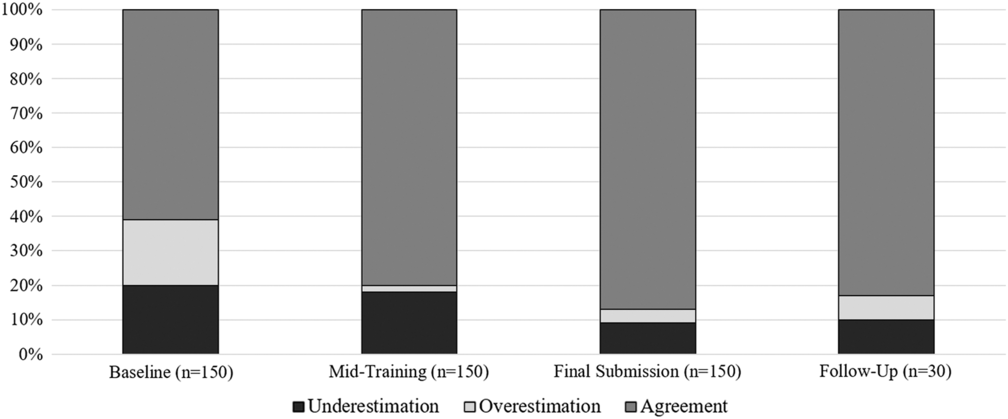
Following Loades and Myles’ (Reference Loades and Myles2016) criterion to assess CTS-R agreement between self and expert ratings, a difference of >5 points in either direction indicated significant trainee under- or over-estimation, while a difference within 5 points indicated significant agreement. This criterion was derived based on the psychometric properties of the CTS-R described by Gordon (Reference Gordon2007). Figure 1 presents patterns of agreement for the whole sample at each time point.
Patterns of agreement between self and expert CTS-R scores.

Overall findings during training
As shown in Fig. 1, the majority of tapes at all time points demonstrated agreement between self and expert CTS-R scores. McNemar’s tests (agreement vs disagreement) found that agreement increased significantly between baseline (61%) and mid-training (80%) [χ2 (1) = .84, p < .001], and slightly but not significantly between mid-training (80%) and final submissions (87%) [χ2 (1) = .36, p = .15]. Visual inspection of the patterns of disagreement indicate relatively even distribution between under- and over-estimation at baseline (20 vs 19%, respectively), marked tendency towards under-estimation mid-training (18 vs 2%), and some tendency towards under-estimation on final submissions (10 vs 4%).
Competent and non-competent trainees
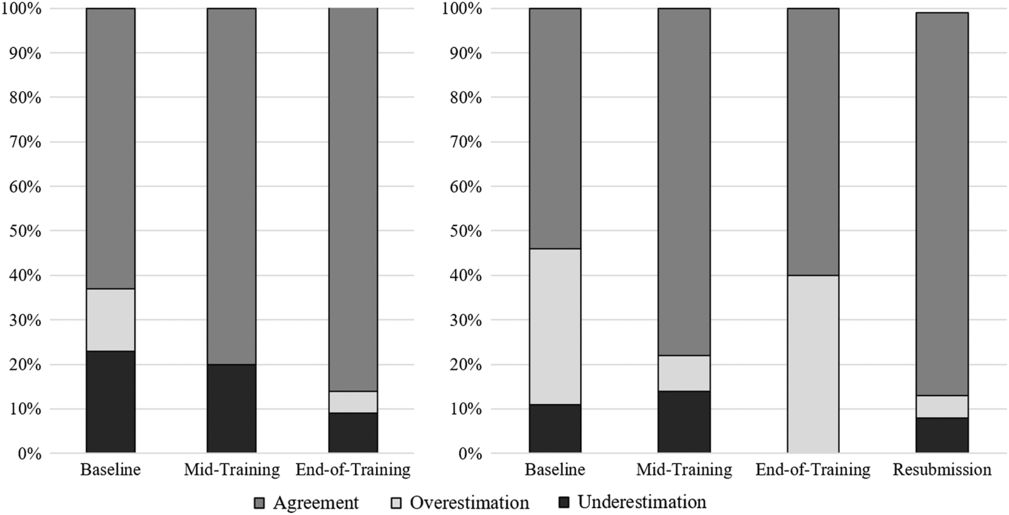
Figure 2 presents patterns of agreement across training for competent and non-competent trainees. The majority of submissions demonstrated agreement between self and expert CTS-R scores across all time points for both competent and non-competent trainees, although patterns of agreement varied considerably for these groups.
Patterns of agreement for competent and non-competent trainees.

Agreement increased significantly for competent trainees between baseline (63%) and mid-training (80%) [χ2 (1) = 1.93, p = .003], and slightly but not significantly between mid-training (80%) and end-of-training (87%) [χ2 (1) = .003, p = .28]. At all time points, competent trainees demonstrated greater frequencies of under-estimation than over-estimation. Notably, there was no over-estimation at mid-training.
There was a non-significant increase from baseline (54%) to mid-training (78%) for non-competent trainees [χ2 (1) = .29, p = .06], and a non-significant decrease by end-of-training (60%) [χ2 (1) = .38, p = .12]. Agreement increased significantly by the resubmission tape (86%) [χ2 (1) = .001, p = .02]. Patterns of disagreement indicated a substantial tendency towards over-estimation at baseline, followed by a small tendency towards under-estimation mid-training. At end-of-training, all disagreements indicated over-estimation; however, a small tendency towards under-estimation was found on the resubmission tape.
Follow-up
A large majority (83%) of tapes demonstrated agreement between self and expert CTS-R scores at follow-up. McNemar’s test found no significant change in agreement between final submissions and follow-up for the 30 follow-up participants [χ2 (1) = 1.20, p = .10]. The distribution of agreement was identical for final submissions and follow-up: 83% agreement, 10% under-estimation, and 7% over-estimation. These findings provide preliminary evidence that agreement between self and expert ratings is retained at follow-up.
Discussion
This study aimed to clarify the relationship between self and expert assessments of CBT competence across training and following transition into the workplace. Recordings of CBT treatment sessions were scored by IAPT trainees and expert markers on the validated CTS-R (Blackburn et al., Reference Blackburn, James, Milne, Baker, Standart, Garland and Reichelt2001) at the beginning, middle and end of the course, and at post-training follow-up. As predicted, self and expert ratings demonstrated positive relationships and the proportion of tapes achieving agreement increased across training. Patterns of agreement between self and expert ratings emerged in the expected directions for trainees who were competent versus non-competent at the end of training, although there was unexpected variability across training for non-competent trainees. At post-training follow-up, former trainees’ self- and expert-rated competence agreed as anticipated.
Agreement across training for the overall cohort
Self and expert CTS-R scores were positively associated across the course, providing evidence of agreement during training. However, the strength of associations varied, which may have been in part due to competent and non-competent trainees having different profiles of agreement between self and expert ratings of their tapes (see discussion below). At all time points, the majority of tapes (61–87%) demonstrated agreement between self and expert ratings. The proportion of significant agreement (CTS-R difference <5; Loades and Myles, Reference Loades and Myles2016) was lowest at baseline, which may be unsurprising as this is when trainees are learning both about the rating system and about CBT itself and thus there is greater opportunity to misunderstand both. Agreement increased significantly between baseline and mid-training, and non-significantly between mid-training and final submissions. These findings indicate that as trainees’ CBT experience and use of rating scales increased, trainee self-ratings of competence began to converge more with expert raters who were highly experienced in both CBT and in the rating system. Improved agreement between self-rated and expert-rated competence is encouraging given the importance of accurate self-assessments for informing clinical practice and calibrating professional development in the post-training workplace.
These findings have important implications regarding the use of self-evaluation as a resource-efficient CBT competence assessment method – particularly in training. The changing proportion of agreement across training supports previous assertions that self-evaluation is not an appropriate stand-alone competence assessment for trainees (Rozek et al., Reference Rozek, Serrano, Marriott, Scott, Hickman, Brothers, Lewis and Simons2018). Rather, self-assessment appears to be more appropriate as a self-reflective learning tool (Waltman et al., Reference Waltman, Frankel and Williston2016), with trainees’ understanding of their own skill becoming more accurate with repeated comparison to expert ratings and with increasing experience. The results also provide further support for the regular use of live therapy clips in supervision, as trainee self-report may not be sufficiently accurate to inform supervision during training.
Furthermore, these findings indicate that CTS-R rater training – which was delivered to trainees at the beginning of the course – is insufficient for the development of accurate self-assessment in the absence of further CBT training and experience. Whilst CTS-R rater training appears important for reliability (Gordon, Reference Gordon2007; Reichelt et al., Reference Reichelt, James and Blackburn2003), it may be that CBT experience itself is necessary for raters to understand and evaluate the underlying construct of how competent CBT is delivered. This has important potential implications beyond self-assessment, as novice raters or those with limited CBT training/experience may be unsuitable to conduct objective assessor ratings using the CTS-R. These findings converge with preliminary evidence of poorer reliability in novices’ judgements of competency on other measures compared with experts’ despite rater training (Schmidt et al., Reference Schmidt, Strunk, DeRubeis, Conklin and Braun2018), and is an important topic for further enquiry.
Patterns of variability for the minority of tapes that disagreed – namely trainees’ tendency to under-estimate rather than over-estimate their competence from the mid-training point – were consistent with those found in smaller longitudinal training studies (Loades and Myles, Reference Loades and Myles2016; McManus et al., Reference McManus, Rakovshik, Kennerley, Fennell and Westbrook2012). Mid-training under-estimation of self-rated competence was consistent with Lyon et al.’s (Reference Lyon, Stirman, Kerns and Bruns2011) learning theory account of skill development. This suggests that skill and self-representations decrease as the implementation of new skills and standards interferes with skill perception, but subsequently increase with awareness of surpassing baseline competence after further training (Lyon et al., Reference Lyon, Stirman, Kerns and Bruns2011). This overall tendency towards under-estimation rather than trainee over-confidence for tapes that disagreed may be encouraging in light of evidence suggesting that professional self-doubt is linked with stronger clinical outcome (Meichenbaum and Lilienfeld, Reference Meichenbaum and Lilienfeld2018; Nissen-Lie et al., Reference Nissen‐Lie, Rønnestad, Høglend, Havik, Solbakken, Stiles and Monsen2017). Although investigating the link between self-assessed competence on the CTS-R and clinical outcome was not within the scope of this study, this is a relevant area for future research given these findings from the literature.
Agreement across training for competent and non-competent trainees
Competent trainees’ (n = 113) self-ratings demonstrated positive relationships with expert ratings at all time points, with the proportion of agreement increasing across training. Additionally, tapes that disagreed tended to demonstrate under-estimation – consistent with McManus et al. (Reference McManus, Rakovshik, Kennerley, Fennell and Westbrook2012). Competent trainees may have used defensive pessimism to manage anxiety, a strategy often attributed to high performers (Norem and Cantor, Reference Norem and Cantor1986), and been more aware of areas requiring improvement (McManus et al., Reference McManus, Rakovshik, Kennerley, Fennell and Westbrook2012). This self-under-estimation in competent trainees may reflect professional self-doubt, a construct that has been linked with good clinical outcome in other therapeutic modalities (Meichenbaum and Lilienfeld, Reference Meichenbaum and Lilienfeld2018; Nissen-Lie et al., Reference Nissen‐Lie, Rønnestad, Høglend, Havik, Solbakken, Stiles and Monsen2017).
Non-competent trainees (n = 37) demonstrated greater variability in agreement. Whilst non-competent trainees tended towards over-estimation at baseline and end-of-training, there was a drop in confidence mid-training that mirrored the pattern demonstrated by the overall cohort. Agreement only improved significantly by the resubmission tape, following additional support by course staff, and there was a significant positive relationship between self and expert ratings at this time point only. Additional support to develop competence may have promoted appropriate self-reflection about therapy skills; however, it was not feasible to evaluate whether this support was responsible for improved agreement beyond the effects of greater practice. Further investigation into effective extra support for non-competent trainees is recommended given this preliminary indication that it may be useful in fostering accurate self-awareness. In particular, future research should investigate whether non-competent trainees struggled on specific items of the CTS-R in order to inform targets for additional support.
Agreement at post-training follow-up
This was the first study that directly assessed agreement between former trainees’ self-ratings and expert ratings of competence following transition into the workplace. Self and expert ratings were positively associated, with the majority demonstrating agreement (83%). Furthermore, there was no significant change in the proportion of significant agreement between end-of-training and follow-up for therapists that participated. Former trainees’ maintenance of accurate self-ratings is encouraging given the international scaling up of CBT training and provision, and given the relevance of self-appraisals to professional accreditation and therapy delivery.
The structure of IAPT CBT training and clinical services may have assisted maintenance of accurate self-ratings of competence. Trainees work 3 days in IAPT services during the course and the majority remain in IAPT services upon course completion (Liness et al., Reference Liness, Beale, Lea, Byrne, Hirsch and Clark2019); therefore, strong ties are established between the course and services. While the amount of supervision decreases post-training, the majority of IAPT CBT therapists report regular individual supervision (Liness et al., Reference Liness, Lea, Nestler, Parker and Clark2017). Continuity between training and clinical practice and ongoing supervision are important for therapists to maintain clinical skills (Brooker et al., Reference Brooker, Saul, Robinson, King and Dudley2003; Mannix et al., Reference Mannix, Blackburn, Garland, Gracie, Moorey, Reid, Standart and Scott2006; Rakovshik et al., Reference Rakovshik, McManus, Vazquez-Montes, Muse and Ougrin2016) and may similarly assist therapists to retain accurate self-assessment of competency in CBT. However, results at follow-up may have been affected by self-selection bias; therapists who participated in the follow-up demonstrated greater expert-assessed end-of-training competence and relatively few previously non-competent trainees contributed tapes or self-assessment ratings. Similar difficulties with recruitment for follow-up studies are noted across the training and workplace literature (Brosan et al., Reference Brosan, Reynolds and Moore2007; Miller et al., Reference Miller, Yahne, Moyers, Martinez and Pirritano2004; Stirman et al., Reference Stirman, Gutner, Crits-Christoph, Edmunds, Evans and Beidas2015). Furthermore, the relatively brief 1-year follow-up period may have been insufficient for the development of therapist drift in experienced clinicians (Waller, Reference Waller2009) and future research should investigate longer follow-up. Given that accurate self-appraisals of competence are proposed to play an important role in post-training CBT clinical practice (Fouad et al., Reference Fouad, Grus, Hatcher, Kaslow, Hutchings, Madson, Collins and Crossman2009) and may provide a resource-efficient adjunctive method to assess therapy quality (Shoenwald et al., Reference Schoenwald, Garland, Chapman, Frazier, Sheidow and Southam-Gerow2011), future studies with larger follow-up samples and longer follow-up periods are recommended to investigate factors that contribute to ongoing accuracy.
Limitations
This study has several limitations linked to its naturalistic, observational design. Sessions were self-selected by trainees and markers were not blinded to time point. It was not feasible to include a control group for training overall or for additional support. Future studies would benefit from a larger follow-up sample to investigate the relationship between self-assessed competence post-training and other practice-related factors and clinical outcomes. Also, while the CTS-R provided a validated and consistent method to compare self and expert competence ratings, estimates of its inter-rater reliability vary considerably across the literature (Blackburn et al., Reference Blackburn, James, Milne, Baker, Standart, Garland and Reichelt2001; Gordon, Reference Gordon2007; James et al., Reference James, Blackburn, Milne and Reichelt2001; Kazantzis et al., Reference Kazantzis, Clayton, Cronin, Farchione, Limburg and Dobson2018; Reichelt et al., Reference Reichelt, James and Blackburn2003). Trained raters, however, appear to achieve stronger reliability (Gordon, Reference Gordon2007; Reichelt et al., Reference Reichelt, James and Blackburn2003) and excellent reliability was obtained by the trained and experienced raters in the present sample (Liness et al., Reference Liness, Beale, Lea, Byrne, Hirsch and Clark2019). The CTS-R also provides a specific rating of competence for a single session at a given time point, and the addition of global self and supervisor ratings of therapist competence across a full caseload may also be informative in future studies.
Conclusions
Training courses are responsible for developing an increasingly large workforce of therapists able to effectively deliver interventions and monitor their own abilities and professional needs. The present findings suggest that self-awareness of competence can be developed during training – even for struggling trainees. Agreement appears to be maintained at post-training follow-up. These findings add to evidence (Liness et al., Reference Liness, Beale, Lea, Byrne, Hirsch and Clark2018) that structured training with strong links to clinical services, as provided by the IAPT training and service delivery model, is beneficial for clinicians’ long-term development and outcomes.
Acknowledgements
With many thanks to all the therapists and patients who participated in this study, and the IAPT services who granted access to information. We also thank research assistants Hannah Parker and Steffen Nessler for their help with data collection and management.
Financial support
This research did not receive any specific grant from funding agencies in the public, commercial, or not-for-profit sectors. Dr Colette Hirsch receives salary support from the National Institute for Health Research (NIHR) Mental Health Biomedical Research Centre at South London and Maudsley NHS Foundation Trust and King’s College London. The views expressed are those of the authors and not necessarily those of NHS, the National Institute for Health Research (NIHR), or the Department of Health.
Conflicts of interest
Sheena Liness runs the IoPPN/KCL IAPT CBT training course that is the subject of this study. Sarah Beale and Colette Hirsch declare that they have no conflicts of interest with respect to this publication.
Ethics statements
All contributors abided by the Ethical Principles of Psychologists and Code of Conduct as set out by the APA. This study was approved by the King’s College London Psychiatry, Nursing, and Midwifery Research Ethics Committee: reference number PNM/12/13-50. Approval on behalf of NHS services was granted by the NHS West Midlands-South Birmingham Research Ethics Committee: reference number 13/WM/0475.
Key practice points
(1) Accurate self-awareness of competence can be developed across long-term CBT training.
(2) Self-evaluations are not recommended as a formal assessment method for CBT trainees. They may, however, be a helpful learning tool.
(3) Additional support for less-competent trainees may help to develop accurate self-awareness of competence in this group.
(4) Good agreement between self and expert judgements of competence can be maintained in the post-training workplace. Continuity between training and clinical services provided by the IAPT programme may have been helpful.




Comments
No Comments have been published for this article.