Introduction
Three phenomena capture the role of women in organisations. First, the attribution of role incongruity creates a glass ceiling which thwarts women from occupying leadership positions (see Eagly, Reference Eagly2004; Ferguson, Reference Ferguson2018; Gupta, Han, Mortal, Silveri, & Turban, Reference Gupta, Han, Mortal, Silveri and Turban2018). Second, despite authentic feminist and zealous political and societal efforts, female leaders still face sex role stereotypes which undermine the ‘mental acceptance’ of women managers (Schein, Reference Schein1973; Donnelly & Twenge, Reference Donnelly and Twenge2017). Third, candidate selection procedures regularly promote those women into managerial positions who over-satisfy masculine role expectations (Gmür, Reference Gmür2004; Gipson, Pfaff, Mendelsohn, Catenacci, & Burke, Reference Gipson, Pfaff, Mendelsohn, Catenacci and Burke2017). All three factors result in an underrepresentation of femininity in businesses.
Besides these basic information, we can perceive a melange of conflicting ideological attitudes circulating in politics, firms and society. The dilemma is as follows: On the one hand, acknowledging biological differences between man and woman must not lead to societal nor vocational drawbacks for one end. On the other hand, striving to bridge the gender gap does not mean to negate existing (e.g., biological) differences between the sexes. Public and media-hyped debates are not free from polemic controversies between these conflicting lobby-like poles. This article will not unify all factions on the quest for an ultimate solution, but rather attempts to contribute to do justice to the role and value of females in organisations in general and of femininity in managerial positions in specific.
To be more specific, this work seeks empirical support for the advantageousness of ‘femininity enrichment’ within small work groups. Although previous research has largely produced either conceptual work from a normative ‘societal betterment’ perspective or empirical studies from an individual or organisational perspective, an explicit ‘small group stance’ has been plainly overlooked. Hence, the main value of the present research lies in adding previously undiscovered insights to the body of knowledge on gender-related team composition.
Theoretical foundation
When trying to remedy both the lack of appreciation as well as the underrepresentation of females and femininity in higher hierarchical positions, we primarily follow the trajectory of prior management and psychology research which offers some more insights. In this respect, three major routes can be identified.
The first reason for female underrepresentation is the Think Manager – Think Male paradigm, which was first brought into light by Schein (Reference Schein1973). She found a strong association between sex role stereotypes and perceived requisite characteristics of successful managers. Both male and female managers, employees and students attribute masculine features to be particularly qualified for becoming an effective leader. When men or women think of a manager, they think of a man. Later replications, always using the Schein Descriptive Index as survey instrument produced similar results (see, e.g., Schein, Reference Schein1975; Schein, Müller, & Jacobson, Reference Schein, Müller and Jacobson1989; Schein, Reference Schein2001). Although Schein, Mueller, Lituchy, and Liu (Reference Schein, Mueller, Lituchy and Liu1996) have proved sex role stereotypes in a large cross-cultural study based on samples from China, Japan, the United States and the United Kingdom, Schein and Müller (Reference Schein and Müller1992) have found strong Think Manager – Think Male evidence surveying German participants.
While the above examples used the Schein Descriptive Index, further studies applied different survey instruments, such as the Bem Sex Role Inventory by Bem (Reference Bem1977) or the Personal Attributes Questionnaire by Spence and Helmreich (Reference Spence and Helmreich1979), amongst others (see the ‘Methodology’ section for further details). These studies also predominantly support the existence of sex role stereotypes [see, e.g., Powell & Butterfield, Reference Powell and Butterfield1979; Rustemeyer & Thrien, Reference Rustemeyer and Thrien1989 (German sample); Powell, Butterfield, & Parent, Reference Powell, Butterfield and Parent2002; Donnelly & Twenge, Reference Donnelly and Twenge2017]. Current research outcomes – either as single investigations or meta-analyses – (see, e.g., Koenig, Eagly, Mitchell, & Ristikari, Reference Koenig, Eagly, Mitchell and Ristikari2011; Paris & Decker, Reference Paris and Decker2012; Berkery, Tiernan, & Morley, Reference Berkery, Tiernan and Morley2013; Koch, D’Mello, & Sackett, Reference Koch, D’Mello and Sackett2015) do not contradict the above sketched state of affairs.
The second reason for female underrepresentation might be the debatable assumption that male leaders are more effective than their female counterparts. To put it the other way round: When reliable research results prove the superiority of female leadership and deliver coherent arguments that women managers outperform male cadres, then this insight might put an end to female underrepresentation in executive chairs. The problem is that such kinds of results actually exist. In the course of a long tradition of attempts to find differences in female and male leadership (see, e.g., Chapman, Reference Chapman1975), Eagly and Carli (Reference Eagly and Carli2003) as well as Eagly, Johannesen-Schmidt, and Van Engen (Reference Eagly, Johannesen-Schmidt and Van Engen2003) have effectively contributed to what has by now become received wisdom, at least in academia: Female managers more often apply leadership styles which are empirically proven to be active and effective, whereas male managers more frequently apply those styles that are evidentially rather passive and less effective. To be more specific, Eagly, Johannesen-Schmidt, and Van Engen (Reference Eagly, Johannesen-Schmidt and Van Engen2003) have conducted a meta-analysis, published in the flagship journal Psychological Bulletin, and exhaustively revealed that in terms of the ‘full range of leadership model’ – inspired by Burns (Reference Burns1978) and finally coined by Bass (Reference Bass1985) – female executives lead more transformationally when compared to male managers, who lead more transactionally and even according to the laissez-faire style. As a meta-analysis by nature tends to reduce the likeliness to produce biased results, this study offers a comprehensive view through the lens of different survey instruments (such as the multifactor leadership questionnaire), different samples, different hierarchical positions, different company sizes, different rater identities, and so on.
The question is that while we know that female managers lead more effective than their male counterparts, why is this still insufficient to help women ascending into managerial positions. The argument is, and this admittedly involves some speculation, that transformational leadership – when applied by female leaders – does not fall on fertile ground, no matter whether followers are male or female. Although in the latter case, the power of persisting sex role stereotypes is not that destructive, it does hold true by tendency (see Poell & Busse, Reference Poell and Busse2017). The opposite applies for male managers who benefit from the existence of the Think Manager – Think Male paradigm. This perceived role incongruity creates a ‘glass ceiling’ for female manager candidates.
This leads over to the third reason for female underrepresentation. The ‘glass ceiling’ effect, which was first referred to by Hymowitz and Schellhardt (Reference Hymowitz and Schellhardt1986) in the Wall Street Journal is a metaphor for what obstructs women from occupying executive positions. Although the last three decades have tried to explain and overcome this barrier (see, e.g., Brenner, Tomkiewicz, & Schein, Reference Brenner, Tomkiewicz and Schein1989; Bass & Avolio, Reference Bass and Avolio1994; Meyerson & Fletcher, Reference Meyerson and Fletcher2000; Hoobler, Wayne, & Lemmon, Reference Hoobler, Wayne and Lemmon2009; Adams & Funk, Reference Adams and Funk2012; Sadler & Linenberger, Reference Sadler and Linenberger2017), we also know that when women actually succeed in climbing the leadership ladder they find themselves in rather precarious and even risky leadership positions in which crisis-like framework conditions apply that make it likely to fail (see, e.g., Ryan & Haslam, Reference Ryan and Haslam2005; Haslam & Ryan, Reference Haslam and Ryan2008; Ryan, Haslam, Morgenroth, Rink, Stoker, & Peters, Reference Ryan, Haslam, Morgenroth, Rink, Stoker and Peters2016) – a phenomenon described as ‘glass cliff’.
The aforementioned role incongruity theory (Eagly & Karau, Reference Eagly and Karau2002) captures a perceived mismatch between female gender role and the expectation towards a successful leader. Two forms of prejudices result. Women are less than men determined to become a leader and behaving ‘in a managerial way’ is perceived less favourably when enacted by a female manager. Consequently, the introduction of a female quota does not reduce any of these stereotype-evoked prejudices. The lack of acceptance towards female managers will persist. I here leave the debate aside on whether gender roles and their perception by others are innate (see, e.g., Alexander, Wilcox, & Woods, Reference Alexander, Wilcox and Woods2009) or predominantly a product of earliest parental education (see, e.g., Hamilton, Anderson, Broaddus, & Young, Reference Hamilton, Anderson, Broaddus and Young2006; Davidson, Payne, Maltz, & Rabow, Reference Davidson, Payne, Maltz and Rabow2015; Endendijk et al., Reference Endendijk, Groeneveld, Pol, Berkel, Hallers‐Haalboom, Bakermans‐Kranenburg and Mesman2017).
Apart from that, Gmür (Reference Gmür2004) has identified that candidate selection procedures regularly promote those women into managerial positions who over-satisfy masculine role expectations. This over-perceptibility of male characteristics exhibited by female applicants for leadership positions leads to a compensation of perceived role incongruity. Hence, female applicants are expected to show more masculine attributes compared to their male competitors in order to achieve perceived role adequacy. As we know, this phenomenon gains relevance the higher a woman climbs the executive ladder. The likeliness to face male decision makers rises and these are more likely to have a distinct masculinity preference compared with female recruiters.
Hypotheses development
Based on the literature review, we can see that the quota does not promote acceptance but rather nominally increases the number of leaders with female sex. According to Gmür (Reference Gmür2004), these ‘biological’ women – by tendency – exhibit male features. Therefore, this pseudo-emancipation does not contribute to real gender equality. In fact, we have few women in managerial positions and those that have climbed the executive ladder over-satisfy masculine role expectations. Organisations are obviously less feminine than they could be. I argue that firms will only accept to enrich their ‘portfolio of characteristics’ with femininity when there is empirical evidence that femininity pays off.
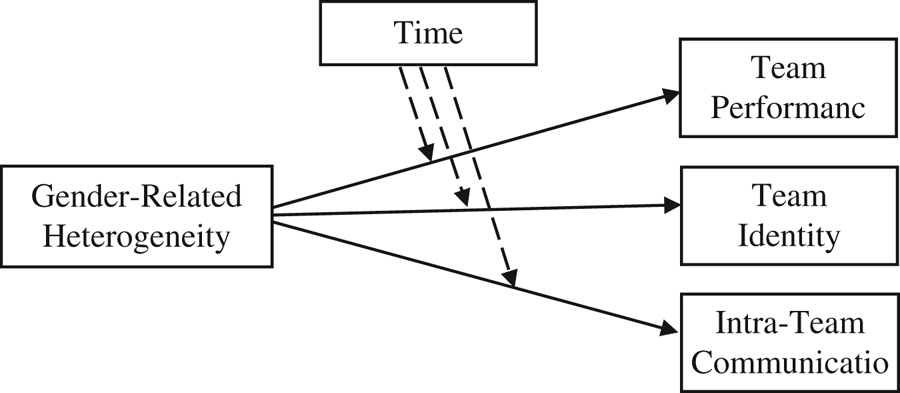
As for the time budget, I assume that it moderates the relation between gender-related work group diversity and performance. This is in accordance with what Earley and Mosakowski, (Reference Earley and Mosakowski2000) have found to hold true for high levels of inter-cultural heterogeneity in management teams. Given sufficient time, highly heterogeneous teams might coalesce so that their high degree of intrateam differences is likely to work to their advantage (see, e.g., Hambrick, Cho, & Chen, Reference Hambrick, Cho and Chen1996; Harrison & Klein, Reference Harrison and Klein2007; Rink & Ellemers, Reference Rink and Ellemers2010; Lavy, Bareli, & Ein-Dor, Reference Lavy, Bareli and Ein-Dor2015).
Hence, I derive the following hypotheses:
Hypothesis 1: Highly gender-related heterogeneous work groups outperform highly homogeneous ones in the long run.
Hypothesis 2: Highly gender-related homogeneous work groups outperform highly heterogeneous as well as moderate heterogeneous ones in the short run.
Hypothesis 3: Moderately gender-related heterogeneous work groups outperform highly homogeneous ones in the long run.
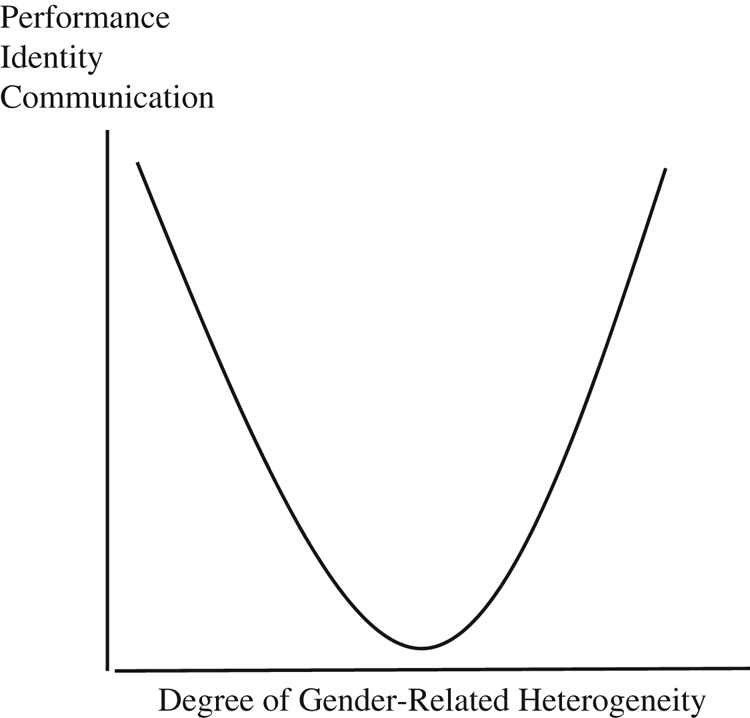
These hypotheses partly admittedly have a normative stance as they come with the pleading that the current state of affairs which discriminates against women in general and against femininity in specific must not persist. This specifically applies to Hypothesis 1. The substantial non-normative argument, however, is that employees might respond with a higher level of work performance, increasing team identity perception and improved intrateam communication quality, when both ends of the gender-related ‘portfolio of characteristics’ are ‘in use’ within a work group. Figure 1 visualises the overall assumption and Figure 2 shows the underlying research model.
Visualisation of general assumption performance identity communication Degree of gender-related heterogeneity

Research model

Although team heterogeneity in general in a ‘double-edged sword’ in terms of ambiguous results concerning its overall advantageousness (see, e.g., Sahaym, Cho, Kim, & Mousa, Reference Sahaym, Cho, Kim and Mousa2016), its optimal degree (see, e.g., Berger & Nieken, Reference Berger and Nieken2014) or appropriate framework conditions (see, e.g., Rutherford, Reference Rutherford2016), we argue that for gender-relatedness diverse teams outperform homogeneous teams at last. More principally and drawn from a pedagogical perspective, for which Lewin, Lippitt, and White (Reference Lewin, Lippitt and White1939) have set up the link to leadership behaviour, the presence of both father and mother has long been discussed to effectively impact children’s socialisation process, such as their gender-related role understanding (Parsons, Reference Parsons1955; Johnson, Reference Johnson1963; Reference Johnson1975), their psychoanalytic development (Chodorow, Reference Chodorow1999) or their social learning (Mischel, Reference Mischel1970). Needless to mention that both sexes are vital for biological reproduction, and more recent findings explicitly associate the ‘both parents claim’ with educational success prediction (Hill, Reference Hill2015) or establish a connection between parental involvement and subjective well-being (Lv, Zhou, Guo, Liu, Liu, & Luo, Reference Lv, Zhou, Guo, Liu, Liu and Luo2016). Therefore, what holds true for pedagogy with regard to the growing attention paid to the importance of masculinity in terms of father involvement in families (see, e.g., Potter, Reference Potter2016) might not be erroneous with regard to the value of femininity involvement in organisations. Surely, this heterosexist arguments have to be treated with caution in terms of both their reliability for pedagogy as well as for their raison d’être in organisational contexts as they might be interpreted as having a normative stance. Finally, the present investigation might stir lively debates on the above issues.
Methodology
The methodological approach is a refined experimental design which stems from Earley and Mosakowski (Reference Earley and Mosakowski2000). A series of experiments was conducted with 288 young executives who were enrolled as extraoccupational MBA candidates at five different business schools in Germany, located in the federal states North Rhine Westphalia, Bavaria and Hesse. Although this group of participants might represent future senior executives, their current leadership experience is relatively little. Therefore, results cannot simply be extrapolated to different age groups or hierarchical levels. The results section contains detailed respondents’ profiles. In total, 72 hierarchy-free, self-organised work groups were composed, each with a team size of four members. The experiments were conducted from March 2016 until December 2016.
As for the independent variable, the degree of gender-related heterogeneity is manipulated according to the ‘portfolio of characteristics’, which a group covers along with the continuum from an extremely masculine to an extremely feminine ‘mental attitude’. This might need some explanation.
There are several survey instruments that allow attributing the degree of sex typing of the corresponding participant. The most commonly used measure is Bem Sex Role Inventory by Bem (Reference Bem1977) with 60 items (or 30 in the short version). A German version from Schneider-Düker and Kohler (Reference Schneider-Düker and Kohler1988) also exists. It differentiates between feminine, neutral and masculine characteristics and thus offers a convenient predefined sex-typing. However, the items are not validated for leadership roles and apart from that, its femininity scale is inconsistent in terms of measuring vocational characteristics (Holt & Ellis, Reference Holt and Ellis1998). Schein Descriptive Index by Schein (Reference Schein1973) was set aside as it does not allow predefining the degree of sex-typing. Spence’s and Helmreich’s (Reference Spence and Helmreich1979) personal attributes questionnaire for which Runge, Frey, Gollwitzer, Helmreich, and Spence (Reference Runge, Frey, Gollwitzer, Helmreich and Spence1981) developed a validated German version is a frequently used test instrument for measuring gender identity on the basis of self-ratings which – independently from the biological sex – produces four types of individuals (see Wood & Eagly, Reference Wood and Eagly2015): (a) feminine gender-typed (scoring high on the dimension of femininity and low on the dimension of masculinity), (b) masculine gender-typed (vice versa), (c) androgynous (scoring high on both dimensions) and (d) undifferentiated (scoring low on both dimensions). Although originally suitable for assessing sex-typing in vocational contexts, Abele (Reference Abele2003) found that its main scales (a) and (b) lost their predictive quality, especially when investigating younger generations, such as student participants.
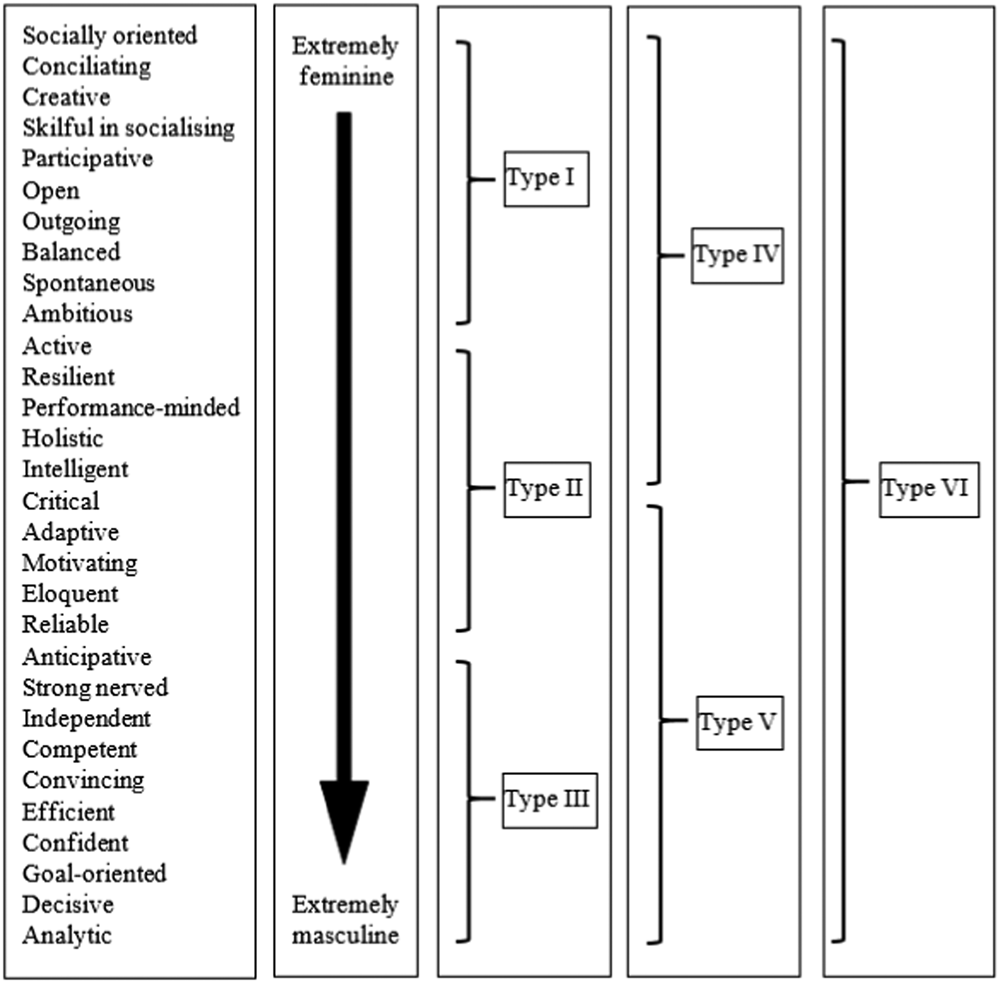
Therefore this study decided to use the Konstanzer Managergeschlechtsrolleninventar (KMGI; Konstanz Manager Gender Role Inventory) that first appeared in a research report by the University of Konstanz (Gmür, Reference Gmür1991). It was finally validated by Gmür (Reference Gmür2004). The KMGI was explicitly conceptualised for candidate selection contexts in terms of measuring gender stereotypes by a predefined scale of 30 items in total. It offers, similar to the Bem Sex Role Inventory, a feminine, a neutral and a masculine dimension, based on 10 items for each dimension. Furthermore, and grounded on the aforementioned items, the KMGI comes with a continuum of characteristics from extremely feminine to extremely masculine (see also Walker & Wänke, Reference Walker and Wänke2017).
The KMGI might fuel lively debates on whether single characteristics can be reliably attributed to the feminine or masculine end, especially when taking into account that a gender-typing of items is at least partially socially rooted. Apart from that, I am aware of the possible powerful influence of contextualisation in terms of say epochs or cultures that co-decide which characteristics are determined to be feminine or masculine. This issue is addressed as it might lead to a rather principal bias in the present investigation. Even though the confirmatory factor analysis statistically supports the assumption of robustness and consistency of the continuum, it should be applied with caution. At least its validation should be subject to a careful re-appraisal on a regular basis in order to update its consistency values and particularly when applied to other than management-related settings, such as in sociological or ethnographic studies. Furthermore, the KMGI only holds true by tendency and individual ‘scores’ might deviate from the tendential attribution. Being aware of the potential critique and constraints this continuum faces, we can finally judge it to be an appropriately robust method that allows gender-typing the participants of the experiment.
The participants were asked to rate the priority they attribute to each of the 30 items in order to determine where on the continuum each candidate can be ‘mentally localised’. Given this option to gender-type the 288 young executives, six team types with 12 teams per type were created: (I) highly homogeneously feminine, (II) highly homogeneously neutral, (III) highly homogeneously masculine, (IV) moderately heterogeneous (feminine+neutral), (V) moderately heterogeneous (masculine+neutral) and (VI) highly heterogeneous (feminine+neutral+masculine). Figure 3 shows the continuum of 30 items according to Gmür (Reference Gmür2004) as well as the composed group types.
Continuum of gender-related characteristics and group composition

To secure that the degree of gender-related heterogeneity functions as the salient differentiator between the groups, all other observable socio-demographic characteristics (such as age, level of education, work tenure) were kept similar, as much as feasible. Participants were aware of being part of a research project to extend findings on team composition but were kept unaware of the fact that the groups were composed according to the gender-type criterion.
As for the dependent variables, team performance, team identity and intrateam communication were assessed. Consistent with the design for experimental management team tasks by Earley, Wojnaroski, and Prest (Reference Earley, Wojnaroski and Prest1987), team performance was measured as follows. Each team was required to develop a short marketing recommendation for certain products (such as milk, personal computer and furniture) according to the ‘four Marketing Ps’ – product, price, promotion and place (see Kotler and Zaltman, Reference Kotler and Zaltman1971). Apart from that, the teams were asked for a short justification for their decisions. The number of products recommendations that were developed by each of the work groups were then counted. The task type was kept the same (only with other randomly selected products) to assure that the degree of heterogeneity is the main influencing factor for the dependent variables. Moreover, it is arguable that the task type did not disadvantage or advantage any of the teams.
In line with Earley and Mosakowski (Reference Earley and Mosakowski2000), team identity and intrateam communication was assessed using team member self-ratings on a 5-point scale from strongly agree (coded as 5) to strongly disagree (coded as 1). Answers were then aggregated to a single overall score for these two variables.
The questions for team identity were:
-
1. The feeling that we are all sharing a common set of beliefs and values is high in our group.
-
2. Our group has a strong sense of what it is.
-
3. Our group acted as a single, cohesive team.
The questions for intrateam communication were:
-
1. People talked with one another openly and freely in our group.
-
2. We seemed to understand what one another was saying during our discussions.
Again, according to Earley and Mosakowski (Reference Earley and Mosakowski2000), the long-term versus short-term distinction is simulated by an admittedly pragmatic measuring approach. Performance, team identity and intrateam communication were quantified twice. Each team received a written explanation of the above described task, plus a list of products (more than they could handle). The first performance trial took exactly 20 min. Then, the groups were given a 30 min time period in order to think about how to improve their performance in the second performance trial, which again lasted 20 min. Two graduate students, who were not informed about the background interest of the present study, assessed the performance of each group independently (with an unambiguous inter-rater agreement of r=1).
Results
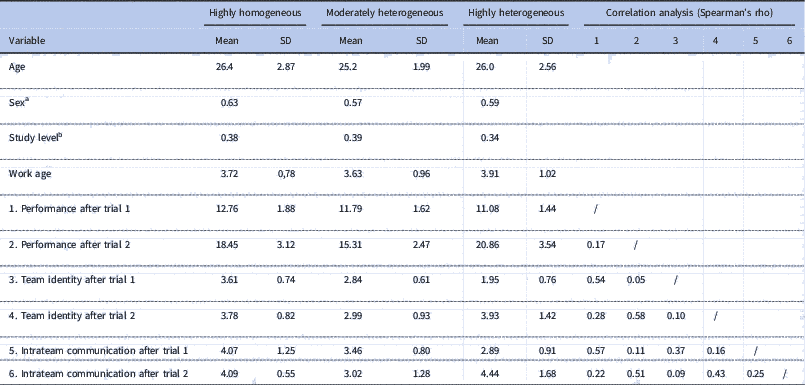
When looking at the results, which are shown in Table 1, there is obvious support for Hypothesis 1, as highly gender-related heterogeneous teams clearly outperform homogeneous ones. Whereas heterogeneous work group start performing relatively low with regard to performance trial 1 and a corresponding mean of 11.08 completed tasks, such teams make the best use of the 30 min break time and then perform almost twice as good in trial 2 (mean=20.86 completed tasks). The same holds true for heterogeneous teams in terms of their perceived team identity as well as intrateam communication. Starting at a bottom line of minimal scores for both variables, diverse gender-typed groups finally coalesced and scored higher than homogeneous groups.
Impact of team type on performance, identity and communication

Correlations with an absolute value >0.36 are significant at p<.05
Correlations with an absolute value >0.49 are significant at p<.01
Note. aSex was coded 0 for female and 1 for male
bStudy level was coded 0 for undergraduate and 1 for graduate students
In the short run, however, homogeneous teams outperform other team types. This might be the case as these groups do not need any ‘warm-up time’ to become fully operational. In trial 1, homogeneous groups show higher task completion scores as well as team identity and intrateam communication values when compared with other group types. Therefore, Hypothesis 2 is also supported.
No support was found for Hypothesis 3. In fact, moderately heterogeneous teams were expected to outperform highly homogeneous teams in the long run. The assumption behind was that a medium level of diversity might result in a manageable amount of different viewpoints which were thought to spice up the team members’ ‘thinking repertoire’ in an advantageous manner. Yet, this was not the case. Instead, the results are consistent with the impression from the observation of the respective groups’ behaviour that moderately heterogeneous teams exhibited an ‘us-versus-them’ within-group-mentality. Almost every moderately heterogeneous team seriously argued about the way of task handling in the provided 30 min break time. This rather impeded than promoted performance, team-identity and intrateam communication.
As Table 1 depicts the results in an aggregated way for homogeneous, moderately heterogeneous and highly heterogeneous work groups, one might ask for differentiation between the homogeneous team types I, II and III or the moderately heterogeneous team types IV and V. Most interestingly, there was no significant difference detected in terms of the underlying source of homogeneity or moderate heterogeneity, respectively. To be more specific, it made no difference whether, say, homogeneity was fed by feminine-only, neutral-only or masculine-only characteristics. The same applies for moderate degrees of heterogeneity which was either fed by feminine-neutral or masculine-neutral characteristics.
As for the results of the correlation analysis, these yielded the following. A strong performance in a certain task trial is significantly positively associated (error margin of p<.01) with a strong perception of team identity as well as with a high-quality intrateam communication (and vice versa) in the same task trial. Within a certain task trial this also applies to the relation between identity and communication, although to a lesser extent and with a slightly higher probability of error (p<.05). Across task trials, no significant correlation was measured.
Discussion
As major contribution, the series of experiments delivered strong support for a long-run superiority of highly heterogeneous gender-typed teams over homogeneous and moderately heterogeneous ones. However, this does not mean that diversity always predicts long-term superiority. Consistent with Srikanth, Harvey, and Peterson (Reference Srikanth, Harvey and Peterson2016) who have developed further the rather simpliste double-edged sword allegory and have consequently come up with a more differentiated ‘tropical’ parable concerning the often ambiguous findings with regard to diverse teams, our highly heterogeneous gender-typed teams might function as examples of what they state as ‘a rainstorm that gives way to sunshine’ whereas other highly diverse teams might shift ‘into a dangerous hurricane’. To be more explicit, the low short-run performance of this study’s highly diverse work groups symbolises the rainstorm, whereas the sunshine is a metaphor for the high long-run performance. Other teams that are highly heterogeneous, but not in a gender-typed manner, might face the hurricane image and fail. In this respect, this investigation has shed some light on the conditions to be met in order to facilitate diversity-related ‘organisational sunshine’.
On the genealogy of the distinction between sex and gender roles (see also Lips, Reference Lips2017), refer to Miller (Reference Miller1984) and we can agree with the problem that individuals cannot refrain from thinking about themselves in a way that distinctively separates between his or her own biological sex and the role which is stereotypically attributed to the respective sex and labelled as feminine or masculine. However, persons differ in terms of whether they integrate gender-related attributions into their concept of the self (schematic) or whether they do not (aschematic). Although this differentiation is theoretically crucial, this study does not methodologically capture this separation as the reason for female as well as femininity underrepresentation is arguably to be found in third-party attribution (e.g., by society; here: by organisations and their members), which leads to stereotyping without regard to the schematic or aschematic self-concept of individuals.
This leads over to the problem that although much (partly feminist-driven) effort has been put into, for example policy changes in terms of gender mainstreaming, these have not been successfully institutionalised into daily activities within organisations (Rao & Kelleher, Reference Rao and Kelleher2005; Henry, Sandler, Passerini, & Darmstadt, Reference Henry, Sandler, Passerini and Darmstadt2017). The privileges of power still remain in the hands of few, mostly male (and masculine) decision makers. Without top-management support gender-related concerns remain marginalised. Here this study addresses that progress in favour of a feminist voice in organisations in general and at the workplace in specific must necessarily diffuse from the nominal level of the formal institution (e.g., in terms of a female quota) to the real level of the informal institution (Rao & Kelleher, Reference Rao and Kelleher2003).
Organisations are both the problem as well as the solution to the emergence of gender-related social justice (Rao, Sandler, Kelleher, & Miller, Reference Rao, Sandler, Kelleher and Miller2015). In the light of social norms on gender roles being closely related to traditional role allocation and associated stereotypes in society and a quasi-natural dominance of one group over the other, the theory of a gendered organisation (Acker, Reference Acker1990) adds to that by revealing that it is not only the informal organisation which effectively thwarts women but simultaneously the underlying structure of organisations which is far from being gender-neutral. Current research in the field confirms that rethinking the gendered organisation remains as topical as it was back then (see also Chin, Reference Chin2016; Hart, Reference Hart2016; Stainback, Kleiner, & Skaggs, Reference Stainback, Kleiner and Skaggs2016). It becomes obvious that numerous areas exist that are worth working on. However, not all of them can be further addressed in the present research.
Now that we know that self-organised work groups benefit from an enrichment of the ‘portfolio of gender-related characteristics’, practical implications for practicing managers to break the ‘glass ceiling’ and to enhance the skid resistance of the ‘glass cliff’ are needed. As the rise of femininity pays off, firms should focus on increasing femininity in teams through setting up their vacancy notices in a way that attracts applicants who explicitly satisfy feminine role expectations. Application procedures like assessment centres might use validated test instruments such as the KMGI (Gmür, Reference Gmür2004) that gender-type candidates in order to identify those who best fill the existent gaps in the organisation’s ‘gender portfolio’.
As a side effect, gender quotas would not be necessary anymore. Organisational efforts to increase femininity quite naturally lead to an increase of the ratio of women in managerial positions as women more frequently than men – and rather coincidentally then fortuitous – exhibit the intended female characteristics. Male candidates who feature female characteristics would be equally welcome in candidate selection procedures, but as female characteristics are overrepresented by women this would not be much of a problem. Besides, the situation of the sexual minority group of gay men, who face serious vocational disadvantages (see Mize, Reference Mize2016), would be bettered, too, as they might also benefit from organisational efforts to increase feminine attributes. The above scenario can be viewed as an ideal long-term outcome of this investigation. To add more depth to this issue, one has to admit that the above beneficial scenario, however, does not hold true for lesbian females who arguable are being given advantages in the existing candidate selection procedures. Consequently, this research has largely failed to add value to the body of research on sexual minority group of homosexuals. Yet, future studies focussing on sexual minorities are needed urgently because such groups face stereotypes at various ends.
Apart from the above illustrated contribution and the inherent practical value of the unique gender-typing of management teams, the present study is not free from limitations. The methodology of the experimental design in this study has both some external validity shortcomings as well as realism deficiencies; (a) it has to be treated with caution when a study which is based on a sample of young executives attempts to gain insights into all hierarchical levels; (b) the task type also has laboratory character and might be of a different kind in ‘real enterprises’; (c) the degree of self-organisation in our hierarchy-free teams might not be equally high in all organisations; (d) insights into project teams are not necessarily transferable to department structures; (e) the simulation of short-term versus long-term is grounded on a 30 min break; (f) processing 12 groups per team type might be regarded as insufficient, whereas this already required an overall sample size of 288 young executives; (g) at the time of the experimental design the author did not configure a moderately heterogeneous gender-typed team type, which comprised of participants with a combination of extremely feminine and extremely masculine members (without the neutral ‘link’). Future research might want to remedy some of the above flaws. A longitudinal study focussing on both project teams and department structures with ‘real work tasks’ could better capture the long-term effects and solve some of the realism and external validity problems. However, this is beyond the scope of the present work.
It is especially important to address the problem of simulating the long-term versus short-term assumption on the basis of a 30 min break in between the two performance trials. Although this causes considerable realism concerns, it is a conscious methodological decision, as this is the price for processing an appropriate amount of work groups and participants through the experimental setting. Thus this time-related issue makes this research rather exploratory. The alternative would have been to process much fewer works groups and allow much more time, say days or even weeks, in between the tasks. However, this would have caused two major problems. First, the lower sample size would have considerably reduced external validity. Second, it would have been beyond feasible control of the researcher to observe what happened in between the two timeframes and, for example how long each group was effectively involved in discussing about how to improve their performance scores for the second trial. This would have introduced several further uncontrollable variables (e.g., effective collaboration time within the break timeframe, external influences such as talking with uninvolved persons about how to improve performance etc.) to the experimental design. Although the conscious decision is suboptimal, the above sketched alternative would have violated the methodological robustness even more.
Given the above limitations, this research provides powerful evidence for the following practical advice: First, firms should encourage higher degrees of femininity regardless of their employees’ biological sex. Second, firms should make better use of those skills that are exhibited by feminine employees, be they male or female. Third, firms should focus on candidates who satisfy feminine role expectations when hiring executives. Finally, team composition should be facilitated on the basis of the curvilinear upright U-shaped format between gender-related heterogeneity and performance, team identity and intrateam communication.
Conclusion
To conclude, this investigation might successfully contribute to an incremental change in organisations’ view on the role and value of femininity. From the big picture perspective, it is likely that research on female representation in upper management positions will continue producing ambiguous results (see, e.g., Jeong & Harrison, Reference Jeong and Harrison2017). As organisations are embedded into society as corporate citizens and leave imprints on patterns of power in society as well as vice versa, the present research has to be carefully interpreted in this ‘polycontextual’ mesh. This work might have opened either an organisational window to society or a societal window to organisations. Whether this will lead to a societal and/or organisational shift might be lively debated.