1 Introduction
Historical studies of English morphology, such as Fleischman (Reference Fleischman1977), Dalton-Puffer (Reference Dalton-Puffer1996), Cowie (Reference Cowie1998), Lloyd (Reference Lloyd2005), Kaunisto (Reference Kaunisto2007) and Trips (Reference Trips2009), have expanded our understanding of changes in the meaning and use of a variety of English derivational morphemes. But these texts say little about how to assess and compare changes in productivity among these morphemes. By tracking neologisms in the Oxford English Dictionary (OED), Anderson (Reference Anderson2000) gives one account of the productivity of derivational suffixes from the twelfth century to the present day. She identifies broad trends, such as increased neologizing among all nominal suffixes in the fifteenth and sixteenth centuries. And yet, neologisms alone cannot fully define productivity; they are the results of productive processes, not necessarily the motivating forces for future productivity. What is lacking in recent scholarship is a more nuanced, comprehensive account of diachronic productivity – a set of measures that help illuminate how a particular ending such as -age came to be increasingly perceived as a suffix capable of producing new English words, like fifteenth-century neologisms stoppage, primage and groundage.
This article aims to describe the emergent productivity of selected nominal suffixes – namely, -ness, -cion, -ity, -age and -ment – as observed in fifteenth- and sixteenth-century English personal correspondence (letters). These suffixes have been among the most frequently studied in previous diachronic research on derivational morphology, e.g. Dalton-Puffer (Reference Dalton-Puffer1996), Cowie (Reference Cowie1998) and Anderson (Reference Anderson2000). Furthermore, this set of suffixes includes both native and borrowed forms, all of which are represented by a reasonably large number of types – characteristics which allow for comparative studies of general trends and changes in their use within letters written during the Early Modern English period.
As scholars such as Nevalainen & Raumolin-Brunberg (Reference Nevalainen and Raumolin-Brunberg2003: 29) have demonstrated, personal letters are ‘one of the most oral written genres’. In historical studies, letters represent the written data that come closest to the everyday speech of English-speaking peoples. Letters are also typically well dated, enabling accurate diachronic studies of language. Using the Corpus of Early English Correspondence (CEEC), Nevalainen & Raumolin-Brunberg discover a number of interesting trends in the fifteenth through seventeenth centuries, including syntactic, inflectional and pronominal changes. Bergs (Reference Bergs2005) provides an excellent sociolinguistic analysis of the Paston Letters, including an account of a number of inflectional morphemes. But with the rare exception of Säily & Suomela (Reference Säily, Suomela, Renouf and Kehoe2009), who examine -ity and -ness in seventeenth-century letters, most scholars have paid little attention to the development of derivational morphology, and especially borrowed derivatives, within this genre.
Filling in several gaps in our knowledge about the historical use of borrowed derivatives in the vernacular, the current study also illuminates many of the forces that influenced the productivity of borrowed nominal suffixes -ity, -ment, -age and -cion in English. It considers several variables that reflect different aspects of these suffixes’ productivity, including hybrid formations (i.e. derivatives with a native base and borrowed suffix, such as stoppage mentioned above) and aggregation (i.e. the regular addition of new derivative types of a particular suffix in sequential subperiods of a corpus). An analysis of base-derivative ratios also provides strong evidence of the varying levels of perceived productivity of each suffix during different subperiods of the fifteenth and sixteenth centuries. This multifaceted approach finds that, while none of these suffixes was as productive as native nominal -ness, each showed various degrees of productivity. Demonstrating that there is no single criterion which measures diachronic productivity, I argue that a multipronged ranking remains the best approach. And finally, I suggest one possible explanation for the increased neologizing with these suffixes in Early Modern English: the increasing token frequency of bases (e.g. determine) compared to their full derivatives (e.g. determination) made the suffixes more transparent over time and, ultimately, increased their perceived productivity.
2 Previous studies
Bauer (Reference Bauer2001: 143–61) provides a brief survey of various proposed measures of productivity, examining primarily synchronic approaches and noting many of the limitations of these measures. Most approaches center on comparisons of word or morpheme frequency, though Bauer argues that a simple frequency count of tokens (e.g. the total number of words ending in -able) only reveals the ‘past productivity’ of a suffix rather than its potential to create new forms, ‘a crucial part of the notion of productivity’ (Reference Bauer2001: 144). But Bauer also finds problems with Aronoff's (Reference Aronoff, Hattori and Inoue1976) proposal, later formalized by Baayen & Lieber (Reference Baayen and Lieber1991), to measure the ratio of actual types produced by a word-formation rule to potential types; he considers the measure too difficult to implement, primarily because of the impossibility of quantitatively determining potentiality (Reference Bauer2001: 146). One of the more promising measures seems to be that proposed in Baayen (Reference Baayen1989, Reference Baayen, Booij and van Marle1992), which requires counting the number of hapax legomena – words that occur once even in a large corpus. Baayen has demonstrated that less productive processes create fewer words, most of which will eventually appear in a corpus, often more than once, if the corpus is fairly large. More productive processes will generate a wider range of forms, many of which will only appear exactly one time in vast stretches of language. Thus, a suffix that produces more hapaxes is assumed to be more productive than one with fewer observed hapaxes. Bauer acknowledges a major limitation of the measurement of hapaxes: it depends heavily on the sample size of the corpus under investigation. In small samples, productive and non-productive processes alike produce so few occurrences that there will be an overestimation of hapaxes, inflating the productivity counts of all processes. At the same time, some less productive processes available in a certain time period may appear infrequently in a small sample of text from that period. This underestimation would lead a linguist to undercount the productivity of a number of emergent, less common processes. This problem is an especial concern for diachronic studies, which often depend on corpora that are relatively small in size, such as ARCHER and the Helsinki Corpus (HC). Baayen's studies have been conducted on corpora of millions of words drawn from the present day. But with very few exceptions – e.g. Schröder's (Reference Schröder2011: 174–5) study of prefixes over- and under- in the Lampeter corpus – historical linguists have been unable to use hapaxes as a reliable measure of diachronic productivity in periods before the late twentieth century.
Scherer (in press) surveys measures of changes in productivity, including a focus on diachronic approaches. Most diachronic studies of English morphology seem to focus primarily on corpora – e.g. Baayen & Renouf (Reference Baayen and Renouf1996), Dalton-Puffer (Reference Dalton-Puffer1996), Cowie (Reference Cowie1998), Palmer (Reference Palmer2009) – or on attestation evidence in historical dictionaries – e.g. Anshen & Aronoff (Reference Anshen, Aronoff, Fasold and Schifferin1989), Aronoff & Anshen (Reference Aronoff, Anshen, Spencer and Zwicky1998), Anderson (Reference Anderson2000), Romaine (Reference Romaine, Booij, Lehmann and Mugdan2004), Hilpert (Reference Hilpert2013). Schröder (Reference Schröder2011) examines the productivity of English prefixes by comparing corpus and dictionary evidence – and even adds elicitation data to the mix, though it must be remembered that elicitation is methodologically possible only for studies of present-day language. Scherer (in press) suggests that competing forms – such as -ity versus -ness in English – have been a primary focus in historical studies of productivity in English. A relatively recent example is Säily & Suomela (Reference Säily, Suomela, Renouf and Kehoe2009), whose study of the seventeenth-century portion of the CEEC finds that -ity exhibits particularly low productivity in letters written by women, with no clear correlation between gender and productivity for much more productive -ness. The purported competition between -ity versus -ness, however, is not always easy to study diachronically, as will be shown in section 4 of this article.
Investigating attestations of -ment in the OED, Hilpert (Reference Hilpert2013) uses a hapax-based measure to show that the period 1400–1649 was a historical peak in the productivity of the suffix. Even though Hilpert carefully analyzes factors such as semantics and etymology to provide a richer descriptive account of changes in -ment formations, he resists identifying causes of its productivity. Importantly, it is not immediately clear why this particular period sees such a sharp increase in productivity compared to periods before and after the fifteenth and sixteenth centuries. More generally, historical linguistic scholarship has not extensively examined particular motivating factors for changes in productivity, such as the perceived decomposability of suffixed forms.
In studies of present-day language, Hay (Reference Hay2003) has shown that derivatives of productive suffixes tend to occur far less frequently than their bases, while derivatives of unproductive suffixes tend to appear far more frequently than their bases. The relationship between base/derivative frequency and productivity depends crucially on the notion of decomposability – the more often a base (such as pass) appears relative to its derivative (passage), the easier it is for speakers to parse the derivative as two morphologically distinct units (pass + -age). Hay & Baayen (Reference Hay, Baayen, Booij and van Marle2002) also demonstrate a causal link between parsability and productivity. They show that, for a range of different suffixes, Baayen's hapax-based measures of productivity correlate strongly with the number of decomposable derivatives. But such measures of the relative frequencies of bases and their derivatives have not yet been studied historically. As detailed in section 6, this study will apply this measure to historical data from the fifteenth and sixteenth centuries to evaluate the relative perceived productivities of various suffixes. I borrow the phrase ‘perceived productivity’ from Bauer (Reference Bauer2001: 145) and apply it here to emphasize the fact that Hay's measure of decomposability reflects the analyzability of a morphologically complex form and the transparency of its suffix. As Dalton-Puffer (Reference Dalton-Puffer, Fernández, Fuster and Calvo1994: 248–9) emphasizes, analyzability and transparency are key features of a productive form, of speakers’ ability to perceive a morpheme as productive. Thus, in lieu of counting neologisms, or hapaxes as surrogates for neologisms – a measure of productivity that does not work well for small, historical corpora – this study focuses on perceived productivity as measured, in part, by base and derivative ratios.
Outlining an ‘alternative’ supplement to such quantitative measures of productivity, Bauer (Reference Bauer2001: 156) describes the measurement of ‘rate of additions’. For this measure, a linguist must use a dictionary and/or a corpus to count the number of new types of a suffix that occur within a fixed period of time. The most elaborated application of this technique to diachronic studies is perhaps Cowie & Dalton-Puffer (Reference Cowie, Dalton-Puffer and Diaz Vera2002: 416), who claim that absolute counts of type frequency in a synchronic snapshot do not sufficiently measure change in productivity: ‘One of the problems is that the existence of a large number of types may of course not be the result of current productivity but of an aggregation through productivity in the past.’ Arguing that diachronic studies can directly respond to the need to measure productivity by accounting for newly introduced types rather than type frequencies alone, they introduce the concept of ‘aggregation’ (Reference Cowie, Dalton-Puffer and Diaz Vera2002: 428), which tracks ‘in each subperiod [the] new types [that] are added to the types of the previous period’ alongside general increases and decreases in overall type frequencies. The aggregation of new types in a body of texts over time, the general trends in the use of different types, provides some sense of what is and what is not productive. Because aggregation seems to be a valuable factor in measuring diachronic productivity, in section 5 this study adapts and applies it to data from the CEEC.
3 Methods and materials
To conduct a diachronic analysis of borrowed derivatives, texts were selected from the CEEC, a 2.7 million-word corpus of personal letters written by over 778 informants, from the beginnings of the records of the genre (c. 1410) to 1681. Individual letters are coded for sociolinguistic variables such as gender and age of writers and addressees. Men are much more represented than women in all subperiods, in part because they tended to have greater access to literacy during this time. Texts from all social classes appear in the corpus, though the upper classes are more strongly represented. The corpus has some geographic diversity, including letters from East Anglia, London, the North and the Royal Court. Because of the demographic composition of the corpus, this study adopts Nevalainen & Raumolin-Brunberg's (Reference Nevalainen and Raumolin-Brunberg2003: 49) view that
while the CEEC may not in all respects represent the entire language community from the fifteenth to seventeenth centuries, it nevertheless provides quite a reliable sample of the informal language used by the language community, or at least by the literate writing community, of Tudor and Stuart England.
To enable diachronic analyses, texts were grouped into fifty-year subperiods, 1401–50 (CEEC1), 1451–00 (CEEC2), 1501–50 (CEEC3) and 1551–1600 (CEEC4).
Nominal derivatives were chosen for analysis and comparison, and they were identified by using the AntConc concordancer. Native suffix -ness was selected, as were borrowed suffixes -age, -ity, -cion and -ment. These suffixes are five of the most frequently occurring suffixes in the HC (Dalton-Puffer Reference Dalton-Puffer1996), and all of them are used to create abstract nominals in English. These suffixes also represent some diversity in terms of morphological processes: -ness and -ity are both deadjectival, -cion and -ment are both deverbal, and -age can be either deverbal or deadjectival. Thus, the trajectories of solely deverbal suffixes can be compared with one another and/or distinguished from patterns evidenced by the deadjectival suffixes.
Certain derivatives were excluded from the present analysis. In particular, the lexeme highness was an outlier in subperiod CEEC3, as letter writers used it in unusually large numbers as an address or reference to the king or other superiors. In fact, it accounted for almost two-thirds of all uses of -ness in that one subperiod, a pattern which was not observed in any other subperiods in the present study. Because of this anomaly, highness was excluded from the token count.
All claims of statistical significance were based on chi-square tests conducted with the software SPSS. A difference was considered significant if the p-value was less than 0.05. More specific discussions of methodological decisions are left to the individual sections of this article.
To contextualize this article's model for measuring diachronic productivity in fifteenth- and sixteenth-century English, the following section presents data on overall token frequencies for -ness, -ity, -cion, -age and -ment throughout Middle and Early Modern English. Section 5 approaches productivity from the perspective of aggregation, offering a comparative account of increases in the frequencies of new derivative types and hybrid formations in subperiods of the CEEC. Providing a complement to aggregation, section 6 measures productivity in terms of base-derivative ratios, which reveal the changing transparency and detachability of various suffixes over time. And section 7 offers both a final summary of findings on the different individual productivities of nominal suffixes in Early Modern English and a discussion of the need for a multifaceted approach to historical accounts of morphological productivity as a broader linguistic phenomenon.
4 Token frequencies: diachronic distributions
Few previous studies have charted the relative distributions of tokens and types of different suffixes in early English usage. In the present article, a token refers to a single occurrence of a derivative in a corpus. A type refers to a particular lexeme; for example, marriage and passage are considered two distinct types of derivatives ending in -age. Prior to the present study, the most comprehensive account of suffix frequencies can be found in Dalton-Puffer (Reference Dalton-Puffer1996). She provides counts for Middle English suffixes in the HC. To understand the general trends underway in the centuries immediately preceding the time period covered in the present study, consider figure 1. Generated from the data in Dalton-Puffer's study, it provides the normalized frequencies for tokens ending in -ness, -ity, -age, -ment and -cion in three subperiods of Middle English: 1150–1250, 1250–1350 and 1350–1420.
Frequency of derivatives of each suffix type in the Early Middle English sections of the Helsinki Corpus. Each bar represents the number of tokens per 10,000 words

Several significant trends can be observed in Dalton-Puffer's data. From the mid twelfth through the early fifteenth century, -ness was used significantly more often than all borrowed affixes. The one exception to this trend is -cion, which in the late fourteenth century begins to rival the usage of -ness. Perhaps unexpectedly, writers in the Middle English period generally use increasing numbers of all borrowed derivatives as each century passes (though -ment shows a leveling out between the second and third subperiods). Dalton-Puffer finds that, more generally, all suffixes borrowed from French (including -aunce and -acy) had the highest usage in the third subperiod of Middle English. In contrast to the trends observed with the borrowed affixes, -ness actually drops in usage after the first subperiod.
It is helpful to compare Dalton-Puffer's data with frequencies observed in the CEEC in the fifteenth and sixteenth centuries. But such a comparison requires at least one caveat: the HC contains texts from many different genres, including literature, religious material, and other registers that are far more formal than personal correspondence. Since highly formal genres such as poetry and religious writing use relatively high numbers of borrowed (especially Latinate) derivatives (see Palmer Reference Palmer2009: 166–256), it is reasonable to suspect that the CEEC might show lower frequencies of borrowed suffixes than the HC.
Figure 2 provides the normalized frequencies in the CEEC of -ness, -ity, -age, -ment and -cion in four fifty-year subperiods, 1401–50 (CEEC1), 1451–1500 (CEEC2), 1501–50 (CEEC3) and 1551–1600 (CEEC4).
Frequency of derivatives of each suffix type in each subperiod of the CEEC. Each bar represents the number of tokens per 10,000 words
The most remarkable trend observed in figure 2 is the usage of -ness. Compared to Dalton-Puffer's data in figure 1, the earliest letters start with a much lower frequency of -ness, far less than a third of the frequency in the 1350–1420 period of the HC. Somewhat surprisingly, -ness is roughly equal in frequency with -ity, consistently less frequent than -ment and much less frequent than -cion. These data suggest that usage of -ness was in relative decline compared to the use of several other borrowed derivatives, at least in the language of letters from this period, and perhaps in everyday informal speech if we assume shared properties between these letters and informal speech. An interesting question here is whether or not this trend in -ness was an effect of the relatively more frequent use of borrowed derivatives. In other words, -ness may have become less useful as a nominalizing suffix in written expression because its borrowed peers became more useful, particularly if -ness was competing with other deadjectival patterns such as -ity. Such competition has been discussed at length in studies such as Riddle (Reference Riddle and Fisiak1985), Cowie (Reference Cowie1998), Anderson (Reference Anderson2000) and Säily & Suomela (Reference Säily, Suomela, Renouf and Kehoe2009). Unfortunately, it is difficult to show that derivational rivalry was underway in the language of English letters – at least on a lexeme-by-lexeme basis. There is perhaps some evidence that, in terms of individual lexical decisions, certain forms may have competed for use (e.g. ableness vs ability, confusedness vs confusion). But these sorts of potential equivalents, which share the same base, are infrequent in the CEEC.
In terms of the borrowed derivatives, -age remains approximately at the same frequency throughout the fifteenth and sixteenth centuries; this frequency is statistically within the same range as the -age derivatives in the last period of Dalton-Puffer's study. Hence, there seems to be no increase in the use of -age over this period of time. In the fifteenth century, the suffix -ment shows a slight increase from the frequencies observed in the preceding centuries of the HC, with a further increase in the sixteenth century. In contrast, -ity shows a 50 percent drop from the last period of Dalton-Puffer's study into CEEC1. At the beginning of the sixteenth century it returns to the frequency level observed in the HC. It is interesting to note that not all borrowed derivatives in the CEEC followed the trends observable in the earlier periods of the HC: -ment continued to increase gradually, while -age flatlined and -ity dipped down and bounced back up.
The one suffix that continued to show a substantial increase in frequency was -cion. Compared to the data in the final period of the Helsinki study, the results in CEEC1 show a jump from just under 30 to just over 50 occurrences per 10,000 tokens. In CEEC2 the number dives down to 30 again, but by the sixteenth century -cion usage climbs to over 70 occurrences. These results may seem somewhat surprising since, as a generally less formal genre, letters might be expected to contain fewer -cion derivatives. As will be shown in the following section, letter writers were drawing upon these derivatives often because they came from a variety of lexical fields, including legal, religious and political discourses.
5 Evaluating productivity: derivative types
5.1 Aggregation of new types
The preceding section on absolute frequencies provides information about the general patterns of use of borrowed derivatives in fifteenth- and sixteenth-century English. But, as demonstrated in Aronoff (Reference Aronoff, Hattori and Inoue1983) and Baayen (Reference Baayen1989, Reference Baayen, Booij and van Marle1992, Reference Baayen, Booij and van Marle1993), token frequency alone sheds little light on the productivity of different suffixes. Type frequencies must also be considered, though even they reveal limited information about the relative potential productivity of suffixes. In this section I present speculations about productivity that can be drawn from a particular diachronic measure of type frequency: the aggregation of new types.
One of the problems with conducting a comparison of type counts is that such an analysis does not distinguish between types used repeatedly from those derivatives that were newly introduced over a period of time. Cowie & Dalton-Puffer (Reference Cowie, Dalton-Puffer and Diaz Vera2002) have shown that a suffix which aggregates – that is, one that consistently appears in new types in contiguous subperiods – must be considered more productive than one that rarely or never appears in new lexemes.
Adapting the methods outlined in Cowie & Dalton-Puffer (Reference Cowie, Dalton-Puffer and Diaz Vera2002) in order to inspect diachronic changes in type frequencies within the CEEC, I carried out an analysis of the aggregation of new types for each nominal suffix. Assuming that the data from CEEC1 provides the ‘starter lexicon’, I counted all new types that were used for the first time in personal correspondence in subsequent subperiods. To take the example of -ity, I first counted the number of derivative types ending in -ity that appear in the CEEC2, but not the CEEC1, and designated that value as the number of new types for CEEC2. Then I counted the number of types ending in -ity that appear in CEEC3, but not CEEC1 or CEEC2, and assigned that number to CEEC3. And so on. The assumption is that suffixes that consistently add high rates of new types over a period of time are the most likely to be productive in the language during that period. To clarify, a ‘new type’ in this analysis is not necessarily a neologism in English. It is, however, a neologism in the corpus.
New types are a particularly useful focal point for diachronic analysis because they serve a function similar to hapaxes in present-day studies of productivity. Recall that a hapax analysis works only if it is conducted on very large corpora – i.e. those with tens of millions of words. Since the majority of historical corpora have, at most, hundreds of thousands of words, hapaxes cannot be reliably counted. But new types resemble hapaxes in at least one important respect: both phenomena indicate the range of different types of a particular derivational process that occur in low frequencies. So a ‘new type’ may be considered a useful surrogate for a hapax in historical analysis, particularly since neither is a direct indicator of productivity but rather an indirect sign of potentially productive processes.
In the following paragraphs, I provide an overview of the aggregation of new types in the fifteenth and sixteenth centuries in the CEEC. The quantitative account of new types reveals the relative trends in lexical growth among the various suffixes in each period. Integrated into the quantitative analysis is a qualitative discussion of the primary lexical fields which contributed most to the new types of each borrowed derivative.
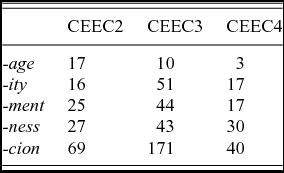
Table 1 provides the raw counts of the new types appearing in personal correspondence in each of the three subperiods, CEEC2, CEEC3 and CEEC4. Because of differences in word counts, values in different periods cannot be compared directly with one another. But values within the same period (i.e. within the same column) can be compared.
Raw counts of new types in each period of the CEEC
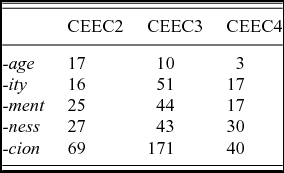
The aggregation analysis shows that, in all periods, -cion consistently has the highest rate of growth. In each subperiod, letter writers use more than twice as many new derivatives with -cion as they do with the other suffixes, except in CEEC4, where -cion has only a 33 percent higher rate than -ness. In all periods, religious discourse supplied many new -cion forms in English letters (absolution, conception, confession, excommunication, damnation, temptation). New legal terms also abounded (allegation, examination, deposition, citation, inquisition, comprobation) as well as political terms (administration, confederation, legation). Many letters relied on derivatives to convey political upheaval and violence (spoliation, usurpation, revolution, insurrection, altercation, expugnation, invasion). And mental processes, such as thought and emotion, were conveyed in lexemes new to letters such as contemplation, affection, imagination, circumspection, comprehension and compassion. It is possible that the rich diversity of lexical fields offered by -cion derivatives was a key motivating force for their use in personal correspondence.
Overall, -age experienced the lowest rate of growth relative to its peers. Even so, in every subperiod the suffix did appear in a number of new forms denoting financial transactions (such as taxes): coinage, groundage, stoppage, primage, quarterage, advowsonage, pawnage and soundage. According to the OED, several of these forms were early attestations in English – soundage, advowsonage, growndage, stoppage – the last three of which were also hybrids. Thus, even with a low rate of aggregation, the occurrence of some neologisms suggests moderate productivity. Other lexical fields that contributed new forms were religion (parsonage, pilgrimmage, vicarage), agriculture and farming (tillage, pawnage), and domestic space (pottage, swepage).
The suffix -ment shows moderate growth in all subperiods. In CEEC2 and CEEC3 it patterns similarly to -ness, though by the end of the sixteenth century it has only half as many new types as the native suffix. The primary lexical fields which contribute to its growth are finance (approwement, (ap)praysment, repayment, deboursement, apporcement), law (inditement, mercement, imprisonment, accusement, arbitrament, araynement) and clothing (abilyments, areyment, vestement). Several forms, such as divorcement and introducement, seem to be English creations (OED).
In CEEC2, -ity shows the lowest aggregate growth. But in the sixteenth century it begins to gain new types at a high rate relative to its peers. Many of its new forms in CEEC2 are abstract descriptive states (ambiguity, perpetuity, possibility, unity). In the sixteenth century, the majority of new derivatives address various aspects of human disposition (CEEC3: alacrity, benignity, emnity, graciousite, magnanymyte, malignitie, partiality, perplexity, sincerity, vanity; CEEC4: animosity, curiositie, hostilitie, importunity). Many of these forms are attested in the OED in other genres in the fifteenth century (such as benignity in poetry), but they make their first appearance in these letters in the sixteenth century. The last subperiod also sees a number of new -ity derivatives that emerge from the discourse of logic (absurdity, probability, validity).
Overall, the suffix -cion shows the highest aggregate growth in all subperiods; -age demonstrates the weakest growth, especially in the sixteenth century. The suffix -ment trends with -ness until the end of the sixteenth century, and -ity experiences a surge of growth at the beginning of the sixteenth century. In every subperiod there is a distinct group of lexical fields that characterizes the semantic domains of each individual derivative type, although in the sixteenth century writers using -ity began to draw from a wider range of lexical fields, such as logic and human disposition.
5.2 Hybrid forms
As noted above, an additional sign of productivity is the presence of hybrid forms: lexemes that include bases and affixes from different languages. Even though Miller (Reference Miller1997) gives almost a hundred examples of borrowed suffixes attaching to native bases in Middle English, other studies (Dalton-Puffer Reference Dalton-Puffer1996; Palmer Reference Palmer2009) demonstrate that it is much more common to find hybrid forms in which native suffixes attach to borrowed bases. In fact, among nominal suffixes, -ness typically produces the most hybrid forms in Middle English. And this trend can also be observed in the CEEC, which contains hybrids such as bounteousness, strangeness, assuredness and reasonableness. In contrast, the only borrowed suffix to appear in hybrid forms within letters is -age, including growndage, stoppage, tyllage and swepage. There are only few of such forms in the corpus. But these hybrids do indicate that -age had a wider set of bases to attach to than did -ity, -cion and -ment, all of which attach only to borrowed bases throughout the fifteenth- and sixteenth-century portions of the CEEC.
Occurrences of hybrid forms should not, however, be treated as a necessary condition for productivity. A few forms, such as divorcement, introducement and recantation, seem to be original English derivations (i.e. with no attested Latinate source in the OED). So -ment and -cion in these cases are being employed to produce non-borrowed neologisms. It may be said that these suffixes exhibit restricted productivity – in which borrowed suffixes attach only to borrowed bases – in contrast to the wide productivity observed in suffixes like -ness and -age.
Even so, what remains unclear is the set of conditioning factors for lower or higher rates of hybridization, for wider or more restricted productivity. An intriguing possibility is that the perceived detachability of a suffix may correlate with the frequency or absence of hybrids: specifically, a suffix with higher transparency may be more likely to appear in hybrids than a suffix with lower transparency. If so, then one would expect -ness and -age, which exhibit higher rates of hybridization in the CEEC, to be more transparently decomposable in their respective derivatives than -ity, -cion and -ment. The difficulty, of course, is figuring out a clear measure of transparency. The following section explores this question of suffix transparency by measuring the decomposability of tokens and types of different derivatives.
6 Decomposability as a measure of perceived productivity
6.1 Base-derivative ratios
The preceding analysis of derivative types has provided some ways to capture the relative productivity of different suffixes in earlier periods of the English language. As useful as these measures are, they are the product of a macro-level linguistic analysis from the eyes of a present-day linguist looking into the language of the past. The linguist with a bird's-eye view of the relative aggregation of new types or the use of hybrid formations may be noticing patterns that were not necessarily felt by language users in the fifteenth century. The suffix -cion, for example, exhibits a wider range of new types than all other suffixes in all subperiods. But did speakers feel this effect?
While it is certainly useful to explore all possible indicators of and influences on productivity, it is also imperative to determine how productive each suffix seemed to speakers living in different periods of time. This concept, perceived productivity, can be explored with an analysis of the relative ratios of all derivatives and their bases in each historical period. In addition to this study's account of aggregating forms, these ratios provide a direct quantitative measure of the relative levels of productivity for different suffixes. Furthermore, this type of analysis at times allows the linguist to move beyond description and into explanation of productivity. That is, base/derivative ratios may help to explain why some suffixes are more productive than others, and why some individual derivatives drift away from their bases semantically. And finally, these ratios help identify for each suffix which specific types were most likely to contribute to the perceived productivity of these suffixes in different periods.
In previous studies of borrowed suffixes in the history of English, some scholars have expressed an intuition that base and derivative co-occurrence might have had an impact on productivity. Consider Gadde (Reference Gadde1910: 70), who suggests that the development of the productivity of -ment in English may have depended directly on the concurrent use of borrowed bases and derivatives:
Among the early adoptions there are such as judgement, amendment, advancement etc., i.e. formations by the side of which occur the verbs from which they are derived, and which accordingly may give rise to new-formations.
While Gadde's instincts may be correct – that the use of bases alongside derivatives in earlier periods influenced new formations down the road – this study will not directly evaluate this claim. As Dalton-Puffer (Reference Dalton-Puffer1996: 219) emphasizes, in derivatives using Latinate and French material as both base and ending (e.g. determination), it is usually impossible to know whether or not a derivative is either a whole-word borrowing or a composite form produced from a borrowed base (determine) and a productive suffix (-ation) in English. But by evaluating the relative frequencies of bases and derivatives, as has been done in Hay & Baayen (Reference Hay, Baayen, Booij and van Marle2002) and Hay (Reference Hay2003), it is possible to predict whether or not individual derivative types were likely to be perceived as either whole-word borrowings or derivatives combining two or more morphemes. Recall from section 2 above that these studies have shown that if a base (such as determine) appears far more frequently than its derivative (determination), then that derivative will be highly decomposable, and its suffix (-ation) will be quite transparent. More crucially, Hay & Baayen (Reference Hay, Baayen, Booij and van Marle2002) demonstrate that the number of decomposable derivatives of a suffix correlates strongly with that suffix's productivity as measured in hapaxes. The higher the number of decomposable derivatives of a particular suffix type, the higher the productivity of that suffix. Thus, base/derivative ratios can shed light on the differing probabilities of individual suffixal productivity – that is, how much more likely -ness was seen as productive compared to -ment, -age, -ity and -cion within the same period of time.
To produce an analysis of decomposable derivatives in Early Modern English, I counted the relative frequencies of bases and derivatives for each lexeme within each suffix type for all four periods of the CEEC. To take into account orthographic variation and homophones, I sorted all words in the corpora with AntConc's WordList feature and inspected all potential bases for each derivative type in KWIC lists. Bases were counted only if they were the relevant part of speech for a specific suffix type – e.g. for deverbal -ment, judge (v.) was counted while judge (n.) was excluded.Footnote 2 Inflectional morphology on bases was assumed to be transparent, so that all inflected forms (e.g. judge, judges, judgeth) were counted. Different derivatives with the same base (e.g. mitigation and mitigative) were not considered in this analysis, though it is possible that they too aided parsability.
After conducting the counts, I calculated the ratios for each base/derivative pair in each period. The ratios of each base to each derivative were then sorted from highest to lowest. Adopting Hay's (Reference Hay2003) threshold for parsability, I categorized all derivatives whose ratios were above 1 (i.e. where the base is more frequent than the derivative) as ‘decomposable’, and all those equal to and less than 1 as ‘undecomposable’.Footnote 3
The decomposable lexemes were then analyzed quantitatively. For each suffix within each subperiod, three distinct metrics were calculated: (1) the type-parsing percentage; (2) the token-parsing percentage; and (3) the mean parsing ratio. The token-parsing percentage, which is calculated by dividing the total number of decomposable derivatives by the total number of derivatives for each suffix, is adapted from Hay & Baayen's (Reference Hay, Baayen, Booij and van Marle2002: 226) discussion of token-parsing ratios. The authors find that this percentage correlates strongly with the number of hapaxes, which is the typical indicator of productivity:
Hapaxes contribute extremely minimally to overall token counts, and there is no a priori reason we should expect the number of hapaxes to correlate with the total number of tokens which are parsed. Yet we do see this relationship, and the reason we see it (we suggest), is because there is a causal relationship between parsing and productivity. The larger the number of tokens that is parsed, the more activated and robust the representation of the affix is, and so the more available it becomes for the formation of new forms.
Recall that hapaxes cannot be reliably counted in small, historical corpora and thus cannot serve as a measure of productivity. However, because there is a direct relationship between token-parsing ratios and hapax frequencies, these token-parsing percentages can stand in for hapaxes as one indicator of productivity. Similarly, Hay & Baayen (Reference Hay, Baayen, Booij and van Marle2002) find that type-parsing percentages – the number of parsable types divided by the total number of types – also correlate with hapaxes and thus productivity. The higher the type-parsing percentage, the more likely a suffix would have been seen as potentially productive. The token- and type-parsing percentages for the CEEC data are presented in section 6.2.
To provide further analysis, I also calculated in section 6.3 the mean parsing ratio for each suffix in each period. This measure was determined by averaging all the base/derivative ratios for each derivative type for each suffix within each period. Hay (Reference Hay2003) notes that higher base/derivative ratios indicate higher levels of decomposability; a derivative with ratio 1/1 might be decomposable, but far less so than a derivative with ratio 10/1. The mean captures the parsability of an ‘average’ derivative of a suffix type in each period. While each mean cannot be directly interpreted, it allows one to compare data to determine which suffixes had a greater ‘weight’ of highly decomposable forms. It is assumed here that, the higher this weight, the more likely a suffix may have been perceived as productive.
Before the analysis was conducted, my hypothesis was the following: because -ness is a native form producing far more hybrids than the borrowed suffixes, it would tend to have the highest parsing percentages. This hypothesis would be predicted based on Hay & Baayen's (Reference Hay, Baayen, Booij and van Marle2002) findings – mainly that productive suffixes appear in a high number of decomposable derivatives. My research has largely confirmed this hypothesis and, as will be seen below, has discovered several other aspects of the synchronic and diachronic development of perceived suffixal productivity among borrowings in fifteenth- and sixteenth-century English.
6.2 Type- and token-parsing percentages: synchronic differences and diachronic development
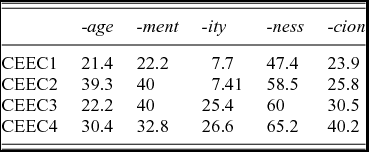
The type-parsing percentages in table 2 illustrate the relative differences in perceived productivity among the five suffixes in each of the four subperiods of the CEEC.
Type-parsing percentages in different subperiods of the CEEC
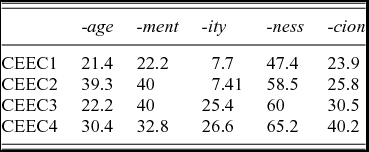
In all four periods, -ness is characterized by a significantly higher number of parsable derivative types than its borrowed peers. In the earliest period, -cion, -ment and -age have approximately half the proportion of decomposable types compared to -ness, with -ity exhibiting a much smaller percentage than its peers. Both -cion and -ity experience only small changes in these ratios in the latter half of the fifteenth century, while -age, -ment and -ness see significant increases in the use of bases relative to their derivatives. Towards the end of the sixteenth century, however, -age, -ment and -ity all hover near the 30 percent mark, while -cion jumps to 40 percent and -ness to a CEEC high of 65 percent of decomposable derivative types.
These data provide strong evidence that -ness was consistently perceived as a significantly more productive suffix than its borrowed peers throughout the fifteenth and sixteenth centuries. Its closest semantic competitor, -ity, was perceived as a much less productive unit. Säily & Suomela's data (Reference Säily, Suomela, Renouf and Kehoe2009) suggest that these differences between the productivity of -ity and -ness persist into the seventeenth-century portions of the CEEC. But the authors also report (Reference Säily, Suomela, Renouf and Kehoe2009: 105–6) that the range of -ity types grows from a low level in the earliest part of the seventeenth century to a significantly higher one by the middle of the century, speculating that a growth spurt in the productivity of the suffix must have begun some time during the sixteenth or seventeenth century. The aggregation data on -ity from table 1 combined with its type-parsing percentages in table 2 suggests that its initial burst of increased productivity occurred early in the sixteenth century. And from Säily & Suomela's (Reference Säily, Suomela, Renouf and Kehoe2009) study, we know the suffix continued to be productive in the seventeenth century, though at a much lower rate than -ness.
When considering type-parsing percentages, it might be possible to identify a suffix that has a high percentage of parsable types but that also turns out to appear infrequently in the corpus. In this case it would be a mistake to immediately declare a high perceived productivity for such a suffix, since the parsable types may not have been frequent enough to regularly activate the decomposability of the suffix. Type-parsing ratios should thus be studied alongside token-parsing percentages because the latter illustrate relative frequencies of decomposable derivatives and the probability that a particular derivative token was parsable.
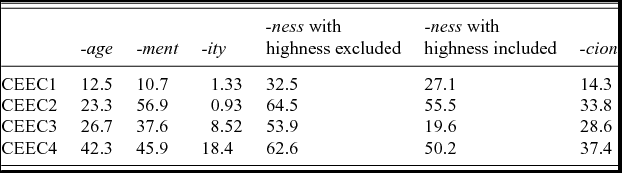
Confirming the type-parsing analysis, trends similar to those in table 2 can be observed in the token-parsing percentages in table 3.
Token-parsing percentages in different subperiods of the CEEC
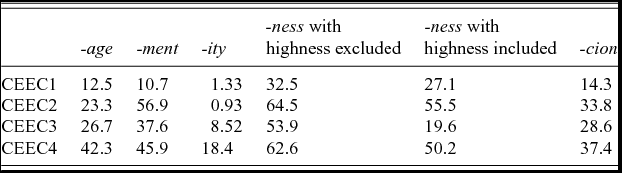
I have included the calculations for -ness both with and without highness in each subperiod. Recall that highness was excluded from the analysis so far because its numbers in period 3 were unusually high. In the case of token-parsing ratios, however, it is possible that highness may have had a significant impact on the overall perceived parsability of -ness. Thus, calculations with and without the lexeme were considered. In general, whether or not highness is excluded, -ness tends to have the highest percentage of parsable tokens among all suffixes in this study. The glaring exception is period CEEC3, where the unparsable highness dwarfs the perceived productivity of -ness tokens to 20 percent – less than all other suffixes besides -ity.Footnote 4 Other than this period, the token-parsing percentages tend to confirm the conclusions of the type-parsing analysis, that -ness has the highest perceived productivity of all suffixes.
Similarly, the token analysis corroborates conclusions about -ity, which has a very low token-parsing percentage. In particular, its token-parsability approaches zero in the fifteenth century, though there is an increase in the second half of the sixteenth century to 18 percent. It is clearly the suffix with the lowest perceived productivity among all suffixes in this study, though as noted above, its productivity does increase during both the sixteenth and seventeenth centuries.
Once again, -cion, -age and -ment are somewhere between -ness and -ity in terms of their token-parsing percentages. But after the first half of the fifteenth century, -ment gains much higher percentages of decomposable tokens compared to -cion and -age. By this measure, it is the suffix with the second highest level of perceived productivity (behind -ness).
Perhaps the most interesting trend apparent in table 2, and to a lesser extent in table 3, is the general increase in parsability of all suffixes during this two-century timespan. In table 2, the type-parsing percentages steadily increase for -cion, -ness and -ity, while -age and -ment have an upward but more variable trend. In table 3, all suffixes but -ity show at least double the percentages of decomposable lexemes in the second half of the fifteenth century compared to the first half. The suffix -ity increases its decomposable tokens thereafter, while the other suffixes remain relatively high.
There are two possible reasons for these trends: (1) in general, letter writers began to use more bases relative to derivatives as the genre developed over time; and/or (2) in general, writers began to introduce more derivatives that were relatively infrequent compared to bases that were in relatively more frequent use. Especially in the case of borrowed derivatives, it is likely that the first possibility was in effect. One lexeme following this pattern is the word communication, where use of the derivative precedes use of the base communicate. Perhaps because of the increasing perceived parsability of the suffix (due to use of other -cion derivatives within the same time period), the base for this initially undecomposable form became more transparent and thus more likely to be used by speakers. In other words, the use of the base may have been motivated by back-formation as much as by direct borrowing from Latin. The second possibility, in which more and more derivatives were introduced with relatively infrequent usage compared to their bases already in relatively frequent usage, is identifiable in lexemes such as diversity and groundage. In the latter case, the perceived productivity of -age, due to its overall number of parsable types and tokens, may have led to the coinage of a hybrid form with a frequent base (ground + -age = groundage). In the case of diversity, the increasing number of parsable types in English may have aided its derivation with an increasingly seen-as-productive -ity (diverse + -ity = diversity). However, its suffix's very low token-parsing percentages may suggest that diversity was more likely to be a direct borrowing than a derivation.
In sum, the preceding analysis suggests that, based on their overall type- and token-parsing percentages, the suffixes can be generally ranked in order of their perceived productivity. From most productive to least productive, the order is as follows:
-ness > -ment > -age/-cion > -ity
In general, all five suffixes increased in perceived productivity over time, due to the more frequent use of bases relative to derivatives and the use of new derivatives that were far less frequent than bases already in use in English.
6.3 Mean parsing ratios
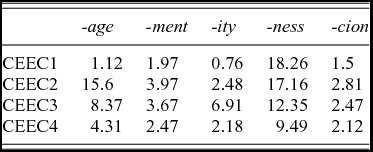
The preceding section has offered a method for quantifying perceived productivity generally. Yet it does not take into account the relative levels of decomposability among parsable forms, and the contributions of those varying levels of parsability to the overall perceived productivity of each suffix. A remedy for this problem is to consider the mean parsing ratio. This ratio increases in size if there is a relatively high number of derivatives whose bases outnumber them substantially. Similarly, the ratio decreases as the number of low or zero ratios increases (e.g. if there is a significant number of derivatives for which no base is used). Table 4 provides the mean ratios for all suffixes and periods in the CEEC.
Mean parsing ratios in different subperiods of the CEEC
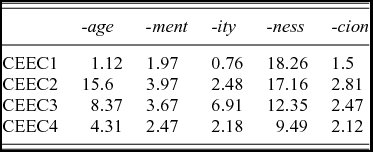
Before discussing these numbers, an important caveat should be made here: the mean ratio has little inherent meaning, and it should probably not be interpreted as a precise measure of the overall parsability of a suffix.Footnote 5 Rather, it should be considered in relation to other mean values and in consultation with the relevant percentages found in the type- and token-parsing analyses.
In table 4, we again see clear evidence that -ness has a much higher level of perceived productivity: its mean parsing ratios are consistently significantly higher than those of all other suffixes. This is due to the fact that many -ness derivatives, such as goodness and greatness, have very high parsing ratios in all subperiods: bases such as good and great were very common in letter writing. Because -ness had a number of forms that were not only decomposable but highly decomposable – as indicated by its high overall mean ratios – it must have been perceived as highly productive.
Other than period CEEC1, the suffix -age exhibits a relatively higher mean than the other borrowed suffixes. Several of its derivatives, especially usage and passage, are highly decomposable, increasing -age's overall perceived productivity. The other suffixes tend to have fairly low means in most periods, though -ment tends to be slightly higher than -ity and -cion (except for period CEEC3, where -ity has a surge of more highly decomposable forms). These low ratios are due mostly to the fact that these suffixes all have a large number of null ratios – that is, there are a significant number of derivatives that occur without any use of their bases. The high number of such opaque forms must have diminished the potential productivities of these suffixes.
In light of this analysis of mean parsing ratios, the ranked list should be amended to show that -age was probably more productive than the type- and token-parsing percentages initially suggested. All measures of parsability considered, one possible ranking of suffixes from highest perceived productivity to lowest perceived productivity would be the following:
-ness > -ment > -age > -cion > -ity
The exact ranking order may be less important than the following observable trends in letters:
(1) The suffix -ness consistently had the highest perceived productivity among all suffixes in this study.
(2) The suffix -ity consistently had the lowest perceived productivity.
(3) The perceived productivities of -age, -ment, and -cion were consistently in between -ness and -ity, though overall -age and -ment had higher perceived productivities than -cion.
(4) All suffixes tend to increase in perceived productivity throughout the fifteenth and sixteenth centuries.
The last finding is particularly interesting since it correlates with Anderson's (Reference Anderson2000) observation that derivational productivity generally increases for all native and borrowed suffixes from the late medieval period up to the seventeenth century. It is possible that the increasing use of bases relative to derivatives promoted the increased analyzability of derivational suffixes, which in turn promoted increased neologizing. Such a cause-and-effect claim is hard to prove, of course, but the correlation between the rise of perceived productivity and the rise of new derivations in English certainly deserves further study.
7 Conclusion: historicizing productivity
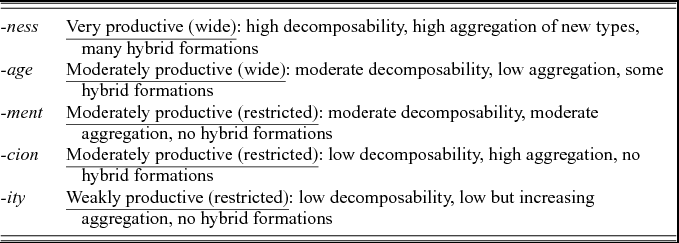
The main findings of this study are summarized in table 5. It states what can be said about the productivity of each suffix relative to the others, based on the data from early English letters. The chart ranks suffixes in order from highest productivity to lowest, though the specific factors listed in the second column should be considered holistically.
Summary of productivity findings based on fifteenth- and sixteenth- century data from the CEEC
This study has outlined a number of critical factors that reflect or explain the relative distributions of nominal derivatives and the relative levels of productivity among several suffixes in fifteenth- and sixteenth-century English. It has argued that productivity in diachronic studies of morphology can be best understood with a multifaceted approach: no single factor can completely explain how particular suffixes came to be seen as productive in the history of English. Such an approach is desirable particularly because of a methodological impasse. Hapax analysis, one of the most reliable measures of productivity, cannot be conducted on most historical corpora because those corpora are often too small. This study therefore adopts the same line of reasoning as Dalton-Puffer (Reference Dalton-Puffer, Fernández, Fuster and Calvo1994: 248–9), who argues that suffixal productivity must be influenced by multiple factors, not all of which are at work in every particular case. These factors include frequency, analyzability, transparency – all of which can be captured diachronically by exploring measures such as type aggregation and parsing percentages. Such measures contribute to a fuller understanding of the relative productivities of suffixes in English in particular historical periods.
Furthermore, the results of this study may explain why neologisms and hybrid forms have tended to appear most often with -age and -ness, since these suffixes appear relatively often in highly decomposable derivatives. The generally low parsability scores of -ity and -cion may explain why these suffixes never form new hybrids in Early Modern English letters, despite the fact that -cion consistently scores the highest aggregation of new types among all suffixes (including -ness).
Taken together, these factors also add more evidence to the claim that absolute frequencies do not necessarily correlate with productivity. The suffix -ness, for example, was found to be used relatively infrequently by letter writers throughout the fifteenth and sixteenth centuries. And yet, along several dimensions, it must be characterized as one of the most (if not the most) productive suffixes. Its perceived productivity thus does not seem to depend on its overall frequency of use.
Even if absolute frequencies do not reveal diachronic productivity, it is possible that relative frequencies (of bases to derivatives) may partially explain changes in diachronic productivity. Recall from tables 2 and 3 that, in general, suffixes showed mostly steady increases in type- and token-parsing ratios from the beginning of the fifteenth century to the end of the sixteenth century. The reason for the increases in type- and token-parsing scores of suffixes is simple: each generation of English speakers used increasingly higher rates of borrowed bases relative to derivatives during these centuries. It is significant to note that increases in the frequency of borrowed bases also correlate with trends observed by Anderson (Reference Anderson2000) and Hilpert (Reference Hilpert2013), which together provide multiple examples of derivational suffixes rising in productivity during this period. Anderson in particular shows that both native and borrowed affixes appear in growing numbers of neologisms in the fifteenth and sixteenth centuries. Hence, it is possible to observe a correlation between derivational productivity and the frequency of bases (rather than derivatives) in English. Of course, correlation should not be considered causation, though a causal link seems possible: as the number of bases increases, derivatives will seem to speakers to be more decomposable. As a result, the suffixes of those derivatives may be increasingly perceived as productive enough to create new words in English. Though further study is necessary, the present data suggest that base-derivative ratios are a reliable metric for diachronic productivity.
In any case, the linguist must be careful not to overvalue the results of any single measure of productivity. If base-derivative ratios alone are considered, it is too easy to conclude that -ness is a productive suffix while -cion is not. But some original derivations with borrowed affixes were occurring in letter writing (introducement, recantation, adwosonage). It has also been shown that all borrowed derivatives were aggregating new forms over time (though in varying degrees). Similarly, it is too simplistic to make a claim such as ‘-age is more productive than -cion because it produces hybrid forms’. The suffix -age showed very little aggregation compared to all other suffixes, so it did not seem to be a particularly productive suffix in personal correspondence of the fifteenth and sixteenth centuries. Perhaps the most useful conclusion to draw here is that no single criterion should be identified as a sufficient cause or indicator of productivity. Claims about productivity must be based on comprehensive data, considering multiple factors to assess and compare suffixes with one another historically.