

Introduction
According to the policy agenda approach, political systems cannot ‘efficiently’ address the numerous changes in the social processes by shifting policies and priorities proportionately to the severity of such changes. There are simply too many subjects claiming attention for the limited cognitive resources of human beings. These limitations are reflected in the architecture of the institutions as well.
The policy-making institutions impose some costs in the decision-making process as a response to an ever-changing environment; they ‘keep the course of public policy steady and unvarying in the face of lots of changes; that is, they do not allow for continuous adjustment to the environment’ (Jones et al., Reference Jones, Sulkin and Larsen2003). Nevertheless, ‘these costs also cause major policy changes when dynamics are favourable – that is a “window of opportunity” opens’. When this happens, we observe rare and major policy shifts called policy punctuations. Such dynamics would characterize every policy-making institution in every political system, but with different strength according to (1) the position of a specific institution throughout the policy cycle, and (2) the overall institutional design of the political system. Institutions impose costs on political action that increase as a political proposal has moved forward in the decision-making process. For instance, while the cost for an issue to enter the media agenda is relatively low, such a cost is supposed to increase (and the decision-making outcomes to become more ‘punctuated’) when that very issue has to be considered in the legislative agenda of a Parliament or in the items of the annual state budget. Rather similarly, the overall costs are likely to be higher (and the outcomes more punctuated) in political systems with a multiplicity of veto points and concurrent majorities.
Current literature following these ideas has already compared the composition of different institutional agendas within the same political system and same institutional agendas in different types of democracies. Other studies have examined the policy agendas of countries characterized by two types of political system in a relatively short period (Borghetto et al., Reference Borghetto, Carammia and Zucchini2014; Borghetto and Carammia, Reference Borghetto and Carammia2015; Basile, Reference Basile2018; Carammia et al., Reference Carammia, Borghetto and Bevan2018) and a few works have addressed the agenda composition and nature of a Constitutional Court (Baumgartner and Gold, Reference Baumgartner and Gold2002; Brouard, Reference Brouard2009). However, to our knowledge, no study on policy agenda has still addressed the agenda of a Constitutional Court in a country that has recently experienced crucial changes in its political system. The present contribution on the Italian Constitutional Court during the so-called First and Second Republic seeks to bridge this gap. Indeed the Italian Constitutional Court is a natural candidate for such an in depth investigation. It has gained considerable importance in the political system and, far from its original function of guardian of the legal order, it has become increasingly sensitive to policy-making (Pederzoli, Reference Pederzoli2008).
Our goal is to assess the role the Italian Court has played in the policy process during the First and the Second Republic by answering two research questions: (1) Does the Court reduce (and if so, to what extent) the so-called institutional frictions by accommodating in its decisions themes that are neglected in the parliamentary legislative process? (2) Does the Court (and if so, how often) represent interests and values in opposition to the interests and values represented by the current or recent legislative majorities? Is there any systematic difference between different policy areas, and between the First and the Second Republic?
As to the first question Constitutional Courts necessarily work on laws that have already been approved, hence we can hypothesize the existence of a large number of institutional filters and barriers that issues have to overcome in order to be taken into consideration. Moreover, in the Italian judicial system, most of the time, the Constitutional Court can decide on the constitutionality of laws only after lower courts have requested its intervention during a trial. Under these circumstances, the Italian Constitutional Court may actually be considered less efficient at answering changing social demands than legislators. As a further step in the policy-making process, which follows the legislative decision, the Court’s intervention may even increase the institutional friction. On the other hand, the Court has also a sophisticated capacity to refer to the Constitution in order to change and amend with its decisions any element of the huge and pervasive set of in force legal rules. Namely, the Court can ‘legislate’ by judgements on almost any issue, regardless of when the same issue might have been processed in other stages of the policy cycle. It may compensate the lack of attention from the legislative bodies and the government for given policy areas by offering alternative access points for otherwise neglected social pressures. In other terms, the Court can work nearly in parallel with the other policy-making institutions. Because of the a priori indeterminacy of the Constitutional Court’s role, we will compare the decisions that declare a law unconstitutional with the bills approved by the Parliament in order to understand whether the Court’s focus is different from (and compensates) the parliamentary one.
The second research question is about the counter-majoritarian nature (Dahl, Reference Dahl1989; Thatcher and Stone Sweet, Reference Thatcher and Stone Sweet2002) of Court’s ‘attention’. By nullifying and changing previous legislative decisions, the Court may represent interests and values visibly in opposition to the current or recent legislative majorities, or it may simply break a legislative stalemate or a prolonged indifference that has prevented the Parliament from changing the status quo for a long time.
In order to ascertain which of these two attitudes prevails in the Court’s behaviour we will consider the interval separating the Court’s decision of repealing a law and the previous approval of the same law in Parliament. We hypothesize that the closer in time the censoring decision follows the law, the more its nature will be conflictual and ‘counter-majoritarian’.
In the first section of this paper we shortly illustrate the main features of the Italian Constitutional Court in a comparative perspective and present the data set used for the analysis. Then, we describe the Court’s agenda by classifying its decisions of unconstitutionality in the years 1983–2013 according to the Italian version of the Comparative Agenda Project’s codebook. We identify 1994 as the beginning year of the so-called Second Republic and, after showing the most relevant issues in the Court’s agenda, we compare the distribution of decisions during the First and the Second Republic. In the third and fourth section, we compare the Court’s agenda with the legislative agenda and we verify if the Court’s agenda compensates the lack of (or the overwhelming) attention of the legislative bodies for the different policy areas. In the fifth section we analyse the nature of the Court’s attention in order to assess the level of conflict with the legislative majorities. The last section is dedicated to our concluding remarks.
The Italian Constitutional Court in a comparative perspective
Founded as an institution whose aim was to oversee and protect the legal order in a democratic regime (Barsotti et al., Reference Barsotti, Carozza, Cartabia and Simoncini2016: 69), the Constitutional Court is the only actor in Italy with the authority to determine whether laws are constitutional.
Constitutional review powers tend to be concentrated in a single court in most European Union Countries (the so-called centralized systems), with the exception of Finland, Sweden, and Denmark, which hold a system of diffuse control of constitutionality (de Visser, Reference De Visser2014: 133). In these Countries, as well as in the United States, many courts, if not all of them, are liable to judge constitutional issues (decentralized systems).
Scrutinies of the Constitutional Courts can be abstract, concerning legal texts that have not yet been promulgated (‘a priori abstract review’) or laws after promulgation (‘a posteriori abstract review’); alternatively scrutinies can be concrete, namely initiated by the judiciary in the course of a controversy (‘concrete review’).
While in the US constitutional review is only concrete, in several countries in the European Union the constitutional scrutiny can be both concrete and abstract. This is the case of countries such as Italy, Germany, Spain, Portugal, and, since 2010, France.
‘A posteriori’ abstract review is registering an increasing role in Italy, yet only central and regional governments are entitled to promote it, and only as far as legislation on concurring competences is concerned. Similarly, federal governments and federated member states or autonomous regions can request ‘a posteriori’ abstract review in Germany, Spain and Portugal. Conversely, France is the archetypal country of the ‘a priori’ abstract review. The a priori scrutiny is mandatory for organic laws; the other parliamentary statutes can be challenged, before promulgation, in front of the Conseil Constitutionnel by the French President of Republic, the Prime Minister, the presidents of the two parliamentary chambers and a parliamentary minority of 60 senators or 60 MPs (Brouard, Reference Brouard2009: 386). ‘A priori’ abstract review was the only access route to the French Conseil Constitutionnel until 2010, before a system of concrete review was introducedFootnote 1 (Brouard and Hönnige, Reference Brouard and Hönnige2017: 9). ‘A priori’ abstract review also applies in Portugal, upon referral by the President of the Republic and, since 1989, the Prime Minister and 20% of the Members of the Parliament (Hanretty, Reference Hanretty2012: 674). In Germany and Spain, ‘a priori’ review on parliamentary statutes is limited to international treaties.
While ‘a priori’ abstract review, a prerogative of the Courts in a small number of countries, is often limited to specific issues and ‘a posteriori’ abstract review is used mostly to address conflicts between different levels of government. On the contrary concrete review, being based on the resolution of concrete disputes, potentially includes a large number of issues. It is addressed by the Constitutional Courts of all the aforementioned Countries and represents also the major duty of the Italian Constitutional Court.Footnote 2
Such a review occurs through the so-called incidental method: national judges who doubt of the constitutional legitimacy of a law they have to apply to a specific case suspend the proceeding and ask for the interpretation of the Court. Contrary to Germany and Spain, where also individual citizens can do it, in Italy only lower national courts are allowed to directly resort to the Constitutional Court to resolve constitutional disputes. However as the cases selected by ordinary judges may concern a large variety of policy themes we opted to focus on concrete review to explore the content and dynamics of the Constitutional Court’s agenda.
The Italian Court is composed of 15 judges, appointed 1/3 by the President of the Republic, 1/3 by the Parliament in joint session, and 1/3 by the highest ordinary and administrative courts (Art. 135 Constitution). If the Court considers a question submitted by ordinary judges admissible and not manifestly unfounded, it proceeds in the assessment of the impugned statute’s constitutionality. The Court can either reject the constitutional challenge (sentenza di rigetto)Footnote 3 or sustain it, nullifying the unconstitutional law (sentenza di accoglimento), with effects for everyone (erga omnes). The Parliament can try to overrule this type of decision only by voting a new constitutional law; this procedure requires de facto Footnote 4 either a qualified majority in the Parliament larger than the majority required to support the government, or, whether this majority is not reached a majority of votes in a confirmatory popular referendum without quorum. For this reason, several authors consider Italian Constitutional Court as a proper veto player, a powerful actor whose intentions the legislators must try to anticipate (see Volcansek, Reference Volcansek2000; Santoni and Zucchini, Reference Santoni and Francesco2004, Reference Santoni and Francesco2006; Pederzoli, Reference Pederzoli2008 for the Italian case).Footnote 5
Although incidental judicial review represents a highly influent – almost legislative – prerogative of the Italian Constitutional Court, to our knowledge no previous work has still systematically analysed which are the policy themes the Court deals with through this procedure, nor the decisions of unconstitutionality taken under this procedure have been analysed in relation with the agenda of the Parliament. The next sections of this article aim at filling this gap.
Data description
Our analysis is based on an original data set, which includes all decisions of constitutional illegitimacy under incidental review which have been passed by the Italian Constitutional Court between 1983 and 2013. As previously noted, incidental review occurs when an ordinary judge, in the event of a trial, resorts to the Court to determine the constitutional legitimacy of a statute he/she is required to apply. Unlike other courts, as the Supreme Court of the United States, the Italian Constitutional Court cannot select which cases to hear. As it lacks this power, the Court reacts to inputs that come from the ordinary judges on their own initiative or on the request of the parties involved in the judicial proceeding. However, more than capturing the output of such a process, we are interested in examining the agenda of Court’s decisions that can change the legislative status quo. Accordingly our data set includes only the decisions on questions raised by an ordinary judge that the Court considered ‘not manifestly unfounded’. Only such decisions, in fact, are universally binding and are able to modify the existing statutes. On the contrary, the rejections of constitutional legitimacy challenges, which can be raised several times, even in the course of the same proceeding, are effective only between the parties.Footnote 6
Most cases referred to the Court concern laws passed by the Parliament, but the controversies can also include regional legislation. Decisions on regional laws were excluded from our analysis.
The time span of our analysis (1983–2013) covers eight legislatures, from the 9th to the 16th . We identify 1994 as the beginning year of the so-called Second Republic. In the transition from the First to the Second Republic, the Italian political system changed dramatically. The traditional pivotal party system characterized by rare and very limited government alternation (Strøm, Reference Strøm2003) collapsed. New electoral rules encouraged the formation of two alternative coalitions that competed for the control of the executive. The sudden and unprecedented alternation strengthened the government, which went from being relatively weak to significantly increasing its agenda setting power (Zucchini, Reference Zucchini2011a, Reference Zucchinib, Reference Zucchini2013). Therefore our time span allows to observe both the Court’s and the Parliament’s agendas in two quite different political systems: the consensual system of the First Republic (9th–11th legislatures), and the ‘alternational’ and more majoritarian system of the Second Republic (12th–16th legislatures).
The decisions were coded according to the Italian version of the Comparative Agenda Project’s codebook. The Italian codebook contains 21 major policy topicsFootnote 7 and a total of 239 subtopics. In order to code each decision, we did not focus on the specific content of the disputes, but rather on the policy issue of the legislative provision that was judged as partially or totally unconstitutional by the Court. For instance, we classifies as a ‘court administration’ issue a case of inheritance litigation, where the ordinary judge requests the Court to review the constitutionality of a law that regulates free legal aid, because a procedural aspect concerning the access to justice is at stake. In total, 1125 decisions of constitutional illegitimacy were included in the data set; 50.6% of the decisions is concentrated in the First Republic and the 10th legislature holds 29.3% of the total number. Conversely, the lowest number of decisions is registered during the short 15th legislature of the Second Republic, with only 3.9% of the total number of decisions.
In order to compare the agenda of the Italian Constitutional Court with that of the Parliament, we relied upon the Italian Law-Making Archive on laws and legislative decrees developed by Borghetto et al. (Reference Borghetto, Curini, Giuliani, Pellegata and Zucchini2012).
Attention allocation across topics in the Italian Constitutional Court’s agenda
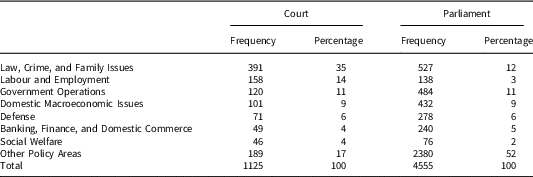
Table 1 shows the frequency distribution of the Court’s most important major topics and reports their distribution in the agenda of the Parliament likewise.
Frequency distribution of the macro-topics (1983–2013)

‘Other policy areas’ covers less than 4% of the Court’s agenda.
The aggregate frequency distribution of the macro-topics between 1983 and 2013 allows to isolate the policy areas on which the Constitutional Court insists more. The greatest part of Court’s agenda is devoted to ‘Law, Crime, and Family Issues’ (35%). The most prominent subtopics in this macro-category are ‘court administration’ and ‘reforms of civil and criminal codes’ (see note 3), which account for in our sample of decisions 14 and 66%, respectively.
The high frequency with which the Court intervenes on law and crime-related issues, especially on amendments to civil and criminal codes, reveals a procedural aspect and more substantial characteristics as well.
On the one side, the incidental review process puts the Court in relation to its ‘gatekeepers’, namely the other national courts. As the ordinary civil and criminal courts are those raising the highest number of issues to the Court, constitutional judges are urged to specialize accordingly.
On the other hand, as several scholars highlight, such a focus seems to confirm the crucial influence of the Constitutional Court’s judges in the field of criminal policy. The Court has shown greater initiative in reshaping criminal proceeding than in any other field since the late 1960s (Bognetti, Reference Bognetti1974: 984), marking the ‘historical, political, institutional and legal trajectory of the penal code until the end of the 1990s’ (Riccio, Reference Riccio2009: 437). ‘The most striking and reiterate examples of constitutional judges’ activism’ occurred in the area of criminal policy (Pederzoli, Reference Pederzoli2008: 82). In particular, the interactions between the Court and the Parliament in the years 1992–1998 were characterized by an open conflict, as the Court obstructed key provisions of the criminal code reformed by the Parliament in 1988 and neutralized the changes introduced by the legislators.Footnote 8 It comes as no surprise that criminal policy has a prominent role in the Court’s agenda.
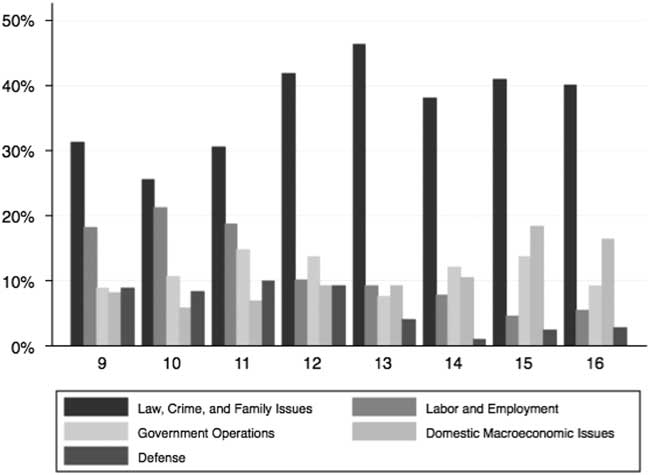
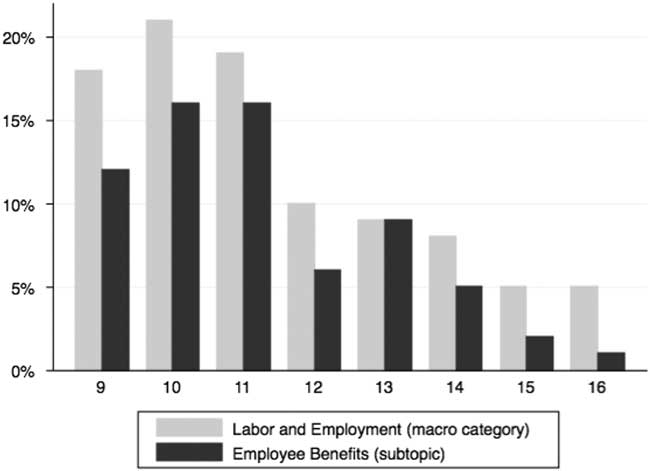
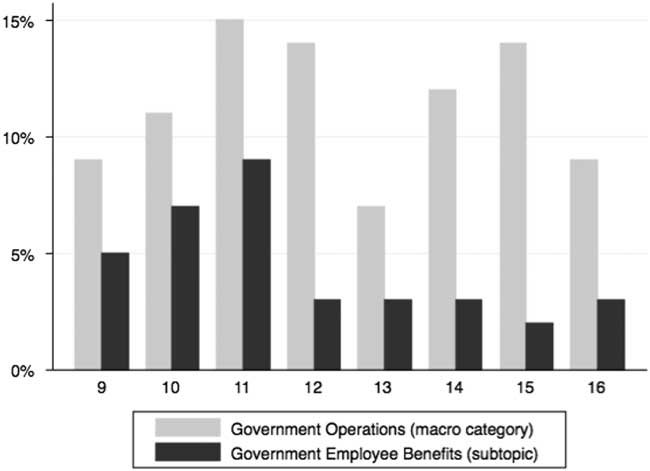
Other prominent categories are ‘Labour and Employment’ and ‘Government Operations’, respectively, covering 14 and 11% of the Court’s agenda. As shown in Figure 1, ‘Labour and Employment’ category decreases its relative importance since the 12th legislature, namely with the transition from the First to the Second Republic. Law scholars argue that until the early 1990s the Constitutional Court’s jurisprudence had been addressing the claims of citizens who were not adequately covered by social protection, ensuring the effective implementation of social security rights in several cases (Persiani, Reference Persiani2006). Through its decisions, during the First Republic, the Court tended to privilege the expansion of social rights regardless of their financial implications. This seems to be reflected by the large number of ‘sentenze di accoglimento’ on policy subtopics including pension related issues, such as ‘employee benefits’, that account for 73% of the ‘Labour and Employment’ category, and ‘government employee benefits’, that covers 45% of the ‘Government Operations’ category (see Figures 2 and 3). This tendency also changed due to constant pressures from the European Union during the Second Republic, when the containment of public debt became the priority. Under such circumstances, the Court’s approach was focussed on the financial sustainability of the welfare system (Barsotti et al., Reference Barsotti, Carozza, Cartabia and Simoncini2016: 150). Accordingly, the relevance of these subtopics in the Court’s agenda, as well as their contribution to the relative macro-categories decreases from the 12th to the 16th Legislature.
Relative distribution of attention to selected policy topics in the Court’s agenda, by legislature (9th–16th).

Relative distribution of attention to ‘Labour and Employment’ category and ‘employee benefits’ subtopic, by legislature (9th–16th).

Relative distribution of attention to ‘government operations’ category and ‘government employee benefits’ subtopic, by legislature (9th–16th).

Macro-topic ‘Defense’ (6% of the Court’s agenda) becomes residual from the second legislature (13th) of the Second Republic on. On the contrary, ‘Domestic Macroeconomic Issues’, filling 9% of the Court’s agenda, increases its relative importance in the last three legislatures of the Second Republic. The decisions classified in this category mainly concern national budget and taxation. Nevertheless, the salience of debt and deficit issues in the Second Republic seemingly produces a certain conflict between the legislators’ preferences and the constitutional judges’ interpretations.
The parliament and the court’s agendas
The current section compares the agenda dynamics of the Constitutional Court and the Parliament.
First, we consider the different levels of attention paid by the two institutions to selected topics in order to understand if the Court’s decisions tend to replicate the patterns of attention of the laws approved by the Parliament, or if they rather follow autonomous dynamics. Second, we compare the level of heterogeneity in the agenda of the two institutions, namely the degree to which the attention is spread across the policy categories, using the normalized Shannon’s H Diversity Index (Alexandrova et al., Reference Alexandrova, Carammia and Timmermans2012; Boydstun et al., Reference Boydstun, Bevan and Thomas2014).
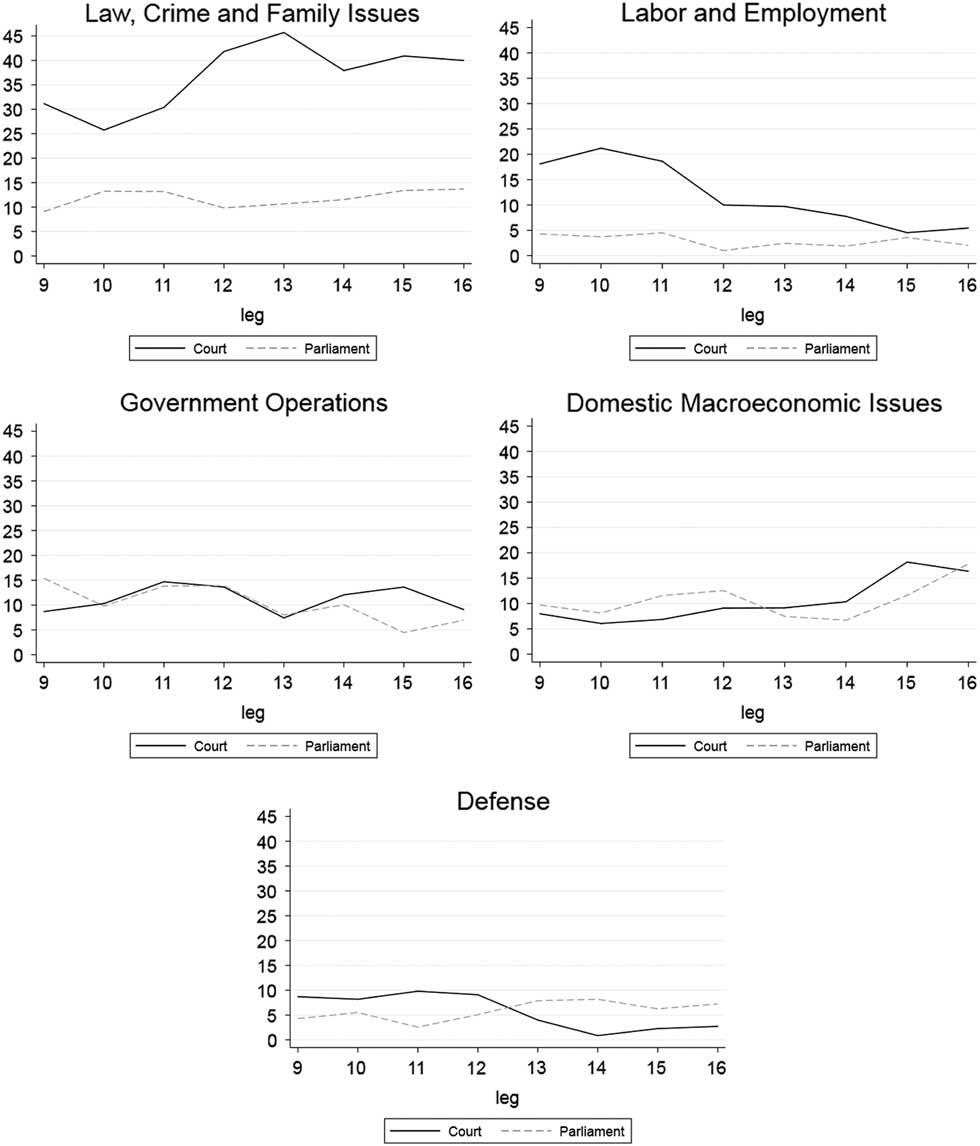
With the exception of ‘Labour and employment’, which has a marginal role in the Parliament’s agenda according to the aggregate frequency distribution of the macro-topics (3% in the Parliament’s agenda against 14% in the Court’s agenda, see Table 1), the most important topics appearing in the Court’s agenda are also well represented in that of the Parliament.
Figure 4 shows that ‘Law, Crime, and Family Issues’, notably the topic receiving the greatest attention in the Parliamentary agenda, is an overrepresented theme in the agenda of the Court. Conversely, ’Labour and Employment’ receives considerably more attention by the Court than by the Parliament, albeit mainly in the First Republic. In other policy fields, ‘Government Operations’, ‘Domestic Macroeconomic Issues’ and ‘Defense’, the level of attention devoted to the macro-category in the two agendas converges.
Relative distribution of attention to selected policy topics in the Court and the Parliament’s agendas, by legislature (9th–16th).

In ‘Defense’ policy sector, in the transition from the First to the Second republic, an increase of attention by the Parliament is followed by a decrease of attention by the Court. Then the two agendas show similar tendencies.
In other policy sectors, the attention devoted to macro-categories seems to vary in a similar way. As previously noted, the attention received by ‘Labour and Employment issues’ is higher in the Court’s agenda during the First Republic, but decreases in both agendas from the 11th legislature on. In ‘Domestic Macroeconomic Issues’, the dynamics of attention in the two institutions have the same trend. As for ‘Government operations’, there is an almost complete overlapping, except for the 9th and 15th legislatures.
Thus, according to this very preliminary exploration, with the exceptions of ‘Law, Crime, and Family Issues’ and ‘Labour and Employment’ in the First Republic, the Court’s patterns of attention do not seem to be clearly alternative to those of the Parliament’s agenda. The Court does not significantly address themes excluded by the agenda of the Parliament, and the most important topics consistently overlap in the agendas of the two institutions.
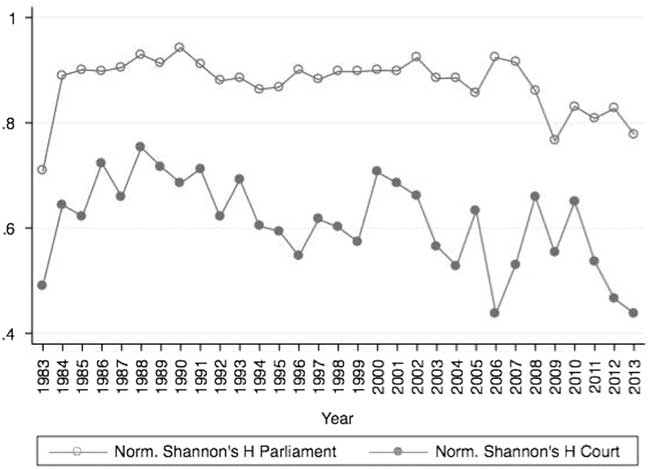
As we have already pointed out in section two, the incidental review process that characterizes the activity of the Italian Constitutional Court can lead to a specialization in the work of the constitutional judges. As a result, we expect the Court’s agenda to be more concentrated than that of the Parliament, since the Court decides on a selection of cases filtered by the ordinary courts, and such courts tend to be specialized in particular areas of law, for instance criminal law or private and public sector labour law. We calculate the normalized Shannon’s H that varies from 0 to 1 regardless of the number of items, and the more the attention is equally distributed among the policy topics, the more it increases (Boydstun et al., Reference Boydstun, Bevan and Thomas2014: 183). Figure 5 seems to confirm our expectations.
Agendas’ entropy of the Parliament and the Court, by years (1983–2013).

Coherently with our expectations, the Parliament’s agenda is considerably more diffuse than the Court’s agenda. The values of Shannon’s H Index range between a minimum of 0.7 and a maximum of 0.94 for the Parliament, and they vary between a minimum of 0.43 and a maximum of 0.75 for the Court. The last years of the second Republic show a declining trend (namely, a decrease of the Shannon index) for both institutions, and such a trend is stronger for the Court. The political system of the Second Republic, based upon majoritarian rules, seems slightly less able to host the same variety of policy areas of the First Republic, even when we consider an institution, the Court, that is not directly connected with the electoral process.
An alternative access point?
As we have argued in the introduction, the Court has the authority to refer to the Constitution in order to ‘legislate’ by judgements on almost any issue. Therefore, it may represent an alternative access point for policy areas that are neglected and overlooked in the legislative arena. Studying the distribution of the attention change in the Court’s agenda and in the Parliament’s agenda we may understand whether the Court plays such a role.
Relying on the ‘percentage-count method’Footnote 9 we calculated the change in the attention paid by both institutions to all major policy categories in a 1-year time frame, for each year of the period we took in consideration (1983–2013). So doing we obtained the frequency distribution of yearly change scores. Through the analysis of the statistics on attention change in both institutions, we aim at understanding to what extent the dynamics of the Parliament’s and the Court’s agendas are in accordance with the Punctuated Equilibrium Theory. Therefore, first we assess whether the Court’s agenda shows a higher level of institutional friction compared to the Parliament’s agenda. Second, we investigate whether the agendas tend to compensate each other, making the policy-making process more adaptive and possibly offering more efficient access points to social demands and needs, or, on the contrary, they tend to follow distinct dynamics.
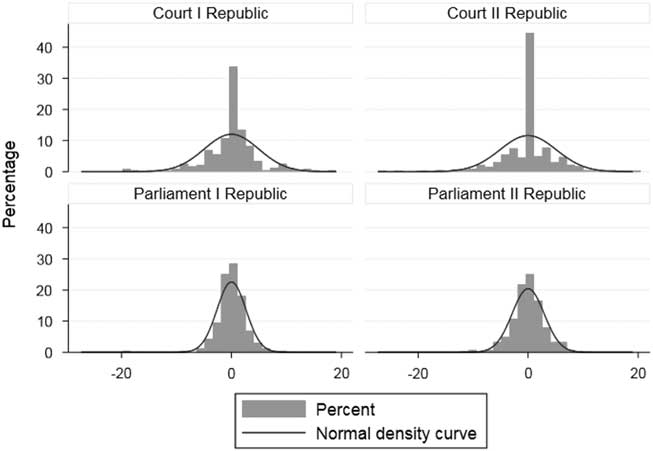
Figure 6 presents the distribution of the change in the percentage attention in the agendas of the two institutions during the First and Second Republic.
Distributions of the percentage of attention change in the Court and the Parliament’s agendas.

According to the Punctuated Equilibrium Theory, public policy changes tend to show a leptokurtic distribution because of the institutional frictions and the human cognitive limitations. Leptokurtic distributions present a central peak that indicates policy stability; weak shoulders that signal few medium-size changes and big tails, representing sporadic major changes (True et al., Reference True, Jones and Baumgartner2007: 168). A high level of leptokurtosis reflects a prolonged resistance to translate the variations in the social pressures into policies, followed by sudden and concentrated periods of major policy change.
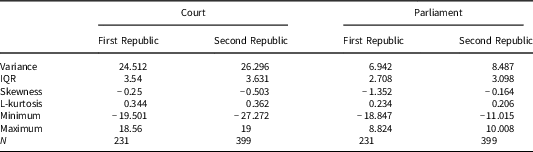
Figure 5 seems to suggest that both the Court’s and the Parliament’ agendas have small tails. However, in order to verify the level of leptokurtosis of the distributions, we rely on L-kurtosis statistics, a measure based on L-moments that is less sensitive to extreme values (Breunig and Jones, Reference Breunig and Jones2011: 107). L-kurtosis varies from o to 1, where the growing number coincides with a greater level of kurtosis. The standard Gaussian distribution has a L-kurtosis score of about 0.123. According to the descriptive statistics on agenda change reported in Table 2, the agendas of both the Court and Parliament have higher level of leptokurtosis than the Gaussian distribution.
Descriptive statistics on agenda change for the Court and the Parliament in the First and Second Republic

IQR=interquartile range.
Data are mean centred and median centred.
Passing from the First to the Second Republic, the distribution of attention change in the Parliamentary agenda becomes slightly less leptokurtic, with a variation from 0.234 to 0.206. The decrease in the L-kurtosis possibly reflects the presence of a legislative arena that the government alternation made marginally more efficient and able to adapt more smoothly the policies to the social changes. Nevertheless, during the Second Republic, the Court slightly increases its institutional stickiness (L-kurtosis value raises from 0.344 to 0.362), contributing to create more stability in the attention dedicated to the different policy areas and sporadic dramatic changes.
No real correlation has been found by testing the relationship between the variables that capture the yearly attention changes in the Court’s and legislative agendas, respectively.Footnote 10 The absence of such a relationship in both the First and the Second Republic shows that the attention changes in the agendas of the two institutions do not compensate each other. In this sense, the Court does not seem to compensate the potential inefficiency of the Parliament in addressing social demands.
An increasing challenging Constitutional Court
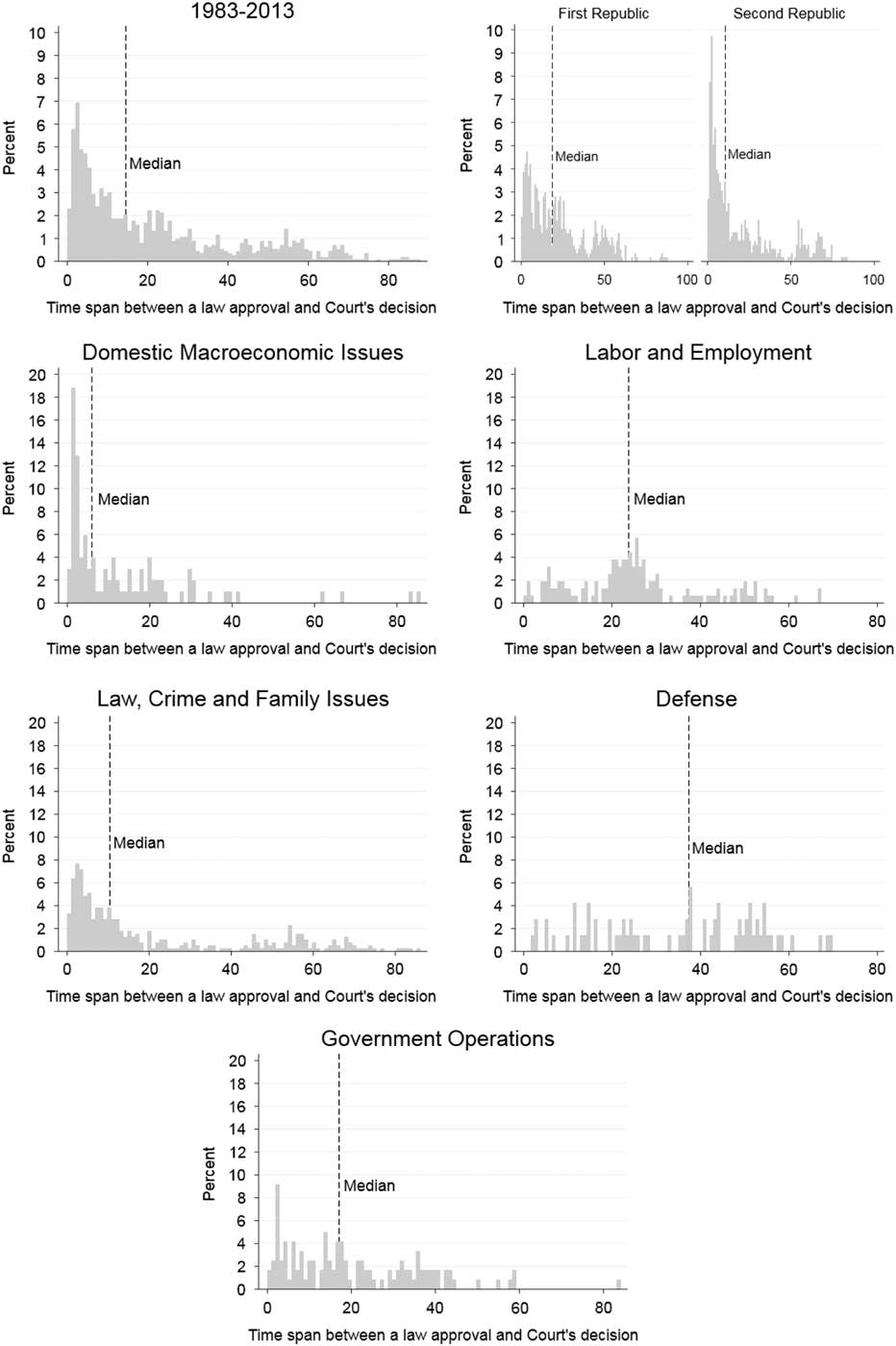
According to the analyses shown in the previous section, in general the Constitutional Court does not offer an alternative access point for new or neglected collective problems to enter the policy agenda. If compared with the legislative agenda, a number of policy areas is traditionally overrepresented and there is much less dispersion. Nevertheless, the Court’s annual distribution of attention among different policy issues, as it is measured by the decisions of unconstitutionality, does not seem to compensate, negatively or positively, the attention’s distribution of the legislative arena. What is the nature of this attention? Does the Court always act as a censor of the Parliament’s activity? Even when the Court intervenes in policy areas that are simultaneously affected by the decisions of the Parliament, it does not mean that the Court is abolishing or amending the current Parliament’s provisions. The Court’s decisions may affect the existence and interpretation of norms that have been in force for a very long time, as they were approved by the Parliament a long time before. In this case, we can assume that the Court is breaking a wall of indifference, or a prolonged stalemate on norms, which are not, or not anymore, politically salient. It may be that the Court is challenging the preferences of a current government actor, but it is not necessarily against the unified will of the current (or recent) legislative majority that supports (or has supported) the government and makes possible the laws’ approval. On the contrary, when the Court’s decision refers to a recent law, it becomes politically salient and is visibly ‘conflictual’. Such a circumstance attests that with respect to the same policy area interests and values are quite heterogeneous, and some of them are strong enough to find in the Constitutional Court a powerful and prompt advocate against the majoritarian will of the Parliament. But what policy areas are we referring to? Did the change of the Italian political system see the Court in opposition to the legislative decisions more frequently than not? What aspect of this change matters most? Figure 7 describes the distribution of the decisions of unconstitutionality by the yearsFootnote 11 that passed between the first approval of eventually censored laws, over the whole period from 1983 to 2013 and by each ‘Republic’ (First and Second). Overall, the Italian Constitutional Court’s decisions do not seem to be very ‘prompt’. 50% of judgments concern laws that have been approved at least 14 years before the decision was adopted. When we consider the First and Second Republic separately, we observe that during the latter Court’s decisions tend to be issued in a relatively short time with respect to the legislative approvals. During the First Republic, 50% of judgments concern laws that have been approved at least 18 years before, the number of years decreasing up to 11 in the Second Republic.
Distribution of decisions of unconstitutionality, according to number of years between a law’s approval and the Court’s decision.

The highest percentage of ‘politically salient’ Court’s decisions occurs within domestic macroeconomic issues. In other terms, the crucial provisions promoted by the government and often included in the annual budgetary laws are the first victims of the Court’s censures.
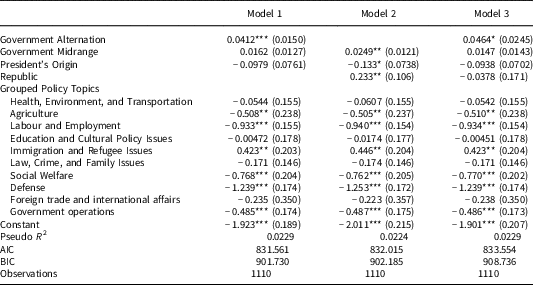
The First Republic most notably differs from the Second because of the rather visible absence of government alternation. We hypothesize that government alternation, by encouraging more significant legislative change and a relatively stronger government’s agenda setting power (Tsebelis, Reference Tsebelis2002; Zucchini, Reference Zucchini2011a, Reference Zucchinib), also triggers more immediate and ‘salient’ reactions from the Constitutional Court (Zucchini, Reference Zucchini2013). This hypothesis is not disconfirmed by a multivariate analysis (see Table 3). We define our dependent variable, that is, the saliency of a decision (SALIENCY), as a measure inversely proportional to the time that separates the enactment of a law from the promulgation of the decision that declares the same law partially or wholly unconstitutional.Footnote 12 We run three different regression analyses. In the first, our main independent variable is the level of government alternation, measured as the difference between the midrange of two successive governments on the left-right dimension (Alternation). The values come from the expert survey conducted by Laver and Hunt (Reference Laver and Hunt1992), Benoit and Laver (Reference Benoit and Laver2006), Curini and Iacus (Reference Curini and Iacus2008), Di Virgilio et al. (Reference Di Virgilio, Giannetti, Pedrazzani and Pinto2015). In the second model, our main independent variable is the dummy variable ‘Republic’, that is equal to 1 when the Court’s decisions are taken after 11th legislature. Finally, in the third model, we considered both variables, Alternation and Republic, together. As control variables, we consider:
a. The political orientation of the government as it is measured by the Government Midrange on the left-right dimension (Government Midrange). As the most far-leftist value is always 1 and the most far-right is 20, a positive coefficient should mean a propensity for more salient decisions when the government is right-oriented.
b. The origin of the Court’s President (President’s origin) at the time when the decision is taken; that is, whether he/she has been elected to the Court by the other courts (the value is equal to 0) or was rather appointed by the President of the Republic, or again elected by the Parliament (the value is equal to 1). In this case, we can presume that the propensity to challenge recent Parliament provisions is lower.
c. The policy areas, grouped in 11 categories in order to overcome the occurrence of too low frequencies in some of the major topics. As the dependent variable’s values stand between 0 and 1, we run a fractional logit with robust standard errors clustered in years.
Predictors of decisions saliency

AIC=Akaike information criterion; BIC=Bayesian information criterion.
Fractional logistic regression with robust standard errors clustered in years. Policy topic reference category: ‘Macroeconomic issues – Banking, Finance and Domestic Commerce’. Shorter descriptors are used for some policy categories. Their full descriptors are: ‘Health, Environment, Energy and Transportation’, ‘Agriculture, Public Lands, Water Management and Territorial Issues’, ‘Education, Cultural Policy Issues, Space, Science, Technology, and Communications’, ‘Law, Crime, and Family Issues, Civil Rights, Minority Issues, and Civil Liberties’, ‘Foreign Trade, International Affairs and Foreign Aid’.
Robust standard errors in parentheses.
***P<0.01, **P<0.05, *P<0.1.
Government alternation in model 1 significantly affects the dependent variable. An increase of one unit in Alternation induces an increase of 4% in the saliency of the decisions. The only topic whose saliency appears to be stronger than in ‘Domestic Macroeconomic Issues’ is ‘Immigration and Refugee Issues’. The coefficient of ‘Origin of the President’ shows the expected sign but, similarly to the coefficient of Government Midrange, it does not reach the conventional levels of statistical significance. When we consider model 2, the dummy variable ‘Republic’ also affects SALIENCY significantly, but all measures of goodness of fit, namely Pseudo R 2, Akaike information criterion, Bayesian information criterion appear slightly worse than in the first model. Finally, when we consider both variables in our third model, the effect of the variable ‘Republic’ is negligible, negative and non-significant. Therefore, according to these results, the increase of government alternation encompasses and absorbs other changes that took place after 1992 in the Italian Political System, at least with respect to the effects of these changes on the Constitutional Court’s behaviour.
Conclusion
The aim of this article was to shed light on the contents and dynamics of the Italian Constitutional Court’s agenda. To do it we focussed on the Court’s relationship with the legislative arena. When the Court evaluates the constitutionality of a law, it interacts more or less explicitly with the Parliament. The Parliament is the institution that approves new laws and/or preserves in force the old ones, both of them being vulnerable to censorship by the Court at all time. For this reason, if we want to identify the role of the Court in the policy process, we have to take into consideration the legislative agenda as well and to compare it with the agenda of the Court. As stressed at the outset of this work our endeavour was to ascertain whether and when the Italian Constitutional Court offers alternative access points to policy areas that are otherwise almost ignored by the Parliament, and whether and when, by declaring unconstitutional a piece of legislation , the Court is explicitly in conflict with the current or recent legislative majority. In the first case, the Court can open up opportunities for the whole set of interests and values that are involved in a neglected policy area. In this respect, some authors argue that Courts are more prone to solve controversies especially when parliaments are ineffective towards a given issue, or even abdicate their legislative role (Lowi, Reference Lowi1979; Tate and Vallinder, Reference Tate and Vallinder1995). Conversely, in the second case, the Court also opens opportunities for those interests and values that have been defeated in parliament nearby in time. In such a case, where the ‘losers’ in the legislative process finally have the chance to challenge legislation, it is the legislative activity, and not the legislative inactivity or ineffectiveness that brings cases before the Court. It is in this regard that the legislative agenda tends to affect the judicial agenda (Baird, Reference Baird2004).
A first comparison of the Court’s agenda with the Parliament’s agenda has shown that the former is significantly more concentrated than the latter, dealing essentially with five major policy topics: ‘Law, Crime, and Family Issues’, ‘Labour and Employment’, ‘Government Operations’, ‘Domestic Macroeconomic Issues’, ‘Defence’. Two of these policy topics in particular are predominant: ‘Law, Crime, and Family Issues’ and ‘Labour and Employment’, albeit the latter prevails only in the First Republic.
When we look at the relative attention that the Court and the Parliament pay to the main policy topics over the course of the legislatures, the Court does not seem to compensate the potential lack of attention of the Parliament, with the exception of ‘Law, Crime, and Family Issues’ and partially of ‘Labour and Employment’, that is, the policy areas that are traditionally more represented. This impression is confirmed when we examine the contribution of the Parliament and the Court to the policy-making process. The statistical analysis shows that the Court’s agenda is more punctuated than the legislative agenda, and besides that there is no relationship between the changes in attention in the agendas of the two institutions either in the First or in the Second Republic. In this sense, we can infer that, broadly speaking, the Court does not offer to the policy-making a more efficient alternative access point for new or neglected issues.
Our second research question concerned the ‘conflictual’ nature of the Court’s attention. We have investigated whether the Court is more prone to sanction laws that were passed in the past legislatures, less politically salient (or almost forgotten) laws, or rather it tends to challenge the will of the incumbent parliamentary majorities; whether the weight of these different behaviours changes either from the First to the Second Republic or according to the different policy areas.
We found that in general the decisions of the Italian Constitutional Court are not very ‘salient’, although their saliency has increased during the Second Republic and especially in the area of ‘Domestic macroeconomic issues’. On top of that, the results of a multivariate analysis show that the Court becomes more ‘conflictual’, namely it tends to censure more recent legislation, when the level of government alternation increases. Such results suggest that the more alternational political system of the Second Republic, characterized by greater legislative change and government’s agenda setting power, also triggers more immediate and ‘salient’ reactions from the Constitutional Court.
More broadly, our results confirm the importance of looking at the inter-institutional relationships between the Court and the Parliament, and at the political framework where these relationships are inserted in order to assess the Constitutional Court’s role in the policy process. This applies in Italy, a country where concrete review has a prominent role and national tribunals detain a consistent gatekeeping power in the access to the Court. Further research may investigate whether such factors maintain their explanatory power in other countries, for instance, Germany, Spain, Portugal, and the United States of America, especially where ordinary tribunals, as well as other actors in a litigants’ community (as lawyers or interest groups), potentially influence which cases to bring to the Court’s attention.
Financial Support
The research received no grants from public, commercial, or non-profit funding agency.
Data
The replication data set is available at http://thedata.harvard.edu/dvn/dv/ipsr-risp
Acknowledgement
The authors would like to thank the special issue editors for sharing data and providing helpful feedbacks and comments. The authors are also indebted to the anonymous reviewers for their valuable comments and suggestions.