


1. Introduction
Choi and Schoen [Reference Choi and Schoen1] proved that for a three-dimensional Riemannian manifold M with positive Ricci curvature, the space of embedded minimal surfaces in M of a fixed genus is compact. Hsieh and Wang [Reference Hsieh and Wang3] have shown that the condition of positive Ricci curvature cannot be relaxed. In particular, they showed in [Reference Hsieh and Wang3] that the embedded minimal tori in  $S^2\times S^1$ do not form a compact family, for
 $S^2\times S^1$ equipped with the standard product metric has non-negative Ricci curvature.
On the other hand, Fraser and Li [Reference Fraser and Li2] proved the corresponding result of Choi and Schoen for the free boundary minimal surfaces. In particular, they proved the following:
Theorem 1.1 (Fraser-Li)
Let M be a compact three-dimensional Riemannian manifold with non-empty boundary  $\partial M$. Suppose M has non-negative Ricci curvature and
 $\partial M$ is strictly convex with respect to the inward unit normal. Then the space of compact properly embedded minimal surfaces of fixed topological type in M with free boundary in
 $\partial M$ is compact in the Ck topology for any
 $k\geq 2$.
Note that the existence of such a free boundary minimal annulus in M was obtained by Maximo, Nunes and Smith [Reference Maximo, Nunes and Smith4]. Inspired by the result of Hsieh and Wang [Reference Hsieh and Wang3] mentioned above, we show that the condition that  $\partial M$ is strictly convex could not be relaxed in Theorem 1.1. To state our main theorem, let
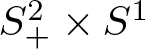
 $S^2_+$ be the two-dimensional hemisphere. Equipped with the standard product metric, the product manifold
 $S^2_+\times S^1$ has non-negative Ricci curvature, and its boundary
 $\partial(S^2_+\times S^1)$ is totally geodesic and is not strictly convex. The following is our main theorem.
Theorem 1.2. Let  $S^2_+\times S^1$ be equipped with the standard product metric. Then there exists a sequence of compact properly embedded minimal annuli in
 $S^2_+\times S^1$ with free boundary in
 $\partial(S^2_+\times S^1)$ which is not compact.
2. Proof of the main theorem
In this section, we prove Theorem 1.2. Let  $S^2_+$ be the two-dimensional hemisphere given by
 \begin{equation*}
S^2_+=\{(x,y,z)\in\mathbb{R}^3: x^2+y^2+z^2=1, y\geq 0\},
\end{equation*}
which is a two-dimensional manifold with boundary
 \begin{equation*}
\partial S^2_+=\{(x,0,z)\in\mathbb{R}^3: x^2+z^2=1\}.
\end{equation*}
Then  $S^2_+$ has a local parametrization given by
 \begin{equation}
\overrightarrow{x}(r,\theta)=(\sin r\cos \theta,\sin r\sin\theta, \cos r),
\end{equation}
where  $0\leq r\leq \pi$ and
 $0\leq \theta\leq \pi$. Note that the boundary
 $\partial S^2_+$ corresponds to the points when θ = 0 or
 $\theta=\pi$. The induced metric on
 $S^2_+$ by
 $\mathbb{R}^3$ is given by
 \begin{equation*}
dr^2+\sin^2 rd\theta^2.
\end{equation*}
Then the product space  $S^2_+\times S^1$ is a three-dimensional manifold with boundary
 $\partial (S^2_+\times S^1)=\partial S^2_+\times S^1$. Moreover,
 \begin{equation}
g=dr^2+\sin^2 rd\theta^2+dt^2
\end{equation}
is a Riemannian metric on  $S^2_+\times S^1$. Equipped with the metric g in (2.2), the boundary
 $\partial (S^2_+\times S^1)$ is a totally geodesic and hence is not strictly convex. It follows from (2.2) that
 \begin{equation}
\begin{split}
\nabla_{\frac{\partial}{\partial\theta}}\frac{\partial}{\partial r}=\cot r\frac{\partial}{\partial\theta},
~~\nabla_{\frac{\partial}{\partial\theta}}\frac{\partial}{\partial t}=0,\\
\nabla_{\frac{\partial}{\partial r}}\frac{\partial}{\partial r}=0,~~
\nabla_{\frac{\partial}{\partial r}}\frac{\partial}{\partial t}=\nabla_{\frac{\partial}{\partial t}}\frac{\partial}{\partial r}=0,~~
\nabla_{\frac{\partial}{\partial t}}\frac{\partial}{\partial t}=0.
\end{split}
\end{equation}
Suppose r(t) is a smooth function on S 1 such that
 \begin{equation}
r(t+2\pi)=r(t).
\end{equation}
Define  $f:[0,\pi]\times S^1\to S^2_+\times S^1$ given by
 \begin{equation}
f(\theta,t)=(\overrightarrow{x}(r(t),\theta),t),
\end{equation}
where  $\overrightarrow{x}$ is defined as in (2.1). Then
 \begin{equation*}
\vec{e}_1:=\frac{1}{\sin r}\frac{\partial}{\partial\theta} ~\text{and}~~ \vec{e}_2:=\frac{1}{\sqrt{1+r'^2}}\left(r'\frac{\partial}{\partial r}+\frac{\partial}{\partial t}\right)
\end{equation*}
are unit vectors with respect to g, and  $\{\vec{e}_1,\vec{e}_2\}$ spans the tangent space of
 $[0,\pi]\times S^1$. Hence the unit normal
 $\vec{n}$ is given by
 \begin{equation*}
\vec{n}=\frac{1}{\sqrt{1+r'^2}}\left(\frac{\partial}{\partial r}-r'\frac{\partial}{\partial t}\right).
\end{equation*}
By (2.3), we see that
 \begin{equation}
(\nabla_{\vec{e}_1}\vec{n})^T=\nabla_{\vec{e}_1}\vec{n}=\left(\frac{\cot r}{\sqrt{1+r'^2}}\right) \vec{e}_1~~\mbox{and }~~
(\nabla_{\vec{e}_2}\vec{n})^T=-\frac{r''}{(1+r'^2)^{\frac{3}{2}}} \vec{e}_2,
\end{equation}
where  $(\nabla_{\vec{e}_2}\vec{n})^T$ denotes the tangential component of
 $\nabla_{\vec{e}_2}\vec{n}$. It follows from (2.6) that the principal curvatures of
 $[0,\pi]\times S^1$ are
 $\frac{\cot r}{\sqrt{1+r'^2}}$ and
 $-\frac{r''}{(1+r'^2)^{\frac{3}{2}}}$, which implies that the mean curvature is
 \begin{equation*}
H=\frac{1}{2\sqrt{1+r'^2}}\left(\cot r-\frac{r''}{1+r'^2}\right).
\end{equation*}
Hence,  $[0,\pi]\times S^1$ is minimal if
 \begin{equation}
\frac{r''}{1+r'^2}=\cot r.
\end{equation}
On the other hand, the outward conormal vector  $\vec{\nu}$ is the unique unit vector in
 $T_p([0,\pi]\times S^1)$ which is orthogonal to
 $T_p\big(\partial ([0,\pi]\times S^1)\big)$. Thus, we have
 \begin{equation}
\vec{\nu}=\pm\frac{1}{\sin r}\frac{\partial}{\partial\theta}.
\end{equation}
Note that the tangent plane of  $\partial(S^2_+\times S^1)$ is spanned by
 $\displaystyle\left\{\frac{\partial}{\partial r}, \frac{\partial}{\partial t}\right\}$. Hence, it follows from (2.8) that
 $\vec{\nu}$ is orthogonal to
 $\partial(S^2_+\times S^1)$, i.e.,
 \begin{equation}
\vec{\nu}\perp \partial(S^2_+\times S^1).
\end{equation}
In view of (2.9), we conclude that if r(t) is a solution to (2.4) and (2.7), then the embedding f of  $[0,\pi]\times S^1$ defined in (2.5) is a free boundary minimal surface in
 $S^2_+\times S^1$. As pointed out in [Reference Hsieh and Wang3], the general solutions to (2.4) and (2.7) are elliptic functions for a sequence of initial values
 $r(t=0)=c_1 \gt c_2 \gt c_3 \gt \cdots\to 0$. The corresponding sequence of embedded free boundary minimal surfaces certainly cannot have a convergent subsequence. This proves our main theorem.
Acknowledgements
The first author was supported by the National Science and Technology Council (NSTC), Taiwan, with Grant Number: 112-2115-M-032-006-MY2. The second author was supported by the National Research Foundation of Korea (NRF-2020R1A2C1A01005698 and NRF-2021R1A4A1032418). The third author was supported by the National Research Foundation of Korea (NRF-2021R1A2C1003365).



