This paper expands the growing body of research on the diachronic phonetic change in the pronunciation of the vowels in words like bat, bet, and bit, regarded as the consequence of the merger of the vowels in bot and bought. This phenomenon has been described locally as the Canadian Shift, California Shift, Third Shift, etc., but has recently gained a unified appellation: the Low Back Merger Shift (henceforth LBMS; Becker, Reference Becker2019). In Roeder and Gardner (Reference Roeder and Gardner2013), we proposed that the LBMS is composed of two components: a systematic phonological change that involves the three-way low-back merger of the lot, thought, and palm lexical setsFootnote 1 (i.e., bot, bought, and balm, henceforth LBM), and a phonetic change driven by universal tendencies for symmetrical, focalized systems of phonetic implementation. Our analysis relies on three crucial propositions: (1) mergers are phonological changes and thus have phonological consequences; (2) the consequence of the LBM is that low vowels become underspecified for [±Front] (or, [±Back]); and (3) unbound by phonological restraints, the vowel space will become more symmetrical and focalized. These three propositions alone account for the lowering and/or retracting of trap, the most commonly observed phonetic movement found across LBMS varieties. It does not, however, clearly account for the accompanying lowering and retracting of dress and kit. In Roeder and Gardner (Reference Roeder and Gardner2013), we proposed that dress and kit move due to analogy with trap. In his review of research on the effect of phonology on phonetic change, Fruehwald (Reference Fruehwald2017) questioned this explanation:
In [Roeder & Gardner's] account, /æ/ [trap] is able to retract following the /a ɑ ɒ/ [palm, lot, thought] merger specifically because it is underspecified for [back]. However, it seems that we need to appeal to a shared [back] specification between /ɪ ɛ æ/ [kit, dress, trap] to account for their backing in the phonological account of parallel shifts. It is not clear what the proper resolution is. Either Roeder & Gardner's (Reference Roeder and Gardner2013) contrastive analysis of /æ/ [trap] is flawed, or Fruehwald's (Reference Fruehwald2013) analysis of parallel shifts is flawed. Or perhaps there is some other feature or phonetic dimension that can better capture the phonological and phonetic parallelism of these vowels than [back]. (Fruehwald Reference Fruehwald2017: 35–36, lexical set notation added).
Below we present our response to Fruehwald (Reference Fruehwald2017) and show how Fruehwald's analysis of parallel shifts and our contrastive analysis of the LBMS are reconcilable. We also present a case study of Victoria, British Columbia, that evidences our claims in apparent time.
Synchronic and diachronic views
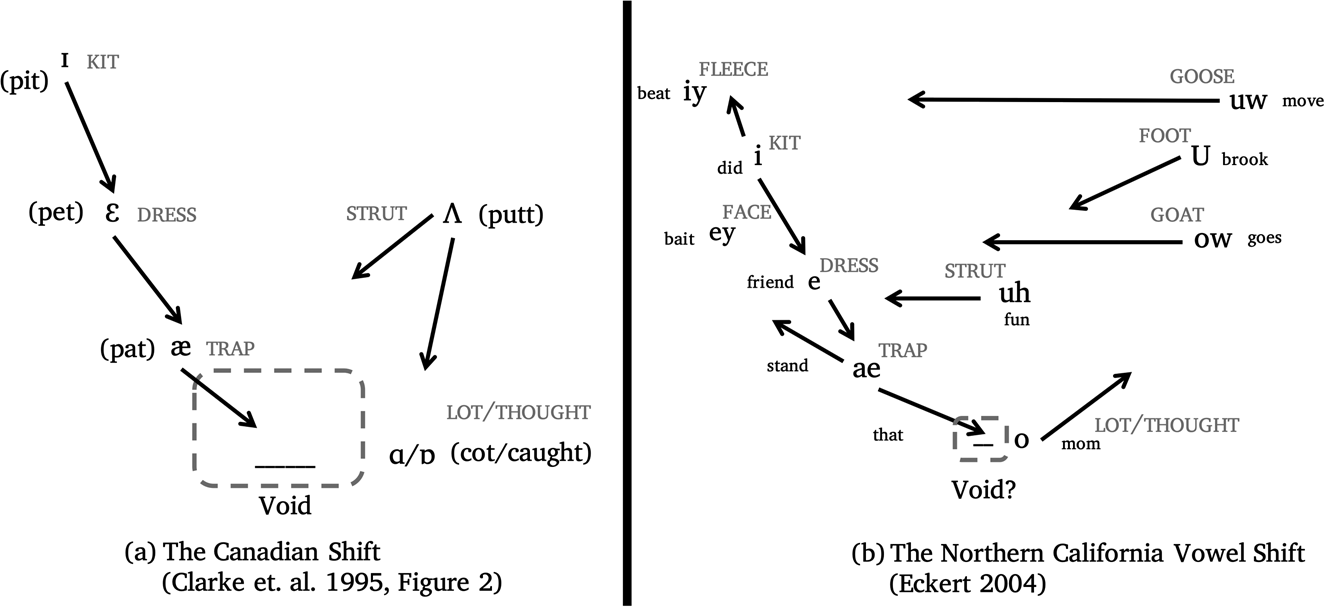
The conventional view among dialectologists and variationist sociolinguists is that the LBMS results from the merger of the low back vowels—that is, the vowels of the lot, thought, and palmFootnote 2 lexical sets (Wells, Reference Wells1982a,Reference Wellsb,Reference Wellsc)—that creates a phonetic “void” or “vacuum” that pulls the front lax vowels (trap, dress, and kit) toward the low central area in a pull/drag chain (e.g., Clarke, Elms, & Youssef, Reference Clarke, Elms and Youssef1995; Gordon, Reference Gordon, Kortmann, Schneider, Upton, Burridge and Mesthrie2004; Labov, Ash, & Boberg, Reference Labov, Ash and Boberg2006; see Figure 1a). This view, however, has led to much inquiry into the Cartesian position of the low back vowels in a two-dimensional vowel space as researchers strive to find diachronic phonetic evidence of such a low central void. The relatively more central position of the merged low-back vowel within the California Shift vowel configuration relative to the Canadian Shift configuration (see Figure 1) led to years of reluctance on the part of (some) sound change researchers to unite the two as a single phenomenon. For example, Hagiwara (Reference Hagiwara2006:134), comparing the vowel systems in Winnipeg, Canada, and Southern California, stated that “while retraction, if not lowering, of the front vowels seems to be occurring in the Californian sample, this cannot have been triggered by the merger of low-back vowels in the fashion of a traditional drag-chain. The merged low-back vowel in Californian does not leave the void in the low-back space that it does in the Canadian space.” Other researchers have tried to surmount this fact by proposing other dispersion-based explanations of the LBMS, such as a kit-lowering push chain (Kennedy & Grama, Reference Kennedy and Grama2012), a strut-centralization push chain (Hagiwara, Reference Hagiwara2006; Hoffman, Reference Hoffman1999), or a trap-backing push chain (Strelluf, Reference Strelluf and Strelluf2019).Footnote 3
Early representations of the Canadian Shift (left) and the Northern California Shift (right) as reported by Clarke et al. (Reference Clarke, Elms and Youssef1995: Fig. 2) and Eckert (Reference Eckert2004). Authors’ original phonetic symbols used, with corresponding lexical sets and putative phonetic voids added. Early conceptions of both shifts included additional vowel movement that was later decoupled from the LBMS pattern by subsequent researchers, including strut centralization (Clarke et al., Reference Clarke, Elms and Youssef1995), and prenasal kit/trap raising and back vowel centralization (Eckert, Reference Eckert2004).

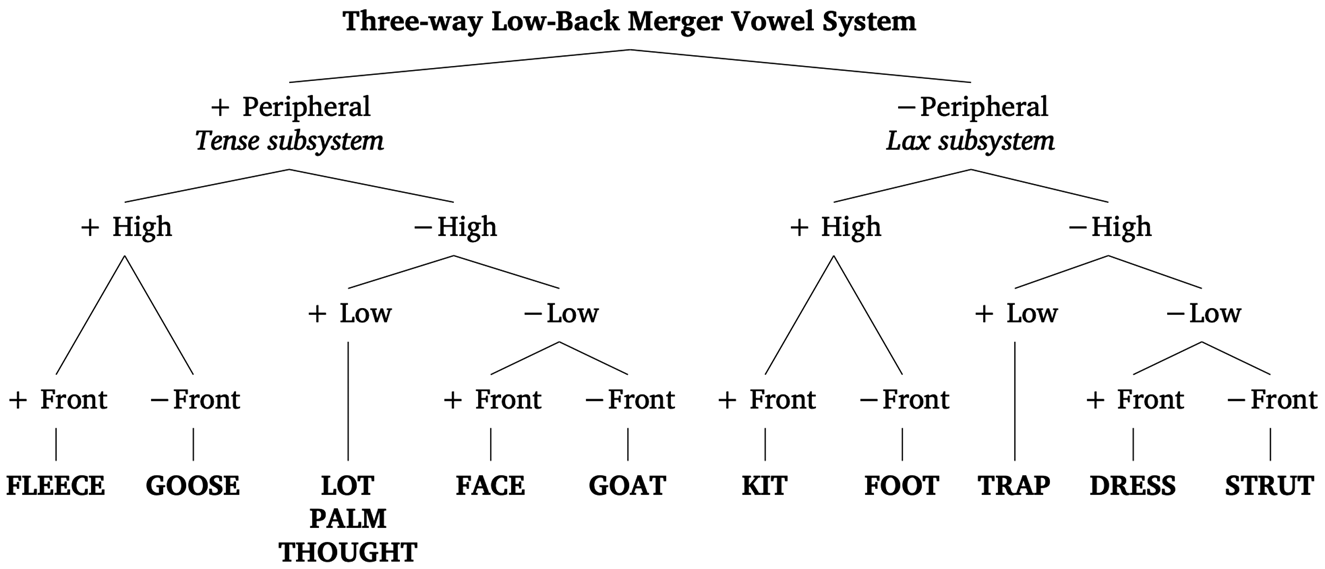
Contrastive phonological hierarchy for a dialect with a three-way Low-Back Merger.

Our proposal, instead, focuses on a structural motivation that does not require a phonetic vacuum (or any other sort of phonetic pressure) to trigger the LBMS. In other words, the relative frontness or backness of lot is irrelevant. The trigger of trap, dress, and kit movement is the phonological merger of palm, lot, and thought, and, therefore, any dialect in which these three phonemes have merged is susceptible to the LBMS.
North American English inherited a phonology in which the lexical sets lot and thought were difficult to distinguish. In Middle English, these vowels were both low, both back, and both round; thought, however, was longer than lot. One of the consequences of the Great Vowel Shift and its aftermath was that Middle English length distinctions were gradually neutralized in favor of distinguishing pure vowels and diphthongs; however, both lot and thought were pure vowels. McColl Millar (Reference McColl Millar2015:227) described this as “a rather uncomfortable state of affairs having two contrasting vowels squeezed so closely together in the mouth.” Most varieties of English have resolved this unstable situation, though in different ways. In North America, this has mostly involved merger. Labov et al. (Reference Labov, Ash and Boberg2006:60) drew an isogloss of the lot-thought merger that encompasses Eastern New England, all of Canada (except Newfoundland) and the American West, from the Pacific as far east as Topeka (Kansas), Tulsa (Oklahoma), and Amarillo and Odessa (Texas). There is also an isogloss that includes Western Pennsylvania and extends down the banks of the Ohio River north of the Appalachians through western West Virginia to eastern Kentucky. Labov et al.'s (Reference Labov, Ash and Boberg2006) comparison of their own data (collected in the 1990s) with data collected in the 1960s and 1930s indicates that the full merger of lot and thought is a change in progress, though most complete among Canadians and speakers from Eastern New England and Western Pennsylvania (Labov et al., Reference Labov, Ash and Boberg2006:62–4). Notably, everywhere except Eastern New England and in some historic varieties found in Canada's Maritime provinces, the merger also includes palm.Footnote 4 The historical path of the lot-thought merger follows known migration routes. It was brought by New England Planters to the Canadian Maritime provinces following the expulsion of the French-speaking Acadians (1755-1764) and later by coastal New England Loyalists seeking refuge after the American War of Independence in the late 1700s (Dollinger, Reference Dollinger and Hickey2010; Roeder & Gardner, Reference Roeder and Gardner2013). It was brought north to Upper Canada (i.e., southeastern Ontario) by inland Loyalists fleeing Western Pennsylvania and Upstate New York (e.g., Bloomfield, Reference Bloomfield1948; Boberg, Reference Boberg2010; Chambers, Reference Chambers1981). In the 1800s, it was brought westward from the same region down the Ohio River to Missouri and westward via the Oregon and California Trails, trundling the merger from the Midlands to the Pacific. It too was transported westward in Canada with the advent of the Canadian Pacific Railway. From these main arteries the merger spread southward and then back eastward (in the US) and northward in Canada as new English-speaking communities were established. In Canada, Esling and Warkentyne (Reference Esling, Warkentyne and Clarke1993) first found the LBMS pattern among young Vancouver speakers. Two years later, Clarke et al. (Reference Clarke, Elms and Youssef1995) identified the pattern in their data from mostly Ontario and labeled it the Canadian Shift. They also explicitly linked the LBMS to the LBM as a trigger (see Figure 1a). The LBMS has been reported widely for Canada, from Victoria, British Columbia in the west (Roeder, Onosson, & D'Arcy, Reference Roeder, Onosson and D'Arcy2018) to St. John's, Newfoundland in the east (D'Arcy, Reference D'Arcy2005), and for every region in between (Boberg, Reference Boberg2005, Reference Boberg2008, Reference Boberg2010, Reference Boberg2019a, Reference Boberg and Becker2019b; De Decker, Reference De Decker2002a, Reference De Decker2002b; De Decker & Mackenzie, Reference De Decker and Mackenzie1999; Friesner, Kastronic, & Lamontagne, Reference Friesner, Kastronic and Lamontagne2021; Hagiwara, Reference Hagiwara2006; Hoffman, Reference Hoffman1999; Hoffman & Walker, Reference Hoffman and Walker2010; Hollett, Reference Hollett2006; Kettig & Winter, Reference Kettig and Winter2017; Labov et al., Reference Labov, Ash and Boberg2006; Meechan, Reference Meechan1999; Peterka, Reference Peterka2019; Roeder, Reference Roeder2012; Roeder & Gardner, Reference Roeder and Gardner2013; Roeder & Jarmasz, Reference Roeder and Jarmasz2010; Sadlier-Brown & Tamminga, Reference Sadlier-Brown and Tamminga2008; Smith, Reference Smith2018; Swan, Reference Swan and Becker2019). The first authors to identify the LBMS pattern in California were Hinton, Moonwoman, Bremner, Luthin, Van Clay, Learner, and Corcoran (Reference Hinton, Moonwoman, Bremner, Luthin, Van Clay, Learner, Corcoran, Aske, Beery, Michaels and Filip1987; see also Luthin, Reference Luthin, Denning, Inkelas, McNair-Knox and Rickford1987). The authors suggested that the concurrent front vowel movement may be a chain shift; however, they also questioned whether California's low-back vowels are fully merged as had been previously reported by the Dictionary of American Regional English and DeCamp (Reference DeCamp1977). The merger Hinton et al. (Reference Hinton, Moonwoman, Bremner, Luthin, Van Clay, Learner, Corcoran, Aske, Beery, Michaels and Filip1987) discussed is the movement of thought toward a lower, unrounded lot, a type of movement that would inhibit a pull chain triggered by a low central phonetic void (see also Hagiwara [Reference Hagiwara2006], above). Conversely, Eckert (Reference Eckert2004, Reference Eckert2008) reported on sociophonetic measurements of Northern California vowels and found lot backing and raising (along with trap, dress, and kit lowering and retracting, see Figure 1b). Kennedy and Grama (Reference Kennedy and Grama2012), in their acoustic study of young adults from across California, resolved the lack of a low-front phonetic void by positing (as one of several hypotheses) a push chain triggered by the lowering of kit. The authors later recanted (Grama & Kennedy, Reference Grama, Kennedy and Becker2019) and argued that just the instantiation of lot movement, not a full lot-thought merger, is enough to trigger a pull chain (see also Durian, Reference Durian2012:248; Strelluf, Reference Strelluf and Strelluf2019:122).
The LBMS occurs throughout California (Cardoso, Hall-Lew, Kementchedjhieva, & Purse, Reference Cardoso, Hall-Lew, Kementchedjhieva, Purse, Fridland, Kendall, Evans and Wassink2016; D'Onofrio, Eckert, Podesva, Pratt, & Van Hofwegen, Reference D'Onofrio, Eckert, Podesva, Pratt, Van Hofwegen, Fridland, Kendall, Evans and Wassink2016; D'Onofrio, Pratt, & Van Hofwegen, Reference D'Onofrio, Pratt and Van Hofwegen2019; Fridland & Kendall, Reference Fridland, Kendall and Becker2019), in western states like Washington (Swan, Reference Swan and Becker2019; Wassink, Reference Wassink, Fridland, Kendall, Evans and Wassink2016), Oregon (Fridland & Kendall, Reference Fridland, Kendall and Becker2019; McLarty, Kendall, & Farrington, Reference McLarty, Kendall, Farrington, Fridland, Kendall, Evans and Wassink2016), and Nevada (Fridland & Kendall, Reference Fridland, Kendall, Fridland, Wassink, Kendall and Evans2017, Reference Fridland, Kendall and Becker2019). The pattern (or some of its components) is also attested increasingly eastward in parts of Montana (Bar-El, Felton Rosulek, & Sprowls, Reference Bar-El, Rosulek, Sprowls, Fridland, Wassink, Kendall and Evans2017), Utah (Bowie, Reference Bowie, Fridland, Wassink, Kendall and Evans2017), New Mexico (Brumbaugh & Koops, Reference Brumbaugh, Koops, Fridland, Wassink, Kendall and Evans2017), Colorado (Holland & Brandenburg, Reference Holland, Brandenburg, Fridland, Wassink, Kendall and Evans2017), Kansas (Kohn & Stithem, Reference Kohn and Stithem2015; Villarreal & Kohn, Reference Villarreal and Kohn2021), Missouri (Strelluf, Reference Strelluf and Strelluf2019), Illinois (Bigham, Reference Bigham2010), and Ohio (Durian, Reference Durian2012; Durian, Dodsworth, & Schumacher, Reference Durian, Dodsworth, Schumacher, Yaeger-Dror and Thomas2009), as well as more remotely in both Alaska (Bowie, Reference Bowie, Fridland, Wassink, Hall-Lew and Tyler2020) and Hawaii (Kirtley, Grama, Drager, & Simpson, 2016). We argue for the unison of LBMS patterns across Canada and the western United States for two reasons: (1) the settlement history of these regions resulted in the same low vowel configuration; and (2) the LBMS is the structural consequence of this configuration. We propose that the three-way merger of palm, lot, and thought in the mixed American dialects brought to Canada following the American Revolution and brought westward during eighteenth-century American expansion sowed the seeds for the LBM and subsequent LBMS. Researchers specializing in koineization would likely be unsurprised that the replanting of inland American dialects to Canada and the West, and the related dialect contact, generated an emergent low vowel configuration simpler than those on the coast or back in the British Isles.
Phonological motivations
We formalize the phonological component of our model by adopting the Contrastive Hierarchy Theory (Dresher, Reference Dresher2009), also known as Modified Contrastive Specification (Dresher, Piggott, & Rice, Reference Dresher, Piggott and Rice1994). Under this approach, phonemes are hierarchically specified only for features that are contrastive by the Successive Division Algorithm (Dresher, Reference Dresher2009), and it is only these contrastive features that are active within the phonology. This (mostly) eliminates redundancy because a phoneme is only specified for features needed to distinguish it from other phonemes. This hierarchy of features is conventionally represented via binary trees.
Using the Successive Division Algorithm, English phonemes are initially divided based on a single feature, [±Peripheral]. Oxford (Reference Oxford2015) argued that [±Peripheral] is the highest-ranked feature in English for historical, phonotactic, and articulatory reasons. In addition, giving peripherality scope over all other features is in agreement with the classification of all vowels in English as being part of either a peripheral or nonperipheral track within the vowel space (Labov, Reference Labov1994; Labov et al., Reference Labov, Ash and Boberg2006; inter alia).
Labov (Reference Labov1994:272) suggested that the “tense” and “lax” feature, that is, [±Peripheral], divides English vowels into two vowel subsystemsFootnote 5 and says this distinction is at a higher level of abstractness from the difference that, for example, divides [+High] from [−High] vowels. In individual languages, vowels may belong to many natural classes, like [+High] or [−Front], but only one subsystem. Further, all vowels must belong to a subsystem but may be unspecified for other phonological distinctions. In English, for example, there are [+Peripheral] and [−Peripheral] subsystems, whereas in French and Portuguese there are [+Oral] and [−Oral] subsystems (Labov, Reference Labov1994:272). Oxford (Reference Oxford2012: §4.5, Reference Oxford2015:311–12) argues that Labov's higher level of abstractness translates to a higher position in the contrastive hierarchy. He suggests that for languages with “tense” and “lax” distinctions, [±Peripheral] must be the highest-ranked feature if it is to delineate two subsystems. He also proposes that higher-ranked features can marshal more phonetic dimensions in their realization, thus explaining why the [±Peripheral] feature is implemented using not just vowel duration but also articulatory position and overall articulatory effort (see also De Decker & Nycz [Reference De Decker and Nycz2012] and Durand [Reference Durand, Carr, Durand and Ewen2005] for an overview).
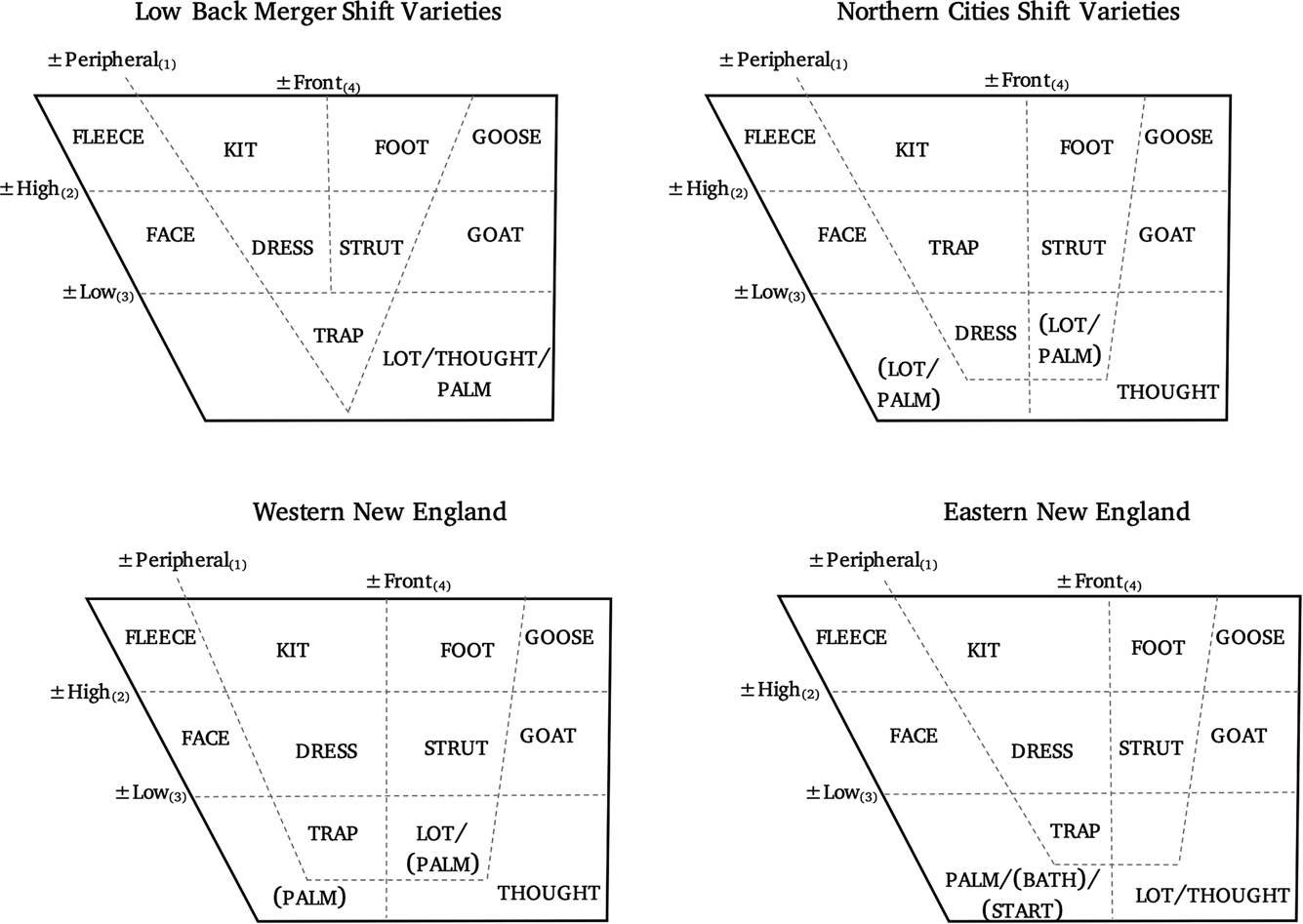
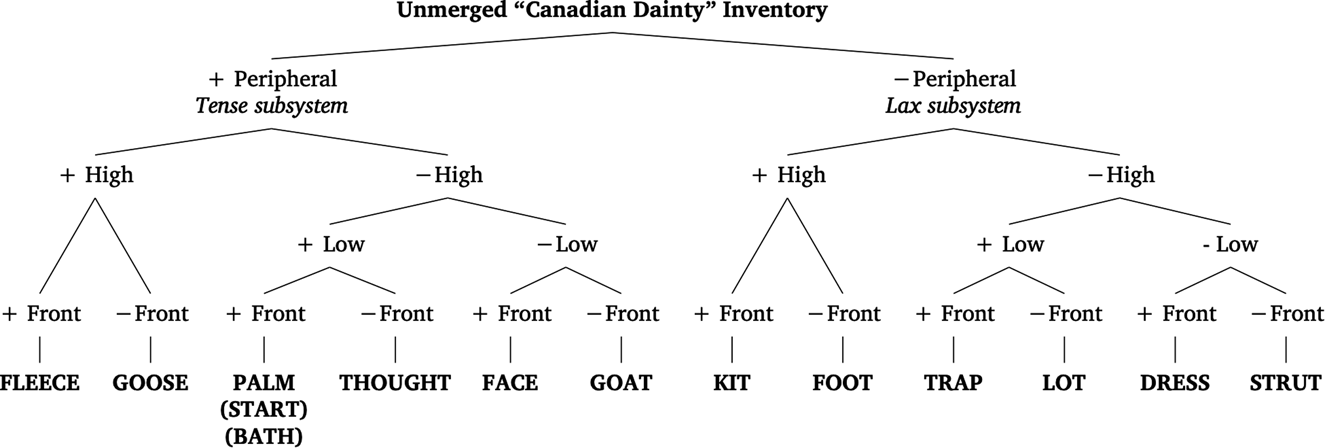
The division of English vowels into two subsystems also reflects their phonotactic and morphological distributional patterns (see discussion in Borowsky, Reference Borowsky1986; Chomsky & Halle, Reference Chomsky and Halle1968; Halle, Reference Halle1977; Halle & Mohanan, Reference Halle and Mohanan1985; Hammond, Reference Hammond1999; Kahn, Reference Kahn1976; Lass, Reference Lass1976). The crucial generalization is that some vowels (kit, dress, trap, lot, strut, foot) are infelicitous in final open syllables: *pɪ, *pɛ, *pæ, *pɔ, *pʌ, *pʊ; and prehiatus: *pɪ.ə, *pɛ.ə, *pæ.ə, *pɔ.ə, *pʌ.ə, *pʊ.ə; while [+Peripheral] vowels can occur in these positions. Conversely, [+Peripheral] vowels do not occur in monomorphemes if they precede consonant clusters in which one consonant is coronal: *pisk, *pejsk, *pɑsk, *powsk, *pusk, (Green, Reference Green2001:5–7). When lot and thought merge, they do so as a [+Peripheral] vowel, as words like claw [klɑ] and clawing [klɑ.ɪŋ] remain licit. However, some ambiguity arises, as words like loft and wasp are part of this lexical set. Trap does not occur in final open syllables and does occur in words like clasp and ask and is therefore like other [−Peripheral] vowels. When palm remains independent from lot-thought, as it does in Eastern New England (Figure 3), it is likely categorized as [+Peripheral], as it includes words like spa and bra (Green, Reference Green2001). As presented in Figure 2, after the first division of vowels into [+Peripheral] and [−Peripheral] subsystems, the inventory is subdivided again based on a second feature, here the binary height feature [±High]. Next, the [−High] vowels are specified for [±Low]. And finally, the [±Front] feature is only needed to differentiate the [−High, −Low] vowels from one another.Footnote 6 Specifying the two [+Low] vowels for frontness would be redundant because they already contrast with every other vowel in the system, and they contrast with each other in the highest-ranked feature [±Peripheral]. Following this model, each phoneme contrasts in at least one feature with every other phoneme in the inventory.
Proposed contrastive feature specifications for vowels in the LBMS varieties, Western New England, and Northern Cities Shift varieties based on Labov et al. (Reference Labov, Ash and Boberg2006), Boberg (Reference Boberg2010), and Johnson and Durian (Reference Johnson, Durian and Hickey2017). Note, these diagrams represent phonological specifications, not locations of vowels within the F1/F2 acoustic space. As the highest-ranked feature, [±Peripheral] divides vowels into the [+Peripheral] and [–Peripheral] subsystems. Divisions then are made using [±High], [±Low], and [±Front] until all vowels contrast with every other vowel in the system by at least one feature.

The configuration presented by Figure 2 is for a rhotic variety. In these varieties, [±Peripheral] pairs are neutralized before r. Prerhotic vowels thus become unspecified for peripherality (in rhotic North American English, at least), but otherwise the contrastive hierarchy persists: [±Peripheral] →[±High] →[±Low] →[±Front]. So, like trap, the [+Low] prerhotic vowel, start, is not specified for [±Front] and is free to be pronounced without the phonetic implementation mechanism needing to satisfy a phonological specification for horizontal aspect and, therefore, may be pronounced further forward or further back in different varieties (e.g., Inland versus Maritime Canadian English; Keifte & Kay-Raining Bird [Reference Keifte, Kay-Raining Bird, Schreier, Trudgill, Schneider and Williams2010:65]). Within this phonological paradigm, true diphthongs (mouth, price, choice) are conceptualized as doubly specified, with the phonetic implementation mechanism transitioning from satisfying the phonological specification of the nucleus to satisfying the phonological specifications of the off-glide. Thus, choice transitions from [+Peripheral][−High][−Low][−Front] to [+Peripheral][+High][−Low][+Front]. The feature [±Round] is not included in this hierarchy because it is unnecessary vis-à-vis contrast in this inventory of English vowels. Giegerich (Reference Giegerich1992:107, 120) pointed out that, for consonants, [±Round] does not figure in phonemic representations in English, and for vowels [±Round] is only operative at the phonemic level to a limited extent. For Giegerich (Reference Giegerich1992:107) the feature [±Round] is only required to differentiate nonprerhotic /ɑ/ and /ɒ/ in a vowel inventory in which both of these phonemes are [+Peripheral], “and for all other contrasts of the basic vowel system, the feature [Round] is not needed.”
Hall (Reference Hall2011) posited that noncontrastive features like [±Round] may be used to supplement the detailed phonetic specification of a particular phoneme. A feature like [+Round] may be used to enhance the phonetic implementation of [−Front] (Hall, Reference Hall, Jensen and Van Herk2001; Keyser & Stevens, Reference Keyser and Stevens2006; Stevens & Keyser, Reference Stevens and Keyser2010) as lip-rounding lengthens the vocal tract, resulting in a lower F2 frequency for an otherwise similarly articulated vowel (see Lindblom & Sundberg, Reference Lindblom and Sundberg1971). [±Round] is likely the lowest-ranked feature in dialects of English, and thus moves back and forth from being contrastive to noncontrastive as needed when the English vowel inventory expands or shrinks due to breaking or merger.
We take a moment here to comment on our view of the relationship between phonetic implementation and phonological contrast. Contrastive feature specifications such as [+Peripheral] or [−Front] can be viewed as placing limits on relative pronunciation or as a kind of requirement needing satisfying but not necessarily specific instructions for phonetic implementation (cf., Hitch, Reference Hitch2017). For instance, a [+Low] vowel ought not be the vowel in the system pronounced with the lowest F1; further, there must be some articulatory behavior that corresponds to the presence of this feature that would be different or absent if the vowel were [−Low] or was unspecified for [±Low].
Given this orientation of phonetics to phonology, each phonemic feature specification allows for a broad range of phonetic realizations. For example, in many North American dialects the [−Peripheral] trap is realized as low and front but alternates with or transitions diachronically to a realization that is often described as “raised” or “tensed” (inter alia Labov, Reference Labov, Fasold and Schiffrin1989; Labov et al., Reference Labov, Ash and Boberg2006). This is not, however, an indication that trap becomes phonologically recategorized as [+Peripheral] in the variety (see also Labov, Reference Labov1994:505). Perceptual support for this claim comes from Duncan (Reference Duncan2016), who tested the acceptability of [Vsk] and [Vsp] nonce words and found that for both California and trap-“tensing” Northern Cities Shift participants, trap—presented as low and front for California participants and raised and front for Northern Cities Shift participants—were judged equally as acceptable in [Vsk] and [Vsp] nonce words as dress and kit, and, like dress and kit, more acceptable than face or fleece. Duncan (Reference Duncan2016:11) concluded that Northern Cities Shift trap is phonologically lax regardless of its phonetic characteristics.Footnote 7
A three-way low-back merger system differs from systems in which thought and lot are merged (e.g., a simple cot-caught merger) but are independent of palm, such as Eastern New England (Labov et al., Reference Labov, Ash and Boberg2006:229, 231). In Eastern New England, palm (a somewhat meagre lexical set) is bolstered by its merger with nonrhotic start and (in many instances) bathFootnote 8 (Johnson & Durian, Reference Johnson, Durian and Hickey2017:259). This necessitates a [±Front] feature to differentiate two [+Low, +Peripheral] vowels (Figure 3). Therefore, the same framework that explains the actuation of the LBMS also provides phonological reasoning for Boberg's (Reference Boberg2010:155) claim that the independence of palm from lot-thought prevents the LBMS in Eastern New England.
Returning to Fruehwald's (Reference Fridland, Kendall, Fridland, Wassink, Kendall and Evans2017:35–36) contention with our analysis, for Fruehwald shift-like movement crucially requires linked moving sounds to share an underlying phonological specification and/or set of phonetic implementation strategies. The author correctly pointed out that our analysis of the LBMS takes as its foundation the loss of the [+Front] feature for trap but that this loss removes trap from the [+Front] natural class containing both dress and kit, the other two vowels involved in the LBMS. In other words, the three vowels do not share a unique feature specification (or phonetic implementation strategy) that could link their movement. We subscribe to Fruehwald's (Reference Fridland, Kendall, Fridland, Wassink, Kendall and Evans2017) proposition that linked sound changes must share an underlying phonological representation or set of phonetic implementation strategies. We, in fact, argue that this is exactly what motivates the movement of dress and kit. The natural class that links trap with these two vowels, however, is not [+Front], but instead [−Peripheral]. The loss of the [±Front] specification for trap opens the door for dispersion focalization to draw trap toward the low-central region of the vowel space (Schwartz, Boë, Vallée, & Abry, Reference Schwartz, Boë, Vallée and Abry1997, Reference Schwartz, Boë, Vallée, Abry, Solé, Beddor and Ohala2007). It also triggers, via analogy, the phonetic reinforcement of the highest-ranked constraint (and the only constraint differentiating trap and lot/thought/palm): [±Peripheral]. In other words, as trap become more central, so too do all lax vowels (kit, dress, strut, and foot).
Crosslinguistic typology
Our analysis aligns with other streams of theorizing about the LBMS and chain shifting generally. For example, our proposal that—free of [+Front] specification—trap will naturally move to a low-central position is supported by the universal propensity for triangular systems (inter alia Boberg, Reference Boberg and Becker2019b; cf., Hitch, Reference Hitch2017). Typological analyses performed on over two hundred languages by Cotterell and Eisner (Reference Cotterell and Eisner2017:9) found that odd-numbered systems that include a low central point vowel are the most common in languages of the world.
Our proposal further aligns with Labov and colleagues’ (Labov, Reference Labov and Eckert1991; Labov et al., Reference Labov, Ash and Boberg2006; Labov & Wald, Reference Labov and Wald1969; Labov, Yaeger, & Steiner, Reference Labov, Yaeger and Steiner1972, among others) principles of chain shifting: that peripheral nuclei rise; that nonperipheral nuclei fall; and that back vowels move to the front. These principles, derived from empirical observation, can be restated as a set of phonologically motivated predictions: peripheral vowels will become more peripheral; lax vowels will become more lax; and round vowels will unround. Of course, these changes are only expected to occur if there are no competing phonological requirements that need to be satisfied. The first two predictions will likely occur if [±Peripheral] is the only feature differentiating two phonemes. The latter is likely to occur because, as discussed above, [±Round] is likely the lowest-ranked feature for Modern English, often dropping out of the contrastive hierarchy, and leaving “round” vowels like goose, foot, and goat without the requirement to satisfy a [+Round] feature.
Evidence of the LBM in progress
We exemplify the phonetics of the LBM that underlie our proposed phonological explanation with data from Victoria, British Columbia. The cultural history of Victoria, a city of roughly 92,000 located on the southern tip of Vancouver Island, allowed a conservative Canadian English to persist longer than in other areas of Canada, although more recent mobility and increasing connection between Victoria and the mainland have facilitated linguistic assimilation. In addition to being geographically isolated, Victoria has maintained a British substrate influence longer than other Canadian communities, including the preservation of British lexical and phonological features.
Roeder et al. (Reference Roeder, Onosson and D'Arcy2018) found this substrate effect most strongly reflected in the speech of Victoria speakers born before 1941. The study examined apparent time vowel change among 114 speakers from the Synchronic Corpus of Victoria English (SCVE), a subsample of the Victoria English Archive Footnote 9 (D'Arcy, Reference D'Arcy2017). Statistical results revealed the LBMS to be a recent development. MANOVA showed the oldest speakers (b. 1913-1941) to be dramatically unshifted as a group in comparison to younger speakers (b. 1942-1998) for all six parameters measured: F1/F2 of kit, dress, and trap (p < 0.001; F-ratio = 13–38; partial η2 = 0.138-0.306). Furthermore, the merged palm-lot-thought vowel was found to be ubiquitous in Victoria only in the speech of individuals born after 1941. This finding suggests that the merger was not the norm in this speech community until the mid-twentieth century, around the time of the post-WWII baby boom—much later than the rest of English-speaking Canada (see Boberg, Reference Boberg2010; Chambers, Reference Chambers2008; Dollinger, Reference Dollinger and Hickey2010; among others). When speakers born before 1941 were excluded from the analysis, a MANCOVA of age and gender showed no significant F1/F2 differences between lot, thought, or palm. However, when the older speakers were included, a Tukey-b post hoc test revealed that the oldest group had a significantly higher thought (lower F1) and more fronted palm (higher F2) than the rest of the community. Similarly, linear regression indicated change over apparent time for both the F1 of thought (F = 11.886, p = 0.001, R2 = 0.096) and the F2 of palm (F = 9.403, R 2 = 0.077, p = 0.003). The significant p-value despite a low R2 reflects the fact that, even though age did not correlate with the dependent variable for speakers born after 1941 (n = 86), it did correlate significantly for those born in and before 1941 (n = 28).
The current study further develops this line of inquiry by examining palm, lot, thought, and trap/bath at the level of the individual for the twenty-nine oldest speakers from the Roeder et al. (Reference Roeder, Onosson and D'Arcy2018) sample. The delayed appearance of both the LBM and the LBMS in Victoria facilitates the present investigation of preshift vowel configurations that may be representative of the emergence of the LBMS more broadly. Previous phonetic research has largely focused on the lot-thought merger with little emphasis on palm as a vowel crucially implicated in the process. This is likely because palm is now merged with lot in most North American varieties of English, despite historically merging with bath and start in Standard British English (Boberg, Reference Boberg2010:128). We address this research gap by investigating the relative F1/F2 positions of palm, lot, and thought in the speech of the oldest speakers in the Victoria study (b. 1913-1943), as well as the F1/F2 position of trap/bath relative to these vowels.
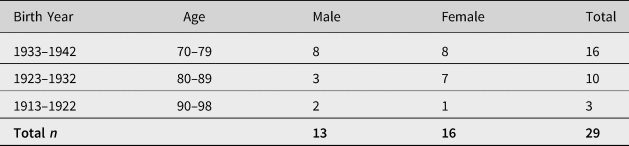
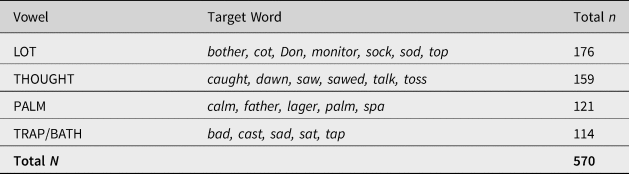
We draw on the lot, thought, palm, and trap/bath vowel pronunciations of twenty-nine speakers (thirteen men, sixteen women) who are life-long residents of Victoria and who were born between the years 1913 and 1942 (Table 1). Findings are based on the analysis of wordlist data.
Sample of Victoria participants drawn from the SCVE (D'Arcy, Reference D'Arcy2017) whose vowel pronunciations were used for acoustic analysis

The wordlist was automatically randomized at every presentation. The format was uncompressed .wav files, recorded at a sampling rate of 44.1 Hz and a depth of 16 bits. Table 2 presents the part of the wordlist, organized by lexical set, germane to the current analysis. The use of the same wordlist data here as was used in the larger study on vocalic features in Victoria speech (Roeder et al., Reference Roeder, Onosson and D'Arcy2018) facilitates contextualization of results within the findings of that study and also enables direct comparison of the same words across all speakers, which controls for factors such as stress and adjacent phoneme.
Target words with low vowels (based on Boberg [Reference Boberg2008]) read by Victoria participants and used for acoustic analysis

Acoustic measurements were taken of 570 tokens, distributed across target words for the three low back merger vowels (lot, thought, and palm) as well as the trap/bath vowel. To ensure accurate analysis, only tokens with an F1/F2 bandwidth of 400 Hz or less were included. Audio files were annotated using Praat (Boersma & Weenink, Reference Boersma and Weenink2020). The Forced Alignment and Vowel Extraction (FAVE) measurement technique (Rosenfelder, Fruehwald, Evanini, Seyfarth, Gorman, Prichard, & Yuan, Reference Rosenfelder, Fruehwald, Evanini, Seyfarth, Gorman, Prichard and Yuan2014) was then operationalized for vowel measurement; FAVE output was double-checked for accuracy. We used FAVE's default measurement method, which measures each vowel at one-third of its duration, except for face (measured at maximum F1) and goat (measured halfway between the beginning of the segment and maximum F1). The Labov et al. (Reference Labov, Ash and Boberg2006) ANAE speaker extrinsic normalization algorithm, available in the vowel normalization and plotting suite NORM (Kendall & Thomas, Reference Kendall and Thomas2010; Thomas & Kendall, Reference Thomas and Kendall2007), was performed on the measurements of the full suite of vowels for all 114 SCVE speakers to prevent skewing, though unnormalized measurements are used for the presentation of individual vowel spaces presented below.
Findings from the current analysis indicate that Victoria participants born before 1943 (n = 29) do not uniformly display the merger in their speech, instead demonstrating interspeaker variation in the relative orientation of these three vowels. Conversely, speakers born in 1943 or later ubiquitously display the palm-lot-thought merger.
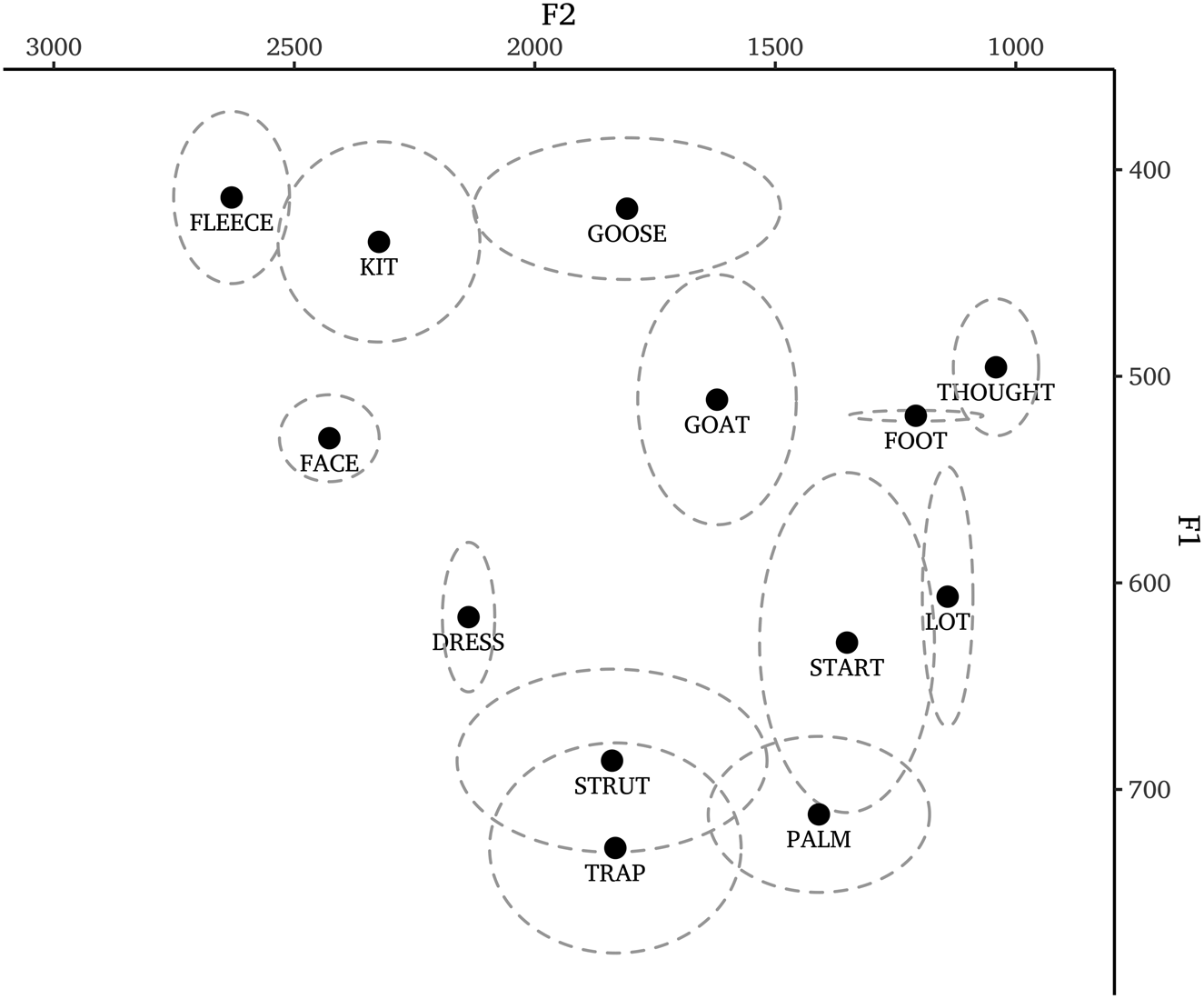
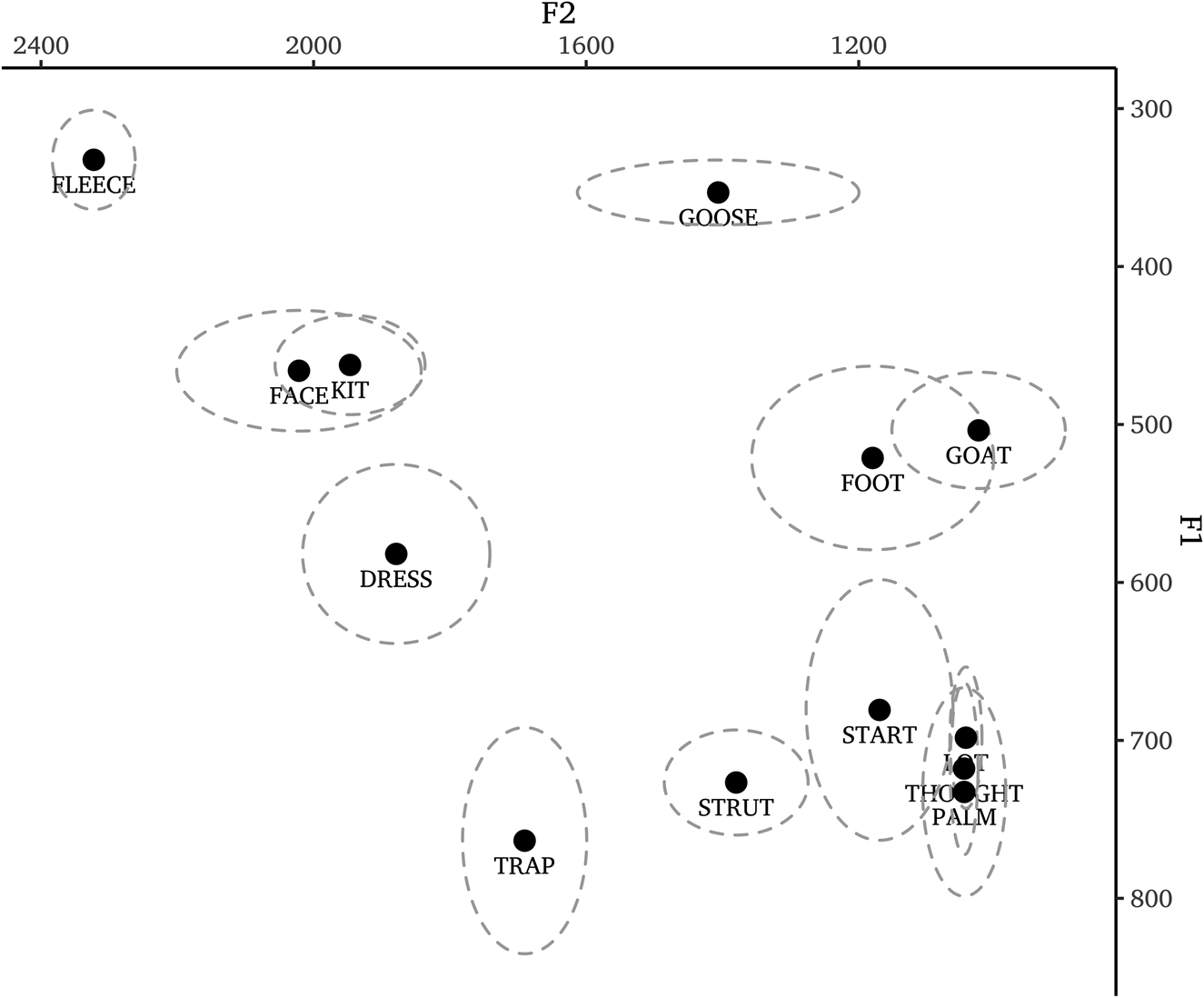
Three distinct phonetic patterns emerged from the data. In Pattern #1, palm, lot, and thought are acoustically distinct (Figure 4), suggesting three separate phonemes (Figure 5). This pattern is illustrated in Figure 4, which shows means for an 83-year-old woman (b. 1928) of the shift vowels (kit, dress, trap/bath), the low back merger vowels (palm, lot, thought), and the point vowels fleece, goose, and goat. Each ellipsis represents one standard deviation. Pattern #1 emerged in the speech of three women and three men (b. 1928-1932).
Pattern #1. Vowels of a Victoria woman (b. 1928) with unmerged palm, lot, thought (n = 44).

Contrastive phonological hierarchy for Victoria Pattern #1.

Since palm has historically been realized as distinct from lot and thought in standard British English (Boberg, Reference Boberg2010:128), its status as a separate vowel in the speech of some older speakers in Victoria reflects the historical influence of prestige British English forms. In fact, two of the three female speakers who exhibited Pattern #1, including the speaker whose vowel chart is presented in Figure 4, can be described as having a language variety referred to locally as “Canadian Dainty,” displaying “the veneer of Briticisms” (Chambers, Reference Chambers and Hickey2004:232). In Victoria, this accent has been observed primarily in the historically English-settled part of town and perseveres among some of the city's older social elite. Features include variable rhoticity in post-vocalic contexts, variable application of the trap/bath split, and retention of intervocalic /t/ (Roeder et al., Reference Roeder, Onosson and D'Arcy2018:89). The third female speaker whose speech showed Pattern #1 reported that her parents were first generation from England and that she “went to school with other children whose parents were also from England.”Footnote 10 These findings provide apparent time evidence that Pattern #1 was being acquired by children in Victoria until at least the early 1930s.
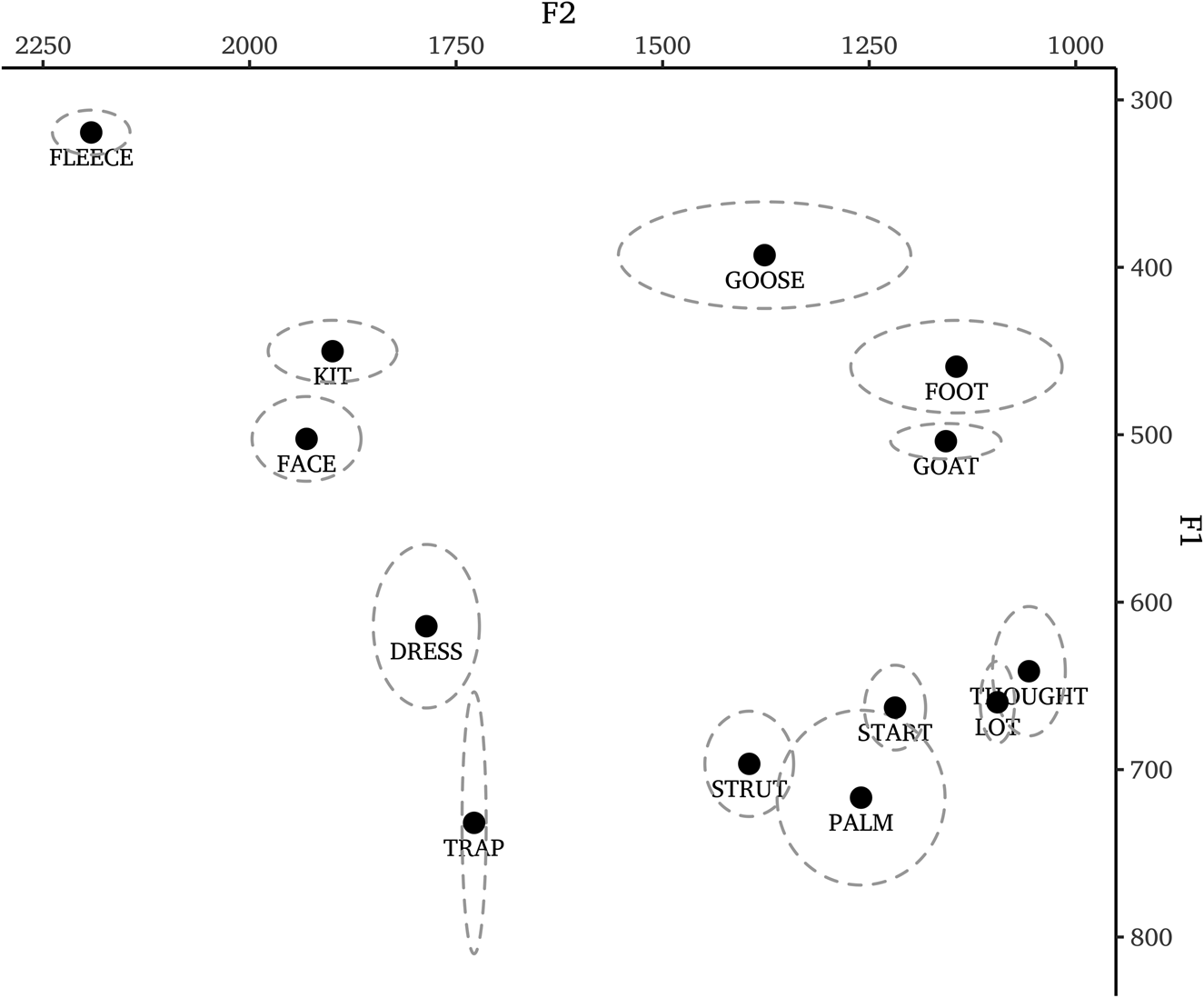
Pattern #2 shows lot and thought overlapping in the F1/F2 acoustic space, with palm remaining separate (similar to Eastern New England in Figure 3). Figure 6 illustrates Pattern #2, which emerged for eight speakers, born between 1920 and 1938. Evaluating Pattern #1 and Pattern #2 together, these results indicate that palm is an acoustically distinct vowel in the speech of eleven of the twenty-nine participants, regardless of whether lot and thought are separate, overlapping, or completely merged.
Pattern #2. Vowels of a Victoria man (b.1937) with unmerged palm but overlapping lot and thought (n = 58).

Pattern #3 (Figure 7), displayed in the speech of the remaining eighteen participants (and all eighty-five SCVE speakers born after 1942), is characterized by complete, or near-complete, overlap in the F1/F2 values for palm, lot, and thought (consistent with a LBMS system, as in Figures 2–3). The degree to which palm-lot-thought are truly merged into one vowel, however, may vary by speaker and requires additional testing with a larger set of words per speaker for each vowel, including comparisons of vowel trajectories and vowel durations. Nonetheless, the observations presented here of differing vowel orientations indicate variable phonology and a state of transition during the pre-WWII era in Victoria. In combination with the quantitative result that kit, dress, and trap lowering and retraction lag dramatically behind in these older speakers (Figure 8), these findings provide compelling evidence for a correlation between unmerged palm-lot-thought and unshifted kit, dress, and trap at the community level.
Pattern #3. Vowels of a Victoria man (b.1931) with near total F1/F2 overlap for palm, lot, and thought (n = 63).

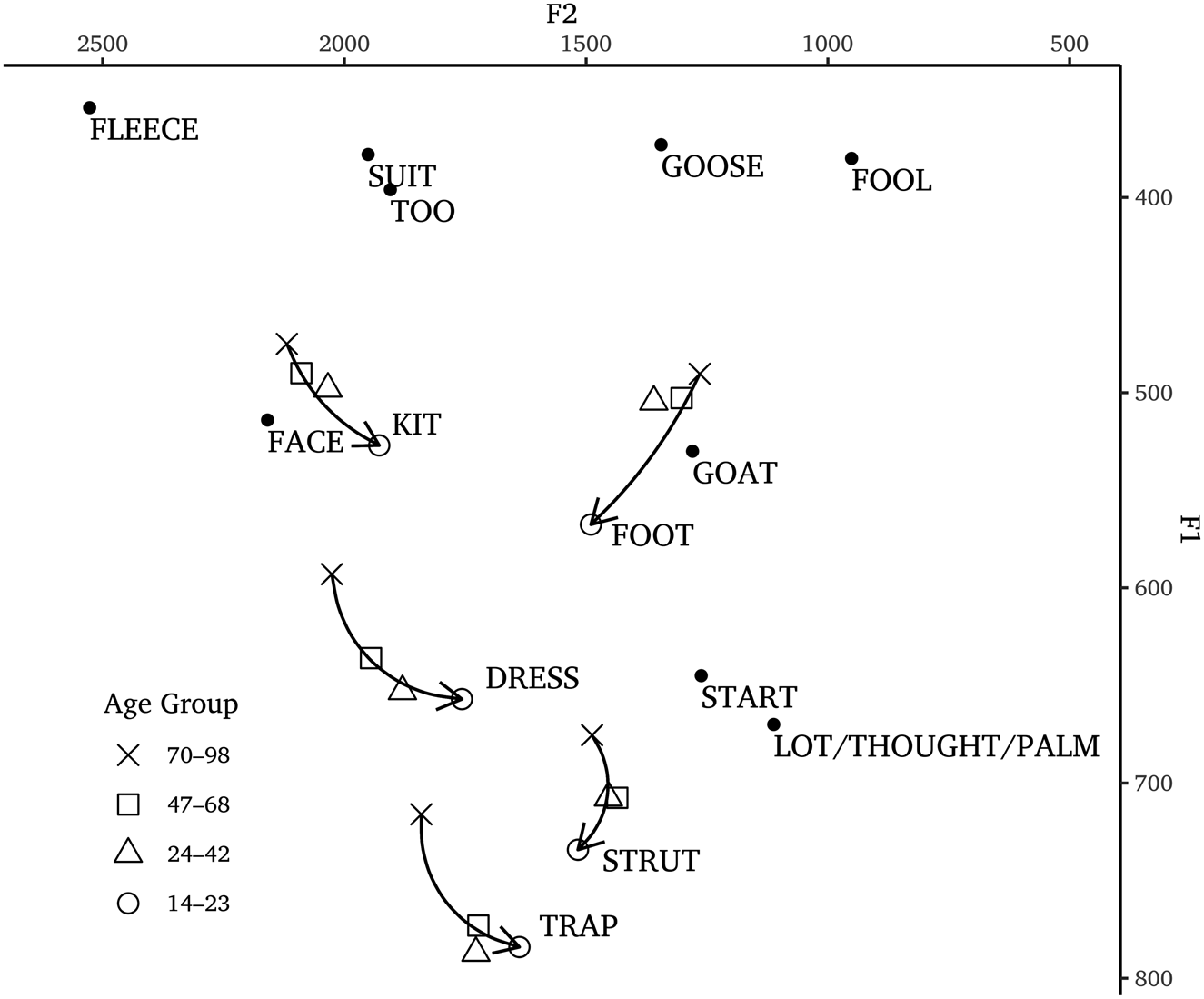
Low-back-merger-shift in apparent time in Victoria, BC, (n = 13,513).

Bigham's (Reference Bigham2010) evolutionary-emergence model of sound change provides a way to interpret the phonetic variation that occurs before a systemic change, such as a merger, has finished working its way through a speech community. Extrapolating from his work on the variable realization of trap in the speech of twenty-six speakers from Southern Illinois, where he found the LBMS to be a nascent feature, Bigham (Reference Bigham2010:30) wrote “…in early stages of change and/or in dialect contact situations, we are able to ‘capture’ this emergent process before the system ‘re-stabilizes.’ Therefore, though trap-retraction and the low-back merger can be ‘decoupled’ in any given individual speaker, a correlation still emerges at the level of a community of speakers.” As such, the Victoria findings support the proposal put forward in this paper that the LBMS is driven by phonology and takes hold at the speech community-level only after the three-way palm-lot-thought merger is widespread.
Discussion
There are other widespread phonological/phonetic changes happening in LBMS varieties. These include trap-raising before nasals (and sometimes /ɡ/, and sometimes /d/, depending on variety) and the fronting of nonlow back vowels. As Becker (Reference Becker2019) pointed out, it is important to maintain a distinction between these changes and the LBMS. We agree that trap-raising before nasals is an independent phenomenon from the LBMS, although we hypothesize that the fronting of nonlow back vowels may, in fact, be related to the LBMS.
The fronting of nonlow back vowels (goose, foot, goat, and strut) could be analyzed as parallel movement; however, it could also be analyzed as two separate phenomena: the unrounding of phonetically round vowels (goose, foot, and goat), as [±Round] is not a contrastive feature in these varieties; plus the centralization of all lax vowels, trap, dress, kit, foot, and strut, that is a redefined, expanded low-back merger shift.Footnote 11
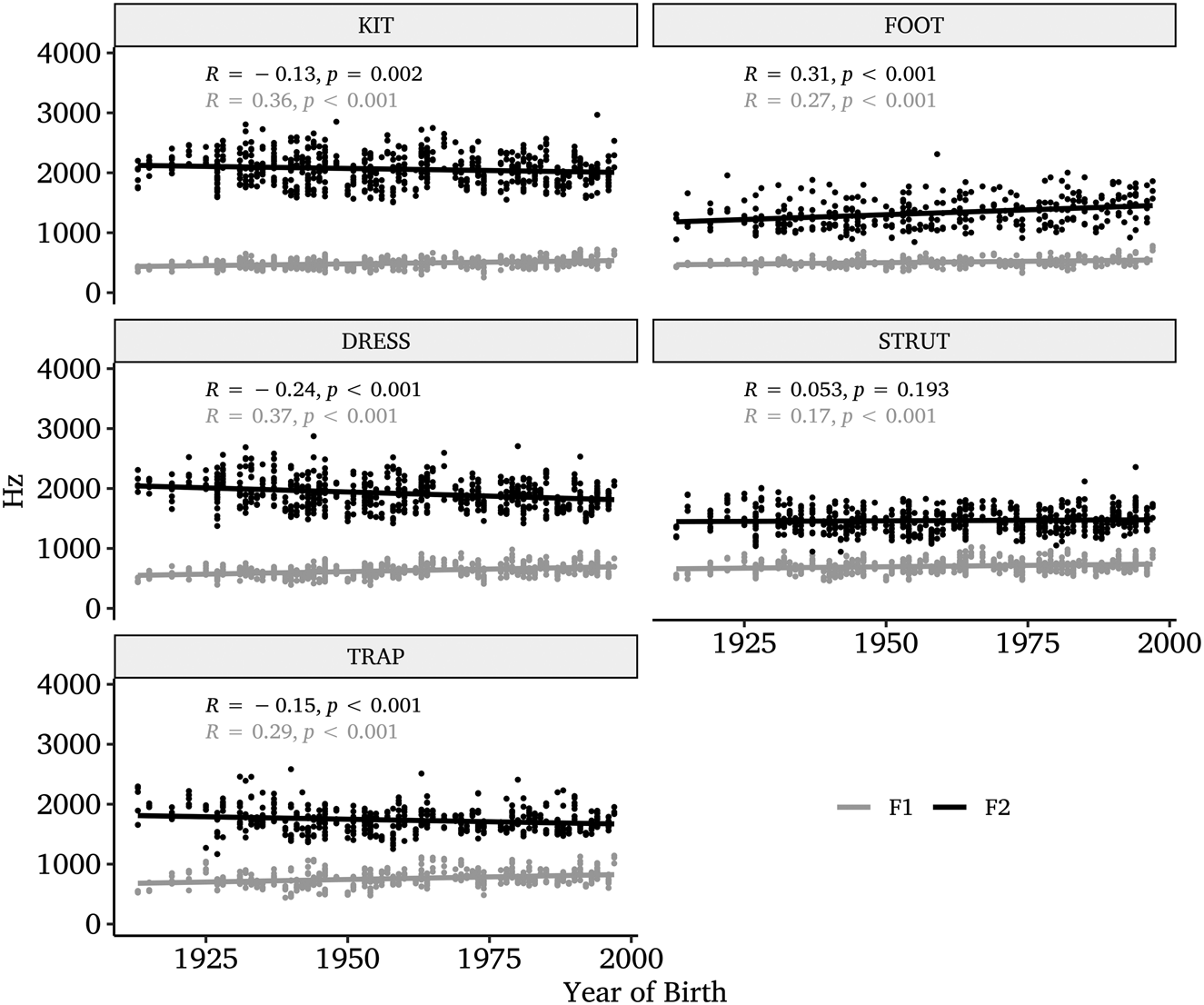
Figures 8–9 show how all [−Peripheral] vowels in Victoria centralize over apparent time. Figure 8 shows that over apparent time the mean F1/F2 values for age cohort members approach those associated with a low-central position (lowering F2, raising F1 for kit, dress, and trap; raising F2, raising F1 for foot and strut). Figure 9 shows the individual F1 and F2 values for each token of each [−Peripheral] vowel, along with regression lines and correlation coefficients (here Spearman's R values) and p-values.Footnote 12 Overall, for kit, dress, and trap, the (black) F2 values are higher among older speakers (indicating retraction over apparent time) and the (grey) F1 values are lower among older speakers (indicating lowering over apparent time). The positive slopes (R > 0) for F1 and negative slopes for F2 (R < 0) are all significant (i.e., p < 0.05). For foot there is a significant correlation between age and fronting and between age and lowering (F1 and F2 increase with year of birth, R > 0, p < 0.05). strut, on the other hand, shows significant lowering (F1 increases with year of birth, R > 0, p < 0.05) but its horizontal F2 value remains consistent (although F2 is lower among older speakers, R < 0, indicating fronting, the correlation is not significant, p > 0.05). The centralization of [−Peripheral] vowels and change toward a triangular rather than quadrilateral vowel space shown in Figures 8–9 not only support a contrastive hierarchy approach, they are strongly counterpredicted by a maximal dispersion model (Liljencrants & Lindblom, Reference Liljencrants and Lindblom1972; Lindblom, Reference Lindblom, Ohala and Jaegar1986; see also Hall, Reference Hall2011).
Normalized F1 (grey) and F2 (black) measurements for nonperipheral/lax vowels by year of birth for 144 speakers from Victoria, BC: kit (n = 623); dress (n = 630); trap (n = 488); foot (n = 325); strut (n = 608). Regression lines, R values, and significance as indicated.

Unfortunately, foot and strut are not always included in studies of LBMS patterns. Those that do include these sounds nearly ubiquitously report fronting or centralization. For example, in the first attestation of a LBMS pattern in California, Hinton et al. (Reference Hinton, Moonwoman, Bremner, Luthin, Van Clay, Learner, Corcoran, Aske, Beery, Michaels and Filip1987) reported foot fronting over time in the Bay area, and though it was not included in their study, the authors report anecdotally that strut, too, is fronting. Eckert (Reference Eckert2004, Reference Eckert2008) reported strut and foot fronting in Northern California. Though they too did not study it directly, Kennedy and Grama (Reference Kennedy and Grama2012) reported anecdotally that foot is centralizing among speakers with the LBMS pattern in their California data. Labov et al. (Reference Labov, Ash and Boberg2006:89) described strut fronting as “characteristic feature” of the Midlands, even though they categorize the Midlands as a transitional LBM region. Looking at their maps, however, (nearly) all speakers west of the Mississippi river show relatively fronter strut and foot (Labov et al., Reference Labov, Ash and Boberg2006:88–91). Additionally, Durian (Reference Durian2012) reported foot and strut fronting in Columbus, Ohio, alongside the LBMS.
In Canada, Esling and Warkentyne (Reference Esling, Warkentyne and Clarke1993) reported front strut and foot realizations in Vancouver, but they could not verify diachronic movement. Clarke, Elms, and Youssef (Reference Clarke, Elms and Youssef1995) reported impressionistically that foot and strut were fronting in their (mostly) Ontario data. Hagiwara (Reference Hagiwara2006) found it acoustically in his data from Winnipeg, as did Boberg (Reference Boberg2010, Reference Boberg2019a) in his pan-Canadian and American corpora (for those Americans participating in the LBMS).
Becker, Aden, Best, and Jacobson's (Reference Becker, Aden, Best, Jacobson, Fridland, Kendall, Evans and Wassink2016) study of Oregon does include foot and strut, but they find no clear movement; however, McLarty et al. (Reference McLarty, Kendall, Farrington, Fridland, Kendall, Evans and Wassink2016), published in the same volume, did find strut and foot movement among young Oregonians.
While there is undoubtedly parallel movement of [−Peripheral] vowels in LBMS varieties, like Victoria, a structural motivation for that movement remains an hypothesis rather than a fait accompli. Brand, Hay, Clark, Watson, and Sóskuthy (Reference Brand, Hay, Clark, Watson and Sóskuthy2021:20–22), exploring another parallel movement in New Zealand English, found “absolutely no evidence…for covariation that could be linked to the phonetic implementation of a single feature” and conclude that “just because there is a plausible structural link between vowels, it does not follow that the observed linkage is indeed solely structural.” Further, the authors’ analysis reveals that speakers who are leaders in one vowel change are not consistently leaders in all vowel changes, as might be expected if vowels are truly moving in parallel due to structural pressure. In contrast to Brand et al. (Reference Brand, Hay, Clark, Watson and Sóskuthy2021), in this paper, we aim to view the LBMS through a wide lens, recognizing that we are looking at phonological patterns as they express themselves within the aggregate population (see also Labov, Reference Labov2001:34). For individuals, the specific relationship between the phonological inventory and Cartesian means in an F1/F2 vowel space is undoubtedly highly idiosyncratic. While we have proposed a theoretically grounded explanation for the cause-and-effect relationship between the LBM and the LBMS, we do not preclude the possibility that in some communities—for example, smaller, rural, remote, and/or close-knit communities in which language change propagates slowly—an LBMS-like lax vowel movement may arrive in the community as a change from above (via diffusion) before it organically develops within the community (via drift). Further, individual components of the LBMS pattern may take on social meanings (e.g., trap retraction's association with California or prestigious speech, D'Onofrio [Reference D'Onofrio2015]; Villarreal [Reference Villarreal, Fridland, Kendall, Evans and Wassink2016, Reference Villarreal2018]; Villarreal & Kohn [Reference Villarreal and Kohn2021]), which may propel or prevent change over time. Strelluf (Reference Strelluf and Strelluf2019:121), for example, argued that evidence for the causal relationship between the LBM and components of the LBMS in the Midwest has been tenuous (see Durian, Reference Durian2012; Gorman, Reference Gorman2012). Likewise, Holland and Brandenburg (Reference Holland, Brandenburg, Fridland, Wassink, Kendall and Evans2017) found that foot and strut are instead backing in Colorado. Strut retraction was also found in New Mexico (Brumbaugh & Koops, Reference Brumbaugh, Koops, Fridland, Wassink, Kendall and Evans2017). In these communities, it may be that trap retraction diffused in advance of a full LBMS structurally motivated change.
Conclusion
This research provides a response to Fruehwald (Reference Fruehwald2017) by clarifying that the analysis of kit, dress, and trap as a parallel shift is reconcilable with a contrastive analysis of the LBMS because the shift is motivated by the feature [−Peripheral], which all three vowels (in addition to foot and strut) share regardless of whether or not trap is specified for [±Front]. The suggested theory predicts that the LBMS or a similar change to the kit, dress, and trap vowels will occur in any North American dialect where the palm-lot-thought merger occurs, unless an intervening phonological change alters the contrasts within the phonological system. This theory is supported by acoustic evidence that palm is crucially implicated in the phonology of the shift. Phonetic variation such as that seen among older speakers in Victoria is to be expected prior to the stabilization of a sound change in progress, which occurs by means of L1 acquisition. The hypothesis proposed here is also consistent with crosslinguistic typology and Labovian principles of chain shifting. Our proposal consolidates previous observations of regional variation into one unified explanation that accounts for linguistic commonalities across input founder populations in the places where this pattern is attested. Finally, we show that strut and kit centralization are key components of the LBMS and should be included alongside kit, dress, and trap centralization moving forward.
Acknowledgments
We would like to thank Alex D'Arcy for allowing us access to data from the Victoria English Archive, which we rely on for our analysis of speech from Victoria, British Columbia. We also acknowledge the Lək̓ʷəŋən (Lekwungen) peoples on whose traditional territory Victoria stands and the Songhees, Esquimalt, and W̱SÁNEĆ peoples whose historical relationships with the land continue to this day. Additionally, we thank Sky Onosson, Elan Dresher, J.K. Chambers, Yoonjung Kang, Joe Salmons, Joseph Fruehwald, Aaron Dinkin, our reviewers, and our audience at NWAV 49, University of Texas at Austin, Oct. 20, 2021.
Competing interests
The authors declare none