While the profiles of a significant number of Vietnamese historical figures have been sketched by researchers through mining European colonial archives, the number of profiles generated for similar figures belonging to peripheral non-Kinh ethnicities has remained comparatively low. Among the few examples available who have triggered interest, one can think of Chinese Black Flag leader Lưu Vĩnh Phúc who roamed the Sông Hông basin in the second half of the nineteenth century, or members of the Đèo family ruling the Sông Đà (Rivière Noire) catchment over the colonial era.Footnote 1
Yet, the number of documents on historical individuals belonging to any of the numerous upland kinship-based—and often illiterate—minority groups is even slighter. Those who made rare appearances in colonial papers were mainly left anonymous or, if names were jotted down, this colonial interest was mostly about so-called rebel leaders whose actions raised colonial anxiety and triggered military reactions and, consequently, the filing of reports.Footnote 2 So when unexpected information surfaces about one such leader, it appears important to allow this information to become more widely available for discussion. Therefore, this work not only speaks directly to Asian and diasporic ethnic Hmong about their forefathers, it should also speak to Kinh readers and open a door on the ‘other within’. In addition, it may help postcolonial scholars better understand the convoluted relationship between indigenous/ethnic minorities with the colonial state and administrators.Footnote 3
In what follows I deploy two types of argument and evidence. First, an anthropological argument based on photographic evidence with its visual analysis. Second, a historical argument based on primary and secondary sources drawn from archives and colonial publications, which is supported by oral history gathered in Vietnam. The result is a text close to what Carlo Ginzburg calls ‘micro-history’, that is, the fine-grained history of small groups, local places or, as in this case, minor events, also including oral history in the sense of Jan Vansina.Footnote 4 But more than anything perhaps, this text is also an example of critical archive studies addressing in a practical way the crucial question of how to deal with piecemeal, fragmented sources such as random photographs in a virtual box of incoherent news agency material. To paraphrase Ann Laura Stoler, I intend to find and then follow the grain of archival material in the hope of uncovering a (concealed?) pattern where, at first, only unrelated events seem to surface.Footnote 5
I am aware that the relevance of simply identifying people in old pictures can be questioned. On this front, I make no secret that my focus is on what the photographs are and show instead of questioning what they do as symbols and statements. As a consequence, this article is conceived as a case study in which I use photography as a method of recording, monitoring and classifying, a process reflected through the photographic method—still acknowledging that this can also in itself be a process of transformation of the subject.Footnote 6 It offers a hands-on illustration, more than a thorough discussion, of the power strategies of record-keeping in which I aim to show that, in a case like this one, when there is little else from which to work, the detective work of uncovering and analysing what little record exists is the obvious first step to take. Doing this can open doors to future publications connecting with additional documents, events, witnesses, and lead to new hypotheses and analysis of otherwise neglected historical events that too often slip under the scholarly radar—or are perhaps subjected to administrative cover-up (but more on this in due course).
Before proceeding, I feel compelled to stress that this research is the work of an ethno-historian, not a historian, and that it represents a deviation from my main field of inquiry. This article was conceived out of a chance encounter with unexpected evidence—as a first step on a promising, yet secluded mountain trail—and I suspect that much of the journey before reaching definitive conclusions still lies ahead. Inevitably, in a process of connecting the dots and ‘feeling one's way’, a degree of informed speculation becomes inevitable.
Three pictures
In April 2011, the Bibliothèque nationale de France (BNF, the French National Library) publicly released through its Gallica online dataset a wealth of archival photographs from the Meurisse Press Agency. The Meurisse Agency was active from 1909 to 1937 and the BNF had acquired its catalogue in 1961. From this collection of 33,000 pictures, a small set of seven photographs recorded sequentially as numbers MEU 80811 to 80817 was catalogued by BNF staff as referring to ‘The Meo Rebellion in China’ (La révolte des Méos en ChineFootnote 7). But that is if one only considers the front page of the freely downloadable PDF files. When one opens the separate online factsheet for each picture, the common root title acquires further nuance (brackets in original): ‘The Meo Rebellion [in French Indochina (Laos)]’ (La révolte des Méos [en Indochine française (Laos)]).Footnote 8 Clicking on the ‘Complete record’ (Notice complète) tab yields another clue: ‘Subject: Hmong (people of Asia)’ (Sujet: Hmong (peuple d'Asie)).
Then, Gallica states that this set of seven photographs stems from ‘Recueil. Actualités 1920-01-18**1920-09-26. Agence Meurisse MEU 78286-83737’, revealing that these seven photographs had been catalogued with nearly 5,500 other items as news material (Actualités) taking place between 18 January and 26 September 1920.
On closer examination, three pictures from this set of seven turn out to be remarkable—the four remaining ones being more anecdotal.Footnote 9 These three pictures leave the viewer with a strong impression of them having been taken in quick succession. They depict the same individuals sharing the same sunny day and location at the same moment in the day and set against the same backdrop.
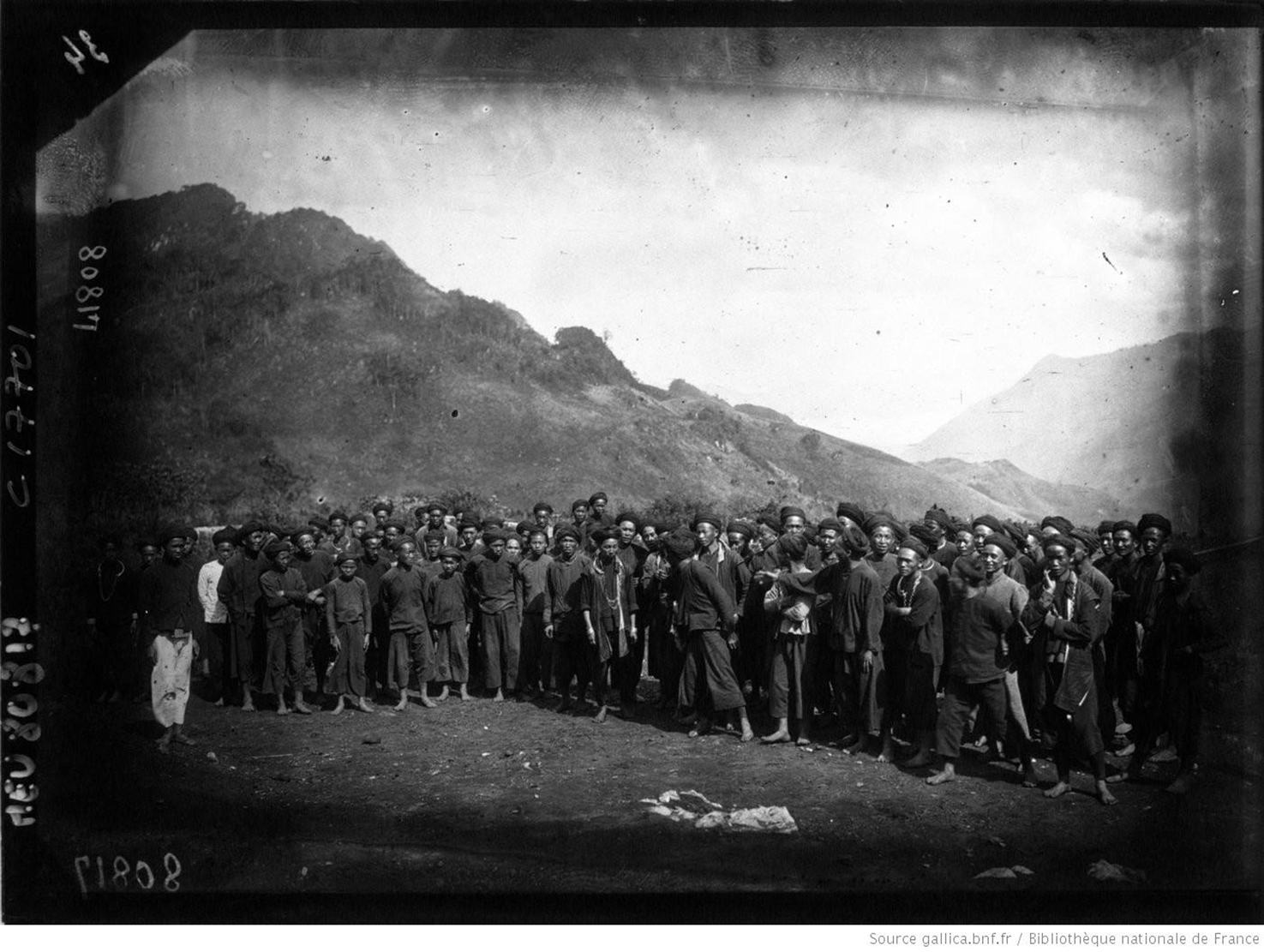
The first picture (Picture 1) displays a group of about 65 men standing in a half circle facing the camera. Most of the men are standing at rest, but many also seem to be in an expectant state though the object of this expectancy is not clear.
Picture 1, MEU 80817

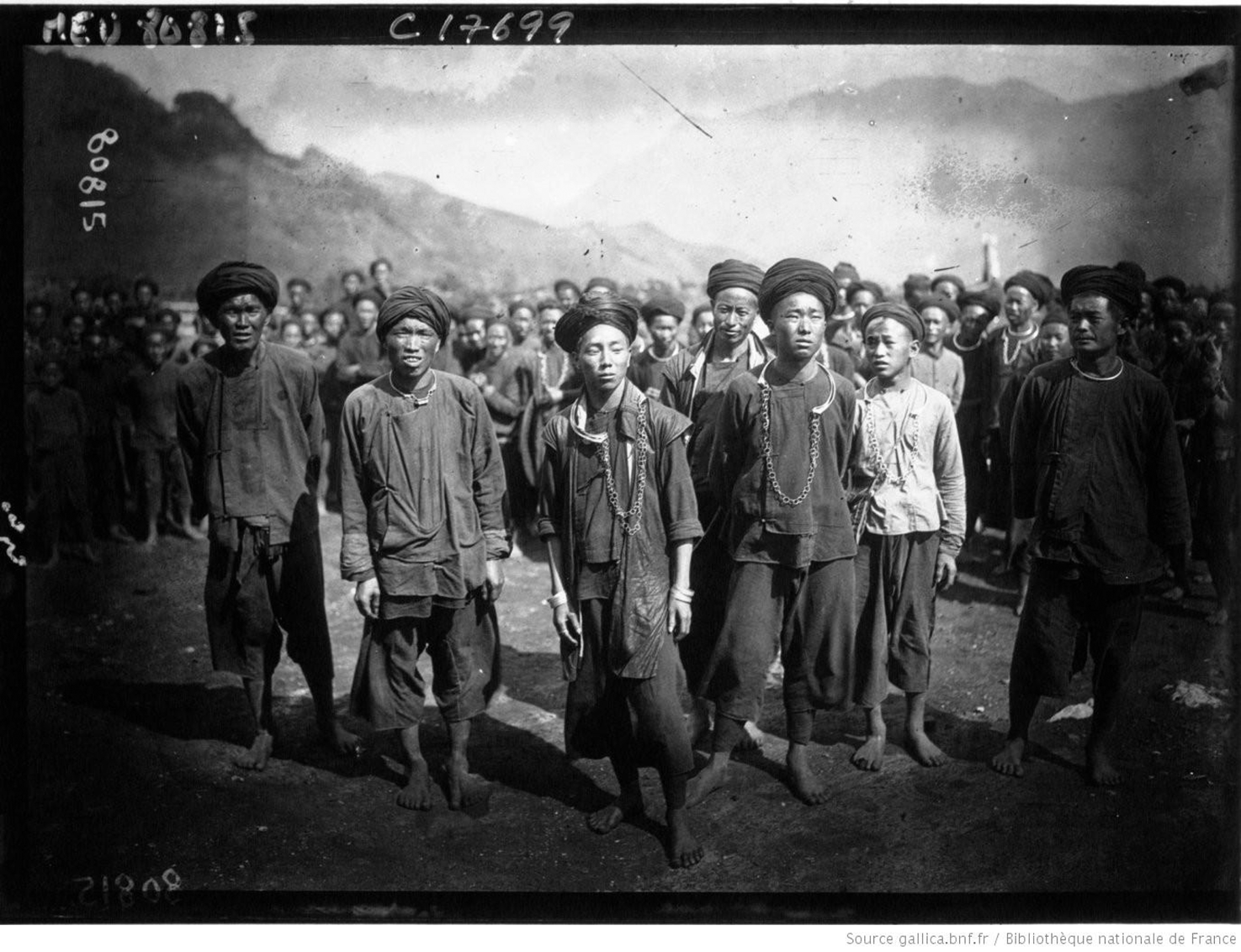
The next picture (Picture 2) shows the same group against the same panorama, but in the interval seven men have stepped forward and struck a group pose about three metres from the camera. Two men stare at the camera, another two look into the distance together—or avoid the camera—while the remaining three watch with interest the central figure in this composition, is a young man standing ahead of the group of seven and gazing in the distance. In the background, the out-of-focus remaining men have their eyes fixed on this vanguard.
Picture 2, MEU 80815

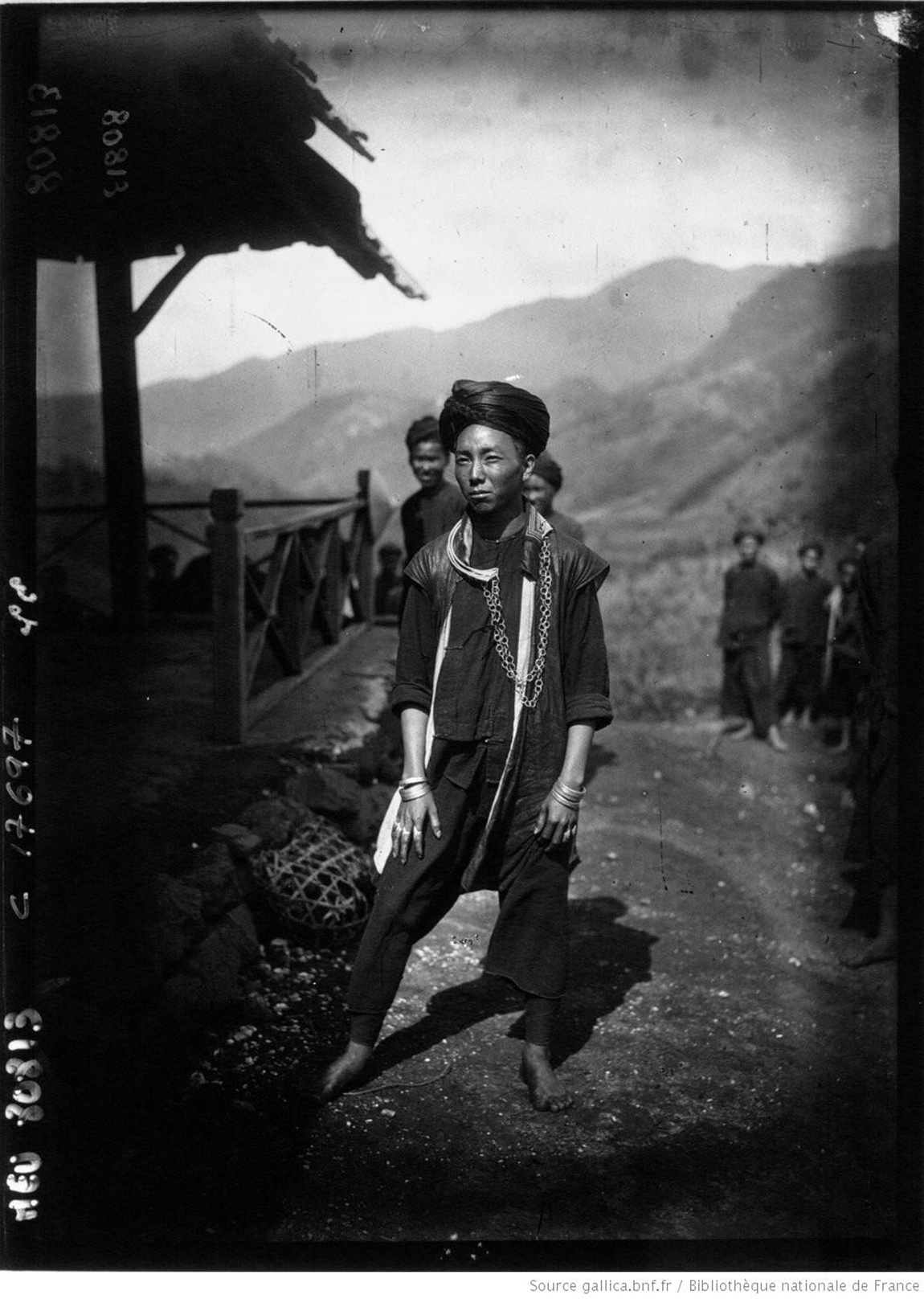
In the third, most explicit and personal photograph (Picture 3), this time from a different angle, the same central man now stands alone. He is striking a pose and may be staring at the camera. The position of his right leg suggests that he might be about to step onto the porch of a building, of which only parts have become visible. Re-examining the two previous pictures, we can now see that this man has been the focal point of the whole sequence, standing centrally in all three.
Picture 3, MEU 80813

The subtitles for these pictures on Gallica are less concerned with details.Footnote 10 They are: (1) ‘A group of Meo conferring’ (groupe de méos discutant une affaire); (2) ‘Meo chiefs’ (chefs méos)’; (3) ‘Meo grand chief’ (grand chef méo), the higher status of the latter emphasised by his being singled out and the vertical frame.
In other words, this choreography frozen in three frames, and the short text escorting it, suggest a delegation of men presenting a member of their group. Only, the emissary seems quite young, he does not stand out with his physical size or authoritative posture, and he is not wearing anything particularly distinctive compared to a number of his peers in Pictures 1 and 2. His arms hang by his sides, showing that he does not carry any weapon, tool, or document. Yet, somehow, this young man's presence is arresting. There is an undeniable dignity to his stance, a quiet distinctiveness that strikes the viewer.
What justifies bringing up and questioning these old photographs is the unescapable question they will trigger in the minds of specialists and many Hmong viewers, in particular those belonging to the latter's out-of-Asia diaspora: might this compelling young man be the prophet and rebel leader Pa Chay Vue? Indeed, might this possibly be the only confirmed visual record left of a man larger than life, who famously led his people in a four-year open anti-colonial rebellion, and whose tragic destiny has become the subject of intense pride through generations?
With so little evidence to work with, careful analytical deconstruction and corroboration is required to progress towards credible understandings of this storyline and to come to terms with the implications.
Who was Pa Chay Vue?
Painting a full picture of the life and deeds of Pa Chay Vue and of the historical importance of his rebellion as well as situating that material within the historical context of Hmong-Vietnamese-French relations, is far beyond the scope of this article. Other social scientists have done this and can profitably be referenced in a short digest. Reliable sources documenting the life and deeds of Pa Chay VueFootnote 11 are scarce. Scholars Jean Mottin,Footnote 12 Isabelle Alleton,Footnote 13 Geoffrey Gunn,Footnote 14 Christian CulasFootnote 15 and Mai Na LeeFootnote 16 have rounded up most of the rare verifiable written records left of the man in colonial archives, some adding elements of oral history, and they have written about his life with academic rigour. Some have focused directly on the rebellion named after him, but most have only broached it in order to make other points.
Blending these sources, one understands that Pa Chay Vue was a Hmong leader in colonial French Indochina. The Bachay (Batchai, Pachay, etc.) Uprising—also known derogatively as the Mad Man's Rebellion (from the French Révolte du fou)—which he was a leader of from 1918 until his death in 1921, was a prominent Hmong armed revolt against both Thái feudal and French colonial powers. Many Hmong in Tonkin resented the excessive level of taxation extorted by the Thái lords, who were authorised to continue this ancient abuse by a complacent French administration that imposed its own taxation on top of this. The Bachay Uprising is generally said to have started in Tonkin in 1918, fanned by a similar uprising of Hmong across the border in southwest China and earlier, next door in the Sông Lô (Clear River) catchment of northern Tonkin.Footnote 17
The initial unrest quickly spread among Hmong of northwest Tonkin and penetrated northern Laos, where much of the decisive fighting took place. Seeing that the revolt was getting out of hand, with the rebels lining up victories against Thái hamlets and even colonial posts, the French authorities directed an important party of troops to quosh it. In the meantime, Pa Chay Vue had proclaimed himself a religious leader of the Hmong, claiming to be invulnerable and raising the stakes to a higher level by playing a powerful and highly sensitive card among his country people: his advent as a new messiah.Footnote 18 Despite favouring a kinship-based social organisation over a hierarchical one, Hmong society was prone to accept the episodic emergence of Hmong messianic leaders sent to free them from oppression and unjust treatment. The rebellion ultimately came to a violent end in northern Laos in 1922 with the slaughter of most rebels, just a few months after Pa Chay Vue had himself been hunted down and killed.
While events from the last three years of his life can be traced through colonial reports, reliable information does not seem to exist regarding the date and place of birth of Pa Chay Vue nor how he spent his life before 1918.Footnote 19 He appears on the colonial radar as an adult. Unsurprisingly, French archives paint a dark picture of him and his followers as dangerous and irrational rebels against a just colonial cause. The leader and his army had to be stopped by all means, including torture and murder. Ultimately, the colonial administration, equipped with a trained military arm, prevailed over the improvised Hmong guerrillas.
Pa Chay Vue has come to matter greatly in discourses of self and identity among the Hmong diaspora in the West.Footnote 20 Numerous websites, blogs, Facebook pages and Wikipedia entries refer to him as an unparalleled folk hero, embodying the pride and fierceness of the Hmong when facing injustice and oppression. His tragic and somewhat mysterious life remains a source of lively debate—for instance, not unlike the resurgence of interest among US African American scholars for the 1811 German Coast slave uprising in Louisiana, although comparing the two events is beyond the scope of this article.Footnote 21
Dating the event
The ‘Révolte des Méos’ series of seven photographs is dated to between January and October 1920. This is what the BNF logged in the 1960s, four decades after the event. Qualified library practice suggests that this dating on Gallica, explicitly labelled ‘date d’édition’ (the date the picture was recorded), simply reproduced the original cataloguing by Agence Meurisse, only altered internally (at a date unknown) to pinpoint Laos instead of China. We can trust that Louis Meurisse and his personnel were able to date relatively accurately the pictures they were including in their own catalogue; thus, it is certain that they already had the pictures in hand by 26 September 1920, making this the latest possible date for the event. But there is currently no certitude as to how much earlier it could have taken place.
These ‘bookend’ months of January and October 1920, set by Meurisse for sorting purposes, likely point to the dates assigned to the first and last items in the lot of 5,500 pictures with which this set of seven was logged. That cannot be considered evidence of the date when the event took place. Meurisse did their best to remain accurate but precision dating might not have been their top priority in this case. To their credit, as a press agency whose reputation relied upon such details as exact identification of photographs, guessing was out of the question. However, if the precise date of the event itself was unknown, lost, or considered of little potential for a profitable sale to a public outlet, they would then temporarily assign the pictures the next best tag: the date when they were recorded by their personnel. If, following that, the pictures were never to appear in the media, as seems to be the case here, such images would soon be considered obsolete, and no effort to refine or correct the initial dating would ever have needed to take place.
Can we get nearer to the truth by exploring the remaining contents of the Meurisse lot? An investigation on Gallica reveals that this cache of 5,500 pictures almost exclusively contains photographs from the immediate post-First World War period in Europe, with events and people in France figuring prominently. This suggests that the mass assignment of names and dates by Meurisse had most probably occurred in their French office, not in Indochina where the agency did not have an office. The administrative logging and dating of the files, thus, has to be at least several months older than the events that they depict, taking into account how long it would have taken for the plates to travel by horse, train and ship from a remote location in the hinterland of Indochina to the Meurisse bureau in Paris. To this must be added the chaos of post-war in France delaying further the moment the plates were put into the hands of a clerk in charge of labelling and dating them. This person being more than likely a clerk not entirely familiar with the time it took to sail from Indochina to Paris, and assuming the plates had been processed and put on a ship promptly, it is safe to compute that the event is very unlikely to have taken place after the summer of 1919.
Beyond that approximation, the dating evidence from the BNF files is silent. No visual element in the seven pictures of the ‘Révolte des Méos’ set provides legible clues as to a more exact date for the event. Fortunately, this is not the end of the road.
Placing the event
In contrast, establishing the location of the event proves surprisingly straightforward. Since this information is crucial to correctly analysing the affair, here is the explanation of how I came to be able to identify it.
Location according to the ethnicity of the subjects
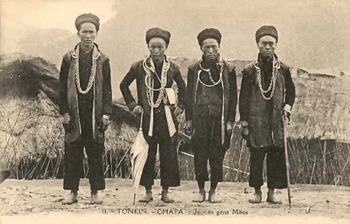
Except for a single man to the left of Picture 1 standing apart from the group and dressed as a house servant (in white trousers and, it seems, sandals), the way in which all the men in the pictures are dressed is characteristic of upland minority ethnicities, particularly Hmong, which is corroborated by the BNF label ‘Hmong (people of Asia)’. French military archivesFootnote 22 and discussions held with local elders over three decades (see below) confirm that most men in the pictures, dressed as they are, can only belong to one precise spot, that is, Chapa in northern Vietnam, a French colonial hill station (Figure 4) close to the Chinese border, and its immediate vicinity of about ten villages and hamlets.
A contemporary control group of Hmong Leng: ‘TONKIN – CHAPA – Young Méo men’. Postcard, circa 1925, source unknown.

The Chapa hill station was founded in the early years of the twentieth century and still exists today, its name now spelled Sa Pa. The specific outfit worn by the men standing centre and right as well as in the back rows on the left in the first two frames, the indigo dyed hemp shirts, trousers, and headgear, but particularly the wax-shined mid-thigh length hemp sleeveless jacket with its non-dyed lining and embroidered collar, has been a signature dress of Hmong Leng men (Hmoob Leeg) in Sa Pa for as far back as records indicate; it still is today. Crucially, across all the Hmong found in Asia, this jacket is exclusive to the group dwelling in that valley. Also consistent with this local group are the thick silver necklaces with their silver chains, the bracelets and the rings, all crafted in the local fashion of Hmong silversmiths. Thus, the dress code of most of the subjects in these three frames—as well as in the remaining four ones of the set of seven—fits effortlessly into that of a Hmong sub-group dwelling exclusively in one particular district of northern Vietnam's Lào Cai province, narrowing down the search dramatically.
In October-November 2019, I showed and discussed these pictures with a Hmong Leng manFootnote 23 born in 1922 in Ta Phin commune in Sa Pa's vicinity. He immediately confirmed the precise ethnicity of the subjects and even claimed to recognise personally two Hmong in the group of seven in Picture 2, who he said were not from Ta Phin, but whom he had seen in Chapa town on market days. He did not know their names. Other elderly Hmong informants also noted that the five or six men standing on the front row on the left in Picture 1 were of the Giáy ethnicity, also found in Sa Pa district, though none of these were part of the subgroup stepping forward in Picture 2, all seven identified as Hmong Leng by all informants. There are, thus, at least two distinct ethnicities present at the event, which could rule out a purely family or ethnically specific grievance; however, the leadership of the event firmly belongs to Hmong individuals.
Location according to geography
Then, there is landscape corroboration. Despite the deceptively non-descript nature of the pictures’ surroundings, an eye familiar with the Sa Pa region can easily identify the skyline in the backdrop. (See Appendix A and B for a comparative demonstration using period and recent photographs.)
The colonial town of Chapa sat at 1,500 metres on a saddle above the Mường Hoa Valley unfolding towards the southeast, at the junction of the Ngòi Ðuòi Valley draining northeast. The ridge in the backdrop of Pictures 1 and 2 shows that the camera was pointing to the southeast. The long shadows on the ground, produced by the sun shining from the west, are revealing a mid-afternoon event.
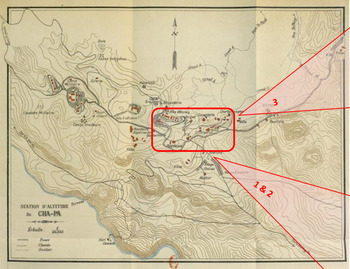
For the third image, the photographer simply rotated the camera about 60 degrees towards the eastern mountain scape, the shadows cast by the men's bodies confirm the move. Picture 3 also brings into view elements of a colonial building with a cement-covered dirt foundation, a wooden structure, a wood-shingled roof, and a characteristically French colonial wooden railing. There are not enough visible details to draw conclusions as to the exact nature of this building, the construction might just as well be the veranda of a house or simply a kiosk. But it is definitely colonial. In 1918 in Chapa, there were only a handful of colonial structures standing at the point where the two ridge views meet unobstructed. To help pinpoint the site and possibly learn more about the context of the event, I have transposed the camera angles on a topographical map of Chapa published in 1924 indicating all of the existing buildings of the bourgeoning hill station (Figure 5).Footnote 24 In the red box stand the likely candidates for this building, given the combination of the views, the angles, the absence of obstructing element, and the presence of a colonial structure.
Direction of the photograph angles transposed onto an early 1920s map of Chapa.

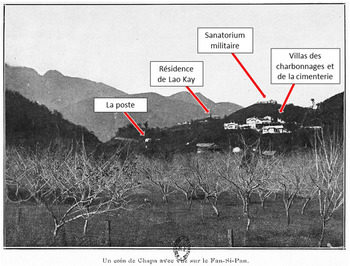
Accordingly, it is possible to narrow down the short list of sites for the event to four (Figure 6). First and less likely is the Poste & Télégraphe building (P.T. on the map), which, with incorrectly aligned ridges, is located too low for our purpose. Then there are the two adjacent clusters of private villas belonging to two private corporations, the Charbonnages du Tonkin (Tonkin Collieries) where the main building of the current Victoria Hotel is located and, a little higher, the Cimenterie de Haïphong (Haiphong Cement Works) now occupied by the pool of the said hotel. All these villas were built in 1918 on a hill with an unimpeded 180-degree view that includes the ridges on the photographs. However, the angle of the view on the mountain ranges from there is slightly off, a little too low and too far to the east to match perfectly the landscape in Pictures 1 and 2.
The four possible locations of the event depicted in an early 1920s picture of Chapa taken from the East (Hotel Jourlin's orchard).
Source: Gallica, Livret-guide de Chapa, 1924.

The third candidate is the flattened hilltop on which sat the military sanatorium. Built in 1913 and enlarged in 1919, this is where a Sa Pa city water reservoir is now embedded next to the Silk Path Grand Resort opened in 2018. The sanatorium stood on a hill higher than the Cimenterie villas with a commanding 300-degree view on both valleys—hence the military's interest in occupying it. It had neither bushes nor trees to block the view, and as opposed to the villas that were only private holidaying residences, the sanatorium was a prime site of colonial power in Chapa. But here again, when tested against the three pictures of the event, angles appear to be slightly off, this time the location being too high up.
Which leads to the fourth site, the grounds of the provincial Résidence. Built in 1912,Footnote 25 this modest complex hosted the highest administrator in the Province, the Résident de France à Lao Kay, when he could leave his headquarters in Lào Cai city and take to the fresh air of Chapa during the hot season.Footnote 26 This time, all clues in the three pictures appear to be consistent with this location: it has the correct, unhindered view over the mountains and, as demonstrated in pictures taken in 2019 on the exact spot where the building stood, shows the precise overlap of mountain ridges. What is more, the Résidence de Lao Kay would be a logical place for locals to meet the colonial administration, much more so than a post office, villas owned by private corporations or a sanatorium.
With such evidence, there is thus no doubt that the Chapa hill station is the location where these three pictures were taken, and the remaining four photographs in the Meurisse set, although not related to the event in a decipherable way, are consistent with this. Also, even before considering the colonial documentary evidence to be explored next, the Résidence de Lao Kay appears to be the most likely place to pinpoint the event.
Interpreting the event
In Picture 1, the assembly of men shows no sign of being a random meeting of individuals who just happened to cross paths. The signs of intention are too numerous. In a remote military outpost of colonial Tonkin at the time, such a large group of indigenous men advancing together in full daylight towards prime sites of colonial authority would have been highly unusual and an immediate cause for alarm. Swift action from the authorities would have occurred before these three pictures could even be taken. The fact that such a reaction did not seem to happen in any visible way strongly suggests that the gathering was not a surprise event.
All the men are barefoot and appear to be dressed for a reasonably mild season, indicating that it was not winter in the Chapa highlands, when temperatures can plummet to freezing point. There are no wet, muddy or rolled-up trouser legs visible, meaning that these men were not coming straight from their fields. None of them appears to be in tattered clothes either, which would be an ordinary sight for many Hmong farmers at the time unless the event was taking place on a market day, when attendees tend to dress more tidily. Otherwise, on a regular day, this degree of uniformity of attire for such a large group would be uncommon, pointing to an equally uncommon event.
These men carried no visible weapons, not even the ubiquitous foot-long utility knives customarily worn at the waist over clothes. No tools are held, and only a few shoulder bags for food, money, tobacco and other daily goods are discernible. These odd omissions by so many at once point to a conscious decision, plausibly one to remove all offensive signs or project a message of non-belligerent assembly. Pack animals, goods, baskets and hunting muskets also seem to have been put away for the duration—or confiscated or dropped outside of the frame.
Colonial records show that at any periodic market in these highlands, women and children also routinely attended.Footnote 27 Yet, none is seen in the pictures, though a few appear casually in the four remaining ones in the set of seven. This unlikely absence also had to be intentional, suggesting that the business these men had there was considered gender-specific and/or could pose a threat to the safety of women and children.
The attitude of the attendees, their similarity in posture standing shoulder to shoulder facing the camera, all provide worthwhile information underlining a singular situation. Their body language is expectant though fairly relaxed, a few are smiling—though this could also be out of disquiet, embarrassment or shyness. Arms are held at the sides, crossed, or clasped at the back, universal signals of benign intention. Some are looking straight at the camera, others at elements outside the frame, and a few are talking to each other. But more strikingly, in Picture 1, over twenty of the men are directing their gaze to the central figures in the front row.
In that row, two men—with their right hands held up—appear to be coaxing the central figure into action while a third one further to the right is caught in the course of stepping forward, his figure blurred. The object of their attention holds his gaze down as if shy or modest, which is somewhat unexpected given his confident demeanour in the next two frames. Is he being pushed forward against his will? Is he simply hesitant to move forward? Is he regrouping before an ordeal?
Set against the same backdrop, indicating that the camera had not moved significantly though its scope and focus have changed, Picture 2 underlines the fact that the seven men having stepped forward are bound to have something in common to justify this joint deed. We know from local informants today that they are all Hmong Leng. They also appear to be recognised as legitimate by the rest of their peers in the frame, who do not show signs of objecting to their being singled out or wanting to join this vanguard. This frontline remains benign, its willingness to pose for the camera is manifest. There is a hint of worry or discomfort in the gaze of the two men on the left while they stare at the camera; the two central figures share a similar body language and might be blood relatives judging by their looks; the last three men, at the rear on the right, appear both eager and concerned, one of them a young adult is in a shirt of different cut and colour which, I was told by Hmong informants today, does not mean anything particular.
Picture 3 carries narrative and emphasis one step further by singling out an individual Hmong man and giving him primacy. This man took a few more steps forward and seems to acknowledge his selection by striking a decisive pose for the camera while straightening his gaze. The change in angle, which results in framing a different segment of the mountain skyline, is due to the initial position of the camera tripod, now required to pivot towards the northeast to meet the incoming man. This did not happen randomly as the competence of the photographer is perceptible in the placing of his subject in the best possible light, just at the right distance for a full body portrait. The other significant element is the appearance of parts of the colonial building. Had this event been merely about documenting exotic men for scientific purpose or for the tourist market for instance, a non-descript section of a common colonial building would have likely been considered an interference to producing the best ethnographic picture. Here, we can assume that this precise building is included for a reason and has something to do with the story, and that putting the primary actor next to it with one leg forward is meant to suggest him moving towards it.
Then nothing. There are no follow-up pictures of this event in the Meurisse collection and we are left to ponder on why there are not more pictures to record this developing story. Had the photographer ended his work on his own volition? Was he stopped? Was the event simply over? Did it turn out to be disappointing enough to take away the photographer's eagerness? It is hard to tell. Did some higher authority consider the photographer's task complete by this stage? And, at that, what actually was the photographer's task?
What the photography process reveals
The identity of the photographer is unknown. It seems that Agence Meurisse did not pass on this information or at least, it never reached the BNF. The Agency's records regarding the identity of the field agents producing photographs for them in Indochina are, in all probability, lost too. It may prove challenging to follow up on this lead as our small set of seven pictures from Asia was a rarity in a press catalogue otherwise resolutely focused on European topics, locations, and celebrities.Footnote 28
The next question then is: what was a press photographer doing in that lost corner of the colony at that moment, as opposed, for instance, to a military photographer ordered to record an event or a colonist on holiday chancing a few snapshots? We have to assume that the man (in those times, it was very unlikely to have been a woman) was a professional, based on the high quality of the pictures revealing an equally high skillset that included proficiency in photographic glass plates.Footnote 29 Several professional photographers would eventually pick Chapa as a profitable site for the production of postcards—Dieulefils and Manh-Hoach, for instance. But their public production suggests that they were not regularly active in Chapa before the 1920s. Moreover, they were rarely inclined to focus on events with low profitability potential as this one, which did not involve prominent colonial individuals or grand architecture. Then again, this proviso is not enough to completely rule anyone out and the Meurisse catalogues, if they still exist, remain to be investigated.
Professional photography at the turn of the 1920s required proper formation with a well-defined set of abilities and principles.Footnote 30 The preparation behind this photo shoot is tangible and cannot be an accident.Footnote 31 The rule of thirds in the composition is rigorously respected, as well as the depth of field which is accentuated by a balanced distribution of the subjects in the photos.Footnote 32 There is a carefully dramatic progression from the general to the particular, with a professional touch regarding the gradually decreasing distance between the camera and the subjects, the participants’ apparent willingness to stay put or even strike a pose, the scenic background, and the absence of undesirable elements such as wires, rubbish, tree shadows, a passer-by, a stray hen or dog. One could even note that in Picture 3, graphically, the roof shingles on the colonial building are pointing to the central figure, which seems an intentional aesthetic integration effect, or at least one transmitted via the photograph. In short, in every picture, the composition, framing and focus, are first-rate.
Composition is symptomatic of a purpose, although it is unclear in this case just what and whose purpose it is. Let us acknowledge from the start that it would have been truly odd in those days if secluded Hmong farmers had commissioned a photographer to record an event on their behalf, so this prospect has to be excluded. We must also leave aside the possibility that the intention was merely to capture exotic images of ‘tribals’, these three pictures being devoid of the usual performance typical of colonial exoticismFootnote 33—although one of the remaining four pictures in the set of seven does drift towards that type.
If we accept that this photo shoot did not happen haphazardly, this leaves us with only three credible explanations: the colonial authorities commissioned it, the photographer acted (at least in part) out of his own volition, or a third party had called for it. Had it been the colonial authorities commissioning the photographer, a motive would have been needed, like security or keeping a record of the participants, and the pictures should have been of a simple and factual style suitable for police record, a style not easily compatible with what we have here. Conversely, had the pictures been commissioned by colonial authorities for public relation purposes, to put the administration in a good light when dealing with ‘natives’, the photographs would have required the careful insertion of colonial agents posing self-importantly next to the said ‘natives’. Quite the opposite: there is a complete absence of Europeans in these frames, and this cannot be insignificant.
Instead, all that we have suggests that the pictures exist to tell a story in which colonial agency is invisible—save for fleeting elements of architecture and the deed of the photographer himself. The compounding fact that the pictures’ glass plates ended up in the catalogue of the Meurisse Press Agency instead of the official colonial archives or some private collection (so far as is known) points to the photographer not being part of the colonial administration nor commissioned or paid by it. His intention might have been solely his own as a photojournalist, to document an event for public release, perhaps even to stage it lightly with the collaboration of his subjects, to whom he could have explained the potential benefit of their actions getting in the public eye—press photographers have been known to foster more convoluted plots. In this case, did the photographer act alone? If this event involved the colonial administration and if security was on the agenda, a lone press photographer fishing for a story would simply not have been granted permission to operate in a military post unless someone in authority vetted for him, plausibly, if the event was held at short notice and deemed to need recording, with no one else at hand with the necessary equipment and competence. And if a third party had stepped up, there is nothing obvious in the pictures to suggest who that party might have been: a press patron, a benefactor, a prominent citizen?
Directing a live scene is one thing, getting untrained subjects to play along with the plot is quite another. Making them act is impossible.Footnote 34 The genuine expectancy, even deference, seen in the gaze and behaviour of many in the group towards the man at the focal point of the event cannot have been simulated. Nor the dignity radiating from this central figure. These were real emotions taking place independently of the photographer's actions, pointing to a genuine event caught as it unfolded.
Assessing the evidence
This is not Pa Chay Vue
This is where textual evidence helps clear some of the fog. By 1920, French military records convincingly show that Pa Chay Vue was elsewhere as colonial reports place him fighting on the Laos-Vietnam border.Footnote 35 The official dating of the pictures between January and October 1920, if taken literally, therefore points to this man not being the Hmong leader. Still, the visual evidence underscores that whoever this man was, his ethnic identity was unquestionably that of a Hmong Leng from the Chapa region, with the BNF caption rating him as “a Meo grand chief”.
If this is not Pa Chay Vue, what would the reason be for this event to be taking place in Chapa and for it to deserve a visual record? What could be the connection(s) between these 65 or so men, and what prompted them into action? In customary Hmong culture, to conduct a joint public gathering, the binding force between participants would have either to be kinship ties (lineage or clan), a shared residence, a common grievance, or a combination of these. But as is also conceivable with Hmong messianic movements,Footnote 36 the required binding agent could also be ideological, even across ethnicity, namely faith in a holy leader able to trump blood and proximity, cheat death, and right the wrongs forced on ‘his people’.Footnote 37 The ornaments worn by the central figure, the deferential attitude of most individuals attending the event, and the photographer's interest in him, point to this being an important man taking part in a momentous event witnessed by his peers.
This central figure may be another Hmong prophet, although there is no known record of another Hmong messianic leader active in Tonkin in 1918–20, the last one, Mi Chang Xiong, having been neutralised in 1912.Footnote 38 Might this man then simply be a close kin or ally to Pa Chay Vue acting on his behalf? Again, no evidence has been found to substantiate such hypothesis.
It should also be clarified that some oral tradition among the Hmong diaspora originating from Laos seems to propose that Pa Chay Vue was from Laos, not Tonkin, and of the White Hmong subgroup, not a Hmong Leng as shown here, the two having quite distinct dress codes. But historical evidence is lacking to support this claim. On the contrary, in a section titled ‘The mystery of Pa Chay's Origin’, LeeFootnote 39 proposes, based on recent interviews with diasporic Hmong in St. Paul, Minnesota, that a misunderstanding stems from confusing two individuals named ‘Pa Chay’, both of whom were active in the 1918–21 rebellion. One was our man from the Vue clan originating from Tonkin and the overall leader of the rebellion; the other, more minor figure, was a White Hmong from the Xiong clan originating from Xiang Khouang province in colonial Laos. From fragments of oral tradition, it seems that the latter is deemed to be the main prophet by his descendants and followers living in the United States, this belief generating a fair amount of confusion in the information on the rebellion circulating on the web.
This is Pa Chay Vue
If indeed this is Pa Chay Vue, and for the same reasons just mentioned, dating the pictures to 1920 would not make better sense. As early as November 1918, Pa Chay Vue was already outlawed and actively hunted by the French colonial police and military. If for some reason the rebel leader had turned up in 1920 in the military post of Chapa, publicly leading a large group of men and about to be photographed, he would have been detained instantly. Consequently, for these three pictures to be a record of him moving freely, the date would have to be pushed back to before he had started to appear on the colonial radar in late 1918.
AlletonFootnote 40 quotes a 1922 report by General Puypéroux:
A young Hmong man, originating from the vicinity of Dien-Bien-Phu, brought to the French authorities by Hmong from Chapa (near Lao-Kay) because he was spreading dangerous propaganda, and left to walk free by the Lao-Kay administration, seized this opportunity to boast about his miraculous impunity.
In a similar vein, Hmong historian Mai Na Lee,Footnote 41 summarising French Colonel Angeli's military report of 15 May 1920,Footnote 42 states that by October 1918, “The Hmong of Sapa arrested him [Pa Chay Vue] and brought him to the French in Lao Cai, but he was set free after an interrogation”. Should the timelines in these two accounts overlay, these two sources (though it is also possible, despite a difference in the place of origin stated for the Hmong leader, that General Puypéroux in 1922 had merely found his inspiration in Colonel Angeli's 1920 report) strongly suggest that the three pictures could be showing Pa Chay Vue on his way to being handed over by a committee of his peers to the provincial authorities in Chapa. This would instantly stand out as the likely explanation for our photographic event and solidly buttress the hypothesis that this is indeed Pa Chay Vue.
Yet, intriguingly, in these frames, the central figure is not in a stance recognisable as that of a prisoner and many questions spring to mind. For instance, why would so many men be needed to take an unbound rebel leader to the colonial authorities and, in the process, be themselves entirely unarmed? Why should such a man be given a position of status in the three frames? Why would nobody at least put a hand on him in a display of constraint? Why had the colonial wardens not entered the frame to assume a victorious stance beside their captive? Why would he even agree to cooperate and be photographed—three times? And astonishingly, why would he still be wearing a particularly elaborate headgear and valuable silver jewellery—two necklaces with their chains, six bracelets, and six rings, a not very common show in Hmong society, making him the individual displaying the most wealth among the whole assembly. Common sense suggests that he should have left this family treasure with his kin to avoid risking it being snatched by his captors. Instead, he appears in his regalia, free, calm, even defiant, deserving of the caption ‘a Meo grand chief’—not ‘a Meo captive’.
Then again, it might be that this man is in the process of handing himself over voluntarily to the colonial authorities. Some among his peers, Hmong elders, or a respected figure from the outside, could have convinced him to risk foregoing his freedom, for real or as part of a strategic plan. Perhaps is he already convinced—or already knows—that he will not be detained? All this could explain his calm and confident demeanour, the absence of ties, and the reverential gazes from many of his peers. But, currently, we are not in a position to either confirm or rule out this eventuality.
A handover or a last chance meeting?
And there is additional evidence opening yet new directions in interpreting this event. This time, it comes in the shape of a reliable account by a contemporaneous source doubling as a close protagonist, which instantly places this largely speculative discussion more solidly within the boundaries of a verifiable investigation. French Catholic missionary François-Marie Savina had been stationed in Tonkin since 1901, and by 1918, was a seasoned missionary in his early forties. He had more than a few years of contact with Hmong in several locations of Upper Tonkin, becoming one of the earliest scholars of the group—whom he called Méo or Miao—while speaking their language fluently.Footnote 43 Mai Na Lee writes: “Fluent in Hmong, Savina would have had easy access to Hmong perspectives. [He was] a meticulous person with vested interest in the Hmong, as evidenced by his pioneer publications”.Footnote 44
Savina formally stated that he was in the Chapa area in the summer of 1918. In a short account of the Pa Chay Vue rebellion appended to his 1924 Histoire des Miao,Footnote 45 Savina stated that the insurrection had started in Tonkin in July 1918. An eyewitness, and thus a primary source, he wrote that he had been warned by Hmong acquaintances about brewing unrest as early as 1914 during a visit to Chapa, and then yearly through his Hmong network spanning several northern provinces and Military Territories. The priest heard again about unrest in Chapa in April 1918. With the high level of credibility attached to him as an expert and witness, there is thus conclusive evidence that the Pa Chay Vue rebellion indeed started in the Chapa vicinity.
About to take an even more central part in the re-counting of the rebellion,Footnote 46 Savina declared that he returned to Chapa in early August 1918 to meet with some Hmong who had written to him because they did not support the insurgency. He quickly realised that the situation was serious, and so decided to go in person warn the Résident de France in Lao Kay city, the highest colonial authority in the province. Savina wrote: “The latter [Résident de France à Lao Kay] asked me to return to Chapa with him, then sent me to see the rebels who had gathered in a neighbouring village, about sixty of them”.Footnote 47 The missionary states that he thus met with Pa Chay and his followers in that nearby village, that he was treated well, and that they told him they were assembled for several days to select “a king”. Savina does not name the village but coexistent sources suggest that it was Ta Phin.Footnote 48 In a confidential report to the military written two years later, Savina explained:
A sorcerer [shaman] from the vicinity of Chapa, one whom I know perfectly, had just been named viceroy of all Meo in Tonkin, by the ‘King of the Méo rebels’ in Yunnan. This sorcerer [Pa Chay] openly preached rebellion, people came to see him from all sides, and his emissaries roamed the region to get the population to join him.Footnote 49
Culas and Alleton do not say more on what Savina wrote about this encounter with the rebel leader or on its immediate repercussion. Still, we can now plausibly envisage that the Résident, when sending Savina to meet the rebels, also asked him to test the ground to see if organising a non-coercive meeting in a mutually agreeable location could be a possibility. In his mind this must have meant in the Chapa military post where he, the highest colonial authority on location, would feel safe while emphasising his power and authority. Such a scenario would be fit either for the Hmong leader to discuss options, to be handed over, or to surrender as suggested by Puypéroux and Lee. If this were to be correct, we know from Savina's timeline that the meeting would have had to be held in August or early in September of 1918. Either way, Pa Chay Vue played his cards well: he walked out a free man and then, started military action within a month.
With this explanation in mind, the party sponsoring the photographer could have been the Resident himself wanting a record of the compliance/handover/surrender of the rebel chief in order to broadcast his success, only to abandon this public relations stunt when things turned sour a few weeks later. Or it could have been Savina commissioning it, with the photographer hopeful of taking advantage of the explosive situation, while, for the priest, this recording by an outside witness might have served as a guardrail to prevent the colonial powers from tricking the leader into a trap and stamping the rebellion into the ground.Footnote 50 If they were rebels in the making, the party of followers themselves would have been able to see this point. And even if they were there instead to hand the man over to the colonial authorities as a show of their good will, both options plausibly shed light on their agreement to the requirements of the photographing process.
Should further research prove either of these options to be correct, this suggests that the encounter would have taken place with the Résident and Pa Chay Vue meeting each other in the grounds of the former's official Chapa residence, with Savina as interpreter, witness and likely guarantor. Once Pa Chay Vue was inside the building, the group of 65 men may have simply dispersed if they were handing him over or continued standing there out of curiosity. If, instead, they were nascent rebels, they may have consented to wait outside as an unarmed but considerable party seeking the safe return of their champion, themselves no doubt aware of the overwhelming presence of colonial troops at the hill station. This, in turn, would explain the prudent removal of overtly threatening signs as well as the absence of women and children. Savina knew both Pa Chay Vue and the Résident personally and he was the local representative of a major colonial institution, the Catholic Church.Footnote 51 He could have vetted for the rebel's safety at the meeting while at the same time persuading the Résident that a show of force to placate the group of 65 unarmed men—if they were sympathisers—could be a messy affair and ultimately prove counterproductive, particularly when performed in the relatively public space of a hill station. Negotiation to defuse the crisis while, hopefully, formally committing the leader to keep peace was undoubtedly the wiser option and the Résident grabbed it, well aware that Chapa stood in a district where Hmong formed the overwhelming majority and were the main growers of the lucrative opium poppy vital to balance the colony's budget. There was simply too much at stake to act rashly.Footnote 52
Finally, one last source confirms that Pa Chay Vue was allowed to walk free after an agreement of keeping peace had been reached. General Leblois mentions in his May 1919 report (italics added): “In mid-November 1918 […] breaking their promise of immediate submission, the rebellious Méo attacked a convoy…”.Footnote 53 As Chief of Staff for the whole of Indochina, Leblois provides here an authoritative clue to a peace agreement having been reached with the Hmong/Méo rebel(s) prior to mid-November 1918, this agreement having clearly been formally transmitted up the hierarchy eventually to reach his office in Hanoi. As such, it should have been archived in the Governor General's (GGI) collection. But was it?
A story of cover-up?
Weighing up the pros and cons, a cluster of converging evidence points towards this photographic event depicting the messianic leader Pa Chay Vue.Footnote 54 The location of the event pictured, the Chapa hill station, close to which several sources and scholars have stated the leader was based, is beyond doubt. The exact spot in Chapa where the event took place is well defined as a seat of colonial authority. We know that the Résident de France à Lao Kay was on location actively working on Pa Chay Vue's case, and that his official residence in Chapa coincides with the location that I have pinpointed for the photographs. If depicting a ‘last chance meeting’, contemporaneous textual evidence corroborates the number of Hmong supporters meeting in the nearby village with those standing with Pa Chay Vue in the pictures, and his status in the 1920 Meurisse Agency's caption is explicitly that of a Hmong leader. The photographer's competence and his intention to produce a story worthy of press coverage are manifest, and as a posteriori proof his pictures did find their way into a bona fide press agency's catalogue. We have explored two plausible scenarios for the event, one based on colonial reports signed by the highest-ranking military sources, and one stemming from a witness and protagonist, Catholic missionary François-Marie Savina, notoriously cognisant of Hmong culture, language and affairs and personally acquainted with both the Résident and Pa Chay Vue. Savina was in Chapa when the meeting took place and has confirmed the sequence of events and their dating to August-September 1918.
Despite this multiple validation, however, it is prudent to say that the demonstration as it stands cannot be seen to prove beyond any reasonable doubt that the people in these three pictures are who they are surmised to be, and the event is what I suggest here that it is. As Elizabeth Edwards demonstrates in relation to studying British colonial photographic material, there are simply too many uncertainties with the visual record, particularly regarding “the epistemic procedures through which photography and its role in colonial governance operated”.Footnote 55 In other words, in British and French colonies alike, pictures could routinely be instrumentalised by various agents to suggest, support, confirm, distort or deny elements relating to the conduct of the colonial project.
The absence of textual archives inside the French colonial administration relating to the event is most intriguing. Particularly since we know from General Leblois that official information from the ‘submission’ meeting with Pa Chay Vue in Chapa had travelled up the hierarchy to Hanoi. A central line of investigation would be to find out what exactly has been written about the content of the discussions in the late summer of 1918 between the colonial representative and the rebel leader, which then fed into Leblois's report of 1919. The Résident's decision to travel swiftly from Lao Cai city to Chapa to investigate personally as soon as he heard about the unrest, and the magnitude of Leblois’ report to the highest authorities in French Indochina and in France are strong testimonies to the importance of the event and could not have been founded on word of mouth alone. The Résident and his staff attending the meeting—and maybe also military observers—had to have the conversation logged in order to prepare their statement to the higher echelons in Hanoi. Even Father Savina is likely to have taken his own notes—perhaps also from his meeting with the rebels in the village near Chapa—though none have been found so far.Footnote 56 As Lee states: “French records do indicate that Pa Chay was captured and interrogated before being released back into the mountains, but there is no extant transcript of this interrogation”, adding fittingly that “Meanwhile, the scarcity of information about Pa Chay adds to his mysteriousness, making him even more of a symbol to the Hmong”.Footnote 57
Who knows? It is conceivable that given the tragic course the Pa Chay Vue rebellion took over the following four years, with abundant casualties on all sides, official notes may have later been deemed worthy of not entering the public archives, purposefully leaving little to probe. Because if they had reached the public eye, these notes and possible extra photographs showing the prophet with the Résident and other colonial agents, could have backfired badly as embarrassing evidence of what was to become a disastrous and costly four-year upheaval started in a major military post under the very eyes of the colonial authorities when the rebellion could have been nipped in the bud there and then. Instead, the rebel leader (and presumably his followers) had been allowed to walk free. A month later, Pa Chay Vue and 300 supporters were attacking Thái villages in the Điện Biên Phủ area, and colonial troops had to be urgently despatched to contain what was just about to turn into a full-scale insurrection.Footnote 58 Someone in the civilian or military apparatus, or both, would have had to answer for such tragic blunder.
If the ‘cover-up’ hypothesis were to be correct, we would have here a patent case of how the structures of power that produced, circulated and archived colonial images and the knowledge they conveyed or supported, interfered to suppress the circulation of said knowledge for purely strategic purposes, thus in practice turning archives and their control into weapons of domination.Footnote 59
Closing thoughts
Several more questions raised by these three photographs remain unanswered. Did the photographer take more than three portraits of the event? The sequential numbers at the BNF seem to refute that.Footnote 60 Did he keep a few to himself without passing them on to the Meurisse Agency? If so, they do not seem to have surfaced. Assessing whether the age of the main character in the pictures is consistent with real life Pa Chay Vue would be helpful. Other authoritatively attributed pictures of him would help cross-check the authenticity of these three ones. But it is unclear whether such pictures have ever existed or have survived to this day. So far, scholars have only mentioned one picture of Pa Chay Vue, though one that might prove to not be very useful if it were to be located: “Once dead, a picture of Batchai's severed head was presented to the locals”.Footnote 61 I have never seen this picture.
Oral history inquiries might also offer a way forward. Despite my initial attempts in the autumn of 2019 having proved inconclusive, the memory may still exist in the Sa Pa district as to the event itself, and this could confirm the identity of the village(s) from which these 65 men came, and, if different, the village where Savina met them with their leader at the end of the summer of 1918. If these men were rebel sympathisers, did all of them return safely home after the event, or were some of them apprehended then or soon after, thus yielding police records? Did any of the men who stepped forward in Picture 2 also take part in the talks, meaning that their names might exist in colonial documents? There might then be a way to track their descendants and retrieve oral history.Footnote 62 And lastly, if the Meurisse Agency succeeded in selling one or all of these three pictures to a public medium, the story accompanying that yet-to-surface publication would be of utmost interest.
Beyond the nuanced-assessment of photographic material and sparse archives, there are several other enticing threads bound up in this case study that cannot be pursued here.Footnote 63 The part played by Savina invites us to reflect more about the ambivalent role of missionaries as brokers between colonial authorities and indigenous groups.Footnote 64 Theorising the colonial encounter between compliance and resistance helps to create a fine-grained image that better defines macroscopic analyses such as that produced by James C. Scott in his The Art of Not Being Governed.Footnote 65 The photographs point at an attempt at negotiation and recognition in the mountainous hinterland of French Indochina between colonial powers and upland societies on the geographical and cultural margins of the Vietnamese Nation.Footnote 66 The exact reason for the later escalation—ongoing Thái/Lao vexations and/or increasing French military presence—remains to be investigated further.
Against the backdrop of more tragic episodes in the history of twentieth-century Indochina, this arguably rates as a medium-size event. Yet, it is also a significant part of the story of ‘the other’ Vietnam—the non-Kinh story. Pa Chay Vue's rebellion was a noteworthy affair that is now part of the history of a regional minority cultural group shaken by domination, modernisation and alien market forces, as has been amply documented.Footnote 67 This rebellion is historically significant not least because of the increasing colonial military presence and attempts to control local administration privileging Thái dominance and thus preparing the ground for later Vietminh mobilisation of disaffected ethnic minorities. It is also significant because it fostered the resilient stereotype of the ‘rebellious Meo’ in the eyes of the French as well as of Kinh and Thái elites.Footnote 68 Apart from very recent interest shown by a handful of historians and social scientists mentioned at the start of this article, such histories remain ‘hidden histories’ in the broader field of Vietnamese historiography. Here, Pa Chay Vue features prominently as proto-revolutionary minority leader and key figure of the early antifeudal and anticolonial struggles.Footnote 69
Appendix A: Location of Pictures 1 and 2
a) 1918

b) Same view in Chapa, 1920s. Source: Manh-Hoach

c) View in Pictures one and two from where used to stand the Résidence de Lao Kay. October 2019. Source: author.

Appendix B: Location of Picture 3
d) 1918

e) Same view in Chapa, 1920s. Source: unknown.

f) View in Picture three from where used to stand the Résidence de Lao Kay. October 2019. Source: author.