Introduction
Rice is one of the most important foods consumed by over 50% of the world population mainly in Asia and sub-Saharan Africa (Akpokodje et al., Reference Akpokodje, Lançon and Erenstein2001). It ranks third after wheat and maize in production (Guimaraẽs, Reference Guimaraẽs2009; Ajah and Ajah, Reference Ajah and Ajah2014). Asia produces and consumes over 90% of the world's rice output while Egypt and Nigeria are the top producers in Africa (USDA, 2017).
The world population is expected to reach 8 billion by 2025 and rice production must increase by 50% in order to meet the growing demand. Increased rice production over the years in Nigeria and other West African countries has been due to expansion in land under cultivation rather than increases in yield per unit area cultivated (Ologbon et al., Reference Ologbon, Ikheloa and Akerele2012). Drought stress and use of unimproved low yielding cultivars are major constraints to rainfed upland rice productivity in Africa (Singh et al., Reference Singh, Fagade, Ukwungwu, Williarn, Jagtap, Oladimeji, Effisue and Okhidievbie1997; Okwu and Umoru, Reference Oguntunde2009).
Most upland rice farmers in sub-Saharan Africa grow unimproved heirloom rice cultivars due to their preferred agronomic traits such as unique grain quality (Adeyemi and Vodouhe, Reference Adeyemi and Vodouhe1996; Sié et al., Reference Sié, Kaboré, Dakouo, Dembélé, Moukoumbi, Ba and Traoré1999). Unimproved cultivars such as the Ofada rice landraces are still popular among rice farmers and consumers in southwestern Nigeria despite their low yield and high susceptibility to lodging (FAO, 2004; Saka and Lawal, Reference Saka and Lawal2009). Since yield is not the only trait considered by farmers prior to the adoption of a new upland rice variety, there is need to develop varieties with high-yield potential and desired agronomic traits.
Variations in rainfall pattern due to climate change have led to drought stress on many agricultural lands around the world. The rainfed upland rice ecology is highly prone to drought and associated risks (Adebayo et al., Reference Adebayo, Onu, Adebayo and Anyanwu2012). Most popular upland rice cultivars have not been selected for high grain production under drought stress. As a result, most of these varieties experience serious yield loss when exposed to severe or even moderate water deficit in farmers’ fields (Kumar et al., Reference Kumar, Bernier, Verulkar, Lafitte and Atlin2008).
Understanding the ideal traits of farmers preferred upland rice landraces and improved varieties in Nigeria will allow selection of new varieties with high grain yield and farmer preferred traits under drought stress (RS) and non-stress conditions (NS). The objectives of this study were to (i) to evaluate upland rice germplasm for various agronomic traits, using selection index to identify superior genotypes for traits considered (ii) assess the response of selected upland rice varieties for reproductive-stage drought tolerance.
Materials and methods
Separate experiments were conducted under field and rainout-shelter conditions in 2014 and 2015 at AfricaRice outstation, International Institute of Tropical Agriculture (IITA), Ibadan, Nigeria. IITA is located in the humid forest–savanna transition zone (210 m a.s.l., 7°30′N, 3°54′E with a bimodal annual rainfall pattern of about 120–128 rainy days amounting to 1200–1400 mm. Pan Evaporation is between 1550 and 1600 mm. The wet season spans from March through October and dry season runs November to February with annual maximum temperature ranging between 27 and 34°C and annual minimum temperature ranging between 20 and 23°C (Oguntunde, Reference Oguntunde1998). The soil type is largely Ferric Luvisols.
Experimental materials
For the 2014 field experiment, 77 upland rice genotypes from diverse genetic backgrounds including local Ofada rice cultivars (online Supplementary Table S1) were evaluated under field conditions. Ofada rice cultivars are popular upland rice genotypes cultivated across southwestern Nigeria. They attract a high premium for rice farmers and traders across the region (PrOpCom, 2007). In the 2014 field trials, 14 varieties selected from the 2014 field evaluation and four new upland rice varieties, IR84984-83-15-481-B, FUNAABOR-1, FUNAABOR-2 and Benue Local (online Supplementary Table S2) were evaluated for grain yield at reproductive-stage drought stress under rainout-shelter conditions. FUNNABOR-1 and FUNNABOR-2 are upland rice varieties developed from the purification of Ofada rice from farmers’ fields in southwestern Nigeria and released to rice farmers in 2011 (Showemimo et al., Reference Showemimo, Gregorio, Nukwungwu, Maji, Adigbo, Olaoye, Akintokun, Bodunde, Idowu and Awe2011). IR84984-83-15-481-B (qDTY 12.1) and IR55419-04 (qDTY 6.1) are exotic upland rice pre-breeding lines developed at International Rice Research Institute (IRRI) and reported to carry reproductive-stage drought-tolerant QTLs (Kumar et al., Reference Kumar, Dixit, Ram, Yadaw, Mishra and Mandal2014). IRAT 109, NERICA 4, IR84984-83-15-481-B and IR55419-04 were used as tolerant checks while IR64 was the drought-susceptible check.
Phenotyping of genetic materials
The first experiment was carried out during 2014 wet season. Three seeds were sown directly per hill on 3 July, 2014, and later thinned to two seedlings per hill 21 days after sowing (DAS) at a spacing of 0.2 m within and between rows. The design was an 11 × 7 α-lattice with four replications having a plot area of 1 m2. A pre-drilling base application of 200 kg/ha of NPK (15–15–15) was made, followed by a total of 100 kg/ha of urea in two applications of 35 kg/ha at 21 days after seeding and 65 kg/ha at the panicle initiation. Two manual weeding were done.
A second experiment was carried out under the rainout shelter of the drought physiology unit, AfricaRice, IITA, Ibadan Nigeria. The 18 genotypes used in this study were planted simultaneously for irrigated control (NS) and reproductive-stage drought stress (RS) evaluation on 22 June 2016 in randomized complete block designs with two replicates. Seeds were sown in single row plots of 2-metre (m) long with a spacing of 0.20 m between and within rows. NERICA 4, a drought-tolerant, early maturing semi-dwarf upland rice variety was used to plant the border rows.
Repeated stress cycles were imposed in the drought stress trials to ensure that lines of different maturities were stressed during the reproductive-stage development as described by (Lafitte et al., Reference Lafitte, Price and Courtois2004; Bernier et al., Reference Bernier, Kumar, Ramaiah, Spaner and Atlin2007; Venuprasad et al., Reference Venuprasad, Cruz, Amante, Magbanua, Kumar and Atlin2008). To impose stress, irrigation was withheld starting at 49 DAS in the stress plots when 50% of the lines in a plot had initiated booting. The NS plots continued to receive irrigation to maturity. Stress was maintained until the tensiometer reading rose above −50 kpa at 60 cm soil depth and about 75% of the lines expressed severe leaf rolling. Life-saving irrigation was supplied through flooding for three hours daily over a 2-day period to ensure that the soil became saturated and tensiometer readings went back to zero before initiating the second cycle of drought stress. Tensiometers were installed in the field to monitor soil–water tension around the root zones at 60 cm depth. The tensiometers were installed 20–30 days before initiation of drought stress to ensure good compaction between the surface of the tensiometer and surrounding soil. Mean temperature of the rainout shelter recorded from 7 days prior to initiation of drought stress to the termination of stress and averaged morning (28.26°C), afternoon (34.4°C) and evening temperature (30.81°C).
Data collection
The experimental data for 2014 field evaluations were based on measurements of 12 rice plants chosen in the middle rows from each plot. Data for grain yield per metre square (GY), 1000 grain weight (TGY), days to 50% flowering (DTF), days to 85% maturity (DM), plant height at maturity (PHT), tiller number at 60DAS (TN60DAS), average leaf area (LA), number of panicles per metre square (NPM) and number filled grains (FG) were recorded on each individual plant and averaged to obtain the plot mean. For the 2015 rainout-shelter drought screening (experiment 2), each plot was evaluated for heading date (DTF) which is when 50% of the plants in the plot were headed according to the IRRI standard evaluation system (SES). At maturity, six uniform plants in each plot were measured for plant height (PH) and grain yield per plot was sampled by cutting the plants right above the soil surface. Plants sampled from each plot were put into a paper bag and air dried inside the glass house for 5–7 days. The dried samples were then threshed and measured for total grain yield per plot (GY), 1000 grain weight (GW) and total panicle number (PN).
Statistical analyses
For the 2014 field trial (experiment 1), a selection index (SI) was computed using the base index as proposed by Williams (Reference Williams1962). The base index uses the economic weight as index weight and is calculated by assigning economic values to five important traits: (yield per metre square = 0.8, days to 50% flowering = −0.2, plant height at maturity = −0.1, Number of panicles per metre square = 0.3, and number of filled grains = 0.2). The traits employed in this ranking were identified based on experience from participatory rural appraisals with upland rice farmers across two major upland rice growing states of Nigeria, Ekiti and Ogun state (Unpublished data).
The genetic values used in the base index computation were estimated from BLUP analysis (Liu et al., Reference Liu, Rong and Liu2008).
Base index = b 1X1 + b 2X2 + b 3X3 +……
where X = genetic value of traits (i) from the BLUP analysis
b = economic weight assigned by breeder.
Mean values of entries were determined using a model in which lines were treated as a fixed effect and replications and blocks within replications as random effects. Broad-sense heritability (H) was computed as:
 $$H = \displaystyle{{V_{\rm g}} \over {V_{\rm g}\; + V_{\rm e}/r}}$$
where V g is the genetic variance, V e is error variance, and r is the number of replications.
The relative yield reduction between the stress and NS in per cent (RYR %) was estimated according to Kumar et al., Reference Kumar, Bernier, Verulkar, Lafitte and Atlin2008 as RYR% = 100 × [1– (Grain yieldstress /Grain yieldnon-stress)
The data collected were subjected to statistical analysis using Breeding Management System (2015) and R statistical packages.
Results
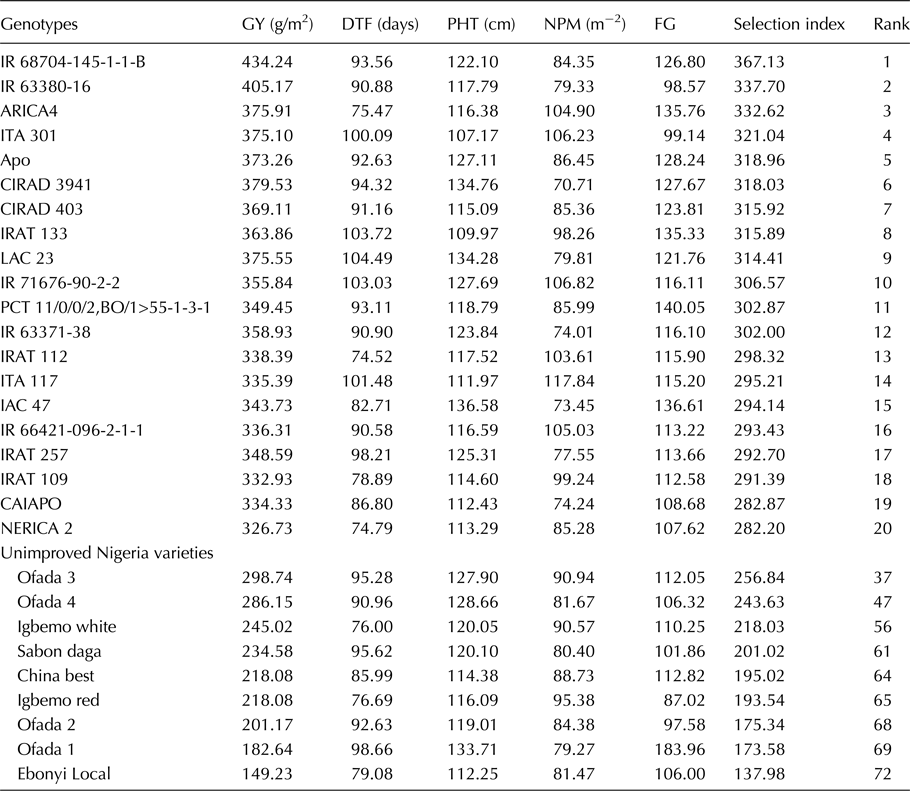
The top 20 genotypes in the 2014 field experiment are presented in Table 1. The germplasm evaluated varied widely for the various traits considered in this study. Earliest days of flowering were observed for IRAT 112 (75 days) and ARICA 4 (76 days). Two improved varieties, IR 68704-145-1-1B (434.24 g/m2) and IR 63380-16 (405.17 g/m2) ranked first and second for selection index while ITA 301 (highest yielding Nigerian improved variety in this study) was fourth. The highest and lowest yielding unimproved varieties from Nigeria, Ofada 3 (298 g/m2) and Ebonyi local (137 g/m2), ranked 37th and 72nd (Table 1). IR 68704-145-1-1B also had a yield advantage of 45% and almost 200% more than the highest and lowest yielding unimproved landraces (Ofada 3 and Ebonyi Local) but had only 16% yield advantage over the best Nigerian improved genotype (ITA 301).
Ranking of best 20 varieties and nine unimproved landraces from Nigeria based on selection index

GY, grain yield per metre square; DTF, days to 50% flowering; PHT, plant height at maturity; LA, average leaf area; NPM, number of panicles per metre square; FG, number filled grains.
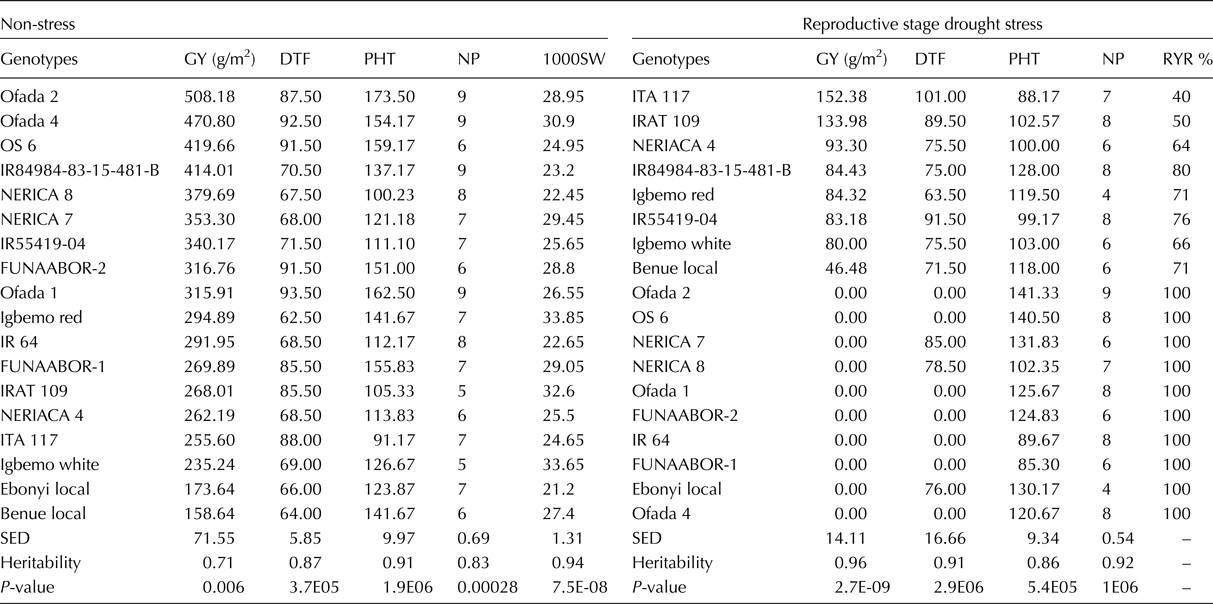
Significant variations were also recorded among traits for the 18 upland rice varieties under rainout-shelter conditions The mean grain yield of selected genotypes and checks are presented in Table 2. Reduced plant height and grain yield were observed under RS compared with NS while days to flowering increased for most of the genotypes under drought stress. All the drought-tolerant checks (IRAT 109, NERICA 4, IR84984-83-15-481-B and IR55419-04) used in this study flowered and produced grain under both water regimes. Two unimproved landraces, Ofada 2 (508.1 g/m2) and Ofada 4 (470.8 g/m2), had the highest grain yield under NS conditions whereas ITA 117 (152.38 gm−2) had the highest grain yield under RS. Yield reduction among the tolerant checks ranged from 50% (IRAT 109) to 79% for IR84984-83-15-481-B whereas ITA 117 (highest yielding variety under stress) had a yield reduction of 40% (Table 2).
Means and heritability of measured traits under non-stress and reproductive-stage drought stress under rainout-shelter conditions at Ibadan

GY, grain yield per plot; DTF, days to flowering; PHT (cm), plant height at maturity; NP, number of panicle; 1000SW, 1000 seed weight; LRS, leaf rolling score.
The susceptible check IR 64 and most of the landraces did not flower under RS due to the severity of imposed drought stress. Igbemo Red was the earliest to flower under the two water regimes while Ofada 2 had the highest PHT under NS (173.5 cm) and RS (140.5 cm) followed by OS 6 (Table 2). In all, ITA 117, the four drought-tolerant checks and Igbemo Red significantly out-yielded IR 64 (the susceptible check) and most of the landraces under RS.
Moderate to high broad sense heritability (H) was observed for most of the traits under RS and NS conditions (Table 2). None of the secondary traits showed higher H than yield under stress in this study. Highest heritability estimates were recorded for plant height under NS and yield per plot under the RS condition.
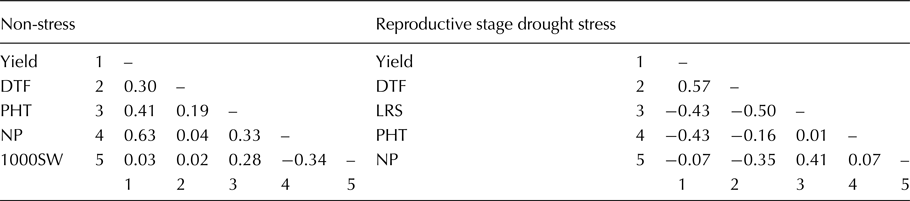
Genotypic correlations of measured traits are presented in Table 3. A moderately positive genetic correlation (0.57) was observed between yield and days to flowering under drought stress. However, yield showed a negative correlation with other traits under stress (Table 3). The association between yield and other traits under NS conditions was fairly high for a number of panicles per hill (0.60). However, low but positive correlation existed between yields, days to flowering (0.29) and plant height (0.40).
Genetic correlations among five characters of 18 rice genotypes under non-stress and reproductive-stage drought stress

DTF, days to flowering; PHT, plant height at maturity; NP, number of panicle; 1000SW, 1000 seed weight; LRS, leaf rolling score P = 0.05.
Discussion
Since yield is not the only trait of importance that farmers consider in the adoption of a new variety, there is need to employ a selection technique that can aid identify genotypes with the best combinations of desired traits. A selection index is a rapid breeding technique that can aid efficient selection of multiple traits simultaneously (Smith, Reference Smith1936). IR 68704-145-1-1-B and IR 63380-16 had higher yield potential and a good combination of desired agronomic traits such as plant height, numbers of panicles, and a number of filled grain per panicle. CIRAD 3941 and LAC 23, although having higher yields compared to ARICA 4 and Apo, ranked lower in the index ranking. Lin (Reference Lin1978) reported that some of the advantages of the base index over other indices are its simplicity and freedom from errors of parameters estimation. Rabiei et al. (Reference Rabiei, Valizadeh, Ghareyazie and Moghaddam2004) reported selection indices to be an effective selection tool in the genetic improvement of rice grain shape.
The improved varieties ranked highest based on yield and selection index ranking from this study while most unimproved cultivars ranked lowest. This might be attributed to the concentration of favourable alleles associated with higher grain yield due to selection among the improved varieties used in this study over most of the landraces. This is in agreement with the reports of Longtau (Reference Longtau2003) and Dalton (Reference Dalton2004) who showed that the use of unimproved landraces characterized by decreased yield by poor resourced farmers’ across Sub-Sahara Africa also contributes to low paddy output per unit area under cultivation.
Based on the soil–water readings of the tensiometers, inability of IR64 (drought-susceptible check) and most of the landraces to flower under RS and yield differences between the stressed plots (RS) and the control (NS) in the rainout-shelter experiment above 70% RYR, drought stress imposed was severe (Kumar et al., Reference Kumar, Bernier, Verulkar, Lafitte and Atlin2008). Such severe stress is recommended to ensure that true drought-tolerant lines are identified (Dixit et al., Reference Dixit, Singh and Kumar2014). Even though the tolerant checks (IRAT 109, NERICA 4, IR84984-83-15-481-B and IR55419-04) flowered and produced appreciable grain yield under RS, they generally performed lower in grain yield and earliness compared with ITA 117 and Igbemo red respectively under water stress conditions. IRAT 109 had the least relative grain yield reduction under stress among the checks used in this study further confirming its suitability as a tolerant check for reproductive-stage drought trials as reported by Zu et al. (Reference Zu, Lu, Wang, Chu, Miao, Wang and La2017).
Water deficit prolonged the overall life cycle of most of the genotypes screened in this study and there were significant reductions in plant yield and height. Most of the Ofada rice cultivars evaluated in this study were early to medium maturing varieties with tall plant type. This agrees with an earlier report that most upland rice landraces are characterized by tall plant type (Kumar et al., Reference Kumar, Dixit, Ram, Yadaw, Mishra and Mandal2014; Vikram et al., Reference Vikram, Swamy, Dixit, Trinidad, Cruz, Maturan, Amante and Kumar2016) but disagree that farmers in drought-prone regions still plant some of these tall traditional cultivars for their resistance to abiotic stresses such as drought. For instance, this finding on the performance of Ofada 2 under stress and non-stressed conditions is not in agreement with the reports of Bernier et al. (Reference Bernier, Atlin, Serraj, Kumar and Spaner2008); Saka and Lawal (Reference Saka and Lawal2009); Vikram et al. (Reference Vikram, Swamy, Dixit, Singh, Singh, Miro, Kohli, Henry, Singh and Kumar2015) that most tall upland landraces are tolerant to drought stress but perform poorly under well-watered condition. Even though Ofada 2 recorded the highest plant height and grain yield under NS, it did not flower under severe drought stress. This is probably on account of adaptation due to years of cultivation of these landraces in the rainforest zone of southwestern Nigeria that is characterized by abundant rainfall during crop growing seasons in the field. The tall plant architecture associated with most of these landraces leads to increased lodging susceptibility rather than resistance to drought stress. Low grain yield often recorded among most Ofada rice landraces within the farmers’ fields in Nigeria might be attributed partly to losses due to high susceptibility to drought stress and lodging at grain filling and ripening stages. This agrees with Vikram et al. (Reference Vikram, Swamy, Dixit, Singh, Singh, Miro, Kohli, Henry, Singh and Kumar2015) who reported that the introduction of the SD1 gene (semi-dwarf gene) during the green revolution era led to the development of high yielding, lodging resistant dwarf rice varieties across Asia. Lodging in these high yielding tall landraces often results in damage from an attack by rodents, thereby reducing harvested yield. Conducting the trial under rainout-shelter conditions with less wind and rainfall might have minimized grain losses due to lodging among these Ofada cultivars compared to what is seen under field conditions. Despite the high grain yield produced by some of these landraces under NS, a good percentage could not flower and produce appreciable grain yield (<50% relative yield reduction) under drought stress. Several earlier studies reported similar results that limited water conditions at reproductive stages of rice plants results in delayed flowering, poor yield and reduced plant height (Price et al., Reference Price, Cairns, Horton, Jones and Griffiths2002; Venuprasad et al., Reference Venuprasad, Lafitte and Atlin2007; Guimarães et al., Reference Guimarães, Stone, Castro and Morais Júnior2015; Shamsudin et al., Reference Shamsudin, Swamy, Ratnam, Cruz, Sandhu, Raman and Kumar2016).
Careful hybridization of top performing genotypes identified from this study with farmers preferred landraces might lead to the development of promising drought-tolerant varieties with a good combination of preferred traits and higher grain yield under stressed and favourable moisture conditions. Development of such resilient varieties will help to bridge the yield gap observed in this study between the low-yielding landraces and the high-yielding improved varieties. Furthermore, it will also trickle down to improve the livelihood of most rice farmers by reducing risk and increasing productivity in rainfed areas of the country that is often highly variable in terms of water availability.
High heritability (>70%) observed for most traits under both RS and NS conditions implies that these traits can be transferred to progenies through hybridization and resourcefully advanced through phenotypic selection (Falconer, Reference Falconer1989). Nassir and Adewusi (Reference Nassir and Adewusi2012) reported high heritability for 1000 g grain weight and days to flowering among sixteen genotypes evaluated under variable soil moisture conditions in Nigeria. High heritability estimates for days to flowering, plant height at maturity and plot yield as recorded in this study have also been reported earlier by Ogunbayo et al. (Reference Ogunbayo, Ojo, Sanni, Akinwale, Toulou, Shittu and Gregorio2014). This implies that selection for traits with moderate to high heritability identified from this study will be effective and such traits can be retained in subsequent generations in an upland rice drought breeding programme involving these germplasms. Low-to-moderate positive genetic association observed in this study between yield and days to flowering under RS and NS are in accordance with Lafitte et al. (Reference Lafitte, Price and Courtois2004) but disagrees with the reports of Bernier et al. (Reference Bernier, Kumar, Ramaiah, Spaner and Atlin2007) and Sellammal et al. (Reference Sellammal, Robin and Raveendran2014) who reported negative association between grain yield and days to flowering under drought stress in rice. Moderate-to-high genetic correlations observed between yield and some yield-related traits in this study might be due to genetic linkage and pleiotropic effects. This is an indication that these traits co-locating with yield can be exploited for indirect selection of yield under RS and NS.
Conclusions
Increased yield under optimal and stress conditions is one of the main objectives of every breeding programme. Two improved varieties were the best performers in this study while unimproved landraces ranked lowest using selection index. The majority of the unimproved rice accessions assessed in this study were susceptible to reproductive-stage drought stress. High-yielding, early maturing and drought-tolerant genotypes identified from this study can be used to develop early maturing, high-yielding, drought-tolerant varieties having a good combination of farmers preferred traits in a new upland rice variety for release to rice farmers across Nigeria. Studies to elucidate the mechanisms underlying the drought response of ITA117 and effects of susceptibility to drought stress and lodging on grain yield among these popular upland rice landraces in Nigeria as identified in this study need to be initiated.
Supplementary material
The supplementary material for this article can be found at https://doi.org/10.1017/S1479262118000060
Acknowledgements
We are grateful to the Alliance for a Green Revolution in Africa (AGRA) for providing funds for this study through the West Africa Centre for Crop Improvement (WACCI), University of Ghana PhD fellowship.