Introduction
Paragonimiasis is an important food-borne disease caused by lung flukes of the genus Paragonimus. Human infection occurs mainly by eating uncooked or semi-cooked freshwater crabs/crayfish that harbour metacercariae of several species of Paragonimus. In addition, consumption of uncooked or semi-cooked meat of paratenic hosts, such as wild boars, containing juvenile worms is an important route of infection in Japan (Blair et al., Reference Blair, Xu and Agatsuma1999). The genus Paragonimus includes more than 50 nominal species. Of these, four species, P. westermani, P. heterotremus, P. skrjabini and P. miyazakii, are identified as important pathogens for human paragonimiasis in Asia (Blair et al., Reference Blair, Xu and Agatsuma1999, Reference Blair, Agatsuma, Wang, Murrell and Fried2007). In South to South-East Asia, except for the Philippines, only P. heterotremus is proven to be pathogenic to humans in India, Thailand, Laos and Vietnam. In contrast, P. westermani is the most important pathogen in Far-East Asia (Japan, Korea, China and Taiwan) and also in the Philippines. In addition, P. skrjabini and P. miyazakii, although less frequent than P. westermani, are important pathogens for human disease in China and Japan, respectively (Blair et al., Reference Blair, Xu and Agatsuma1999, Reference Blair, Agatsuma, Wang, Murrell and Fried2007). These two species are not only morphologically but also genetically close to each other, and are considered to be the sub-species, P. skrjabini skrjabini and P. skrjabini miyazakii, in the P. skrjabini complex (Blair et al., Reference Blair, Chang, Chen, Cui, Wu, Agatsuma, Iwagami, Corrlis, Fu and Zhan2005). Outside of Japan and China, members of this complex have been reported recently from India (Singh et al., Reference Singh, Singh and Singh1998, Reference Singh, Singh and Sugiyama2006; Singh, Reference Singh2002).
Here we report the discovery of P. skrjabini metacercariae from mountain crabs from Thanh Hoa province, Vietnam. Adult worms were obtained by experimental infection of the metacercariae in cats and dogs. Their morphological and phylogenetic relationships with other geographical populations in the P. skrjabini species complex are discussed herein.
Materials and methods
Collection of metacercariae and adult worms
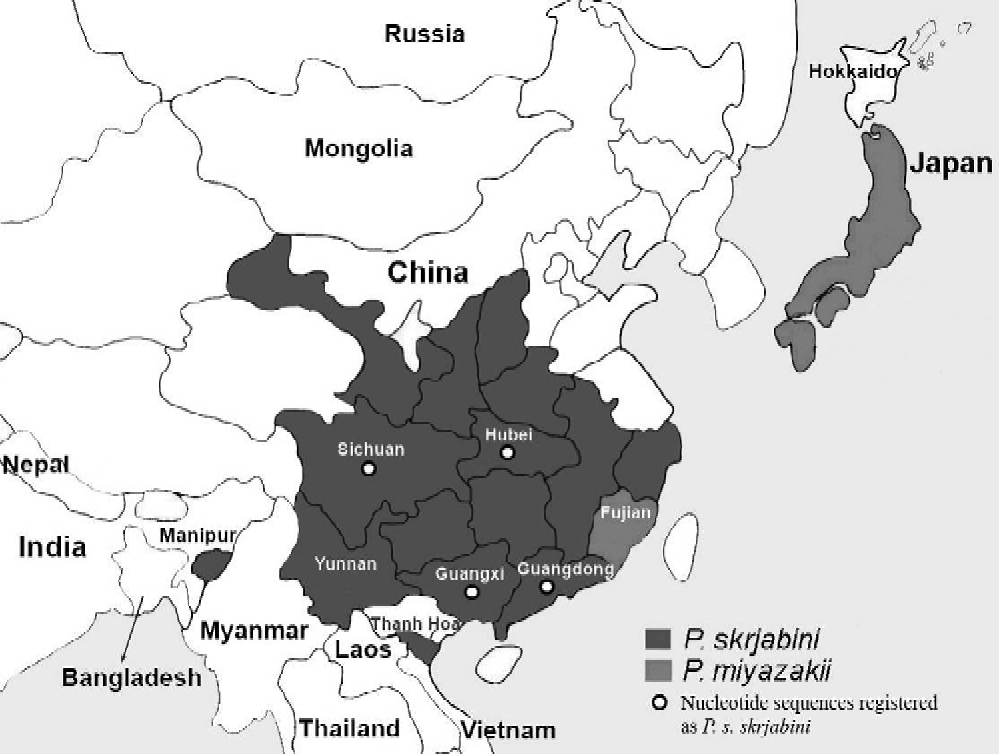
Paragonimus metacercariae were collected from 100 individuals of mountain crabs, Indochinamon tannanti (previously known as Potamiscus tannanti), caught in the small streams in the forest of Thach Lam commune, Thach Thanh district, Thanh Hoa province, Vietnam (fig. 1) by the method described previously (Doanh et al., Reference Doanh, Shinohara, Horii, Habe, Nawa, The and Le2007). Varieties of metacercariae were separated by morphological features such as the shape, size and cyst wall structure. A new type of Paragonimus metacercaria was used for molecular analyses and experimental infection.
A map to show the studied site in the province of Thanh Hoa, Vietnam and the distribution of P. skrjabini and P. miyazakii in Asian countries.

Two cats and two dogs, found to have no existing Paragonimus infection, were fed with 18 metacercariae (cats) or 10 metacercariae (dogs). The cats and dogs were kept in animal quarters and handled with respect in accordance with the laws on experimental animal care in Vietnam. Starting 1 month post infection (PI), faeces of these animals were checked periodically for the presence of Paragonimus eggs. Following euthanasia, the experimental animals were dissected to permit collection of adult worms. A small piece of each worm was cut off and separately preserved in 100% ethanol and stored at − 20°C for DNA extraction. The rest of each worm was flattened between glass slides and fixed in 70% ethanol. The worms were then stained with carmine, cleared in xylene, mounted individually on to a glass slide with Canada balsam, and covered with a cover slip for permanent preparation for morphological study. The shape and the size of body and the ratio of body length and width, the arrangement of cuticular spines, the size and degree of branching of ovary and testes, as well as the shape and the size of eggs, were employed as the morphological parameters.
Polymerase chain reaction and DNA sequencing
Four new type metacercariae (codes: MC72–MC75), which were identified as P. skrjabini, collected from Thanh Hoa province, Vietnam, and five adult worms (codes: AD72–AD76) obtained from experimental animals were used for molecular phylogenetic analyses. For this purpose, the nuclear ribosomal second internal transcribed spacer region (ITS2) and the partial mitochondrial cytochrome oxidase subunit 1 gene (CO1) were amplified by polymerase chain reaction (PCR) (Doanh et al., Reference Doanh, Shinohara, Horii, Habe, Nawa, The and Le2007) using 3S and A28 (Bowles et al., Reference Bowles, Blair and McManus1995) and JB3 and JB4.5 (Bowles et al., Reference Bowles, Hope, Tiu, Liu and McManus1993) primer pairs, respectively. The PCR products were purified using Qiaquick PCR purification Kit (Qiagen Inc., Tokyo, Japan), then each strand sequenced in a Genetic Analyzer 3130 (Applied Biosystems Japan Ltd, Tokyo, Japan) using the PCR primers as sequencing primers and a Big-Dye terminator cycle sequencing kit v3.1 (Applied Biosystems).
Phylogenetic analyses
To analyse the phylogenetic relationship, we downloaded all ITS2 (29) and CO1 (82) sequences registered as P. skrjabini/P. miyazakii, originating from China, Japan and India, in GenBank. In addition, 14 ITS2 and 10 CO1 sequences of Paragonimus sp. from Yunnan province, China, which showed high similarities with our sequences from Vietnam by BLAST search, were used for analyses. Moreover, sequences of P. proliferus (and P. hokuoensis as a synonym) were also included because of their high similarities with P. skrjabini complex (Blair et al., Reference Blair, Chang, Chen, Cui, Wu, Agatsuma, Iwagami, Corrlis, Fu and Zhan2005; Doanh et al., Reference Doanh, Shinohara, Horii, Habe, Nawa and Le2008; Zhou et al., Reference Zhou, Yang, Doanh, Yang, Xiang, Li, Shinohara, Horii and Nawa2008). Two sequence data sets, ITS2 and CO1, were set up for reconstructing the phylogenetic trees. They were aligned using Clustal-W (Thompson et al., Reference Thompson, Higgins and Gibson1994) with default options. Evolutionary analyses were conducted in MEGA5 (Tamura et al., Reference Tamura, Peterson, Peterson, Stecher, Nei and Kumar2011). The best model of nucleotide substitution for each sequence data set was tested and maximum likelihood trees were subsequently reconstructed using Kimura 2-parameter model for the ITS2 tree and Tamura–Nei model with gamma rate heterogeneity (+G) for the CO1 tree (both models are included in MEGA5, Tamura et al., Reference Tamura, Peterson, Peterson, Stecher, Nei and Kumar2011). The data set was resampled 1000 times using the bootstrap method.
Results
Prevalence and morphological identification of metacercariae and adults
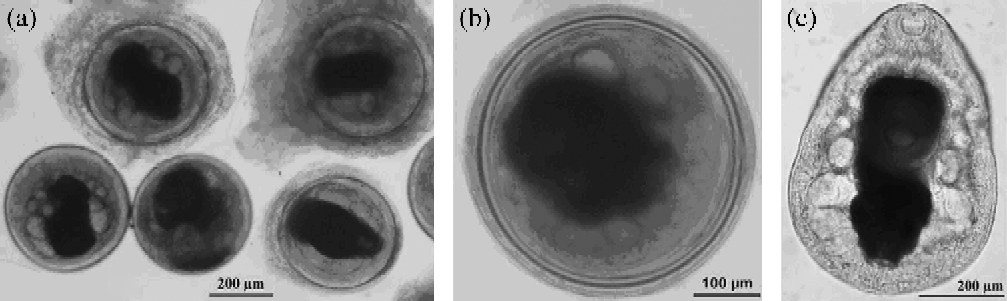
Four types of morphologically different Paragonimus metacercariae were found from mountain crabs, I. tannanti, caught from Thanh Hoa province, Vietnam. Three of them were identified as P. vietnamensis, P. heterotremus and P. bangkokensis, with the low infection rates of 1.0, 3.0 and 15.0%, respectively. Another, more prevalent, type was found in 25.0% of crabs with up to 31 (average 5.6) metacercariae/infected crab. This new type of metacercaria (fig. 2a and b) is round or spherical in shape, measuring 410–459 × 405–459 μm (average 433 × 425 μm). The cyst wall of the metacercaria has three layers: the outer layer is thin and easily ruptured, and the middle layer is thicker than the inner one (fig. 2b). Excysted metacercariae (fig. 2c) measure 650–670 × 370–420 μm; the diameter of the oral sucker is 80–120 μm and that of the ventral sucker, 120–60 μm. These morphological characteristics are compatible with those of P. skrjabini (Chen, Reference Chen1964; Blair et al., Reference Blair, Chang, Chen, Cui, Wu, Agatsuma, Iwagami, Corrlis, Fu and Zhan2005).
Encysted (a, b) and excysted (c) metacercariae of P. skrjabini in crabs from Thanh Hoa province, Vietnam.
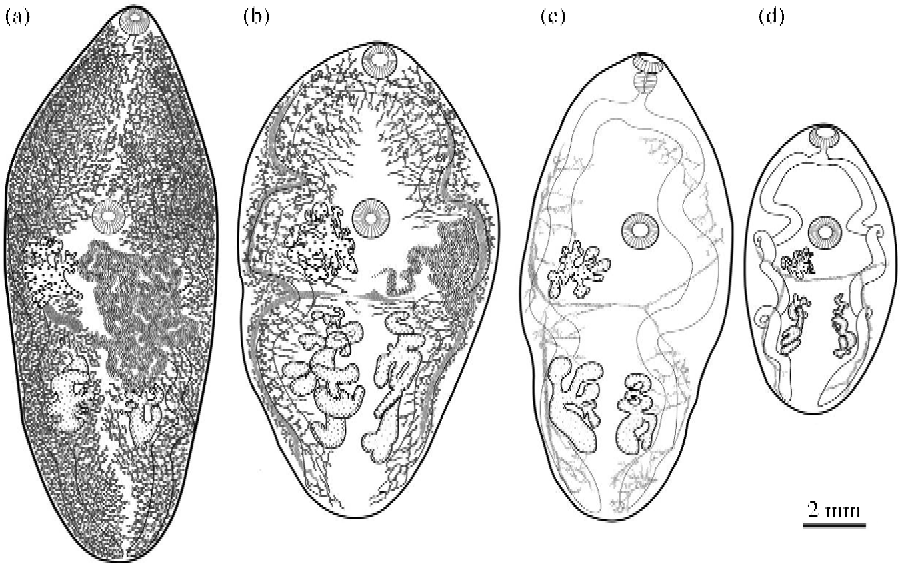
Two dogs and two cats were infected with these new-type metacercariae. The cats and dogs were euthanized at 90 and 150 days PI, respectively, to collect adult worms. A total of 14 Paragonimus flukes were collected from two cats and one dog with recovery rates of 22.2–38.9%. Two worms from each positive animal were fully mature (fig. 3a), while the other worms were still young or immature (fig. 3b–d). Morphologically, except for a slight difference in body shape between fully mature and immature worms, all Paragonimus specimens from a dog (3 worms) and cats (11 worms) share the common characteristics. The body is more or less elongate and is covered by singly arranged spines, some of which split into two. The ventral sucker is slightly larger than the oral sucker. Testes and ovary are well branched, but are very variable (table 1). All these morphological and morphometric data of metacercariae and adults are identical to those of P. skrjabini (Blair et al., Reference Blair, Chang, Chen, Cui, Wu, Agatsuma, Iwagami, Corrlis, Fu and Zhan2005).
Various developmental stages of P. skrjabini worms recovered at 150 days post infection from the dog (a,b) and at 90 days post infection from the cats (c, d).
Morphometrics of P. skrjabini worms collected from experimentally infected dog and cats in this study compared with those of P. skrjabini and P. miyazakii after Blair et al. (Reference Blair, Chang, Chen, Cui, Wu, Agatsuma, Iwagami, Corrlis, Fu and Zhan2005)*.

Molecular phylogenetic analyses
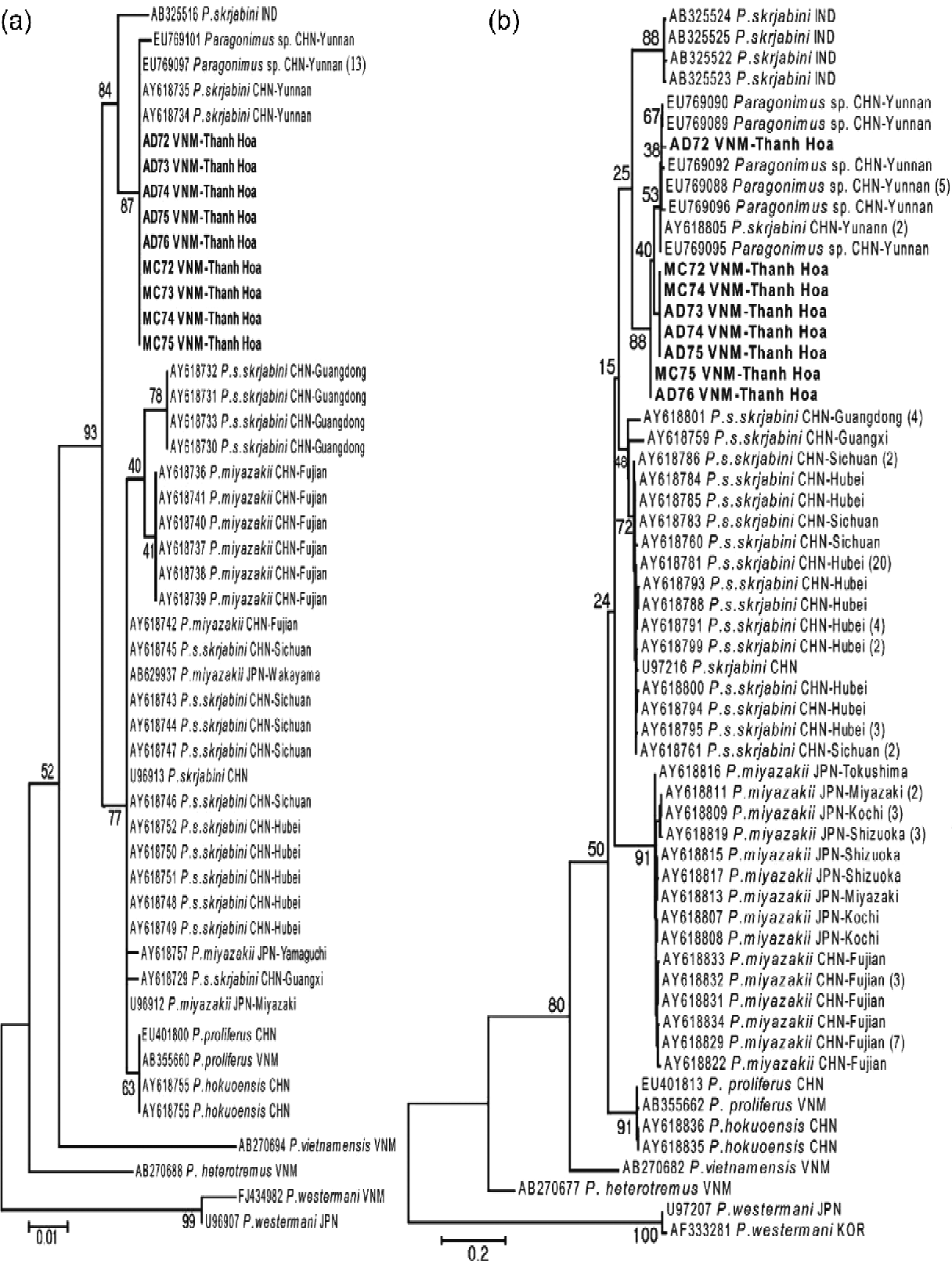
We obtained a total of nine ITS2 and eight CO1 sequences, which are deposited in GenBank with Accession numbers AB703444–AB703460. The BLAST search showed that they are highly similar to those of P. skrjabini. These sequences were aligned with the homologues of P. skrjabini complex and several related species within the genus Paragonimus obtained from GenBank, and the phylogenetic trees were reconstructed separately using two sequence data sets of ITS2 (fig. 4a) and CO1 (fig. 4b) genes.
Maximum likelihood trees reconstructed from ITS2 (a) and CO1 (b) sequences. New sequences obtained in this study are represented with the sample codes in bold, while others from the DNA database are indicated with the Accession no., species name and the country code. The numbers in parentheses indicate the numbers of identical sequences. The numbers on the branches show percentages of 1000 bootstrap replications.
For the ITS2 data set, several sequences lacked some nucleotides. The sequences used for alignment were, therefore, 352 nucleotides in length. GT deletion was observed at positions 244–245 of P. s. skrjabini populations from Guangdong, Guangxi, Sichuan and Hubei provinces and also in one sequence (AY618742) of P. miyazakii from Fujian province, China. Nevertheless, these sequences having common indels did not cluster in one separate group in the phylogenetic tree. As can be seen in the ITS2 tree (fig. 4a), ITS2 sequences of Vietnamese isolates were completely identical with those of P. skrjabini (AY618734, AY618735) and also unidentified Paragonimus sp. (EU769097, EU769101), all of which were from Yunnan province, China. This cluster was closer to one sequence (AB325516) of P. skrjabini from India, and these populations from India, Yunnan province of China and Vietnam were distant from other P. skrjabini/P. miyazakii populations from other provinces of China and Japan at 1.6%. The latter populations were closer (0.5% difference) to, and clustered with P. proliferus. All P. skrjabini, P. miyazakii and also P. proliferus (including P. hokuoensis as a synonym; Doanh et al., Reference Doanh, Shinohara, Horii, Habe, Nawa and Le2008; Zhou et al., Reference Zhou, Yang, Doanh, Yang, Xiang, Li, Shinohara, Horii and Nawa2008) were clustered in a common clade with the high bootstrap value of 93%.
In the CO1 tree (fig. 4b), the P. skrjabini population from Thanh Hoa province, Vietnam was almost completely identical (only 2.2% difference) with P. skrjabini from Yunnan province, China, to make a distinct clade clustered with an Indian P. skrjabini population at the low bootstrap value of 25%. In contrast to the ITS2 tree, P. skrjabini, P. miyazakii and P. proliferus were clearly separated from each other with considerable differences in the CO1 tree. Paragonimus proliferus was far different (9.5 and 11.5%) from P. miyazakii and P. skrjabini populations, respectively. The two latter populations also showed a high difference (11.2% in average) from each other. In the P. miyazakii clade, populations from Japan and Fujian province, China, showed very high similarity (only 1.3% difference) to each other. In contrast, considerable variation was observed among CO1 sequences of P. skrjabini populations. Three groups were recognized, coinciding with their geographical origins: the first group consists of Indian population alone; the second group includes populations from Yunnan province, China and Vietnam; and the third group includes other populations from Sichuan, Hubei, Guangdong, and Guangxi provinces, China, with moderate differences (fig. 4b). The average differences among these three groups ranged from 9.2 to 10.4%; and they were clustered with each other at very low bootstrap values (15 and 25%).
Discussion
Recent molecular phylogenetic studies revealed that the genus Paragonimus could be divided into several groups called ‘species complexes’ (Blair et al., Reference Blair, Xu and Agatsuma1999, Reference Blair, Chang, Chen, Cui, Wu, Agatsuma, Iwagami, Corrlis, Fu and Zhan2005; Doanh et al., Reference Doanh, Shinohara, Horii, Habe, Nawa, The and Le2007, Reference Doanh, Shinohara, Horii, Habe, Nawa and Le2008; Nawa & Doanh, Reference Nawa and Doanh2009). Of these, the P. skrjabini complex includes two sub-species, P. s. skrjabini and P. s. miyazakii, which were deduced from P. skrjabini and P. miyazakii, respectively, because of their high similarities in morphology and molecular data (Blair et al., Reference Blair, Chang, Chen, Cui, Wu, Agatsuma, Iwagami, Corrlis, Fu and Zhan2005). In addition, P. szechuanensis and P. hueitungensis from China were regarded as P. s. skrjabini (Blair et al., Reference Blair, Chang, Chen, Cui, Wu, Agatsuma, Iwagami, Corrlis, Fu and Zhan2005). Outside of China and Japan, Miyazaki (Reference Miyazaki1991) described the discovery of an immature worm of P. skrjabini in Thailand; however, the possible presence of P. skrjabini in Thailand was denied by Waikagul & Yoonuan (Reference Waikagul, Yoonuan, Arizono, Chai, Nawa and Takahashi2005). From Manipur, India, Singh and his colleagues reported the presence of P. miyazakii manipurinus, P. hueitungensis and P. skrjabini (Singh et al., Reference Singh, Singh and Singh1998, Reference Singh, Singh and Sugiyama2006; Singh, Reference Singh2002). Of these, P. hueitungensis was, as discussed above, considered as a synonym of P. s. skrjabini, and there has been little information about the validity of P. miyazakii manipurinus (Blair et al., Reference Blair, Chang, Chen, Cui, Wu, Agatsuma, Iwagami, Corrlis, Fu and Zhan2005). Only P. skrjabini was confirmed by both morphological and molecular data.
In this study, we first collected P. skrjabini metacercariae from crab hosts in Thanh Hoa province, Vietnam. Molecular phylogenetic analyses of the ITS2 and CO1 sequences of metacercariae and adults showed that the P. skrjabini population from Thanh Hoa province, Vietnam was almost completely identical with those from Yunnan, China. Remarkably, these populations from Vietnam and Yunnan of China, and also a P. skrjabini Indian population, are genetically distant from other P. skrjabini populations, to make separate groups that are close to sub-species P. s. skrjabini in CO1 tree. Blair et al. (Reference Blair, Chang, Chen, Cui, Wu, Agatsuma, Iwagami, Corrlis, Fu and Zhan2005) distinguished two sub-species, P. s. skrjabini and P. s. miyazakii, by the differences in CO1 sequences and the body length/width ratio. Although considerable genetic distances were observed between these newly discovered/registered populations and the two present sub-species, the morphological data are not enough to name them as new sub-species. As reported by Blair et al. (Reference Blair, Chang, Chen, Cui, Wu, Agatsuma, Iwagami, Corrlis, Fu and Zhan2005), the morphological differences of geographical populations of P. skrjabini complex were found but not clear, and the body length/width ratio, which was used for the discrimination of the two sub-species, P. s. skrjabini and P. s. miyazakii, does partly overlap (table 1). In addition, the present results showed that the body length/width ratio of P. skrjabini young/immature adults was smaller than that of mature ones (table 1, fig. 3). Thus, morphological keys seem to be difficult to apply for the identification of P. skrjabini at the sub-species level. Further analyses are needed on specimens from various geographical locations to confirm whether the newly discovered Vietnamese population, together with Chinese Yunnan and Indian Manipur populations, would make up a new sub-species of the P. skrjabini complex. To date, P. skrjabini has been reported widely in China and spread to Vietnam and India; while P. miyazakii has been reported from almost all of Japan (except for Hokkaido) and Fujian province, China (Nishida, Reference Nishida, Vemoto and Wada1989; Blair et al., Reference Blair, Xu and Agatsuma1999, Reference Blair, Chang, Chen, Cui, Wu, Agatsuma, Iwagami, Corrlis, Fu and Zhan2005).
In addition to these two species considered as two sub-species of the P. skrjabini complex, P. hokuoensis was also included in this species complex (Blair et al., Reference Blair, Chang, Chen, Cui, Wu, Agatsuma, Iwagami, Corrlis, Fu and Zhan2005). Recently, P. hokuoensis was confirmed to be a synonym of P. proliferus (Doanh et al., Reference Doanh, Shinohara, Horii, Habe, Nawa and Le2008; Zhou et al., Reference Zhou, Yang, Doanh, Yang, Xiang, Li, Shinohara, Horii and Nawa2008). Despite having unique, large excysted metacercariae, P. proliferus adults are morphologically similar to those of P. skrjabini, except that the former has grouped cuticular spines whereas the latter has single spines (Blair et al., Reference Blair, Chang, Chen, Cui, Wu, Agatsuma, Iwagami, Corrlis, Fu and Zhan2005; Doanh et al., Reference Doanh, Shinohara, Horii, Habe, Nawa and Le2008; Zhou et al., Reference Zhou, Yang, Doanh, Yang, Xiang, Li, Shinohara, Horii and Nawa2008). Molecular analyses in this study also indicated that P. proliferus is a member of the P. skrjabini complex.
In conclusion, we discovered metacercariae of P. skrjabini in freshwater crabs in Vietnam for the first time. Based on ITS2 and CO1 sequences, the P. skrjabini population from Thanh Hoa, Vietnam was almost completely identical with P. skrjabini from Yunnan, China. The present study also revealed the considerable genetic variation of the P. skrjabini complex and its possible distribution in other countries. This discovery suggests that human paragonimiasis caused by P. skrjabini might be present in Vietnam and other countries.
Acknowledgements
This study was supported by the Japanese Society for Promotion of Science (under Postdoctoral Fellowship No. P10111) and by the Vietnam National Foundation for Science and Technology Development (No. 106.12.53.09).