Implications
Grazing ruminants and their production systems have been associated with the supply of food that is more beneficial for human health and environmental preservation. There is an increasing consumer interest in animal products from pasture production systems. In recent years, efforts have been made to enable direct tracing of grass feeding in herbivore products. Skatole, 2,3-octanedione and terpenes have been proposed as possible biomarkers of pasture feeding in ruminant products. In this study, 2,3-octanedione was a good indicator of green herbage feeding, and terpene profiles allowed the identification of high botanical diversity in the pasture that was fed to the animals.
Introduction
Grazing ruminants and their production systems are intuitively regarded as producing meat that is better for human health, the environment and animal welfare than the meat produced in intensive production systems. Therefore, efforts have been made in recent years to establish methods to directly trace green herbage feeding in herbivore products (Coulon and Priolo, Reference Coulon and Priolo2002; Prache et al., Reference Prache, Cornu, Berdagué and Priolo2005; Karaoui and De Baerdemaeker, Reference Karaoui and De Baerdemaeker2007). Skatole, 2,3-octanedione and terpenes have been proposed as possible biomarkers of pasture feeding in ruminant products (Young et al., Reference Young, Berdagué, Viallon, Rousset-Akrim and Theriez1997; Priolo et al., Reference Priolo, Cornu, Prache, Krogmann, Kondjoyan, Micol and Berdagué2004; Martin et al., Reference Martin, Cornu, Kondjoyan, Ferlay, Verdier-Metz, Pradel, Rock, Chilliard, Coulon and Berdagué2005).
Young et al. (Reference Young, Berdagué, Viallon, Rousset-Akrim and Theriez1997) observed that 2,3-octanedione was not found in meat from sheep fed on grain, and suggested that it could be a good indicator of pasture feeding. They proposed that it could result from the action of lipoxygenase on linoleic and linolenic acids, both the enzyme and its substrates being abundant in green leafy tissue. The 2,3-octanedione would form during mastication of green forages and accumulate in the fat after absorption via the rumen or the lungs.
Skatole (3-methylindole) is known as a component of boar-taint flavour in pork (Berg et al., Reference Berg, Agerhem, von Seth, Tornberg and Andresen1993) and pastoral flavour in meat products from ruminants (Young et al., Reference Young, Berdagué, Viallon, Rousset-Akrim and Theriez1997; Schreurs et al., Reference Schreurs, Lane, Tavendale, Barry and McNabb2008). Research efforts have been made to elucidate the mechanisms and factors governing skatole production and accumulation in ruminants’ fat in order to reduce unpleasant pastoral flavour (Lane and Fraser, Reference Lane and Fraser1999; Schreurs et al., Reference Schreurs, McNabb, Tavendale, Lane, Barry, Cummings, Fraser, López-Villalobos and Ramírez-Restrepo2007; Priolo et al., Reference Priolo, Vasta, Fasone, Lanza, Scerra, Biondi, Bella and Whittington2009), and in order to study the reliability of the skatole determination in fat as an indicator of pasture feeding (Priolo et al., Reference Priolo, Cornu, Prache, Krogmann, Kondjoyan, Micol and Berdagué2004, Prache et al., Reference Prache, Kondjoyan, Delfosse, Chauveau-Duriot, Andueza and Cornu2009). Skatole is a product of tryptophan degradation in the rumen. In forage-based diets with high-protein/non-fibrous carbohydrate ratios, protein and therefore tryptophan degradation is enhanced, resulting in increased skatole production (Sheath et al., Reference Sheath, Coulon and Young2001). Differences in skatole formation and tissue accumulation have been reported not only when comparing forage vs. concentrate-based diets (Lane and Fraser, Reference Lane and Fraser1999; Young et al., Reference Young, Lane, Priolo and Fraser2003; Priolo et al., Reference Priolo, Vasta, Fasone, Lanza, Scerra, Biondi, Bella and Whittington2009), but also between forage diets (Schreurs et al., Reference Schreurs, Tavendale, Lane, Barry, Marotti and McNabb2003 and Reference Schreurs, McNabb, Tavendale, Lane, Barry, Cummings, Fraser, López-Villalobos and Ramírez-Restrepo2007), depending on protein solubility and degradability and on synchronisation of protein and carbohydrate degradation in the rumen.
Terpenes are plant secondary metabolites produced in large amounts with broad molecular diversities in certain Apiaceae, Lamiaceae and Asteraceae, which are found in diversified permanent pastures. Poaceae and legumes contain only a few of the most common terpenes and in small amounts. Permanent, diversified grasslands have a rich, characteristic terpene fingerprint, whereas artificial grasslands, cultivated mainly with Poaceae species, are poor in terpenes. Although terpenes have long been reported in meat products (Larick et al., Reference Larick, Hedrick, Bailey, Williams, Hancock, Garner and Morrow1987; Young et al., Reference Young, Berdagué, Viallon, Rousset-Akrim and Theriez1997), examples of diet-based meat discrimination remain scarce. The terpene fingerprints of muscle lipid fractions allowed Cornu et al. (Reference Cornu, Kondjoyan, Begnaud, Micol, Renou and Berdagué2001b) to identify four groups of steers, three of which had been fed on pasture and the fourth on maize silage. By analysing terpenes in subcutaneous fat, Priolo et al. (Reference Priolo, Cornu, Prache, Krogmann, Kondjoyan, Micol and Berdagué2004) were able to identify lambs finished on pasture from lambs finished on concentrate. The study of terpene fingerprinting in ruminant meat products is complicated by the diversity of production systems in terms of different animal management systems through to slaughter, which is compounded by a range of slaughter ages. Serrano et al. (Reference Serrano, Cornu, Kondjoyan, Figueredo, Agabriel and Micol2007a) studied the early stages of cattle rearing when only milk was given to calves. Adding essential oil in the artificial milk produced weak terpene enrichment in adipose tissues. A preferential accumulation of terpenes was observed in perirenal and intraperitoneal fat compared to intermuscular and subcutaneous fatty tissues.
The first objective of this study was to elucidate whether the three potential tracers, skatole, 2,3-octanedione and terpenes, would accumulate differently in the fatty tissues of calves reared in three different forage-based systems, and to determine whether perirenal and subcutaneous fat would give the same results. The second objective was to evaluate the possibility of using these three compounds to trace the feeding system for beef products.
Material and methods
This trial was conducted at the INRA Marcenat experimental farm (Cantal department, France). Twelve male Salers calves born on January 8 ± 9 days were used. All of the animals were reared indoors using the conventional winter calf-rearing procedure of French upland zones, until approximately 150 days of age. They were suckled twice a day by their mothers, and both calves and cows had free access to cocksfoot hay. At the end of the indoor wintering period (24 May), calves were evenly distributed into three groups balanced for live weight. One group was then fed ad libitum cocksfoot (Dactylis glomerata) hay and had limited access to concentrate (HL). A second group was fed freshly cut herbage and also had limited access to concentrate (GL). The third group grazed highland (altitude 1100 m) pastures with rich botanical diversity, and was offered concentrate ad libitum (PH). The limited quantity of concentrates was adjusted daily to half that ingested by comparable growing animals receiving the same feed with concentrates offered ad libitum (Serrano et al., Reference Serrano, Pradel, Jailler, Dubroeucq, Bauchart, Hocquette, Listrat, Agabriel and Micol2007b). The HL and GL calves were housed in individual pens separate from their mothers, but twice daily were given access to their mothers to suckle. The PH calves remained with their mothers at all times. The cow’s diet consisted of the same forage as their calves, without any concentrate. The cocksfoot hay offered to HL group was field cured and stored as large rectangular bales. The herbage offered to the GL group was green vegetative herbage (spring growth and summer regrowth) cut every morning from a permanent pasture.
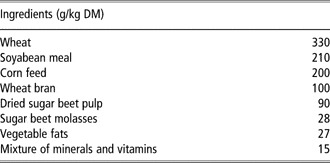
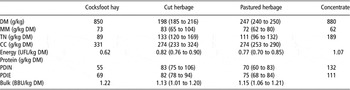
The composition of the concentrate is given in Table 1. Chemical composition and feed values of concentrate, hay, cut-green herbage and grazed herbage are given in Table 2. Water and salt blocks were always available to the animals. For HL and GL calves, daily individual intake of forage and concentrate was recorded 5 days a week. As the PH calves were fed in a group, no individual intake was measured. Mean concentrate intake was estimated daily as offered minus refused divided by the number of calves. All the animals were individually weighed once a week before and after suckling in order to estimate milk ingestion and live weight (Le Neindre, Reference Le Neindre1973). PH calves rested in the same pasture, but separated from their mothers the night before being weighed. Average daily gains (ADGs) were calculated by linear regression.
Composition of the concentrate

DM = dry matter.
Chemical composition of feed and feeding values (for green herbage mean and range of six analyses performed during all experimental period)

DM = dry matter; MM = mineral matter; TN = total nitrogen content; CC = crude cellulose; UFL = net energy for maintenance and gain expressed in milk feed units (unités fourragères lait); PDIN = proteins truly digestible in the small intestine allowed by the nitrogen content; PDIE = proteins truly digestible in the small intestine allowed by the energy content; BBU = bovine bulk unit.
Botanical composition of the grasslands
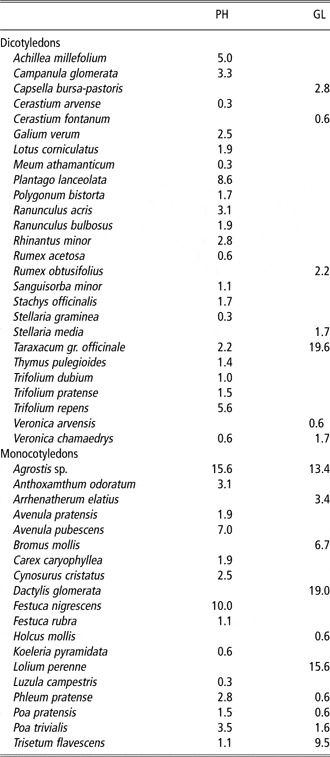
The botanical composition of the plot grazed by the PH group and the plot used to cut herbage for the GL group (Table 3) was estimated by the point quadrat method of Daget and Poissonnet (Reference Daget and Poissonnet1971) between 10 June and 16 June. The relative abundance of the species was recorded at 30 points located 0.5 m apart on two transects and expressed as a percentage of the total species.
Botanical composition (%) of the pastures used to feed the animals of the PH (pasture plus concentrate ad libitum) and GL (cut grass plus limited quantities of concentrate) groups

Slaughter and fat sampling
Slaughtering took place at the experimental slaughterhouse (EEC agreement n°6334501) at the INRA centre in Theix, Clermont Ferrand (France) in four sessions between 4 October and 8 November when the calves were approximately 10 months old. In each session, the oldest animal of each group was slaughtered. Total non-carcass fat was calculated as the sum of perirenal, peritoneal, mesenteric and pericardiac fat weights recorded at slaughter, and carcass fat was estimated by linear regression from the proportion of muscle, bone and fat of the sixth rib obtained by dissection (Robelin and Geay, Reference Robelin and Geay1975).
Approximately 20 g samples of fat were taken at slaughter from the subcutaneous and perirenal adipose tissues and wrapped in aluminium foil, then sealed in polyethylene bags with a vacuum packaging machine (Multivac, F77462 Lagny-sur-Marne, France), and stored at −20°C.
Analysis of volatile compounds
Subsamples of 0.15 g adipose tissue taken from inside each sample were deposited, still frozen, onto 0.2 g of glass wool in 40-ml cylindrical glass extractors. Volatile compounds were extracted from the adipose tissue using a dynamic headspace method using a helium purge flow of 80 ml/min. Headspace volatiles were absorbed onto Tenax, desorbed at 200°C and analysed by gas chromatography–mass spectrometry with a Supelco SPB5 capillary column as described by Priolo et al. (Reference Priolo, Cornu, Prache, Krogmann, Kondjoyan, Micol and Berdagué2004).
Peak integrations were performed on the m/z 93 chromatogram for monoterpenes and the m/z 161 chromatogram for sesquiterpenes, except for γ-terpinene, menthol and unidentified components with retention indices 1227 and 1411 for which the m/z 121, 138, 123 and 154 were integrated, respectively. Skatole and 2,3-octanedione were quantified using the m/z 130 and 99 chromatograms, respectively. The proposed identification was based on linear retention indices and mass spectra similarities.
Data analysis
Variance of the data of volatile compounds (arbitrary area units) was stabilised using logarithmic transformation. The logarithmic values of the areas underwent variance analysis using the GLM procedure of SAS (SAS, 1989). The effects of the feeding treatment (HL, GL and PH), the site of measurement (perirenal and subcutaneous fatty tissues) and their interaction were examined. A two-factor model (3 × 2) with repeated measures on one factor (site) as described by Cody and Smith (Reference Cody and Smith1991) was used. Single animals were considered as experimental units. Differences between means were separated by the PDIFF procedure of SAS. The results are presented as least squared mean values with standard error. A principal component analysis (PCA) was performed using Statistica Software (Statsoft, Inc., OK, USA) on skatole, 2,3-octanedione and γ-cadinene logarithmic data as active variables.
Results
Food intake and animal performance
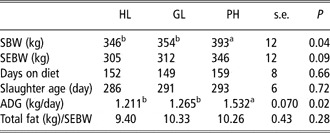
No difference was found between groups (P > 0.05) for the days spent on the experimental diets or for the slaughter age (Table 4).
Growth performances of the HL (hay plus limited quantities of concentrate), GL (cut grass plus limited quantities of concentrate) and PH (pasture plus concentrate ad libitum) animals

SBW = slaughter body weight; SEBW = slaughter empty body weight: ADG = average daily live weight gain.
a,bMeans within a row with different superscripts are significantly different at P ≤ 0.05.
Average total milk intake of HL, GL and PH calves was not different (P > 0.05; 838 ± 124 kg). Total dry matter (DM) concentrate intake of HL and GL calves was 264 ± 18 and 257 ± 19 kg, respectively. Concentrate intake increased with growth from 250 g to, approximately, 2250 g/day. Total DM concentrate intake of PH calves averaged 377 kg, respectively, 30% and 32% higher than that of HL and GL calves. Total DM forage intake was 339 ± 35 and 375 ± 42 kg, respectively, in HL and GL calves.
The ADG was higher for the PH group than HL and GL groups (P = 0.021; Table 4). Feeding treatment did not affect the fat percentage of the empty body weight at slaughter (P = 0.28).
Volatile compounds
The 2,3-octanedione and skatole were detected in all the samples analysed. The 2,3-octanedione was higher (P < 0.05) in the fat from animals in the PH and GL groups than from the HL group (Table 5). For the two types of tissue analysed, the GL group presented the highest skatole values, followed by the HL group and then the PH group. Differences between all groups were significant (P < 0.05).
2,3-octanedione and skatole desorbed from perirenal and subcutaneous fat of the HL (hay plus limited quantities of concentrate), GL (cut grass plus limited quantities of concentrate) and PH (pasture plus concentrate ad libitum) animals†

a,b,cMeans within a row with different superscripts are significantly different at P ⩽ 0.05.
†Logarithmic values of area arbitrary units, means of four measurements.
‡Linear retention indices on a DB5 column.
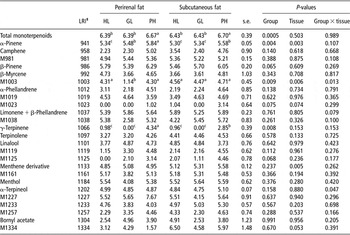
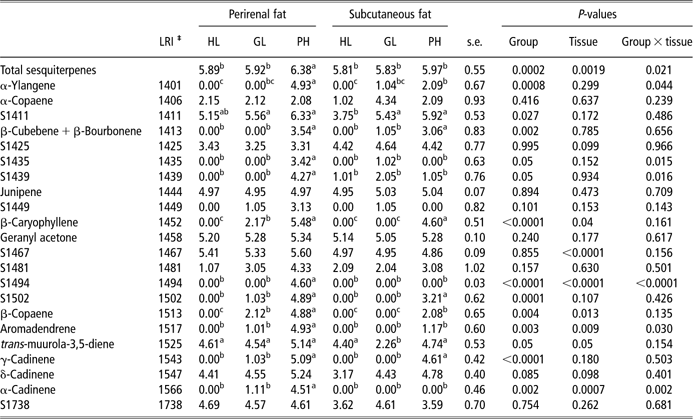
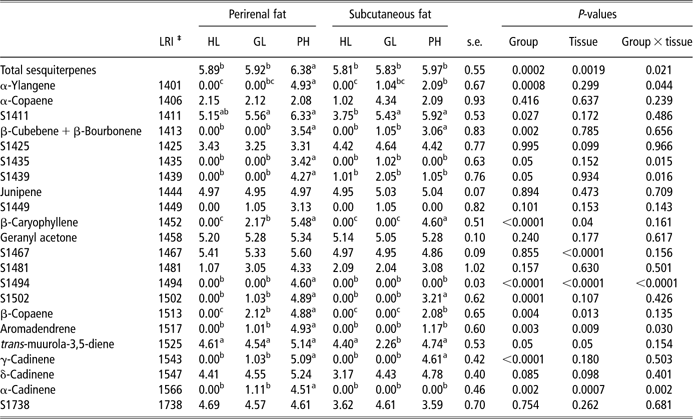
The 26 monoterpenoids and 23 sesquiterpenoids detected in the samples are presented in Tables 6 and 7. Although in very low amounts in milk and meat products, terpenes are easily detected using mass spectrometry, thanks to their characteristic ions (93 and 136 for monoterpenes, 93, 136, 161 and 204 for sesquiterpenes). However, co-eluting fat compounds in much higher amounts sometimes confuse their mass spectra, thereby preventing them from being identified. In order to facilitate the comparison with other studies, unidentified terpenes have been named from their retention indices.
Monoterpenoids desorbed from perirenal and subcutaneous fat of the HL (hay plus limited quantities of concentrate), GL (cut grass plus limited quantities of concentrate) and PH (pasture plus concentrate ad libitum) animals†

LRI = linear retention indices.
a,b,cMeans within a row with different superscripts are significantly different at P ⩽ 0.05.
†Logarithmic values of area arbitrary units, means of four measurements.
‡LRI on a DB5 column.
Unidentified monoterpenoids: M981, M1003, M1019, etc.
Sesquiterpenoids desorbed from perirenal and subcutaneous fat of the HL (hay plus limited quantities of concentrate), GL (cut grass plus limited quantities of concentrate) and PH (pasture plus concentrate ad libitum) animals†
LRI = linear retention indices.
a,b,cMeans within a row with different superscripts are significantly different at P ⩽ 0.05.
†Logarithmic values of area arbitrary units, means of four measurements. ‡LRI on a DB5 column.
Unidentified sesquiterpens: S1411, S1425, S1435, etc.
The only monoterpenoids affected by the group factor (P < 0.05) were α-pinene, M1003 and γ-terpinene, all of them except M1003 allowing group discrimination. The highest α-pinene values were found in the PH group, followed by the GL and HL groups. Between-group differences were significant (P < 0.05) except between GL and HL in subcutaneous fat. Perirenal values were higher than subcutaneous values for GL and PH groups. For the two tissues studied, γ-terpinene values were higher (P < 0.05) in the PH group than in the other two groups.
Thirteen sesquiterpenes were affected (P ⩽ 0.05) by the treatment (Table 7). For six of them (β-caryophyllene, S1494, β-copaene, aromadendrene, trans-muurola-3,5,-diene and α-cadinene), perirenal values were significantly higher (P < 0.05) than subcutaneous values.
In perirenal fat, for 11 of the 13 substances significantly affected by the treatment, the highest values (P < 0.05) were found in the PH group. For two of them (β-caryophyllene and β-copaene), differences between the HL and GL groups were significant (P < 0.05). In subcutaneous fat, PH values were higher than HL and GL values for β-cubebene + β-bourbonene, β-caryophyllene, S1502, β-copaene and γ-cadinene. There was no significant difference between HL and GL values for these compounds. For S1411, HL values were lower (P < 0.05) than GL and PH values.
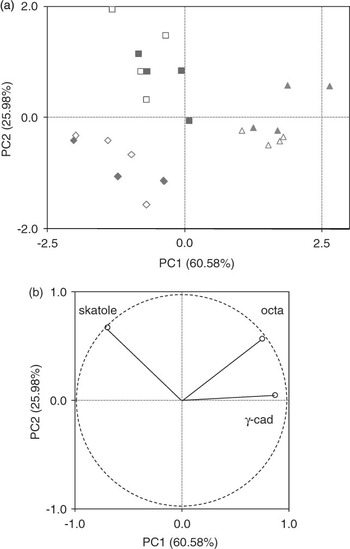
The PCA presented in Figure 1 allowed to completely separate the three groups of animals using the three markers: 2,3-octanedione, skatole and one terpene. The sesquiterpene γ-cadinene was chosen as the most significant for the group, but not influenced by the tissue.
Plot of the two first Principal Components for (a) the individuals: perirenal (empty symbols) and subcutaneous (plain symbols) fatty tissues from animals fed on diversified pasture with concentrates ad libitum (triangles), low-diversity green herbage with low level of concentrate (squares) or hay with low level of concentrate (lozenges) and (b) the active variables skatole, 2,3-octanedione (octa) and γ-cadinene (γ-cad).

Discussion
The three rearing systems applied in this study were expected to lead to three different adipose tissue marking patterns, combining terpene, 2,3-octanedione and skatole. The main factors governing biomarker accumulation in ruminant products are the botanical composition of the forage, its preservation mode, the level of grain supplementation and the considered fatty tissue type. The pasture supporting the PH animals was highly diversified. Among its 35 plant species, Meum athamanticum, Achillea millefolium and Thymus pulegioides are known as terpene-rich plants (Cornu et al., Reference Cornu, Carnat, Martin, Coulon, Lamaison and Berdagué2001a). In contrast, the grassland from which herbage was cut for the GL animals contained 17 plant species, none of which were known to be aromatic plants. Preserved forages, and particularly hay, lose a high proportion of terpenes (Cornu et al., Reference Cornu, Kondjoyan, Martin, Ferlay, Pradel, Coulon and Berdagué2002) and the lipoxygenase/linoleic/linolenic acid from which 2,3-octanedione originates (Keen and Wilson, Reference Keen and Wilson1992; Ferlay et al., Reference Ferlay, Martin, Pradel, Coulon and Chilliard2006). Concentrates tend not to contain any terpene or lipoxygenase (except for the soyabean meal, that contains lipoxygenase), and therefore feeding concentrates will dilute the tissue concentration of these compounds (Young et al., Reference Young, Berdagué, Viallon, Rousset-Akrim and Theriez1997; Liu, Reference Liu1999).
In agreement with Young et al. (Reference Young, Berdagué, Viallon, Rousset-Akrim and Theriez1997) and Priolo et al. (Reference Priolo, Cornu, Prache, Krogmann, Kondjoyan, Micol and Berdagué2004), 2,3-octanedione proved to be a good indicator of green herbage feeding, diversified or not. The lowest 2,3-octanedione raw value in cut-green herbage or pasture-fed animals was 2.5 times higher than the highest one in hay-fed animals. Low amounts of 2,3-octanedione were found in the animals fed on hay. Only one anecdotal assay has been mentioned in the literature, which failed to mention any evidence of lipoxygenase activity in ryegrass hay, whereas it had been abundant in the fresh grass (Keen and Wilson, Reference Keen and Wilson1992). Therefore, the lipoxygenase most probably originated from the soyabean contained in the concentrate. In a study published by Ferlay et al. (Reference Ferlay, Martin, Pradel, Coulon and Chilliard2006), linoleic and linolenic acid content of cocksfoot hay were, respectively, 0.28% and 0.63% DM, whereas they represented up to 0.82% and 2.25% DM in fresh herbage from diversified grassland. Thus, the fatty acid precursors of 2,3-octanedione might have come from the hay. Analysing lipid composition in the hay and the concentrate could help understanding more precisely the origin of 2,3-octanedione in hay-fed animals.
Skatole was detected in the perirenal and subcutaneous fat of all the animals. Animals receiving high-concentrate levels (PH group) presented lower skatole values than animals receiving low-concentrate levels (HL and GL groups). Lane and Fraser (Reference Lane and Fraser1999) reported higher levels of skatole in the subcutaneous fat from steers finished on a ryegrass-clover pasture than in fat from steers finished on a maize-based diet. In their study, the protein/non-fibrous carbohydrate ratio was much higher in pasture than in the maize diet. Young et al. (Reference Young, Lane, Priolo and Fraser2003) reported higher levels of skatole in the perirenal fat of lambs raised on pasture compared to maize-dominated concentrate-fed lambs. In the same study, a third group of lambs fed on a lucerne-dominated concentrate diet with intermediate values of nitrogen/soluble carbohydrate ratio presented intermediate skatole values, not significantly different from those of the two other groups. Although in this study, all between-group differences were significant, PH values overlapped the HL group values and these overlapped the GL values. Considering total nitrogen content in the three forage types used (Table 2) and the proportion forage/concentrate in the diet, the protein/soluble carbohydrate ratio would be higher in GL group followed by HL and PH groups.
Priolo et al. (Reference Priolo, Cornu, Prache, Krogmann, Kondjoyan, Micol and Berdagué2004) observed no difference in skatole accumulation in the subcutaneous caudal fat of lambs raised and finished on pasture, raised on pasture and finished on concentrate and raised and finished on concentrate. In this study, the crude protein (CP) to NDF ratio of the concentrate-based diet was in the range of values found in the grassland samples (calculated from the data given in Prache et al., Reference Prache, Priolo and Graulier2003). Moreover, the proportion of legume species in the pasture used was low. Schreurs et al. (Reference Schreurs, Tavendale, Lane, Barry, Marotti and McNabb2003) observed higher rumen concentrations of skatole per kilogram of CP eaten, when fistulated sheep were fed white clover than when they were fed perennial ryegrass. In another study, Priolo et al. (Reference Priolo, Vasta, Fasone, Lanza, Scerra, Biondi, Bella and Whittington2009) reported higher levels of skatole in ruminal fluid and in caudal fat of lambs fed a legume forage (Vicia sativa, CP intake 181 g/day) than in lambs given concentrate (CP intake 120 g/day).
Conflicting results reported in the literature with regard to skatole as feeding tracer could be also clarified considering other factors like between-animal variation due to differences in liver metabolism (Deighton et al., Reference Deighton, Pacheco, Tavendale, Schreurs, Peters, McNabb and Roy2006), conditions of animal housing (Hansen et al., Reference Hansen, Larsen, Jensen, Hansen-Moller and Barton-Gade1993), presence of compounds in the diet as condensed tannins capable to slow down rumen degradation of forage protein (Schreurs et al., Reference Schreurs, Lane, Tavendale, Barry and McNabb2008; Priolo et al., Reference Priolo, Vasta, Fasone, Lanza, Scerra, Biondi, Bella and Whittington2009), location of fat sampling and animal breed (Priolo et al., Reference Priolo, Cornu, Prache, Krogmann, Kondjoyan, Micol and Berdagué2004).
Most of the terpenes for which significant differences were observed between diets were not detected or of low concentration in the fat of calves from the HL and GL treatments. Low-diversity cut-green herbage-fed animals could not be distinguished from hay-fed animals. Although monocotyledons are considered poor in terpenes, Priolo et al. (Reference Priolo, Cornu, Prache, Krogmann, Kondjoyan, Micol and Berdagué2004) observed marked differences in the sesquiterpene profile of fat from lambs fed on pasture containing 90% Poaceae and those fed on hay and concentrate. Although the low-terpene content in the fat of GL calves essentially reflects the narrow diversity of the grassland used, terpene volatilisation from the cut herbage must not be neglected. Cut herbage remained in the feeders for 24 h and the main periods of forage consumption were in the morning immediately after dispensing, in the evening and in the early morning of the next day. The different terpenes behave differently as discriminating markers. Globally, sesquiterpenes have been accepted as having higher discriminatory powers than monoterpenes in ovine fat (Priolo et al., Reference Priolo, Cornu, Prache, Krogmann, Kondjoyan, Micol and Berdagué2004; Prache et al., Reference Prache, Kondjoyan, Delfosse, Chauveau-Duriot, Andueza and Cornu2009), bovine fat and meat (Cornu et al., Reference Cornu, Kondjoyan, Begnaud, Micol, Renou and Berdagué2001b; Serrano et al., Reference Serrano, Cornu, Kondjoyan, Figueredo, Agabriel and Micol2007a) and dairy products (Fernandez et al., Reference Fernandez, Astier, Rock, Coulon and Berdagué2003). These differences could be explained by a lower absorption in the digestive tract and a greater degradation of monoterpenoids in the animal organs. Secretion in milk could be considered as a route of terpene elimination. Observations in this study agree with the results obtained by Viallon et al. (Reference Viallon, Martin, Verdier-Metz, Pradel, Garel, Coulon and Berdagué2000), who observed that monoterpene content in milk increased more rapidly than sesquiterpene content after a terpene-rich diet.
For skatole and 11 terpenes analysed in this study, the perirenal fat values were higher than those for subcutaneous fat. In addition, as some potent discriminants like S1494 and α-cadinene were not found in subcutaneous fat, perirenal fat proved more reliable than subcutaneous fat for distinguishing between feeding treatments. According to Vernon (Reference Vernon1986), during the postnatal phase fatty tissues develop mainly by adipocyte hypertrophy, the earliest being perirenal, followed by omental, intermuscular and lastly subcutaneous. As lipophilic compounds, such as terpenes enter fatty tissues along with fatty acids, differences in the timing of fatty-tissue development or in tissue turnover could explain the between-tissue differences observed in the relatively young animals studied here. These between-tissue differences in tracer accumulation may imply differences in the utilisation of different tissue types when tracing grass feeding. Serrano et al. (Reference Serrano, Prache, Chauveau-Duriot, Agabriel and Micol2006 and Reference Serrano, Cornu, Kondjoyan, Figueredo, Agabriel and Micol2007a) observed similar differences when they compared the reliability of perirenal and subcutaneous fatty tissues for discriminating between different feeding regimes differing in carotenoid and terpene content in calves. Priolo et al. (Reference Priolo, Cornu, Prache, Krogmann, Kondjoyan, Micol and Berdagué2004) have already hypothesised that differences in the location of fat sampling (subcutaneous v. perirenal) could explain differences in skatole concentrations in different trials. In another study, Priolo et al. (Reference Priolo, Prache, Micol and Agabriel2002) found perirenal fat to be much more reliable than subcutaneous fat for discriminating concentrate v. green herbage feeding in young lambs using carotenoid absorption measurements.
Conclusion
The three experimental rearing systems can readily be discriminated using the three markers studied, as illustrated by the PCA (Figure 1). The 2,3-octanedione is confirmed as a good indicator of green herbage feeding, allowing animals fed on pasture and on freshly cut-green herbage to be differentiated from animals that had been fed on hay. Skatole can be considered as a biomarker of low-concentrate feeding that reflects differences in ruminal protein degradation associated with variations in protein/soluble carbohydrates ratio in the diet. The sesquiterpene γ-cadinene separates high-diversity pasture-fed animals from hay- or low-diversity cut-green herbage-fed animals. Finally, a complete separation of the three groups is achieved by combining the three markers. Sesquiterpenes were better tracers than monoterpenes: a greater number were significantly different, with no overlapping values between the PH group and the two other groups for 10 of them, and five were found only in PH adipose tissues. Perirenal fat proved more responsive than subcutaneous fat to increased dietary terpenes in young calves, and thus was more reliable for distinguishing between feeding treatments. As some disappearance of terpenes in low-diversity cut-green herbage may have occurred, a similar study needs to be undertaken using grazing animals.
Acknowledgements
The authors thank I. Constant, Ph. Pradel and INRA-Marcenat staff, R. Jailler and the team at the experimental slaughterhouse in Theix.