Introduction
Cylindropuntia fulgida (Engelmann) F.M. Knuth var. fulgida (Engelmann) F.M. Knuth (Cff) (Caryophyllales: Cactaceae) is commonly known as the jumping or chain fruit cholla in its native range (Benson, Reference Benson1982; Anderson, Reference Anderson2001) and as rosea cactus in its introduced range in South Africa (Zimmermann, Reference Zimmermann and Stirton1978; De Beer, Reference De Beer1986a). Cff is a tree-like cactus composed of a woody trunk and cylindrical cladodes that are densely covered with spines coated with deciduous, papery sheaths (Bravo-Hollis, Reference Bravo-Hollis1978; Benson, Reference Benson1982; Anderson, Reference Anderson2001; Rebman & Pinkava, Reference Rebman and Pinkava2001). The evolution and systematics of the cacti have recently been reviewed, with molecular data providing evidence for splitting the genus, Opuntia, into five genera (Wallace & Gibson, Reference Wallace, Gibson and Nobel2002). Among the five is Cylindropuntia (the chollas) in a clade with the genera Grusonia, Marenopuntia, Corynopuntia and Micropuntia and the ancestral relatives, Pereskiopsis and Quiabentia. Cylindropuntia is composed of 33 recognized species, six varieties and nine known hybrids (Anderson, Reference Anderson2001; Rebman & Pinkava, Reference Rebman and Pinkava2001). Cff is one of two varieties of C. fulgida, the other being C. f. var. mamillata (Benson, Reference Benson1982; Anderson, Reference Anderson2001; Rebman & Pinkava, Reference Rebman and Pinkava2001) and is taxonomically similar to C. cholla (Rebman, Reference Rebman1995). The distribution of Cylindropuntia spp. spans from southwestern and southern USA to Mexico and Cff is native to the Sonoran Desert of Arizona in the USA and Sinaloa and Sonora in Mexico, where it occurs in sympatry with C. f. var. mamillata (Benson, Reference Benson1982; Anderson, Reference Anderson2001).
According to Zimmermann (Reference Zimmermann and Stirton1978), Cff was introduced to South Africa in the 1940s for ornamental purposes where, initially, it was incorrectly known as Opuntia rosea De Candolle. With time, it spread from gardens and became a noxious weed. It encroaches on natural vegetation, reducing biodiversity, an important feature of conservation areas and, in rangelands, reduces the carrying capacity and the economic value of the land. Although listed as a weed of minor economic importance in the early 1990s (Moran & Zimmermann, Reference Moran and Zimmermann1991), Cff spread steadily and now forms dense infestations over large areas of the Free State, Northern Cape, Limpopo and North West Provinces of South Africa (Zimmermann, Reference Zimmermann and Stirton1978; De Beer, Reference De Beer1986a; Henderson, Reference Henderson1995, Reference Henderson2001; Henderson & Zimmermann, Reference Henderson and Zimmermann2003; Plant Protection Research Institute, 2007). It is now listed as a Category 1 weed (Conservation of Agricultural Resource Act, 1983 as amended in 2001).
Both mechanical and chemical control measures failed to curb the spread of Cff because they were laborious and expensive (Malan & Zimmermann, Reference Malan and Zimmermann1988); hence, there is an urgent need to identify a highly effective biological control agent with the potential to cause maximum damage to Cff and curtail its spread. Cochineal insects (Dactylopius species) rank highest among the agents that have been used for the biological control of cactus weeds worldwide (Moran & Zimmermann, Reference Moran, Zimmermann and Delfosse1984b; Julien & Griffiths, Reference Julien and Griffiths1999). As the insects feed, it is believed that toxins in the cochineal saliva, which are injected into the plant during the feeding process, may be responsible for the death of tissues causing host plants to eventually succumb to the sheer numbers of nymphs and adult females (Moran, Reference Moran1981). However, as cochineal insects tend to be specialized on particular cactus species (Moran, Reference Moran1980), it is imperative that an appropriate species be identified for each target weed (Zimmermann & Granata, Reference Zimmermann, Granata and Nobel2002).
The biological control of Cff was attempted using D. tomentosus (Lamarck). This species had been introduced to South Africa for biological control of C. imbricata (Haw.) F.M. Knuth (Ci) in 1970, following its success on the same weed in Australia (De Beer, Reference De Beer1986b). However, for unknown reasons, D. tomentosus had little impact on Cff, as only small plants were killed (Moran & Zimmermann, Reference Moran and Zimmermann1984a) and the weed's invasive range continued to expand. Cochineal insects only feed and reproduce on certain species within the Opuntioidea (Moran, Reference Moran1980) and, in previous studies (Volchansky et al., Reference Volchansky, Hoffmann and Zimmermann1999; Githure et al., Reference Githure, Zimmermann and Hoffmann1999), D. opuntiae (Cockerell) was shown to have such a restricted host range that, at the sub-specific level, biotypes exist that are host-adapted to particular Opuntia species. The success of biological control of Ci by D. tomentosus and its failure to establish on Cff is an indication that host-adapted biotypes may also exist within this species. If this is the case, discovery of host adapted biotypes of D. tomentosus could renew the prospect of biological control of Cff in South Africa. The correct identification of the weed in South Africa, as Cff, at the onset of this project enabled exploration of its native range for new provenances of D. tomentosus and investigation of host plant specialisation.
The monogeneric family, Dactylopiidae, within the Hemiptera has nine Dactylopius species (De Lotto, Reference De Lotto1974) all of which originate from North and South America where they feed exclusively on Cactaceae (De Lotto, Reference De Lotto1974; Guerra & Kosztarab, Reference Guerra and Kosztarab1992; Portillos & Vigueras, Reference Portillos and Vigueras2006). The native range of D. tomentosus is in North America, including Arizona, Texas, New Mexico and Mexico (Rodríguez et al., Reference Rodríguez, Méndez and Niemeyer2001). Descriptions of the different species within the genus Dactylopius were made by De Lotto (Reference De Lotto1974) and Guerra & Kosztarab (Reference Guerra and Kosztarab1992) and the latter authors proposed the phylogenetic relationships within the genus based on morphological characteristics. Rodríguez et al. (Reference Rodríguez, Méndez and Niemeyer2001) also used morphological characteristics to construct the phylogeny of the genus. However, their analysis is at variance with that of Guerra & Kosztarab (Reference Guerra and Kosztarab1992) and, in the absence of molecular information, the phylogenetic relationship within this genus remains unresolved.
Like other cochineal insects, D. tomentosus has a restricted range of host plants, such that it is only associated with Cylindropuntia species (Zimmermann & Granata, Reference Zimmermann, Granata and Nobel2002), and a list of host species has been published by Guerra & Kosztarab (Reference Guerra and Kosztarab1992). Most of these were unidentified cactus species, but several Cylindropuntia species are mentioned, including C. acanthocarpa, C. bigelovii, C. imbricata, C. leptocaulis, C. fulgida and C. tunicata. Although the developmental and reproductive biology of D. tomentosus has recently been described (Mathenge et al., in press), the host specificity of different provenances of D. tomentosus has not been examined. In particular, the host specificity of the D. tomentosus provenance used for the biological control of Ci had not been tested prior to its release. Therefore, the overall objectives of this study were to examine host specificity and level of performance of D. tomentosus provenances from different hosts and localities on Cff in the laboratory. The specific objectives were: (i) to investigate the occurrence of host-adapted biotypes; and (ii) to identify provenances with the potential to severely damage and effectively control Cff in South Africa.
Materials and methods
Exploration and survey
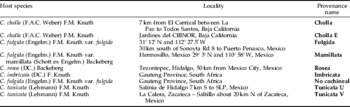
Plants in the native range of Cff, the Sonoran desert, as well as plants of closely related Cylindropuntia species in different localities in the central part of Mexico between 24–25° N were surveyed for D. tomentosus. Populations of different provenances were collected following the guidelines for the biological control of weeds as outlined by Briese (Reference Briese2004) and Briese et al. (Reference Briese, Pettit and Walker2004). The host species and location from which each provenance was collected is given in table 1. The species were identified by staff from the Laboratorio de Biotecnología, Universidad de Guadalajara. Provenance names are derived from the specific name of the host species from which a cochineal population was collected and are given in bold throughout this paper. Both infested and un-infested fresh cladodes of each host plant were also collected. Each cochineal population was packaged in a separate, sealed box; and the insects and cladodes were sent to the quarantine facilities of the Weeds Research Division at the Plant Protection Research Institute (PPRI) of the Agricultural Research Council in Pretoria (ARC), South Africa, where all experiments were conducted. In addition, Ci and Cff cladodes, as well as the cochineal insects infesting them, were collected from the field in South Africa (table 1).
Host plant species and locations of collection of the 8 provenances of D. tomentosus used in this study.

Host specificity tests
Prior to host specificity testing, teneral females from each consignment were mounted on slides following the method of Cox (Reference Cox1987) and Williams & Granara de Willink (Reference Williams and Granara de Willink1992). Using a phase contrast microscope, insects were identified as D. tomentosus based on the characteristic arrangement of the medial and sub-medial rows of setae on the dorsal surface of the cuticle; the patterns observed were compared with the identification key of Guerra & Kosztarab (Reference Guerra and Kosztarab1992) and voucher specimens deposited at the Biosystematics Division of PPRI, ARC, Pretoria, South Africa. The two test plants, Cff and C. imbricata, originated from Gauteng province, South Africa and were propagated in pots at the Weeds Research Division. Their identity was confirmed by the National Botanical Institute, Pretoria, South Africa.
Host specificity tests were conducted concurrently under controlled environmental conditions as described below. All tests were ‘no-choice’ tests with crawlers being placed directly on detached cladodes of test plants, namely, Cff and C. imbricata. Mature, terminal cladodes picked from un-infested, potted plants were used at the start of each experiment, as they had been found to be most suitable for rearing cochineal insects (Volchansky, Reference Volchansky2000). All cladodes were washed thoroughly to remove unwanted organisms prior to seeding with cochineal insects.
Gravid females of the eight provenances of D. tomentosus were collected from their respective host plants and de-waxed by winding their wax onto a pin. The de-waxing of females ensured that the waxy threads did not hamper the removal and transfer of females into glass Petri dishes (90-mm Ø) where they were allowed to lay eggs. The Petri dishes were covered to prevent mobile crawlers from escaping. Crawlers were observed using a microscope to ensure that they were healthy and undamaged and then transferred onto test cladodes using a fine paintbrush. Thirty, neonate crawlers (<24-h old) from each provenance were introduced onto cladodes of Cff. In addition, 30 crawlers of the provenances, Cholla and Imbricata, were placed onto cladodes of Ci. Each combination of insect provenance and plant host species was replicated 3–5 times. The cladodes were supported using four pins embedded into a polystyrene block. This allowed the crawlers to settle anywhere on the cladode, as they are known to prefer settling in shaded areas such as the lower surface of the cladode and at the base of thorns or grooves of tuberculates. Cladodes on polystyrene blocks were placed in plastic cages. Replicates were placed randomly on bench tops in the laboratory in which conditions were regulated to 26±2°C and 60% RH, which are optimal conditions for cochineal survival and development (Hosking, Reference Hosking1984).
Data collection
The cladodes were inspected daily under a microscope to record the development and survival of nymphal stages. The time taken by the nymphs to undergo their first moult and the number of moults was recorded. The insects were allowed to develop undisturbed through the rest of their life cycle, and the numbers that reached maturity were used as a measure of survival.
The cladodes from replicates of the same treatments were paired in a single cage once males had pupated to increase the chance of mating between males and females. To assess fecundity, females were removed from cladodes at the onset of egg production, and the date of removal was recorded to measure female developmental time. Each female was dewaxed, weighed and placed in a Petri dish to continue egg production. Removing females from their feeding spot severs their mouthparts, which remain embedded in the tissues of the cladode, depriving them of their only source of food. However, this has no deleterious effects on egg production, as females separated from cladodes produce as many offspring as females left intact on cladodes (Moran & Cobby, Reference Moran and Cobby1979). Petri dishes were covered using a larger (100-mm Ø) glass Petri dish to prevent the hatching crawlers from escaping. At the end of the oviposition period, the number of progeny produced by each female was recorded.
From the above data, a fitness index was calculated for each provenance on the host(s) on which they were reared: where S is the proportion of crawlers surviving to first moult, P is the average number of progeny per female and T is the average female developmental time.
Statistical analysis
Analysis of variance was used to assess differences between means of time to first moult, time to female maturity, female mass at maturity and number of progeny produced per female, using Statistica (Version 6.1, StatSoft Inc.) and SPSS 14 for Windows (SPSS Inc.). Where data were not homoscedastic, they were subjected to square root transformations before analysis to remove or reduce heteroscedasticity. Where the data were homoscedastic, means were separated using Tukey's HSD tests; where data were heteroscedastic, means were separated using Games-Howell tests. A contingency χ2 test was performed on data relating to proportions of crawlers surviving to the first moult, with 95% confidence intervals calculated according to Snee (Reference Snee1974) and used to separate groups. Correlations between time to maturity, female mass and progeny numbers were determined using Statistica.
Results
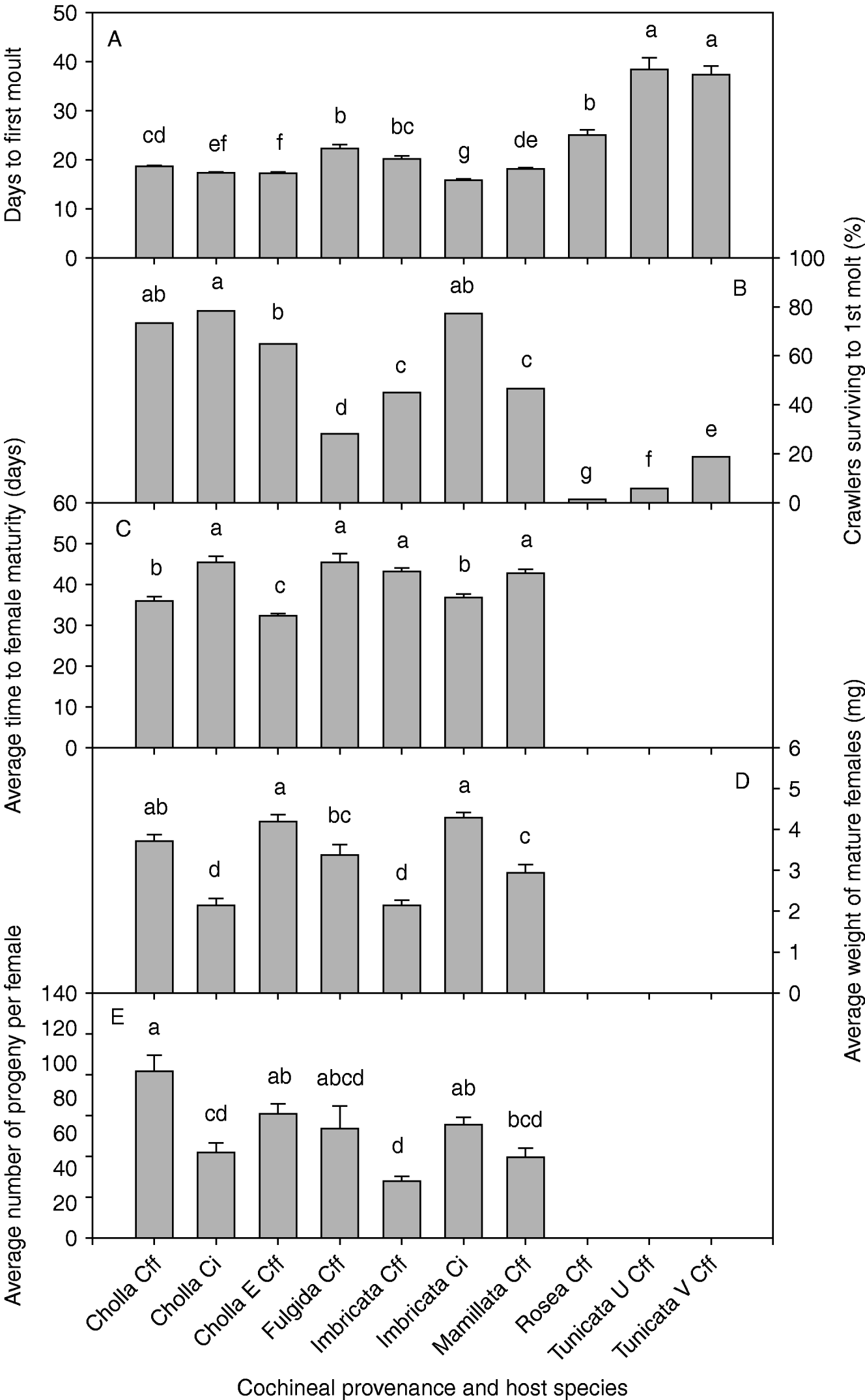
The developmental biology and reproductive performance of provenances of D. tomentosus on Cff are presented in fig. 1. There were large differences in the ability of the provenances reared on this species to develop and survive. In particular, crawlers of the provenances, Tunicata U and Tunicata V, took a long time to reach first moult (~36 days) compared to the other provenances (average development time ~20 days). The number of days to first moult of the provenance, Rosea, was also somewhat extended; and most of the crawlers of these three accessions died during their first instar stage, so that few individuals survived past their first moult (fig. 1a). The few crawlers that underwent first moult died in the early stage of second instar and none survived to maturity.
Times to different developmental stages (A and C), percentage of crawlers surviving from first to second instar (B), weight of females at maturity (D) and numbers of progeny produced (E), by provenances of D. tomentosus provenances cultured on C. fulgida var. fulgida (Cff) or C. imbricata (Ci). Bars (mean±SE) annotated with the same letters do not differ significantly (P<0.05). Individuals of the provenances Rosea, Tunicata U and Tunicata V did not survive to maturity.
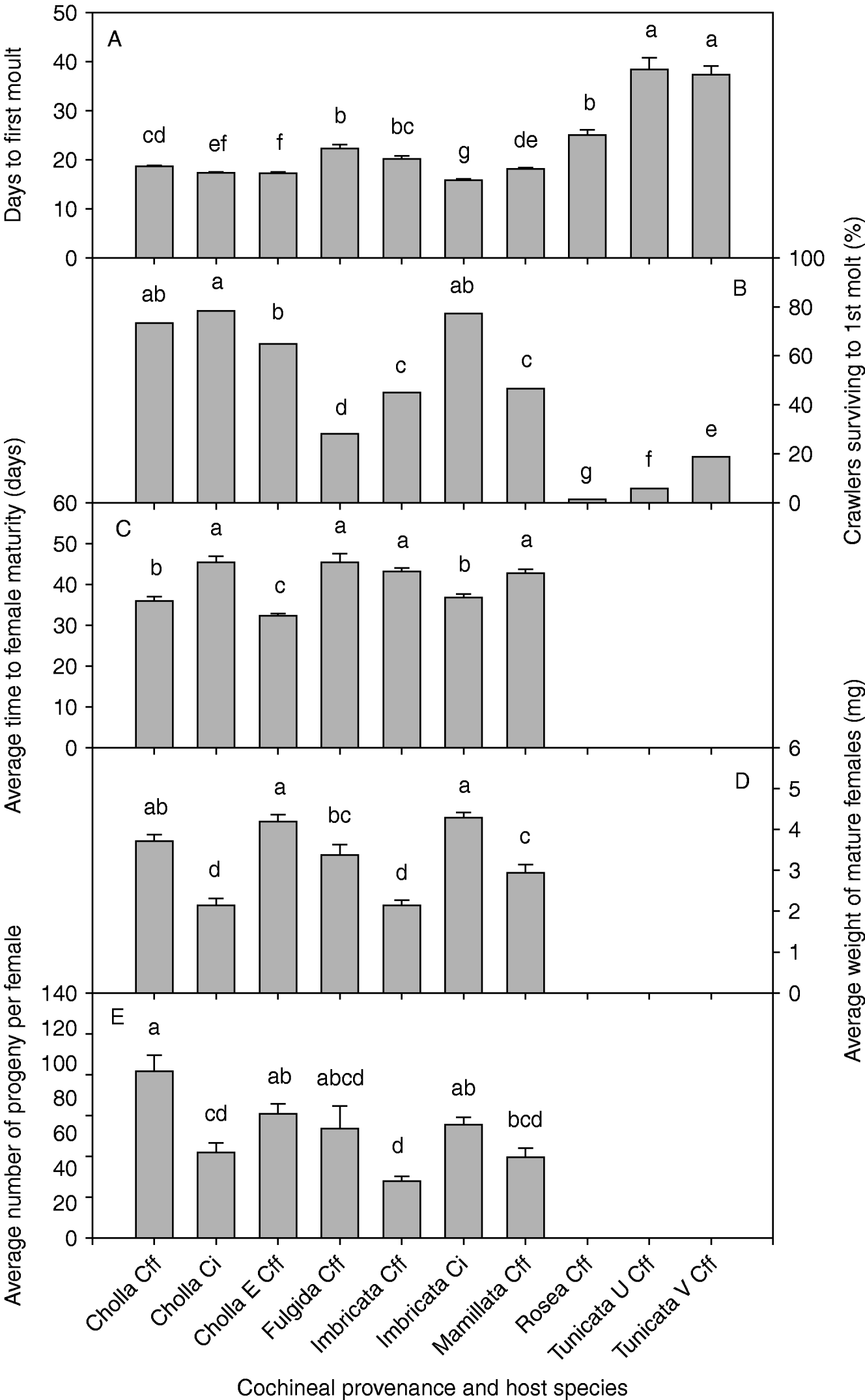
There was little difference between the performance of Cholla and Cholla E with respect to developmental time and survival on Cff. For the other provenances reared on Cff, the small variation in average time to first moult (17.2–22.2 days) was significantly different. Larger variation (32.4–44.5 days) was seen in the average number of days that females of the different provenances took to become mature; and, in general, provenances that took the longest time to first moult also took the longest time to reach maturity (fig. 1a, c). Large variation was also seen in the percentage of crawlers surviving to their first moult, and a significantly higher proportion of Cholla and Cholla E crawlers moulted (73% and 65%, respectively) compared to all other provenances (fig. 1b). Percentage survival tended to be negatively related to time to the first moult and to female maturity; this was particularly noticeable for the provenances Fulgida and Imbricata.
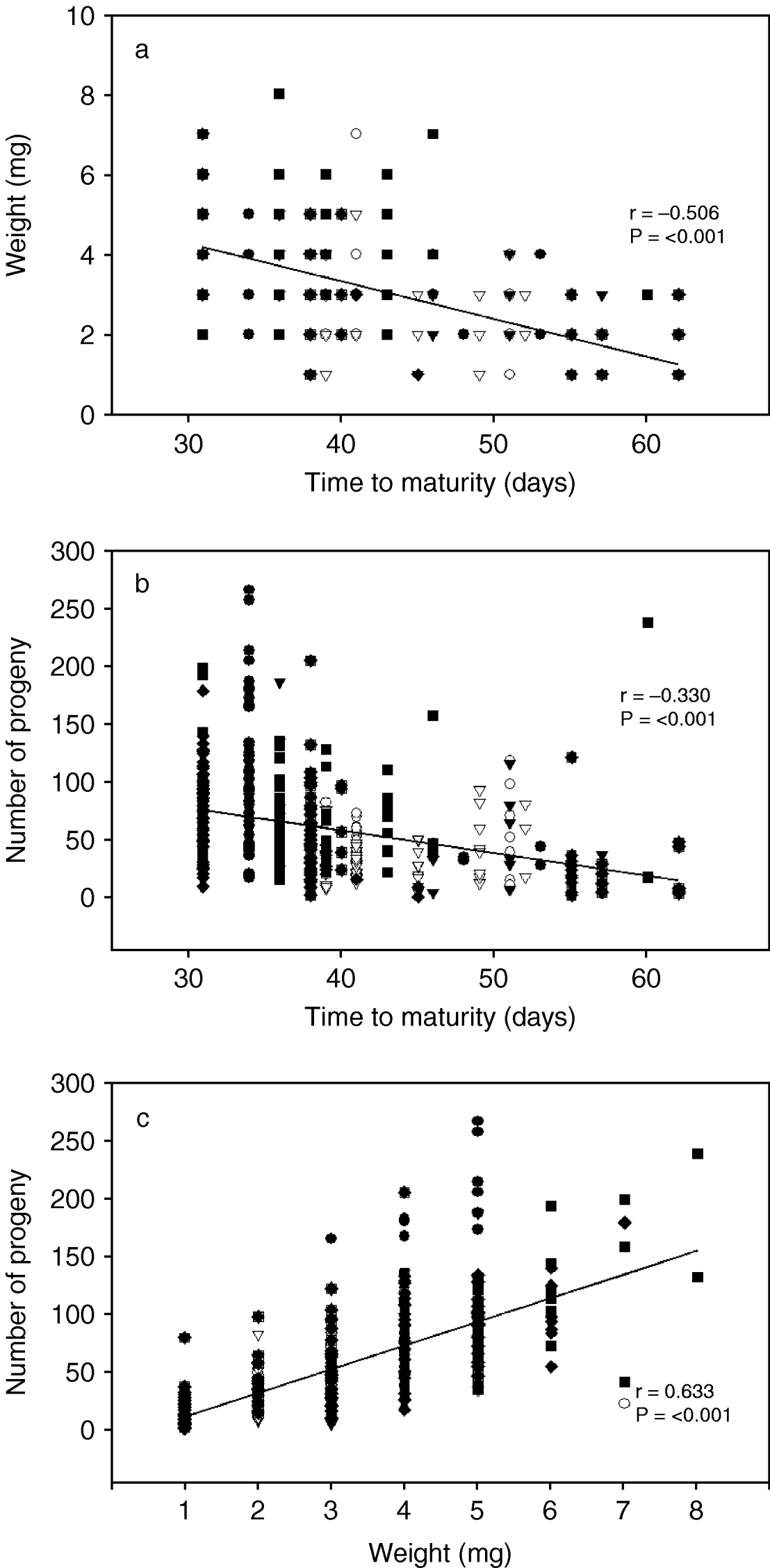
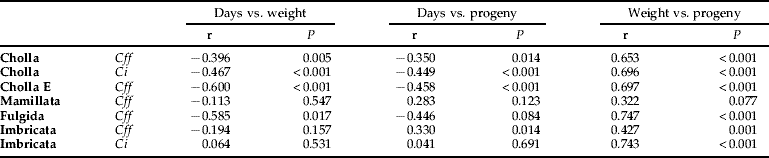
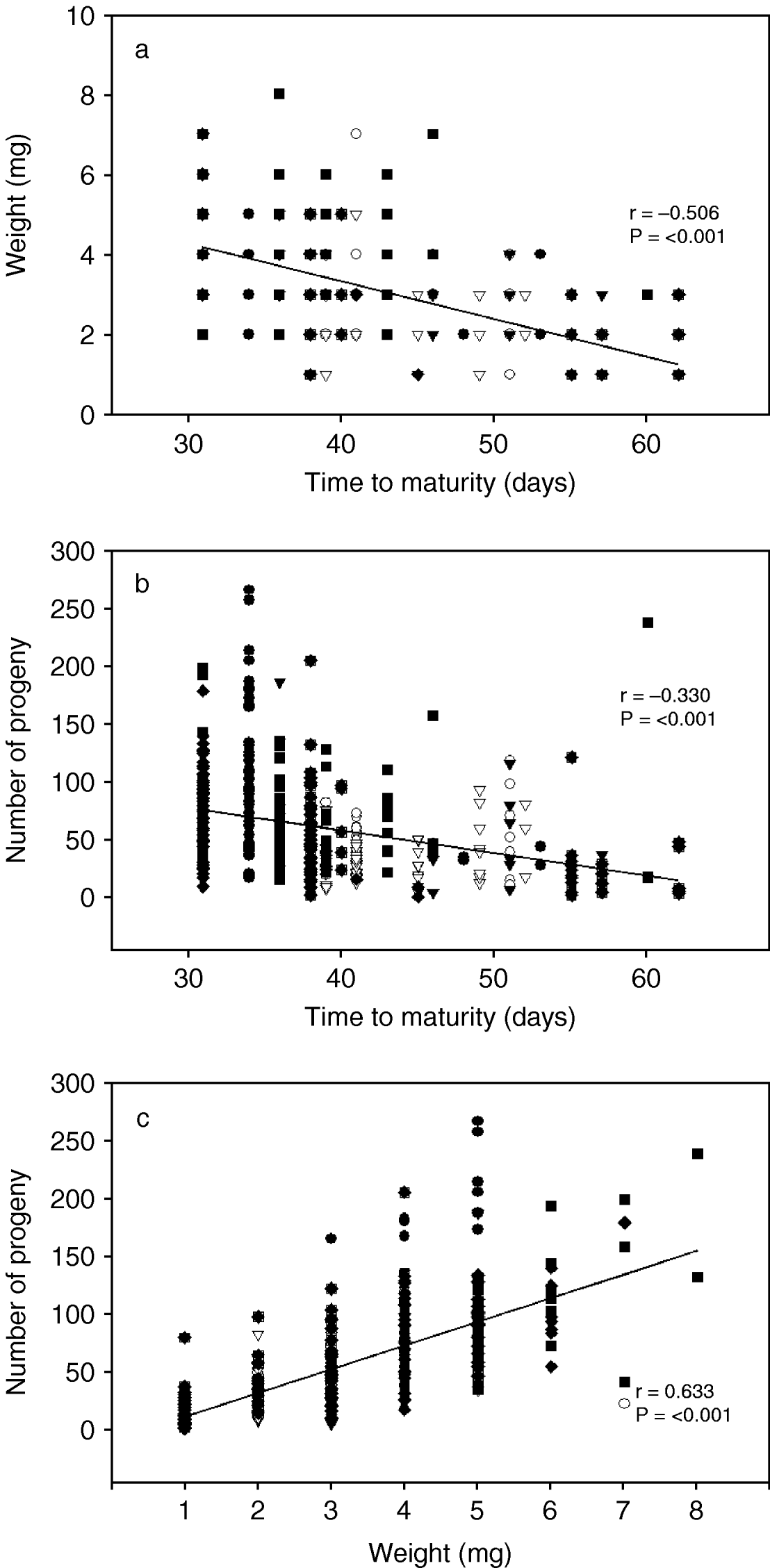
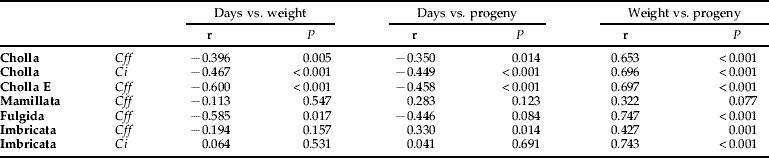
Reproductive performances of the provenances on Cff are expressed as the average number of progeny per female and female weight (fig. 1d, e), and there were statistically significant differences between the means of these parameters. The ranking of the provenances in terms of the number of progeny produced was similar to the ranking by female weight, with only Cholla and Cholla E differing in their placings; Cholla and Cholla E had the highest weight and number of progeny. Correlation analysis of the data from all accessions showed significant, negative relationships between time to maturity in females vs. female weight at maturity (r=−0.51, P<0.001) and between time to maturity and number of progeny (r=−0.33, P<0.001) (fig. 2). There was also a substantial, positive relationship between female weight at maturity and number of progeny (r=0.63, P<0.001) (fig. 2). The correlations between these parameters for individual provenances are presented in table 2. Female weight and the number of progeny of most individual provenances were significantly correlated; the exception was Mamillata where the relationship just failed to be significant (r=0.322, P=0.077). The correlations between time to maturity and female weight or number of progeny produced were less strong and were significant for three of the five provenances only; Mamillata showed no correlations between any of these three parameters.
Correlations between time to maturity and weight at maturity (a), time to maturity and numbers of progeny (b), and weight at maturity and numbers of progeny (c). Data are for females of provenances Cholla, Mamillata, Fulgida, Imbricata and Cholla E cultured on C. fulgida. var. fulgida (Cff) and Imbricata and Cholla cultured on C. imbricata (Ci) (•, Cholla Cff; ○, Mamillata Cff; ▾, Fulgida Cff; ▿, Imbricata Cff; ▪, Imbricata Ci; □, Cholla Ci; ♦, Cholla E Cff).
Correlations between days to female maturity, female weight (mg) at maturity and number of progeny produced by the five provenances of D. tomentosus cultured on either C. fulgida var. fulgida (Cff) or C. imbricata (Ci).
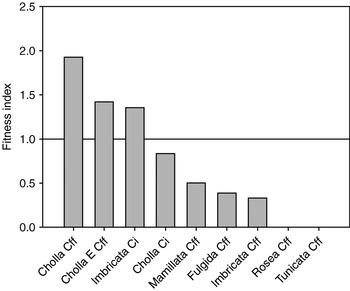
A comparison between the performance of the crawler and adult female stages of Cholla and Imbricata was also made on Cff and on Ci. For the provenance Cholla, there was little difference in the performance of the crawlers with similar numbers of days to first moult (18.4 vs. 17.4) and crawler survival (73.3% vs. 78.7%) on Cff and Ci. However, Cholla females took longer to reach maturity, weighed less and produced fewer progeny on Ci than on Cff. Larger differences were found between individuals of Imbricata on the two hosts, and both crawlers and mature females fared better on Ci than on Cff. Approximately 60% more crawlers of this provenance survived past first moult on Ci than on Cff, and the mature females were twice as heavy and produced twice the number of eggs (fig. 1). The fitness of the provenances, as assessed by their fitness index, is shown in fig. 3. This value varied between 0 and 1.93. Provenances with index values ≥1 were deemed to have thrived on their host whilst provenances with index values <1 but >0 were deemed to have survived; provenances with an FI of 0 died before completing their life cycle.
Fitness index of the provenances Cholla, Mamillata, Fulgida, Imbricata and Cholla E cultured on C. fulgida var. fulgida (Cff) and Imbricata and Cholla cultured on C. imbricata (Ci). Provenances with index values >1 were deemed to have thrived on their host whilst provenances with index values <1 but not >0 were deemed to have survived; provenances with an FI of 0 died before completing their life cycle.

Discussion
This study revealed that, for most provenances, there were correlations between adult development and fecundity. Time to maturity negatively correlated with female weight at maturity and the number of progeny produced by females; these relationships imply that faster developing females attain a larger size at maturity than slower developing females. Therefore, suitable host plants not only supported the complete development of individuals of a provenance but also enhanced their developmental time, survival and reproduction, i.e. their biological performance. The positive correlation between female weight and number of progeny is a common phenomenon among insects (Moran & Cobby, Reference Moran and Cobby1979) and has been observed in other Dactylopius species (Githure et al., Reference Githure, Zimmermann and Hoffmann1999; Volchansky et al., Reference Volchansky, Hoffmann and Zimmermann1999). This study has also shown that provenances of D. tomentosus fall into one of three subjective categories, based on their behaviour and FI, as follows: (i) those thriving on their host (FI≥1) – the insects settled quickly, began to feed and readily developed through the subsequent stages, and the females were highly fecund; (ii) those surviving on their host (FI<1 but >0) – the insects took a long time to settle, developed slowly through their life stages, and the females were not highly fecund; and (iii) those dying on their host (FI=0) – the majority of the insects failed to settle and feed, and none completed their life cycle.
Cholla thrived on Cff and, for this host plant, can be placed in category 1. The crawlers settled and developed faster and larger numbers survived each of the developmental stages compared to all other provenances. In addition, female developmental time was shorter, reproduction commenced at an earlier age, and the females were larger and produced more progeny. All these attributes qualify Cholla as the agent of choice for the control of Cff. As cochineal insects have multiple, overlapping generations in a year (Guerra & Kosztarab, Reference Guerra and Kosztarab1992), the short time taken to complete each generation by Cholla implies it has the potential to undergo more generations per year compared to the other provenances. In combination with more generations per year, the higher survival rate of Cholla crawlers and the higher number of progeny produced by this provenance suggest it has the ability to build high population levels within a short time. This is a desirable trait for the biological control of cacti, as they are large, resilient plants (Anderson, Reference Anderson2001), and it is the impact of cochineal insects in high numbers that eventually causes plants to succumb (Moran, Reference Moran1980). Based on their low crawler survival percentage, prolonged developmental time and low fecundity, the provenances Imbricata, Fulgida and Mamillata on Cff fell into category 2, and they would not be expected to attain a population large enough to control Cff. The provenances Tunicata and Rosea fell into category 3, as most crawlers did not settle or feed, and the few that settled did not complete the second instar stage.
In common with other Dactylopius species (Guerra & Kosztarab, Reference Guerra and Kosztarab1992), this study shows that D. tomentosus is capable of survival and reproduction on different Cylindropuntia species. However, it exhibits differential host utilisation at the subspecific level, whereby provenances vary in their ability to survive and thrive on particular host species. Based on the definition of biotypes as ‘morphologically indistinguishable insects which have distinct host preferences’ (Diehl & Bush, Reference Diehl and Bush1984) and the criteria for determination of biotypes (Zwölfer & Romstöck-Völkl, Reference Zwölfer, Romstöck-Völkl, Price, Lewinsohn, Fernandes and Benson1991; Drès & Mallet, Reference Drès and Mallet2002), this study demonstrated that biotypes of D. tomentosus exist. In particular, host specialisation in Tunicata and Rosea appear to have progressed to a level where the two provenances are unable to utilize Cff. In contrast, Cholla thrives on Cff. The existence of biotypes is further supported by the data from Cholla and Imbricata when each provenance was reared on two different hosts; Cholla thrived on Cff but was less fecund and survived on Ci, whereas Imbricata thrived on Ci but only survived on Cff. This differential biological performance is in accord with observations made in the laboratory and in the glasshouse during the rearing of cochineal for this study and other observations in the field. Cholla damaged cladodes from both plant species in cultures and when reared on 300–600-mm tall potted plants more rapidly than did Imbricata. Imbricata has also been observed to successfully control Ci but kills only small Cff plants in the field in South Africa (Moran & Zimmermann, Reference Moran and Zimmermann1991).
Due to the limited mobility of cochineal insects, local adaptation is expected to develop on a prevailing host species as has been found in other scale insects (Alstad, Reference Alstad, Mopper and Strauss1998; Mopper & Strauss, Reference Mopper and Strauss1998). Host adaptation in insects may be influenced by the characteristics of the insect, its host or both. Characteristics of D. tomentosus that could promote host specialization are the sedentary life style of females, the limited dispersal ability of the juveniles and short-lived, weak-flying males (Miller & Kosztarab, Reference Miller and Kosztarab1979). These characteristics promote isolation of insect populations on particular host plants. With respect to the host plant, Cylindropuntia species are long-lived, but their distribution can be patchy (Godínez-Álvarez et al., Reference Godínez-Álvarez, Valverde and Ortega-Baes2003). These isolated patches of plants would tend to be genetically similar with greater variation likely to occur between patches. Thus, isolated patches of plants also encourage the isolation of insect populations leading to the development of insect biotypes. In this study, two provenances (Tunicata U and Tunicata V) obtained from C. tunicata from two different localities had similar low performances on Cff. In addition, two provenances (Cholla and Cholla E) obtained from different populations of C. cholla had similar high biological performances on Cff. Therefore, any intraspecific variation that existed between the plant populations from which the insects were obtained did not result in variation in performance of these insect accessions. Thus, the major source of differential performance is from specialisation on different host species.
The biological performance of Fulgida on its native host species, Cff, was poor and was characterized by a low survival rate, a prolonged developmental time of the nymphal stages and a longer time to the commencement of oviposition. Therefore, it would be expected that Fulgida would have a slow rate of population increase on Cff. However, the relatively high fecundity of this provenance may compensate for the poor nymphal survival and prolonged developmental time, ensuring continued survival of this provenance at a level higher than if fecundity was also low. Such differential performance between immature and adult stages underlines the need to always include an evaluation of fecundity in host specificity tests of cochineal and other insects; evaluating cochineal insects based on nymphal performance alone may not adequately represent the overall performance of the provenance and may lead to erroneous acceptance or rejection of a candidate for biological control.
The relatively poor performance of Fulgida on Cff was surpassed by that of Cholla despite Cff being the original host of the former provenance in its native range. It would be expected that provenances of D. tomentosus should be better adapted to their founder host species and have a better biological performance on this species compared to alternative species (Via, Reference Via1991; Caillaud & Via, Reference Caillaud and Via2000). For some of the provenances of D. tomentosus used in this study, this does not appear to be the case. A number of explanations for the differences between these provenances can be given. Firstly, the prevalent taxonomic problems associated with cacti (Benson, Reference Benson1982; Rebman, Reference Rebman1995; Anderson, Reference Anderson2001) make it possible that the plant accessions used could have been misidentified. However, the host species used in this study were identified by recognised cactus taxonomists based on the current cactus classification system; therefore, the observed performances are likely to be due to other factors. Secondly, cactus species exhibit high levels of morphological variation (Rebman & Pinkava, Reference Rebman and Pinkava2001), and it is possible that subtle variation between Cff in its native and introduced range has resulted in the poor performance of Fulgida. Thirdly, the poor performance of Fulgida on its host of origin may be a case of maladaptation, which, though not common, has been observed among two lineages of the soft scale, Saissetia coffeae (Walker) (Hemiptera: Coccidae), originating from two different host species. These lineages exhibited lower fitness on their host of origin compared to that on their novel host (Spitzer, Reference Spitzer2006). Fourthly, although Fulgida was found on Cff in its natural range, this does not necessarily mean that Cff was the provenance's most preferred host. Fifthly, the performance of Cholla and Fulgida on Cff may be interpreted in terms of the ‘new association’ hypothesis proposed by Hokkanen & Pimentel (Reference Hokkanen and Pimentel1984, Reference Hokkanen and Pimentel1989). According to this hypothesis, a plant species may have developed defence mechanisms against an insect with which it has had a long association; however, these defences may not be effective against a recently introduced insect. Due to the formation of biotypes, Cholla may be acting as a new association and, thus, is likely to be an effective agent against Cff.
The existence of biotypes has implications for the practice and procedures of agent selection in the biological control of weeds. Firstly, provenances other than those utilising the weed in its native range need to be assessed during agent selection. Secondly, the collection of agents from closely related species (Wapshere, Reference Wapshere1974) needs to be treated with caution due to the possibility of introducing host-adapted biotypes that are less adapted to the target weed. For example, in this study, although all D. tomentosus provenances were collected from Cylindropuntia species that are supposedly closely related to Cff, Rosea and Tunicata were unable to use Cff as a host. Thirdly, it is important to include provenances from several hosts and localities during host specificity testing to avoid rejection of a potentially suitable biocontrol agent due to differential performance of provenances. For example, if host specificity testing was restricted to Rosea and Tunicata, D. tomentosus would have been rejected. As suggested by Sheppard et al. (Reference Sheppard, Hodge, Paynter and Rees2002), host specificity tests need to be conducted for each provenance prior to its release as a precaution against negative consequences of introduction of multiple strains (Clarke & Walter, Reference Clarke and Walter1995). Particularly, due to the existence of biotypes, agent species that successfully control a target weed species may fail to control a closely related species due to host adaptation. This is the case with Imbricata, which controlled Ci successfully in Australia and South Africa but not Cff in South Africa.
This study has demonstrated the occurrence of host-adapted biotypes of D. tomentosus and, hence, corresponds to the findings of host-adapted biotypes in D. opuntiae (Githure et al., Reference Githure, Zimmermann and Hoffmann1999; Volchansky et al., Reference Volchansky, Hoffmann and Zimmermann1999); this supports the conclusion that this phenomenon is widespread among Dactylopius species. Whether this sub-specific differentiation in host use has a genetic basis (Jaenike, Reference Jaenike1981) is not yet known. Hoffmann et al. (Reference Hoffmann, Impson and Volchansky2002) showed that there probably is a genetic basis to host specificity, because specificity changed in the progeny of crosses and back-crosses between different biotypes of D. opuntiae. This assumption would need to be verified using molecular techniques that would enable correct assignment of taxonomic status to the biotypes. Until this is done, it is recommended that Dactylopius provenances collected from different hosts or localities should not be mixed during collection, shipping and rearing and that the host specificity of each should be determined prior to their use in biological control of cactus weeds. Therefore, based on the findings of the current study, only Cholla should be released for biological control of Cff in South Africa.
Acknowledgements
We are grateful to the Weeds Research Division of the Plant Protection Research Institute, Agricultural Research Council, Pretoria, South Africa for provision of facilities during this research. We would like to thank their staff for help with this work and the South African Department of Agriculture, the National Research Foundation and the University of Cape Town for financial assistance. We are grateful to the Centre for Plant and Food Science, University of Western Sydney, Australia for financial support and provision of facilities enabling the preparation of this manuscript.