Introduction
Universities increasingly recognise the importance of embedding the 17 United Nations’ Sustainable Development Goals (SDGs) into their strategic plans and their teaching and research practices (Farinha et al., Reference Farinha, Caeiro and Azeiteiro2020). The SDGs (UN Global Compact, 2016), ratified in 2015, are set to guide global development through to 2030 (UNDP, 2015) and cover a wide range of issues including global poverty, health, sustainable production and consumption and climate change. Universities are claimed to play a key role in addressing sustainability-related problems (Aleixo, Leal, & Azeiteiro, Reference Aleixo, Leal and Azeiteiro2016; Gale, Davison, Wood, Williams, & Towle, Reference Gale, Davison, Wood, Williams and Towle2015). They play a critical role in developing human capital and producing graduates who not only are ‘work ready’ but can also become change agents within their organisations (Heiskanen, Thidell, & Rodhe, Reference Heiskanen, Thidell and Rodhe2016; Hesselbarth & Schaltegger, Reference Hesselbarth and Schaltegger2014).
The term ‘Anthropocene’ denotes the new geological era in which many conditions and processes on Earth are profoundly altered by the impact of humans (Crutzen & Stormer, Reference Crutzen, Ehlers and Krafft2000). According to Crutzen (Reference Crutzen, Ehlers and Krafft2006, p.13), “Because human activities have also grown to become significant geological forces, for instance through land use changes, deforestation and fossil fuel burning, it is justified to assign the term “anthropocene” to the current geological epoch”. It is argued that the Anthropocene “marks an awakening and a significant moment for environmental education” (Cole & Malone Reference Cole and Malone2019, p. 157). Given the significant challenges facing humanity, familiar approaches to sustainability education may be inadequate. A critical challenge for universities is the ‘framing’ of sustainability within traditional degree programmes so that students can see its relevance for professional practice and are empowered to respond to the global ecological challenges of our time (Sandri, Reference Sandri2020). It has been argued that cross-disciplinary, participative approaches (Edwards et al., Reference Edwards, Brown, Benn, Bajada, Perey, Cotton and Waite2020), as well as novel, experiential approaches to sustainability teaching are needed, where learning takes place outside of, or in addition to, traditional lecture-centred forms of education (Backman, Pitt, Marsden, Medmood, & Mathijs, Reference Backman, Pitt, Marsden, Mehmood and Mathijs2019). With scientists across the world warning of an impending climate emergency (Ripple, Wolf, Newsome, Barnard, & Moomaw, Reference Ripple, Wolf, Newsome, Barnard and Moomaw2019), there is a need to explore whether graduates possess the skills and competencies needed to solve a ‘super wicked’ problem, a new class of global, environmental problems that are disregarded by policymakers (Levin, Cashore, Bernstein, & Auld, Reference Levin, Cashore, Bernstein and Auld2012).
While changes in student identity, world view and epistemology are known to occur across the undergraduate degree study period (Hay & Eagle, Reference Green, Hammer and Star2020), universities face many challenges. These include a denial of personal responsibility by staff and students for sustainability challenges (Pompeii et al. Reference Pompeii, Chiu, Neill, Braun, Fiegel, Oulton and Kylee Singh2019); the task of engaging external actors which requires flexibility and may generate unease among students (Backman et al., Reference Backman, Pitt, Marsden, Mehmood and Mathijs2019) and the need for personal commitment among academics to act as champions of sustainability (Kemper, Ballantine, & Hall, Reference Kemper, Ballantine and Hall2019). In addition, as most universities see public financial support diminishing, they feel the need to become more efficient and business-like to survive and this scenario is not always conducive to a reorientation of teaching and research. Sustainability is often “just another course or research project, which is just as expendable if it does not pay its way” (UNESCO, 2012, p. 49). Increased pressure has been noted for at least the last decade for educational institutions to keep up with international competitors, particularly via achievement in core subject such as maths, science and literacy (Kennelly, Taylor, & Serow, Reference Kennelly, Taylor and Serow2011). Furthermore, the uncritical and enthusiastic promotion of Science, Mathematics, Engineering and Technology (STEM) subjects has been linked to neoliberalism, with its emphasis on free market activity and deregulation. Consequently, it is argued that the pursuit of economic growth does little to address environmental decline (Smith & Watson, Reference Smith and Watson2019). Scholars (Aikens, McKenzie, & Vaughter, Reference Aikens, McKenzie and Vaughter2016) highlight ‘competing paradigms’ in a recent review of the field of environmental and sustainability education (ESD), or in other words, variations and tensions in the terminology and understandings of environmental and sustainability education. Scholars suggest that by virtue of its openness to interpretation, ESD fails to challenge ‘business as usual’ perspectives and supports economic primacy, allowing a neoliberal agenda to further dominant educational policy (González-Gaudiano Reference González-Gaudiano2006; McKenzie Reference McKenzie2012). Policymakers are embracing ‘industry 4.0’ or the ‘fourth industrial revolution’ concept (Ghobakhloo, Reference Ghobakhloo2020), and graduates are expected to acquire digital skills which support advanced technologies such as cloud computing, artificial intelligence, robotics, as well as emerging technologies such as the ‘Internet of Things’ (Nord, Koohang, & Paliszkiewicz, Reference Nord, Koohang and Paliszkiewicz2019). These significant changes will also require critical examination of the relevance of the disparate range of theories and frameworks that have been applied to sustainability educational design and delivery (see, for example, Eagle et al., Reference Eagle, Low, Case and Vandommele2015). Many of these theories are descriptive rather than predictive and have not been subject to empirical testing in the modern educational context, thus offering limited support for educators. Further, the link between industry 4.0 and sustainability has been found to be weak, particularly in relation to social sustainability (Furstenau et al., Reference Furstenau, Sott, Kipper, Machado, Lopez-Robles, Dohan and Imran2020). Therefore, competing paradigms and a shift to the instrumentalist role of education could perhaps dilute the priority given to cultivating a sense of ethics and care for people, as well as for the natural environment. These debates are highly relevant to regional, resource-based economies. The priority given to assimilating sustainability competences into the curriculum by regional universities may, or may not be, shared by regional employers, making it important to explore regional employers’ perspectives and adopt a place-based approach.
This paper examines the role of a regional Australian university in delivering sustainability education and meeting the needs of regional employers. The role for regional universities in sustainability and sustainable development has been acknowledged as underrated (Karatzoglou, Reference Karatzoglou2013; Sedlacek, Reference Sedlacek2013). While it is claimed that an overwhelming majority of the world’s CEOs regard sustainability and sustainable development as essential for long-term business success (Lans, Blok, & Wesselink, Reference Lans, Blok and Wesselink2014), the match between sustainability-related skills and competencies of recent business graduates relative to firms’ expectations has not been explored in detail (Teijeiro, Rungo, & Freire, Reference Teijeiro, Rungo and Freire2013).
The paper is organised as follows: a literature review is presented that evaluates the skills and competencies needed by graduates. The research questions and methods are then presented, followed by research findings, discussion and conclusions.
Education for Sustainability: Skills and Competencies Required by Graduates
Dealing with complex problems and implementing more sustainable business practices requires specific values (Bhattacharyya & Biswas, Reference Bhattacharyya and Biswas2020), competencies and personal characteristics (Osagie, Wesselink, Blok, Lans, & Mulder, Reference Osagie, Wesselink, Blok, Lans and Mulder2016). Issues of intersectionality or interconnectivity arise when considering the role that universities and businesses play in the transition to more sustainable societies. As noted by Lozano, Lukman, Lozano, Huisingh, and Lambrechts (Reference Lozano, Lukman, Lozano, Huisingh and Lambrechts2013), sustainability has to be a ‘golden thread’ throughout the entire organisation (i.e., where actors consider their resource use, energy use, emissions, ethical actions, and so forth) and solving complex problems demands collective responsibility. However, labour market experts are often unaware of sustainability challenges (Jelonek & Urbaniec, Reference Jelonek and Urbaniec2019). Students who leave university typically work under supervision and if their employers show little interest in sustainability, then it may make it more difficult for them to improve sustainability in their working lives and have a concrete effect on the industry in which they work. Therefore, it is important to consider the sustainability-oriented policies adopted by regional businesses, along with the barriers they face, since their experiences are legitimate and worthy of inclusion. It is argued that sustainability is essentially a question of value (Sidiropolous, Reference Sidiropoulos2014) and education plays a role in strengthening students’ actual values and creating ‘agents of change’ who are motivated to undertake more sustainable behaviours (Bremer & López-Franco, Reference Bremer and López-Franco2006). Accordingly, a strong multidisciplinary curriculum should have flow-on effects, where graduates can have a positive impact in their workplaces or in their communities.
The term ‘Environmental and Sustainability Education’ (ESE) is increasingly used to highlight the role of education in building people’s capacity to deal with socio-ecological challenges (Aikens, McKenzie, & Vaughter, Reference Aikens, McKenzie and Vaughter2016). Yet, sustainability can be difficult to teach in a scholastic setting since teaching and learning strategies may be limited by the teacher’s sustainability identity, their beliefs and personal understandings of sustainability (Almeida, Moore, & Barnes, Reference Almeida, Moore and Barnes2018). Deep learning is very relevant to sustainability education (Grover, Emmitt, & Copping, Reference Grover, Emmitt and Copping2019), and it represents a move beyond information transfer and has particular characteristics, such as being able to interact critically with content, to relate this to personal experiences and to draw logical conclusions (Beattie, Collins, & McInnes, Reference Beattie, Collins and McInnes1997). Due to the holistic and often contradictory nature of sustainability, learning about sustainability requires students to adopt critical and reflective practices (Grover et al., Reference Grover, Emmitt and Copping2019). It is argued that measuring ‘learning gain’ in higher education, defined as increases in knowledge, thinking skills, employability skills and other attributes, is complex, involving philosophical questions of what to measure, and scientific questions on how to measure, and questions as to why such measurement is undertaken (Evans, Howson, & Forsythe, Reference Evans, Kandiko Howson and Forsythe2018).
Given that sustainability literacy has a direct effect on graduate employment prospects (Winfield & Ndlovu, Reference Winfield and Ndlovu2019), it is essential that universities have formal curricula that expose students to different types of sustainability-related knowledge, develop awareness and critical thinking skills, promote environmental literacy and address unsustainable lifestyles (Jurdi-Hage, Hage, & Chow, Reference Jurdi-Hage, Hage and Chow2019). A meaningful strategy is to focus on competencies acquired by learner, defined as “the ability to successfully meet complex demands in a particular context through the mobilisation of psychosocial prerequisites (including cognitive and non-cognitive aspects)” (Giangradne et al., Reference Giangrande, White, East, Jackson, Clarke, Saloff Coste and Penha-Lopes2019, p.3). There is a long history of research into competency frameworks (Cebrián Bernat, Segalàs Coral, & Hernández Gómez, Reference Cebrián Bernat, Segalàs Coral and Hernández Gómez2019), and several competency frameworks have been identified in the literature with different researchers emphasising different competencies, depending on the context and disciplinary focus (Jelonek & Urbaniec, Reference Jelonek and Urbaniec2019). For instance, Sleurs (Reference Sleurs2008) distinguished five competence domains: knowledge, systems thinking, emotions, values and ethics, and action. Sustainability is said to be a multi-layered concept, with equity, social and racial justice as foundational elements (Brundiers et al., Reference Brundiers, Barth, Cebrián, Cohen, Diaz, Doucette-Remington and Zint2021). However, frameworks have been criticised for the lack of attention given to racial inequality (Valley et al., Reference Valley, Anderson, Blackstone, Sterling, Betley, Akabas and Iles2020). The concept of social sustainability is particularly relevant to Australia, a country where settler colonialism has led to the economic exclusion, dependency and the near collapse of aboriginal culture (Bodkin-Andrews & Carlson, Reference Bodkin-Andrews and Carlson2016). Today, there is growing agreement on the key sustainability competences that business professionals should possess (Brundiers et al., Reference Brundiers, Barth, Cebrián, Cohen, Diaz, Doucette-Remington and Zint2021). In a seminal paper, Wiek, Withycombe, and Redman (Reference Wiek, Bernstein, Foley, Cohen, Forrest, Kuzdas, Withycombe Keeler, Barth, Michelsen, Rieckmann and Thomas2011, p.204) state that “key competencies provide the reference scheme for transparently evaluating student learning and teaching effectiveness” and they are “critically important for curriculum design”. These five key sustainability competencies, which serve as clusters of related competencies, are namely systems thinking, anticipatory or futures thinking competence, values thinking or normative competence, strategic (or action-oriented) competence and collaboration (or interpersonal) competencies (Wiek et al., Reference Wiek, Bernstein, Foley, Cohen, Forrest, Kuzdas, Withycombe Keeler, Barth, Michelsen, Rieckmann and Thomas2015). There is, however, little evidence that sustainability courses have long-term impact or are better than the status quo (Wiek et al., Reference Wiek, Bernstein, Foley, Cohen, Forrest, Kuzdas, Withycombe Keeler, Barth, Michelsen, Rieckmann and Thomas2011), and it is noted that “the most critical check for the adequacy of the competencies is the degree to which graduates can improve sustainability in the world” (Wiek et al., Reference Wiek, Bernstein, Foley, Cohen, Forrest, Kuzdas, Withycombe Keeler, Barth, Michelsen, Rieckmann and Thomas2011, p. 214). Therefore, our research agenda focuses on evaluating students’ competencies from the perspectives of regional employers.
The terms ‘skills’ and ‘competencies’ are used interchangeably in the literature, with debate extending over decades as to whether this is correct or whether they are different concepts (Sultana, Reference Sultana2009). We have adopted the stance that they are related concepts, with competencies not only being broader in scope, incorporating specific, usually taught, skills but also extending to include broader knowledge and attitudes that enable skills to be used in practice. Thus, the ability to extract and interpret business research data would be a skill, and problem solving, a competency (Orinos, Reference Orinos2012; Parry, Reference Parry1996).
We note that there has been a long history of debate regarding the relevance of business curricula to the business world and concerns regarding a perceived academic-practitioner divide, particularly in disciplines such as marketing (Brennan, Reference Brennan2004) and management (Stewart, Gold, Gray, Iles, & Watson, Reference Stewart, Gold, Gray, Iles and Watson2011). There is a natural alignment between the business discipline and ESE, given that graduates of business studies are future leaders, who are responsible for developing and implementing sustainability strategies. While there is evidence from a Spanish study that identifies both organisational and strategic capabilities as barriers to achieving sustainability (Murillo-Luna, Garcés-Ayerbe, & Rivera-Torres, Reference Murillo-Luna, Garcés-Ayerbe and Rivera-Torres2011), there is a lack of proactive discussion regarding the role of universities in improving these capabilities. Employers seek graduates with both discipline-specific knowledge and generic ‘soft skills’ such as the ability to communicate effectively, interpersonal and team-working skills, problem-solving abilities, adaptability and versatility (Clokie & Fourie, Reference Clokie and Fourie2016; Finch, Hamilton, Baldwin, & Zehner, Reference Finch, Hamilton, Baldwin and Zehner2013; Helyer, Reference Helyer2011). There is evidence of ongoing employer dissatisfaction in many countries with the performance of graduates entering the workforce (Jackson & Chapman, Reference Jackson and Chapman2012; McMurray, Dutton, McQuaid, & Richard, Reference McMurray, Dutton, McQuaid and Richard2016). There is also evidence of some frustration among recent graduates that some skills expected by employers had not been taught (Orinos, Reference Orinos2012). An examination of the changing expectations of employers, and the alignment of current business curricula with those expectations, would appear to be warranted. This study will therefore assist with the further refinement of the business curriculum, particularly in relation to strategies that are claimed to improve work-relevant competencies (Heiskanen, Thidell, & Rodhe, Reference Heiskanen, Thidell and Rodhe2016).
Our research differs from the existing literature in relation to its context: the focus is on regional employers and their perspectives. The employers are based in a region that is heavily focused on expanding resource extraction, and research has found that the high school curriculum in this region is underpinned by a neoliberal agenda and Education for Sustainable Development (ESD) is not prioritised in the syllabus (Tomas et al., Reference Tomas, Mills, Rigano and Sandhu2019). Place-based approaches are important since climate change mitigation initiatives are being undermined by economic interests (Muroi & Bertone, Reference Muroi and Bertone2019). There is a rich tradition of study into the skills and competencies required by employers (Abbasi, Ali, & Bibi, Reference Abbasi, Ali and Bibi2018; Baird & Parayitam, Reference Baird and Parayitam2019; Hernández-March, Del Peso, & Leguey, Reference Hernández-March, Del Peso and Leguey2009). However, a limitation of the literature is the focus on career-ready skills and competencies that help sustain business and grow the economy, rather than on the skills and competencies that help foster a more sustainable society. Environmental education is evolving with a new philosophy, which embodies a commitment to activism and the enactment of social change (Cole & Malone Reference Cole and Malone2019). Studies tend to focus on teachers and learners (Stevenson, Reference Stevenson2007), such as students’ environmental worldviews (Jurdi-Hage et al., Reference Jurdi-Hage, Hage and Chow2019), the response of undergraduates to the framing of sustainability in traditional degrees (Sandri, Reference Sandri2020), as well as on MBA students, their personal values, attitudes and subjective norms (Bhattacharyya & Biswas, Reference Bhattacharyya and Biswas2020). This study offers a novel contribution to the research on environmental and sustainability education by examining whether regional employers value a focus on sustainability in the business curriculum and are satisfied with graduates’ skills and competencies. Due to the global nature of climate change, a unified approach to combating climate change must include all levels of education and actors (Muroi & Bertone, Reference Muroi and Bertone2019), including regional employers and regional universities. Furthermore, our study focuses on the outcomes of environmental and sustainability education, on acquired skills and competencies, recognising that education must go beyond the goal of simply imparting knowledge (Jurdi-Hage et al., Reference Jurdi-Hage, Hage and Chow2019).
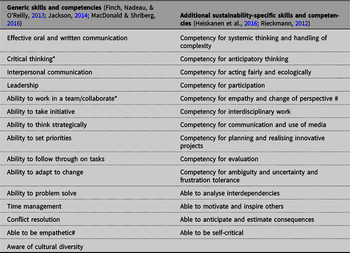
In order to develop an appropriate research instrument, we first reviewed the generic and specific sustainability-related skills and competencies claimed, in the academic literature, to be important. The skills and competencies listed in the left-hand column of Table 1 have been described as ‘meta-skills’ – i.e. not discipline-specific skills, but rather generic skills that apply across disciplines. We note that there is no agreement on exactly what these key competencies are (Barth, Godemann, Rieckmann, & Stoltenberg, Reference Barth, Godemann, Rieckmann and Stoltenberg2007; Rieckmann, Reference Rieckmann2012), although there is substantial commonality across studies and also recognition of the need to “mirror professional practice and test more than just rote memorization” (James & Casidy, Reference James and Casidy2016). The right-hand column lists the additional skills and competencies identified as particularly important in sustainability and sustainable development contexts. We have marked with an asterisk those skills and competencies that are common to both lists, and with a # to indicate those for which there is a partial overlap. These generic and sustainability-specific competency skill sets have been the focus of much discussion in the academic literature (see, for example, Baird & Parayitam, Reference Baird and Parayitam2019; Heiskanen et al., Reference Heiskanen, Thidell and Rodhe2016; James & Casidy, Reference James and Casidy2016).
Comparison of most commonly listed generic versus sustainability-specific skills and competencies

* Also on list of key sustainable development competencies.
# Partial overlap between the two lists.
Research Methods
The specific aim of this study is to investigate whether the generic and sustainability-oriented skills and competencies that are embedded in the business curricula are meeting the needs of regional employers. The study is a pilot study, and the findings reported in this paper relate to an Australian regional university (i.e. based in a provincial city rather than a major metropolitan centre), as it is claimed that regional universities have a very specific role in helping regional organisations to address sustainability-related problems (Karatzoglou, Reference Karatzoglou2013; Sedlacek, Reference Sedlacek2013).
The key research questions are as follows:
-
(1) What are the generic and sustainability-oriented skills and competencies required of business graduates by regional employers?
-
(2) Are regional employers satisfied with recent graduates’ level of skills and competencies?
-
(3) What recommendations do employers have for universities in relation to improving their education and training and instilling sustainability principles in the curriculum?
-
(4) How do regional employers rate the importance of sustainability-related practices to their organisation?
An online survey was undertaken to address these research questions, and the target population was regional employers. Participants were recruited at university events aimed at the business community and through targeted emails sent by an industry association and local government to their members, such as the local Chamber of Commerce and Townsville Enterprise limited. Ethics approval for the study was obtained from the Human Ethics Committee at the authors’ university.
The survey included a range of statements about climate change, risk denial and the respondent’s personal beliefs and actions in relation to sustainability. These scales were validated in earlier studies of students enrolled on an undergraduate business degree (Eagle, Low, Case, & Vandommele, Reference Eagle, Low, Case and Vandommele2015) and those who had graduated from this programme (Hay & Eagle, Reference Green, Hammer and Star2020). Employers were also asked to indicate the degree of importance attached to sustainability-related practices in their organisation; the items were developed by the authors and informed by the literature (see for example, Murillo-Luna, Garcés-Ayerbe, & Rivera-Torres, Reference Murillo-Luna, Garcés-Ayerbe and Rivera-Torres2011). These questions are important given that a match between graduate skills and employers’ expectations is deemed important for employability (Teijeiro et al., Reference Teijeiro, Rungo and Freire2013). The statements on skills and competencies were derived from previous studies (see, for example, Heiskanen et al., Reference Heiskanen, Thidell and Rodhe2016; James & Casidy, Reference James and Casidy2016). The statements used a six-point scale with anchor points of 5 = extremely important and 1 = not at all important, and 5 = strongly agree and 1 = strongly disagree and 0 = don’t know.
Findings
The next section presents background information on the chosen university.
The university and adoption of sustainability as part of its strategic agenda
The employers’ survey contained questions that related to graduates of one programme, the Bachelor of Business Studies (BBS) degree from James Cook University, a regional university based in Townsville, Australia. Almost half of the world’s population lives in the tropics, and climate change is expected to exacerbate the challenges faced by tropical nations (State of the Tropics, 2017). Not surprisingly, the university highlights its commitment to the principles of sustainability (JCU, 2018) and uses the SDGs as a framework against which their sustainability goals can be aligned. It is ranked number 1 in the world for partnerships for the UN SDGs, which looks at the broader ways in which universities support the SDG through collaboration with other parties and countries, the promotion of best practices and the publication of data (The World University Rankings, 2020).
Survey Findings: Graduates’ Skills and Competencies and Employers’ Perspectives of Sustainability
In the following section, the results of the online survey are outlined.
Descriptive statistics
A total of 29 usable responses were analysed. Small sample sizes are not uncommon, and inferences can still be made, even with a very sparse data set of 29 responses (Chouinard, Wandschneider, & Paterson, Reference Chouinard, Wandschneider and Paterson2016). The sample was successful in recruiting large employers of JCU graduates. Firms from diverse industry sectors responded to the survey, such as professional, scientific and technical (n = 5); financial services (n = 4); public administration and safety (n = 2); health care and social assistance (n = 3); other (n = 3) and information media and telecommunications (n = 1). Annual turnover ranged from <$100,000 per annum (n = 4); from $500,000 to <$1m per annum (n = 3); $10m or more (n = 2) and six respondents preferred not to answer this question. The number of full-time employees ranged from 2 to 23,000; part-time employees ranged from 1 to 8,000 and casual staff ranged from 0 to 2,000. The number of full-time graduates employed by the organisations in the last five years ranged from 3 to around 1,000. When asked if their organisation reported on the ‘triple bottom line outcomes’, a third of the respondents (n = 6) said yes, and the same number said no (n = 6) and did not know (n = 6). Of the people surveyed, 60% were male (n = 12) and 40% were female (n = 8). In terms of age, 20% were in the 25–34 age group (n = 4), 30% were in 35–44 year age group (n = 6), 25% were in 45–54 age group (n = 5), 20% were in 55–65 age group (n = 4) and 5% were 65–74 year age group (n = 1).
Sustainability-oriented skills and competencies of business graduates: requirements of regional employers and level of satisfaction
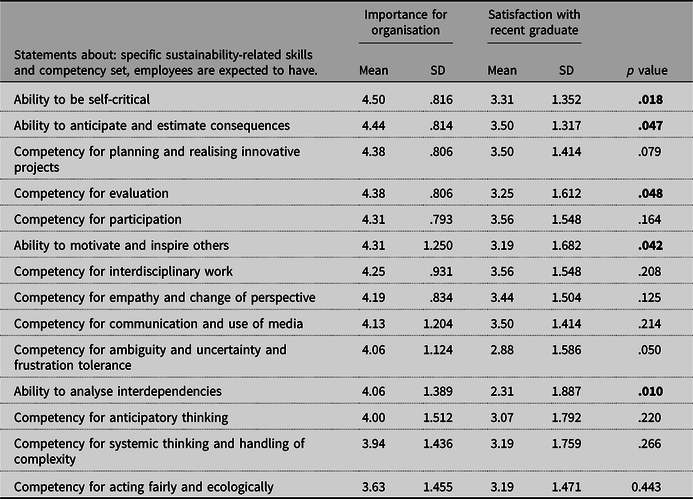
In order to address the first two research questions, employers were asked to indicate the degree of importance they attach to sustainability-related skills and competencies and their level of satisfaction with the performance of a recent graduate on those same competencies (Table 2). All items were rated as important, and they were dissatisfied with graduates in relation to the ‘ability to analyse interdependencies’.
Comparative analysis of importance and satisfaction ratings: sustainability-oriented skills and competencies
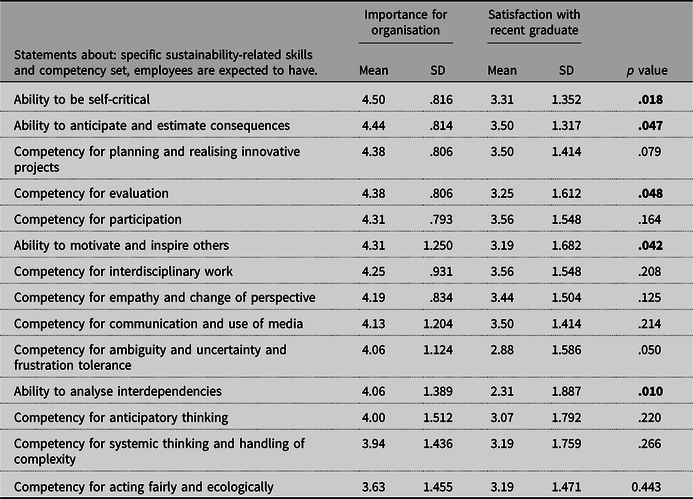
A paired sample t-test was selected to identify differences in relation to the repeated measurement of two constructs with two scales. Scholars note that the t-test, originally designed by Gosset (Reference Gosset1909), can be used effectively with small sample sizes: “…fortunately, even for small sample sizes (less than 30), the t-test generates reliable results when the data are not normally distributed” (Sauro & Lewis, Reference Sauro and Lewis2016, p. 74). The results show that there is a significant difference between the importance employers attach to five sustainability-oriented skills and competencies, and their satisfaction with the performance of recent graduates on those desired attributes. Respondents attached more importance to the ability to be self-critical (M = 4.50, SE = .204) than to their satisfaction rating with a recent graduate (M = 3.31, SE = .338). This difference was significant, t (15) = 2.643, p = .018. Respondents attached more importance to the ability to anticipate and estimate consequences (M = 4.44, SE = .202) than to their satisfaction rating with a recent graduate (M = 3.50, SE = .329). This difference was significant, t (15) = 2.167, p = .047. On average, respondents attached more importance to the competency for evaluation (M = 4.38, SE = .202) than to their satisfaction rating (M = 3.25, SE = 403). This difference was significant t (15) = 2.149, p = .048. Respondents attached more importance to the ability to motivate and inspire others (M = 4.31; SE = .313) than to their satisfaction rating with a recent graduate (M = 3.19, SE = .421). This difference was significant, t (15) = 2.218, p = .042. Respondents attached more importance to the ability to analyse interdependencies (M = 4.06, SE = .347) than to their satisfaction rating (M = 2.31, SE = .472). This difference was significant t (15) = 2.941, p = .010.
Generic skills and competencies of business graduates: requirements of regional employers and level of satisfaction
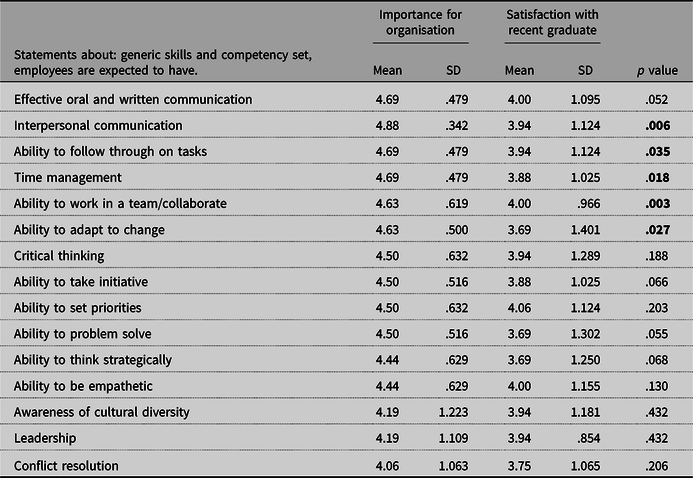
Employers were asked to indicate the degree of importance they attach to generic skills and competencies and their level of satisfaction with the performance of a recent graduate on those same competencies (Table 3). All items were rated as important, with higher scores attached to effective oral and written communication skills, interpersonal communication, ability to follow through on tasks and time management.
Comparative analysis of importance and satisfaction ratings: generic skills and competencies

A paired sample t-test showed that there is a significant difference between the importance attached to five skills and competencies by an employer, and their satisfaction with recent graduates. On average, respondents attached more importance to interpersonal communication (M = 4.88, SE = .085) than to their satisfaction rating of a recent graduate (M = 3.94, SE = .281). This difference was significant, t (15) = 3.174, p = .006. Respondents attached more importance to ability to follow through on tasks (M = 4.69, SE = .120) than to their satisfaction rating of a recent graduate (M = 3.94, SE = .281). This difference was significant, t (15) = 2.324, p = .035. Respondents attached more importance to time management (M = 4.69, SE = .120) than to their satisfaction rating of a recent graduate (M = 3.88, SE = .256). This difference was significant, t (15) = 2.657, p = .018. Respondents attached more importance to ability to work in a team/collaborate (M = 4.63, SE = .155) than to their satisfaction rating of a recent graduate (M = 4.00, SE = .242). This difference was significant, t (15) = 3.478, p = .003. Respondents attached more importance to ability to adapt to change (M = 4.63, SE = .125) than to their satisfaction rating of a recent graduate (M = 3.69, SE = .350). This difference was significant, t (15) = 2.457, p = .027.
Recommendations of regional employers for universities in relation to improving their education and training and instilling sustainability principles in the curriculum
In order to address the third research question, employers were asked to indicate their level of agreement with statements concerning education for sustainability (Table 4). All items were rated as important.
Attitudes towards education for sustainability

Respondents were asked, in an open-ended question, to reflect on what the university should do to teach sustainability to business students. Of the few responses that were obtained (n = 8), two related to the triple bottom line, as indicated by the comment below:
“To reinforce the importance that society, the economy, and the environment are interconnected, thus students need to be aware of all three in their future work endeavours. They are after all the planet’s future, without emphasising sustainable behaviours and activities, it will be detrimental to the planet’s survival as we know it.”
One was focused on looking after limited planetary resources:
“To look after the planet for the future. That there are limited resources and if you don’t look after them. They will run out. That if you sell the farm, you will have to pay others for the crop”.
Other comments related to the need to have a sustainability plan, adopt best practices and link sustainability to future success. Two comments related to attitudinal change, with the following comments typifying views:
“How to convince the older generations to employ sustainability initiatives as this is often where things fall down”.
“But you need first to teach adaptability and open minds. Many of your former students are not open.”
The responses were limited to the three pillars, measurement, sustainability planning and mindsets, suggesting that regional employers are interested in, and aware of, sustainability concepts. However, since they are not experts in sustainability, they are unable to act as knowledge producers and help address weaknesses in the curriculum.
Regional employers and the importance ratings given to sustainability-related practices in their organisations
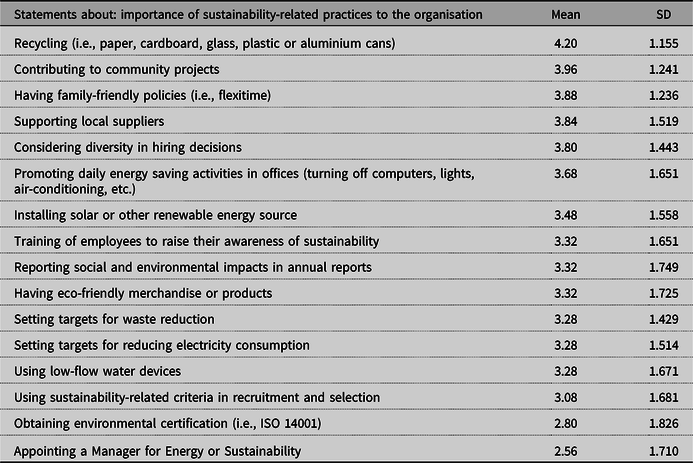
To address the last research question, employers were asked to indicate the degree of importance attached to sustainability-related practices in their organisation (Table 5). Statements were modelled on the ‘triple bottom line’ activities, and some were rated as important, including recycling, contributing to community projects, having family-friendly policies, considering diversity in hiring decisions and promoting daily energy-savings. Items that received the lowest scores were obtaining environmental certification (i.e., ISO 14001) and appointing a Manager for Energy or Sustainability.
Importance of sustainability-related practices to the organisation

Discussion and Implications for Teaching and Learning Practices
A key research objective was to investigate the perceived importance of generic and sustainability-oriented skills and competencies by regional employers. All of the generic skills and competencies presented to respondents were seen as important or very important. These findings support studies that highlight the importance of soft skills or transferrable skills (i.e. teamwork, assertiveness, ability to work under pressure) to career success and the labour market (Caggiano, Schleutker, Petrone, & González-Bernal, Reference Caggiano, Schleutker, Petrone and González-Bernal2020). Employers were then asked to critique the performance of a recent graduate on those same competencies, and they were generally satisfied with the graduates. Significant differences between importance and satisfaction ratings were found in related to five generic competencies. These are as follows: interpersonal communication; ability to follow through on tasks; time management; the ability to work in a team/collaborate and the ability to adapt to change. Hence, instructors should take advantage of these insights and design assessment tasks in a way that strengthens these competencies. Assessments such as negotiation tasks, presentations, group work, interviews with managers or other stakeholders are commonly used to develop interpersonal communication, and continued use is recommended. Project management software and tools (such as Gantt charts) could assist planning, and their inclusion in the curriculum is warranted.
A range of sustainability-oriented skills and competencies were perceived to be important by employers, and they were generally satisfied with recent graduates, apart from one competence, the ‘ability to analyse interdependencies’. Significant differences between importance and satisfaction ratings were found in related to five sustainability-oriented competencies. These are as follows: the ability to be self-critical; the ability to anticipate and estimate consequences; the competency for evaluation; the ability to motivate and inspire others and the ability to analyse interdependencies. It is recognised in the literature that Education for Sustainable Development (ESD) must have three key features: the intent to develop citizens prepared to take action, the need for a holistic approach to ESD and the goal for education to be transformational (Tomas et al., Reference Tomas, Mills, Rigano and Sandhu2019). There is, however, a debate in the literature as to whether some competencies are personal attributes of an individual and whether there may be specific competencies that some individuals will never be able to master (Sultana, Reference Sultana2009). Concerns exist that positioning young people as agents for change is idealised and aspirational (Walker, Reference Walker2017), and this study’s findings suggest that this may be true of recent graduates. Scholars such as De Haan (Reference De Haan2006), Barth et al. (2007) and Michelsen and Adomsent (Reference Michelsen, Adomssent and Wals2007) suggest that the five competencies outlined above are critical to sustainable education. Noting that employers have a responsibility to provide graduates with training and learning opportunities (Sultana, Reference Sultana2009), universities and employers may have to revise their expectations and accept the fact that some competencies will not exist at an early career stage and may evolve over time. Research has shown that many factors shape sustainability values, such as personality and social support in homes and communities (Waring, Sullivan, & Stapp, Reference Waring, Sullivan and Stapp2016).
There is, however, a vast literature on teaching and learning strategies that offers insights on how to develop graduates’ competencies and meet the needs of regional employers. Scholars propose that sustainability learning in higher education should focus on learning content, pedagogy and the learning environment (Greig & Prindle, Reference Greig and Priddle2019). Some of the preferred procedures for developing students’ competencies in sustainability are placements, internships and authentic ‘real-world’ projects (Bigg et al., Reference Bhattacharyya and Biswas2018). Instructors in higher education could use assessment tasks that are problem-based (i.e., scenario analysis, forecasting, back-casting and case studies) and that generally encourage students to think about alternative futures and evaluate the consequences of different decisions and actions. Reports show that a range of innovative teaching and learning practices help instil sustainability competencies, including case studies, problem-based learning and reflective journal writing (UNESCO, 2012). Lecturers are advised to experiment with non-traditional pedagogical approaches and consider reflective journals, peer-reviewed assessments or managerial-type feedback, so that a self-critical perspective is developed. Challenges are acknowledged, since an emphasis on self-reflection “…demands that individuals are honest with themselves and have a capacity for self-reflection, traits that are not always favored in contemporary formal education” (Giangrande et al., Reference Giangrande, White, East, Jackson, Clarke, Saloff Coste and Penha-Lopes2019, p.14). Practical tasks such as performing cost-benefit analysis could help graduates develop an ability to estimate consequences. Furthermore, incorporating gamification elements (Stanitsas et al., Reference Stanitsas, Kirytopoulos and Vareilles2019) in learning tasks may help develop a competence to ‘motivate oneself and others’. As noted by Caggiano et al., (Reference Caggiano, Schleutker, Petrone and González-Bernal2020), soft skills can be learned and traditional assessment methods, such as quizzes or exams, cannot accurately measure soft skills. Instead, ‘active learning’ (MacVaugh & Norton, Reference MacVaugh and Norton2012) and applied projects based on authentic, real-world challenges should aid learning trajectories. New forms of assessment may help learners develop a capability to be “future generators of sustainable value” (Kelley & Nahser, Reference Kelley and Nahser2014).
Our findings report positive attitudes towards education for sustainability; however, one factor, ‘using sustainability-related criteria in recruitment and selection’ received a neutral score, which confirms previous findings that sustainability knowledge and skills may not be seen as a high priority for employers when assessing potential employees (Ali, Murphy, & Nadkarni, Reference Ali, Murphy and Nadkarni2017). This finding is surprising given that universities have adopted the SDGs and increasing importance is placed on embedding sustainability in the curriculum (Purcell, Henriksen, & Spengler Reference Purcell, Henriksen and Spengler2019) as well as turning universities into ‘living labs’ or role models of sustainability practices through partnerships with external stakeholders (König & Evans, Reference König, Evans and König2013; Verhoef et al., Reference Verhoef, Bossert, Newman, Ferraz, Robinson, Agarwala, Hellinga and Walter2020).
Regional employers attached importance to some sustainable practices in their organisations, including recycling, energy-saving and supporting local suppliers. Equity-related polices were considered important, such as diversity in hiring, contributing to community projects and having family-friendly policies. However, the focus on the local rather than the global, and the lack of importance attached to items such as having eco-friendly merchandise and certifications, suggests a weak sustainability index (Nikolaou & Tsalis, Reference Nikolaou and Tsalis2018). Studies show a growing commitment on the part of CEOs to sustainability (Lans Blok, & Wesselink, Reference Lans, Blok and Wesselink2014); however, our findings suggest that regional firms could do a lot more to protect natural and social capital. Two actions received the lowest scores, such as obtaining environmental certification and appointing a Manager for Energy or Sustainability. The installation of solar panels received a score close to neutral (mean value of 3.48), which presumably is due to the cost of installation (Karakaya & Sriwannawit, Reference Karakaya and Sriwannawit2015) or presence of other barriers to the adoption of proactive sustainability strategies (Murillo-Luna, Garcés-Ayerbe, & Rivera-Torres, Reference Murillo-Luna, Garcés-Ayerbe and Rivera-Torres2011).
Finally, an open-ended question was designed to capture employers’ views on what business students should be taught about sustainability and responses related to the three pillars, measurement, sustainability planning and mindsets. It was interesting that the SDGs were not mentioned, and this may be due to the lack of media attention given to the SDGs when the survey was conducted. The sparse responses suggest that employers are not experts on sustainability and have limited ability to act as ‘co-creators of knowledge’, i.e., where business people act as mentors and collaborate with universities to improve students’ sustainability competencies (Soini, Korhonen-Kurki, & Asikainen, Reference Soini, Korhonen-Kurki and Asikainen2019).
This study raises two questions. First, should sustainability education be positioned as core or peripheral to regional universities, given the weak interest displayed by regional employers’ in the sustainability literacy of business graduates? Second, how can regional universities progress regional companies beyond the initial stage of sustainability awareness and the adoption of small, cost-saving operational changes? Answering these questions is a challenge, given that the commitment to sustainable practices by regional enterprise is weak, and there is some doubt as to whether graduates with a high level of competencies in the area of social and environmental sustainability are seen as a valuable asset by regional employers. We argue that there are ways to connect a shift towards sustainability to the values that employers already hold, such as hiring graduates with sophisticated soft skills. Other scholars have found that the capabilities sought by employers match those for sustainability, and hence the meta-topic of sustainability offers a ‘win-win’ situation for industry and academia (Thomas, Barth, & Day, Reference Thomas, Barth and Day2013). Various commentators have argued that teaching practices must facilitate the development of capable citizens who can instigate and manage change towards sustainability within an organisation, community or industry (Cole & Malone Reference Cole and Malone2019; Sandri, Reference Sandri2020; Tilbury, Reference Tilbury2004). Furthermore, the opportunities offered by the ‘green’ economy justify the teaching of competencies in sustainability. In addition, Goody (Reference Goody2002), an anthropologist, argues that educational institutions are not the only social institutions through which individuals can develop competencies, and but the cultural context and the roles of family and friends should also be taken into account. Furthermore, given the barriers to sustainability education, such as the increasing casualisation of academic staff (Green, Hammer, & Star, Reference Giangrande, White, East, Jackson, Clarke, Saloff Coste and Penha-Lopes2009) and the time and commitment needed to develop innovative teaching approaches (Backman et al., Reference Backman, Pitt, Marsden, Mehmood and Mathijs2019; Kemper, Ballantine, & Hall, Reference Kemper, Ballantine and Hall2019), regional universities need support to fulfil their sustainability mission. Regional universities, on their own, cannot be the catalyst of sustainability values, given the complex nature of sustainable development (Tilbury, Reference Tilbury2004). While recognising that sustainability competencies are crucial to the business curriculum, there may be a need to reframe sustainability education as a process of acquiring a sophisticated set of soft skills, moulded through lifelong education, influenced by personal and professional development and by other social institutions.
Limitations and Future Research Directions
The limitations of this study include the use of a convenience sample, the small sample size and the self-selection bias. However, it is not uncommon to find studies with small sample sizes, given budget constraints and historically low response rates to surveys. For example, Wickramasinghe and Perera (Reference Wickramasinghe and Perera2010) studied 26 employers to identify the skills gap of graduates. Acknowledging these limitations, this pilot study provides useful preliminary information that is currently lacking in the literature. Future research with a larger sample is recommended, where the focus could be on comparing the perspectives of regional employers with those in major metropolitan areas, and other regional areas with a different mix of industries could be sampled. A follow-up study that focuses on curriculum redesign, academic staff and graduates could be conducted to assess whether an improvement in generic and sustainability-related competencies (such as those identified in this study as needing improvement) was achieved as a result of changes to teaching and learning strategies.
Conclusions
This study is the first to evaluate how graduates’ competencies and skills are meeting employers’ needs in a regional setting. The recommendations for the faculty are to focus on curriculum design to improve specific competencies, including, but not limited to, interpersonal communication; time management; the ability to motivate and inspire others; the ability to anticipate and estimate consequences and the ability to be self-critical. The regional enterprises have positive attitudes towards education for sustainability and attach importance to some sustainable business practices. However, sustainability competencies remain in the background during the graduate recruitment and selection process. The study concludes that a reframing of sustainability education is required and the capabilities sought by employers match those for sustainability.
Acknowledgements
This work was supported by an internal grant from James Cook University, Townsville.
Conflicts of Interest
The authors were employees at the chosen university and declare no conflict of interests.
Ethical Approval
All procedures performed in studies involving human participants were in accordance with the ethical standards of the institutional and/or national research committee and with the 1964 Helsinki declaration and its later amendments or comparable ethical standards.
Informed Consent
Informed consent was obtained from all individual participants included in the study.