Introduction
Highest visual acuity is achieved only within a small region in the foveal area. Thus, in order to perceive objects at different locations in visual scenes, eyes execute saccades to center the visual target into the foveal region. Two different attentional visual modes, ambient and focal, have been proposed to explain scene exploration through viewing time (Trevarthen, Reference Trevarthen1968). It has been suggested that the ambient mode dominates the early part, first 2 s of scene viewing, and it is characterized by short fixations (<180 ms) followed by large saccade amplitudes (>5 deg). This mode allows the localization of objects in the environment (e.g., Scinto & Pillalamarri, Reference Scinto, Pillalamarri and Karsh1986). The focal mode appears later in time and is characterized by longer fixations (>180 ms) surrounded by saccades of reduced amplitude (<5 deg). This mode has been associated to the process of objects in detail (Velichkovsky et al., Reference Velichkovsky, Rothert, Kopf, Dornhöfer and Joos2002; Unema et al., Reference Unema, Pannasch, Joos and Velichkovsky2005; Henderson, Reference Henderson2007). Ambient and focal processing strategies have been demonstrated using different types of stimuli (e.g., high versus low density, emotional pictures, landscapes) during memorization and free viewing tasks (Unema et al., Reference Unema, Pannasch, Joos and Velichkovsky2005; Pannasch et al., Reference Pannasch, Helmert, Roth and Walter2008; Follet et al., Reference Follet, Le Meur and Baccino2011; Pannasch et al., Reference Pannasch, Schulz and Velichkovsky2011). However, there is evidence that saccade lengths during initial viewing (Castelhano et al., Reference Castelhano, Mack and Henderson2009) and also their relationship to fixation durations (Castelhano et al., Reference Castelhano, Mack and Henderson2009; Mills et al., Reference Mills, Hollingworth and Dodd2011) are influenced by task instruction. It has been proposed that these two attentional mechanisms might be fundamental for our survival. This assumption is supported by the evidence that these attentional mechanisms have been also found in nonhuman primates and various other animal species (Ingle, Reference Ingle1967; Trevarthen, Reference Trevarthen1968). Recently, we also showed that ambient and focal modes processes were present in children as early as 24-months of age (Helo et al., Reference Helo, Pannasch, Sirri and Rämä2014) providing further evidence for their importance as a fundamental mechanism in scene viewing.
Eye-movement control improves extensively already during the first year of life, even though the adult-like levels are reached later during childhood (reviewed in Luna et al., Reference Luna, Velanova and Geier2008). Visual acuity increases rapidly from birth to 7 months of age followed by a slower improvement until preschool ages (reviewed in Chandna, Reference Chandna1991). The capability to fixate a target binocularly is present from birth (Slater & Findlay, Reference Slater and Findlay1975), but fixation durations decrease with increasing age up to late childhood (Bronson, Reference Bronson1991; Colombo et al., Reference Colombo, Mitchell, Coldren and Freeseman1991; Helo et al., Reference Helo, Pannasch, Sirri and Rämä2014; Wass & Smith, Reference Wass and Smith2014). The number of saccades needed to fixate a peripheral target also decreases during the first year of life (Aslin & Salapatek, Reference Aslin and Salapatek1975; Salapatek et al., Reference Salapatek, Aslin, Simonson and Pulos1980; Regal et al., Reference Regal, Ashmead and Salapatek1983; Roucoux et al., Reference Roucoux, Culee and Roucoux1983). In addition, smooth pursuit improves rapidly in precision during the first three or four months of age (Shea & Aslin, Reference Shea and Aslin1990; Phillips et al., Reference Phillips, Finocchio, Ong and Fuchs1997; Von Hofsten & Rosander, Reference Von Hofsten and Rosander1997; Rosander & Von Hofsten, Reference Rosander and Von Hofsten2002). The latencies of reflexive saccades also decrease and facility of disengagement from a stimulus increases during the first year of life (Hood & Atkinson, Reference Hood and Atkinson1993; Matsuzawa & Shimojo, Reference Matsuzawa and Shimojo1997). Likewise, the ability to inhibit a reflexive saccade is also present in early infancy but it improves from four to six months of age (Johnson et al., Reference Johnson, Posner and Rothbart1994; Gilmore & Johnson, Reference Gilmore and Johnson1995; Johnson, Reference Johnson1995). Furthermore, the coordination between head and eye movements—which is needed to shift a gaze from a fixated target to another during visual exploration—emerges at two months and improves across the first year of life (Roucoux et al., Reference Roucoux, Culee and Roucoux1983; Daniel & Lee, Reference Daniel and Lee1990; Bloch & Carchon, Reference Bloch and Carchon1992; Nakagawa & Sukigara, Reference Nakagawa and Sukigara2013).
Despite of extensive amount of evidence on the development of oculomotor functions during the first year of life and early childhood, much less is known about developing eye-movement control during scene viewing. As indicated above, many ocular functions or skills are operative by the end of the first year of life allowing an infant to explore the visual environment proficiently. Moreover, visual attention is notably developing during the first year of life (for reviews, see Colombo, Reference Colombo2001; Johnson, Reference Johnson, Johnson, Munakata and Gilmore2002). It has been proposed that there are at least three important phases in the development of visual attention during the first year (for review, see Colombo, Reference Colombo2001). During the first period, from birth to two months of age, alert system develops and infants attain alertness periods more frequently and for longer durations. During the second period, from two to six months of age, visual acuity and eye-movement control improve significantly allowing children to shift attention from one particular location to another. In this period, infants also start to attend more to object features. The third period, from 5 or 6 months and beyond, is characterized by significant changes in endogenous attention. During this period, the eye-movement control further increases, infants learn to inhibit attentional shifts, alternate between two stimuli, and also maintain vigilance (for review, see Colombo, Reference Colombo2001). Development of both eye-movement and attention control during the first year of life most probably allows an infant to explore visual scenes efficiently and attentively by the end of this period.
The first aim of the current study was to determine whether eye-movement patterns change from 3- to 12-months of age during a scene exploration task. The second aim was ascertain whether ambient and focal attentional modes are present during the first year of life and when they emerge. We tested four age groups of infants: 3-, 6-, 9-, and 12-month-olds, and compared the results with those of adult participants. Based on earlier findings on studies showing that fixation durations decrease and saccade lengths increase with age (Aslin & Salapatek, Reference Aslin and Salapatek1975; Regal et al., Reference Regal, Ashmead and Salapatek1983; Roucoux et al., Reference Roucoux, Culee and Roucoux1983; Bronson, Reference Bronson1991; Colombo et al., Reference Colombo, Mitchell, Coldren and Freeseman1991; Helo et al., Reference Helo, Pannasch, Sirri and Rämä2014; Wass & Smith, Reference Wass and Smith2014), we expected the same results during free exploration of visual scenes. We also expected the two visual attentional modes (ambient and focal) to emerge by the end of the first year of life. We based our assumption on three developmental evidences: First, several important aspects of eye-movement control are well established by the first year. Second, spatial orienting, associated with ambient mode, and attention to object features needed to inspect objects in detail and related to focal mode are already developed (for reviews, see Colombo, Reference Colombo2001; Johnson, Reference Johnson, Johnson, Munakata and Gilmore2002). Third, endogenous attention, fundamental for the guidance of gaze allocation and effective exploration of the scene also appears during the latter half of the first year. Based on findings that the proficiency of motor-ocular functions continues improving after the first year of life (Luna et al., Reference Luna, Velanova and Geier2008), we predicted a less scattered scan pattern of scenes in infants. Therefore, even if both processing modes are present, ambient processing might be less prominent in infants compared with adults. Accordingly, we assumed stronger dominance of focal processing in infants since a predominance of this mode has been already found in 2-year-old children (Helo et al., Reference Helo, Pannasch, Sirri and Rämä2014). To answer these questions, all the participants freely explored colorful visual scenes while their eye movements were recorded. We analyzed eye movement patterns during the whole viewing time and fixation durations and saccade amplitudes during the early and the late phases of scene viewing. We also analyzed the proportion of ambient and focal fixations in all age groups to explore which fixation types are more present in each age group.
Materials and methods
Subjects
A total of 214 subjects participated in the experiment including 44 adult student volunteers (23 females and 21 males, mean age 23 years, range 20–45 years) and 170 infants. All participants were tested in the Laboratoire de Psychologie et NeuroCognition of Grenoble. The infants were assigned to four groups according to their age: 3-month-olds (26 girls and 17 boys, mean age 117 days, range 86–127 days), 6-month-olds (23 girls and 21 boys, mean age 191 days, range 181–198 days), 9-month-olds (22 girls and 18 boys, mean age 284 days, range 273–314 days), and 12-month-olds (14 girls and 28 boys, mean age 375 days, range 364–402 days). In order to facilitate reading, we will henceforth use the following labels for the groups of different ages: 3m, 6m, 9m, 12m, and adults.
All adult subjects had normal or corrected to normal vision with no hearing impairment. All children were born full-term and presented a typical development. The infants were recruited from a database of parents who volunteered to participate in child development studies, and came from diverse socio-economic backgrounds in the region of Grenoble. The study was conducted in conformity with the declaration of Helsinki and approved by the Ethics Committee of the University of Grenoble-Alpes. Formal written consent was obtained from all parents before testing and the parents filled a short questionnaire concerning their infant’s daily activity and skills. Overall effective testing time was around 6–7 min. The present study lasted around 1 min.
Apparatus and stimuli
Eye movements were sampled monoculary at 250 Hz using the EyeLink 1000 Remote eye-trackers system (SR Research, Ontario, Canada) with a spatial resolution below 0.01 deg and a spatial accuracy of better than 0.5 deg. In order to operate the system in head-free mode, a small target sticker was placed on the participants' forehead. The sticker allowed tracking of head position and subsequent correction of gaze position. The eye-tracker settings were the same in both the infant and the adult group. We used a 5-point calibration procedure (followed by a 5-point validation to test calibration accuracy) with small animations (<2 deg of visual angle) instead of the classical static EyeLink calibration point. Saccades and fixations were identified using the saccade detection algorithm supplied by SR Research: Saccades were identified by deflections in eye position in excess of 0.1 deg, with a minimum velocity of 30 deg/s and a minimum acceleration of 8000 deg/s2, maintained for at least 4 ms. Six digitized scenes from the Kodak lossless true color image suite (images 3, 7, 11, 14, 22, and 23, http://r0k.us/graphics/kodak/). Images were resized to 1024 × 768 pixels to match display resolution. Stimuli were displayed on a CRT display (Iiama Vision Master) with a resolution of 1024 × 728 pixels and a refresh rate of 100 Hz. Screen size was 40.5 × 30 cm. When viewed from 60 cm, the image subtended around 37 deg of visual angle horizontally and 28 deg vertically.
Procedure
Adult participants as well as the parents were informed of the purpose of the study before signing the consent. All participants viewed the scenes from a distance of 60 cm. Infant participants were seated on a small chair in front of the screen, in a sound attenuated dimly lit room, with their parents staying in close contact behind them. With the exception of the use of the small chair, adults and infants were tested under the same conditions. Participants of all groups were shown the images without any instructions while the eye movements were recorded. Each trial started with a fixation target located on the top center of the image. Once the participant fixated the target, the experimenter launched the presentation of a full-screen scene image for 5 s. Scene images were shown in randomized order. The total duration of the experiment, including the preparation for recording and calibration, was less than two minutes per participant.
Data analysis
The data analyses were carried out using SPSS 21.0 and MATLAB 8.4. The first fixation in each trial was defined as the first fixation that began after the onset of the image; as the first saccade we considered the saccade following this fixation. All fixations outside the presentation screen, fixations shorter than 80 ms, and fixations around eyeblinks were discarded. According to earlier findings (e.g., Velichkovsky, Dornhoefer, Pannasch, & Unema, Reference Velichkovsky, Dornhoefer, Pannasch, Unema and Duhowski2000), fixation durations were anticipated to show a right skewed distribution where the median represents a more reliable value than the mean. Therefore, the median (fixation durations and saccade amplitudes) of each subject was calculated and used for the further analysis. To compare different age groups, the mean of medians was used.
For the statistical testing, the respective values were subjected to one-way analysis of variance (ANOVA), repeated measures ANOVA, and repeated measures multivariate ANOVA (MANOVA) and pairwise t-test. Bonferroni correction was used in the post-hoc analyses.
Results
Eye-movement patterns during scene viewing
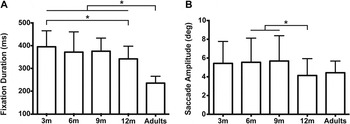
In order to assess age-related characteristics of eye movement patterns, median values for fixation durations and saccade amplitudes, and mean values for first saccade latencies, total scan path lengths, and total looking times were compared between age groups. A MANOVA revealed a significant multivariate main effect for age group on fixation durations and saccade amplitudes, F(2,8) = 21.36, P < 0.001. No effect of gender or interactions between factors, F = 1.12, were found. Follow-up ANOVAs confirmed significant differences between the age groups for fixation durations, F(4,213) = 46.78, P < 0.001 [means and standard deviations are presented in ms; 3m: 392 (68), 6m: 371 (88), 9m: 377 (56), 12m: 340 (49), adults: 237 (30)], as well as for saccade amplitudes, F(4,213) = 4.58, P < 0.01 [means and standard deviations are presented in deg; 3m: 5.8 (2.4), 6m: 6.1 (2.8), 9m: 6.4 (2.8), 12m: 4.6 (1.9), adults: 4.9 (1.3)]. Post-hoc analyses revealed longer fixations in all infant groups compared to the adults, all P < 0.01 (Fig. 1A) and fixations in the 3m-group were significantly longer than fixations in the 12m-group, P < 0.01. No significant differences were obtained among 3-, 6-, and 9-m groups. Saccade amplitudes were significantly shorter in the 12m-group compared with 6m- and 9m-groups, all Ps < 0.05 (Fig. 1B).
Mean fixation duration (A) and saccade amplitude (B). All data in mean ± SD. * indicates P < 0.05.

A one-way-ANOVA analysis for the first-saccade latency revealed a significant age group effect, F(4,213) = 31.33, P < 0.001, while no main effect of gender was found, P > 0.05, F < 1. Bonferroni post-hoc tests showed that the first-saccade latencies (ms) were longer for the two youngest groups [3m: 941 (246) and 6m: 974 (304)] compared with all the other age groups, Ps < 0.05. Likewise, the two oldest groups [9m: 848 (161) and 12m: 791 (171)] presented longer latencies compared to adults: 528 (92), Ps < 0.05. No differences between 3m and 6m (P > 0.05) or between 9m and 12m (P > 0.05) months were found.
Age group had also a significant effect on total scan path lengths, F(4,213) = 15.51, and total looking times, F(4,213) = 10.45, Ps < 0.05, while no main effects of gender were found, Ps > 0.05, Fs < 1. Bonferroni post-hoc analysis showed that the scan paths were shorter (deg) for all infant groups compared to adults [3m: 45.6 (17.1), 6m: 48.7 (17.7), 9m: 51.1 (15.12), 12m: 48.5 (17.9), adults: 72.4 (22.5)], Ps < 0.05. Also total looking times were shorter (ms) for all infant groups compared to adults [3m: 2975 (434), 6m: 2908 (548), 9m: 2636 (426), 12m: 2949 (419), adults: 3406 (257)], Ps < 0.05. No significant differences between infants groups were found for either measure, F < 1.
Time course of fixation durations and saccade amplitudes
Possible influences of time course of visual exploration on the gaze behavior were analyzed by comparing two different viewing phases. Previous studies have shown differences in fixation durations and saccade amplitudes between the early viewing phase comprising the time interval from 0 to 2 s and the late viewing phase covering from 4 to 6 s (Pannasch et al., Reference Pannasch, Helmert, Roth and Walter2008). However, the total viewing time per image was shorter (5 s) than in previous studies (10 s) and thus, we chose slightly different time windows for our study (0–1.5 s versus 2.5–4 s).
For both viewing phases, we calculated the median for fixation durations and for saccade amplitudes per subject; these individual medians were used for statistical testing. Since no effects or interactions of gender were found in the previous analyses, this variable was excluded from the following analyses. Fixation durations and saccade amplitudes were examined for differences along the time course by conducting a 5 (age group) × 2 (viewing phase) repeated measures ANOVA for each parameter.
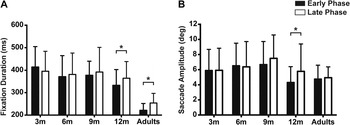
The analysis for fixation durations during early and late phases [means and standard deviations are presented in ms; 3m: early 414 (91), late 395 (89), 6m: early 371 (94), late 380 (96), 9m: early 377 (63), late 392 (110), 12m: early 332 (70), late 364 (74), adults: early 321 (31), late 254 (43)] revealed main effects for age group, F(4,202) = 47.7, P < 0.001, and for viewing phase F(1,202) = 4.33, P < 0.05. Fixation durations increased from early to late phase in all, but 3m-group, and thus, the interaction between age group and phase was only close to significance, F(4,202) = 2.07, P = 0.086. When the two age groups at the middle (6- and 9-month-olds) were combined, the interaction between age group and phase was significant, F(3,203) = 2.76, P < 0.05. Following pairwise t-tests revealed that fixation durations were significantly longer during the late than the early viewing phase in 12-month-olds, t(40) = −2.35, d = 0.35, and in adults, t(43) = −6.56, d = 1.06, both P < 0.05 (Fig. 2A).
Mean fixation duration (A) and saccade amplitude (B) during early and late viewing phases. All data in mean ± SD. * indicates P < 0.05.

ANOVA for saccade amplitudes during early and late phases [means and standard deviations are presented in deg; 3m: early 5.9 (2.8), late 5.9 (2.9), 6m: early 6.5 (2.9), late 6.4 (3.3), 9m: early 6.7 (3.1), late 7.5 (3.1), 12m: early 4.3 (3.1), late 5.8 (3.6), adults: early 4.8 (1.8), late 4.9 (1.4)] revealed main effects for age group, F(4,202) = 7.06, and for viewing phase F(1,202) = 4.79, P < 0.05. Saccades amplitudes increased, or were similar between two phases in all age groups, and thus, no significant interaction was found, F = 1.53, P > 0.05. Even when two age groups (6 and 9 months) were combined, the interaction between age group and phase did not reach significance F(3,203) = 1.61, P < 0.05. However, a paired t-test showed that saccade amplitudes were significantly longer during the late than the early phase only in 12-month-olds t(40) = −2.45, P < 0.05, d = 0.46, but not in other age groups or in adults (P > 0.05) (Fig. 2B).
Proportion of “ambient” and “focal” fixations in each age group
In order to know whether the proportion of ambient and focal fixations was different between the age groups, we categorized the fixations based on fixation duration and following saccade amplitude. Short fixations (<180 ms) followed by long saccades (>5 deg) were considered as ambient fixations, whereas long fixations (>180 ms) followed by short saccades (<5 deg) were considered as focal fixations (Unema et al., Reference Unema, Pannasch, Joos and Velichkovsky2005). To compare the proportion of ambient and focal fixation between groups, a 5 (age group) × 2 (fixation type) repeated measures ANOVA was conducted. Statistical testing revealed a significant main effect of fixation type, F(1,209) = 947.34, P < 0.001, group effect, F(1,209) = 3.72. Furthermore, there was a significant interaction between group and fixation type, F(4,209) = 10.85, P < 0.001.
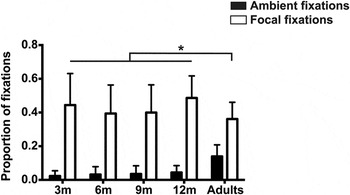
All groups showed higher proportion of focal than ambient fixations. Post-hoc analyses revealed the lowest proportion of ambient fixations for all groups of infants compared with adults; all P-values < 0.05. The proportions furthermore did not differ between infants groups (Fig. 3).
Proportion of ambient and focal fixations for the different age groups. All data in mean ± SD. * indicates P < 0.05.

Discussion
Our aim was to investigate whether eye-movement characteristics in infants during scene viewing revealed indications for processing according to the two modes approach. The results showed that fixation durations decreased with growing age while saccade amplitudes were similar in infants and adults. Fixation durations were longer in the 3- to 9-month-olds compared with 12-month-olds and adults. Previous evidence using standardized experimental assessments has shown that fixation durations decrease with age (Bronson, Reference Bronson1991; Colombo et al., Reference Colombo, Mitchell, Coldren and Freeseman1991). We have previously shown that fixation durations decrease by age from 2- to 10-years of age (Helo et al., Reference Helo, Pannasch, Sirri and Rämä2014). Altogether our previous and the current results indicate that there is age-related decrease in fixation durations from 3-months to 6-years of age, at which age adult values are reached. Longer fixations have been associated with higher cognitive effort, difficulties in information extraction, and with lesser amount of visual exploration in infants (Bronson, Reference Bronson1990, Reference Bronson1991, Reference Bronson1994; Colombo et al., Reference Colombo, Mitchell, Coldren and Freeseman1991; Colombo et al., Reference Colombo, Freeseman, Coldren and Frick1995; Wass & Smith, Reference Wass and Smith2014). Accordingly, our results indicate that visual information processing becomes easier by the end of the first year of life.
First-saccade latencies were longer for 3-month- and 6-month-olds compared with all the other age groups, and also for 9-month- and 12-month-olds presented longer latencies compared to adults, indicating that even if the latencies decrease, they do not reach adult values during the first year of life. It has been suggested that the initial fixation activates scene category or schema (Potter, Reference Potter1976; Schyns & Oliva, Reference Schyns and Oliva1994) and provides information for planning the subsequent eye movements (Castelhano & Henderson, Reference Castelhano and Henderson2007, Reference Castelhano and Henderson2008). Our results suggest that the youngest infants might devote a higher cognitive effort to activate scene category or planning the following saccade than the older infants and adults. In contrast, saccade lengths (as measured during the whole viewing time) in infants were not different from adults but the two youngest group presented longer saccades lengths compared with 12-month-olds. This finding differs from previous results, which showed that infants typically perform hypometric saccades, at least in tasks requiring shifting of gaze toward peripheral targets (Aslin & Salapatek, Reference Aslin and Salapatek1975; Regal et al., Reference Regal, Ashmead and Salapatek1983; Roucoux et al., Reference Roucoux, Culee and Roucoux1983).
The second aim of our study was to determine whether and when infants exhibit ambient and focal attentional modes during exploration of scenes. We compared fixation durations and saccade amplitudes at the early and late phases of viewing. We also compared the proportion of ambient and focal fixations between age groups. The oldest infant group (12-month-olds) and the adult group had shorter fixations during the early than the late phase of scene viewing whereas fixation durations of the three youngest age groups (3- to 9-month-olds) were equally long during both phases of viewing time. These findings suggest that the transition between ambient and focal modes during viewing time appears at the end of the first year of life. Short fixation durations during the early phase have been previously associated to ambient mode during which a viewer orientates to object locations within the scene while longer fixation durations during the later viewing phase have been associated with focal processing mode, allowing processing of objects in detail (Velichkovsky et al., Reference Velichkovsky, Rothert, Kopf, Dornhöfer and Joos2002; Unema et al., Reference Unema, Pannasch, Joos and Velichkovsky2005; Henderson, Reference Henderson2007). However, contrary to previous findings, even fixation durations increased with viewing time, both infants and adults exhibited either similar saccade lengths in two viewing phases or increased lengths from the early to late viewing phase. This result is not in accordance with previous reports supporting the two visual attentional modes hypothesis that show longer saccade lengths at the beginning of viewing compared with shorter lengths at the late viewing time (Velichkovsky et al., Reference Velichkovsky, Rothert, Kopf, Dornhöfer and Joos2002; Unema et al., Reference Unema, Pannasch, Joos and Velichkovsky2005; Henderson, Reference Henderson2007). Our finding is rather in accordance with other reports showing that saccade lengths increase during viewing time (e.g., Castelhano & Henderson, Reference Castelhano and Henderson2008; Castelhano et al., Reference Castelhano, Mack and Henderson2009; Mills et al., Reference Mills, Hollingworth and Dodd2011). In these studies, saccades lengths increased when visual information was degraded (Castelhano & Henderson, Reference Castelhano and Henderson2008), or when cognitive task was implemented (Castelhano et al., Reference Castelhano, Mack and Henderson2009; Mills et al., Reference Mills, Hollingworth and Dodd2011). It is possible that the scenes used in the current study were too simple and were not providing enough background features, which might have contributed to lack of differences in saccade lengths between viewing phases in adults. However, it is difficult to explain why 12-month-olds increased their saccade lengths while younger infants had similar lengths throughout the viewing time. One possibility is that since scene processing is more difficult for children than for adults, 12-month-olds increased both fixation durations and saccade lengths in order to process and extract information as efficiently as possible.
Nevertheless, our findings suggest that by the end of the first year of life, infants change their scanning strategies during the viewing time. Earlier, it has been proposed that spatial orientating (related to ambient mode) and attention to object features (related to focal mode) are emerging around 4 to 6 months of age (for reviews, see Colombo, Reference Colombo2001; Johnson, Reference Johnson, Johnson, Munakata and Gilmore2002). Therefore, it is possible that by the end of the first year of life, these processes are mature enough and allow infants to modify their attentional strategies depending on the viewing time. Additionally, it has been shown that endogenous attention, which might partly determine how engaged infants are to viewing or exploration, improves at the end of the first year of life (Courage et al., Reference Courage, Reynolds and Richards2006). However, in our study, all infant age groups presented similar total looking times across the trials suggesting that they were equally engaged to the task, and the difference in total looking times was only present when compared infants with adults. This result indicates that improved global endogenous attention at the end of first year do not explain our results.
Even if our results indicate that ambient and focal processing modes might emerge by the age of 12 months, the proportion of ambient fixations was lower in all infant groups compared to adults. Moreover, the total scan path length, which measures the gaze distribution within the scene was shorter in all infant age groups compared with adults. We have earlier shown that children from 2- to 8-years of age exhibit lower proportion of ambient fixations and higher proportion of focal fixations than adults up to the age of 8 years (Helo et al., Reference Helo, Pannasch, Sirri and Rämä2014). These results indicate that the focal mode dominates in children. We offer two possible explanations for these findings: first, it is possible that attention to object features matures earlier than spatial orienting and this slower maturation is reflected by a dominance of focal mode. Second, it is possible that more advanced oculomotor functions (e.g., fixation and saccade programming) that are needed to orientate within scenes (ambient mode) are still immature by the end of the first year, or even by later childhood.
To sum up, our results showed that 12-month-olds but not younger infants use two different attentional strategies while exploring scenes. Longer fixation durations and longer first saccade latencies between 12-month-olds and adults suggest that even if these strategies are functional, infants devote more cognitive effort to scene processing. In addition, infants explore the scenes in a less scattered manner as indicated by shorter scan path lengths and lower proportion of ambient fixations. Altogether, our results suggest that attention mechanisms associated with scene viewing are developing in early infancy but adult-like strategies might be reached later during childhood.
Acknowledgments
We express our gratitude to the infants and parents who participated to the study, we thank for their kindness and cooperation. We also thank the Laboratoire de Psychologie et NeuroCognition of Grenoble for testing the participants. A.H. was supported by doctoral fellowship from CONICYT, Chile.