Public debate on same-sex marriage has attracted attention throughout most of the Western world. Among Council of Europe member states, same-sex marriage is now legal in Belgium, Iceland, the Netherlands, Norway, Portugal, Spain and Sweden, and fourteen other countries have introduced various forms of registered partnerships (Council of Europe, 2011). Very recently, in 2013, the United Kingdom and France approved same-sex marriage laws. Different countries and states around the globe have also promulgated same-sex marriage either fully or in equivalent legal forms. As a result, same-sex marriage has gained increasing coverage in the national and global media. Despite the increasing globalization of this phenomenon, the majority of the studies in this area were developed in the US, while in European countries this research area still remains underdeveloped.
Since the 2000’s, Portugal has introduced legislation to prevent discrimination. Either by protecting individual rights, such as the explicit reference to sexual orientation in the Constitutional Principle of Equality (article 13) in 2004, or by securing relational rights, such as the introduction of same-sex de facto unions in 2001 and the same-sex marriage law in 2010 (Roseneil, Crowhurst, Hellsund, Santos, & Stoilova, Reference Roseneil, Crowhurst, Hellesund, Santos and Stoilova2013). As argued by Oliveira, Costa, and Nogueira (Reference Oliveira, Costa and Nogueira2013), these legislative changes do not seem to be enough to challenge widespread heterosexism, in contexts such as public demonstrations of affects between same-sex couples or feelings of multiple discrimination in the public sphere. Therefore, there is a contradiction between equality in the law and unequal social practices of discrimination. It is still not possible for a same-sex couple to adopt or co-adopt children. This study reflects also this sort of political context where, despite a progressive legislation, there are widespread heterosexist practices and representations (Oliveira, Costa, & Nogueira, Reference Oliveira, Costa and Nogueira2013).
The aim of the present article is to contribute to the advancement of research on this topic by providing a validated measurement instrument in a sample of Portuguese respondents. In Portugal, the need for a reliable scale to undertake regular and systematic scrutiny of public attitudes on same-sex marriage became more relevant in 2010, the year of its legalization by the Portuguese Parliament. Therefore, in conjunction with the validation study, the present article also aims to provide a timely overview of Portuguese public opinion on this topic, as well as analyze the main predictors of attitudes towards same-sex marriage. Also this study can be a contribution for a deeper understanding of the impact of legal changes in people’s attitudes and on the predictors of such attitudes.
Attitudes Towards Same-Sex Marriage
In the US, attitudes towards same-sex marriage have been shifting (Sherkat, Powell-Williams, Maddox, & De Vries, Reference Sherkat, Powell-Williams, Maddox and de Vries2011): in 1998, under 12% of respondents were favorable to same-sex marriage, whereas in 2008, 44% returned that opinion. According to Lewis and Gosset (Reference Lewis and Gossett2008), who compared Field Polls of Californians carried out regularly ever since 1985, support for same-sex marriage has been growing significantly, despite the strong opposition still faced in other parts of the country. The study further showed that support is growing among Liberals, Democrats and non-religious people, whereas Conservatives, Republicans and Protestants display a pattern of continuous opposition.
In Europe, and according to the Eurobarometer (European Commission, 2006), 44% of citizens support the approval of same-sex marriage, and rising especially in countries where same-sex marriage has already been adopted, such as the Netherlands, Sweden, Spain and Belgium (all scoring above the EU average). Taken collectively, these results seem to indicate a growing change in public opinion in Western countries. As Lewis and Gosset (Reference Lewis and Gossett2008) assert, public opinion is highly important to the debate on the legalization of same-sex marriage since, at least in the US, those states that took public action to recognize same-sex relationships are also those returning higher levels of public support.
In the case of Portugal, the absence of specific studies on attitudes towards same-sex marriage is notorious. Indeed, same-sex marriage has solely been investigated as an additional issue in studies on attitudes towards gays and lesbians (e.g., Gato, Fontaine, & Carneiro, Reference Gato, Fontaine and Carneiro2012). This might well have been due to the lack of scientific and validated instruments required to undertake specific research on this issue. Another feature of the present study is that the data collection occurred months before the introduction of the law, at a time where the debate was occurring in the Parliament with widespread media coverage. Therefore it seemed useful to undertake studies on attitudes concerning same-sex marriage at the time of its inception in Portuguese society.
Predictors of Attitudes Towards Same-Sex Marriage
Different social, ideological, political, demographic or psychological dimensions have been identified and analyzed as predictors of attitudes towards same-sex marriage. Religion and religiosity constitute one such predictor (Olson, Cadge, & Harrison, Reference Olson, Cadge and Harrison2006) given the moral charge in these issues. Lubbers, Jaspers, and Ultee (Reference Lubbers, Jaspers and Ultee2009) found that the religiosity of the respondents’ parents, as well as their attitudes towards homosexuality, are the strongest determinants of attitudes towards same-sex marriage. Evidence of the importance of religion consistently appears in the literature on attitudes towards same-sex marriage, especially when taking into consideration religiosity and church attendance (Brumbaugh, Sanchez, Nock, & Wright, Reference Brumbaugh, Sanchez, Nock and Wright2008; Pearl & Galupo, Reference Pearl and Galupo2007; Schwartz, Reference Schwartz2010; Sherkat et al., Reference Sherkat, Powell-Williams, Maddox and de Vries2011; Walls, Reference Walls2010).
Other studies identify socio-demographic factors that account for attitudes toward same-sex marriage, such as age and political positioning. For instance, the more elderly or politically right wing respondents (Lewis & Gossett, Reference Lewis and Gossett2008) or reporting high levels of transphobia/genderism or traditional heterosexism (Moskowitz, Rieger, & Roloff, Reference Moskowitz, Rieger and Roloff2010) display more negative attitudes towards same-sex marriage.
Gender also plays an important role in these matters with women tending to be more in favor of same-sex marriage than men. In fact, this result is very consistent throughout several studies (for a review, see Lannutti & Lachlan, Reference Lannutti and Lachlan2007). Moskowitz et al. (Reference Moskowitz, Rieger and Roloff2010) report that gender shapes the attitudes toward specific aspects of same-sex marriage, i.e., men tend to be more favorable to lesbian marriages than to gay male marriages, and this difference interlinks with stronger homophobic attitudes towards gay males than towards lesbians. In contrast, women respondents do not display different attitudes either towards gay male marriage and lesbian marriage or different degrees of homophobia toward gay males and lesbians.
Moreover, multiple positive contact with gays and lesbians proves to effectively reduce homophobia (Herek & Capitanio, Reference Herek and Capitanio1996). Departing from the intergroup contact hypothesis (Allport, Reference Allport1954), these studies test the prediction that prejudice is reduced in an “equal situation between majority and minority groups in the pursuit of common goals” (Herek & Capitanio, Reference Herek and Capitanio1996, p. 412). This seems to be a promising area for future research, since it highlights the importance of studying the engagement of heterosexuals as allies for LGBT rights (Montgomery & Stewart, Reference Montgomery and Stewart2012; Russell, Reference Russell2011).
The Attitudes Towards Same-Sex Marriage Scale
Although several of the above cited studies were based in poll data, thus generally using a single-item measure of attitudes towards same-sex marriage, several authors have stressed the advantages of validated multi-item scales (even assuming all items are highly inter-correlated) when assessing psychological constructs such as attitudes (e.g., DeVellis, Reference DeVellis2003; Nunnally & Bernstein, Reference Nunnally and Bernstein1994). Responses to single item scales are more prone to bias and error than to multiple items scales, which, by leveling these errors out, typically result in increased construct validity. Carefully built multi-item scales generally yield common variance, which increases reliability, but also contribute with an amount of unique variance associated with every composing item.
Two recently validated scales matched our purpose: Pearl and Galupo’s (Reference Pearl and Galupo2007) Attitudes Towards Same-Sex Marriage scale (ATSM) and Lannutti and Lachan’s (Reference Lannutti and Lachlan2007) Attitude Towards Same-Sex Marriage Scale (ASSMS). The scales were very similar in the number of items (17 and 18) and their level of internal consistency (both alphas scored above .90). The respective validation studies were also equally thorough and comprehensive. However, we preferred ATSM due to general orientation of the items that, in our opinion, was closer to the way the Portuguese public feel and think about this topic. Specifically, symbolic issues like the “meaning of the traditional family”, “morals of society”, “decay of society”, “primary purpose of marriage” and so forth, were more likely to tap our targets’ concerns than ASSMS items which tap predominantly the material and legal sides of same-sex marriage. Therefore, participants would be more committed, we believed, in responding to the ATSM items than to ASSMS items.
The ATSM scale was developed with the purpose of obtaining “a psychometrically sound research instrument relevant to current attitudes toward same-sex marriage” (Pearl & Galupo, Reference Pearl and Galupo2007; p. 121). This scale originally featured 17 items measuring different aspects of attitudes toward same-sex marriage, specifically beliefs about marriage – its general purpose, and its impact on the strength and morality of family and society; parenting and gender roles; homosexuality and ensuring the civil rights of homosexuals; the relationship between marriage and religion; and financial aspects of marriage. Finally, it includes a statement of belief in same-sex marriage. The majority of these aspects are measured twice, i.e., with one question representing a supportive attitude toward same-sex marriage, and a second question expressed in a non-supportive fashion.
In order to analyze the psychometric properties of the scale, the samples used in Pearl and Galupo study were undergraduate students and adults, all identifying themselves as heterosexuals, and belonging to different ethnic groups. The scale 17 items consistently aggregate into a single factor in all three samples surveyed. Pearl and Galupo (Reference Pearl and Galupo2007) further report high reliability across the samples (α = .96 to .97). Construct validity was ascertained by high negative correlations with prejudice against lesbians and gay men – Herek’s (Reference Herek1988) Attitudes toward Lesbians and Gay Men Scale –Short Form –, as well as with self-described religiosity, political conservatism, and moderate positive correlations with educational attainment. Finally, women proved significantly more supportive of same-sex marriage than men. All results obtained were coherent with data collected in related studies thus confirming the construct validity of the new scale.
Subsequent research using the ATSM confirmed the scale general reliability and its value in revealing group differences in the population. For instance, responses to ATSM collected in lesbian, gay and bisexual samples suggested that support to same-sex marriage diverges in these sexual minorities (Pearl & Galupo, Reference Pearl and Galupo2007). Whereas gay men and lesbians were equally (highly) supportive, bisexual men were less supportive than bisexual women, seemingly, reproducing the gender differential in the heterosexual population.
Duncan and Kemmelmeier (Reference Duncan and Kemmelmeier2012) used the ATSM scale to examine the hypothesis that attitudes toward same-sex marriage were associated with essentialist beliefs about marriage, i.e., that low ATSM scores would be associated with strong essentialists beliefs. Besides confirming the authors’ main hypothesis, results also suggested that belief in marriage primordialism (vs. the conception stressing human agency) mediated the effects of religiosity and political orientation (especially in the former case). In other words, the proven effects of religiosity and political orientation in attitudes towards same-sex marriage are to some extent due to the stronger beliefs that religious and right wing people hold about the transcendent nature of the marriage institution.
Overview of the ATSM scale construct validation in a Portuguese sample
The original ATSM Scale 17 items were translated into Portuguese and applied via Web to a large and diversified sample of respondents. Responses to the items on the ATSM scale were then submitted to Principal Axes Factoring analysis (PAF), yielding a one-factor solution. In order to further examine the construct validity of the Portuguese version of this scale, the total ATSM scores were analyzed by function of the relevant socio-demographic variables, beliefs and contact with Lesbian/Gay friends. The relative predictive power of each variable was assessed by means of an OLS Hierarchical Regression.
Following previous research on predictors of attitudes towards lesbian and gay men in other countries (e.g., Bessen & Zicklin, Reference Bessen and Zicklin2007; Fleischmann & Moyer, Reference Fleischmann and Moyer2009; Herek & Capitanio, Reference Herek and Capitanio1996; Lannutti & Lachlan, Reference Lannutti and Lachlan2007; Lewis & Gossett, Reference Lewis and Gossett2008; Moskowitz et al., Reference Moskowitz, Rieger and Roloff2010; Olson et al., Reference Olson, Cadge and Harrison2006), we expect that men (vs. women), with lower (vs. higher) educational levels, married (vs. single, living as married or divorced), religious (vs. non-religious), embracing a right-wing (vs. left-wing) political ideology, and without (vs. with) lesbian and gay men friends, would record less favorable attitudes towards same-sex marriage. Moreover, we predict that gay discrimination and the perception of justification for discrimination will emerge as important predictors of these same attitudes.
Method
Participants
Only heterosexual respondents with Portuguese nationality (98.5%) living mainly in urban areas (38.9%) participated in the present study, n = 1,402, 75.7% of whom were women (1061). The average respondent age was 31.97 (SD = 10.35; Min = 13, Max = 71; five cases did not report their age). As regards their level of education, the majority of respondents graduated from university (55.3%); while 26.8% completed post-graduate studies (Master’s or PhD degrees), a small group of respondents had completed primary or secondary school education (12.4%; 67 respondents did not respond to this item, i.e., 4.8% of the sample). Regarding marital status, 58.3% of respondents are single; 21% are married and 12.4% are living in common-law relationships; 7.6% are divorced and 0.6% are widows. Only 26% of sample respondents have children (mostly, married or in similar long term relationships, 77.4%).
Moreover, 77% of sample respondents reported not regularly attending religious ceremonies. However, as regards their religious beliefs, 43.5% of respondents self-identified themselves as Catholic, 5.7% as non-Catholic Christians, and 3.3% other religions (one participant - 0.1% - did not reveal his/her religious belief). Concerning political identification, a slim majority of participants declared themselves as left-wing (53.3%), followed by 26.4% identifying with the “political centre”, and a 10.3% minority of respondents declaring they are right-wingers; the remaining participants identified either with the extreme left (4.1%) or with the extreme right positions (0.4%; 5.1% of respondents did not provide their political identification).
Two sub-samples were randomly drawn from this main sample. In one we conducted a Principal Axis Factoring analysis (PAF), on the other a Confirmatory Factorial Analysis (CFA) was deployed. In the PAF sub-sample, participants were mainly female (73.8%), had a mean age of approximately 32 years old (SD = 10.56), and most of them completed a university major (58.6%). In the CFA sub-sample, the majority of participants were female (76.2%), with a mean age of approximately 32 years old (SD = 9.96), and that completed a university major (57.4%).
Procedure
Participants were recruited via e-mail, given that the questionnaire was run on the Internet, through recourse to different mailing lists, in 2009, during the same-sex law debate. These mailing lists were made available by different LGBT NGO’s and universities. The questionnaire’s link was disseminated through social networks (namely Facebook). The link to the questionnaire was made available at a blog site developed specifically for this study. Participants were asked to fill in the ATSM and other measures. At the beginning of the questionnaire, full anonymity and data confidentiality were guaranteed. At the end, participants received a small debriefing text and were thanked.
ATSM Scale
The original ATSM Scale was first translated into Portuguese before being reverse translated by an English translator. No discrepancies were found. The translated scale was subsequently pre-tested on a sample of thirteen respondents. In the pre-test, several respondents asked what was meant by “religious freedom” in item 14 (“The legalization of same-sex marriage will jeopardize religious freedom”), and why this question was framed in relation to same-sex marriage. Furthermore, several respondents mentioned that they agreed with the first part of item 15 but not for the reason stated (“Individuals should be free to enter into marriage with another same-sex consenting adult because God created all people and does not make mistakes”). Therefore, they were reluctant to agree with the whole statement. We reasoned that both questions involved concepts and associations unfamiliar to contemporary Portuguese culture and could, in many cases, hinder the clear expression of respondent attitudes on the topic. These two items were discarded accordingly.
We also retained the original answering scale with respondents choosing a number on a five-point Likert-type scale (1 = strongly disagree to 5 = strongly agree) to report their level of agreement with each of the fifteen statements in the Portuguese version.
Additional Measures
After completing the Portuguese version of the ATSM Scale, participants were asked to respond to some additional measures. Specifically, we collected demographic data such as gender, education, marital status, and parental status (1); ideological-political positioning (2) and religion; religiosity (3); and “friendship with lesbian and gay men” (4). Finally, we measured respondent perceptions of existing Lesbian/Gay discrimination (5) and their perception of deservingness of discrimination toward the Lesbian/Gay community (6).
Results
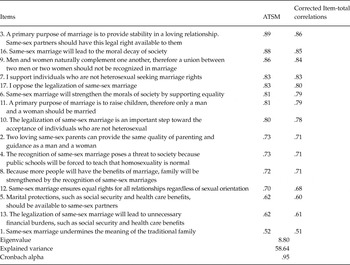
We began by determining the factorial structure of the ATSM Scale by means of PAF analysis, using the first sub-sample. Prior to this all the items were subject to linearization by square rooting the participant scores for each item in order to smooth out skewed distributions. The solution obtained by PAF is shown in Table 1, and proved highly robust, KMO = .97. Furthermore, no evidence of an identity matrix was reported by Bartlett’s test of sphericity χ2 = 8267.49, df = 105, p < .001, also assuring the PAF quality. A single factor explaining 58.64% of the variance aggregated all items (very close to Pearl and Galupo original result of 60%) with the scale also reporting a very high internal consistency level (α = .95). Moreover, corrected item-total correlation assure of the consistency of the obtained solution.
Principal axis factoring and reliability analyses of the ATSM Scale

In all cases, factor loadings were close to those in Pearl and Galupo (Reference Pearl and Galupo2007) original study, with items referring to legal issues (e.g., “The legalization of same-sex marriage will lead to unnecessary financial burdens, such as social security and health care benefits”) presenting smaller loadings than items relative to values/moral issues (e.g., “A primary purpose of marriage is to provide stability in a loving relationship. Same-sex partners should have this legal right available to them”). These results indicate that the construct underlying this single factor structure focuses more on the values/moral dimension of same-sex marriage than on its legal implications.
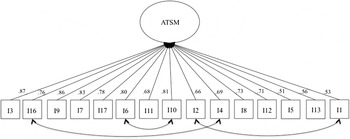
Resorting to the second sub-sample, we conducted a CFA on the 15 items of the ATSM scale. A diagrammatic representation of the one factor model tested, as well as the results obtained are shown in Figure 1. This one factor model was tested using M-Plus software (Muthén & Muthén, Reference Muthén and Muthén2010), imposing the usual constraints so that model identification and required general model specifications were met (Byrne, Reference Byrne2012). Correspondingly, one indicator path loading of the latent factor was set to 1, and all measurement errors were set to 1. Both relative and absolute goodness of fit indexes of the models were obtained: the chi-square fit index (χFootnote 2 ); the relative chi-square fit index (χ 2 /df); the comparative fit index (CFI; Bentler, Reference Bentler1990); the Tucker-Lewis Index (TLI; Tucker & Lewis, Reference Tucker and Lewis1973); the Standardized Root Mean Residual (SRMR); and the root mean square error of approximation (RMSEA; Browne & Cudeck, Reference Browne and Cudeck1989).
Confirmatory factorial analysis of the ATSM Scale (standardized regression weights from latent factor to observed variables and associations between measurement errors).
Note: Model fit -χ 2 (87, N = 349) = 214.02, χ 2 /df = 2.46; CFI = .93; TLI = .91; SRMR = .05; RMSEA = .07, 90% CI [.05, .08].

The model tested proved to be highly acceptable. Indeed, and examination of both absolute and relative fit indexes (see Figure 1) shows that the model keeps within the minimum standards normally established in the literature for goodness of fit measures (cf. Bentler, Reference Bentler1990; Jöreskog & Sörbom, Reference Jöreskog and Sörbom1984). Also, the standardized regression weights of the paths from the latent factor to observed variables were, on average, moderate to high (ranging from λ = 0.51 to λ = 0.87).
Two alternative models were also tested. Resorting to the legal vs. values/moral content of the items that comprise the ATSM scale, we computed two CFA where these items were distributed in two first-order factors. In one factor (of legal issues regarding same-sex marriage), items 3, 9, 7, 17, 10, 8, 12, 5, and 13 were expected to load. In another factor (of values/moral issues regarding same-sex marriage) items 16, 6, 11, 2, 4, 1 were expected to load (see table 1 for a complete description of each of these items). In one of these CFA models, these two factors were declared as correlated. In the other model, no such correlation was declared.
The results show that in both models the fit indexes proved unacceptable, or at least poorer when compared to the one-factor model presented above. Indeed, in the non-correlated two-factors model both relative and absolute goodness of fit indexes are unacceptable when compared with the minimum standards established in the literature: χ2 (90, N = 349) = 532.14; χ2 /df = 5.91; CFI = .74; TLI = .69; SRMR = .33; RMSEA = .12 (90% CI [.11, .13]) In the case of the correlated model, fit indexes were, as expected, more adequate but still outside the minimum standards established in the literature: χ2 (89, N = 349) = 259.54; χ2 /df = 2.92; CFI = .89; TLI = .88; SRMR = .05; RMSEA = .07 (90% CI [.06,.09]). Moreover, these two factors appear as highly correlated (ϕ = .97) a results that allows assuming that these two latent factors are measuring exactly the same underlying construct (i.e., that items measuring these two latent factors should in reality underlie the same factor), or at least that a second-order factor is underlying these two first-order factors.
All in all, the one-factor structure presented above allows for a far better adjustment to our present data than any of the two other models tested, i.e., the uncorrelated and the correlated two-factors model.
Descriptive Statistics
Following Pearl and Galupo (Reference Pearl and Galupo2007) original procedure, we summed up the fifteen items scores to obtain each respondent’s ATSM total score (maximum disagreement = 15; maximum agreement = 75; mid-score, i.e., indecisive or indifferent = 45). The overall mean was 63.79, SD = 12.66, representing a clearly positive attitude (well above the scale mid-point, t(1401) = 55.55, p < .001). Indeed, only 9% of the sample reported a negative position toward same-sex marriage. Scores varied between 15 and 75, but the modal score was 75, accounting for 12.6% of respondents. The overall median score was 69.
Predictors of Attitudes towards Same-Sex Marriage
We proceeded by examining the power of the socio-demographic variables, beliefs, and perceived lesbian and lesbian/gay discrimination and grounds for discrimination to predict attitudes toward same-sex marriage in accordance with an OLS Hierarchical Regression. We began by dummy coding the two categorical variables, Marital Status and Religion before aggregating some of the categories. Marital status compares married respondents with all other respondents (cf. Becker, Reference Becker2012; 0 = Married and 1 = Other marital statuses); Religion compares Catholic respondents with all other respondents (0 = Catholic, 1 = Other religious beliefs).
We then formed three blocks of predictors in order to compare the relative power of socio-demographic variables, that is, gender, age, education, marital and parental status, and social contact with lesbians and gays (i.e., having lesbian/gay friends), with variables related to respondent beliefs, i.e., political ideology, religiosity and religion, and socio-psychological variables, i.e., perceived lesbian and gay discrimination and deservedness of discrimination.
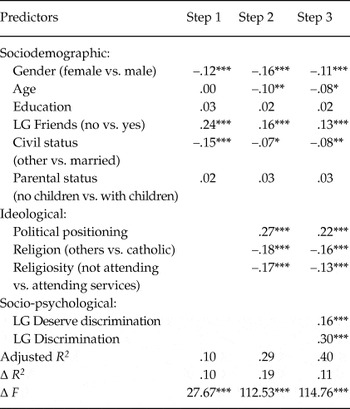
As seen in Table 2 the group of selected predictors plays a significant role in respondent attitudes towards same-sex marriage (R 2 = .40). All variables contribute significantly to predicting respondent attitudes, apart from age, educational attainment, with parental status also contributing negligibly and non-significantly (respectively, β = .01, β = .04, and β = .03). The block of political and religious beliefs (ΔR 2 = .19) and socio-psychological (ΔR 2 = .11) predictors was considerably more predictive than the demographics block (ΔR 2 = .10). This means that the introduction of variables accounting for beliefs and socio-psychological dimensions enables us to better explain respondent attitudes towards same-sex marriage than when deploying demographic variables.
Predictors of attitudes towards same-sex marriage

Note: LG = Lesbian/Gay; *p < .05; **p < .01; ***p < .001.
Despite these differences in the predictive power of the different blocks of variables entered into the regression equations, the results point out how the perception of deservingness for lesbian/gay discrimination (β = .30) and political positioning (β = .22) prove among the best predictors of respondent attitudes towards same-sex marriage. Indeed, left-wing respondents and those rejecting any grounds for lesbian/gay discrimination are among those reporting the most positive attitudes towards same-sex marriage. Next, we identify the perception of lesbian/gay discrimination, religion and religiosity, lesbian/gay friends, and gender as variables equally contributing but at a lower level to predicting attitudes towards same-sex marriage. In this sense, female non-catholic respondents that do not usually attend religious services, that have lesbian/gay friends, and that assume that lesbians/gays are discriminated against return the most positive attitudes towards same-sex marriage. Finally, and with much lower predictive powers, come the variables for age and marital status. Correspondingly, younger non-married respondents are those displaying the more positive attitudes towards same-sex marriage.
Discussion
Although some adjustments had to be made, in particular, discarding two items from the original scale, the psychometric properties of the Portuguese version of the ATSM Scale revealed a sound factorial structure with high internal consistency, similar to that returned by the original Pearl and Gallupo (Reference Pearl and Galupo2007) study. The differences among participants as a function of their socio-demographic groups also followed the predicted direction and thus confirming the construct validity of the Portuguese ATSM Scale version. Only age and educational attainment did not achieve the levels usually found in the literature (e.g., Fleischmann & Moyer, Reference Fleischmann and Moyer2009; Lewis & Gossett, Reference Lewis and Gossett2008; Montgomery & Stewart, Reference Montgomery and Stewart2012; Pearl & Gallupo, Reference Pearl and Galupo2007). However, in our opinion, this may be attributed to the relative homogeneity of the present sample as regards these two variables. For instance, 60% of the sample was aged between 25 and 35, and only 10% of the sample was over 40 years old. The sample was also “over-educated” with only a few representatives from lower educational levels. Correspondingly, these aspects should be approached by future studies tackling the issue of same-sex marriage.
Analysis of the predictors of attitudes towards same-sex marriage provided by the OLS Hierarchical Regression indicates that, similar to other studies (e.g., Bessen & Zicklin, Reference Bessen and Zicklin2007; Brumbaugh et al., Reference Brumbaugh, Sanchez, Nock and Wright2008; Moskowitz et al., Reference Moskowitz, Rieger and Roloff2010), people’s beliefs, whether ideological, socio-psychological or religious, hold the most decisive weighting in attitudes toward same-sex marriage. For instance, Becker (Reference Becker2012) found that whereas respondent demographics (including race) accounted only for 7.9% of attitudes towards same-sex marriage, political and religious beliefs, taken together (including, party affiliation), corresponded to an increment of 23.5% in explained variance. This proportion of values is similar to the present study and, to some extent, it accounts for deeming the scale construct valid. Indeed, our results point to the fact that left-wing respondents denying any grounds for lesbian/gay discrimination are also those reporting the most positive attitudes towards same-sex marriage. Moreover, female non-catholic respondents that do not usually attend religious services, that have lesbian/gay friends, and that assume that lesbians/gays are discriminated against hold the more positive attitudes towards same-sex marriage. With lesser predictive importance of attitudes towards same-sex marriage were the socio-demographic variables, such as age and marital status. Taken collectively, the ranking of betas obtained following OLS Hierarchical Regression is consistent with the results mentioned in the literature, further confirming the scale’s construct validity.
Our results also support other research studies making recourse to the Pearl and Gallupo (Reference Pearl and Galupo2007) attitudes towards same-sex marriage scale. In fact, the results concerning political ideology are consistent with those presented in the literature: the more one moves to the left of the political spectrum, the greater the openness to same-sex marriage. For instance, Pearl and Galupo (Reference Pearl and Galupo2007) obtained strong relationships with self-reported conservatism running in the same direction, with less conservative respondents proving more supportive of same-sex marriage (see also Bessen & Zicklin, Reference Bessen and Zicklin2007; Lewis & Gossett, Reference Lewis and Gossett2008; Moskowitz et al., Reference Moskowitz, Rieger and Roloff2010).
By the same token, our results show moderate gender differences identical to those identified by Pearl and Gallupo in their undergraduate sample, as well as those returned by most empirical studies applying this scale (cf. Lannutti & Lachlan, Reference Lannutti and Lachlan2007). Indeed, Portuguese women did prove slightly more supportive of same-sex marriage than men. Regarding marital and parental status, our findings are consistent with those of Becker (Reference Becker2012).
Finally, and regarding the religious beliefs of respondents, the pattern of results is more complex. Perhaps due to the predominance of Catholicism in Portugal, in contrast to the United States, as well as due to differences between the two Catholic churches in both countries, the fact remains that Portuguese Catholics are the strongest opponents of same-sex marriage, whereas in the United States other denominations take this role (e.g., Brumbaugh et al., Reference Brumbaugh, Sanchez, Nock and Wright2008; Schwartz, Reference Schwartz2010; Sherkat et al., Reference Sherkat, Powell-Williams, Maddox and de Vries2011). The results of religiosity confirm Pearl and Galupo’s (Reference Pearl and Galupo2007) findings and the importance of its interlink age with individual attitudes toward same-sex marriage.
The results of the present study attest that this scale is a good instrument to measure attitudes towards same-sex marriage, showing individual differences in scores that can be accounted by social belongings. This is an important contribution to understand the dynamics of same-sex marriage attitudes within a context of different ideologies and positionings. This law is innovative in the Portuguese legal and social context and therefore such an instrument can give us an in depth comprehension of the changes and permanencies in attitudes created by this law.
In spite of the consistent results, our validation study does incur certain limitations. Firstly, we did not inspect the convergent validity of the scale. In this sense, future studies should analyze the association between ATSM and other measures of attitudes towards same-sex marriage (e.g., Lannutti & Lachlan, Reference Lannutti and Lachlan2007). Furthermore, and to gather more evidence on construct validity, the scale should again be applied in order to analyze eventual attitudinal changes following the legalization of same-sex marriage in 2010. In summary, the results obtained indicate that the Portuguese version of the Attitudes toward Same-Sex Marriage Scale is a reliable instrument for scientific research and assessing trends in public opinion on this subject.