‘Will Europe become what it is in reality – that is, a little promontory on the continent of Asia? Or will it remain what it seems – that is, the elect portion of the terrestrial globe, the pearl of the sphere, the brain of a vast body?’.Footnote 1 Paul Valéry's question encapsulates the concern of twentieth century European elites in the face of the decline of the Old World. These fears were further stoked after 1945 by the rise of the two superpowers and the emergence of nationalist movements in the colonies.Footnote 2 Maintaining Europe's global standing was a core preoccupation of the European integration projects that developed after the Second World War. To restore their power, which had been eroded by the war, imperial Western European countries counted on the possibility of exploiting their colonies.Footnote 3 By 1945, indeed, Europe was not limited to the land between Lisbon and Moscow. By way of an example, nearly 80 per cent of the territory under French administration lay on the African continent, and the literature on the EU's ‘colonial origins’ has shown what the regional integration process owed to the empires.Footnote 4 The preservation of empires was all the more essential to maintaining the global status of European powers as the Soviet Union occupied Eastern Europe and the United States became a true ‘economic leviathan’.Footnote 5
While the idea that regional European integration is primarily the result of global conditions is fairly consensual in many areas, it has remained somewhat underexplored in the field of health.Footnote 6 On the one hand, there has long been a prevailing sense in history and political science that health remained a marginal policy area for European construction;Footnote 7 on the grounds of it being a ‘high policy’ field, states are reluctant to give up their sovereignty in these matters. According to that approach, the European integration of health policy has only happened ‘against’ the states’ will, as a gradual spillover effect of the development of the common market after 1957 and in response to the health crises of the 1980s and 1990s.Footnote 8 Research on international health policy after 1945 has focused on actors other than the European institutions, particularly the World Health Organisation (WHO).Footnote 9
Yet, a little-known attempt to build a Europe of public health was made by the Council of Europe (CoE) in the 1950s. As the number of international organisations multiplied, officials and experts were constantly reaffirming the need to reduce duplication. Yet, the CoE embarked on the creation of an obvious duplication by establishing a Committee of Experts on Public Health (CEPH) in 1954, only three years after the creation of the WHO regional office for Europe. To shed light on this paradox, I started by exploring the CoE's archives. Interviews were also conducted with Hans Pfeffermann's children, who offered me access to private documents belonging to their father, director of the CoE's CEPH in the 1950s and 1960s, giving a glimpse into what the institution looked like from the inside. This work revealed that CEPH owed a great deal to the effort of France, supported by the Netherlands, which fought hard to impose its creation on more reluctant countries, especially the Scandinavian ones. The study of the CoE's archives was thus complemented by the archives of the French Ministry of Public Health's ‘Service des Relations Extérieures’ (Foreign Relations Department). These documents showed that France's European efforts were closely linked to its distrust of UN-affiliated international organisations and fit within a global strategy devised to offset the influence of the United States and of international organisations in the empires. Secondary literature was used to analyse the policy of other European states, particularly Great Britain, while the US strategy was studied on the basis of the Department of State's published materials, to establish to what extent French fears were based on actual US policy. The corpus was thus built up from the recently reopened collections of the Council of Europe and expanded in concentric circles, taking the study from an internal perspective to a European perspective, and eventually to a global one.
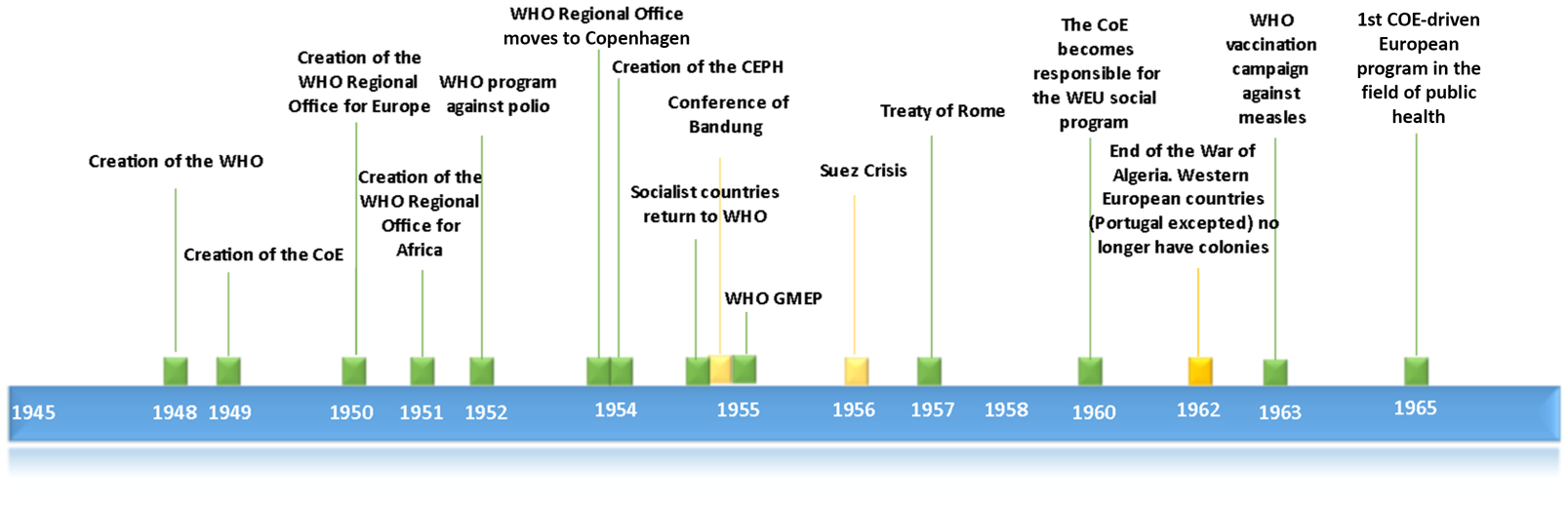
In order to understand why the WHO appeared to be such a scarecrow for some Western countries, we must go back to the first years of the institution. In its first decades, the WHO concentrated its efforts on infectious diseases, for instance organising campaigns against yaws and polio in 1952. This trend culminated with the 1955 launch of the Global Malaria Eradication Program, which drained much of the organisation's resources in the following years.Footnote 10 While the WHO orchestrated programmes on a global scale, ‘regional offices’ were opened between 1951 and 1954, tasked with applying global policies at the ‘regional’ (mostly continental) level.Footnote 11 A Regional Office for Europe was created in 1951. In the early years of the WHO, the Soviet bloc countries did not participate in the institution, leaving the United States in a dominating position at the international scale, and Western European countries in the Regional Office for Europe. The reintegration of socialist countries in 1955 had several consequences: (1) the priority given to the fight against infectious diseases was reinforced, (2) the newly independent countries had new allies in their opposition to the colonial powers, (3) in the WHO European office, the countries of the Western bloc now had to deal with the socialist countries (Figure 1).
Key events regarding global health (1945–1965).

It is thus key to ‘provincialise’ the Europe of public health by showing what it owes to the broader geopolitical configuration of which it is a part, since global factors crucially determined its development. Here, the term ‘provincialise’ is used not in Dipesh Chakrabarty's classic sense (to re-contextualise and situate alleged European ‘universals’), but in Kiran Klaus Patel's sense of scrutinising ‘the ways in which the interconnections with other international organisations have energised, complemented or rivalled the efforts of the European Communities/EU’.Footnote 12
The connection between the development of cooperation in the field of public health and the sense of Europe's decline as a global power can be studied at three key junctures. First, from 1945 to the mid-1950s, France played an important role in rallying colonial powers to keep specialised UN agencies, especially the WHO, and US-funded economic aid programmes at an arm's length from the empires. The main fear was that these institutions would become US Trojan horses, undermining their colonial empires from within. Then, beginning in 1953, a coalition of European countries led by France and the Netherlands, seeking to prevent their contributions to the WHO from funding health programmes in newly independent states, supported cooperation in the public health field within the CoE: unlike the WHO, it did not have to share resources with newly independent countries, and it also excluded socialist countries at that time. Lastly, in the 1960s, the discourse purporting that the WHO opposed European interests and concerned itself only with Third World countries, initially promoted by certain colonial powers, was taken up by the CoE itself. Whereas the WHO spent most of its funds on programmes for the eradication of infectious diseases (smallpox, malaria), the CoE structured its action around the fight against ‘lifestyle diseases’ (aging, pollution, mental health disorders, etc.) that were considered the preserve of Europe.Footnote 13
Europe, a ‘Coordinated Colonial Front?’ (1945–1953)
On 17 March 1945, Georges Bidault, the French Minister of Foreign Affairs, urged Paul Giaccobi, the Minister for the Colonies, to build a ‘coordinated colonial front in the face of other powers’, arguing that Europe would lose its standing if ‘the front of colonial nations did not play in solidarity’.Footnote 14 The ‘other powers’ Bidault was referring to were the United States and the Soviet Union, but soon another threat loomed over the empires: the United Nations and its specialised agencies. In the field of health, the main institution is the World Health Organisation (WHO), which was founded in 1948, replacing the International Office of Public Hygiene (OIHP) and the League of Nations’ Health Organisation (LNHO).Footnote 15 The literature has argued that industrialised countries controlled the WHO until the 1960s–70s, before decolonisation and the emergence of numerous independent states challenged their hegemony, in an institution operating on the ‘one country = one voice’ principle.Footnote 16 This is an overly US-centric vision. In fact, colonial powers already perceived the WHO as a threat when it was created: it was believed to be a vector of US influence that would threaten their empires. To counter this threat, colonial powers acted on two levels: (1) internally, by attempting to strengthen their position within the institution, (2) externally, by developing institutions over which they had control and which could constitute alternatives to the WHO.
The United States and Their Trojan Horse
After 1945, the US position on the colonies was ambiguous, designed as it was to reconcile two contradictory objectives. On the one hand, Washington wanted to restore the power of the Western European countries, which were indispensable allies in the fight against the Soviet Union as fears of a communist takeover remained a major concern.Footnote 17 On the other hand, it needed to cultivate ‘the friendship of emerging colonial peoples’, to prevent communism from spreading on the African continent, which meant backing political and social reforms that would ultimately lead to the independence of these populations.Footnote 18 Indeed, the United States worried about the prospect of seeing the ‘African question’ discussed at the UN, which would put them in the ‘embarrassing position’ of choosing between publicly calling out their European allies or defending the colonial order in a way that Moscow could use against them. As the US consul in Tunis put it, ‘the propaganda value to the Soviets of our failure to side with the dependent people […] would in the existing international situation, be enormous’.Footnote 19
This ‘middle-of-the-road policy’ tended to make everyone unhappy.Footnote 20 The colonial powers were wary that the United States or the international organisations could intervene in and against their empires. In 1942, General de Gaulle had already accused the United States of having ‘supported if not orchestrated’ unrest among the population of New Caledonia to justify an intervention, which he believed called for ‘great caution when it comes to the presence of the Americans in our free Africa’.Footnote 21 On 11 January 1949, the US ambassador used harsh words against the Netherlands at the UN Security Council regarding the repression of the Indonesian independence movement, and Amsterdam had to yield to Washington's threat not to accept the Netherlands into NATO if they did not launch negotiations with the Indonesian leaders.Footnote 22 In 1950, the Resident-General of Tunisia (a French protectorate) accused the US consul in Tunis of engaging in secret talks with nationalist leaders.Footnote 23 The United States was perceived in Europe as a threat to colonial empires.
Beyond the US, the international organisations, including the WHO, were also perceived as threats by colonial powers. These fears did not date back to the creation of the UN in 1945. During the Second World War, Ludwik Rajchman, a major actor in the field of international health during the interwar period, particularly in the LNHO, had proposed the creation of an international health agency that would exercise ‘a form of control over colonial empires’.Footnote 24 This suggestion led him to be excluded from the process of creation of the WHO following pressure from the British authorities, but it stoked the fears of colonial powers about international institutions interfering with their interests. Less than a year after it was founded, the French Minister of Foreign Affairs already described the WHO as ‘dominated by anti-colonialist leanings’.Footnote 25 In addition to the activism of newly independent countries such as India, the progression of US influence was denounced by Jacques Parisot, a French doctor and another key member of the LNHO:
Some accuse France (and others) of ‘colonialism’ . . . But aside from this, there are other methods, a ‘form of expansion’ implemented by certain nations: ‘penetration’ through the medico-social action of technical assistance, of aid under all its forms, of health education and general education, with staff and resources allowing for ‘entering into contact’ but also ‘entering into possession’ of all these countries that need ‘picking up’. The dissemination and predominance of the English language ensue.Footnote 26
The discourses and careers of Rajchman and Parisot tend to support the thesis put forward by Thomas Zimmer, who, at odds with Iris Borowy, has argued that the United States had more influence than the former leading members of the LNHO on the direction pursued by the WHO in its early years.Footnote 27 In Europe, the WHO was perceived as a double threat to the hegemony of colonial powers: both because it could amplify anti-colonial demands and because it might act as a Trojan horse for the new US superpower. To make sure that the WHO's plans for ‘insufficiently developed regions’ would not threaten their interests, the colonial powers adopted a two-tier strategy, implemented in the central organisation and in its regional offices. The French and Dutch setbacks respectively in Indochina and Indonesia led to a rapprochement between Paris and Amsterdam, who secured clear support from the United Kingdom on certain issues, and a more reserved backing on others.
The Battle over Seats: Europe in America
France, the Netherlands and the United Kingdom first attempted to secure a representation at the WHO's regional office for ‘America’. This first required the adoption of a definition of ‘member state’ that suited their interests, one that would consider overseas possessions (the French and Dutch West Indies, Surinam, Guiana) as full parts of their national territories, and hence justify a seat for these European powers at the WHO's American office.Footnote 28 This push for representation had two motives. First, they wanted to make sure that the WHO would not perform missions in their possessions without supervision from national authorities. The instructions from the French Ministry of Foreign Affairs were clear: ‘we have to close our doors, without looking like we want to hide our miseries’; indeed, caution was in order as ‘we must avoid giving off the impression that we want to stop all international organisations from accessing our territory altogether’.Footnote 29
The second motive was to ‘maintain and develop scientific influence in Latin American countries’.Footnote 30 This was not just a matter of prestige, but also of having new markets for medical equipment and drugs in the region. While national European industries were rivals in that field, their governments were united by the desire to compete with the United States.Footnote 31 This was made all the more difficult by the fact that the regional WHO office for America was part of the Pan-American Sanitary Bureau, an older organisation that was largely funded and dominated by the United States.Footnote 32 Medical markets were important to national industries, but also to public finances, as states could pay their yearly contribution to the WHO by delivering drugs or medical equipment and, in the process, avoid paying conversion fees (as monetary contributions had to be made in dollars or Swiss Francs). In their struggle over continued representation at the WHO's American office, the French, Dutch and British came up against strong opposition from the United States.Footnote 33 Yet, the conflict remained limited in that the United States did not call into question the European possessions as such.Footnote 34
A ‘Filter’ between Africa and the WHO: The CTCA
A similar situation arose in Africa, where colonial powers opposed the creation of a regional office on the grounds that there were no high-level medical centres on the continent and that most countries could not take part in major scientific collaborations because they were for the most part colonised.Footnote 35 Inspired by the American model, in which the WHO regional office was part of another, US-dominated institution, the colonial powers attempted to circumvent the UN agencies. The idea was to create an institution that could act as a regional office for the WHO or neutralise it to keep the central body's influence at bay. As a memorandum by the French Minister for Overseas Territories put it:
The only way, apparently, to thwart the indiscretions of the United Nations, of the specialised institutions and of the United States in this technical area, is to put up the barrier of an organisation that represents the sum of all the French, Belgian, English and South African scientific resources between them and Africa.Footnote 36
This white pan-African project gave birth to the Council for Africa South of the Sahara (CSA) in 1949, followed by the Commission for Technical Cooperation in Africa South of the Sahara (CTCA) in 1950.Footnote 37 Two extreme positions squared off in that organisation. South Africa wanted to use the CTCA to entirely bypass the UN system and maintain white hegemony in Africa, whereas the United Kingdom sought to make it a more technical than political commission.Footnote 38 Between the two, France, Belgium and Portugal worked to set up multiple sector-specific offices to complicate US and UN interventions in Africa as much as possible, but they had to contend with the British, who limited the institution's prerogatives. Indeed, the UK's strategy to retain its influence in Africa consisted in recognising some of the local claims for the purpose of integrating the former colonies into the Commonwealth in the long run.Footnote 39 This strategy made it essential to maintain good relationships with the African elites, and in particular to fight ‘the suspicions of Europeans ‘“ganging up”’ that the creation of Paris- or London-based institutions dealing with African problems would inevitably raise.Footnote 40
In the face of Soviet and US pressure, some countries changed their stance, such as Belgium, which hoped that a regional WHO office would be established in Congo. France was the most hostile country, but feared that its opposition to the idea of an African office might be ‘used by anti-French propaganda in [its] African territories’ and grudgingly accepted its creation. Lastly, the United Kingdom formally opposed the creation of a health office within the CTCA, which paved the way for the establishment of an African office of the WHO. Its members first met in Geneva in 1951 and moved to Africa in 1953. The Portuguese director, Francisco Cambournac (1954–1964), embodied the ambiguous position of the office: a white European man, he did not explicitly oppose colonisation and supported development aid rather than independence.Footnote 41
Even after the creation of the WHO's African office, France continued to try to rally colonial powers to ‘counter the penetration efforts of specialised institutions with achievements and stances that these institutions will have to consider’.Footnote 42 Despite the UK's opposition, Paris continued to try to turn the CTCA into a filter between the occupied African territories and the WHO, whose extension it argued should be limited ‘to the extent of our resources’ by developing multiple medical projects outside of the WHO framework.Footnote 43 Whereas on the American question the ‘colonial front’ formed by France, the United Kingdom and the Netherlands was fairly solid, this wasn't the case in Africa, particularly due to the opposition between the colonial policies of Paris and London. However, at the central WHO level, a broad coalition of European countries was built, including even countries that did not (or no longer) possess colonies.
The Fight over the ‘Safeguarding of the European Position’ at the WHO
At the central WHO level, France sought to secure a leadership over the ‘safeguarding of the European position’ by demanding an increase of the number of European seats in the key committees. This push was backed by the United Kingdom and Belgium, but also Switzerland and Italy, countries whose contributions to the WHO exceeded the value of the services they received from it, and which were concerned about the ‘high-spending policy systematically pursued by the WHO Directorate-General’.Footnote 44 The goal here was to actively combat any proposals to significantly raise the institutions’ expenses, the majority of which were funded by contributions from rich countries, but chiefly benefited developing countries. The French Ministry of Foreign Affairs insisted that the WHO stick to its role ‘as an organisation for research and coordination, without purporting to become a charitable administration’.Footnote 45
These demands from Western Europe faced, however, opposition from three sides. It came first from the Third World countries that ‘hoped to get more out of the WHO than what they contributed’; second from the United States, which saw in the expansion of the WHO budget a way to implement President Truman's Point Four Program, i.e. provide technical aid to development in emerging countries to combat communism; and third from the Scandinavian countries, which were particularly prominent WHO contributors. Investing in global health was one of the pillars of the Sverigebilden, the vision of the country that Sweden's government sought to promote internationally.Footnote 46 From 1948, Sweden was the highest contributor to the WHO's extraordinary budget per capita, and only second to the United States in terms of total amount.Footnote 47 This investment was part of the country's push to assert itself as a ‘moral superpower’, according to a phrase coined by Swedish politician Pierre Schori, embodying a ‘third way’ between capitalism and socialism, helping emerging countries that might need humanitarian aid.Footnote 48 On the strength of its neutrality during the Second World War and of its absence of a colonial empire, Sweden fashioned itself as the defender of the small nations. In fact, the Swedish position was more ambiguous and related to its geopolitical situation. As it had a threatening neighbour, the Soviet Union, its support to small, dominated countries went primarily to those that faced threats from the United States or colonial powers, but it remained silent on the fate of Baltic countries. At the same time, Stockholm developed a secret military cooperation with the Western bloc to the extent that it was called ‘NATO's seventeenth member’. Its anti-colonialist discourse in international arenas allowed Sweden to give the Soviet Union noncommittal tokens of neutrality, while discreetly forging ties with the rival bloc.Footnote 49
The colonial powers perceived the WHO as a threat that should be kept at bay and managed to coordinate to secure representation at the organisation's American office, but the difference between the French and British African strategies prevented the formation of a genuine ‘colonial front’. On the other hand, a broader coalition of Western European states developed at the WHO, faced with newly independent countries that sought to increase the organisation's budget with support from the United States and Scandinavian countries, which saw international health as a means to reinforce their global political and economic influence. As European projects multiplied, the reinforcement of regional cooperation in the field of public health represented an alternative that allowed some states to undercut the WHO.
Colonial Powers and Scandinavians: Conflicting Visions of the ‘Europe of Public Health’ (1953–1960)
On the international stage, the ‘colonial front’ registered some victories in America in the field of health but could not prevent the creation of a regional WHO office in Africa. Likewise, its efforts to ‘safeguard the European position’ were perceived as failures in European capitals: while industrialised countries contributed to a large extent to the organisation's budget, they could not prevent these funds from being mainly directed to countries in what began to be called in 1952 the ‘Third World’.Footnote 50 European countries were not, however, united. A North-South divide quickly emerged, pitting the defenders of the WHO against the advocates of closer health cooperation on a European scale. Colonial powers, mostly France and the Netherlands, pursued their two-tiered strategy of containing the WHO influence both from the inside and from the outside. When the WHO created a Regional Office for Europe, France offered to establish its seat in Nice, but it lost the election by the narrowest of margins (eleven votes against ten) to Copenhagen.Footnote 51 In response, France and the Netherlands supported investments from the CoE in the field to curb the WHO's influence on European affairs and to organise research on subjects that were more relevant to them.
The Agenda-Setting of Health at the Council of Europe
After the Second World War, a multitude of European cooperation projects emerged. The Council of Europe was founded in 1949, the European Coal and Steel Community (ECSC) in 1951 and the Western European Union (WEU),Footnote 52 a political and military cooperation agreement, in 1954.Footnote 53 Beyond these institutions that came to exist, multiple projects were debated and then shelved, such as the planned European Defence Community (EDC) and the European Health Community (EHC).Footnote 54 The main body of the EHC or ‘White Pool’ would have been a supranational organisation to harmonise medical training, drug markets and healthcare systems.Footnote 55 Although it was eventually dropped, this project, defended by the French Minister of Health, Paul Ribeyre, points to the continuity between the French attempts to build a ‘colonial front’ against the WHO and the leading role of Paris in the promotion of European projects in the health field. The Council of Europe was an international organisation consisting of a Council of Ministers, bringing together the Ministers of Foreign Affairs of member states, and proposing non-binding recommendations or conventions, with a voice for each country, and a parliamentary assembly made up of representatives of national parliaments, where votes were weighted based on the countries’ population and wealth. The CoE covered Europe in a geographically broad (from Iceland to Turkey) but politically narrow sense: it promoted liberal democracy values and effectively excluded Eastern European socialist republics and the authoritarian regimes of the Iberian peninsula.Footnote 56
In May 1953, the CoE's Council of Ministers decided to begin work on a programme of action to frame its activities for the following years, leading the French, British and West German governments to formulate proposals that were liable to be ‘conducive to developing European cooperation in the field of health’.Footnote 57 While the German and British ambitions were somewhat limited, Paris submitted a long list of proposals. This was essentially another version of the EHC with the most (economically, in particular) divisive aspects expunged, although it made sure not to explicitly reference that stillborn project.Footnote 58 The CoE's Committee of Ministers then reached out to Norman Begg, the head of the WHO's regional European office, to establish the extent to which the points included in its programme of action had already been studied by the WHO, and to ask how the European Office could assist the CoE.Footnote 59 Begg responded that he was willing to work with the CoE but stressed that ‘[f]requently, progress can be made more rapidly within a group of countries having fairly common health problems rather than to attempt initially a wide attempt at standardization on a regional basis’, which suggested that it might be better to act through smaller regional entities (like the Nordic Council or the Western European Union).Footnote 60 He also noted that most of the CoE's proposals were already being tackled by the WHO in Europe, and that those that were not could be.Footnote 61 When the CoE contacted the High Authority of the ECSC, which had a branch that dealt with occupational health matters, the ECSC responded that it would only share a summary of its activities.Footnote 62 Lastly, the CoE struggled to extend its action in the field of health beyond its member states. Invitations were issued to Austria, Portugal and Switzerland in 1954.Footnote 63 In 1957, a similar attempt was made with Finland and Yugoslavia,Footnote 64 which, like Portugal and Austria, declined, citing the overlap with the regional WHO office.Footnote 65
The Creation of the Expert Committee on Public Health
The CoE struggled to gain recognition of the relevance of its investment in the public health field in what was perceived as an already saturated institutional space. The worry was that the coexistence of multiple institutions with similar purviews in the same territory might lead to conflicts, as each of them attempts to secure its survival.Footnote 66 Still, on a Franco-Dutch initiative, the Committee of Ministers decided to summon a Committee of Experts on Public Health (CEPH) to reflect on a programme and tasked it with studying the question of the CoE/WHO relations in more detail. In the minutes of the CEPH's first meeting (5–7 July 1954), it clearly transpired that two sides were at odds: the Scandinavian countries (Denmark, Norway and Sweden), generally supported by Ireland, and the Franco-Dutch partnership, backed by Greece.Footnote 67
The French and the Dutch underlined the WHO's limitations and called for increased European cooperation through the CoE. C. van den Berg (Netherlands) argued that ‘the WHO, even at the European level, deals with global issues’. He was backed by Jacques Parisot, who in 1951 had denounced the US influence on the WHO, and now proposed that the CoE ‘expand on some of the WHO's activities, which are limited by nature, and take on […] the activities that are ignored by the WHO’. The Franco-Dutch tandem drew on a rhetoric developed during years of common struggle at the international level, claiming that the WHO mostly concerned itself with the problems of poor countries and ignored those of industrialised countries. A memo by the Dutch delegation hence justified the need for heightened European-level cooperation on public health in terms of combating the marginalisation of Europe by the WHO, on the grounds that each redistribution of the organisation's budget was done at the expense of Europe, even though it was one of the biggest contributors (far behind the United States).Footnote 68 For the Netherlands and France, the strategy was to play off the CoE against the WHO and Europe against the world.
A similar discourse was conveyed by the Greek representative, who deplored that ‘within the framework of the WHO, Europe finds itself disadvantaged by the Asian and South American preponderance’: Athens supported Paris and Amsterdam because it saw itself as a victim of its status of ‘poor among the rich’ at the WHO.Footnote 69 This was a particularly problematic situation for Greece, which had been badly hit by the Second World War and largely relied on international aid in the 1940s.Footnote 70 The shift from institutions and programmes mainly geared towards the reconstruction of Europe to global institutions targeting mainly the Southern hemisphere took a toll on Athens (the UNRRA was terminated in 1948 and the ERP in 1951).Footnote 71 The end of the civil war in 1949 also led international aid flows to run dry; British then US authorities had until then provided the Greek government with economic support to ensure its victory over the communist rebellion.Footnote 72
In response to the Franco-Dutch stance, the Danish and Norwegian delegates argued that European collaboration in the field of health fell within the province of the WHO's European regional office, and that exchange of scientific documentation should take place at the global rather than European level. The idea that the European level was not suitable on the grounds that it was too vast to allow for effective action was not new, as shown by a letter sent by the royal legation of Denmark to the director of the WHO in 1947 that proposed the creation of several regional offices in Europe based on the premise that ‘epidemiological issues are of a very different character and scope in the various European countries’.Footnote 73 There was still something paradoxical about pushing this discourse in the 1950s, as the European region covered by the WHO was geographically far broader, bringing together countries with far more varied epidemiological profiles than the CoE, insofar as it also comprised Soviet bloc countries. The Scandinavian scepticism towards the CoE should be understood in light of the pre-existence of a strong regional cooperation in Scandinavian countries, with the creation of the Nordic Council in 1952, and of the fact that Sweden was particularly invested in the WHO (Figure 2).Footnote 74
CEPH's defenders and opponents. On the left, the states most favourable to the development of the CoE's role in the field of public health; on the right, those most opposed to it.

Opposite Policies and Twin Expertise
The rift between the Franco-Dutch axis and the Scandinavians reverberated on all the issues. For instance, van den Berg (Netherlands) wanted to create a European blood bank, whereas Malcolm Tottie (Sweden) and Johan Frandsen (Denmark) opposed it. Likewise, at the second meeting of the Expert Committee, van den Berg was narrowly re-elected with seven votes against five, which reflected the North/South divide regarding the question of the model of public health cooperation to adopt in Europe.Footnote 75 The Scandinavian offensive against the Expert Committee on Public Health continued: in 1955 and 1956, at the Council of Ministers, the delegates for Norway and Sweden ‘voiced doubts on the relevance of the continuation of the work of the Expert Committee’,Footnote 76 while the delegate for Ireland opposed (in vain) the creation of a CoE programme of medical scholarships.Footnote 77
It should be noted that the CoE and the WHO were at odds over the hierarchisation of health priorities at the global level and not over the diagnosis of the health issues faced by Europe, as is evidenced by the expert reports on which they based their action, drafted respectively by Jacques Parisot (1887–1967) and Yves Biraud (1900–65). The two men were French and had worked for the LNHO, but their trajectories were different. Parisot had spent his whole career in France, most importantly at the Faculty of Medicine of Nancy, of which he was the dean, and after 1945 became the head of the French delegations at the WHO and the CoE. Biraud did a PhD in France and then moved to the United States, where he trained under the supervision of Wade Hampton Frost, an epidemiologist at the Johns Hopkins School of Hygiene, worked at the Rockefeller Foundation, and was the first head of the WHO's epidemiology services division.Footnote 78 Parisot, who was very close to the Ministry for Public Health and Population and hostile to US imperialism, was a defender of national interests, unlike his countryman Biraud, who perfectly embodied the group of international civil servants that emerged in the twentieth century, whose loyalty lay with the institutions they served rather than their home countries.Footnote 79
In a 1955 report, Biraud reviewed ‘Europe's health problems’ and the area in which international cooperation was necessary. He noted that the main trend on the continent was the reduction in the incidence of infectious diseases and that the main challenges in the coming years would be (1) the development of a joint quarantine defence system against infectious disease, (2) the international standardisation of biologicals and drugs, (3) the international coordination of research in the fields of medicine and health and (4) international collaboration for the technical training of healthcare professionals.Footnote 80 The first two challenges were the initial subjects to be addressed at the European level outside of the WHO, by the WEU for a restricted number of countries and by the CoE on a broader scale.Footnote 81 Collaboration in the fields of research and training was also a major concern in a long report drafted by Parisot in 1954, which was central to the CoE's early efforts in the field of public health.Footnote 82 While the WHO and the CoE did not necessarily rely on the same experts, their observations on the state of health in Europe were extremely similar.Footnote 83
In sum, the development of a European public health policy was perceived by Scandinavian governments as irrelevant because it meant acting on the wrong scale, but it also risked weakening their position at the international level.Footnote 84 Still, the CoE increasingly invested in the public health field, especially on the impulse of France and the Netherlands, with support from Greece, who saw this as a way to partly bypass the WHO, which was dominated by the interests of the United States and Third World countries, backed by the Soviet Union. To justify the CoE's legitimacy to invest in this area, the French, Dutch and Greek delegates emphasised its complementarity with the WHO, although the comparison of the priorities defined by the two institutions does not support this.
The Council of Europe vs. ‘Lifestyle Diseases’ (the 1960s)
In the 1950s, the World Health Assemblies, the annual meetings of all WHO member states, were, like the other international meetings of UN bodies, opportunities for delegations from the South to denounce the colonial system and the egoism and imperialism of European countries, and of France in particular. This discourse began gaining momentum at the Bandung Conference (1955), which witnessed the emergence of a coalition of interests bringing together newly independent states.Footnote 85 In general, Washington was increasingly embarrassed in the face of what a Department of State memo called the ‘dilemma of colonialism’ (i.e. should they back allied colonial powers or independentist movements in case their support might be needed in the future?) and abstained from showing ostensible support to their allies on this topic.Footnote 86 Lastly, the Algerian War, but also the hostility of Soviet-backed former colonies, such as Sekou Touré's Guinea, made France a target of choice at the WHO, which made it even more eager to reinforce the European institutions.Footnote 87 It was at this time that the Treaty of Rome was ratified, founding the EEC (1957), which the Ghanaian president Kwame Nkrumah compared to the Berlin Conference in 1885: ‘the latter treaty established the undisputed sway of colonialism in Africa, the former marks the advent of neo-colonialism in Africa’.Footnote 88 While the wording was picked for shock value, it pointed to a possible connection between European integration and the desire to counter the rising ‘Afro-Asian’ forces, as suggested by David Van Reybrouck.Footnote 89 In the field of public health, French diplomats and their Dutch counterparts actually explicitly acknowledged fighting an ‘Afro-Asian offensive’ as late as 1959.Footnote 90 This rhetoric persisted in Europe throughout the 1960s, but it changed in two different ways. Firstly, it was no longer just the national delegates who promoted it, but the head of public health at the Council of Europe himself. Secondly, ‘Europe's decline’ was now more a state of affairs to be mitigated than a threat to be averted.
‘Lifestyle Diseases’: A Scientific Paradigm and a Rhetorical Strategy
In the mid-1960s, the CEPH's functions changed; it tended to become a ‘control and programming body’ proposing broad research guidelines. The head of the CoE's Public Health Division, Hans Pfeffermann, remarked that ‘many of the concerns of the Expert Committee have pertained to the repercussions of the progress of modern civilisation on individual physical and mental health’, and accordingly proposed a programme revolving around the general idea of ‘twentieth-century man in the face of the progress of civilisation’.Footnote 91 This was inspired by the Expert Committee's past work, but it also defined an institutional space: the WHO would tackle the health issues of developing countries whereas the CoE would address those of developed countries (pollution, aging, mental health, etc.). The Europe of public health, in the sense of a community of researchers grappling with common issues, was thus built by overstating the distinction with the WHO for institutional rivalry reasons. The programme was elaborated by synthesising the proposals of member states, as a result of which issues that were somewhat secondary for the WHO (such as noise pollution or the management of the elderly population) and themes also studied by the WHO (such as water and air pollution) were put on the agenda.Footnote 92 While the CoE's Social Committee put real effort into demonstrating that European societies had distinguishing features that resulted in specific health issues, in effect, the technical documentation on these purportedly ‘European’ problems underlined a range of dynamics also observed in other parts of the world: industrialisation, urbanisation, increased circulation of products and people, etc.Footnote 93 While some of the points it raised did seem slightly more distinctively European, such as the elevation of standards of living, the more important place of leisure and the increasing elderly population, they were also relevant to countries such as the United States or Japan.
It is impossible to precisely determine whether this opposition between Europe and the ‘Third World’ that structures the discourse is reflected in the ‘facts’. Indeed, vital statistics were not properly gathered in most countries. For instance, in the late 1960s, the UN statistical office estimated that the causes of death were known for 36 per cent, 7 per cent and 3.3 per cent of the population of, respectively, Latin America, Asia and Africa.Footnote 94 Moreover, no relevant inference could be derived from the existing numbers, since the population that was properly followed was not representative of the entire population.Footnote 95 The limited existing data, published in the UN annual's Demographic Yearbook, suggests that while infectious diseases are still prevalent in the ‘Third World’ countries, ‘lifestyle diseases’ are also very common.Footnote 96 Moreover, if the epidemiological transition model works for most Western countries, some national nuances still exist in the 1960s.Footnote 97 In the United States, the two major causes of death in 1962 were diseases of the heart (39.2 per cent) and cancers (15.9 per cent). The only infectious disease category ranking in the first fifteen causes of death is a grouped one: influenza and pneumonia (eighth, at 3.4 per cent).Footnote 98 In Europe, cardio-vascular diseases became the predominant cause of death in the 1950s.Footnote 99 In United Kingdom, around 1960, the first cause of death for males was motor vehicle incidents (below thirty years old) and heart conditions (above thirty years old), while for females it was motor vehicle incidents (one to twenty-five years old), cancers (twenty-five to fifty-five years old) and heart conditions (above fifty-five years old).Footnote 100 In France, cancer (95,365 deaths) and heart diseases (97,549 deaths) were by far the two main causes of death in 1964; the deadliest infectious disease (tuberculosis) and motor vehicle accidents killed, respectively, 8,000 and 11,184 people.Footnote 101
Whatever its ‘factual’ grounding, the choice of the theme of ‘repercussions of the progress of modern civilisation on individual physical and mental health’ also had a strategic value in that it signalled the CoE's originality in comparison with the WHO, which in the 1960s focused on programmes for the eradication of infectious diseases (smallpox, malaria). Beyond the principled political opposition to the WHO, this choice of theme for the five-year programme also reflected the CoE's distancing from the public health model promoted by the UN agency, characterised by highly medicalised vertical interventions geared towards countries in Latin America, Africa and Asia. Lastly, the CoE's five-year public health programme also addressed the repercussions of civilisation on states’ budgets. Indeed, the item ‘the elderly issue’ was preceded by ‘healthcare – reducing the costs of disease’.Footnote 102 Beyond the interest in the wellbeing of an ageing population, the question of the rise of healthcare expenditure concerned European governments, uniting (for once) the United Kingdom, which had been attempting to place this question on the European agenda since 1960, and France, where it was at the time raised increasingly acutely.Footnote 103
By the mid-1950s, Hans Pfeffermann embraced the Franco-Dutch stance that Europe was being unfairly neglected by the WHO despite its significant financial contribution. His support to the rhetoric that depicted the CoE as the guarantor of European interests was probably motivated both by interest and convenience.Footnote 104 The defence of the interests of Europe united against the superpowers resonated with his convictions and had the advantage of stressing the legitimacy of the institution he worked for. In 1956, as the WHO's global budget was cut by 6 per cent, and the European office's funds by 12 per cent, Pfeffermann deplored that ‘[as always] the European region [comes] last’.Footnote 105 He would again have reason to complain on multiple occasions during the 1960s, as the increasing number of independent African and Asian states gradually contributed to make European states a minority:
Aid to developing countries comes first and each year it absorbs a larger part of the WHO's budget. This trend results in the transformation of the European region into a ‘Cinderella region’ and makes the Council of Europe's contribution to the resolution of health problems in the region increasingly important.Footnote 106
The reference to Cinderella sounds strange in French, the language in which the text was written, but makes more sense in Pfeffermann's mother tongue. In German, the word Aschenputtel refers to something that is insufficiently taken into account or neglected. In 1964, he welcomed the increase in funding for high-tech medical research, a project that was supported by industrialised countries, but this ‘new trend’ of ‘taking Europe's regional needs into account’ would not last: by 1966, the WHO's general budget increased again (by 16 per cent), despite the disapproval of France and the United Kingdom, to allow for the funding of a global campaign for the eradication of smallpox, which primarily targeted developing countries.Footnote 107
The choice of the theme of ‘repercussions of the progress of modern civilisation on individual physical and mental health’ was based on the premise that Europe was a space characterised by a specific degree of development, causing specific health issues that required studies and actions distinct from those conducted at the WHO, focused on the fight against infectious diseases in Latin America, Africa and Asia. The opposition between the CoE and the WHO did not lie in divergences over their scientific analysis of ‘Europe's health problems’, as reflected by the analysis of the reports by Parisot (1954) and Biraud (1955) and the technical documents for the CoE's five-year programme on public health (1965–70), but in a different hierarchisation of priorities between health problems and between regions of the world.
The Council of Europe as a Producer of Norms
While, from the perspective of Western Europe, the battle over the defence of European interests at the WHO was lost entirely in the 1960s, at the same time, the Franco-Dutch vision of the CoE's role in the field of public health triumphed over the Scandinavian one. Additionally, whereas the CoE's defence had been mainly taken on by the French and Dutch delegates in the 1950s, the institution's employees now spoke for the institution themselves.Footnote 108 For instance, in 1966, the Norwegian Minister of Foreign Affairs sent the Director General of the Council of Europe an official letter deploring ‘the less than satisfactory achievement of the Council of Europe in the public health sector’.Footnote 109 The CoE Secretariat responded by underlining the number of conventions, agreements and recommendations issued by the CEPH, ratified by some fifteen member states, and denying any overlap with the WHO. First, he explained, the two organisations did not cover the same territories; those of the CoE were more ‘homogeneous’, making the elaboration of common studies and norms more plausible. In addition, the CoE primarily aimed at producing legal instruments, whereas the WHO did not have either the mandate or the experience to do so. Lastly, the cooperation between the CoE and the WHO was satisfactory according to the central WHO itself.Footnote 110
The vision of the CoE as a producer of international norms, promoted as soon as the Expert Committee was created, was reasserted on the occasion of the preparation of its first five-year programme (1965–70). The institution's Secretary General reminded the expert that it was essential to pursue research avenues that were easy to turn into the subjects of European conventions, as those were the most likely to receive support from member states’ governments.Footnote 111 Two possibilities were suggested: elaborating norms applicable in Europe in the limited sense that could subsequently be extended to Council of Europe member states; generalising to all member states norms already being applied in the EEC countries. In the field of health, the CoE presented itself as an institution that worked towards the harmonisation of laws at the European level. In addition to the thematic complementarity of its output vis-à-vis the WHO, the CoE's capacity to produce normative tools was cited to justify its originality, and by extension, its existence.
The CoE thus performed a work of ‘normative Europeanisation’: it elaborated eight agreements, half of which were ratified by almost all member states, providing for the pooling of blood products, climate resources and medical equipment in the event of a crisis.Footnote 112 In addition to the conventions, the CoE issued recommendations, which were not binding but still had effects. Indeed, the accumulation of soft law texts influences national legislatures who draw inspiration from them over the long term.Footnote 113 As Sauter, the Swiss president of the CEPH, put it in 1965, ‘simple recommendations from international organisations can as such be useful and appreciated by member states’.Footnote 114
The Council of Europe's investment in the public health field shows how CoE employees were able to appropriate discourses produced by a coalition of national interests and use them to defend the legitimacy of their institution. Likewise, the CEPH's history shows that an institution can legitimise its introduction into a field in which other organisations are already active. The CoE departed from the WHO at two closely linked levels: by promoting a different political line (the defence of European interests rather than global health) and a distinct scientific approach (‘lifestyle diseases’ rather than infectious diseases).
Conclusion
By 1945, France was already trying to unite Western European powers against interventions by the United States and international organisations in the colonies. While Paris, London and Amsterdam saw eye to eye on some issues, Franco-British divergences on African policies made it impossible for them to build a solid ‘colonial front’. Still, sharing a defiance towards the WHO, Paris and Amsterdam saw in European collaboration a way to fight against the decline of Europe and to bypass global institutions in which the interests of the United States and of newly independent countries were increasingly represented. By drawing on the broader dynamic of European construction, embracing the project of a white pool and teaming up with other countries that were wary of the WHO, they managed in having the CoE prevail as an actor of public health despite the Scandinavian opposition. In the mid-1960s, CoE employees embraced the Franco-Dutch rhetoric on the defence of European interests in the face of the ‘Afro-Asian offensive’ in a now postcolonial context.Footnote 115
Several insights can be gained from this research. First, by studying European integration in the field of public health through the lens of international relations, it appears that the Western bloc was fractured even in the context of the Cold War. Strong tensions existed between Western colonial powers and the United States, while Scandinavian countries preferred to get involved in an international organisation where socialist countries were represented (WHO Europe) rather than one from which they were excluded (CoE). Second, the history of global health until the 1970s has mainly been described as a struggle for influence between the United States and the Soviet Union. However, European mistrust of the WHO, too often overlooked, was essential on two levels: (1) it fuelled plans for European integration of public health, (2) it laid the foundations for a critical approach to the WHO which was taken up by the United States from the Reagan presidency onwards.Footnote 116 Moreover, the international politics lens applied to the history of global health has the merit of evidencing that scientific agendas can also be geopolitical ones and of highlighting connections between medical and diplomatic issues. Third, from a political science perspective, the CoE's ability to carve its place as an actor in the field of international health exemplifies what Franck Petiteville has coined ‘the resilient politicisation of international organisations’: far from the purportedly natural reluctance of international organisations to concern themselves with international policy, the CoE built its legitimacy on its legal expertise, but also by positioning itself as a defender of European interests.Footnote 117 This positioning explains its focus on ‘lifestyle diseases’ at a time when the WHO was primarily conducting campaigns to eradicate infectious diseases in developing countries. In that sense, the CoE and the WHO were venues for the elaboration and confrontation between different conceptions of Europe and of its relations with other regions, especially regarding the hierarchisation of priorities at the global level; beyond the official discourses, the two institutions’ views on the health issues faced by Europe were virtually identical.Footnote 118 Rethinking European history through a global prism allows us to rethink relations between ‘Europe’ and ‘non-Europe’, and to nuance the hagiographic discourses that cite the defence of democracy as the driving force of European integration, as a number of studies have already done.Footnote 119 The creation of a ‘European space of public health’ did not involve the development of supranational institutions; it can only be understood by considering both Europe and its overseas possessions.Footnote 120 Anticipating the OCDE work on ‘the problems of modern society’, this framing of European public health around ‘lifestyle diseases’ is linked to the epidemiological transition as well as the growing interest in environmental issues in the 1960s, but it is also linked to older (post)colonial issues as well as geopolitical interests.Footnote 121
Acknowledgements
This work of the Interdisciplinary Thematic Institute MAKErS, as part of the ITI 2021-2028 programme of the University of Strasbourg, CNRS and INSERM, was supported by IdEx Unistra (ANR-10-IDEX-0002) and by SFRI-STRAT'US project (ANR-20-SFRI-0012).