Introduction
The perception of late life had been investigated through the study of attitudes toward older adults (e.g. Fraboni et al., Reference Fraboni, Saltstone and Hughes1990), by examinations of anxieties concerning the aging process (e.g. Lasher and Faulkender, Reference Lasher and Faulkender1993), and through the study of personal and cultural views of aging. Stereotypical attitudes, which discriminate older adults due to their age, are defined as ageism (Butler, Reference Butler and Maddox1995), whereas concern and anticipation of adverse physical, mental, and personal losses during the aging process is regarded as aging anxiety (Lasher and Faulkender, Reference Lasher and Faulkender1993). Personal and cultural views on aging refer to general perceptions regarding physical, cognitive, and socio-emotional characteristics of age-related changes that are widespread around the world (McConatha et al., Reference McConatha, Schnell, Volkwein, Riley and Leach2003).
These three dimensions of people's views on aging have been studied in different countries (e.g. Abrams et al., Reference Abrams, Russel, Vauclair and Swift2011), in different cultures (e.g. Löckenhoff et al., 1999; McConatha et al., Reference McConatha, Schnell, Volkwein, Riley and Leach2003), and even in multicultural societies (e.g. Yan et al., Reference Yan, Silverstein and Wilber2011). Yet, to the best of our knowledge, little is known regarding views on aging and older adults in a multicultural society, in which the traditional society is undergoing a transition. The Arab society in Israel is currently exposed to Western influences from the dominant Jewish culture, while witnessing profound societal changes in the Arab world around them. Hence, the present study aims at comparing the extent to which attitudes toward aging and older people diverge between these two subcultures in Israel.
Attitudes toward aging in different cultures
Many people feel that as they approach old age, they become the target of negative attitudes and beliefs resulting from their age. On an individual level, ageism is visible in the avoidance of contact with older people, age denial, ageist humor, patronizing, and holding negative attitudes and stereotypes about older adults (Palmore et al., Reference Palmore, Branch and Harris2005). On an institutional level, ageism can involve discrimination in housing, employment, mandatory retirement, public policy, and inappropriate care in institutional settings (International Longevity Center – ILC, 2006). Societal aspects of ageism include age discrimination, age norms, ageist language, and age segregation (Palmore et al., Reference Palmore, Branch and Harris2005).
Ageism is inextricably linked with cultural influences (Cuddy et al., Reference Cuddy, Norton and Fiske2005). Western cultures generally value individualism, adhere to a more youth-oriented society and hold negative beliefs regarding older adults and the aging process (e.g. see Wang and Mallinkrodt, Reference Wang and Mallinkrodt2006). More traditional cultures, however, tend to lean toward more collectivistic values, which support and honor their familial bonds and their elders (e.g. see Boggatz and Dassen, Reference Boggatz and Dassen2005). Traditional cultures emphasize interdependence and connectedness among individuals, and intensely favor natural bonds of affection between all members of the family, meeting one's social obligations and preferring social requirements to the pursuit of personal goals.
It seems that in light of these distinctions, attitudes toward older adults should be profoundly different between Western and traditional societies. However, studies that examined such attitudes in Western countries have not been consistent in demonstrating this pattern. For example, McConatha et al. (Reference McConatha, Schnell, Volkwein, Riley and Leach2003), upon examining differences between young Americans and Germans, found that Americans tend to view aging much more positively, while considering themselves to be “old” at a much younger age than their German counterparts. Similar inextricable patterns were illustrated in traditional societies. For example, Cuddy et al. (Reference Cuddy, Norton and Fiske2005) examined the prevalence of the conceptualization of elders as warm but incompetent using a cross-cultural sample of college students in six countries, including Israel. It was found that this stereotyped view was quite universal, even in the most collectivistic cultures examined (i.e. Hong Kong, Japan, and South Korea), with no reported differences between collectivistic and individualistic cultures. McConatha and colleagues, however, found more negative attitudes toward older people in Turkey compared to an American cohort (see McConatha et al., Reference McConatha, Hayta, Rieser-Danner and McConatha2004).
In comparison to the detailed cross-cultural investigation on ageism and views of older adults, only few studies examined the issue of aging anxieties in a cross-cultural perspective. For example, Yun and Lachman (Reference Yun and Lachman2006) found that Koreans portray higher overall levels of anxiety about aging and greater fear of old people in comparison to Americans. Yan et al. (Reference Yan, Silverstein and Wilber2011), however, argued that cultural and racial differences in aging anxieties actually reflect low socioeconomic status, and lack of contact with elders. Thus, cultural differences in aging anxieties are also unclear. Moreover, no study has yet compared the extent by which attitudes toward aging and older people diverge in a multicultural setting, which reflects an encounter between traditional societies undergoing a transition in the context of a dominant Western culture. As the Arab society in Israel seems to represent such a culture, we sought to examine cultural and personal attitudes toward aging and the aged in Israel.
Ageism and aging anxieties among Israeli Arabs and Jews
Studies examining ageism in Israel have demonstrated that ageist attitudes are quite prevalent among young Israeli Jews, and resemble findings across other cultures. For example, Bodner et al. (Reference Bodner, Bergman and Cohen-Fridel2012) found ageist attitudes to be prevalent among Jewish Israelis of all ages. Other examinations of the Israeli society, which were done by the European Research Group on Attitudes to Age (EURAGE; Abrams et al., Reference Abrams, Russel, Vauclair and Swift2011), have also shown that the general patterns of ageism in Israel do not deviate from other European countries. Nevertheless, to the best of our knowledge, no study has yet related distinctively to differences between Israeli Arabs and Jews in aging anxieties and in the perception of older adults.
Although Israel was originally established as a homeland for the Jewish people, only 75.3% of its population are Jewish, with an Arab minority of over 20% (Central Bureau of Statistics, 2011a). Statistics, which examined the distribution of different religions among the Israeli Arabs, demonstrated that the vast majority (83%) of the Israeli-Arabs are Muslim. Accordingly, we chose in the current study to focus on cultural differences between Israeli Jews and Israeli Muslim Arabs.
There are demographic differences between the aging populations of Jews and Arabs in Israel, which should be taken into account when examining attitudes toward older people and aging in both societies. Today, the portion of older adults in the Jewish population is nearly four times higher than in the Arab society (11.6% vs. 4%, respectively; Central Bureau of Statistics, 2011b), a situation which may lead to increased needs for special care facilities in the Jewish society, and subsequently contribute to the perception of older adults as a social burden for Israeli Jews. This, in turn, may result in more concerns about the problems of aging (i.e. more aging anxiety) and contribute to more ageist attitudes, when Jews are compared to Arabs.
The Arab society in Israel, like several other societies in the Middle East, is undergoing a transition as far as traditional family values are concerned (Azaiza et al., Reference Azaiza, Lowenstein and Brodsky1999), and this may affect attitudes toward older generations. Despite maintaining traditional views which consider elders to be the pillars of the family, more and more Arab young adults are now beginning to consider external sources of caregiving, such as sheltered housing facilities, as a possible alternative to home caregiving (Suleiman and Walter-Ginzburg, Reference Suleiman and Walter-Ginzburg2005). Indeed, it has been shown that caring for older adults has become a problem in other neighboring Arab countries such as Egypt (Boggatz and Dassen, Reference Boggatz and Dassen2005). These social changes may stem from the rapid increase in the proportions of older adults in the Arab society. According to Azaiza and Brodsky (Reference Azaiza and Brodsky2003), despite the lower percentages of older adults, the increase in the number of older Arabs is nearly 2.5 times greater than the increase in the number of older Jews.
While Arabs in Israel share many similarities with neighboring Arab populations, there is an important distinction between the changes in traditional family values among Israeli Arabs in comparison to their regional counterparts (Azaiza and Brodsky, Reference Azaiza and Brodsky2003). In other Middle-Eastern countries, young educated people leave their home villages, usually never to return, whereas educated young Arabs in Israel take the opposite route, opting instead to return to their villages (Azaiza and Brodsky, Reference Azaiza and Brodsky2003). Therefore, among Israeli Arab families who keep their older parents at home, the structure of the traditional expanded Arab family (“Hamulla”), which includes the elders in a leading position, may remain intact, while it is disappearing from adjacent Arab societies. This phenomenon may be intensified by filial piety, which includes the values of loving one's parents, being respectful, polite, considerate, loyal, helpful, dutiful, and obedient to them (Khaliaila and Litwin, Reference Khalaila and Litwin2011).
Caring for the family's elders at home is in accordance with the view held by several religion researchers, who argue that in comparison to Judaism and Christianity, Islam is more empathic in its emphasis on the importance of filial respect to older adults (Said, Reference Said and Clements1989). In fact, this could count for the finding that in different Arab countries (e.g. Egypt, see Sinunu et al., Reference Sinunu, Yount and El Afify2009), the family prefers to keep older adults at home, and that this is the general societal norm and expectation. In Israel, data from the Central Bureau of Statistics (2011a) show that according to the general census and dwelling from 1995, only 0.3% of older adults in sheltered housing facilities were Muslim-Arabs and over 99% were Jews. This may imply that Muslim-Arabs do not use institutional sources (e.g. sheltered housing) and prefer to treat their elders in the family and in the community.
Accordingly, the current study aims at examining cultural differences between Israeli Jews and Arabs in attitudes toward aging and older adults. In line with the aforementioned findings, which emphasize the importance of older adults in the Arab society in comparison to Jews, we can expect the following hypotheses:
(1) Arabs will rate their culture as more tolerant of older adults, and report spending more time with their elders than Jews.
(2) Arabs’ perceptions of changes associated with age will be more favorable than that of the Jews.
(3) Arabs will display less ageist attitudes in comparison to Jews.
(4) Arabs will demonstrate less aging anxieties in comparison to Jews.
Method
Participants
The participants were 86 Jewish and 68 Muslim Arabs. Most of the participants (65.8% for the Jewish cohort, 61.7% for the Arab cohort) were undergraduate students in social sciences, and all were native Israeli citizens. Regarding the Jewish subgroup, 28 of the participants were male (32.6%), and 58 (67.4%) were female, and age range was 18–25 years (M = 23.56, SD = 1.40). The Arab group comprised of 19 male (27.9%) and 49 female (72.1%), and age-range was 18–30 years (M = 21.95, SD = 2.66). No group differences were found with regard to various sociodemographic variables such as education level, income, general health, or health of parents. However, since preliminary analyses yielded significant group differences with regard to age and relationship status (80.6% of the Arab cohort was single, in comparison to 46.4% of the Jewish cohort), both variables were inserted as covariates throughout subsequent analyses. Participants were also asked to rate their religiosity (secular / traditional / religious), but, since we expect Judaism and Islam to define religiosity differently, we added religiosity as a third covariate. Accordingly, throughout the Results section, corrected means are presented, and covariates are controlled in all analyses.
Measures and procedure
Personal and cultural views of aging were measured by the Perceptions of Aging Measure (POA, Löckenhoff et al., 1999). This 10-item scale, which was constructed and validated in 26 different cultures across six continents, is rated on a 5-point Likert scale ranging from -2 (decreases a lot) to +2 (increases a lot), and examines general perceptions regarding physical, cognitive, and socioemotional characteristics of age-related changes. Eight items assess general perceptions of aging: physical attractiveness, the ability to perform everyday tasks, ability to learn new information, general knowledge, wisdom, received respect, family authority, and life satisfaction. The additional two items examine cultural attitudes toward aging (“In general, how positively or negatively does your culture view old age?”) and personal contact with older adults (“How often do you speak or do things with older people?”).
Ageist attitudes were examined by a short version (Bodner et al., Reference Bodner, Bergman and Cohen-Fridel2012) of the Fraboni Scale of Ageism (FSA, Fraboni et al., Reference Fraboni, Saltstone and Hughes1990). Participants rate 18 items on a scale ranging from 1 (lower ageist attitudes) to 6 (higher ageist attitudes). Three factors are derived from the scale: contribution (six items, Cronbach's α = 0.69), which indicates perceived level of older people's contribution to society (e.g. “Complex and interesting conversation cannot be expected from most old people”); avoidance (five items, Cronbach's α = 0.80), or the tendency to avoid contact with older adults either directly or indirectly (e.g. “It is best that old people live where they won't bother anyone”); and stereotypes (seven items, Cronbach's α = 0.70), which examines negative attitudes toward older adults (e.g. “Old people complain more than others”).
Anxieties regarding aging were examined by the Anxiety about Aging Scale (AAS; Lasher and Faulkender, Reference Lasher and Faulkender1993), a scale comprised of 20 items rated on a 5-point Likert scale ranging from 1 (Strongly disagree) to 5 (Strongly agree). Four subscales are derived from the AAS: fear of old people (Cronbach's α = 0.77), which measures nervousness and fear regarding older adults (e.g. “I feel very comfortable when I'm around an old person”); psychological concerns (Cronbach's α = 0.62), which relates to the worries people have regarding growing old (e.g. “I fear it will be very hard for me to find contentment in old age”); physical appearance (Cronbach's α = 0.61), which indicates sensitivity toward changes in physical appearance (e.g. “When I look in the mirror, it bothers me to see how my looks have changed with age”); and fear of losses (Cronbach's α = 0.74), which relates to worries about future deteriorations in one's health and social life (e.g. “I fear that when I am old all my friends will be gone”).
Participants also filled out a detailed sociodemographic questionnaire, which included various variables such as age, income, education levels, and relationship status. All participants were actively recruited by a research assistant of his/her respective religion and culture. Participation was voluntary, and no extra credit or monetary compensation was offered.
Results
General cultural differences
In order to examine the first hypothesis, we conducted a multivariate analysis of covariance (MANCOVA), with the two POA items that examine cultural attitudes toward older adults and time spent with older people as dependent variables, culture (Jewish/Arab) as the independent variable, and age, relationship status, and religiosity as covariates. The MANCOVA yielded a main effect of culture, F (2,140) = 5.18, p < 0.01,  = 0.07. Univariate analyses of covariance (ANCOVAs) conducted for each dependent variable demonstrated that the effect remained significant for both cultural attitudes, F (1,141) = 9.70, p < 0.01, = 0.06, and time spent with older people, F (1,141) = 3.63, p < 0.05, = 0.03. The results indicate that Arabs rated their culture as more favorable toward older adults when compared to Jews (M = 0.68, SD = 1.04 vs. M = 0.04, SD = 1.12), and spend more time with their elders as well (M = 0.32, SD = 1.13 vs. M = −0.04, SD = 0.79). Covariates were insignificant throughout the analysis.
Differences in perceptions of age-related changes at old age between Arabs and Jews
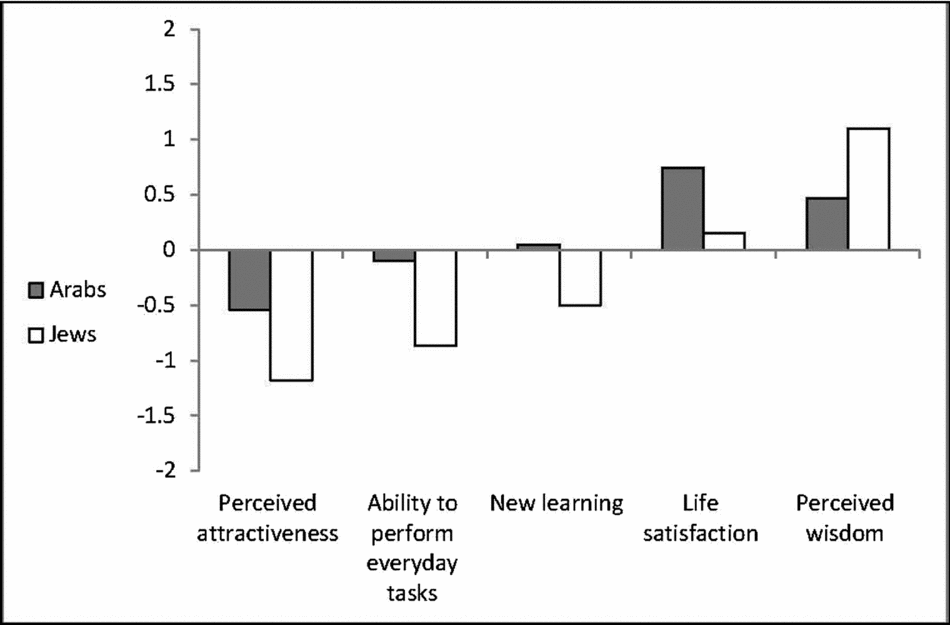
In order to examine the second hypothesis, we conducted a MANCOVA with eight of the ten POA items as dependent variables (we excluded the two items examined in the first hypothesis), culture and gender as the independent variables, and age, relationship status, and religiosity as covariates. The MANCOVA yielded a main effect of culture, F (8,131) = 6.02, p < 0.001, = 0.33. Univariate analyses aimed at examining the main effect demonstrated that Arabs reported significantly more positive views of aging than Jews in the following four factors: perceived attractiveness (M = −0.54, SD = 1.24 vs. M = −1.18, SD = 0.76, F(1,138) = 8.52, p < 0.01, = 0.06); the ability to perform everyday tasks (M = −0.10, SD = 1.11 vs. M = −0.87, SD = 0.72, F(1,138) = 17.14, p < .001, = 0.11); new learning (M = 0.05, SD = 1.05 vs. M = −0.50, SD = 0.84, F(1,138) = 9.47, p < 0.01, = 0.06); and life satisfaction (M = 0.74, SD = 1.02 vs. M = 0.15, SD = 1.03, F(1,138) = 8.54, p < 0.01, = 0.06). In contrast, Jews reported higher levels of perceived wisdom (M = 1.10, SD = 0.87 vs. M = 0.47, SD = 0.99, F(1,138) = 11.38, p < 0.001, = 0.08). These significant differences are demonstrated in Figure 1. Finally, regarding the covariates, age was found significant, F (10,129) = 2.16, p < 0.05, = 0.14.
Corrected means for general cultural differences between Arabs and Jews regarding perceptions on ageing.

Differences in ageism between Arabs and Jews
In order to examine the third hypothesis, we conducted a MANCOVA with the three factors of ageism as dependent variables, culture and gender as the independent variables, and age, relationship status, and religiosity as covariates.
The MANCOVA yielded a main effect of culture, F (3,140) = 4.70, p < 0.01, = 0.09. Subsequent ANCOVAs demonstrated that the effect remained significant for contribution, F (1,142) = 12.83, p < 0.001, = 0.08, and avoidance, F (1,142) = 3.83, p < 0.05, = 0.03. Thus, Jews rated their elders as less contributing to society in comparison to Arabs (M = 2.51, SD = 0.65 vs. M = 2.07, SD = 0.69) and sought more to avoid contact with older adults (M = 2.60, SD = 0.95 vs. M = 2.22, SD = 1.11).
An interaction of culture × gender was also found significant, F (3,140) = 9.45, p < 0.001, = 0.17. Accordingly, we conducted two ANCOVAs for both cultures, which revealed significant gender differences for both Arabs and Jews regarding avoidance and stereotypes. Arab women reported higher levels of avoiding older adults than Arab men (M = 2.64, SD = 1.18 vs. M = 1.81, SD = 0.61, F (1,61) = 7.54, p < 0.01, = 0.11), as well as higher levels of stereotypical thinking (M = 4.54, SD = 0.76 vs. M = 3.79, SD = 0.83, F (1,61) = 9.76, p < 0.01, = 0.14). Among the Jewish cohort, the exact opposite was discovered, as Jewish men were more ageist than women with regard to the same factors of avoidance (M = 2.93, SD = 1.13 vs. M = 2.28, SD = 0.78, F (1,78) = 8.95, p < 0.01, = 0.10) and stereotypes (M = 4.23, SD = 0.79 vs. M = 3.85, SD = 0.73, F (1,78) = 3.94, p < 0.05, = 0.05). Covariates were insignificant throughout the analysis.
Differences in aging anxiety between Arabs and Jews
In order to examine the fourth hypothesis, we conducted a MANCOVA with the four factors of aging anxiety as dependent variables, culture and gender as the independent variables, and age, relationship status, and religiosity as covariates (see Table 1 for corrected means and standard deviations).
Corrected means and standard deviations for the four factors of the Aging Anxiety Scale among Jews, Arabs, and total sample

The MANCOVA yielded main effects of culture, F (4,139) = 7.03, p < 0.001, = 0.17, and gender, F (4,139) = 5.46, p < 0.001, = 0.14. Univariate analyses demonstrated that Arabs scored lower than Jews in both fear of old age (M = 2.17, SD = 0.88 vs. M = 2.56, SD = 0.61, F (1,142) = 7.60, p < 0.01, = 0.05) and physical appearance (M = 2.58, SD = 0.94 vs. M = 2.93, SD = 0.84, F (1,142) = 4.16, p < 0.05, = 0.03), but higher than Jews in psychological concerns (M = 2.85, SD = 0.56 vs. M = 2.42, SD = 0.79, F (1,142) = 11.00, p < 0.001, = 0.07). Additional uni-variate analysis examining gender differences found that women scored higher than men in both psychological concerns (M = 2.88, SD = 0.69 vs. M = 2.40, SD = 0.62, F (1,142) = 16.16, p < 0.001, = 0.10) and worries about physical appearance (M = 3.01, SD = 0.87 vs. M = 2.51, SD = 0.85, F (1,142) = 10.43, p < 0.01, = 0.07).
A significant interaction of culture × gender was also found, F (4,139) = 6.95, p < 0.001, = 0.17. Subsequent ANCOVAs revealed significant gender difference for the Jewish cohort in psychological concerns, F (1,78) = 13.42, p < 0.001, = 0.15, and physical appearance, F (1,78) = 19.77, p < 0.001, = 0.20, and in fear of losses for the Arab cohort, F (1,61) = 4.03, p < 0.05, = 0.06. As can be seen in Table 1, Jewish women scored higher than Jewish men in psychological concerns (M = 2.84, SD = 0.76 vs. M = 2.01, SD = 0.50) and apprehension regarding future physical appearance (M = 3.33, SD = 0.73 vs. M = 2.52, SD = 0.82), whereas Arab women reported higher levels of fears of losses during old age when compared to Arab men (M = 3.26, SD = 0.78 vs. M = 2.74, SD = 1.01). Covariates were insignificant throughout the analysis.
Discussion
The main aim of the current study was to examine cultural differences between Jews and Arabs in attitudes toward aging and older adults within the Israeli multicultural setting. Our results point out that although the cohort consisted of Jews and Arabs who are all part of the Israeli society, significant differences stand out with regard to the two populations. First of all, in line with the first hypothesis, Arabs rated their culture as more tolerant toward older adults in comparison to Jews’ assessment of their own culture, and reported spending more time with their elders. The cultural importance of older adults for the Arab cohort seems to transcend beyond Westernization processes which affect the Arab society in Israel (Khalaila and Litwin, Reference Khalaila and Litwin2011), and we can infer that time-honored views of older adults prevail over more modern individualistic views, which rate individuals based on their relative input to society.
The second hypothesis was also generally confirmed, as Arabs viewed their elders more favorably than Jews. As with the first hypothesis, these results can be seen within the context of the general positive stance of Arab young adults toward their elders. However, a unique finding which seemingly negates this line of thought demonstrated that, against our premonitions, Jews rated older adults as wiser. We believe that the cultural differences in wisdom perception can be understood by looking into modern Arab society in Israel. First of all, a significantly greater percentage of the Arab elders have no formal education (60% as opposed to 12% in the Jewish community). Since the majority of our participants, both Jews and Arabs, were students, this may create a dissonance for the Arab students. On the one hand, they spend more time with their elders, show them more respect, and value their familial and societal importance. On the other hand, they become increasingly aware of their elders’ relative lack of education, and these feelings may be exacerbated through acquaintances with younger Jewish peers whose parents and grandparents are more intellectually active.
These ideas are in line with Baltes and Staudinger's (Reference Baltes and Staudinger2000) perception of wisdom, which is defined as “an expertise in the conduct and meaning of life” (p. 124). According to this view, wisdom is seen as a manifestation of pragmatic skills regarding the continuum of human life, together with knowledge about life's obligations and goals. For the younger Arab generation, higher education may offer new ideas and skills, which the elders are unfamiliar with. For example, Arab students, who see their future as scholars and value their lives through the eyes of academic studies, may find little in common with their grandparents, who have worked the land their entire life. Since these discrepancies are more common among the Arab population, it may be that they will see their elders as less competent in achieving goals of life, which are meaningful to them, and thus, according to Baltes and Staudinger's view, will judge them as less wise.
Findings regarding increased ageism among Jews in comparison to Arabs are also in line with our expectations. As hypothesis 3 presumes, Arabs rated their elders as significantly more contributing to society, and reported engaging in less avoiding behaviors toward them. This finding may also be connected with the fact that caregiving for older adults in the Arab population is still perceived as the duty of the family (Azaiza and Brodsky, Reference Azaiza and Brodsky2003), and that more Arabs over the age of 65 live with their families (Central Bureau of Statistics, 2011a). In line with the social contact hypothesis (see Pettigrew and Tropp, Reference Pettigrew and Tropp2006), which states that positive interactions with a given out-group are important for reducing prejudice and negative thoughts toward it, we can deduce that the familial structure of the Arab cohort, which may provide more positive interactions between young adults and older adults, decreases ageist attitudes.
It is generally agreed that men tend to be more ageist than women (see Bodner et al., Reference Bodner, Bergman and Cohen-Fridel2012). While our results did not indicate gender differences in ageism, inverse directions with regard to gender were found between the cultures. In the Jewish cohort, ageist avoidance and stereotypes were significantly more pronounced among male participants, while the same two factors were higher in Arab women in comparison to their male counterparts. The two interactions may account for the statistical insignificance of gender as a main effect, but the increased ageism among Arab women is an intriguing finding, which will be discussed in detail later.
Our fourth hypothesis regarding cultural differences in anxieties related to aging was partially confirmed, as Arabs exhibited significantly less general fears of growing old and concerns over one's physical appearance in old age. While we have mentioned the growing trend of institutionalization among Arabs, it is still much more common in Jewish households (4.7% of Jews over 65, compared to 0.7% of Arabs over 65; Azaiza and Brodsky, Reference Azaiza and Brodsky2003). Additionally, even though many older Jewish adults remain at home and are cared for by migrant care workers, the connection with their family and loved ones is reduced, and family contact tends to resemble weekly visits to sheltered housing facilities. Consequently, it is not surprising that Jews view their future with more apprehension, and see physical changes which are associated with aging as more threatening, since they lack the security that their family will be able or willing to provide for them during their decline. However, this finding is interesting in light of the lack of significant results with regard to fear of losses, and further questioning and research is needed in order to clarify this issue. This rationale could also account for the finding that Arabs reported significantly higher fears of the psychological aspects of aging. As previous cross-cultural examinations of aging attitudes reveal conflicting evidence (see Yun and Lachman, Reference Yun and Lachman2006; Yan et al., Reference Yan, Silverstein and Wilber2011), the current research may provide an additional insight into the importance of cultural affiliations with regard to aging. It seems that for young Arab adults, close contact with their elders may be a mixed blessing; while it alleviates personal fear of growing old, it induces anxieties regarding the psychological facets of aging.
Differences in everyday involvement are also apparent when we examine gender differences in aging anxieties. First, among both Arabs and Jews, women reported increased anxieties regarding the physical and the psychological aspects of aging, and this pattern was repeated within the Jewish cohort. As society demands more of women with regard to physical appearance, it is feasible that in comparison to men, women are more apprehensive about the physical aspects of aging. Moreover, it has been demonstrated that as they age, women feel tense about their physical appearance, and invest a lot of effort in trying to appear younger, due to ageist social norms (Clarke and Griffin, Reference Clarke and Griffin2008). Additionally, as previous findings demonstrate that women display more aging anxieties (Allan and Johnson, Reference Allan and Johnson2009), it is not surprising that they are concerned about the psychological aspects of aging.
If this is true, however, we need to address the finding that in comparison to Arab men, Arab women report higher fears of losses which occur during aging, a result which was not replicated in the Jewish cohort. This, together with the aforementioned increased ageism among Arab women in comparison to Arab men, portrays an interesting story with regard to the role of the Arab woman in relation to herself and to the elders in her extended family. While caring for older family members in the Arab society is usually the children's responsibility, the daughter (or daughter in-law) assumes the responsibility of day-to-day caregiving, whereas her husband is expected to provide instrumental and economic support (Lowenstein and Katz, Reference Lowenstein and Katz2000). According to Haj-Yahia (Reference Haj-Yahia1995), this norm is internalized through the socialization process of Arab women, making this obligation an important part of their lives. In this regard, Faison et al. (Reference Faison, Faria and Frank1999) demonstrated that caregiving burden is correlated with difficult everyday activities such as washing, bathing, and preparing meals. Accordingly, this stressor can take the form of ageist attributes such as seeking to avoid being in the presence of older adults, or harboring negative stereotypes toward them.
The finding regarding fear of losses in old age can also be seen through this prism, as this factor examines fears of losing one's friends, health, and most importantly, dignity. As the Arab woman is a first-hand witness to such losses through her own day-to-day involvement in caretaking for older adults, it is feasible that she will regard her future more apprehensively than her male counterpart. Thus, the frustration stemming from the gap between the Arab cultural world-view and the difficult caretaking tasks may contribute to the reported increased ageism and aging anxieties.
It is true, though, that our Arab sample was comprised of young women in their early twenties, who are not yet subjected to the daily hardships of caring for the family's elders. However, the reality of their lives dictates that they do experience not only the gradual decline of their elder relatives in their own home (something that Jews do not come in contact with), but also foresee their own future responsibilities in this matter, which stem from the obligatory filial piety associated with their traditional role in the Arab family. Accordingly, one of the possible implications of the current study is the need of introducing opportunities which are available today for older people care (e.g. sheltered housing) to Israeli-Arab families in general and to women in this society in particular, while altering them in line with the Arab culture. For example, sheltered housing facilities, which take into account the importance of older adults within the family and encourage the traditional familial structure, may assist in bridging the gap between filial piety and difficulties associated with home care. It would be interesting to examine whether such facilities would, in the long run, alleviate caregiver burden and reduce personal anxieties regarding aging in the Arab society.
An additional issue concerns the increased ageism among the Jewish cohort in comparison to the Arab group. This finding, together with the fact that Arabs generally hold their elders in higher regard, could be an important starting point for examining how more positive views of older adults can be introduced to Israeli Jews. While respect toward elders is well-founded in Jewish tradition, as the Old Testament dictates us to “respect the elderly” (Leviticus 19:32), it seems that modernization and the loss of family traditions have blurred this important value. Accordingly, trying to enhance the traditional Jewish approach, which respects the elders and sees them as a crucial link in the familial chain, may assist in decreasing ageist stereotypes and avoidance of their own elders.
Several limitations arise from the present study. First and foremost, it should be noted that the sample is not a large one, and is a convenient sample comprised mostly of students. Despite the fact that such samples are frequently used in cross-cultural studies in social psychology, this may hinder the generalizability of our findings, and future studies are needed in order to examine such cultural differences among larger and more diverse cohorts. It should also be mentioned that the research was conducted in Israel, and it is important to further examine personal views about aging and older adults in other multicultural societies.
It should also be mentioned that despite the significant results, the sample taken focused on young adults, most of whom were university students. It is therefore possible that young adults who choose not to pursue higher education may provide us with different information regarding older adults in the two cultures. For example, it is possible that Arabs who do not choose to continue their education may hold a more traditional view, and this could affect their attitudes toward aging and older adults. Accordingly, future studies are needed in order to provide a wider view of the phenomenon examined in the current study. Additionally, future studies may want to look closer into additional subcultures within the Israeli society (e.g. Christian Arabs, or Jewish immigrants from various cultures). Furthermore, employing in-depth interviews and other qualitative methods in the future may provide additional insight into the experiences within each culture. It may also be important for future investigations into ageism in traditional societies to examine the familial role and expectations in conjunction with attitudes toward aging and the aged, a perspective which was not examined in the present study.
In conclusion, the current study demonstrates that we should not look at multicultural societies from a single viewpoint, and take into account traditional and cultural values. This cultural perspective should be taken despite the gradual disappearance of cultural and societal boundaries, as culture cannot be separated from the attitudes and opinions regarding caring for older adults, or from the aging process itself. The consideration of tradition and age-old values may also improve our efforts to provide more options and opportunities for the welfare of aging individuals, their families, and their societies.
Conflict of interest
None.
Description of authors’ roles
Y.S. Bergman contributed the results and discussion parts, while overseeing the general research and writing process. E. Bodner provided the introduction and parts of the discussion, and contributed to the rationale of the research. S. Cohen-Fridel oversaw data gathering, statistical analyses, and the method. All authors cooperated through all stages of the study (i.e. data collection, writing, editing, and commenting on the writing process).
Acknowledgments
The authors thank Ms. Ansam Amer for her important contribution in the data gathering process.