


Introduction
Auditory hallucinations are traditionally associated with psychotic illnesses such as schizophrenia, manic depression, and affective psychoses (Chadwick, Birchwood and Trower, Reference Chadwick, Birchwood and Trower1996; Morrison, Reference Morrison1998). They exist in a number of different forms, but most often take the form of voices (Beck and Rector, Reference Beck and Rector2003), which are often disabling and distressing (Leudar, Thomas, McNally and Glinsky, Reference Leudar, Thomas, McNally and Glinski1997; Nayani and David, Reference Nayani and David1996; Chadwick, Lees and Birchwood, Reference Chadwick, Lees and Birchwood2000). However, for some individuals the experience can serve adaptive functions (Miller, O'Connor and DiPasquale, Reference Miller, O'Connor and DiPasquale1993). Many people hear positive voices, which offer advice and guidance, and have made sense of and integrated the experience into their lives without support from healthcare professionals. These individuals are reportedly less or not at all distressed by their experiences (Honig et al., Reference Honig, Romme, Ensink, Escher, Pennings and Devries1998). Enhancing understandings of the factors that may play a role in mediating distress for people who hear voices is clinically important, as reducing the distress associated with voices has become one of the main therapeutic targets for therapists working with this client group.
A mediating variable that has recently been explored concerns the relationship with the voice. Benjamin (Reference Benjamin1989) found that some hearers form relationships with their voices, which show many of the dynamics found in ordinary social relationships. Phenomenological research has found that many people who hear voices attribute their voices to others, suggesting that one way in which hearers may attempt to make sense of the experience is through the personification and personalization of the voices (Leudar et al., Reference Leudar, Thomas, McNally and Glinski1997). Indeed, voices personified as parental or dominant figures are commonly reported (Chadwick et al., Reference Chadwick, Birchwood and Trower1996; Thomas and Leudar, Reference Thomas and Leudar1996). These findings have led to the suggestion that the experience of voice hearing can be viewed as interpersonal (Chadwick et al., Reference Chadwick, Birchwood and Trower1996) and cognitive theorists have incorporated beliefs about interpersonal power structures into theories of the maintenance of voice hearing (e.g. Birchwood, Meaden, Trower, Gilbert and Plaistow, Reference Birchwood, Meaden, Trower, Gilbert and Plaistow2000; Birchwood et al., Reference Birchwood, Gilbert, Gilbert, Trower, Meaden, Hay, Murray and Miles2004). However, it has been argued that the way in which people relate to others is far more complex than the dimension of power. It is likely that the relationship of hearers to voices is similarly complex, and the additional dimension of proximity or intimacy, which has been theorized to be of importance in interpersonal relationships in general (Leary, Reference Leary1957), has also been shown to be of relevance to the experience of voice hearing (Birchwood and Chadwick, Reference Birchwood and Chadwick1997; Nayani and David, Reference Nayani and David1996). One theory that addresses dimensions of both power and proximity is Birtchnell's Relating Theory (1996, 2002).
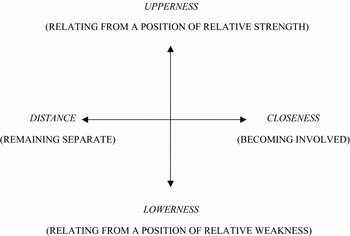
Relating Theory describes how people relate along two dimensions, proximity and power. Proximity describes the distance that exists between two people and hence the degree of intimacy. Power describes the amount of influence that one has over another. These two dimensions can be thought of as two intersecting axes; the poles of the horizontal axis are labelled closeness and distance, and the poles of the vertical axis are labelled upperness and lowerness (see Figure 1). Each position on these axes is potentially advantageous.
The axes of Birtchnell's (Reference Birtchnell1996) Relating Theory

People who are competent or versatile in relating can vary their relating styles as the situation requires (Birtchnell, Reference Birtchnell2001). This is a skill acquired developmentally and is regarded as positive. However, non-versatile people are either unable or disinclined to relate in certain ways and are therefore unable to be flexible in the way they relate. This non-versatile form of relating is defined as negative.
Two studies (Vaughan and Fowler, Reference Vaughan and Fowler2004; Hayward, Reference Hayward2003) have utilized Relating Theory to investigate interpersonal aspects of voice hearing. Vaughan and Fowler (Reference Vaughan and Fowler2004) adapted Birtchnell's questionnaire investigating negative styles of relating between couples (CREOQ; Birtchnell, Voortmn, De Jong and Gordon, Reference Birtchnell, Voortmn, De Jong and Gordon2006) to examine relationships between voice and hearer. Findings from 30 hearers were reported and large and statistically significant positive correlations were found between voice upperness and distress and between hearer distance and distress. A small but significant negative correlation between hearer lowerness and distress was found, and a small but significant positive correlation between voice closeness and distress was also reported. Multiple regression analysis was undertaken and found that two independent variables contributed uniquely and significantly to the prediction of distress, appraisals of voice upperness (power) (9%) and distancing by the hearer (8%).
Vaughan and Fowler (Reference Vaughan and Fowler2004) suggested that their findings provided further evidence for the importance of power structures in mediating distress, as suggested by the cognitive model (Birchwood and Chadwick, Reference Birchwood and Chadwick1997; Birchwood et al., Reference Birchwood, Meaden, Trower, Gilbert and Plaistow2000, Reference Birchwood, Gilbert, Gilbert, Trower, Meaden, Hay, Murray and Miles2004). However, the independence of the association between relating styles and distress from cognitive factors has important implications. The authors suggest that the results provide tentative support for the hypothesis that interpersonal schemata, developed through attachment and relational experiences, may influence a hearer's construction of themselves in relation to their voice. This subsequently impacts upon beliefs about the voice's malevolence or benevolence, and consequent emotional and behavioural responses to the experience.
However, conclusions that can be drawn from this study are limited due to problems with the method used. First, the psychometric properties of a number of the subscales of the questionnaires used to assess hearer relating and voice relating were poor. A refined and integrated measure of voice relating has been developed, The Voice and You (VAY), which assesses the interrelating between the hearer and predominant voice (Hayward, Denney, Vaughan and Fowler, Reference Hayward, Denney, Vaughan and Fowler2008). The VAY assesses four subscales, which according to previous studies are of clinical and theoretical importance: voice dominance (corresponding to voice upperness), voice intrusiveness (voice closeness), hearer dependence (a combination of hearer lowerness and closeness), and hearer distance. The scale demonstrates good test-retest reliability and acceptable internal reliability. Second, the original version of the Beliefs About Voices Questionnaire was used, which has been criticized for its lack of sensitivity in detecting variations in beliefs due to its “yes” or “no” response options, and also its lack of reliability in measuring the construct of omnipotence. A revised version of the scale, the revised Beliefs about Voices Questionnaire (BAVQ-R) (Chadwick et al., Reference Chadwick, Lees and Birchwood2000) was developed to address these issues. Third, multiple regression was used to assess the relative degree to which each variable was associated with distress. However, the use of this technique can be criticized on the basis of the small sample size (power analysis indicates that a sample of 92 would be required to detect a medium effect size).
For these reasons, conclusions that can be drawn are tentative and the study requires replication with a more rigorous methodology. Further, the study only examined relating styles in clinical hearers and it is unclear whether these findings extend to non-clinical samples. As the experiences of non-clinical voice hearers have been found to share many of the characteristics and consequences of the voice hearing experiences of clinical samples (Honig et al., Reference Honig, Romme, Ensink, Escher, Pennings and Devries1998), the influence of relating variables would be expected to be apparent also. Previous research suggests that non-clinical hearers are less distressed by their experiences (Honig et al., Reference Honig, Romme, Ensink, Escher, Pennings and Devries1998) and have more social support, indicating perhaps more competence in social skills and relating (Romme and Escher, Reference Romme and Escher1989). If non-clinical hearers are less distressed by their experience, they may relate with their voices in less maladaptive (negative) ways.
The aim of the current study was therefore to replicate the work of Vaughan and Fowler (Reference Vaughan and Fowler2004) using a measure of relating with sound psychometric properties (VAY, Hayward et al., Reference Hayward, Denney, Vaughan and Fowler2008), and the revised and more sensitive measure of beliefs about voices (BAVQ-R, Chadwick et al., Reference Chadwick, Lees and Birchwood2000). Additionally, this study sought to generate hypotheses about voice hearing across the continuum of experience by comparing the voice hearing experiences of clinical and non-clinical participants within a relational framework.
To determine whether styles of relating to and by the voice are associated with distress in the clinical sample, three hypotheses were tested:
Hypothesis 1: People who perceive their voice to relate more dominantly and intrusively, and who attempt to relate to the voice more distantly, will experience greater levels of distress.
Hypothesis 2: People who relate to their voice more dependently will experience less distress.
Hypothesis 3: The association between voice dominance, voice intrusiveness, hearer distance and distress will be independent of the association between distress and beliefs about voices and mood linked appraisals.
Method
Clinical participants
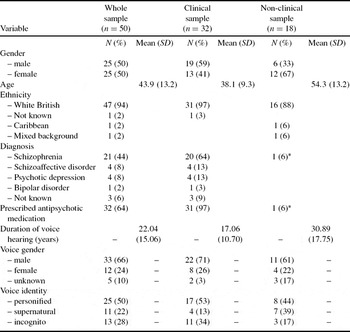
Participants were recruited over a 6-month period from adult mental health services in three NHS mental health trusts. Criteria for inclusion were the need to be aged between 18 and 65, and to have heard voices for at least 6 months, irrespective of diagnosis. Participants were excluded from the study if they heard voices as a consequence of substance misuse or organic illness. Of 62 hearers approached to consider participation in the study, 44 consented to contact by the research group. Of these, 12 declined to participate, leaving 32 clinical participants, a response rate of 51%. Demographic data for the clinical sample can be found in Table 1.
Demographics and characteristics of the voice hearing experience of the whole sample, and clinical and non-clinical hearers

*No longer in contact with mental health services.
Non-clinical participants
To be eligible for inclusion, participants needed to be aged 18 or over, to have heard voices for at least 6 months, and to not currently be in contact with mental healthcare services as a consequence of hearing voices. For the non-clinical group, initial contact was made in a variety of ways. One group of participants (n = 4) were recruited from a conference that explored the possible ordinariness of voice hearing experiences. A second group (n = 17) contacted the second author after an article about the research was published in a national newspaper. Of these, nine people (53%) took part in the research. A further five participants were recruited following the publication of an article about the research in a newspaper of the spiritualist church community. Of 26 hearers who approached the research team about participation in the study, 18 consented to participate, a response rate of 69%. Demographic data for the non-clinical sample can also be found in Table 1.
Measures
Psychotic Symptoms Rating Scale (PSYRATS; Auditory Hallucinations Rating Scale, Haddock, McCarron, Tarrier and Faragher, Reference Haddock, McCarron, Tarrier and Faragher1999). The auditory hallucinations rating scale is an 11-item scale, administered by the researcher, assessing frequency, duration, severity, loudness, location, negative content and controllability of voices, intensity of distress and beliefs about origin of voices and disruption. The authors report excellent inter-rater reliability. The “intensity of distress” item of the PSYRATS was used to assess levels of distress within the current study.
Voice and You (VAY; Hayward et al., Reference Hayward, Denney, Vaughan and Fowler2008). The VAY self-report questionnaire is a 28-item measure of a person's interrelating with their predominant voice. Each of the 28 items contributes to one of four scales; voice dominance, voice intrusiveness, hearer dependence, and hearer distance. The higher the score, the greater the tendency to relate negatively from that position. The scale demonstrates good test-retest reliability and acceptable internal reliability.
Beliefs about Voices Questionnaire – Revised (BAVQ-R; Chadwick et al., Reference Chadwick, Lees and Birchwood2000). The BAVQ-R is a self-report measure of a person's beliefs, emotions and behaviour in response to auditory hallucinations. The 35-item questionnaire forms five sub-scales: three concerning beliefs about the dominant voice (malevolence, benevolence and omnipotence), and two concerning emotional and behavioural reactions (resistance and engagement). The subscales demonstrate good psychometric properties.
Beck Depression Inventory II (BDI-II; Beck, Steer and Brown, Reference Beck, Steer and Brown1996). This 21-item self-report instrument measures the severity of depression and is a well validated and widely used instrument.
Data analysis
Those data found to be normally distributed after transformation were subject to parametric testing. Where correlational analysis was used, Pearson's correlation coefficient was calculated. Where comparisons between groups were being made, independent samples t-tests were calculated. In cases where transformations were unsuccessful, non-parametric tests were conducted (Siegel and Castellan, Reference Siegel and Castellan1988), Kendalls-tau-b was conducted for correlational analysis, whilst Mann-Whitney U tests were calculated to compare groups.
Results
Characteristics of voice hearing experiences
The characteristics of the voice hearing experiences of the clinical and non-clinical participants are shown in Table 1. Findings relating to voice gender and voice identity apply to the predominant voice. Analyses were conducted to evaluate differences in voice hearing experiences between the two groups. Participants from the non-clinical sample had been hearing voices for a significantly greater length of time (M = 30.89, SD = 17.75) than the clinical sample (M = 17.00, SD = 10.70) [t (24.10) = −3.01, p < .01]. However, there was no significant association between sample and gender of the voice [χ2 (2, N = 50) = 1.39, p = n.s.], or sample and the identity of the voice [χ2 (2, N = 50) = 5.11, p = n.s.]. The characteristics of the predominant voice (voice gender and identity) are similar to those reported in previous studies (Leudar et al., Reference Leudar, Thomas, McNally and Glinski1997; Hayward, Reference Hayward2003; Vaughan and Fowler, Reference Vaughan and Fowler2004).
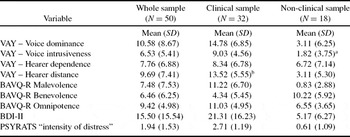
The characteristics of the two groups on the relating measure (VAY), beliefs about voices (BAVQ-R), depression (BDI-II) and intensity of distress (PSYRATS) are shown in Table 2.
Scores on the PSYRATS (intensity of distress), VAY, BAVQ-R and BDI-II

a N = 17; b N = 31.
Differences between clinical and non-clinical participants
A Mann-Whitney U test was conducted to determine if statistically significant differences existed between clinical and non-clinical hearers on a measure of intensity of distress (PSYRATS). The result of the test was significant, z = −4.58, p < .01, r = .64. Non-clinical hearers were significantly less distressed (median = 0) than clinical hearers (median = 3).
Mann-Whitney U tests were conducted to determine if statistically significant differences existed between clinical and non-clinical hearers on measures of relating style. Results from the three tests were significant. Non-clinical hearers perceived their voices to relate in a significantly less dominant manner (median = 0) compared to clinical hearers (median = 17.5), z = −4.61, p < .01, r = .65. Non-clinical hearers perceived their voices to relate significantly less intrusively (median = 0) than clinical hearers (median = 10), z = −4.60, p < .01, r = .65. Finally, non-clinical hearers tended to relate to their voices from a position of lesser distance (median = 1) than clinical hearers (median = 15), z = −4.51, p < .01, r = .64.
An independent-samples t test was conducted to determine if there were significant differences between clinical and non-clinical hearers on a measure of hearer dependence (VAY). The test was non-significant, [t(48) = 0.43, p = n.s., r = .06], suggesting no significant difference in the tendency of clinical (M = 8.34, SD = 6.78) or non-clinical hearers (M = 6.72, SD = 7.14) to relate from a position of dependence.
Mann-Whitney U tests were conducted to determine whether statistically significant differences existed between clinical and non-clinical hearers on measures of voice malevolence and voice benevolence (BAVQ-R). The results of the tests were significant. Non-clinical hearers perceived their voices to be significantly less malevolent (median = 0) than clinical hearers (median = 14), z = −5.08, p < .01, r = .72, and perceived their voices to be significantly more benevolent (median = 12) than clinical hearers (median = 2), z = −3.12, p < .01, r = .44.
An independent-samples t test was conducted to determine if there were significant differences between clinical and non-clinical hearers on a measure of voice omnipotence (BAVQ-R). The test was significant, t(48) = 3.35, p < .01, r = .44. Non-clinical hearers (M = 6.56, SD = 3.65) on average believed their voices to be less omnipotent than clinical hearers (M = 11.03, SD = 4.95).
Mann-Whitney U tests were conducted to determine whether statistically significant differences existed between clinical and non-clinical hearers on a measure of depression (BDI-II). Non-clinical hearers were significantly less depressed (median = 3) than clinical hearers (median = 20), z = −3.73, p < .01, r = .53.
Hypothesis testing
Hypotheses 1 and 2 – associations between distress and relating variables within the clinical sample. As assumptions for parametric testing were not met, Kendall's tau correlation was used. In view of the number of correlations conducted, there is an increased likelihood of a Type I error occurring. Findings should be viewed with caution. The associations between relating styles and distress are shown in Table 3.
Bivariate correlations (Kendall's tau) between distress and relating subscales in the clinical sample

aN = 31; * = p < .05; ** = p < .01.
There were large and significant correlations between distress and voice dominance, voice intrusiveness and hearer distance. A negative correlation between hearer dependence was found, but this was not statistically significant.
Hypothesis 3 – independence of association between distress and relating variables within the clinical sample. Significant correlations were found between relating variables, distress, beliefs about voices and mood. However, it was hypothesized that the significant associations between voice dominance, voice intrusiveness, hearer distance and distress would be independent of the associations between distress and beliefs about voices and mood linked appraisals. Therefore, partial correlations were conducted to control for the effect of each of these variables on the association between distress and voice dominance, hearer distance and voice intrusiveness. The partial correlations are reported in Table 4.
Partial correlations between distress and relating subscales in the clinical sample

* = p < .05; ** = p < .01.
After controlling for the effect of beliefs about the voice's malevolence and omnipotence, the correlations between distress and the relating variables were no longer statistically significant. However, after controlling for the effect of beliefs about the voice's benevolence and depression, the correlations between distress and the relating variables remained statistically significant. The hypothesis that the associations between distress and the relating variables would be independent of the associations between distress and other variables was supported only in relation to belief about the voice's benevolence and depression.
Summary
The hypotheses that voice dominance, voice intrusiveness and hearer distance would be associated with distress were supported. These associations were found to be independent of levels of depression and beliefs about the predominant voice's benevolence. However, the relationship between relating variables and distress was not independent of beliefs about the omnipotence or malevolence of the predominant voice. The hypothesized association between distress and hearer dependence was not supported.
Discussion
This study corroborated previous research as the interrelating between the hearer and the predominant voice was associated with distress in the clinical sample (Hayward et al., Reference Hayward, Denney, Vaughan and Fowler2008; Vaughan and Fowler, Reference Vaughan and Fowler2004). However, whilst these associations were independent of beliefs about voices’ benevolence and mood-linked appraisals, they were not independent of beliefs about voices’ malevolence or omnipotence.
The study extended previous research by comparing the voice hearing experiences of clinical and non-clinical hearers on variables of clinical interest. Non-clinical participants were found to be significantly less distressed than their clinical counterparts and reported significantly different levels of the cognitive and relational variables that are usually found to correlate with distress.
Theoretical implications
Clinical voice hearers. A significant association between voice dominance and distress provides support for the finding of Vaughan and Fowler (Reference Vaughan and Fowler2004), and corroborates the influence of power within voice hearing experiences (Birchwood and Chadwick, Reference Birchwood and Chadwick1997; Birchwood et al., Reference Birchwood, Meaden, Trower, Gilbert and Plaistow2000, Reference Birchwood, Gilbert, Gilbert, Trower, Meaden, Hay, Murray and Miles2004). The finding that this association was not independent of beliefs about omnipotence or malevolence, however, contradicts the findings of Vaughan and Fowler (Reference Vaughan and Fowler2004) and suggests that beliefs about voices (specifically malevolence and omnipotence) moderate or possibly mediate the association between relating styles and distress: a moderating role would suggest that beliefs about voices are influencing the strength of the association between relating variables and distress; whilst a mediating role would account for the association between relating variables and distress (Baron and Kenney, Reference Baron and Kenny1986). Further delineation of the influence of beliefs about voices would require the use of multivariate statistical techniques on a larger data set.
Relating to the voice from a position of distance amongst clinical voice hearers was found to be significantly associated with distress in the current study, and this concurs with the findings of Vaughan and Fowler (Reference Vaughan and Fowler2004). This association suggests that reacting to the voice by distancing oneself can increase distress, and that no distance from the voice is “safe”. Nayani and David (Reference Nayani and David1996) and Romme and Escher (Reference Romme and Escher2000) argue that intimacy is important in the relationship with voices, and that the acceptance and development of intimacy, the very opposite of distancing, is one strategy that may lower distress. In contrast to Vaughan and Fowler (Reference Vaughan and Fowler2004), this association was not independent of beliefs about omnipotence or malevolence, again suggesting an influential role for cognitive variables within the association between relating variables and distress.
These findings differ from those of Vaughan and Fowler (Reference Vaughan and Fowler2004) who assert the primacy of relating variables in predicting distress. Reasons for these inconsistent findings may be rooted in methodological limitations. Vaughan and Fowler (Reference Vaughan and Fowler2004) conducted a multiple regression analysis to determine which variables contributed uniquely to distress. The use of this technique can be criticized due to the small sample size (n = 30), and findings should therefore be interpreted cautiously (Field, Reference Field2000; Tabachnick and Fidell, Reference Tabachnick and Fidell2001; Miles and Shelvin, Reference Miles and Shelvin2001). Due to the small sample size in the current study, multivariate analysis was not conducted. Therefore, it is not possible to clarify whether beliefs about omnipotence or malevolence moderate or mediate the association between relating variables and distress or whether in fact the association between relating variables and distress is independent of beliefs about voices. What seems likely is that the relationships between these variables is perhaps more complex than previously thought, and relating variables and beliefs about voices may be construed as very similar variants of the same underlying construct – the voice in relation to the self – albeit measured cognitively or interpersonally.
Clinical and non-clinical hearers. The lower levels of distress within the non-clinical sample were consistent with the finding of Honig et al. (Reference Honig, Romme, Ensink, Escher, Pennings and Devries1998) who reported “non-patient” hearers to be less afraid of their voice(s) when compared to hearers who had been given a psychiatric diagnosis. This consistency also holds for studies that have more rigorously defined the identity of the non-clinical participants, e.g. “born-again Christians” who reported feelings generated by their voice hearing experience to be more positive when compared to both “psychotic” and “control” groups (Davies, Griffin and Vice, Reference Davies, Griffin and Vice2001). Consequently, the findings from the non-clinical participants provide further evidence to support the assertion that it is not the voice hearing experience per se that causes distress, but the interpretations that are placed upon it (Romme and Escher, Reference Romme and Escher1993, Reference Romme and Escher2000).
This study focused upon cognitive and relational variables as greater clarity was sought about the interpretations of voices that can mediate distress. In this respect, the existing cognitive literature (Chadwick and Birchwood, Reference Chadwick and Birchwood1994; Birchwood and Chadwick, Reference Birchwood and Chadwick1997) was corroborated as non-clinical hearers reported perceptions of their predominant voice as comparatively less malevolent and omnipotent, and more benevolent. A similarly corroborative picture was found for relational variables (Vaughan and Fowler, Reference Vaughan and Fowler2004; Hayward, Reference Hayward2003; Hayward et al., Reference Hayward, Denney, Vaughan and Fowler2008) as the predominant voice of the non-clinical participants was reported to be experienced as comparatively less dominant and intrusive, with the hearer seeking less distance as a consequence. Less clarity pertained in relation to hearer dependence, as non-clinical participants reported comparatively lower levels of a variable that has previously been found to correlate negatively with distress (Vaughan and Fowler, Reference Vaughan and Fowler2004; Hayward et al., Reference Hayward, Denney, Vaughan and Fowler2008). This unexpected finding may suggest that this form of relating has greater meaning to clinical hearers as it may represent the only perceived alternative to a distressing voice from whom sufficient distance cannot be achieved. As discussed above, non-clinical hearers do not necessarily strive for distance and can tolerate the intimacy of a voice perceived as benevolent.
Conclusions
Clinical implications
Overall, the findings from this study indicate that the interrelating between hearer and voice is associated with distress. Comparisons between clinical and non-clinical samples suggest the importance of less maladaptive (negative) relating styles and also less maladaptive beliefs in determining the level of distress experienced. Therefore, both beliefs about voices and relating styles appear to be potential therapeutic targets. Belief modification has been the mainstay of cognitive therapy for voices over the last two decades, but the findings from this study support a subtly different therapeutic focus upon interpersonal aspects of the experiences for some hearers, possibly those who “do not wish to alter their views that voices reflect real interpersonal experiences” (Vaughan and Fowler, Reference Vaughan and Fowler2004, p. 152).
In clinical samples, voices have often been experienced as dominating and intrusive and many hearers respond to this by attempting to distance themselves from the voice. However, distance does not necessarily facilitate a lessening of distress (Hayward et al., Reference Hayward, Denney, Vaughan and Fowler2008; Vaughan and Fowler, Reference Vaughan and Fowler2004). A unique finding of the current study concerns the generalization to a non-clinical sample of the association between hearer distance and distress, offering further support to the suggestion that distancing oneself from the voice may not be a useful coping strategy. Clinically, the use of coping strategies such as attempting to ignore the voice, or the use of distraction, have been encouraged by clinicians (Tarrier, Harwood and Yussof, Reference Tarrier, Harwood and Yussof1990), but such superficial strategies ignore the apparent complexities and heterogeneous nature of relationships with voices. The findings from the current study corroborate the suggestions of Romme and Escher (Reference Romme and Escher2000), Leudar et al. (Reference Leudar, Thomas, McNally and Glinski1997) and Chin, Hayward and Drinnan (Reference Chin, Hayward and Drinnan2009) that accepting and engaging with the voices can be adaptive for some hearers.
Therapeutically, the possible benefits of engaging with voices have previously been explored through the development of the “focusing” approach (Haddock, Slade, Bentall, Reid and Faragher, Reference Haddock, Slade, Bentall, Reid and Faragher1998). Therapeutic approaches that additionally encourage acceptance of voices are being developed in two different, but seemingly complementary forms. From the perspective of Relating Therapy, engagement and acceptance can be facilitated through the hearer stepping into the relationship with the voice and expressing curiosity about how the relationship may change in pursuit of greater balance (Hayward and May, Reference Hayward and May2007; Hayward, Overton, Dorey and Denney, Reference Hayward, Overton, Dorey and Denney2009). From the perspective of Person Based Cognitive Therapy, consideration of voices within a relational framework in combination with mindfulness approaches enables a noticing of the voice, without emotionally engaging with it; an approach that enhances a sense of control as the hearer breaks free from habitual forms of responding, in a manner that accepts the continued existence of the voice (Abba, Chadwick and Stevenson, Reference Abba, Chadwick and Stevenson2008; Chadwick, Reference Chadwick2006; Goodliffe et al., Reference Goodliffe, Hayward, Brown, Turton, Chadwick and Dannahy2009). What each of these evolving therapeutic approaches has in common is a focus upon the reciprocal nature of the relationship between hearer and voice, and the role of proximity in addressing the imbalances within the relationship.
Future research
Future work should aim to recruit a larger sample of both clinical and non-clinical hearers, in order to address the limitations described above. This may allow the use of multivariate statistical techniques such as multiple regression or structural equation modelling, which would help to address the issue of causality in the relationship between relating variables, cognition and distress (Miles and Shelvin, Reference Miles and Shelvin2001). Further investigation of the mirroring of voice relating and social relating may also clarify these issues (Birchwood et al., Reference Birchwood, Meaden, Trower, Gilbert and Plaistow2000, Reference Birchwood, Gilbert, Gilbert, Trower, Meaden, Hay, Murray and Miles2004; Hayward, Reference Hayward2003). Also, the study focused on measures of maladaptive (negative) relating. It is possible that by using a measure of adaptive (positive) relating, the association between relating and distress would have been clearer, especially in non-clinical participants. However, such a measure, based on Birtchnell's (Reference Birtchnell1996, Reference Birtchnell2002) theory would need to be developed.
Acknowledgements
The authors would like to thanks all the participants, clinicians and members of the Hearing Voices Network who contributed to this study. Thanks are also due to Barbara Phillips, Victoria Tozer and Nicola Hartigan for the assistance with data collection, and to Mike Slade for his comments on an earlier draft of this paper.





Comments
No Comments have been published for this article.