Introduction
The average number of annual newly diagnosed head and neck cancer cases between 2017 and 2019 in the UK was 12 759, of which approximately 3 per cent were hypopharyngeal cancer.1 According to the World Health Organisation International Agency for Research on Cancer, hypopharyngeal cancer ranks 25th among cancers for incidence and mortality.2
The main risk factors for developing hypopharyngeal cancer are associated with the patient’s lifestyle because they often have a history of heavy alcohol consumption and tobacco use.Reference Hall, Groome, Irish and O'Sullivan3 It is thought that individuals remain asymptomatic until the disease has progressed to more advanced stages, associated with nodal metastases and laryngeal involvement. When symptoms occur, they are often non-specific in the early stages and may be mistaken for benign conditions. Furthermore, the pyriform sinuses and post-cricoid region are more challenging to visualise endoscopically in the clinic, making recognition of disease more difficult.Reference Hall, Groome, Irish and O'Sullivan3–Reference Garneau, Bakst and Miles5 Therefore, efficient diagnostic routes for this type of cancer are crucial, as it is commonly diagnosed at advanced stages, which is associated with poorer outcomes.Reference Kwon and Miles4, Reference Homer, Winter, Abbey, Aga, Agrawal and ap Dafydd6 This study aimed to analyse the current pathway to diagnosis of hypopharyngeal cancer in the West of Scotland.
Materials and methods
This was a retrospective observational cohort study of all patients diagnosed with hypopharyngeal cancer in the West of Scotland cancer network over a 14-year period from July 2010 to October 2024. All patients with ‘hypopharynx’ listed as the primary anatomical site were extracted from the prospectively collected West of Scotland multidisciplinary team database of Head and Neck cancer patients. Data pertaining to patient demographics, disease characteristics, diagnostic pathway and treatment intent were recorded on a standardised Microsoft Excel spreadsheet from manual review of individual electronic patient records. General practitioner referrals were assessed from the Scottish Care Information (SCI) gateway referral pathway electronic records and were classified according to the Scottish Referral Guidelines for Suspected Cancer, which were first published in 2002 and revised in 2025.7
Patients with red flag symptoms of malignancy are referred from primary care specialists via the Urgent Suspicion of Cancer pathway and enter a nationally monitored cancer pathway with a target of commencing first cancer treatment within 62 days of receipt of referral. Urgent referrals are prioritised for specialist assessment, but are not monitored according to national waiting time targets. Routine referrals are managed through standard out-patient pathways with no fixed national target.
Patients were staged according to the American Joint Committee on Cancer 8th edition cancer staging guidelines. Patients’ home postcodes were linked to the Scottish Index of Multiple Deprivation 2020 version to assess area-based socioeconomic status, where Scottish Index of Multiple Deprivation 1 represents the most deprived area and Scottish Index of Multiple Deprivation 5 represents the least deprived area. Patients' performance status was assessed using the Eastern Cooperative Oncology Group Performance Status Scale.8
Results and analysis
Patient characteristics
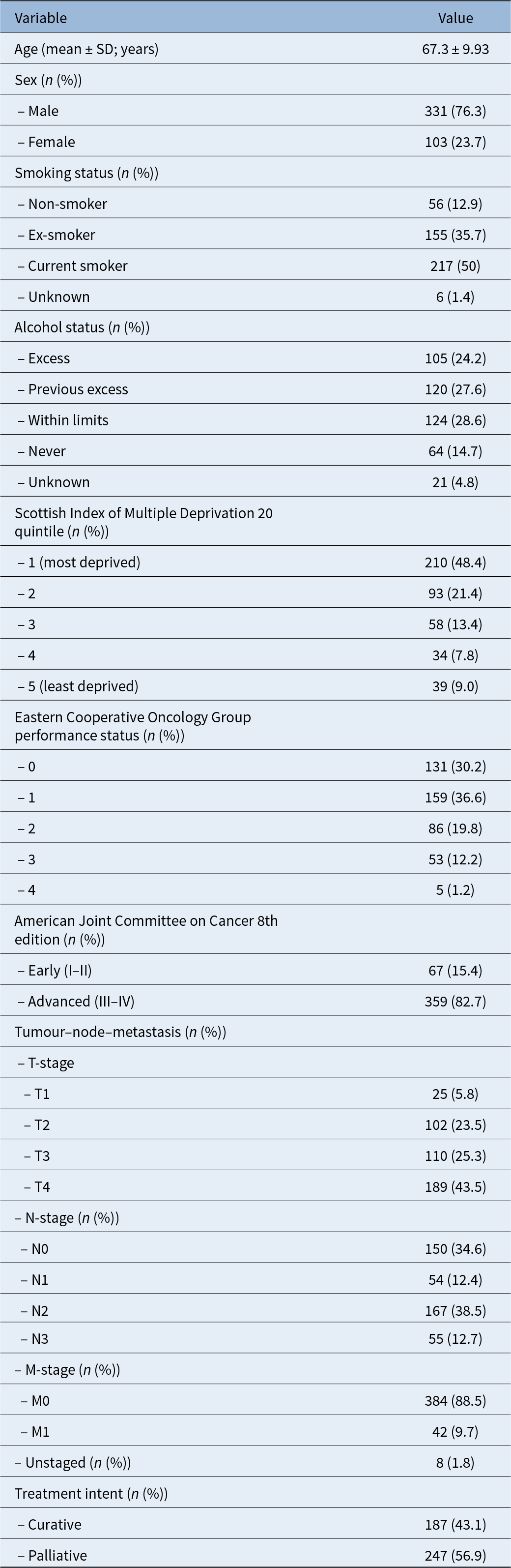
There were 434 patients diagnosed with hypopharyngeal cancer between July 2010 and October 2024 in the West of Scotland, with a mean age of 67.3 years (standard deviation, ±9.93), comprising 331 males (76.3 per cent) and 103 females (23.7 per cent) with a male:female ratio of 3.2:1.
A total of 372 patients (85.7 per cent) were current or former smokers and 225 (51.8 per cent) were exposed to excessive alcohol consumption. Analysis of Scottish Index of Multiple Deprivation 20 quantiles showed that 303 patients (69.8 per cent) were from the most deprived areas (Scottish Index of Multiple Deprivation 1 and 2) with a high prevalence of advanced stage disease. Eastern Cooperative Oncology Group analysis revealed 290 patients (66.8 per cent) had a good performance status of 0–1 at the time of diagnosis.
The majority of patients, 359 (82.7 per cent), were diagnosed with American Joint Committee on Cancer advanced stage disease (III–IV) and 67 (15.4 per cent) with early stage disease (I–II). Eight patients (1.8 per cent) were not staged because of poor performance status. There were 187 patients (43.1 per cent) treated with curative intent versus 247 (56.9 per cent) palliative patients. The baseline characteristics of the overall cohort are depicted in Table 1.
Baseline characteristics of the overall cohort*

Table 1 Long description
Baseline characteristics are listed as values for age and as counts with percentages for gender, smoking, alcohol, deprivation quintile, performance status, cancer stage, tumour node metastasis stage, and treatment intent. Mean age was 67.3 years with a standard deviation of 9.93. Gender counts were 331 male and 103 female. Smoking status counts were 56 non smoker, 155 ex smoker, 217 current smoker, and 6 unknown. Alcohol status counts were 105 excess, 120 previous excess, 124 within limits, 64 never, and 21 unknown. Scottish Index of Multiple Deprivation 20 quintile counts were 210 in quintile 1 most deprived, 93 in quintile 2, 58 in quintile 3, 34 in quintile 4, and 39 in quintile 5 least deprived. Eastern Cooperative Oncology Group performance status counts were 131 at 0, 159 at 1, 86 at 2, 53 at 3, and 5 at 4. American Joint Committee on Cancer 8th edition counts were 67 early stage I to II and 359 advanced stage III to IV. Tumour node metastasis counts were T stage 25 at T1, 102 at T2, 110 at T3, and 189 at T4; N stage 150 at N0, 54 at N1, 167 at N2, and 55 at N3; M stage 384 at M0, 42 at M1, and 8 unstaged. Treatment intent counts were 187 curative and 247 palliative.
* Total n = 434. SD = standard deviation
Diagnostic route characteristics
There were 385 patients (88.7 per cent) who presented to the ENT clinic following general practitioner or other secondary specialities referral, while 49 patients (11.3 per cent) presented as an emergency.
Among emergency patients, 15 (30.6 per cent) were admitted with acute airway compromise, 19 (38.8 per cent) with total or progressive dysphagia and 15 (30.6 per cent) as a result of other causes, such as pain or general decline. Moreover, because of the development of acute airway compromise, 9 patients (18.4 per cent) underwent tracheostomy and 4 (8.2 per cent) had surgical debulking. Nine (18.4 per cent) patients had the Urgent Suspicion of Cancer pathway in place, but because of the rapid decline they presented acutely.
Overall, 237 patients (54.6 per cent) were referred through the Urgent Suspicion of Cancer referral pathway, 53 patients (12.2 per cent) had an urgent referral and 34 patients (7.8 per cent) had a routine general practitioner referral.
It was found that 101 patients (23.3 per cent) were referred to ENT from other specialities. The majority of these were from gastroenterology, general surgery, including upper gastrointestinal (n = 41, 9.5 per cent) and respiratory (n = 13, 3 per cent). Seven patients had hypopharyngeal cancer incidentally found on a positron emission tomography (PET) scan for lung cancer investigations.
Fifteen patients (3.46 per cent) were referred to the head and neck ENT clinic through intradepartmental referral. Two patients (0.46 per cent) had an unknown diagnostic route because of a lack of data.
The greatest proportion of patients (228 cases, 66.3 per cent) experienced symptoms for up to 3 months before ENT referral and 180 patients (41.5 per cent) were seen in the ENT clinic following referral within 2 weeks. The two most common clinical symptoms were dysphagia with another symptom and throat pain, accounting for 217 cases (50.0 per cent) and 197 cases (45.4 per cent), respectively. Other symptoms included odynophagia in 132 cases (30.4 per cent), neck lump in 137 (31.6 per cent), dysphonia in 140 (32.3 per cent) and weight loss in 150 (34.6 per cent). A greater number of patients presented with a combination of 2 (32.3 per cent) and 3 (26.7 per cent) head and neck symptoms. However, 8 patients (1.8 per cent) did not experience any head and neck cancer symptoms and were diagnosed as a result of incidental findings on computed tomography and/or PET or gastroscopy; 6 of these had T1–T2 stage of disease. Diagnostic routes characteristics are described in Table 2.
Diagnostic route characteristics

Table 2 Long description
Patient counts and percentages are listed for diagnostic route characteristics under the column header, patients with n and percent. General practitioner referrals include Urgent Suspicion of Cancer pathway 237 patients 54.6 percent, urgent 53 patients 12.2 percent, routine 34 patients 7.8 percent, and no referral 110 patients 25.3 percent. Other speciality referrals are 101 patients 23.3 percent, with gastroenterology 19 patients 4.4 percent, respiratory 13 patients 3.0 percent, general surgery and or gastrointestinal 22 patients 5.1 percent, general medicine 20 patients 4.6 percent, maxillofacial 6 patients 1.4 percent, other including urology, ortho, oncology, dentist 5 patients 1.2 percent, and intradepartmental ENT 15 patients 3.46 percent. Duration of symptoms before referral in weeks is less than 4 for 67 patients 15.4 percent, 4 to 12 for 221 patients 50.9 percent, 13 to 26 for 39 patients 9.0 percent, 27 to 52 for 14 patients 3.2 percent, more than 52 for 7 patients 1.6 percent, and not specified for 86 patients 19.8 percent. Time from referral to ENT appointment in weeks is 2 or less for 180 patients 41.5 percent, 2 to 4 for 114 patients 26.3 percent, 4 to 8 for 33 patients 7.6 percent, more than 8 for 12 patients 2.8 percent, and no data for 40 patients 9.2 percent. Symptoms include dysphagia and other 217 patients 50.0 percent, throat pain 197 patients 45.4 percent, weight loss 150 patients 34.6 percent, dysphonia 140 patients 32.3 percent, neck lump 137 patients 31.6 percent, odynophagia 132 patients 30.4 percent, and dysphagia alone 28 patients 6.5 percent. Number of symptoms is 0 for 8 patients 1.8 percent, 1 for 117 patients 27 percent, 2 for 140 patients 32.3 percent, 3 for 116 patients 26.7 percent, and more than 4 for 53 patients 12.2 percent.
There were 118 patients (27.2 per cent) who received an antibiotic prescription before referral. Among them, 96 patients (81.4 per cent) had one course, 17 (14.4 per cent) had two courses and 5 (4.2 per cent) had three courses.
Discussion
Patient characteristics
The mean age of the patients in this study was 67.3 years, with male predominance (76.3 per cent), which aligns with previous studies confirming that hypopharyngeal cancer occurs commonly in the mid-60s among the male population.Reference Hall, Groome, Irish and O'Sullivan3, Reference Garneau, Bakst and Miles5, Reference Homer, Winter, Abbey, Aga, Agrawal and ap Dafydd6 The high prevalence of smoking (85.7 per cent) and heavy alcohol consumption (51.8 per cent) has been identified, supporting the link between tobacco and alcohol exposure and the increased risk of hypopharyngeal cancer.Reference Hall, Groome, Irish and O'Sullivan3, Reference Garneau, Bakst and Miles5, Reference Homer, Winter, Abbey, Aga, Agrawal and ap Dafydd6
There was a greater number of patients from deprived areas (Scottish Index of Multiple Deprivation 1 and 2) with a high prevalence of advanced stage disease in this cohort. Unfortunately, this pattern is not new and a previous study on a Scottish Head and Neck cancer cohort reports similar results with high mortality rates in deprived areas.Reference Robertson, Greenlaw, Bray and Morrison9 There are multiple social factors contributing to this, such as smoking and alcohol drinking, together with lower health literacy and communication barriers about medical care.Reference Homer, Winter, Abbey, Aga, Agrawal and ap Dafydd6, 10 The impact of these factors has been extensively investigated and could be mitigated by higher rates of referrals to smoking cessation and alcohol treatment services, together with public strategies to educate the population on symptom awareness. However, further research is needed to understand the mechanism by which deprivation affects the performance status and survival of Head and Neck cancer patients.Reference Robertson, Greenlaw, Bray and Morrison9
The majority of patients in this cohort (66.8 per cent) had an Eastern Cooperative Oncology Group score of 0 or 1, which is consistent with previous studies.Reference Hall, Groome, Irish and O'Sullivan3 Despite these results, there was a high proportion of non-curative patients (56.9 per cent), highlighting the aggressiveness of this disease and often advanced stage (82.7 per cent), rendering them ineligible for curative treatment intent, even with good performance status at the time of presentation.
Diagnostic route characteristics
Hypopharyngeal cancer is characterised by the worst outcomes among all Head and Neck cancers and with 5-year overall survival rates of 25 per cent.Reference Homer, Winter, Abbey, Aga, Agrawal and ap Dafydd6 This study shows that the majority of patients (54.6 per cent) are being referred on the correct pathway, the Urgent Suspicion of Cancer pathway, highlighting that general practitioners are appropriately referring patients with red flag symptoms. This is similar to the study by Pearce et al., who reported 50 per cent of patients being referred on the 2-week wait pathway, the equivalent to the Urgent Suspicion of Cancer pathway in Scotland.Reference Pearce, Hamilton, Sharp, Deane, Kennedy and O'Hara11
This study shows that the predominant symptoms of hypopharyngeal cancer are dysphagia with another symptom (50.0 per cent) and throat pain (45.4 per cent). Dysphagia was reported as a single symptom in only 28 patients (6.6 per cent) in this study. The study by Tikka et al. (2015) on Head and Neck cancer referral guidelines revealed that persistent dysphagia has a 13–25 per cent positive predictive value and has a statistically significant association with Head and Neck cancer,Reference Tikka, Pracy and Paleri12 moreover it is associated with a significantly shorter median survival of 1.3 years compared with 4.3 years for those who did not have dysphagia.Reference Douglas, Ingarfield, McMahon, Savage, Conway and MacKenzie13 Other studies report dysphagia as the most common symptom of hypopharyngeal cancer, with rates of 50–53 per centReference Hall, Groome, Irish and O'Sullivan3, Reference Kwon and Miles4, Reference Douglas, Ingarfield, McMahon, Savage, Conway and MacKenzie13 and 34 per cent incidence of sore throat.Reference Hall, Groome, Irish and O'Sullivan3
National Institute for Health and Care Excellence (NICE) guidelines 12 from 2015 were developed to facilitate early cancer diagnosis and optimise healthcare capacity. However, hypopharyngeal cancer is not included in the NICE12 referral guidelines, unlike laryngeal, oral and thyroid cancer, which can limit general practitioners' recognition and awareness of the disease.14 Scottish suspected cancer referral guidelines include a common group for all Head and Neck cancers and address some of the hypopharyngeal cancer symptoms.15 This highlights the difference between diagnostic pathways in England and Scotland.
A number of tools helping general practitioners in decision-making have been created, such as the Head and Neck Cancer Risk Calculator.16 Moreover, the evolution of a patient-reported symptom-based risk stratification system to redesign the suspected head and neck cancer referral pathway (EVEREST-HN) trial that started in 2022 aims to develop a risk stratification system for Head and Neck cancer patients referred through a suspected cancer pathway and optimise the use of healthcare resources. The results of this trial are expected by 2029, with the main goal to improve early detection of the Head and Neck cancer.17
Assessing general practitioner referrals, urgent and routine referrals comprised 12.2 per cent and 7.8 per cent of patients, respectively. Another study reported a routine referral rate by general practitioners of 11.7 per cent.Reference Pearce, Hamilton, Sharp, Deane, Kennedy and O'Hara11 Among patients who were referred routinely, 48.5 per cent had an ENT clinic appointment within 4 weeks, indicating that these referrals were triaged and upgraded as urgent by ENT consultants.
One of the reasons for routine referral was persistence of Head and Neck cancer symptoms in 6 patients (17.6 per cent) who had previously attended an ENT appointment with no pathology found on flexible nasendoscopy. The majority of these patients were re-referred routinely to ENT clinics 1 year after their first referral. This shows that examination at early stages may be inaccurate because of challenges in visualising hypopharyngeal cancer subsites (piriform sinuses and post-cricoid region) and symptoms could be mistaken for benign diseases such as laryngopharyngeal reflux.Reference Kwon and Miles4, Reference Garneau, Bakst and Miles5 These factors together delay early diagnosis of hypopharyngeal cancer, therefore with persistence of symptoms and poor response after the first course of antibiotics, further referral should be considered.
High rates of referrals from other specialities (23.3 per cent) were found in this study. This could be explained by dysphagia, which was included in the suspected cancer pathway referral for oesophageal cancer in NICE12 guidelines and the Scottish suspected cancer guidelines as the main indication for urgent endoscopy.18 Respiratory was another commonly referring speciality (n = 13) because of the development of synchronous malignancies as a result of common risk factors such as smoking.
Emergency presentation rates were observed in 49 patients (11.3 per cent); of these, 6 (12.2 per cent) subsequently had curative treatment intent and 43 (87.8 per cent) were managed palliatively, suggesting that emergency presentation indicates a poor prognosis.
Eight patients (1.8 per cent) did not experience any head and neck cancer symptoms, with 6 patients showing T1–T2 stage of disease, indicating that this cancer remains difficult to diagnose at the early stage because patients remain asymptomatic until laryngeal invasion or nodal metastasis occurs.Reference Garneau, Bakst and Miles5
A large proportion of patients (41.5 per cent) were seen in the ENT clinic within 2 weeks and 26.3 per cent within 4 weeks following referral, highlighting that the referral pathway is reasonable and if the patients are referred on the appropriate pathway, they are seen within a reasonable timeframe. However, even without delay in patients being seen, they can still present with advanced disease.
There were 118 patients (27.2 per cent) who received an antibiotic prescription before referral. The majority of patients in this cohort are older men with a history of smoking and alcohol use, so the likelihood of them developing acute tonsillitis or pharyngitis requiring antibiotics is low. A single course of antibiotics may be reasonable, but further courses could delay referral. This data could assist the general practitioner in decision-making, highlighting that poor response to antibiotic treatment requires a change of the initial approach and potential specialist referral for the high-risk patients.
Strengths and limitations
This study represents a large cohort of patients over 14 years with data on demographics, symptoms and diagnostic pathways, highlighting areas for potential improvement of practice. The main limitation of this study is its retrospective nature. We did not collect data on anaemia for this paper, but we will continue research on hypopharyngeal cancer and will address this in the future.
• The pathway to the diagnosis of hypopharyngeal cancer in the West of Scotland is efficient
• The two most common clinical symptoms are dysphagia with another symptom and throat pain
• The majority of patients present with short symptom duration and advanced disease
• A large number of patients are palliative at diagnosis, highlighting the aggressive nature of hypopharyngeal cancer
• Enhancement of general practitioner education and patient awareness of pertinent symptoms could facilitate early referrals for suspected cancer cases
Conclusions
The study shows that the pathway to the diagnosis of hypopharyngeal cancer is efficient, despite the diversity of clinical presentations to different healthcare providers. The majority of patients present with advanced disease, highlighting the aggressive and likely indolent nature of hypopharyngeal cancer. A significant number of patients develop symptoms when the disease is more advanced, meaning they are palliative at diagnosis. Enhancement of general practitioner education and patient awareness of pertinent symptoms could facilitate early referrals for suspected cancer cases, avoiding late-stage disease at presentation.