Introduction
Northern Australia is often celebrated as one of the most significant areas for rock art found anywhere in the world. One of the foremost reasons appears to be the great antiquity of the rock art. Dated rock art from Sulawesi (Aubert et al. Reference Aubert, Brumm and Ramli2014) indicates that the tradition of creating rock art was part of the cultural package of those groups of people that first colonized Southeast Asia and Australia (Taçon et al. Reference Taçon, Hidalgo Tan and O'Connor2014; Veth et al. Reference Veth, Myers, Heaney and Ouzman2017). Even with the age of rock art from Australia constantly under review (Aubert Reference Aubert2012) and new methods and discoveries being made, there is enough evidence to indicate that some Australian rock art belongs to the oldest known art traditions in the world, with the oldest currently dated rock art in northern Australia made around 28,000 years ago (David et al. Reference David, Barker and Petchey2013).
Australia is also known as one of very few places in the world that can provide multi-vocal historical and anthropological sources concerning emic perspectives on the many meanings and significances of different rock-art traditions (e.g. Chaloupka Reference Chaloupka1993; Domingo Reference Domingo2011; Layton Reference Layton1991; May & Domingo Sanz Reference May and Domingo Sanz2010; Morwood Reference Morwood2002). In some parts of Australia rock art was being created until very recently (and continues to be produced, at least in western Arnhem Land), and older art traditions still constitute a vital part of contemporary Indigenous societies, their beliefs and cultural understanding of the world (Brady et al. Reference Brady, Bradley and Kearney2016; May Reference May, Sanz, May and Fiore2008). This is manifested not least through the rich assemblages of so-called contact rock art, which document encounters with outside groups (see, for example, Clarke Reference Clarke1994; Clarke & Frederick Reference Clarke, Frederick and Lilley2006; May et al. Reference May, Taçon, Guse and Travers2010, 2017; Taçon & May Reference Taçon, May and Clark2013; Veth et al. Reference Veth, Sutton and Neale2008).
Our work adds to the case for a further argument for the international significance of Australian rock art—the many early and complex depictions of anthropomorphs that were first produced during the Pleistocene (including Dynamic Figure rock art, the focus of this paper). Pleistocene rock-art assemblages are generally perceived as mainly focusing on animal depictions, abstract designs and/or signs (Ross et al. Reference Ross, Westaway, Travers, Morwood and Hayward2016), with anthropomorphic figures being under-represented. While rare, representations of anthropomorphs from the Pleistocene do occur elsewhere in the world. European Palaeolithic art, for example, includes both depicted, engraved and sculpted anthropomorphic figures, such as the famous Aurignacian lion-men from Hohlenstein-Stadel (Germany), numerous Gravettian Venus figurines, or the unique collection of human portraits on portable art of La Marche (Vienne, France), to name a few. Their presence gradually increases throughout the Upper Palaeolithic, with an interesting growth in number and forms during the Magdalenian (Duhard Reference Duhard1993; Fuentes Reference Fuentes2013). Yet, contrary to the Australian Dynamic Figure rock-art tradition, where humans are the main subject matter of scenes that incorporate all sorts of body details, ornaments and weapons, European Palaeolithic humans are generally unrealistic and simplified; they are rarely associated with other humans or animals, or involved in some sort of scenic composition (Duhard Reference Duhard1996). While there are more realistic images at La Marche (Pales & Tassin de Saint Péreuse Reference Pales and Péreuse1976) or Roc-aux-Sorciers (Vienne, France) (Iakovleva & Pinçon Reference Iakovleva and Pinçon1999), they lack the dynamism as well as the tools or paraphernalia characterizing the Australian Dynamic Figure rock art. Similarly, the compositions from Gönnersdorf (Germany), with several groups of very simplified female figures interpreted as potential scenes or even dances (Albrecht et al. Reference Albrecht, Bosinski, Feustel, Hahn, Klíma and Müller-Beck1989), the well-known scene from Lascaux (Dordogne, France) and other scenes produced on portable art are clearly distant from the realism and dynamism of Australian Dynamic Figure rock art.
If we are to draw parallels with other rock-art traditions in other parts of the world, in terms of the central role of humans, motion, body decorations and arrangement in dynamic scenes, we have to wait until well into the Holocene, to find Levantine rock art in Spain (Domingo Reference Domingo, McDonald and Veth2012), the Round Head and the pastoral styles from Tassili n’ Ajjer (Algeria) (Hachid Reference Hachid1998), or Tadrart Acacus (Libya) in the Sahara (Gallinaro Reference Gallinaro and Smith2014), or San rock art in South Africa (Mazel Reference Mazel and Deacon2007), to name just a few. While the chronologies of these traditions are still contested, and at certain times some of them were attributed to the Pleistocene–Holocene transition, today it is widely accepted that they are more likely from the Holocene (Gallinaro Reference Gallinaro and Smith2014; Mazel Reference Mazel and Deacon2007; Villaverde et al. Reference Villaverde, Martínez, Guillem, López, Domingo, García, Collado and Nash2012). If this is the case, is northern Australia offering the only rock-art tradition of this kind of Pleistocene chronology? And thus, could northern Australia be the first place where human figures suddenly start monopolizing the rock-art panels, explicitly representing their belongings and performing all sorts of dynamic activities?
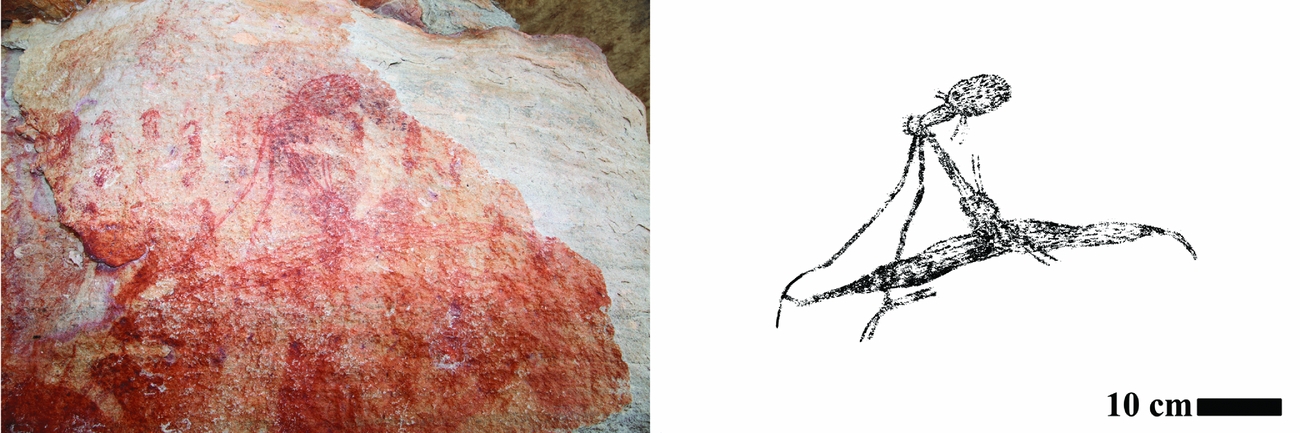
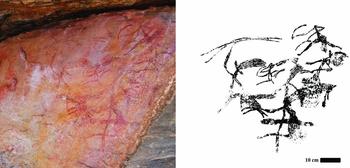
In this paper we draw upon a detailed survey of the Jabiluka Leasehold area in western Arnhem Land to present the first systematically recorded statistics and analysis of Dynamic Figures (Fig. 1). We present our argument for this rock art being one of the earliest examples of painted complex depictions of anthropomorphs in Australia and of international significance for their insights into early hunter-gatherer life. Dynamic Figure art signals important information relating to landscape use; it embeds information on animal–human relationships; it provides unequalled access to information on material culture, particularly organic material culture not surviving in the archaeological record; it hints at the emergence of cultural belief systems; and it provides insights into sex and/or gender roles in society and in artistic practices of early Australia. Yet, perhaps even more importantly, Dynamic Figure rock art specifically illustrates relationships between these human-like figures by showing scenes of individuals engaged in activities, underlining some explicit kind of social positioning among peers. Emerging from a rock-art tradition focused on the non-human motifs, these anthropomorphs embody the cultural complexity of their time.
An example of Dynamic Figure rock art from Jabiluka with original photograph of the motif (left) and a digital tracing (right).

In this paper we build an argument for the significance of this rock-art style based on new recordings of 69 Dynamic Figure scenes and 246 individual anthropomorphs. Utilizing this new data, we use six criteria—placement in the landscape; depictions of anthropomorphs; animals; animal-headed beings; material culture; and sex—and an analysis of one Dynamic Figure scene to present our results. Together these findings point to Dynamic Figure rock art having some of the earliest and most extensive depictions of complex anthropomorph scenes found anywhere in the world.
Dynamic Figure rock art of Arnhem Land
Chaloupka's (Reference Chaloupka1984a, 8) definition of Dynamic Figure rock art encapsulates their essence:
This style consists of small drawings of human figures, anthropomorphs, animals and composite beings, predominately portrayed in animated action. In the depictions of running figures with their wide spread legs, the artist of this style translated the intensity of physical motion into pictorial dynamics.
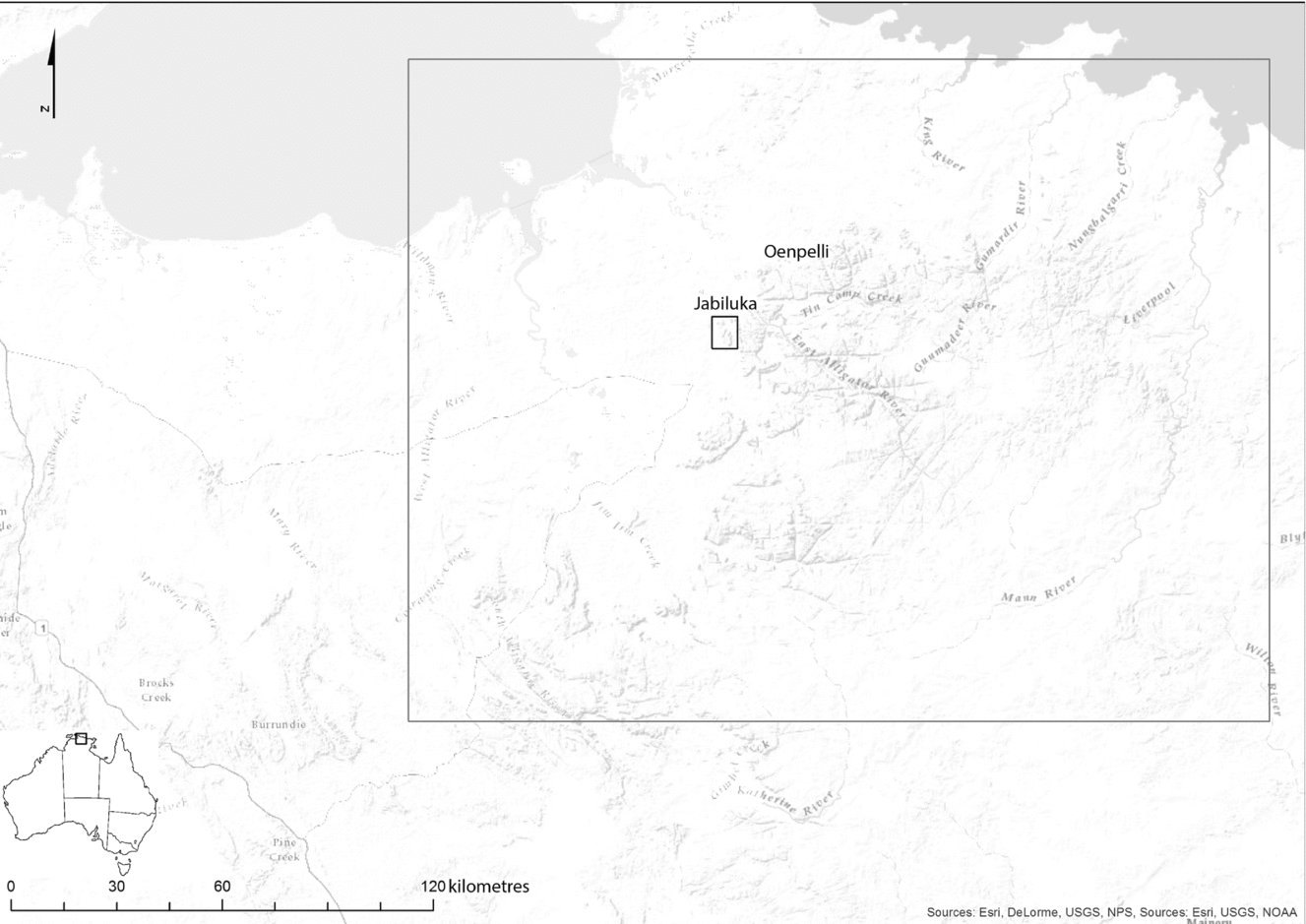
Dynamic Figure rock art is found across the ‘Stone Country’ of western Arnhem Land. They have been recorded at sites from the Cadell and Mann Rivers in the east stretching 200 km to the outliers of the Arnhem Land escarpment to the west, and from the Wellington Range in the north some 180 km south to Birdie Creek (Fig. 2; Chaloupka Reference Chaloupka1984a; Reference Chaloupka1993; Chippindale et al. Reference Chippindale, Smith and Taçon2000, 66; cf. Gunn & Whear Reference Gunn and Whear2007).
Map showing the general distribution of Dynamic Figure rock art, the Jabiluka Leasehold area and the major town centre of Oenpelli (Gunbalanya).

Brandl (Reference Brandl1982, 169, 172–3) was the first researcher to suggest that Dynamic Figures, which he described as ‘early’ Mimi art, were of a great age and were a distinctive assemblage of art. Subsequent researchers have refined the definition and confirmed their early placement in the rock-art sequence (Chaloupka Reference Chaloupka and Ucko1977; Reference Chaloupka1984a,b; Reference Chaloupka1988; Reference Chaloupka1993; Chippindale & Taçon Reference Chippindale, Taçon, Steinbring, Watchman, Faulstich and Taçon1993; Reference Chippindale and Taçon1998a; Chippindale et al. Reference Chippindale, Smith and Taçon2000; Haskovec Reference Haskovec1992; Johnston et al. in press; Lewis Reference Lewis1988; Taçon & Chippindale Reference Taçon and Chippindale1994; Reference Taçon, Chippindale and Helskog2001). Dynamic Figure rock art appears to follow a long period of largely naturalistic art depicting animals, stencils and abstract designs (Brandl Reference Brandl1982; Chaloupka Reference Chaloupka1984b; Reference Chaloupka1993; Chippindale & Taçon Reference Chippindale and Taçon1998a; Haskovec Reference Haskovec1992; Lewis Reference Lewis1988). In other words, with the Dynamic Figures, depictions of human motifs become central to rock art in western Arnhem Land for the first time.
While the early rock art of Australia is obviously difficult to date, superimposition analyses and direct dating of later traditions offer evidence to suggest that Dynamic Figures were first made during the Pleistocene. Chaloupka (Reference Chaloupka1993) suggests Dynamic Figures were produced sometime between 20,000 bp and 8000 bp; however, most other researchers acknowledge Dynamic Figure art as a Pleistocene–Holocene tradition likely beginning around 11,000–12,000 years ago and possibly continuing for 2000 years (Chippindale & Taçon Reference Chippindale and Taçon1998a; Haskovec Reference Haskovec1992; Lewis Reference Lewis1988; Taçon & Brockwell Reference Taçon and Brockwell1995). Recent direct dating of the Northern Running Figure style of rock art in western Arnhem Land by Jones et al. (Reference Jones, Levchenko, King, Troitzsch, Wesley, Williams and Nayingull2017) also adds to our understanding of the age of Dynamic Figure rock art. They conclude that this later style of rock art dates from 9400 cal. bp, thereby providing an indirect minimum age for Dynamic Figure rock art that is known to occur earlier in the record, as indicated by superimposition (Jones & May in press; Jones et al. Reference Jones, Levchenko, King, Troitzsch, Wesley, Williams and Nayingull2017).
Much of the research on Dynamic Figures has focused upon their placement within the chronologies of western Arnhem Land and how the art more broadly has changed over time (Chaloupka Reference Chaloupka1984a; Reference Chaloupka1988; Reference Chaloupka1993; Chippindale et al. Reference Chippindale, Smith and Taçon2000; Gunn & Whear Reference Gunn and Whear2007; Haskovec Reference Haskovec1992; Lewis Reference Lewis1988; Reference Lewis1997; Taçon & Chippindale Reference Taçon, Chippindale and Helskog2001). Using etic perspectives, Lewis (Reference Lewis1988) has discussed the changing areas of distribution of art styles and the implications for understanding regional identities through time. Similarly, Chaloupka (Reference Chaloupka1993, 106) proposed a sequence to explain variation within Dynamic Figure art; however, this was recently criticized by Johnston et al. (in press), who argued that this does not satisfactorily explain this variation. Largely absent from this discussion is how Dynamic Figure scenes may inform us about the people who created them and how they depicted their world. The notable exception is Chippindale et al. (Reference Chippindale, Smith and Taçon2000), where the authors explore altered states of conscience within rock art and how they may be portrayed or be manifested in Dynamic Figures scenes. Taçon and Chippindale (Reference Taçon, Chippindale and Helskog2001) have also more broadly discussed Dynamic Figures within the changing complex belief systems embedded in Arnhem Land rock art and the significance of animal-headed beings. Most recently, Johnston (in press) has discussed the role and significance of headdresses and ritual within Dynamic Figure scenes.
In order for Dynamic Figure rock art to inform our global understandings of the nature of early complex anthropomorph scenes, we must first garner a clear understanding of the very nature of this Australian art style. This paper presents the results of the first dedicated systematic survey and analysis of Dynamic Figure rock art within a defined area. This has allowed us to understand better the placement, the subject matter and the significance of Dynamic Figure art, building upon previous research focused upon a limited or ad hoc selection of sites. We also aim to address the lack of discussion as to how Dynamic Figure scenes may inform us about the people who created them and how they depicted their world.
Study area: Jabiluka
Since 2011, our team has been documenting rock art in the Jabiluka Leasehold area (henceforth Jabiluka) as part of the Mirarr Gunwarddebim project (see also Hayward Reference Hayward2016; in press; Johnston in press; Johnston et al. in press; May et al. Reference May, Wesley, Goldhahn, Litster and Manera2017; in press; Miller Reference Miller2016; Wright et al. Reference Wright, May, Taçon and Stephenson2014; Reference Wright, Langley, May, Johnston and Allen2016). This project aims to document, study and promote rock-art sites in Mirarr Country—with an initial focus on Jabiluka. Keen (Reference Keen1980, 147) defines Mirarr Country as covering ‘the upper reaches of the Magela Creek, between Leichardt billabong in the north and Mount Brockman and Whistleduck dreaming in the south, “Urralugoorwa” waterhole in the west and the escarpment in the east’.
The Mirarr Gunwarddebim recording teams conducted a systematic survey of Jabiluka which included walking all of the area and documenting all rock art and other cultural sites found in the process. As of 2015 we have recorded a total of 528 rock-art sites within Jabiluka. The Dynamic Figures were recorded as part of this project and are also the focus of PhD research by one of the authors (Johnston). A recording form was developed specifically for Dynamic Figures in order to explore the research questions outlined in this paper and others. Within Jabiluka, the majority of Dynamic Figures come from the Djawumbu-Madjawarrnja complex, which is the largest rock formation within Jabiluka, approximately 5×2.7 km in area (including outlying rock formations).
Jabiluka Dynamic Figure rock art
Without doubt, Jabiluka has one of the most important assemblages of Dynamic Figure rock art found in the region. Our team documented 69 Dynamic Figure scenes and 246 individual anthropomorphs. For our study, we define a scene as two or more motifs performing a common action, usually with a defined time and certain internal coherence, that can be described even if the meaning is unknown (May & Domingo 2010, 37). Of the 528 rock-art sites documented within Jabiluka, 40 sites or 8 per cent featured Dynamic Figures. Unfortunately, three of the Dynamic Figure sites were in such poor condition that the motifs could not be analysed in a meaningful way and have been excluded from further analysis. Factors impacting the survival of Dynamic Figures in this area include their antiquity (and subsequent preservation issues), overpainting by later artists and the shifting deposit within shelters—with many early paintings probably now beneath the current ground level (see May et al. in press).
We have chosen to outline some key results of this research according to six criteria: (a) Placement in the landscape, (b) Anthropomorphs, (c) Animals, (d) Animal-headed beings, (e) Material Culture and (f) Sex. This is followed by an analysis of one Dynamic Figure scene, as an example of the interpretative potential of this body of rock art.
Placement in landscape
While Dynamic Figures do occur across the Jabiluka area, there are obvious clusters (no map showing site locations is provided, at the request of the Aboriginal Traditional Owners). The vast majority of Dynamic Figure sites (85 per cent) were recorded on the southeastern side of the survey area, located on either side of a north–south aligned rock formation and valley. This is a clear and deliberate placement of these paintings and perhaps suggests an early use of this area—as part of a walking route within Jabiluka. The two other well-documented dense concentrations of Dynamic Figure sites in Kakadu—the Mt Brockman area and Deaf Adder Creek—are also valley systems with almost permanent water sources; however, it should be noted that the landscape would have been significantly different when Dynamic Figures are argued to have been produced. Chappell and Shackleton (Reference Chappell and Shackleton1986, 137; see also Woodroffe et al. Reference Woodroffe, Chappell, Thom and Wallensky1989) suggest that seas rose from –130 m to –12 m between 19,000 and 8000 bp. During this period the area was drier than at present, with vegetation and faunal taxa being similar to those of the present-day drier areas south of Kakadu National Park (Taçon & Brockwell Reference Taçon and Brockwell1995). However, between 8000 and 6000 bp, seas are thought to have reached 0–3 m above current levels in northern Australia (Chappell & Grindrod Reference Chappell, Grindrod and Thom1983, 67; Lambeck & Chappell Reference Lambeck and Chappell2001). This shifting environmental context for the landscape is an important factor in interpreting Dynamic Figure placement.
The concentrations suggested by our study indicate that Dynamic Figure painters have chosen specific places in their landscape to produce art. The absence of Dynamic Figures at other places in Jabiluka where suitable panels exist, shown by the presence of later art types, demonstrates that these painters most likely responded to cultural conditions and prompts at these specific places. As we will argue later in this paper, the clustering of Dynamic Figure sites may well be related to the location of ceremonial grounds in Jabiluka (and in other areas)—a case supported by ethnographic records and the subject matter of some Dynamic Figure scenes.
Anthropomorphs
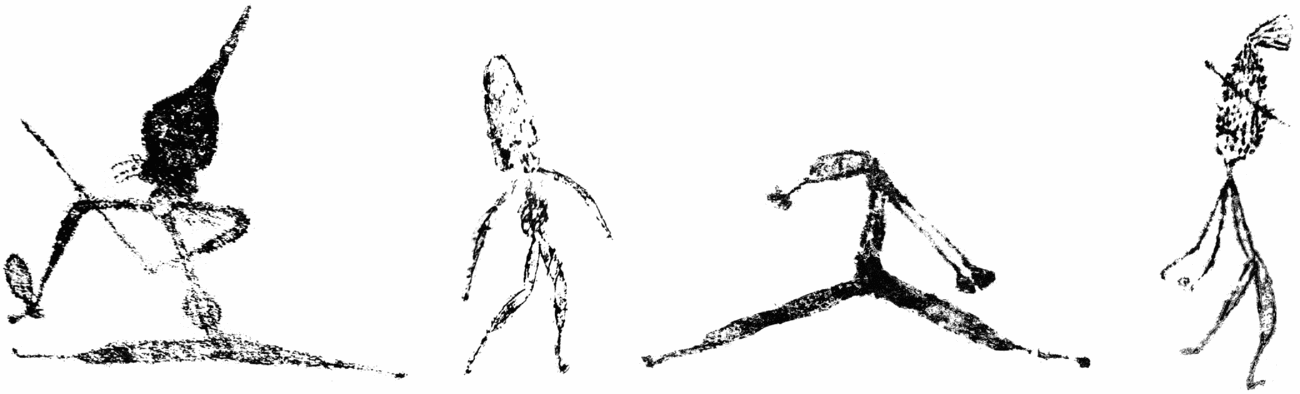
Dynamic Figure rock art of Jabiluka is mostly human figures (anthropomorphs) with 246 individual examples (Fig. 3). This number includes 209 complete and 37 partial figures (due to preservation issues rather than incomplete paintings). Our analysis excludes the partial human figures.
Four examples of anthropomorph Dynamic Figures from Jabiluka (digital tracings not to scale).

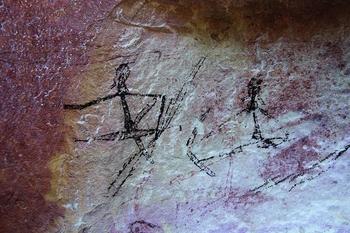
In many ways our assemblage is typical of the larger body of Dynamic Figure rock art recorded in the whole of the Kakadu area (Chaloupka Reference Chaloupka1984a). The majority of anthropomorphs are wearing elaborate headdresses and many are wearing hair belts, some with boomerangs held in the belts (for example, see Fig. 4). These headdresses are identified as such from their clear similarities with ethnographically documented examples (see, for example, Welch Reference Welch, Donaldson and Kenneally2007). Their weapons are one-piece spears with barbs on one side (often carried in pairs), boomerangs and, on one occasion, a stone axe. The exact manner or form of the depiction varies between scenes. The most complex Dynamic Figures have intricate musculature, where the thighs and calves form into single-line ankles and feet. Their arms follow the same convention: defined upper-arm and lower-arm muscles form into a single-line wrist. These Dynamic Figures can have no infill, parallel line or crossed-line infill. The less complex anthropomorphs have less muscle definition, sometimes only thigh and upper-arm muscles into single lines and in other scenes only single-line arms, but consistently the same material culture assemblage associated with Dynamic Figures. Similar headdresses are worn by both the more and less complex Dynamic Figures.
Dynamic Figure with headdress, hair belt and boomerang. This scene is also an example of the one-piece spears with barbs often carried by Dynamic Figure anthropomorphs. The Dynamic Figures have been digitally enhanced in this image.

The anthropomorphs are often depicted in various scenes of activity. The majority are shown running or moving across the rock face without further context to define the activity (see Fig. 1). However, some scenes have greater detail, where anthropomorphs are depicted running above a line of animal tracks, engaged in sexual intercourse or running in a circle around a central figure (see Fig. 5).
A Dynamic Figure scene from Jabiluka showing a macropod-headed being in the centre, as well as headdresses, spears, boomerangs and other material culture associated with the anthropomorphs. Original photograph with Dynamic Figures enhanced using digital tracing methods (left) and digital tracing (right).

Animals
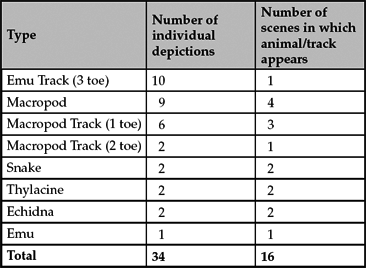
Alongside the well-known anthropomorphs of Dynamic Figure rock art, we found evidence for five different animals in Jabiluka: macropod, snake, emu, thylacine and echidna, and two types of animal tracks, macropod and emu (Table 1). Animals are, however, relatively rare, with only 16 of the 69 Dynamic Figure scenes featuring animals. It is important to note that these animals are defined as Dynamic Figures because they appear directly in scenes with the Dynamic Figure anthropomorphs and are painted in the same style.
Total number of each animal/track type found in association with Dynamic Figure scenes and total number of each animal/track depicted.

From these numbers there is little doubt that this art is human focused. It is interesting to question, then, why these animal types continued to be painted in association with the dominant human figures. On one hand, macropods and emus could be seen simply as an important food source. However, we would argue that the presence of thylacines, echidnas and snakes suggests another element to the story. While these three animals were likely also a limited food source, they are unlikely to have formed a major part of the diet. Is this, then, an indication of a stronger spiritual or other association with these animals? It is also important to note that these animals represent only a tiny fraction of the animals in the environment at the time. These depictions clearly indicate a selection of particular animal species for special inclusion in human-focused Dynamic Figure rock art and this, in turn, points to cultural choices relating to an underlying belief system.
Animal-headed beings (therianthropes)
In total, 14 animal-headed beings (therianthropes) were recorded in Jabiluka Dynamic Figure rock art (see Fig. 5). We have chosen to highlight these figures separately as they are an important indicator of the messages the artists were intending to portray (Taçon & Chippindale Reference Taçon, Chippindale and Helskog2001). The Jabiluka animal-headed beings were recorded in a total of nine scenes, with seven of these scenes involving anthropomorphs. There is one depiction of an animal-headed being alone (though associated figures may simply have disappeared over time) and there is a scene of two animal-headed beings facing each other without any associated anthropomorphs. All of them carry material culture, most often boomerangs and spears. Interestingly, Chaloupka (Reference Chaloupka1993, 114) argued that representations of animal-headed beings in Dynamic Figure rock art represented ‘. . . the first concrete evidence of mythogenesis in rock art’ (i.e. the formation or production of myths), but he did not explore this in any further detail. We will return to this point later in the discussion.
Material culture
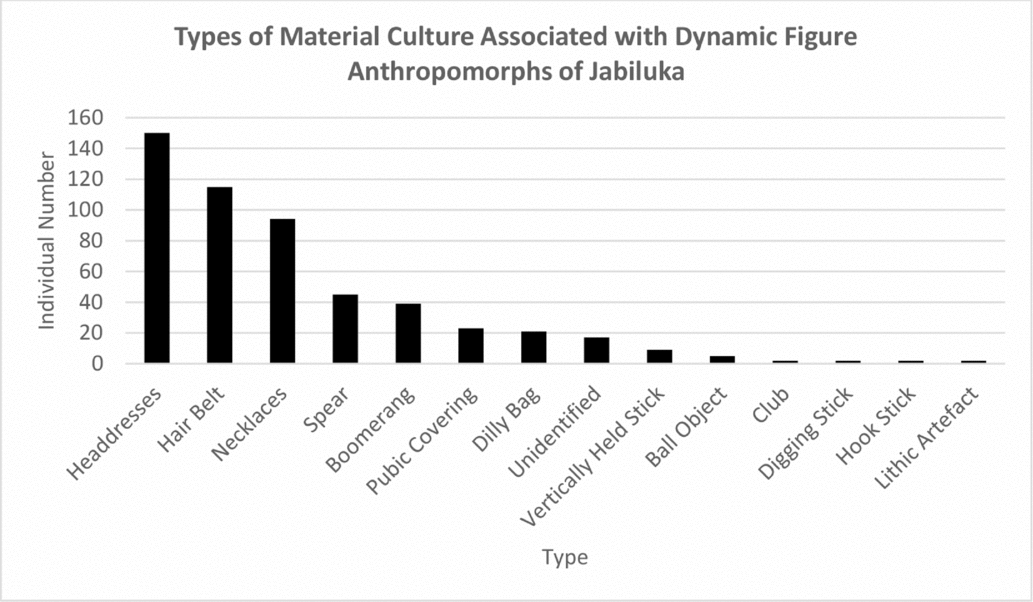
Most of the Dynamic Figure anthropomorphs carry or wear material culture, with 14 different items represented (not including the 17 unidentified items). In fact, 93 per cent of the anthropomorphs possess one or more items of material culture. The range of depicted material culture is intriguing (Fig. 6). Importantly, the three most common items are body adornments—headdresses, hair belts and necklaces, material culture seldom preserved in archaeological deposits. Nearly all of the human figures wear a headdress. Despite the focused discussion of spears and boomerangs in Dynamic Figure rock art (i.e. Brandl Reference Brandl1982, 172; Chaloupka Reference Chaloupka1984a, 7; Lewis Reference Lewis1988) they only appear half as often as the body adornments, followed by lesser numbers of items such as dilly bags and pubic coverings. Only two images of lithics appear in the whole assemblage of Dynamic Figure rock art from Jabiluka—a small number, considering their importance as evidenced by the excavated archaeological record (Hiscock et al. Reference Hiscock, Mowat and Guse1992; Jones & Negerivich Reference Jones, Negerivich and Jones1985).
Items of material culture depicted with Dynamic Figure anthropomorphs.

As the vast majority of the listed material culture is organic, there is little archaeological evidence available for us to cross-reference. From ethnographic sources it is possible to say that all of the identified items of material culture were still in use during the contact period. Ethnographic museum collections from Jabiluka and nearby areas illustrate this clearly (see, for example, Hayward Reference Hayward2016; May Reference May2009; Miller Reference Miller2016; Peterson et al. Reference Peterson, Allen and Hamby2008). Importantly, we cannot say with any certainty that the painted material culture represents an overview guide to the material culture being used at this time. But it does provide a unique insight into the importance of early organic material culture and, in particular, the social and/or ceremonial importance of body adornments to the artists and their societies.
Sex
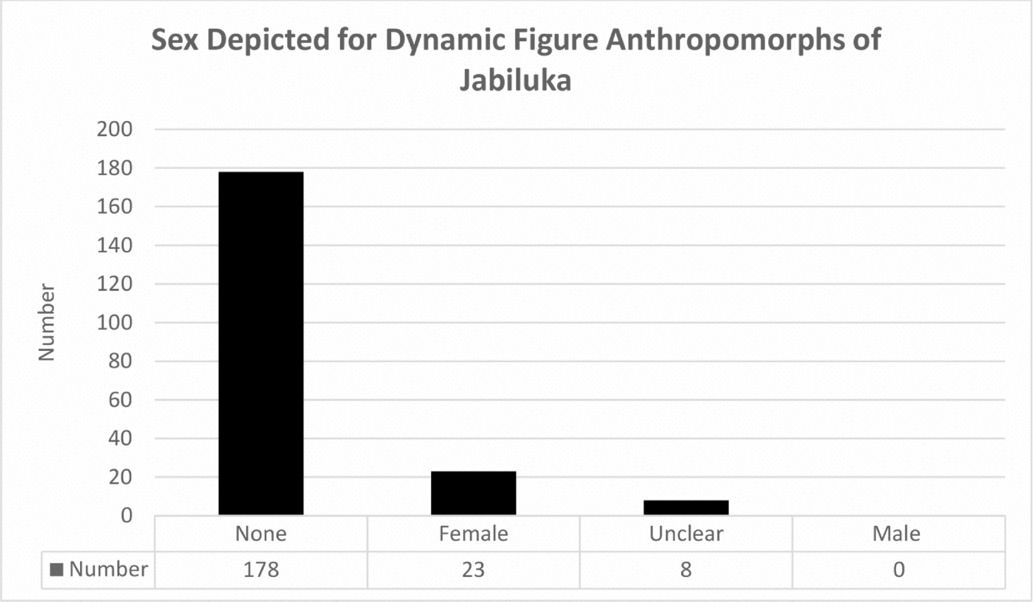
While much has been made of the male attributes and activities revealed in the Dynamic Figure tradition (see, for example, Brandl Reference Brandl1982; Chaloupka Reference Chaloupka1984a), our results suggest a more detailed analysis is needed, backed up by a reliable dataset such as that which was collected in Jabiluka. As can be seen in Figure 7, the vast majority of Dynamic Figures do not feature sex-indicating attributes such as breasts, vulva or penis. In fact, there are no clear identifiable images of men at all, if sex organs are the defining criteria—while 23 are clearly women, because breasts are depicted.
Sex of Dynamic Figure anthropomorphs based on presence or absence of sexual indicators.

This intriguing statistic opens up some fascinating avenues for further research, including: are there other indicators of sex and gender in Dynamic Figure rock art (such as headdresses, as first argued in Brandl Reference Brandl1982)? We would suggest that the artists are using other artistic elements, such as material culture, to indicate sex and/or engender this assemblage of rock art, rather than attributes indicating biological sex. It is also intriguing that the artists choose to depict 23 women, when most Dynamic Figures do not have sexual indicators.
Dynamic Figure scenes of Jabiluka: a case study
We now turn to a vitally important aspect of Dynamic Figure art—the fact that many anthropomorphs are arranged into scenes of activity. In the case of Jabiluka, there are 69 different Dynamic Figure scenes. We have chosen a key example as a focus for this paper.
Site context and description
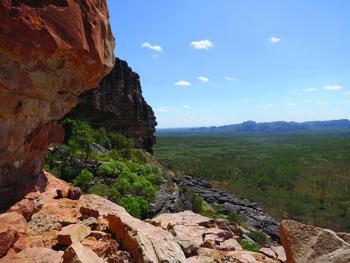
This scene is located on the eastern edge of the Djawumbu massif, in an area with a cluster of Dynamic Figure rock-art sites. The site itself is very large (over 50 m in length) with hundreds of paintings, drawings, stencils and prints, ranging from the earliest rock art in the region to some of the most recent figures. The location is difficult to reach, with a significant climb from ground level and steep terrain (Fig. 8). This scene is not directly over or under any other rock art.
View from the site of the Dynamic Figure scene under discussion (Site Number I3 0030 N13 16/06/2012, Jabiluka).

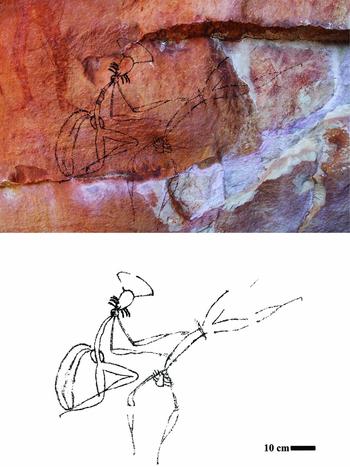
The scene in question is one of the larger Dynamic Figure scenes documented in Jabiluka, measuring 80×106 cm (Fig. 9). It was produced using a naturally occurring red colouring material, such as an ochre, and a very fine brush. The two human figures are engaged in an activity involving one lying on its back and the other kneeling and leaning over it with an object in its hand. The kneeling figure has a large headdress and some kind of body adornment around its waist, while the figure lying on its back has a smaller headdress which mimics the one worn by the kneeling figure (or possibly an elaborate hair style which similarly is mimicking that of the kneeling figure). Where the kneeling figure holds its right hand over the figure lying on its back, dashed lines appear. These lines are not indicated directly on the body, but are floating around the figure, suggesting activity, rather than direct marks or adornments on the body. In the left hand of the kneeling figure is a small object of some kind, with the appearance of a stone artefact. This hand is poised ready to touch or mark the body of the figure lying on its back near their abdomen or perhaps groin.
Dynamic Figure scene from Jabiluka with digital enhancement of human figures (above); the same Dynamic Figure scene with background removed (below).

Interpretation
In order to offer some interpretation of the activity taking place in this scene, we use four strands of evidence: archaeology, rock art, ethnographic information, and historic photographs and films. As we are using ethnographic information to inform our interpretations, it is important to be clear on how we are approaching the use of ethnographic analogy. There is ample literature addressing the uses and misuses of ethnographic analogy in rock-art studies (see, for example, Chippindale & Taçon Reference Chippindale and Taçon1998a; Keyser et al. Reference Keyser, Poetschat and Taylor2006). Importantly, we use recent accounts of cultural activities and art production as one element within a wider array of evidence. We take a conservative approach to comparisons, yet it is one informed by our own experiences working with the descendants of the rock artists living in the same areas. Far from evidence of an unchanging society, the rock art of western Arnhem Land suggests the opposite and is some of the best evidence for this change over time. Yet there remain aspects of style and subject that are repeated over extraordinarily long periods of time, for example, the use of X-ray design in rock paintings and today in contemporary art (Taylor Reference Taylor, David and McNiven2017). We would argue, then, that it is possible that if one attribute persists, others may have as well, albeit in an altered form (Whitley Reference Whitley2001, 825).
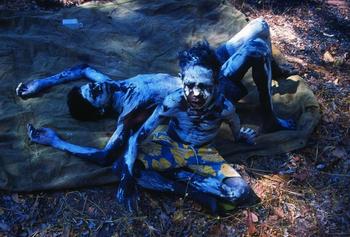
The artist(s) are clearly trying to communicate status via the headdresses in this image. We would argue that this indicates a senior person performing a cultural activity on a younger person. One possibility for this scene is that it represents the production of body art as part of ceremony. We suspected this because the production of body art during ceremonies is still practised in this area today and has been witnessed by the authors (for example, see Fig. 11). There is also ample ethnographic, historic and visual evidence for this; yet, as mentioned earlier, there is a great distance of time between the production of this rock-art scene and current ceremonial activities in western Arnhem Land. Any analogy must be considered in its wider archaeological context. The main problem with a body art interpretation is that it would be unusual to draw or paint on a human body with an ochre crayon (cf. Figs. 9 & 10). In our experience, the body is painted on with a soft brush or a finger as part of ceremonial activities in western Arnhem Land. This artist has deliberately depicted a solid object being used on the figure lying on its back.
Mann River region body painting, 1993. (Photograph: Paul S.C. Taçon.)

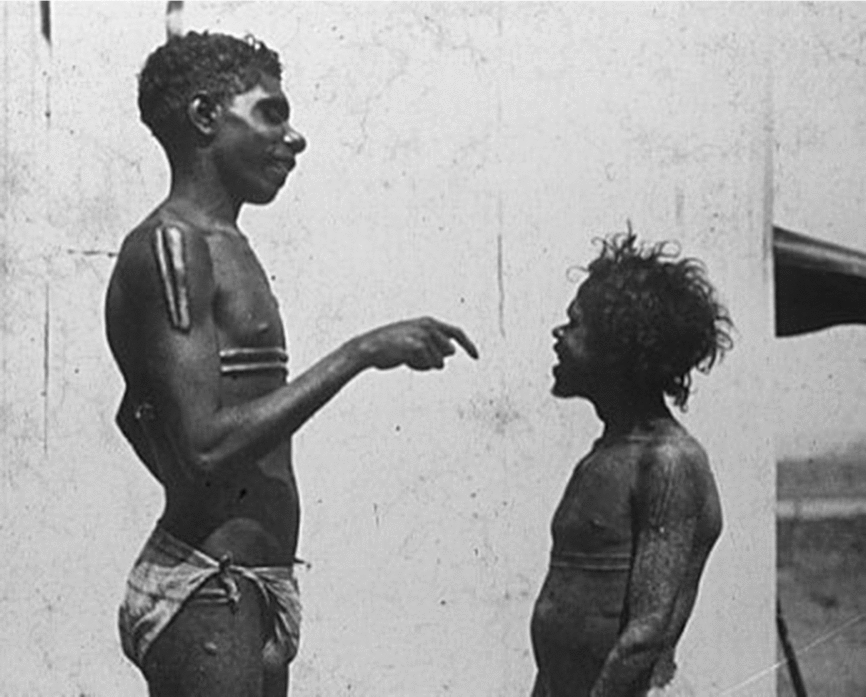
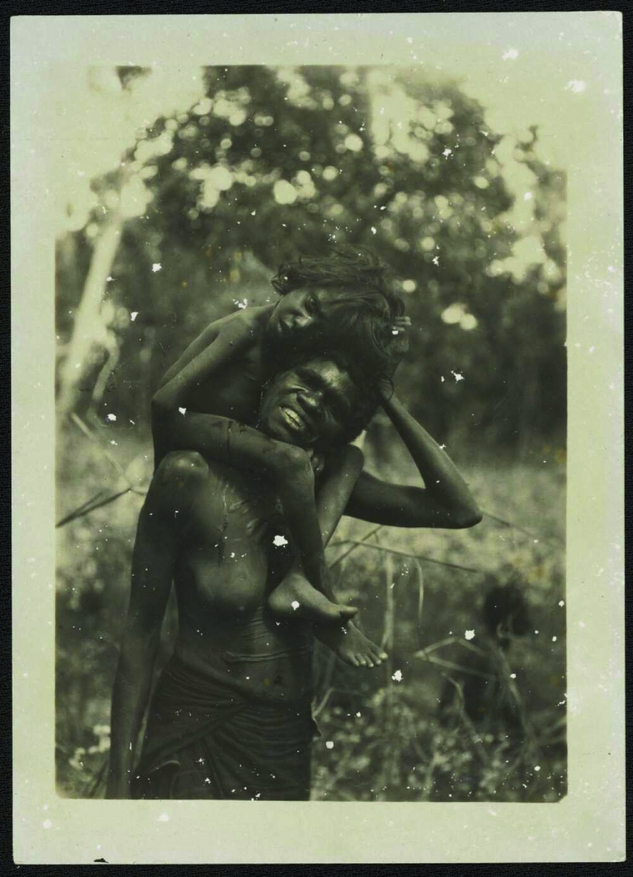
So we turn to another possible interpretation—that this image represents circumcision and/or body scarification. As with body art, circumcision and body scarification were very common in western Arnhem Land until quite recent times (Figs. 11 & 12). What is particularly interesting about this image is that it may be showing both circumcision and body scarification at the same time—something that is unlikely actually to have occurred. The artist may be, therefore, illustrating forms of body marking that take place within society, rather than an individual event. We know of no other detailed scene like this from Dynamic Figure sites elsewhere in Arnhem Land, or from any other style-period of the region or elsewhere in Australia.
Two men from the Oenpelli Mission showing body scarification on their upper arms and torso, c. 1930. (Courtesy of the Church Missionary Society.)

Portrait of an Aboriginal mother with her child on her shoulders, Arnhem Land, Northern Territory, 1928. The mother has cultural scarification marks on her upper and lower abdomen. (Donald Mackay collection, National Library of Australia.)

This scene is just one example of the complexity of Dynamic Figure rock art, and we think it highlights this point well: Dynamic Figures are embedded with evidence for cultural activities that could have taken place and are markers of individual and group identity—in this case life-course rituals and/or status within society.
Discussion
The Dynamic Figure rock art of northern Australia offers a unique insight into cultural complexity during the Pleistocene. With its depictions of human-like figures and their material culture, and explicit illustrations of relationships between these human-animal and composite beings, we are given an insight into the cultural life of Pleistocene Australia. At the same time, we are left to wonder how such a rock-art tradition, emerging from earlier traditions focused on the non-human motifs, came to appear. Could northern Australia be the first place where human figures suddenly start monopolizing the rock-art panels, explicitly representing their belongings and performing all sorts of dynamic activities?
We would argue that the Dynamic Figures are an illustration of the way the artists and their communities saw themselves—illustrations of group identity–and as indications of intra-group social positioning. The rock art certainly does include many aspects of everyday life, but our more detailed analysis has also shown that the rock art includes elements that go beyond basic human needs. For example, the inclusion of a highly restricted range of animals in the assemblage hints at a special relationship between humans and particular animal species, such as thylacines. We believe this is a clear indicator of a stronger spiritual association with particular animals and cultural choices relating to an underlying belief system.
Likewise, the appearance of animal-human composite beings is important as it suggests something of the complex belief systems at the centre of the community of which the artists are a part. Is this, as Chaloupka (Reference Chaloupka1993, 114) first suggested, the beginning of mythogenesis in western Arnhem Land? It is certainly the earliest and most explicit evidence we have for a complex belief system in the area. Such composite beings have also been recorded in other early rock-art traditions such as European Palaeolithic art: for example, the sorcerer and the therianthrope from Grotte des Trois Frères (Ariège, France), the sorcerer from Gabillou (Dordogne, France) and the bird-headed human from Lascaux (Dordogne, France). This ambiguity between humans and animals has been interpreted as a voluntary denial of the human shape, reflecting the close liaison between humans and animals (Lorblanchet Reference Lorblanchet and Morphy1989, 139), which may reflect an interaction with the animal world that goes beyond their mere use as hunting prey. As such, it is a reflection of the nature of scenes such as that mentioned above, which certainly go beyond the mundane to reflect the complex relationships between humans and animals.
This complexity of cultural life is even more explicitly outlined in the Dynamic Figure scenes. The example outlined in this paper does not simply suggest cultural activities relating to belief systems, but explicitly details these activities in a scene that illustrates aspects of social transformation and status within society. This is highlighted through the importance of body ornaments and the depiction of body alternations (Figs. 9 & 10). The artist has chosen to communicate these details to the world openly, rather than embedding this information in some kind of artistic code only to be read by people inside this particular group (also see Johnston in press). For example, Taçon (Reference Taçon1989) illustrates that depictions of X-ray fish in western Arnhem Land rock art are not simply a reflection of ‘fishing’, but include a complex relationship of instructions regarding the animal and its totemic and spiritual symbolism. The apparent open communication of cultural knowledge in Dynamic Figure art stands in contrast to many later rock-art traditions and contemporary art in western Arnhem Land (May Reference May2006; 2008; Taylor Reference Taylor1996).
There is potentially an interesting link between this open communication and the location of the sites within the landscape. Overwhelmingly Dynamic Figure rock art is found in difficult-to-reach locations and, as mentioned earlier, it clusters in key areas within Jabiluka. This clustering could suggest that, if the artist and their community were attempting to restrict information illustrated in these paintings, they may have done so by restricting access to place. This is in contrast to recent and current systems in western Arnhem Land, whereby knowledge is protected not by limiting access to sites or paintings, but by restricting access to cultural knowledge that allows you to interpret the art (see May Reference May2006; 2008; Taylor Reference Taylor1996; Reference Taylor, David and McNiven2017).
Of course, it may be that the information such as that depicted in the body scarification scene was not culturally sensitive and was open for all to see and understand. It may even be that these paintings were tools for educating community members about cultural practices; but the difficult-to-reach locations perhaps hint at a more complex relationship. Recent research by linguist and anthropologist, Murray Garde, provides an interesting perspective on the importance of location. In his discussions of the Wubarr ceremonial ground near Gunbalanya (Oenpelli), approximately 30 km from Jabiluka, Garde (Reference Garde, Thomas and Neale2011, 410) uses linguistics to suggest an ancient tradition of ceremonial grounds being found at the top of elevated landscapes:
This longstanding tradition is reflected even today—if not geographically, then linguistically—in the major regional ceremonies that have replaced the now defunct Wubarr, such as the Kunabibi and Yabbadurruwa. To enter the restricted men's ceremonial ground from outside, one says figuratively in the Bininj Gunwok dialects of Western Arnhem Land, nga-bidbun—‘I'm going up’—regardless of whether the speaker will ascend, descend or walk across a flat area to get to the ceremony ground.
Finally, the importance of material culture depicted in Dynamic Figure rock art cannot be underestimated. Not only do we have access to information on organic material culture not usually preserved in the archaeological record, but also we have the material culture of the time seen through the lens of the artist—what is significant to them, to their community and how it all links together. The importance of body adornments is something not seen from generations of archaeological excavations in the area. Far outnumbering tools associated with hunting and gathering food, this focus on body adornments again suggests a complex cultural system and one in which a community has the time and resources to focus on more than basic human needs.
Conclusion
Dynamic Figure rock art of Jabiluka illustrates, for the first time in northern Australia, the intricate relationship between humans and other aspects of their lifeworld. It emerges from a period of largely naturalistic art and quickly centres on the human, on self-awareness and communication of a complex cultural life to potentially a wide audience. In this way, Dynamic Figure anthropomorphs are a template for communicating social and ideological issues and have unprecedented potential to increase our understanding of early life in Australia, and beyond.
Acknowledgements
We would like to thank the Gundjeihmi Aboriginal Corporation for their ongoing collaboration with us for the Mirarr Gunwarddebim project. Special thanks to Yvonne Margarula and Justin O'Brien for establishing the project with us and for their ongoing support. Many people have helped with rock-art recording for this project and we thank them all for their time and efforts. We thank John Hayward, Celena Hayward, Melissa Marshall, Janet Davill, Phil Davill, Norrae Johnston and Helen Shope for assistance in the field. Thanks also to the Natural Cultural Programs Unit (Kakadu National Park) and especially Gabrielle O'Loughlin; to the Northern Land Council for permits; and to Energy Resources of Australia Ltd (ERA) for allowing us access to the Jabiluka area for this work. We are grateful to the CMS Sydney for permission to use images and to the Northern Territory Archives for their help in sourcing early photographs from this region. Griffith University, the Australian National University, the University of Barcelona and Linnaeus University are thanked for supporting this research in various ways. Finally, we are grateful to the three anonymous reviewers who took the time to provide detailed feedback on the original version of this paper.