CHILDREN'S ROLE IN THE HISTORY OF SCHISTOSOMIASIS
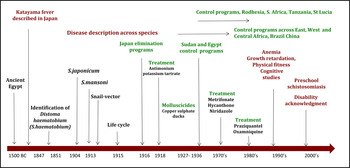
As Farley has stated: ‘Tropical medicine from 1898 to the 1970s was fundamentally imperialistic in its basic assumptions, its methods, its goals and its priorities’ (Farley, Reference Farley1991). He then elaborates on this point by stating that ‘…the basic goal of tropical medicine was to render the tropical world fit for white habitation and white investment’. This period broadly overlaps the time of the discovery of the Schistosoma parasite and the evolution in the biomedical community's understanding of the parasite's biology, transmission and disease manifestations (Fig. 1). Robert T. Leiper, one of the most prominent parasitologists of his time, detailed the African schistosome life cycle in 1916, enabling him to fulfil his mandate: to prevent the transmission of schistosomiasis among British troops during World War I (Stothard et al. Reference Stothard, Kabatereine, Archer, Al-Shehri, Tchuem-Tchuente, Gyapong and Bustinduy2016). He did so by promoting activities to prevent contact with cercariae-infested waters. Although prevention proved to be the most effective strategy for military troops, it was largely impracticable for indigenous people whose lives depended on irrigation and farming along the Nile Delta, and so could not be enforced.
A brief timeline summary of the more important events in the history of schistosomiasis. In black, discoveries in parasite biology; in red, clinical studies; in green, schistosomiasis control efforts.

In terms of the significance of disease in children, The British Colonial Office recognized the inherent risks of raising children in tropical environments where, in 1893, schistosomiasis (Bilharzia) was known to be a common illness. British children were advised to be sent home ‘…. or they will deteriorate physically and morally, grow up slight, weedy, and delicate, with a general feebleness’ (Farley, Reference Farley1991). This is one of the first (indirect) descriptions of the disabling effects of schistosomiasis in children, albeit European.
There was a slow transition from the golden era of descriptive parasitology (1850s–1920s), which had a particular interest in environmental practices for disease control, towards disease-centred research, which enabled the discovery of effective drugs. Nevertheless, human Schistosoma-related disease went without an available treatment for over 50 years (Fig. 1). The species-specific description of schistosomiasis-associated morbidity began early on, and necropsy studies primarily contributed to this knowledge of chronic Schistosoma infection (Bustinduy and King, Reference Bustinduy, King, Farrar, Hotez, Junghanss, Kang, Lalloo and White2013) (Fig. 1). As a result, the most overt organ-level morbidities, such as hepatosplenomegaly, peri-portal fibrosis, and subsequent portal hypertension with oesophageal varices, were clearly linked to Schistosoma mansoni and Schistosoma japonicum. They thus became the primary focus of population-based disease prevalence studies for intestinal forms of schistosomiasis. Haematuria and renal tract pathology (bladder polyps, hydronephrosis and associations to bladder cancer) were identified as complications of Schistosoma haematobium infection, and these became the focus of efforts for prevention and control for this species (Bustinduy and King, Reference Bustinduy, King, Farrar, Hotez, Junghanss, Kang, Lalloo and White2013; Colley et al. Reference Colley, Bustinduy, Secor and King2014). Unfortunately, it took over 100 years to recognize the more widespread and disabling systemic morbidities of Schistosoma infection that affect the youngest age groups (Parraga et al., Reference Parraga, Assis, Prado, Barreto, Reis, King and Blanton1996; Koukounari et al., Reference Koukounari, Fenwick, Whawell, Kabatereine, Kazibwe, Tukahebwa, Stothard, Donnelly and Webster2006, Reference Koukounari, Gabrielli, Toure, Bosque-Oliva, Zhang, Sellin, Donnelly, Fenwick and Webster2007; King and Dangerfield-Cha, Reference King and Dangerfield-Cha2008; Mupfasoni et al., Reference Mupfasoni, Karibushi, Koukounari, Ruberanziza, Kaberuka, Kramer, Mukabayire, Kabera, Nizeyimana, Deville, Ruxin, Webster and Fenwick2009).
Michael Gelfand, a clinician stationed in Rhodesia (present-day Zimbabwe) in the early 1960s, was particularly influential in describing the morbidity of the disease in children. In a detailed clinical description of intestinal schistosomiasis, he reported: ‘This feature of tiredness stands out more in bilharziasis than in any other tropical infestation. The lethargy of the child is often noticed by teachers, who sees him becoming apathetic, falling behind in games and lacking enthusiasm.’ (Gelfand, Reference Gelfand1967). At the time, these careful clinical observations lacked metrics to accurately measure this ‘fatigue’. Moreover, there was no strategy to treat these children en masse (Farley, Reference Farley1991). Much later, the association between schistosomiasis and decreased physical fitness was documented in Coastal Kenya among boys with urogenital schistosomiasis. This study, although innovative, made use of the Harvard step-test, an instrument not validated for children (Stephenson et al. Reference Stephenson, Latham, Kurz, Miller, Kinoti and Oduori1985b ). Subsequent work in the same area has identified the 20-m shuttle run test as an accurate and easy-to-implement field fitness test with excellent correlations between child poly-parasitic status, anaemia and decreased aerobic capacity in over 2000 children (Bustinduy et al. Reference Bustinduy, Thomas, Fiutem, Parraga, Mungai, Muchiri, Mutuku, Kitron and King2011).
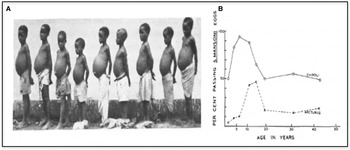
Infection in very young children was particularly well described in clinical accounts from Rhodesia. Up to half of children as young as 2 years old were documented as having egg-patent infection in endemic villages, but in an era of very expensive injectable drug therapy, treating them was not even considered (Fig. 2). Only overt morbidity was eligible for treatment and this mostly occurred among older children and adults (Gelfand, Reference Gelfand1967).
Often overlooked aspects of schistosomiasis previously identified decades ago. (A) Young children with severe hepatosplenomegaly in Zimbabwe (Rhodesia). (B) Age distribution of egg-patent S. mansoni infection in a high-(Chipoli) and low-(Arcturus) transmission villages, with significant involvement of children under 5 (50% prevalence in Chipoli). Adapted from Gelfand (Reference Gelfand1967).

In textbooks and policy literature, school-age children have been characterized as the main transmitters of Schistosoma infection due to their high egg output (peaking in mid-childhood between 10 and 15 years old) and increased water contact. Owing to their ‘careless’ water use practices, which include frequent wading, playing and urinating or defecating in or near the water, the Schistosoma transmission cycle is greatly bolstered (Webbe, Reference Webbe, Jordan and Webbe1982; Mott et al. Reference Mott, Dixon, Osei-Tutu, England and Davis1985). Because detectable Schistosoma-specific morbidity due to advanced organ fibrosis is mostly seen in early adulthood, children were not considered as seriously affected by their infection status (Gryseels, Reference Gryseels1989). In addition, risk for disease was erroneously believed to be related only to high-intensity infections. (Warren et al. Reference Warren, Mahmoud, Muruka, Whittaker, Ouma and Arap Siongok1979; Gryseels, Reference Gryseels1989) Recent studies across Schistosoma species have discredited this paradigm by demonstrating that light-intensity infections already have tangible negative health effects (Ezeamama et al. Reference Ezeamama, Friedman, Olveda, Acosta, Kurtis, Mor and McGarvey2005b ; Bustinduy et al. Reference Bustinduy, Parraga, Thomas, Mungai, Mutuku, Muchiri, Kitron and King2013; King, Reference King2015).
In the first wave of population-based morbidity surveys in the 1960s and 1970s, many children were wrongly classified as ‘uninfected’ due to insensitive diagnostic methods (i.e. eggs were not found in urine or stool), and they were termed ‘asymptomatic’ when overt anatomic morbidity was absent. (Mott and Cline, Reference Mott and Cline1980; Mott, Reference Mott, Murray, Lopez and Mathers2004) More refined seroprevalence studies have now demonstrated that almost all children from highly endemic areas are infected by the time they reach puberty (Colley et al. Reference Colley, Bustinduy, Secor and King2014). Sadly, this misclassification of infection status has confounded accurate burden of disease estimates and has delayed recognition of Schistosoma infection as a major cause of disease/disability burden in endemic countries (King, Reference King2010, Reference King2015). Novel diagnostic assays, the CCA (Circulating Cathodic Antigen) and the CAA (Circulating Anodic Antigen), which are able to detect circulating Schistosoma antigens from as little as one worm pair, are now revealing clinically significant worm burdens in individuals who were previously thought to be ‘uninfected’ based on egg-count testing (Colley et al. Reference Colley, Binder, Campbell, King, Tchuem Tchuente, N'Goran, Erko, Karanja, Kabatereine, van Lieshout and Rathbun2013; Van Dam et al. Reference Van Dam, Xu, Bergquist, de Dood, Utzinger, Qin, Guan, Feng, Yu, Zhou, Zheng, Zhou and Corstjens2015).
THE FIRST NUTRITIONAL STUDIES
The first nutritional studies in the 1980s were seminal in the field of paediatric schistosomiasis. Conducted in Coastal Kenya by Stephenson and Latham, they opened the door to rigorous research in this area. Epidemiological correlations were made between parasitic infections, including S. haematobium, and delayed growth (Stephenson et al. Reference Stephenson, Latham, Kurz, Kinoti, Oduori and Crompton1985a ). Children showed dramatic improvements in appetite and physical fitness after a single dose of metrifonate, a drug effective against S. haematobium that was used in that era (Latham et al. Reference Latham, Stephenson, Kurz and Kinoti1990). Unfortunately, little had changed in the same area of Kenya over the next 25 years, when further studies, applying more accurate morbidity metrics, confirmed that decreased fitness and undernutrition were still highly prevalent among children infected with S. haematobium (Bustinduy et al., Reference Bustinduy, Thomas, Fiutem, Parraga, Mungai, Muchiri, Mutuku, Kitron and King2011, Reference Bustinduy, Parraga, Thomas, Mungai, Mutuku, Muchiri, Kitron and King2013).
Progress in this field has been slow but steady. Nutritional studies of the impact of S. japonicum infection led by McGarvey and colleagues at Brown University in collaboration with researchers in the Philippines and China, have highlighted the relationship between S. japonicum infection and increased systemic inflammation within the human body, which is associated with a negative impact on growth. (McGarvey et al., Reference McGarvey, Aligui, Daniel, Peters, Olveda and Olds1992, Reference McGarvey, Aligui, Graham, Peters, Olds and Olveda1996). Later studies have shown (partial) reversibility of malnutrition after treatment, particularly among those children who are clinically wasted at baseline (Coutinho et al. Reference Coutinho, Acosta, McGarvey, Jarilla, Jiz, Pablo, Su, Manalo, Olveda, Kurtis and Friedman2006a ).
FUNCTIONAL MORBIDITIES AFFECTING GROWTH
Advances in the knowledge of host–parasite immune responses have revealed that schistosomiasis is fundamentally a chronic inflammatory disease that affects the entire body. This has led to much wider recognition of morbidities that are linked to the pro-inflammatory state that precedes fibrosis (Wamachi et al. Reference Wamachi, Mayadev, Mungai, Magak, Ouma, Magambo, Muchiri, Koech, King and King2004; Coutinho et al. Reference Coutinho, Leenstra, Acosta, Su, Jarilla, Jiz, Langdon, Olveda, McGarvey, Kurtis and Friedman2006b ; Leenstra et al. Reference Leenstra, Coutinho, Acosta, Langdon, Su, Olveda, McGarvey, Kurtis and Friedman2006). These so-called ‘subtle’ morbidities perhaps should be better termed ‘functional’ morbidities, as they impair normal physiological functioning of an infected child. The impact of infection on growth hormone/insulin-like growth factor-1 pathways is anabolic to the skeleton, and other inflammatory cytokines also compromise bone growth (Farquharson and Ahmed, Reference Farquharson and Ahmed2013). Linear growth can be severely impaired by any chronic inflammation, including inflammation caused by schistosomiasis, and this, in turn, leads to childhood growth stunting. Associated anaemia of inflammation caused by infection with all species of Schistosoma impairs iron storage release and utilization (Ezeamama et al. Reference Ezeamama, Friedman, Olveda, Acosta, Kurtis, Mor and McGarvey2005b ; Koukounari et al. Reference Koukounari, Fenwick, Whawell, Kabatereine, Kazibwe, Tukahebwa, Stothard, Donnelly and Webster2006) and this complication most readily manifests itself as decreased physical fitness (Stephenson et al. Reference Stephenson, Latham, Kurz, Miller, Kinoti and Oduori1985b ; Friedman et al. Reference Friedman, Kanzaria and McGarvey2005; Bustinduy et al. Reference Bustinduy, Thomas, Fiutem, Parraga, Mungai, Muchiri, Mutuku, Kitron and King2011), poor concentration and diminished school performance (Nokes et al. Reference Nokes, McGarvey, Shiue, Wu, Wu, Bundy and Olds1999; Jukes et al. Reference Jukes, Nokes, Alcock, Lambo, Kihamia, Ngorosho, Mbise, Lorri, Yona, Mwanri, Baddeley, Hall and Bundy2002; Ezeamama et al. Reference Ezeamama, Friedman, Acosta, Bellinger, Langdon, Manalo, Olveda, Kurtis and McGarvey2005a ). If untreated, these manifestations become irreversible with significant lifetime consequences: decreased work productivity as adults, altered fertility in both men and women (Kjetland et al. Reference Kjetland, Leutscher and Ndhlovu2012) and decreased quality of life. (Terer et al. Reference Terer, Bustinduy, Magtanong, Muhoho, Mungai, Muchiri, Kitron, King and Mutuku2013) The misfortune behind the failure to recognize such ‘functional’ morbidities is that, because they are confounded by other co-endemic diseases, particularly malaria, they are often not adequately recognized as schistosomiasis-related manifestations.
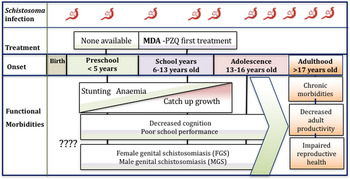
There is a ‘magic window’ of opportunity to treat children who have suffered a growth arrest. This is the ‘catch up’ growth period, when a child can accelerate growth to achieve normal weight and height after an acute health insult, such as schistosomiasis (Gurarie et al. Reference Gurarie, Wang, Bustinduy and King2011). This window closes when the growth plates fuse, and therefore early intervention is essential to achieve normal height. (Fig. 3)
Timing of the onset of different schistosomiasis-associated morbidities. Pro-inflammatory state due to Schistosoma infection impairs normal linear growth and development (functional morbidity) and manifests as stunting and anaemia starting <2 years of age. The catch-up growth window can only occur before growth plates fuse. First treatment occurs at school entry but chronic infection can already be present years before, and re-infection may be rapid. The onset of first FGS/MGS manifestations is unknown.

ASSOCIATED DISABILITY IN CHILDREN
Why has the negative impact of paediatric schistosomiasis been undervalued? Part of what makes schistosomiasis a ‘neglected’ disease [i.e. counted among the Neglected Tropical Diseases (NTDs)] is that its perceived importance to health has been linked to its disability-adjusted life-year (DALY) ranking in the WHO–World Bank Global Burden of Disease (GBD) system. In its first iteration, the GBD program intentionally weighted disease impact by age, giving much greater emphasis to diseases that affect 20–30 year olds, and much less to diseases of children under 5 (Murray, Reference Murray1996). While this error has been corrected in more recent GBD versions (Salomon and Jonas, Reference Salomon, Vos, Hogan, Gagnon, Naghavi, Mokdad, Begum, Shah, Karyana, Kosen, Farje, Moncada, Dutta, Sazawal, Dyer, Seiler, Aboyans, Baker, Baxter, Benjamin, Bhalla, Bin Abdulhak, Blyth, Bourne, Braithwaite, Brooks, Brugha, Bryan-Hancock, Buchbinder and Burney2012; Vos and Memish, Reference Vos, Flaxman, Naghavi, Lozano, Michaud, Ezzati, Shibuya, Salomon, Abdalla, Aboyans, Abraham, Ackerman, Aggarwal, Ahn, Ali, Alvarado, Anderson, Anderson, Andrews, Atkinson, Baddour, Bahalim, Barker-Collo, Barrero, Bartels, Basanez, Baxter, Bell, Benjamin and Bennett2012) schistosomiasis has always been assigned the health impact associated with ‘minor infections’ and given a negligible 0·004–0·005 disability weight. Thus, although there are more than 250 million persons with active (egg-positive) cases, and likely an equivalent number of people with ‘egg-negative’ Schistosoma-related disease, the calculated worldwide DALY impact of schistosomiasis is perceived as less than one-tenth of that attributed to other, more lethal diseases of childhood. In the eyes of many donors and policymakers, this lowers its priority for control and prevention.
To correctly assess the disease burden of Schistosoma infection it is important to recognize the lifetime cumulative impact of infection, not just in terms of individual organ pathology and dysfunction, but also on the overall whole-body performance of the growing child and young adults. Schistosomiasis that causes chronic anaemia, growth faltering and poor cognitive performance is quite disabling in a setting where resources are limited, and accommodation for disabilities is inadequate. Disease impact does not end when Schistosoma infection ends, and the associated loss of schooling and/or reduced growth cannot be reversed by childhood treatments if rapid reinfection is likely where a child lives, plays and works. Similarly, these losses cannot be reversed once a person reaches adulthood. Once the child passes school age, most of these functional pathologies become irreversible.
EARLY YEARS (<5 YEARS OF AGE)
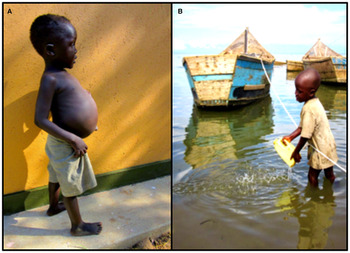
The institutional apathy regarding treatment of schistosomiasis in children under six is in stark contrast to the recommendations for treatment of preschool children infected with soil-transmitted helminths, a practice that has been at the forefront of paediatric care and treatment campaigns for many years (World Health Organisation, 2007). Children under 5 years of age are often daily exposed to infected water very early in life, and although initial infection occurs ‘silently’, it generates inflammation that predisposes to organ fibrosis, which will then endure for decades (Colley et al. Reference Colley, Bustinduy, Secor and King2014) Fig. 4. This lack of recognition dates back to early WHO reports on schistosomiasis, in which disease among very young children was described, but then appears to have been forgotten in subsequent formulation of action plans (Mott, Reference Mott1982). The justification for this health policy gap was 2-fold; firstly, young children were considered a lightly infected population and therefore thought to be at low risk for schistosomiasis-associated morbidity; secondly, there was no child-friendly formulation for oral treatment that would decrease the risk of choking. Crushing tablets to treat younger children was not considered practical for national programmes, although this approach is widely performed for pill treatment of other diseases such as tuberculosis (Pineiro Perez et al. Reference Pineiro Perez, Santiago Garcia, Fernandez Llamazares, Baquero Artigao, Noguera Julian and Mellado Pena2016). In essence, the under-fives were not seriously considered at risk and they were deemed too difficult and unsafe to treat, so they were excluded. It was not until 2010 that the first expert meeting on the inclusion of preschool children in schistosomiasis control efforts was convened at the World Health Organisation (WHO) (World Health Organization, 2011).
Photographs of young children suffering from schistosomiasis. (A) Early chronic morbidity (hepatosplenomegaly) in child under 5 years of age with intestinal schistosomiasis; (B) A preschool child collecting water and being exposed to cercariae-infested freshwater.

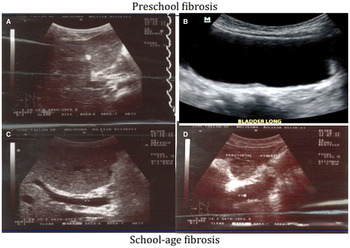
From a modern perspective, stronger evidence is emerging that very young preschool children do indeed harbour egg-patent infection (Bosompem et al. Reference Bosompem, Bentum, Otchere, Anyan, Brown, Osada, Takeo, Kojima and Ohta2004; Odogwu et al. Reference Odogwu, Ramamurthy, Kabatereine, Kazibwe, Tukahebwa, Webster, Fenwick and Stothard2006; Sousa-Figueiredo et al. Reference Sousa-Figueiredo, Basanez, Mgeni, Khamis, Rollinson and Stothard2008; Verani et al. Reference Verani, Abudho, Montgomery, Mwinzi, Shane, Butler, Karanja and Secor2011). and also present with early fibrosis, including hepatosplenic disease due to S. mansoni and early bladder changes due to S. haematobium (Fig. 5). Detection of these early fibrotic changes, however, may prove challenging.
Ultrasound findings by WHO classification. Preschool children in (A): Uganda – Liver fibrosis-stage C on a 4-year-old girl and (B): Gabon – early bladder polyp and bladder thickening in a 2-year-old boy. School-aged children (C): Uganda – 12-year-old boy with stage D fibrosis (D): 16-year-old girl with stage E fibrosis. N.B. Image B – courtesy of Dr. Jonathan Rempiss.

A recent study in Gabon, piloting a novel protocol for clinical bedside ‘Focused Assessment with Sonography in Urogenital Schistosomiasis’ (FASUS), showed a 41% prevalence of ultrasound detectable urinary tract morbidity in under-fives in a S. haematobium endemic area (Jonathan Remppis et al., manuscript in preparation). This protocol was derived from the WHO's Niamey ultrasound protocol, widely used in prevalence studies, but not validated as a clinical tool for morbidity assessment in individual patients presenting with symptoms of S. haematobium infection. With the increasing availability of low-cost ultrasound in endemic areas, this approach could provide a point-of-care morbidity detection tool that could allow better definition of the risk of early childhood pathology (Belard et al. Reference Belard, Tamarozzi, Bustinduy, Wallrauch, Grobusch, Kuhn, Brunetti, Joekes and Heller2016; Richter et al. Reference Richter, Botelho, Holtfreter, Akpata, El Scheich, Neumayr, Brunetti, Hatz, Dong and Dietrich2016).
THE EVOLUTION OF ANTI-SCHISTOSOMAL TREATMENT
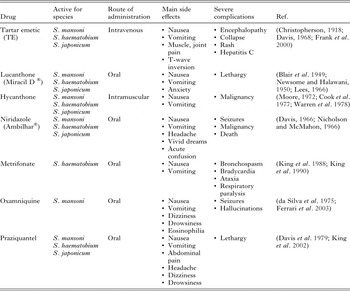
The first injectable anti-schistosomal treatment, potassium antimony tartrate, or tartar emetic (TE), which contained trivalent antimony, was introduced in 1918 as a drug initially used to treat visceral leishmaniasis (Christopherson, Reference Christopherson1924) (Fig. 1). Although promising at first, it had very limited efficacy and severe side-effects (Jordan, Reference Jordan2000). Other drugs followed, including hycanthone and oral niridazole each with severe side-effects and difficulties in administration. Table 1 summarizes the different anti-schistosomal treatments through time.
Different anti-schistosomal treatments through time

Since 1984, praziquantel (PZQ), the current drug of choice, has displaced older drugs of lesser effectiveness for all types of schistosomiasis (King et al. Reference King, Lombardi, Lombardi, Greenblatt, Hodder, Kinyanjui, Ouma, Odiambo, Bryan, Muruka, Magak, Weinert, Ransohoff, Houser, Koech, Arap Siongok and Mahmoud1988; King and Mahmoud, Reference King and Mahmoud1989; Doenhoff et al. Reference Doenhoff, Cioli and Utzinger2008). Its full mechanism of action remains unclear, but it is thought to act on the calcium ion channels of schistosome's tegument leading to disruption of the parasite's surface, and exposing it to lethal damage by the host's immune system (Doenhoff et al. Reference Doenhoff, Cioli and Utzinger2008). Adult dose finding studies in the 1970s and 1980s concluded that a single PZQ dose of 40 mg kg−1 was effective for treating S. haematobium and S. mansoni (Davis et al. Reference Davis, Biles and Ulrich1979; Davis and Wegner, Reference Davis and Wegner1979; King et al. Reference King, Muchiri, Mungai, Ouma, Kadzo, Magak and Koech2002). However, in highly endemic areas, a more intense, repeated dosing approach is likely needed for optimal effect, particularly for S. mansoni (King et al. Reference King, Olbrych, Soon, Singer, Carter and Colley2011).
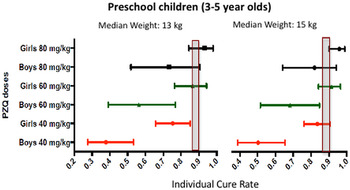
Since its introduction in the 1980s, PZQ has been used safely in children. However, their recommended dosages were directly extrapolated from pharmacokinetic studies performed in adults (Xiao, Reference Xiao2005; Kabatereine et al. Reference Kabatereine, Brooker, Koukounari, Kazibwe, Tukahebwa, Fleming, Zhang, Webster, Stothard and Fenwick2007; Mutapi et al. Reference Mutapi, Rujeni, Bourke, Mitchell, Appleby, Nausch, Midzi and Mduluza2011). Work in Uganda in 2010 revealed sub-optimal PZQ cure rates for S. mansoni among preschool children (Sousa-Figueiredo et al. Reference Sousa-Figueiredo, Pleasant, Day, Betson, Rollinson, Montresor, Kazibwe, Kabatereine and Stothard2010). To explore the appropriateness of age-adjusted dosing, the first pharmacokinetic/pharmacodynamic PZQ study in children in Uganda was conducted in that same area. Results from this recent study showed a very concerning risk of underdosing of children, particularly the younger ones, if standard 40 mg kg−1 was given. Higher doses may be needed for treating these and other children infected with S. mansoni (Bustinduy et al. Reference Bustinduy, Waterhouse, de Sousa-Figueiredo, Roberts, Atuhaire, Van Dam, Corstjens, Scott, Stanton, Kabatereine, Ward, Hope and Stothard2016a ) Fig. 6.
Individual cure rate by different PZQ doses as modelled in 5000 patients in scale 0·0 (total failure) to 1·0 (complete cure) at 24 days post-single dose PZQ. Median weights-for-age were used to calculate the plots. Adapted from (Bustinduy et al. Reference Bustinduy, Waterhouse, de Sousa-Figueiredo, Roberts, Atuhaire, Van Dam, Corstjens, Scott, Stanton, Kabatereine, Ward, Hope and Stothard2016a ).

EXPANDING ACCESS TO PZQ FOR PRESCHOOL CHILDREN
In response to the recommendations from the WHO expert consultation in 2011 (World Health Organization, 2011) an international, non-profit, public–private partnership, called the Praziquantel Consortium has been formed (www.paediatricpraziquantelconsortium.org). Its primary objective is to develop, register and provide access to a new and more palatable paediatric (orodispersible) formulation of PZQ that can be used to treat young children, including infants and toddlers under the age of 6 years. More importantly, data on the treatment of very young children has been sparse and insufficient to define and confirm the best dosing regimens for young children. These factors mandated the need for the Paediatric PZQ Formulation Program to go through a full clinical drug development pathway. Currently, a Phase 2 study is being conducted in infected preschool children in Ivory Coast. To complement the product development aspects of the programme, the consortium has also started to explore means to provide access to the new paediatric treatment as soon as it is marketed (Bustinduy et al. Reference Bustinduy, Friedman, Kjetland, Ezeamama, Kabatereine, Stothard and King2016b ).
THE DOUBLE-TREATMENT GAP IN MDA PROGRAMMES
The success of schistosomiasis control programmes has been very uneven over the last century. Efficacy has varied largely depending on the baseline prevalence of infection (Jordan, Reference Jordan2000; Wang et al. Reference Wang, Utzinger and Zhou2008). Success stories in Japan, Morocco (Amarir et al. Reference Amarir, El Mansouri, Fellah, Sebti, Mohammed, Handali, Wilkins, El Idrissi, Sadak and Rhajaoui2011), Iran and Tunisia give hope to less developed countries that are confronted by the ‘trap’ of self-perpetuating, disease-related poverty (Sacks, Reference Sacks2005). Economically disadvantaged countries are only just now starting to prioritize NTD control (Savioli et al. Reference Savioli, Gabrielli, Montresor, Chitsulo and Engels2009). To date, implementation of large-scale control efforts in highly endemic areas has not shown permanent success, likely due to ecological factors favouring transmission and human reinfection. Part of the unfortunate lack of success of many control efforts stems from the complex reality of a disease that involves social interactions in hot spots of high transmission. Campaigns frequently miss ‘super-spreaders’– children and individuals highly infected who act as reservoirs (King, Reference King2009). The risk of reinfection or ‘re-worming’ in high-transmission villages in Kenya was found to be as high as 50% over 2 years despite ongoing school-based mass drug administration (MDA) (Satayathum et al. Reference Satayathum, Muchiri, Ouma, Whalen and King2006). Even more disheartening was the return to high prevalence in the same areas after control efforts were interrupted for 8 years (Wang et al. Reference Wang, Gurarie, Mungai, Muchiri, Kitron and King2012). Older control interventions, based on better access to clean water and the use of molluscicides, may still have important adjuvant roles to play as part of adaptive strategies in implementing more effective schistosomiasis control programmes (Fenwick et al. Reference Fenwick, Webster, Bosque-Oliva, Blair, Fleming, Zhang, Garba, Stothard, Gabrielli, Clements, Kabatereine, Toure, Dembele, Nyandindi, Mwansa and Koukounari2009; Garba et al. Reference Garba, Toure, Dembele, Boisier, Tohon, Bosque-Oliva, Koukounari and Fenwick2009).
The WHO estimates that in the 52 countries in need of schistosomiasis control, over 123 million of school-age children need preventive chemotherapy, out of which only 43 million school age children (34·6%) may actually receive it (World Health Organization, 2016). Therefore, there is a large treatment gap remaining among this age group. Because current control strategies primarily target children who attend school, those remaining at home, often with more severe disease, do not necessarily receive treatment from MDA. A vicious cycle of heavier infection and more severe morbidity ensues (Stothard et al. Reference Stothard, Sousa-Figueiredo, Betson, Green, Seto, Garba, Sacko, Mutapi, Vaz Nery, Amin, Mutumba-Nakalembe, Navaratnam, Fenwick, Kabatereine, Gabrielli and Montresor2011; Stothard et al., Reference Stothard, Sousa-Figueiredo, Betson, Bustinduy and Reinhard-Rupp2013). This double-treatment gap (preschool children and absent school age children) is a health inequality that should be a priority in control programme planning and implementation. Ambitious goals set by the WHO, 2012 roadmap (World Health Organization, 2012; Stothard et al. Reference Stothard, Stanton, Bustinduy, Sousa-Figueiredo, Van Dam, Betson, Waterhouse, Ward, Allan, Hassan, Al-Helal, Memish and Rollinson2014) have increased funding and raised the profile of schistosomiasis control, but this leaves a long road ahead for true elimination.
CONCLUDING REMARKS
While there has not been a failure to recognize early childhood Schistosoma-related disease, treatment strategies have not been focused on this phase of infection and its spectrum of disease. It is time for this to change. While MDA continues to lower Schistosoma prevalence, the residual morbidity is significant and persistent low-level worm burdens hinder the plans for elimination in many endemic areas. A more comprehensive integrated management of schistosomiasis, including effective MDA of both preschool and school age children, needs to be adopted as a better strategy for control.
ACKNOWLEDGEMENTS
We would like to thank Jonathan Remppis and Anais Verheyden for contributing their data on preschool children from Gabon. We thank the University for Glasgow for hosting the meeting on celebration of Leiper, Leishman and Robertson. J.R.S. is Director of COUNTDOWN, an implementation research consortium funded by DFID, UK.
FINANCIAL SUPPORT
This research received no specific grant from any funding agency, commercial or not-for-profit sectors.