

In the spring of 2010, the Ministries in charge of Agriculture and Ecology requested the INRA to conduct a collective scientific assessment of nitrogen balances and flows in livestock farming systems. The articles of this review outline the principal results of the assessment report produced by the scientific experts. The introduction explains its purposes, the context, how the assessment was conducted and its sources of information.
The issue of nitrogen in livestock farming
Nitrogen is an essential nutrient in agriculture. Nitrogen is one of the four main chemical elements of living matter, along with hydrogen, oxygen and carbon. It stands out by its abundance and the wide variety of its chemical forms, from the nitrogen molecule (N2) that accounts for 78% of the earth’s atmosphere and 99% of nitrogen present in the world, to the nitrogen atom (N) that is a vital constituent of proteins and DNA, and comprising so-called reactive forms (reacting with other surrounding elements) that may be oxidised (NOx, N2O, nitrate) or reduced (NH3, NH4+), as well as other organic forms such as urea. These reactive forms are the focus of the assessment since (i) plants can use nitrogen only in its reactive forms (except for legumes that fix the nitrogen molecule via microbial symbiosis) and (ii) the increased use of industrial nitrogen fertilisers for agricultural production results in emissions from agro-systems, responsible for a multitude of impacts on the environment and health. These numerous transformations and transfers have led to the representation of cycles, emissions into the environment and impacts in the form of a ‘nitrogen cascade’. This better illustrates emissions, transfers between different environments and impacts, than the notion of the nitrogen cycle seen from the agricultural standpoint (Galloway et al., Reference Galloway, Townsend, Erisman, Bekunda, Cai, Freney, Martinelli, Seitzinger and Sutton2008; Leip et al., Reference Leip, Weiss, Wassenaar, Perez, Fellmann, Loudjani, Tubiello, Grandgirard, Monni and Biala2010; Slootweg, et al., Reference Slootweg, Posch and Hettelingh2010).
Although the issue of nitrogen in France is often simplified to the pollution of drinking water and aquatic ecosystems by nitrate, this is not the only form of nitrogen to pose environmental problems. Gaseous emissions of nitrogen compounds contribute via various routes to the degradation of air quality, acidification, eutrophication and losses of biodiversity in environment compartments, the destruction of the stratospheric ozone layer and global climate change. A recent study, the 2011 European Nitrogen Assessment (Sutton et al., Reference Sutton, Oenema, Erisman, Leip, van Grinsven and Winiwarter2011a and 2011b), focused primarily on costs to society resulting from the negative impacts of reactive atmospheric nitrogen on public health, and only secondarily from impacts on ecosystems resulting from water pollution (Billen et al., Reference Billen, Silvestre, Grizzetti, Leip, Garnier, Voss, Howarth, Bouraoui, Lepisto, Kortelainen, Johnes, Curtis, Humborg, Smedberg, Kaste, Ganeshram, Beusen and Lancelo2011; Durand et al., Reference Durand, Breuer, Johnes, Billen, Butturini, Pinay, van Grinsven, Garnier, Rivett, Reay, Curtis, Siemens, Maberly, Kaste, Humborg, Loeb, de Klein, Hejzlar, Skoulikidis, Kortelainen, Lepsito and Wright2011; Howarth et al., Reference Howarth, Chan, Conley, Garnier, Doney, Marino and Billen2011).
Livestock farming systems are major consumers and emitters of reactive nitrogen. Several reasons explain the importance of considering the role of livestock farming systems in the nitrogen cascade. Most nitrogen in livestock farming systems originates in grains, meal cakes and fodder, whose production partly requires industrialised nitrogen fertilisers. This increased need for available quantities of nitrogen can continue, resulting from the global demand for animal food products, in turn causing an increasing need for available nitrogen. In other respects, the transformation of plant nitrogen into animal products is notoriously inefficient: less (even much less) than half the nitrogen supplied ends up in milk, eggs or meat as proteins. The rest returns to the environment to be recycled, transformed, stored or transferred to the air, water and soil, thereby becoming potential sources of pollution (Mosier et al., Reference Mosier, Syers and Freney2004; Oenema et al., Reference Oenema, van Liere and Schoumans2005). This low biotechnical efficiency is related to a low financial and energy efficiency of the nitrogen resource. Its sustainability is thus a current topic of discussion.
Finally, the assessment follows several international reports, including that of the FAO (2009) and the European Nitrogen Assessment (Sutton et al., Reference Sutton, Oenema, Erisman, Leip, van Grinsven and Winiwarter2011) that drew a critic of the role of the livestock farming in environmental imbalances and health risks, at the same time as noting its positive effects on biodiversity and more efficient land use. These reports raise questions on the development of livestock farming systems and call for serious discussion that are a difficult issue, as most livestock farm sectors are in the midst of a difficult – even crisis – situation.
The legal context is tense
Nitrogen pollution is the subject of government policies in Europe and North America, for both water and atmospheric pollution. The hallmark ‘Nitrates Directive’ of 12 December 1991 aimed at protecting water quality and included many measures targeting the management of nitrogen in livestock farming systems (animal waste, manuring, fertilisation, nitrate catch crops). The French transposition of the Directive has given rise to considerable discussions largely analysed in the scientific literature and has created tensions with the European Commission. In 2009, the Commission filed a pre-litigation against France concerning the transposition of the Nitrates Directive into national legislation. The objections primarily involved the reference values of nitrogenous wastes excreted by animals, taking the volatility of ammonia into account and periods of prohibition for manure application. Previously, the Commission had contested the French application of Directive 75/440 on the quality of surface waters intended for drinking water: this litigation concerning Brittany was dropped in 2010. In addition, the Commission has requested information on the implementation of the ‘Green Algae Plan’ (2011). Regulations concerning the atmosphere are in the framework of the Geneva Convention and the Gothenburg Protocol, in particular via the 2001 European ‘NEC’ Directive (National Emission Ceilings, setting national emission limits for certain atmospheric pollutants). Upper limits of emissions and penalties for exceeding authorised limits should strengthen the legal framework in the near future. The revision of the NEC Directive is under way. In 2010, France complied with its NH3 emission ceiling, but this ceiling is expected to decrease by 20% to 30%. The national health-environment plan (http://www.development-durable.gouv.fr/Plan-National-Health-Environment,20693.html) and the ‘Particles Plan’ mention ammonia emissions for which livestock farming systems are a majority contributor.
Questions asked to scientific experts
This is the context in which the Ministries in charge of Ecology and Agriculture requested INRA to coordinate a collective scientific assessment of nitrogen balances and flows in livestock farming systems. The requirements were to make available to decision makers and stakeholders, scientific knowledge on these flows and their fate, and identify options to reduce nitrogen impacts on the environment. Nitrogen impacts are also referred to as nitrogen pressures. The detailed examination of these nitrogen pressures was not within the scope of the assessment, but it was nevertheless important to review them (this paper). International scientific literature that could be transposed into the French context was preferred.
Finally, it is to be noted that by focusing on relationships between nitrogen and livestock farming systems, the assessment does not reflect the global impact of livestock farming systems on the environment, nor does it deal with the contribution of livestock farming systems to the dynamics of rural areas.

Assessment principles and method
A collective scientific expert assessmentFootnote 1 is designed to answer a question posed by an external sponsor by determining an inventory of scientific knowledge, which reflects the data acquired and the uncertainties, deficiencies and controversies that remain. It involves preparing a critical compilation of available published scientific knowledge. The objective is to define acquired bases on which public decisions can be made, and also to point out controversies, uncertainties and shortfalls of scientific knowledge. The assessment includes neither opinions nor recommendations; rather, the experts attempt to clarify the various options for action. The scope is strictly limited in order to ensure feasibility of the operation. The work is based on a scientific assessment charter whose general principles are competence, impartiality, plurality and transparency. These principles are based predominantly on AFNOR standard NF X 50-110.
Competence of experts
The conduct of the analysis is entrusted to a multidisciplinary community of experts in the disciplines required by the needs of the assessment. In the present case, the issues are totally within the domain of competence of INRA that has many teams working on the subject. The experts recruited were known and recognised by their respective communities (qualification by a literature search). The expert study itself involves a series of plenary meetings of the expert group.
Plurality of approaches and domains of competence
The plurality of experts guarantees that the diversity of scientific arguments was all considered. One-third of the experts were from other research institutions than INRA, three of whom were from other countries (The Netherlands and Canada). One-quarter of the experts are from the fields of human and social sciences; animal breeding and the systemic approach to livestock farm systems account for 40%; one-third involves competence in biogeochemical cycles, the environment and agronomy in the broad sense.
Risk of partiality and conflicts of interest
INRA is committed to guaranteeing the impartiality of its assessment with respect to all public and private interests. The missions assigned to the respective parties – assessment study sponsors and INRA– are defined by a convention. In addition, the experts were required to fill out a declaration of interests and no case of conflict for the assessment was found. Most importantly, the assessment was intended to be based on international scientific literature and not on the beliefs and statements of the experts.
Transparency of the method
The procedures of the collective scientific expert assessment are available upon request. During the assessment and up to remitting the final report, the experts worked in stand-alone committees. But progress and difficulties encountered were discussed with a monitoring committee, which members belonged to agricultural organisations, technical centers for studies on air pollution, other research institutes and departments of Ministries. The results were provided in a public symposium and are available on the INRA Website.Footnote 2
Analysis of the literature
Constitution of the body of literature
A literature search was conducted in the following databases: Web of Sciences, CAB Abstracts and for the human and social sciences part: Econlit, Francis, Cairn, Repec and library catalogues (Worldcat, etc.). Continuous iterative searching between science librarians and the experts was required in order to select relevant documents and identify gaps to fill. The final body of literature included 1360 references (2912 authors). The references selected were those corresponding to or transposable to the geographic context of the study, giving preference to the most recent publications.
Principal characteristics
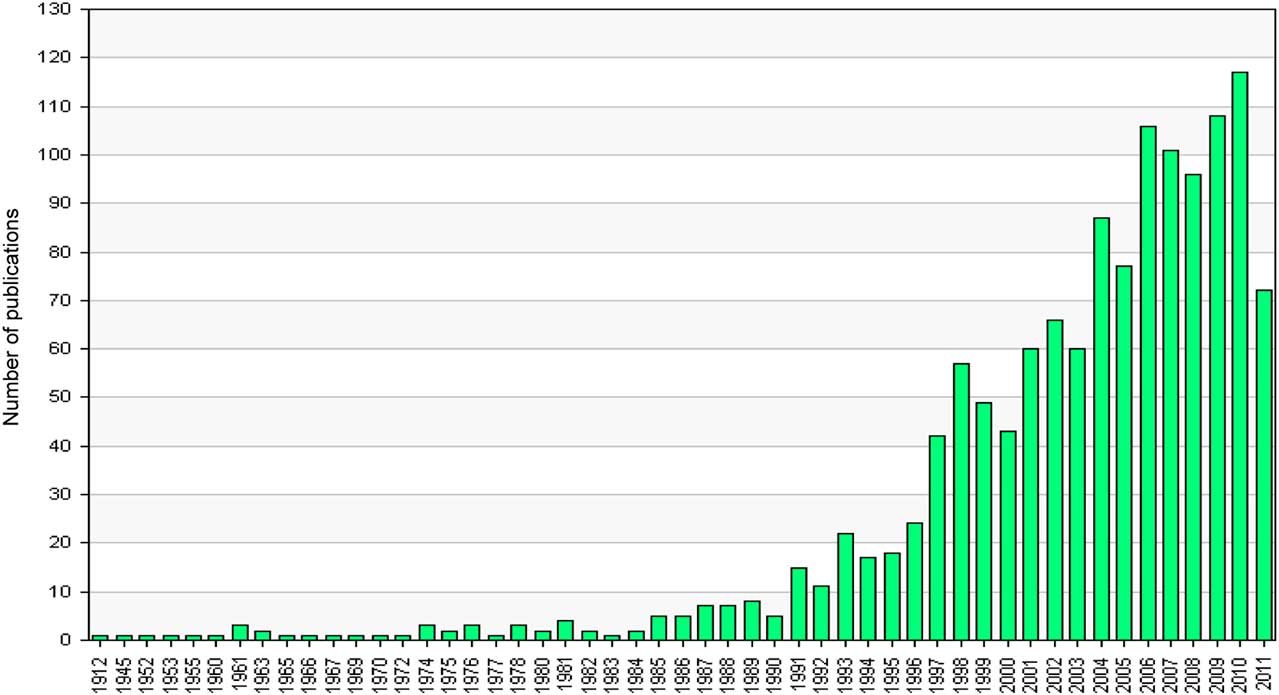
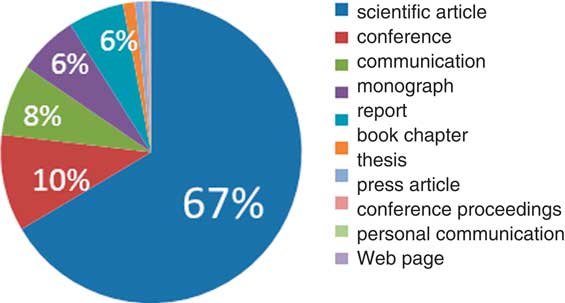
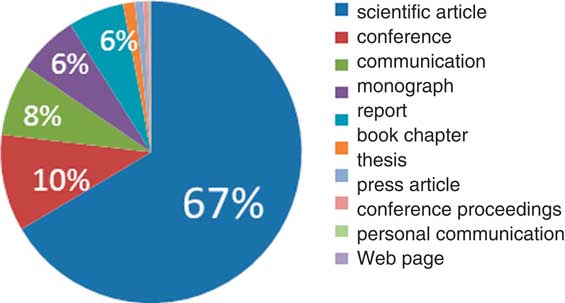
In all, 80% of the references cover the period 1998 to 2011. The body of literature is composed of 67% primary scientific articles. After including principal conferences in international congresses, scientific productions account for three quarters of sources. The remaining quarter is composed of books and chapters of scientific and technical publications, and to a lesser extent reports published by national government organisations, local governments and technical institutes, theses, newspaper and magazine articles and Web pages.
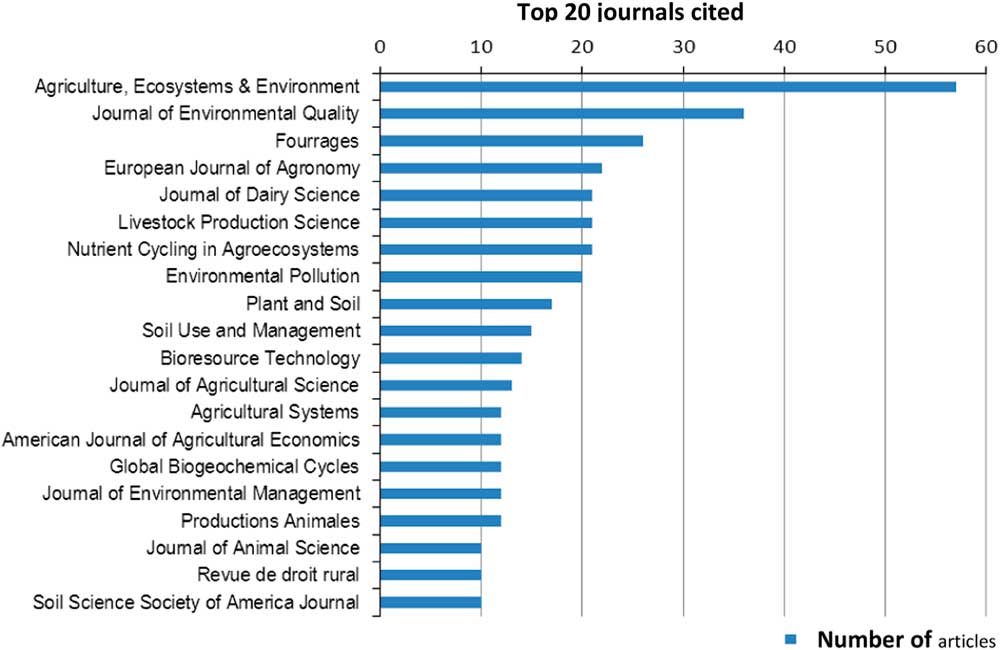
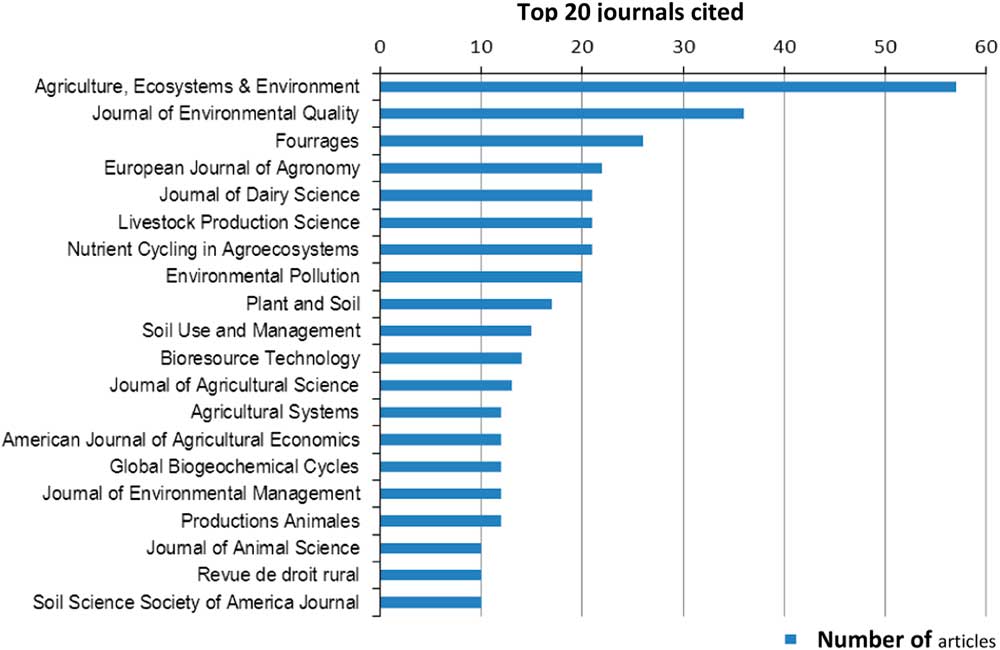
The 20 most often cited journals shown below account for 42% of reference articles in the report. The entire body of literature comprised 272 scientific journals.
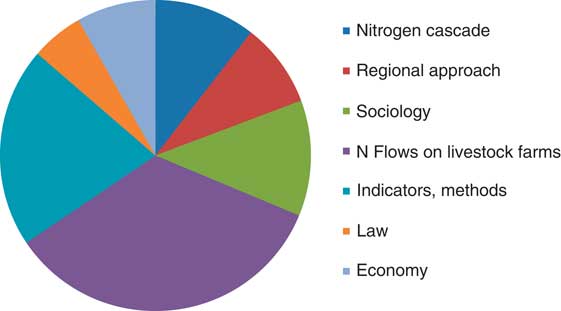
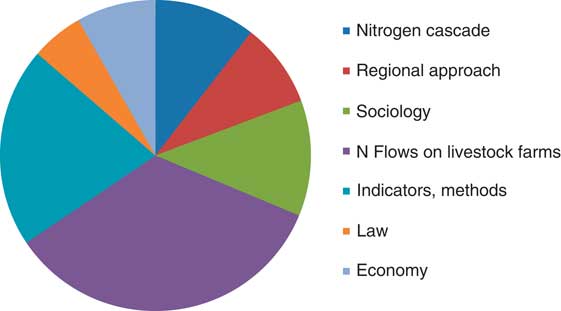
The distribution of references by major topics places biotechnical aspects in the foreground: they account for 75% of the references, half of which deal with the description and quantification of nitrogen flows in animal production systems. Very few articles simultaneously considered the issue of nitrogen flows and that of other flows with environmental impacts. There are many publications dealing with indicators and methods: more than one-fifth of the entire body. One-quarter of the references are in the social sciences (law, economy, sociology), half of which involve sociology; these references concern primarily the ‘nitrate’ aspect in France (Figure 4).
Time frames of sources.

Distribution of sources per category of documents.
The 20 most often cited scientific journals.
Distribution of references by major topics.
Description of the contents of this volume 5 special issue s1
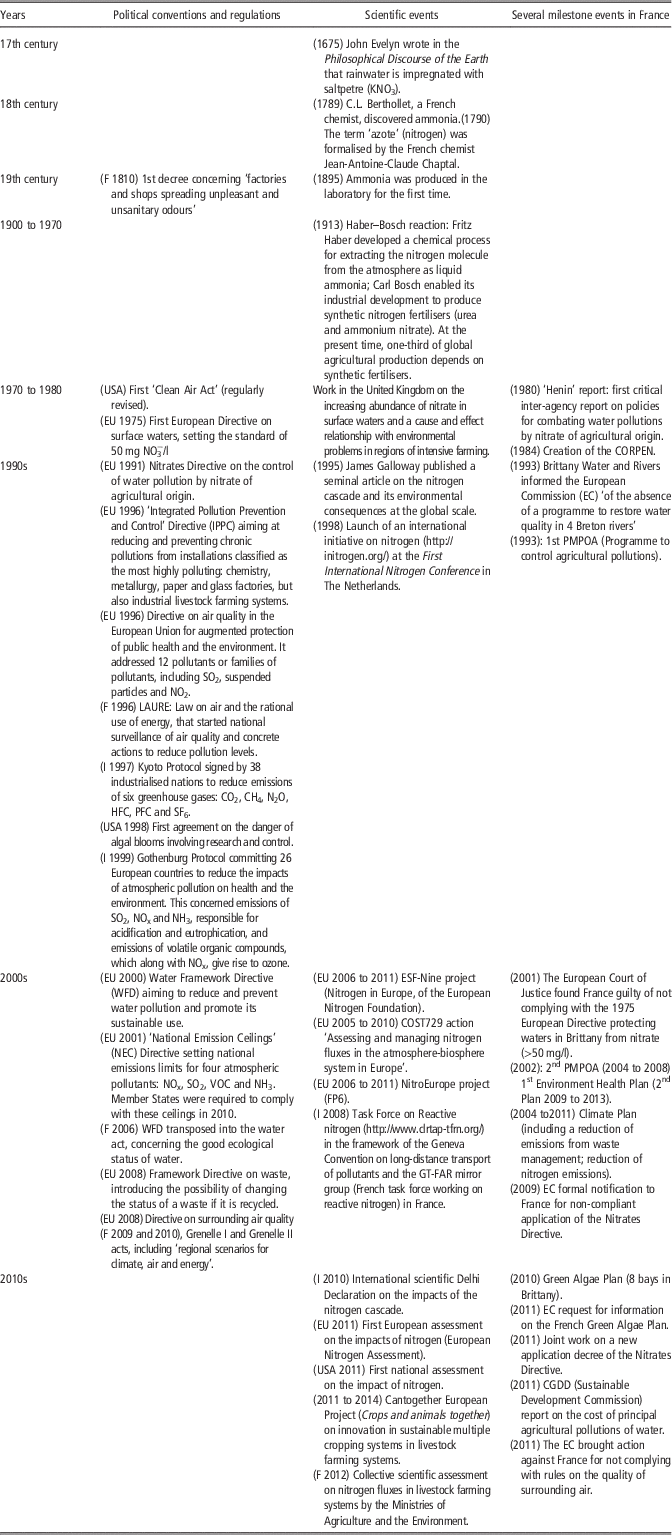
This extended summary is broken down into eight articles. The following one describes the role of the livestock farm in the nitrogen cascade and the consequences of nitrogen impacts at different geographic scales. Then an article concentrates on socio-economic factors having led to the current situation, in particular the concentration of problems in regions with high animal densities. The third paper contains quantitative and qualitative information on flows in various animal production systems. It summarises knowledge on animals, the fate of animal waste and the balance at the level of the farm and the region. The fourth article is a critical panorama of methods and indicators for monitoring flows of reactive nitrogen and regulatory or economic means that could orient the management of nitrogen discharged from agriculture. In the next paper, we expose the principal options for actions to reduce nitrogen losses in livestock farming systems. The conclusion draws the lessons and perspectives that come out of the analysis (Table 1)
Scientific, political and society events around nitrogen

F=France; I=international; EU=European Union; USA=United States of America.
This table that is not exhaustive shows that the ‘nitrogen’ issue has been and still is the subject on international policies and protocols that have progressively included all compartments of the environment. In the same logic, the scientific approach to the questions has recently become more systemic.

.
Acknowledgement
The experts thank for their thoughtful and reliable advices in the course of the drafting of the French report: Marc Benoît (Inra, F-88500 Mirecourt, France), Gilles Billen (CNRS, F-75252 Paris cdx 05), Isabelle Doussan (Inra, F-06050 Nice), Amédée Mollard (Inra, F-38400 St Martin d’Hyères), Philippe Leterme (Agrocampus ouest, F-35042 Rennes), Didier Stilmant (CRA Wallonie, B-6800 Libramont).
We also thank the French Ministry of the Environment and Sustainable Development and the Ministry of Agriculture who funded this scientific assessment; a special acknowledgement to Valerie Maquere, Rosine Travers and Philippe Jeannot who were our administrative correspondants.
Thanks to the steering committee with whom the dialogue was rich and helpful: Sophie Agasse (APCA), Philippe Vissac and Emmanuel de Chezelles (ACTA), José Martinez (IRSTEA), Romain Joya (CITEPA), Delphine Antolin (Coop de France), Christophe Chassande, Jimmy Annet and Clément Villien (Ministry of Agriculture), Bjorn Desmet, Pascal Blanquet and Lucile Gauchet (Ministry of Environment and Sustainable Development).
The French version of this document was first presented at a conference on the 19 of January 2012. It is the synthesis of a global report ‘Les flux d’azote liés aux élevages, réduire les pertes, rétablir les équilibres’ which is in open access in French on the INRA web site: http://inra.dam.front.pad.brainsonic.com/ressources/afile/223277-92bc0-resource-expertise-flux-d-azote-rapport-complet.html.