





1. [T]he kind of action I’m calling for is erotic with classical overtones, it seeks another body, it sends out mixed signals, reviles its own neediness, comes back embellished, ornamented, broken, capricious, fails to advance or return; and sociality in my formulation is repetition; that is, sessions, versions, takes, sublime rehearsal, a six-pack, a twelve-pack, the unwritten future, a circle of fifths, a purposeful and diligent disentanglement from the interests of the owner class; the call to unison, those millions of metrical and supervisory events that instrumentalize our sensoria in the name of content and participation, must be resisted;…Footnote 1
There is a certain wildness to the work of Marina Rosenfeld (b. 1968). Pursuing a broad hybrid between an expanded notion of musical composition, a gallery-based audiovisual practice, and improvisatory work in the field of experimental turntablism, her work explores the outer edges of the several disciplinary territories in which it exists, thus stubbornly resisting categorisation. G Douglas Barrett, for instance, cites Rosenfeld’s work as an example of ‘[m]usical contemporary art’, in that it ‘can take virtually any material form, including but not limited to sound, and use cultural (and musical and artistic) references ranging from low to high’.Footnote 2 A central attribute of Rosenfeld’s body of work is its tendency to repeat. This repetitiveness does not primarily materialise in the post-minimal sense of repeating musical notes or motifs – although such instances do occur – but operates on a more conceptual level, of repeating in the sense of looping and revisiting; the deliberate act of circling back. For instance, the circular movement of repurposing archival materials sits at the heart of Rosenfeld’s turntablism practice, which centres around vinyl sampling or the repetition of pre-recorded musics. A similar gesture of repetition-as-returning also informs works such as Teenage Lontano (2007–08), in which György Ligeti’s 1967 modernist orchestral work of the same name is reinterpreted for a choir of thirty-four teenage vocalists. In its emphasis on recurrence, Rosenfeld’s work connects to a broader and relatively recent lineage of composers and artists such as Pamela Z (b. 1956), Bernhard Lang (b. 1957), or Ragnar Kjartansson (b. 1976), whose creative poietics I refer to as one of ‘loop aesthetics’: a mode of musical thinking and making in which the act of repeating is explicitly foregrounded and not merely employed as a structural element, but also featured as material, language, and subject matter.Footnote 3 However, what largely sets Rosenfeld’s oeuvre apart is how her body of work is in itself structured as a feedback loop: it is largely self-referential, forever folding back upon itself in a quasi-ouroboric ruminating movement. In works such as Music Stands (2019), for instance, the artist revisits the spatialised notation system she created for an earlier work, Free Exercise (2016). Recurrence is also a central theme in GREATEST HITS: A Reproduction (2016), not just in its title but also in its score, which is a musical translation of setlists created for the earlier installation project Turn of My Century: Dub Plates and Test Pressings, 1997–2014 (2015). In other words, Rosenfeld’s artistic world is one of traces; one of perpetual recurrence, rethinking, and rephrasing; of probing echoes and tentative double takes. Rather than being an accidental property or trace of the artist’s methodology, circularity is an intentional and fundamental feature of Rosenfeld’s work.
This article takes Rosenfeld’s circular aesthetics as a starting point for inquiry and focuses on her Deathstar series (2017–), which arguably represents the artist’s most overt engagement with repetition thus far. It asks: what materials does Deathstar repeat, and to what effect? And more importantly, what might it mean for a contemporary artist to continuously ‘circle back’, especially as life under late capitalism is also largely loop-based. Since the end of the twentieth century, numerous sociocultural patterns of consumption and behaviour have sedimented into repetitive structures, effectuating what Robert Fink refers to as a ‘culture of repetition’, in which ‘the extremely high level of repetitive structuring necessary to sustain capitalist modernity becomes salient in its own right, experienced directly as constituent of subjectivity’.Footnote 4 Although capitalism has always been based on the cyclical consumption model of purchase, use, disposal, and repurchase, Anna Kornbluh notes a recent contraction of global productivity into a phase of socioeconomic stagnation, which she claims is marked by intensified circulation. In the contemporary moment, she argues, economic value is no longer strictly found in manufacturing the new but in an obsessive move towards circulation: an intensified flux of trading and exchanging commodities, or the restructuring, remixing, and recycling – and thus, repeating – of existing infrastructures.Footnote 5 ‘Flow’, she argues, has become an ‘essential value for the twenty-first century economy’Footnote 6 and repetitive structures have become a symptom of our times: ‘[p]erhaps the greatest loop of all, a widening gyre of swirling flush, is the universe recycling of sopping content, reaping efficiencies from sprawling recirculation of the same conceits’.Footnote 7
Reading Rosenfeld’s circular aesthetics alongside neo-liberal critique by contemporary thinkers such as Anna Kornbluh, Mark Fisher, and Rosi Braidotti, I theorise Deathstar’s repetitive aesthetics as an act of resistance to – and from within – the circulation economy that is the international art industry, and, by extension, a means of musically thinking through and providing alternatives to the many circular and loop-based dynamics that underpin the socioeconomic realities of the new millennium.
Circular aesthetics
Deathstar is arguably Rosenfeld’s most explicitly repetitive project to date. Loops, doublings, and other acts of circling back inform and shape the series in several respects. On the series level, repetition informs how the project is structured. Deathstar is serially iterative, meaning that each chronologically prior work in the series forms the starting point for the next. At the time of writing, Deathstar has accumulated into a series consisting of at least eight iterations. Listed here chronologically for the sake of clarity and initial overview, these include (1) the site-specific sound installation Deathstar (Installation), 2017; (2, 3) two different sets of visual artworks titled Deathstar (Notation), 2017 and 2019; the first of which doubles as (4) a functional score for piano solo; (5) a piano concerto titled Deathstar (Orchestration), 2017; (6) a work for chamber ensemble titled Deathstar (Reduction), for two percussionists and two pianists, 2019; (7) a video titled Deathstar (Isolation), 2021; and (8) a durational performance for Yamaha Disklavier, a self-playing piano, titled Deathstar (Duration), 2023. While it is possible to mark the 2020 release of Deathstar as an album on the Shelter Press record label as another iteration of the project (9?) – something I will circle back to later – Rosenfeld does not explicitly identify it as such.
On the level of individual works, repetition manifests in several different ways throughout each of Deathstar’s iterations. For instance, the 2017 site-specific installation Deathstar (Installation) – which was mounted at the Portikus gallery in Frankfurt, Germany, and would soon thereafter crystallise into the starting point for the series – essentially functions as an echo chamber. The installation is built around a sculptural plexiglass orb housing a seven-microphone array which Rosenfeld refers to as ‘the deathstar object’ and which is positioned high up overhead in the gallery space (Figure 1, Figure 2). From the object, a ‘massive, umbilical mess of cables’Footnote 8 droops down and connects to four loudspeakers positioned at floor level in the gallery’s four corners (Figure 2).Footnote 9 The object is then set up to perform an endlessly recursive operation, recording all sonic events in and around the gallery space – including a tape that contains pre-recorded electroacoustic music, vocal utterances, and sampled audio from the 1933 Marx Brothers’ film Duck Soup – before recirculating these back into said space with a slight delay, thus effectively amplifying, doubling, and ultimately distorting its acoustic soundscape into a thick mass of sonic resonance. Rosenfeld notes that the installation’s
Close-up of Rosenfeld’s ‘deathstar’ object, on view at Portikus, Frankfurt (18 February–16 April 2017). Photo © Marina Rosenfeld.

Deathstar (Installation) (2017). Installation view at Portikus, Frankfurt (18 February–16 April 2017). Photo © Marina Rosenfeld.

recursive structure meant that composition – or a kind of mutating, unpredictable propagation, to be more accurate – was staged to be in process at all times. One of the things that became clear quite quickly was that the room and its objects, the system itself, was generative. The model was almost maternal: cyclical and reproductive. [… C]omposition was understood to be forever ‘in progress’ in this construct (as opposed to arriving at an outcome or a goal).Footnote 10
The many warped echoes at the heart of Deathstar (Installation) prefigure the structure of the series as a whole, in which fragments of one work are subsequently captured, reproduced, and distorted into the next. With each subsequent iteration, new elements emerge, others receive more or less emphasis, while others still are forgotten or erased entirely. As traces of Deathstar (Installation) kaleidoscopically linger throughout each subsequent iteration of the series, the work is steadily reconfirmed as the project’s originary event.Footnote 11 A constant throughout the series are heavily manipulated field recordings harvested from Deathstar (Installation), which are featured as backtracks in each of the series’ works. Another is the use of Deathstar (Notation) as the designated piano score for the project’s future iterations. This score is essentially a visual translation of the soundscapes generated by and within Deathstar (Installation). It consists of upwards of a hundred pages of both traditional music notation supplemented with hand-drawn vertical lines bisecting pitches to indicate large clusters of resonance, as well as textual information, such as transcriptions of phrases uttered by the installation’s visitors in the Portikus gallery or session data. The score has a thoroughly mobile form, leaving the pianist to decide freely which pages to play, in what order to do so, where to insert page repetitions, and whether to interpret the pages containing text either as ‘unplayable’ or as ‘a secondary site of transcription’ that can be ‘mined for useful numbers’.Footnote 12 As a result of the score’s foregrounding of verbal notation and its idiosyncratic notational system, Deathstar (Notation) leads a double life as a visual artwork. In that capacity, the work has since 2019 fed into another, eponymous series of visual artworks that feature empty staves against a colour gradient (Figure 3).
Three prints from the ongoing series Deathstar (Notation) (2019), as photographed on show at The Artist’s Institute, New York (February–March 2019). Photo © Marina Rosenfeld.

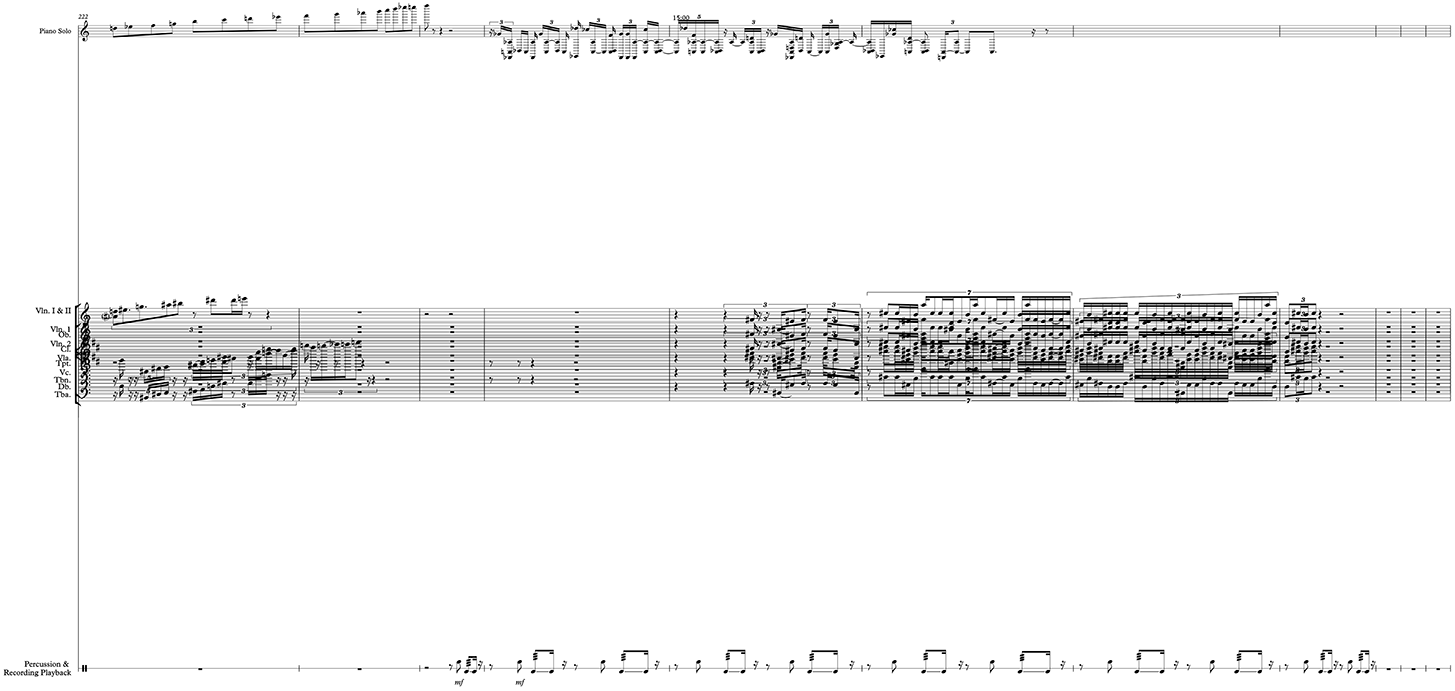
Instances of repetition in the sense of mirroring are also prevalent in the series. Deathstar (Orchestration) and Deathstar (Reduction), for instance, constitute each other’s mirror image. Whereas the former is written for large orchestra and solo pianist, thus symbolising an expansion or thickening of sorts compared to the series’ previous iterations, the latter interrupts the previously additive trajectory of the project and implodes the chronologically prior orchestral work into one for two pianists, two percussionists, and solo piano. Its score, too, exists out of a visual reduction of that of Deathstar (Orchestration). The result is purposefully gimmicky, with the image of the orchestral score vertically compressed into a flattened, intelligible, horizontal squish of staves and notes, thus in a sense mirroring and amplifying to an absurd extent – and, therefore, subversing – the status of Deathstar (Notation) as a visual artwork (Figure 4).
Score excerpt from Deathstar (Reduction) (2019), bb. 222–232. © Marina Rosenfeld.

A sonic hauntology
In addition to repeating itself throughout various different media (i.e., installation, music, the visual arts, and video) and forms (i.e., the solo piano recital, the piano concerto, the ensemble work), the Deathstar project also repeats traces of several of Rosenfeld’s other works. In Deathstar (Orchestration), for example, textual instructions for passages to be played ‘a little bit wobbly, thin, like a recording on vinyl’ (bb. 175–76) recall the composer’s work in the field of experimental turntablism. Another example is the work’s staging, which, in its use of a horizontal wall of guitar amps to visually obscure the orchestra from view while also amplifying and distorting its sound, explicitly mirrors that of Rosenfeld’s Sheer Frost Orchestra (1993) (Figure 5, Figure 6). In addition to forming a dramaturgical link to this chronologically earlier work by Rosenfeld, this choice of staging also functions as a comment on the social and symbolic space of the concert hall: with the presumed ‘grandeur’ of the classical orchestra funnelled through what is often presumed to be a hallmark of popular (and particularly rock) music and its sound distorted into a lo-fi crackle, the gesture raises questions around the elitism and the high/low divide that has driven the art market since its inception.
Sheer Frost Orchestra (1993), performance view at Tate Modern, London (2006). Photo © Marina Rosenfeld.

Deathstar (Orchestration) (2017), performance view at Donaueschinger Musiktage, Donaueschingen (2017). Photo © Marina Rosenfeld.

Meanwhile, elements of Deathstar also reappear in several of Rosenfeld’s chronologically later works.Footnote 13 The multimedia installation Music Stands (2019), for example, consists of a network of three microphone-bearing sculptures placed in a gallery space. Although these sculptures are generally placed much closer to the ground than the ceiling-mounted microphone array in Deathstar (Installation), both consist of microphone-based sculptures that, in amplifying and reflecting the ambience of the spaces in which they exist , create a hyper-volatile, resonant, and feedback-based sonic environment. The visual works that make up Rosenfeld’s ongoing Annotations project (2021–) also contain traces of Deathstar. In this series, the artist reproduces instances in which performers have left pencil, pen, or highlighter markings on her scores. A large part of the Annotations series consists of outtakes from Deathstar (Notation), and more specifically, of the many intricate performance notes left behind by pianist Marino Formenti, one of Rosenfeld’s long-time collaborators who has to date premiered each of Deathstar’s iterations.
In its iterative structure, Deathstar thus effectively creates something of a sonic hauntology, in which past, present, and future are continuously folded into one another. Jacques Derrida describes hauntology – a compound of ‘haunting’ and ‘ontology’ – as an inevitable state of being in which elements of the past (or ‘spectres’) will always necessarily linger within (or ‘haunt’) and therefore shape the present.Footnote 14 The idea of haunting in the sense of being eerie or unsettling is also foregrounded musically in Deathstar’s soundworld, which is generally dampened and permeated by whispering disembodied voices, distorted echoes, acoustic interferences, crackles, and glitches. In Deathstar (Installation), for instance, quasi-ethereal ascending piano arpeggios dissipate into thick and highly dissonant clouds of resonance as they are fed through the installation’s feedback loop. A repeated violent cough suddenly interrupts the built-up resonance. Rosenfeld’s disembodied voice, granulated into mere phonemes – ‘oh’, ‘ah’, ‘ee’ – is heard whispering softly, its acoustic locus switching erratically from background to foreground. The affective experience of this work and its subsequent iterations is unsettling and disorienting, as if being sedated and trapped in a liminal space of sorts; a warped echo room in which unexpected sounds are eternally circulated into distortion with only pointillistic moments of clarity to bring relief.
Mark Fisher, in his reading and extension of Derrida’s concept, argues that art in the new millennium is oversaturated with hauntological dimensions.Footnote 15 This, he argues, indicates a larger sociocultural crisis in which neo-liberal consumerism has led to a stagnation in cultural innovation and ultimately, an inability to imagine new futures. Fisher argues that repetition is one of the hallmarks of this crisis of temporal dislocation, noting rather pessimistically that ‘[m]usic culture is in many ways paradigmatic of the fate of culture under post-Fordist capitalism. At the level of form, music is locked into pastiche and repetition’.Footnote 16 In Fisher’s reading, then, Deathstar’s multifarious repetitiveness would likely signify a deadlock: an artistic byproduct of late capitalism’s repetitive stronghold, a musical representation of Kornbluh’s circulation society. For what is neoliberalist consumerism if not a system of feedback; a dynamic process that loops desire and gratification through never-ending circuits of production and exchange? Feedback, under neoliberalism, amplifies and intensifies certain values – for example, affective response and profitability – while also devaluating and discarding others – for example, labour, attention span, and sustainability. What thus emerges is a volatile feedback loop that thrives on acceleration and accumulation, followed by crisis, disruption, and ultimately, reinvention. This feedback loop is rendered sonorous in and by Deathstar, not just through the many loops and echoes that shape the project musically, but also by its sheer seriality. The iterative structure at the core of Deathstar, in which a work is continually remade and the artistic process is described as never-ending, effecively performs the 24/7 demands of labour in late-stage capitalism.Footnote 17 In addition, the project is in itself also reliant on its own circulation within the international art market, its institutional spaces of being – that is, the gallery space, the concert hall, the record label – and the mechanisms of supply and demand that inform its processes of commissioning and programming.
Resisting closure
Yet, despite its circular aesthetics, Deathstar firmly resists closure, let alone sentiments o deadlock or impasse. In fact, its loop-based structure invites flux, openness, and non-identity into the project in many different ways. Rather than operating as a self-contained circuit with well-defined beginnings and endings, the project’s endlessly recursive movement suggests a much more chaotic, speculative, and open structure in which time neither flows nor stops, but rather folds, echoes, and doubles back on itself. The result is a rhizomatic network of interconnections that calls into question the traditional dichotomies between beginnings and endings, pasts and futures, things remembered and things forgotten. In Deathstar, repetition creates a space of far-reaching instability. As a result of its recursive structure, the project is marked by what Seth Kim-Cohen refers to as ‘an absence at its center’:
The maturation and increasing sophistication of appropriative strategies build complex structures on the foundation, not of something signified, but of apparently descendent signifiers. There is no stable it to which [this self-appropriative] work refers. The referent has been replaced by the ever-receding, ever-expanding process of signification. […T]he newer work continually slips back into the past and forward into the future as material from a known source is both remembered and anticipated. At the same time, this simple backward and forward in time is problematized by the fact that remembered material from the source is anticipated in the appropriation (the past in the future), and by the fact that, once it arrives, this anticipated remembrance slips into the second generation memory of the appropriation (the past-in-the-future: first in the present, then in the past).Footnote 18
In other words, Deathstar asserts the flux of the creative process as opposed to the finitude of the work concept; becoming as opposed to being, and ultimately, question as opposed to answer. The result is a dense, cascading meshwork of emergent and revolving topics, themes, and contingencies that freely drift in and out of focus; an ongoing process of revisiting, reworking, extending and refining. There is no definite goal or endpoint to the project; no ideal state of or stable ‘it’ at the end of things. As a result, the works contained within the series are not to be understood as endpoints in and of themselves, but merely as occupying liminal spaces of transience; fragmentary moments of intensity that will inevitably feed into a future iteration. While, along the route, the work has indeed been fixed into what may appear to be stable identities such as the score, the performance, or the recording, these are but moments of pause and tension in an ongoing process of transformation; parts of a discourse of continuity. Tim Ingold’s notion of ‘wayfaring’, which he describes as a meandering process of attentive and intuitive travel or an ‘improvisatory movement of “going along”, that is open-ended and knows no final destination’, springs to mind.Footnote 19 Ingold opposes the process of wayfaring to that of transport, in which passive passengers are relocated to specific destinations ‘across a pre-prepared, planar surface’.Footnote 20 Though both wayfaring and transport are modalities of movement, only the wayfarer acknowledges both the importance of the journey and the restlessness implied by any apparent arrival:
Even the wayfarer, of course, goes from place to place, as does the mariner from harbor to harbor. He must periodically pause to rest, and may even return repeatedly to the same abode or haven to do so. Each pause, however, is a moment of tension that – like holding one’s breath – becomes ever more intense and less sustainable the longer it lasts. Indeed, the wayfarer […] has no final destination, for wherever he is, and so long as life goes on, there is somewhere further he can go.Footnote 21
The 2020 CD release of Deathstar on the Shelter Press record label illustrates this tension between product and process. On the one hand, the physicality of the recording marks what is perhaps the benchmark of musical ‘finishedness’, in that it symbolises a mechanically reproducible and thus inevitably fixed version of a musical work. On the other, the live recordings from Deathstar (Installation), (Notation), (Orchestration), and (Reduction) that form the basis for the album are manipulated to such an extent that they are effectively recomposed into new works, with not only their formal structures reshaped but also sonic parameters such as attack and delay, timbre, and diffusion engineered drastically. For these reasons, the album can be viewed as yet another series iteration.
Repetition, in Deathstar, is thus not merely a symptom of Fisher’s capitalist deadlock or an artistic rendering of neoliberalism’s self-perpetuating structures. In fact, it is exactly in its emphasis on circularity that the project creates friction against the very loop-based mechanisms that shape the contemporary moment. In Deathstar, repetition is understood not as the return of sameness, but rather as a dynamic and unruly phenomenon that affirms difference and open-endedness. Building on the Deleuzian idea that ‘difference inhabits repetition’,Footnote 22 Rosi Braidotti theorises repetition as a tool that opens up space for slippages and divergences of meaning. To repeat, she argues, is to render out of focus, to defy the status quo, to make space for new perspectives and alternative futures. In other words, to circle back is an act of defiance in and of itself:
The basis for this practical method [of nomadic thinking] is that of affirmative differences, or creative repetitions, i.e., retelling, reconfiguring, and revisiting the concept, phenomenon, event, or location from different angles. This is the application of the key concept of Spinoza’s perspectivism, but it also infuses it with a nomadic tendency that establishes multiple connections and lines of interaction. Central to this is the notion of repetition as the internal return of difference, not of sameness. It is creative mimesis, not static repetition. Revisiting the same idea or project or location from different angles is therefore not merely a quantitative multiplication of options, but rather a qualitative leap of perspective.Footnote 23
It is exactly this type of ‘creative repetition’ that points toward the critical potential that sits at the heart of Deathstar. Instead of propagating a stable identity, the project’s circula aesthetics engender a process of perpetual becoming, existing solely through and in ‘shifts and patterns of repetition’ and comprising ‘flows of transformation without ultimate destination’.Footnote 24 Such circular reasoning, which Braidotti categorises as a type of ‘nomadic thinking’,Footnote 25 resists ‘the dominant system of representation’, which Braidotti defines as one of linearity, objectivity, and ultimately, essentialism:
Philosophical nomadism addresses, in both a critical and creative manner, the role of the former ‘center’ in redefining power relations. Margins and center shift and destabilize each other in parallel, albeit dissymmetrical, movements. My position is equally resistant to the identification of the center as inertia and self-perpetuation and to the aporetic repetition of Sameness. The challenge is to destabilize dogmatic, hegemonic, exclusionary power at the very heart of the identity structures of the dominant subject through nomadic interventions.Footnote 26
Brandon LaBelle similarly points towards the disruptive power of repetition, noting that ‘echoes and echoing greatly lend to practices adept at appropriating and mimicking, to give support to appearances that never quite “fit in” – that return to the dominant order and the master tongue its own performative grammars and narratives yet reshaped by an altogether different rhythm, an errant migrating repetition that may sound out alternative futures’.Footnote 27 In other words, both Braidotti and LaBelle point towards the strangeness that inevitably comes with repetition and theorise it as a tool for disrupting everyday realities; a way of thinking differently about longstanding conventions, institutionalised ideas, and structural ideologies. Using repetition as its main heuristic tool, Deathstar formulates a way of thinking beyond music’s historical associations with linearity, objectivity, and essentialism by reintroducing a playful dynamism and flux. For instance, the project’s iterative structure subverts the traditional notion of the work concept – that is, the idea that a musical composition should exist as a unique, timeless, and formally delineated work of art.Footnote 28 The project emphasises a fluid dynamism of becoming, rather than of stable being, and of circular rumination rather than linear progression. In its firm resistance to closure, the project ultimately raises questions about goal- and product-based consumerism. Samuel J. Wilson notes that while ‘[t]here is an object or artistic “product” before us […], this comes with the knowledge that every work is also a moment of an ongoing process of making. Each artistic object becomes a specific point in a continual line of practice, and as such emphasises the ongoingness of production’.Footnote 29 In other words, ‘iterative forms constitute a critical negotiation of logics derived from life under neoliberalism, and the latter’s concomitant processes of production and consumption’.Footnote 30
Challenging neoliberalist ideals even further are the project’s many sonic foregroundings of failure. Most of these instances highlight the limitations of technological mediation. In Deathstar (Installation), for instance, the harsh sound of what appears to be a connection pop is rhythmically repeated before coming to an abrupt end. Later series iterations, and especially Deathstar (Orchestration) and (Reduction), foreground vinyl crackles and glitches. The series as a whole is characterised by distortion, feedback, and acoustic interference. From a new materialist perspective, such deliberate moments of imperfection work as sites of resistance, emphasising the irreducibility of lived, embodied experience to mechanical or technological systems and thus foregrounding notions of indeterminacy and play. The correlation between failure and play is also composed explicitly into both Deathstar (Notation) and Deathstar (Isolation), two works in which the solo pianist is instructed to sightread and explore the score as they proceed, thus again emphasising process over final result.Footnote 31 As Emma Cocker argues, both ‘failure and repetition […] demonstrate a playful disregard for dominant efficiency-based models of expenditure and productivity; the work serves to expose the modernist promise of progression and success as unattainable or flawed’.Footnote 32 In its resistance to closure, Deathstar actively performs failure in its refusal to abide by dominant essentialist and teleological doctrines. By instead continuously looping back on itself and therefore never really getting anywhere, the project offers a dissenting mode of opposition against the sociopolitical context of neoliberalism in which it is created, opening up space for the latent potential of the being-not-yet-there; for wandering, detours, and rumination.
Wild inside itself
In an interview for BOMB Magazine, Tristan Shepherd writes:
[w]hen I think about Marina Rosenfeld, I recall a refrain from a Pablo Neruda poem I read as a teenager: ‘everything, so quick, so lively, / immobile, though, like the pulley, wild inside itself’. The dynamism and mutability [Neruda] invokes are, to my mind, also present in her work, which resists assuming static form. It appears, rather, as glittering constellations of sounding objects, flickering images, choirs, and orchestras that foreground the social and performative entanglements of bodies […] making music.Footnote 33
While Shepherd confirms my reading of Rosenfeld’s work as one that emphasises flux and openness, I find that Neruda’s phrase of being ‘wild inside itself’ also resonates differently with her work, and particularly with the Deathstar series. Wildness, according to Jack Halberstam, suggests ‘a challenge to an assumed order of things from, by, and on behalf of things that refuse and resist order itself. Wildness names simultaneously a chaotic force of nature, the outside of categorisation, unrestrained forms of embodiment, the refusal to submit to social regulation, loss of control, the unpredictable’.Footnote 34 As such, I read Neruda’s ‘wild inside itself’ as suggestive of a dissident energy that is bursting at its seams; a well-contained though urgent move towards disruption; a resistance-from-within.
In its insistence on recursivity, Deathstar both performs and resists the loop-based structures of today’s circulation economy. While on the one hand, the project’s iterative structure can be seen as both a symptom and a symbol of neoliberalism’s incessant flows and redistributions of commodities and information, it also decentres exactly those phenomena through its focus on process rather than product, openness rather than closure, relationality rather than hierarchy, and play rather than mastery. The dialectic tension between reinforcing and resisting systems of power that characterises Deathstar is also evident from the project’s transmediality. At the same time both familiar in and foreign to the many disciplinary territories through which it moves, Deathstar both reinforces and strains several of the conventions that surround the concert hall, the gallery space, and the commercial record label, thus challenging the various symbolic and socioeconomic spaces in which music has traditionally existed. Deathstar (Orchestration), for instance, sits rather uncomfortably in the traditional concert hall and, although outwardly presenting as a traditional piano concerto featuring a solo pianist and a large orchestra, subverts many of its stylistic conventions. This tension results largely from the work’s unconventional staging, which obscures the orchestral musicians from the audience’s view through a horizontal wall of guitar amps, which also amplify and heavily distort their sound. The solo pianist is similarly obscured from view, as Rosenfeld deliberately removes them from their traditional front-and-centre placement on the concert stage and relocates them to the back of the concert hall, behind the audience, thereby challenging the idea of the soloist as the ‘star’ of the event. In other words, the work subverts the traditional notions of virtuosity that typically surround the piano concerto as well as the elitist and primarily ‘classical’ connotations of the concert space. Nevertheless, other stylistic conventions are maintained: the piano part is complex and requires technical mastery over the instrument, and there is a sense of dialogue between the soloist and the orchestra as the latter largely echoes or mirrors the sonic events either created by the soloist or heard on the electronic playback. Furthermore, it is also important to note that this work – as is the case for the other works contained in the series – could not have existed without institutional commissioning (in this case, by Ensemble Musikfabrik and Donaueschingen Musiktage) and the infrastructures of both the orchestra and its idiosyncratic spaces of being – that is, the orchestral stage and the concert hall. In effect, Deathstar is thus ‘wild inside itself’ in that it critiques the musical ecosystem while at the same time also being firmly rooted within that very system. Or, as Braidotti notes, ‘a critique of the center from the center’.Footnote 35
Although Deathstar’s circular aesthetics may not have caused any major disruptions to said centres – that is, the art market and those sociosymbolic spaces traditionally occupied by music – the project does provide an opening gambit. Rather than declaring a full-blown war on institutionalised neo-liberal structures that prioritise mastery, control, and productivity, Deathstar provokes and creates friction by turning these systems against themselves, exposing their limitations and creating space for alternatives. The project’s resistance, then, lies in its sociopolitical formation: in inviting rumination and play back into the definitional space of the musical work; in foregrounding resonance, feedback, and openness; and in pursuing speculation rather than unambiguous truths.
Acknowledgements
This article builds on work developed during my affiation with Columbia University as a Fulbright Visiting Scholar. I am thankful to Seth Cluett, Matthew Shlomowitz, Samuel J. Wilson, Adam Haper, Ann Werner, Ed Cooper, and Andrew Simmons for their feedback throughout the various stages of writing. My gratitude also goes out to Marina Rosenfeld, Marino Formenti,and Paul Geluso for sharing invaluable information about Deathstar in both composition and performance.
Christine Dysers is a postdoctoral researcher in the Department of Musicology at Uppsala University. Her work focuses on music after 1989, with a particular emphasis on contemporary composition. Her research interests include the aesthetics of repetition, the politicality of music, and the notions of the weird and the eerie. She has a PhD in Music from City, University of London, and was previously affiliated with Columbia University as a Fulbright Visiting Scholar (2021). Dr. Dysers is a Fellow of the Higher Education Academy (FHEA), and is the author of Critical Guides to Contemporary Composers: Bernhard Lang (Intellect, 2023) and co-editor of Music of Absence: An Aesthetics of Loss in the New Millennium (Edinburgh University Press, 2026).




 Open access

